Integrating Climate Change
and Forest Adaptation
Maria Janowiak
mjanowiak02@fs.fed.us
Todd Ontl, Courtney Peterson,
Linda Nagel, Chris Swanson
Northern Institute of Applied
Climate Science
NIACS (NorthernInstituteofAppliedClimateScience)
Chartered by FS, universities, non-profit
and tribal conservation organizations
 Climate and carbon services
• Climate impacts modeling
• Vulnerability assessment
• Climate adaptation
• Carbon biogeochemistry
• Carbon management
 20 staff members (FS/universities)
• 9 climate outreach specialists
• 6 research scientists
• 2 web and 3 GIS/lab specialists
Hewes et al. 2014
Forest Ownership
Maine Forest Service 2010, Butler 2017
Forest Ownership
Maine
17.6 million acres of forest land
89% forested
Landowner Values
Desired
ConditionsNatural Forest
Dynamics
Wildlife
Habitat
Past
Management
History
Invasives Timber Sale
Revenue
Disturbance:
Past + Future
Recreation
Forest
Health
And more!!
Climate
Change
Plan & Project
Requirements
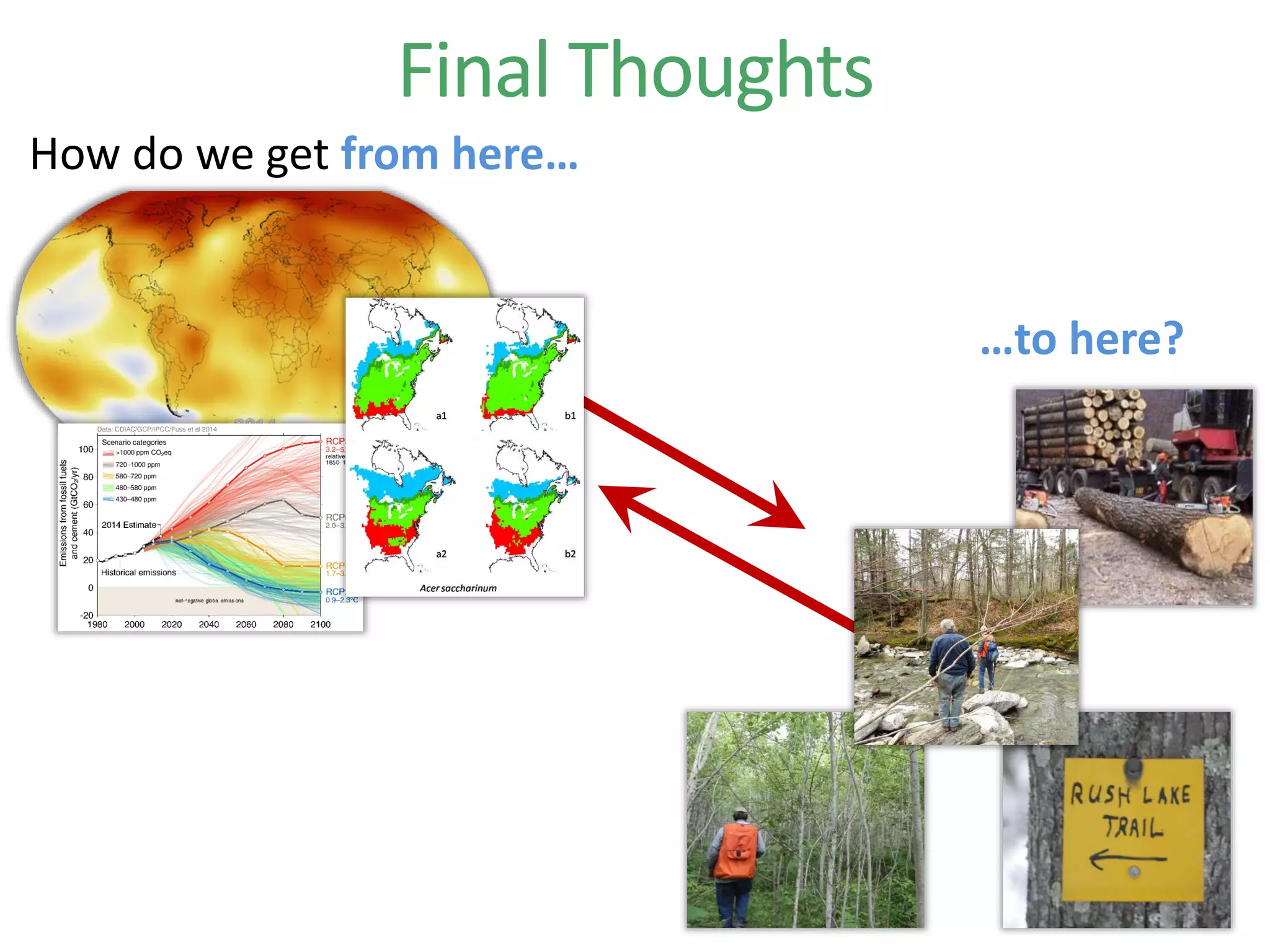
How do we get from here…
…to here?
Climate Change Challenges
What we heard from forest and land managers:
Climate change is too big and too complex
Climate research is not relevant enough
One-size-fits-all answers are insufficient
There are not enough real-world examples
Swanston et al. 2016
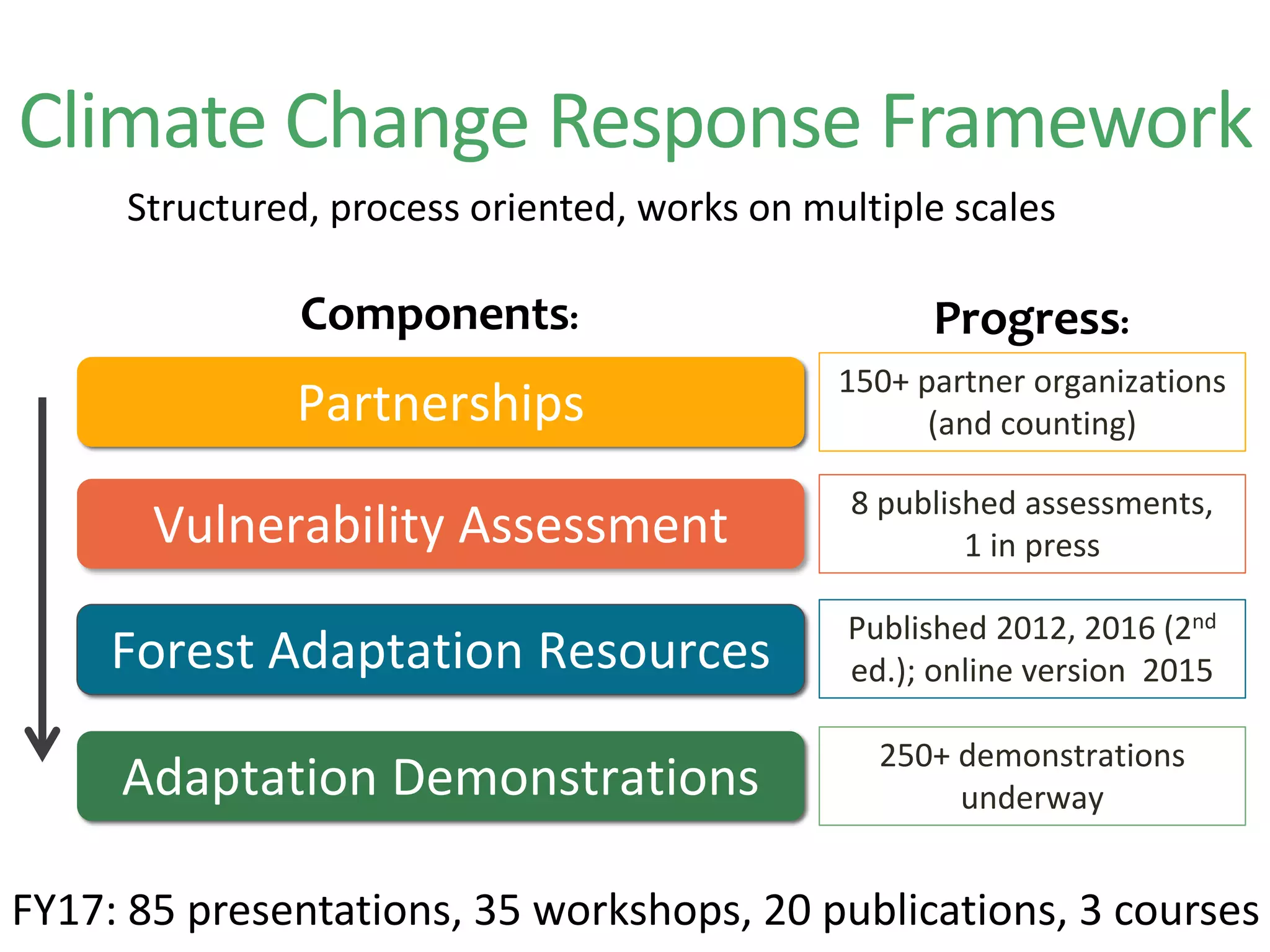
Climate Change Response Framework
Components: Progress:
Structured, process oriented, works on multiple scales
150+ partner organizations
(and counting)
8 published assessments,
1 in press
Published 2012, 2016 (2nd
ed.); online version 2015
250+ demonstrations
underway
FY17: 85 presentations, 35 workshops, 20 publications, 3 courses
Partnerships
Vulnerability Assessment
Forest Adaptation Resources
Adaptation Demonstrations
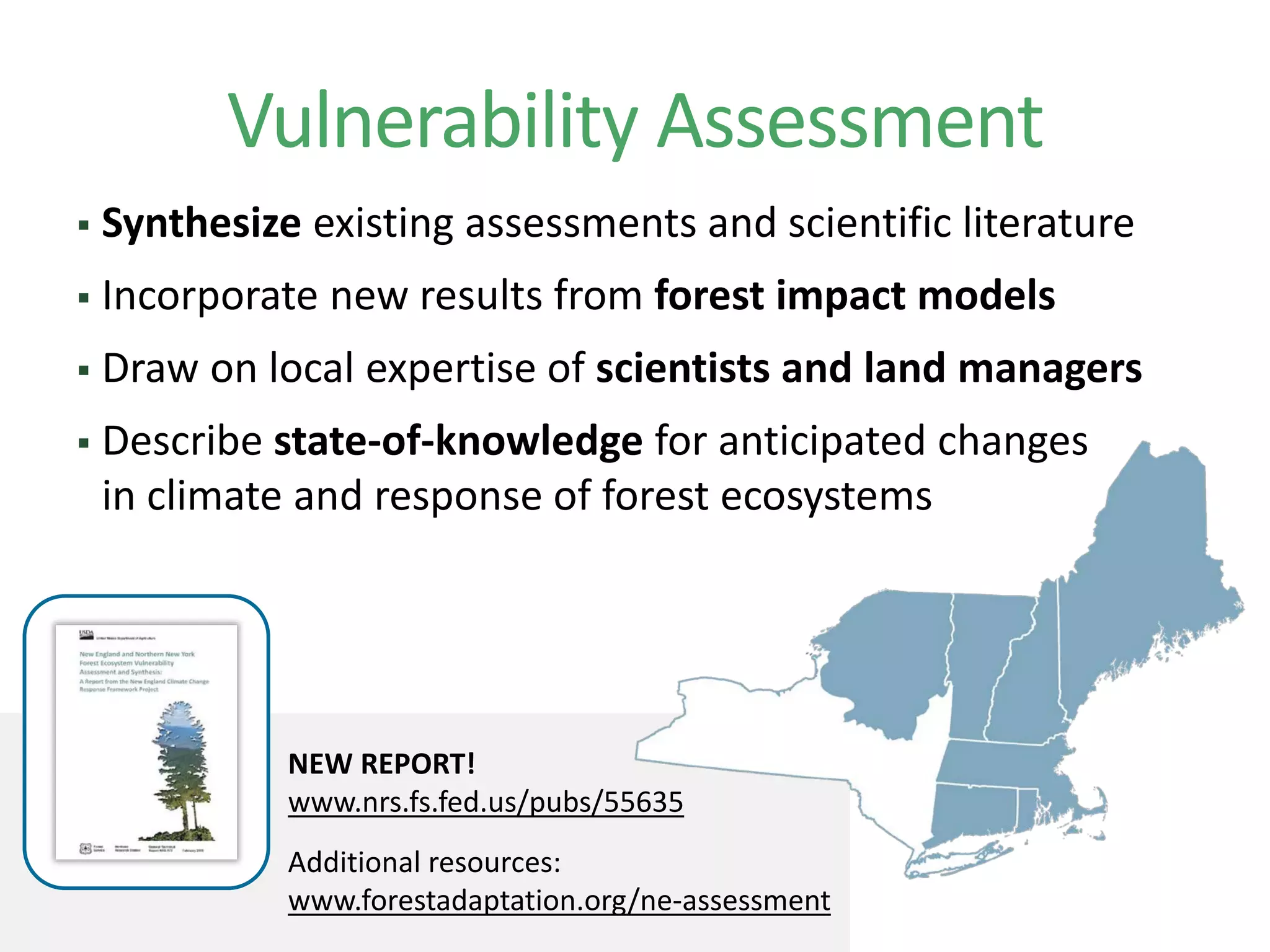
Vulnerability Assessment
NEW REPORT!
www.nrs.fs.fed.us/pubs/55635
Additional resources:
www.forestadaptation.org/ne-assessment
 Synthesize existing assessments and scientific literature
 Incorporate new results from forest impact models
 Draw on local expertise of scientists and land managers
 Describe state-of-knowledge for anticipated changes
in climate and response of forest ecosystems
Swanston et al. 2016;
www.nrs.fs.fed.us/pubs/52760 adaptationworkbook.org
Forest Adaptation Resources
Adaptation Workbook
Adaptation Workbook provides structured process to
integrate climate change considerations into management
planning and activities
1. DEFINE area of
interest, management
objectives, and time
frames.
2. ASSESS climate
change impacts and
vulnerabilities for the
area of interest.
3. EVALUATE
management objectives
given projected impacts
and vulnerabilities.
4. IDENTIFY and
implement adaptation
approaches and tactics .
5. MONITOR and
evaluate effectiveness
of implemented
actions.
Vulnerability
assessments,
scientific literature,
and other resources
Adaptation
Strategies and
Approaches
www.forestadaptation.org/demos
250+ Projects
have used the
Adaptation Workbook
Adaptation Demonstrations
Real-world examples of climate-informed
forest management
How are land managers responding?
Adaptation is the adjustment of systems in
response to climate change.
It means taking action to prepare for potential
changes and risks, and responding to effects.
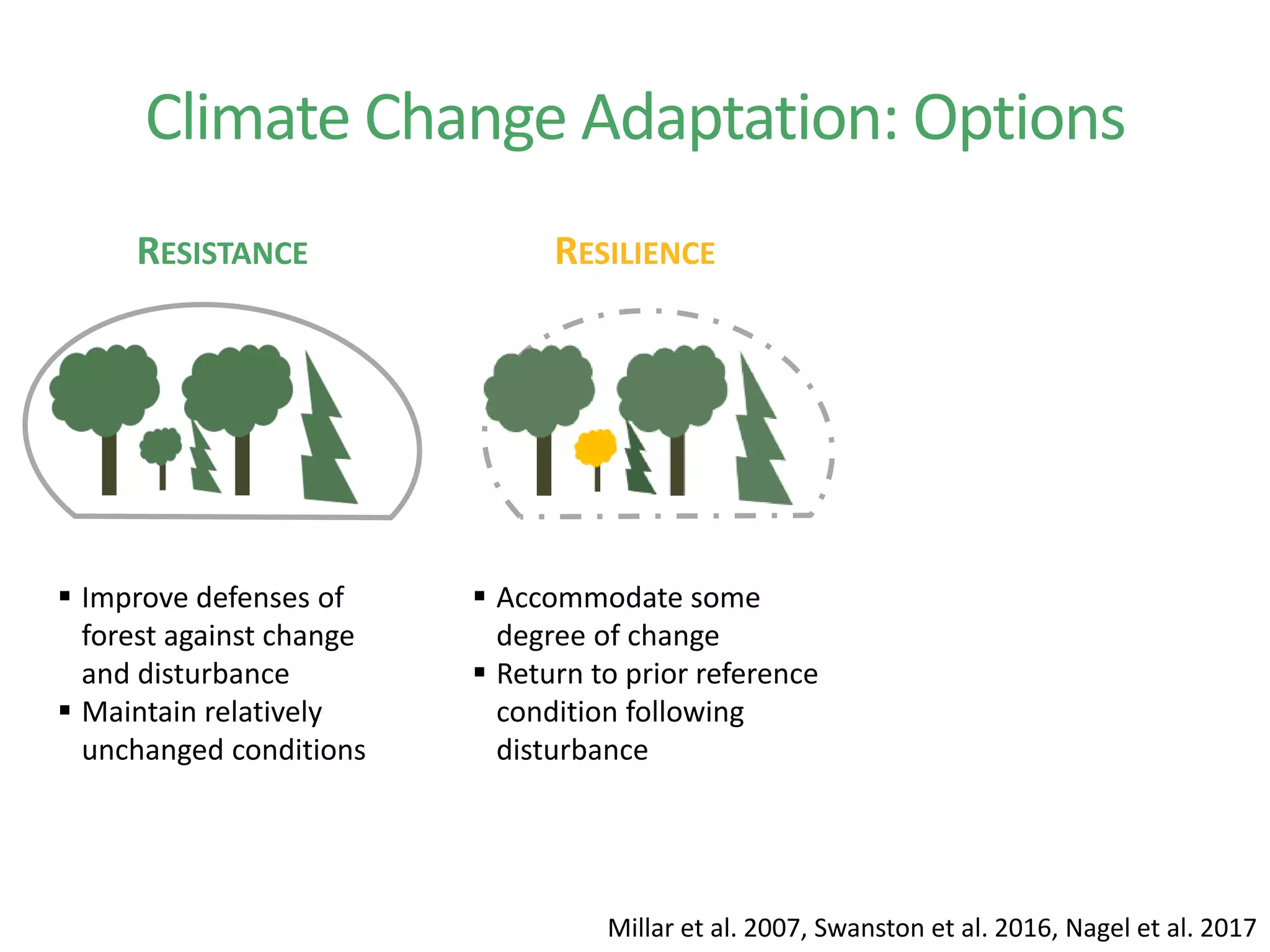
RESISTANCE
 Improve defenses of
forest against change
and disturbance
 Maintain relatively
unchanged conditions
Millar et al. 2007
Climate Change Adaptation: Options
Millar et al. 2007, Swanston et al. 2016, Nagel et al. 2017
RESISTANCE RESILIENCE
 Improve defenses of
forest against change
and disturbance
 Maintain relatively
unchanged conditions
 Accommodate some
degree of change
 Return to prior reference
condition following
disturbance
Millar et al. 2007
Climate Change Adaptation: Options
Millar et al. 2007, Swanston et al. 2016, Nagel et al. 2017
RESISTANCE RESILIENCE TRANSITION
 Improve defenses of
forest against change
and disturbance
 Maintain relatively
unchanged conditions
 Accommodate some
degree of change
 Return to prior reference
condition following
disturbance
 Intentionally facilitate
change
 Enable ecosystem to
respond to changing
and new conditions
Millar et al. 2007
Climate Change Adaptation: Options
Millar et al. 2007, Swanston et al. 2016, Nagel et al. 2017
RESISTANCE RESILIENCE TRANSITION
 Improve defenses of
forest against change
and disturbance
 Maintain relatively
unchanged conditions
 Accommodate some
degree of change
 Return to prior reference
condition following
disturbance
 Intentionally facilitate
change
 Enable ecosystem to
respond to changing
and new conditions
Millar et al. 2007
Climate Change Adaptation: Options
Millar et al. 2007, Swanston et al. 2016, Nagel et al. 2017
Climate Change Adaptation: Strategies
TRANSITIONRESILIENCERESISTANCE
10
Sustain fundamental ecological
functions
1
Reduce the impact of biological
stressors
2
4 Maintain or create refugia
5
Maintain and enhance species and
structural diversity
Reduce the risk and long-term
impacts of severe disturbances
3
6
Increase ecosystem redundancy across
the landscape
Realign following severe disturbance
7 Promote landscape connectivity
8 Maintain and enhance genetic diversity
Facilitate community adjustments
through species transitions
9
Swanston et al. 2016
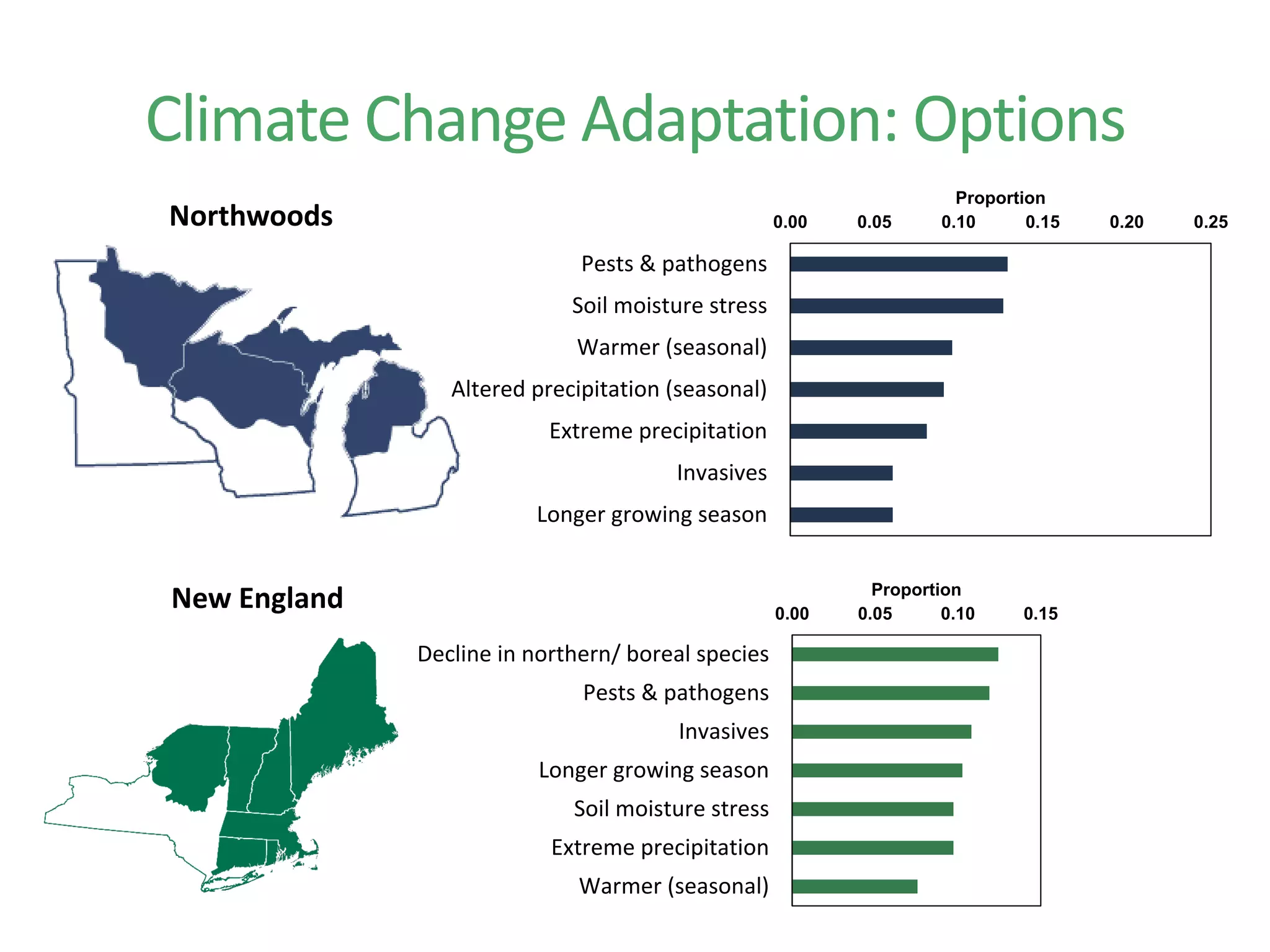
0.00 0.05 0.10 0.15 0.20 0.25
Pests & pathogens
Soil moisture stress
Warmer (seasonal)
Altered precipitation (seasonal)
Extreme precipitation
Invasives
Longer growing season
Proportion
0.00 0.05 0.10 0.15
Decline in northern/ boreal species
Pests & pathogens
Invasives
Longer growing season
Soil moisture stress
Extreme precipitation
Warmer (seasonal)
Proportion
Northwoods
New England
Climate Change Adaptation: Options
What actions are managers considering
for climate change adaptation?
Region Resistance Resilience Transition
Northwoods 27% 43% 30%
New England 21% 46% 33%
RESISTANCE RESILIENCE TRANSITION
Resist Change
Prevent the introduction and establishment of invasive plant
species and remove existing invasives (4)
Maintain or improve the ability of forests to resist pests and
pathogens (6)
Prudence Island Natural Heritage Unit: www.forestadaptation.org/node/723
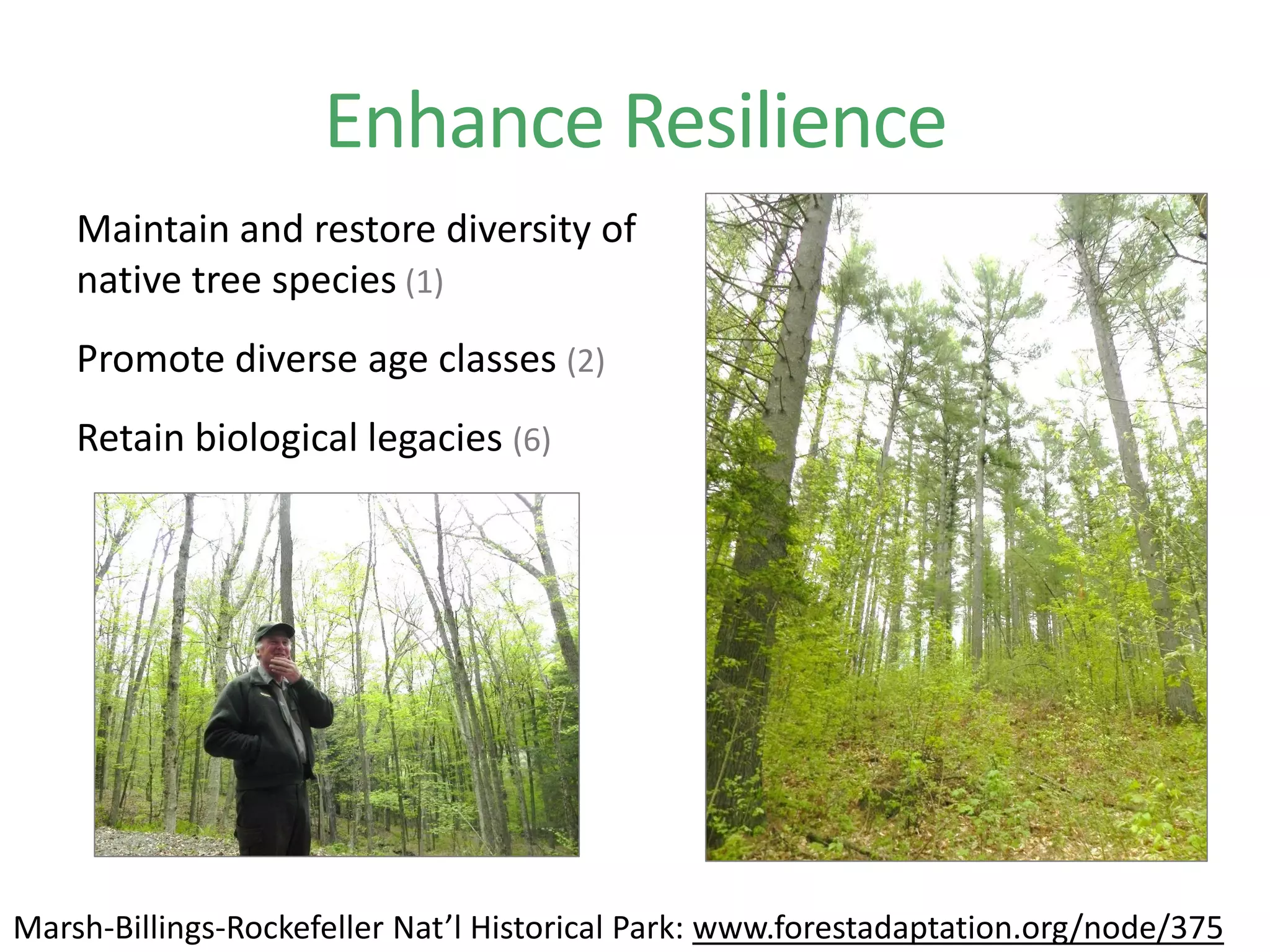
Enhance Resilience
Maintain and restore diversity of
native tree species (1)
Promote diverse age classes (2)
Retain biological legacies (6)
Marsh-Billings-Rockefeller Nat’l Historical Park: www.forestadaptation.org/node/375
Enhance Resilience
Restore fire to fire-adapted ecosystems (5)
MA Dept. of Conservation and Rec, Bristol Lot: www.forestadaptation.org/bristol
Enhance Resilience
Maintain or restore soil quality
and nutrient cycling (8)
Atlas Timberlands: www.forestadaptation.org/atlas
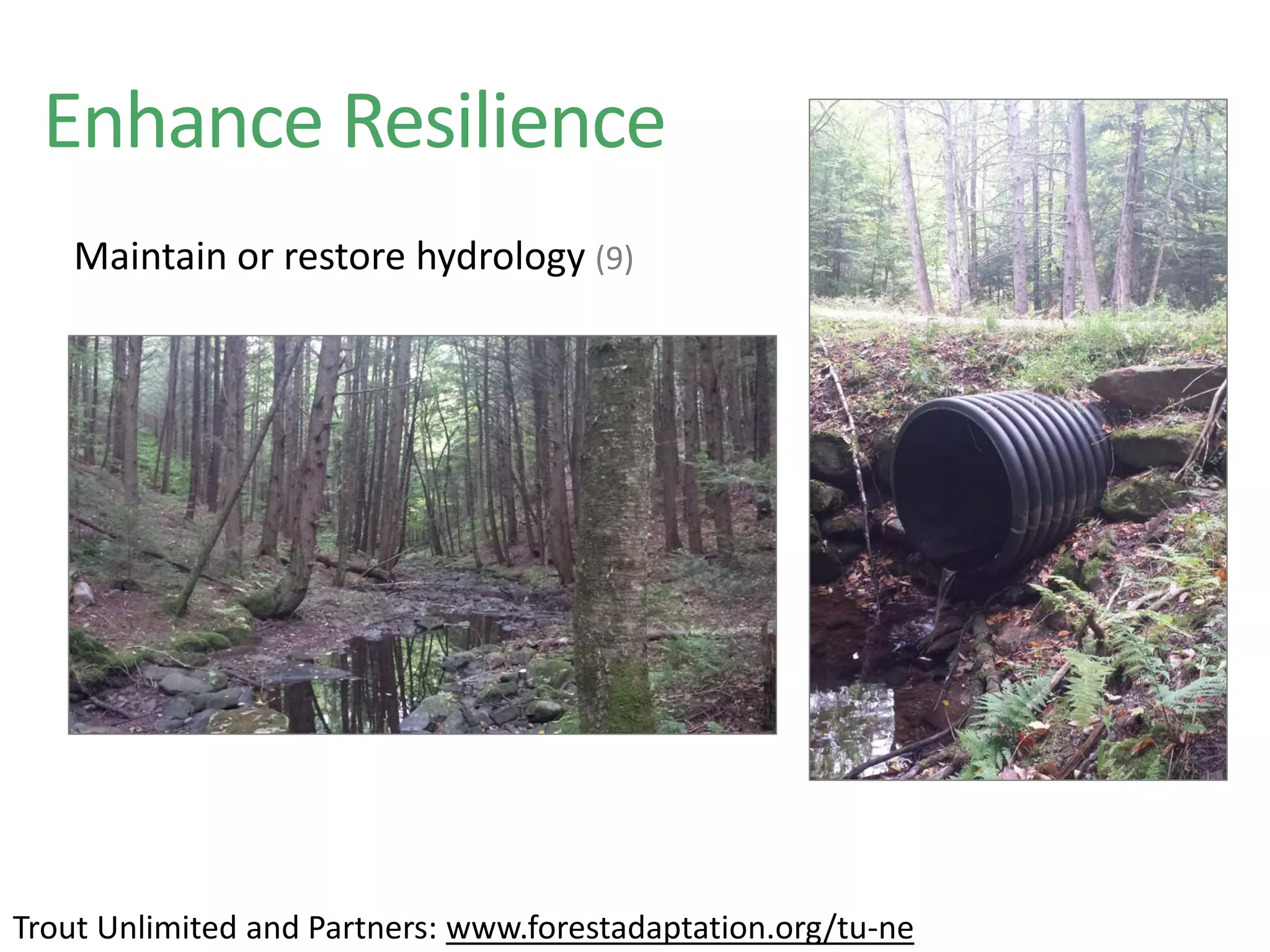
Enhance Resilience
Maintain or restore hydrology (9)
Trout Unlimited and Partners: www.forestadaptation.org/tu-ne
Transition Systems
Favor or restore native species that are expected to be better
adapted to future conditions (3)
Norcross Wildlife Sanctuary: www.forestadaptation.org/norcross
New England & Northern New York
Northern New England
Southern New England
18 Workbooks in New England
• 14 in the Northern ecoregions
• 4 in the Southern ecoregion
Northern New England
Southern New England
32% 43% 25%
21% 46% 33%
Adaptive Silviculture for Climate Change (ASCC)
Multi-region silvicultural trials to test climate
change adaptation actions
Silviculture: the art and science of controlling the establishment, growth,
composition, health, and quality of forests and woodlands to meet the diverse
needs and values of landowners and society on a sustainable basis
ASCC Objectives
 Populate a multi-region study
design with ecosystem-specific
climate change adaptation
treatments using input from an
expert panel of regional
scientists and local managers
 Introduce natural resource
managers to conceptual tools
and approaches that help
integrate climate change into
natural resource management
and silvicultural decision making
Core Management Questions
1) Will adaptation approaches and treatments work in a real-
world context to meet local management goals and
objectives?
2) How feasible are the treatments silviculturally, as well as in
terms of financial, social, or other management constraints?
3) How does our idea of desired future conditions (DFCs)
change with each treatment type?
4) What does it mean to deliberately create a future-adapted
ecosystem, and why would a manager choose to do this?
5) What tradeoffs exist between achievement of adaptation
objectives and other common objectives for a given region
and ecosystem type?
Nagel et al. 2017
Conceptual
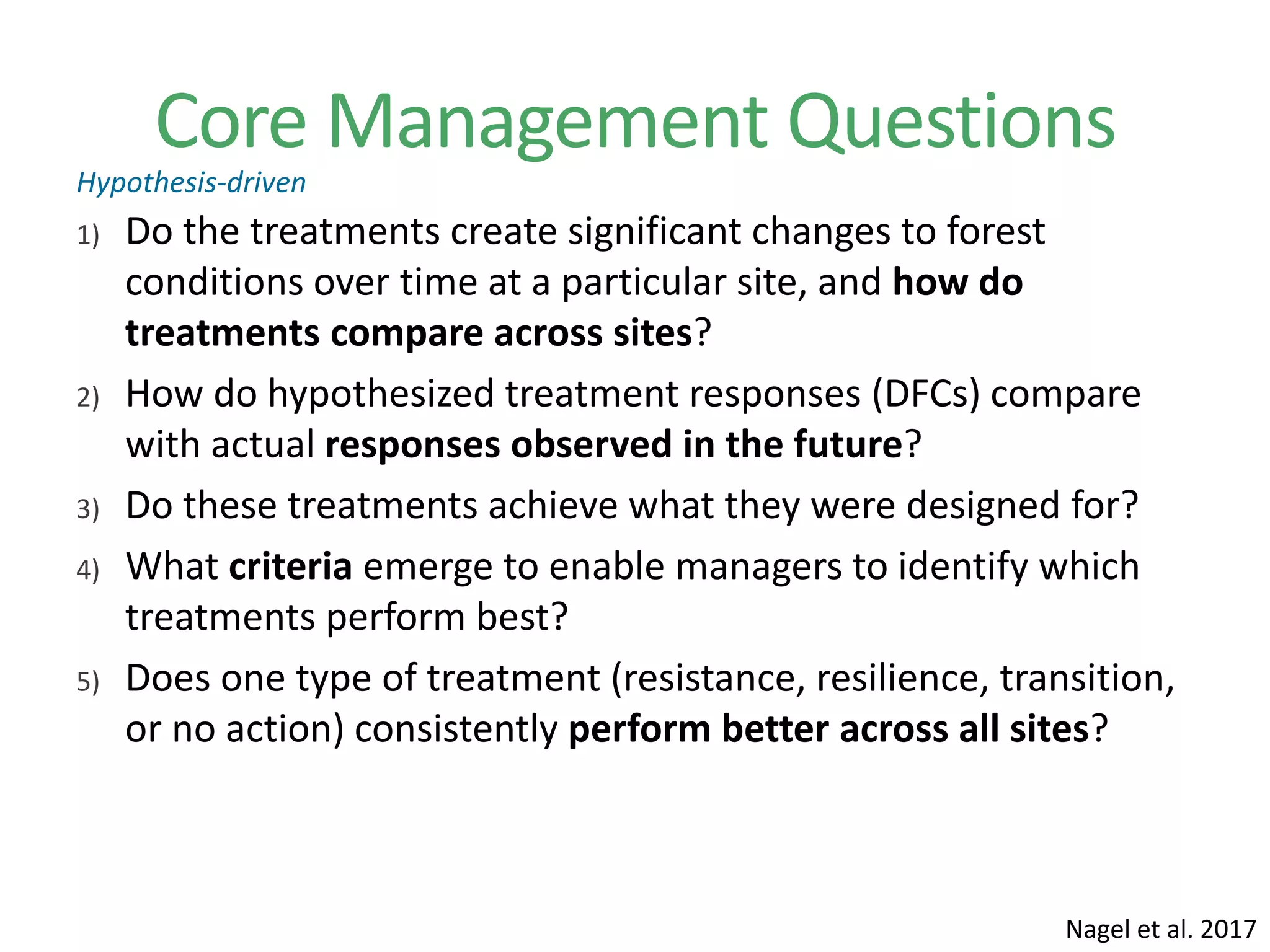
Core Management Questions
1) Do the treatments create significant changes to forest
conditions over time at a particular site, and how do
treatments compare across sites?
2) How do hypothesized treatment responses (DFCs) compare
with actual responses observed in the future?
3) Do these treatments achieve what they were designed for?
4) What criteria emerge to enable managers to identify which
treatments perform best?
5) Does one type of treatment (resistance, resilience, transition,
or no action) consistently perform better across all sites?
Nagel et al. 2017
Hypothesis-driven
ASCC
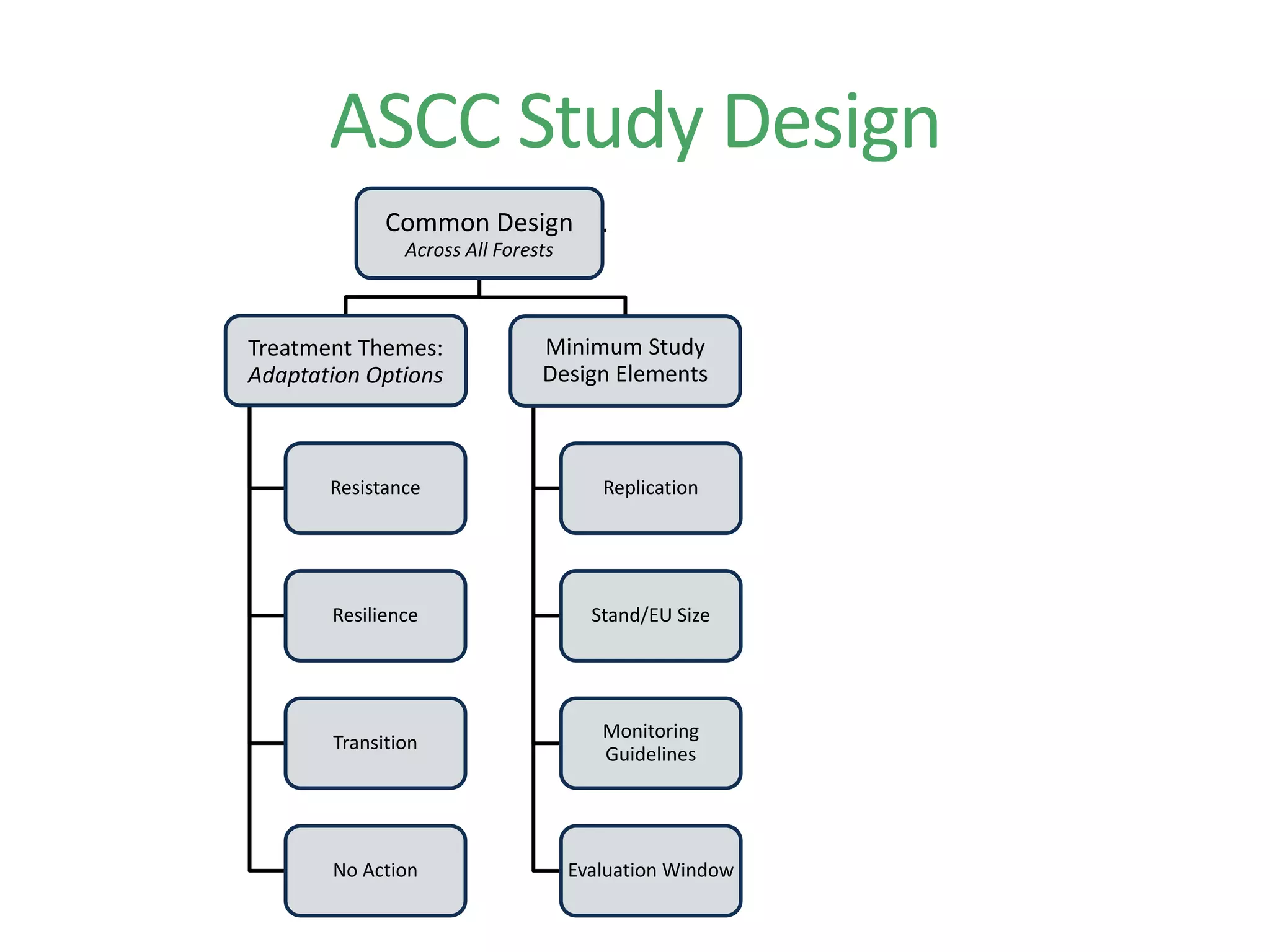
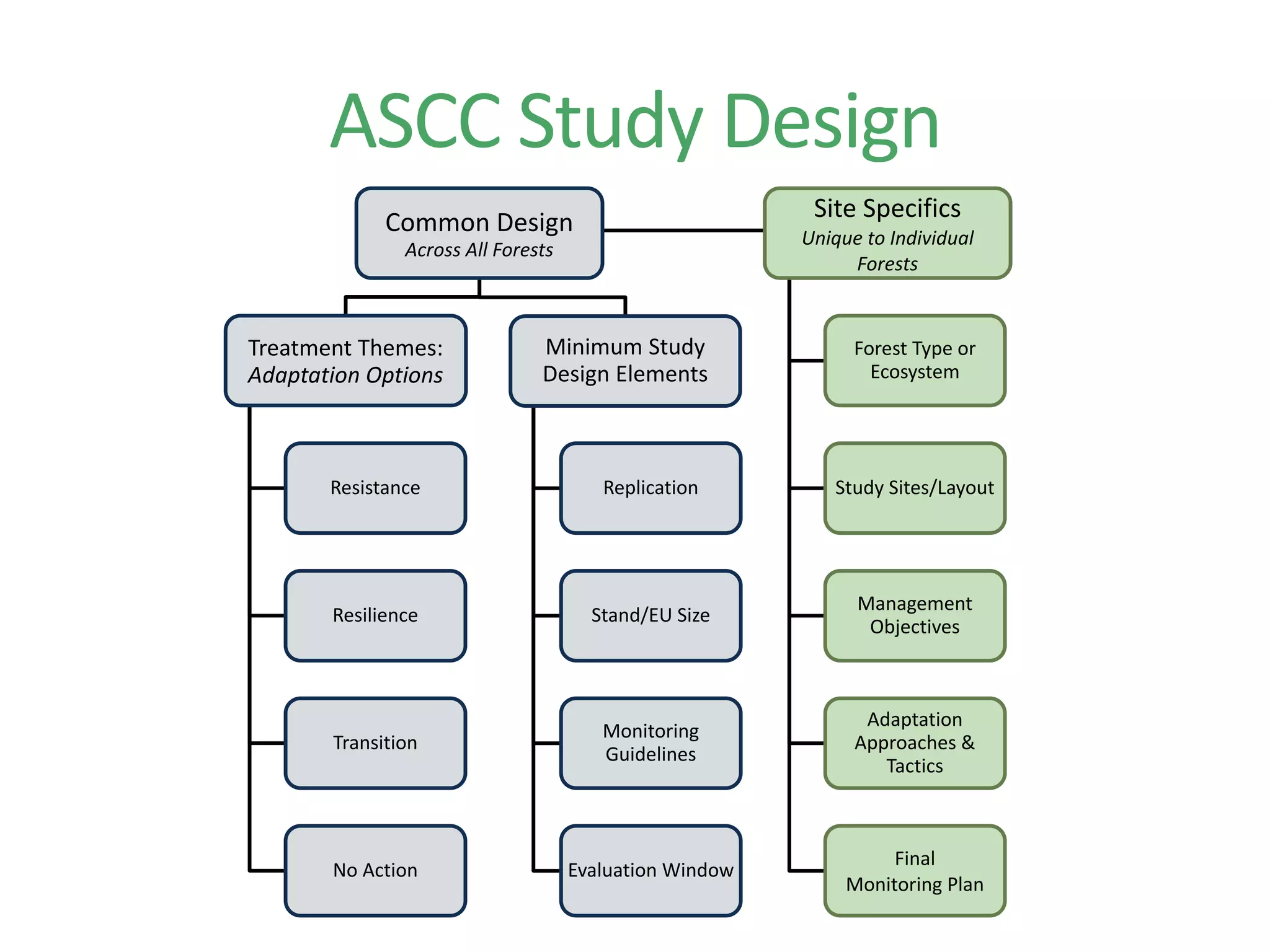
Study Design
Common Design
Across All Forests
Treatment Themes:
Adaptation Options
Resistance
Resilience
Transition
No Action
Minimum Study
Design Elements
Replication
Stand/EU Size
Monitoring
Guidelines
Evaluation Window
Site Specifics
Unique to Individual
Forests
Forest Type or
Ecosystem
Study Sites/Layout
Management
Objectives
Adaptation
Approaches &
Tactics
Final
Monitoring Plan
ASCC Study Design
ASCC
Study Design
Common Design
Across All Forests
Treatment Themes:
Adaptation Options
Resistance
Resilience
Transition
No Action
Minimum Study
Design Elements
Replication
Stand/EU Size
Monitoring
Guidelines
Evaluation Window
Site Specifics
Unique to Individual
Forests
Forest Type or
Ecosystem
Study Sites/Layout
Management
Objectives
Adaptation
Approaches &
Tactics
Final
Monitoring Plan
ASCC Study Design
San Juan NF
J.W. Jones Ecological Research Center
Flathead NF/
Coram EF
Chippewa NF/
Cutfoot EF
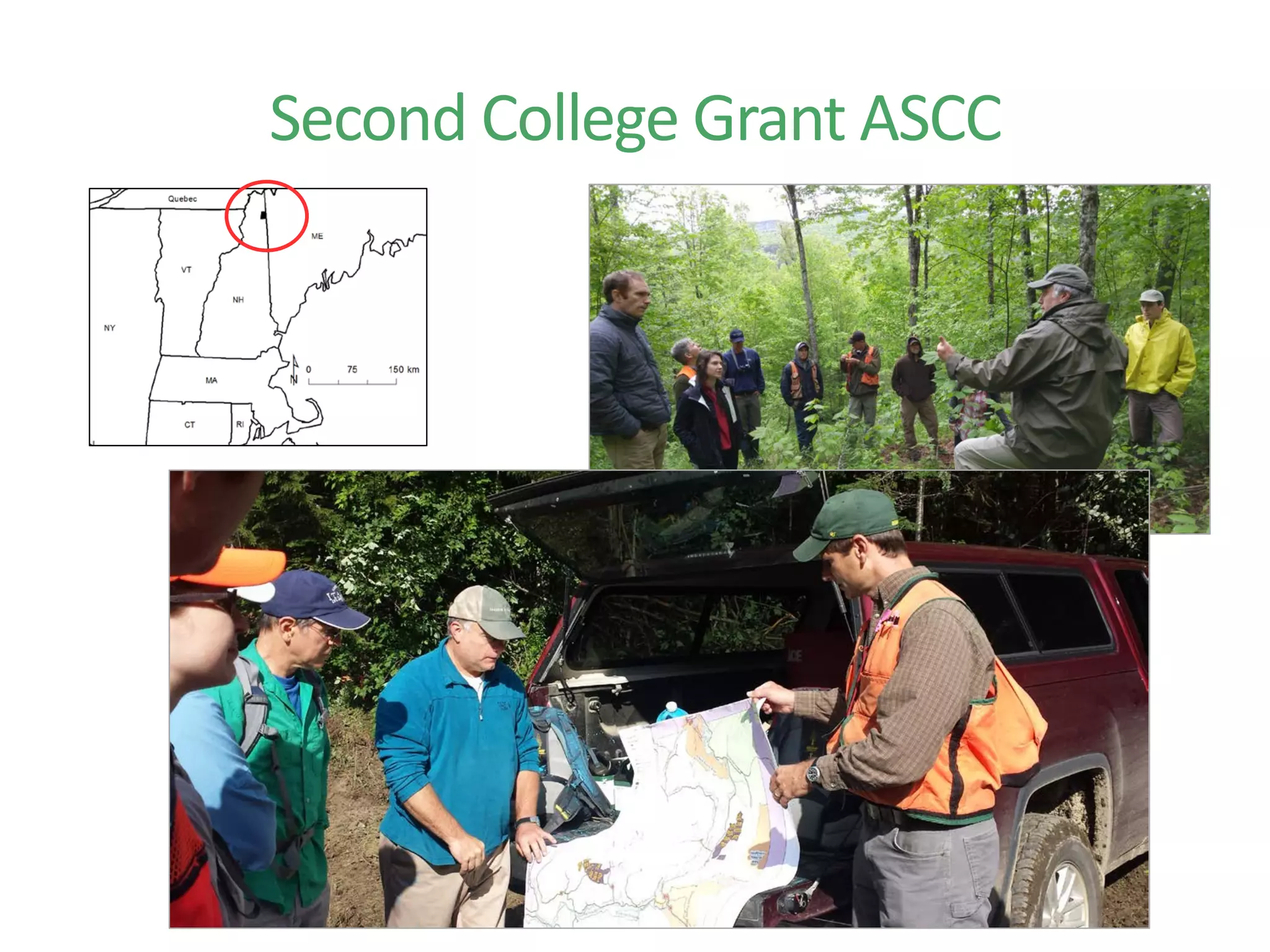
Second College Grant/
Dartmouth College, NH
Flathead National Forest / Coram
Experimental Forest, MT
• Western larch/mixed-conifer
• Climate concerns include uncertain
precipitation patterns, earlier snowpack
melt, and increased risk of wildfire
Cutfoot Experimental Forest /
Chippewa National Forest, MN
• Red pine-dominated, mixed species
• Climate concerns include increased
drought stress, increased risk of wildfire,
and increased insect and disease
outbreaks
Second College Grant / Dartmouth
College, NH
• Northern hardwoods
• Climate concerns include increased wind and
ice events, increased drought stress, and loss
of key ecosystem service species
San Juan National Forest, CO
• Warm-dry mixed conifer
• Climate concerns include
warming, variable precipitation
patterns, earlier snowmelt,
increased risk of wildfire and
insect outbreaks
J.W. Jones Ecological Research
Center, GA
• Mixed pine - hardwood system of
the southeastern coastal plain
• Climate concerns include
increased drought severity and
extreme weather events
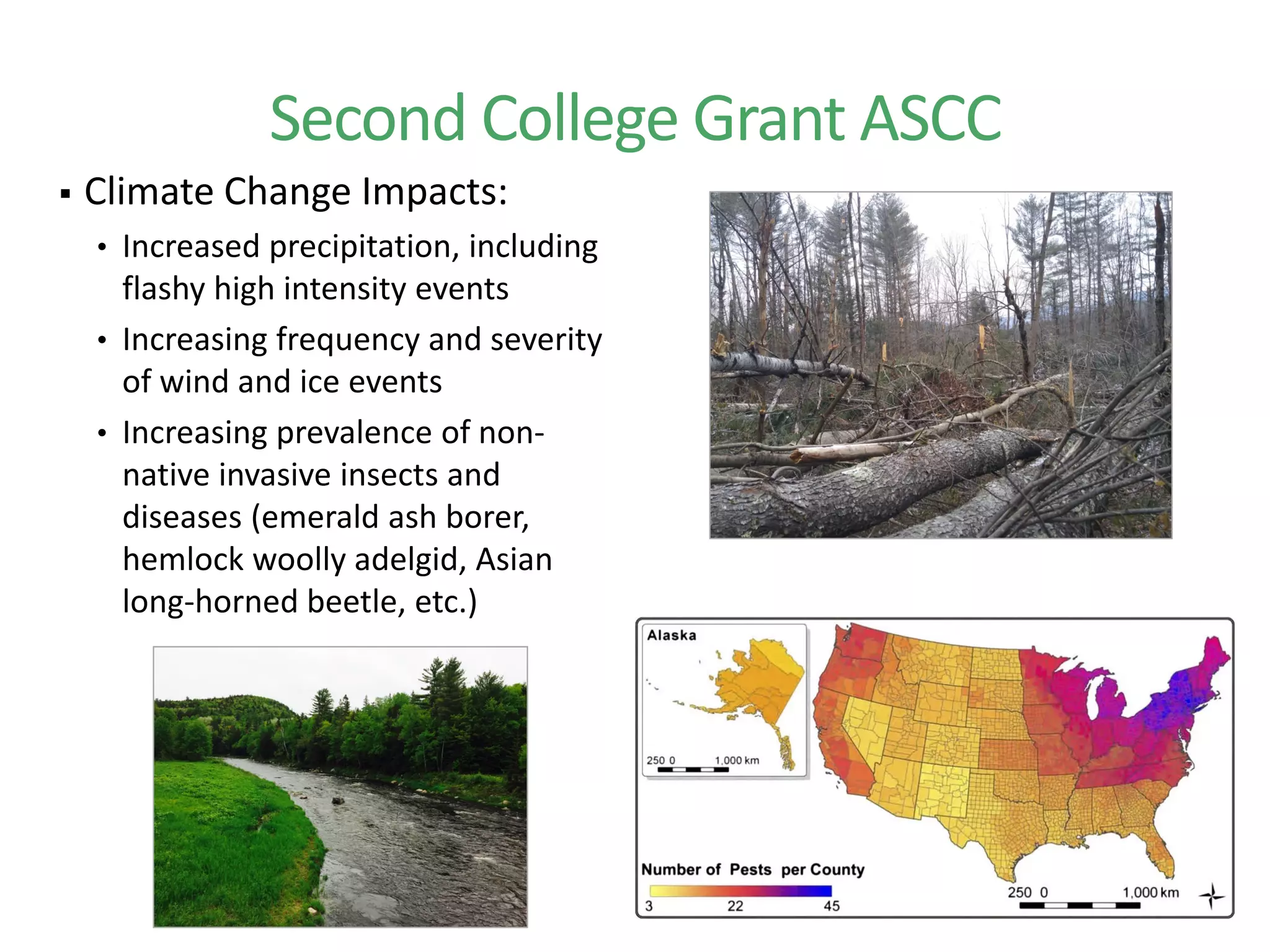
Second College Grant ASCC
 Climate Change Impacts:
• Increased precipitation, including
flashy high intensity events
• Increasing frequency and severity
of wind and ice events
• Increasing prevalence of non-
native invasive insects and
diseases (emerald ash borer,
hemlock woolly adelgid, Asian
long-horned beetle, etc.)
Second College Grant ASCC
Adaptive Silviculture for Climate Change (ASCC)
RESISTANCE
Maintain condition:
 Single-tree selection
Adaptive Silviculture for Climate Change (ASCC)
RESISTANCE RESILIENCE
Maintain condition:
 Single-tree selection
Maintain similar conditions
 Single-tree/small group
selection
 Increase diversity
Intentionally accommodate
change toward future
Variable-density
thin/irregular shelterwood
Plant future-adapted
species in gaps
Adaptive Silviculture for Climate Change (ASCC)
RESISTANCE RESILIENCE TRANSITION
Maintain condition:
 Single-tree selection
Maintain similar conditions
 Single-tree/small group
selection
 Increase diversity
northern red oak, bitternut
hickory, white pine, hemlock,
basswood, black birch,
bigtooth aspen, chestnut
Final Thoughts
How do we get from here…
…to here?
Final Thoughts
How do we get from here…
Final Thoughts
…to here?
Maria Janowiak
mjanowiak02@fs.fed.us
906-482-6303 x1329
Photo by Todd Ontl, NIACS

Integrating Climate Change and Forest Adaptation

  • 1.
    Integrating Climate Change andForest Adaptation Maria Janowiak mjanowiak02@fs.fed.us Todd Ontl, Courtney Peterson, Linda Nagel, Chris Swanson Northern Institute of Applied Climate Science
  • 2.
    NIACS (NorthernInstituteofAppliedClimateScience) Chartered byFS, universities, non-profit and tribal conservation organizations  Climate and carbon services • Climate impacts modeling • Vulnerability assessment • Climate adaptation • Carbon biogeochemistry • Carbon management  20 staff members (FS/universities) • 9 climate outreach specialists • 6 research scientists • 2 web and 3 GIS/lab specialists
  • 3.
    Hewes et al.2014 Forest Ownership
  • 4.
    Maine Forest Service2010, Butler 2017 Forest Ownership Maine 17.6 million acres of forest land 89% forested
  • 5.
  • 6.
    Desired ConditionsNatural Forest Dynamics Wildlife Habitat Past Management History Invasives TimberSale Revenue Disturbance: Past + Future Recreation Forest Health And more!! Climate Change Plan & Project Requirements
  • 7.
    How do weget from here… …to here?
  • 8.
    Climate Change Challenges Whatwe heard from forest and land managers: Climate change is too big and too complex Climate research is not relevant enough One-size-fits-all answers are insufficient There are not enough real-world examples Swanston et al. 2016
  • 9.
    Climate Change ResponseFramework Components: Progress: Structured, process oriented, works on multiple scales 150+ partner organizations (and counting) 8 published assessments, 1 in press Published 2012, 2016 (2nd ed.); online version 2015 250+ demonstrations underway FY17: 85 presentations, 35 workshops, 20 publications, 3 courses Partnerships Vulnerability Assessment Forest Adaptation Resources Adaptation Demonstrations
  • 10.
    Vulnerability Assessment NEW REPORT! www.nrs.fs.fed.us/pubs/55635 Additionalresources: www.forestadaptation.org/ne-assessment  Synthesize existing assessments and scientific literature  Incorporate new results from forest impact models  Draw on local expertise of scientists and land managers  Describe state-of-knowledge for anticipated changes in climate and response of forest ecosystems
  • 11.
    Swanston et al.2016; www.nrs.fs.fed.us/pubs/52760 adaptationworkbook.org Forest Adaptation Resources
  • 12.
    Adaptation Workbook Adaptation Workbookprovides structured process to integrate climate change considerations into management planning and activities 1. DEFINE area of interest, management objectives, and time frames. 2. ASSESS climate change impacts and vulnerabilities for the area of interest. 3. EVALUATE management objectives given projected impacts and vulnerabilities. 4. IDENTIFY and implement adaptation approaches and tactics . 5. MONITOR and evaluate effectiveness of implemented actions. Vulnerability assessments, scientific literature, and other resources Adaptation Strategies and Approaches
  • 13.
    www.forestadaptation.org/demos 250+ Projects have usedthe Adaptation Workbook Adaptation Demonstrations Real-world examples of climate-informed forest management
  • 14.
    How are landmanagers responding?
  • 15.
    Adaptation is theadjustment of systems in response to climate change. It means taking action to prepare for potential changes and risks, and responding to effects.
  • 16.
    RESISTANCE  Improve defensesof forest against change and disturbance  Maintain relatively unchanged conditions Millar et al. 2007 Climate Change Adaptation: Options Millar et al. 2007, Swanston et al. 2016, Nagel et al. 2017
  • 17.
    RESISTANCE RESILIENCE  Improvedefenses of forest against change and disturbance  Maintain relatively unchanged conditions  Accommodate some degree of change  Return to prior reference condition following disturbance Millar et al. 2007 Climate Change Adaptation: Options Millar et al. 2007, Swanston et al. 2016, Nagel et al. 2017
  • 18.
    RESISTANCE RESILIENCE TRANSITION Improve defenses of forest against change and disturbance  Maintain relatively unchanged conditions  Accommodate some degree of change  Return to prior reference condition following disturbance  Intentionally facilitate change  Enable ecosystem to respond to changing and new conditions Millar et al. 2007 Climate Change Adaptation: Options Millar et al. 2007, Swanston et al. 2016, Nagel et al. 2017
  • 19.
    RESISTANCE RESILIENCE TRANSITION Improve defenses of forest against change and disturbance  Maintain relatively unchanged conditions  Accommodate some degree of change  Return to prior reference condition following disturbance  Intentionally facilitate change  Enable ecosystem to respond to changing and new conditions Millar et al. 2007 Climate Change Adaptation: Options Millar et al. 2007, Swanston et al. 2016, Nagel et al. 2017
  • 20.
    Climate Change Adaptation:Strategies TRANSITIONRESILIENCERESISTANCE 10 Sustain fundamental ecological functions 1 Reduce the impact of biological stressors 2 4 Maintain or create refugia 5 Maintain and enhance species and structural diversity Reduce the risk and long-term impacts of severe disturbances 3 6 Increase ecosystem redundancy across the landscape Realign following severe disturbance 7 Promote landscape connectivity 8 Maintain and enhance genetic diversity Facilitate community adjustments through species transitions 9 Swanston et al. 2016
  • 21.
    0.00 0.05 0.100.15 0.20 0.25 Pests & pathogens Soil moisture stress Warmer (seasonal) Altered precipitation (seasonal) Extreme precipitation Invasives Longer growing season Proportion 0.00 0.05 0.10 0.15 Decline in northern/ boreal species Pests & pathogens Invasives Longer growing season Soil moisture stress Extreme precipitation Warmer (seasonal) Proportion Northwoods New England Climate Change Adaptation: Options
  • 22.
    What actions aremanagers considering for climate change adaptation? Region Resistance Resilience Transition Northwoods 27% 43% 30% New England 21% 46% 33% RESISTANCE RESILIENCE TRANSITION
  • 23.
    Resist Change Prevent theintroduction and establishment of invasive plant species and remove existing invasives (4) Maintain or improve the ability of forests to resist pests and pathogens (6) Prudence Island Natural Heritage Unit: www.forestadaptation.org/node/723
  • 24.
    Enhance Resilience Maintain andrestore diversity of native tree species (1) Promote diverse age classes (2) Retain biological legacies (6) Marsh-Billings-Rockefeller Nat’l Historical Park: www.forestadaptation.org/node/375
  • 25.
    Enhance Resilience Restore fireto fire-adapted ecosystems (5) MA Dept. of Conservation and Rec, Bristol Lot: www.forestadaptation.org/bristol
  • 26.
    Enhance Resilience Maintain orrestore soil quality and nutrient cycling (8) Atlas Timberlands: www.forestadaptation.org/atlas
  • 27.
    Enhance Resilience Maintain orrestore hydrology (9) Trout Unlimited and Partners: www.forestadaptation.org/tu-ne
  • 28.
    Transition Systems Favor orrestore native species that are expected to be better adapted to future conditions (3) Norcross Wildlife Sanctuary: www.forestadaptation.org/norcross
  • 29.
    New England &Northern New York Northern New England Southern New England 18 Workbooks in New England • 14 in the Northern ecoregions • 4 in the Southern ecoregion
  • 30.
    Northern New England SouthernNew England 32% 43% 25% 21% 46% 33%
  • 31.
    Adaptive Silviculture forClimate Change (ASCC)
  • 32.
    Adaptive Silviculture forClimate Change (ASCC) Multi-region silvicultural trials to test climate change adaptation actions Silviculture: the art and science of controlling the establishment, growth, composition, health, and quality of forests and woodlands to meet the diverse needs and values of landowners and society on a sustainable basis
  • 33.
    ASCC Objectives  Populatea multi-region study design with ecosystem-specific climate change adaptation treatments using input from an expert panel of regional scientists and local managers  Introduce natural resource managers to conceptual tools and approaches that help integrate climate change into natural resource management and silvicultural decision making
  • 34.
    Core Management Questions 1)Will adaptation approaches and treatments work in a real- world context to meet local management goals and objectives? 2) How feasible are the treatments silviculturally, as well as in terms of financial, social, or other management constraints? 3) How does our idea of desired future conditions (DFCs) change with each treatment type? 4) What does it mean to deliberately create a future-adapted ecosystem, and why would a manager choose to do this? 5) What tradeoffs exist between achievement of adaptation objectives and other common objectives for a given region and ecosystem type? Nagel et al. 2017 Conceptual
  • 35.
    Core Management Questions 1)Do the treatments create significant changes to forest conditions over time at a particular site, and how do treatments compare across sites? 2) How do hypothesized treatment responses (DFCs) compare with actual responses observed in the future? 3) Do these treatments achieve what they were designed for? 4) What criteria emerge to enable managers to identify which treatments perform best? 5) Does one type of treatment (resistance, resilience, transition, or no action) consistently perform better across all sites? Nagel et al. 2017 Hypothesis-driven
  • 36.
    ASCC Study Design Common Design AcrossAll Forests Treatment Themes: Adaptation Options Resistance Resilience Transition No Action Minimum Study Design Elements Replication Stand/EU Size Monitoring Guidelines Evaluation Window Site Specifics Unique to Individual Forests Forest Type or Ecosystem Study Sites/Layout Management Objectives Adaptation Approaches & Tactics Final Monitoring Plan ASCC Study Design
  • 37.
    ASCC Study Design Common Design AcrossAll Forests Treatment Themes: Adaptation Options Resistance Resilience Transition No Action Minimum Study Design Elements Replication Stand/EU Size Monitoring Guidelines Evaluation Window Site Specifics Unique to Individual Forests Forest Type or Ecosystem Study Sites/Layout Management Objectives Adaptation Approaches & Tactics Final Monitoring Plan ASCC Study Design
  • 38.
    San Juan NF J.W.Jones Ecological Research Center Flathead NF/ Coram EF Chippewa NF/ Cutfoot EF Second College Grant/ Dartmouth College, NH Flathead National Forest / Coram Experimental Forest, MT • Western larch/mixed-conifer • Climate concerns include uncertain precipitation patterns, earlier snowpack melt, and increased risk of wildfire Cutfoot Experimental Forest / Chippewa National Forest, MN • Red pine-dominated, mixed species • Climate concerns include increased drought stress, increased risk of wildfire, and increased insect and disease outbreaks Second College Grant / Dartmouth College, NH • Northern hardwoods • Climate concerns include increased wind and ice events, increased drought stress, and loss of key ecosystem service species San Juan National Forest, CO • Warm-dry mixed conifer • Climate concerns include warming, variable precipitation patterns, earlier snowmelt, increased risk of wildfire and insect outbreaks J.W. Jones Ecological Research Center, GA • Mixed pine - hardwood system of the southeastern coastal plain • Climate concerns include increased drought severity and extreme weather events
  • 39.
  • 40.
     Climate ChangeImpacts: • Increased precipitation, including flashy high intensity events • Increasing frequency and severity of wind and ice events • Increasing prevalence of non- native invasive insects and diseases (emerald ash borer, hemlock woolly adelgid, Asian long-horned beetle, etc.) Second College Grant ASCC
  • 41.
    Adaptive Silviculture forClimate Change (ASCC) RESISTANCE Maintain condition:  Single-tree selection
  • 42.
    Adaptive Silviculture forClimate Change (ASCC) RESISTANCE RESILIENCE Maintain condition:  Single-tree selection Maintain similar conditions  Single-tree/small group selection  Increase diversity
  • 43.
    Intentionally accommodate change towardfuture Variable-density thin/irregular shelterwood Plant future-adapted species in gaps Adaptive Silviculture for Climate Change (ASCC) RESISTANCE RESILIENCE TRANSITION Maintain condition:  Single-tree selection Maintain similar conditions  Single-tree/small group selection  Increase diversity northern red oak, bitternut hickory, white pine, hemlock, basswood, black birch, bigtooth aspen, chestnut
  • 44.
  • 45.
    How do weget from here… …to here? Final Thoughts
  • 46.
    How do weget from here… Final Thoughts …to here?
  • 47.