
www.forestadaptation.org
Climate Change and the Forests and
Habitats of Southern New England
March 16-17, 2015
Storrs, CT
 Provides practical information,
resources, and technical assistance
related to forests and climate change
 Supports the integration of climate
change information into natural
resource management
www.nrs.fs.fed.us/niacs/
Northern Institute of Applied Climate Science
Regional multi-institutional partnership among:
Climate
Carbon
Bioenergy
NIACS
Coordinates the
Northern Forests
Sub Hub as part
of the USDA
Regional Climate
Hubs in the
Midwest and
Northeast
Climate Hub
Midwest
Climate Hub
Northeast
USDA Climate Hubs
March 16 – Agenda
1:45 Forest Adaptation Resources: an Introduction Southern New
England’s Changing Climate
2:55 Break
3:20 Climate Change Effects on Forest Ecosystems
March 17 – Hands-on Training
An active, hands-on training, to assist natural resource professionals in
incorporating climate change considerations and identifying actions for
adaptation into their own real-world management and conservation projects.
Join us tomorrow!
March 17 – Agenda
8:30 Climate Change Impacts on Forest Management Projects (Step 2)
10:00 Break
10:15 Challenges/Opportunities for Management (Step 3)
11:30 Identifying Forest Adaptation Approaches and Tactics (Step 4)
12:00 Lunch (BYO)
1:00 Identifying Forest Adaptation Approaches and Tactics (Step 4)
3:00 Break
3:15 Identifying Forest Adaptation Approaches and Tactics
4:00 Next Steps & Wrap-up
4:00 Adjourn
When we started…
Responding to Climate Change
There is not a single “answer”
Critical to start with:
Manager’s Guide Decision Tree E-Z Whiz-bang Tool
The place
Management goals
& objectives
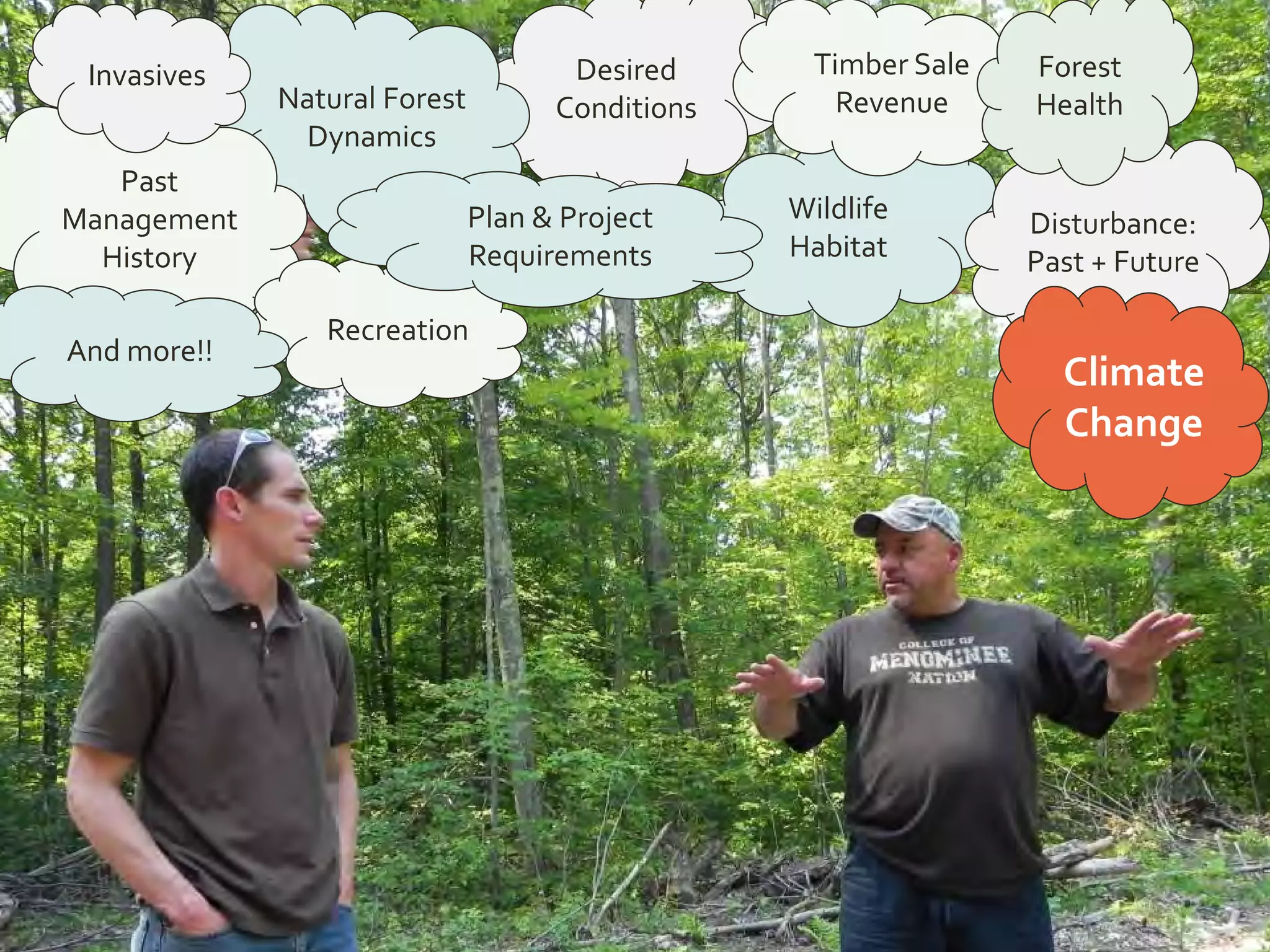
Desired
ConditionsNatural Forest
Dynamics
Wildlife
Habitat
Past
Management
History
Invasives Timber Sale
Revenue
Disturbance:
Past + Future
Recreation
Forest
Health
And more!!
Climate
Change
Plan & Project
Requirements
Partnerships
Vulnerability Assessment
Forest Adaptation Resources
Adaptation Demonstrations
Climate Change Response Framework
Components: Progress:
75+ partner organizations
(and counting)
3 published assessments,
3 more in press/revision
Published in 2012, updated
and online versions in prep
50+ demonstrations
underway
Structured, process oriented, works on multiple scales
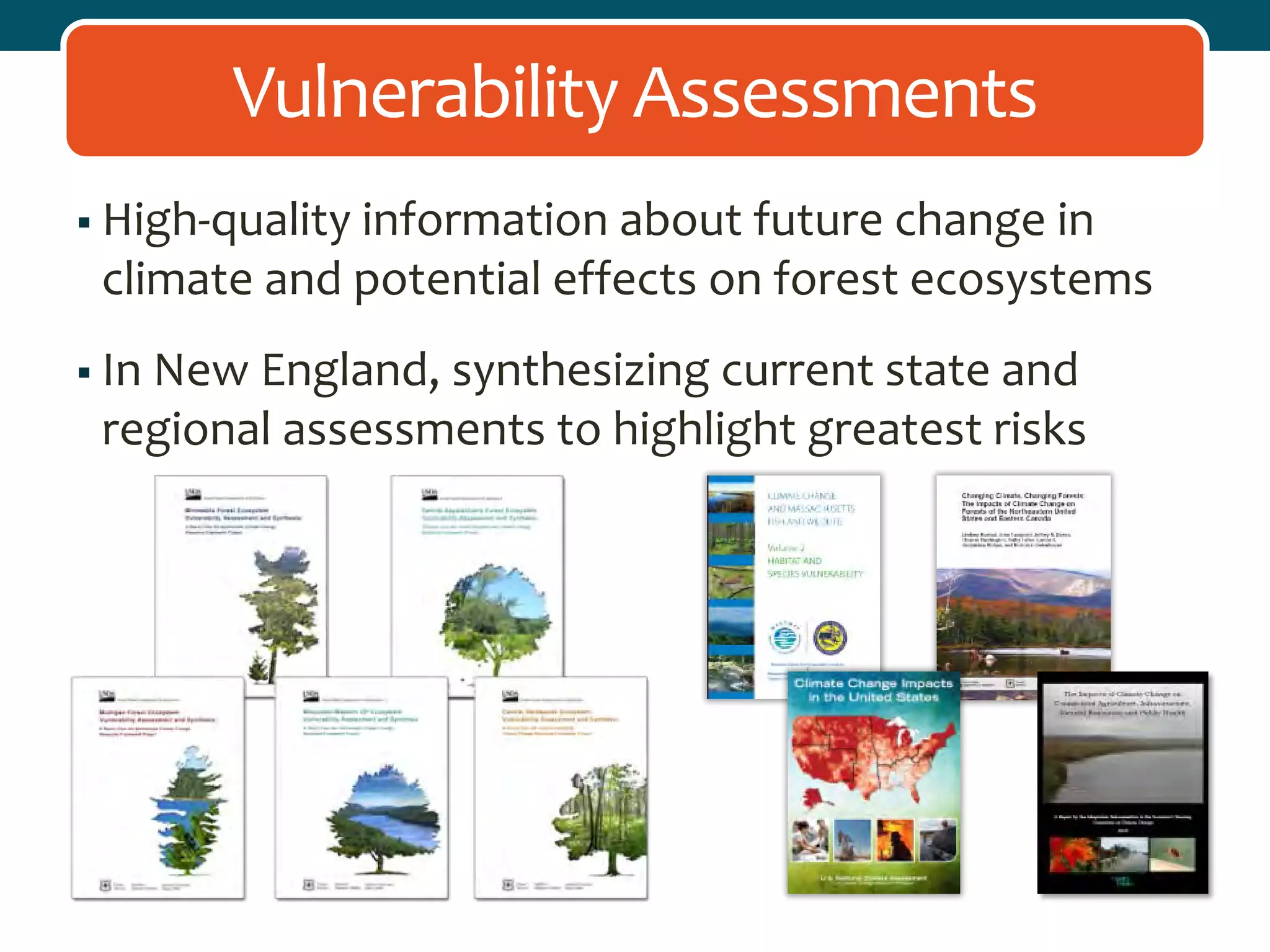
Vulnerability Assessments
 High-quality information about future change in
climate and potential effects on forest ecosystems
 In New England, synthesizing current state and
regional assessments to highlight greatest risks
Swanston and Janowiak 2012; www.nrs.fs.fed.us/pubs/40543
 Designed for a variety of land
managers
 Does not make
recommendations
 Menu of strategies &
approaches for climate change
adaptation
 Adaptation workbook process
for implementation
Swanston and Janowiak 2012; www.treesearch.fs.fed.us/pubs/40543
Forest Adaptation Resources
Swanston and Janowiak 2012; www.treesearch.fs.fed.us/pubs/40543
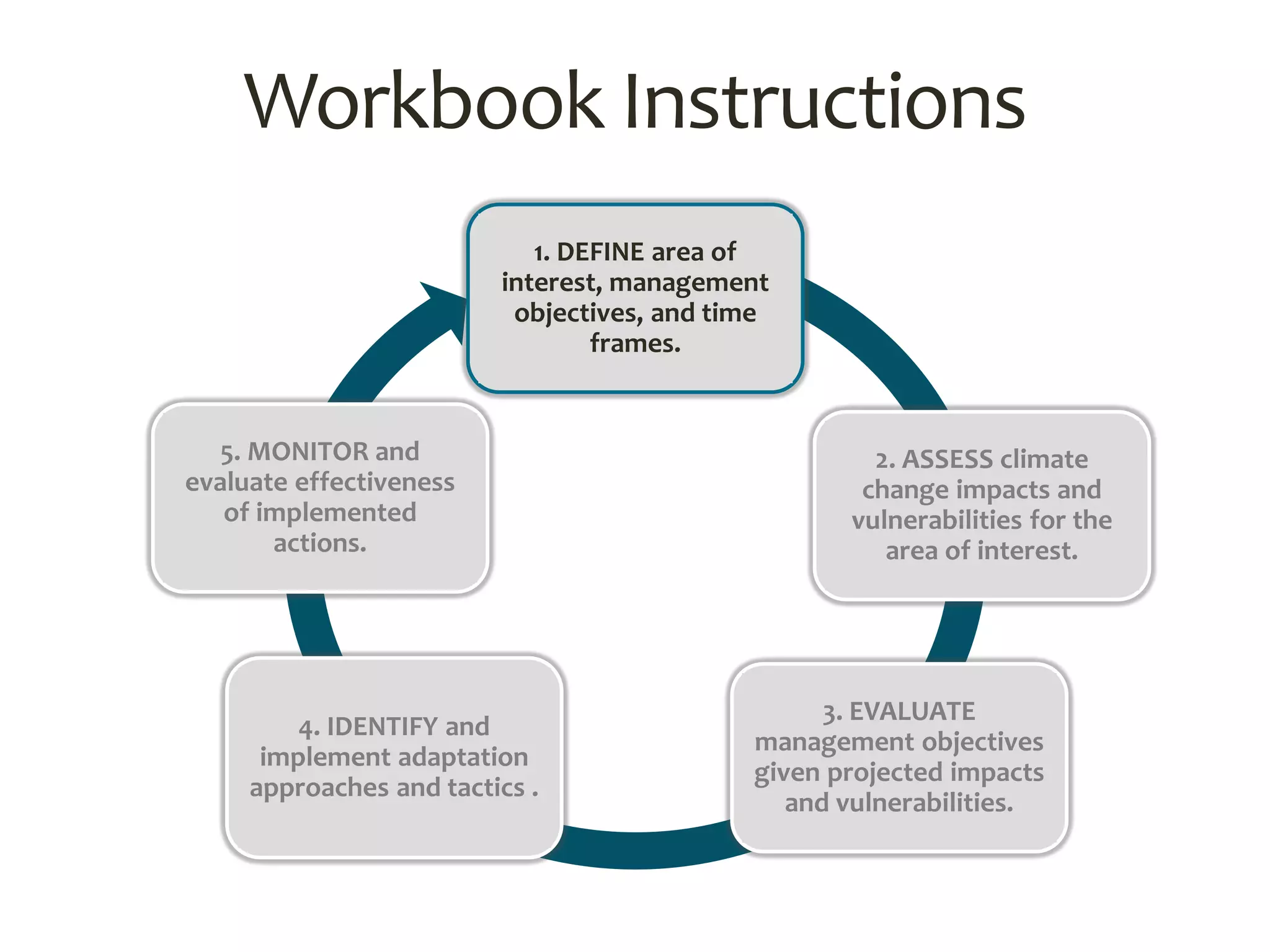
Provides structured process to integrate climate change
considerations into management planning and activities
1. DEFINE area of
interest, management
objectives, and time
frames.
2. ASSESS climate change
impacts and
vulnerabilities for the
area of interest.
3. EVALUATE
management objectives
given projected impacts
and vulnerabilities.
4. IDENTIFY and
implement adaptation
approaches and tactics .
5. MONITOR and
evaluate effectiveness of
implemented actions.
Vulnerability
assessments, scientific
literature, and other
resources
Adaptation
Strategies and
Approaches
Management
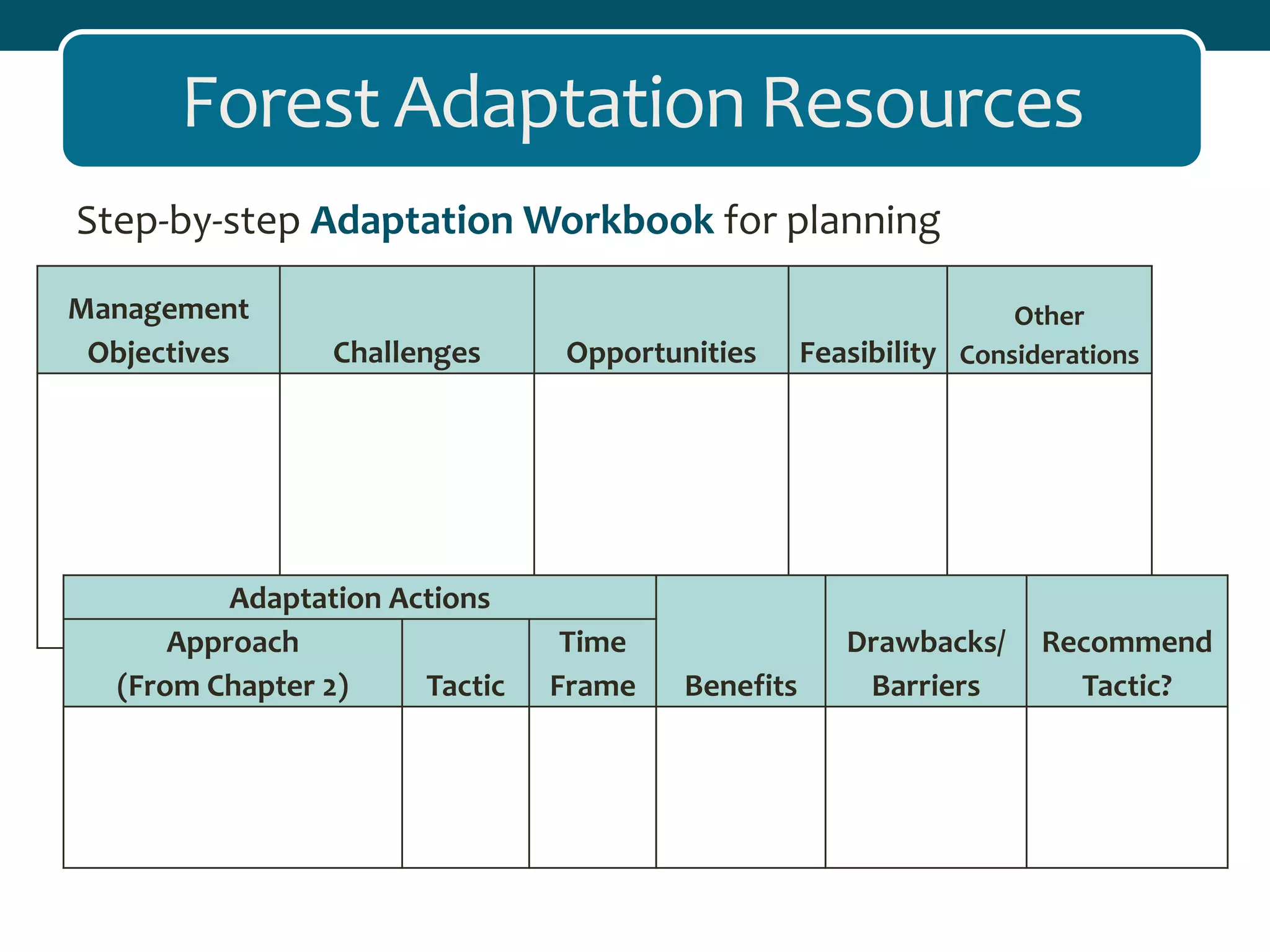
Objectives Challenges Opportunities Feasibility
Other
Considerations
Adaptation Actions
Benefits
Drawbacks/
Barriers
Recommend
Tactic?
Approach
(From Chapter 2) Tactic
Time
Frame
Forest Adaptation Resources
Step-by-step Adaptation Workbook for planning
Ways the Adaptation
Workbook can be used:
 Coordinator facilitates
individual or small group
 Forest Adaptation Planning
and Practices workshop
• General (state agencies; SFEC)
• Tribal (Sault; Menominee)
• Conservation (WCS; DU)
 Managers use the
workbook independently
• Online version soon!!
Forest Adaptation Resources
Real-world ExamplesAdaptation Demonstrations
 Provide real-world examples of forest management
activities that:
• Enhance the ability of forests to cope with changing
conditions
• Achieve land owner management goals
 Foster cross-ownership dialogue and learning
 Illustrate diverse goals and approaches
www.forestadaptation.org Click ‘Demonstration Projects’
Real-world ExamplesAdaptation Demonstrations
www.forestadaptation.org Click ‘Demonstration Projects’
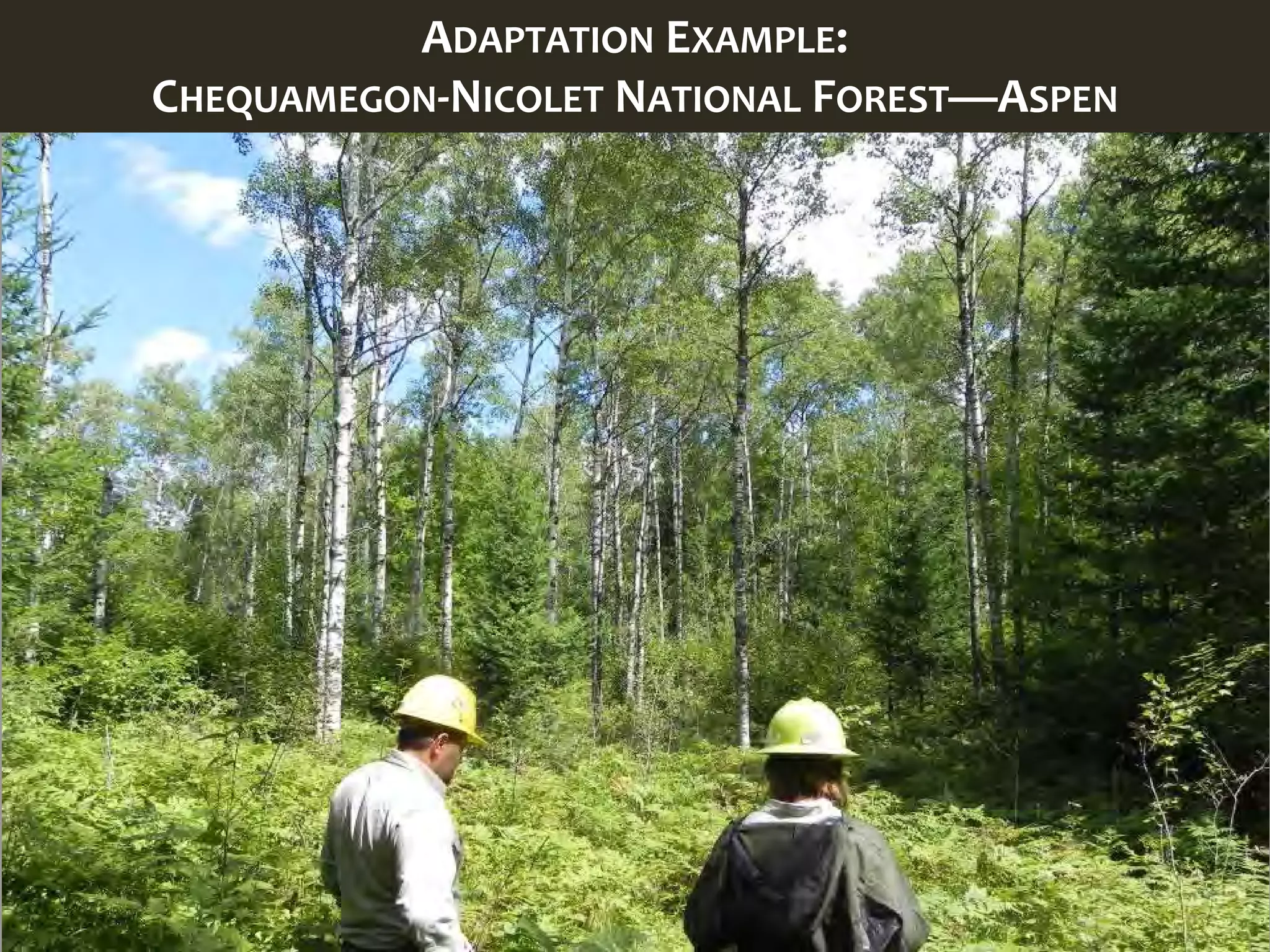
Chequamegon-Nicolet NF: Aspen
1
2
34
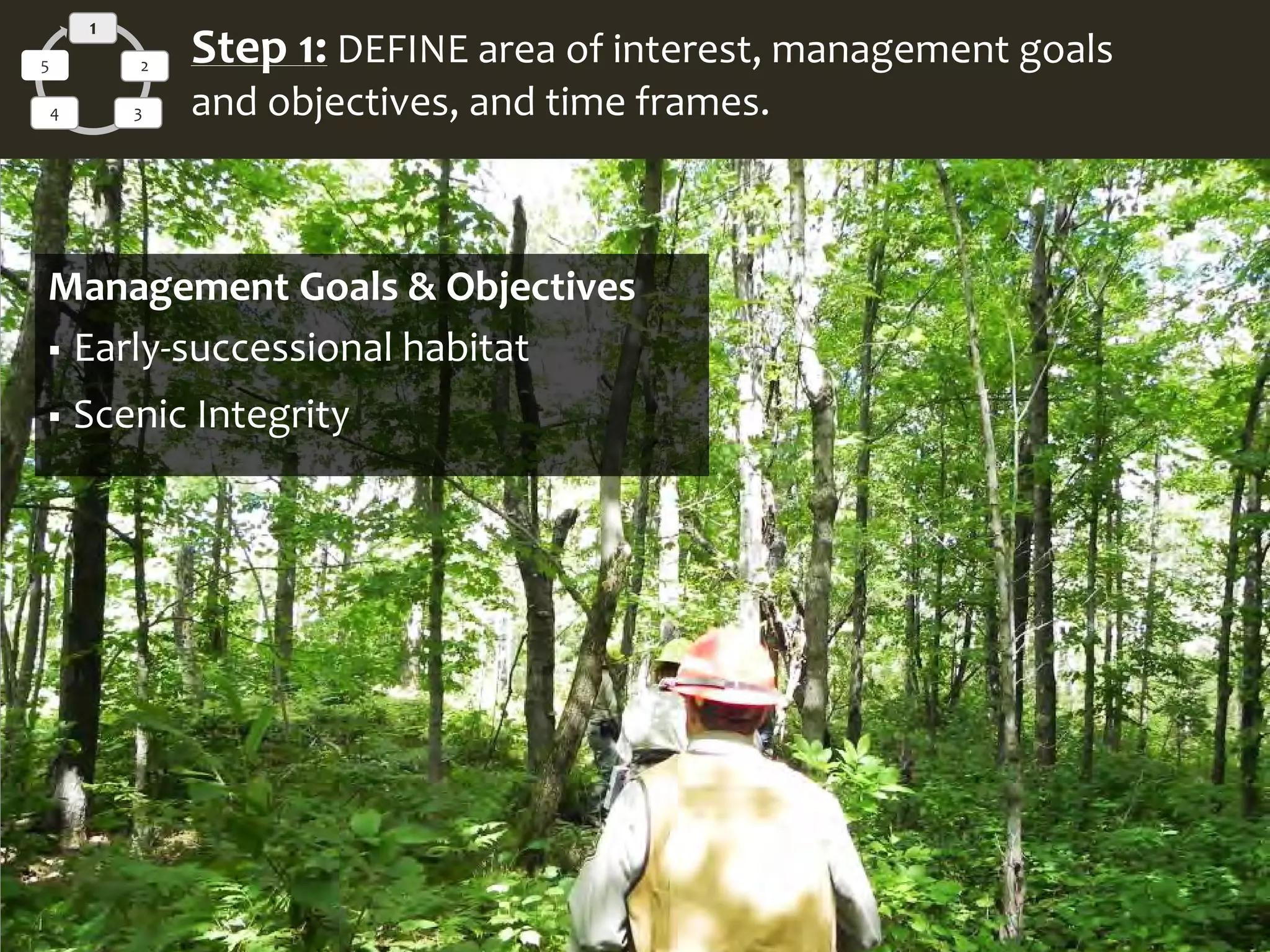
5 Step 1: DEFINE area of interest, management goals
and objectives, and time frames.
Management Goals & Objectives
 Early-successional habitat
 Scenic Integrity
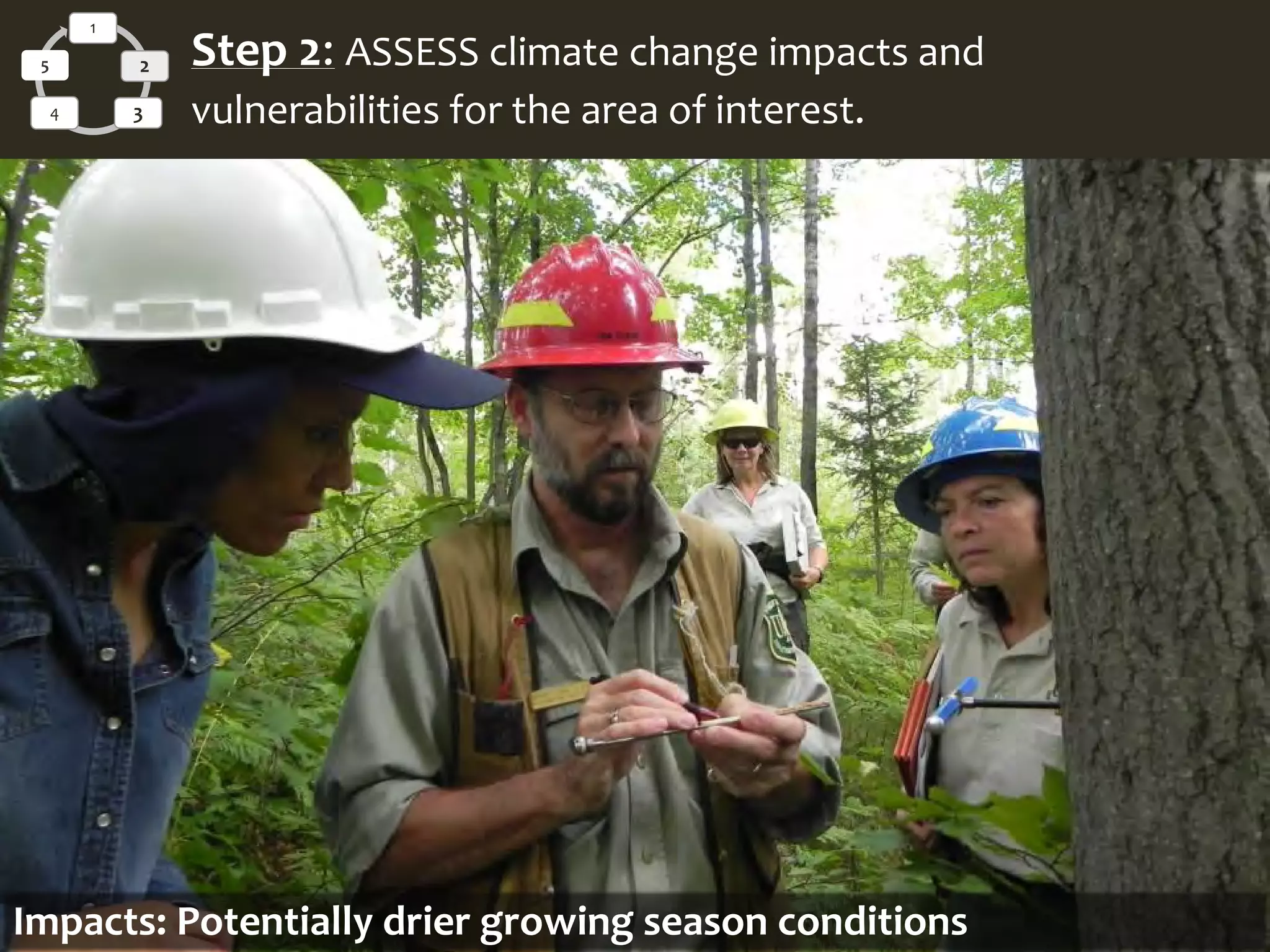
Impacts: Potentially drier growing season conditions
1
2
34
5 Step 2: ASSESS climate change impacts and
vulnerabilities for the area of interest.
Challenges
 Aspen in long-term
 Few tree species
 Productivity issues
 Hazel competition
 Windthrow
1
2
34
5 Step 3: EVALUATE management objectives given
projected impacts and vulnerabilities.
Opportunities
 Site suitable for
pine in future?
1
2
34
5 Step 4: IDENTIFY and adaptation approaches and
tactics for implementation.
Overall Approach: Enhance future options
within existing management trajectory
 Aspen will regenerate now, but is likely to fare
poorly over the long term.
 Maintain plans for clearcut for aspen regeneration
 Additional actions to promote diversity and provide
future options: plant red oak and white pine
 Pro-active on invasives and disturbance planning
 Post clearcut stocking*
 Survival of planted trees*
 Species composition for
trees* and seedlings/saplings
 Intensified inventory (?)
*existing monitoring item
1
2
34
5 Step 5: MONITOR and evaluate effectiveness of
implemented actions.
Chequamegon-Nicolet Aspen: Status
• Stands are marked
• Winter harvest –this winter
• Then: underplant native
future-adapted species
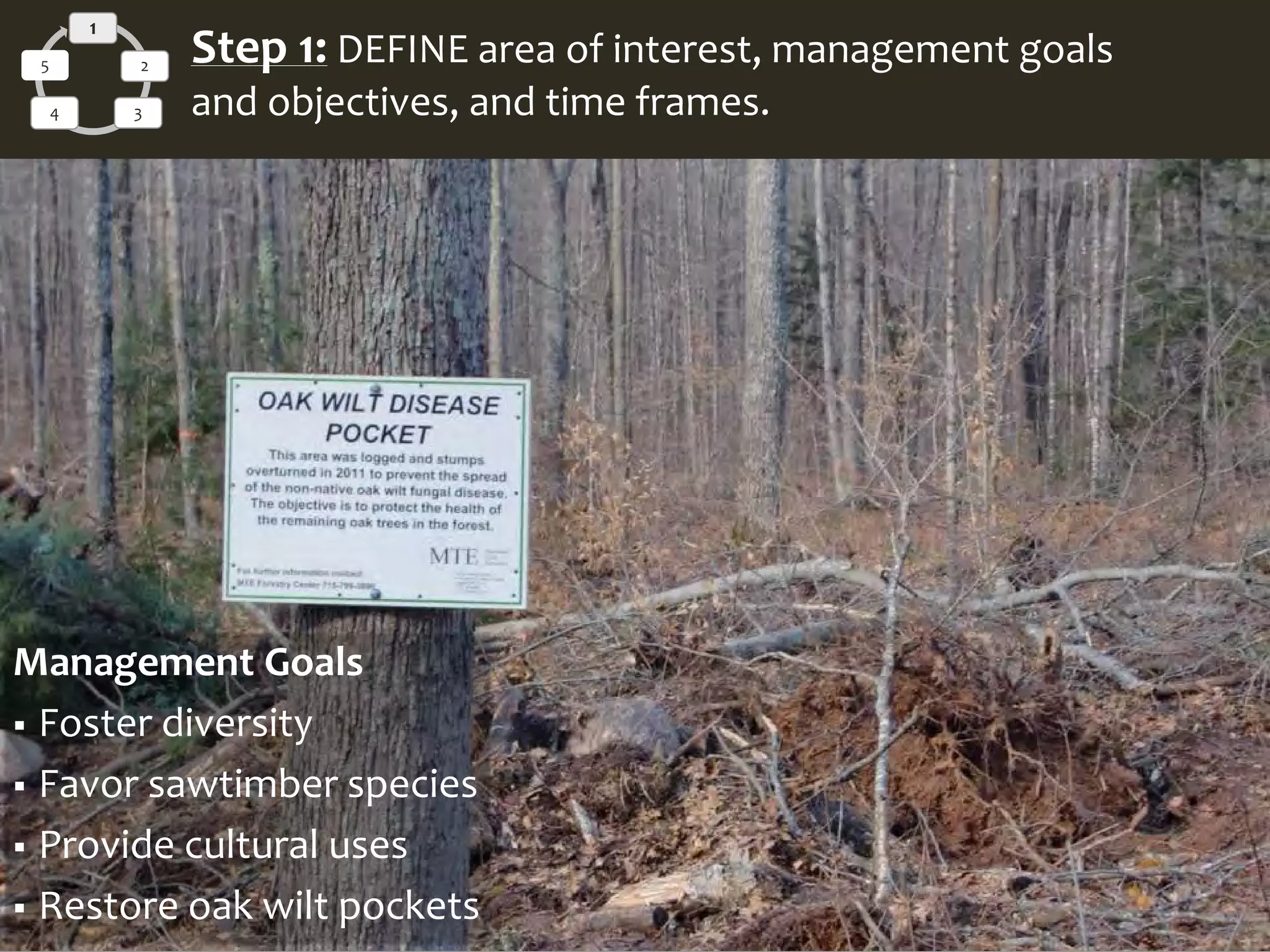
Menominee Tribal Enterprises: Oak Wilt
Photo: College of Menominee Nation SDI
Management Goals
 Foster diversity
 Favor sawtimber species
 Provide cultural uses
 Restore oak wilt pockets
1
2
34
5 Step 1: DEFINE area of interest, management goals
and objectives, and time frames.
1
2
34
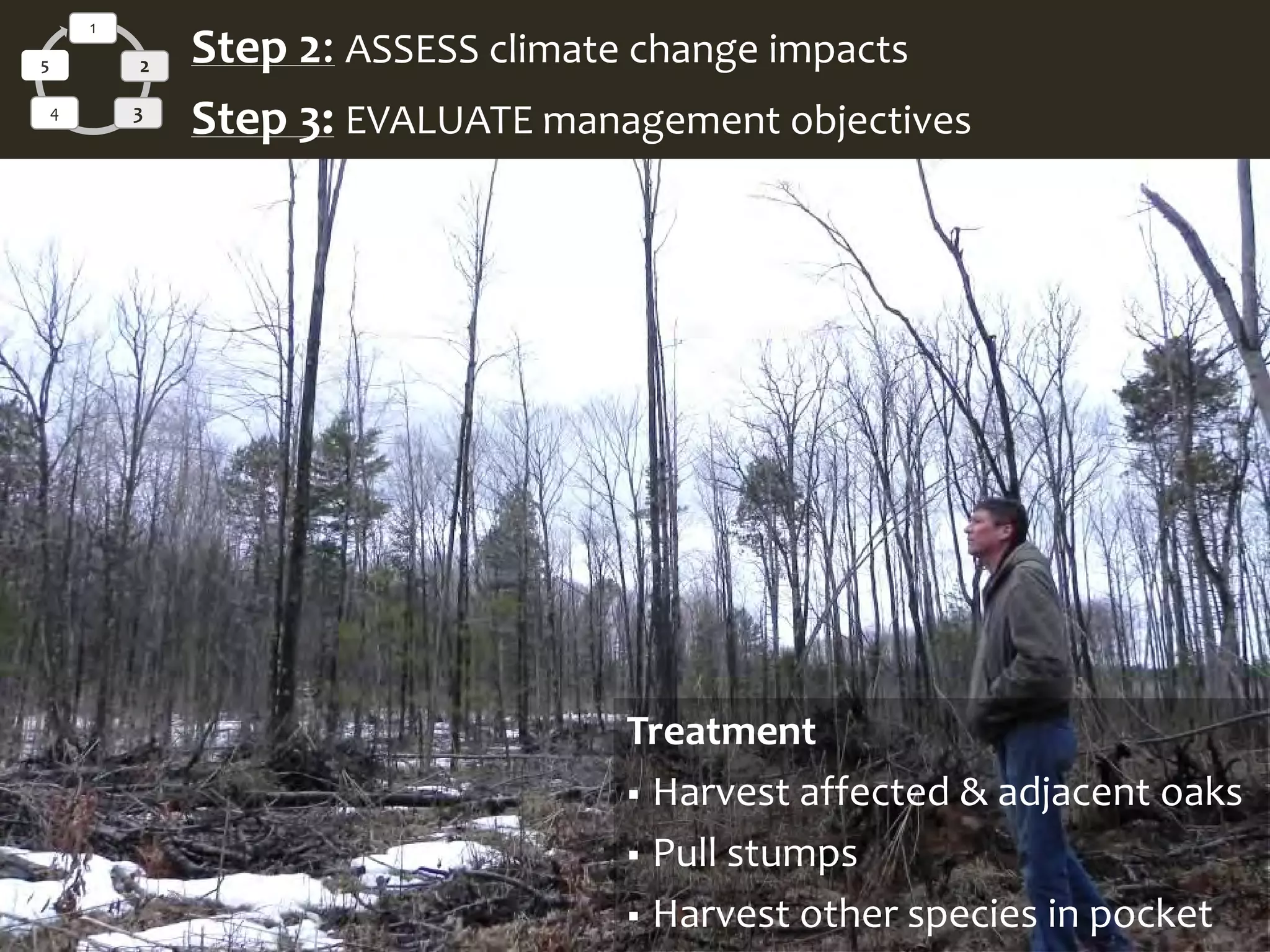
5 Step 2: ASSESS climate change impacts
Step 3: EVALUATE management objectives
Treatment
 Harvest affected & adjacent oaks
 Pull stumps
 Harvest other species in pocket
Treatment
 Harvest affected & adjacent oaks
 Pull stumps
 Harvest other species in pocket
1
2
34
5 Step 2: ASSESS climate change impacts
Step 3: EVALUATE management objectives
Adaptation
Approach
•Reduce biological
stressors
•Maintain and
enhance diversity
•Promote future-
adapted species
•Enhance genetic
diversity
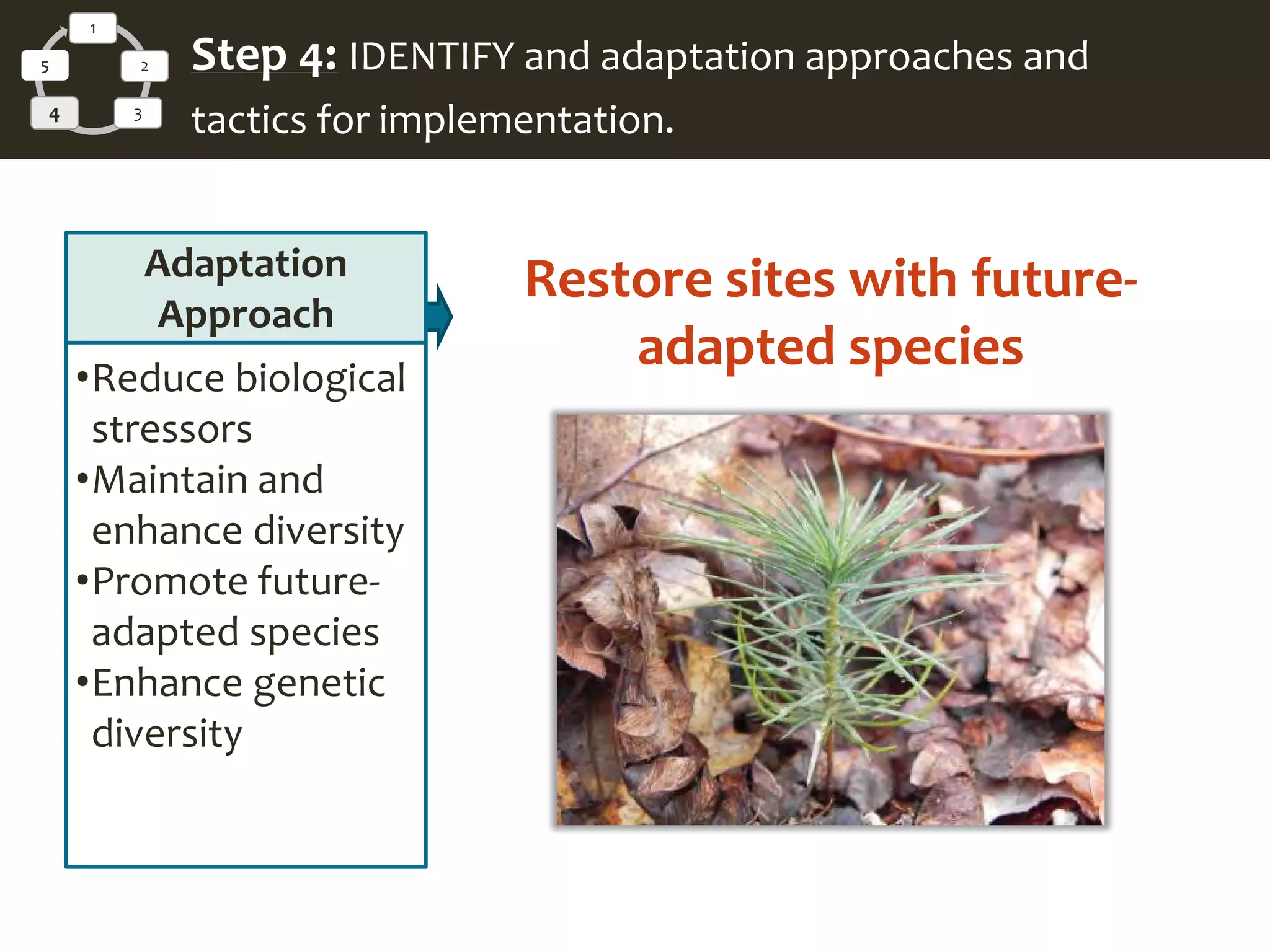
Restore sites with future-
adapted species
1
2
34
5 Step 4: IDENTIFY and adaptation approaches and
tactics for implementation.
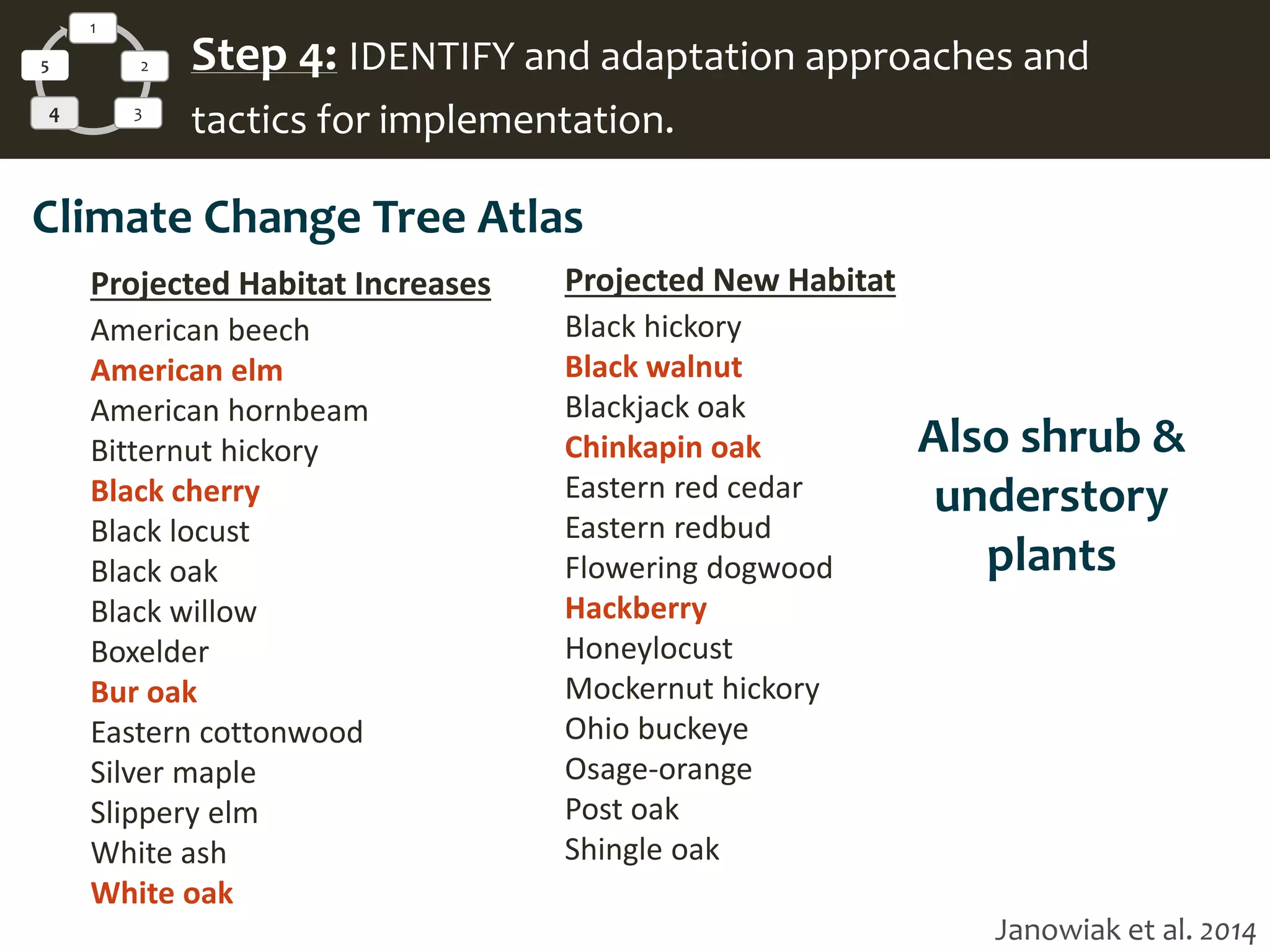
Projected Habitat Increases
American beech
American elm
American hornbeam
Bitternut hickory
Black cherry
Black locust
Black oak
Black willow
Boxelder
Bur oak
Eastern cottonwood
Silver maple
Slippery elm
White ash
White oak
Projected New Habitat
Black hickory
Black walnut
Blackjack oak
Chinkapin oak
Eastern red cedar
Eastern redbud
Flowering dogwood
Hackberry
Honeylocust
Mockernut hickory
Ohio buckeye
Osage-orange
Post oak
Shingle oak
Also shrub &
understory
plants
1
2
34
5 Step 4: IDENTIFY and adaptation approaches and
tactics for implementation.
Climate Change Tree Atlas
Janowiak et al. 2014
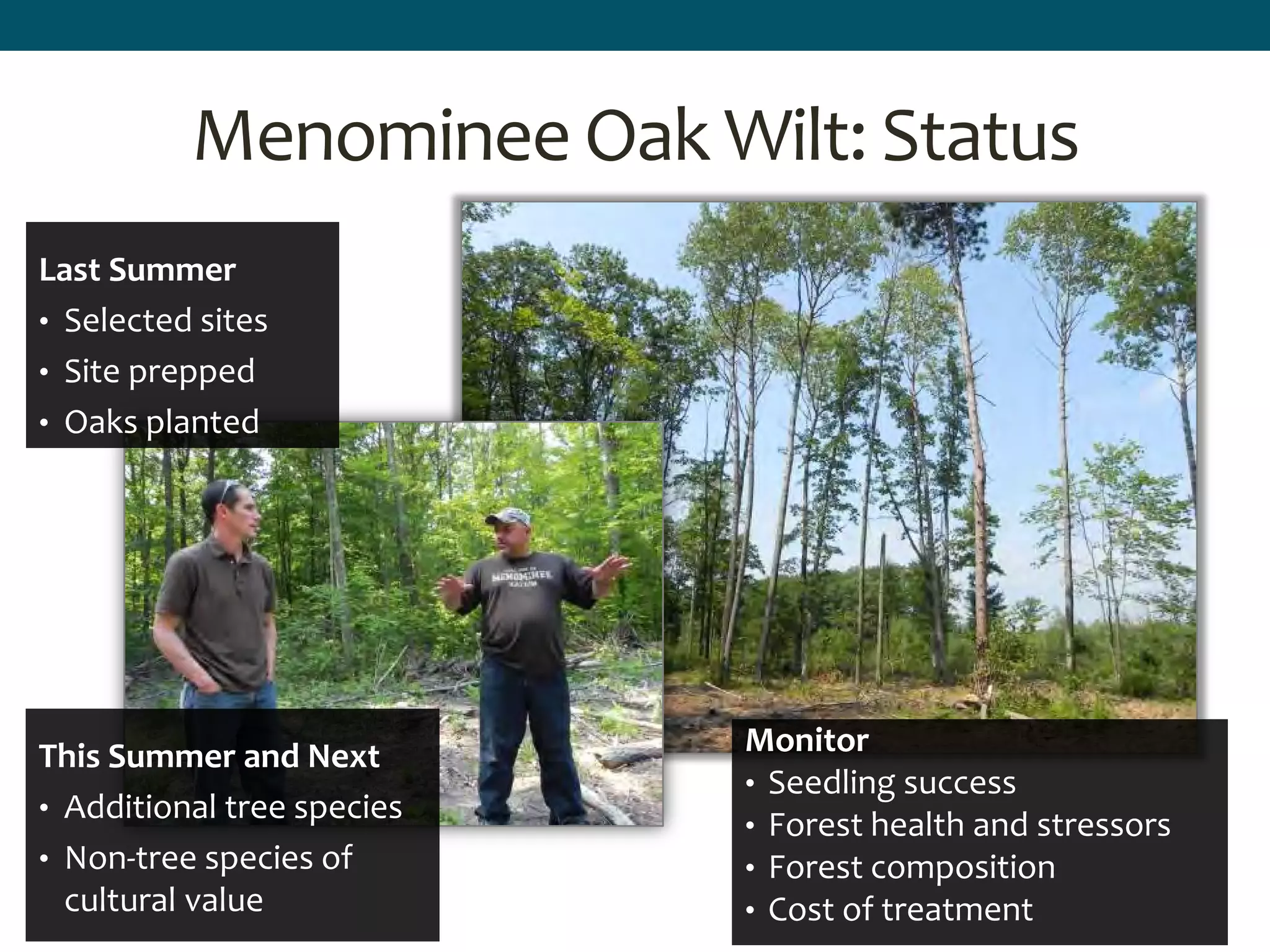
Menominee Oak Wilt: Status
Last Summer
• Selected sites
• Site prepped
• Oaks planted
Monitor
• Seedling success
• Forest health and stressors
• Forest composition
• Cost of treatment
This Summer and Next
• Additional tree species
• Non-tree species of
cultural value
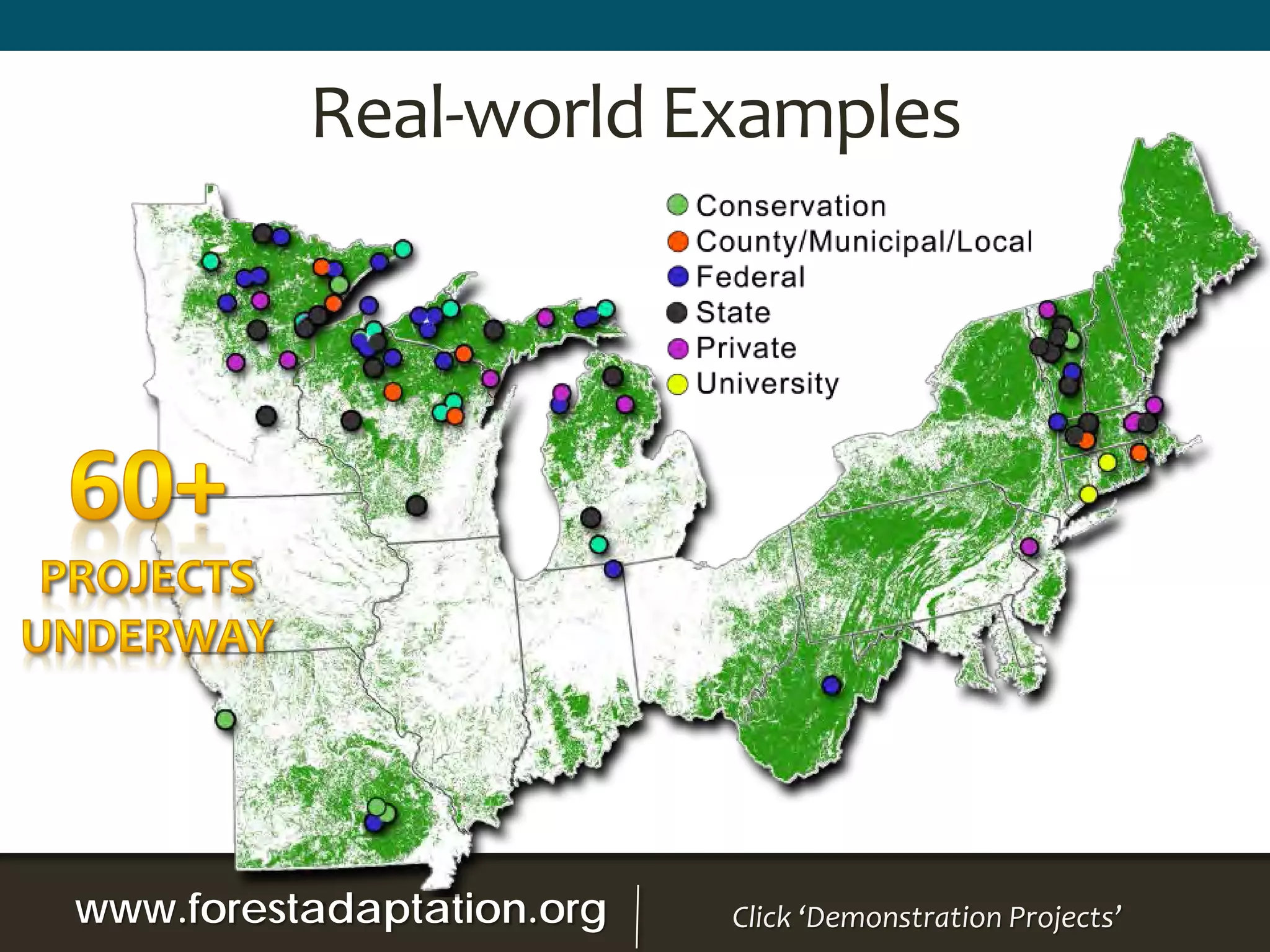
Real-world Examples
www.forestadaptation.org Click ‘Demonstration Projects’
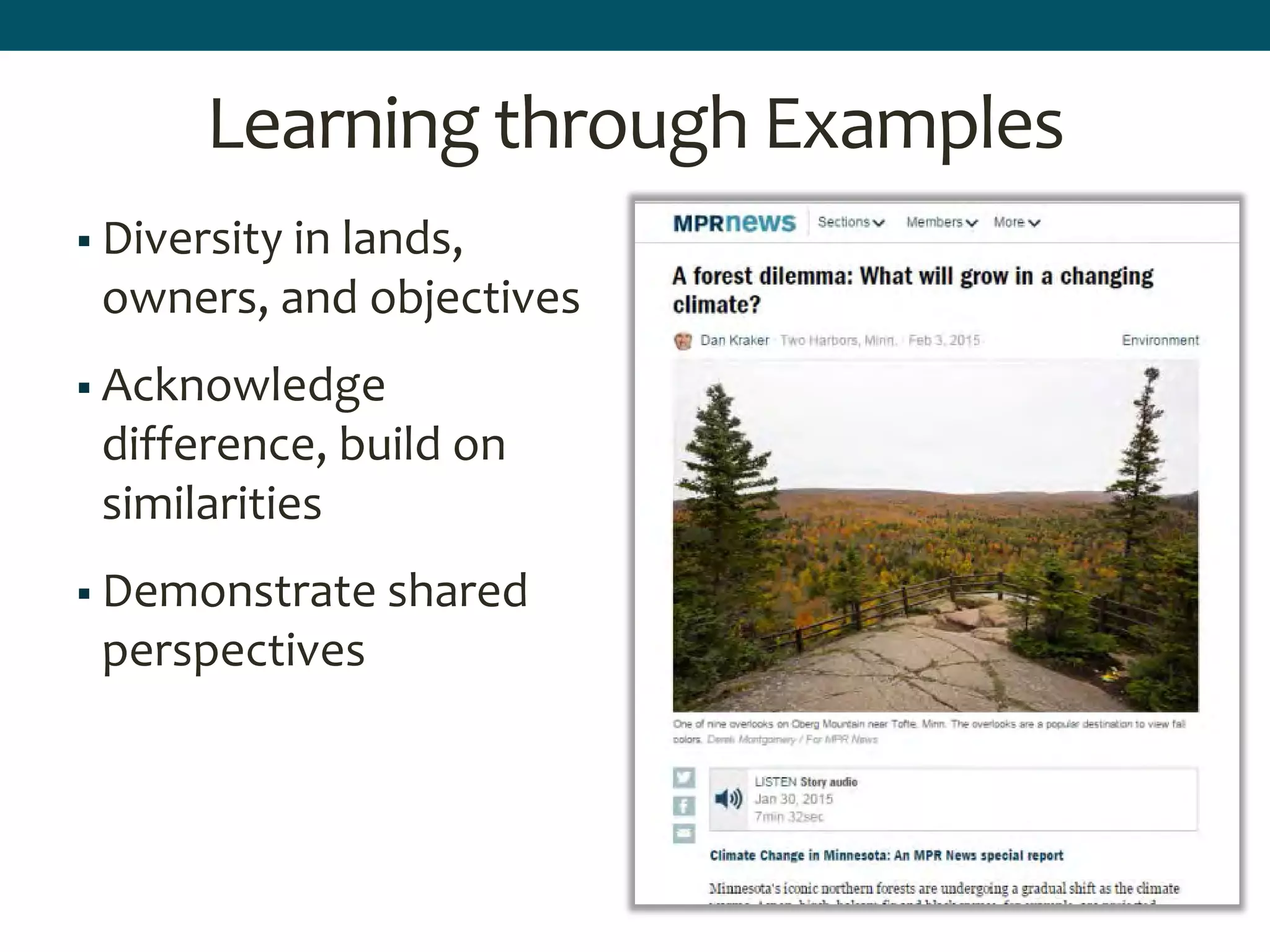
Learning through Examples
 Diversity in lands,
owners, and objectives
 Acknowledge
difference, build on
similarities
 Demonstrate shared
perspectives
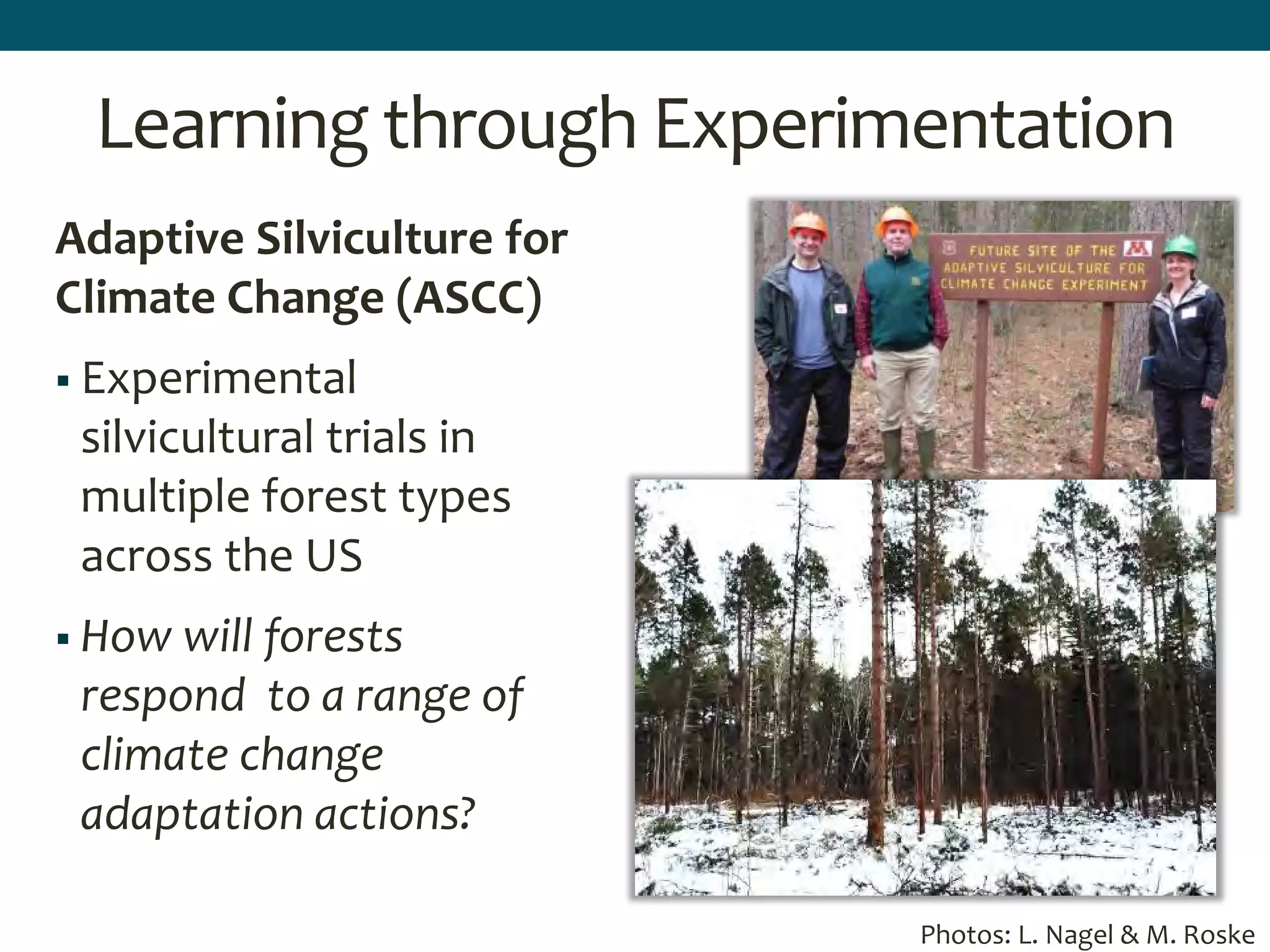
Learning through Experimentation
Adaptive Silviculture for
Climate Change (ASCC)
 Experimental
silvicultural trials in
multiple forest types
across the US
 How will forests
respond to a range of
climate change
adaptation actions?
Photos: L. Nagel & M. Roske
Using new information and ideas
Beginning to take small steps
Being creative and flexible
Working and learning with others
What does adaptation look like?
Atlas Timberlands
Management Goals
 Sustainable forestry
 Conservation
1
2
34
5 Step 1: DEFINE area of interest, management goals
and objectives, and time frames.
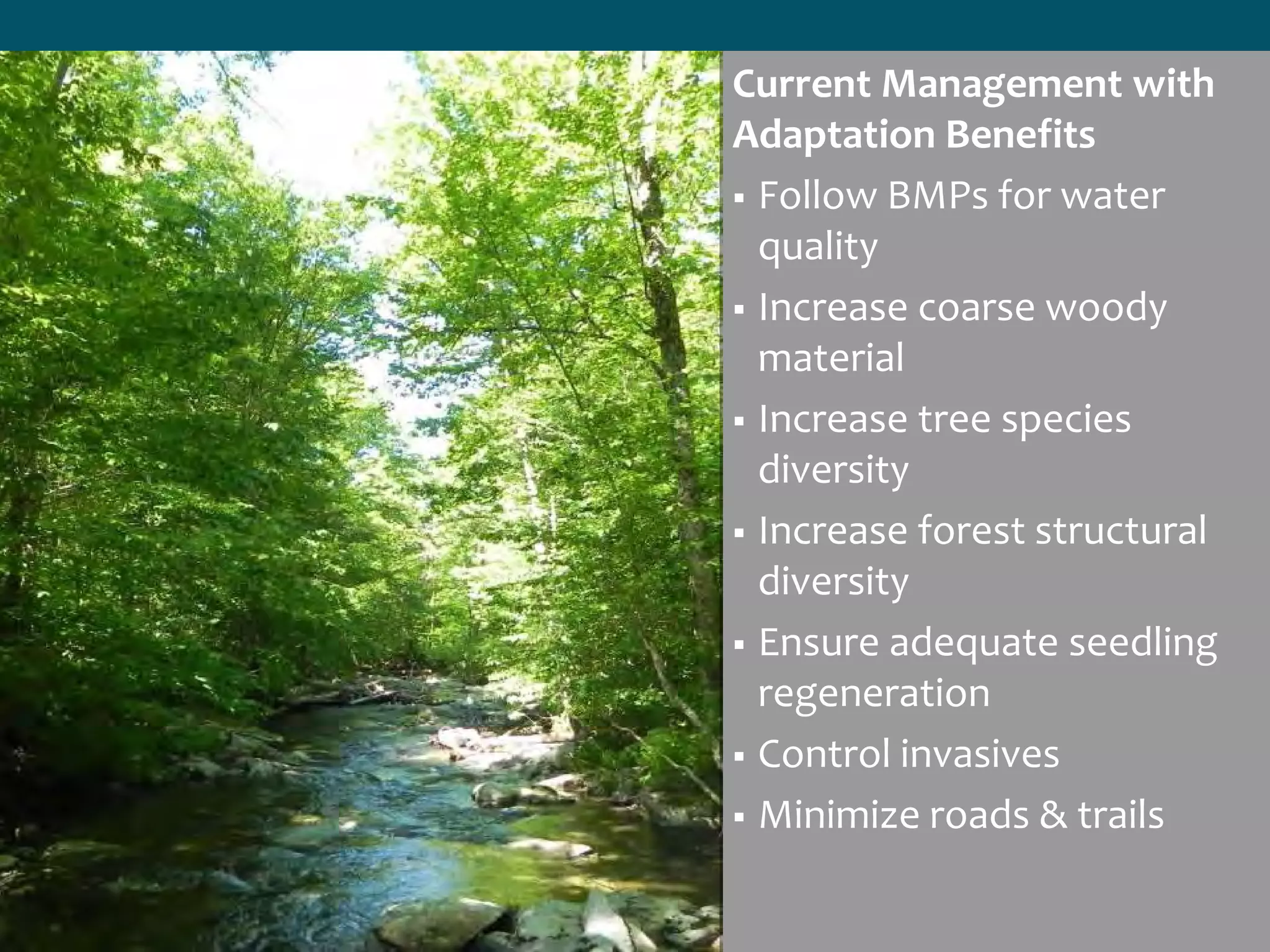
Current Management with
Adaptation Benefits
 Follow BMPs for water
quality
 Increase coarse woody
material
 Increase tree species
diversity
 Increase forest structural
diversity
 Ensure adequate seedling
regeneration
 Control invasives
 Minimize roads & trails
Challenge: Shorter and more variable winter
1
2
34
5 Step 2: ASSESS climate change impacts
Step 3: EVALUATE management objectives
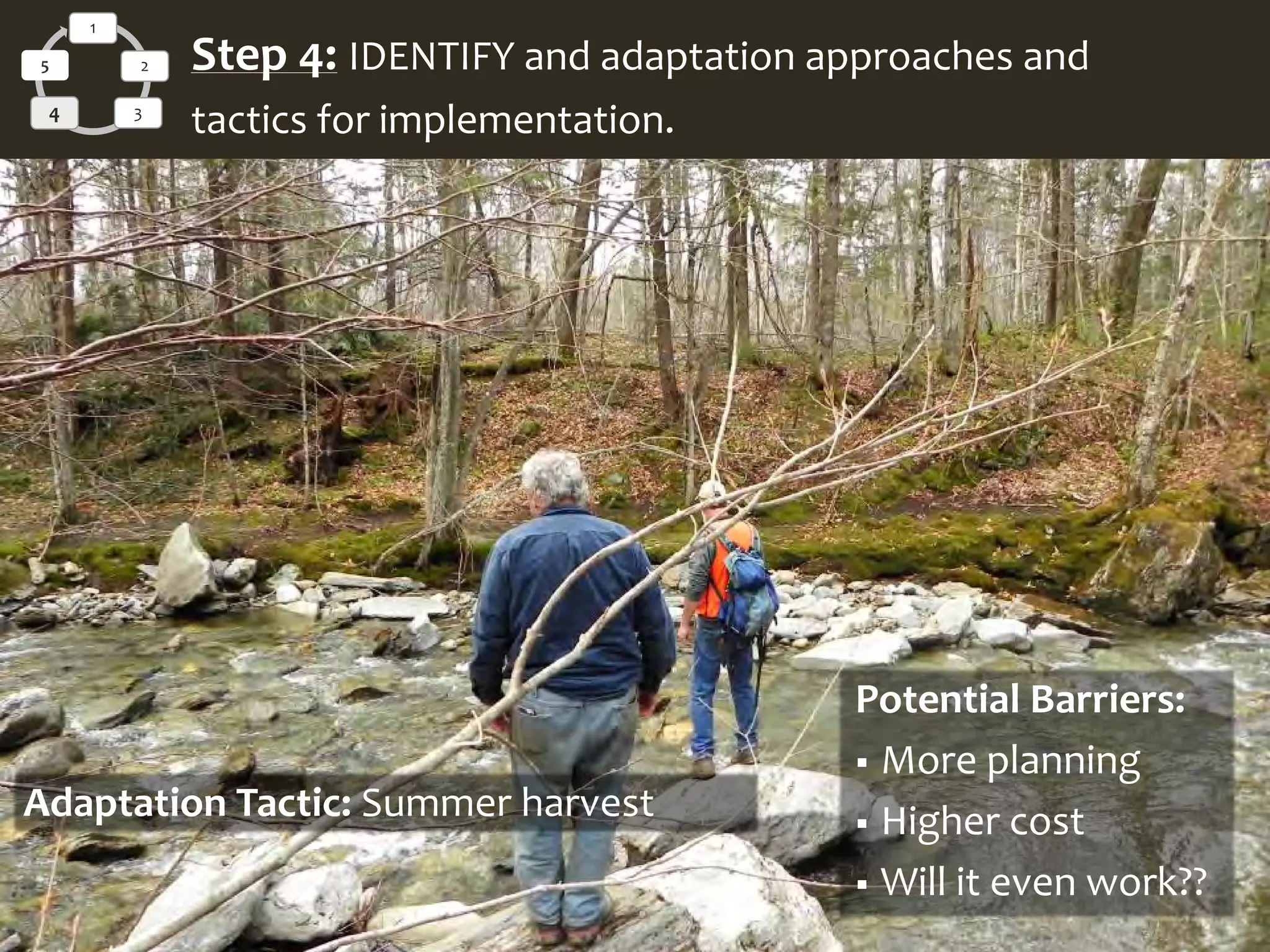
Potential Barriers:
 More planning
 Higher cost
 Will it even work??
Adaptation Tactic: Summer harvest
1
2
34
5 Step 4: IDENTIFY and adaptation approaches and
tactics for implementation.
Spring/Early Summer 2014
• Timber marking
• Road layout
• Pre-sale road work
• Temporary bridge installation
Harvested Summer 2014
(when the weather cooperated!)
1
2
34
5 Step 4: IDENTIFY and adaptation approaches and
tactics for implementation.
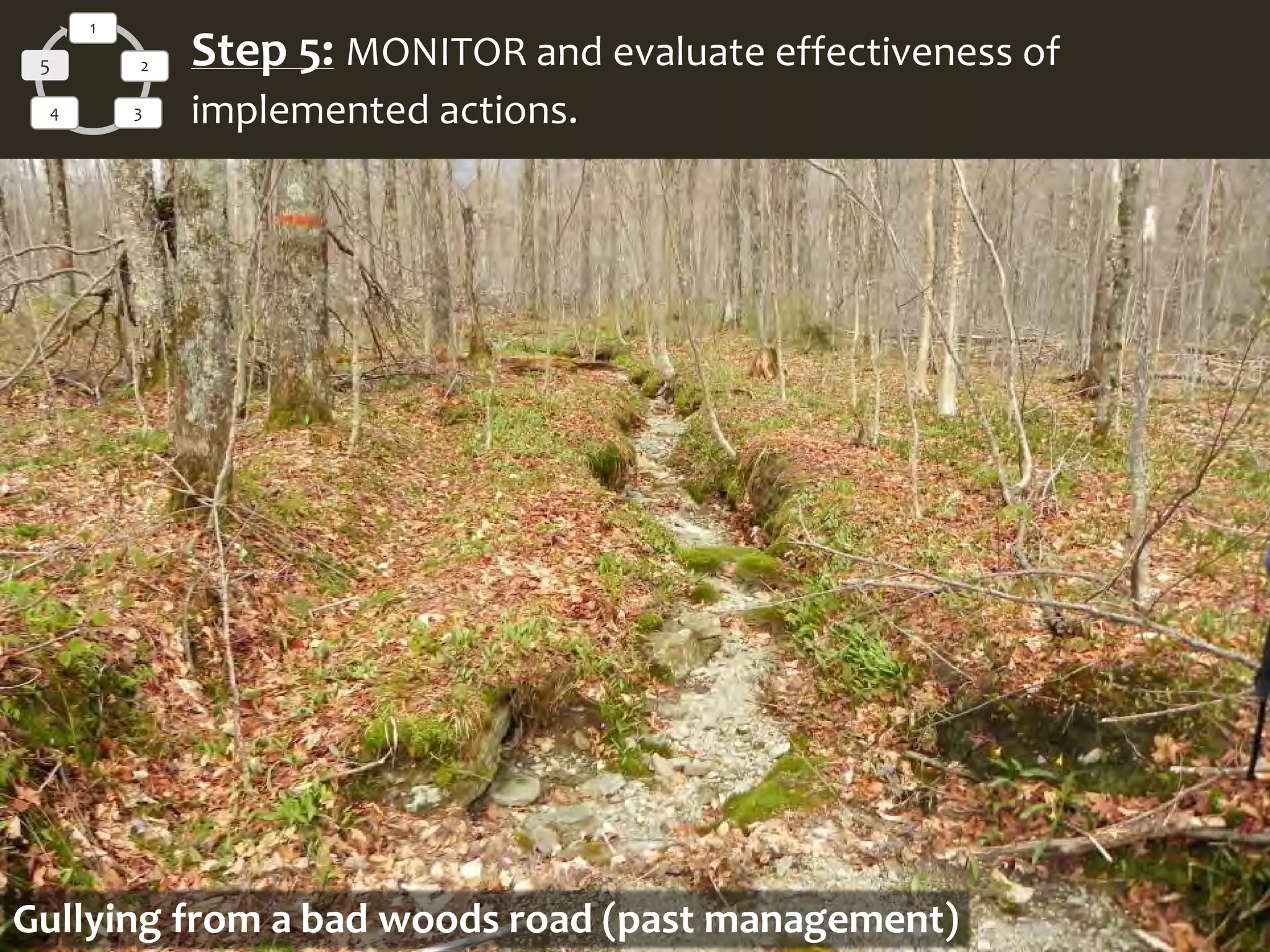
Gullying from a bad woods road (past management)
1
2
34
5 Step 5: MONITOR and evaluate effectiveness of
implemented actions.
CLIMATE CHANGE EFFECTS
ON NORTHEAST FOREST
ECOSYSTEMS & HABITATS
New England Synthesis
1) Introduction
2) Contemporary Landscape
3) Observed Climate Change
4)Future Climate Change
5) Impacts on Forests
6)Conclusions
Timeline = in progress,
draft this spring
How has climate changed
over the past century?
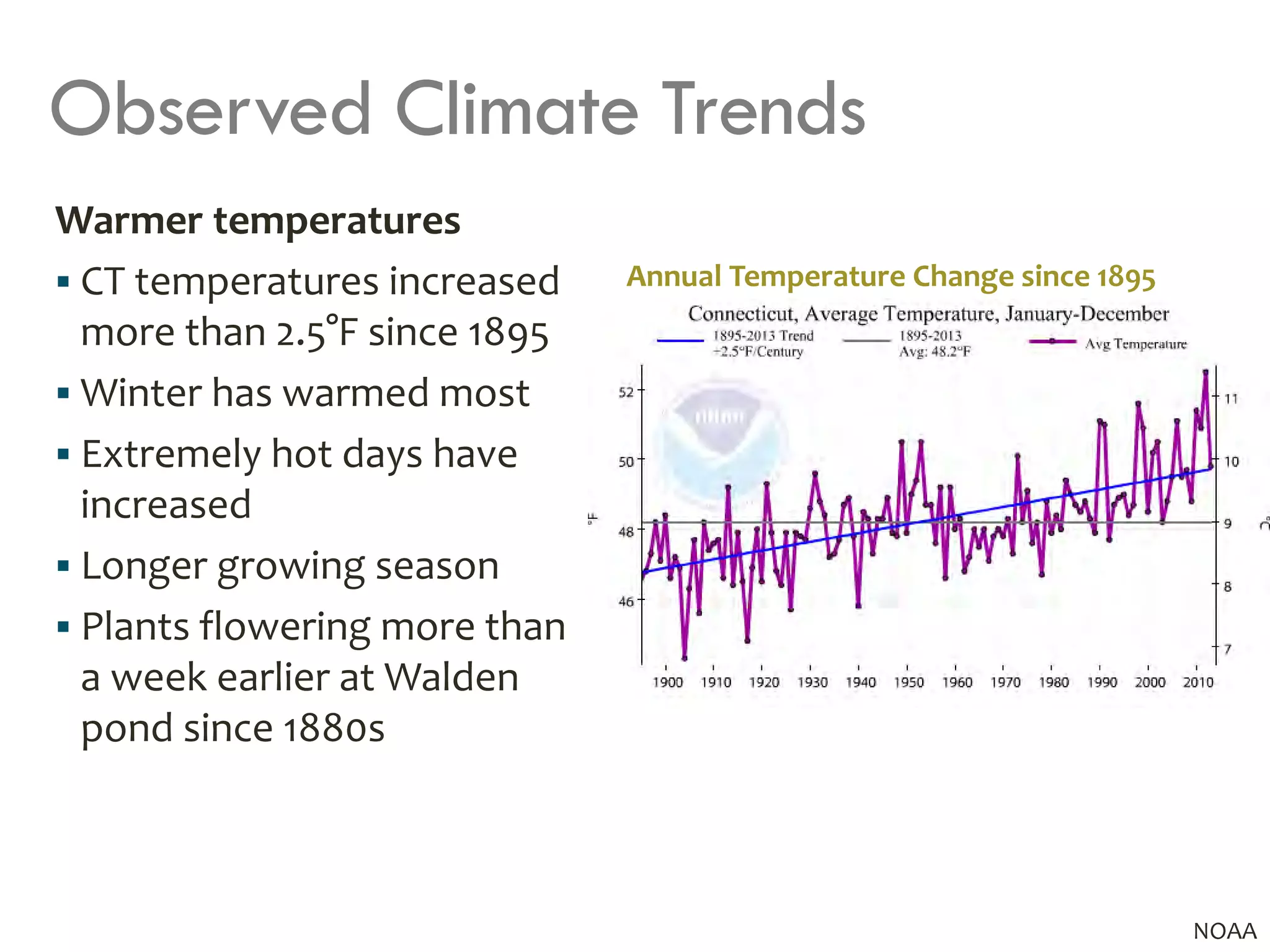
Observed Climate Trends
Warmer temperatures
 CT temperatures increased
more than 2.5°F since 1895
 Winter has warmed most
 Extremely hot days have
increased
 Longer growing season
 Plants flowering more than
a week earlier at Walden
pond since 1880s
Annual Temperature Change since 1895
NOAA
Winter
(Dec-Feb)
Summer
(Jun-Aug)
Spring
(Mar-May)
Fall
(Sep-Nov)
3.5°F 2.2°F
2.2°F 1.8 °F
Seasonal Mean Temperature Change
Observed Climate Trends
Altered Precipitation
 CT precipitation increased
nearly 3” since 1895
 Extremely high variability
from year to year
 Slight decrease in spring;
increase of 2” in fall
 Substantial increases in
extreme rain events: 71%
increase across northeast
since 1958
Annual Precipitation Change since 1895
Increase in
Extreme
Rain Events
since 1958
NOAA,
Melillo et
al. 2014
Annual Precipitation Change (1901-2011)
Precipitation
change (inches)
6.9 Inches
 0.06 inches per year = 6.9 inches over 110 years
 Substantial inter-annual fluctuation
Winter
(Dec-Feb)
Spring
(Mar-May)
Summer
(Jun-Aug)
Fall
(Sep-Nov)
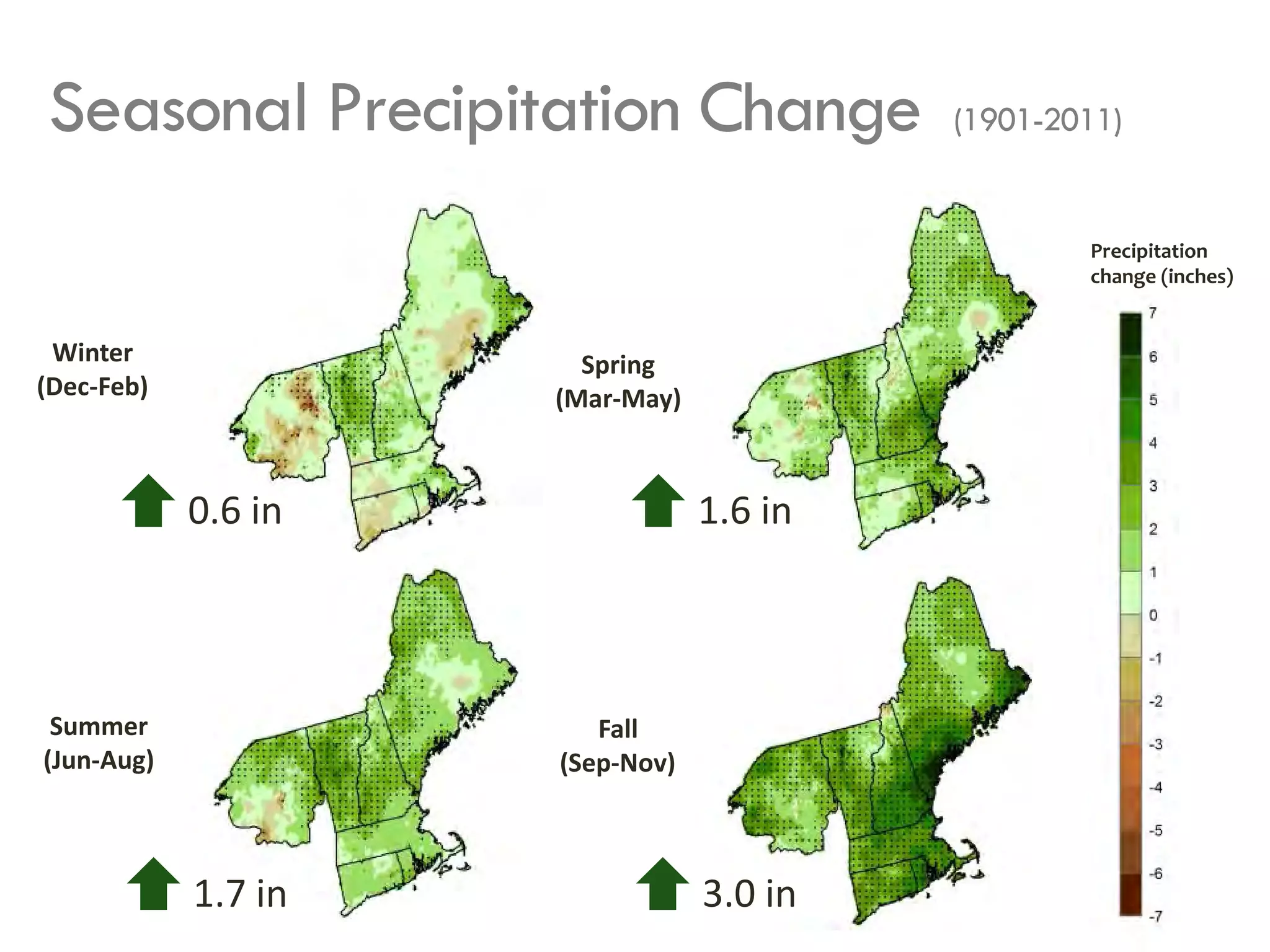
Seasonal Precipitation Change (1901-2011)
Precipitation
change (inches)
0.6 in 1.6 in
1.7 in 3.0 in
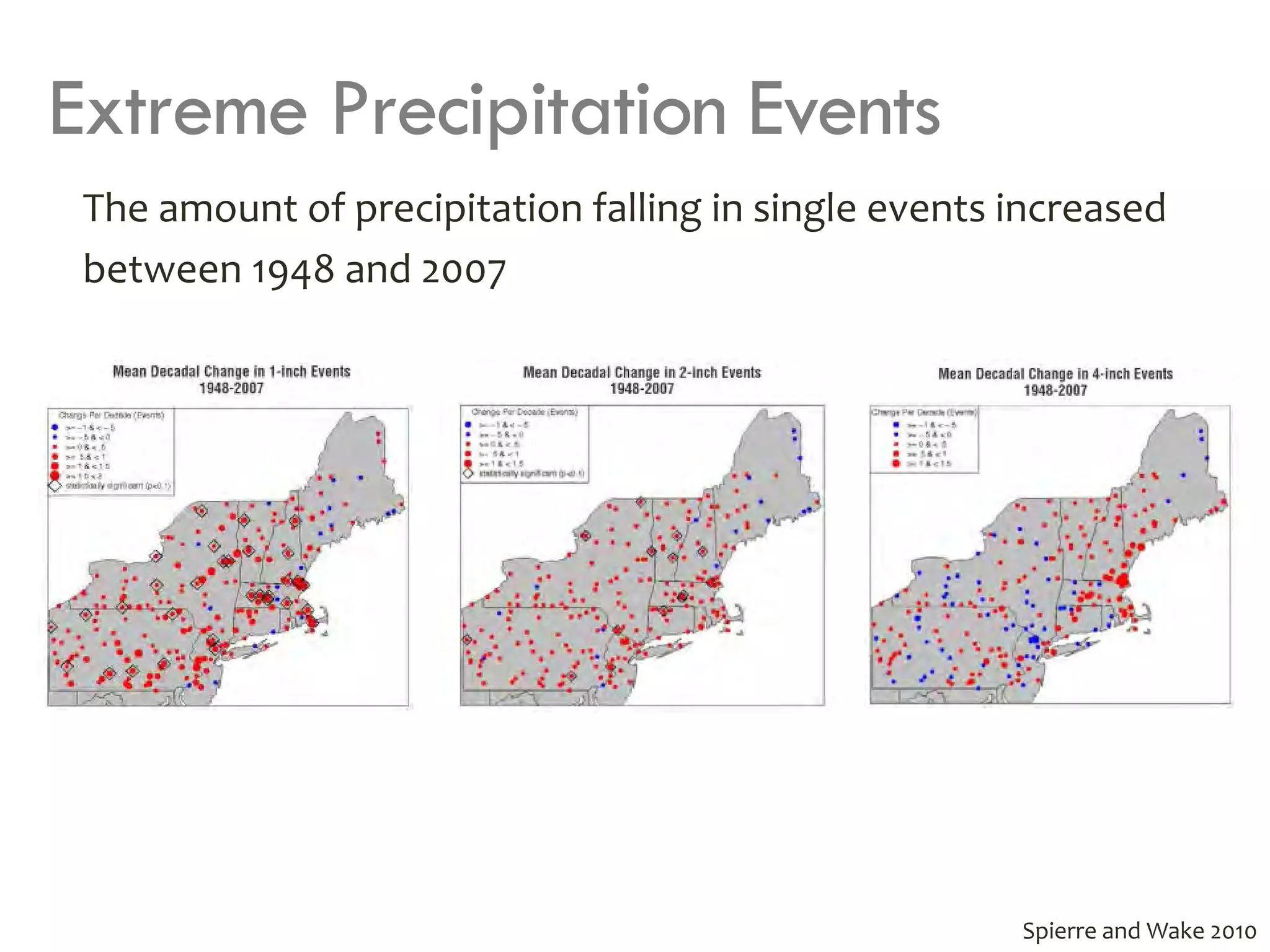
Extreme Precipitation Events
The amount of precipitation falling in single events increased
between 1948 and 2007
Spierre and Wake 2010
Sea-level Rise
Sea-level Rise
 Sea level rose about 1 foot since 1900
 Increases in coastal flooding
Horton et al. 2014 (NCA)
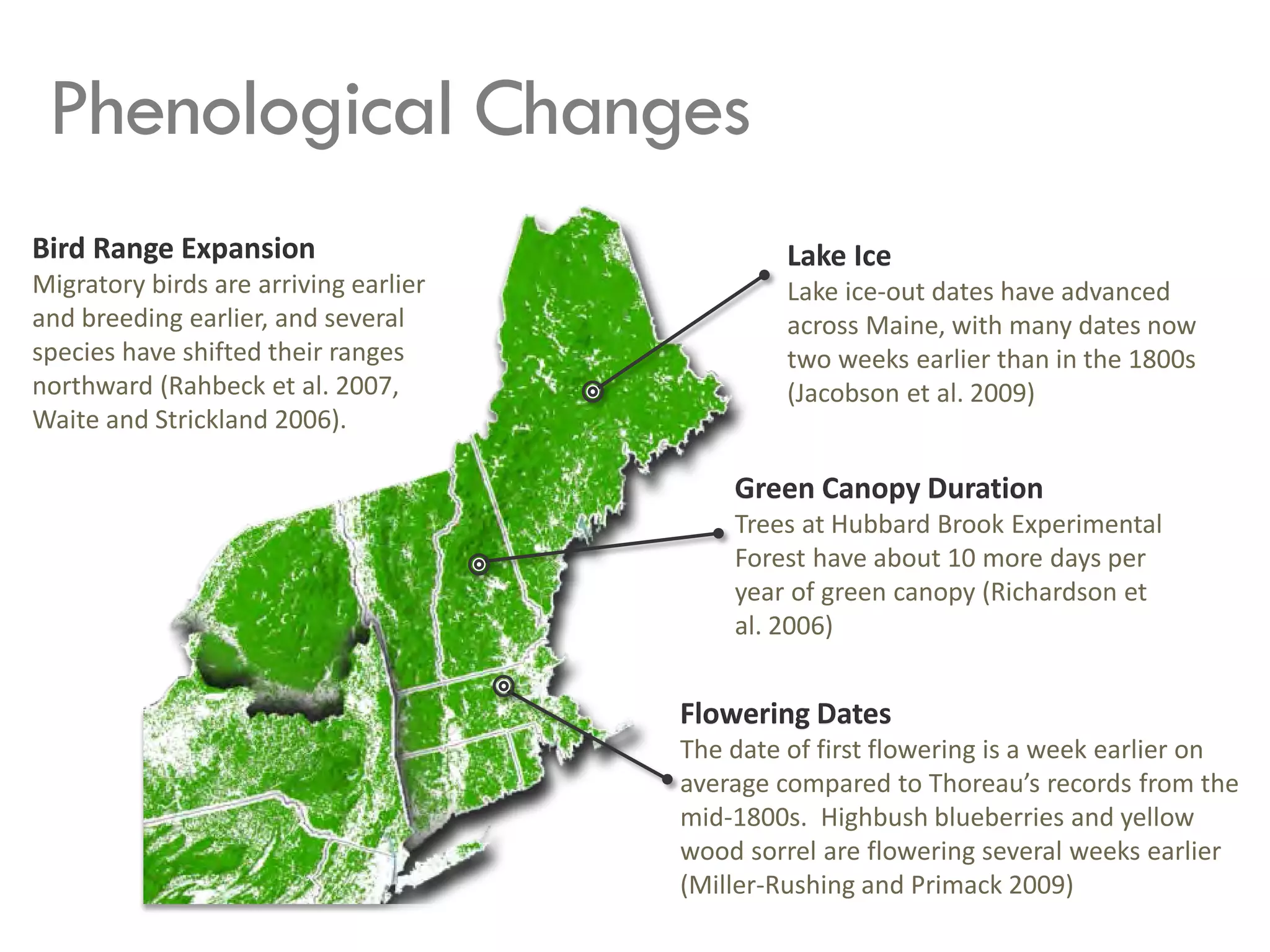
Green Canopy Duration
Trees at Hubbard Brook Experimental
Forest have about 10 more days per
year of green canopy (Richardson et
al. 2006)
Bird Range Expansion
Migratory birds are arriving earlier
and breeding earlier, and several
species have shifted their ranges
northward (Rahbeck et al. 2007,
Waite and Strickland 2006).
Flowering Dates
The date of first flowering is a week earlier on
average compared to Thoreau’s records from the
mid-1800s. Highbush blueberries and yellow
wood sorrel are flowering several weeks earlier
(Miller-Rushing and Primack 2009)
Lake Ice
Lake ice-out dates have advanced
across Maine, with many dates now
two weeks earlier than in the 1800s
(Jacobson et al. 2009)
Phenological Changes
How is the climate expected to
change over the next century?
How is the climate expected to
change over the next century?
Future Changes – inherent uncertainty
IPCC 2007
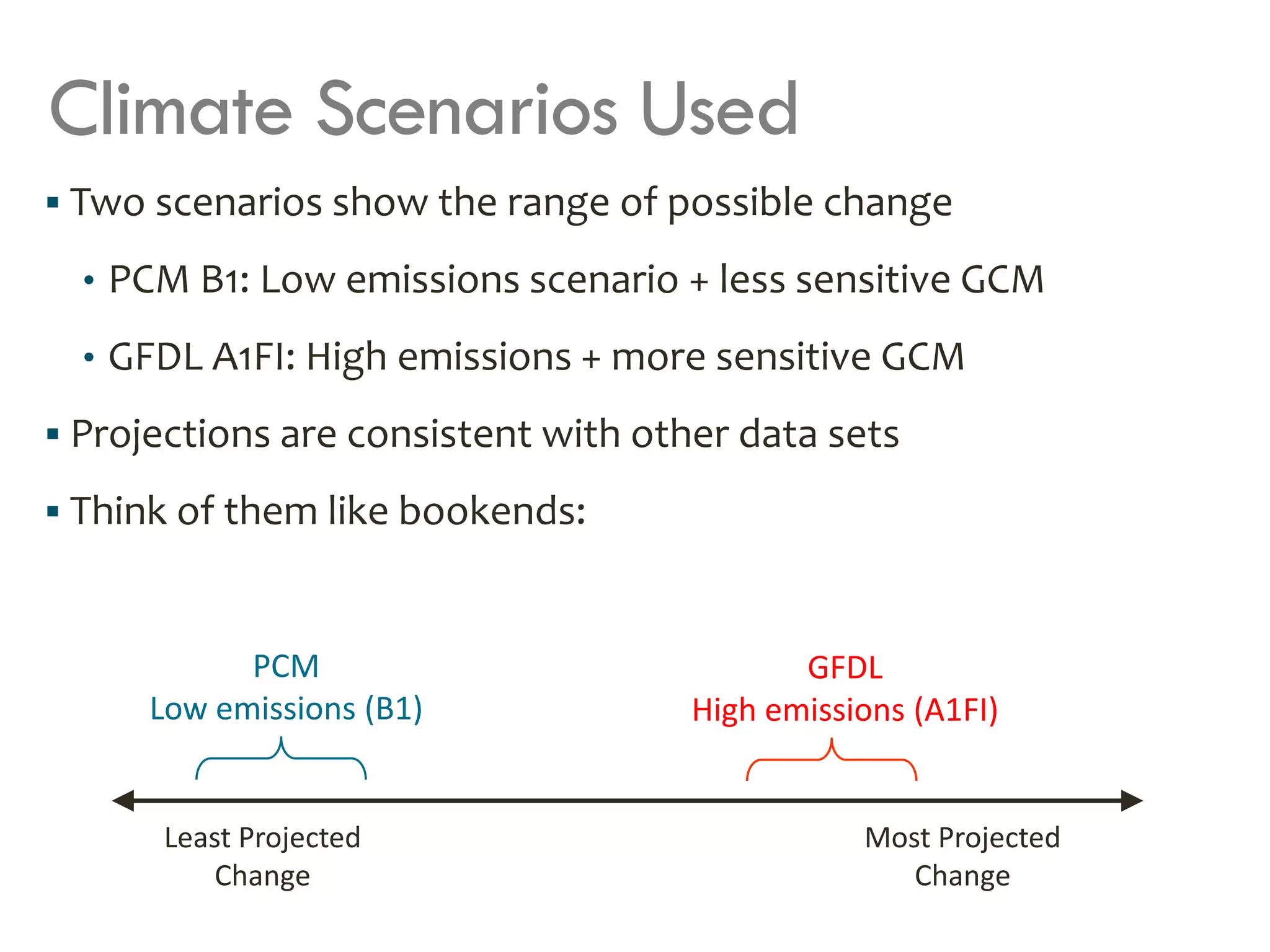
Climate Scenarios Used
 Two scenarios show the range of possible change
• PCM B1: Low emissions scenario + less sensitive GCM
• GFDL A1FI: High emissions + more sensitive GCM
 Projections are consistent with other data sets
 Think of them like bookends:
Least Projected
Change
Most Projected
Change
PCM
Low emissions (B1)
GFDL
High emissions (A1FI)
Temperature Change Projections
Kunkel et al. 2013
Entire Northeast Region
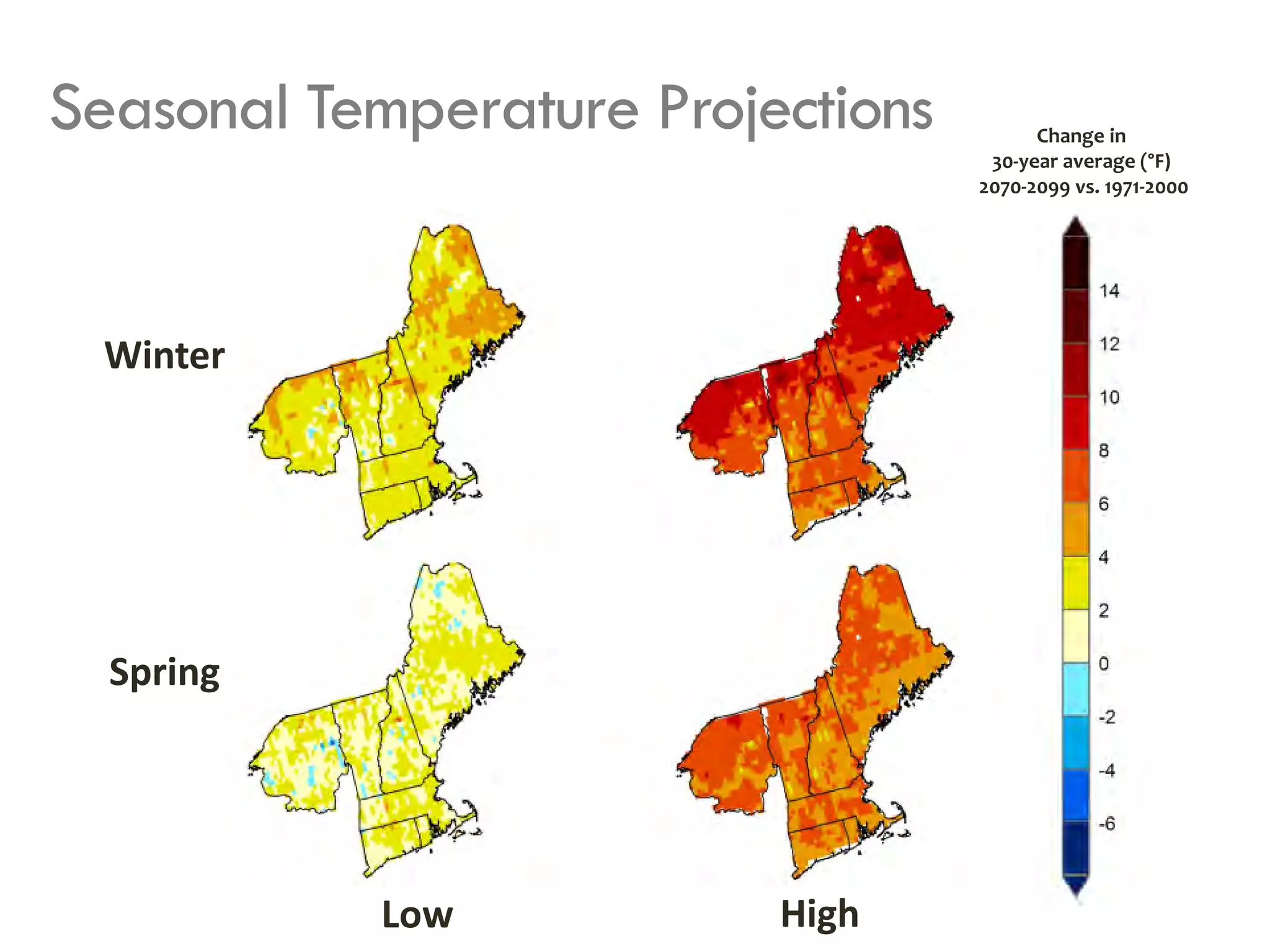
Seasonal Temperature Projections
Spring
Winter
Change in
30-year average (°F)
2070-2099 vs. 1971-2000
Low High
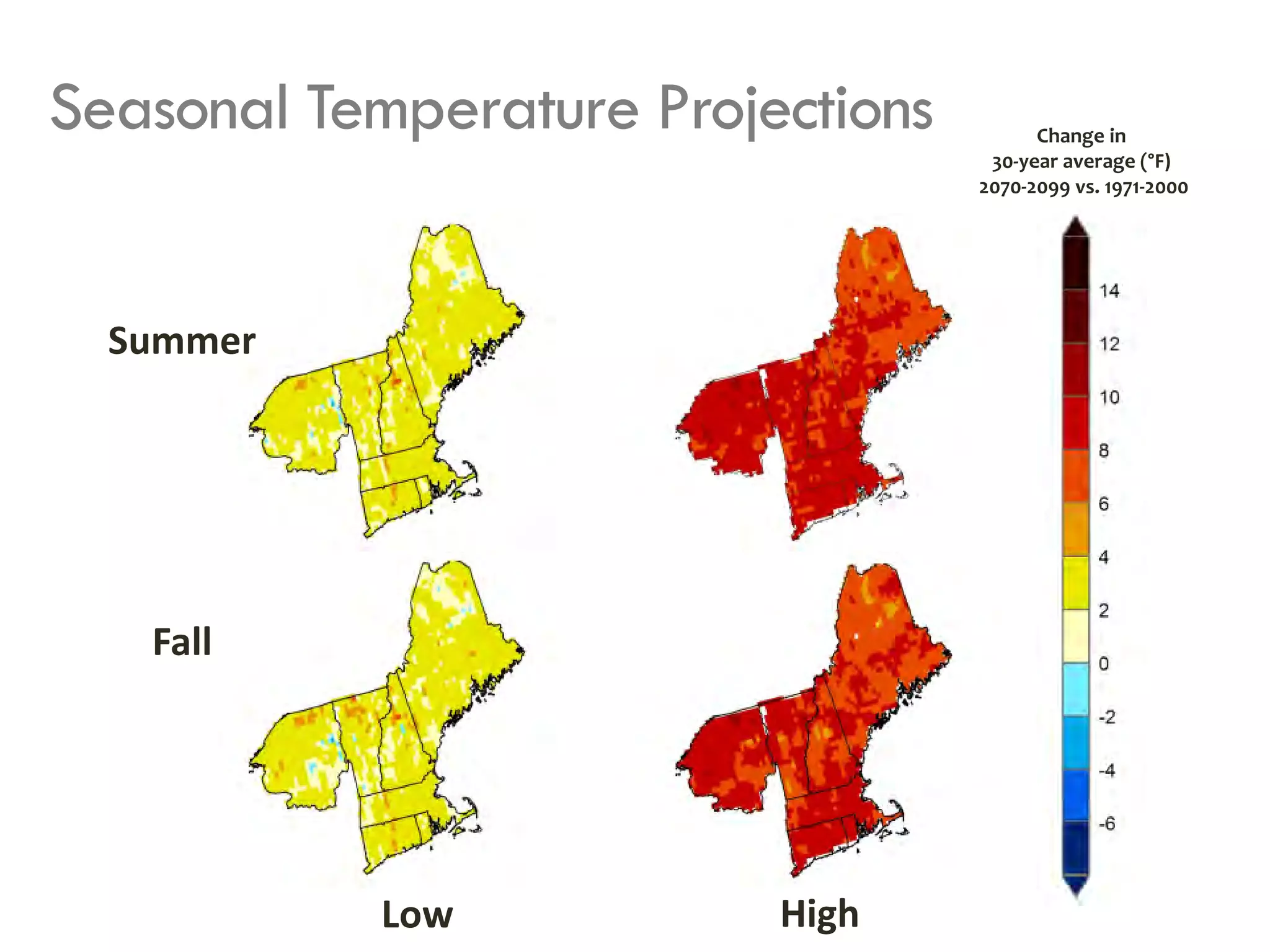
Seasonal Temperature Projections Change in
30-year average (°F)
2070-2099 vs. 1971-2000
Low High
Fall
Summer
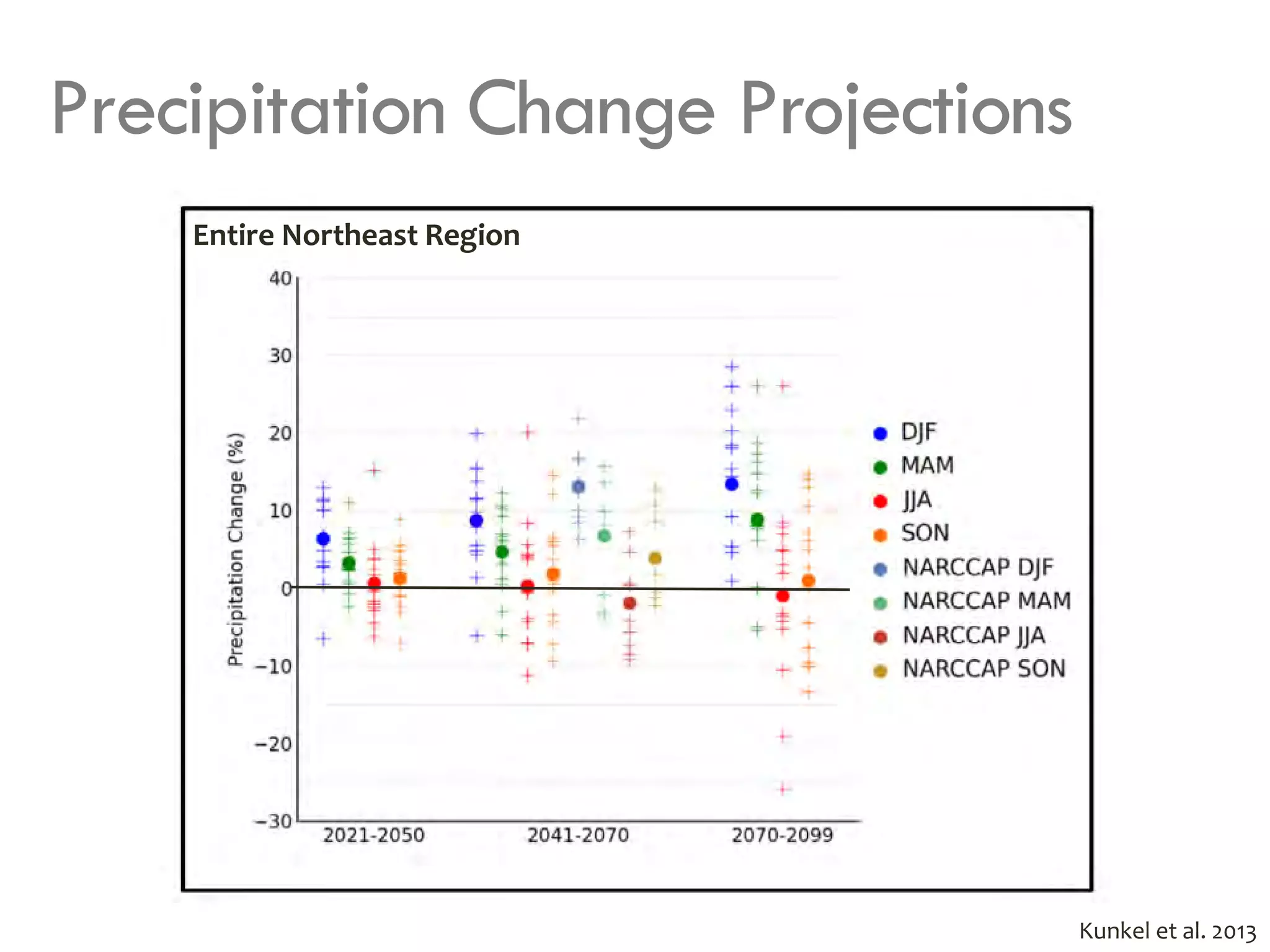
Precipitation Change Projections
Kunkel et al. 2013
Entire Northeast Region
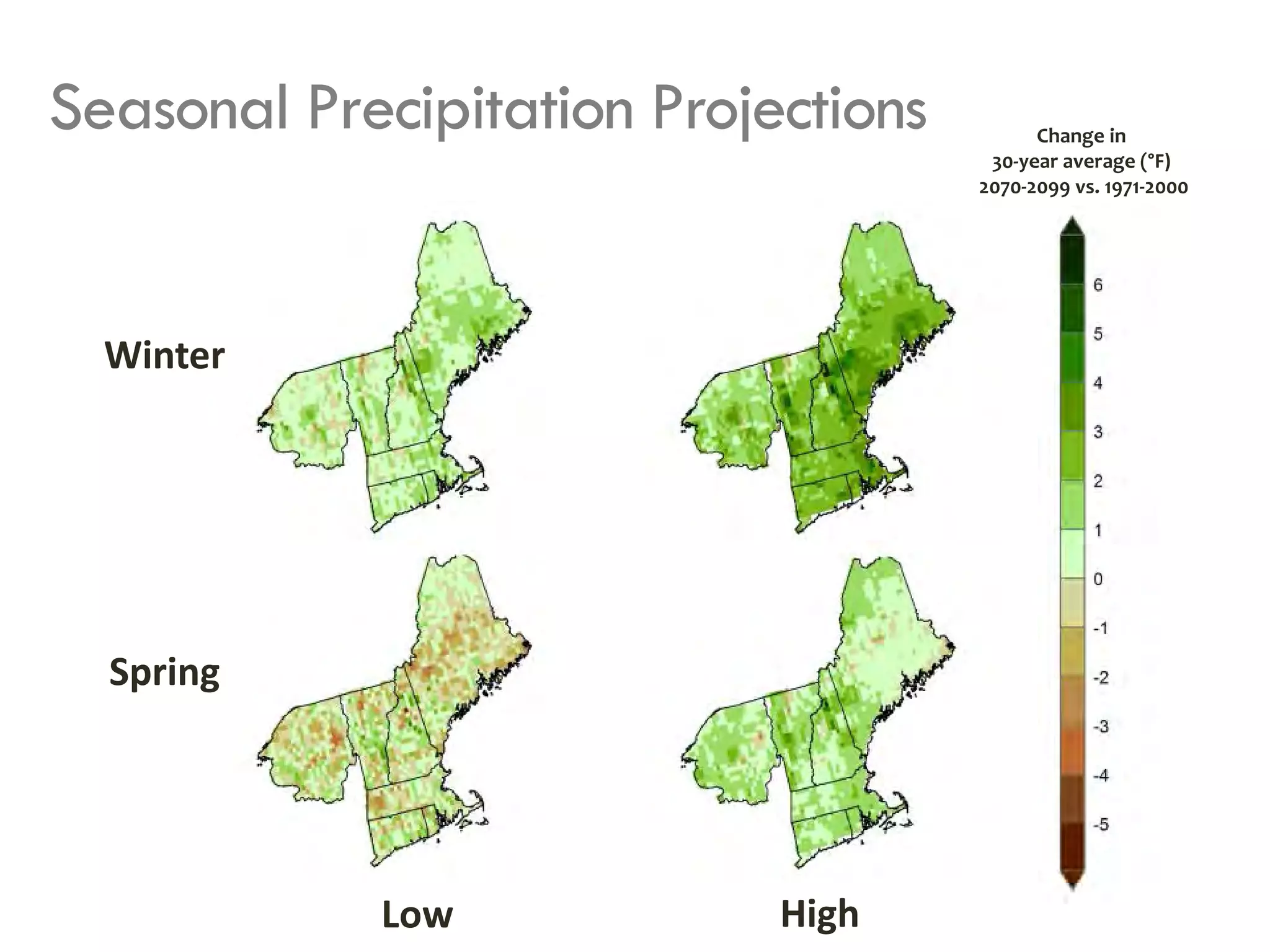
Seasonal Precipitation Projections
Spring
Winter
Change in
30-year average (°F)
2070-2099 vs. 1971-2000
Low High
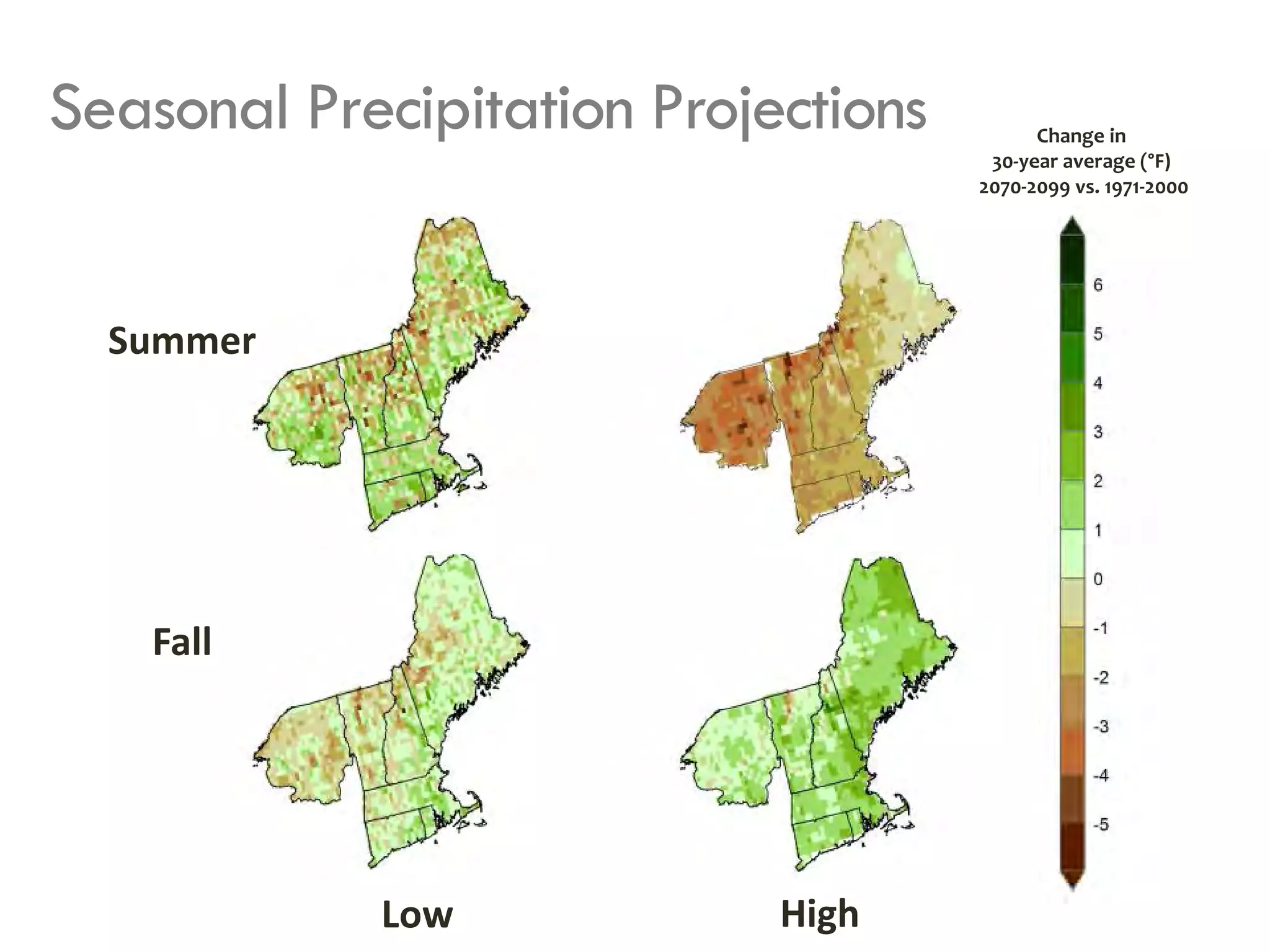
Seasonal Precipitation Projections Change in
30-year average (°F)
2070-2099 vs. 1971-2000
Low High
Fall
Summer
Extreme Precipitation Events
 Extreme precipitation has increased dramatically
• Precip in heaviest 1% of events increased 71% between 1958 to 2012
 Trend expected to continue/increase
Change in 2-inch Precipitation Events (late 21st century)
B1 A2
Kunkel et al. 2013; Figure: Center for Climatic Change, http://ccr.aos.wisc.edu/resources/data_scripts/LCC/
Change: 2” Precip
Events per Decade
Anticipated Climate Changes
Warmer temperatures
 3-9°F increase annually
Altered precipitation
 High variability: slight
decrease to more than
15% increase
 Generally increasing in
winter & spring
 Potential decreases or
less substantial increases
in summer & fall
 More extreme rain
Sea-level Rise
 12 to 23” by end of century
CT DEEP 2011, Climatewizard.org
How could ecosystems be affected?
9 WAYS THAT
CLIMATE CHANGE
WILL AFFECT FORESTS
A Synthesis of Anticipated Impacts
Climate Change Impacts
1) Longer Growing Season
2) Shorter Winters
3) Potential for Summer Drought
4) CO2 Fertilization
5) Changes in Suitable Habitat
6) Extreme Events
7) Wildfire Risk
8) Forest Pests and Diseases
9) Invasive Plants
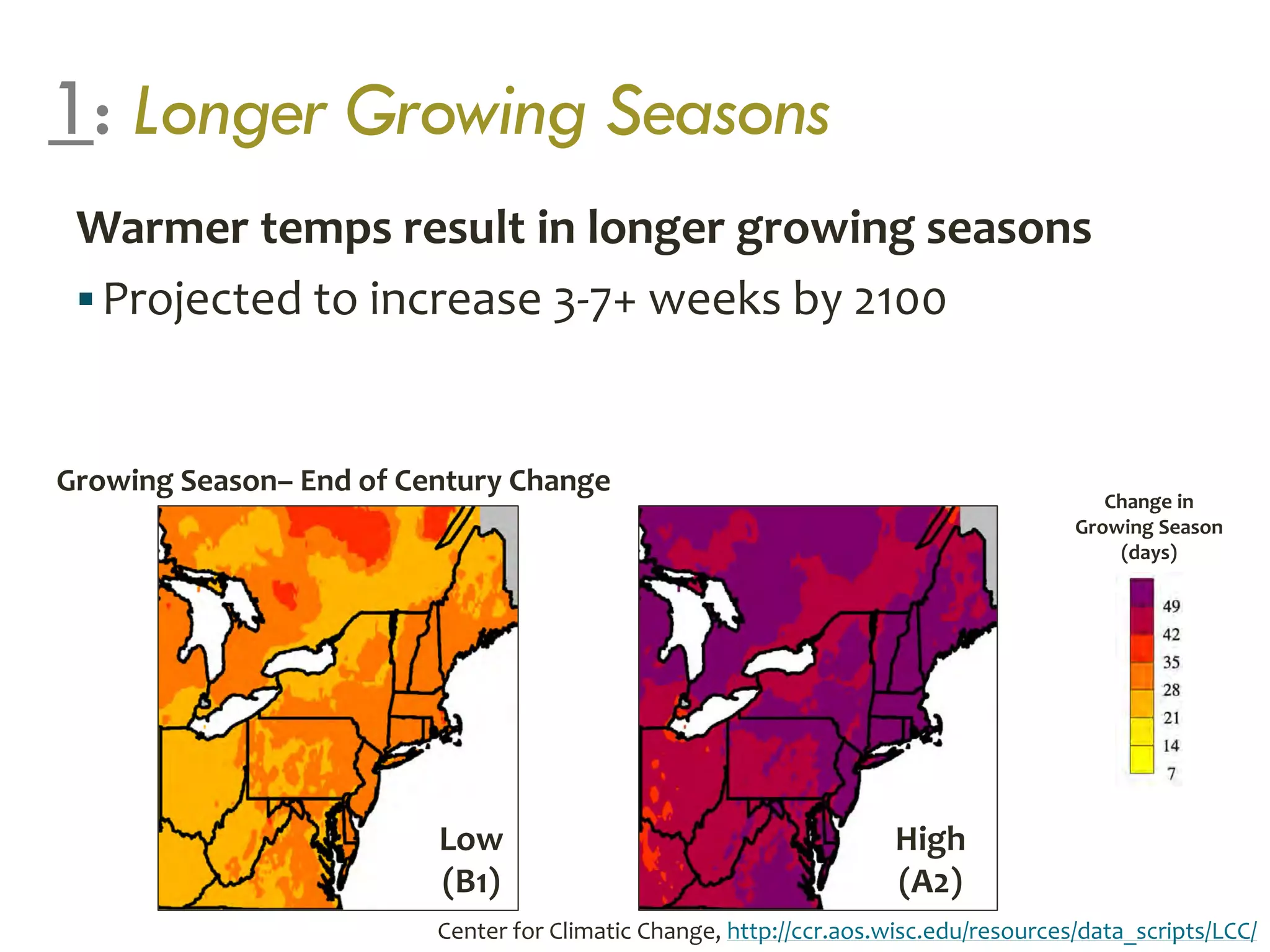
1: Longer Growing Seasons
Warmer temps result in longer growing seasons
Projected to increase 3-7+ weeks by 2100
Growing Season– End of Century Change
Center for Climatic Change, http://ccr.aos.wisc.edu/resources/data_scripts/LCC/
Change in
Growing Season
(days)
Low
(B1)
High
(A2)
1: Longer Growing Season
Warmer temps result in longer growing seasons
 Evidence of phenological shifts
 Projected to increase 3-7+ weeks
Longer period for plant growth
Melillo et al. 2014, Nelson Center 2014
1: Longer Growing Season
Warmer temps result in longer growing seasons
 Projected to increase 3-7+ weeks
 Evidence of phenological shifts
Longer period for plant growth
Potential risks:
 Early bud break/loss of cold hardening
 Frost damage during spring freezing
Melillo et al. 2014, Nelson Center 2014
2: Shorter Winter (Less Snow)
Projected decreases in snow fall, cover, and depth
 30-70% decreases in snowfall
 Greatest snowfall decreases in December or January
Percent change in snowfall (late 21st century)
Notaro et al. 2014; Figure: Center for Climatic Change, http://ccr.aos.wisc.edu/resources/data_scripts/LCC/
Percent Change
in Snowfall
Low
(B1)
High
(A2)
2: Shorter Winter (Less Snow)
Decreased snowpack
 Increased soil frost and root damage in cold temps
 Warmer soil temperatures and altered processes
Wisconsin Frozen Ground
Source: C. Rittenhouse (UConn) and A. Rissman (UW-Madison), in review
Frozen Ground Season
Annual data
Trend
Frozen Ground Days
Annual data
Trend
2: Shorter Winter (Less Snow, More Rain)
Precipitation is projected
to increase = more rain
Dale et al 2001, Huntingon 2004, Parmesan 2006
2: Shorter Winter (Less Snow, More Rain)
Precipitation is projected
to increase = more rain
Altered streamflow
timing and amount
 Earlier spring peak flows
 Potential increases in
flashiness and episodic
high flows
 Potential declines in
summer seasonal stream
flow
Dale et al 2001, Huntingon 2004, Parmesan 2006
3: Potential for Summer Drought
Greater uncertainty about future precipitation, but increased
risk of summer moisture stress
Water loss from soils
(evaporation)
Water loss from trees
(transpiration)
Groundwater
recharge
Runoff
Precipitation
3: Potential for Summer Drought
Greater uncertainty about future precipitation, but increased
risk of summer moisture stress
Water loss from soils
(evaporation)
Water loss from trees
(transpiration)
Groundwater
recharge
Runoff
Precipitation
Warmer
temps
increase
water loss
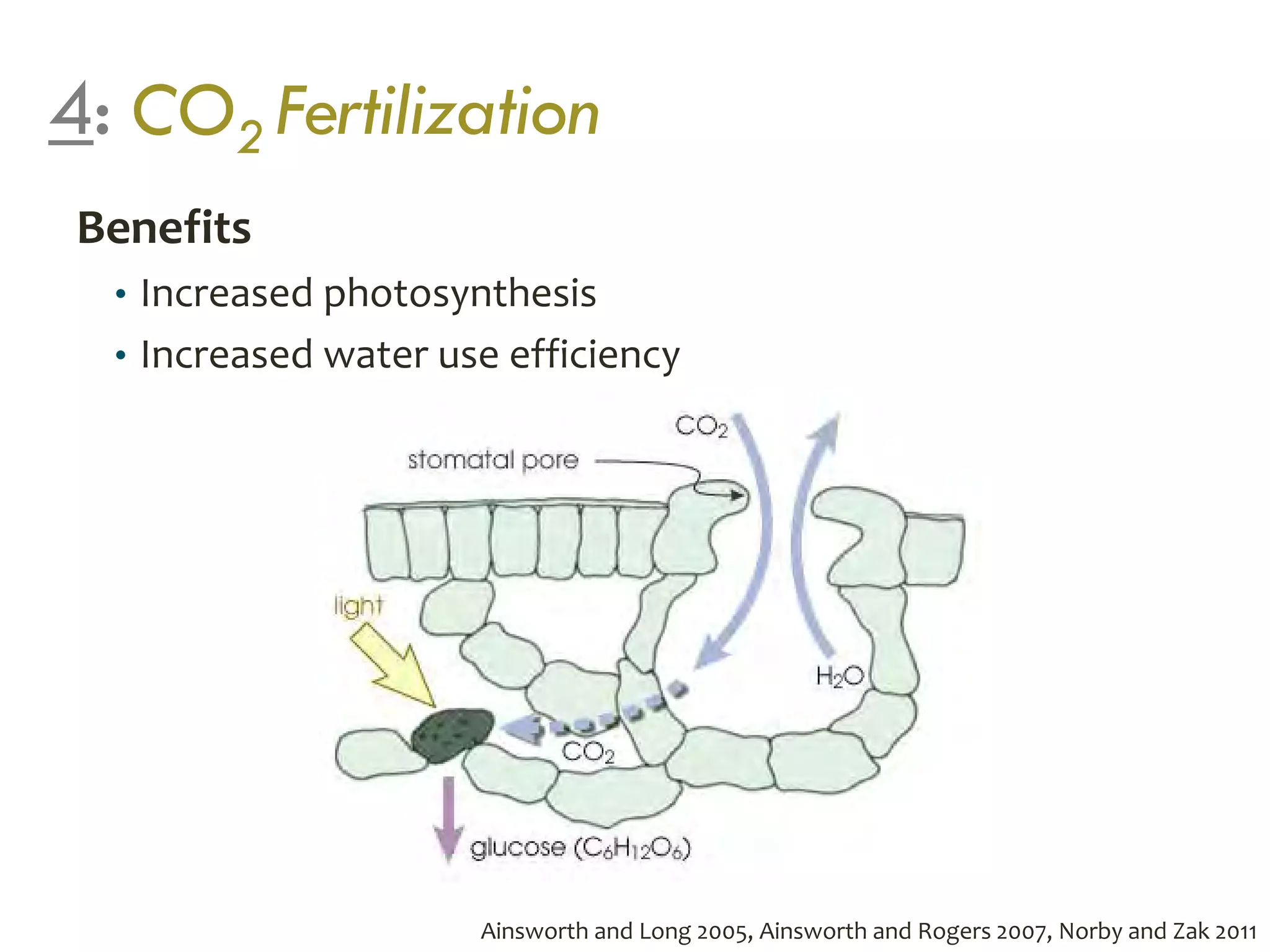
4: CO2 Fertilization
Benefits
• Increased photosynthesis
• Increased water use efficiency
Ainsworth and Long 2005, Ainsworth and Rogers 2007, Norby and Zak 2011
4: CO2 Fertilization
Limits to CO2 fertilization
• Varies by species and site
• Nutrient deficiencies (especially N)
• Sensitive to ozone pollution
• Limited sink strength
• Limited evidence of long-term
sequestration
• Any productivity increases may be
offset by reductions from increased
drought stress or disturbance
Ainsworth and Long 2005, Ainsworth and Rogers 2007, Norby and Zak 2011
5: Changes in Suitable Habitat
Habitat based on:
Temperature
Precipitation
Elevation
Latitude
Soils
Slope & Aspect
Land use
Competition
Past management
5: Changes in Suitable Habitat
Habitat based on:
Temperature
Precipitation
Elevation
Latitude
Soils
Slope & Aspect
Land use
Competition
Past management
Climate Change Atlas:
What happens to tree and bird
habitat when climate changes?
•134 Trees
•147 Birds
Iverson et al. 2008; Atlas website: www.fs.fed.us/nrs/atlas/
www.fs.fed.us/nrs/atlas/
5: Changes in Suitable Habitat
Habitat based on:
Temperature
Precipitation
Elevation
Latitude
Soils
Slope & Aspect
White Pine: Current Habitat (modeled)
www.fs.fed.us/nrs/atlas/
5: Changes in Suitable Habitat
Habitat based on:
Temperature
Precipitation
Elevation
Latitude
Soils
Slope & Aspect
White Pine: Current Habitat (modeled)
PCM B1 (Less Change) GFDL A1FI (More Change)
www.fs.fed.us/nrs/atlas/
5: Changes in Suitable Habitat
Habitat based on:
Temperature
Precipitation
Elevation
Latitude
Soils
Slope & Aspect
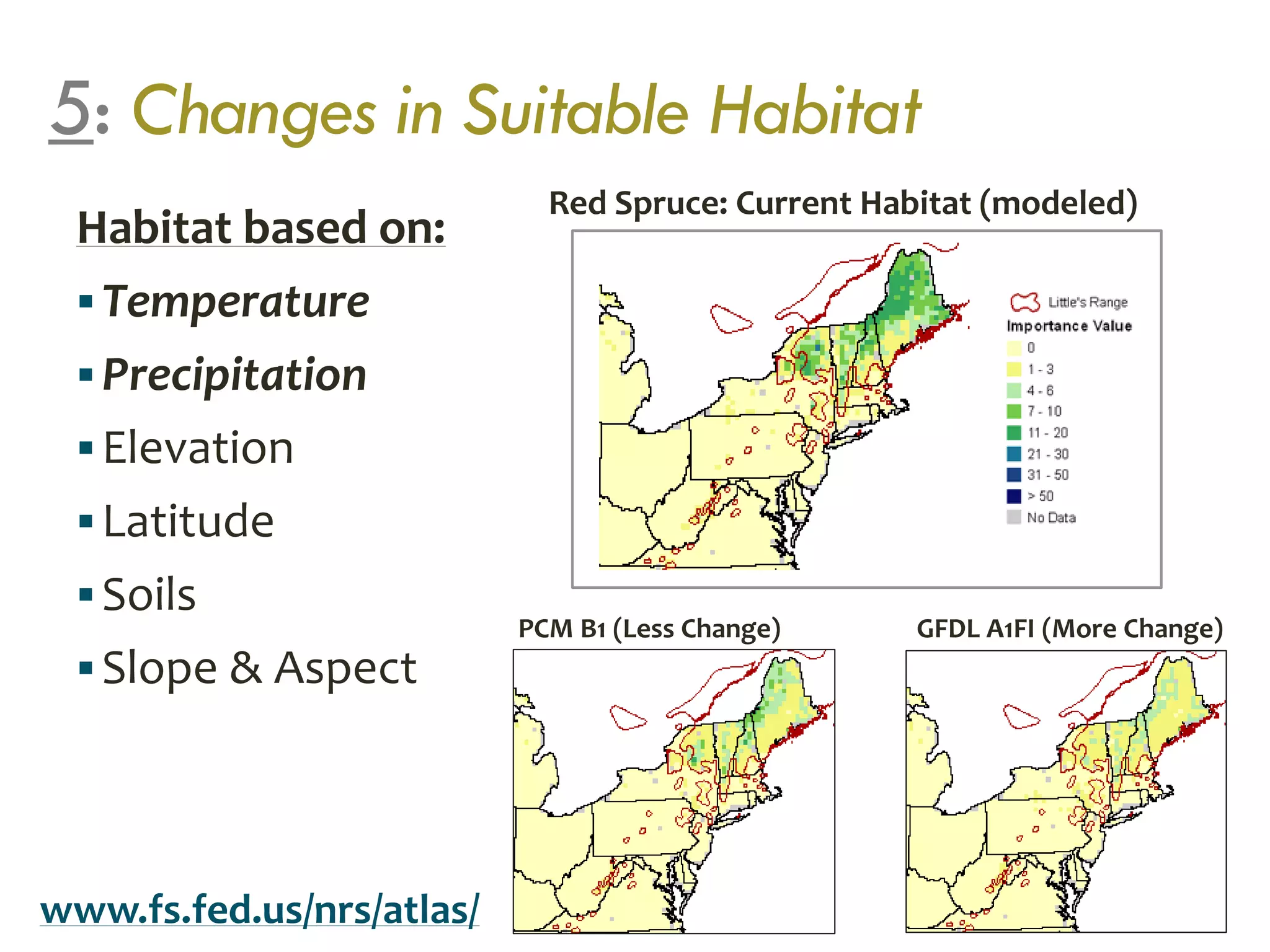
Red Spruce: Current Habitat (modeled)
PCM B1 (Less Change) GFDL A1FI (More Change)
www.fs.fed.us/nrs/atlas/
5: Changes in Suitable Habitat
Habitat based on:
Temperature
Precipitation
Elevation
Latitude
Soils
Slope & Aspect
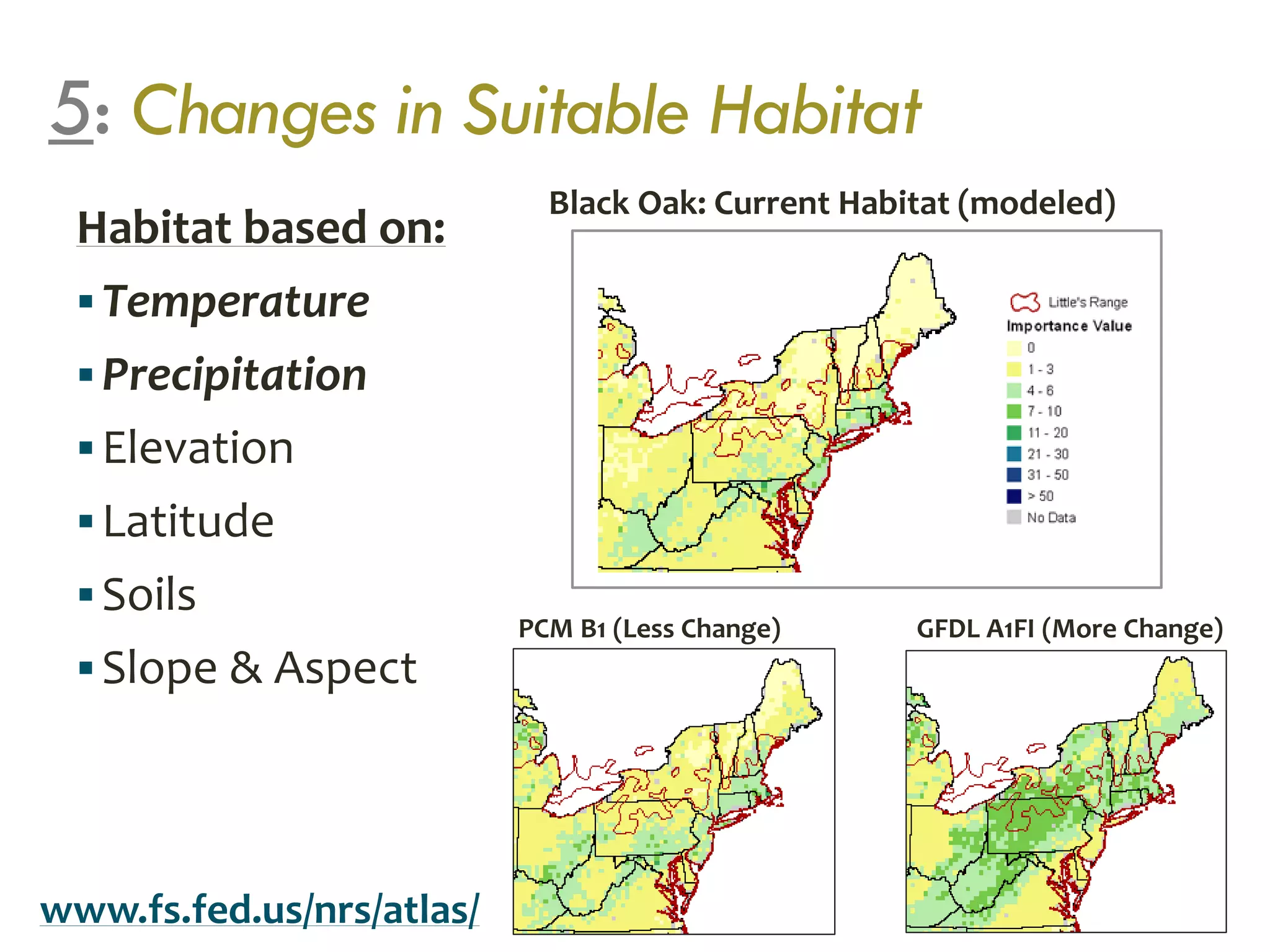
Black Oak: Current Habitat (modeled)
PCM B1 (Less Change) GFDL A1FI (More Change)
www.fs.fed.us/nrs/atlas/
5: Changes in Suitable Habitat
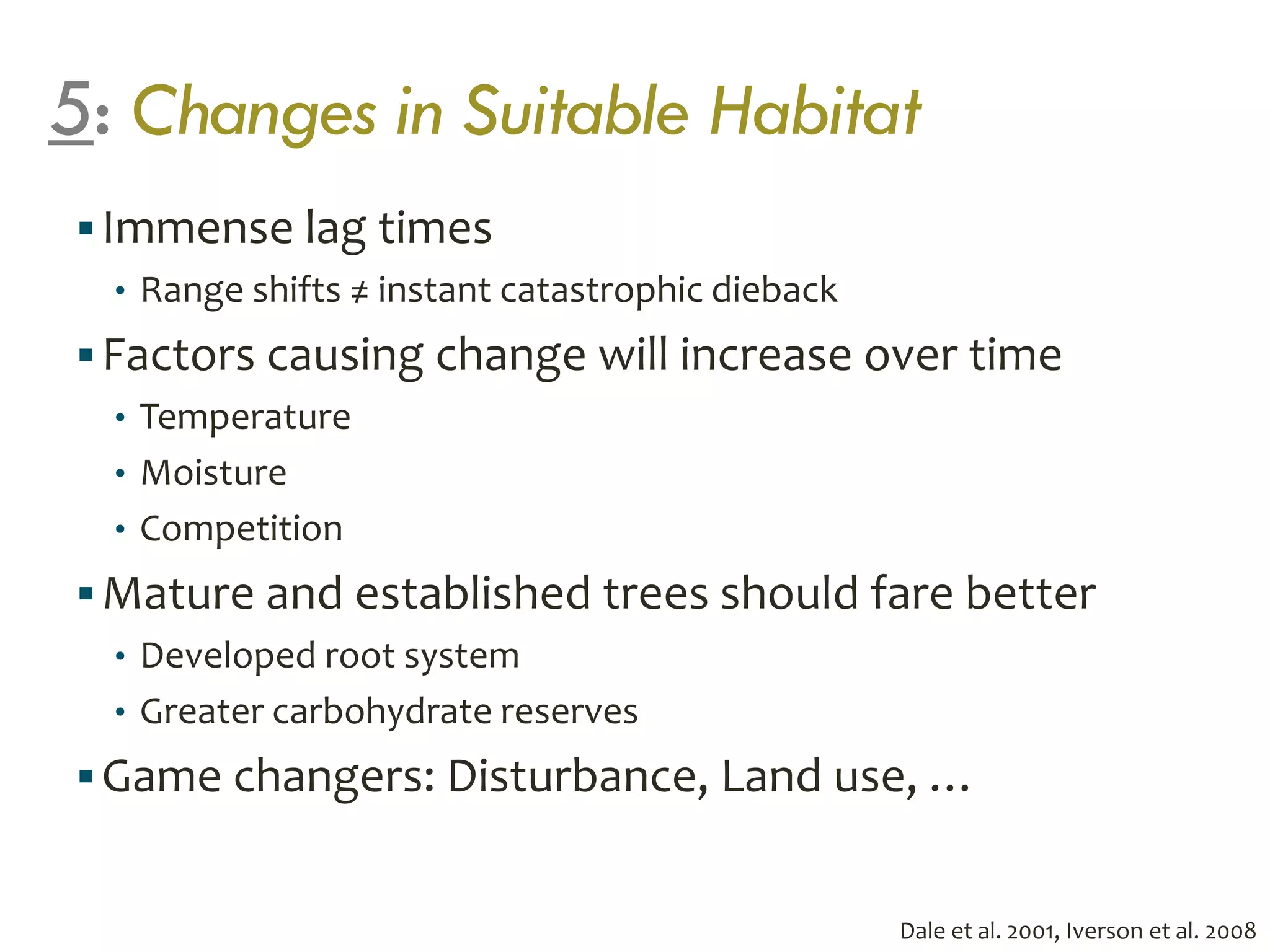
Immense lag times
• Range shifts ≠ instant catastrophic dieback
Factors causing change will increase over time
• Temperature
• Moisture
• Competition
Mature and established trees should fare better
• Developed root system
• Greater carbohydrate reserves
Game changers: Disturbance, Land use, …
Dale et al. 2001, Iverson et al. 2008
5: Changes in Suitable Habitat
Use the Climate Change Atlas to:
 Evaluate how suitable habitat may change for species
• Species more likely to decline or increase
• Consider multiple scenarios
• Consider local conditions and anticipated impacts
 Identify factors driving the modeled changes
 Generate ideas for potential future-adapted species
Dale et al. 2001, Iverson et al. 2008
5: Changes in Suitable Habitat
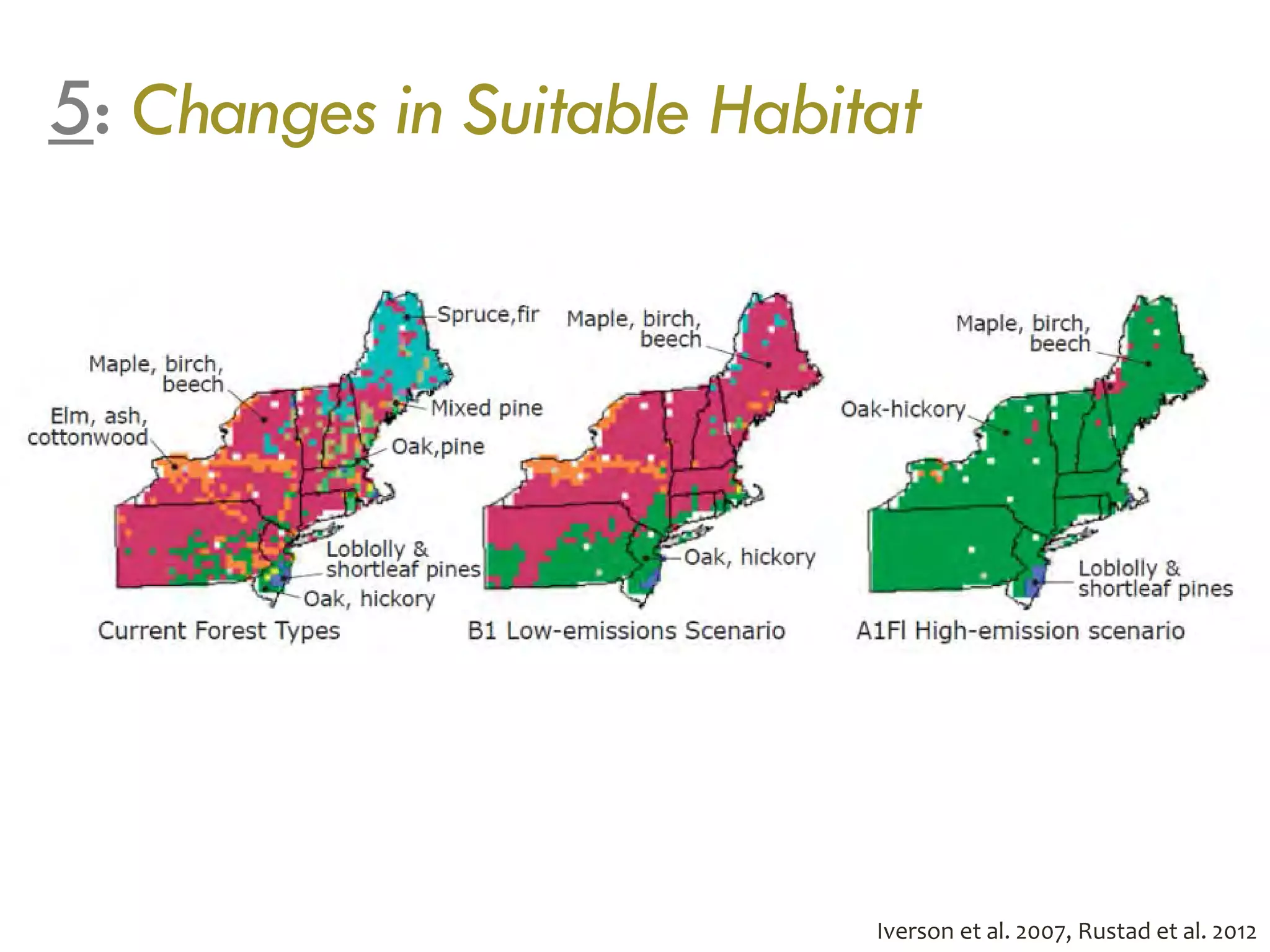
Iverson et al. 2007, Rustad et al. 2012
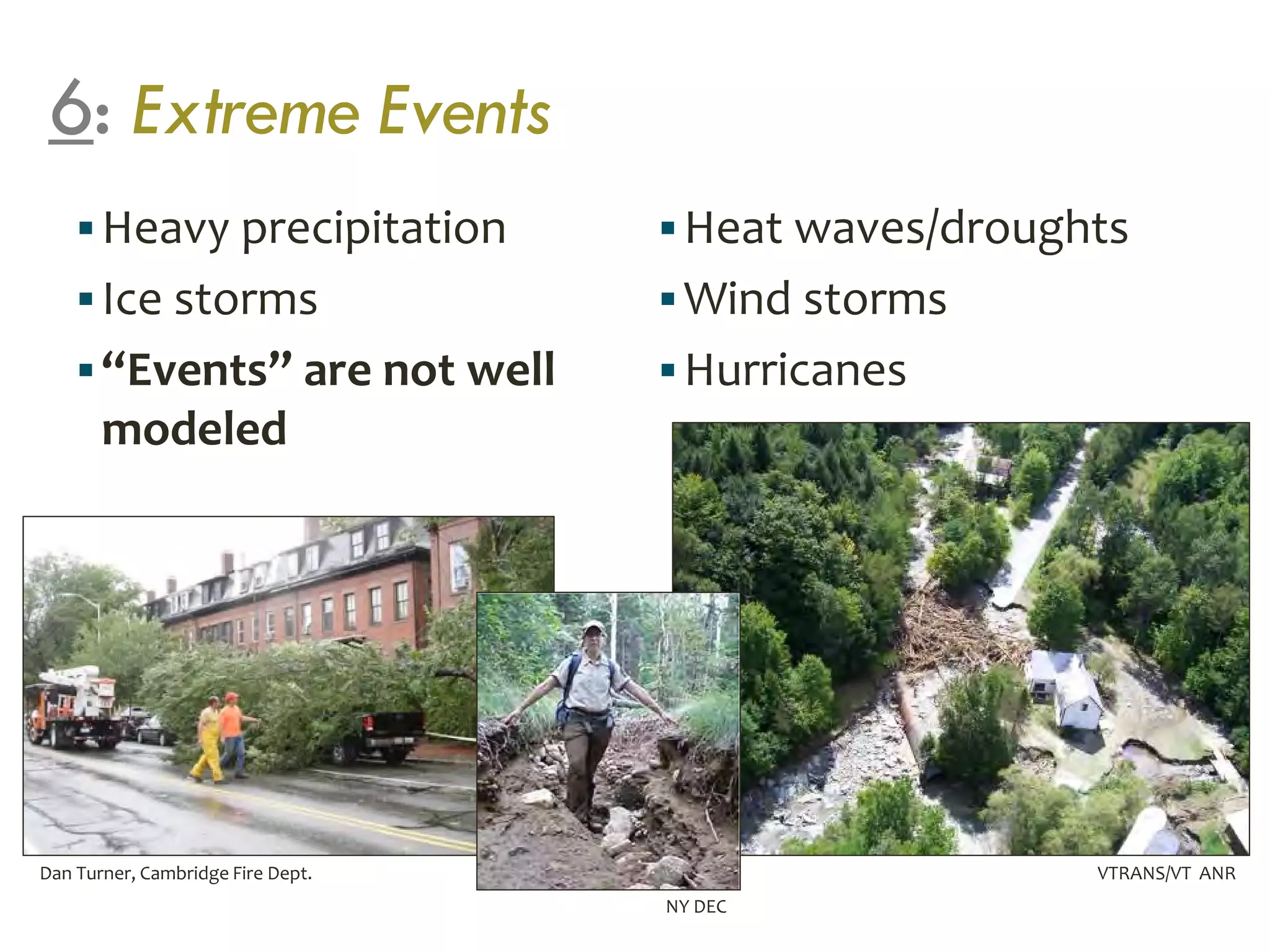
Dan Turner, Cambridge Fire Dept.
6: Extreme Events
Heavy precipitation
Ice storms
“Events” are not well
modeled
Heat waves/droughts
Wind storms
Hurricanes
VTRANS/VT ANR
NY DEC
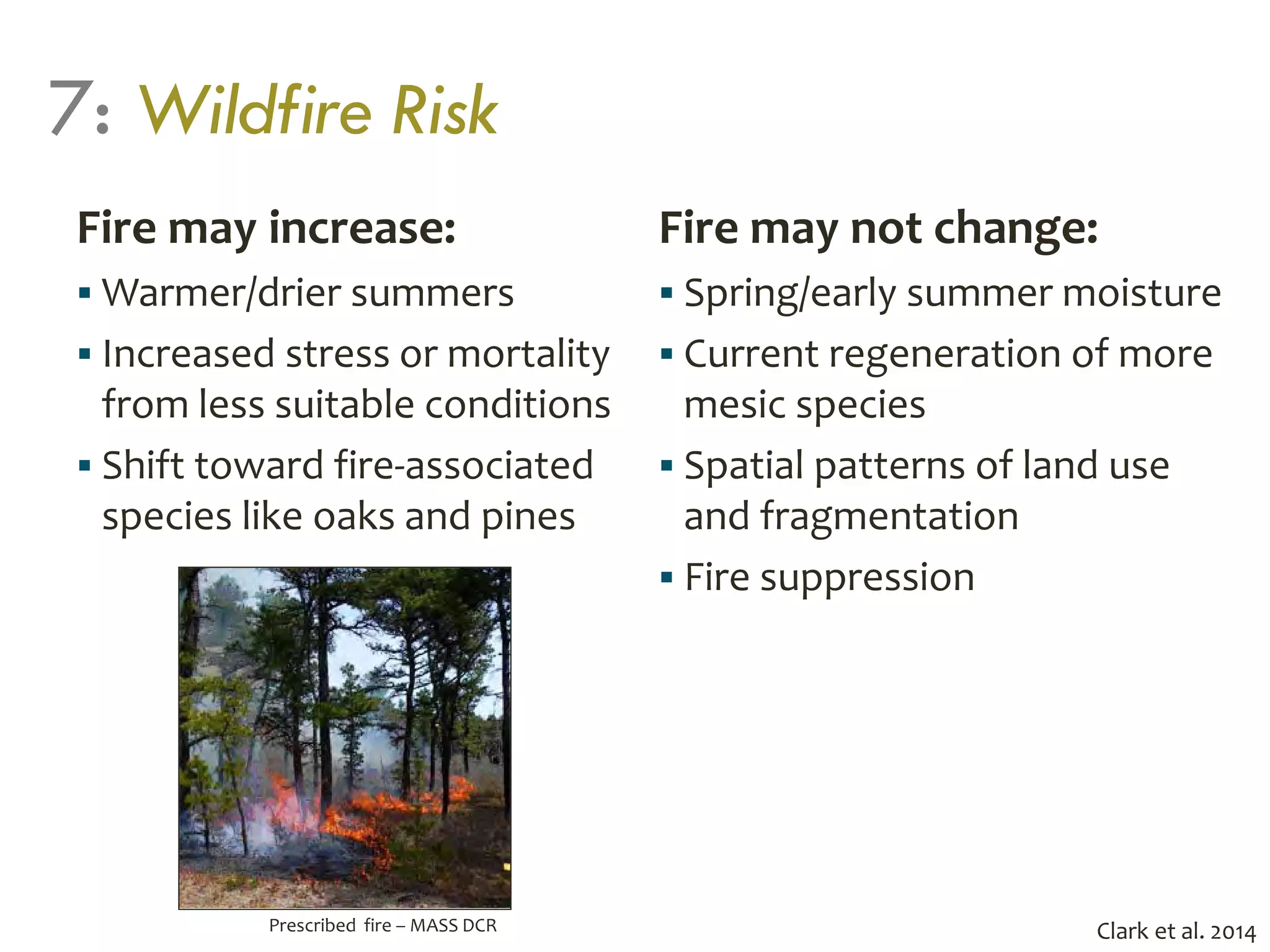
7: Wildfire Risk
Fire may increase:
 Warmer/drier summers
 Increased stress or mortality
from less suitable conditions
 Shift toward fire-associated
species like oaks and pines
Fire may not change:
 Spring/early summer moisture
 Current regeneration of more
mesic species
 Spatial patterns of land use
and fragmentation
 Fire suppression
Clark et al. 2014Prescribed fire – MASS DCR
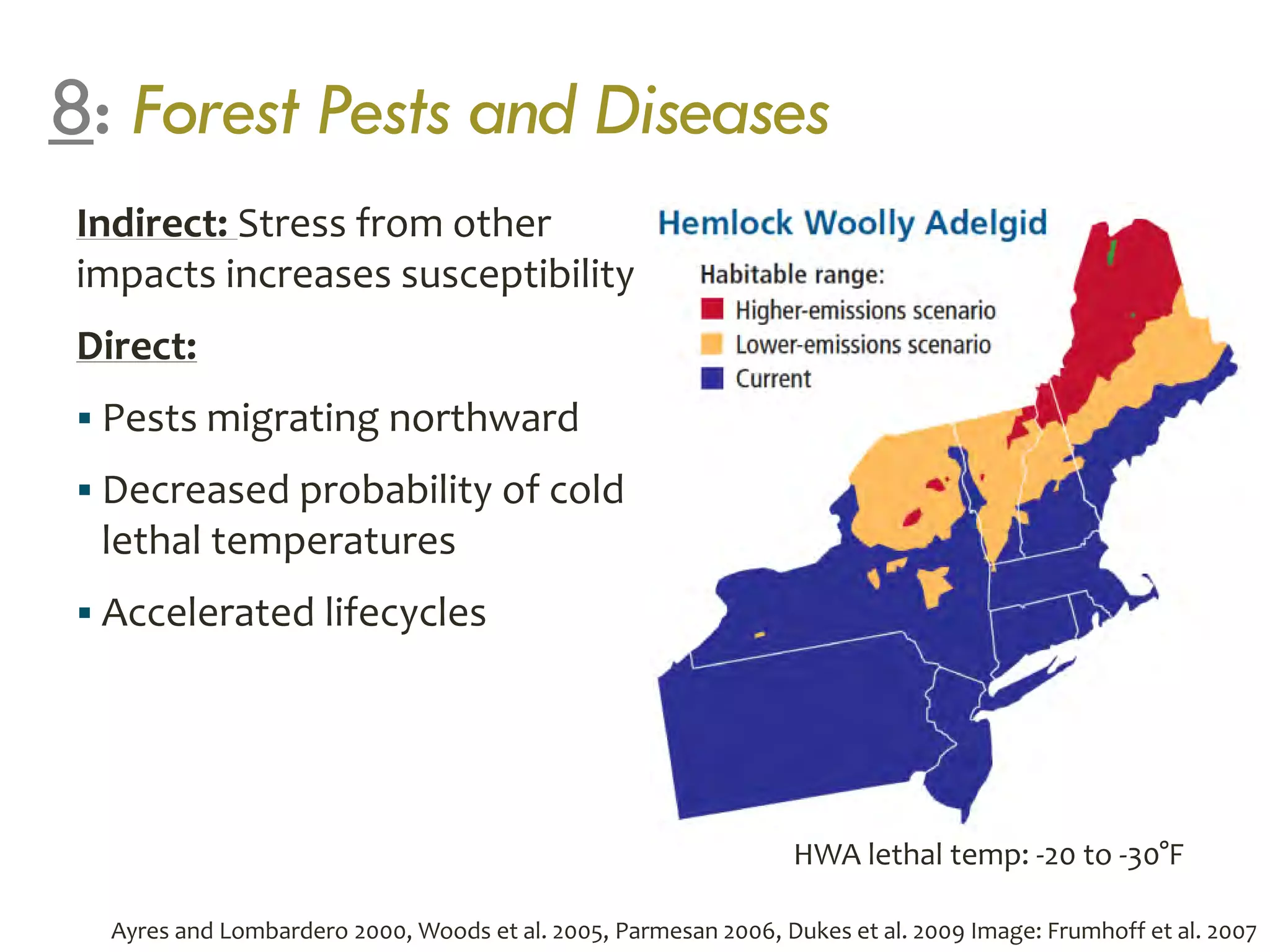
8: Forest Pests and Diseases
Indirect: Stress from other
impacts increases susceptibility
Direct:
 Pests migrating northward
 Decreased probability of cold
lethal temperatures
 Accelerated lifecycles
Ayres and Lombardero 2000, Woods et al. 2005, Parmesan 2006, Dukes et al. 2009 Image: Frumhoff et al. 2007
HWA lethal temp: -20 to -30°F
9: Invasive Plants
Indirect: Stress or disturbance from other impacts can affect
the potential for invasion or success
Direct:
 Expanded ranges under warmer conditions
 Increased competitiveness from ability of some plants to
take advantage of elevated CO2
Invasives Plants Atlas of New England (www.eddmaps.org)
Dukes et al. 2009, Rustad et al. 2011
What
conclusions
can we draw
from all this?
Climate Change Impacts
1) Longer Growing Season
2) Shorter Winters
3) Potential for Summer Drought
4) CO2 Fertilization
5) Changes in Suitable Habitat
6) Extreme Events
7) Wildfire Risk
8) Forest Pests and Diseases
9) Invasive Plants
Vulnerability: Forest Communities
May have greater risk:
 Low diversity
 Static
 Threatened, rare, or
endangered
 Already in decline
 Fragmented
May have less risk:
 More diversity (species, genetics, …)
 Adapted to disturbance
 Wider ecological range of
tolerances
 Currently increasing
 Larger, contiguous blocks
Forest communities will be affected differently
Impacts:
 Extreme storms
 Several diseases, pests, invasives
 Several northern species projected
to decline
Adaptive Capacity:
 Mixed species forests
 Several southern species projected
to increase
 Extensive type, exists farther south
Vulnerability: Hardwood Forests
Vulnerability rated as low (central hardwoods) or moderate
(northern hardwoods) based on species and location.
Connecticut Climate Change 2010, Manomet and Mass. Dept. of Fish and Wildlife 2010, Manomet and NWF 2012
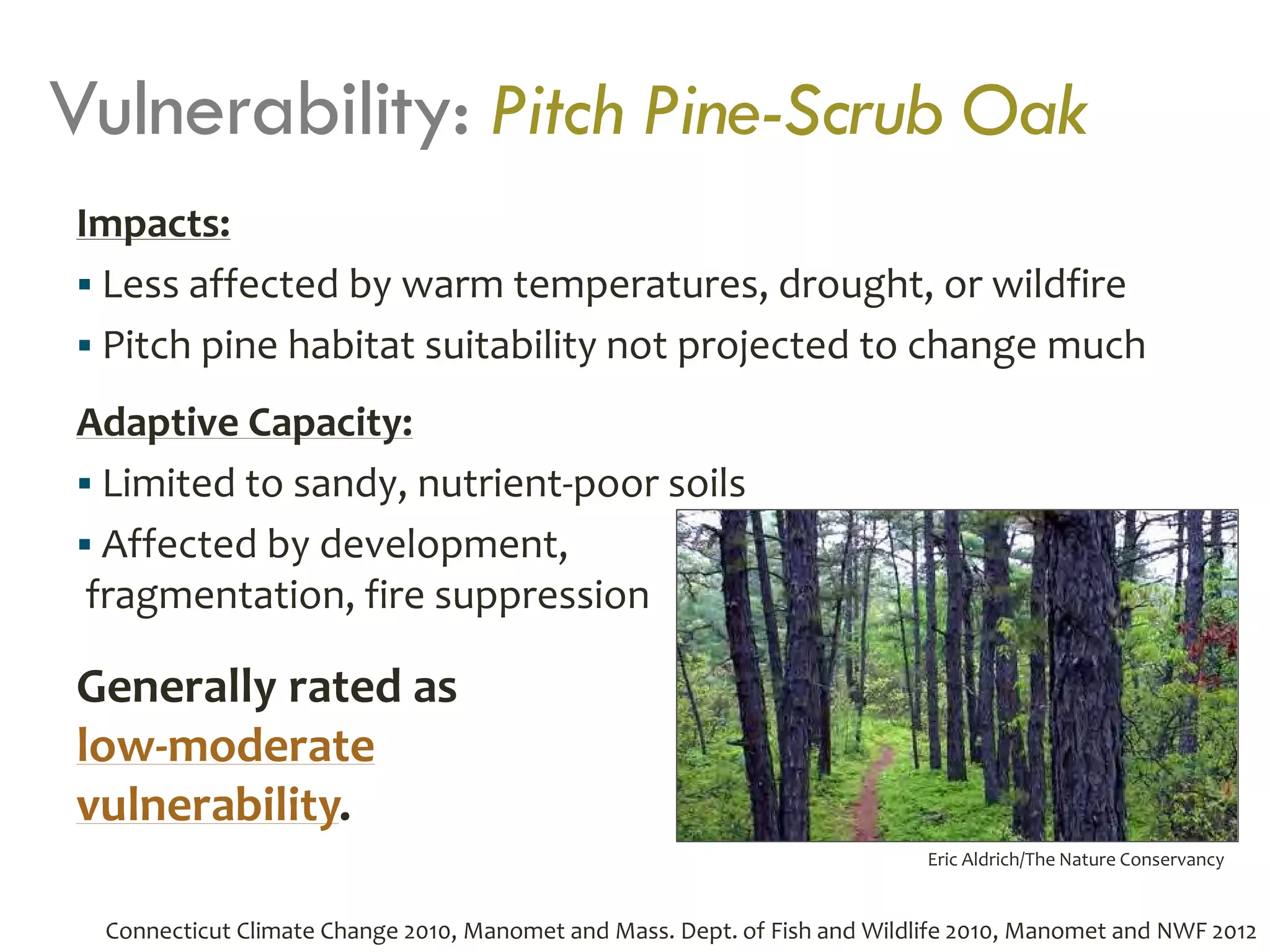
Vulnerability: Pitch Pine-Scrub Oak
Impacts:
 Less affected by warm temperatures, drought, or wildfire
 Pitch pine habitat suitability not projected to change much
Adaptive Capacity:
 Limited to sandy, nutrient-poor soils
 Affected by development,
fragmentation, fire suppression
Eric Aldrich/The Nature Conservancy
Generally rated as
low-moderate
vulnerability.
Connecticut Climate Change 2010, Manomet and Mass. Dept. of Fish and Wildlife 2010, Manomet and NWF 2012
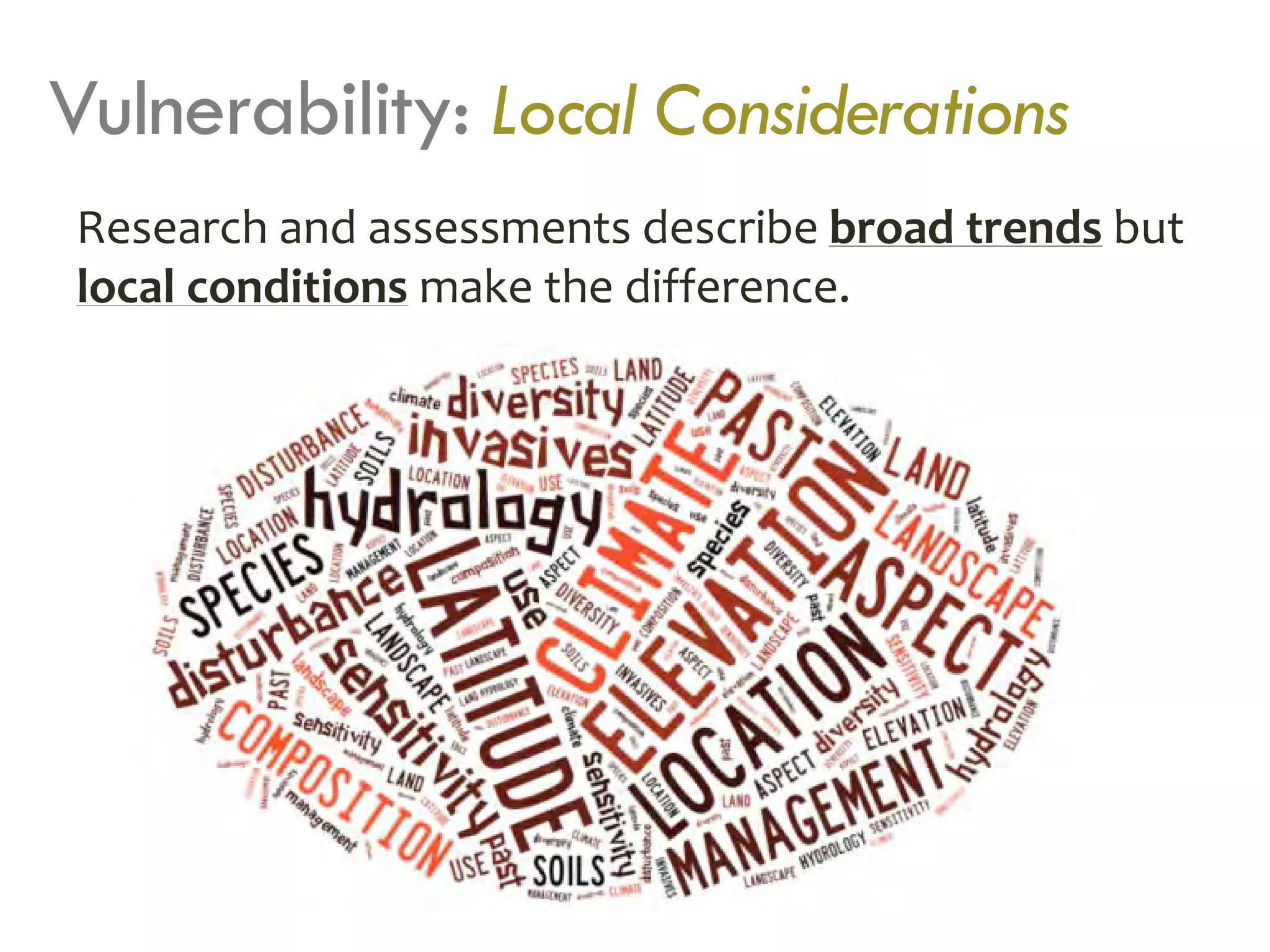
Vulnerability: Local Considerations
Research and assessments describe broad trends but
local conditions make the difference.
Vulnerability: Spruce-fir
Impacts:
 Warm temperatures
 Declines in boreal tree species
 Extreme storms
Adaptive Capacity:
 Generally slow to adjust to change
 Constrained by elevation/latitude
 Isolated mountaintops
Generally rated as most vulnerable forest
community, especially at southern extent of range.
Connecticut Climate Change 2010, Manomet and Mass. Dept. of Fish and Wildlife 2010, Manomet and NWF 2012
Step 1: DEFINE area of interest, management
goals and objectives, and time frames.
1. DEFINE area of
interest, management
objectives, and time
frames.
2. ASSESS climate
change impacts and
vulnerabilities for the
area of interest.
3. EVALUATE
management objectives
given projected impacts
and vulnerabilities.
4. IDENTIFY and
implement adaptation
approaches and tactics .
5. MONITOR and
evaluate effectiveness
of implemented
actions.
Workbook Instructions
1
2
34
5
Purpose:
 Define the scope of the project
Step 1: DEFINE area of interest, management
goals and objectives, and time frames.
Where are you working?
What are your current management goals
and plans for this area?
1
2
34
5 Step 1: DEFINE area of interest, management
goals and objectives, and time frames.
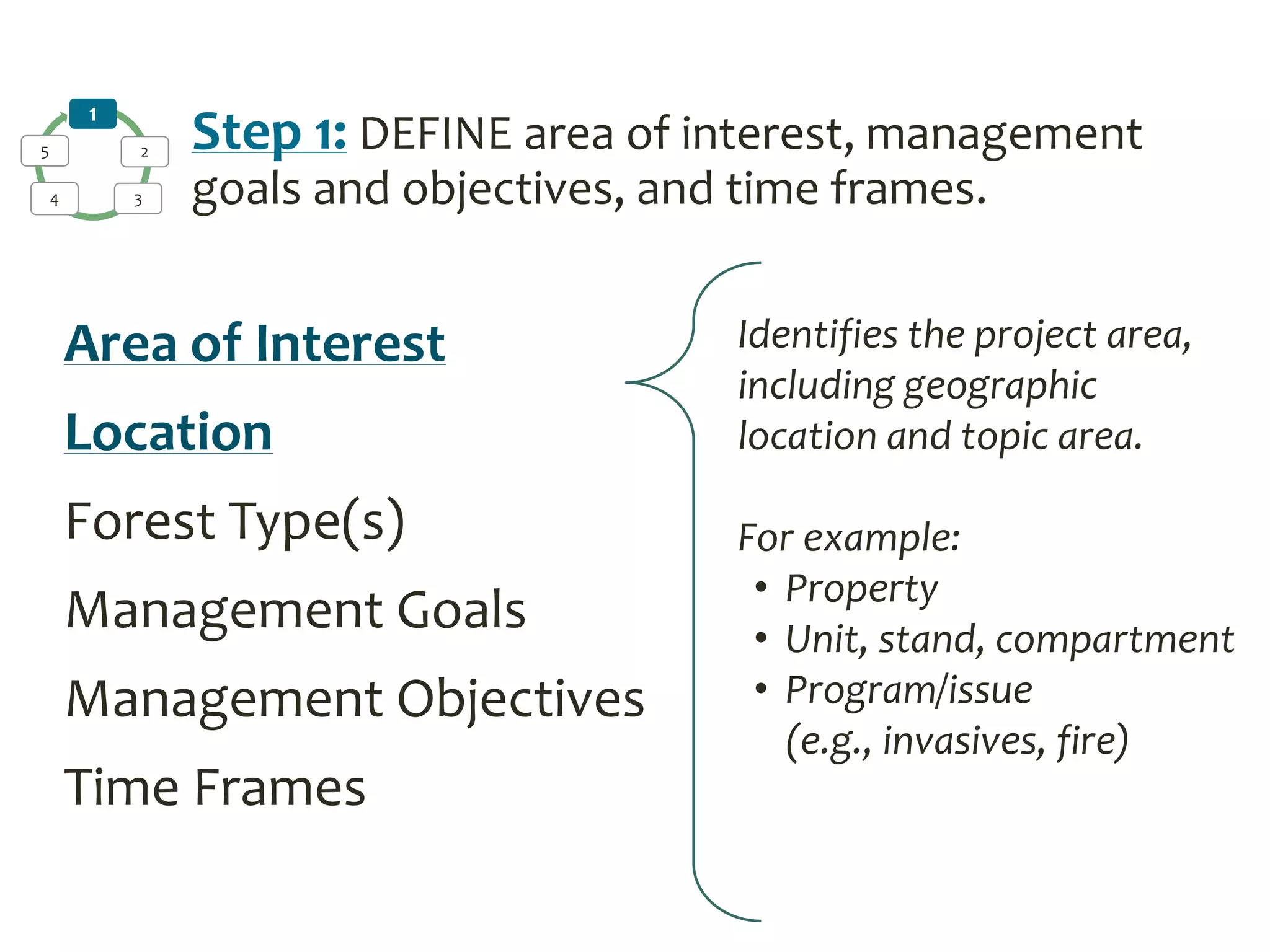
Area of Interest
Location
Forest Type(s)
Management Goals
Management Objectives
Time Frames
Identifies the project area,
including geographic
location and topic area.
For example:
• Property
• Unit, stand, compartment
• Program/issue
(e.g., invasives, fire)
1
2
34
5 Step 1: DEFINE area of interest, management
goals and objectives, and time frames.
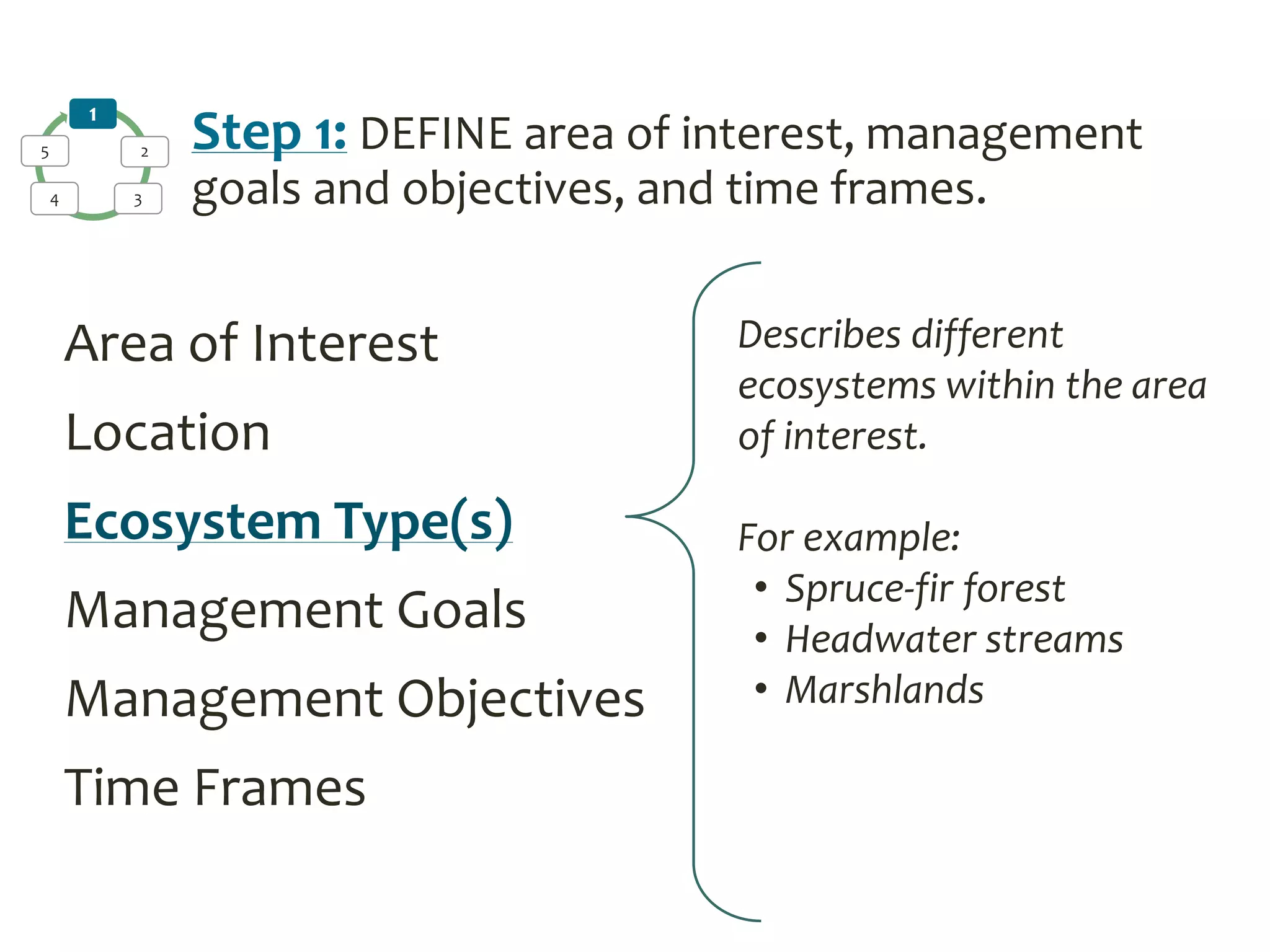
Area of Interest
Location
Ecosystem Type(s)
Management Goals
Management Objectives
Time Frames
Describes different
ecosystems within the area
of interest.
For example:
• Spruce-fir forest
• Headwater streams
• Marshlands
1
2
34
5 Step 1: DEFINE area of interest, management
goals and objectives, and time frames.
Area of Interest
Location
Forest Type(s)
Management Goals
Management Objectives
Time Frames
Describes intent.
Goals: broad, generally not
quantifiable
• Enhance wildlife habitat
• Restore wetland function
Objectives: specific, outline
planned results
• Create 10 acres of early
successional habitat by…
• Upgrade infrastructure to
increase water flow…
1
2
34
5 Step 1: DEFINE area of interest, management
goals and objectives, and time frames.
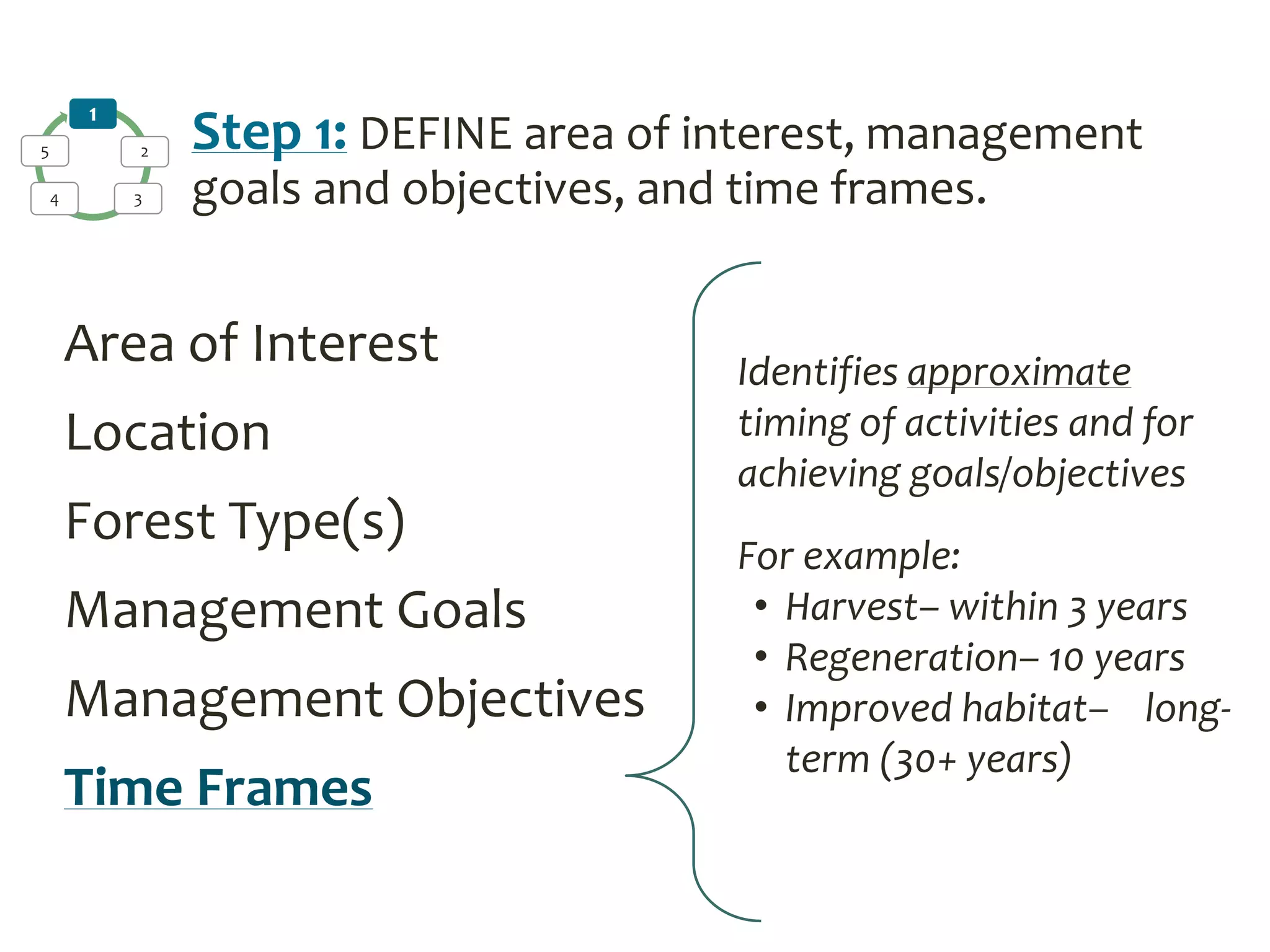
Area of Interest
Location
Forest Type(s)
Management Goals
Management Objectives
Time Frames
Identifies approximate
timing of activities and for
achieving goals/objectives
For example:
• Harvest– within 3 years
• Regeneration– 10 years
• Improved habitat– long-
term (30+ years)
Area of
Interest Location
Forest
Type(s) Management Goals Management Objectives Time Frames
SOUTH
Camp Four
Project
Park Road Sale
Stand 1089-025
East of
Park Falls
along
FR1903,
Newman
Lake Road
– Mature
aspen, mixed
ages
– Planted
white spruce
along road
– Maple
understory
– Desired landscape conditions, MA 4A:
even-aged management maintains early
to mid-successional communities. Aspen
is over-represented; transitions to conifer
species are encouraged.
– Maintain healthy forest and tree vigor
– Appropriate age class distribution:
redistribute toward younger aspen
– Safe, efficient road infrastructure
– Provide wood through environmentally
responsible harvest
– Maintain healthy white spruce
along Newman Lake Road to achieve
desired scenic conditions and
diversity
– Maintain healthy hardwoods to
achieve desired landscape conditions
and age class distribution
– Protect against annosum root rot
to maintain a healthy forest and tree
vigor
– Provide scenic integrity (moderate
SIO)
– Maintain consistency with Forest
Plan Standards and Guidelines (e.g.,
reserve trees)
– Marking is immediate
(Oct.)
– Harvest operations
would occur in the short-
term
– Management goals
would be achieved in the
short- (white spruce) and
medium- to long-term
(hardwoods)
1
2
34
5
Step 1: DEFINE area of interest, management
goals and objectives, and time frames.
EXAMPLE: CHEQUAMEGON-NICOLET NATIONAL FOREST—ASPEN
1. DEFINE area of
interest, management
objectives, and time
frames.
2. ASSESS climate
change impacts and
vulnerabilities for the
area of interest.
3. EVALUATE
management objectives
given projected impacts
and vulnerabilities.
4. IDENTIFY and
implement adaptation
approaches and tactics .
5. MONITOR and
evaluate effectiveness
of implemented
actions.
Workbook Instructions
Purpose:
 Uses local expertise to determine
how climate change may
specifically affect the project area
How might the area be uniquely affected by
climatic change and subsequent impacts?
1
2
34
5 Step 2: ASSESS climate change impacts and
vulnerabilities for the area of interest.
1
2
34
5 Step 2: ASSESS climate change impacts and
vulnerabilities for the area of interest.
General (Broad-scale)
Impacts & Vulnerabilities
Climate Change Impacts
and Vulnerabilities for
the Area of Interest
Vulnerability
Determination
Information on regionally-
relevant climate change
effects.
From vulnerability
assessments, literature, etc.
For example:
• Increased likelihood of
extreme rain events
1
2
34
5 Step 2: ASSESS climate change impacts and
vulnerabilities for the area of interest.
General (Broad-scale)
Impacts & Vulnerabilities
Climate Change Impacts
and Vulnerabilities for
the Area of Interest
Vulnerability
Determination
Site-based assessment of risk
to regionally-relevant climate
change impacts.
For example:
• Steep stream banks and
poorly-sized culverts are at
increased risk; impacts
already being observed
during large rain events.
1
2
34
5 Step 2: ASSESS climate change impacts and
vulnerabilities for the area of interest.
General (Broad-scale)
Impacts & Vulnerabilities
Climate Change Impacts
and Vulnerabilities for
the Area of Interest
Vulnerability
Determination
How vulnerable is the site to the
effects of climate change?
High: Impacts exceed ability of
ecosystem to cope; functions and
services disrupted.
Moderate: Impacts will cause
changes, but systems can cope
Low: Ecosystems can readily cope
with impacts; relatively
few/minor negative impacts
1
2
34
5 Step 2: ASSESS climate change impacts and
vulnerabilities for the area of interest.
Vulnerability Determination
Potential Impacts
Adaptive Capacity
of Ecosystem
High
Moderate
Vulnerability
Positive
Low
Negative
Low
Vulnerability
High
Vulnerability
1
2
34
5 Step 2: ASSESS climate change impacts and
vulnerabilities for the area of interest.
EXAMPLE: CHEQUAMEGON-NICOLET NATIONAL FOREST—ASPEN
Broad-scale Impacts and Vulnerabilities
Climate Change Impacts and Vulnerabilities for
the Area of Interest
Vulnerability
Determination
Mean annual temperatures are projected to
increase by about 6.5 °F to 10.5 °F over the next
century
In NE Price County, winter temps projected to increase 12F
from 1980 to 2090 (A2); summer temps projected to increase
9.75F
Low to Moderate
Growing seasons have become longer and this
trend is expected to continue
Growing seasons have become longer and this trend is
expected to continue
Precipitation patterns may change, which may
impact hydrologic regimes
Highly uncertain. Model average projects 0.75” increase in
precip in the winter from 1980-2090; 0.25” decrease in the
summer (A2); increase in extreme precipitation events
Altered hydrologic regimes may contribute to
drier soils during summer and increased potential
for drought
Altered hydrologic regimes may contribute to drier soils
during summer and increased potential for drought
Increases in drought, rain and wind storms,
wildfire, and other disturbances may contribute to
successional changes or loss of forest cover
Increases in drought, rain and wind storms, wildfire, and
other disturbances may contribute to successional changes or
loss of forest cover
Carbon dioxide and ozone pollution currently
cause changes to forest productivity
Maria look up concentration maps and leaf symptoms
Increases of invasive plant species, herbivores,
and disease agents may contribute to reduced
Activity
ADAPTATION EXAMPLE:
CHEQUAMEGON-NICOLET NATIONAL FOREST—ASPEN
1
2
34
5
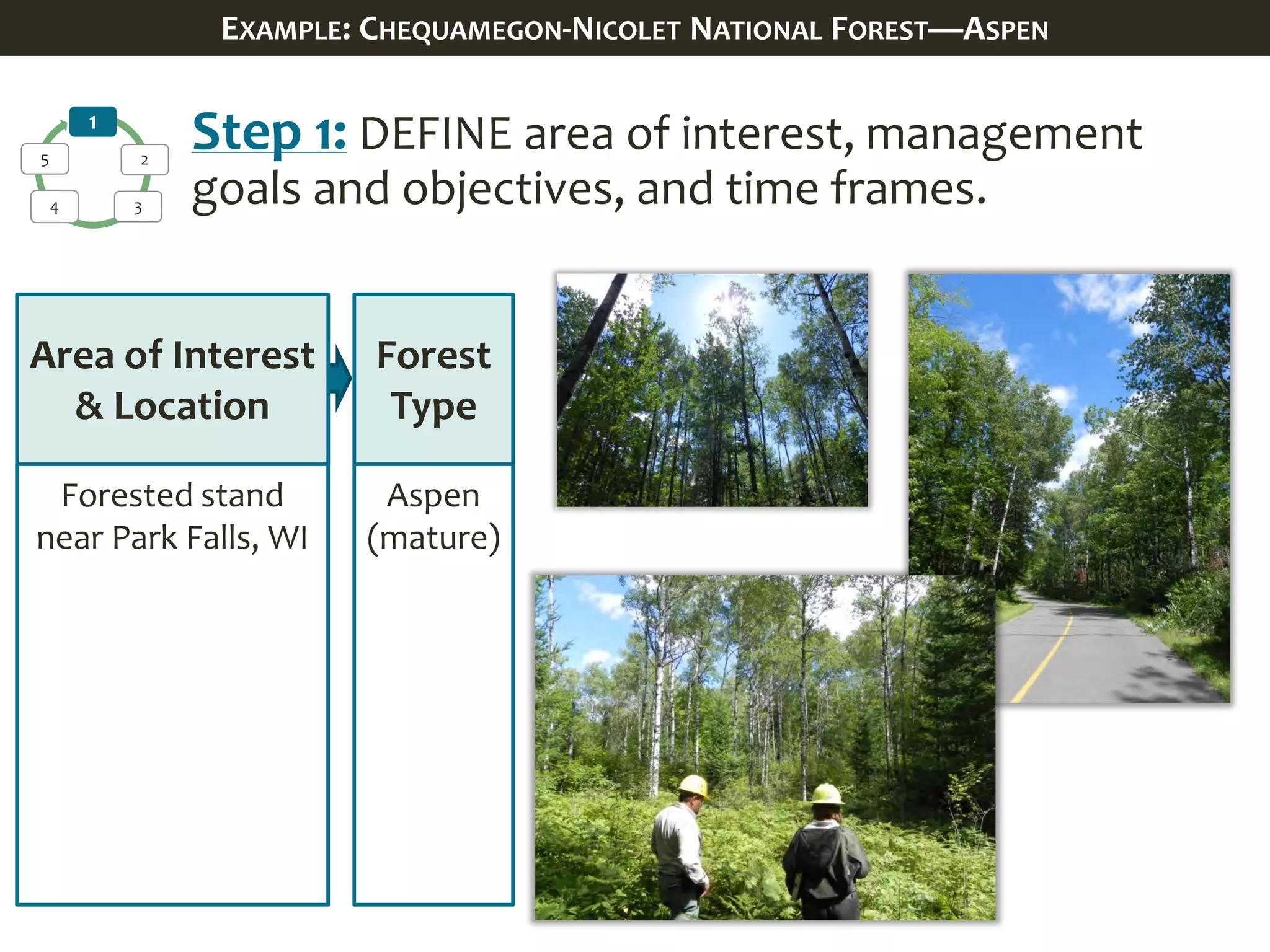
Area of Interest
& Location
Forest
Type
Forested stand
near Park Falls, WI
Aspen
(mature)
Step 1: DEFINE area of interest, management
goals and objectives, and time frames.
EXAMPLE: CHEQUAMEGON-NICOLET NATIONAL FOREST—ASPEN
1
2
34
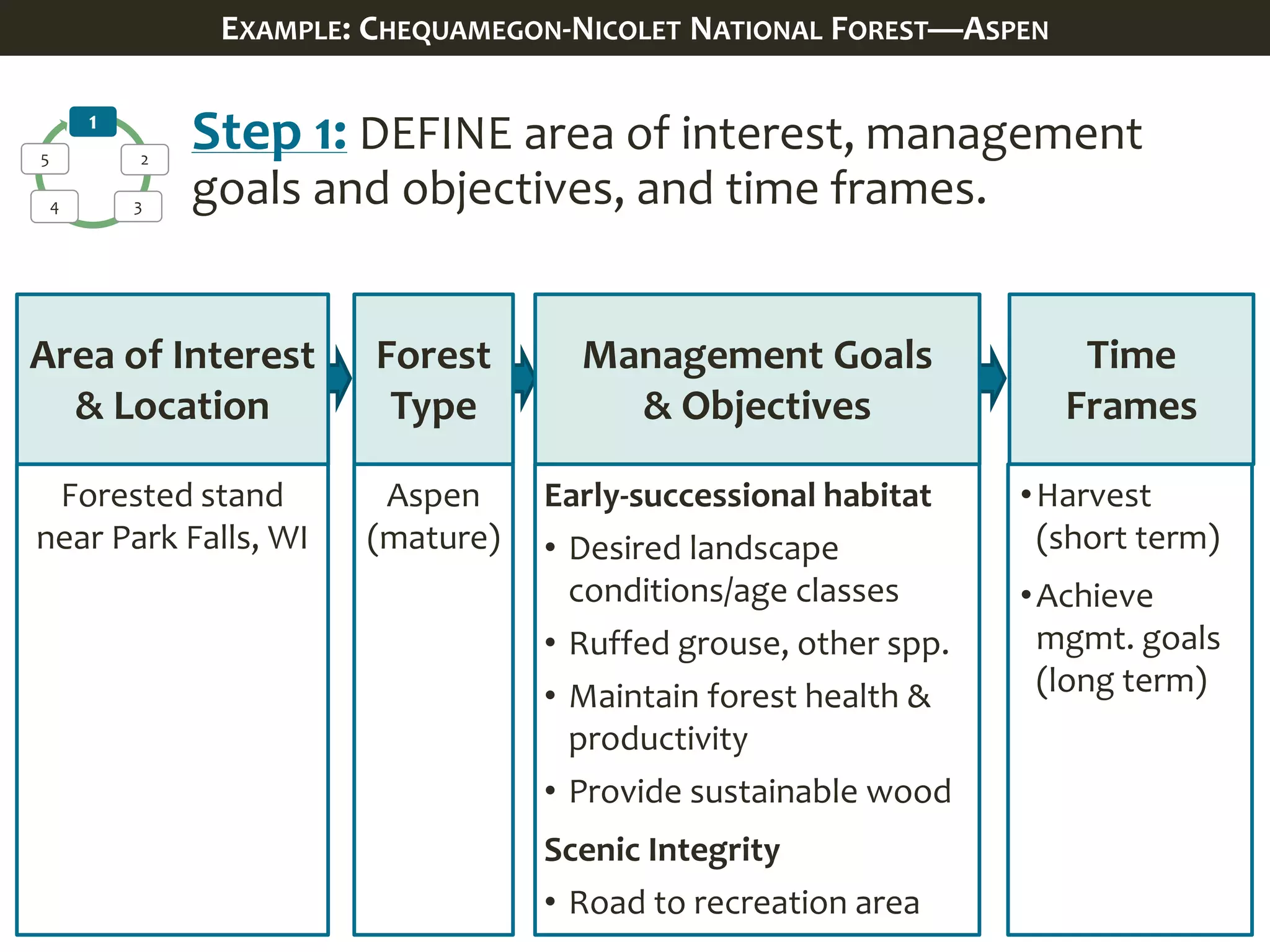
5
Step 1: DEFINE area of interest, management
goals and objectives, and time frames.
Management Goals
& Objectives
Time
Frames
Early-successional habitat
• Desired landscape
conditions/age classes
• Ruffed grouse, other spp.
• Maintain forest health &
productivity
• Provide sustainable wood
Scenic Integrity
• Road to recreation area
•Harvest
(short term)
•Achieve
mgmt. goals
(long term)
Area of Interest
& Location
Forest
Type
Forested stand
near Park Falls, WI
Aspen
(mature)
EXAMPLE: CHEQUAMEGON-NICOLET NATIONAL FOREST—ASPEN
1
2
34
5
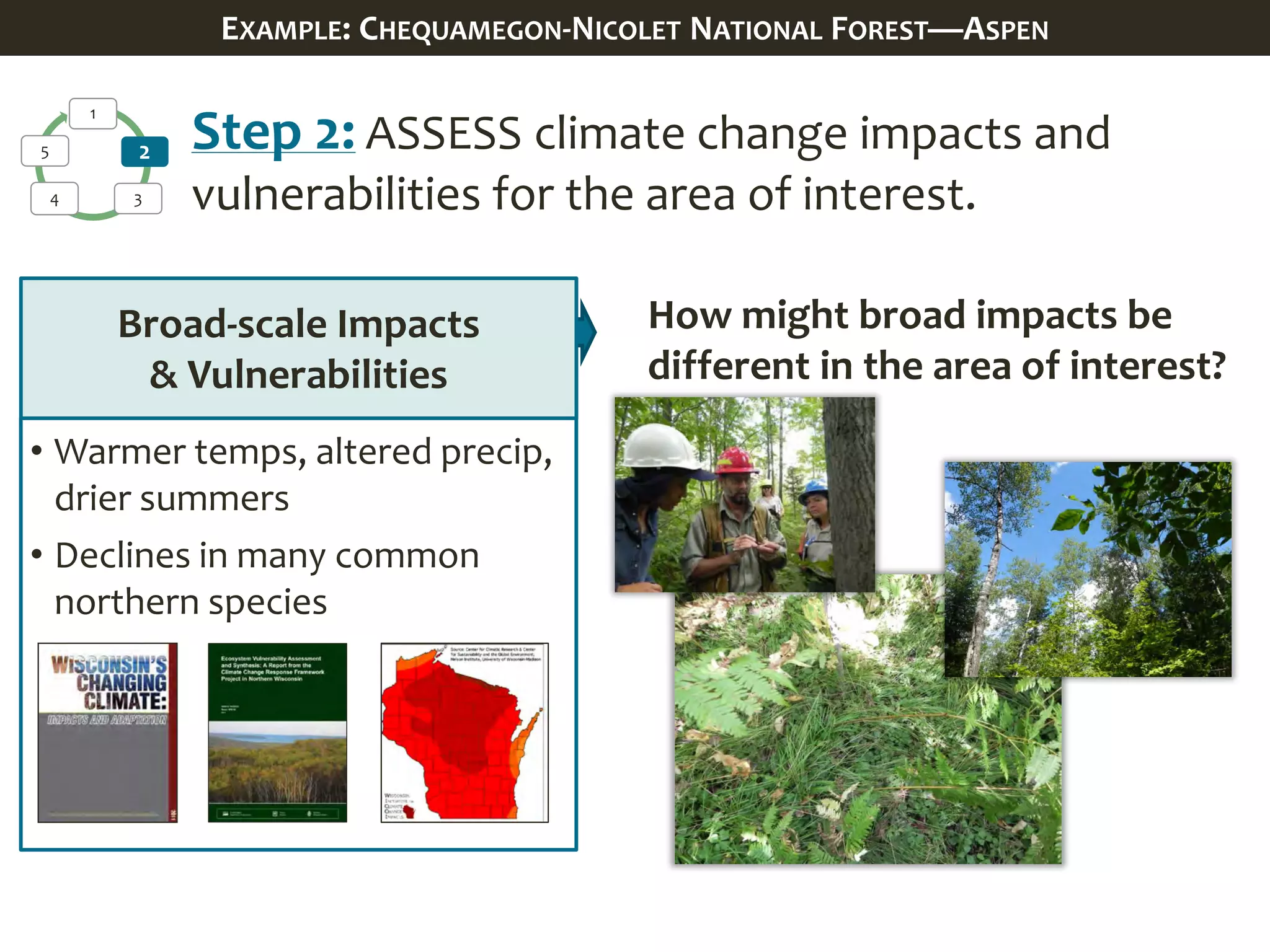
How might broad impacts be
different in the area of interest?
Step 2: ASSESS climate change impacts and
vulnerabilities for the area of interest.
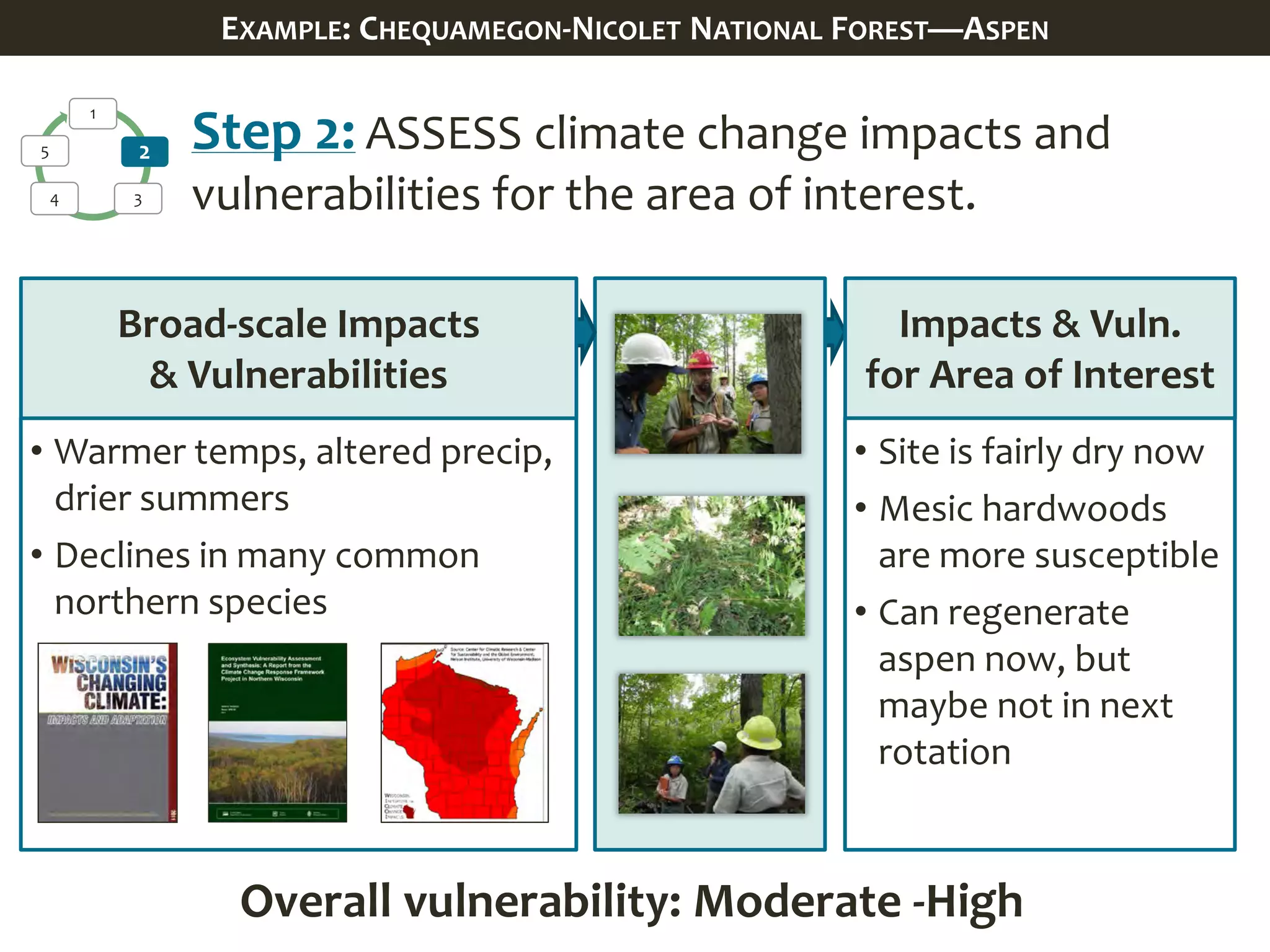
Broad-scale Impacts
& Vulnerabilities
• Warmer temps, altered precip,
drier summers
• Declines in many common
northern species
EXAMPLE: CHEQUAMEGON-NICOLET NATIONAL FOREST—ASPEN
1
2
34
5
Impacts & Vuln.
for Area of Interest
• Site is fairly dry now
• Mesic hardwoods
are more susceptible
• Can regenerate
aspen now, but
maybe not in next
rotation
Overall vulnerability: Moderate -High
Step 2: ASSESS climate change impacts and
vulnerabilities for the area of interest.
Broad-scale Impacts
& Vulnerabilities
• Warmer temps, altered precip,
drier summers
• Declines in many common
northern species
EXAMPLE: CHEQUAMEGON-NICOLET NATIONAL FOREST—ASPEN
Step 3: EVALUATE management objectives
given projected impacts and vulnerabilities.
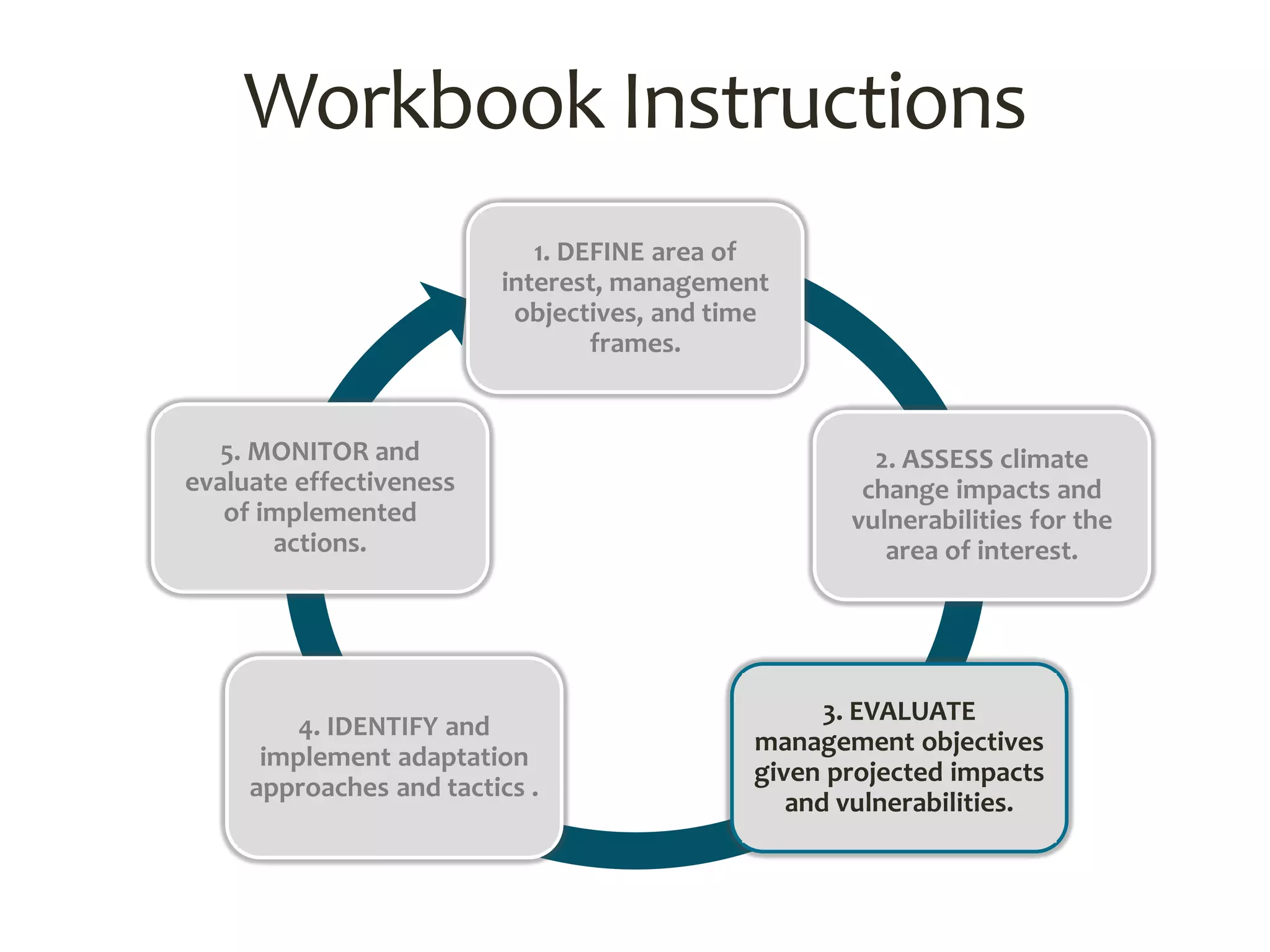
1. DEFINE area of
interest, management
objectives, and time
frames.
2. ASSESS climate
change impacts and
vulnerabilities for the
area of interest.
3. EVALUATE
management objectives
given projected impacts
and vulnerabilities.
4. IDENTIFY and
implement adaptation
approaches and tactics .
5. MONITOR and
evaluate effectiveness
of implemented
actions.
Workbook Instructions
Purpose:
 Realistically assess the ability to
meet goals and objectives under
current management.
Can current management achieve goals?
1
2
34
5 Step 3: EVALUATE management objectives
given projected impacts and vulnerabilities.
1
2
34
5 Step 3: EVALUATE management objectives
given projected impacts and vulnerabilities.
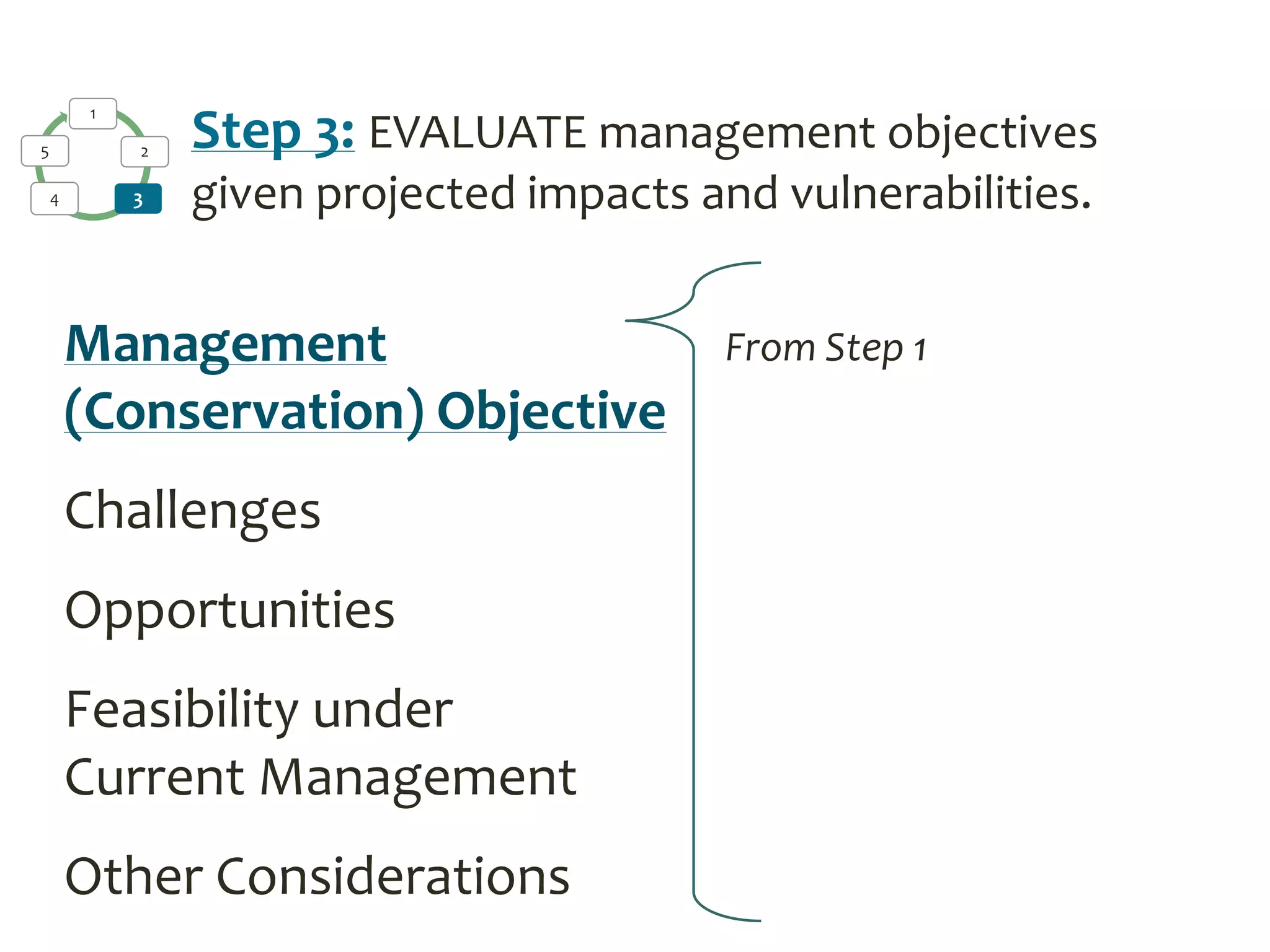
Management
(Conservation) Objective
Challenges
Opportunities
Feasibility under
Current Management
Other Considerations
From Step 1
1
2
34
5 Step 3: EVALUATE management objectives
given projected impacts and vulnerabilities.
Management Objective
Challenges
Opportunities
Feasibility under
Current Management
Other Considerations
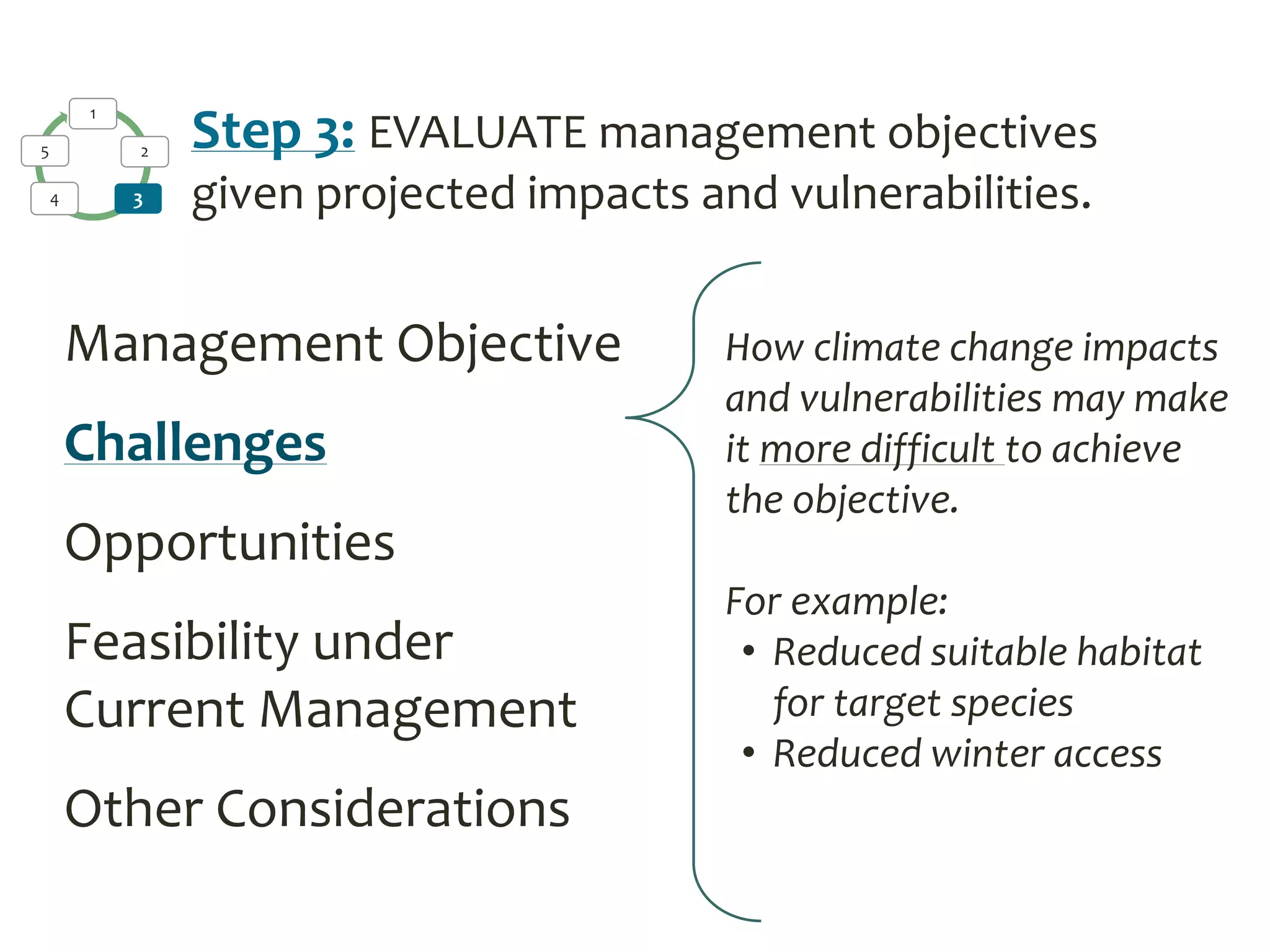
How climate change impacts
and vulnerabilities may make
it more difficult to achieve
the objective.
For example:
• Reduced suitable habitat
for target species
• Reduced winter access
1
2
34
5 Step 3: EVALUATE management objectives
given projected impacts and vulnerabilities.
Management Objective
Challenges
Opportunities
Feasibility under
Current Management
Other Considerations
How climate change impacts
and vulnerabilities may make
it easier to achieve the
objective.
For example:
• Reduced competition
• Increased growth
1
2
34
5 Step 3: EVALUATE management objectives
given projected impacts and vulnerabilities.
Management Objective
Challenges
Opportunities
Feasibility under
Current Management
Other Considerations
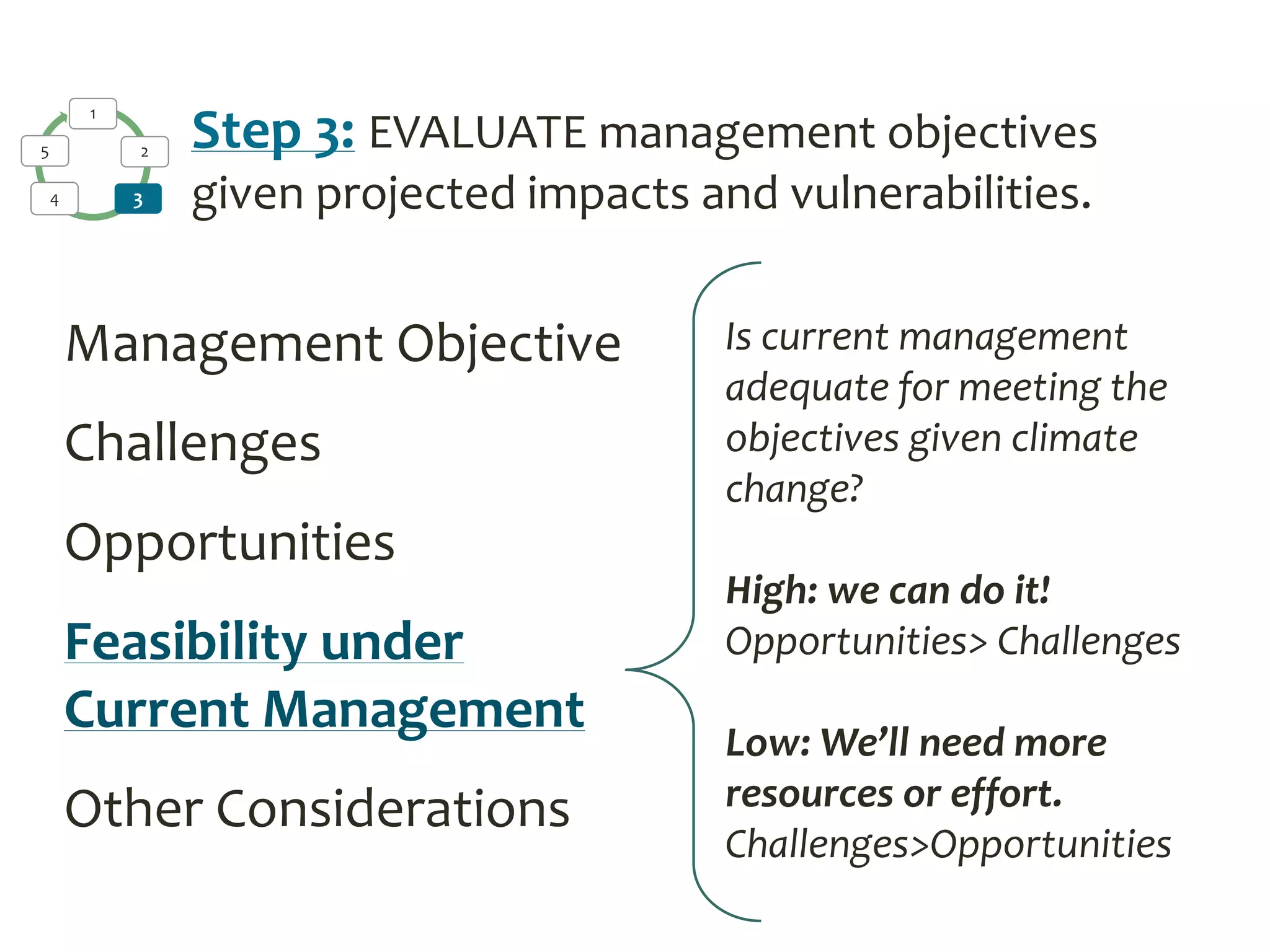
Is current management
adequate for meeting the
objectives given climate
change?
High: we can do it!
Opportunities> Challenges
Low: We’ll need more
resources or effort.
Challenges>Opportunities
1
2
34
5 Step 3: EVALUATE management objectives
given projected impacts and vulnerabilities.
Management Objective
Challenges
Opportunities
Feasibility under
Current Management
Other Considerations
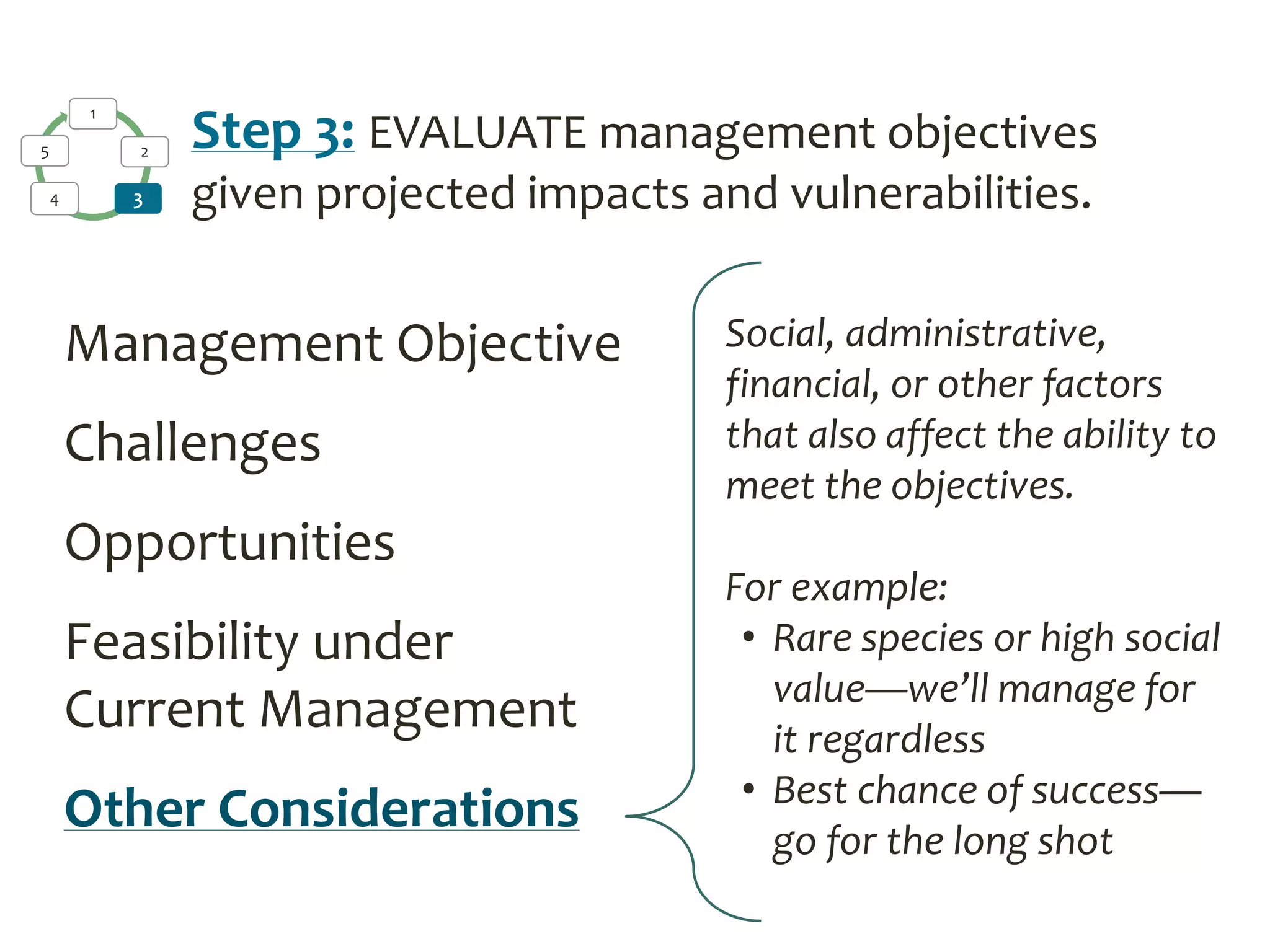
Social, administrative,
financial, or other factors
that also affect the ability to
meet the objectives.
For example:
• Rare species or high social
value—we’ll manage for
it regardless
• Best chance of success—
go for the long shot
1
2
34
5 Step 3: EVALUATE management objectives
given projected impacts and vulnerabilities.
Slow down!
Are you going to continue with the management
objectives that you have identified?
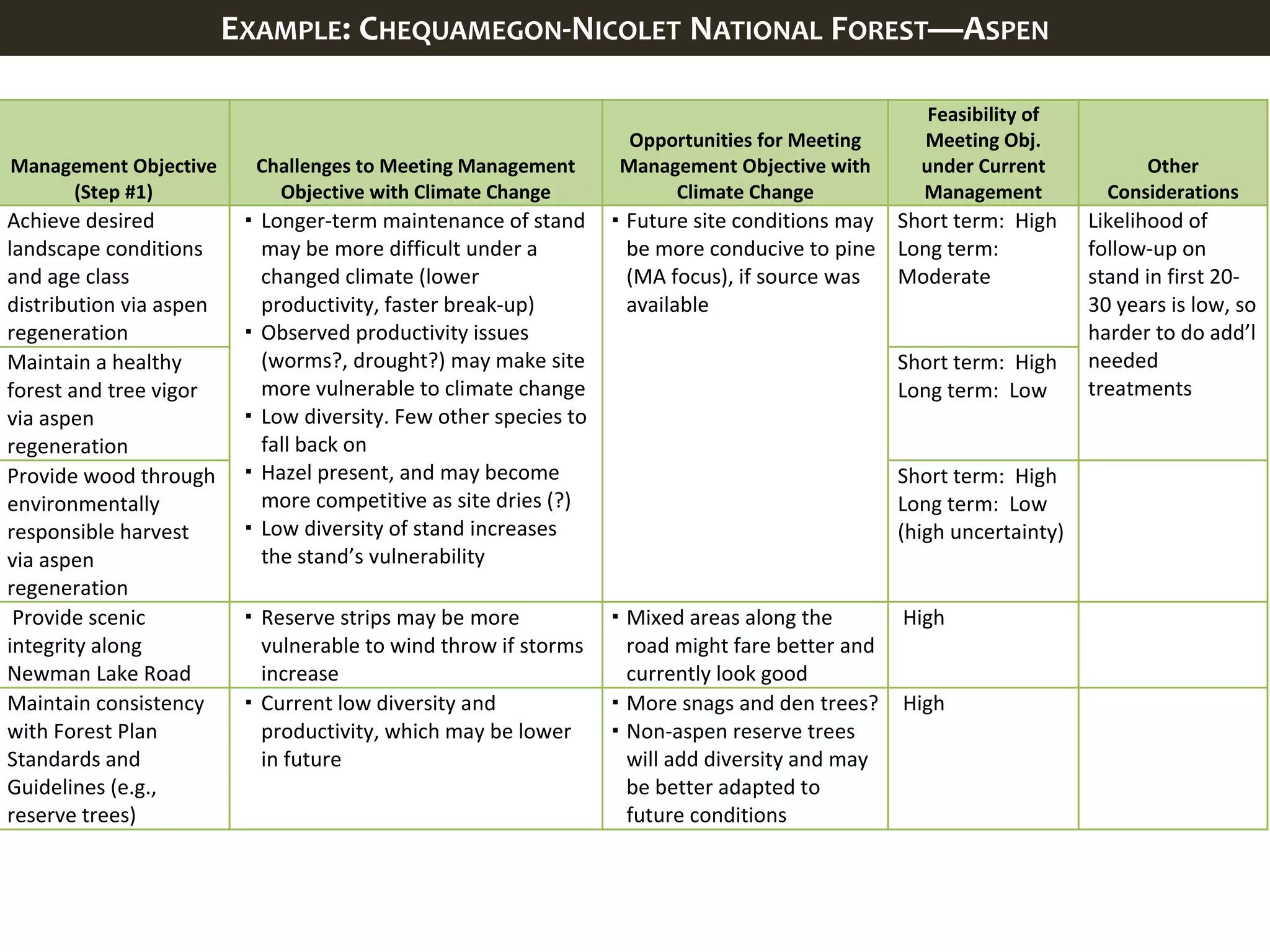
EXAMPLE: CHEQUAMEGON-NICOLET NATIONAL FOREST—ASPEN
Management Objective
(Step #1)
Challenges to Meeting Management
Objective with Climate Change
Opportunities for Meeting
Management Objective with
Climate Change
Feasibility of
Meeting Obj.
under Current
Management
Other
Considerations
Achieve desired
landscape conditions
and age class
distribution via aspen
regeneration
 Longer-term maintenance of stand
may be more difficult under a
changed climate (lower
productivity, faster break-up)
 Observed productivity issues
(worms?, drought?) may make site
more vulnerable to climate change
 Low diversity. Few other species to
fall back on
 Hazel present, and may become
more competitive as site dries (?)
 Low diversity of stand increases
the stand’s vulnerability
 Future site conditions may
be more conducive to pine
(MA focus), if source was
available
Short term: High
Long term:
Moderate
Likelihood of
follow-up on
stand in first 20-
30 years is low, so
harder to do add’l
needed
treatments
Maintain a healthy
forest and tree vigor
via aspen
regeneration
Short term: High
Long term: Low
Provide wood through
environmentally
responsible harvest
via aspen
regeneration
Short term: High
Long term: Low
(high uncertainty)
Provide scenic
integrity along
Newman Lake Road
 Reserve strips may be more
vulnerable to wind throw if storms
increase
 Mixed areas along the
road might fare better and
currently look good
High
Maintain consistency
with Forest Plan
Standards and
Guidelines (e.g.,
reserve trees)
 Current low diversity and
productivity, which may be lower
in future
 More snags and den trees?
 Non-aspen reserve trees
will add diversity and may
be better adapted to
future conditions
High
ADAPTATION EXAMPLE:
CHEQUAMEGON-NICOLET NATIONAL FOREST—ASPEN
1
2
34
5
Mgmt.
Obj.
Challenges Opportunities
Feasibility of
Meeting Obj.
(Current Mgmt)
•Regenerate
aspen
•Long-term
maintenance
•Few tree species
•Productivity issues
•Hazel competition
• Future site may be
suitable for pine
• Short term: High
• Long-term: Low
•Scenic
integrity
•Reserve strips
more vulnerable to
windthrow
• Mixed areas along
road look better
• High
Step 3: EVALUATE management objectives
given projected impacts and vulnerabilities.
EXAMPLE: CHEQUAMEGON-NICOLET NATIONAL FOREST—ASPEN
Identifying Adaptation Actions
What actions can be taken to
enhance the ability of an ecosystem
to cope with change while meeting
conservation goals and objectives?
Uncertainty and Risk
Design actions that are robust across
a range of potential future conditions
Adaptation
Adaptation is the adjustment of systems
in response to climate change.
Adaptation activities can build on
sustainable management, conservation,
and restoration of forests
Parry et al. 2007, SCBD 2009, Groves et al. 2010
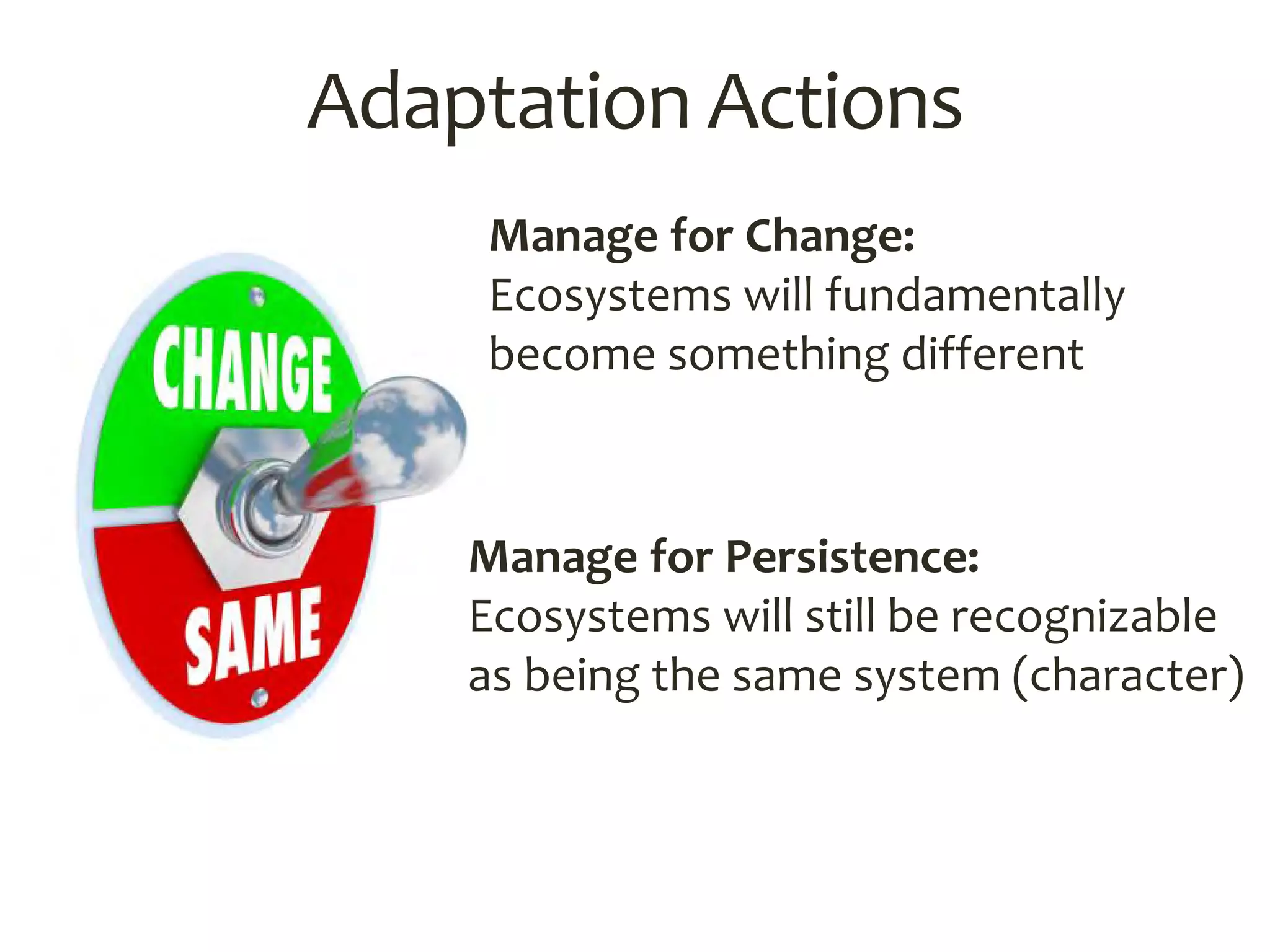
Adaptation Actions
Manage for Persistence:
Ecosystems will still be recognizable
as being the same system (character)
Manage for Change:
Ecosystems will fundamentally
become something different
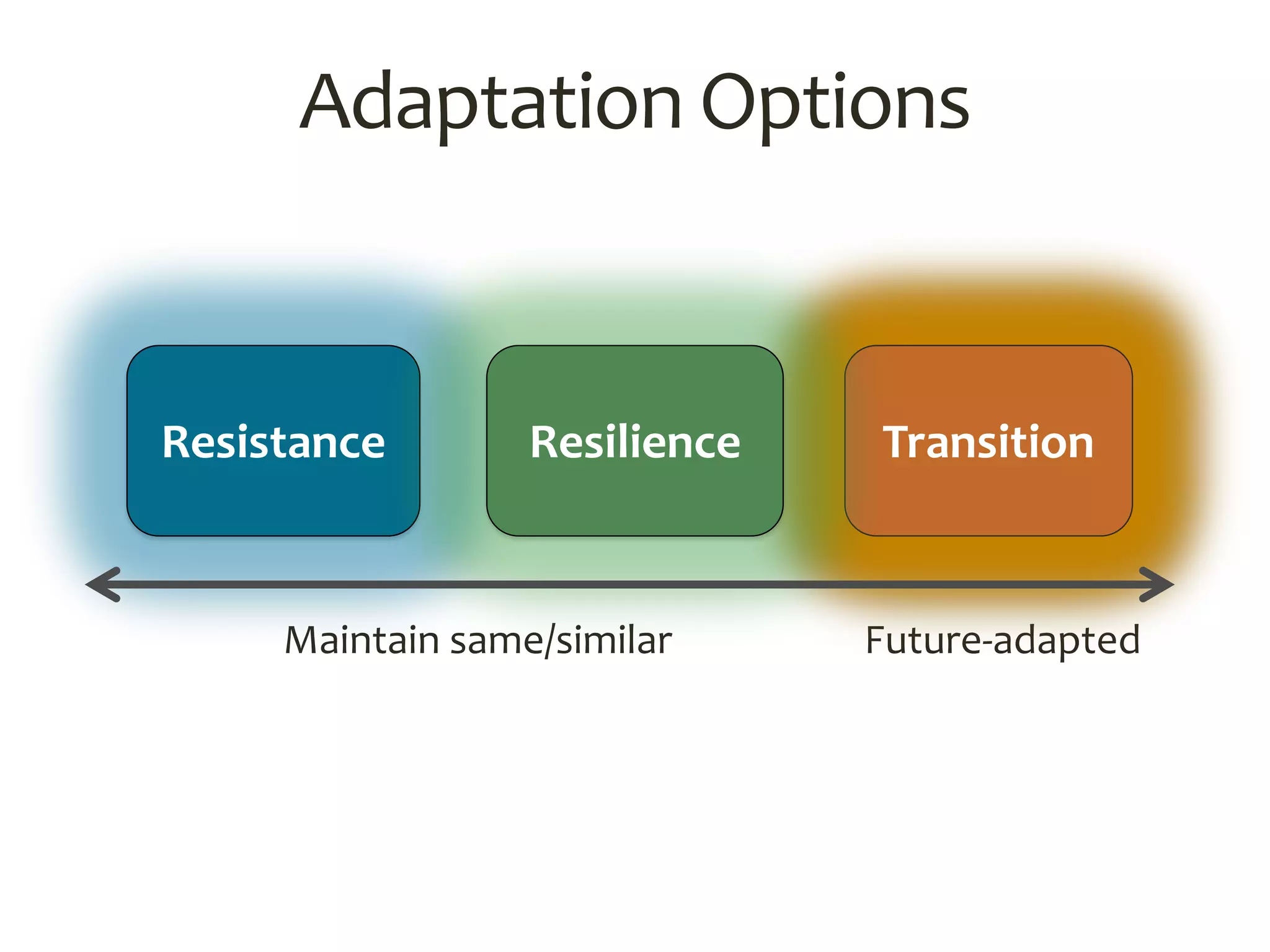
MANAGE FOR PERSISTENCE
RESISTANCE
Improve the defenses of
the forest against effects
of change.
• Short-term
• High-value
Millar et al. 2007Photo: USFS
MANAGE FOR PERSISTENCE
RESILIENCE
Enhance the ability of an system to maintain or return
to a particular ecological state following disturbance
Holling 1973, Millar et al. 2007, NWF 2014
Photo: USFS
MANAGE FOR CHANGE
TRANSITION
Intentionally encourage change, help
ecosystems respond in a targeted fashion
Millar et al. 2007
Adaptation Options
Maintain same/similar Future-adapted
Resistance TransitionResilience
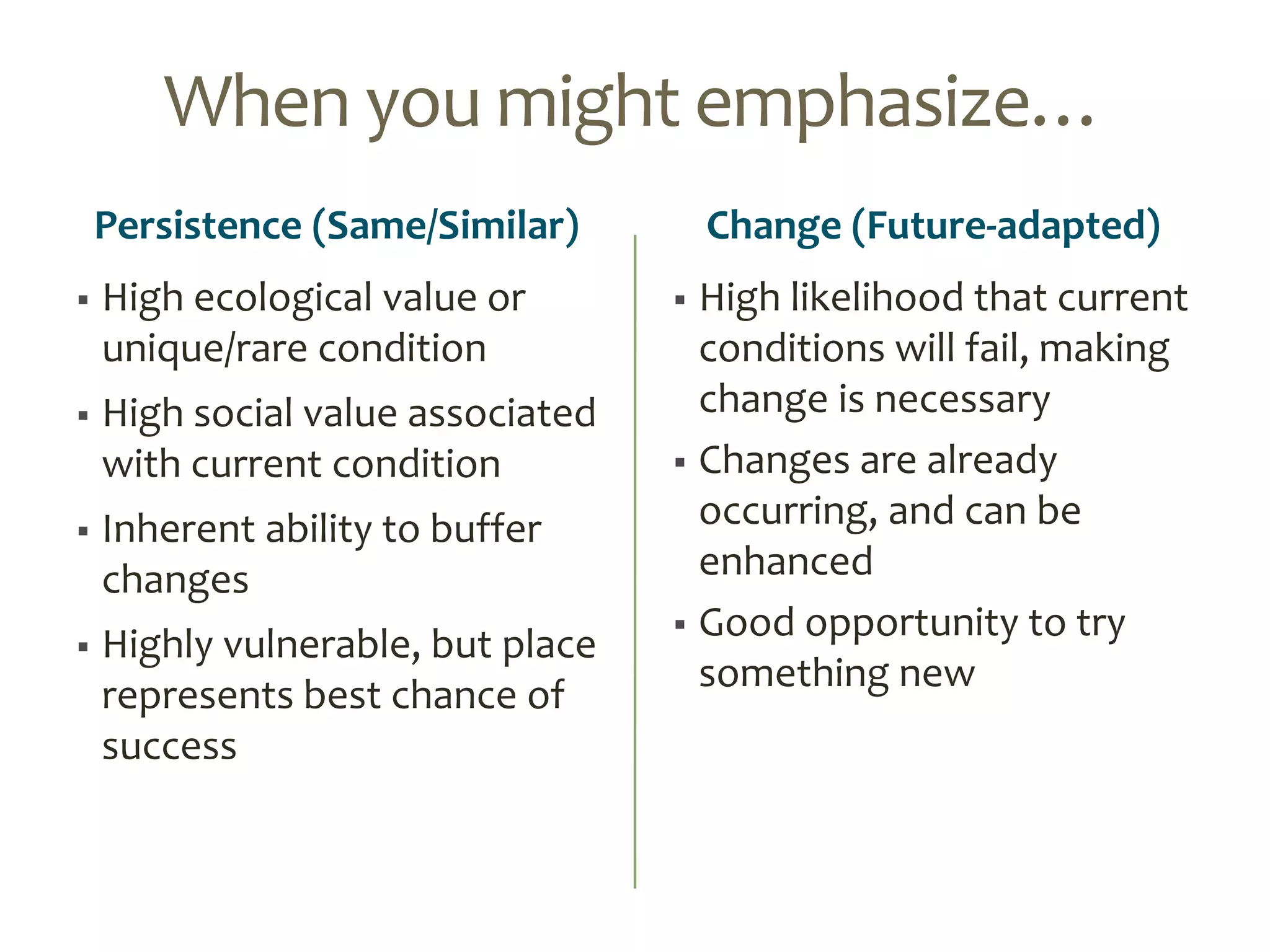
When you might emphasize…
Persistence (Same/Similar)
 High ecological value or
unique/rare condition
 High social value associated
with current condition
 Inherent ability to buffer
changes
 Highly vulnerable, but place
represents best chance of
success
Change (Future-adapted)
 High likelihood that current
conditions will fail, making
change is necessary
 Changes are already
occurring, and can be
enhanced
 Good opportunity to try
something new
Swanston and Janowiak 2012; www.treesearch.fs.fed.us/pubs/40543
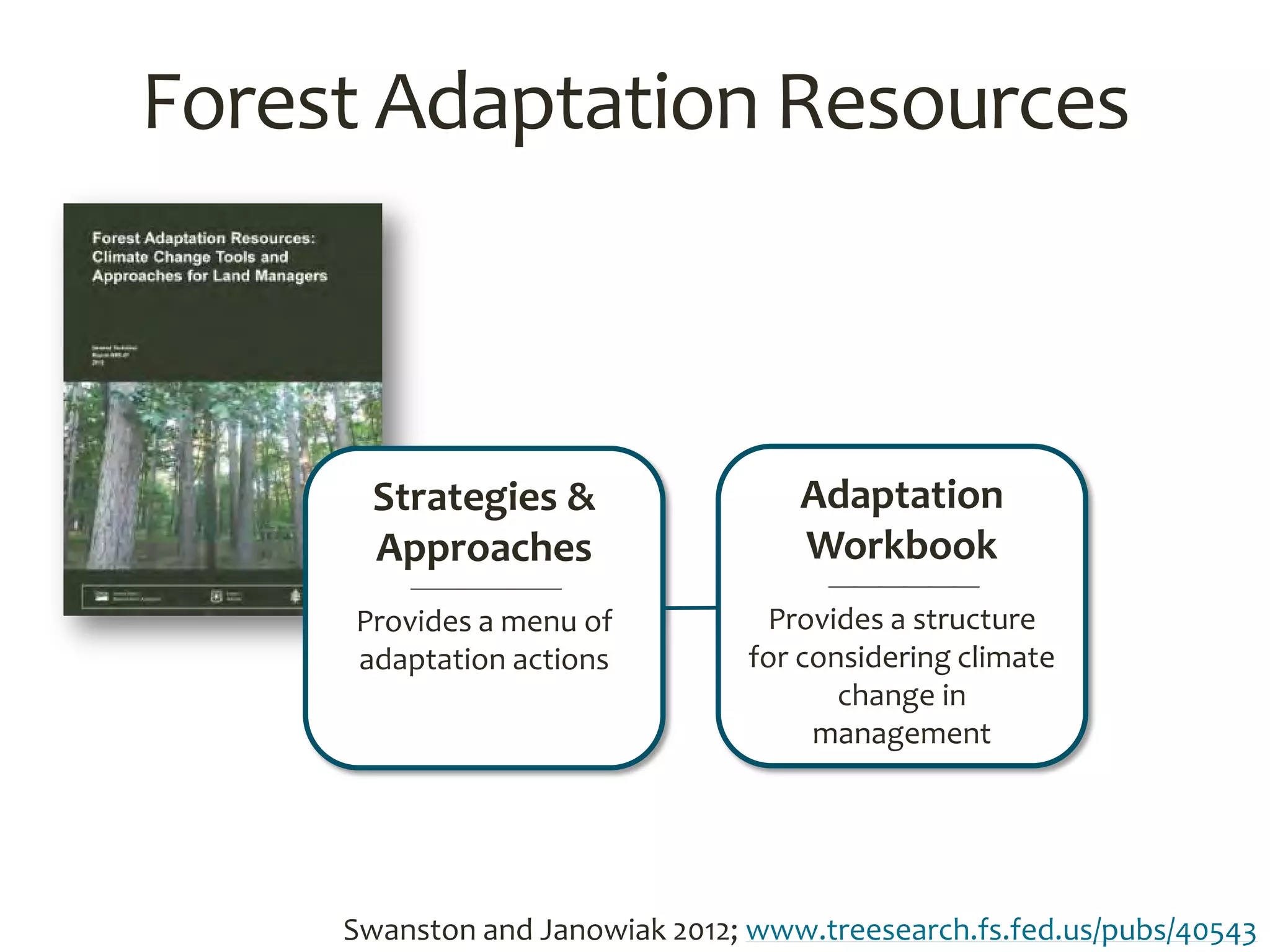
Forest Adaptation Resources
Strategies &
Approaches

Provides a menu of
adaptation actions
Adaptation
Workbook

Provides a structure
for considering climate
change in
management
1. DEFINE area of
interest, management
objectives, and time
frames.
2. ASSESS climate change
impacts and
vulnerabilities for the
area of interest.
3. EVALUATE
management objectives
given projected impacts
and vulnerabilities.
4. IDENTIFY and
implement adaptation
approaches and tactics .
5. MONITOR and
evaluate effectiveness of
implemented actions.
Vulnerability
assessments, scientific
literature, and other
resources
Adaptation
Strategies and
Approaches
AdaptationWorkbook
Can we use this approach for other resource areas?
Adaptation Strategies & Approaches
A “menu” of possible
actions that allows you
to decide what is most
relevant for a particular
location and set of
conditions.
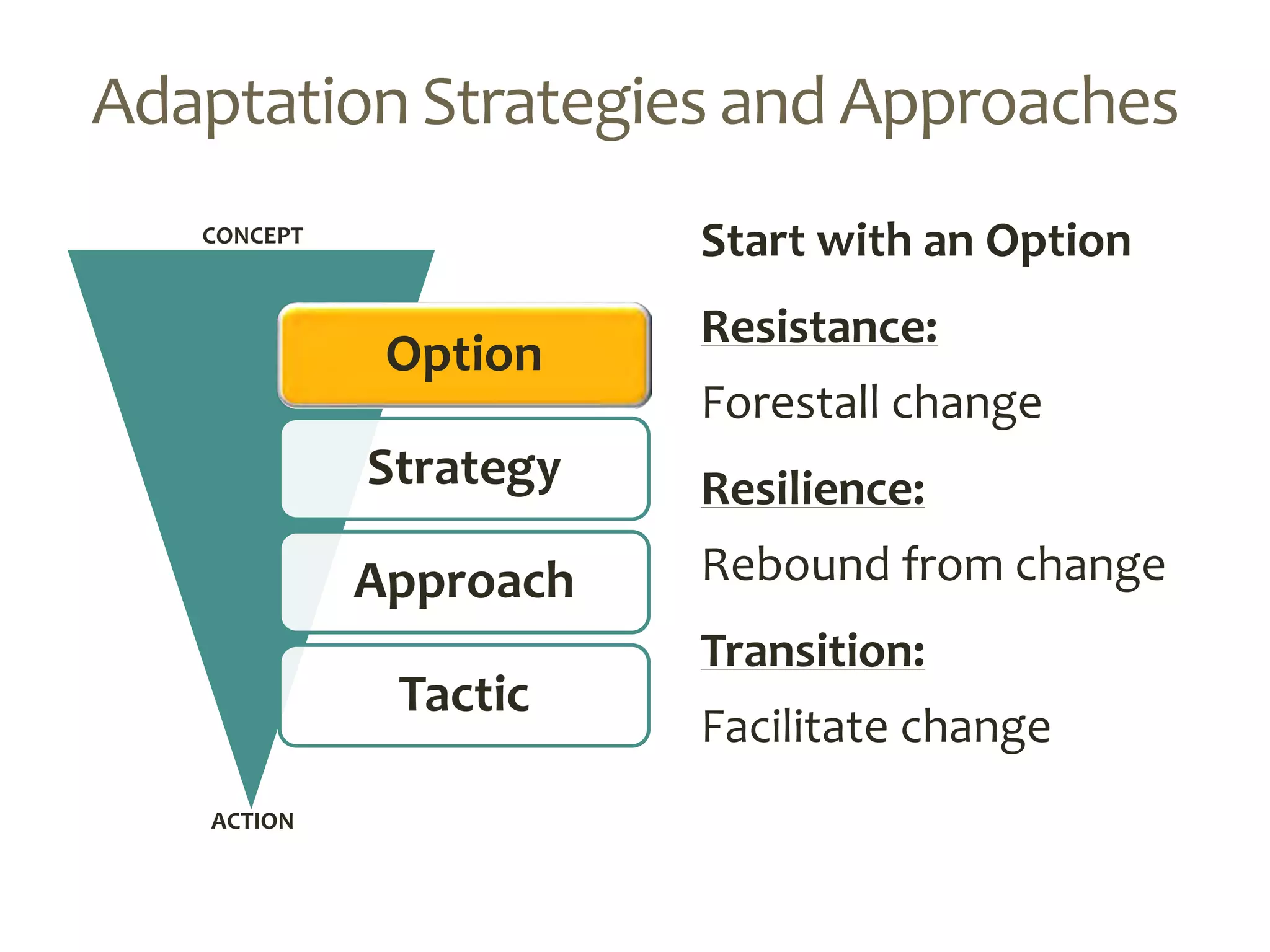
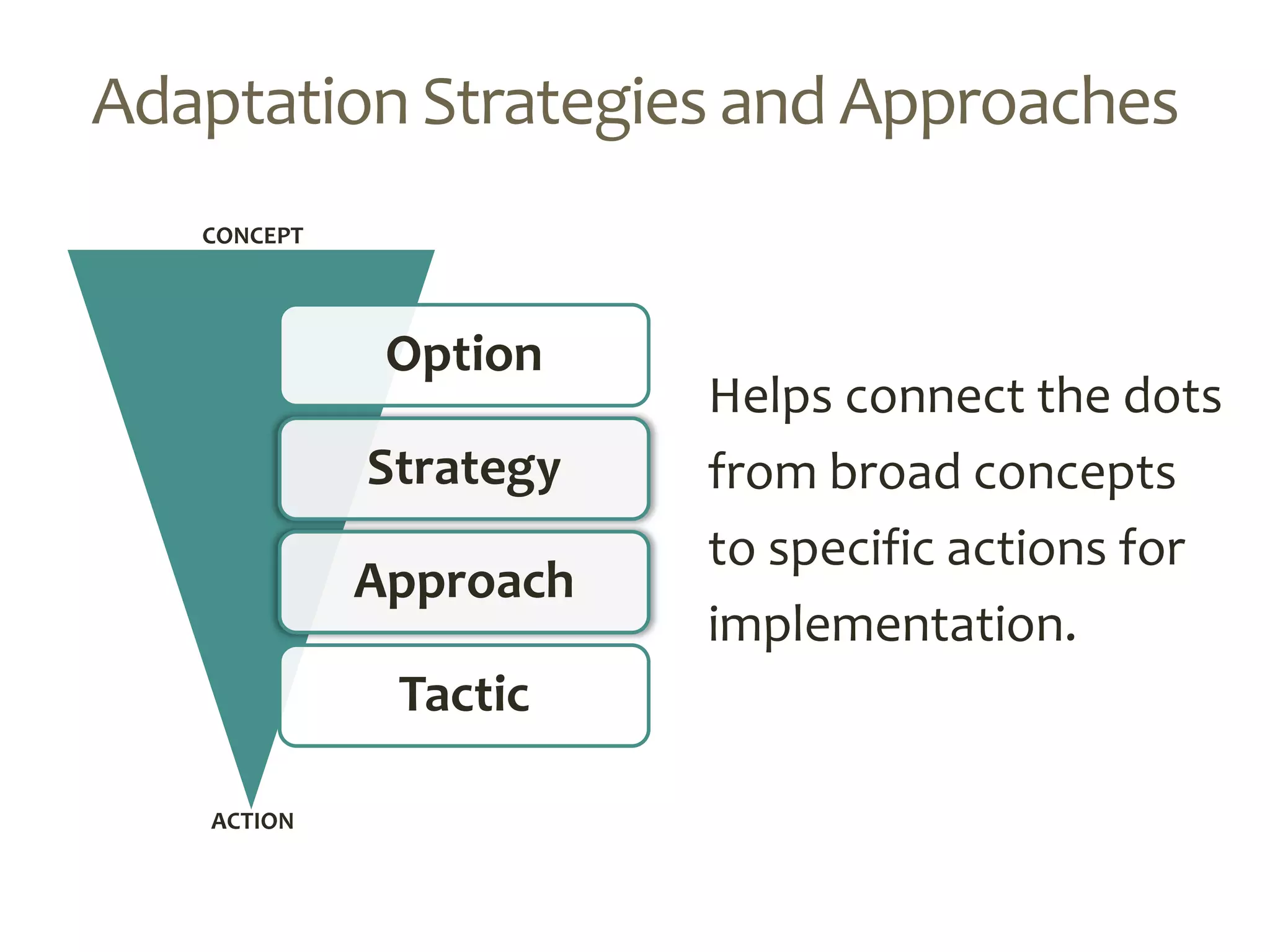
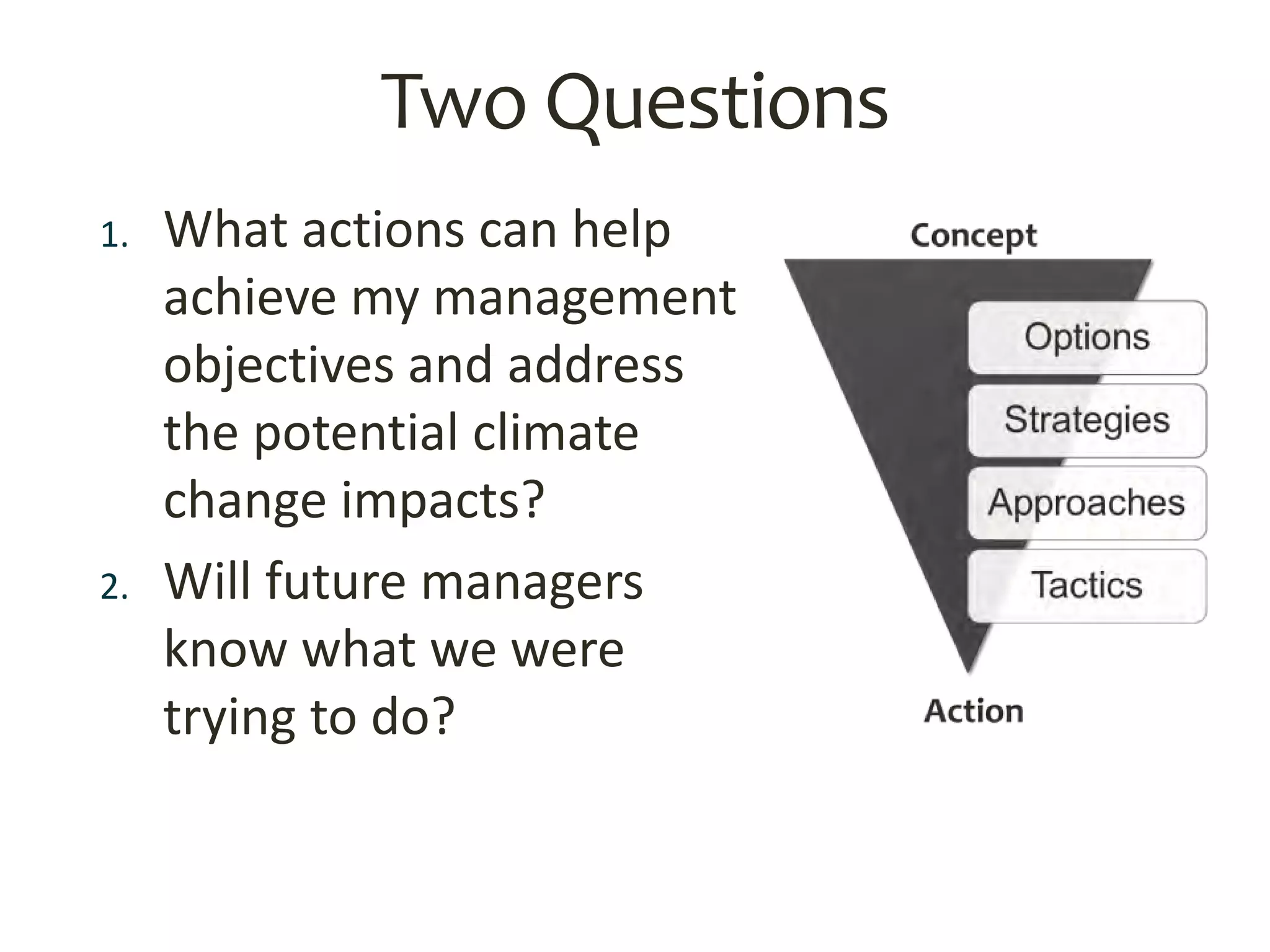
Option
CONCEPT
ACTION
Adaptation Strategies and Approaches
 Resistance
 Resilience
 Transition
A menu of Strategies
and Approaches
provides a way to
translate broad
Options into locally-
relevant Tactics
Option
Strategy
Approach
Tactic
CONCEPT
ACTION
Adaptation Strategies and Approaches
Option
Strategy
Approach
Tactic
ACTION
Adaptation Strategies and Approaches
CONCEPT Start with an Option
Resistance:
Forestall change
Resilience:
Rebound from change
Transition:
Facilitate change
Option
Strategy
Approach
Tactic
ACTION
Adaptation Strategies and Approaches
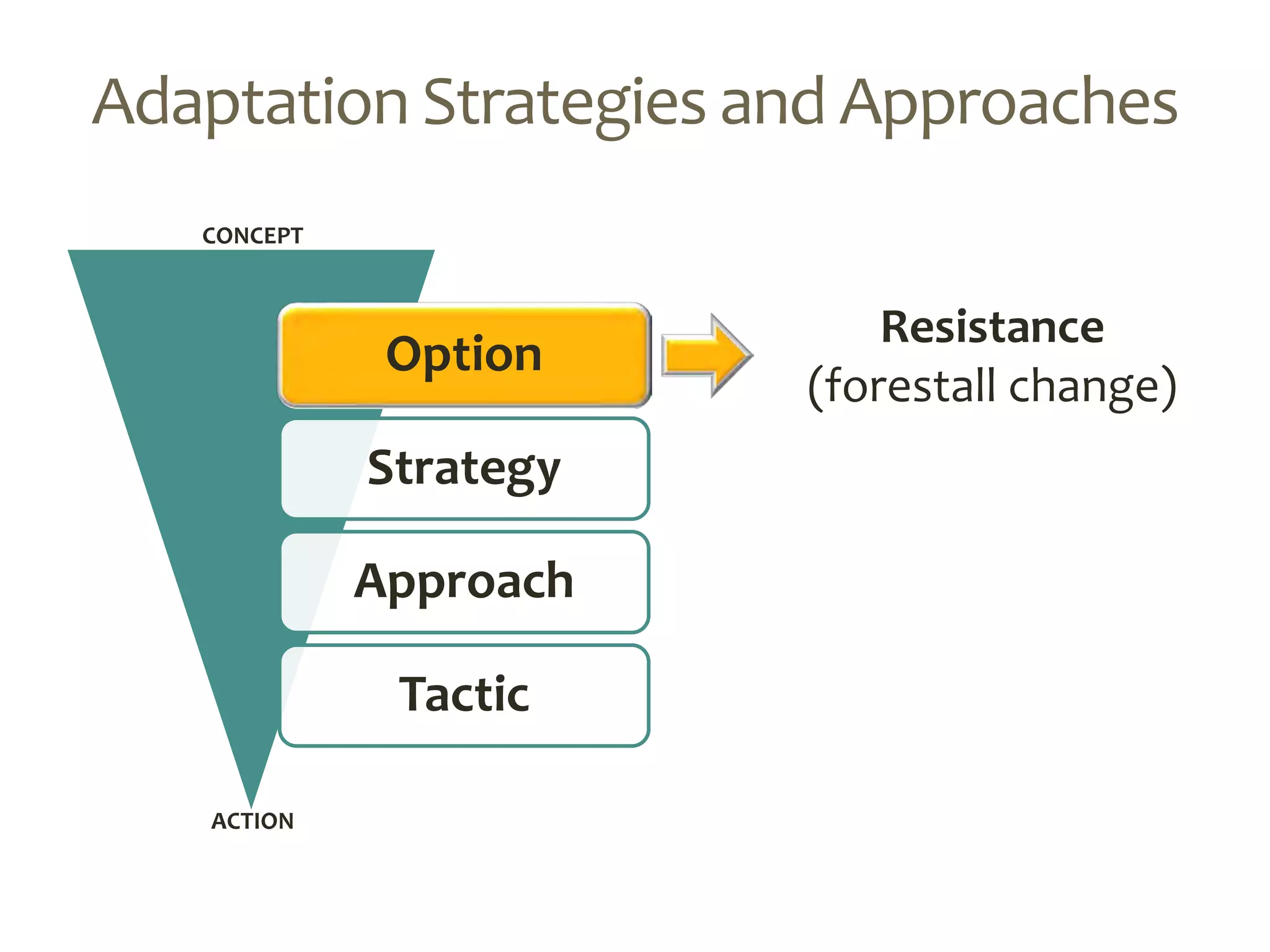
CONCEPT
Resistance
(forestall change)
Option
Strategy
Approach
Tactic
ACTION
Adaptation Strategies and Approaches
Sustain fundamental
ecological functions
CONCEPT
Option
Strategy
Approach
Tactic
ACTION
Adaptation Strategies and Approaches
CONCEPT
Maintain or restore
hydrology
Option
Strategy
Approach
Tactic
ACTION
Adaptation Strategies and Approaches
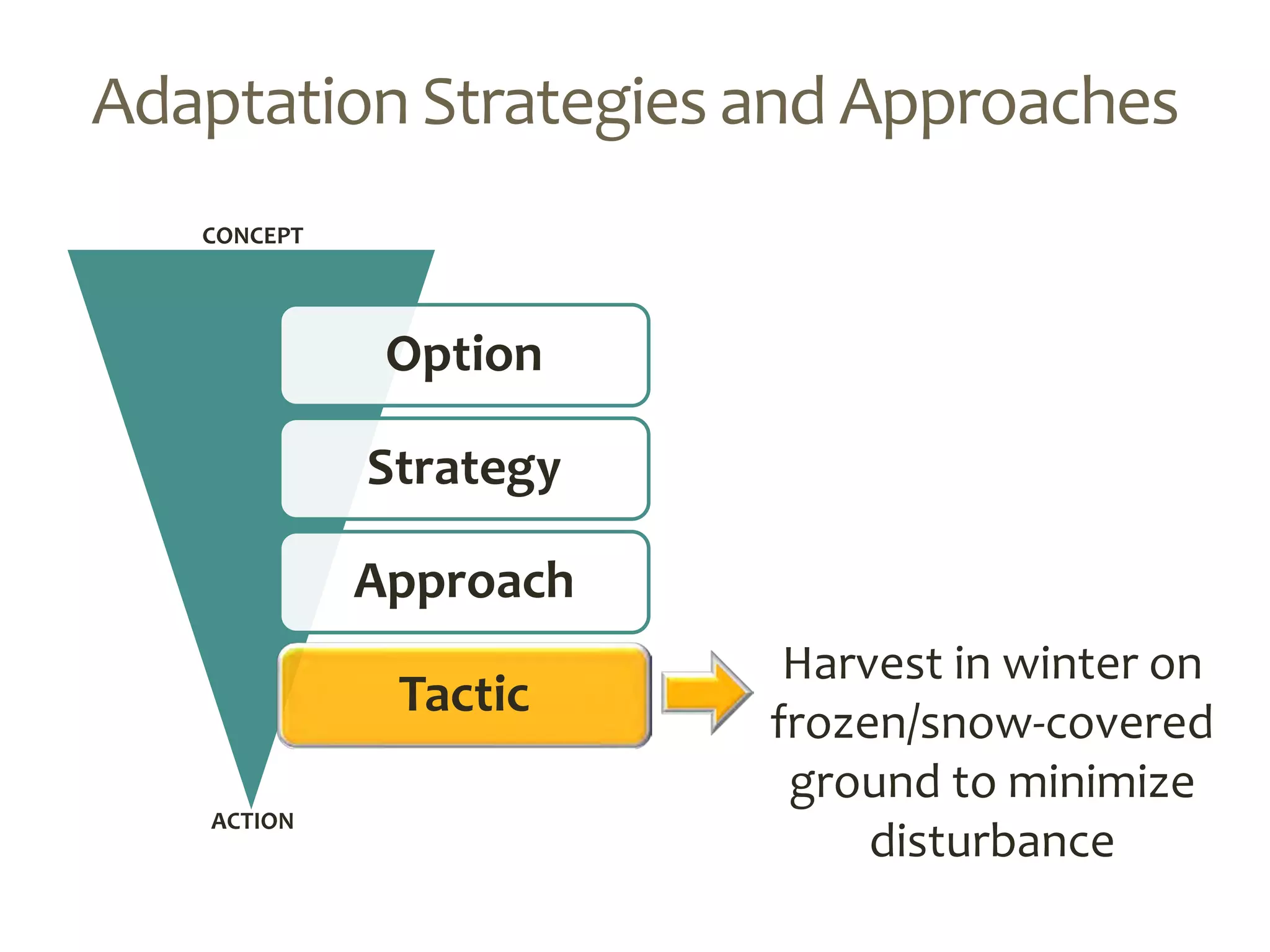
CONCEPT
Harvest in winter on
frozen/snow-covered
ground to minimize
disturbance
Option
Strategy
Approach
Tactic
ACTION
Adaptation Strategies and Approaches
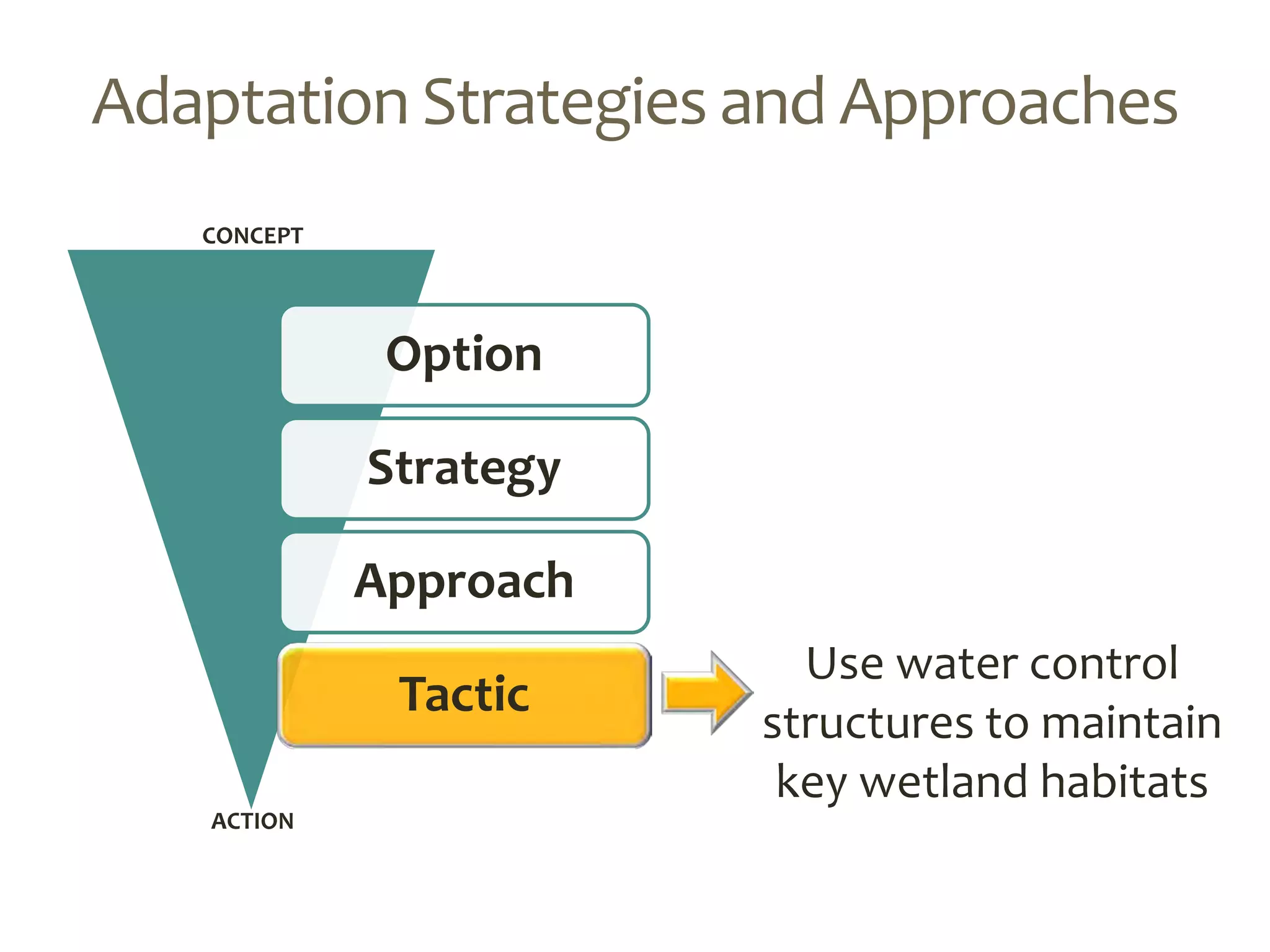
CONCEPT
Use water control
structures to maintain
key wetland habitats
Option
Strategy
Approach
Tactic
ACTION
Adaptation Strategies and Approaches
CONCEPT
Use water control
structures to maintain
key wetland habitats
Option
Strategy
Approach
Tactic
ACTION
Adaptation Strategies and Approaches
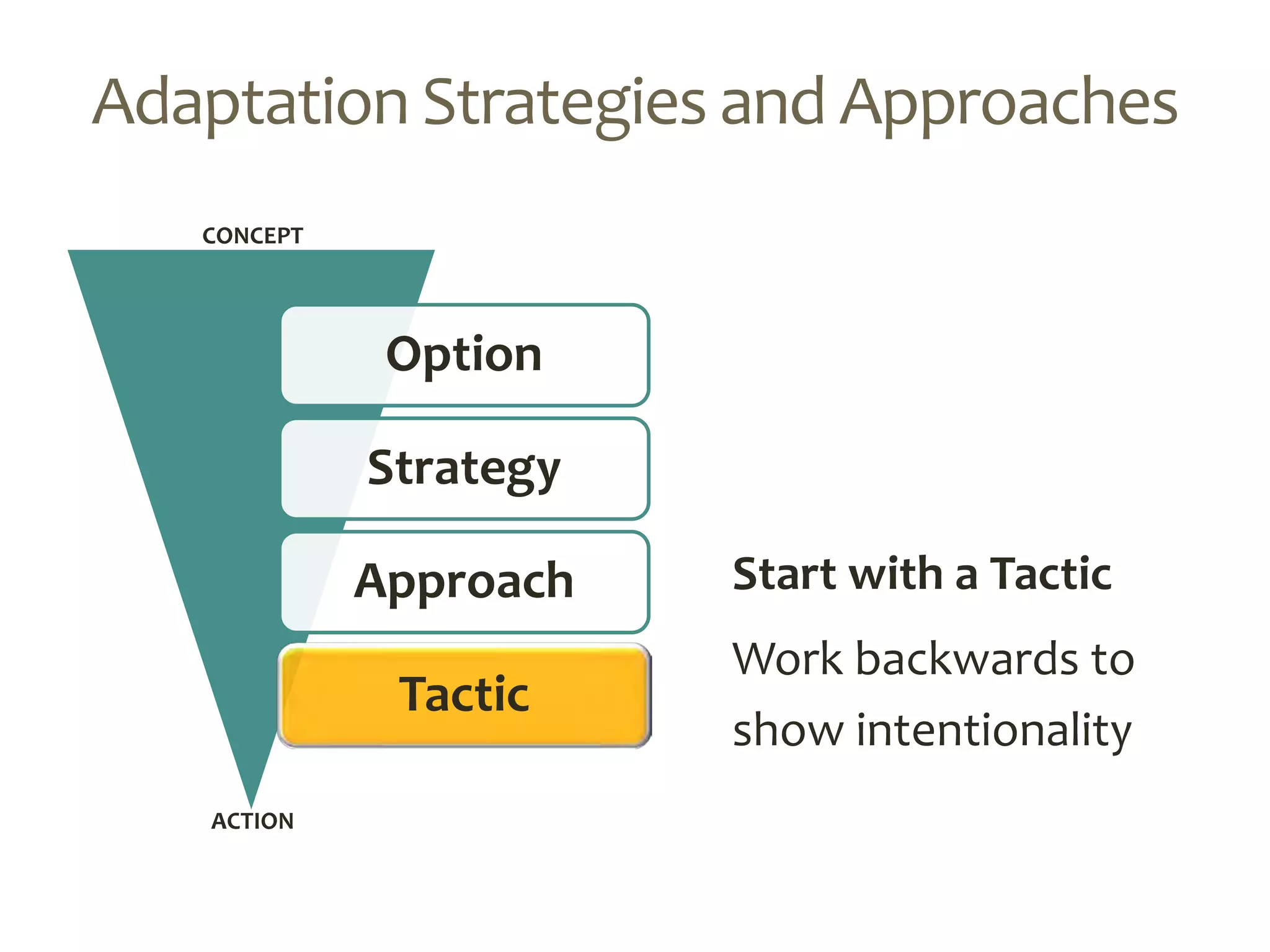
CONCEPT
Start with a Tactic
Work backwards to
show intentionality
Option
Strategy
Approach
Tactic
ACTION
Adaptation Strategies and Approaches
CONCEPT
Establish future-
adapted species on
south-facing slopes
Option
Strategy
Approach
Tactic
ACTION
Adaptation Strategies and Approaches
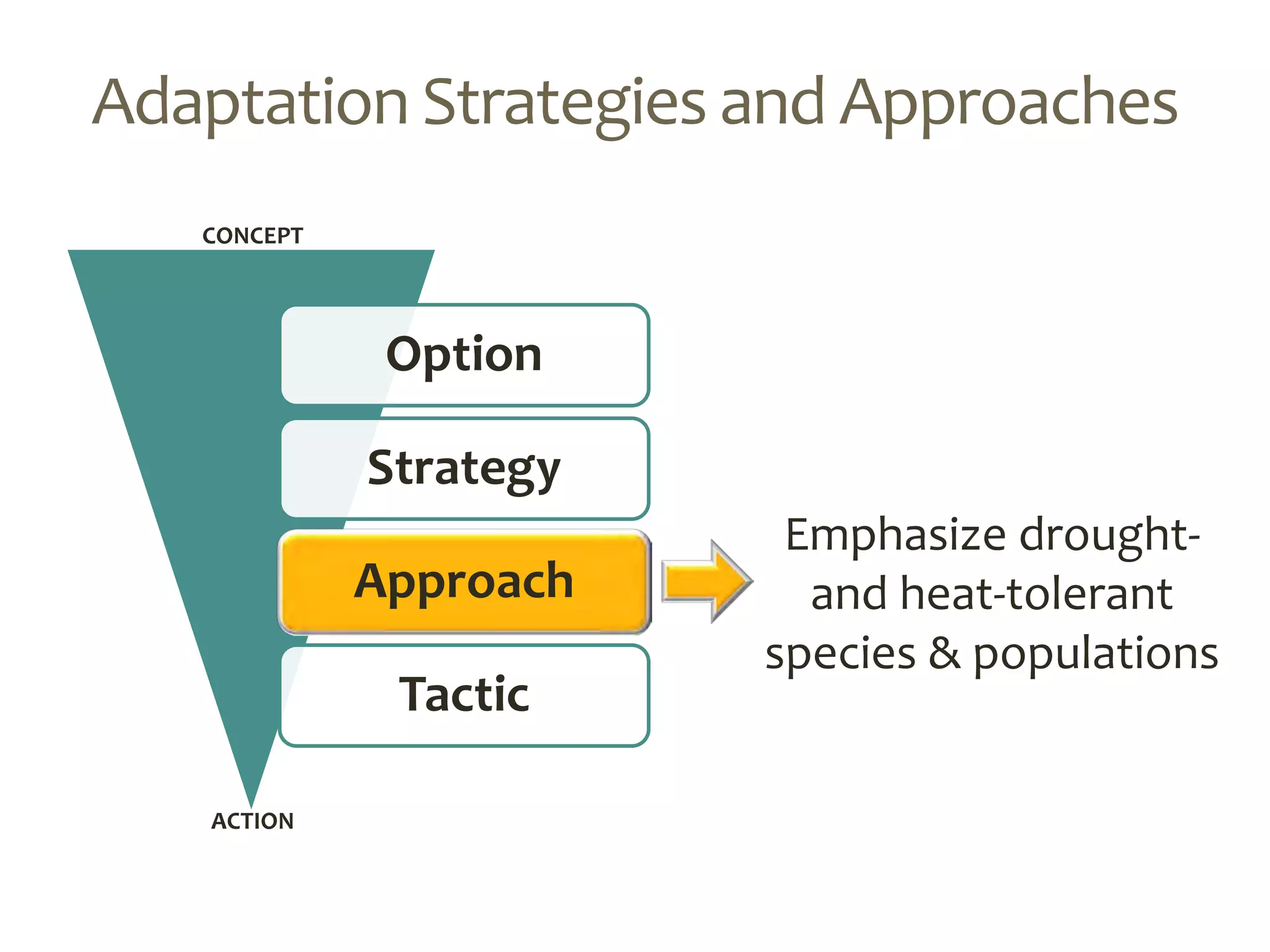
CONCEPT
Emphasize drought-
and heat-tolerant
species & populations
Option
Strategy
Approach
Tactic
ACTION
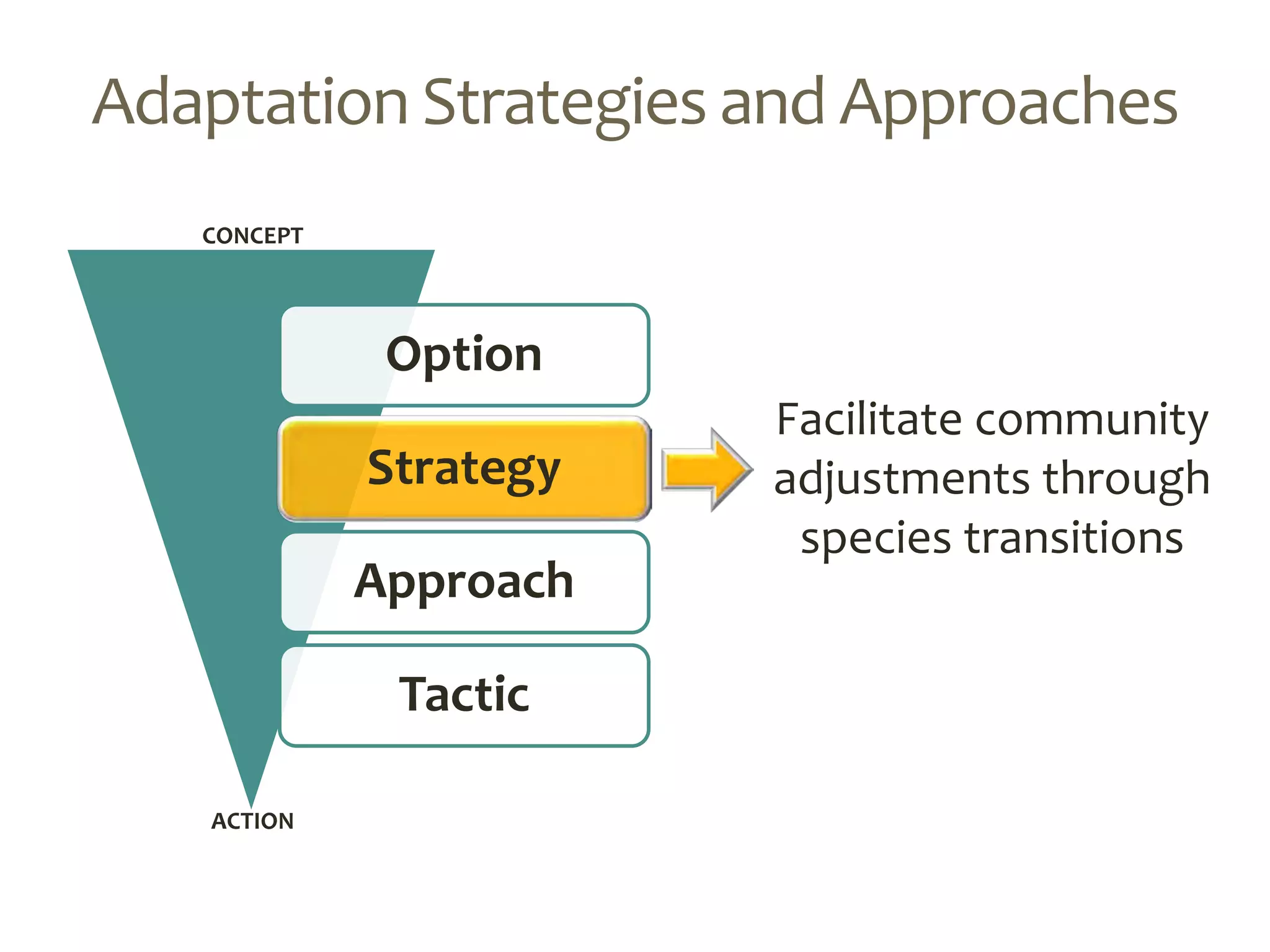
Adaptation Strategies and Approaches
Facilitate community
adjustments through
species transitions
CONCEPT
Option
Strategy
Approach
Tactic
ACTION
Adaptation Strategies and Approaches
CONCEPT
Transition
(facilitate change)
Helps connect the dots
from broad concepts
to specific actions for
implementation.
Option
Strategy
Approach
Tactic
CONCEPT
ACTION
Adaptation Strategies and Approaches
 It doesn’t matter whether you start with
approaches or tactics.
 It is important to connect the two: shows
how your action is related to climate change
Approaches Tactics
Step 4: IDENTIFY adaptation approaches and
tactics for implementation.
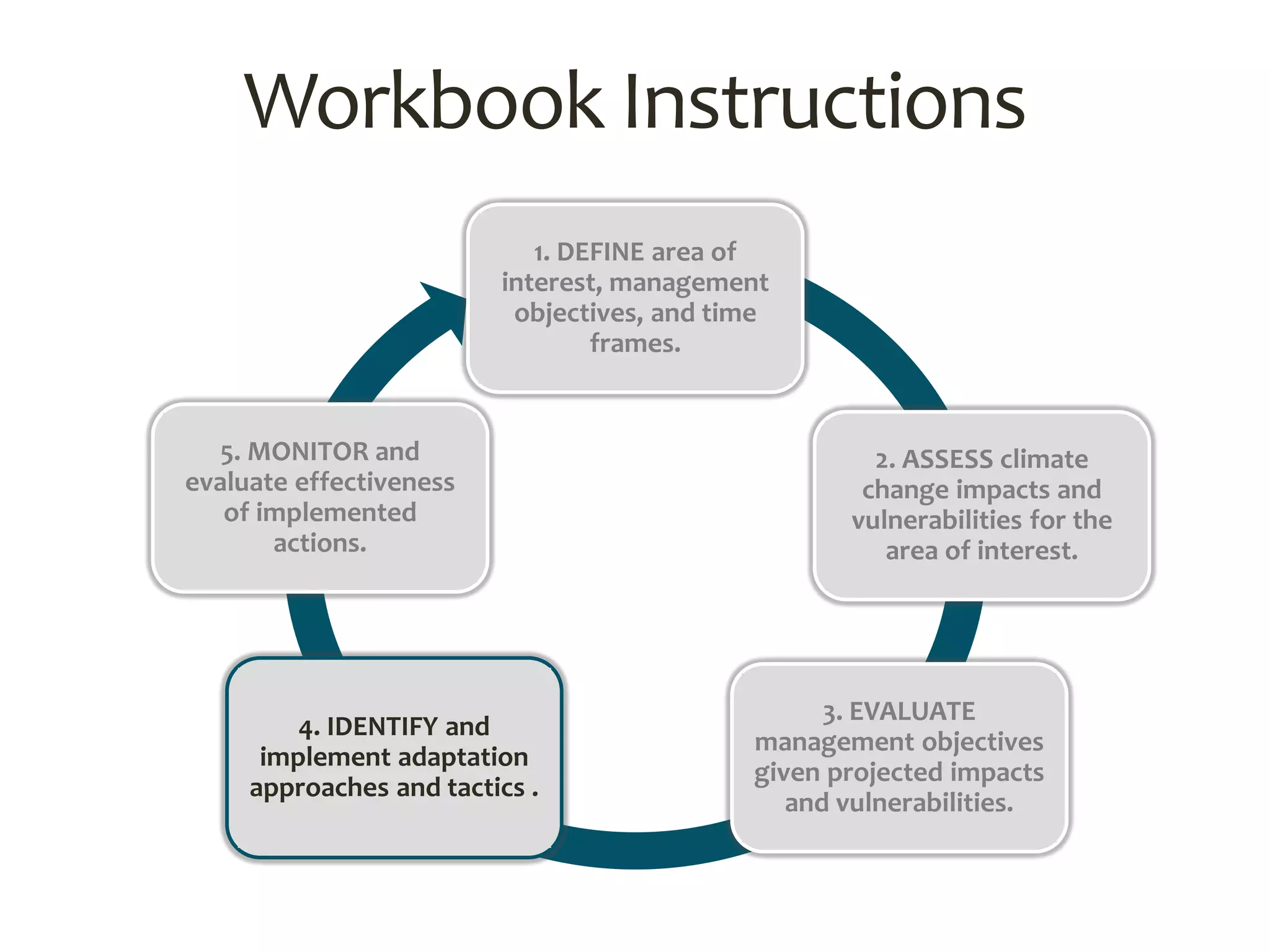
1. DEFINE area of
interest, management
objectives, and time
frames.
2. ASSESS climate
change impacts and
vulnerabilities for the
area of interest.
3. EVALUATE
management objectives
given projected impacts
and vulnerabilities.
4. IDENTIFY and
implement adaptation
approaches and tactics .
5. MONITOR and
evaluate effectiveness
of implemented
actions.
Workbook Instructions
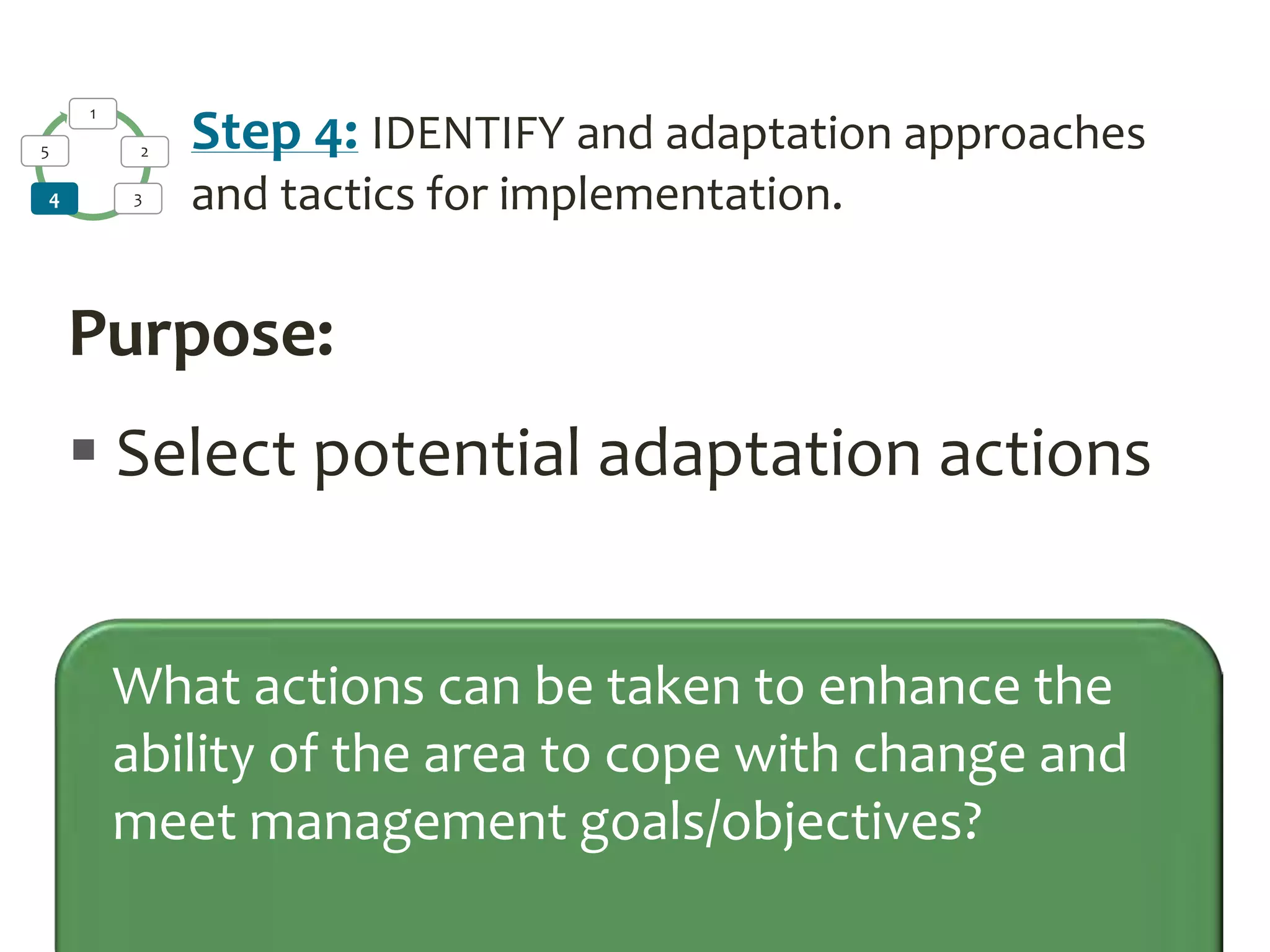
Purpose:
 Select potential adaptation actions
What actions can be taken to enhance the
ability of the area to cope with change and
meet management goals/objectives?
1
2
34
5 Step 4: IDENTIFY and adaptation approaches
and tactics for implementation.
Two Questions
1. What actions can help
achieve my management
objectives and address
the potential climate
change impacts?
2. Will future managers
know what we were
trying to do?
1
2
34
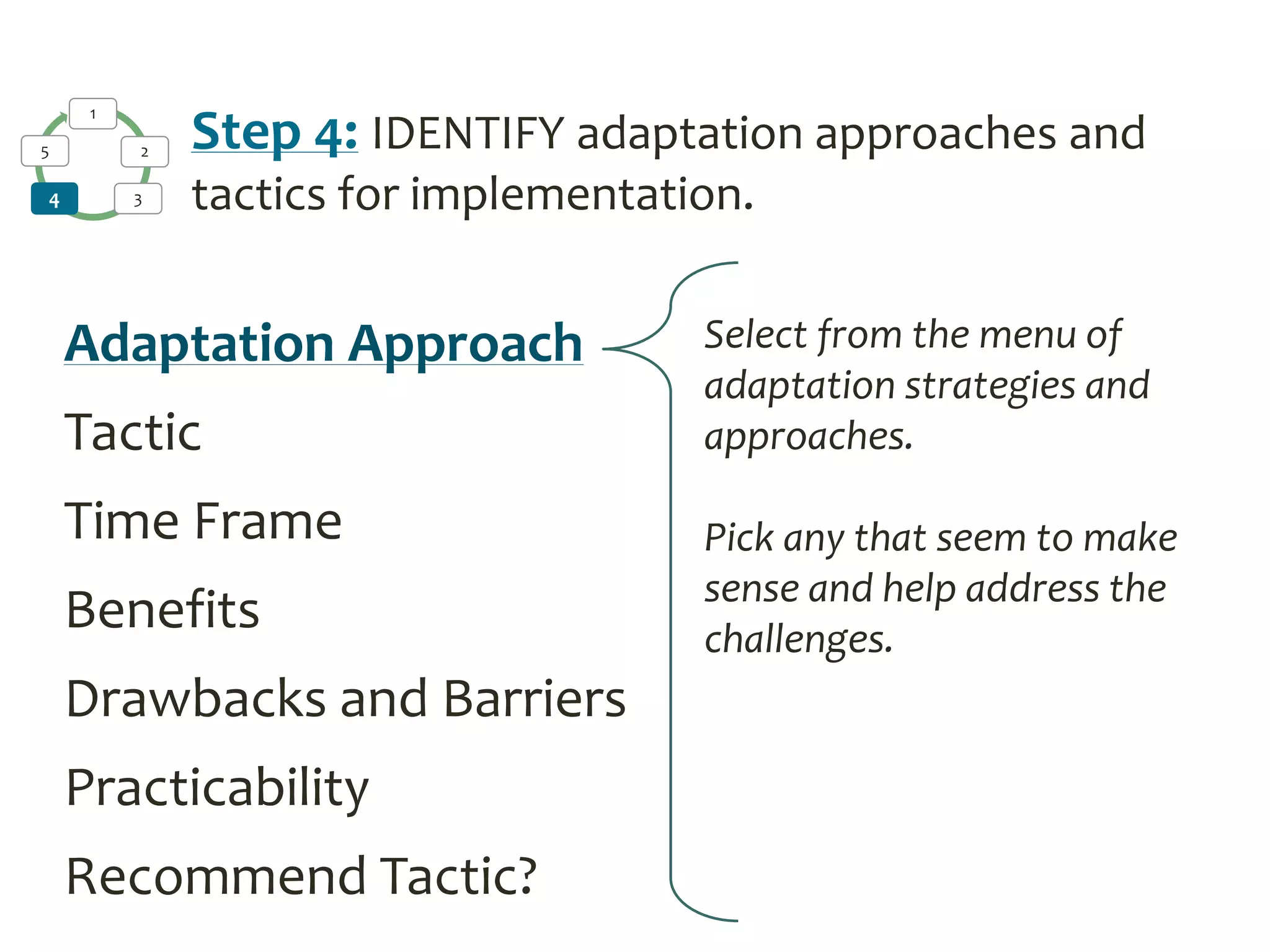
5 Step 4: IDENTIFY adaptation approaches and
tactics for implementation.
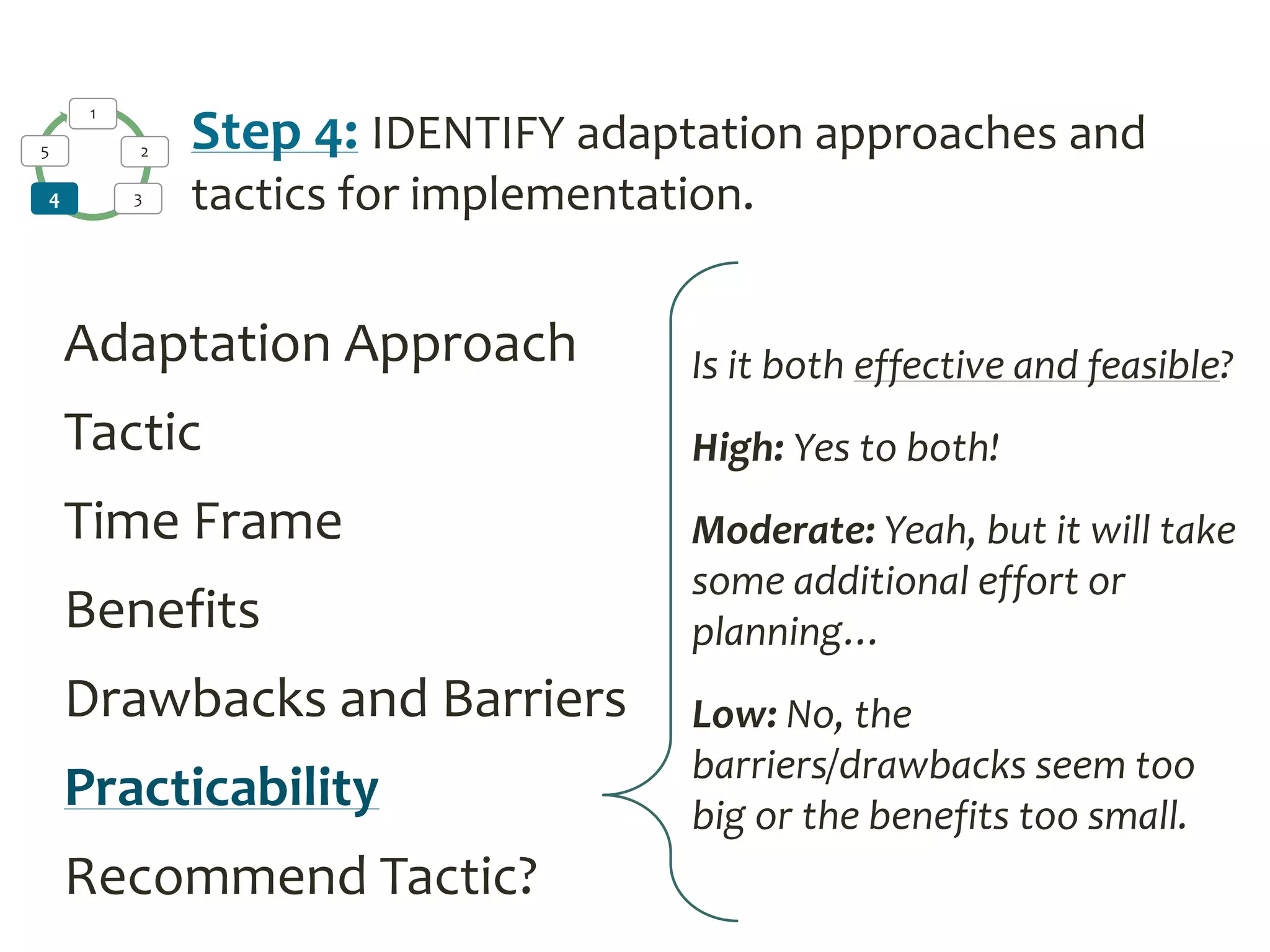
Adaptation Approach
Tactic
Time Frame
Benefits
Drawbacks and Barriers
Practicability
Recommend Tactic?
Select from the menu of
adaptation strategies and
approaches.
Pick any that seem to make
sense and help address the
challenges.
1
2
34
5 Step 4: IDENTIFY adaptation approaches and
tactics for implementation.
Adaptation Approach
Tactic
Time Frame
Benefits
Drawbacks and Barriers
Practicability
Recommend Tactic?
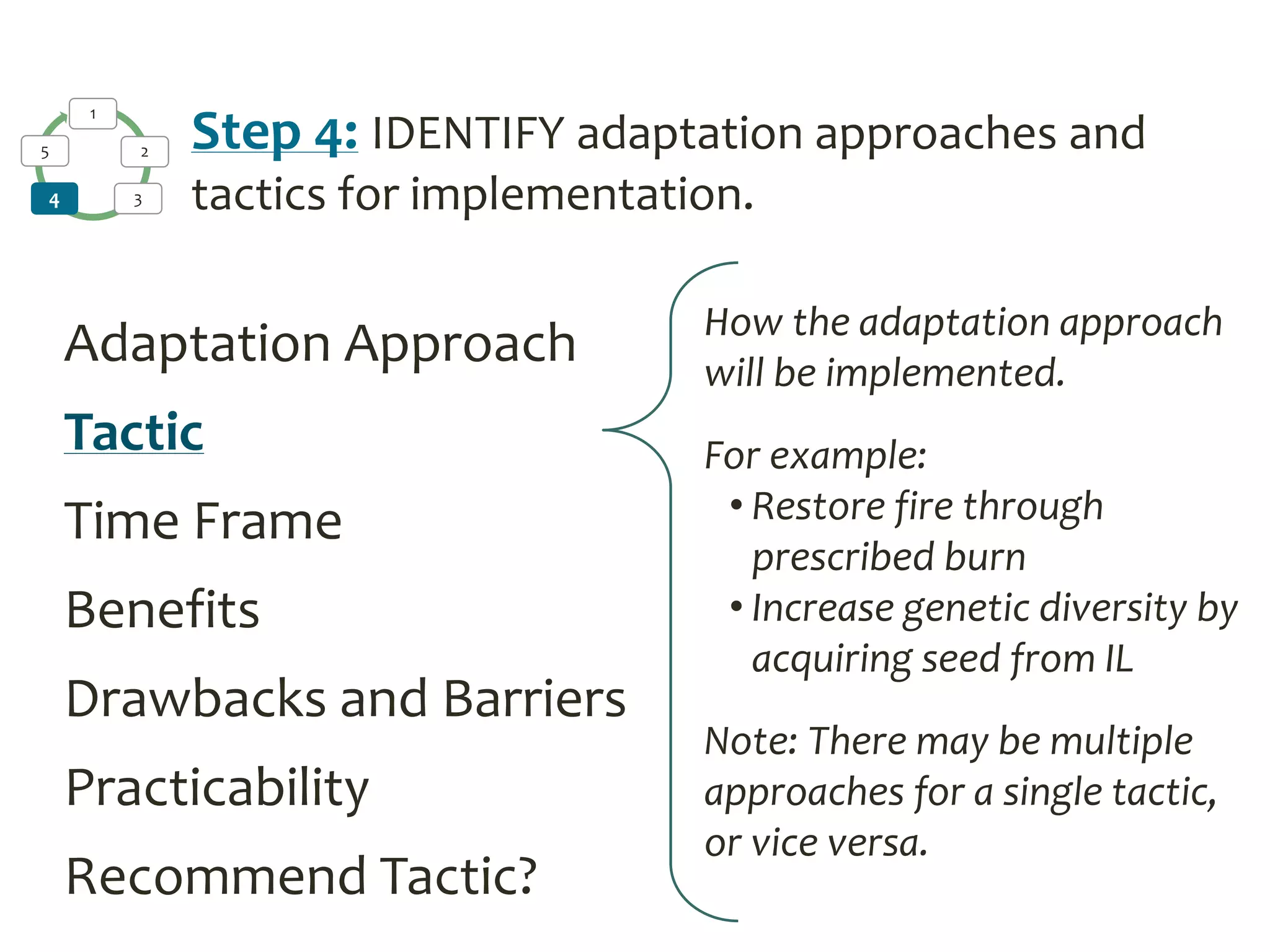
How the adaptation approach
will be implemented.
For example:
• Restore fire through
prescribed burn
• Increase genetic diversity by
acquiring seed from IL
Note: There may be multiple
approaches for a single tactic,
or vice versa.
1
2
34
5 Step 4: IDENTIFY adaptation approaches and
tactics for implementation.
Adaptation Approach
Tactic
Time Frame
Benefits
Drawbacks and Barriers
Practicability
Recommend Tactic?
Timing for the tactics
For example:
• Summer 2014
• Winter 2013-2016
• Within 3 years of…
• After…
1
2
34
5 Step 4: IDENTIFY adaptation approaches and
tactics for implementation.
Adaptation Approach
Tactic
Time Frame
Benefits
Drawbacks and Barriers
Practicability
Recommend Tactic?
Why it’s good
For example:
• Addresses biggest or
multiple challenges
• Cheap, easy
• Co-benefits
• Likely to succeed
1
2
34
5 Step 4: IDENTIFY adaptation approaches and
tactics for implementation.
Adaptation Approach
Tactic
Time Frame
Benefits
Drawbacks and Barriers
Practicability
Recommend Tactic?
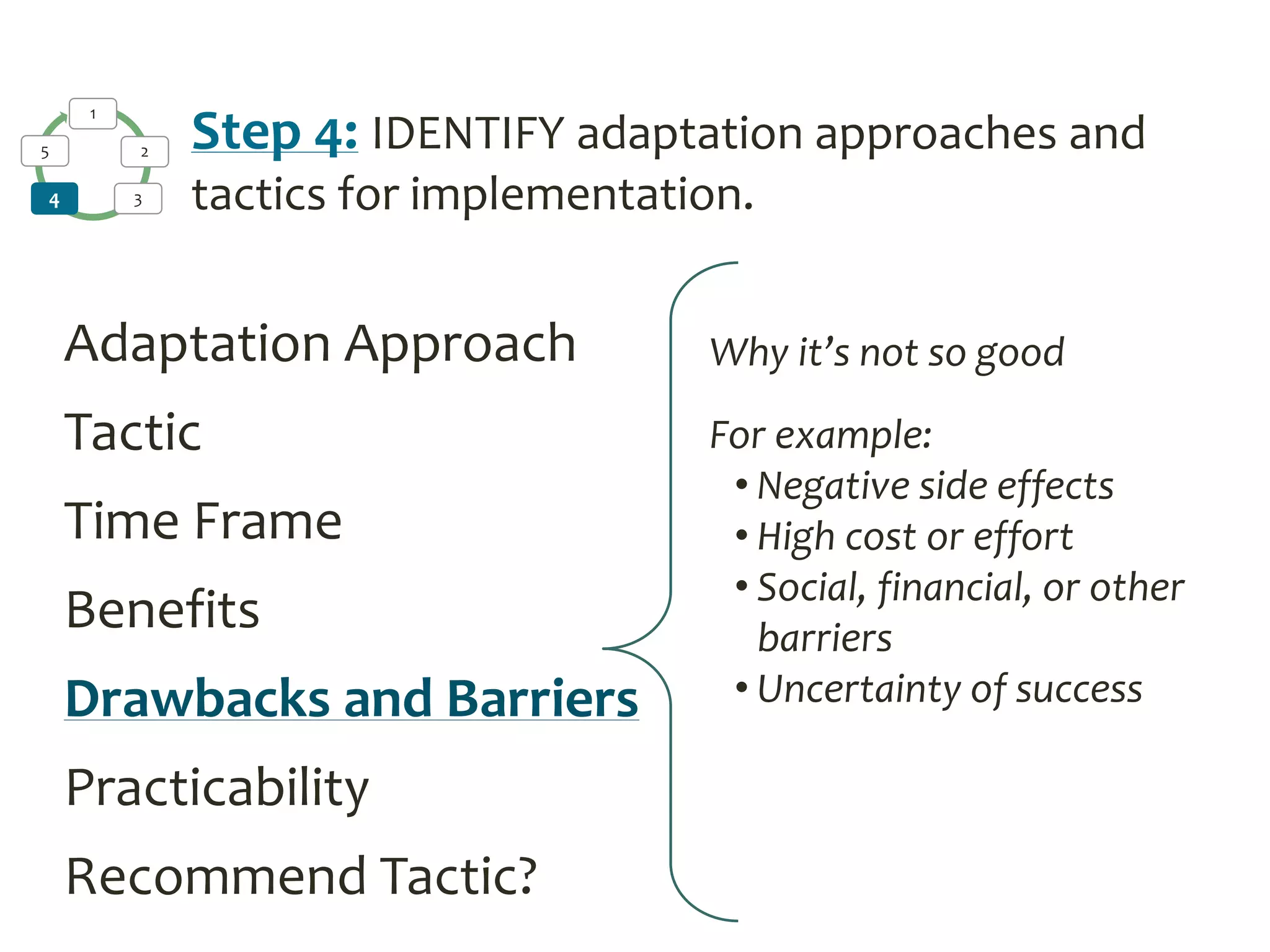
Why it’s not so good
For example:
• Negative side effects
• High cost or effort
• Social, financial, or other
barriers
• Uncertainty of success
1
2
34
5 Step 4: IDENTIFY adaptation approaches and
tactics for implementation.
Adaptation Approach
Tactic
Time Frame
Benefits
Drawbacks and Barriers
Practicability
Recommend Tactic?
Is it both effective and feasible?
High: Yes to both!
Moderate: Yeah, but it will take
some additional effort or
planning…
Low: No, the
barriers/drawbacks seem too
big or the benefits too small.
1
2
34
5 Step 4: IDENTIFY adaptation approaches and
tactics for implementation.
Adaptation Approach
Tactic
Time Frame
Benefits
Drawbacks and Barriers
Practicability
Recommend Tactic?
Given all this, is this tactic likely
to be helpful?
Also consider: trade-offs,
urgency, likelihood of success,
cost, and effort…
Yes: look to integrate into plan,
prescription, or other activities
No: not useful at this time
Slow down!
Are you going to continue with the adaptation
tactics that have been selected?
1
2
34
5 Step 4: IDENTIFY adaptation approaches and
tactics for implementation.
Adaptation
Approach Tactic
Time
Frames Benefits Drawbacks & Barriers
Practicability
of Tactic
Recommend
Tactic?
5.2 — Maintain or
improve the
ability of forests
to resist pests
and pathogens.
Clearcut aspen in
winter to promote
vigorous regrowth
Short
term
(harvest)
 Young aspen is
generally less
susceptible to pests
and diseases than
mature aspen
 May help reduce
patchiness of aspen in
stand
 Extremely
High
Yes
9.2 — Favor or
restore native
species that are
expected to be
better adapted to
future conditions.
9.4 — Emphasize
drought- and
heat-tolerant
species and
populations.
Plant red oak in select
areas to introduce a
small component to
stand and add species
diversity, especially in
reserve areas near
road. Consider deer
protection for oak.
Short-
term
(harvest)
 Species seems like it
would be well-adapted
to site
 Add diversity and a
future adapted species
 Not sure whether
competition could be
controlled sufficiently
 Not good place to put
oak where it can get the
right amount of light at
the right time
 Emphasis is aspen, so
sinking lots of effort into
oak doesn’t make sense
 Not specified in NEPA
Low
(effectivenes
s and
feasibility are
both low)
Additional
steps would
be needed to
prep for oak
planting
Yes
9.4 — Emphasize
drought- and
heat-tolerant
species and
populations.
8.2 — Favor
existing
genotypes that
are better
adapted to future
conditions
For any planted red
oak, consider selecting
acorns from trees that
have survived drought
and other stressors
(e.g., Twin Ghost areas
of oak mortality)
Short
term
 Stock might be better
adapted to future
conditions.
 Stock would be within
the same seed zone.
 Overall suitability for
this stand is unknown.
 Haven’t done this
before. Low probability
of success?
Getting
acorns: high
Successfully
raising oak:
low (see
#10)
No
EXAMPLE: CHEQUAMEGON-NICOLET NATIONAL FOREST—ASPEN
ADAPTATION EXAMPLE:
CHEQUAMEGON-NICOLET NATIONAL FOREST—ASPEN
1
2
34
5
Step 4: IDENTIFY and adaptation approaches
and tactics for implementation.
What actions can be taken to
enhance the ability of the area
to cope with change and meet
management goals?
EXAMPLE: CHEQUAMEGON-NICOLET NATIONAL FOREST—ASPEN
1
2
34
5
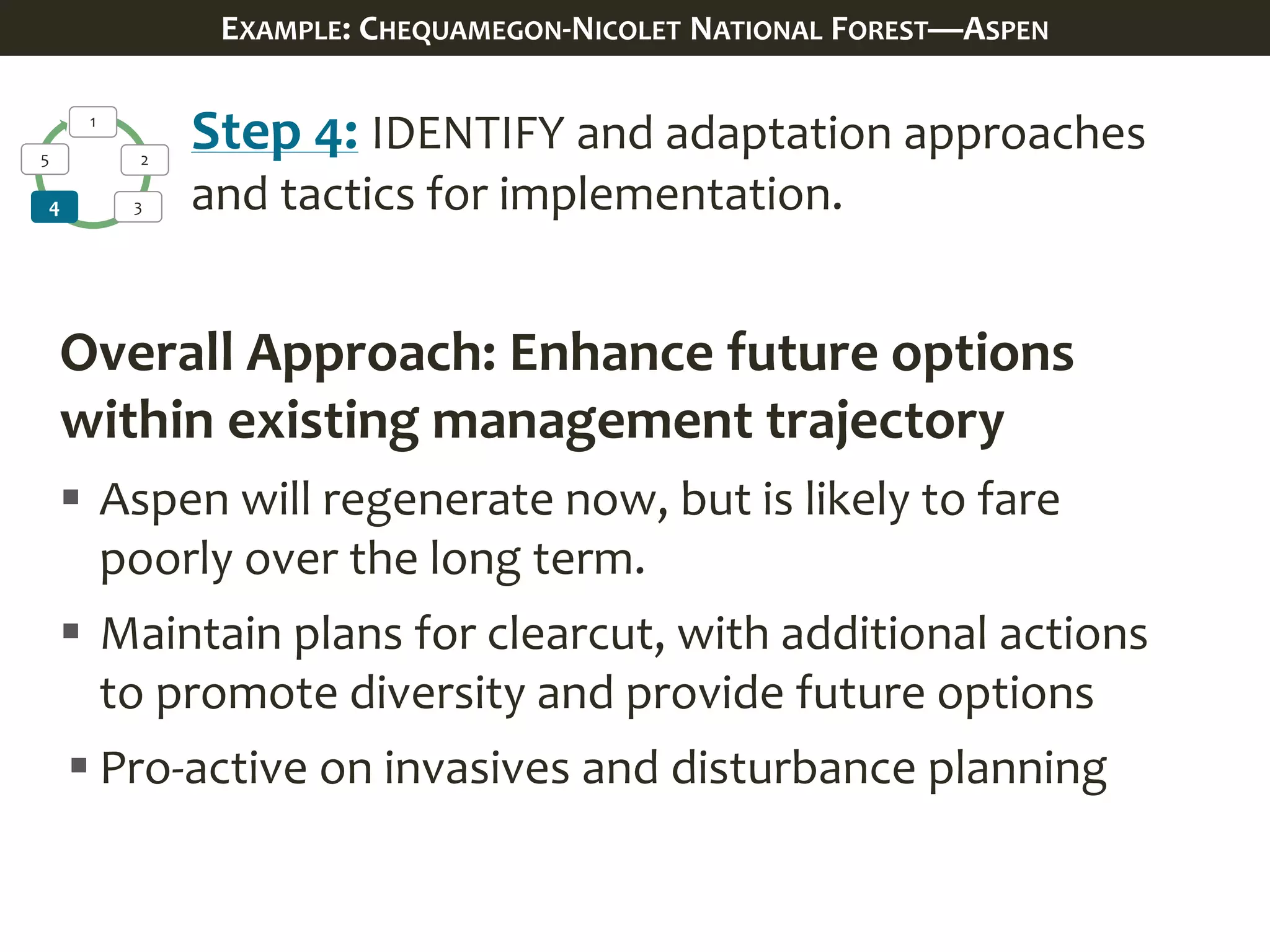
Overall Approach: Enhance future options
within existing management trajectory
 Aspen will regenerate now, but is likely to fare
poorly over the long term.
 Maintain plans for clearcut, with additional actions
to promote diversity and provide future options
 Pro-active on invasives and disturbance planning
Step 4: IDENTIFY and adaptation approaches
and tactics for implementation.
EXAMPLE: CHEQUAMEGON-NICOLET NATIONAL FOREST—ASPEN
1
2
34
5
Adaptation
Approach
Tactic Consider: Recommend
Tactics?
•Maintain or
improve the
ability of forests
to resist pests
and pathogens.
•Clearcut aspen
•Thin roadside aspen
•Favor or restore
native species
that are expected
to be better
adapted to future
conditions.
•Plant white pine and
red oak (to become
minor component)
•Favor future-adapted
species on site
•Benefits
•Drawbacks
•Barriers
•Practicability
Yes
Yes
Step 4: IDENTIFY and adaptation approaches
and tactics for implementation.
EXAMPLE: CHEQUAMEGON-NICOLET NATIONAL FOREST—ASPEN
Step 5: MONITOR and evaluate effectiveness
of implemented actions.
1. DEFINE area of
interest, management
objectives, and time
frames.
2. ASSESS climate
change impacts and
vulnerabilities for the
area of interest.
3. EVALUATE
management objectives
given projected impacts
and vulnerabilities.
4. IDENTIFY and
implement adaptation
approaches and tactics .
5. MONITOR and
evaluate effectiveness
of implemented
actions.
Workbook Instructions
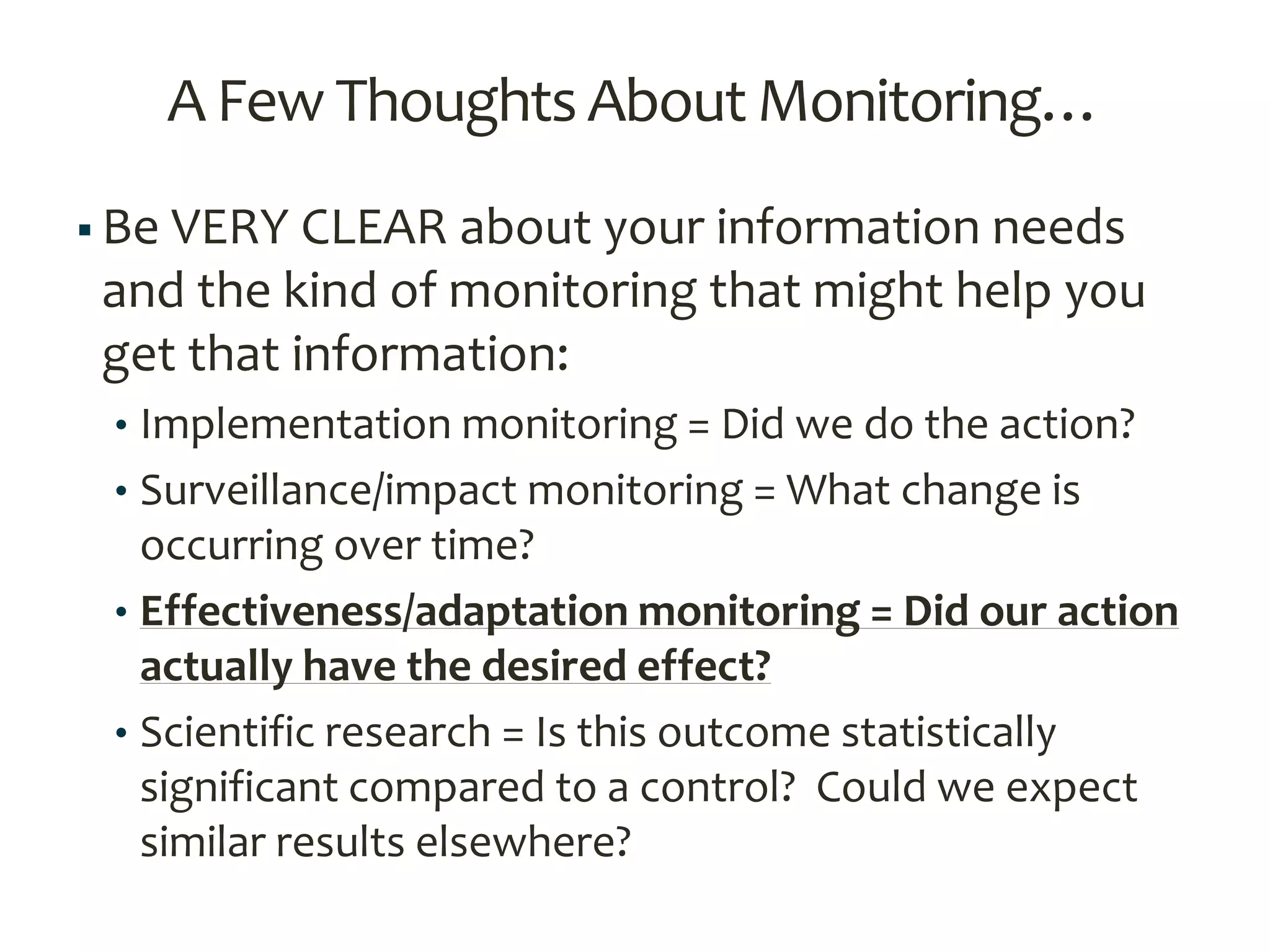
A Few Thoughts AboutMonitoring…
 Be VERY CLEAR about your information needs
and the kind of monitoring that might help you
get that information:
• Implementation monitoring = Did we do the action?
• Surveillance/impact monitoring = What change is
occurring over time?
• Effectiveness/adaptation monitoring = Did our action
actually have the desired effect?
• Scientific research = Is this outcome statistically
significant compared to a control? Could we expect
similar results elsewhere?
A Few Thoughts AboutMonitoring…
 Be VERY CLEAR about your information needs
and the kind of monitoring that might help you
get that information:
• Implementation monitoring = Did we do the action?
• Surveillance/impact monitoring = What change is
occurring over time?
• Effectiveness/adaptation monitoring = Did our action
actually have the desired effect?
• Scientific research = Is this outcome statistically
significant compared to a control? Could we expect
similar results elsewhere?
Purpose:
 Practice adaptive management
How do we know if the selected actions
were effective?
What can we learn from these actions to
inform future management?
1
2
34
5 Step 5: MONITOR and evaluate effectiveness
of implemented actions.
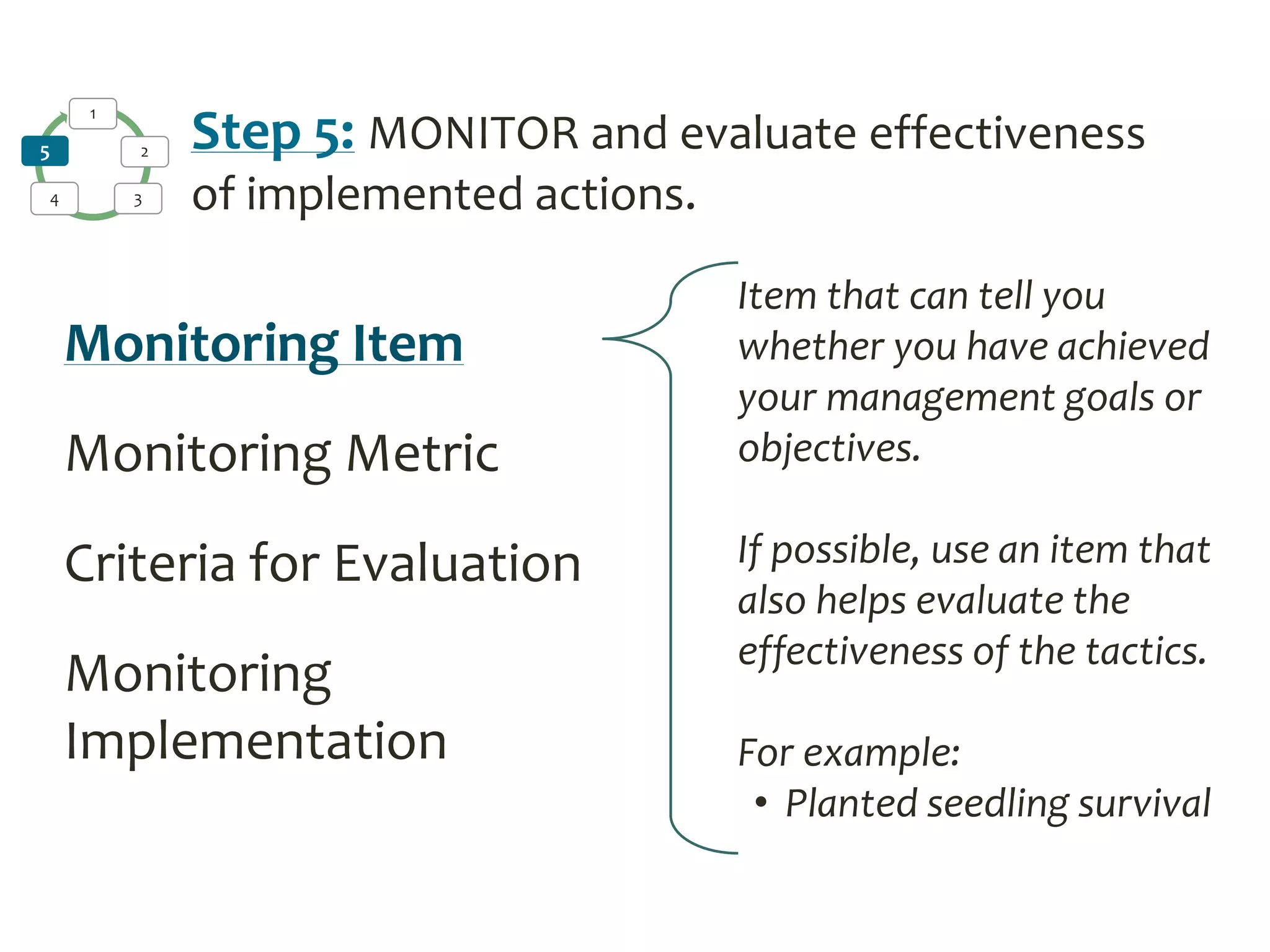
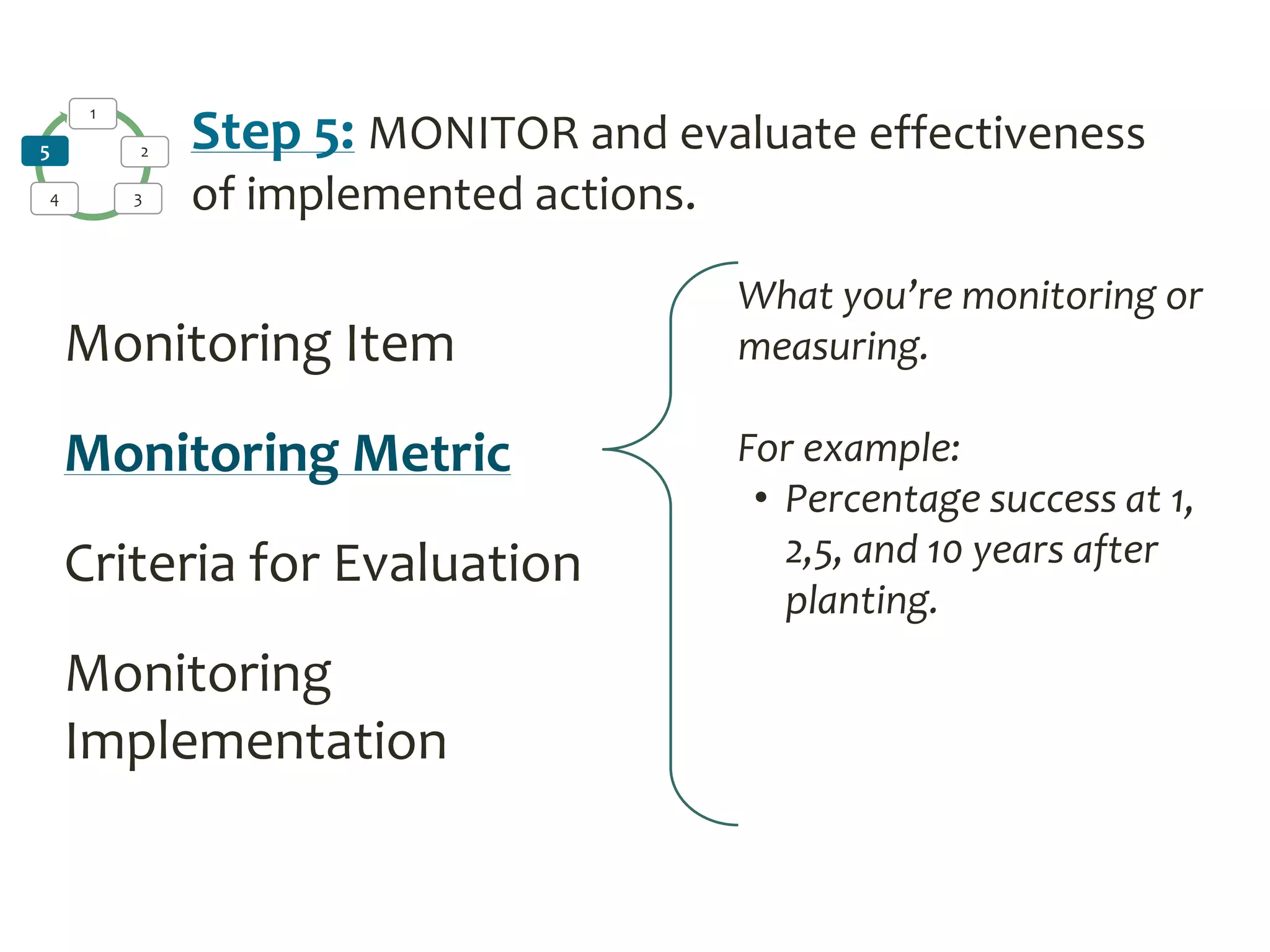
Monitoring Item
Monitoring Metric
Criteria for Evaluation
Monitoring
Implementation
Item that can tell you
whether you have achieved
your management goals or
objectives.
If possible, use an item that
also helps evaluate the
effectiveness of the tactics.
For example:
• Planted seedling survival
1
2
34
5 Step 5: MONITOR and evaluate effectiveness
of implemented actions.
Monitoring Item
Monitoring Metric
Criteria for Evaluation
Monitoring
Implementation
What you’re monitoring or
measuring.
For example:
• Percentage success at 1,
2,5, and 10 years after
planting.
1
2
34
5 Step 5: MONITOR and evaluate effectiveness
of implemented actions.
Monitoring Item
Monitoring Metric
Criteria for Evaluation
Monitoring
Implementation
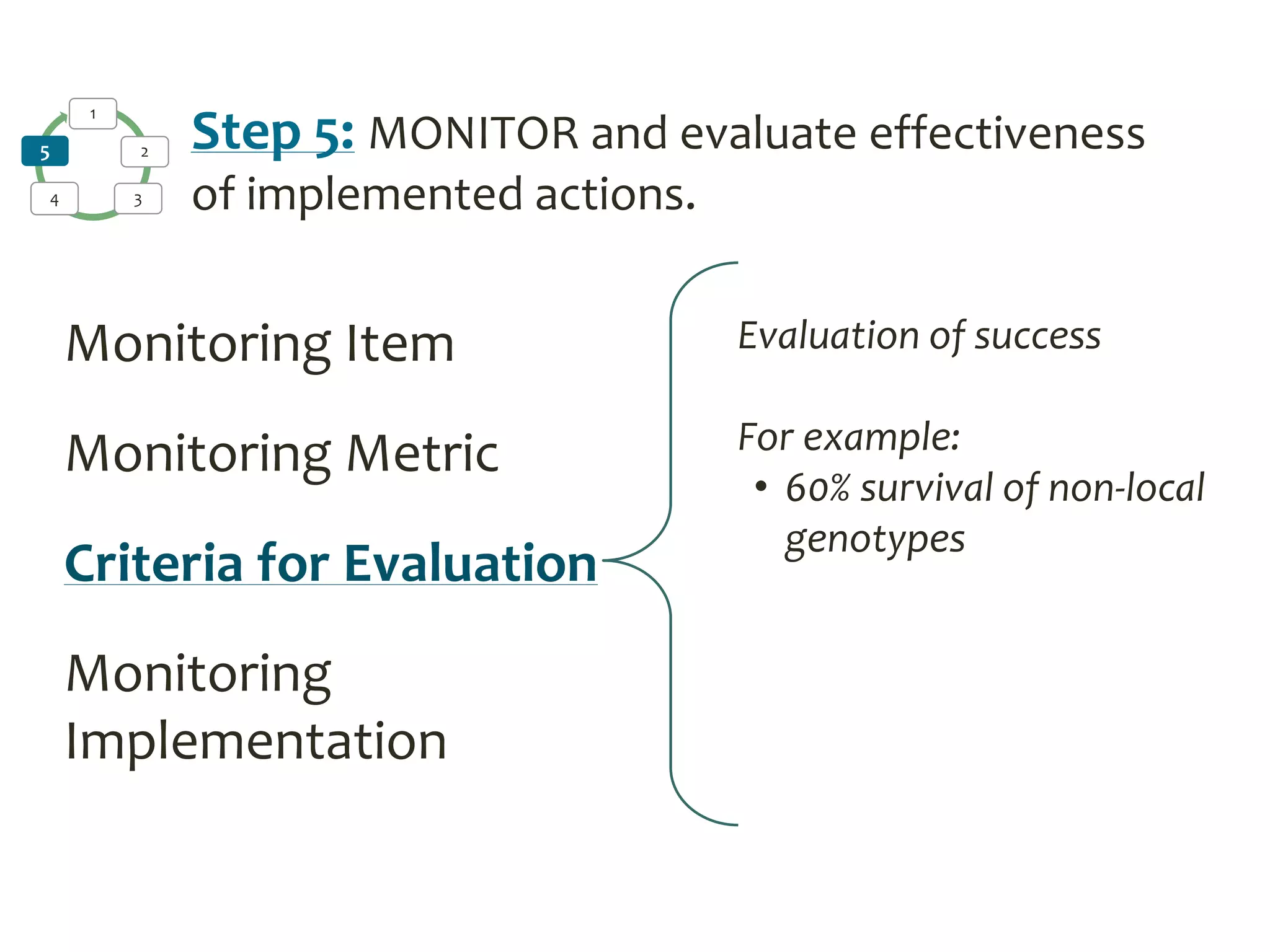
Evaluation of success
For example:
• 60% survival of non-local
genotypes
1
2
34
5 Step 5: MONITOR and evaluate effectiveness
of implemented actions.
Monitoring Item
Monitoring Metric
Criteria for Evaluation
Monitoring
Implementation
How the monitoring will
actually get done.
Note: use existing
monitoring when possible
For example:
• Regular post-planting
stocking surveys.
• Supplemental surveys at
10 years.
1
2
34
5 Step 5: MONITOR and evaluate effectiveness
of implemented actions.
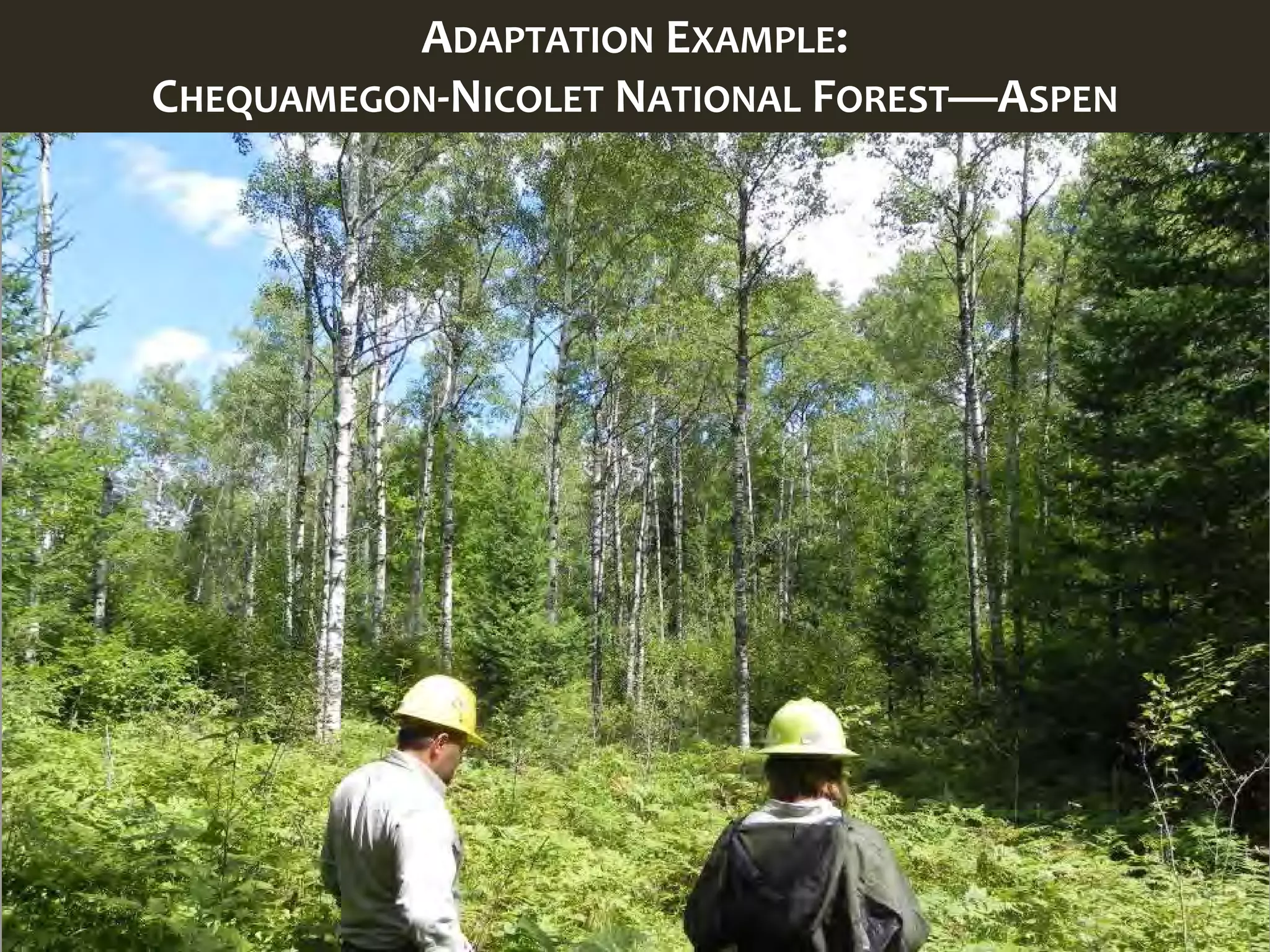
ADAPTATION EXAMPLE:
CHEQUAMEGON-NICOLET NATIONAL FOREST—ASPEN
1
2
34
5
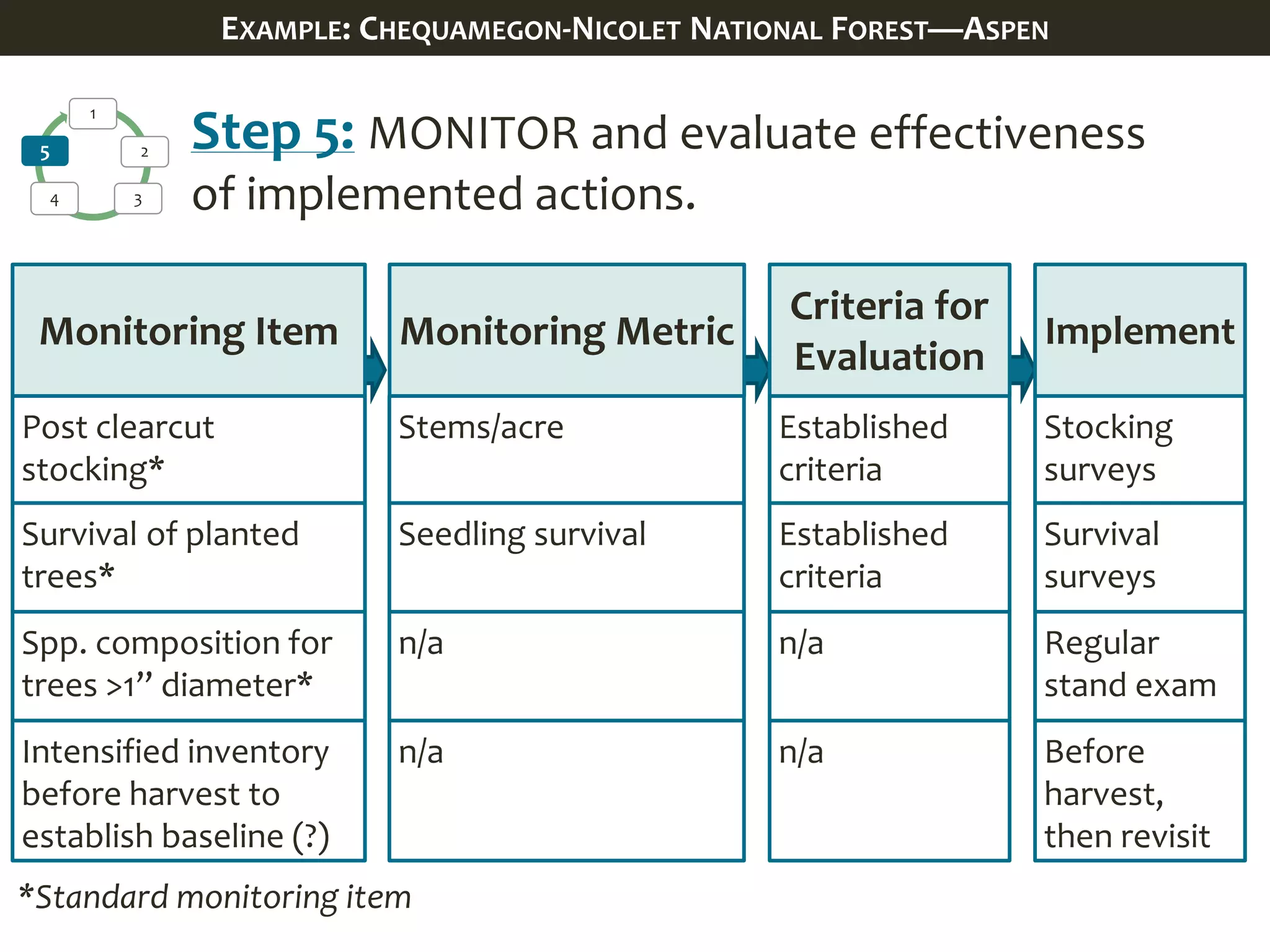
Monitoring Item Monitoring Metric
Criteria for
Evaluation
Implement
Post clearcut
stocking*
Stems/acre Established
criteria
Stocking
surveys
Survival of planted
trees*
Seedling survival Established
criteria
Survival
surveys
Spp. composition for
trees >1” diameter*
n/a n/a Regular
stand exam
Intensified inventory
before harvest to
establish baseline (?)
n/a n/a Before
harvest,
then revisit
*Standard monitoring item
Step 5: MONITOR and evaluate effectiveness
of implemented actions.
EXAMPLE: CHEQUAMEGON-NICOLET PARK FALLS ASPENEXAMPLE: CHEQUAMEGON-NICOLET NATIONAL FOREST—ASPEN
EXAMPLE: TNC CAROLINE LAKE PRESERVE
How can we better use inventory data?
Images: www.magazine.nature.org
 Evaluate success of
management in achieving goals
 Evaluate effectiveness of
adaptation actions
 Integrate monitoring and
evaluation into forest
management plan
EXAMPLE: CHEQUAMEGON-NICOLET PARK FALLS ASPENEXAMPLE: THE NATURE CONSERVANCY—CAROLINE LAKE, WI
EXAMPLE: TNC CAROLINE LAKE PRESERVE
Forest Inventory: Climate Change Filter
Common Measures
 Species
 Diameter
 Merchantable height
Key Ecological Attributes
 Stocking/Density
 Structure
 Large live trees
 Species richness/evenness
Can also tell you…
 Proportion of forest at
risk of decline from
climate change
 Stocking of desirable or
future-adapted trees
EXAMPLE: TNC CAROLINE LAKE PRESERVEEXAMPLE: CHEQUAMEGON-NICOLET PARK FALLS ASPENEXAMPLE: THE NATURE CONSERVANCY—CAROLINE LAKE, WI
EXAMPLE: TNC CAROLINE LAKE PRESERVE
Extra Measures
 Tree condition class
 Tree crown ratio
 Regen
 Snags
 Browse severity
 Woody/vegetative
competition
Can also tell you…
 Tree health/vigor (sort of)
 Established seedlings of
desirable or future-
adapted species
EXAMPLE: TNC CAROLINE LAKE PRESERVEEXAMPLE: CHEQUAMEGON-NICOLET PARK FALLS ASPENEXAMPLE: THE NATURE CONSERVANCY—CAROLINE LAKE, WI
Forest Inventory: Climate Change Filter
EXAMPLE: TNC CAROLINE LAKE PRESERVEEXAMPLE: TNC CAROLINE LAKE PRESERVEEXAMPLE: CHEQUAMEGON-NICOLET PARK FALLS ASPENEXAMPLE: THE NATURE CONSERVANCY—CAROLINE LAKE, WI
Forest Inventory: Climate Change Filter
Stand 25 – Trees at risk of declining from climate change
TREES
Species BA/Ac TPA IV PCM GFDL PCM GFDL PCM GFDL PCM GFDL
Balsam Fir 2.3 11.8 7.1 yes yes 2.3 2.3 11.8 11.8 7.1 7.1
Basswood 5.1 9.3 7.2 0.0 0.0 0.0 0.0 0.0 0.0
Black Ash 0.6 0.4 0.5 yes 0.0 0.6 0.0 0.4 0.0 0.5
Black Spruce 0.6 0.4 0.5 yes yes 0.6 0.6 0.4 0.4 0.5 0.5
Hemlock 4.0 5.7 4.8 0.0 0.0 0.0 0.0 0.0 0.0
Ironwood 0.6 2.1 1.3 0.0 0.0 0.0 0.0 0.0 0.0
Paper Birch 0.6 0.8 0.7 yes yes 0.6 0.6 0.8 0.8 0.7 0.7
Quaking Aspen 4.6 8.5 6.5 yes yes 4.6 4.6 8.5 8.5 6.5 6.5
Red Maple 22.2 59.9 41.1 0.0 0.0 0.0 0.0 0.0 0.0
Red Oak 1.1 0.5 0.8 0.0 0.0 0.0 0.0 0.0 0.0
Sugar Maple 38.2 76.9 57.6 yes 0.0 38.2 0.0 76.9 0.0 57.6
White Cedar 5.7 8.3 7.0 yes 0.0 5.7 0.0 8.3 0.0 7.0
Yellow Birch 14.8 23.4 19.1 yes 0.0 14.8 0.0 23.4 0.0 19.1
Grand Total 100.4 207.9 154.1 8.0 67.3 21.5 130.6 14.8 98.9
8% 67% 10% 63% 10% 64%
At Risk IV
Proportion at Risk:
At-Risk Value:
At Risk? At Risk BA At Risk TPA
EXAMPLE: CHEQUAMEGON-NICOLET PARK FALLS ASPENEXAMPLE: CHEQUAMEGON-NICOLET NATIONAL FOREST—ASPEN
Monitoring Items
Monitoring
Metric(s)
Criteria for
Evaluation Monitoring Implementation
Effectiveness of clearcut to see
whether site is adequately stocked
(STANDARD)
Stems per
acre
Established
criteria
- First-year stocking survey (Post-harvest survey to assess
condition of midstory and see if follow-up actions are
needed)
- Additional stocking surveys at 3 and possibly 5 years
- FACTS database tracks activity
Survival of planted species
(STANDARD)
Seedling
survival
Established
criteria
- Survival survey at 1 and 3 years
- FACTS database tracks activity
Post-sale and post disturbance
monitoring of invasives - See tactics
#2,10
(IN ADDITION TO STANDARD)
Presence/
absence
Plant
ecologist
evaluation
- Two years after close of sale
- Two years after any large disturbances
- TESP Invasives would record invasives if present
- FACTS database tracks activity
Stand exam – relative amounts of
major stand components. Trees
greater that 1”. Seedlings optional.
(STANDARD)
n/a n/a - Every 10 years.
- Recorded in FSVEG
Certification of release for planted
trees following TSI (STANDARD)
Survival/
condition
Forester/
silviculturist
evaluation
- Concurrent with final (2nd
or 3rd
) release
- FACTS database tracks activity
Breeding birds (STANDARD) - Breeding bird plots nearby
OPTIONAL: Intensified stand exam or
veg survey before harvest to identify
baseline conditions (ADDITIONAL)
n/a n/a - Before harvest: additional “intensified stand exam” in this
stand and possibly 1-2 control stands within sale area.
Measure marked stand before harvest to collect “pre/post”
harvest data. Preferably by plant ecologist in summer to
collect other veg data.
- Use intensified stand exams in future to collect data over
long-term.
- Recorded in FSVEG
Monitoring Items
 Proportion of young forest habitat
 Effectiveness of invasives control
 Desired tree species composition
 Desirable seedling species (and abundance)
 Planted seedling survival (by species or genotype)
 Condition/health of white pine
 Understory herbaceous species diversity
 Experience interactions/contact hours for education
 Herbivory
 Wildlife (?)

Connecticut Forest Adaptation Planning and Practices (March 2015)

  • 1.
    www.forestadaptation.org Climate Change andthe Forests and Habitats of Southern New England March 16-17, 2015 Storrs, CT
  • 2.
     Provides practicalinformation, resources, and technical assistance related to forests and climate change  Supports the integration of climate change information into natural resource management www.nrs.fs.fed.us/niacs/ Northern Institute of Applied Climate Science Regional multi-institutional partnership among: Climate Carbon Bioenergy
  • 3.
    NIACS Coordinates the Northern Forests SubHub as part of the USDA Regional Climate Hubs in the Midwest and Northeast Climate Hub Midwest Climate Hub Northeast USDA Climate Hubs
  • 4.
    March 16 –Agenda 1:45 Forest Adaptation Resources: an Introduction Southern New England’s Changing Climate 2:55 Break 3:20 Climate Change Effects on Forest Ecosystems March 17 – Hands-on Training An active, hands-on training, to assist natural resource professionals in incorporating climate change considerations and identifying actions for adaptation into their own real-world management and conservation projects. Join us tomorrow!
  • 5.
    March 17 –Agenda 8:30 Climate Change Impacts on Forest Management Projects (Step 2) 10:00 Break 10:15 Challenges/Opportunities for Management (Step 3) 11:30 Identifying Forest Adaptation Approaches and Tactics (Step 4) 12:00 Lunch (BYO) 1:00 Identifying Forest Adaptation Approaches and Tactics (Step 4) 3:00 Break 3:15 Identifying Forest Adaptation Approaches and Tactics 4:00 Next Steps & Wrap-up 4:00 Adjourn
  • 7.
  • 8.
  • 9.
    Responding to ClimateChange There is not a single “answer” Critical to start with: Manager’s Guide Decision Tree E-Z Whiz-bang Tool The place Management goals & objectives
  • 10.
    Desired ConditionsNatural Forest Dynamics Wildlife Habitat Past Management History Invasives TimberSale Revenue Disturbance: Past + Future Recreation Forest Health And more!! Climate Change Plan & Project Requirements
  • 11.
    Partnerships Vulnerability Assessment Forest AdaptationResources Adaptation Demonstrations Climate Change Response Framework Components: Progress: 75+ partner organizations (and counting) 3 published assessments, 3 more in press/revision Published in 2012, updated and online versions in prep 50+ demonstrations underway Structured, process oriented, works on multiple scales
  • 12.
    Vulnerability Assessments  High-qualityinformation about future change in climate and potential effects on forest ecosystems  In New England, synthesizing current state and regional assessments to highlight greatest risks
  • 13.
    Swanston and Janowiak2012; www.nrs.fs.fed.us/pubs/40543  Designed for a variety of land managers  Does not make recommendations  Menu of strategies & approaches for climate change adaptation  Adaptation workbook process for implementation Swanston and Janowiak 2012; www.treesearch.fs.fed.us/pubs/40543 Forest Adaptation Resources
  • 14.
    Forest Adaptation Resources Swanstonand Janowiak 2012; www.treesearch.fs.fed.us/pubs/40543 Provides structured process to integrate climate change considerations into management planning and activities 1. DEFINE area of interest, management objectives, and time frames. 2. ASSESS climate change impacts and vulnerabilities for the area of interest. 3. EVALUATE management objectives given projected impacts and vulnerabilities. 4. IDENTIFY and implement adaptation approaches and tactics . 5. MONITOR and evaluate effectiveness of implemented actions. Vulnerability assessments, scientific literature, and other resources Adaptation Strategies and Approaches
  • 15.
    Management Objectives Challenges OpportunitiesFeasibility Other Considerations Adaptation Actions Benefits Drawbacks/ Barriers Recommend Tactic? Approach (From Chapter 2) Tactic Time Frame Forest Adaptation Resources Step-by-step Adaptation Workbook for planning
  • 16.
    Ways the Adaptation Workbookcan be used:  Coordinator facilitates individual or small group  Forest Adaptation Planning and Practices workshop • General (state agencies; SFEC) • Tribal (Sault; Menominee) • Conservation (WCS; DU)  Managers use the workbook independently • Online version soon!! Forest Adaptation Resources
  • 17.
    Real-world ExamplesAdaptation Demonstrations Provide real-world examples of forest management activities that: • Enhance the ability of forests to cope with changing conditions • Achieve land owner management goals  Foster cross-ownership dialogue and learning  Illustrate diverse goals and approaches www.forestadaptation.org Click ‘Demonstration Projects’
  • 18.
  • 19.
  • 20.
    1 2 34 5 Step 1:DEFINE area of interest, management goals and objectives, and time frames. Management Goals & Objectives  Early-successional habitat  Scenic Integrity
  • 21.
    Impacts: Potentially driergrowing season conditions 1 2 34 5 Step 2: ASSESS climate change impacts and vulnerabilities for the area of interest.
  • 22.
    Challenges  Aspen inlong-term  Few tree species  Productivity issues  Hazel competition  Windthrow 1 2 34 5 Step 3: EVALUATE management objectives given projected impacts and vulnerabilities. Opportunities  Site suitable for pine in future?
  • 23.
    1 2 34 5 Step 4:IDENTIFY and adaptation approaches and tactics for implementation. Overall Approach: Enhance future options within existing management trajectory  Aspen will regenerate now, but is likely to fare poorly over the long term.  Maintain plans for clearcut for aspen regeneration  Additional actions to promote diversity and provide future options: plant red oak and white pine  Pro-active on invasives and disturbance planning
  • 24.
     Post clearcutstocking*  Survival of planted trees*  Species composition for trees* and seedlings/saplings  Intensified inventory (?) *existing monitoring item 1 2 34 5 Step 5: MONITOR and evaluate effectiveness of implemented actions.
  • 25.
    Chequamegon-Nicolet Aspen: Status •Stands are marked • Winter harvest –this winter • Then: underplant native future-adapted species
  • 26.
    Menominee Tribal Enterprises:Oak Wilt Photo: College of Menominee Nation SDI
  • 27.
    Management Goals  Fosterdiversity  Favor sawtimber species  Provide cultural uses  Restore oak wilt pockets 1 2 34 5 Step 1: DEFINE area of interest, management goals and objectives, and time frames.
  • 28.
    1 2 34 5 Step 2:ASSESS climate change impacts Step 3: EVALUATE management objectives Treatment  Harvest affected & adjacent oaks  Pull stumps  Harvest other species in pocket
  • 29.
    Treatment  Harvest affected& adjacent oaks  Pull stumps  Harvest other species in pocket 1 2 34 5 Step 2: ASSESS climate change impacts Step 3: EVALUATE management objectives
  • 30.
    Adaptation Approach •Reduce biological stressors •Maintain and enhancediversity •Promote future- adapted species •Enhance genetic diversity Restore sites with future- adapted species 1 2 34 5 Step 4: IDENTIFY and adaptation approaches and tactics for implementation.
  • 31.
    Projected Habitat Increases Americanbeech American elm American hornbeam Bitternut hickory Black cherry Black locust Black oak Black willow Boxelder Bur oak Eastern cottonwood Silver maple Slippery elm White ash White oak Projected New Habitat Black hickory Black walnut Blackjack oak Chinkapin oak Eastern red cedar Eastern redbud Flowering dogwood Hackberry Honeylocust Mockernut hickory Ohio buckeye Osage-orange Post oak Shingle oak Also shrub & understory plants 1 2 34 5 Step 4: IDENTIFY and adaptation approaches and tactics for implementation. Climate Change Tree Atlas Janowiak et al. 2014
  • 32.
    Menominee Oak Wilt:Status Last Summer • Selected sites • Site prepped • Oaks planted Monitor • Seedling success • Forest health and stressors • Forest composition • Cost of treatment This Summer and Next • Additional tree species • Non-tree species of cultural value
  • 33.
  • 34.
    Learning through Examples Diversity in lands, owners, and objectives  Acknowledge difference, build on similarities  Demonstrate shared perspectives
  • 35.
    Learning through Experimentation AdaptiveSilviculture for Climate Change (ASCC)  Experimental silvicultural trials in multiple forest types across the US  How will forests respond to a range of climate change adaptation actions? Photos: L. Nagel & M. Roske
  • 36.
    Using new informationand ideas Beginning to take small steps Being creative and flexible Working and learning with others What does adaptation look like?
  • 38.
  • 39.
    Management Goals  Sustainableforestry  Conservation 1 2 34 5 Step 1: DEFINE area of interest, management goals and objectives, and time frames.
  • 40.
    Current Management with AdaptationBenefits  Follow BMPs for water quality  Increase coarse woody material  Increase tree species diversity  Increase forest structural diversity  Ensure adequate seedling regeneration  Control invasives  Minimize roads & trails
  • 41.
    Challenge: Shorter andmore variable winter 1 2 34 5 Step 2: ASSESS climate change impacts Step 3: EVALUATE management objectives
  • 42.
    Potential Barriers:  Moreplanning  Higher cost  Will it even work?? Adaptation Tactic: Summer harvest 1 2 34 5 Step 4: IDENTIFY and adaptation approaches and tactics for implementation.
  • 43.
    Spring/Early Summer 2014 •Timber marking • Road layout • Pre-sale road work • Temporary bridge installation Harvested Summer 2014 (when the weather cooperated!) 1 2 34 5 Step 4: IDENTIFY and adaptation approaches and tactics for implementation.
  • 44.
    Gullying from abad woods road (past management) 1 2 34 5 Step 5: MONITOR and evaluate effectiveness of implemented actions.
  • 46.
    CLIMATE CHANGE EFFECTS ONNORTHEAST FOREST ECOSYSTEMS & HABITATS
  • 47.
    New England Synthesis 1)Introduction 2) Contemporary Landscape 3) Observed Climate Change 4)Future Climate Change 5) Impacts on Forests 6)Conclusions Timeline = in progress, draft this spring
  • 48.
    How has climatechanged over the past century?
  • 49.
    Observed Climate Trends Warmertemperatures  CT temperatures increased more than 2.5°F since 1895  Winter has warmed most  Extremely hot days have increased  Longer growing season  Plants flowering more than a week earlier at Walden pond since 1880s Annual Temperature Change since 1895 NOAA
  • 50.
  • 51.
    Observed Climate Trends AlteredPrecipitation  CT precipitation increased nearly 3” since 1895  Extremely high variability from year to year  Slight decrease in spring; increase of 2” in fall  Substantial increases in extreme rain events: 71% increase across northeast since 1958 Annual Precipitation Change since 1895 Increase in Extreme Rain Events since 1958 NOAA, Melillo et al. 2014
  • 52.
    Annual Precipitation Change(1901-2011) Precipitation change (inches) 6.9 Inches  0.06 inches per year = 6.9 inches over 110 years  Substantial inter-annual fluctuation
  • 53.
    Winter (Dec-Feb) Spring (Mar-May) Summer (Jun-Aug) Fall (Sep-Nov) Seasonal Precipitation Change(1901-2011) Precipitation change (inches) 0.6 in 1.6 in 1.7 in 3.0 in
  • 54.
    Extreme Precipitation Events Theamount of precipitation falling in single events increased between 1948 and 2007 Spierre and Wake 2010
  • 55.
    Sea-level Rise Sea-level Rise Sea level rose about 1 foot since 1900  Increases in coastal flooding Horton et al. 2014 (NCA)
  • 56.
    Green Canopy Duration Treesat Hubbard Brook Experimental Forest have about 10 more days per year of green canopy (Richardson et al. 2006) Bird Range Expansion Migratory birds are arriving earlier and breeding earlier, and several species have shifted their ranges northward (Rahbeck et al. 2007, Waite and Strickland 2006). Flowering Dates The date of first flowering is a week earlier on average compared to Thoreau’s records from the mid-1800s. Highbush blueberries and yellow wood sorrel are flowering several weeks earlier (Miller-Rushing and Primack 2009) Lake Ice Lake ice-out dates have advanced across Maine, with many dates now two weeks earlier than in the 1800s (Jacobson et al. 2009) Phenological Changes
  • 57.
    How is theclimate expected to change over the next century?
  • 58.
    How is theclimate expected to change over the next century?
  • 59.
    Future Changes –inherent uncertainty IPCC 2007
  • 60.
    Climate Scenarios Used Two scenarios show the range of possible change • PCM B1: Low emissions scenario + less sensitive GCM • GFDL A1FI: High emissions + more sensitive GCM  Projections are consistent with other data sets  Think of them like bookends: Least Projected Change Most Projected Change PCM Low emissions (B1) GFDL High emissions (A1FI)
  • 61.
    Temperature Change Projections Kunkelet al. 2013 Entire Northeast Region
  • 62.
    Seasonal Temperature Projections Spring Winter Changein 30-year average (°F) 2070-2099 vs. 1971-2000 Low High
  • 63.
    Seasonal Temperature ProjectionsChange in 30-year average (°F) 2070-2099 vs. 1971-2000 Low High Fall Summer
  • 64.
    Precipitation Change Projections Kunkelet al. 2013 Entire Northeast Region
  • 65.
    Seasonal Precipitation Projections Spring Winter Changein 30-year average (°F) 2070-2099 vs. 1971-2000 Low High
  • 66.
    Seasonal Precipitation ProjectionsChange in 30-year average (°F) 2070-2099 vs. 1971-2000 Low High Fall Summer
  • 67.
    Extreme Precipitation Events Extreme precipitation has increased dramatically • Precip in heaviest 1% of events increased 71% between 1958 to 2012  Trend expected to continue/increase Change in 2-inch Precipitation Events (late 21st century) B1 A2 Kunkel et al. 2013; Figure: Center for Climatic Change, http://ccr.aos.wisc.edu/resources/data_scripts/LCC/ Change: 2” Precip Events per Decade
  • 68.
    Anticipated Climate Changes Warmertemperatures  3-9°F increase annually Altered precipitation  High variability: slight decrease to more than 15% increase  Generally increasing in winter & spring  Potential decreases or less substantial increases in summer & fall  More extreme rain Sea-level Rise  12 to 23” by end of century CT DEEP 2011, Climatewizard.org
  • 69.
  • 70.
    9 WAYS THAT CLIMATECHANGE WILL AFFECT FORESTS A Synthesis of Anticipated Impacts
  • 71.
    Climate Change Impacts 1)Longer Growing Season 2) Shorter Winters 3) Potential for Summer Drought 4) CO2 Fertilization 5) Changes in Suitable Habitat 6) Extreme Events 7) Wildfire Risk 8) Forest Pests and Diseases 9) Invasive Plants
  • 72.
    1: Longer GrowingSeasons Warmer temps result in longer growing seasons Projected to increase 3-7+ weeks by 2100 Growing Season– End of Century Change Center for Climatic Change, http://ccr.aos.wisc.edu/resources/data_scripts/LCC/ Change in Growing Season (days) Low (B1) High (A2)
  • 73.
    1: Longer GrowingSeason Warmer temps result in longer growing seasons  Evidence of phenological shifts  Projected to increase 3-7+ weeks Longer period for plant growth Melillo et al. 2014, Nelson Center 2014
  • 74.
    1: Longer GrowingSeason Warmer temps result in longer growing seasons  Projected to increase 3-7+ weeks  Evidence of phenological shifts Longer period for plant growth Potential risks:  Early bud break/loss of cold hardening  Frost damage during spring freezing Melillo et al. 2014, Nelson Center 2014
  • 75.
    2: Shorter Winter(Less Snow) Projected decreases in snow fall, cover, and depth  30-70% decreases in snowfall  Greatest snowfall decreases in December or January Percent change in snowfall (late 21st century) Notaro et al. 2014; Figure: Center for Climatic Change, http://ccr.aos.wisc.edu/resources/data_scripts/LCC/ Percent Change in Snowfall Low (B1) High (A2)
  • 76.
    2: Shorter Winter(Less Snow) Decreased snowpack  Increased soil frost and root damage in cold temps  Warmer soil temperatures and altered processes Wisconsin Frozen Ground Source: C. Rittenhouse (UConn) and A. Rissman (UW-Madison), in review Frozen Ground Season Annual data Trend Frozen Ground Days Annual data Trend
  • 77.
    2: Shorter Winter(Less Snow, More Rain) Precipitation is projected to increase = more rain Dale et al 2001, Huntingon 2004, Parmesan 2006
  • 78.
    2: Shorter Winter(Less Snow, More Rain) Precipitation is projected to increase = more rain Altered streamflow timing and amount  Earlier spring peak flows  Potential increases in flashiness and episodic high flows  Potential declines in summer seasonal stream flow Dale et al 2001, Huntingon 2004, Parmesan 2006
  • 79.
    3: Potential forSummer Drought Greater uncertainty about future precipitation, but increased risk of summer moisture stress Water loss from soils (evaporation) Water loss from trees (transpiration) Groundwater recharge Runoff Precipitation
  • 80.
    3: Potential forSummer Drought Greater uncertainty about future precipitation, but increased risk of summer moisture stress Water loss from soils (evaporation) Water loss from trees (transpiration) Groundwater recharge Runoff Precipitation Warmer temps increase water loss
  • 81.
    4: CO2 Fertilization Benefits •Increased photosynthesis • Increased water use efficiency Ainsworth and Long 2005, Ainsworth and Rogers 2007, Norby and Zak 2011
  • 82.
    4: CO2 Fertilization Limitsto CO2 fertilization • Varies by species and site • Nutrient deficiencies (especially N) • Sensitive to ozone pollution • Limited sink strength • Limited evidence of long-term sequestration • Any productivity increases may be offset by reductions from increased drought stress or disturbance Ainsworth and Long 2005, Ainsworth and Rogers 2007, Norby and Zak 2011
  • 83.
    5: Changes inSuitable Habitat Habitat based on: Temperature Precipitation Elevation Latitude Soils Slope & Aspect Land use Competition Past management
  • 84.
    5: Changes inSuitable Habitat Habitat based on: Temperature Precipitation Elevation Latitude Soils Slope & Aspect Land use Competition Past management Climate Change Atlas: What happens to tree and bird habitat when climate changes? •134 Trees •147 Birds Iverson et al. 2008; Atlas website: www.fs.fed.us/nrs/atlas/ www.fs.fed.us/nrs/atlas/
  • 85.
    5: Changes inSuitable Habitat Habitat based on: Temperature Precipitation Elevation Latitude Soils Slope & Aspect White Pine: Current Habitat (modeled) www.fs.fed.us/nrs/atlas/
  • 86.
    5: Changes inSuitable Habitat Habitat based on: Temperature Precipitation Elevation Latitude Soils Slope & Aspect White Pine: Current Habitat (modeled) PCM B1 (Less Change) GFDL A1FI (More Change) www.fs.fed.us/nrs/atlas/
  • 87.
    5: Changes inSuitable Habitat Habitat based on: Temperature Precipitation Elevation Latitude Soils Slope & Aspect Red Spruce: Current Habitat (modeled) PCM B1 (Less Change) GFDL A1FI (More Change) www.fs.fed.us/nrs/atlas/
  • 88.
    5: Changes inSuitable Habitat Habitat based on: Temperature Precipitation Elevation Latitude Soils Slope & Aspect Black Oak: Current Habitat (modeled) PCM B1 (Less Change) GFDL A1FI (More Change) www.fs.fed.us/nrs/atlas/
  • 89.
    5: Changes inSuitable Habitat Immense lag times • Range shifts ≠ instant catastrophic dieback Factors causing change will increase over time • Temperature • Moisture • Competition Mature and established trees should fare better • Developed root system • Greater carbohydrate reserves Game changers: Disturbance, Land use, … Dale et al. 2001, Iverson et al. 2008
  • 90.
    5: Changes inSuitable Habitat Use the Climate Change Atlas to:  Evaluate how suitable habitat may change for species • Species more likely to decline or increase • Consider multiple scenarios • Consider local conditions and anticipated impacts  Identify factors driving the modeled changes  Generate ideas for potential future-adapted species Dale et al. 2001, Iverson et al. 2008
  • 91.
    5: Changes inSuitable Habitat Iverson et al. 2007, Rustad et al. 2012
  • 92.
    Dan Turner, CambridgeFire Dept. 6: Extreme Events Heavy precipitation Ice storms “Events” are not well modeled Heat waves/droughts Wind storms Hurricanes VTRANS/VT ANR NY DEC
  • 93.
    7: Wildfire Risk Firemay increase:  Warmer/drier summers  Increased stress or mortality from less suitable conditions  Shift toward fire-associated species like oaks and pines Fire may not change:  Spring/early summer moisture  Current regeneration of more mesic species  Spatial patterns of land use and fragmentation  Fire suppression Clark et al. 2014Prescribed fire – MASS DCR
  • 94.
    8: Forest Pestsand Diseases Indirect: Stress from other impacts increases susceptibility Direct:  Pests migrating northward  Decreased probability of cold lethal temperatures  Accelerated lifecycles Ayres and Lombardero 2000, Woods et al. 2005, Parmesan 2006, Dukes et al. 2009 Image: Frumhoff et al. 2007 HWA lethal temp: -20 to -30°F
  • 95.
    9: Invasive Plants Indirect:Stress or disturbance from other impacts can affect the potential for invasion or success Direct:  Expanded ranges under warmer conditions  Increased competitiveness from ability of some plants to take advantage of elevated CO2 Invasives Plants Atlas of New England (www.eddmaps.org) Dukes et al. 2009, Rustad et al. 2011
  • 96.
    What conclusions can we draw fromall this? Climate Change Impacts 1) Longer Growing Season 2) Shorter Winters 3) Potential for Summer Drought 4) CO2 Fertilization 5) Changes in Suitable Habitat 6) Extreme Events 7) Wildfire Risk 8) Forest Pests and Diseases 9) Invasive Plants
  • 97.
    Vulnerability: Forest Communities Mayhave greater risk:  Low diversity  Static  Threatened, rare, or endangered  Already in decline  Fragmented May have less risk:  More diversity (species, genetics, …)  Adapted to disturbance  Wider ecological range of tolerances  Currently increasing  Larger, contiguous blocks Forest communities will be affected differently
  • 98.
    Impacts:  Extreme storms Several diseases, pests, invasives  Several northern species projected to decline Adaptive Capacity:  Mixed species forests  Several southern species projected to increase  Extensive type, exists farther south Vulnerability: Hardwood Forests Vulnerability rated as low (central hardwoods) or moderate (northern hardwoods) based on species and location. Connecticut Climate Change 2010, Manomet and Mass. Dept. of Fish and Wildlife 2010, Manomet and NWF 2012
  • 99.
    Vulnerability: Pitch Pine-ScrubOak Impacts:  Less affected by warm temperatures, drought, or wildfire  Pitch pine habitat suitability not projected to change much Adaptive Capacity:  Limited to sandy, nutrient-poor soils  Affected by development, fragmentation, fire suppression Eric Aldrich/The Nature Conservancy Generally rated as low-moderate vulnerability. Connecticut Climate Change 2010, Manomet and Mass. Dept. of Fish and Wildlife 2010, Manomet and NWF 2012
  • 100.
    Vulnerability: Local Considerations Researchand assessments describe broad trends but local conditions make the difference.
  • 102.
    Vulnerability: Spruce-fir Impacts:  Warmtemperatures  Declines in boreal tree species  Extreme storms Adaptive Capacity:  Generally slow to adjust to change  Constrained by elevation/latitude  Isolated mountaintops Generally rated as most vulnerable forest community, especially at southern extent of range. Connecticut Climate Change 2010, Manomet and Mass. Dept. of Fish and Wildlife 2010, Manomet and NWF 2012
  • 103.
    Step 1: DEFINEarea of interest, management goals and objectives, and time frames.
  • 104.
    1. DEFINE areaof interest, management objectives, and time frames. 2. ASSESS climate change impacts and vulnerabilities for the area of interest. 3. EVALUATE management objectives given projected impacts and vulnerabilities. 4. IDENTIFY and implement adaptation approaches and tactics . 5. MONITOR and evaluate effectiveness of implemented actions. Workbook Instructions
  • 105.
    1 2 34 5 Purpose:  Define thescope of the project Step 1: DEFINE area of interest, management goals and objectives, and time frames. Where are you working? What are your current management goals and plans for this area?
  • 106.
    1 2 34 5 Step 1:DEFINE area of interest, management goals and objectives, and time frames. Area of Interest Location Forest Type(s) Management Goals Management Objectives Time Frames Identifies the project area, including geographic location and topic area. For example: • Property • Unit, stand, compartment • Program/issue (e.g., invasives, fire)
  • 107.
    1 2 34 5 Step 1:DEFINE area of interest, management goals and objectives, and time frames. Area of Interest Location Ecosystem Type(s) Management Goals Management Objectives Time Frames Describes different ecosystems within the area of interest. For example: • Spruce-fir forest • Headwater streams • Marshlands
  • 108.
    1 2 34 5 Step 1:DEFINE area of interest, management goals and objectives, and time frames. Area of Interest Location Forest Type(s) Management Goals Management Objectives Time Frames Describes intent. Goals: broad, generally not quantifiable • Enhance wildlife habitat • Restore wetland function Objectives: specific, outline planned results • Create 10 acres of early successional habitat by… • Upgrade infrastructure to increase water flow…
  • 109.
    1 2 34 5 Step 1:DEFINE area of interest, management goals and objectives, and time frames. Area of Interest Location Forest Type(s) Management Goals Management Objectives Time Frames Identifies approximate timing of activities and for achieving goals/objectives For example: • Harvest– within 3 years • Regeneration– 10 years • Improved habitat– long- term (30+ years)
  • 110.
    Area of Interest Location Forest Type(s)Management Goals Management Objectives Time Frames SOUTH Camp Four Project Park Road Sale Stand 1089-025 East of Park Falls along FR1903, Newman Lake Road – Mature aspen, mixed ages – Planted white spruce along road – Maple understory – Desired landscape conditions, MA 4A: even-aged management maintains early to mid-successional communities. Aspen is over-represented; transitions to conifer species are encouraged. – Maintain healthy forest and tree vigor – Appropriate age class distribution: redistribute toward younger aspen – Safe, efficient road infrastructure – Provide wood through environmentally responsible harvest – Maintain healthy white spruce along Newman Lake Road to achieve desired scenic conditions and diversity – Maintain healthy hardwoods to achieve desired landscape conditions and age class distribution – Protect against annosum root rot to maintain a healthy forest and tree vigor – Provide scenic integrity (moderate SIO) – Maintain consistency with Forest Plan Standards and Guidelines (e.g., reserve trees) – Marking is immediate (Oct.) – Harvest operations would occur in the short- term – Management goals would be achieved in the short- (white spruce) and medium- to long-term (hardwoods) 1 2 34 5 Step 1: DEFINE area of interest, management goals and objectives, and time frames. EXAMPLE: CHEQUAMEGON-NICOLET NATIONAL FOREST—ASPEN
  • 111.
    1. DEFINE areaof interest, management objectives, and time frames. 2. ASSESS climate change impacts and vulnerabilities for the area of interest. 3. EVALUATE management objectives given projected impacts and vulnerabilities. 4. IDENTIFY and implement adaptation approaches and tactics . 5. MONITOR and evaluate effectiveness of implemented actions. Workbook Instructions
  • 112.
    Purpose:  Uses localexpertise to determine how climate change may specifically affect the project area How might the area be uniquely affected by climatic change and subsequent impacts? 1 2 34 5 Step 2: ASSESS climate change impacts and vulnerabilities for the area of interest.
  • 113.
    1 2 34 5 Step 2:ASSESS climate change impacts and vulnerabilities for the area of interest. General (Broad-scale) Impacts & Vulnerabilities Climate Change Impacts and Vulnerabilities for the Area of Interest Vulnerability Determination Information on regionally- relevant climate change effects. From vulnerability assessments, literature, etc. For example: • Increased likelihood of extreme rain events
  • 114.
    1 2 34 5 Step 2:ASSESS climate change impacts and vulnerabilities for the area of interest. General (Broad-scale) Impacts & Vulnerabilities Climate Change Impacts and Vulnerabilities for the Area of Interest Vulnerability Determination Site-based assessment of risk to regionally-relevant climate change impacts. For example: • Steep stream banks and poorly-sized culverts are at increased risk; impacts already being observed during large rain events.
  • 115.
    1 2 34 5 Step 2:ASSESS climate change impacts and vulnerabilities for the area of interest. General (Broad-scale) Impacts & Vulnerabilities Climate Change Impacts and Vulnerabilities for the Area of Interest Vulnerability Determination How vulnerable is the site to the effects of climate change? High: Impacts exceed ability of ecosystem to cope; functions and services disrupted. Moderate: Impacts will cause changes, but systems can cope Low: Ecosystems can readily cope with impacts; relatively few/minor negative impacts
  • 116.
    1 2 34 5 Step 2:ASSESS climate change impacts and vulnerabilities for the area of interest. Vulnerability Determination Potential Impacts Adaptive Capacity of Ecosystem High Moderate Vulnerability Positive Low Negative Low Vulnerability High Vulnerability
  • 117.
    1 2 34 5 Step 2:ASSESS climate change impacts and vulnerabilities for the area of interest. EXAMPLE: CHEQUAMEGON-NICOLET NATIONAL FOREST—ASPEN Broad-scale Impacts and Vulnerabilities Climate Change Impacts and Vulnerabilities for the Area of Interest Vulnerability Determination Mean annual temperatures are projected to increase by about 6.5 °F to 10.5 °F over the next century In NE Price County, winter temps projected to increase 12F from 1980 to 2090 (A2); summer temps projected to increase 9.75F Low to Moderate Growing seasons have become longer and this trend is expected to continue Growing seasons have become longer and this trend is expected to continue Precipitation patterns may change, which may impact hydrologic regimes Highly uncertain. Model average projects 0.75” increase in precip in the winter from 1980-2090; 0.25” decrease in the summer (A2); increase in extreme precipitation events Altered hydrologic regimes may contribute to drier soils during summer and increased potential for drought Altered hydrologic regimes may contribute to drier soils during summer and increased potential for drought Increases in drought, rain and wind storms, wildfire, and other disturbances may contribute to successional changes or loss of forest cover Increases in drought, rain and wind storms, wildfire, and other disturbances may contribute to successional changes or loss of forest cover Carbon dioxide and ozone pollution currently cause changes to forest productivity Maria look up concentration maps and leaf symptoms Increases of invasive plant species, herbivores, and disease agents may contribute to reduced
  • 118.
  • 119.
  • 120.
    1 2 34 5 Area of Interest &Location Forest Type Forested stand near Park Falls, WI Aspen (mature) Step 1: DEFINE area of interest, management goals and objectives, and time frames. EXAMPLE: CHEQUAMEGON-NICOLET NATIONAL FOREST—ASPEN
  • 121.
    1 2 34 5 Step 1: DEFINEarea of interest, management goals and objectives, and time frames. Management Goals & Objectives Time Frames Early-successional habitat • Desired landscape conditions/age classes • Ruffed grouse, other spp. • Maintain forest health & productivity • Provide sustainable wood Scenic Integrity • Road to recreation area •Harvest (short term) •Achieve mgmt. goals (long term) Area of Interest & Location Forest Type Forested stand near Park Falls, WI Aspen (mature) EXAMPLE: CHEQUAMEGON-NICOLET NATIONAL FOREST—ASPEN
  • 122.
    1 2 34 5 How might broadimpacts be different in the area of interest? Step 2: ASSESS climate change impacts and vulnerabilities for the area of interest. Broad-scale Impacts & Vulnerabilities • Warmer temps, altered precip, drier summers • Declines in many common northern species EXAMPLE: CHEQUAMEGON-NICOLET NATIONAL FOREST—ASPEN
  • 123.
    1 2 34 5 Impacts & Vuln. forArea of Interest • Site is fairly dry now • Mesic hardwoods are more susceptible • Can regenerate aspen now, but maybe not in next rotation Overall vulnerability: Moderate -High Step 2: ASSESS climate change impacts and vulnerabilities for the area of interest. Broad-scale Impacts & Vulnerabilities • Warmer temps, altered precip, drier summers • Declines in many common northern species EXAMPLE: CHEQUAMEGON-NICOLET NATIONAL FOREST—ASPEN
  • 124.
    Step 3: EVALUATEmanagement objectives given projected impacts and vulnerabilities.
  • 125.
    1. DEFINE areaof interest, management objectives, and time frames. 2. ASSESS climate change impacts and vulnerabilities for the area of interest. 3. EVALUATE management objectives given projected impacts and vulnerabilities. 4. IDENTIFY and implement adaptation approaches and tactics . 5. MONITOR and evaluate effectiveness of implemented actions. Workbook Instructions
  • 126.
    Purpose:  Realistically assessthe ability to meet goals and objectives under current management. Can current management achieve goals? 1 2 34 5 Step 3: EVALUATE management objectives given projected impacts and vulnerabilities.
  • 127.
    1 2 34 5 Step 3:EVALUATE management objectives given projected impacts and vulnerabilities. Management (Conservation) Objective Challenges Opportunities Feasibility under Current Management Other Considerations From Step 1
  • 128.
    1 2 34 5 Step 3:EVALUATE management objectives given projected impacts and vulnerabilities. Management Objective Challenges Opportunities Feasibility under Current Management Other Considerations How climate change impacts and vulnerabilities may make it more difficult to achieve the objective. For example: • Reduced suitable habitat for target species • Reduced winter access
  • 129.
    1 2 34 5 Step 3:EVALUATE management objectives given projected impacts and vulnerabilities. Management Objective Challenges Opportunities Feasibility under Current Management Other Considerations How climate change impacts and vulnerabilities may make it easier to achieve the objective. For example: • Reduced competition • Increased growth
  • 130.
    1 2 34 5 Step 3:EVALUATE management objectives given projected impacts and vulnerabilities. Management Objective Challenges Opportunities Feasibility under Current Management Other Considerations Is current management adequate for meeting the objectives given climate change? High: we can do it! Opportunities> Challenges Low: We’ll need more resources or effort. Challenges>Opportunities
  • 131.
    1 2 34 5 Step 3:EVALUATE management objectives given projected impacts and vulnerabilities. Management Objective Challenges Opportunities Feasibility under Current Management Other Considerations Social, administrative, financial, or other factors that also affect the ability to meet the objectives. For example: • Rare species or high social value—we’ll manage for it regardless • Best chance of success— go for the long shot
  • 132.
    1 2 34 5 Step 3:EVALUATE management objectives given projected impacts and vulnerabilities. Slow down! Are you going to continue with the management objectives that you have identified?
  • 133.
    EXAMPLE: CHEQUAMEGON-NICOLET NATIONALFOREST—ASPEN Management Objective (Step #1) Challenges to Meeting Management Objective with Climate Change Opportunities for Meeting Management Objective with Climate Change Feasibility of Meeting Obj. under Current Management Other Considerations Achieve desired landscape conditions and age class distribution via aspen regeneration  Longer-term maintenance of stand may be more difficult under a changed climate (lower productivity, faster break-up)  Observed productivity issues (worms?, drought?) may make site more vulnerable to climate change  Low diversity. Few other species to fall back on  Hazel present, and may become more competitive as site dries (?)  Low diversity of stand increases the stand’s vulnerability  Future site conditions may be more conducive to pine (MA focus), if source was available Short term: High Long term: Moderate Likelihood of follow-up on stand in first 20- 30 years is low, so harder to do add’l needed treatments Maintain a healthy forest and tree vigor via aspen regeneration Short term: High Long term: Low Provide wood through environmentally responsible harvest via aspen regeneration Short term: High Long term: Low (high uncertainty) Provide scenic integrity along Newman Lake Road  Reserve strips may be more vulnerable to wind throw if storms increase  Mixed areas along the road might fare better and currently look good High Maintain consistency with Forest Plan Standards and Guidelines (e.g., reserve trees)  Current low diversity and productivity, which may be lower in future  More snags and den trees?  Non-aspen reserve trees will add diversity and may be better adapted to future conditions High
  • 134.
  • 135.
    1 2 34 5 Mgmt. Obj. Challenges Opportunities Feasibility of MeetingObj. (Current Mgmt) •Regenerate aspen •Long-term maintenance •Few tree species •Productivity issues •Hazel competition • Future site may be suitable for pine • Short term: High • Long-term: Low •Scenic integrity •Reserve strips more vulnerable to windthrow • Mixed areas along road look better • High Step 3: EVALUATE management objectives given projected impacts and vulnerabilities. EXAMPLE: CHEQUAMEGON-NICOLET NATIONAL FOREST—ASPEN
  • 136.
  • 137.
    What actions canbe taken to enhance the ability of an ecosystem to cope with change while meeting conservation goals and objectives?
  • 138.
    Uncertainty and Risk Designactions that are robust across a range of potential future conditions
  • 139.
    Adaptation Adaptation is theadjustment of systems in response to climate change. Adaptation activities can build on sustainable management, conservation, and restoration of forests Parry et al. 2007, SCBD 2009, Groves et al. 2010
  • 140.
    Adaptation Actions Manage forPersistence: Ecosystems will still be recognizable as being the same system (character) Manage for Change: Ecosystems will fundamentally become something different
  • 141.
    MANAGE FOR PERSISTENCE RESISTANCE Improvethe defenses of the forest against effects of change. • Short-term • High-value Millar et al. 2007Photo: USFS
  • 142.
    MANAGE FOR PERSISTENCE RESILIENCE Enhancethe ability of an system to maintain or return to a particular ecological state following disturbance Holling 1973, Millar et al. 2007, NWF 2014 Photo: USFS
  • 143.
    MANAGE FOR CHANGE TRANSITION Intentionallyencourage change, help ecosystems respond in a targeted fashion Millar et al. 2007
  • 144.
    Adaptation Options Maintain same/similarFuture-adapted Resistance TransitionResilience
  • 145.
    When you mightemphasize… Persistence (Same/Similar)  High ecological value or unique/rare condition  High social value associated with current condition  Inherent ability to buffer changes  Highly vulnerable, but place represents best chance of success Change (Future-adapted)  High likelihood that current conditions will fail, making change is necessary  Changes are already occurring, and can be enhanced  Good opportunity to try something new
  • 146.
    Swanston and Janowiak2012; www.treesearch.fs.fed.us/pubs/40543 Forest Adaptation Resources Strategies & Approaches  Provides a menu of adaptation actions Adaptation Workbook  Provides a structure for considering climate change in management
  • 147.
    1. DEFINE areaof interest, management objectives, and time frames. 2. ASSESS climate change impacts and vulnerabilities for the area of interest. 3. EVALUATE management objectives given projected impacts and vulnerabilities. 4. IDENTIFY and implement adaptation approaches and tactics . 5. MONITOR and evaluate effectiveness of implemented actions. Vulnerability assessments, scientific literature, and other resources Adaptation Strategies and Approaches AdaptationWorkbook Can we use this approach for other resource areas?
  • 148.
    Adaptation Strategies &Approaches A “menu” of possible actions that allows you to decide what is most relevant for a particular location and set of conditions.
  • 149.
    Option CONCEPT ACTION Adaptation Strategies andApproaches  Resistance  Resilience  Transition
  • 150.
    A menu ofStrategies and Approaches provides a way to translate broad Options into locally- relevant Tactics Option Strategy Approach Tactic CONCEPT ACTION Adaptation Strategies and Approaches
  • 151.
    Option Strategy Approach Tactic ACTION Adaptation Strategies andApproaches CONCEPT Start with an Option Resistance: Forestall change Resilience: Rebound from change Transition: Facilitate change
  • 152.
    Option Strategy Approach Tactic ACTION Adaptation Strategies andApproaches CONCEPT Resistance (forestall change)
  • 153.
    Option Strategy Approach Tactic ACTION Adaptation Strategies andApproaches Sustain fundamental ecological functions CONCEPT
  • 154.
    Option Strategy Approach Tactic ACTION Adaptation Strategies andApproaches CONCEPT Maintain or restore hydrology
  • 155.
    Option Strategy Approach Tactic ACTION Adaptation Strategies andApproaches CONCEPT Harvest in winter on frozen/snow-covered ground to minimize disturbance
  • 156.
    Option Strategy Approach Tactic ACTION Adaptation Strategies andApproaches CONCEPT Use water control structures to maintain key wetland habitats
  • 157.
    Option Strategy Approach Tactic ACTION Adaptation Strategies andApproaches CONCEPT Use water control structures to maintain key wetland habitats
  • 158.
    Option Strategy Approach Tactic ACTION Adaptation Strategies andApproaches CONCEPT Start with a Tactic Work backwards to show intentionality
  • 159.
    Option Strategy Approach Tactic ACTION Adaptation Strategies andApproaches CONCEPT Establish future- adapted species on south-facing slopes
  • 160.
    Option Strategy Approach Tactic ACTION Adaptation Strategies andApproaches CONCEPT Emphasize drought- and heat-tolerant species & populations
  • 161.
    Option Strategy Approach Tactic ACTION Adaptation Strategies andApproaches Facilitate community adjustments through species transitions CONCEPT
  • 162.
    Option Strategy Approach Tactic ACTION Adaptation Strategies andApproaches CONCEPT Transition (facilitate change)
  • 163.
    Helps connect thedots from broad concepts to specific actions for implementation. Option Strategy Approach Tactic CONCEPT ACTION Adaptation Strategies and Approaches
  • 164.
     It doesn’tmatter whether you start with approaches or tactics.  It is important to connect the two: shows how your action is related to climate change Approaches Tactics
  • 165.
    Step 4: IDENTIFYadaptation approaches and tactics for implementation.
  • 166.
    1. DEFINE areaof interest, management objectives, and time frames. 2. ASSESS climate change impacts and vulnerabilities for the area of interest. 3. EVALUATE management objectives given projected impacts and vulnerabilities. 4. IDENTIFY and implement adaptation approaches and tactics . 5. MONITOR and evaluate effectiveness of implemented actions. Workbook Instructions
  • 167.
    Purpose:  Select potentialadaptation actions What actions can be taken to enhance the ability of the area to cope with change and meet management goals/objectives? 1 2 34 5 Step 4: IDENTIFY and adaptation approaches and tactics for implementation.
  • 168.
    Two Questions 1. Whatactions can help achieve my management objectives and address the potential climate change impacts? 2. Will future managers know what we were trying to do?
  • 169.
    1 2 34 5 Step 4:IDENTIFY adaptation approaches and tactics for implementation. Adaptation Approach Tactic Time Frame Benefits Drawbacks and Barriers Practicability Recommend Tactic? Select from the menu of adaptation strategies and approaches. Pick any that seem to make sense and help address the challenges.
  • 170.
    1 2 34 5 Step 4:IDENTIFY adaptation approaches and tactics for implementation. Adaptation Approach Tactic Time Frame Benefits Drawbacks and Barriers Practicability Recommend Tactic? How the adaptation approach will be implemented. For example: • Restore fire through prescribed burn • Increase genetic diversity by acquiring seed from IL Note: There may be multiple approaches for a single tactic, or vice versa.
  • 171.
    1 2 34 5 Step 4:IDENTIFY adaptation approaches and tactics for implementation. Adaptation Approach Tactic Time Frame Benefits Drawbacks and Barriers Practicability Recommend Tactic? Timing for the tactics For example: • Summer 2014 • Winter 2013-2016 • Within 3 years of… • After…
  • 172.
    1 2 34 5 Step 4:IDENTIFY adaptation approaches and tactics for implementation. Adaptation Approach Tactic Time Frame Benefits Drawbacks and Barriers Practicability Recommend Tactic? Why it’s good For example: • Addresses biggest or multiple challenges • Cheap, easy • Co-benefits • Likely to succeed
  • 173.
    1 2 34 5 Step 4:IDENTIFY adaptation approaches and tactics for implementation. Adaptation Approach Tactic Time Frame Benefits Drawbacks and Barriers Practicability Recommend Tactic? Why it’s not so good For example: • Negative side effects • High cost or effort • Social, financial, or other barriers • Uncertainty of success
  • 174.
    1 2 34 5 Step 4:IDENTIFY adaptation approaches and tactics for implementation. Adaptation Approach Tactic Time Frame Benefits Drawbacks and Barriers Practicability Recommend Tactic? Is it both effective and feasible? High: Yes to both! Moderate: Yeah, but it will take some additional effort or planning… Low: No, the barriers/drawbacks seem too big or the benefits too small.
  • 175.
    1 2 34 5 Step 4:IDENTIFY adaptation approaches and tactics for implementation. Adaptation Approach Tactic Time Frame Benefits Drawbacks and Barriers Practicability Recommend Tactic? Given all this, is this tactic likely to be helpful? Also consider: trade-offs, urgency, likelihood of success, cost, and effort… Yes: look to integrate into plan, prescription, or other activities No: not useful at this time
  • 176.
    Slow down! Are yougoing to continue with the adaptation tactics that have been selected? 1 2 34 5 Step 4: IDENTIFY adaptation approaches and tactics for implementation.
  • 177.
    Adaptation Approach Tactic Time Frames BenefitsDrawbacks & Barriers Practicability of Tactic Recommend Tactic? 5.2 — Maintain or improve the ability of forests to resist pests and pathogens. Clearcut aspen in winter to promote vigorous regrowth Short term (harvest)  Young aspen is generally less susceptible to pests and diseases than mature aspen  May help reduce patchiness of aspen in stand  Extremely High Yes 9.2 — Favor or restore native species that are expected to be better adapted to future conditions. 9.4 — Emphasize drought- and heat-tolerant species and populations. Plant red oak in select areas to introduce a small component to stand and add species diversity, especially in reserve areas near road. Consider deer protection for oak. Short- term (harvest)  Species seems like it would be well-adapted to site  Add diversity and a future adapted species  Not sure whether competition could be controlled sufficiently  Not good place to put oak where it can get the right amount of light at the right time  Emphasis is aspen, so sinking lots of effort into oak doesn’t make sense  Not specified in NEPA Low (effectivenes s and feasibility are both low) Additional steps would be needed to prep for oak planting Yes 9.4 — Emphasize drought- and heat-tolerant species and populations. 8.2 — Favor existing genotypes that are better adapted to future conditions For any planted red oak, consider selecting acorns from trees that have survived drought and other stressors (e.g., Twin Ghost areas of oak mortality) Short term  Stock might be better adapted to future conditions.  Stock would be within the same seed zone.  Overall suitability for this stand is unknown.  Haven’t done this before. Low probability of success? Getting acorns: high Successfully raising oak: low (see #10) No EXAMPLE: CHEQUAMEGON-NICOLET NATIONAL FOREST—ASPEN
  • 178.
  • 179.
    1 2 34 5 Step 4: IDENTIFYand adaptation approaches and tactics for implementation. What actions can be taken to enhance the ability of the area to cope with change and meet management goals? EXAMPLE: CHEQUAMEGON-NICOLET NATIONAL FOREST—ASPEN
  • 180.
    1 2 34 5 Overall Approach: Enhancefuture options within existing management trajectory  Aspen will regenerate now, but is likely to fare poorly over the long term.  Maintain plans for clearcut, with additional actions to promote diversity and provide future options  Pro-active on invasives and disturbance planning Step 4: IDENTIFY and adaptation approaches and tactics for implementation. EXAMPLE: CHEQUAMEGON-NICOLET NATIONAL FOREST—ASPEN
  • 181.
    1 2 34 5 Adaptation Approach Tactic Consider: Recommend Tactics? •Maintainor improve the ability of forests to resist pests and pathogens. •Clearcut aspen •Thin roadside aspen •Favor or restore native species that are expected to be better adapted to future conditions. •Plant white pine and red oak (to become minor component) •Favor future-adapted species on site •Benefits •Drawbacks •Barriers •Practicability Yes Yes Step 4: IDENTIFY and adaptation approaches and tactics for implementation. EXAMPLE: CHEQUAMEGON-NICOLET NATIONAL FOREST—ASPEN
  • 182.
    Step 5: MONITORand evaluate effectiveness of implemented actions.
  • 183.
    1. DEFINE areaof interest, management objectives, and time frames. 2. ASSESS climate change impacts and vulnerabilities for the area of interest. 3. EVALUATE management objectives given projected impacts and vulnerabilities. 4. IDENTIFY and implement adaptation approaches and tactics . 5. MONITOR and evaluate effectiveness of implemented actions. Workbook Instructions
  • 184.
    A Few ThoughtsAboutMonitoring…  Be VERY CLEAR about your information needs and the kind of monitoring that might help you get that information: • Implementation monitoring = Did we do the action? • Surveillance/impact monitoring = What change is occurring over time? • Effectiveness/adaptation monitoring = Did our action actually have the desired effect? • Scientific research = Is this outcome statistically significant compared to a control? Could we expect similar results elsewhere?
  • 185.
    A Few ThoughtsAboutMonitoring…  Be VERY CLEAR about your information needs and the kind of monitoring that might help you get that information: • Implementation monitoring = Did we do the action? • Surveillance/impact monitoring = What change is occurring over time? • Effectiveness/adaptation monitoring = Did our action actually have the desired effect? • Scientific research = Is this outcome statistically significant compared to a control? Could we expect similar results elsewhere?
  • 186.
    Purpose:  Practice adaptivemanagement How do we know if the selected actions were effective? What can we learn from these actions to inform future management? 1 2 34 5 Step 5: MONITOR and evaluate effectiveness of implemented actions.
  • 187.
    Monitoring Item Monitoring Metric Criteriafor Evaluation Monitoring Implementation Item that can tell you whether you have achieved your management goals or objectives. If possible, use an item that also helps evaluate the effectiveness of the tactics. For example: • Planted seedling survival 1 2 34 5 Step 5: MONITOR and evaluate effectiveness of implemented actions.
  • 188.
    Monitoring Item Monitoring Metric Criteriafor Evaluation Monitoring Implementation What you’re monitoring or measuring. For example: • Percentage success at 1, 2,5, and 10 years after planting. 1 2 34 5 Step 5: MONITOR and evaluate effectiveness of implemented actions.
  • 189.
    Monitoring Item Monitoring Metric Criteriafor Evaluation Monitoring Implementation Evaluation of success For example: • 60% survival of non-local genotypes 1 2 34 5 Step 5: MONITOR and evaluate effectiveness of implemented actions.
  • 190.
    Monitoring Item Monitoring Metric Criteriafor Evaluation Monitoring Implementation How the monitoring will actually get done. Note: use existing monitoring when possible For example: • Regular post-planting stocking surveys. • Supplemental surveys at 10 years. 1 2 34 5 Step 5: MONITOR and evaluate effectiveness of implemented actions.
  • 191.
  • 192.
    1 2 34 5 Monitoring Item MonitoringMetric Criteria for Evaluation Implement Post clearcut stocking* Stems/acre Established criteria Stocking surveys Survival of planted trees* Seedling survival Established criteria Survival surveys Spp. composition for trees >1” diameter* n/a n/a Regular stand exam Intensified inventory before harvest to establish baseline (?) n/a n/a Before harvest, then revisit *Standard monitoring item Step 5: MONITOR and evaluate effectiveness of implemented actions. EXAMPLE: CHEQUAMEGON-NICOLET PARK FALLS ASPENEXAMPLE: CHEQUAMEGON-NICOLET NATIONAL FOREST—ASPEN
  • 193.
    EXAMPLE: TNC CAROLINELAKE PRESERVE How can we better use inventory data? Images: www.magazine.nature.org  Evaluate success of management in achieving goals  Evaluate effectiveness of adaptation actions  Integrate monitoring and evaluation into forest management plan EXAMPLE: CHEQUAMEGON-NICOLET PARK FALLS ASPENEXAMPLE: THE NATURE CONSERVANCY—CAROLINE LAKE, WI
  • 194.
    EXAMPLE: TNC CAROLINELAKE PRESERVE Forest Inventory: Climate Change Filter Common Measures  Species  Diameter  Merchantable height Key Ecological Attributes  Stocking/Density  Structure  Large live trees  Species richness/evenness Can also tell you…  Proportion of forest at risk of decline from climate change  Stocking of desirable or future-adapted trees EXAMPLE: TNC CAROLINE LAKE PRESERVEEXAMPLE: CHEQUAMEGON-NICOLET PARK FALLS ASPENEXAMPLE: THE NATURE CONSERVANCY—CAROLINE LAKE, WI
  • 195.
    EXAMPLE: TNC CAROLINELAKE PRESERVE Extra Measures  Tree condition class  Tree crown ratio  Regen  Snags  Browse severity  Woody/vegetative competition Can also tell you…  Tree health/vigor (sort of)  Established seedlings of desirable or future- adapted species EXAMPLE: TNC CAROLINE LAKE PRESERVEEXAMPLE: CHEQUAMEGON-NICOLET PARK FALLS ASPENEXAMPLE: THE NATURE CONSERVANCY—CAROLINE LAKE, WI Forest Inventory: Climate Change Filter
  • 196.
    EXAMPLE: TNC CAROLINELAKE PRESERVEEXAMPLE: TNC CAROLINE LAKE PRESERVEEXAMPLE: CHEQUAMEGON-NICOLET PARK FALLS ASPENEXAMPLE: THE NATURE CONSERVANCY—CAROLINE LAKE, WI Forest Inventory: Climate Change Filter Stand 25 – Trees at risk of declining from climate change TREES Species BA/Ac TPA IV PCM GFDL PCM GFDL PCM GFDL PCM GFDL Balsam Fir 2.3 11.8 7.1 yes yes 2.3 2.3 11.8 11.8 7.1 7.1 Basswood 5.1 9.3 7.2 0.0 0.0 0.0 0.0 0.0 0.0 Black Ash 0.6 0.4 0.5 yes 0.0 0.6 0.0 0.4 0.0 0.5 Black Spruce 0.6 0.4 0.5 yes yes 0.6 0.6 0.4 0.4 0.5 0.5 Hemlock 4.0 5.7 4.8 0.0 0.0 0.0 0.0 0.0 0.0 Ironwood 0.6 2.1 1.3 0.0 0.0 0.0 0.0 0.0 0.0 Paper Birch 0.6 0.8 0.7 yes yes 0.6 0.6 0.8 0.8 0.7 0.7 Quaking Aspen 4.6 8.5 6.5 yes yes 4.6 4.6 8.5 8.5 6.5 6.5 Red Maple 22.2 59.9 41.1 0.0 0.0 0.0 0.0 0.0 0.0 Red Oak 1.1 0.5 0.8 0.0 0.0 0.0 0.0 0.0 0.0 Sugar Maple 38.2 76.9 57.6 yes 0.0 38.2 0.0 76.9 0.0 57.6 White Cedar 5.7 8.3 7.0 yes 0.0 5.7 0.0 8.3 0.0 7.0 Yellow Birch 14.8 23.4 19.1 yes 0.0 14.8 0.0 23.4 0.0 19.1 Grand Total 100.4 207.9 154.1 8.0 67.3 21.5 130.6 14.8 98.9 8% 67% 10% 63% 10% 64% At Risk IV Proportion at Risk: At-Risk Value: At Risk? At Risk BA At Risk TPA
  • 197.
    EXAMPLE: CHEQUAMEGON-NICOLET PARKFALLS ASPENEXAMPLE: CHEQUAMEGON-NICOLET NATIONAL FOREST—ASPEN Monitoring Items Monitoring Metric(s) Criteria for Evaluation Monitoring Implementation Effectiveness of clearcut to see whether site is adequately stocked (STANDARD) Stems per acre Established criteria - First-year stocking survey (Post-harvest survey to assess condition of midstory and see if follow-up actions are needed) - Additional stocking surveys at 3 and possibly 5 years - FACTS database tracks activity Survival of planted species (STANDARD) Seedling survival Established criteria - Survival survey at 1 and 3 years - FACTS database tracks activity Post-sale and post disturbance monitoring of invasives - See tactics #2,10 (IN ADDITION TO STANDARD) Presence/ absence Plant ecologist evaluation - Two years after close of sale - Two years after any large disturbances - TESP Invasives would record invasives if present - FACTS database tracks activity Stand exam – relative amounts of major stand components. Trees greater that 1”. Seedlings optional. (STANDARD) n/a n/a - Every 10 years. - Recorded in FSVEG Certification of release for planted trees following TSI (STANDARD) Survival/ condition Forester/ silviculturist evaluation - Concurrent with final (2nd or 3rd ) release - FACTS database tracks activity Breeding birds (STANDARD) - Breeding bird plots nearby OPTIONAL: Intensified stand exam or veg survey before harvest to identify baseline conditions (ADDITIONAL) n/a n/a - Before harvest: additional “intensified stand exam” in this stand and possibly 1-2 control stands within sale area. Measure marked stand before harvest to collect “pre/post” harvest data. Preferably by plant ecologist in summer to collect other veg data. - Use intensified stand exams in future to collect data over long-term. - Recorded in FSVEG
  • 198.
    Monitoring Items  Proportionof young forest habitat  Effectiveness of invasives control  Desired tree species composition  Desirable seedling species (and abundance)  Planted seedling survival (by species or genotype)  Condition/health of white pine  Understory herbaceous species diversity  Experience interactions/contact hours for education  Herbivory  Wildlife (?)