What’s at risk?
Implications of climate change on forests
and options for adaptation
Maria Janowiak maria.janowiak@usda.gov
Northern Institute of Applied Climate Science
USDA Forest Service
Climate Change Response Framework
www.forestadaptation.org
Climate and carbon services
• Climate impacts modeling
• Vulnerability assessment
• Climate adaptation
• Carbon biogeochemistry
• Carbon management
21 staff members
(Forest Service/universities)
• 10 climate outreach specialists
• 7 research scientists
• 2 web specialists
• 2 GIS/lab specialists
Northern Institute of Applied Climate Science
Chartered by USDA Forest Service, universities,
non-profit, and tribal conservation organizations
(aka NIACS)
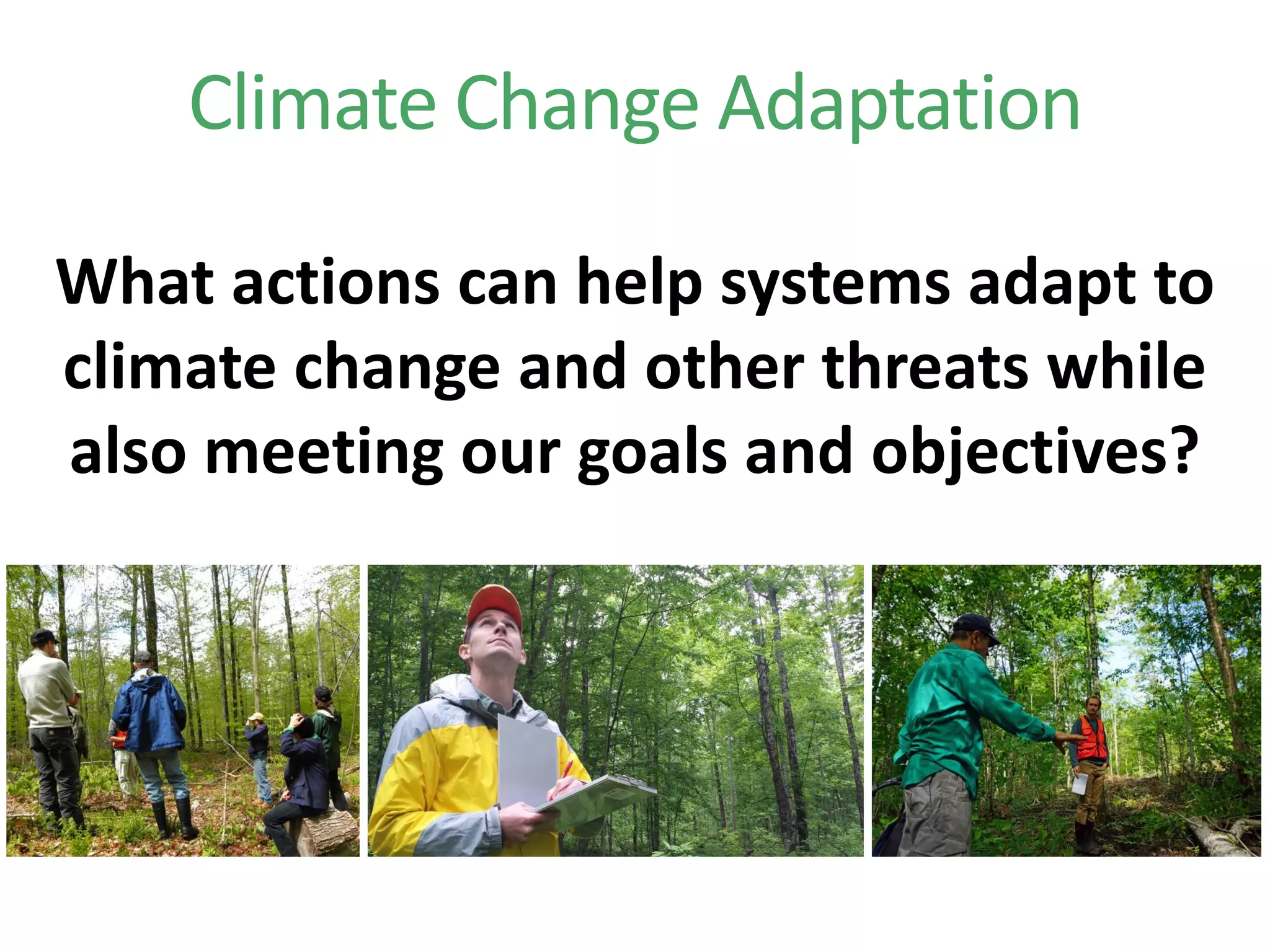
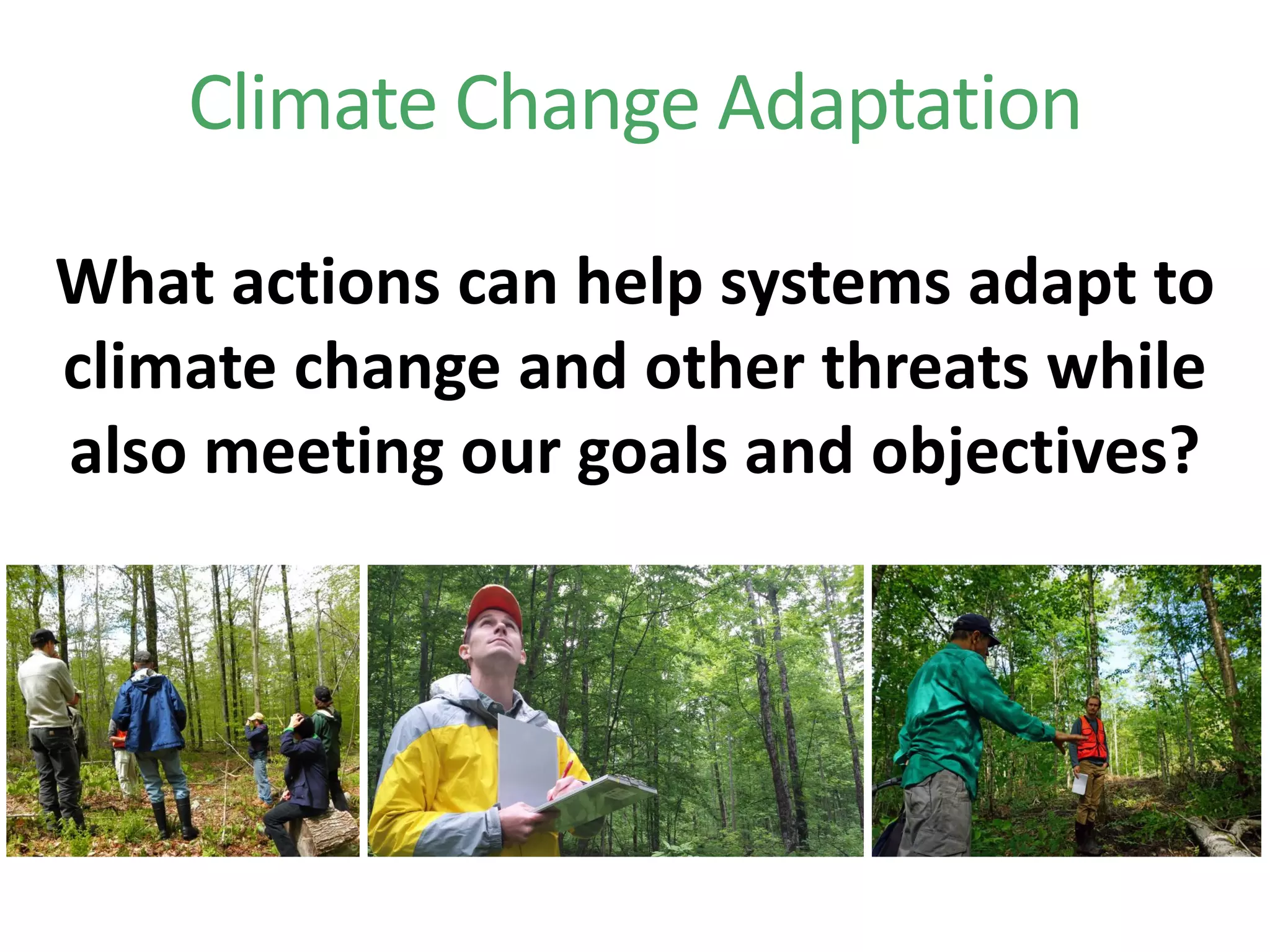
Climate Change Adaptation
What actions can help systems adapt to
climate change and other threats while
also meeting our goals and objectives?
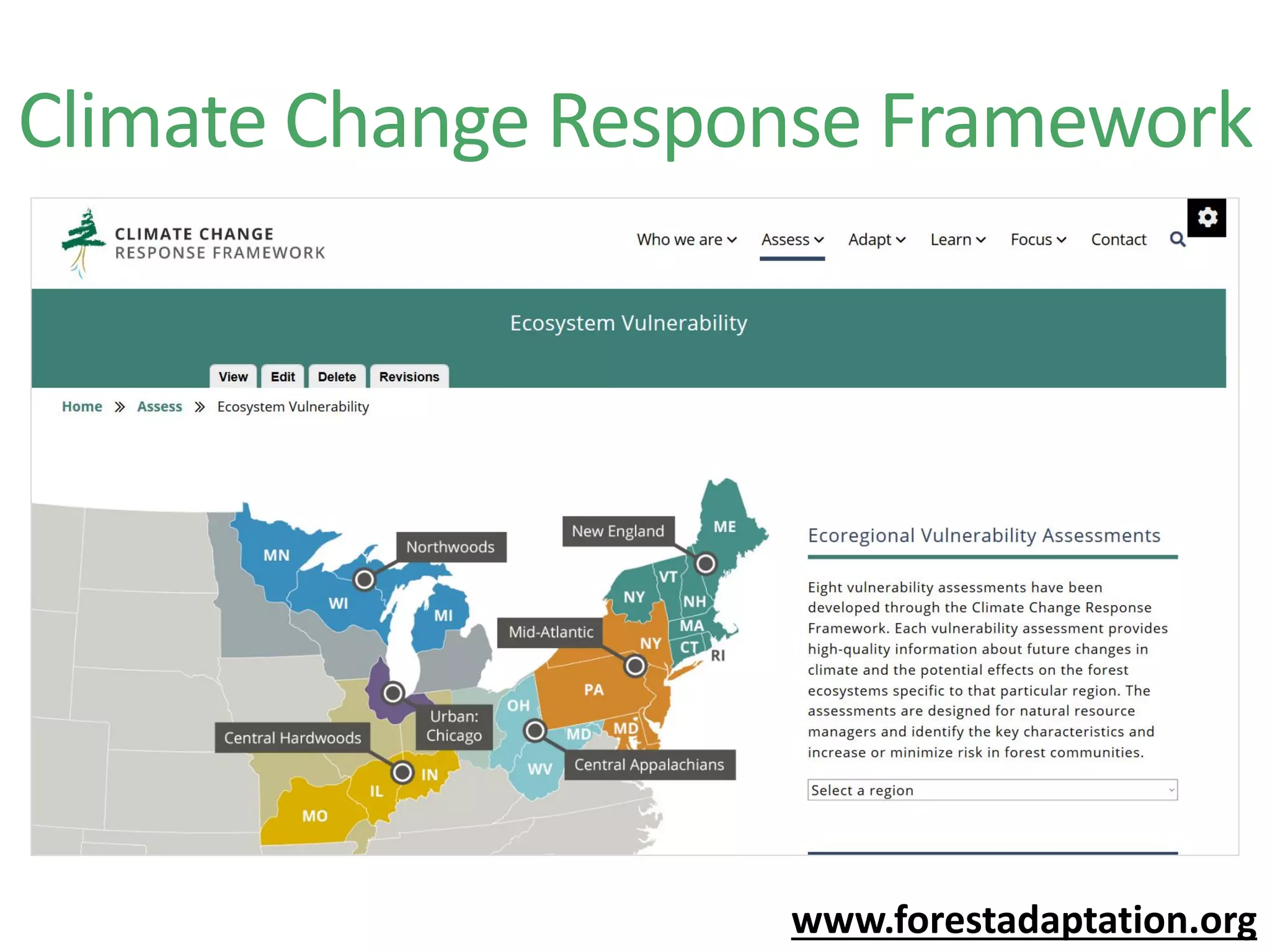
Climate Change Response Framework
www.forestadaptation.org
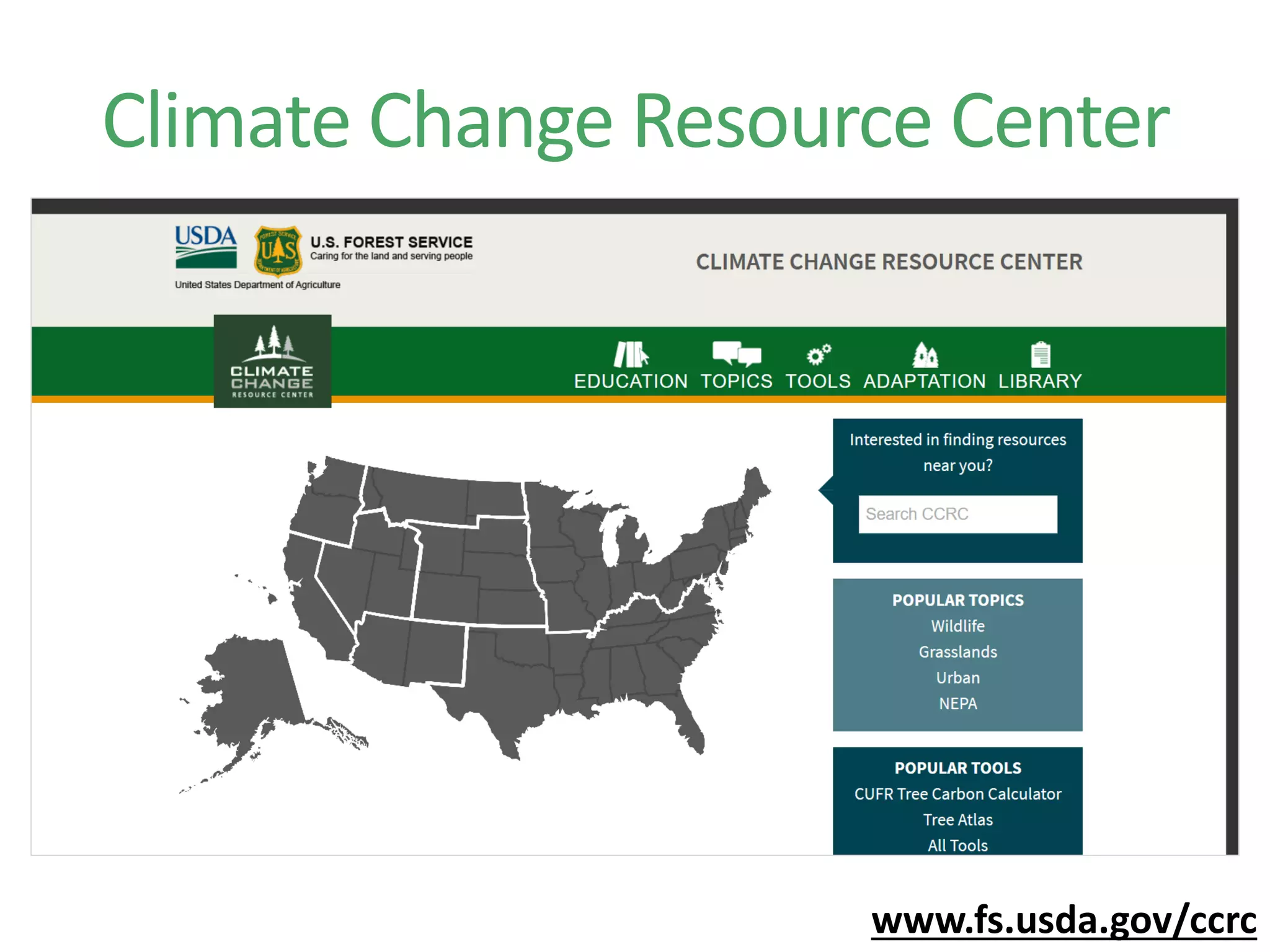
Climate Change Resource Center
www.fs.usda.gov/ccrc
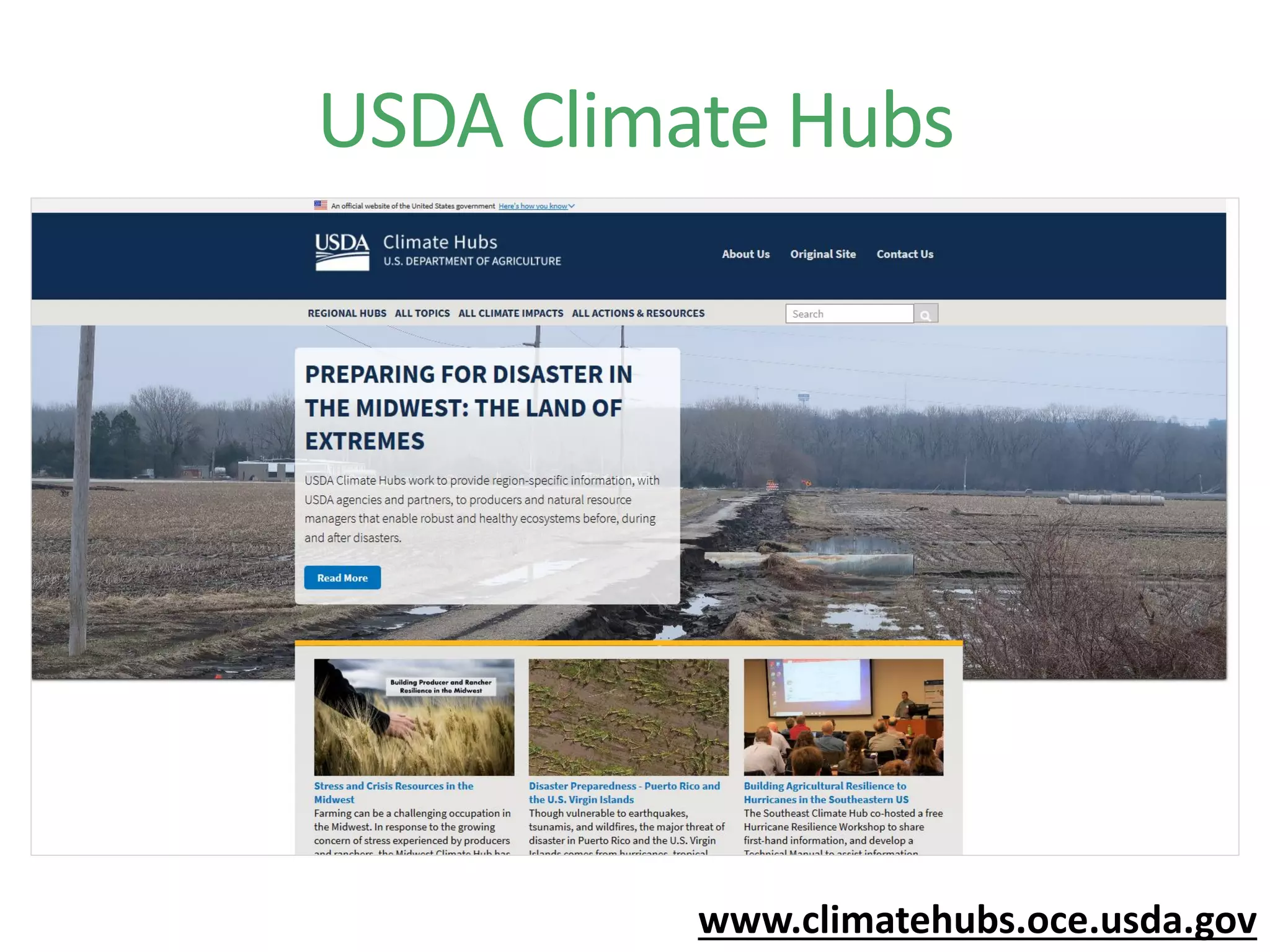
USDA Climate Hubs
www.climatehubs.oce.usda.gov
Climate Change Adaptation
What actions can help systems adapt to
climate change and other threats while
also meeting our goals and objectives?
If you want a single “answer” for how to
respond to climate change, it’s
“It depends”
It depends on where you are working
and what you’re trying to achieve.
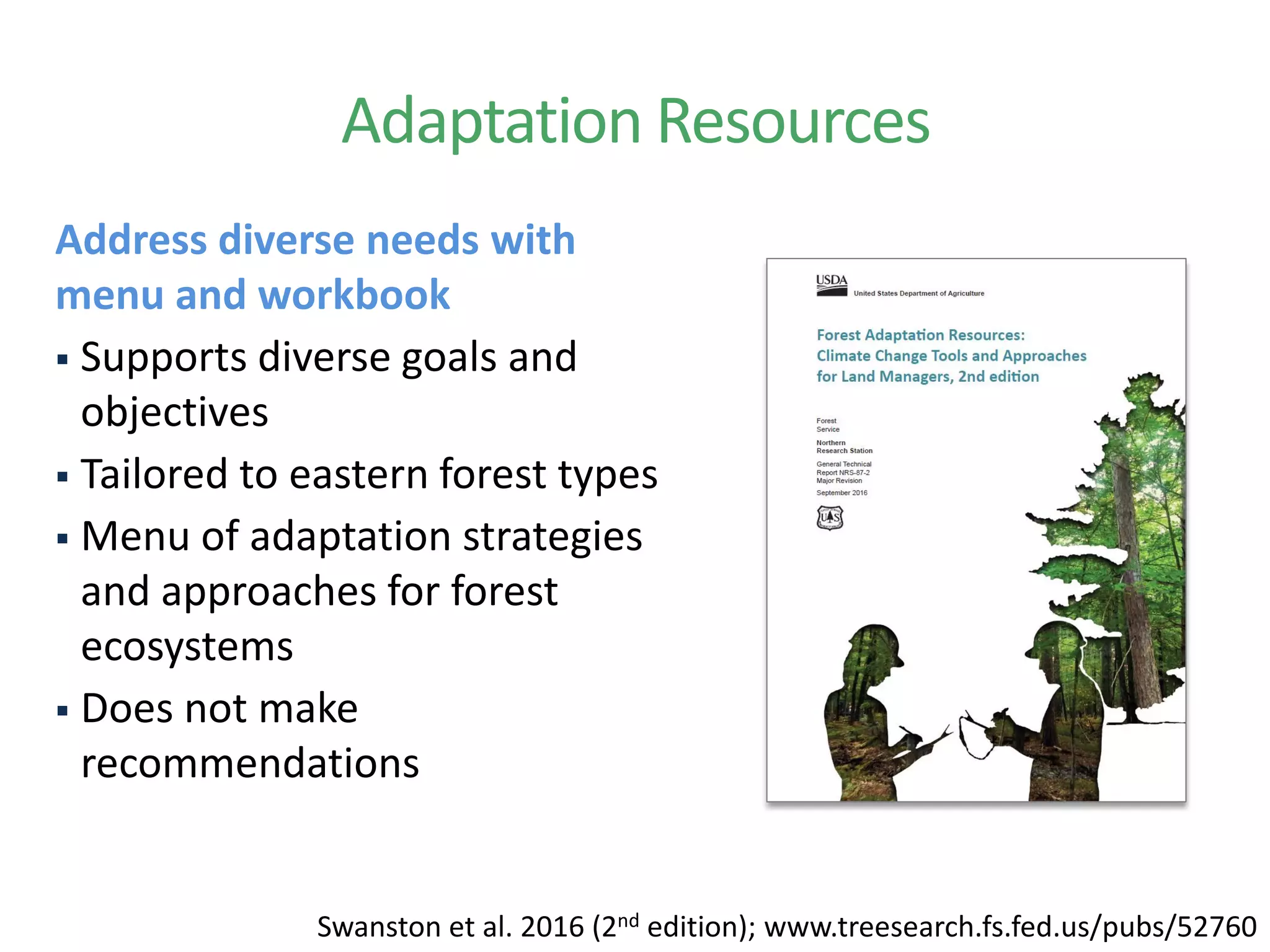
Adaptation Resources
Address diverse needs with
menu and workbook
 Supports diverse goals and
objectives
 Tailored to eastern forest types
 Menu of adaptation strategies
and approaches for forest
ecosystems
 Does not make
recommendations
Swanston et al. 2016 (2nd edition); www.treesearch.fs.fed.us/pubs/52760
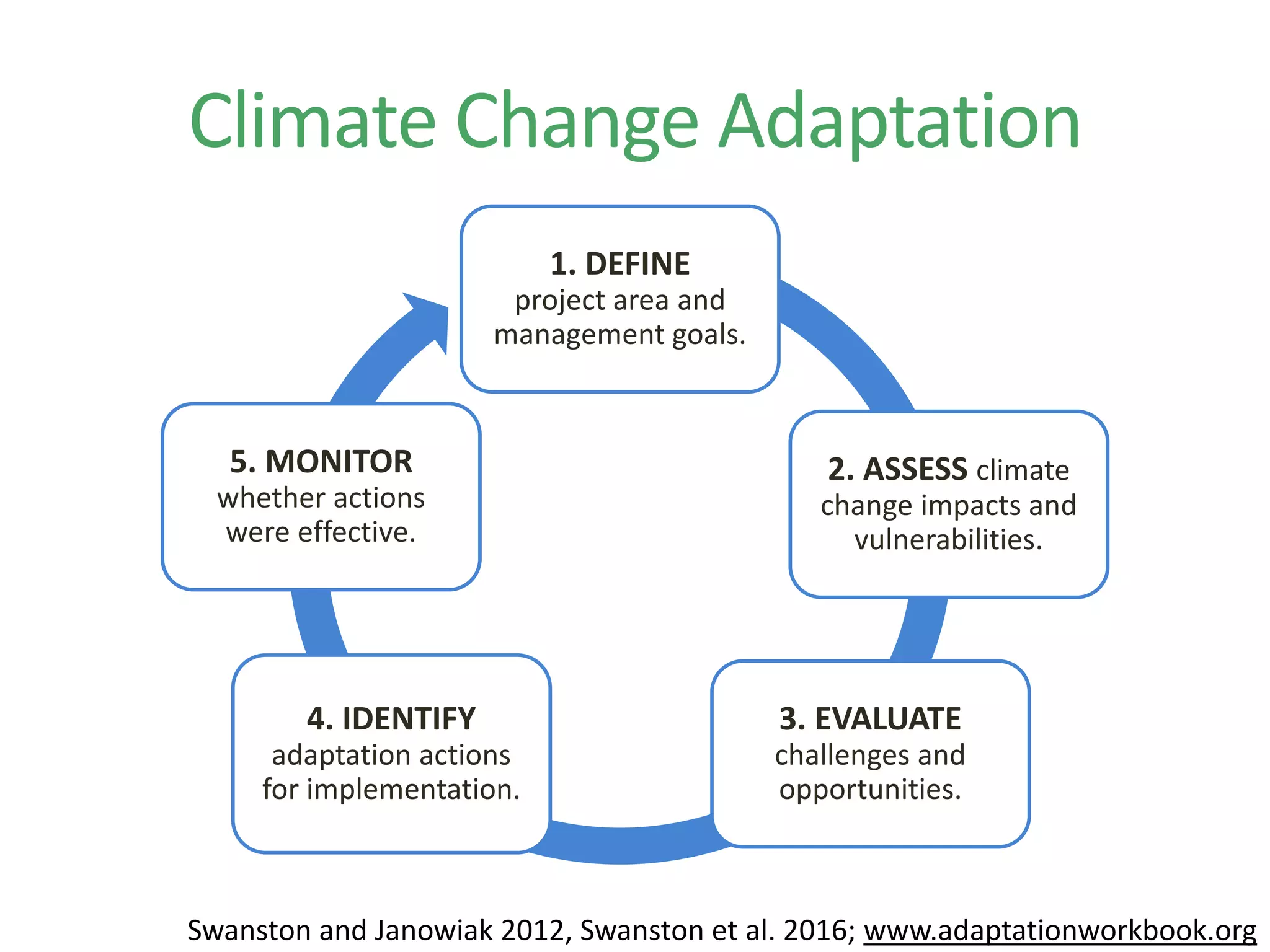
Climate Change Adaptation
1. DEFINE
project area and
management goals.
2. ASSESS climate
change impacts and
vulnerabilities.
3. EVALUATE
challenges and
opportunities.
4. IDENTIFY
adaptation actions
for implementation.
5. MONITOR
whether actions
were effective.
Swanston and Janowiak 2012, Swanston et al. 2016; www.adaptationworkbook.org
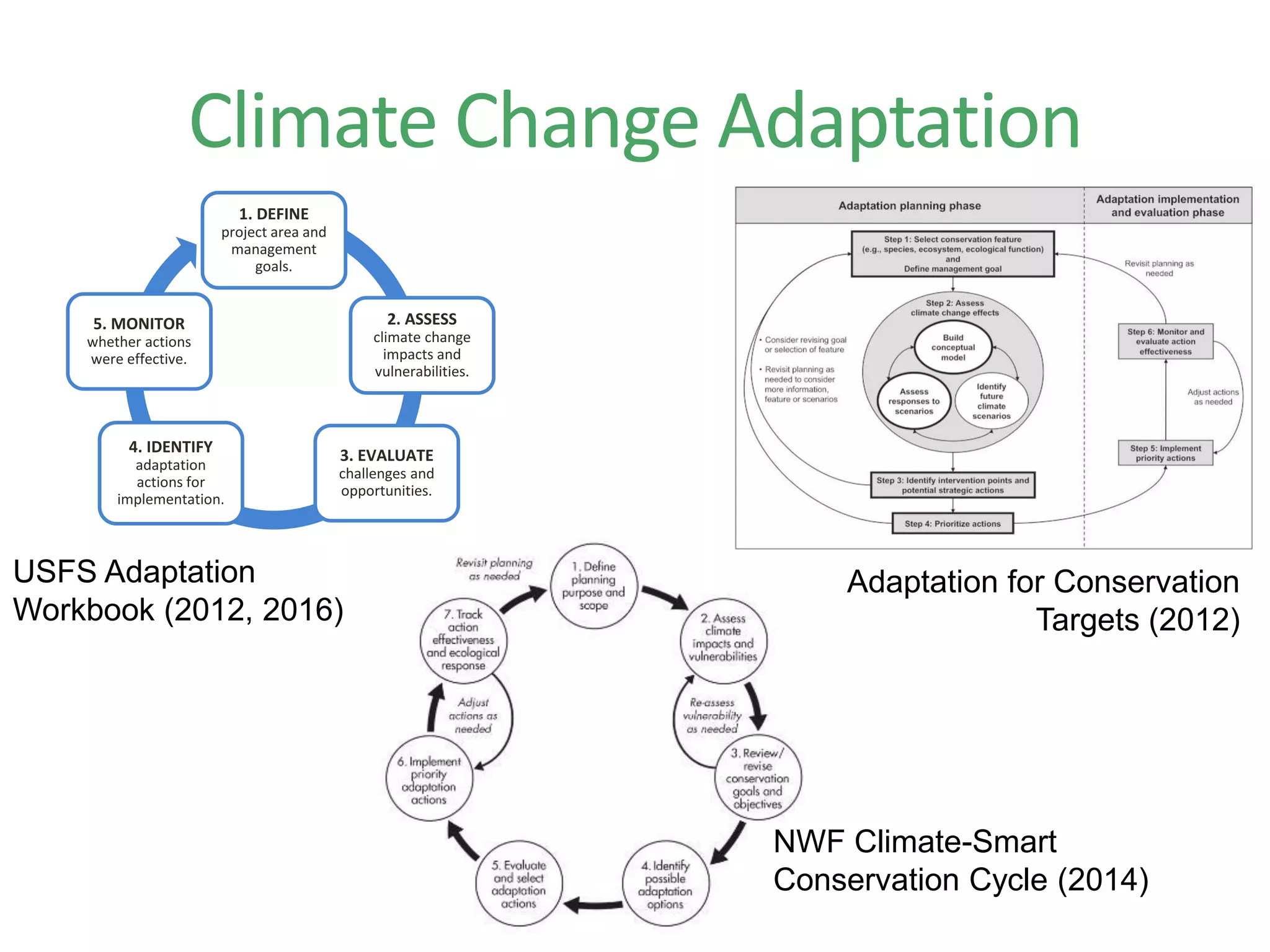
NWF Climate-Smart
Conservation Cycle (2014)
Adaptation for Conservation
Targets (2012)
USFS Adaptation
Workbook (2012, 2016)
1. DEFINE
project area and
management
goals.
2. ASSESS
climate change
impacts and
vulnerabilities.
3. EVALUATE
challenges and
opportunities.
4. IDENTIFY
adaptation
actions for
implementation.
5. MONITOR
whether actions
were effective.
Climate Change Adaptation
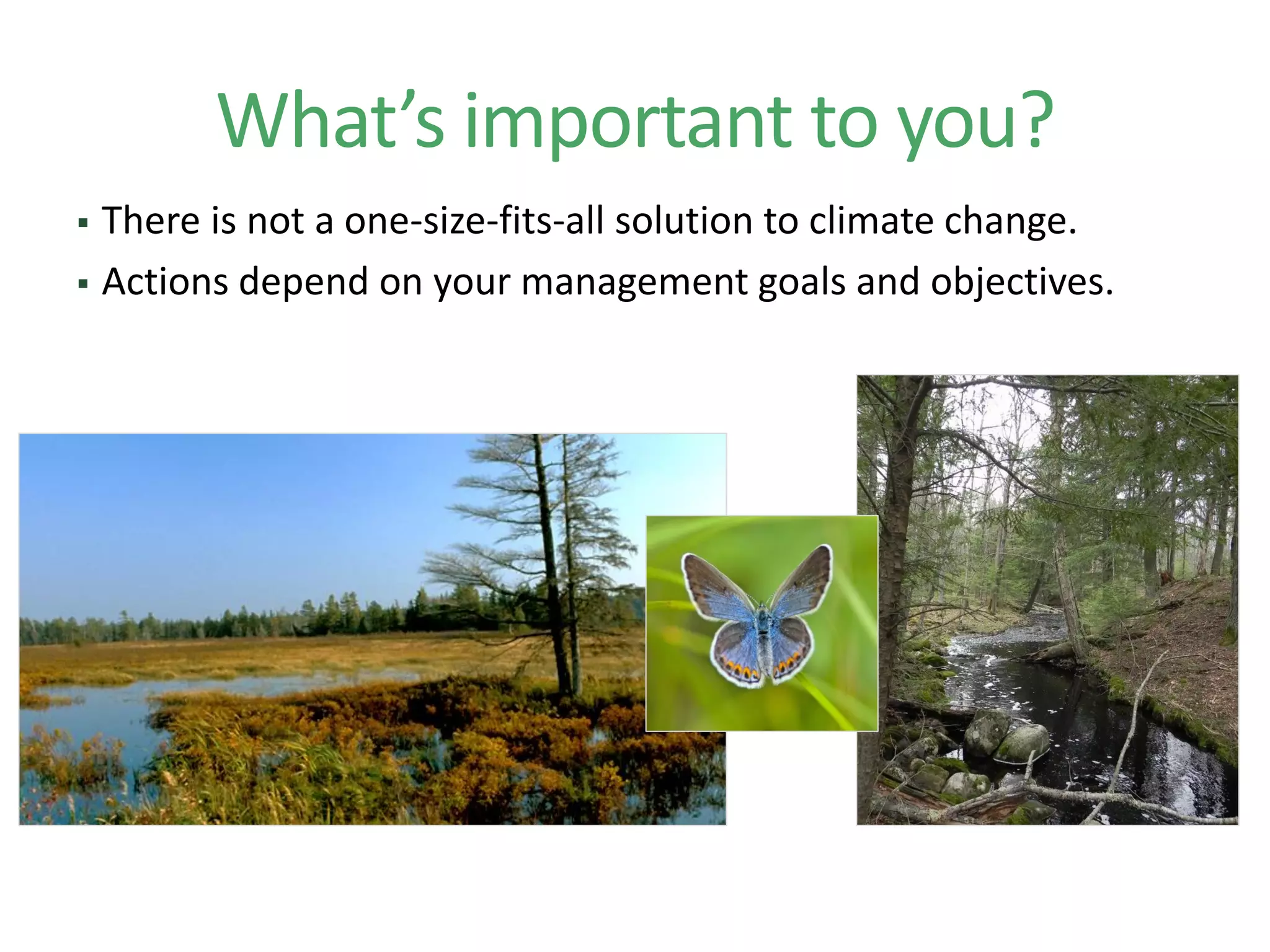
What’s important to you?
 There is not a one-size-fits-all solution to climate change.
 Actions depend on your management goals and objectives.
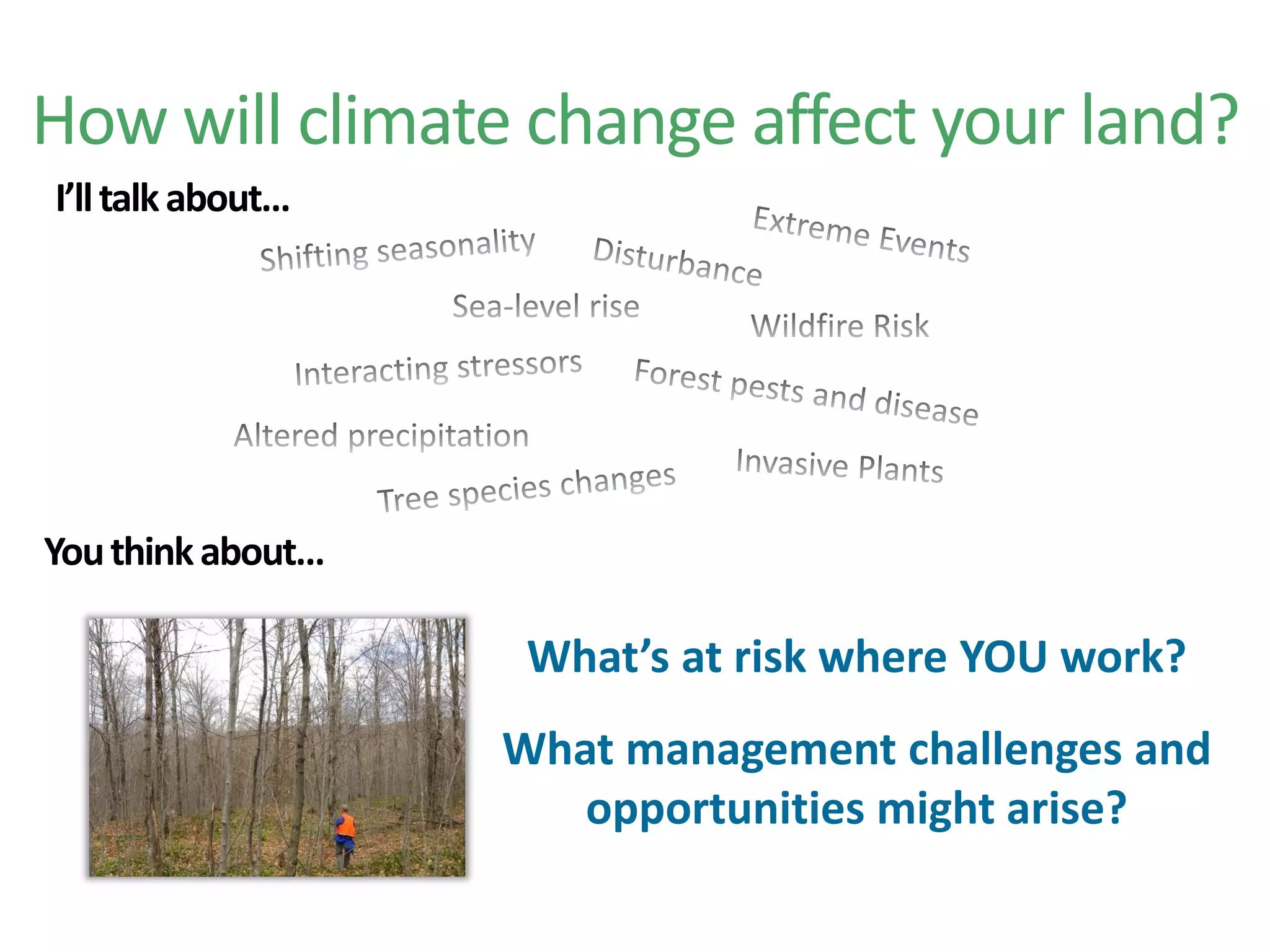
How will climate change affect your land?
What’s at risk where YOU work?
What management challenges and
opportunities might arise?
I’lltalkabout…
Youthinkabout…
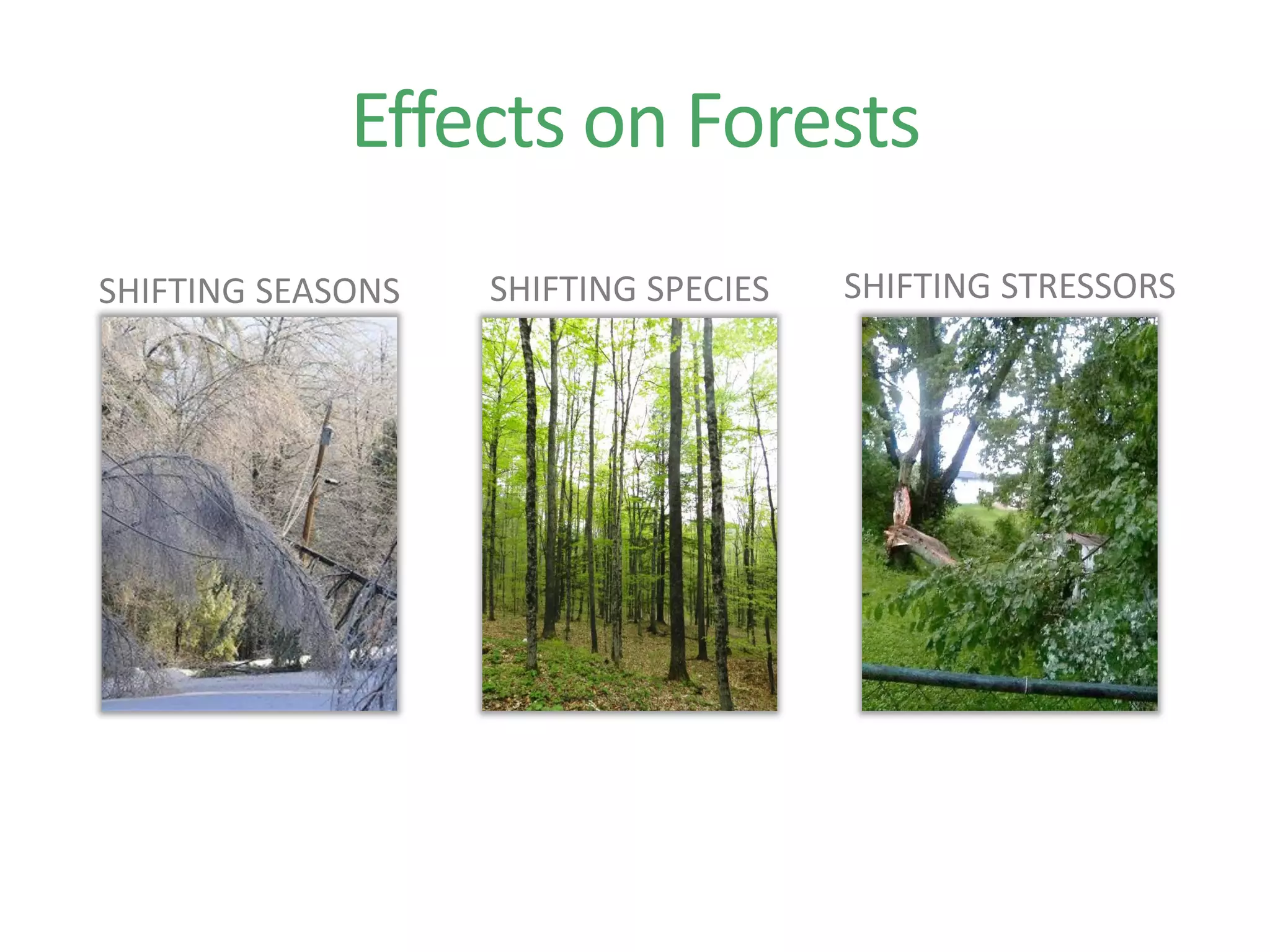
Effects on Forests
SHIFTING SPECIESSHIFTING SEASONS SHIFTING STRESSORS
Longer Growing Season
SHIFTING SEASONS | SHIFTING SPECIES | SHIFTING STRESSORS
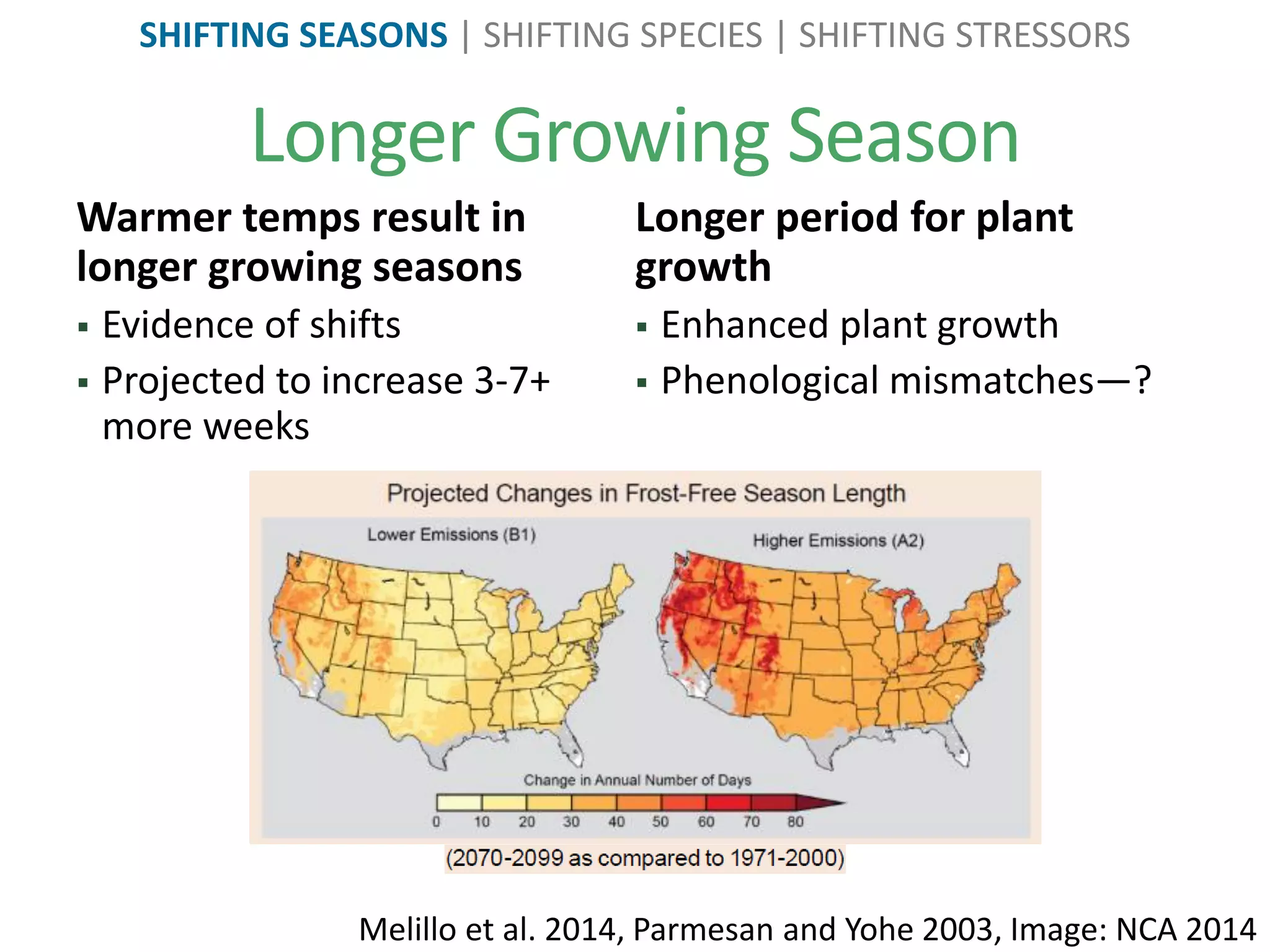
Warmer temps result in
longer growing seasons
 Evidence of shifts
 Projected to increase 3-7+
more weeks
Longer period for plant
growth
 Enhanced plant growth
 Phenological mismatches—?
Melillo et al. 2014, Parmesan and Yohe 2003, Image: NCA 2014
SHIFTING SEASONS | SHIFTING SPECIES | SHIFTING STRESSORS
Longer Growing Season
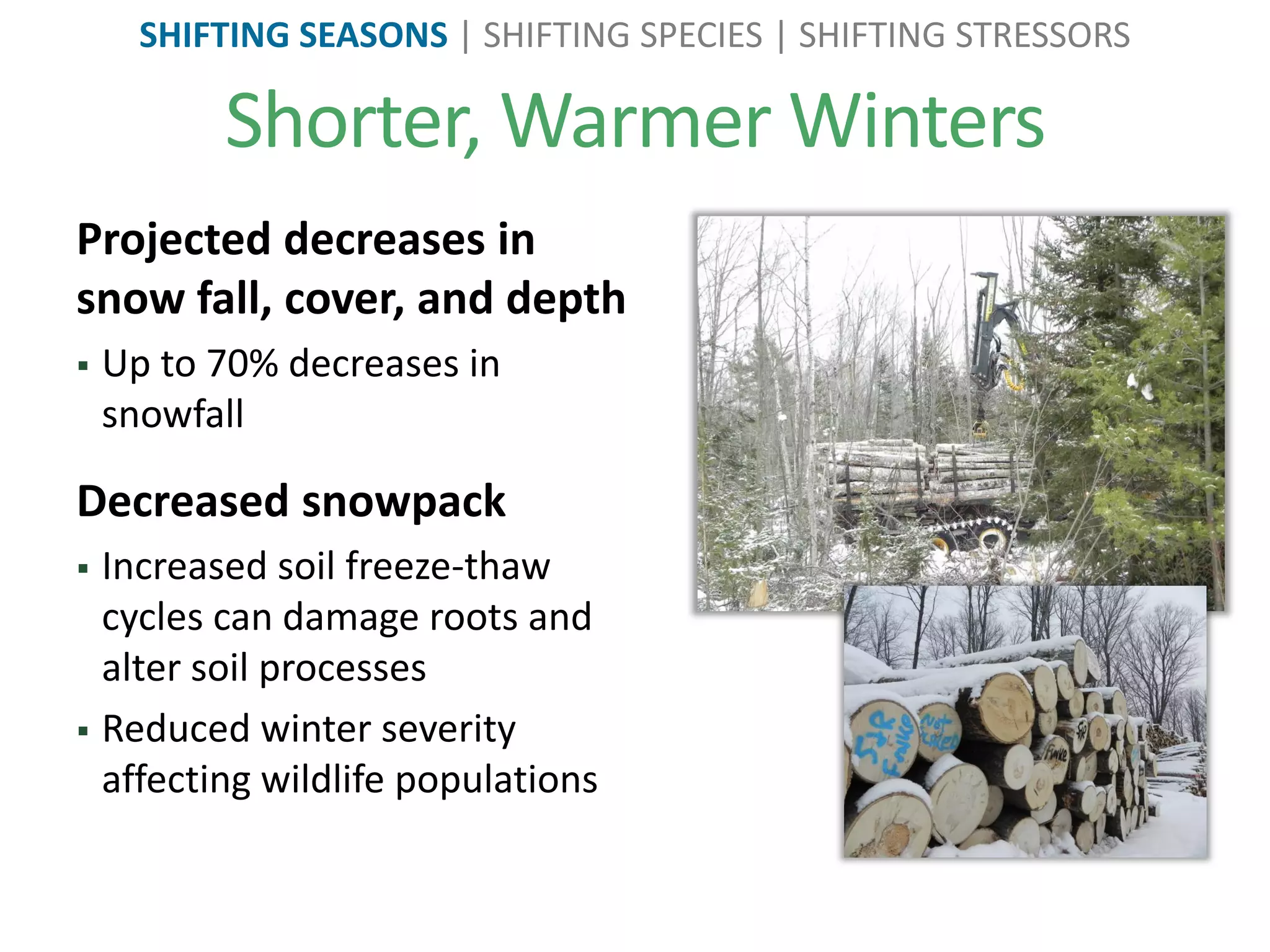
Shorter, Warmer Winters
Projected decreases in
snow fall, cover, and depth
 Up to 70% decreases in
snowfall
Decreased snowpack
 Increased soil freeze-thaw
cycles can damage roots and
alter soil processes
 Reduced winter severity
affecting wildlife populations
SHIFTING SEASONS | SHIFTING SPECIES | SHIFTING STRESSORS
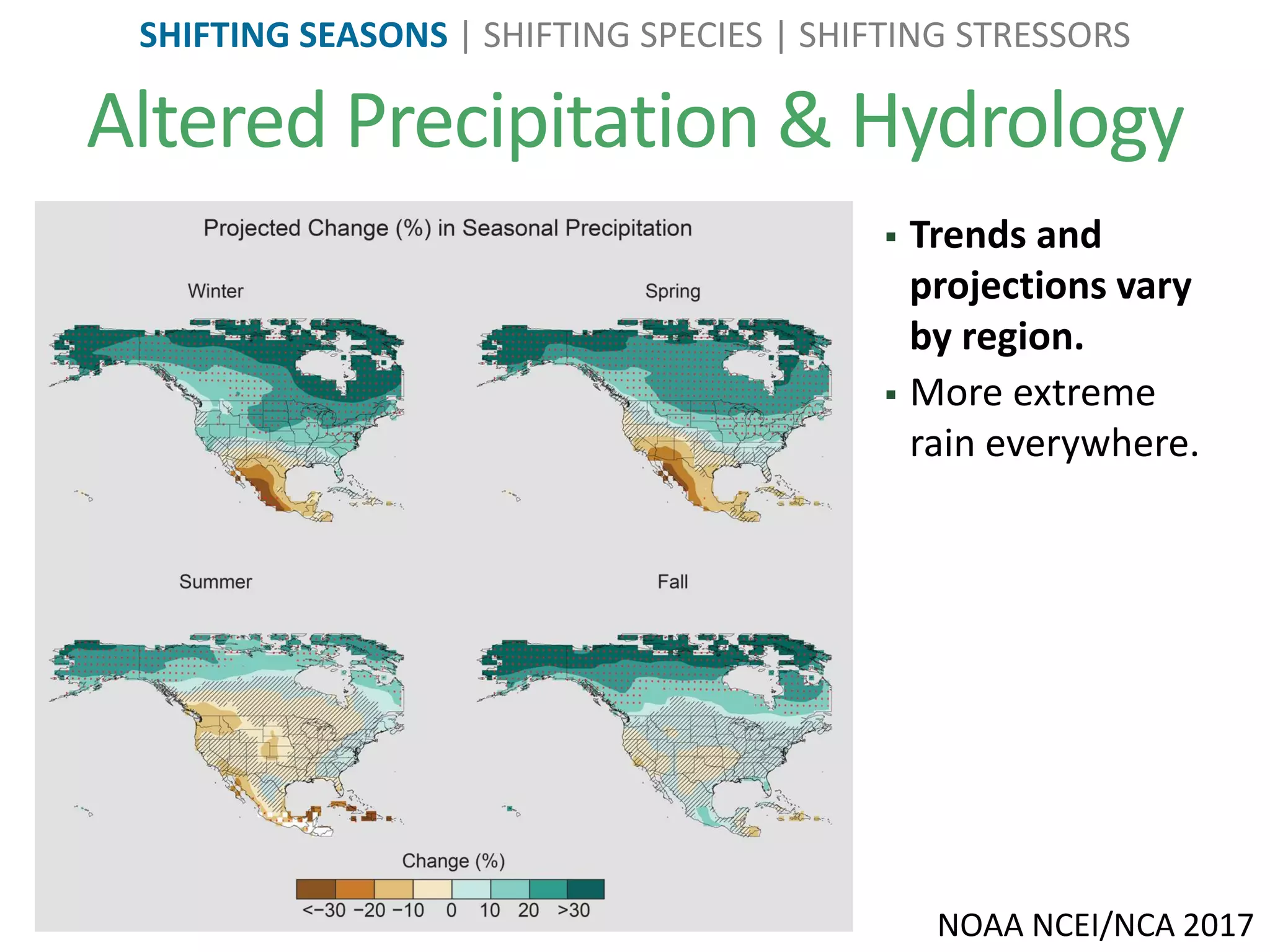
Altered Precipitation & Hydrology
 Trends and
projections vary
by region.
 More extreme
rain everywhere.
SHIFTING SEASONS | SHIFTING SPECIES | SHIFTING STRESSORS
NOAA NCEI/NCA 2017
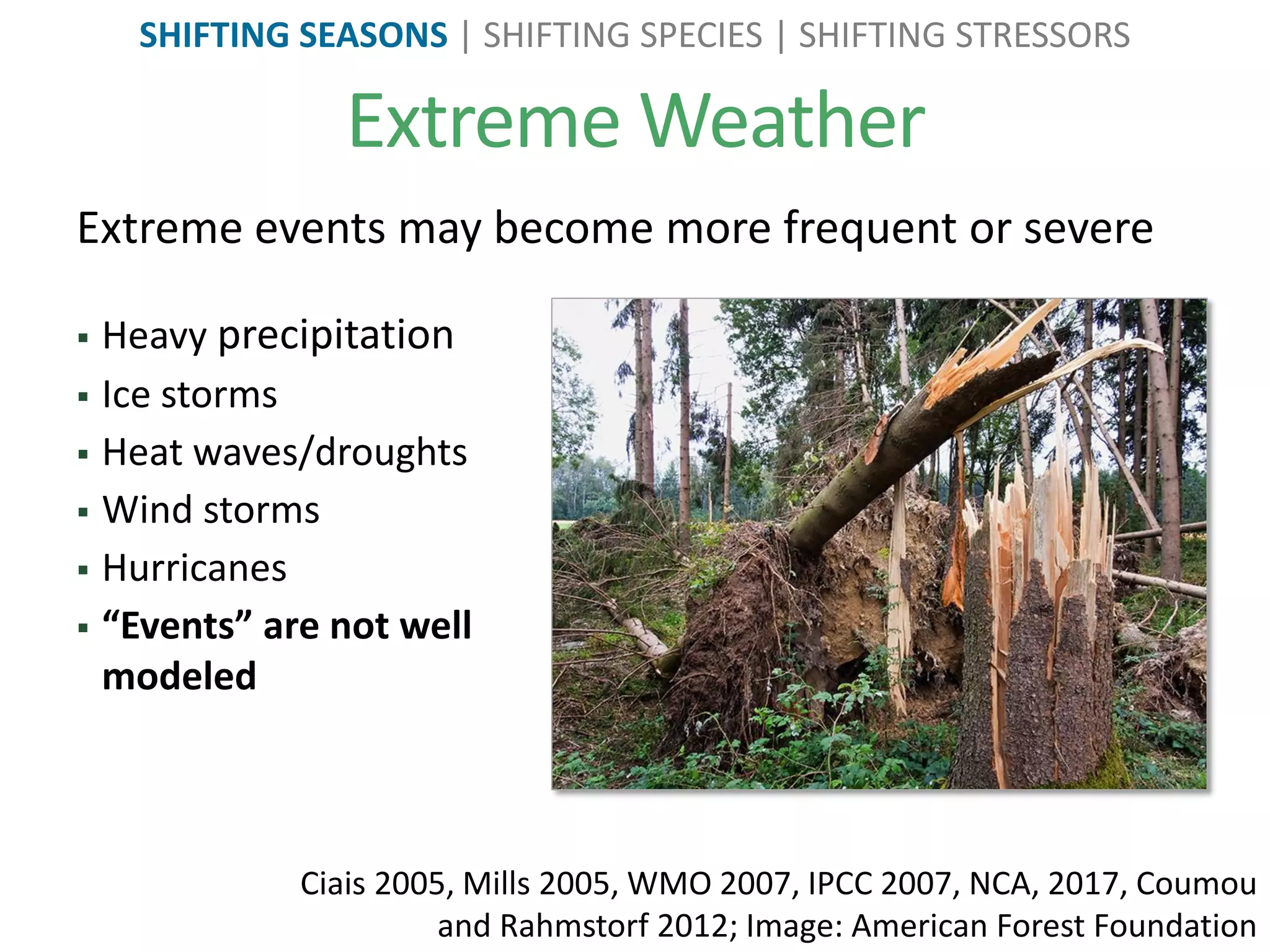
Extreme Weather
SHIFTING SEASONS | SHIFTING SPECIES | SHIFTING STRESSORS
Extreme events may become more frequent or severe
 Heavy precipitation
 Ice storms
 Heat waves/droughts
 Wind storms
 Hurricanes
 “Events” are not well
modeled
Ciais 2005, Mills 2005, WMO 2007, IPCC 2007, NCA, 2017, Coumou
and Rahmstorf 2012; Image: American Forest Foundation
SHIFTING SEASONS | SHIFTING SPECIES | SHIFTING STRESSORS
Species Range Shifts
SHIFTING SEASONS | SHIFTING SPECIES | SHIFTING STRESSORS
Species Range Shifts
SHIFTING SEASONS | SHIFTING SPECIES | SHIFTING STRESSORS
www.fs.fed.us/nrs/atlas/
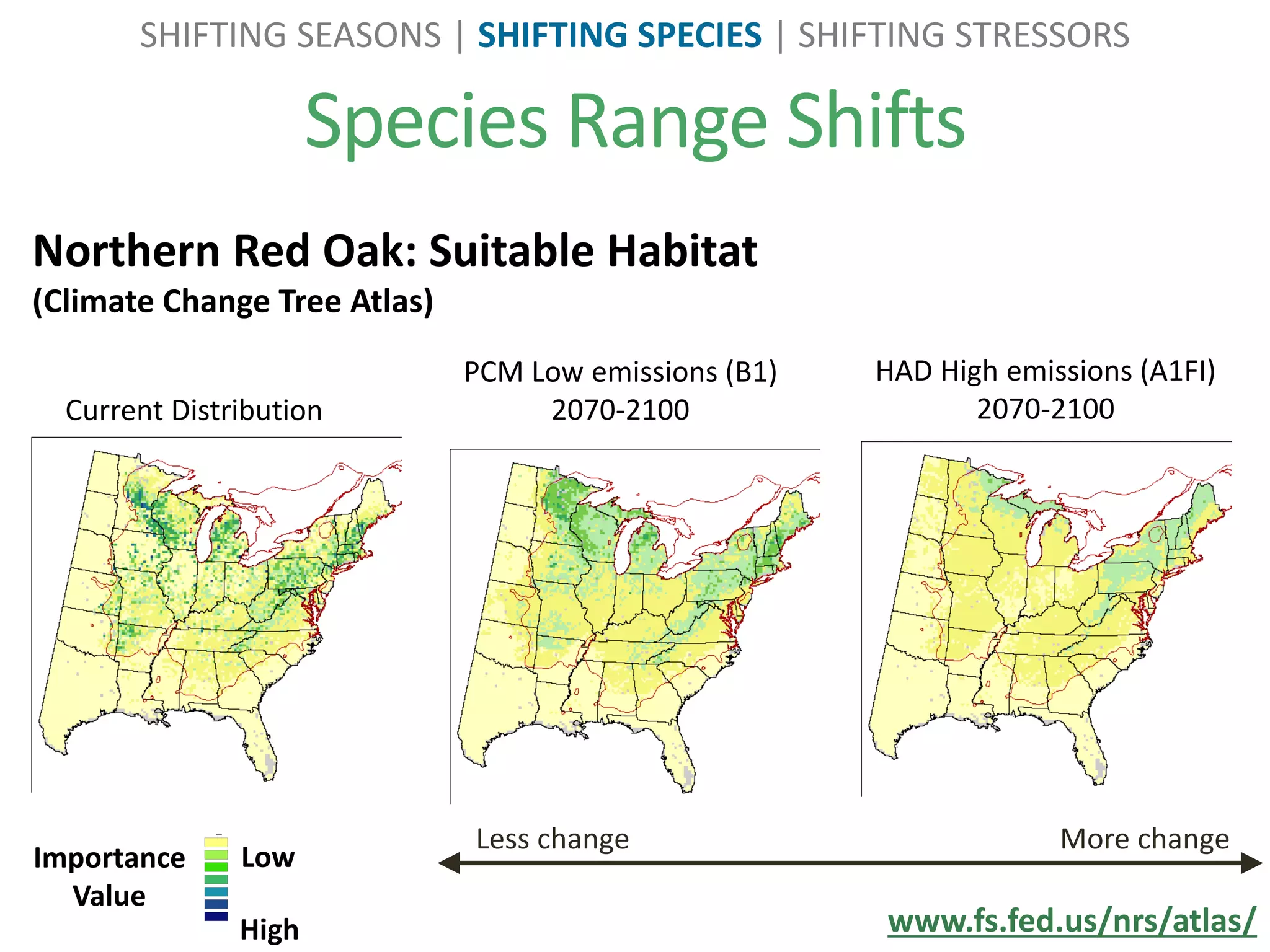
Northern Red Oak: Suitable Habitat
(Climate Change Tree Atlas)
Less change More change
PCM Low emissions (B1)
2070-2100
HAD High emissions (A1FI)
2070-2100
Importance
Value
Low
High
Legend
all_spp_current
fia_802
1.000000
1.000001 - 4.000000
4.000001 - 6.000000
6.000001 - 9.000000
9.000001 - 11.000000
11.000001 - 14.000000
14.000001 - 23.000000
Current Distribution
Species Range Shifts
SHIFTING SEASONS | SHIFTING SPECIES | SHIFTING STRESSORS
www.fs.fed.us/nrs/atlas/
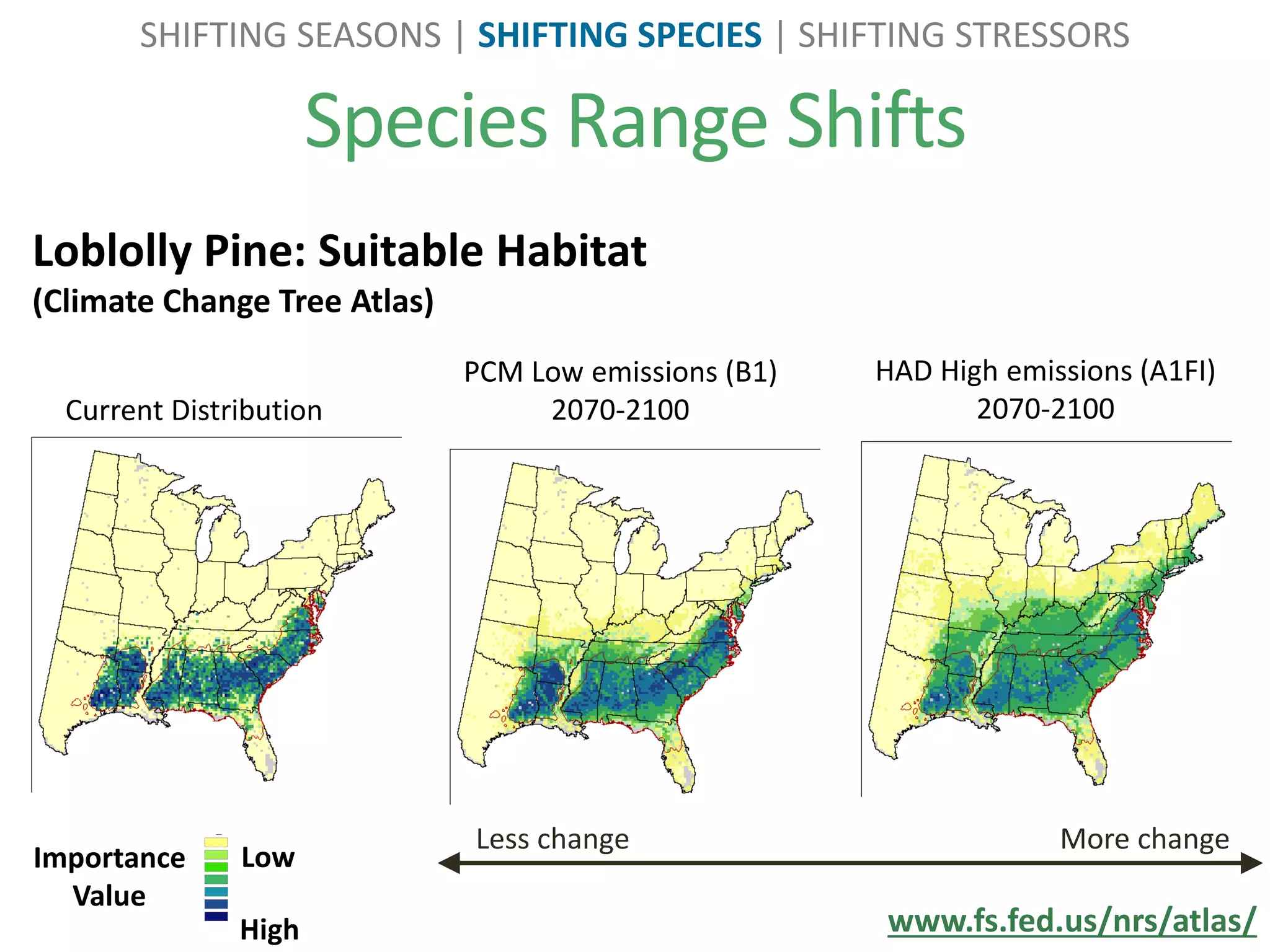
Loblolly Pine: Suitable Habitat
(Climate Change Tree Atlas)
Less change More change
PCM Low emissions (B1)
2070-2100
HAD High emissions (A1FI)
2070-2100
Importance
Value
Low
High
Legend
all_spp_current
fia_802
1.000000
1.000001 - 4.000000
4.000001 - 6.000000
6.000001 - 9.000000
9.000001 - 11.000000
11.000001 - 14.000000
14.000001 - 23.000000
Current Distribution
Species Range Shifts
SHIFTING SEASONS | SHIFTING SPECIES | SHIFTING STRESSORS
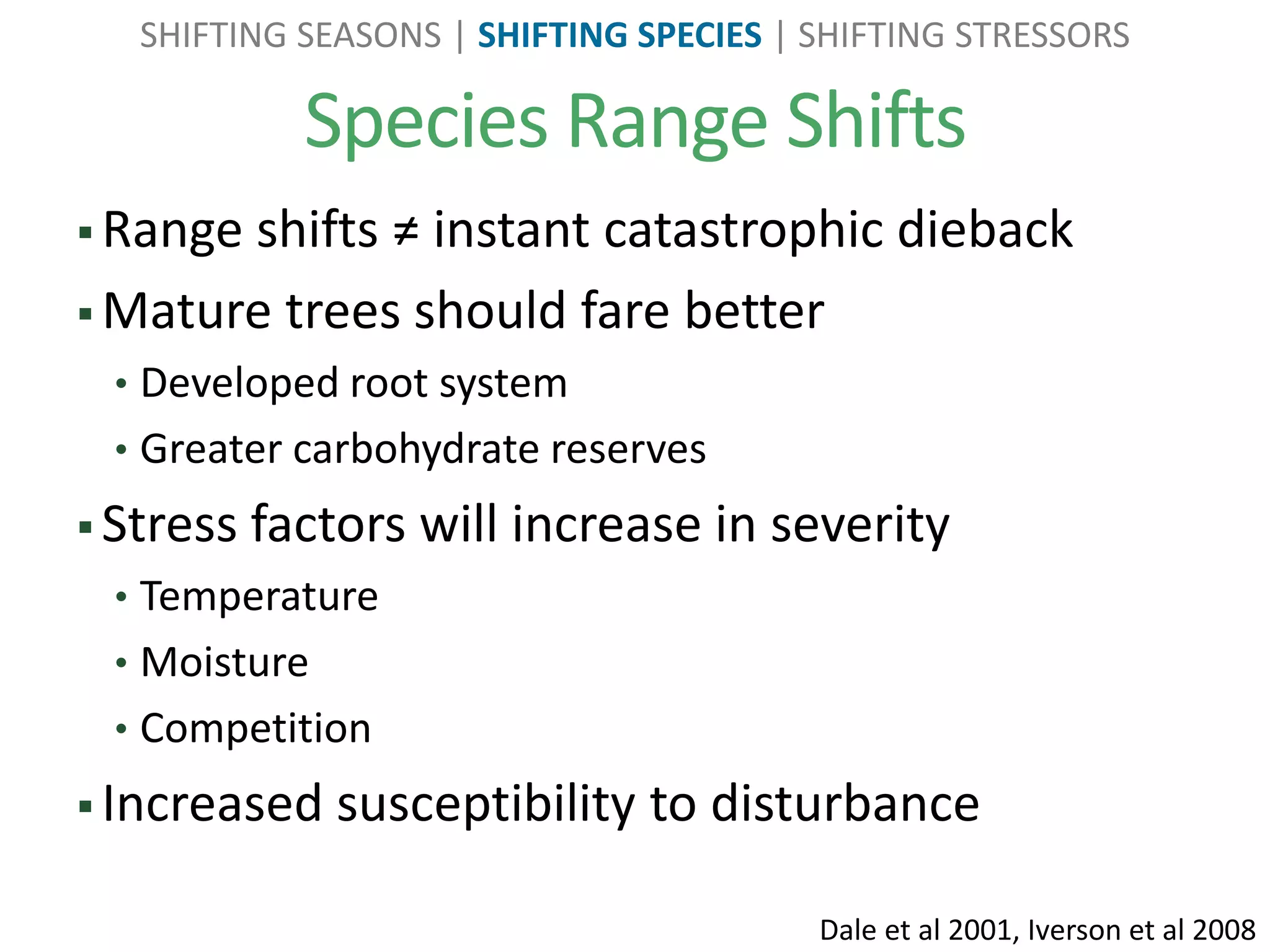
 Range shifts ≠ instant catastrophic dieback
 Mature trees should fare better
• Developed root system
• Greater carbohydrate reserves
 Stress factors will increase in severity
• Temperature
• Moisture
• Competition
 Increased susceptibility to disturbance
Dale et al 2001, Iverson et al 2008
SHIFTING SEASONS | SHIFTING SPECIES | SHIFTING STRESSORS
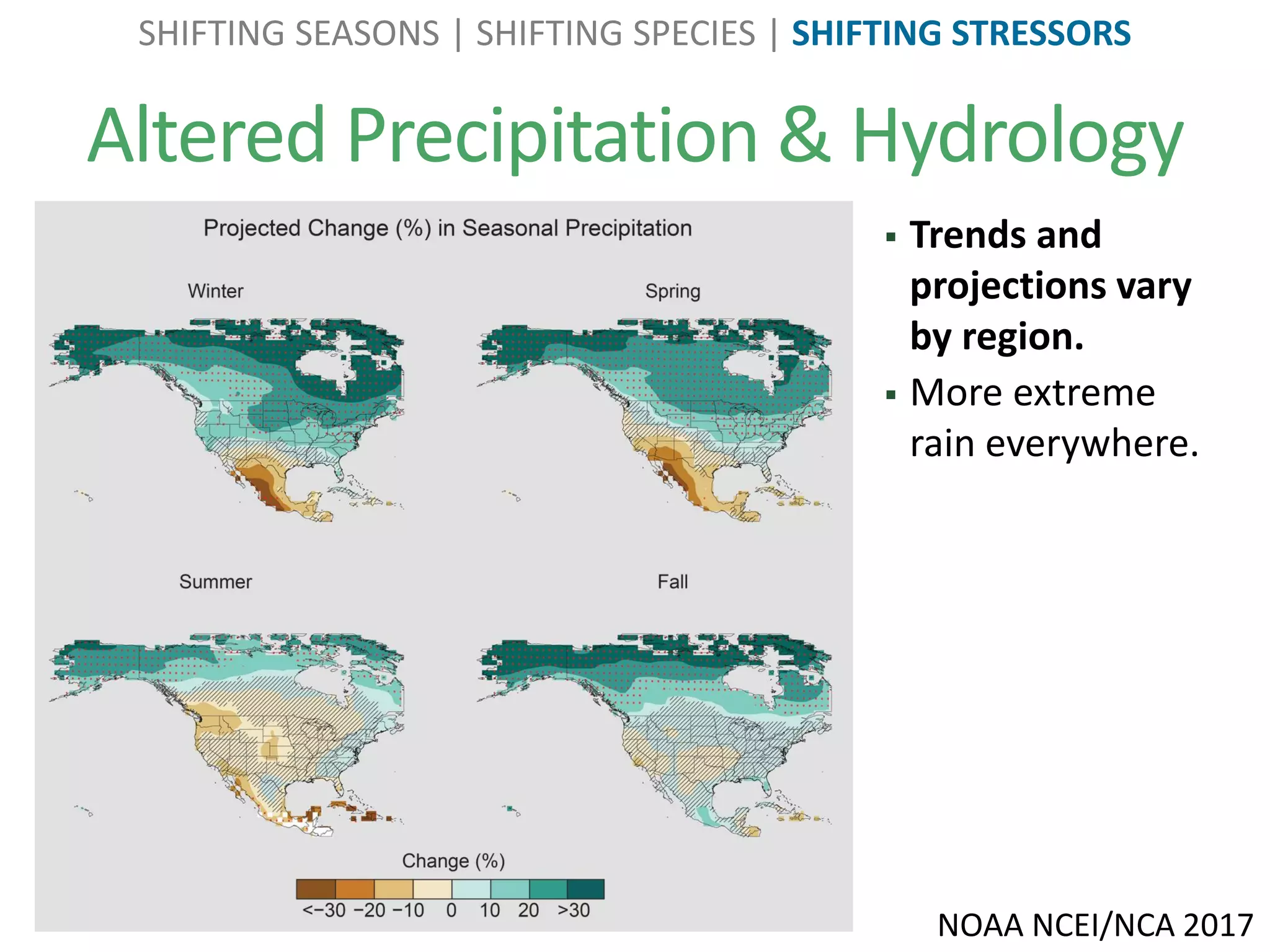
Altered Precipitation & Hydrology
 Trends and
projections vary
by region.
 More extreme
rain everywhere.
NOAA NCEI/NCA 2017
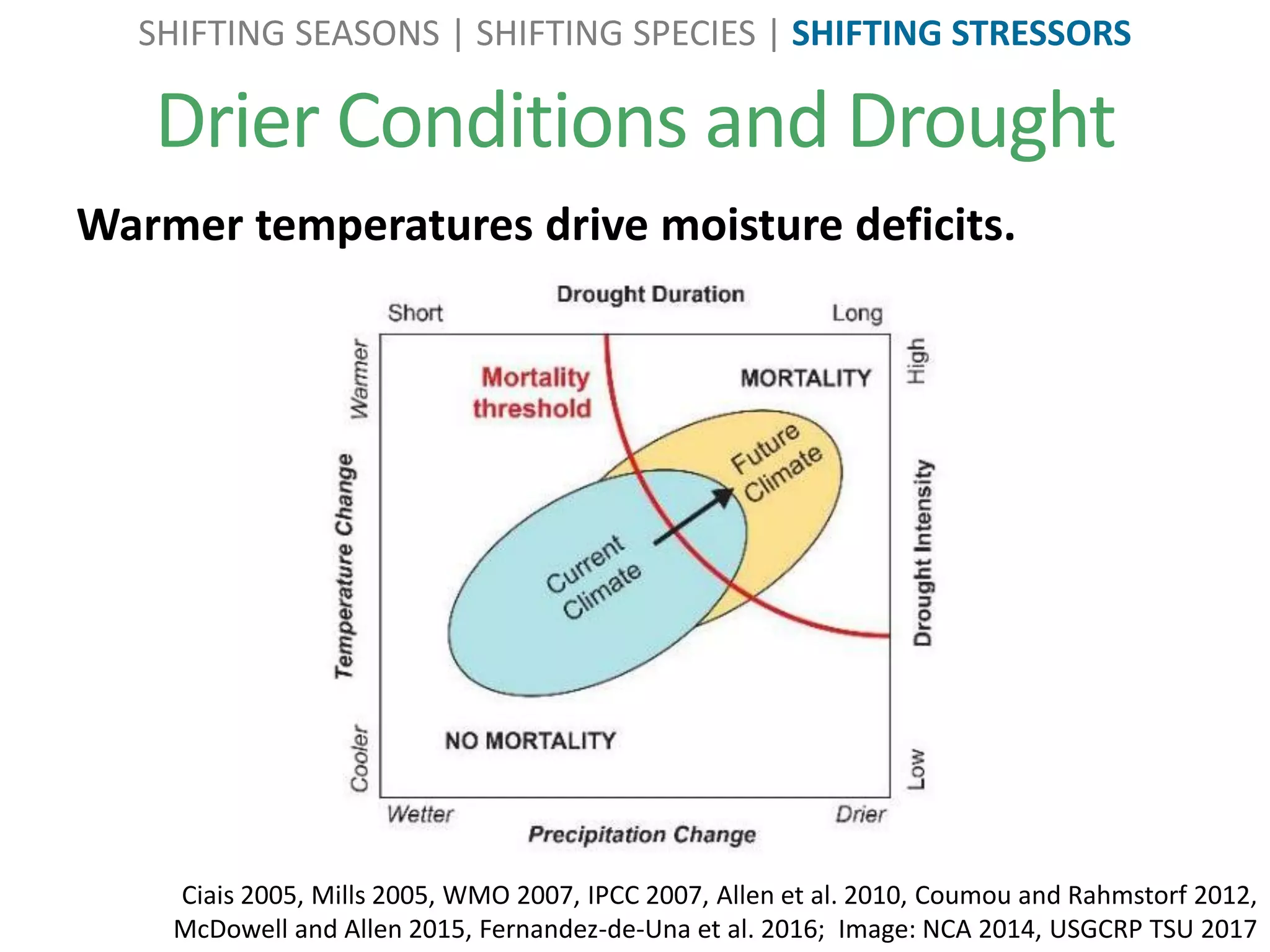
Drier Conditions and Drought
Ciais 2005, Mills 2005, WMO 2007, IPCC 2007, Allen et al. 2010, Coumou and Rahmstorf 2012,
McDowell and Allen 2015, Fernandez-de-Una et al. 2016; Image: NCA 2014, USGCRP TSU 2017
SHIFTING SEASONS | SHIFTING SPECIES | SHIFTING STRESSORS
Warmer temperatures drive moisture deficits.
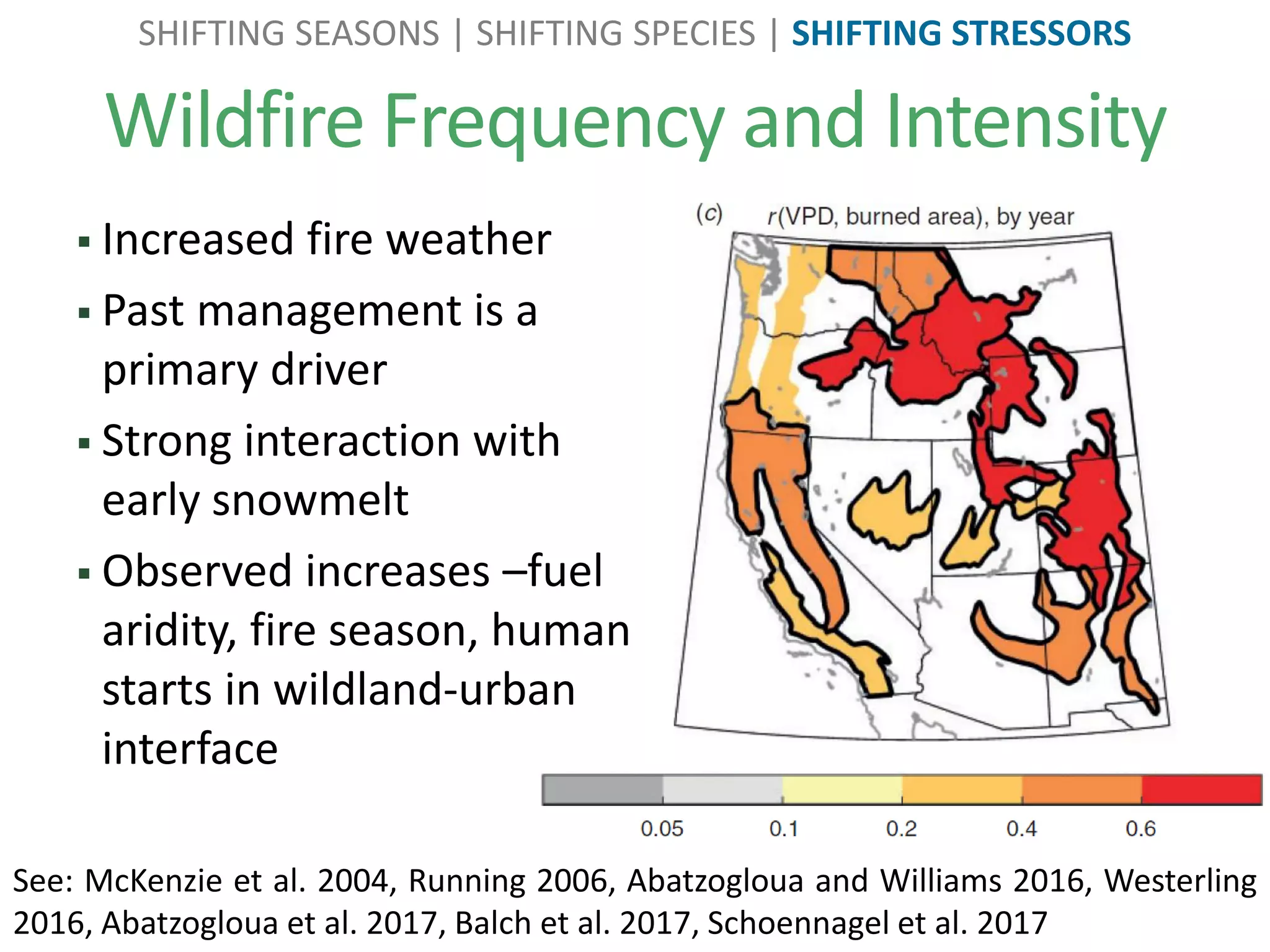
See: McKenzie et al. 2004, Running 2006, Abatzogloua and Williams 2016, Westerling
2016, Abatzogloua et al. 2017, Balch et al. 2017, Schoennagel et al. 2017
Wildfire Frequency and Intensity
 Increased fire weather
 Past management is a
primary driver
 Strong interaction with
early snowmelt
 Observed increases –fuel
aridity, fire season, human
starts in wildland-urban
interface
SHIFTING SEASONS | SHIFTING SPECIES | SHIFTING STRESSORS
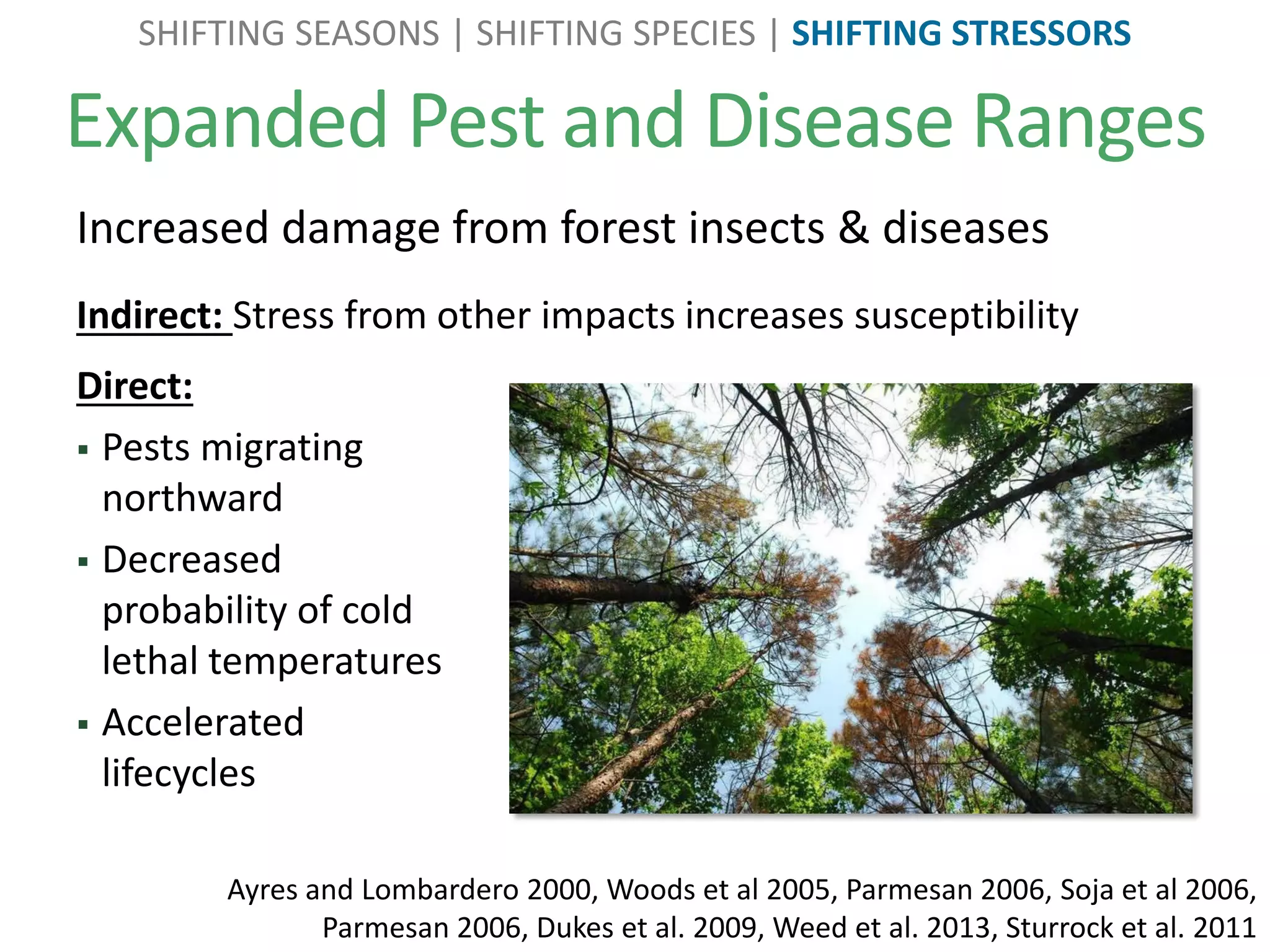
Expanded Pest and Disease Ranges
Ayres and Lombardero 2000, Woods et al 2005, Parmesan 2006, Soja et al 2006,
Parmesan 2006, Dukes et al. 2009, Weed et al. 2013, Sturrock et al. 2011
SHIFTING SEASONS | SHIFTING SPECIES | SHIFTING STRESSORS
Indirect: Stress from other impacts increases susceptibility
Increased damage from forest insects & diseases
Direct:
 Pests migrating
northward
 Decreased
probability of cold
lethal temperatures
 Accelerated
lifecycles
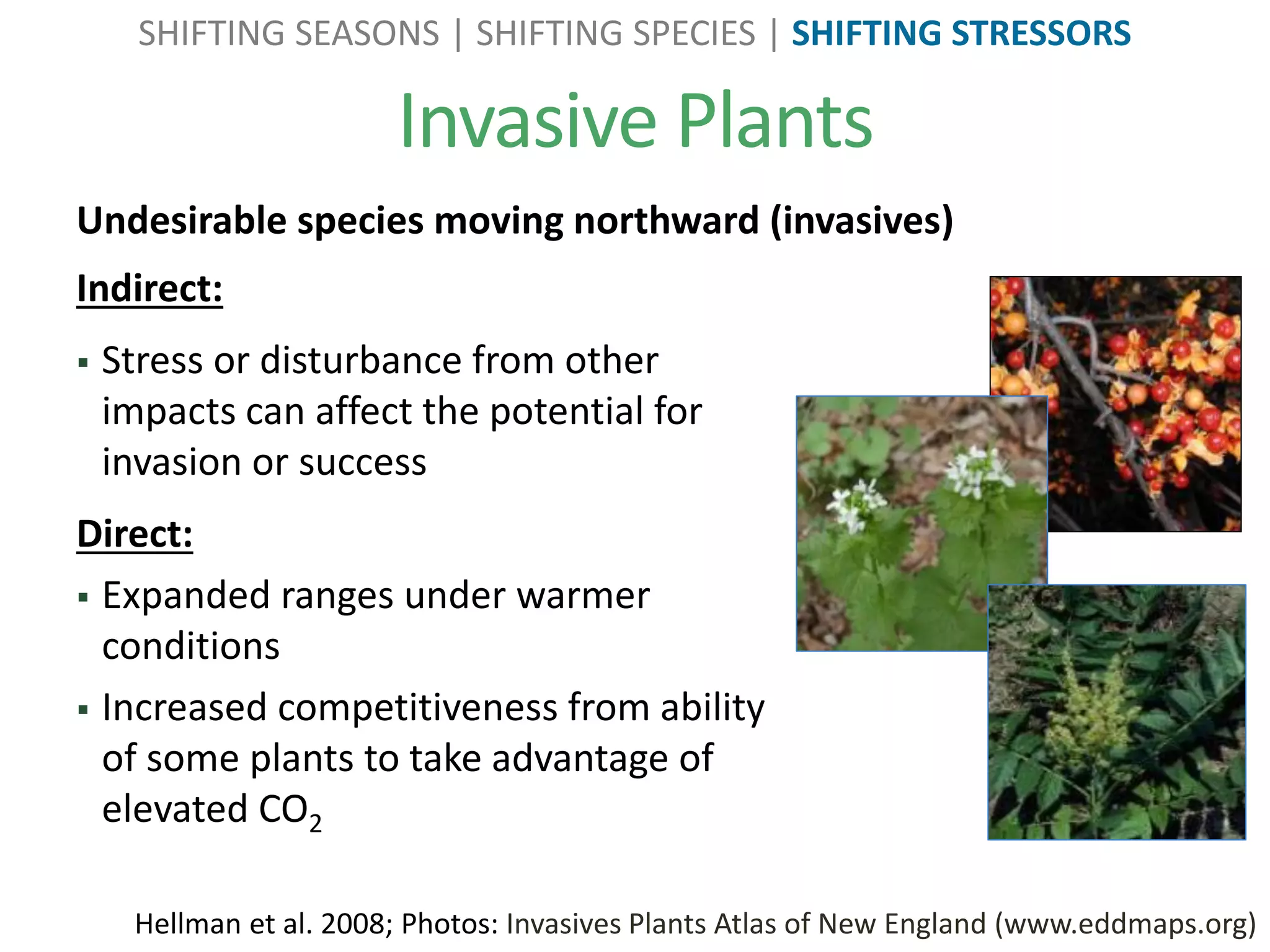
Undesirable species moving northward (invasives)
Invasive Plants
Hellman et al. 2008; Photos: Invasives Plants Atlas of New England (www.eddmaps.org)
SHIFTING SEASONS | SHIFTING SPECIES | SHIFTING STRESSORS
Indirect:
 Stress or disturbance from other
impacts can affect the potential for
invasion or success
Direct:
 Expanded ranges under warmer
conditions
 Increased competitiveness from ability
of some plants to take advantage of
elevated CO2
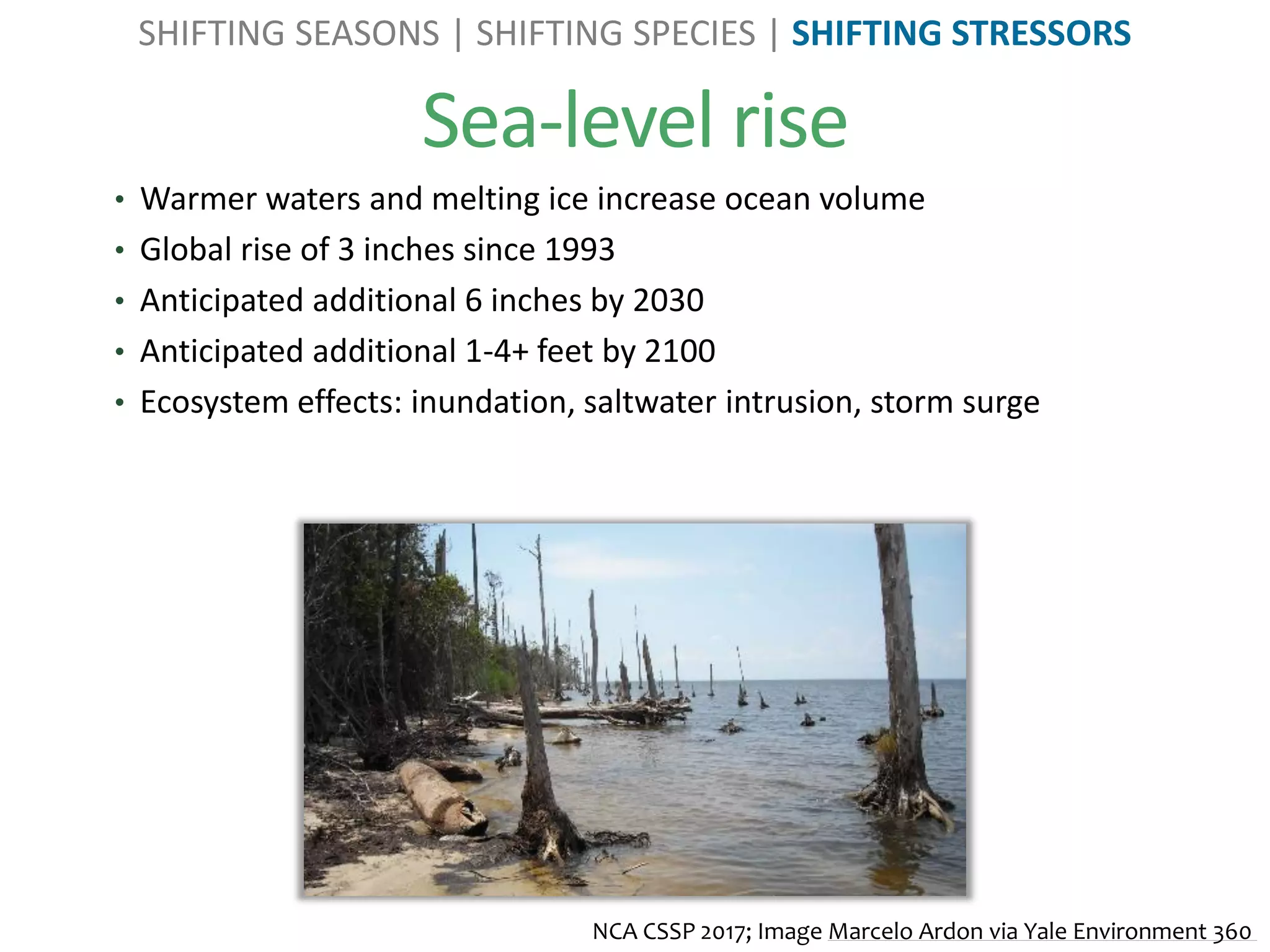
Sea-level rise
• Warmer waters and melting ice increase ocean volume
• Global rise of 3 inches since 1993
• Anticipated additional 6 inches by 2030
• Anticipated additional 1-4+ feet by 2100
• Ecosystem effects: inundation, saltwater intrusion, storm surge
NCA CSSP 2017; Image Marcelo Ardon via Yale Environment 360
SHIFTING SEASONS | SHIFTING SPECIES | SHIFTING STRESSORS
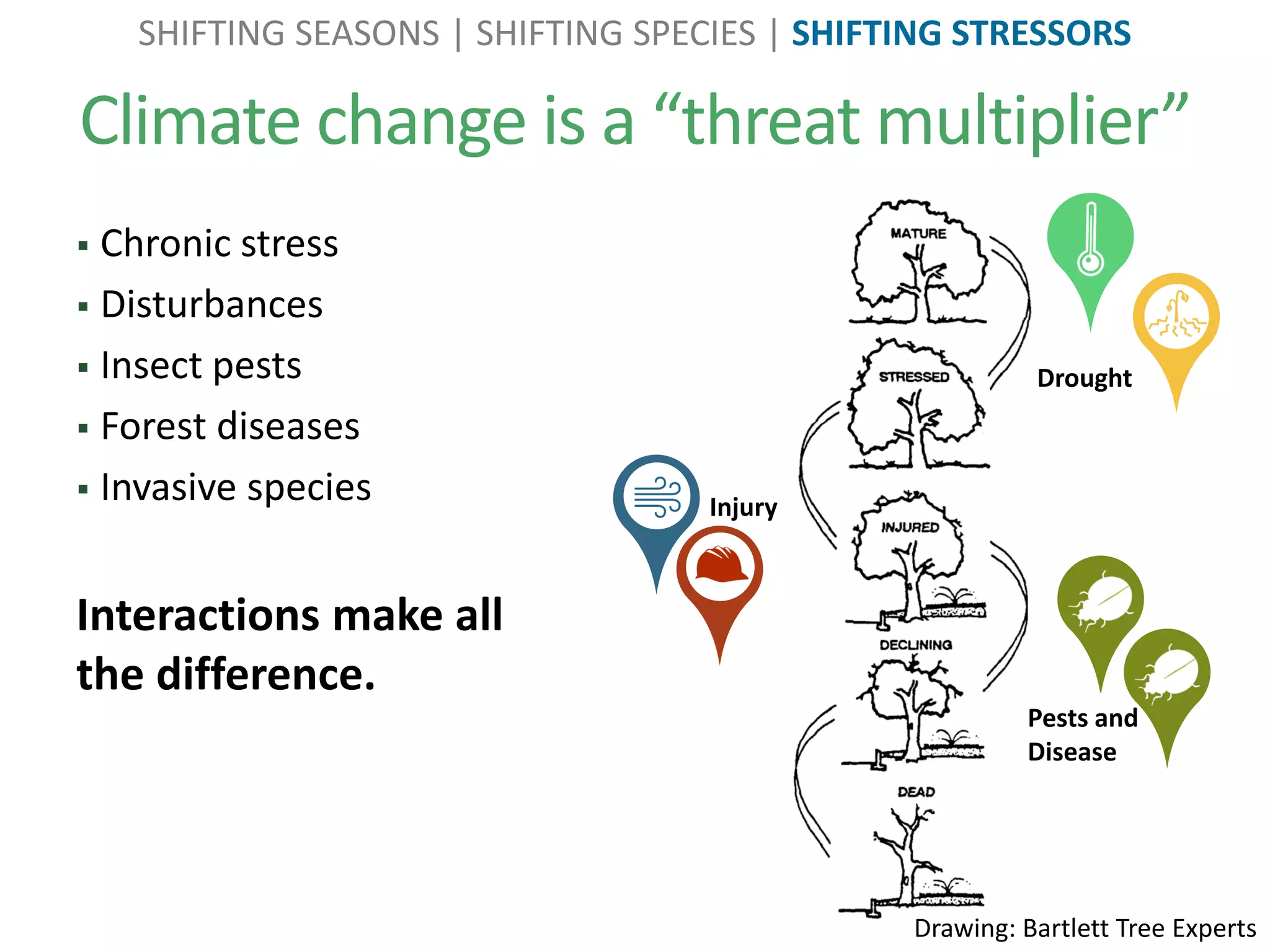
Climate change is a “threat multiplier”
SHIFTING SEASONS | SHIFTING SPECIES | SHIFTING STRESSORS
 Chronic stress
 Disturbances
 Insect pests
 Forest diseases
 Invasive species
Interactions make all
the difference.
Drought
Injury
Pests and
Disease
Drawing: Bartlett Tree Experts
Responding to Change
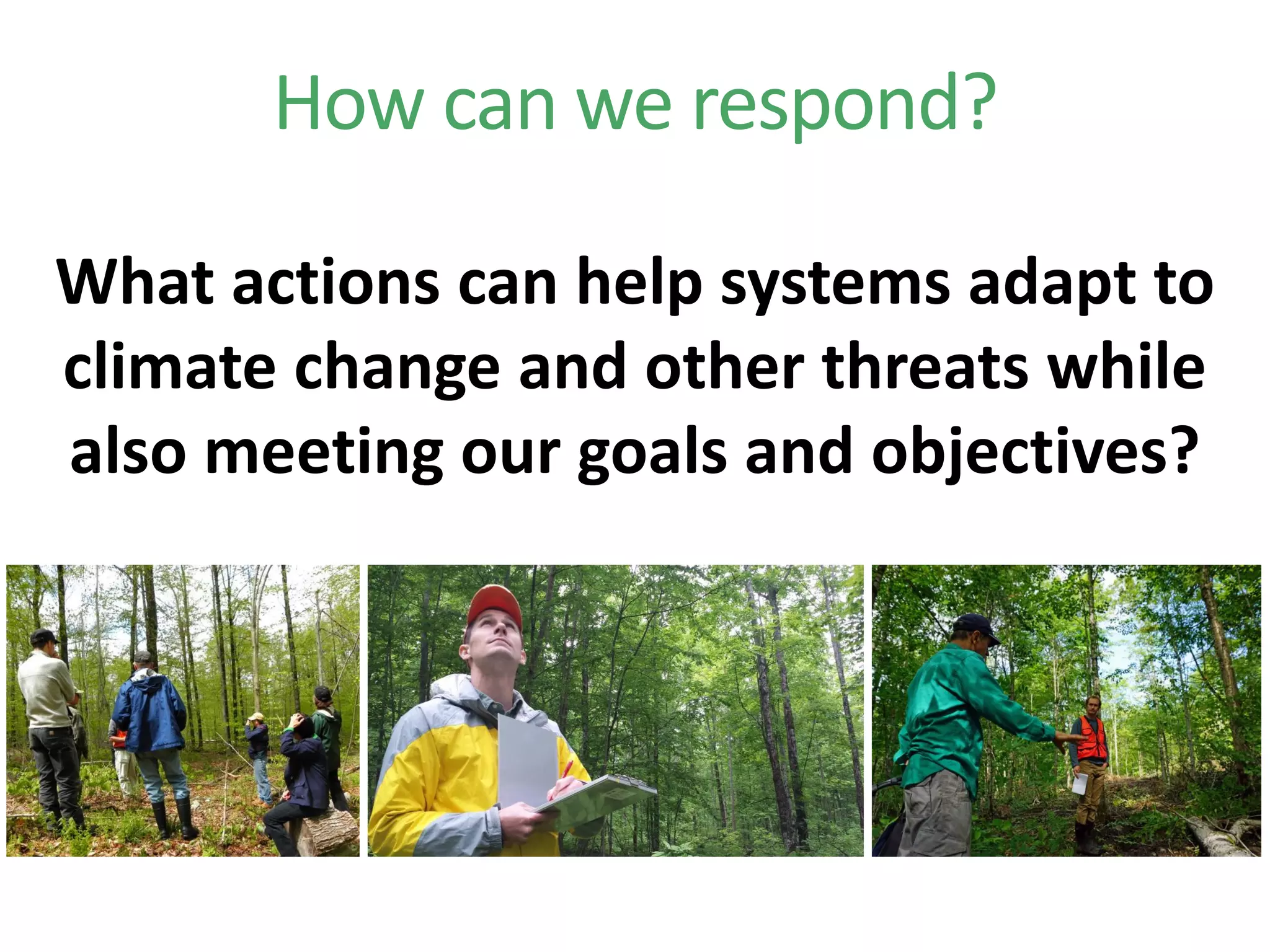
How can we respond?
What actions can help systems adapt to
climate change and other threats while
also meeting our goals and objectives?
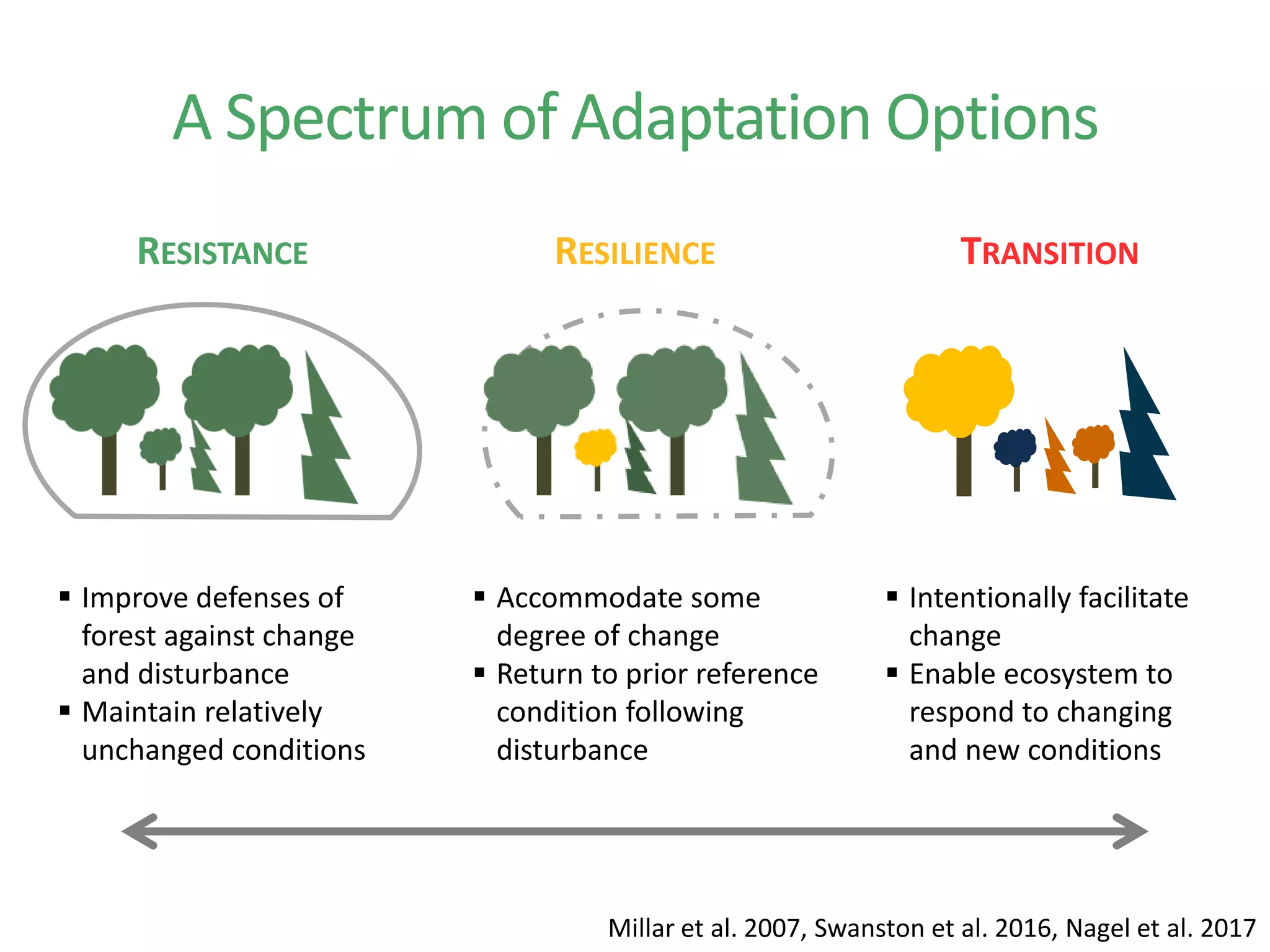
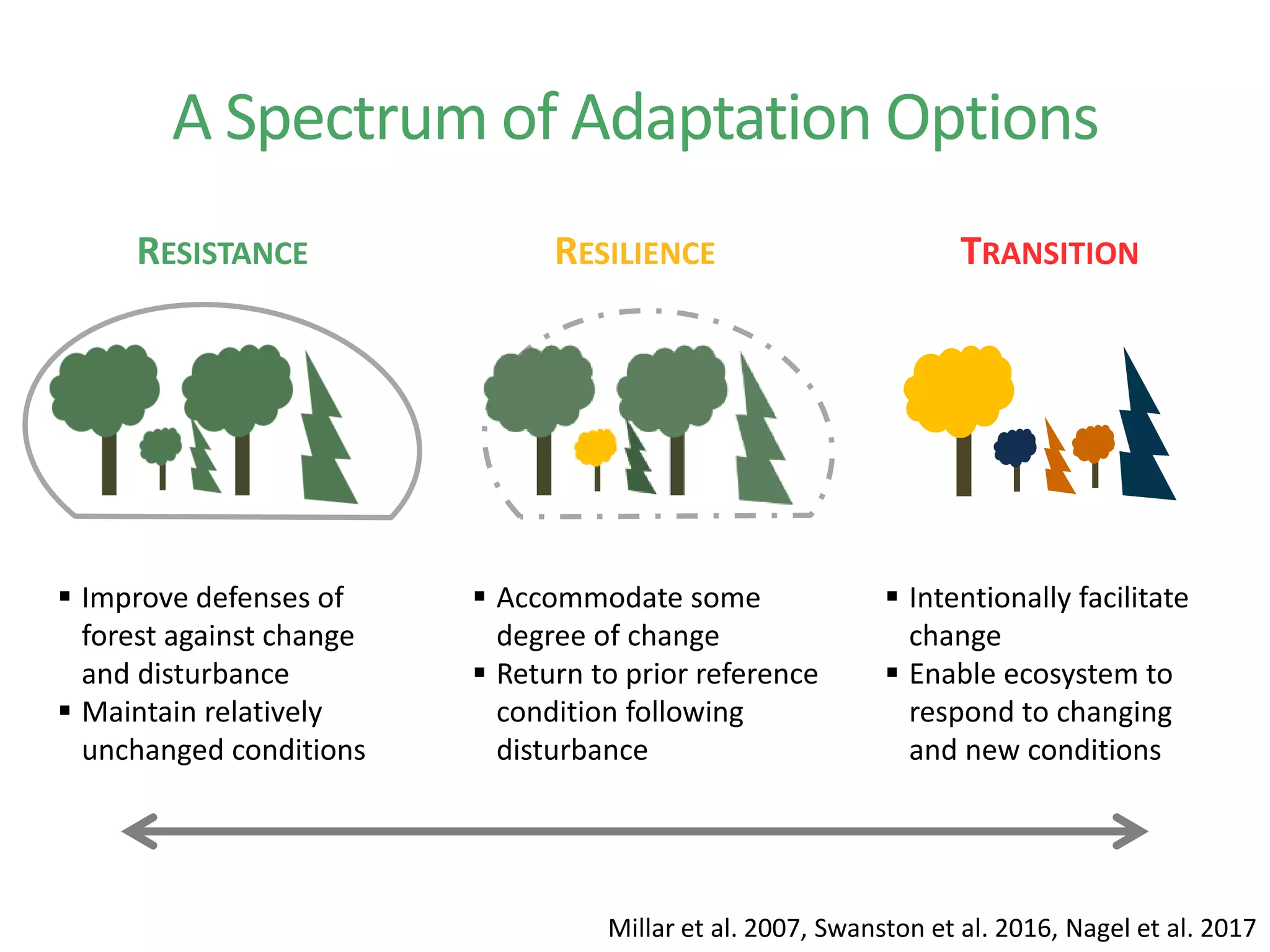
RESISTANCE RESILIENCE TRANSITION
 Improve defenses of
forest against change
and disturbance
 Maintain relatively
unchanged conditions
 Accommodate some
degree of change
 Return to prior reference
condition following
disturbance
 Intentionally facilitate
change
 Enable ecosystem to
respond to changing
and new conditions
Millar et al. 2007
A Spectrum of Adaptation Options
Millar et al. 2007, Swanston et al. 2016, Nagel et al. 2017
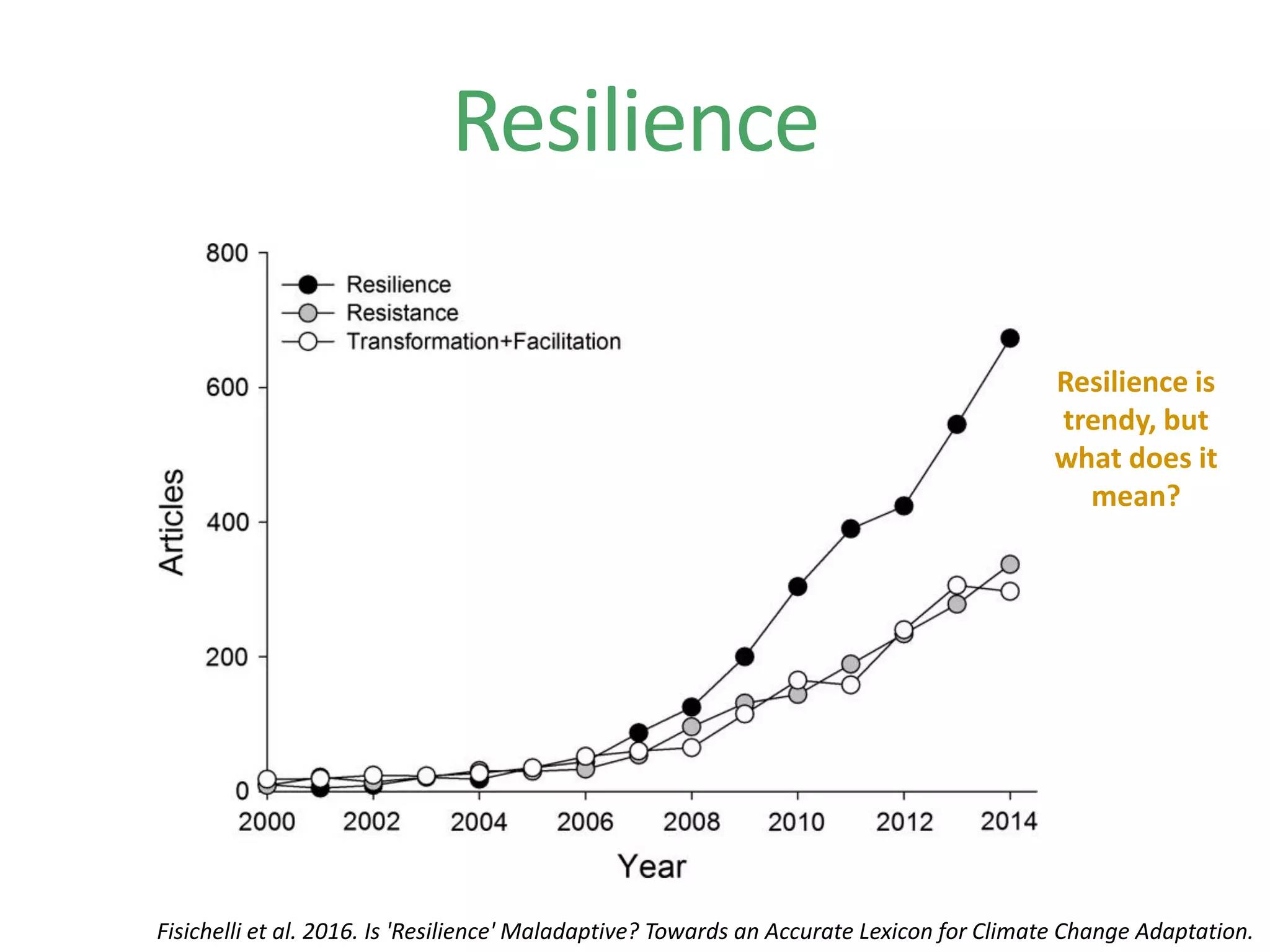
Resilience
Resilience is
trendy, but
what does it
mean?
Fisichelli et al. 2016. Is 'Resilience' Maladaptive? Towards an Accurate Lexicon for Climate Change Adaptation.
Resilience
Resilience has a definition!
“The ability of a system to maintain or return to a particular
ecological state following a disturbance”
- e.g., Holling 1973, Griffith et al. 2009
“The ability of a system and its component parts to anticipate,
absorb, accommodate, or recover from the effects of a hazardous
event in a timely and efficient manner, including through ensuring
the preservation, restoration, or improvement of its essential basic
structures and functions.”
- Intergovernmental Panel on Climate Change (IPCC)
Resilience
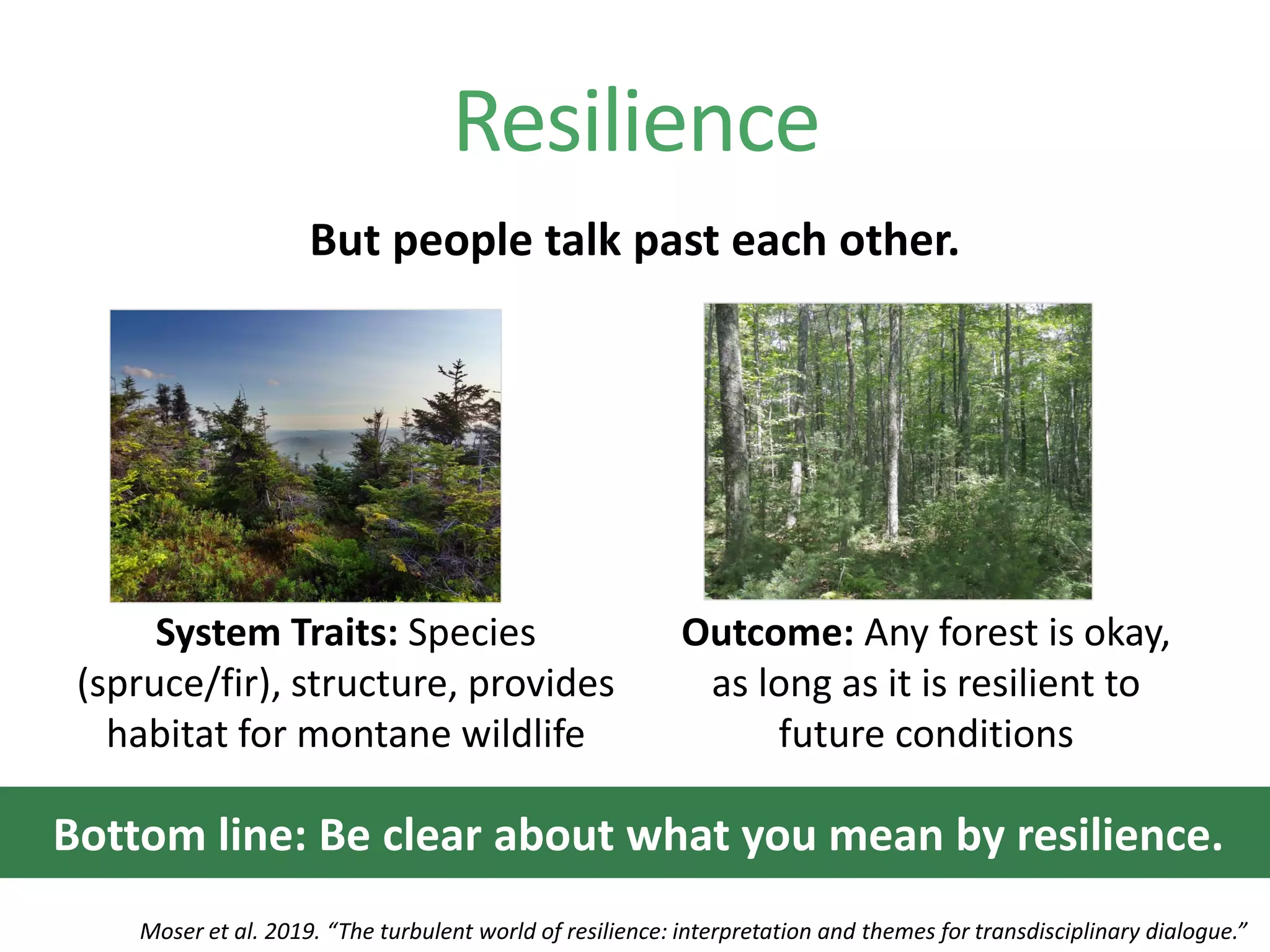
But people talk past each other.
Resilience
System Traits: Species
(spruce/fir), structure, provides
habitat for montane wildlife
Outcome: Any forest is okay,
as long as it is resilient to
future conditions
Moser et al. 2019. “The turbulent world of resilience: interpretation and themes for transdisciplinary dialogue.”
Bottom line: Be clear about what you mean by resilience.
RESISTANCE RESILIENCE TRANSITION
 Improve defenses of
forest against change
and disturbance
 Maintain relatively
unchanged conditions
 Accommodate some
degree of change
 Return to prior reference
condition following
disturbance
 Intentionally facilitate
change
 Enable ecosystem to
respond to changing
and new conditions
Millar et al. 2007
A Spectrum of Adaptation Options
Millar et al. 2007, Swanston et al. 2016, Nagel et al. 2017
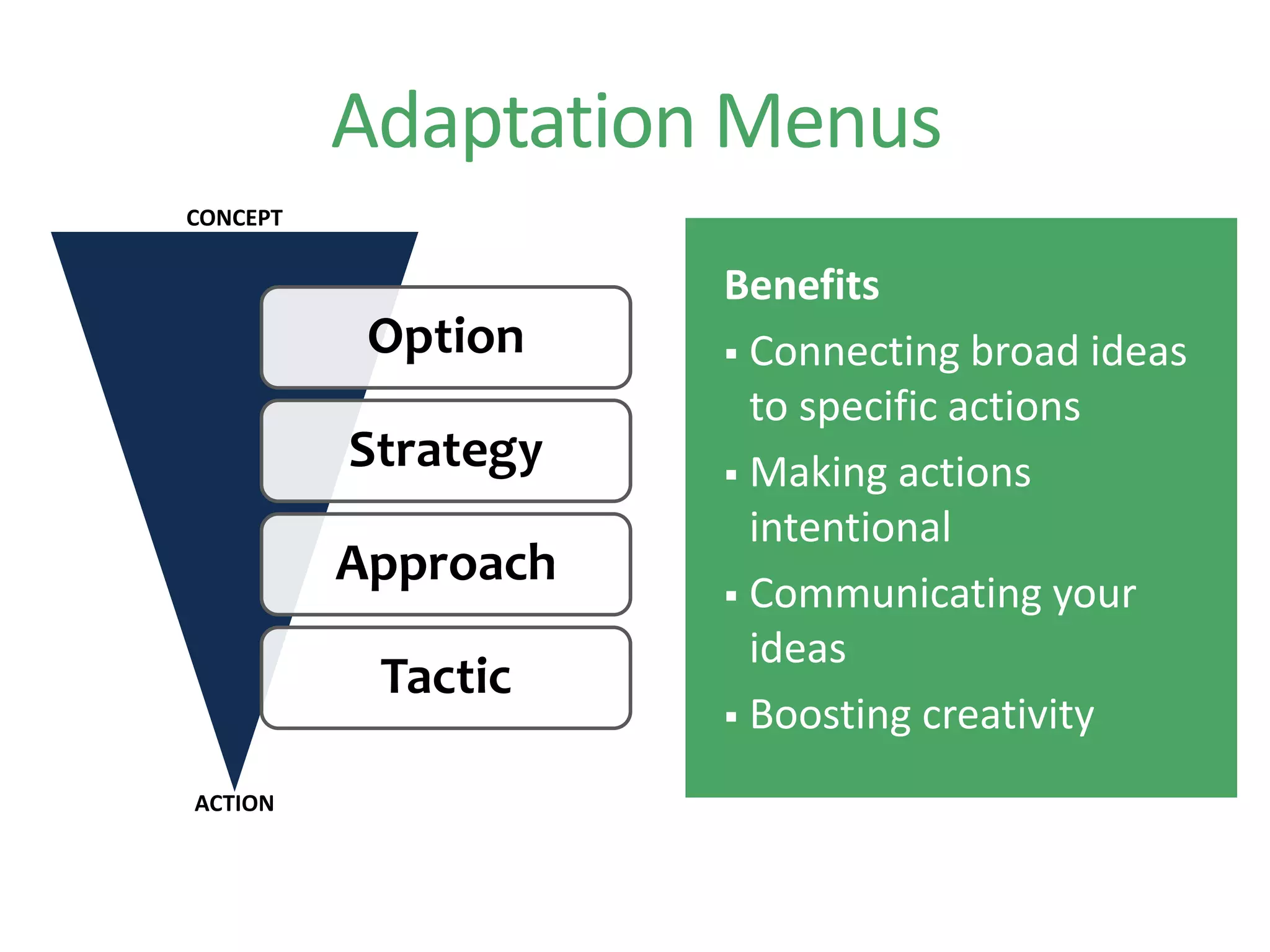
Adaptation Menus
Benefits
 Connecting broad ideas
to specific actions
 Making actions
intentional
 Communicating your
ideas
 Boosting creativity
Option
Strategy
Approach
Tactic
CONCEPT
ACTION
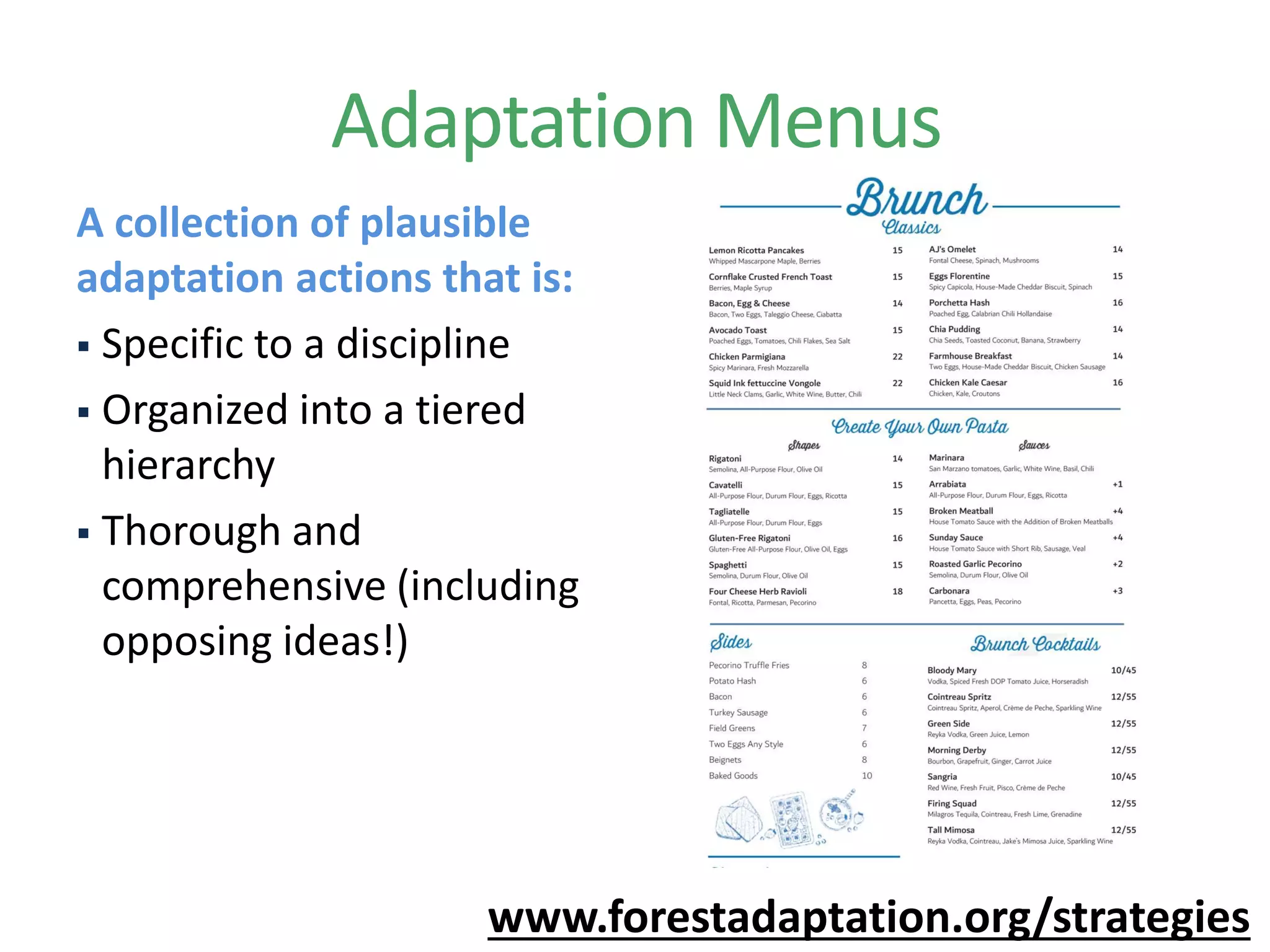
Adaptation Menus
A collection of plausible
adaptation actions that is:
 Specific to a discipline
 Organized into a tiered
hierarchy
 Thorough and
comprehensive (including
opposing ideas!)
www.forestadaptation.org/strategies
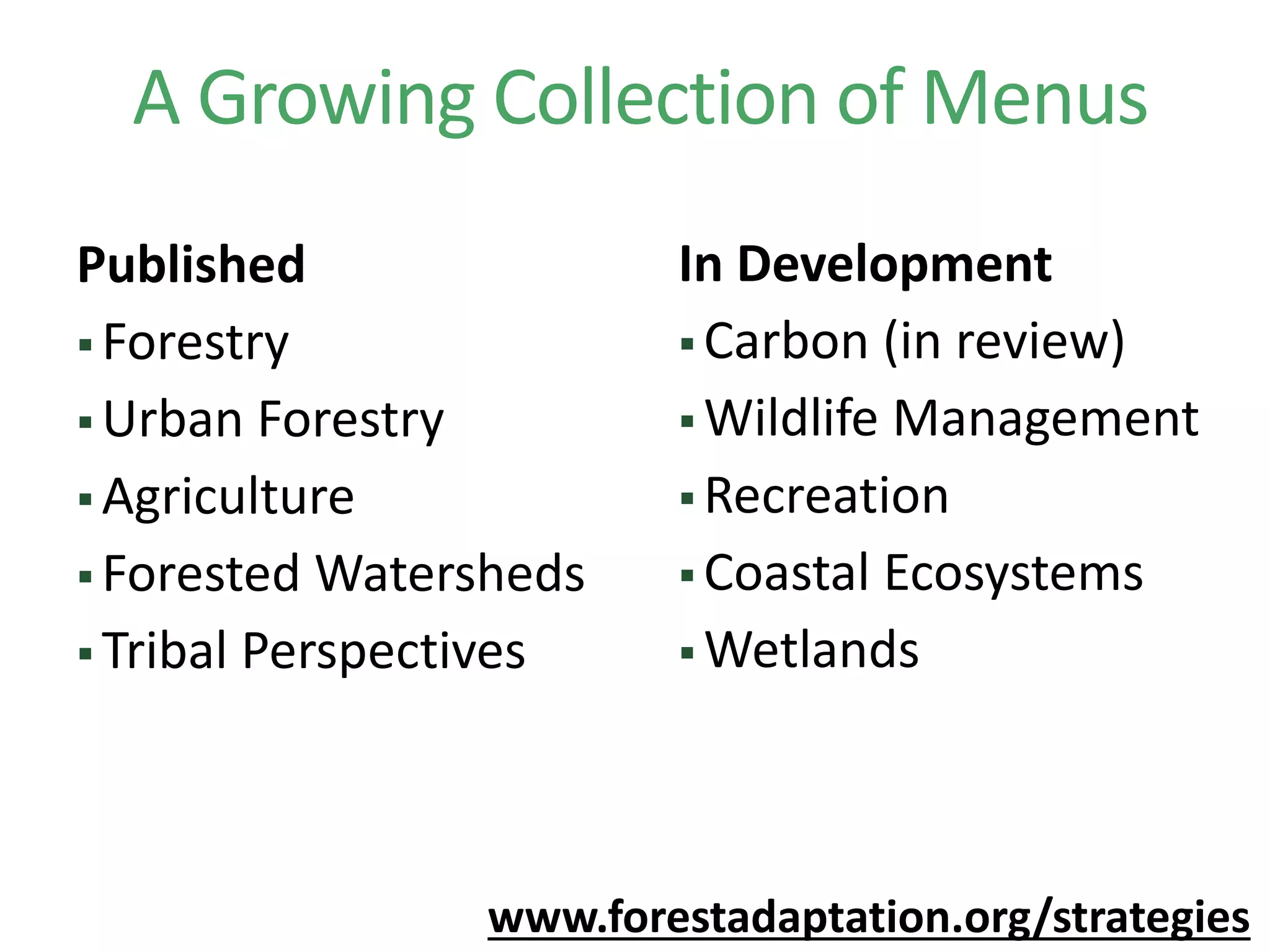
A Growing Collection of Menus
Published
 Forestry
 Urban Forestry
 Agriculture
 Forested Watersheds
 Tribal Perspectives
www.forestadaptation.org/strategies
In Development
 Carbon (in review)
 Wildlife Management
 Recreation
 Coastal Ecosystems
 Wetlands
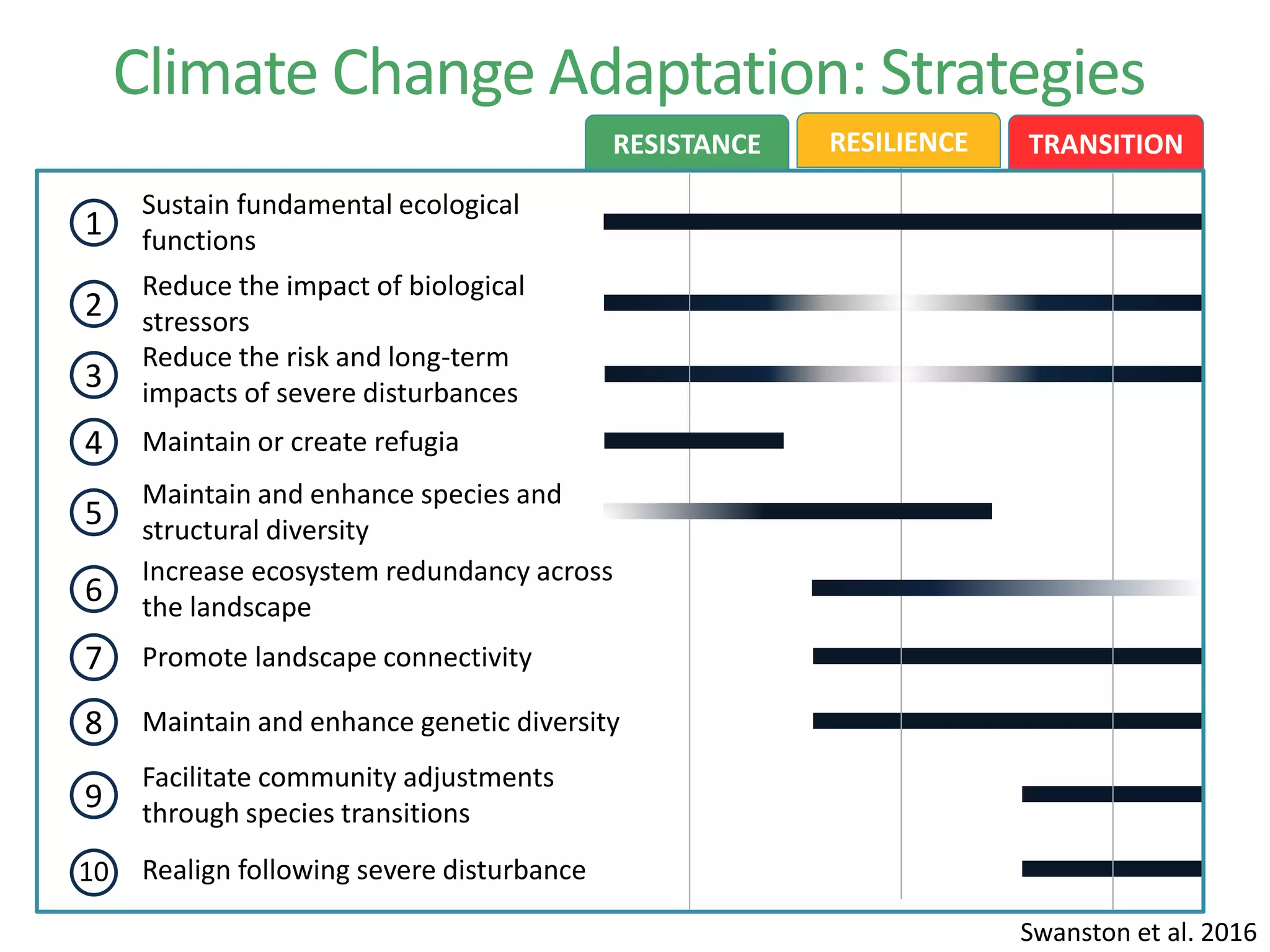
Climate Change Adaptation: Strategies
TRANSITIONRESILIENCERESISTANCE
10
Sustain fundamental ecological
functions
1
Reduce the impact of biological
stressors
2
4 Maintain or create refugia
5
Maintain and enhance species and
structural diversity
Reduce the risk and long-term
impacts of severe disturbances
3
6
Increase ecosystem redundancy across
the landscape
Realign following severe disturbance
7 Promote landscape connectivity
8 Maintain and enhance genetic diversity
Facilitate community adjustments
through species transitions
9
Swanston et al. 2016
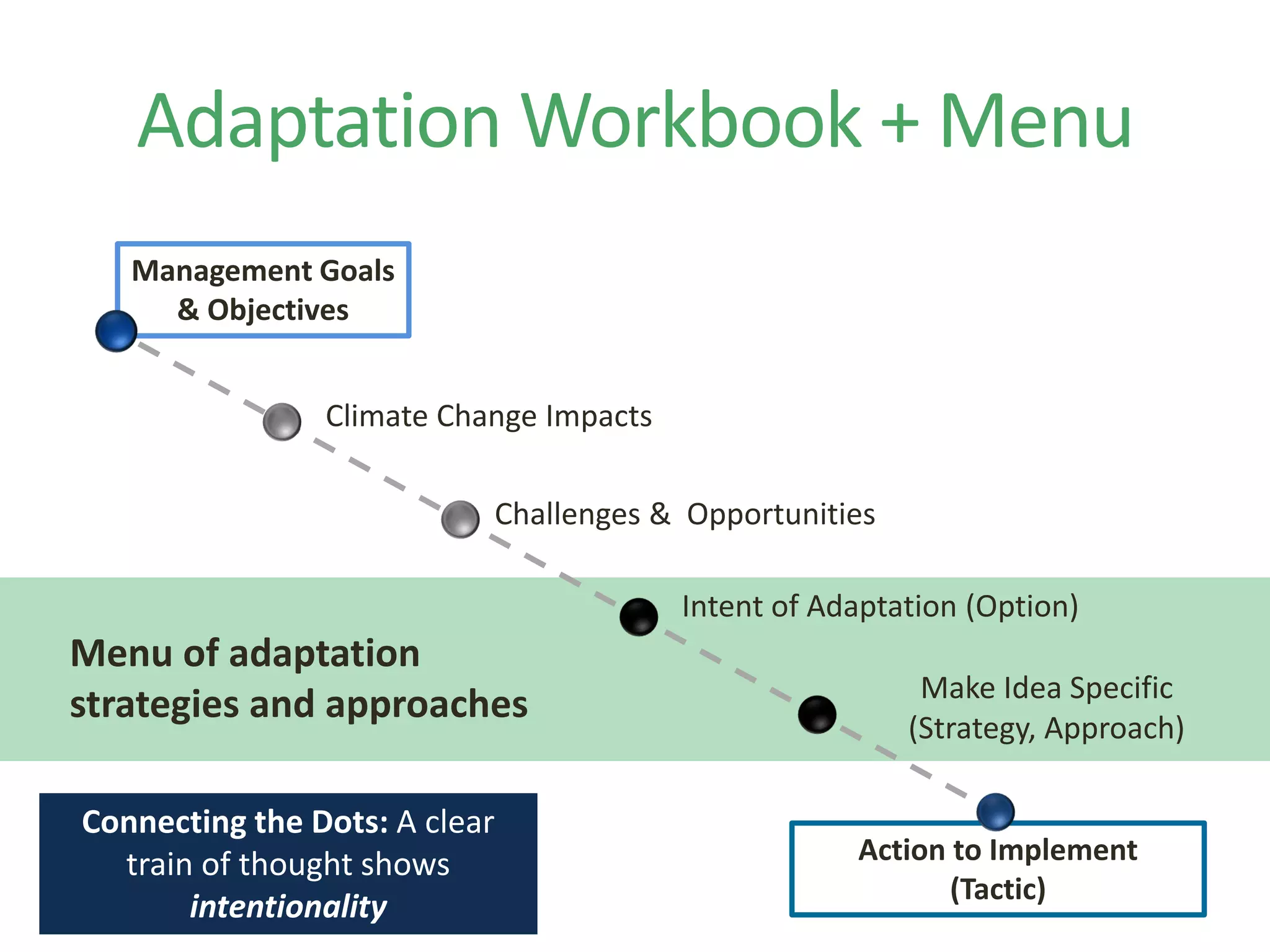
Adaptation Workbook + Menu
Management Goals
& Objectives
Climate Change Impacts
Intent of Adaptation (Option)
Make Idea Specific
(Strategy, Approach)
Action to Implement
(Tactic)
Challenges & Opportunities
Menu of adaptation
strategies and approaches
Connecting the Dots: A clear
train of thought shows
intentionality
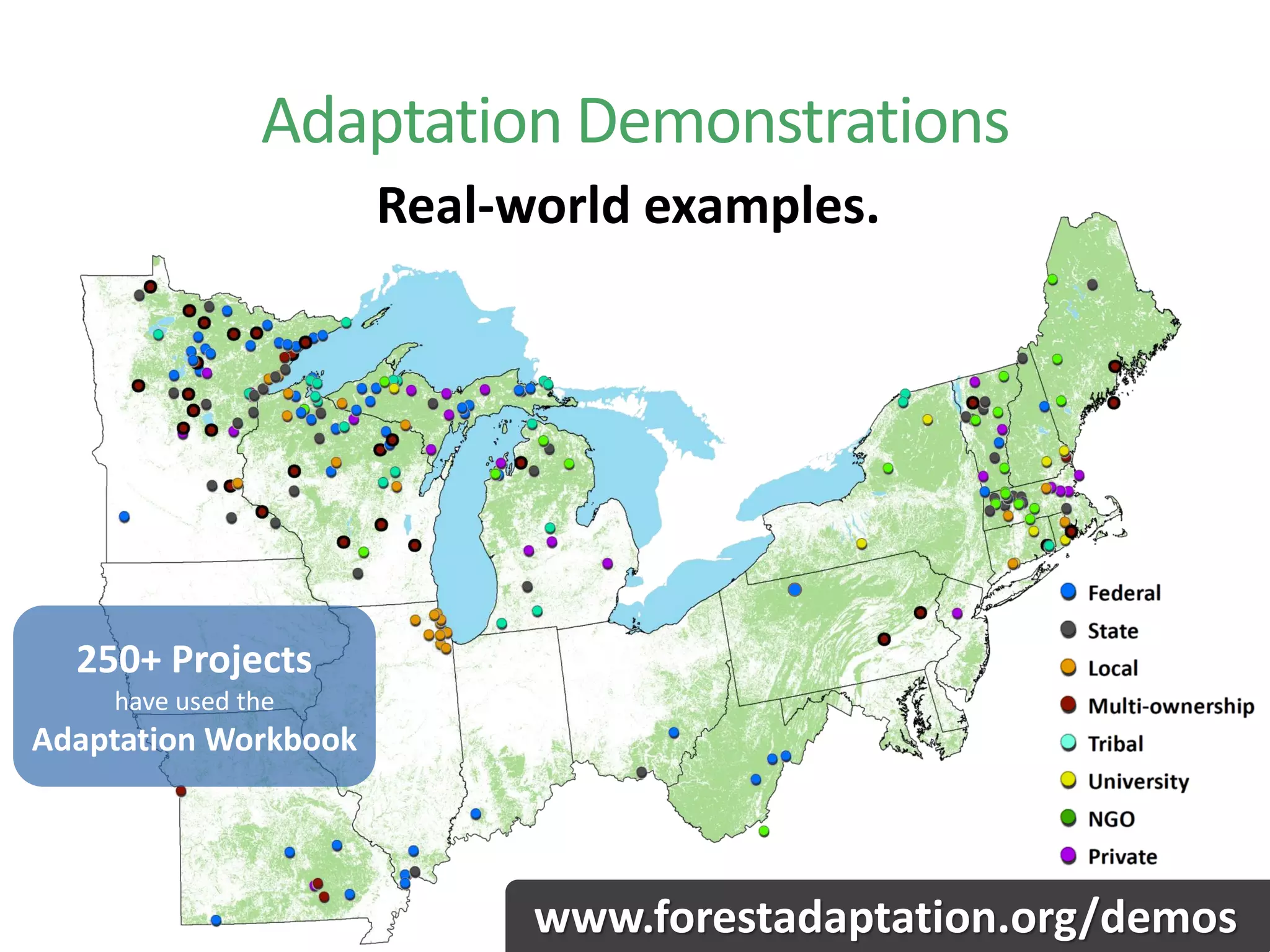
Adaptation Demonstrations
www.forestadaptation.org/demos
250+ Projects
have used the
Adaptation Workbook
Real-world examples.
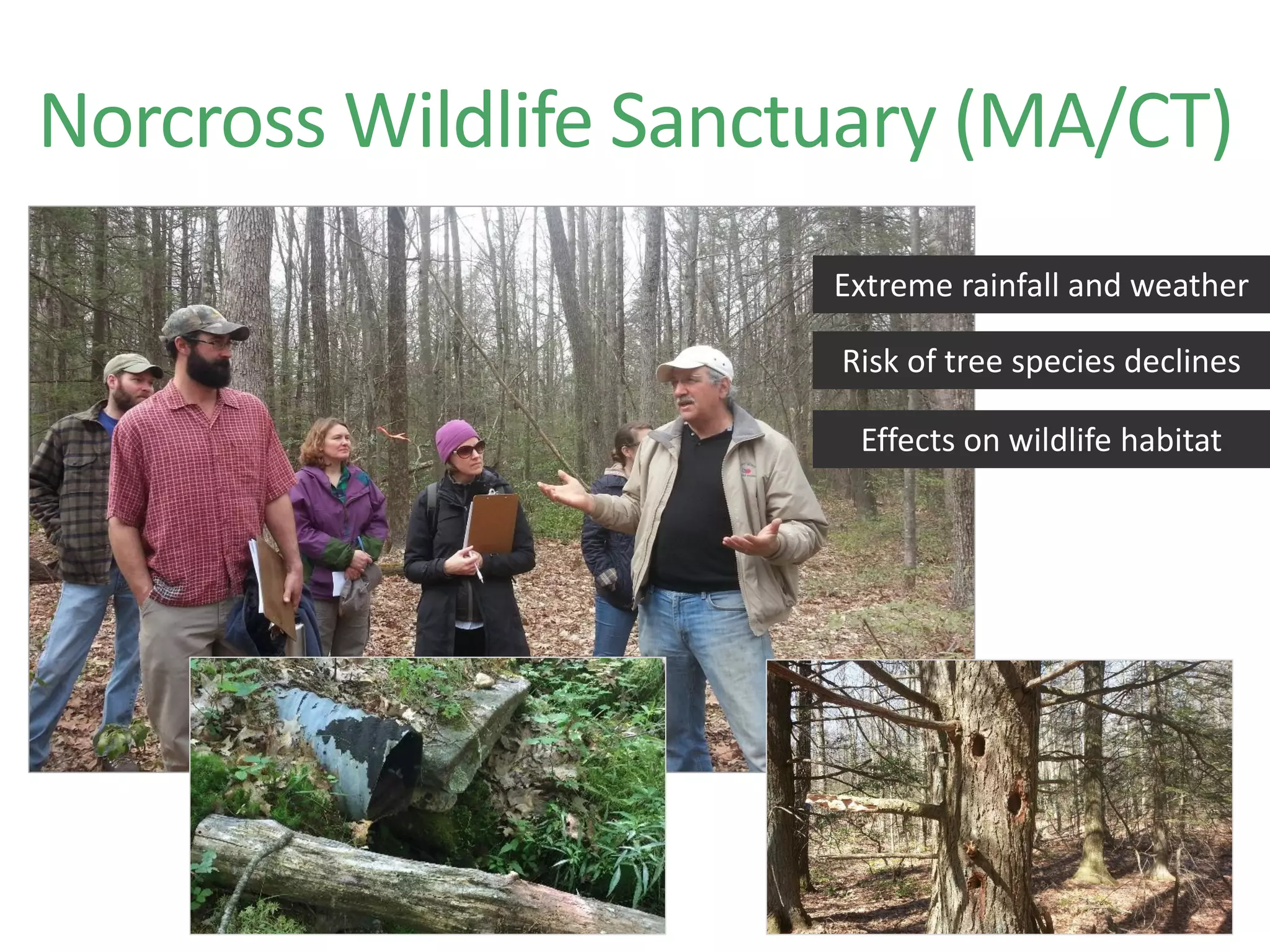
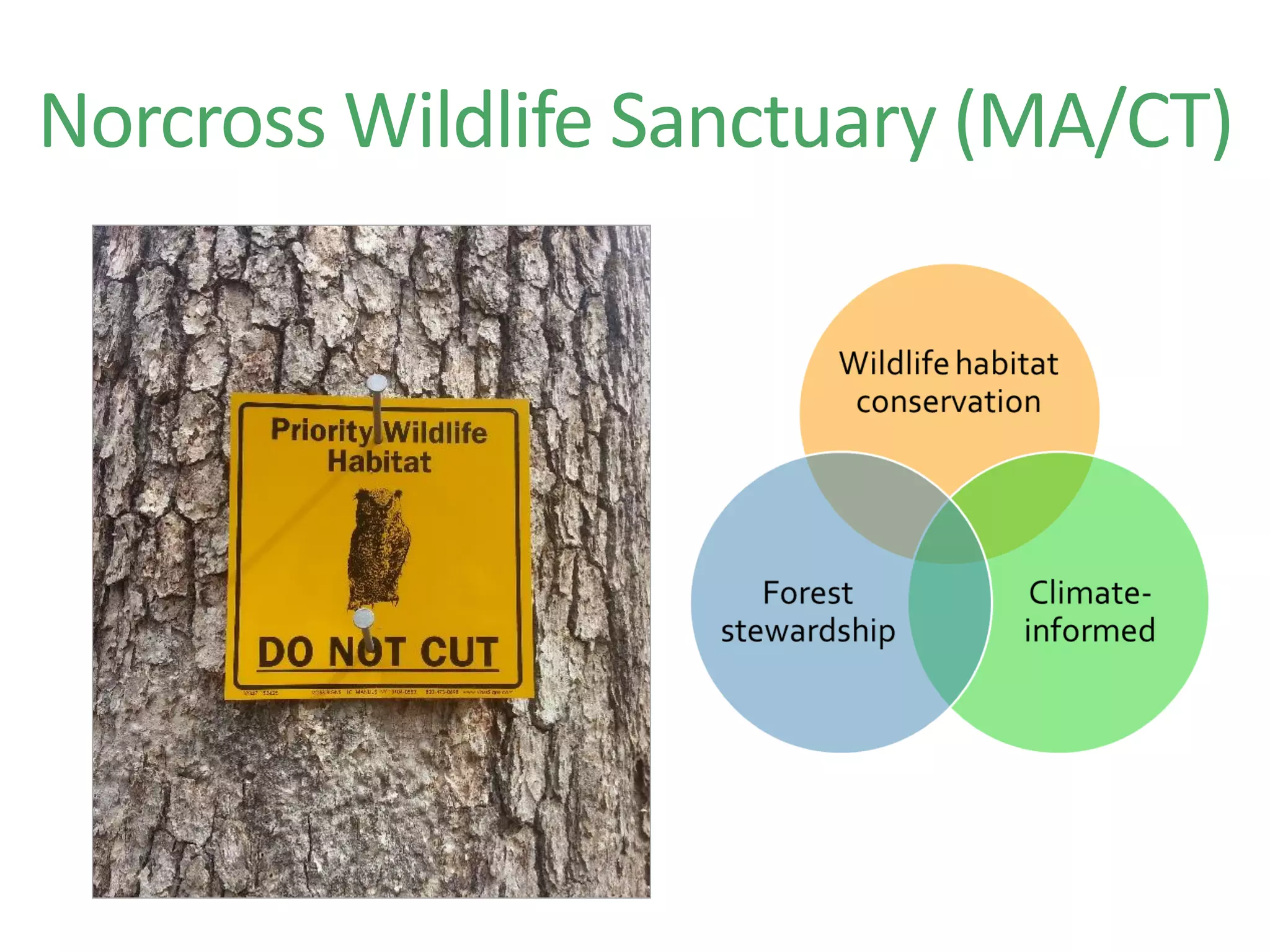
Norcross Wildlife Sanctuary (MA/CT)
Risk of tree species declines
Extreme rainfall and weather
Effects on wildlife habitat
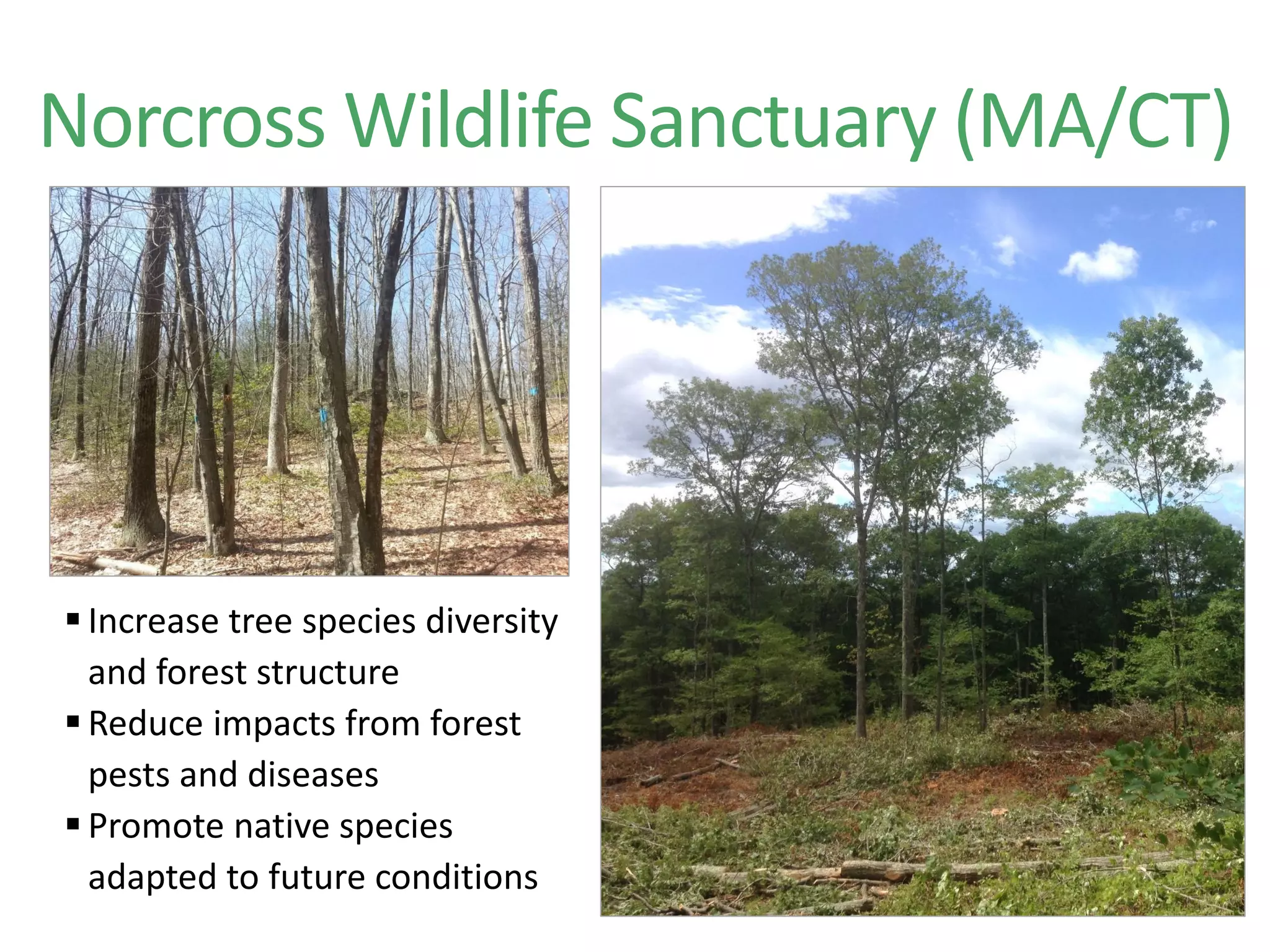
Norcross Wildlife Sanctuary (MA/CT)
 Increase tree species diversity
and forest structure
 Reduce impacts from forest
pests and diseases
 Promote native species
adapted to future conditions
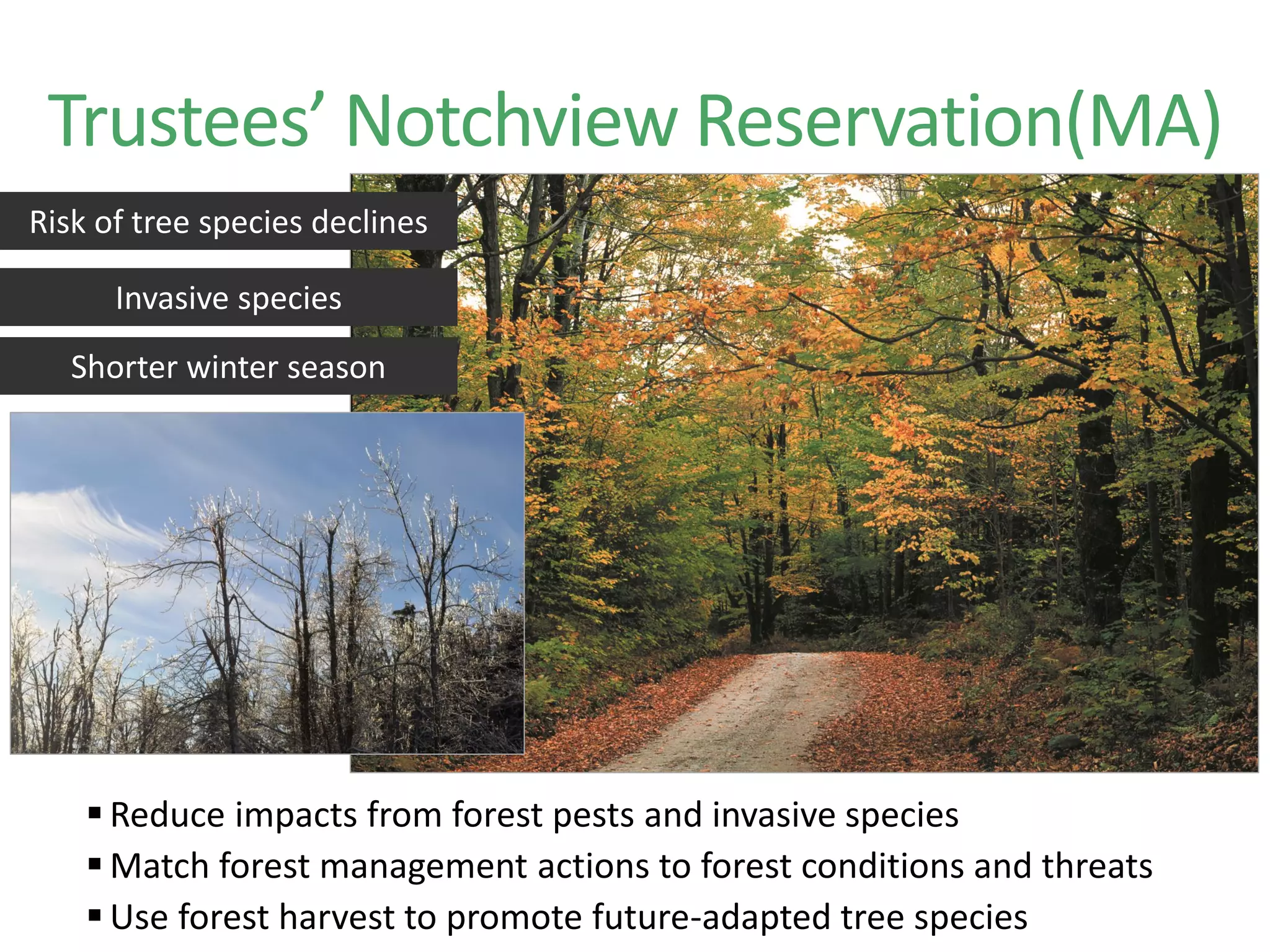
Norcross Wildlife Sanctuary (MA/CT)
 Reduce impacts from forest pests and invasive species
 Match forest management actions to forest conditions and threats
 Use forest harvest to promote future-adapted tree species
Trustees’ Notchview Reservation(MA)
Risk of tree species declines
Invasive species
Shorter winter season
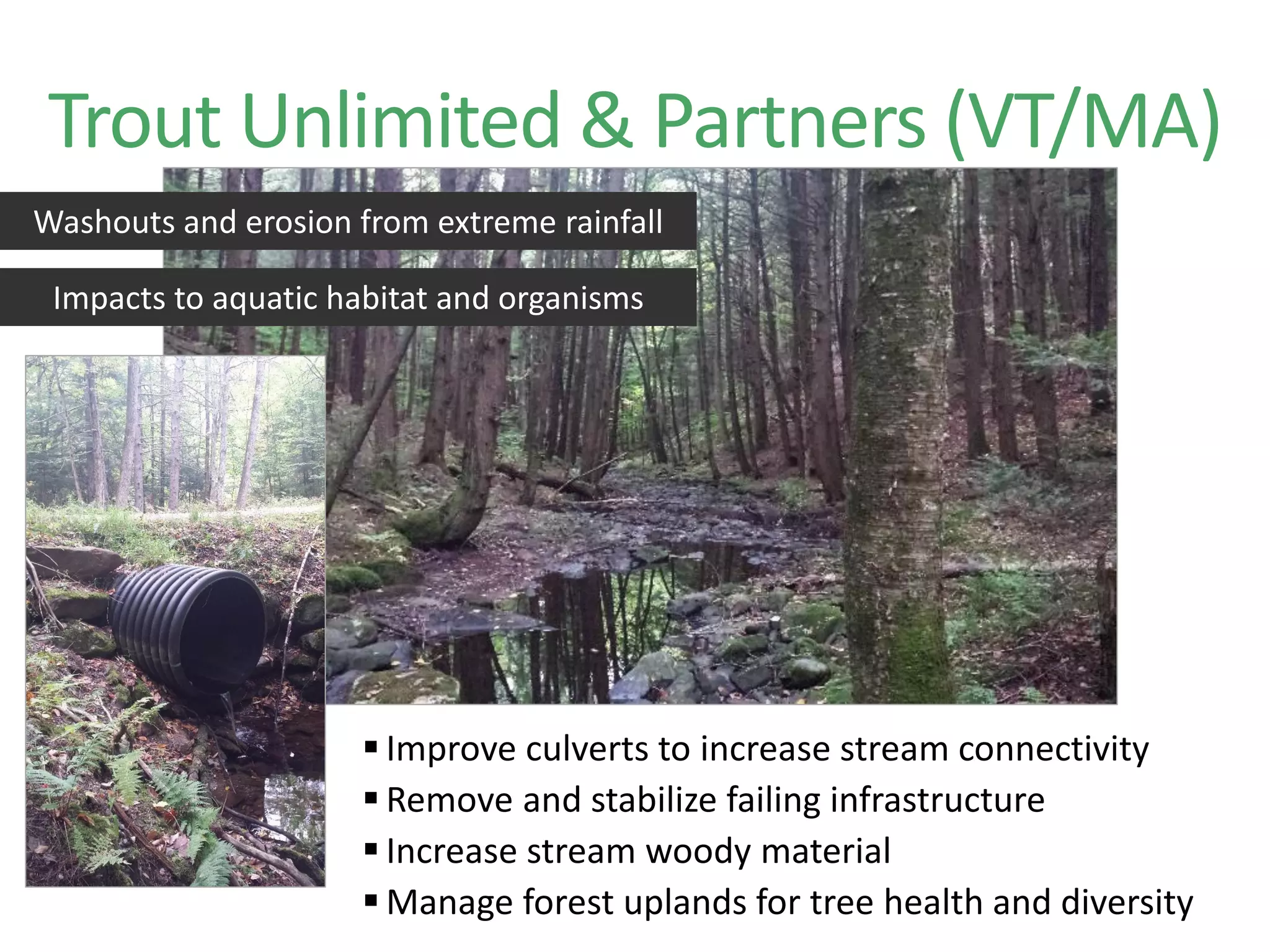
 Improve culverts to increase stream connectivity
 Remove and stabilize failing infrastructure
 Increase stream woody material
 Manage forest uplands for tree health and diversity
Trout Unlimited & Partners (VT/MA)
Washouts and erosion from extreme rainfall
Impacts to aquatic habitat and organisms
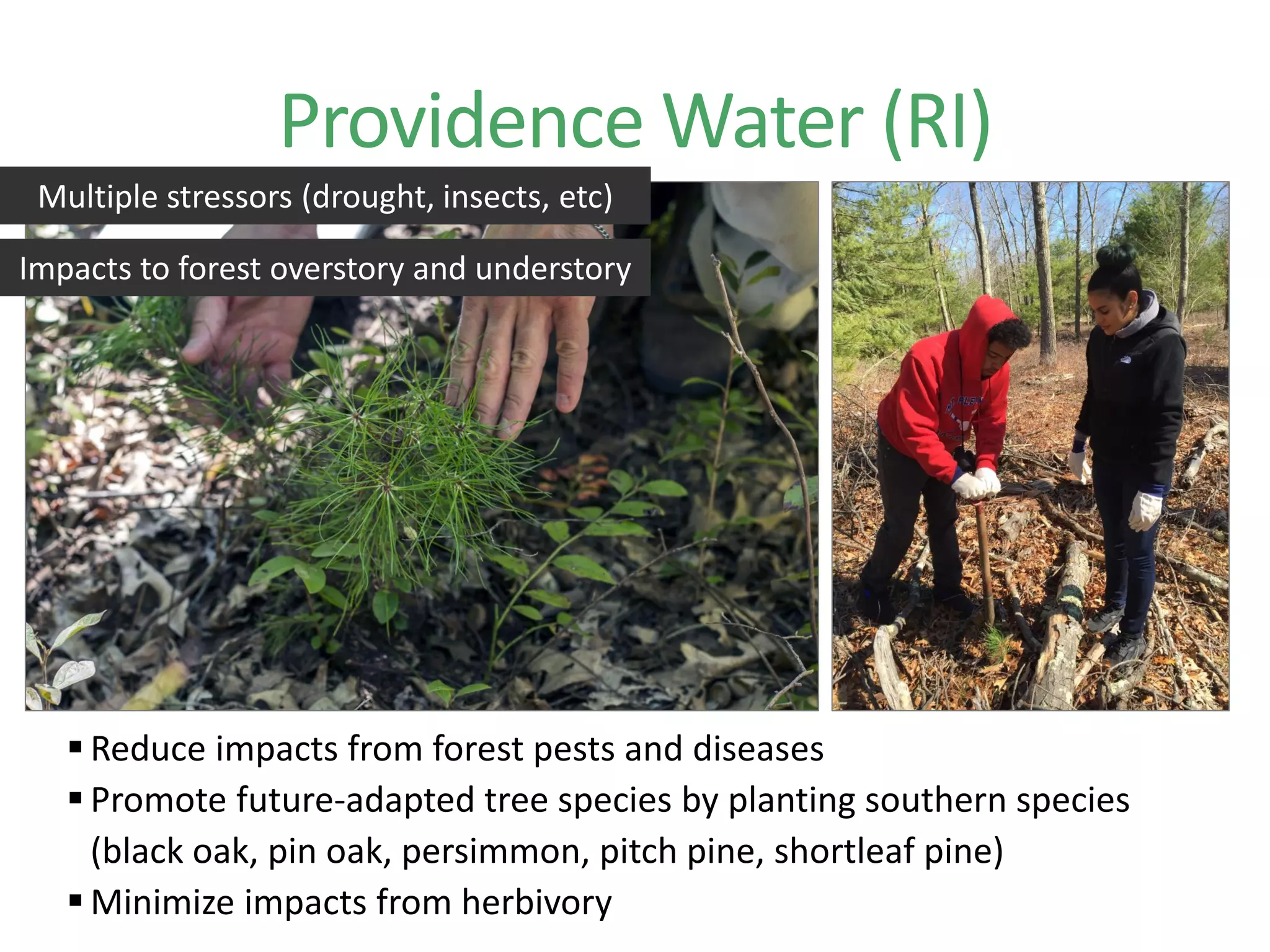
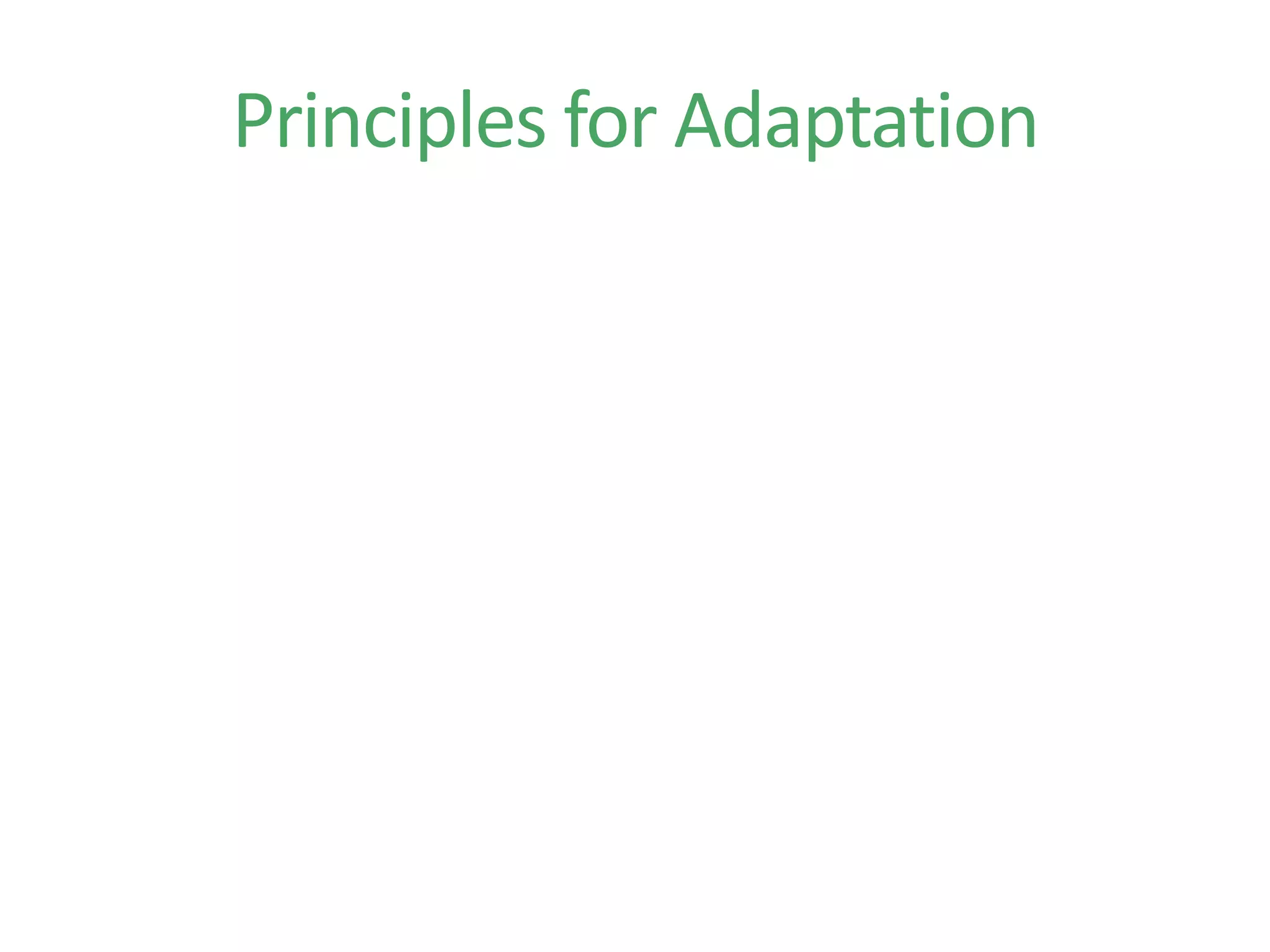
Multiple stressors (drought, insects, etc)
Impacts to forest overstory and understory
 Reduce impacts from forest pests and diseases
 Promote future-adapted tree species by planting southern species
(black oak, pin oak, persimmon, pitch pine, shortleaf pine)
 Minimize impacts from herbivory
Providence Water (RI)
Principles for Adaptation
 Prioritization and triage – direct actions based on vulnerability
and anticipated effectiveness
 Flexible and adaptive management – stay flexible, and
improve over time
 “No regrets” decisions – emphasize win-win actions, especially
in the short-term
 Precautionary actions – take action to reduce risk in the most
vulnerable systems
 Variability and uncertainty – design actions to accommodate a
greater variety of future conditions
 Integrating mitigation – use complimentary actions to ensure
forest can sequester carbon
Swanston et al. 2012
What’s at risk?  Implications of climate change on forests and options for adaptation

What’s at risk? Implications of climate change on forests and options for adaptation

  • 1.
    What’s at risk? Implicationsof climate change on forests and options for adaptation Maria Janowiak maria.janowiak@usda.gov Northern Institute of Applied Climate Science USDA Forest Service Climate Change Response Framework www.forestadaptation.org
  • 2.
    Climate and carbonservices • Climate impacts modeling • Vulnerability assessment • Climate adaptation • Carbon biogeochemistry • Carbon management 21 staff members (Forest Service/universities) • 10 climate outreach specialists • 7 research scientists • 2 web specialists • 2 GIS/lab specialists Northern Institute of Applied Climate Science Chartered by USDA Forest Service, universities, non-profit, and tribal conservation organizations (aka NIACS)
  • 3.
    Climate Change Adaptation Whatactions can help systems adapt to climate change and other threats while also meeting our goals and objectives?
  • 4.
    Climate Change ResponseFramework www.forestadaptation.org
  • 5.
    Climate Change ResourceCenter www.fs.usda.gov/ccrc
  • 6.
  • 7.
    Climate Change Adaptation Whatactions can help systems adapt to climate change and other threats while also meeting our goals and objectives?
  • 8.
    If you wanta single “answer” for how to respond to climate change, it’s “It depends” It depends on where you are working and what you’re trying to achieve.
  • 9.
    Adaptation Resources Address diverseneeds with menu and workbook  Supports diverse goals and objectives  Tailored to eastern forest types  Menu of adaptation strategies and approaches for forest ecosystems  Does not make recommendations Swanston et al. 2016 (2nd edition); www.treesearch.fs.fed.us/pubs/52760
  • 10.
    Climate Change Adaptation 1.DEFINE project area and management goals. 2. ASSESS climate change impacts and vulnerabilities. 3. EVALUATE challenges and opportunities. 4. IDENTIFY adaptation actions for implementation. 5. MONITOR whether actions were effective. Swanston and Janowiak 2012, Swanston et al. 2016; www.adaptationworkbook.org
  • 11.
    NWF Climate-Smart Conservation Cycle(2014) Adaptation for Conservation Targets (2012) USFS Adaptation Workbook (2012, 2016) 1. DEFINE project area and management goals. 2. ASSESS climate change impacts and vulnerabilities. 3. EVALUATE challenges and opportunities. 4. IDENTIFY adaptation actions for implementation. 5. MONITOR whether actions were effective. Climate Change Adaptation
  • 12.
    What’s important toyou?  There is not a one-size-fits-all solution to climate change.  Actions depend on your management goals and objectives.
  • 13.
    How will climatechange affect your land? What’s at risk where YOU work? What management challenges and opportunities might arise? I’lltalkabout… Youthinkabout…
  • 14.
    Effects on Forests SHIFTINGSPECIESSHIFTING SEASONS SHIFTING STRESSORS
  • 15.
    Longer Growing Season SHIFTINGSEASONS | SHIFTING SPECIES | SHIFTING STRESSORS
  • 16.
    Warmer temps resultin longer growing seasons  Evidence of shifts  Projected to increase 3-7+ more weeks Longer period for plant growth  Enhanced plant growth  Phenological mismatches—? Melillo et al. 2014, Parmesan and Yohe 2003, Image: NCA 2014 SHIFTING SEASONS | SHIFTING SPECIES | SHIFTING STRESSORS Longer Growing Season
  • 17.
    Shorter, Warmer Winters Projecteddecreases in snow fall, cover, and depth  Up to 70% decreases in snowfall Decreased snowpack  Increased soil freeze-thaw cycles can damage roots and alter soil processes  Reduced winter severity affecting wildlife populations SHIFTING SEASONS | SHIFTING SPECIES | SHIFTING STRESSORS
  • 18.
    Altered Precipitation &Hydrology  Trends and projections vary by region.  More extreme rain everywhere. SHIFTING SEASONS | SHIFTING SPECIES | SHIFTING STRESSORS NOAA NCEI/NCA 2017
  • 19.
    Extreme Weather SHIFTING SEASONS| SHIFTING SPECIES | SHIFTING STRESSORS Extreme events may become more frequent or severe  Heavy precipitation  Ice storms  Heat waves/droughts  Wind storms  Hurricanes  “Events” are not well modeled Ciais 2005, Mills 2005, WMO 2007, IPCC 2007, NCA, 2017, Coumou and Rahmstorf 2012; Image: American Forest Foundation
  • 20.
    SHIFTING SEASONS |SHIFTING SPECIES | SHIFTING STRESSORS
  • 21.
    Species Range Shifts SHIFTINGSEASONS | SHIFTING SPECIES | SHIFTING STRESSORS
  • 22.
    Species Range Shifts SHIFTINGSEASONS | SHIFTING SPECIES | SHIFTING STRESSORS www.fs.fed.us/nrs/atlas/ Northern Red Oak: Suitable Habitat (Climate Change Tree Atlas) Less change More change PCM Low emissions (B1) 2070-2100 HAD High emissions (A1FI) 2070-2100 Importance Value Low High Legend all_spp_current fia_802 1.000000 1.000001 - 4.000000 4.000001 - 6.000000 6.000001 - 9.000000 9.000001 - 11.000000 11.000001 - 14.000000 14.000001 - 23.000000 Current Distribution
  • 23.
    Species Range Shifts SHIFTINGSEASONS | SHIFTING SPECIES | SHIFTING STRESSORS www.fs.fed.us/nrs/atlas/ Loblolly Pine: Suitable Habitat (Climate Change Tree Atlas) Less change More change PCM Low emissions (B1) 2070-2100 HAD High emissions (A1FI) 2070-2100 Importance Value Low High Legend all_spp_current fia_802 1.000000 1.000001 - 4.000000 4.000001 - 6.000000 6.000001 - 9.000000 9.000001 - 11.000000 11.000001 - 14.000000 14.000001 - 23.000000 Current Distribution
  • 24.
    Species Range Shifts SHIFTINGSEASONS | SHIFTING SPECIES | SHIFTING STRESSORS  Range shifts ≠ instant catastrophic dieback  Mature trees should fare better • Developed root system • Greater carbohydrate reserves  Stress factors will increase in severity • Temperature • Moisture • Competition  Increased susceptibility to disturbance Dale et al 2001, Iverson et al 2008
  • 25.
    SHIFTING SEASONS |SHIFTING SPECIES | SHIFTING STRESSORS
  • 26.
    SHIFTING SEASONS |SHIFTING SPECIES | SHIFTING STRESSORS Altered Precipitation & Hydrology  Trends and projections vary by region.  More extreme rain everywhere. NOAA NCEI/NCA 2017
  • 27.
    Drier Conditions andDrought Ciais 2005, Mills 2005, WMO 2007, IPCC 2007, Allen et al. 2010, Coumou and Rahmstorf 2012, McDowell and Allen 2015, Fernandez-de-Una et al. 2016; Image: NCA 2014, USGCRP TSU 2017 SHIFTING SEASONS | SHIFTING SPECIES | SHIFTING STRESSORS Warmer temperatures drive moisture deficits.
  • 28.
    See: McKenzie etal. 2004, Running 2006, Abatzogloua and Williams 2016, Westerling 2016, Abatzogloua et al. 2017, Balch et al. 2017, Schoennagel et al. 2017 Wildfire Frequency and Intensity  Increased fire weather  Past management is a primary driver  Strong interaction with early snowmelt  Observed increases –fuel aridity, fire season, human starts in wildland-urban interface SHIFTING SEASONS | SHIFTING SPECIES | SHIFTING STRESSORS
  • 29.
    Expanded Pest andDisease Ranges Ayres and Lombardero 2000, Woods et al 2005, Parmesan 2006, Soja et al 2006, Parmesan 2006, Dukes et al. 2009, Weed et al. 2013, Sturrock et al. 2011 SHIFTING SEASONS | SHIFTING SPECIES | SHIFTING STRESSORS Indirect: Stress from other impacts increases susceptibility Increased damage from forest insects & diseases Direct:  Pests migrating northward  Decreased probability of cold lethal temperatures  Accelerated lifecycles
  • 30.
    Undesirable species movingnorthward (invasives) Invasive Plants Hellman et al. 2008; Photos: Invasives Plants Atlas of New England (www.eddmaps.org) SHIFTING SEASONS | SHIFTING SPECIES | SHIFTING STRESSORS Indirect:  Stress or disturbance from other impacts can affect the potential for invasion or success Direct:  Expanded ranges under warmer conditions  Increased competitiveness from ability of some plants to take advantage of elevated CO2
  • 31.
    Sea-level rise • Warmerwaters and melting ice increase ocean volume • Global rise of 3 inches since 1993 • Anticipated additional 6 inches by 2030 • Anticipated additional 1-4+ feet by 2100 • Ecosystem effects: inundation, saltwater intrusion, storm surge NCA CSSP 2017; Image Marcelo Ardon via Yale Environment 360 SHIFTING SEASONS | SHIFTING SPECIES | SHIFTING STRESSORS
  • 32.
    Climate change isa “threat multiplier” SHIFTING SEASONS | SHIFTING SPECIES | SHIFTING STRESSORS  Chronic stress  Disturbances  Insect pests  Forest diseases  Invasive species Interactions make all the difference. Drought Injury Pests and Disease Drawing: Bartlett Tree Experts
  • 33.
  • 34.
    How can werespond? What actions can help systems adapt to climate change and other threats while also meeting our goals and objectives?
  • 35.
    RESISTANCE RESILIENCE TRANSITION Improve defenses of forest against change and disturbance  Maintain relatively unchanged conditions  Accommodate some degree of change  Return to prior reference condition following disturbance  Intentionally facilitate change  Enable ecosystem to respond to changing and new conditions Millar et al. 2007 A Spectrum of Adaptation Options Millar et al. 2007, Swanston et al. 2016, Nagel et al. 2017
  • 36.
    Resilience Resilience is trendy, but whatdoes it mean? Fisichelli et al. 2016. Is 'Resilience' Maladaptive? Towards an Accurate Lexicon for Climate Change Adaptation.
  • 37.
    Resilience Resilience has adefinition! “The ability of a system to maintain or return to a particular ecological state following a disturbance” - e.g., Holling 1973, Griffith et al. 2009 “The ability of a system and its component parts to anticipate, absorb, accommodate, or recover from the effects of a hazardous event in a timely and efficient manner, including through ensuring the preservation, restoration, or improvement of its essential basic structures and functions.” - Intergovernmental Panel on Climate Change (IPCC)
  • 38.
  • 39.
    But people talkpast each other. Resilience System Traits: Species (spruce/fir), structure, provides habitat for montane wildlife Outcome: Any forest is okay, as long as it is resilient to future conditions Moser et al. 2019. “The turbulent world of resilience: interpretation and themes for transdisciplinary dialogue.” Bottom line: Be clear about what you mean by resilience.
  • 40.
    RESISTANCE RESILIENCE TRANSITION Improve defenses of forest against change and disturbance  Maintain relatively unchanged conditions  Accommodate some degree of change  Return to prior reference condition following disturbance  Intentionally facilitate change  Enable ecosystem to respond to changing and new conditions Millar et al. 2007 A Spectrum of Adaptation Options Millar et al. 2007, Swanston et al. 2016, Nagel et al. 2017
  • 41.
    Adaptation Menus Benefits  Connectingbroad ideas to specific actions  Making actions intentional  Communicating your ideas  Boosting creativity Option Strategy Approach Tactic CONCEPT ACTION
  • 42.
    Adaptation Menus A collectionof plausible adaptation actions that is:  Specific to a discipline  Organized into a tiered hierarchy  Thorough and comprehensive (including opposing ideas!) www.forestadaptation.org/strategies
  • 43.
    A Growing Collectionof Menus Published  Forestry  Urban Forestry  Agriculture  Forested Watersheds  Tribal Perspectives www.forestadaptation.org/strategies In Development  Carbon (in review)  Wildlife Management  Recreation  Coastal Ecosystems  Wetlands
  • 44.
    Climate Change Adaptation:Strategies TRANSITIONRESILIENCERESISTANCE 10 Sustain fundamental ecological functions 1 Reduce the impact of biological stressors 2 4 Maintain or create refugia 5 Maintain and enhance species and structural diversity Reduce the risk and long-term impacts of severe disturbances 3 6 Increase ecosystem redundancy across the landscape Realign following severe disturbance 7 Promote landscape connectivity 8 Maintain and enhance genetic diversity Facilitate community adjustments through species transitions 9 Swanston et al. 2016
  • 45.
    Adaptation Workbook +Menu Management Goals & Objectives Climate Change Impacts Intent of Adaptation (Option) Make Idea Specific (Strategy, Approach) Action to Implement (Tactic) Challenges & Opportunities Menu of adaptation strategies and approaches Connecting the Dots: A clear train of thought shows intentionality
  • 46.
    Adaptation Demonstrations www.forestadaptation.org/demos 250+ Projects haveused the Adaptation Workbook Real-world examples.
  • 47.
    Norcross Wildlife Sanctuary(MA/CT) Risk of tree species declines Extreme rainfall and weather Effects on wildlife habitat
  • 48.
  • 49.
     Increase treespecies diversity and forest structure  Reduce impacts from forest pests and diseases  Promote native species adapted to future conditions Norcross Wildlife Sanctuary (MA/CT)
  • 50.
     Reduce impactsfrom forest pests and invasive species  Match forest management actions to forest conditions and threats  Use forest harvest to promote future-adapted tree species Trustees’ Notchview Reservation(MA) Risk of tree species declines Invasive species Shorter winter season
  • 51.
     Improve culvertsto increase stream connectivity  Remove and stabilize failing infrastructure  Increase stream woody material  Manage forest uplands for tree health and diversity Trout Unlimited & Partners (VT/MA) Washouts and erosion from extreme rainfall Impacts to aquatic habitat and organisms
  • 52.
    Multiple stressors (drought,insects, etc) Impacts to forest overstory and understory  Reduce impacts from forest pests and diseases  Promote future-adapted tree species by planting southern species (black oak, pin oak, persimmon, pitch pine, shortleaf pine)  Minimize impacts from herbivory Providence Water (RI)
  • 53.
  • 54.
    Principles for Adaptation Prioritization and triage – direct actions based on vulnerability and anticipated effectiveness  Flexible and adaptive management – stay flexible, and improve over time  “No regrets” decisions – emphasize win-win actions, especially in the short-term  Precautionary actions – take action to reduce risk in the most vulnerable systems  Variability and uncertainty – design actions to accommodate a greater variety of future conditions  Integrating mitigation – use complimentary actions to ensure forest can sequester carbon Swanston et al. 2012