Sustainable Forest Management
Techniques
Prepared by
Joe John Ponnezhan
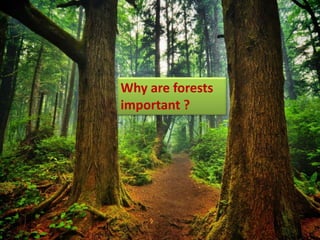
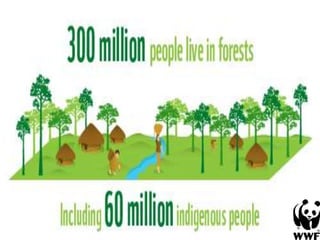
Why are forests
important ?
From the air we breathe to the wood we love…
• From the air we breathe to the wood we use, we
depend on forests for our survival.
• Forests help preserve biodiversity by providing
habitat to many diverse species of wildlife.
• Because trees use carbon dioxide for photosynthesis,
forested areas clean the air of excess carbon dioxide
and produce oxygen in return.
• Soil that might otherwise be lost to wind and water is
held in place by the deep roots of trees (i.e, forests
prevent soil erosion).
What is sustainable forest management?
• Sustainable forest management is the management
of forests according to the principles of sustainable
development.
• Management of forests or Forest management is a
branch of forestry concerned with overall
administrative, economic, legal, and social aspects,
as well as scientific and technical aspects.
• Sustainable development is defined as a process of
meeting human development goals while sustaining
the ability of natural systems to continue to provide
the natural resources.
Sustainable forest management practices
• The specific practices of a sustainable forestry vary
from forest to forest, depending on the specific
environment and the exact resources to be extracted
from the forest.
• The first step is to survey the land that's part of the
sustainable forestry project, creating not just an
inventory of the timber, but also of the various
wildlife species present and whether any of them are
endangered, along with other environmental issues.
• Next, forest managers determine what can be
harvested from the forest, and in what amounts.
Their goal is to harvest timber in a way that doesn't
destroy the overall health of the forest.
• It's also important to plant new trees, taking care to
plant species that will both provide the type of
timber wanted and fit into the forest ecosystem.
Sustainable Forest Management Techniques by Joe John Ponnezhan

Sustainable Forest Management Techniques by Joe John Ponnezhan

  • 1.
  • 2.
  • 3.
    From the airwe breathe to the wood we love… • From the air we breathe to the wood we use, we depend on forests for our survival. • Forests help preserve biodiversity by providing habitat to many diverse species of wildlife. • Because trees use carbon dioxide for photosynthesis, forested areas clean the air of excess carbon dioxide and produce oxygen in return. • Soil that might otherwise be lost to wind and water is held in place by the deep roots of trees (i.e, forests prevent soil erosion).
  • 9.
    What is sustainableforest management? • Sustainable forest management is the management of forests according to the principles of sustainable development. • Management of forests or Forest management is a branch of forestry concerned with overall administrative, economic, legal, and social aspects, as well as scientific and technical aspects. • Sustainable development is defined as a process of meeting human development goals while sustaining the ability of natural systems to continue to provide the natural resources.
  • 10.
    Sustainable forest managementpractices • The specific practices of a sustainable forestry vary from forest to forest, depending on the specific environment and the exact resources to be extracted from the forest. • The first step is to survey the land that's part of the sustainable forestry project, creating not just an inventory of the timber, but also of the various wildlife species present and whether any of them are endangered, along with other environmental issues.
  • 11.
    • Next, forestmanagers determine what can be harvested from the forest, and in what amounts. Their goal is to harvest timber in a way that doesn't destroy the overall health of the forest. • It's also important to plant new trees, taking care to plant species that will both provide the type of timber wanted and fit into the forest ecosystem.