Crimean federal university named after V.I. Vernadsky
Medical academy named after S.I. Georgiyevsky
Department of forensic medicine with the course of law
FORENSIC MEDICINE.
FORENSIC ANTHROPOLOGY AND
ODONTOLOGY.
Forensic Anthropology and
Odontology
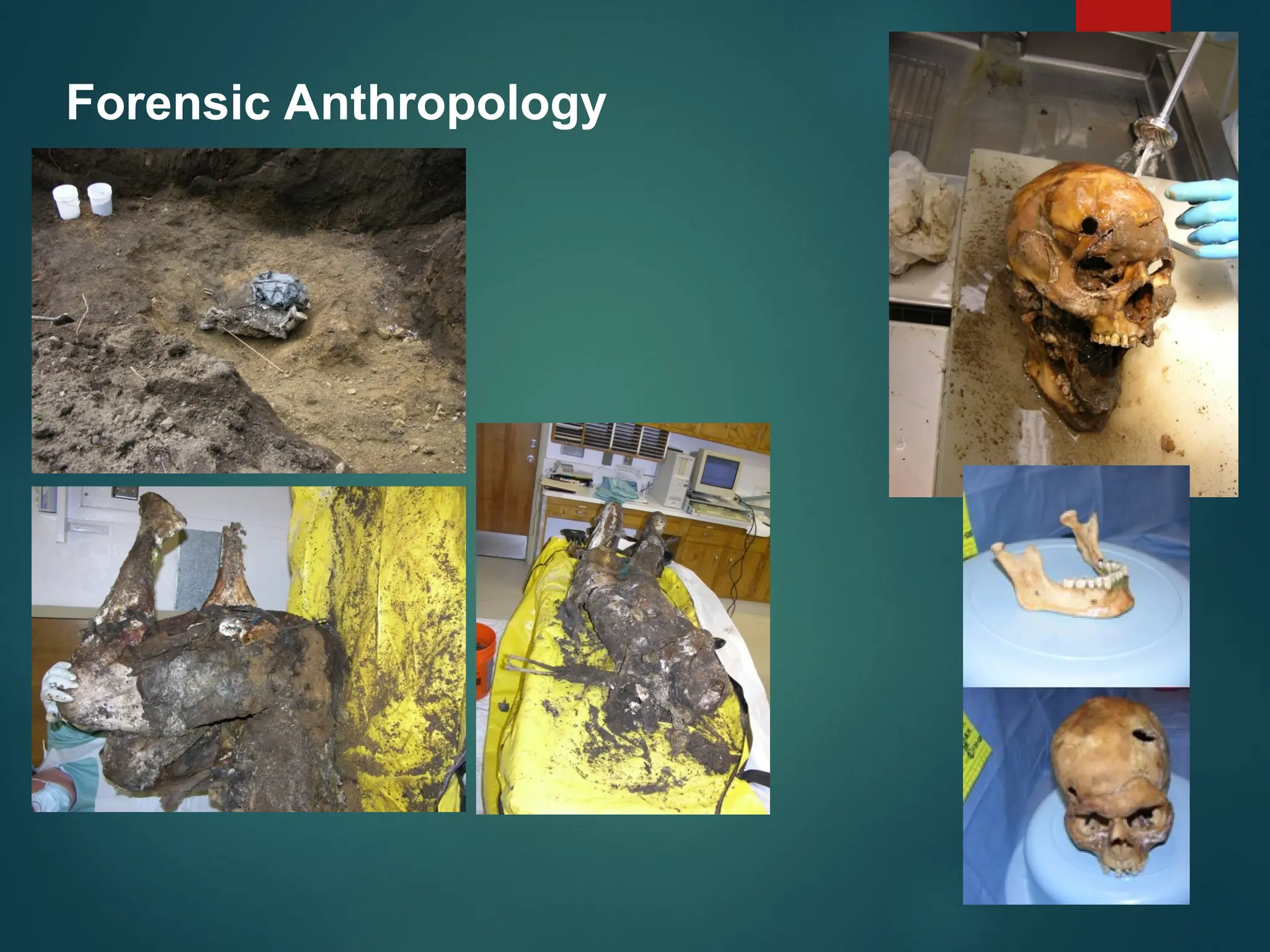
Forensic Anthropology
the study of human skeletal remains to determine sex,
age, race, and time of death in an effort to identify an
individual
Definition has been expanded to include these subtopics:
 forensic taphonomy – interpretation of outdoor death scenes
 forensic archaeology – recovery of scattered or buried remains
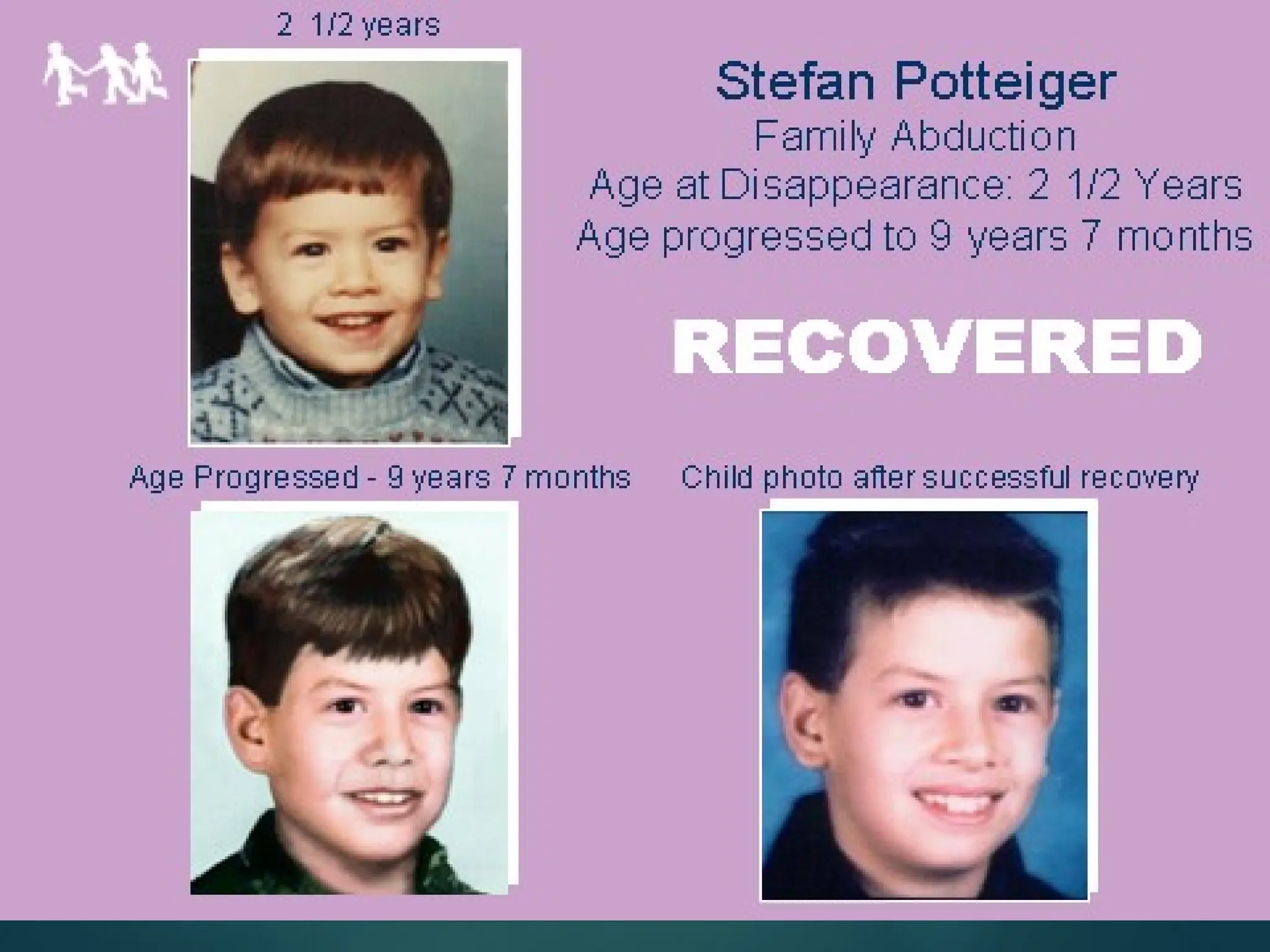
 newer topics of facial reconstruction and age progression
“Anthros” is Greek for humankind or man and logos means “the
study of.”
Forensic Anthropology
Determination of Sex
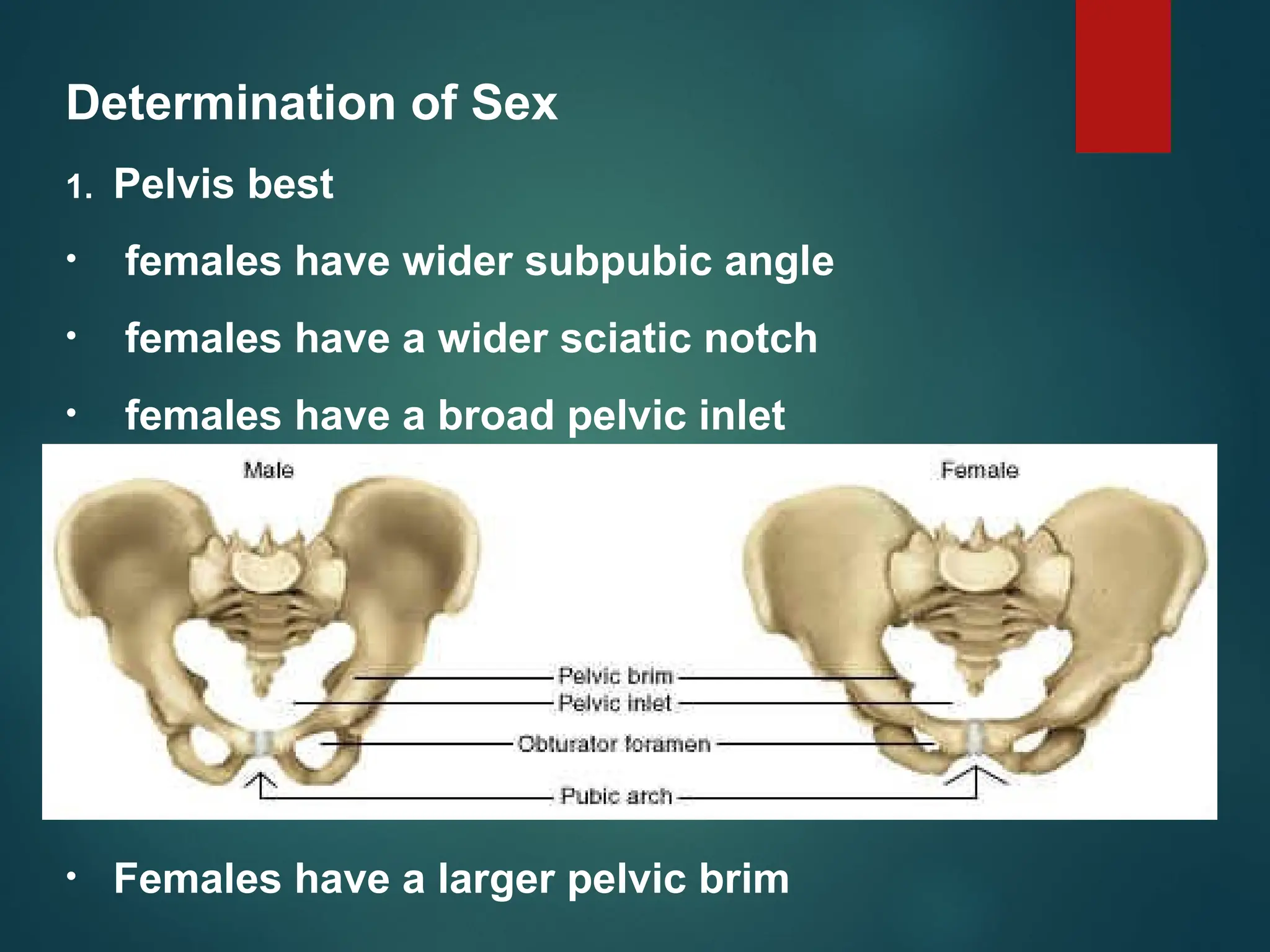
1. Pelvis best
• females have wider subpubic angle
• females have a wider sciatic notch
• females have a broad pelvic inlet
• Females have a larger pelvic brim
Determination of Sex
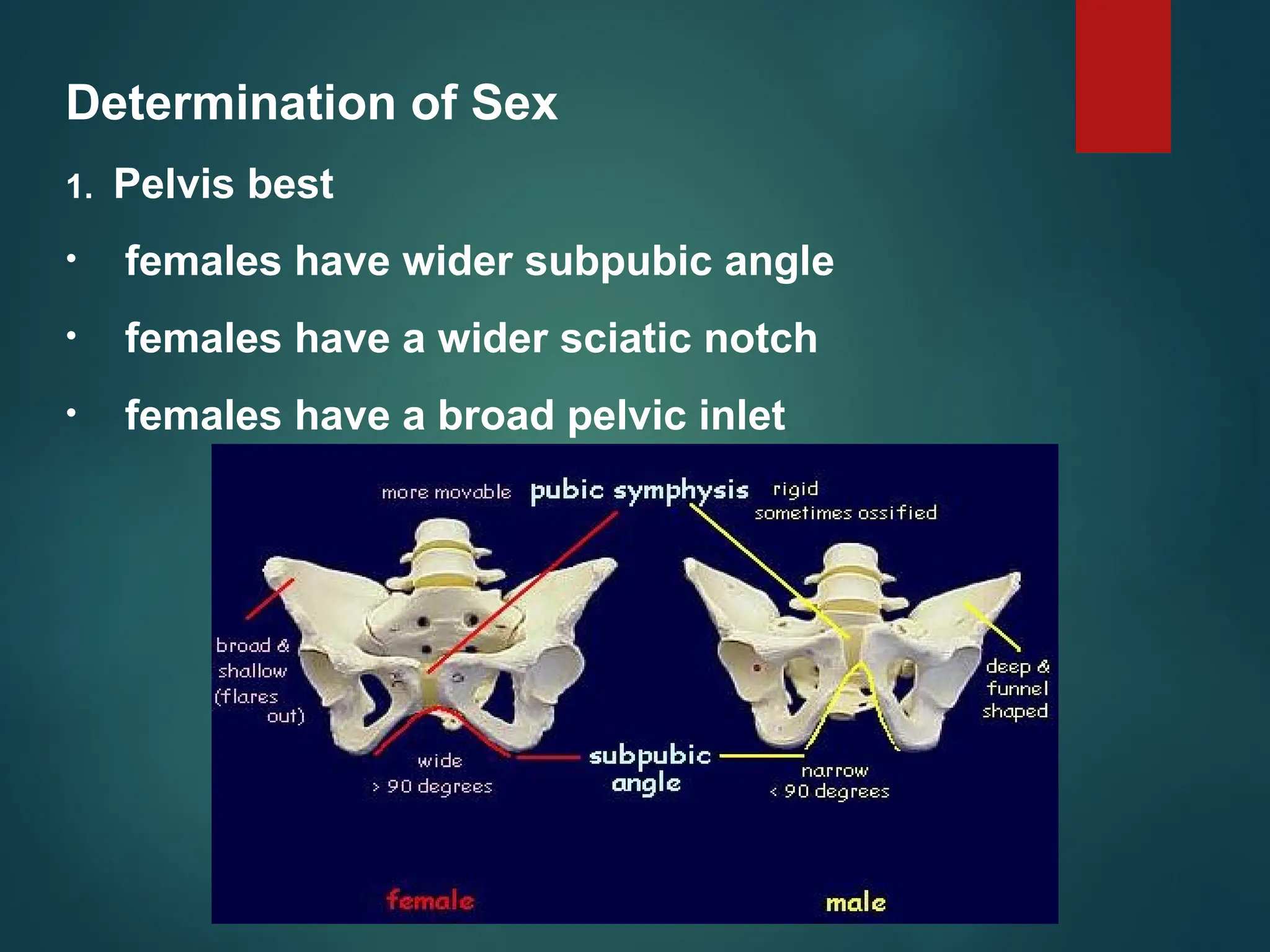
1. Pelvis best
• females have wider subpubic angle
• females have a wider sciatic notch
• females have a broad pelvic inlet
Determination of Sex
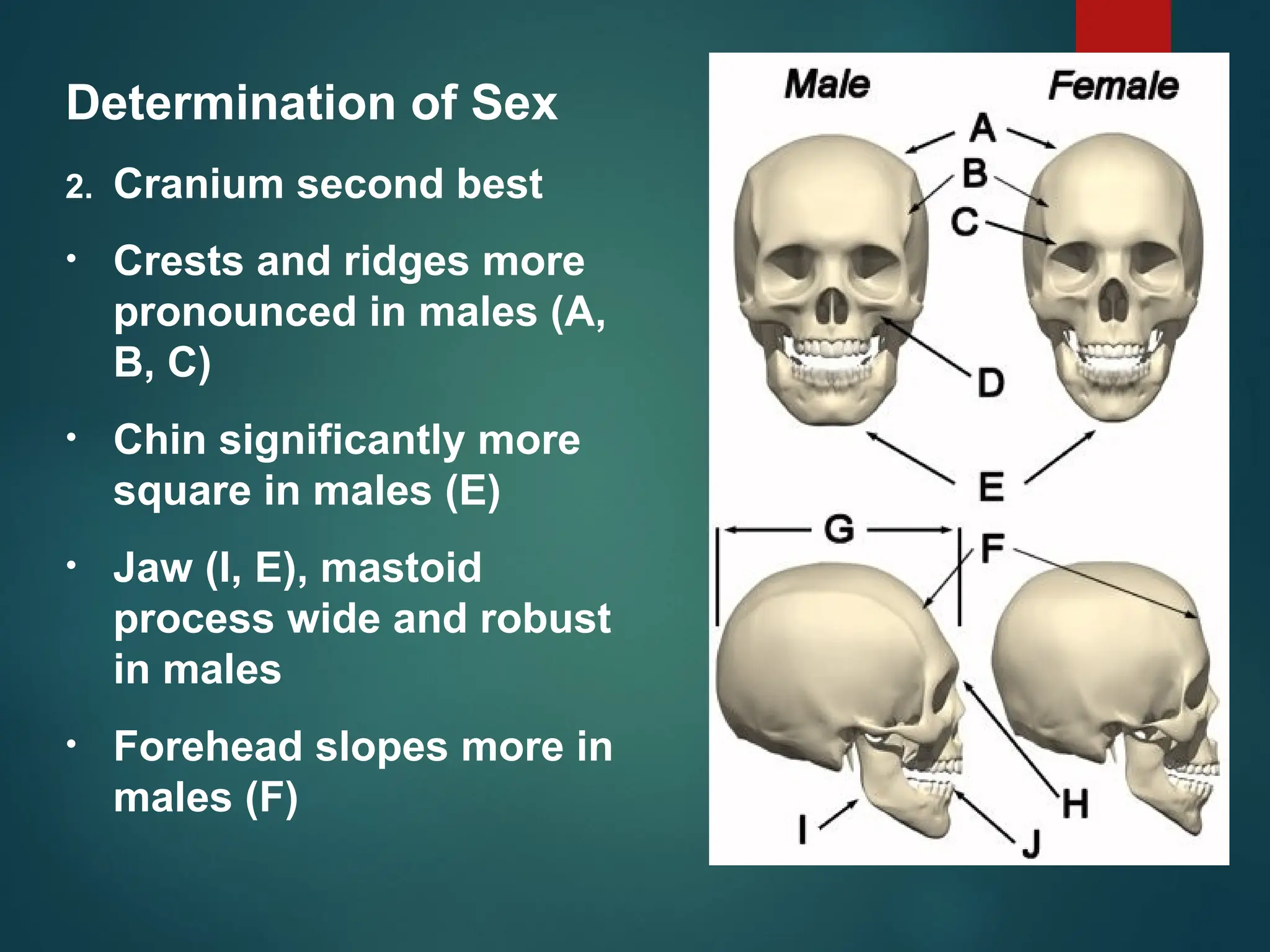
2. Cranium second best
• Crests and ridges more
pronounced in males (A,
B, C)
• Chin significantly more
square in males (E)
• Jaw (I, E), mastoid
process wide and robust
in males
• Forehead slopes more in
males (F)
Determination of Sex
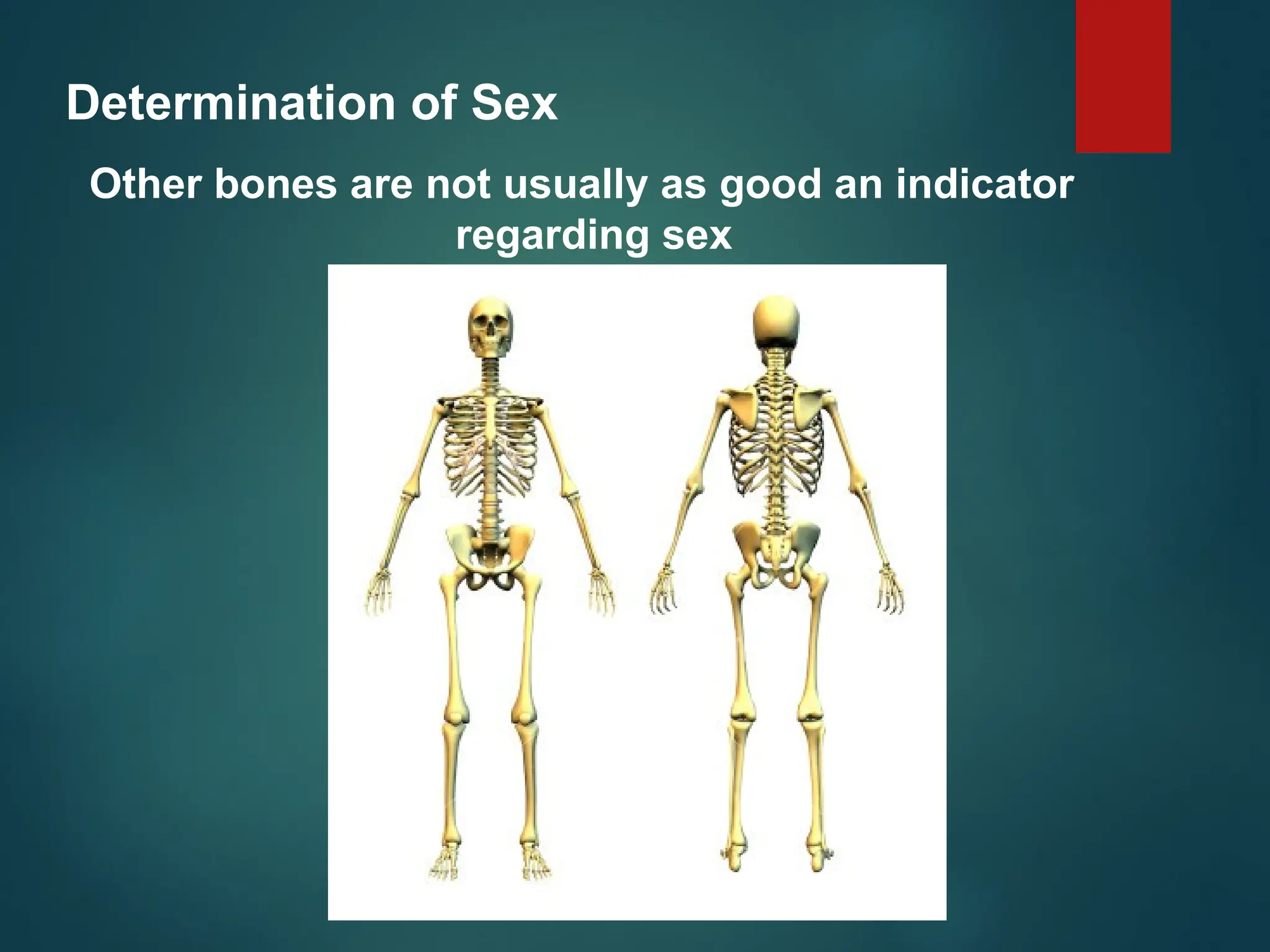
Other bones are not usually as good an indicator
regarding sex
Determination of Race
The cranium is the only reliable bone and, even
then, can only tell general category as below:
• ‘Mongoloid’ (all of Asian and Native American
decent)
wider cheekbones, concave incisors,
width between eyes greatest
• ‘Black’ (everyone of African and West Indian
decent)
more prominent ridges, wider nasal opening
• ‘White’ (Caucasian and Hispanic decent)
narrow everything
Determination of Age from Bones
• Ages 0-5: teeth are best – forensic odontology
• Ages 6-25: epiphyseal fusion – fusion of bone
ends to bone shaft
epiphyseal fusion varies with sex and is typically
complete by age 25
• Ages 25-40: very hard, can use pubic symphysis
• Ages 40+: periodontal disease, arthritis,
breakdown of pelvis, occupational stress,
unique clues
Determination of Age from Bones
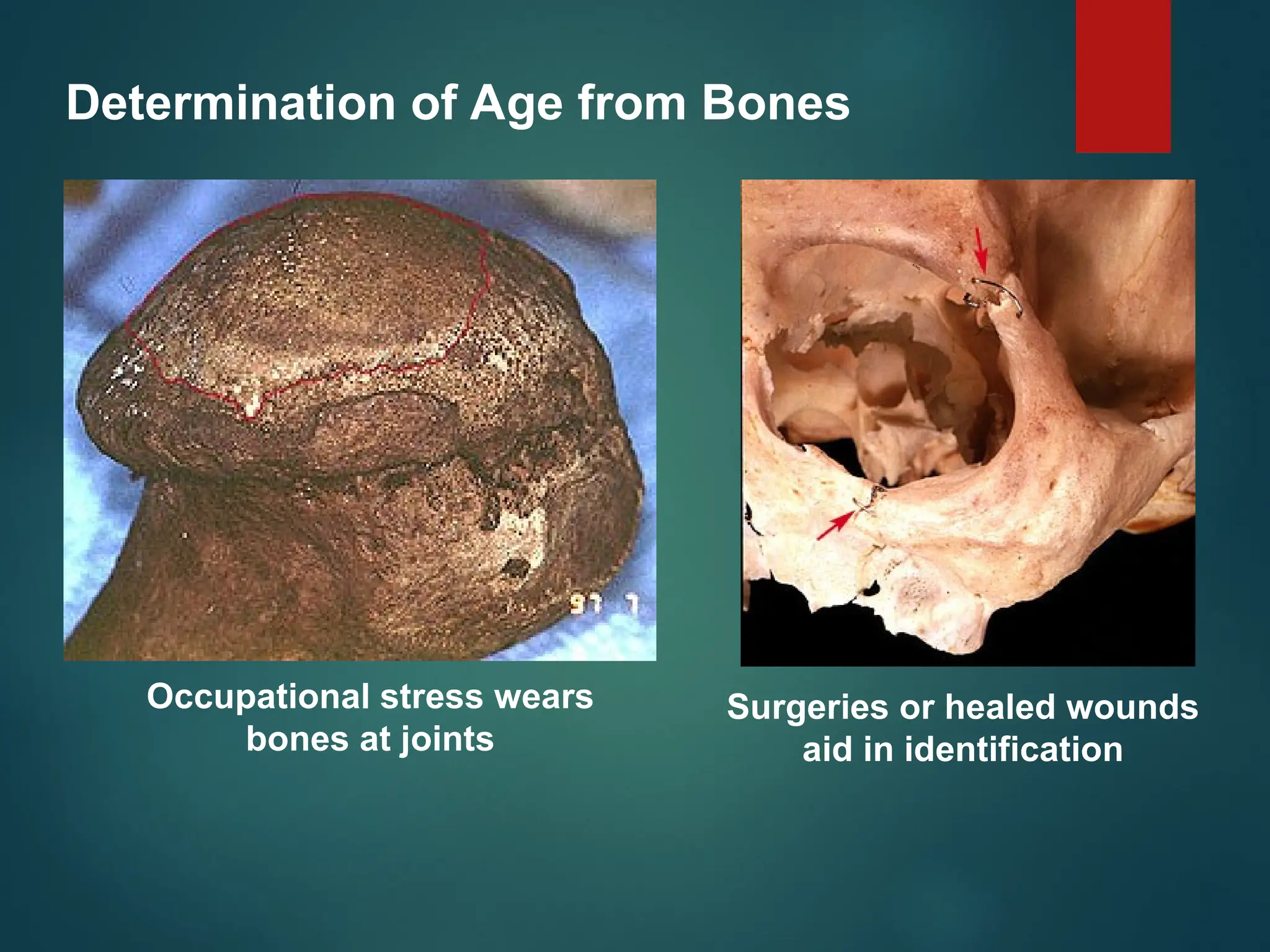
Occupational stress wears
bones at joints
Surgeries or healed wounds
aid in identification
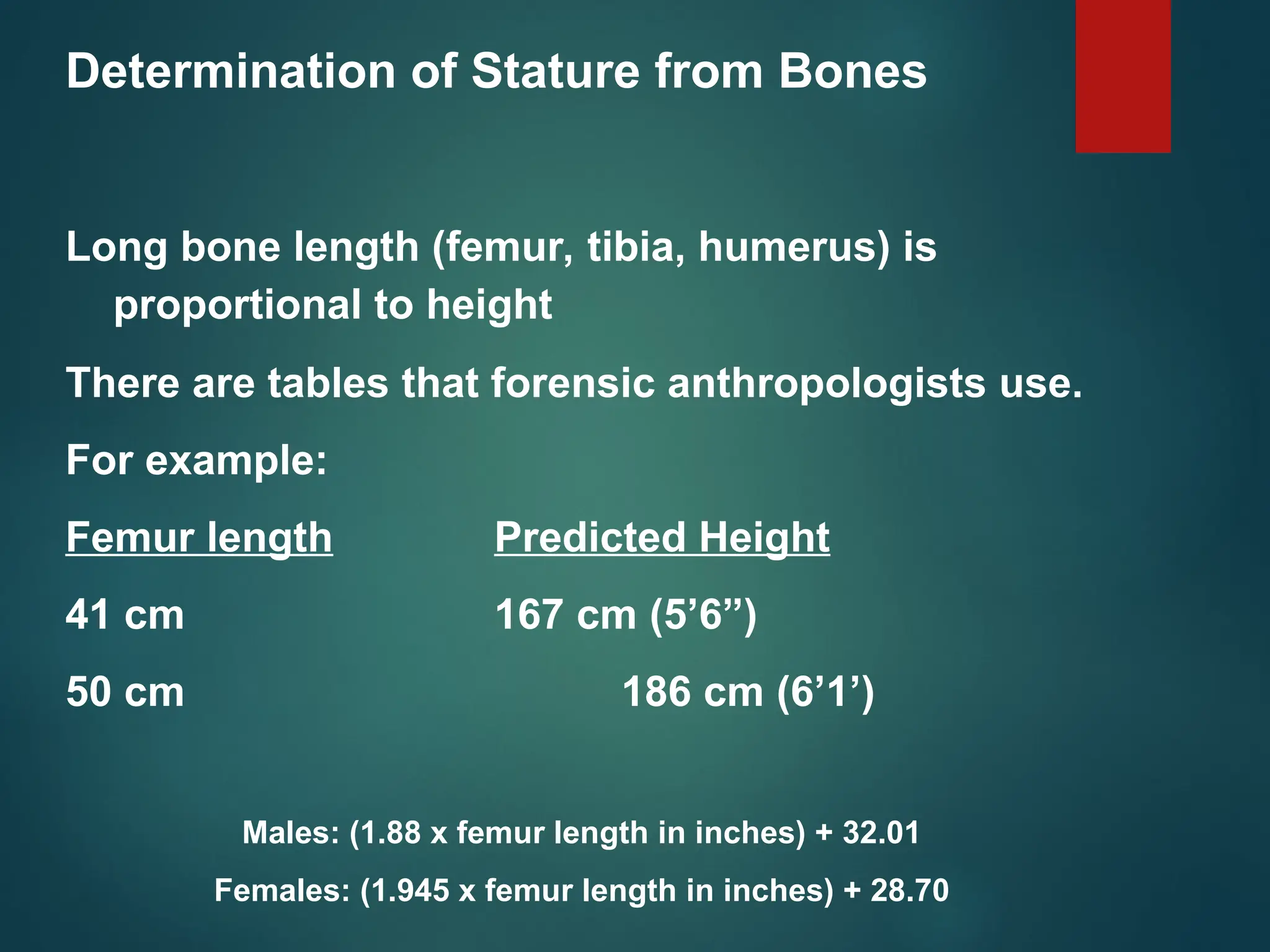
Determination of Stature from Bones
Long bone length (femur, tibia, humerus) is
proportional to height
There are tables that forensic anthropologists use.
For example:
Femur length Predicted Height
41 cm 167 cm (5’6”)
50 cm 186 cm (6’1’)
Males: (1.88 x femur length in inches) + 32.01
Females: (1.945 x femur length in inches) + 28.70
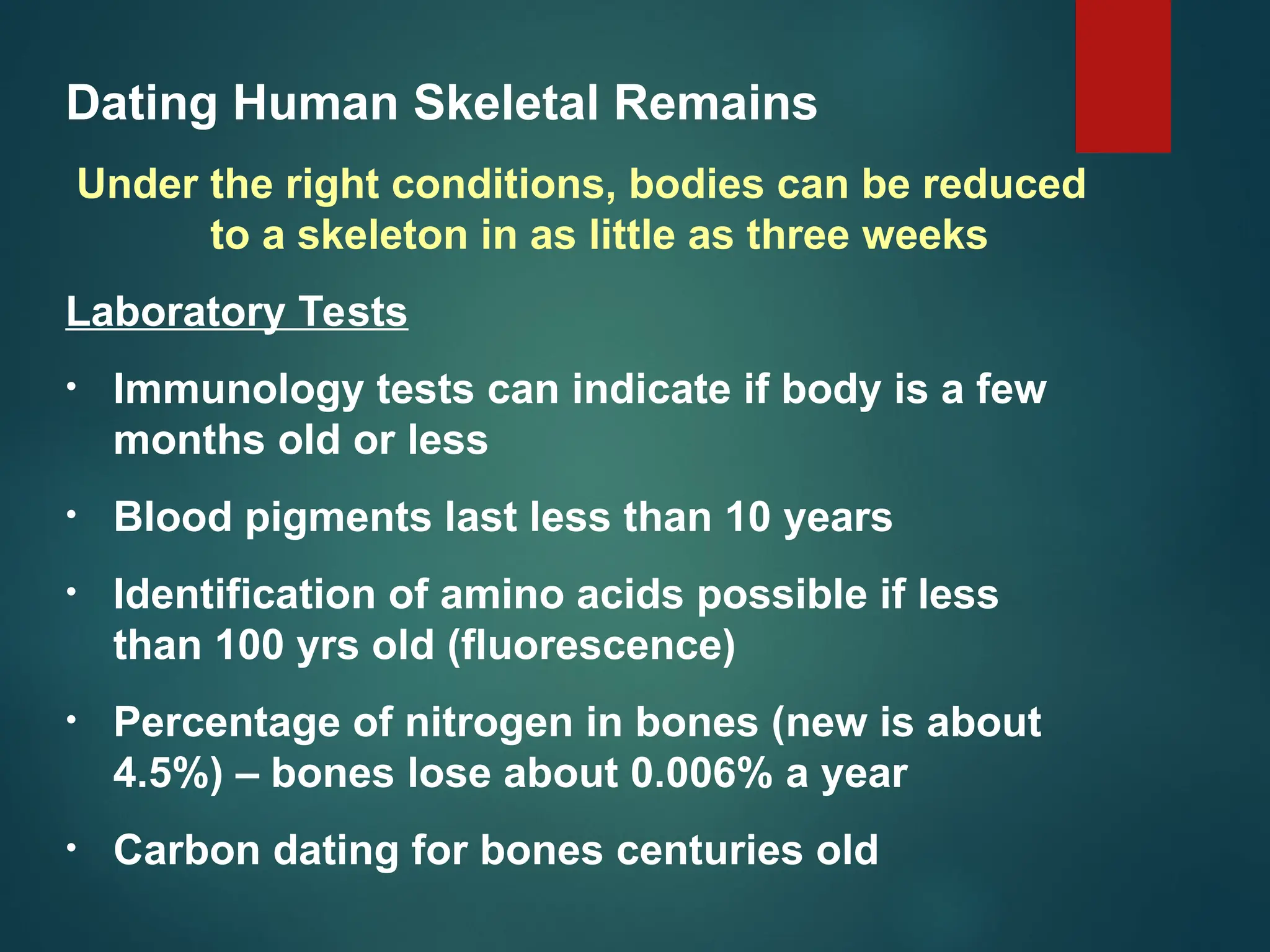
Dating Human Skeletal Remains
Under the right conditions, bodies can be reduced
to a skeleton in as little as three weeks
Laboratory Tests
• Immunology tests can indicate if body is a few
months old or less
• Blood pigments last less than 10 years
• Identification of amino acids possible if less
than 100 yrs old (fluorescence)
• Percentage of nitrogen in bones (new is about
4.5%) – bones lose about 0.006% a year
• Carbon dating for bones centuries old
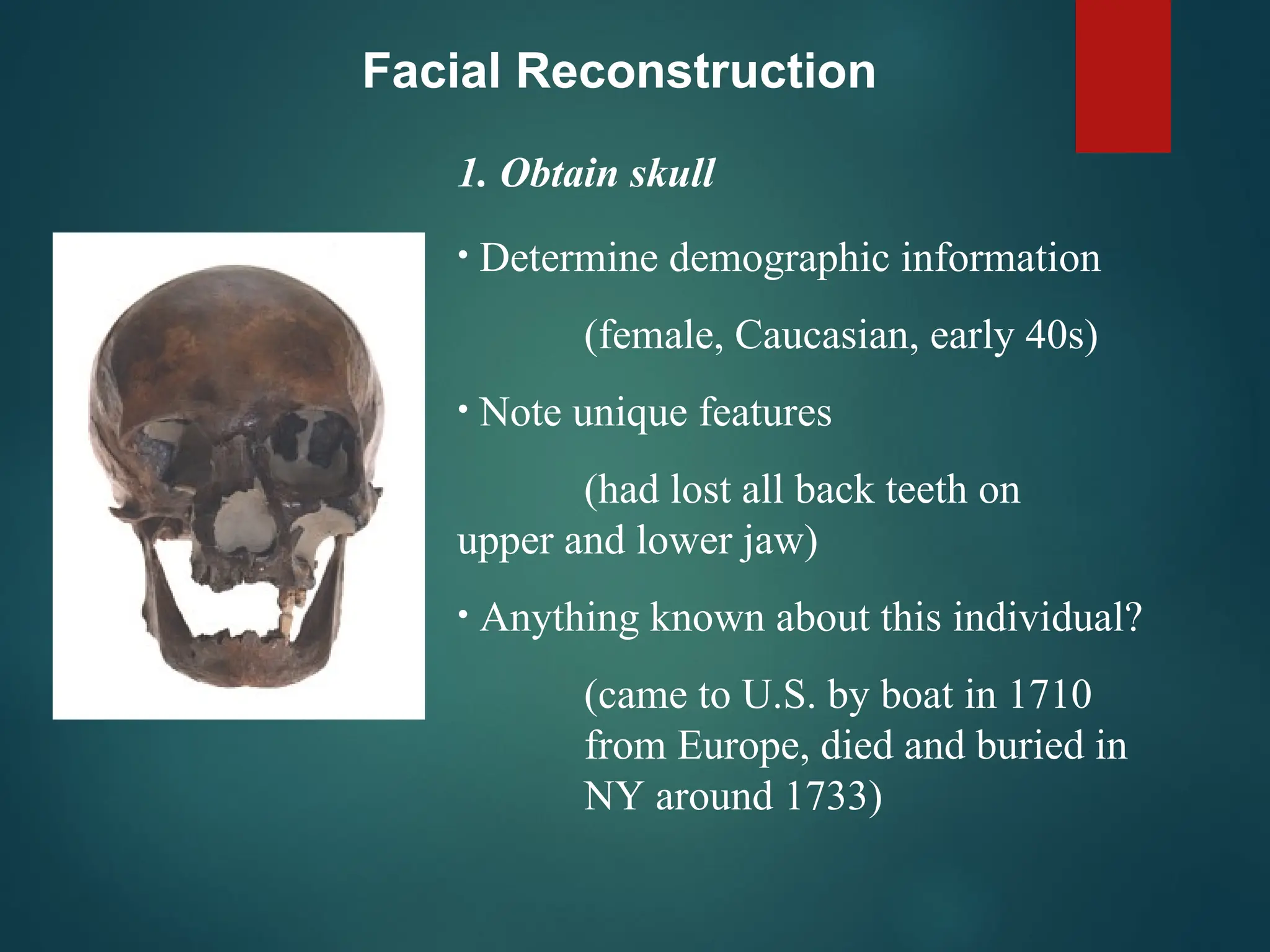
Facial Reconstruction
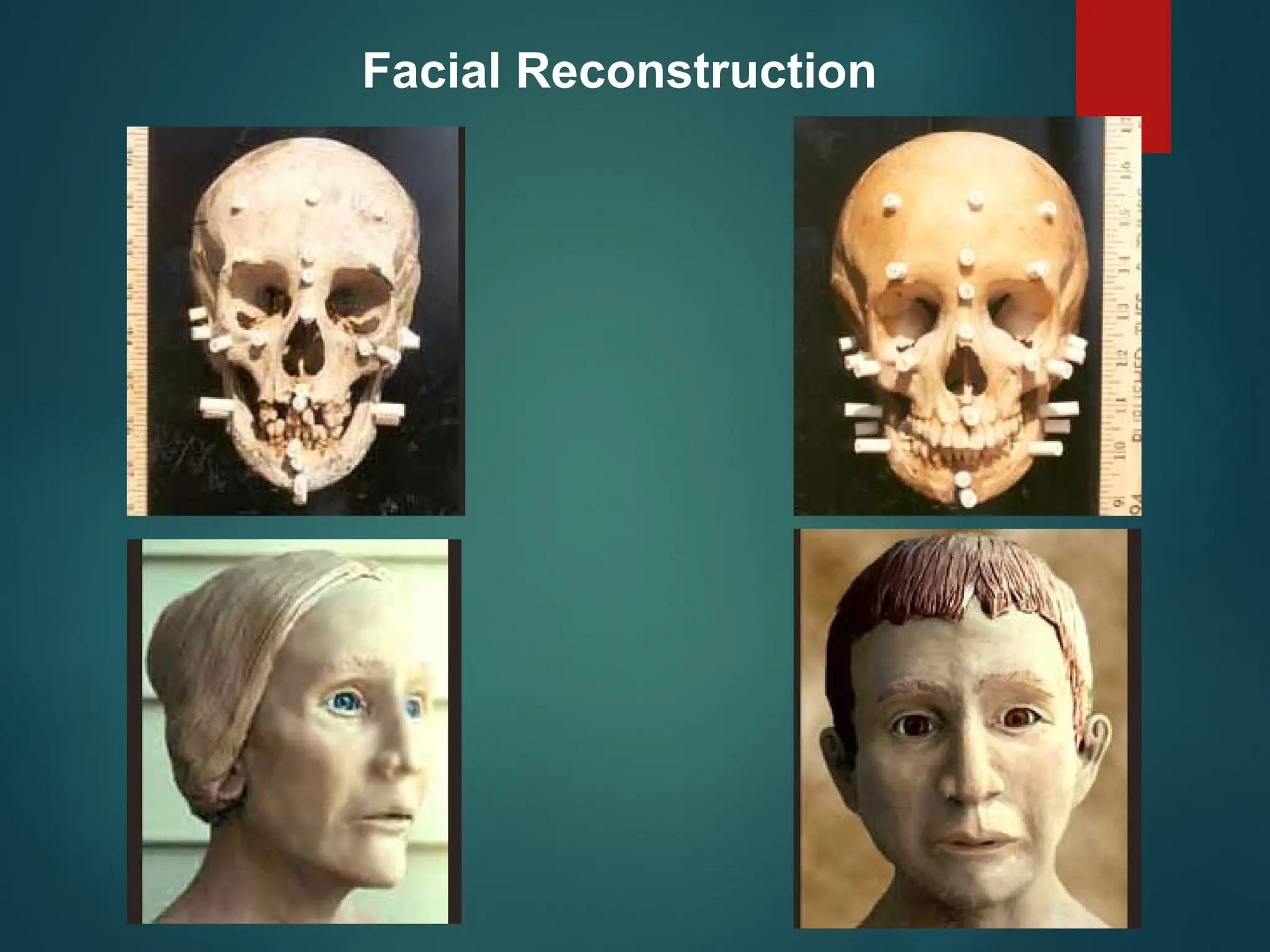
• Determine demographic information
(female, Caucasian, early 40s)
• Note unique features
(had lost all back teeth on
upper and lower jaw)
• Anything known about this individual?
(came to U.S. by boat in 1710
from Europe, died and buried in
NY around 1733)
1. Obtain skull
Facial Reconstruction
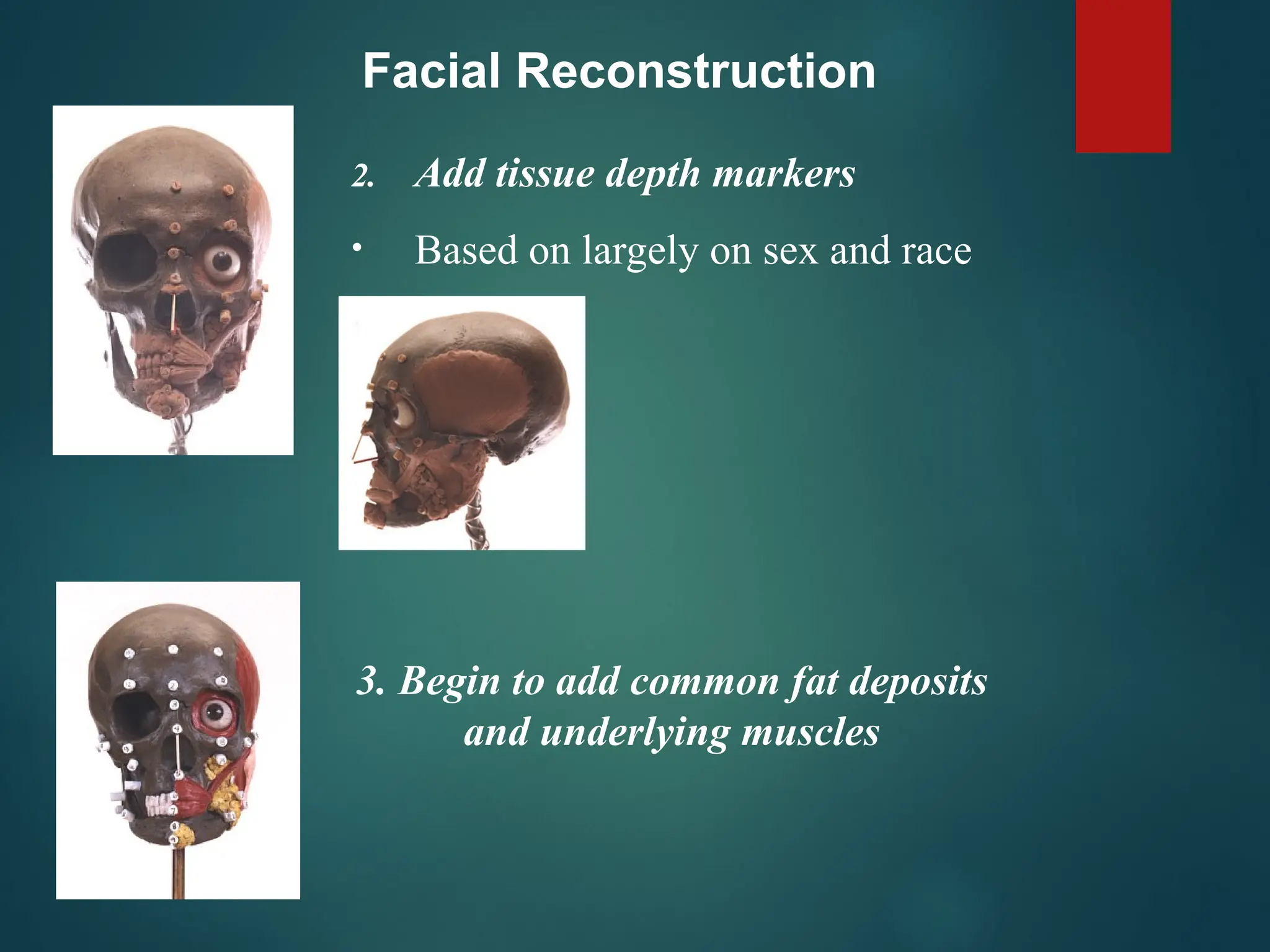
2. Add tissue depth markers
• Based on largely on sex and race
3. Begin to add common fat deposits
and underlying muscles
Facial Reconstruction
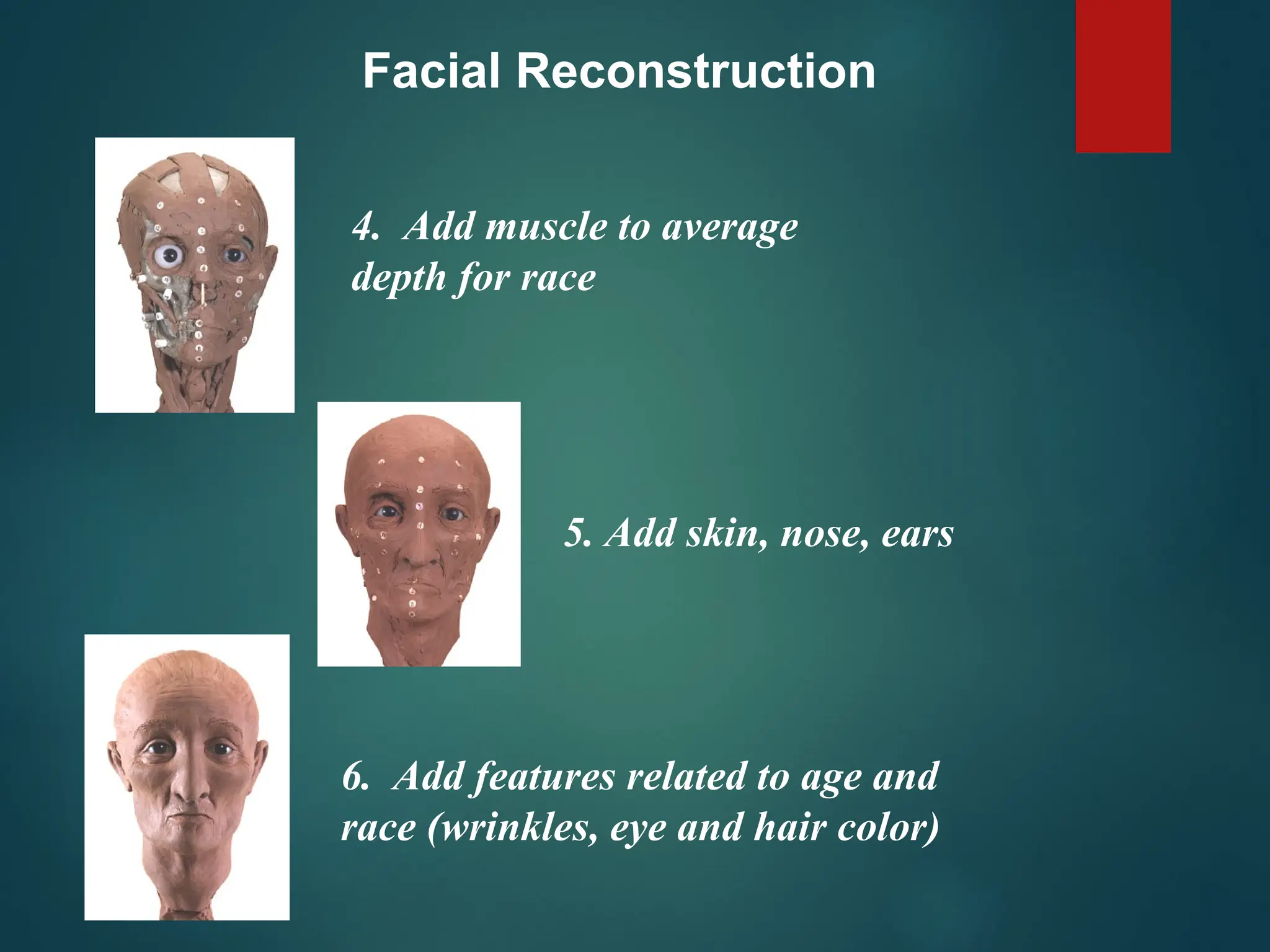
4. Add muscle to average
depth for race
5. Add skin, nose, ears
6. Add features related to age and
race (wrinkles, eye and hair color)
Facial Reconstruction
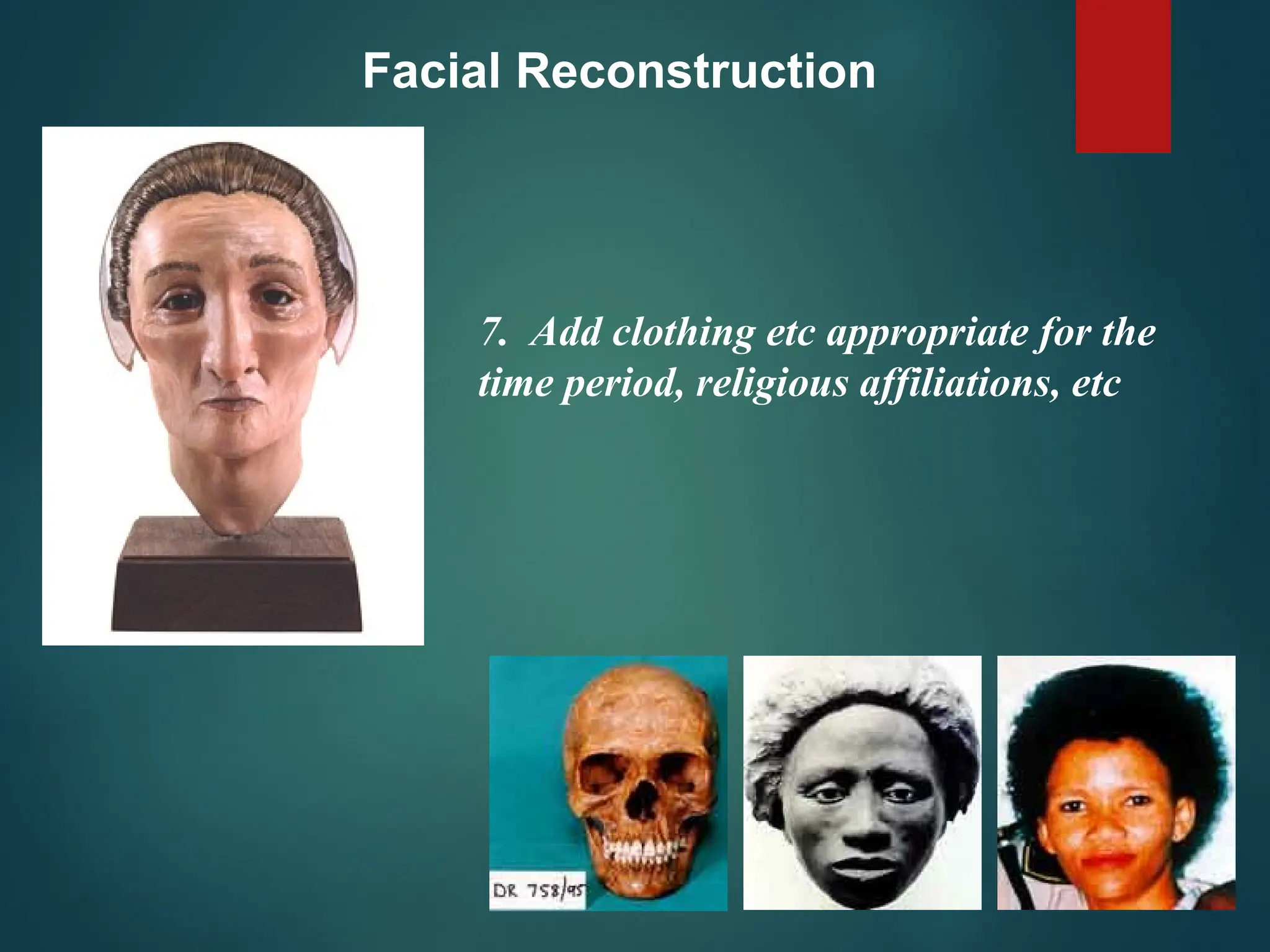
7. Add clothing etc appropriate for the
time period, religious affiliations, etc
Facial Reconstruction
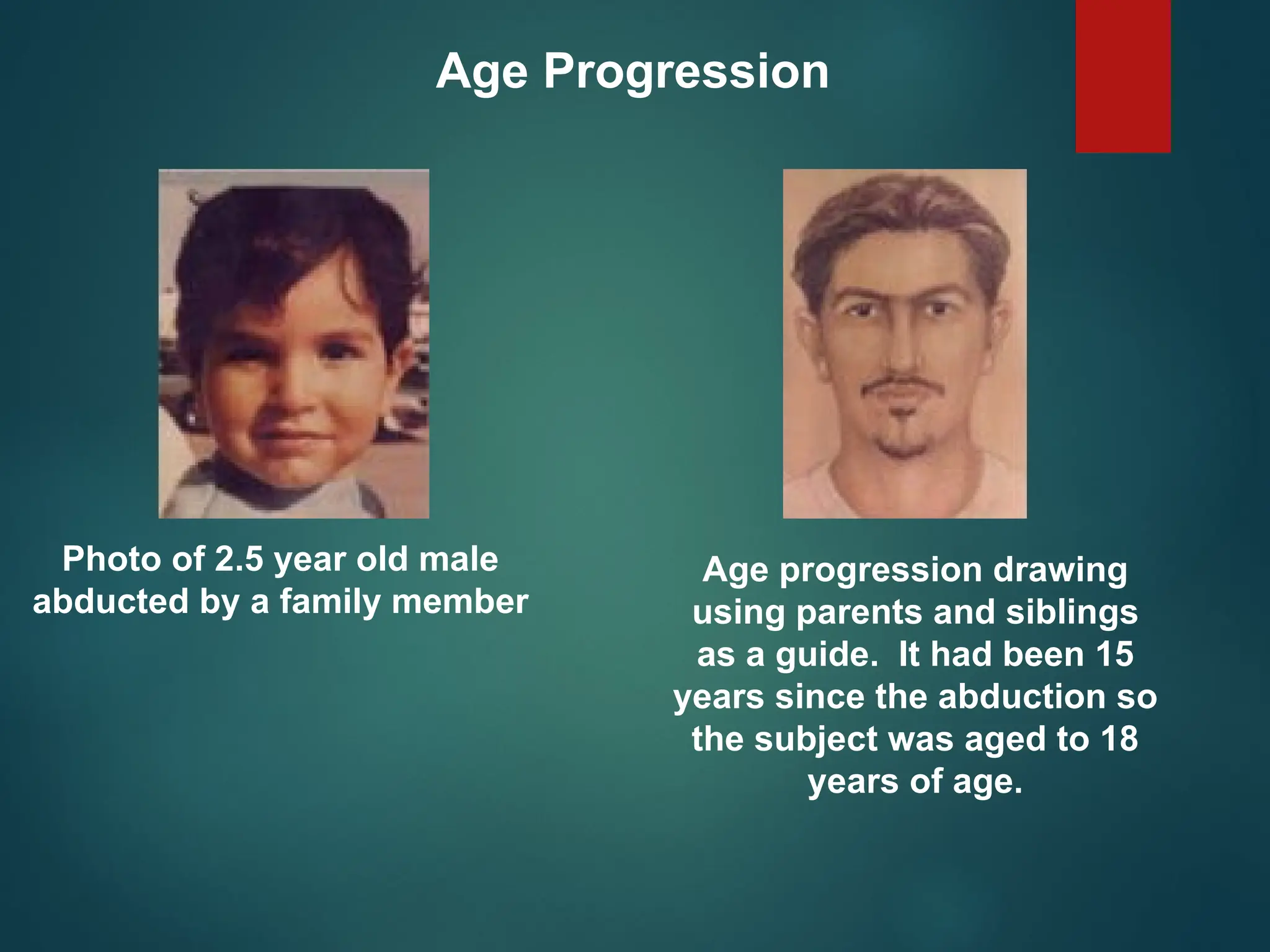
Age Progression
Photo of 2.5 year old male
abducted by a family member
Age progression drawing
using parents and siblings
as a guide. It had been 15
years since the abduction so
the subject was aged to 18
years of age.
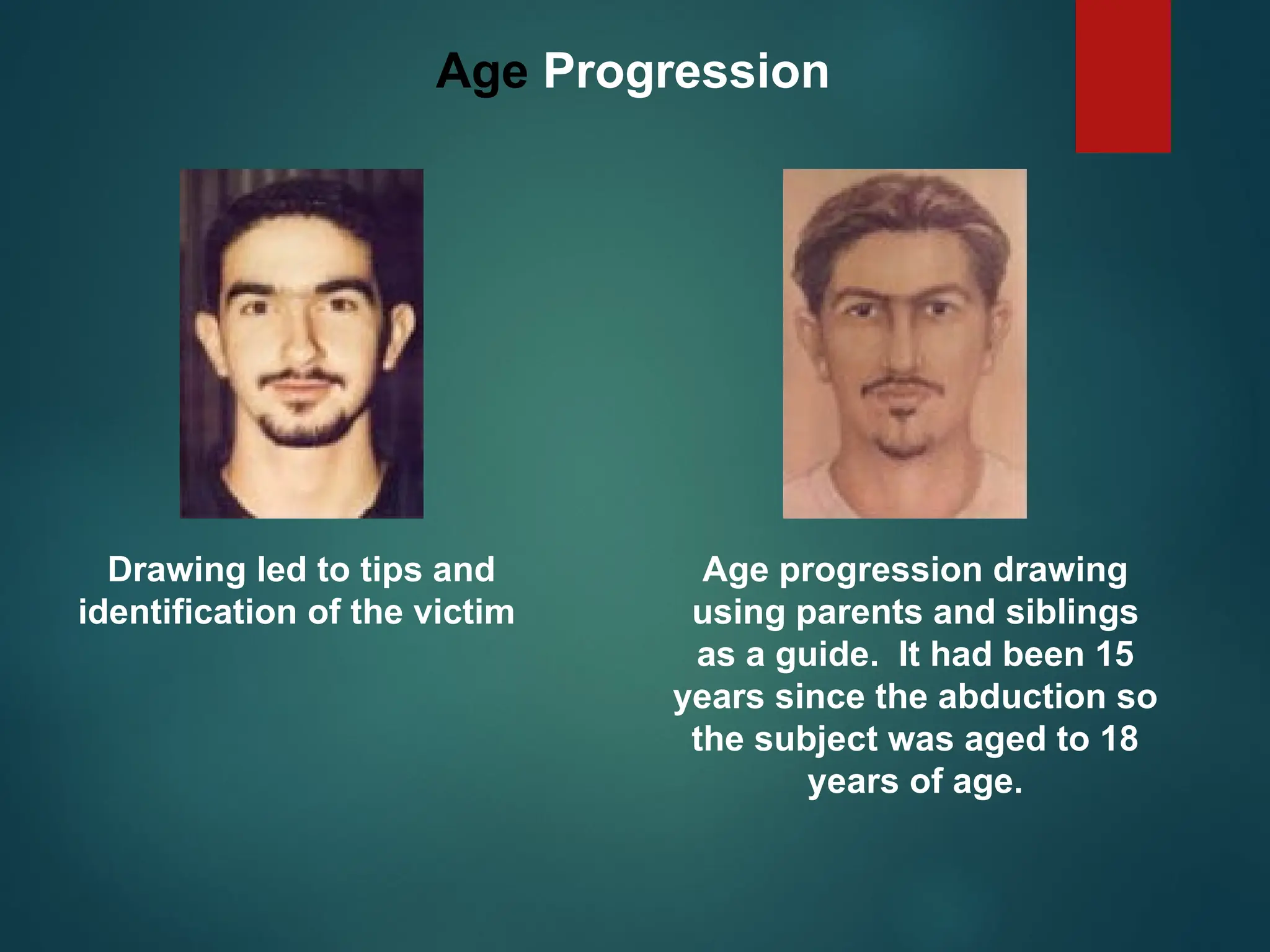
Age Progression
Age progression drawing
using parents and siblings
as a guide. It had been 15
years since the abduction so
the subject was aged to 18
years of age.
Drawing led to tips and
identification of the victim
Age Progression
Age progression drawing
using parents and siblings
as a guide. It had been 15
years since the abduction so
the subject was aged to 18
years of age.
Drawing led to tips and
identification of the victim
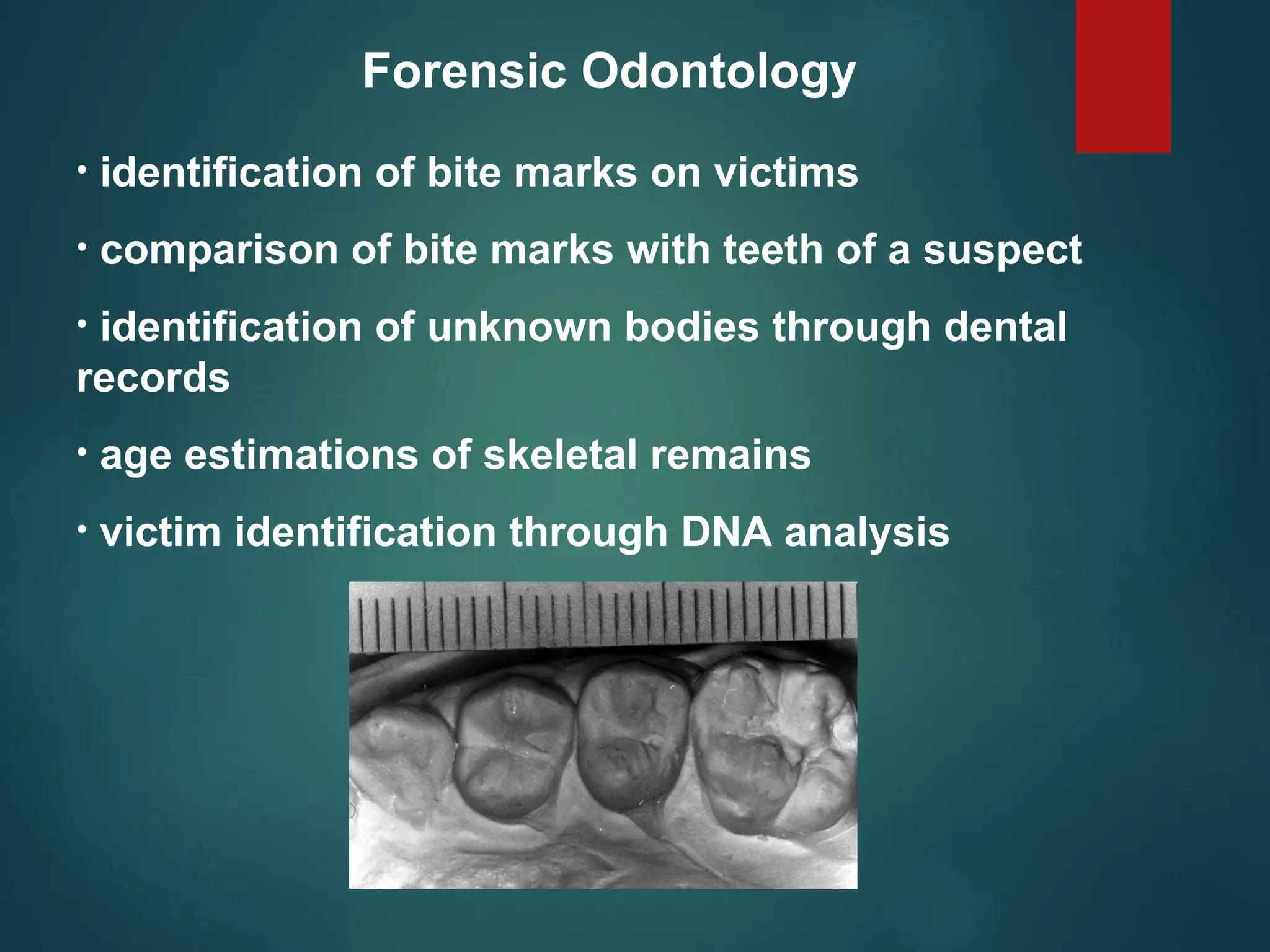
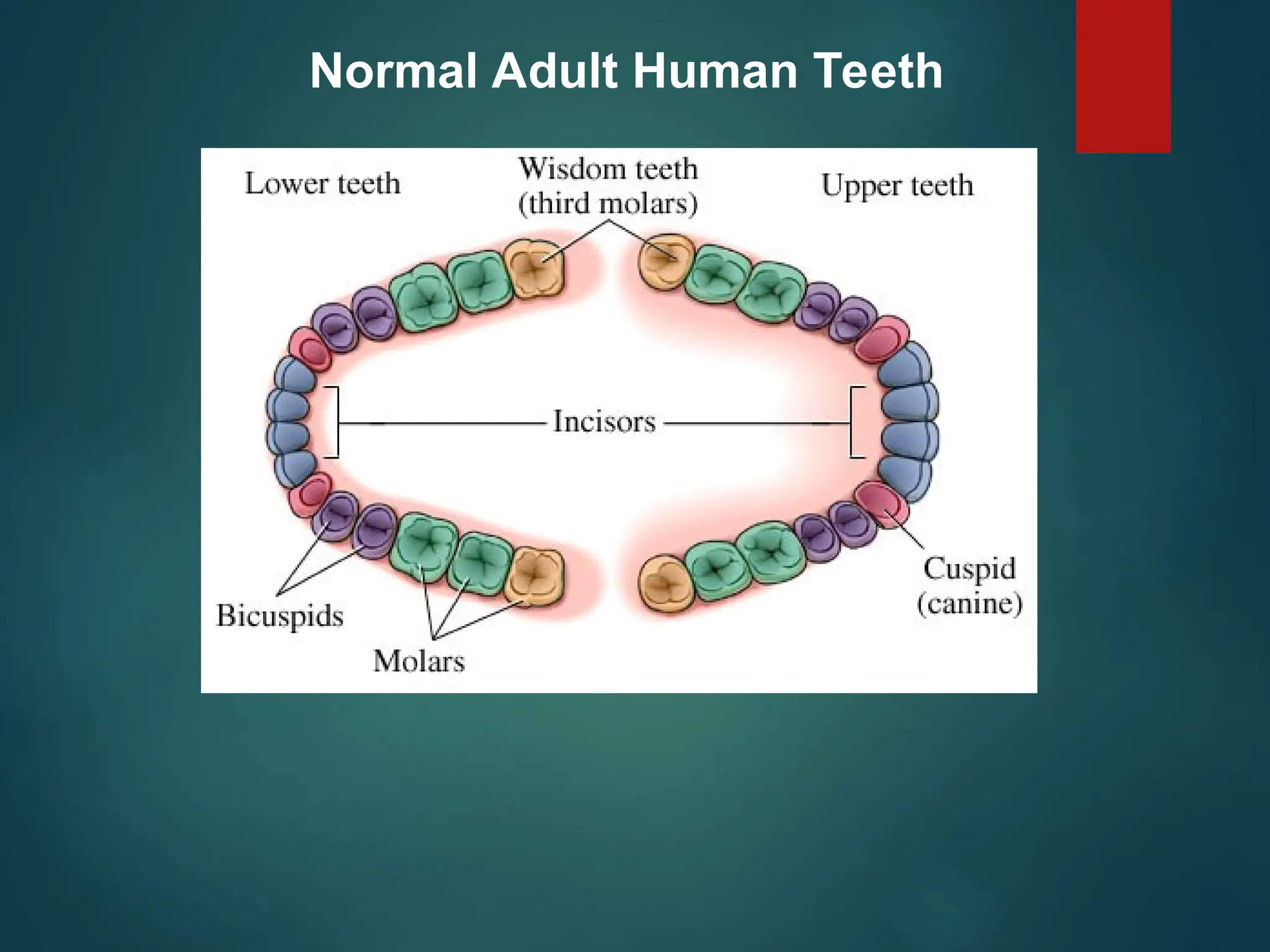
Forensic Odontology
• identification of bite marks on victims
• comparison of bite marks with teeth of a suspect
• identification of unknown bodies through dental
records
• age estimations of skeletal remains
• victim identification through DNA analysis
Normal Adult Human Teeth
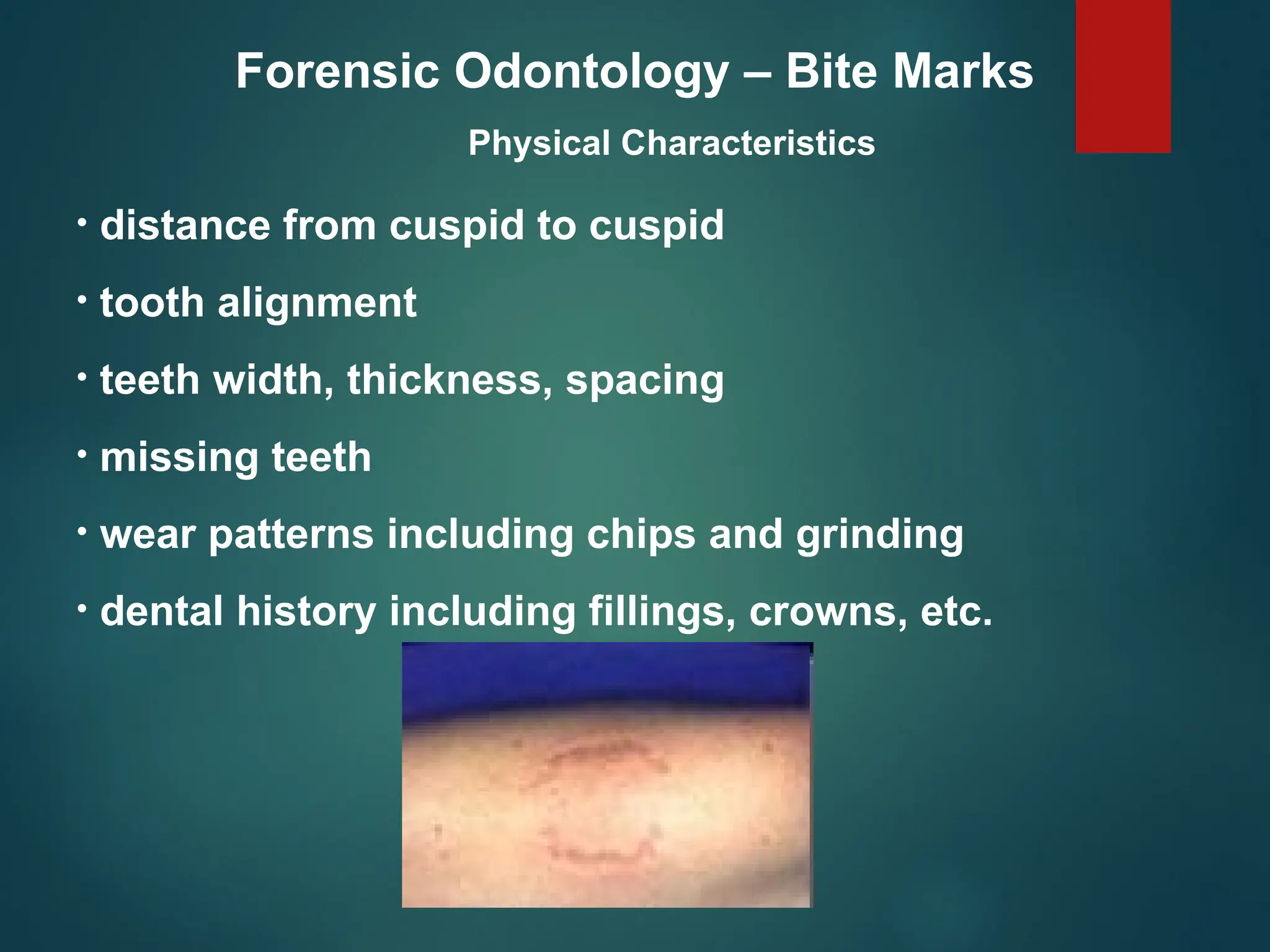
Forensic Odontology – Bite Marks
Physical Characteristics
• distance from cuspid to cuspid
• tooth alignment
• teeth width, thickness, spacing
• missing teeth
• wear patterns including chips and grinding
• dental history including fillings, crowns, etc.
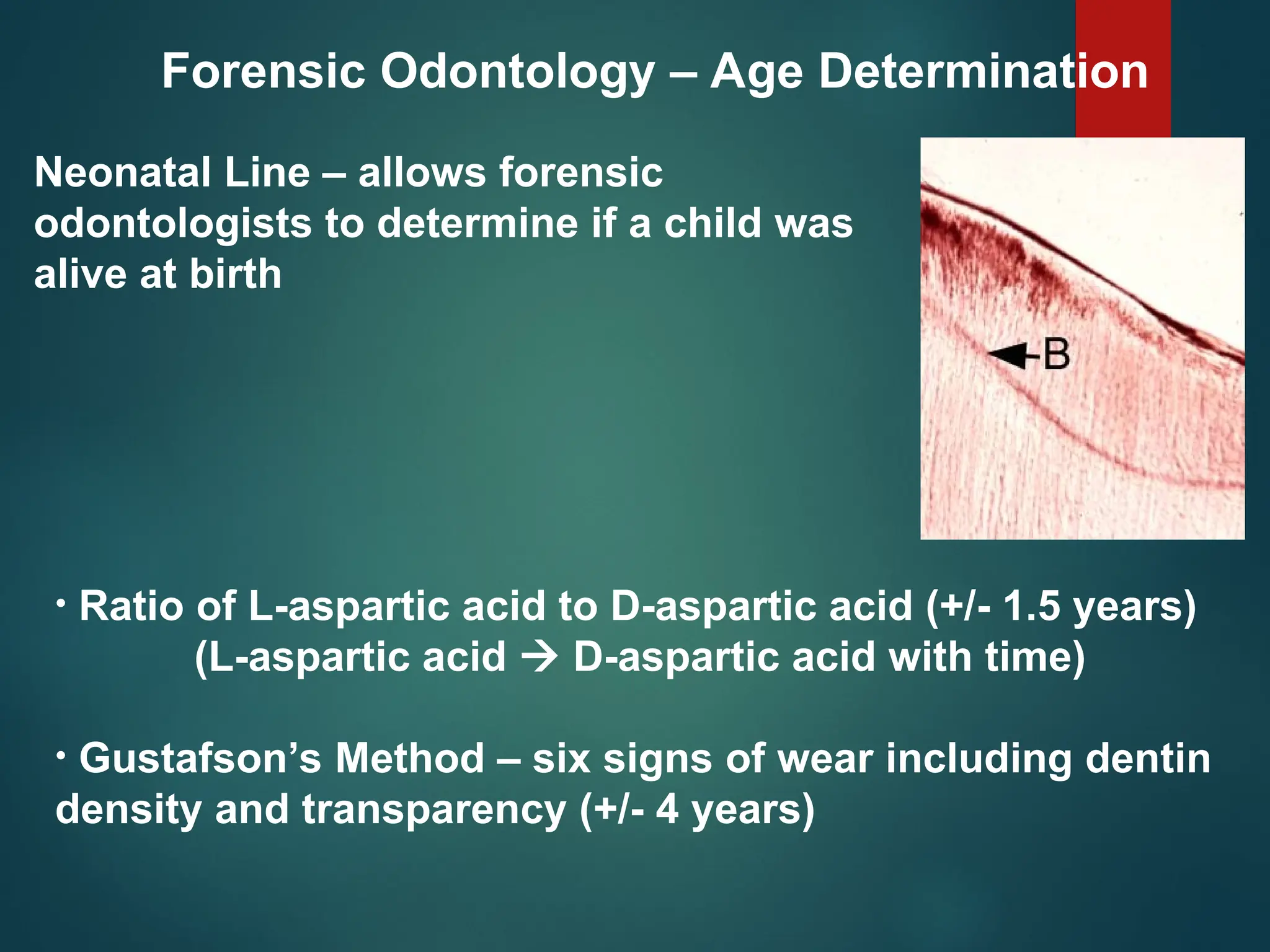
Forensic Odontology – Age Determination
Neonatal Line – allows forensic
odontologists to determine if a child was
alive at birth
• Ratio of L-aspartic acid to D-aspartic acid (+/- 1.5 years)
(L-aspartic acid  D-aspartic acid with time)
• Gustafson’s Method – six signs of wear including dentin
density and transparency (+/- 4 years)

FORENSIC ANTHROPOLOGY AND ODONTOLOGY.ppt

  • 1.
    Crimean federal universitynamed after V.I. Vernadsky Medical academy named after S.I. Georgiyevsky Department of forensic medicine with the course of law FORENSIC MEDICINE. FORENSIC ANTHROPOLOGY AND ODONTOLOGY.
  • 2.
  • 3.
    Forensic Anthropology the studyof human skeletal remains to determine sex, age, race, and time of death in an effort to identify an individual Definition has been expanded to include these subtopics:  forensic taphonomy – interpretation of outdoor death scenes  forensic archaeology – recovery of scattered or buried remains  newer topics of facial reconstruction and age progression “Anthros” is Greek for humankind or man and logos means “the study of.”
  • 4.
  • 5.
    Determination of Sex 1.Pelvis best • females have wider subpubic angle • females have a wider sciatic notch • females have a broad pelvic inlet • Females have a larger pelvic brim
  • 6.
    Determination of Sex 1.Pelvis best • females have wider subpubic angle • females have a wider sciatic notch • females have a broad pelvic inlet
  • 7.
    Determination of Sex 2.Cranium second best • Crests and ridges more pronounced in males (A, B, C) • Chin significantly more square in males (E) • Jaw (I, E), mastoid process wide and robust in males • Forehead slopes more in males (F)
  • 8.
    Determination of Sex Otherbones are not usually as good an indicator regarding sex
  • 9.
    Determination of Race Thecranium is the only reliable bone and, even then, can only tell general category as below: • ‘Mongoloid’ (all of Asian and Native American decent) wider cheekbones, concave incisors, width between eyes greatest • ‘Black’ (everyone of African and West Indian decent) more prominent ridges, wider nasal opening • ‘White’ (Caucasian and Hispanic decent) narrow everything
  • 10.
    Determination of Agefrom Bones • Ages 0-5: teeth are best – forensic odontology • Ages 6-25: epiphyseal fusion – fusion of bone ends to bone shaft epiphyseal fusion varies with sex and is typically complete by age 25 • Ages 25-40: very hard, can use pubic symphysis • Ages 40+: periodontal disease, arthritis, breakdown of pelvis, occupational stress, unique clues
  • 11.
    Determination of Agefrom Bones Occupational stress wears bones at joints Surgeries or healed wounds aid in identification
  • 12.
    Determination of Staturefrom Bones Long bone length (femur, tibia, humerus) is proportional to height There are tables that forensic anthropologists use. For example: Femur length Predicted Height 41 cm 167 cm (5’6”) 50 cm 186 cm (6’1’) Males: (1.88 x femur length in inches) + 32.01 Females: (1.945 x femur length in inches) + 28.70
  • 13.
    Dating Human SkeletalRemains Under the right conditions, bodies can be reduced to a skeleton in as little as three weeks Laboratory Tests • Immunology tests can indicate if body is a few months old or less • Blood pigments last less than 10 years • Identification of amino acids possible if less than 100 yrs old (fluorescence) • Percentage of nitrogen in bones (new is about 4.5%) – bones lose about 0.006% a year • Carbon dating for bones centuries old
  • 14.
    Facial Reconstruction • Determinedemographic information (female, Caucasian, early 40s) • Note unique features (had lost all back teeth on upper and lower jaw) • Anything known about this individual? (came to U.S. by boat in 1710 from Europe, died and buried in NY around 1733) 1. Obtain skull
  • 15.
    Facial Reconstruction 2. Addtissue depth markers • Based on largely on sex and race 3. Begin to add common fat deposits and underlying muscles
  • 16.
    Facial Reconstruction 4. Addmuscle to average depth for race 5. Add skin, nose, ears 6. Add features related to age and race (wrinkles, eye and hair color)
  • 17.
    Facial Reconstruction 7. Addclothing etc appropriate for the time period, religious affiliations, etc
  • 18.
  • 19.
    Age Progression Photo of2.5 year old male abducted by a family member Age progression drawing using parents and siblings as a guide. It had been 15 years since the abduction so the subject was aged to 18 years of age.
  • 20.
    Age Progression Age progressiondrawing using parents and siblings as a guide. It had been 15 years since the abduction so the subject was aged to 18 years of age. Drawing led to tips and identification of the victim
  • 21.
    Age Progression Age progressiondrawing using parents and siblings as a guide. It had been 15 years since the abduction so the subject was aged to 18 years of age. Drawing led to tips and identification of the victim
  • 22.
    Forensic Odontology • identificationof bite marks on victims • comparison of bite marks with teeth of a suspect • identification of unknown bodies through dental records • age estimations of skeletal remains • victim identification through DNA analysis
  • 23.
  • 24.
    Forensic Odontology –Bite Marks Physical Characteristics • distance from cuspid to cuspid • tooth alignment • teeth width, thickness, spacing • missing teeth • wear patterns including chips and grinding • dental history including fillings, crowns, etc.
  • 25.
    Forensic Odontology –Age Determination Neonatal Line – allows forensic odontologists to determine if a child was alive at birth • Ratio of L-aspartic acid to D-aspartic acid (+/- 1.5 years) (L-aspartic acid  D-aspartic acid with time) • Gustafson’s Method – six signs of wear including dentin density and transparency (+/- 4 years)