FORENSIC
ANTHROPOLOGY
SPRING 2011


      Prof. Nathan Whitley-Grassi
What do Forensic Anthropologists
do?
   Use anthropological knowledge to assist the
    process of law.
   This often involves assisting law enforcement in
    identifying skeletal remains.
   Identify specific characteristics that can be used to
    identify human remains.
       Age and stature
       Time since death
       Gender
       Evidence of Trauma or Pathology
       Distinguishing traits
How does Forensic Anthropology
Work?
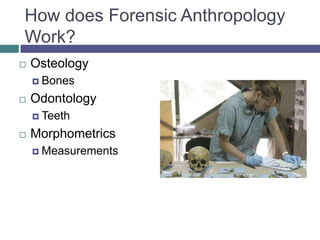
   Osteology
     Bones

   Odontology
     Teeth

   Morphometrics
     Measurements
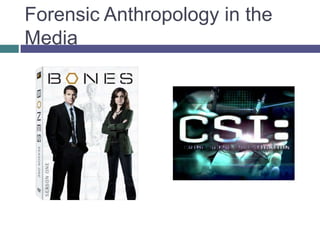
Forensic Anthropology in the
Media
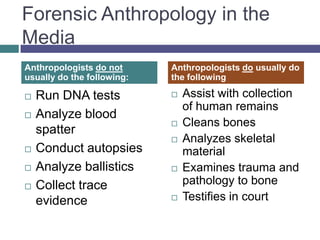
Forensic Anthropology in the
Media
Anthropologists do not      Anthropologists do usually do
usually do the following:   the following

   Run DNA tests              Assist with collection
                                of human remains
   Analyze blood
                               Cleans bones
    spatter
                               Analyzes skeletal
   Conduct autopsies           material
   Analyze ballistics         Examines trauma and
   Collect trace               pathology to bone
    evidence                   Testifies in court
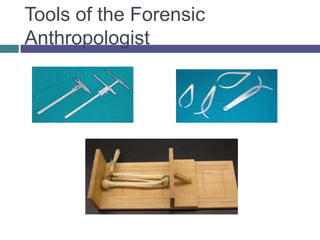
Tools of the Forensic
Anthropologist
Tools of the Forensic
Anthropologist


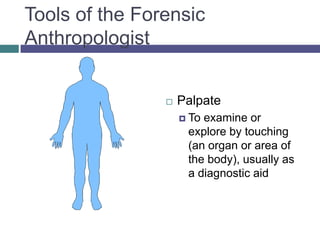
                   Palpate
                     Toexamine or
                     explore by touching
                     (an organ or area of
                     the body), usually as
                     a diagnostic aid
Introduction:
   The problem of the unidentified

   Violence and Forensic Anthropology

   Identification
Education Requirements:
   Requires a post graduate degree in
    physical, biological or forensic anthropology.
   Many have additional training in human
    biology, anatomy, medicine, nursing or
    dentistry.
   On the Job training!
   Constant personal research

   Preferred: PhD.
Objectives of an
Anthropological Investigation:
   Identification
   Determination or cause and manner of death
   Estimation of time since death
   Collection of physical evidence

   Anthropologist – Physical/Biological
     Focus   on skeletonized remains
   Anthropologist – Archeologist
     Recovery   of evidence
Forensic Anthropology
CHE 113
  12


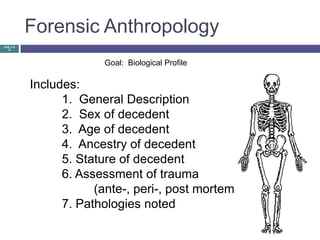
                       Goal: Biological Profile

          Includes:
                1. General Description
                2. Sex of decedent
                3. Age of decedent
                4. Ancestry of decedent
                5. Stature of decedent
                6. Assessment of trauma
                      (ante-, peri-, post mortem)
                7. Pathologies noted
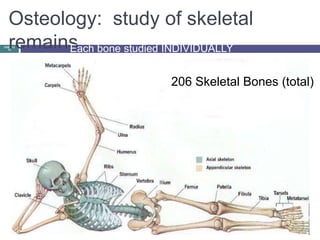
Osteology: study of skeletal
  remainsach bone studied INDIVIDUALLY
CHE 113
  13    E


                         206 Skeletal Bones (total)
Personal Identification:
   Are they Human?
   One or more than one individual?
   Description? (sex, age, stature, race,
    handedness)
   Unique traits? (abnormaity, prostheses,
    remodeling)

   Who is it? Or at least Who ISN’T it?
Circumstances of Death:
   When did it occur?
   Where did it occur? (Here or moved)
   Was the grave disturbed?
     Buried   more than once?
   Cause of death?
     (gun   shot, stabbing, asphyxia)
   Manner of death?
     (Suicide,   homicide, accident, natural)
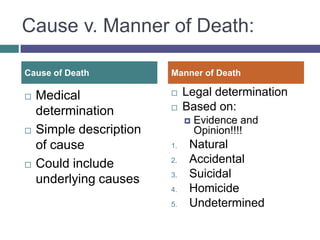
Cause v. Manner of Death:

Cause of Death           Manner of Death

   Medical                  Legal determination
    determination            Based on:
                                 Evidence and
   Simple description            Opinion!!!!
    of cause             1.    Natural
   Could include        2.    Accidental
    underlying causes    3.    Suicidal
                         4.    Homicide
                         5.    Undetermined
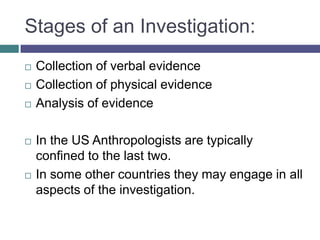
Stages of an Investigation:
   Collection of verbal evidence
   Collection of physical evidence
   Analysis of evidence

   In the US Anthropologists are typically
    confined to the last two.
   In some other countries they may engage in all
    aspects of the investigation.
Ethical issues in Forensic
Anthropology
Your Promise to me!
Questions?
Next Week:
Osteiology and Intro to Forensics
Chapters 2 in Burns

Forensic week 1

  • 1.
    FORENSIC ANTHROPOLOGY SPRING 2011 Prof. Nathan Whitley-Grassi
  • 2.
    What do ForensicAnthropologists do?  Use anthropological knowledge to assist the process of law.  This often involves assisting law enforcement in identifying skeletal remains.  Identify specific characteristics that can be used to identify human remains.  Age and stature  Time since death  Gender  Evidence of Trauma or Pathology  Distinguishing traits
  • 3.
    How does ForensicAnthropology Work?  Osteology  Bones  Odontology  Teeth  Morphometrics  Measurements
  • 4.
  • 5.
    Forensic Anthropology inthe Media Anthropologists do not Anthropologists do usually do usually do the following: the following  Run DNA tests  Assist with collection of human remains  Analyze blood  Cleans bones spatter  Analyzes skeletal  Conduct autopsies material  Analyze ballistics  Examines trauma and  Collect trace pathology to bone evidence  Testifies in court
  • 6.
    Tools of theForensic Anthropologist
  • 7.
    Tools of theForensic Anthropologist  Palpate  Toexamine or explore by touching (an organ or area of the body), usually as a diagnostic aid
  • 8.
    Introduction:  The problem of the unidentified  Violence and Forensic Anthropology  Identification
  • 9.
    Education Requirements:  Requires a post graduate degree in physical, biological or forensic anthropology.  Many have additional training in human biology, anatomy, medicine, nursing or dentistry.  On the Job training!  Constant personal research  Preferred: PhD.
  • 11.
    Objectives of an AnthropologicalInvestigation:  Identification  Determination or cause and manner of death  Estimation of time since death  Collection of physical evidence  Anthropologist – Physical/Biological  Focus on skeletonized remains  Anthropologist – Archeologist  Recovery of evidence
  • 12.
    Forensic Anthropology CHE 113 12 Goal: Biological Profile Includes: 1. General Description 2. Sex of decedent 3. Age of decedent 4. Ancestry of decedent 5. Stature of decedent 6. Assessment of trauma (ante-, peri-, post mortem) 7. Pathologies noted
  • 13.
    Osteology: study ofskeletal remainsach bone studied INDIVIDUALLY CHE 113 13 E 206 Skeletal Bones (total)
  • 14.
    Personal Identification:  Are they Human?  One or more than one individual?  Description? (sex, age, stature, race, handedness)  Unique traits? (abnormaity, prostheses, remodeling)  Who is it? Or at least Who ISN’T it?
  • 15.
    Circumstances of Death:  When did it occur?  Where did it occur? (Here or moved)  Was the grave disturbed?  Buried more than once?  Cause of death?  (gun shot, stabbing, asphyxia)  Manner of death?  (Suicide, homicide, accident, natural)
  • 16.
    Cause v. Mannerof Death: Cause of Death Manner of Death  Medical  Legal determination determination  Based on:  Evidence and  Simple description Opinion!!!! of cause 1. Natural  Could include 2. Accidental underlying causes 3. Suicidal 4. Homicide 5. Undetermined
  • 17.
    Stages of anInvestigation:  Collection of verbal evidence  Collection of physical evidence  Analysis of evidence  In the US Anthropologists are typically confined to the last two.  In some other countries they may engage in all aspects of the investigation.
  • 18.
    Ethical issues inForensic Anthropology Your Promise to me!
  • 19.
    Questions? Next Week: Osteiology andIntro to Forensics Chapters 2 in Burns