Principle and Practice of
Identification of Firearms
Submitted By : Bhavya Bhardwaj
&
Surbhi Bhadoriya
M.Sc. Forensic Science
Submitted To: Dr. Navjot Kaur Kanwal
Assistant Professor
Department of Criminology & Forensic Science
Dr. Harisingh Gour Vishwavidyalaya
Sagar, Madhya Pradesh
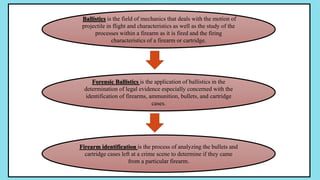
Ballistics is the field of mechanics that deals with the motion of
projectile in flight and characteristics as well as the study of the
processes within a firearm as it is fired and the firing
characteristics of a firearm or cartridge.
Forensic Ballistics is the application of ballistics in the
determination of legal evidence especially concerned with the
identification of firearms, ammunition, bullets, and cartridge
cases.
Firearm identification is the process of analyzing the bullets and
cartridge cases left at a crime scene to determine if they came
from a particular firearm.
Principles of Firearm Identification
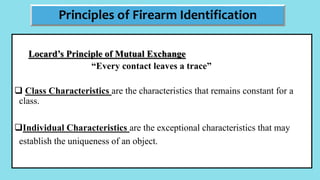
Locard’s Principle of Mutual Exchange
“Every contact leaves a trace”
 Class Characteristics are the characteristics that remains constant for a
class.
Individual Characteristics are the exceptional characteristics that may
establish the uniqueness of an object.
 Rifling
 Calibre
 Firing pin impression
 Breech face marks
 Ejector marks
 Extractor marks
Class Characterisitics
Rifling marks on a Bullet Different marks on a Cartridge Case
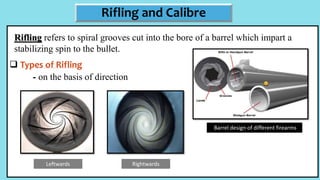
Rifling refers to spiral grooves cut into the bore of a barrel which impart a
stabilizing spin to the bullet.
 Types of Rifling
- on the basis of direction
Rifling and Calibre
Barrel design of different firearms
Leftwards Rightwards
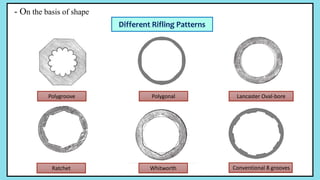
- On the basis of shape
Polygroove Polygonal
Ratchet
Lancaster Oval-bore
Whitworth Conventional 8 grooves
Different Rifling Patterns
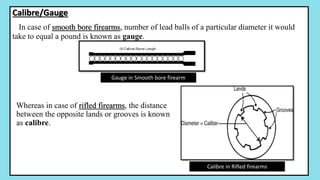
Calibre/Gauge
In case of smooth bore firearms, number of lead balls of a particular diameter it would
take to equal a pound is known as gauge.
Whereas in case of rifled firearms, the distance
between the opposite lands or grooves is known
as calibre.
Calibre in Rifled firearms
Gauge in Smooth bore firearm
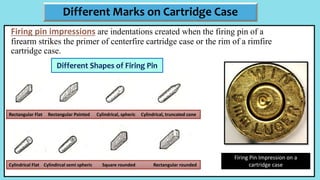
Firing pin impressions are indentations created when the firing pin of a
firearm strikes the primer of centerfire cartridge case or the rim of a rimfire
cartridge case.
Different Marks on Cartridge Case
Firing Pin Impression on a
cartridge case
Rectangular Flat Rectangular Pointed Cylindrical, spheric Cylindrical, truncated cone
Cylindrical Flat Cylindircal semi spheric Square rounded Rectangular rounded
Different Shapes of Firing Pin
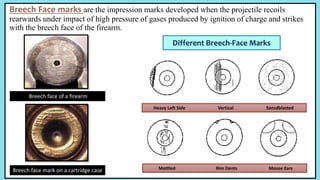
Breech Face marks are the impression marks developed when the projectile recoils
rearwards under impact of high pressure of gases produced by ignition of charge and strikes
with the breech face of the firearm.
Different Breech-Face Marks
Heavy Left Side Vertical Sansdblasted
Mottled Rim Dents Mouse Ears
Breech face of a firearm
Breech face mark on a cartridge case
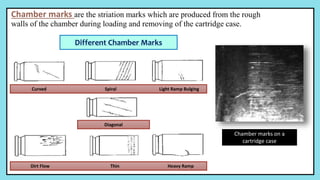
Chamber marks are the striation marks which are produced from the rough
walls of the chamber during loading and removing of the cartridge case.
Different Chamber Marks
Diagonal
Dirt Flow Thin Heavy Ramp
Curved Spiral Light Ramp Bulging
Chamber marks on a
cartridge case
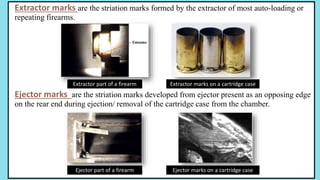
Extractor marks are the striation marks formed by the extractor of most auto-loading or
repeating firearms.
Ejector marks are the striation marks developed from ejector present as an opposing edge
on the rear end during ejection/ removal of the cartridge case from the chamber.
Extractor part of a firearm Extractor marks on a cartridge case
Ejector part of a firearm Ejector marks on a cartridge case
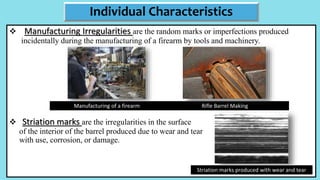
 Manufacturing Irregularities are the random marks or imperfections produced
incidentally during the manufacturing of a firearm by tools and machinery.
 Striation marks are the irregularities in the surface
of the interior of the barrel produced due to wear and tear
with use, corrosion, or damage.
Individual Characteristics
Manufacturing of a firearm Rifle Barrel Making
Striation marks produced with wear and tear
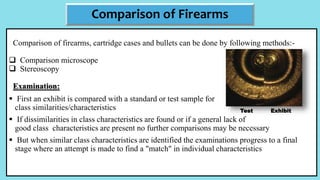
Comparison of firearms, cartridge cases and bullets can be done by following methods:-
 Comparison microscope
 Stereoscopy
Examination:
 First an exhibit is compared with a standard or test sample for
class similarities/characteristics
 If dissimilarities in class characteristics are found or if a general lack of
good class characteristics are present no further comparisons may be necessary
 But when similar class characteristics are identified the examinations progress to a final
stage where an attempt is made to find a "match" in individual characteristics
Comparison of Firearms
Test Exhibit
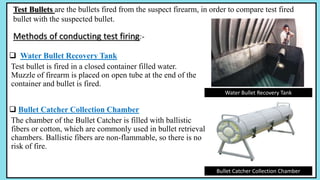
Test Bullets are the bullets fired from the suspect firearm, in order to compare test fired
bullet with the suspected bullet.
Methods of conducting test firing:-
 Water Bullet Recovery Tank
Test bullet is fired in a closed container filled water.
Muzzle of firearm is placed on open tube at the end of the
container and bullet is fired.
 Bullet Catcher Collection Chamber
The chamber of the Bullet Catcher is filled with ballistic
fibers or cotton, which are commonly used in bullet retrieval
chambers. Ballistic fibers are non-flammable, so there is no
risk of fire.
Bullet Catcher Collection Chamber
Water Bullet Recovery Tank
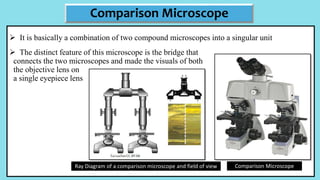
 It is basically a combination of two compound microscopes into a singular unit
 The distinct feature of this microscope is the bridge that
connects the two microscopes and made the visuals of both
the objective lens on
a single eyepiece lens
Comparison Microscope
Comparison MicroscopeRay Diagram of a comparison microscope and field of view
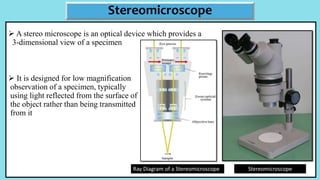
 A stereo microscope is an optical device which provides a
3-dimensional view of a specimen
 It is designed for low magnification
observation of a specimen, typically
using light reflected from the surface of
the object rather than being transmitted
from it
Stereomicroscope
StereomicroscopeRay Diagram of a Stereomicroscope
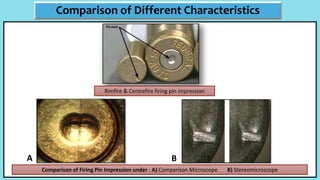
Comparison of Different Characteristics
Rimfire & Centrefire firing pin impression
Comparison of Firing Pin Impression under : A) Comparison Microscope B) Stereomicroscope
A B
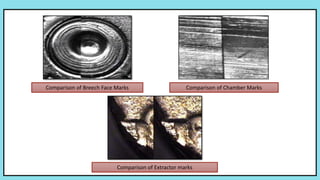
Comparison of Breech Face Marks
Comparison of Extractor marks
Comparison of Chamber Marks
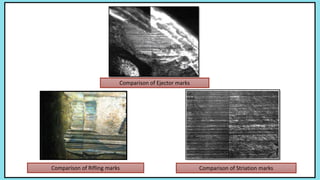
Comparison of Ejector marks
Comparison of Rifling marks Comparison of Striation marks
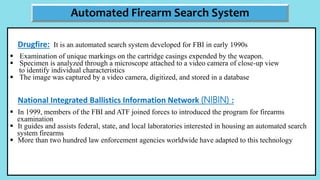
Drugfire: It is an automated search system developed for FBI in early 1990s
 Examination of unique markings on the cartridge casings expended by the weapon.
 Specimen is analyzed through a microscope attached to a video camera of close-up view
to identify individual characteristics
 The image was captured by a video camera, digitized, and stored in a database
National Integrated Ballistics Information Network (NIBIN) :
 In 1999, members of the FBI and ATF joined forces to introduced the program for firearms
examination
 It guides and assists federal, state, and local laboratories interested in housing an automated search
system firearms
 More than two hundred law enforcement agencies worldwide have adapted to this technology
Automated Firearm Search System
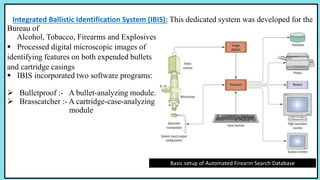
Integrated Ballistic Identification System (IBIS): This dedicated system was developed for the
Bureau of
Alcohol, Tobacco, Firearms and Explosives,
 Processed digital microscopic images of
identifying features on both expended bullets
and cartridge casings
 IBIS incorporated two software programs:
 Bulletproof :- A bullet-analyzing module.
 Brasscatcher :- A cartridge-case-analyzing
module
Basic setup of Automated Firearm Search Database
REFERENCES
 Saferstein, R., 2015, Criminalistics: An Introduction to Forensic Science, 11th edition, New
Jersey, Pearson Publications
 Heard, B.J., 2008, Handbook of Firearms and Ballistics, United Kingdoms, Wiley
Blackwell
 Gun University, https://gununiversity.com/gauge-vs-caliber-whats-the-difference/ Retrived
on 13th October, 2019
 An Introduction to Forensic Firearm Identification- FirearmsID.com,
http://www.firearmsid.com/ Retrived on 30th September, 2019
 Sharma, B.R., 2002, Firearms in Criminal Investigation and Trials, 3rd edition, India,
Universal Law Publishing Co. Pvt. Ltd.
 Microscopy U- The source for Microscopy Education,
https://www.microscopyu.com/techniques/stereomicroscopy/introduction-to-
stereomicroscopy Retrived on 10th October, 2019

Firearms

  • 1.
    Principle and Practiceof Identification of Firearms Submitted By : Bhavya Bhardwaj & Surbhi Bhadoriya M.Sc. Forensic Science Submitted To: Dr. Navjot Kaur Kanwal Assistant Professor Department of Criminology & Forensic Science Dr. Harisingh Gour Vishwavidyalaya Sagar, Madhya Pradesh
  • 2.
    Ballistics is thefield of mechanics that deals with the motion of projectile in flight and characteristics as well as the study of the processes within a firearm as it is fired and the firing characteristics of a firearm or cartridge. Forensic Ballistics is the application of ballistics in the determination of legal evidence especially concerned with the identification of firearms, ammunition, bullets, and cartridge cases. Firearm identification is the process of analyzing the bullets and cartridge cases left at a crime scene to determine if they came from a particular firearm.
  • 3.
    Principles of FirearmIdentification Locard’s Principle of Mutual Exchange “Every contact leaves a trace”  Class Characteristics are the characteristics that remains constant for a class. Individual Characteristics are the exceptional characteristics that may establish the uniqueness of an object.
  • 4.
     Rifling  Calibre Firing pin impression  Breech face marks  Ejector marks  Extractor marks Class Characterisitics Rifling marks on a Bullet Different marks on a Cartridge Case
  • 5.
    Rifling refers tospiral grooves cut into the bore of a barrel which impart a stabilizing spin to the bullet.  Types of Rifling - on the basis of direction Rifling and Calibre Barrel design of different firearms Leftwards Rightwards
  • 6.
    - On thebasis of shape Polygroove Polygonal Ratchet Lancaster Oval-bore Whitworth Conventional 8 grooves Different Rifling Patterns
  • 7.
    Calibre/Gauge In case ofsmooth bore firearms, number of lead balls of a particular diameter it would take to equal a pound is known as gauge. Whereas in case of rifled firearms, the distance between the opposite lands or grooves is known as calibre. Calibre in Rifled firearms Gauge in Smooth bore firearm
  • 8.
    Firing pin impressionsare indentations created when the firing pin of a firearm strikes the primer of centerfire cartridge case or the rim of a rimfire cartridge case. Different Marks on Cartridge Case Firing Pin Impression on a cartridge case Rectangular Flat Rectangular Pointed Cylindrical, spheric Cylindrical, truncated cone Cylindrical Flat Cylindircal semi spheric Square rounded Rectangular rounded Different Shapes of Firing Pin
  • 9.
    Breech Face marksare the impression marks developed when the projectile recoils rearwards under impact of high pressure of gases produced by ignition of charge and strikes with the breech face of the firearm. Different Breech-Face Marks Heavy Left Side Vertical Sansdblasted Mottled Rim Dents Mouse Ears Breech face of a firearm Breech face mark on a cartridge case
  • 10.
    Chamber marks arethe striation marks which are produced from the rough walls of the chamber during loading and removing of the cartridge case. Different Chamber Marks Diagonal Dirt Flow Thin Heavy Ramp Curved Spiral Light Ramp Bulging Chamber marks on a cartridge case
  • 11.
    Extractor marks arethe striation marks formed by the extractor of most auto-loading or repeating firearms. Ejector marks are the striation marks developed from ejector present as an opposing edge on the rear end during ejection/ removal of the cartridge case from the chamber. Extractor part of a firearm Extractor marks on a cartridge case Ejector part of a firearm Ejector marks on a cartridge case
  • 12.
     Manufacturing Irregularitiesare the random marks or imperfections produced incidentally during the manufacturing of a firearm by tools and machinery.  Striation marks are the irregularities in the surface of the interior of the barrel produced due to wear and tear with use, corrosion, or damage. Individual Characteristics Manufacturing of a firearm Rifle Barrel Making Striation marks produced with wear and tear
  • 13.
    Comparison of firearms,cartridge cases and bullets can be done by following methods:-  Comparison microscope  Stereoscopy Examination:  First an exhibit is compared with a standard or test sample for class similarities/characteristics  If dissimilarities in class characteristics are found or if a general lack of good class characteristics are present no further comparisons may be necessary  But when similar class characteristics are identified the examinations progress to a final stage where an attempt is made to find a "match" in individual characteristics Comparison of Firearms Test Exhibit
  • 14.
    Test Bullets arethe bullets fired from the suspect firearm, in order to compare test fired bullet with the suspected bullet. Methods of conducting test firing:-  Water Bullet Recovery Tank Test bullet is fired in a closed container filled water. Muzzle of firearm is placed on open tube at the end of the container and bullet is fired.  Bullet Catcher Collection Chamber The chamber of the Bullet Catcher is filled with ballistic fibers or cotton, which are commonly used in bullet retrieval chambers. Ballistic fibers are non-flammable, so there is no risk of fire. Bullet Catcher Collection Chamber Water Bullet Recovery Tank
  • 15.
     It isbasically a combination of two compound microscopes into a singular unit  The distinct feature of this microscope is the bridge that connects the two microscopes and made the visuals of both the objective lens on a single eyepiece lens Comparison Microscope Comparison MicroscopeRay Diagram of a comparison microscope and field of view
  • 16.
     A stereomicroscope is an optical device which provides a 3-dimensional view of a specimen  It is designed for low magnification observation of a specimen, typically using light reflected from the surface of the object rather than being transmitted from it Stereomicroscope StereomicroscopeRay Diagram of a Stereomicroscope
  • 17.
    Comparison of DifferentCharacteristics Rimfire & Centrefire firing pin impression Comparison of Firing Pin Impression under : A) Comparison Microscope B) Stereomicroscope A B
  • 18.
    Comparison of BreechFace Marks Comparison of Extractor marks Comparison of Chamber Marks
  • 19.
    Comparison of Ejectormarks Comparison of Rifling marks Comparison of Striation marks
  • 20.
    Drugfire: It isan automated search system developed for FBI in early 1990s  Examination of unique markings on the cartridge casings expended by the weapon.  Specimen is analyzed through a microscope attached to a video camera of close-up view to identify individual characteristics  The image was captured by a video camera, digitized, and stored in a database National Integrated Ballistics Information Network (NIBIN) :  In 1999, members of the FBI and ATF joined forces to introduced the program for firearms examination  It guides and assists federal, state, and local laboratories interested in housing an automated search system firearms  More than two hundred law enforcement agencies worldwide have adapted to this technology Automated Firearm Search System
  • 21.
    Integrated Ballistic IdentificationSystem (IBIS): This dedicated system was developed for the Bureau of Alcohol, Tobacco, Firearms and Explosives,  Processed digital microscopic images of identifying features on both expended bullets and cartridge casings  IBIS incorporated two software programs:  Bulletproof :- A bullet-analyzing module.  Brasscatcher :- A cartridge-case-analyzing module Basic setup of Automated Firearm Search Database
  • 22.
    REFERENCES  Saferstein, R.,2015, Criminalistics: An Introduction to Forensic Science, 11th edition, New Jersey, Pearson Publications  Heard, B.J., 2008, Handbook of Firearms and Ballistics, United Kingdoms, Wiley Blackwell  Gun University, https://gununiversity.com/gauge-vs-caliber-whats-the-difference/ Retrived on 13th October, 2019  An Introduction to Forensic Firearm Identification- FirearmsID.com, http://www.firearmsid.com/ Retrived on 30th September, 2019  Sharma, B.R., 2002, Firearms in Criminal Investigation and Trials, 3rd edition, India, Universal Law Publishing Co. Pvt. Ltd.  Microscopy U- The source for Microscopy Education, https://www.microscopyu.com/techniques/stereomicroscopy/introduction-to- stereomicroscopy Retrived on 10th October, 2019