PT.MANAGEMENT OF SHAFT
OF HUMERUS FRACTURE
Presenter:Mr.Aragya Khadka
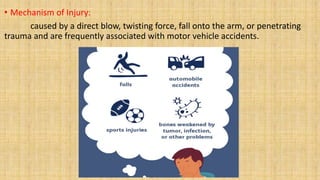
• Mechanism of Injury:
caused by a direct blow, twisting force, fall onto the arm, or penetrating
trauma and are frequently associated with motor vehicle accidents.
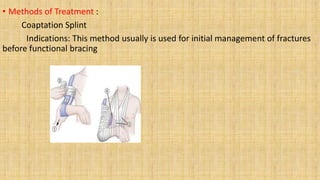
• Methods of Treatment :
Coaptation Splint
Indications: This method usually is used for initial management of fractures
before functional bracing
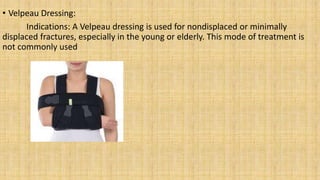
• Velpeau Dressing:
Indications: A Velpeau dressing is used for nondisplaced or minimally
displaced fractures, especially in the young or elderly. This mode of treatment is
not commonly used
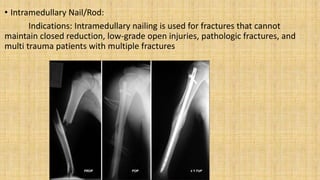
• Intramedullary Nail/Rod:
Indications: Intramedullary nailing is used for fractures that cannot
maintain closed reduction, low-grade open injuries, pathologic fractures, and
multi trauma patients with multiple fractures
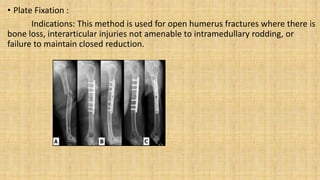
• Plate Fixation :
Indications: This method is used for open humerus fractures where there is
bone loss, interarticular injuries not amenable to intramedullary rodding, or
failure to maintain closed reduction.
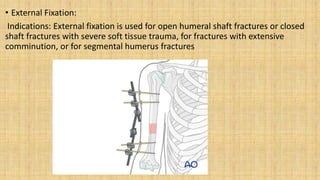
• External Fixation:
Indications: External fixation is used for open humeral shaft fractures or closed
shaft fractures with severe soft tissue trauma, for fractures with extensive
comminution, or for segmental humerus fractures
Expected Time of Bone Healing :
Eight to 12 weeks in uncomplicated cases.
Expected Duration of Rehabilitation :
Twelve to 16 weeks.
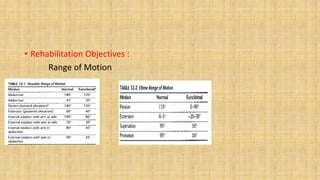
• Rehabilitation Objectives :
Range of Motion
• Muscle Strength:
Improve the strength of the following muscles that are injured secondary to the
fracture;
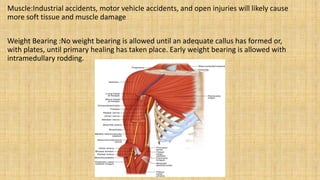
Pectoralis major: shoulder adductor
Deltoid: shoulder flexor, extensor, and abductor
Biceps: elbow flexor and shoulder flexor
Triceps: elbow extensor
The rotator cuff muscles, supraspinatus, infraspinatus, and teres minor do
not usually require aggressive rehabilitation.
• Functional Goals:
Improve and restore the function of the involved extremity in self-care
and personal hygiene.
Shoulder movement and strength are vital in almost all sports activities.
• Special Considerations of the Fracture :
Open Fractures :The more severe the soft tissue injury, the more appropriate is treatment with
external fixation.
Pathologic Fractures :Fractures of pathologic bone (e.g., from osteoporosis, Paget's disease,
metatastic disease) are best managed using reamed intramedullary rodding because plates rely
on strong bone.
Age :Elderly patients may be more difficult to immobilize because they are less able to tolerate
treatment
Joint Stiffness :Elderly patients in particular need early, aggressive rehabilitation to avoid loss of
joint motion. The shoulder and elbow are particularly susceptible when closed treatment is
undertaken because of immobilization.
• Associated Injuries :
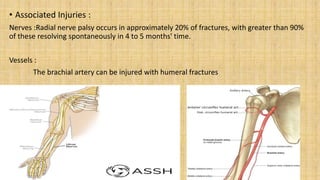
Nerves :Radial nerve palsy occurs in approximately 20% of fractures, with greater than 90%
of these resolving spontaneously in 4 to 5 months' time.
Vessels :
The brachial artery can be injured with humeral fractures
Muscle:Industrial accidents, motor vehicle accidents, and open injuries will likely cause
more soft tissue and muscle damage
Weight Bearing :No weight bearing is allowed until an adequate callus has formed or,
with plates, until primary healing has taken place. Early weight bearing is allowed with
intramedullary rodding.
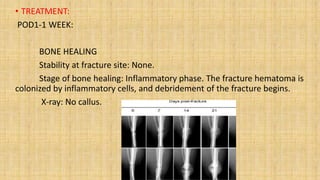
• TREATMENT:
POD1-1 WEEK:
BONE HEALING
Stability at fracture site: None.
Stage of bone healing: Inflammatory phase. The fracture hematoma is
colonized by inflammatory cells, and debridement of the fracture begins.
X-ray: No callus.
Physical examination:
• assess complaints of pain, swelling, and paresthesia.
• Check capillary refill and sensation, as well as the active and passive range of
motion of the wrist and digits.
• Swelling and discoloration of the arm and wrist
• radial nerve function
Intervention:
• Weight Bearing :
Early weight bearing is impossible unless the fracture was treated
with an intramedullary rod.
• Range of Motion :
No range of motion is allowed to the shoulder and elbow because
they are in a splint or brace.
Active range of motion is allowed to the wrist and digits to reduce
dependent edema and stiffness
• Muscle Strength
No strengthening exercises are prescribed to the shoulder or elbow
• Functional Activities:
The patient should use the uninvolved extremity for self-care and
personal hygiene.
• Gait/ Ambulation:
Usually there is no arm swing at this stage, because of pain
Special considerations:
• Open Reduction/Intramedullary Nail/Rod:
Depending on the stability of the fixation, the patient should be
encouraged to use the affected extremity for light activities such as writing .
active-assistive range of motion and active range of motion are allowed to
the shoulder.
Gentle gravity-assisted pendulum exercises are instituted to the shoulder
toward the end of first week.
No lifting is allowed.
• 2-4 weeks:
BONE HEALING:
Stability at fracture site: None to minimal.
Stage of bone healing: beginning of reparative phase. Formation of
osteoblasts.
X-ray : none to very early callus.
• Weight Bearing :
No weight bearing is permitted with external fixation, a plate, or a
functional brace.
Limited weight bearing is permitted for other types of treatment (e.g.,
rod).
• Range of Motion :
Active and active-assistive range of motion is prescribed to the
shoulder, elbow, and wrist.
• Muscle Strength :
No strengthening exercises are prescribed to the shoulder or elbow.
Prescribe isotonic exercises to the forearm muscles with wrist flexion and
extension and ball-squeezing exercises.
• Functional Activities:
The patient should use the uninvolved extremity for self-care and
personal hygiene.
• Gait/ Ambulation:
Arm swing during gait is minimal secondary to pain and discomfort.
Special Considerations:
• Open Reduction/Intramedullary Nail/Rod/Plate fixation
Full active and active-assistive range of motion is allowed to the shoulder
and elbow.
The involved extremity is used for feeding, light grooming, and writing
activities. No heavy lifting is allowed.
Limited weight bearing is allowed.
• 4-6 weeks
Bone Healing:
Stability at fracture site:Bridging callus and moderate stability.
Stage of bone healing: Reparative phase. Organization of callus continues
and lamellar bone deposition begins .Bridging callus is still weaker than normal
bone.
X-ray: Briding callus is visible.
• Weight Bearing:
In a functional brace, the patient may begin to feel comfortable bearing
some weight on the arm.
With an intramedullary rod, weight bearing should be relatively pain free
and encouraged.
With plate fixation, light weight bearing is allowed.
• Range of Motion :
Active and active-assistive range of motion is instituted to the shoulder and
elbow, wrist, and digits.
Continue pendulum exercises.
Continue supination and pronation of the forearm.
• Muscle Strength :
Continue strengthening exercises to the wrist and digits with isotonic exercises to the
forearm muscles against resistance.
At the end of 6 weeks, gentle isometric exercises may be instituted to the biceps and
triceps if good callus formation is present.
• Functional Activities :
The patient may use the involved extremity for basic self-care and personal hygiene.
No heavy lifting is allowed.
• Gait/ Ambulation:
Arm swing should be returning at this point.
Intramedullary rodding treatment allows the earliest return.
Special Considerations:
Open Reduction/Intramedullary Nail/Rod /Plate fixation
The patient may continue to use the extremity for basic activities of daily
living, other than lifting heavy objects.
Continue full range of motion to the shoulder and elbow.
• 8-12 weeks:
Bone healing:
Stability at fracture site: Stable callus.
Stage of bone healing: Remodeling phase. Woven bone is replaced by
lamellar bone. Remodeling occurs over months to years.
X-ray: Abundant callus, fracture line begins to disappear, reconstitution of
medullary canal. Nonunion is clearly evident.
• Weight Bearing :
For fractures treated with an intramedullary rod, weight bearing should be
painless.
If healing has progressed, the patient can continue progressive weight
bearing on a fracture treated with a plate or by external fixation.
• Range of Motion :
Full range of motion in all planes is instituted to the shoulder and elbow.
Once there is good callus formation, passive range of motion is encouraged
if full range is not present at these joints.
• Muscle Strength:
Continue isometric exercises to the shoulder and elbow.
Progressive resistive exercises can be instituted with a gradual increase in
weights to the shoulder and elbow.
• Functional Activities :
The involved extremity may now be used in selfcare and personal hygiene.
Light lifting is allowed.
No heavy contact sports are allowed.
• Gait/ Ambulation:
Arm swing should now be fully integrated into the gait.
Special considerations:
Open Reduction/Intramedullary Nail/Rod/plate fixation:
The patient may begin light lifting.
Stress the importance of the possibility of refracture from overlifting.
The patient should understand that this risk decreases over time.
No sports are allowed
• LONG-TERM CONSIDERATIONS AND PROBLEMS:
Uneventful healing is the rule in uncomplicated closed fractures.
Transverse fractures and open fractures have a higher incidence of
nonunion.
Reflex sympathetic dystrophy is a concern after treatment has been
discontinued.
Radial nerve exploration may be reconsidered if there is no return of
function after four months.
Plate removal is usually not necessary.
RSD is a post-traumatic disorder characterized by a non-
dermatomal distributed, severe, continuous pain in the affected limb
and is associated with sensory, motor, vasomotor, sudomotor, and
trophic disturbances.
• References:
Treatment and Rehabilitation of Fractures: Stanley Hoppenfield.
Handbook of orthopaedics rehabilitation . S. Bent Brotzman
Orthopaedics and Applied Physiotherapy: Jayant Joshi

Humerus fracture

  • 1.
    PT.MANAGEMENT OF SHAFT OFHUMERUS FRACTURE Presenter:Mr.Aragya Khadka
  • 2.
    • Mechanism ofInjury: caused by a direct blow, twisting force, fall onto the arm, or penetrating trauma and are frequently associated with motor vehicle accidents.
  • 3.
    • Methods ofTreatment : Coaptation Splint Indications: This method usually is used for initial management of fractures before functional bracing
  • 4.
    • Velpeau Dressing: Indications:A Velpeau dressing is used for nondisplaced or minimally displaced fractures, especially in the young or elderly. This mode of treatment is not commonly used
  • 5.
    • Intramedullary Nail/Rod: Indications:Intramedullary nailing is used for fractures that cannot maintain closed reduction, low-grade open injuries, pathologic fractures, and multi trauma patients with multiple fractures
  • 6.
    • Plate Fixation: Indications: This method is used for open humerus fractures where there is bone loss, interarticular injuries not amenable to intramedullary rodding, or failure to maintain closed reduction.
  • 7.
    • External Fixation: Indications:External fixation is used for open humeral shaft fractures or closed shaft fractures with severe soft tissue trauma, for fractures with extensive comminution, or for segmental humerus fractures
  • 8.
    Expected Time ofBone Healing : Eight to 12 weeks in uncomplicated cases. Expected Duration of Rehabilitation : Twelve to 16 weeks.
  • 9.
  • 10.
    • Muscle Strength: Improvethe strength of the following muscles that are injured secondary to the fracture; Pectoralis major: shoulder adductor Deltoid: shoulder flexor, extensor, and abductor Biceps: elbow flexor and shoulder flexor Triceps: elbow extensor The rotator cuff muscles, supraspinatus, infraspinatus, and teres minor do not usually require aggressive rehabilitation.
  • 11.
    • Functional Goals: Improveand restore the function of the involved extremity in self-care and personal hygiene. Shoulder movement and strength are vital in almost all sports activities.
  • 12.
    • Special Considerationsof the Fracture : Open Fractures :The more severe the soft tissue injury, the more appropriate is treatment with external fixation. Pathologic Fractures :Fractures of pathologic bone (e.g., from osteoporosis, Paget's disease, metatastic disease) are best managed using reamed intramedullary rodding because plates rely on strong bone. Age :Elderly patients may be more difficult to immobilize because they are less able to tolerate treatment Joint Stiffness :Elderly patients in particular need early, aggressive rehabilitation to avoid loss of joint motion. The shoulder and elbow are particularly susceptible when closed treatment is undertaken because of immobilization.
  • 13.
    • Associated Injuries: Nerves :Radial nerve palsy occurs in approximately 20% of fractures, with greater than 90% of these resolving spontaneously in 4 to 5 months' time. Vessels : The brachial artery can be injured with humeral fractures
  • 14.
    Muscle:Industrial accidents, motorvehicle accidents, and open injuries will likely cause more soft tissue and muscle damage Weight Bearing :No weight bearing is allowed until an adequate callus has formed or, with plates, until primary healing has taken place. Early weight bearing is allowed with intramedullary rodding.
  • 15.
    • TREATMENT: POD1-1 WEEK: BONEHEALING Stability at fracture site: None. Stage of bone healing: Inflammatory phase. The fracture hematoma is colonized by inflammatory cells, and debridement of the fracture begins. X-ray: No callus.
  • 16.
    Physical examination: • assesscomplaints of pain, swelling, and paresthesia. • Check capillary refill and sensation, as well as the active and passive range of motion of the wrist and digits. • Swelling and discoloration of the arm and wrist • radial nerve function
  • 17.
    Intervention: • Weight Bearing: Early weight bearing is impossible unless the fracture was treated with an intramedullary rod. • Range of Motion : No range of motion is allowed to the shoulder and elbow because they are in a splint or brace. Active range of motion is allowed to the wrist and digits to reduce dependent edema and stiffness • Muscle Strength No strengthening exercises are prescribed to the shoulder or elbow
  • 18.
    • Functional Activities: Thepatient should use the uninvolved extremity for self-care and personal hygiene. • Gait/ Ambulation: Usually there is no arm swing at this stage, because of pain
  • 19.
    Special considerations: • OpenReduction/Intramedullary Nail/Rod: Depending on the stability of the fixation, the patient should be encouraged to use the affected extremity for light activities such as writing . active-assistive range of motion and active range of motion are allowed to the shoulder. Gentle gravity-assisted pendulum exercises are instituted to the shoulder toward the end of first week. No lifting is allowed.
  • 20.
    • 2-4 weeks: BONEHEALING: Stability at fracture site: None to minimal. Stage of bone healing: beginning of reparative phase. Formation of osteoblasts. X-ray : none to very early callus.
  • 21.
    • Weight Bearing: No weight bearing is permitted with external fixation, a plate, or a functional brace. Limited weight bearing is permitted for other types of treatment (e.g., rod). • Range of Motion : Active and active-assistive range of motion is prescribed to the shoulder, elbow, and wrist.
  • 22.
    • Muscle Strength: No strengthening exercises are prescribed to the shoulder or elbow. Prescribe isotonic exercises to the forearm muscles with wrist flexion and extension and ball-squeezing exercises. • Functional Activities: The patient should use the uninvolved extremity for self-care and personal hygiene. • Gait/ Ambulation: Arm swing during gait is minimal secondary to pain and discomfort.
  • 23.
    Special Considerations: • OpenReduction/Intramedullary Nail/Rod/Plate fixation Full active and active-assistive range of motion is allowed to the shoulder and elbow. The involved extremity is used for feeding, light grooming, and writing activities. No heavy lifting is allowed. Limited weight bearing is allowed.
  • 24.
    • 4-6 weeks BoneHealing: Stability at fracture site:Bridging callus and moderate stability. Stage of bone healing: Reparative phase. Organization of callus continues and lamellar bone deposition begins .Bridging callus is still weaker than normal bone. X-ray: Briding callus is visible.
  • 25.
    • Weight Bearing: Ina functional brace, the patient may begin to feel comfortable bearing some weight on the arm. With an intramedullary rod, weight bearing should be relatively pain free and encouraged. With plate fixation, light weight bearing is allowed. • Range of Motion : Active and active-assistive range of motion is instituted to the shoulder and elbow, wrist, and digits. Continue pendulum exercises. Continue supination and pronation of the forearm.
  • 26.
    • Muscle Strength: Continue strengthening exercises to the wrist and digits with isotonic exercises to the forearm muscles against resistance. At the end of 6 weeks, gentle isometric exercises may be instituted to the biceps and triceps if good callus formation is present. • Functional Activities : The patient may use the involved extremity for basic self-care and personal hygiene. No heavy lifting is allowed.
  • 27.
    • Gait/ Ambulation: Armswing should be returning at this point. Intramedullary rodding treatment allows the earliest return. Special Considerations: Open Reduction/Intramedullary Nail/Rod /Plate fixation The patient may continue to use the extremity for basic activities of daily living, other than lifting heavy objects. Continue full range of motion to the shoulder and elbow.
  • 28.
    • 8-12 weeks: Bonehealing: Stability at fracture site: Stable callus. Stage of bone healing: Remodeling phase. Woven bone is replaced by lamellar bone. Remodeling occurs over months to years. X-ray: Abundant callus, fracture line begins to disappear, reconstitution of medullary canal. Nonunion is clearly evident.
  • 29.
    • Weight Bearing: For fractures treated with an intramedullary rod, weight bearing should be painless. If healing has progressed, the patient can continue progressive weight bearing on a fracture treated with a plate or by external fixation. • Range of Motion : Full range of motion in all planes is instituted to the shoulder and elbow. Once there is good callus formation, passive range of motion is encouraged if full range is not present at these joints.
  • 30.
    • Muscle Strength: Continueisometric exercises to the shoulder and elbow. Progressive resistive exercises can be instituted with a gradual increase in weights to the shoulder and elbow. • Functional Activities : The involved extremity may now be used in selfcare and personal hygiene. Light lifting is allowed. No heavy contact sports are allowed. • Gait/ Ambulation: Arm swing should now be fully integrated into the gait.
  • 31.
    Special considerations: Open Reduction/IntramedullaryNail/Rod/plate fixation: The patient may begin light lifting. Stress the importance of the possibility of refracture from overlifting. The patient should understand that this risk decreases over time. No sports are allowed
  • 32.
    • LONG-TERM CONSIDERATIONSAND PROBLEMS: Uneventful healing is the rule in uncomplicated closed fractures. Transverse fractures and open fractures have a higher incidence of nonunion. Reflex sympathetic dystrophy is a concern after treatment has been discontinued. Radial nerve exploration may be reconsidered if there is no return of function after four months. Plate removal is usually not necessary. RSD is a post-traumatic disorder characterized by a non- dermatomal distributed, severe, continuous pain in the affected limb and is associated with sensory, motor, vasomotor, sudomotor, and trophic disturbances.
  • 33.
    • References: Treatment andRehabilitation of Fractures: Stanley Hoppenfield. Handbook of orthopaedics rehabilitation . S. Bent Brotzman Orthopaedics and Applied Physiotherapy: Jayant Joshi