AOTrauma Principles Course
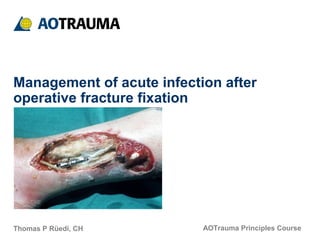
Management of acute infection after
operative fracture fixation
Thomas P Rüedi, CH
“The risk of infection remains the crucial
issue of internal fixation”—Martin Allgöwer, 1975
Today, 30 years later, this statement is still valid!
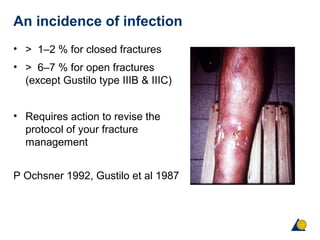
An incidence of infection
• > 1–2 % for closed fractures
• > 6–7 % for open fractures
(except Gustilo type IIIB & IIIC)
• Requires action to revise the
protocol of your fracture
management
P Ochsner 1992, Gustilo et al 1987
Risk factors for surgical site infection
Host related:
• Older age
• Co-morbidity
(diabetes, obesity,
arteriosclerosis, malnutrition,
nicotine, etc)
• Drugs (steroids, immuno-
suppression, antibiotics)
• Remote infections (dental, etc)
• Preoperative hospitalization
Procedure related:
• Emergency operation
• Duration of surgery
• Surgical technique
• Timing of surgery
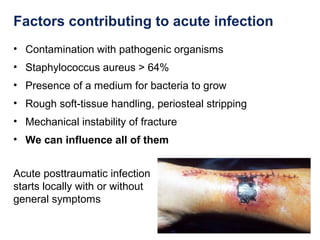
Factors contributing to acute infection
• Contamination with pathogenic organisms
• Staphylococcus aureus > 64%
• Presence of a medium for bacteria to grow
• Rough soft-tissue handling, periosteal stripping
• Mechanical instability of fracture
• We can influence all of them
Acute posttraumatic infection
starts locally with or without
general symptoms
How to reduce the risk of contamination
• Staphylococcus aureus are everywhere in our hospitals
• Discipline in patient management is essential:
- good cleaning of our hospitals
- wearing face masks
- repeated hand disinfection―mandatory to disinfect
hands for each patient contact
- type and time of hair removal
- correct skin disinfection
- no “small talk” during surgery
- sterile gloves for dressing changes
Strict isolation if MRSA (methicillin-resistant
Staphylococcus aureus)is suspected (referrals)
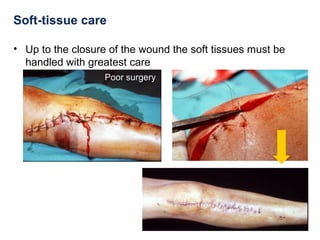
Soft-tissue care
• Up to the closure of the wound the soft tissues must be
handled with greatest care
Poor surgery
Influences on bacterial growth
• All bacteria require a medium with which to grow.
• The commonest medium following ORIF is a
haematoma, seroma or fluid collection around an
implant.
• Such a medium can be reduced by meticulous
haemostasis and the use of suction drains.
• The surface structure of an implant is also critical when
determining the critical size of an innoculum which will
result in an infection.
Influences on infection―dead soft
tissues
• Skin necrosis can be prevented by not closing wounds
that are too tight.
• Damage to muscle and periosteum can be reduced by
meticulous surgical technique—in open cases, careful
debridement of all necrotic tissue is vital.
• Thermal damage can be caused either by cauterization
or occasionally by drilling.
• Reduce thermal damage by ensuring drill tips are sharp
and lubricated.
Influences on infection―dead hard
tissue
• Devascularized bone and foreign bodies are good
culture media for bacterial growth.
• Risk of infection can be minimized by excising all
devascularized bone and removing all foreign bodies.
• Adequate debridement in an open fracture is the most
important surgical maneuver in the prevention of
infection.
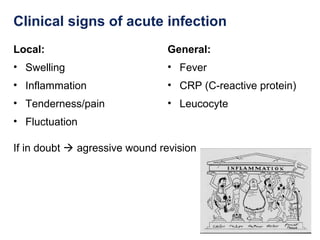
Clinical signs of acute infection
Local:
• Swelling
• Inflammation
• Tenderness/pain
• Fluctuation
If in doubt  agressive wound revision
General:
• Fever
• CRP (C-reactive protein)
• Leucocyte
Wound revision in acute infection
• Wash-out with lots of fluid (+/- antibiotics) > dilution
• Debridement (repeated) of all dead tissue, fibrin or pus
• Checking stability of fixation and implants:
- To be improved if inadequate
• Gentamycin beads? antibiotic sponges?
• Wound closure depending on local situation
• Temporary bedrest (2–3 days)
• Antibiotics for 6 weeks (according to culture test)
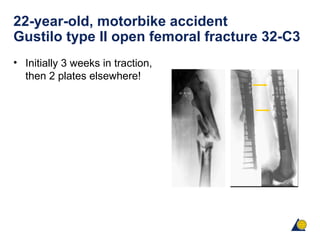
22-year-old, motorbike accident
Gustilo type II open femoral fracture 32-C3
• Initially 3 weeks in traction,
then 2 plates elsewhere!
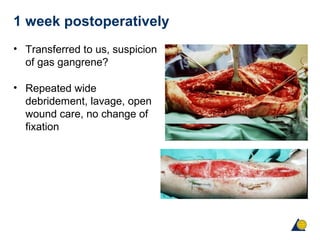
1 week postoperatively
• Transferred to us, suspicion
of gas gangrene?
• Repeated wide
debridement, lavage, open
wound care, no change of
fixation
Infection and implants of fracture fixation
• Although you should leave in fixation devices in fractures
that are stably fixed
• Be aware that infection is a common cause of loosening,
especially of screws
• Almost 50% of implants need to be removed in
established deep infections, even if the implants were
stable at the time of first diagnosis of infection
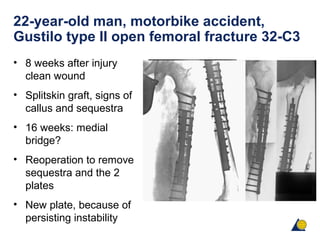
22-year-old man, motorbike accident,
Gustilo type II open femoral fracture 32-C3
• 8 weeks after injury
clean wound
• Splitskin graft, signs of
callus and sequestra
• 16 weeks: medial
bridge?
• Reoperation to remove
sequestra and the 2
plates
• New plate, because of
persisting instability
22-year-old man, motorbike accident,
Gustilo type II open femoral fracture 32-C3
• Uneventful healing, immediate active motion & ambulation
• 39 weeks: follow-up with good function, full weightbearing,
• Implant removal after 18 months
• Result after 2 years, back to work and sports, muscle
herniation
Infection and implants for fracture
fixation
• Any implant/device providing mechanical stability should
stay in place
• Loose implants must be removed or replaced to optimize
the fixation
• A rigidly fixed fracture will unite in spite of infection
W W Rittmann & S Perren, 1974
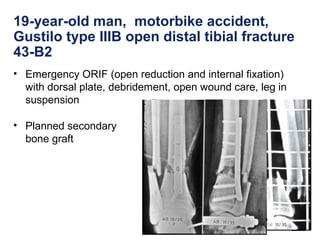
19-year-old man, motorbike accident,
Gustilo type IIIB open distal tibial fracture
43-B2
• Emergency ORIF (open reduction and internal fixation)
with dorsal plate, debridement, open wound care, leg in
suspension
• Planned secondary
bone graft
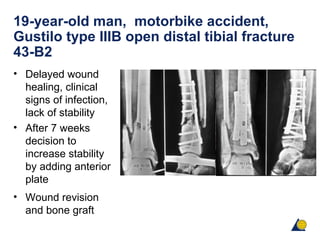
19-year-old man, motorbike accident,
Gustilo type IIIB open distal tibial fracture
43-B2
• Delayed wound
healing, clinical
signs of infection,
lack of stability
• After 7 weeks
decision to
increase stability
by adding anterior
plate
• Wound revision
and bone graft
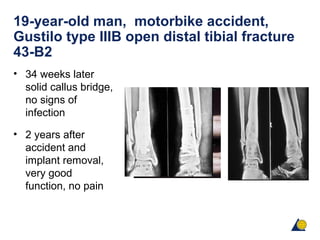
19-year-old man, motorbike accident,
Gustilo type IIIB open distal tibial fracture
43-B2
• 34 weeks later
solid callus bridge,
no signs of
infection
• 2 years after
accident and
implant removal,
very good
function, no pain
Role of antibiotics in fracture surgery
Prophylactic antibiotics reduce risk of contamination:
• Perioperative (before tourniquet!)
• Single dose (1st/2nd generat. Cefalosporin) max. 24
hours
Burke JF 1961, Surgery
• Prophylactic antibiotics are not a substitute for a
careful surgical technique
Bodoki et al l993,
Boxma et al 1996
Summary
• Incidence of infection after operative fixation of closed
fractures should be < 1-2%
• Appropiate “behaviour” helps to reduce the risks
• In case of acute infection immediate action is mandatory
• Thorough debridement of all dead tissue
• Implants providing stability may remain “in situ”
• Mechanical stability and vital tissues are essential to
obtain bony union
• Prophylactic single dose antibiotics are effective, but
cannot replace poor surgery
Albin Lambotte in 1902
“Opening the site of a fracture is not serious provided that
one avoids surgery of contused tissue, bruised and
infiltrated with blood and generally disposed to invasion by
pyogenic germs.
All that creates the danger of infection is bad surgery,
where the surgeon, uncertain of his technique fumbles and
at length infects all recesses of the wound with his fingers.
This danger is avoidable and must be averted. Before
taking the scalpel the surgeon planes his task in detail, so
to perform the operation rapidly and precisely without
creating additional damage”.

Infection

  • 1.
    AOTrauma Principles Course Managementof acute infection after operative fracture fixation Thomas P Rüedi, CH
  • 2.
    “The risk ofinfection remains the crucial issue of internal fixation”—Martin Allgöwer, 1975 Today, 30 years later, this statement is still valid!
  • 3.
    An incidence ofinfection • > 1–2 % for closed fractures • > 6–7 % for open fractures (except Gustilo type IIIB & IIIC) • Requires action to revise the protocol of your fracture management P Ochsner 1992, Gustilo et al 1987
  • 4.
    Risk factors forsurgical site infection Host related: • Older age • Co-morbidity (diabetes, obesity, arteriosclerosis, malnutrition, nicotine, etc) • Drugs (steroids, immuno- suppression, antibiotics) • Remote infections (dental, etc) • Preoperative hospitalization Procedure related: • Emergency operation • Duration of surgery • Surgical technique • Timing of surgery
  • 5.
    Factors contributing toacute infection • Contamination with pathogenic organisms • Staphylococcus aureus > 64% • Presence of a medium for bacteria to grow • Rough soft-tissue handling, periosteal stripping • Mechanical instability of fracture • We can influence all of them Acute posttraumatic infection starts locally with or without general symptoms
  • 6.
    How to reducethe risk of contamination • Staphylococcus aureus are everywhere in our hospitals • Discipline in patient management is essential: - good cleaning of our hospitals - wearing face masks - repeated hand disinfection―mandatory to disinfect hands for each patient contact - type and time of hair removal - correct skin disinfection - no “small talk” during surgery - sterile gloves for dressing changes Strict isolation if MRSA (methicillin-resistant Staphylococcus aureus)is suspected (referrals)
  • 7.
    Soft-tissue care • Upto the closure of the wound the soft tissues must be handled with greatest care Poor surgery
  • 8.
    Influences on bacterialgrowth • All bacteria require a medium with which to grow. • The commonest medium following ORIF is a haematoma, seroma or fluid collection around an implant. • Such a medium can be reduced by meticulous haemostasis and the use of suction drains. • The surface structure of an implant is also critical when determining the critical size of an innoculum which will result in an infection.
  • 9.
    Influences on infection―deadsoft tissues • Skin necrosis can be prevented by not closing wounds that are too tight. • Damage to muscle and periosteum can be reduced by meticulous surgical technique—in open cases, careful debridement of all necrotic tissue is vital. • Thermal damage can be caused either by cauterization or occasionally by drilling. • Reduce thermal damage by ensuring drill tips are sharp and lubricated.
  • 10.
    Influences on infection―deadhard tissue • Devascularized bone and foreign bodies are good culture media for bacterial growth. • Risk of infection can be minimized by excising all devascularized bone and removing all foreign bodies. • Adequate debridement in an open fracture is the most important surgical maneuver in the prevention of infection.
  • 11.
    Clinical signs ofacute infection Local: • Swelling • Inflammation • Tenderness/pain • Fluctuation If in doubt  agressive wound revision General: • Fever • CRP (C-reactive protein) • Leucocyte
  • 12.
    Wound revision inacute infection • Wash-out with lots of fluid (+/- antibiotics) > dilution • Debridement (repeated) of all dead tissue, fibrin or pus • Checking stability of fixation and implants: - To be improved if inadequate • Gentamycin beads? antibiotic sponges? • Wound closure depending on local situation • Temporary bedrest (2–3 days) • Antibiotics for 6 weeks (according to culture test)
  • 13.
    22-year-old, motorbike accident Gustilotype II open femoral fracture 32-C3 • Initially 3 weeks in traction, then 2 plates elsewhere!
  • 14.
    1 week postoperatively •Transferred to us, suspicion of gas gangrene? • Repeated wide debridement, lavage, open wound care, no change of fixation
  • 15.
    Infection and implantsof fracture fixation • Although you should leave in fixation devices in fractures that are stably fixed • Be aware that infection is a common cause of loosening, especially of screws • Almost 50% of implants need to be removed in established deep infections, even if the implants were stable at the time of first diagnosis of infection
  • 16.
    22-year-old man, motorbikeaccident, Gustilo type II open femoral fracture 32-C3 • 8 weeks after injury clean wound • Splitskin graft, signs of callus and sequestra • 16 weeks: medial bridge? • Reoperation to remove sequestra and the 2 plates • New plate, because of persisting instability
  • 17.
    22-year-old man, motorbikeaccident, Gustilo type II open femoral fracture 32-C3 • Uneventful healing, immediate active motion & ambulation • 39 weeks: follow-up with good function, full weightbearing, • Implant removal after 18 months • Result after 2 years, back to work and sports, muscle herniation
  • 18.
    Infection and implantsfor fracture fixation • Any implant/device providing mechanical stability should stay in place • Loose implants must be removed or replaced to optimize the fixation • A rigidly fixed fracture will unite in spite of infection W W Rittmann & S Perren, 1974
  • 19.
    19-year-old man, motorbikeaccident, Gustilo type IIIB open distal tibial fracture 43-B2 • Emergency ORIF (open reduction and internal fixation) with dorsal plate, debridement, open wound care, leg in suspension • Planned secondary bone graft
  • 20.
    19-year-old man, motorbikeaccident, Gustilo type IIIB open distal tibial fracture 43-B2 • Delayed wound healing, clinical signs of infection, lack of stability • After 7 weeks decision to increase stability by adding anterior plate • Wound revision and bone graft
  • 21.
    19-year-old man, motorbikeaccident, Gustilo type IIIB open distal tibial fracture 43-B2 • 34 weeks later solid callus bridge, no signs of infection • 2 years after accident and implant removal, very good function, no pain
  • 22.
    Role of antibioticsin fracture surgery Prophylactic antibiotics reduce risk of contamination: • Perioperative (before tourniquet!) • Single dose (1st/2nd generat. Cefalosporin) max. 24 hours Burke JF 1961, Surgery • Prophylactic antibiotics are not a substitute for a careful surgical technique Bodoki et al l993, Boxma et al 1996
  • 23.
    Summary • Incidence ofinfection after operative fixation of closed fractures should be < 1-2% • Appropiate “behaviour” helps to reduce the risks • In case of acute infection immediate action is mandatory • Thorough debridement of all dead tissue • Implants providing stability may remain “in situ” • Mechanical stability and vital tissues are essential to obtain bony union • Prophylactic single dose antibiotics are effective, but cannot replace poor surgery
  • 24.
    Albin Lambotte in1902 “Opening the site of a fracture is not serious provided that one avoids surgery of contused tissue, bruised and infiltrated with blood and generally disposed to invasion by pyogenic germs. All that creates the danger of infection is bad surgery, where the surgeon, uncertain of his technique fumbles and at length infects all recesses of the wound with his fingers. This danger is avoidable and must be averted. Before taking the scalpel the surgeon planes his task in detail, so to perform the operation rapidly and precisely without creating additional damage”.