Subtrochanteric fracture
Orthopaedic surgeon : Zagarzusem.E
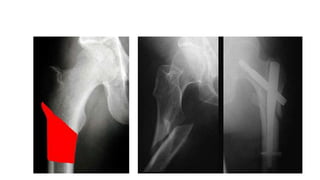
Fielding classification
Subtrochanteric fractures is based
on the level of the subtrochanteric
region through which the fracture
extends.
• type I: at the level of the lesser
trochanter (most common)
• type II: within the region 2.5 cm
below the lesser trochanter
• type III: within the region 2.5 cm
to 5 cm below the lesser
trochanter (least common)
Seinsheimer’s classification
• Type I: Nondisplaced fracture or one with less than
• 2 mm of displacement
• Type II: Two-part fracture
• Type IIa: Transverse fracture
• Type IIb: Spiral configuration with the lesser trochanter
• attached to proximal fragment
• Type IIc: Spiral configuration with the lesser trochanter
• attached to distal fragment
• Type III: Three-part fracture
• Type IIIa: Three-part spiral configuration with the lesser
• trochanter a part of the third fragment
• Type IIIb: Three-part spiral configuration with the third
• part a butterfly fragment
• Type IV: Comminuted fracture with four or more
• Fragments
• Type V: Subtrochanteric - intertrochanteric configuration
Temporary Thomas splint
Indications
• Medically unfit for surgery
• Polytrauma, in extremis
External fixator (subtrochanteric)
Compression plating - DCS (subtrochanteric)
Compression plating - locking plate
(subtrochanteric)
preparation
• Abducted contralateral leg The patient is positioned supine with the
contralateral leg flexed and abducted.
Supine position without traction
• The patient is positioned supine
on a radiolucent table. The
pelvis may be elevated by a firm
cushion.
Bilateral traction
• The patient is positioned supine
with both legs in traction on a
traction table.
Lateral decubitus position
• The patient is positioned in
lateral decubitus with the
contralateral leg resting on the
fracture table.
Knee flexed 30°
• The patient is positioned supine
on a radiolucent table with the
knee in 30° flexion.
Approach
• Antegrade nailing approach
with piriformis entry point
Lateral approach
• he fascia lata is split
longitudinally and the vastus
lateralis muscle is elevated off of
the intermuscular septum.
• Skin incision
Opening the fascia lata
• The fascia lata is incised with a
scalpel and split with scissors
parallel to the skin incision,
along its fibers.
• The muscle fascia over the
vastus lateralis is exposed.
Separation of vastus lateralis from fascia lata
• In the next step, the vastus
lateralis is separated by blunt
dissection from the fascia lata.
• The vastus lateralis is now
retracted anteromedially.
• The muscle fascia investing the
vastus lateralis is incised about 1
cm anterior to the intermuscular
septum.
Mobilization of vastus lateralis from intermuscular
septum
• The muscle is detached from the
lateral intermuscular septum
and the linea aspera with a
periosteal elevator.
Minimally invasive ostheosynthesis approach
• They vary according to the
fracture location:
• proximal (segment 1)
• mid-shaft (segment 2)
• distal femur (segment 3)
sections.
MIO approach to the subtrochanteric region
Skin incision
• The lateral proximal incision
starts at the greater trochanter
and continues distally as far as
needed.
Opening the fascia lata
Treatment
• Stable fractures:
Close reduction with
DHS(Dynamic hip screw)
• Unstable fractures:
Close reduction
Gamma-nail(Small lever
arm)
• Subtrochanteric fracture of
femur without trauma in a
patient with a new onset
fracture. The figure shows a
subtrochanteric fracture in a 66-
yr-old woman with a history of 8
yr risedronate treatment.
Subtrochanteric
fractures are from the
base of the lesser
trochanter to 5 cm distal
Low Subtroch Fx’s
Most low subtrochanteric
fractures with an intact
piriformis fossa can be treated
with a 1st gen IM Nail
When piriformis fossa is not
involved and the lesser
trochanter is fractured, a 2nd
generation nail may be used
Nail or… Plate
Complications
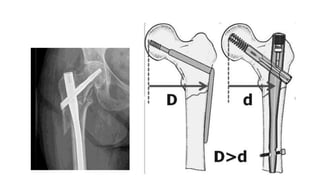
• Varus/ procurvatum malunion
• Nonunion
• Malunion:
- Coxa varus
- Shortening
- Rotational deformity
- Fixation failure
- Failure of implant
D.S:Закр.подвертельный перелом правой бедренной кости со-
смещ
D.S: Closed subtrochanteric fracture of right femur
Do you have any question?
Thank you so much

Subtrochanteric fracture