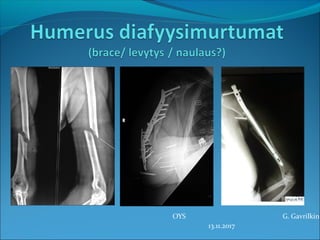
OYS G. Gavrilkin
13.11.2017
“It is perhaps the easiest of the
major long bones to treat by
conservative methods.”
Sir John Charnley
(1911 – 1982)
Humeral diaphysis frx
1-3% of adult fractures
20% of humeral fractures
15-30/100 000 frequency (elderly 100/100000)
Simple falls, road traffic accidents and sports
injuries
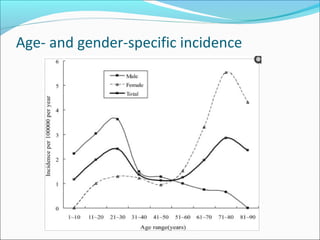
Age- and gender-specific incidence
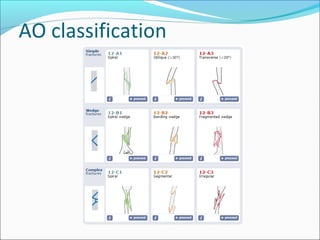
AO classification
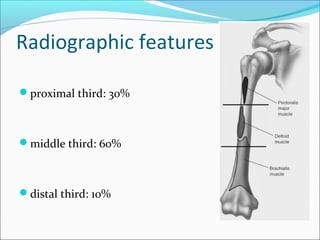
Radiographic features
proximal third: 30%
middle third: 60%
distal third: 10%
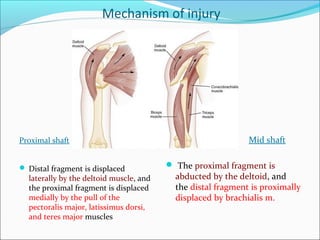
Mechanism of injury
Proximal shaft
 Distal fragment is displaced
laterally by the deltoid muscle, and
the proximal fragment is displaced
medially by the pull of the
pectoralis major, latissimus dorsi,
and teres major muscles
Mid shaft
 The proximal fragment is
abducted by the deltoid, and
the distal fragment is proximally
displaced by brachialis m.
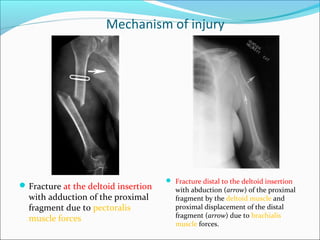
Mechanism of injury
Fracture at the deltoid insertion
with adduction of the proximal
fragment due to pectoralis
muscle forces
 Fracture distal to the deltoid insertion
with abduction (arrow) of the proximal
fragment by the deltoid muscle and
proximal displacement of the distal
fragment (arrow) due to brachialis
muscle forces.
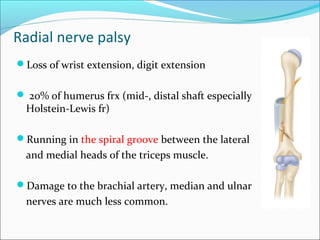
Radial nerve palsy
Loss of wrist extension, digit extension
 20% of humerus frx (mid-, distal shaft especially
Holstein-Lewis fr)
Running in the spiral groove between the lateral
and medial heads of the triceps muscle.
Damage to the brachial artery, median and ulnar
nerves are much less common.
Radial nerve palsy
A. Neuropraxia (nerve minor compression/contusion) – closed fr
B. Neurotmesis – open fr. (exploration usually needed)
 90% injuries usually recover in 3-4 months
 Secondary palsy – due to reduction for bracing or iatrogenic
ORIF
 Radial nerve palsy is not a contraindication to functional
bracing!
Background
Sarmiento et al. reported a union rate of 97% in
their case series of 922 patients, but they were able
to follow only 67% of the patients until healing.
Zagorski et al. reported a 98% union rate and 95%
excellent functional results in a case series of 233
patients from the same clinic as Sarmiento et al,
but 27% of the patients were lost to follow-up.
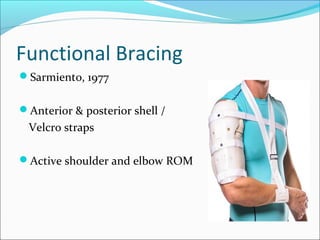
Functional Bracing
Sarmiento, 1977
Anterior & posterior shell /
Velcro straps
Active shoulder and elbow ROM
Conservative treatment
Orthosis/ bracing union 77-98%, complications ⇓
Union in 11 weeks (5-22 weeks)
Non union risk in transverse and proximal shaft frx
ad 38% (m.deltoideus & m.pectoralis major traction
& muscle interposition)
Conservative treatment
Problems with elbow and shoulder functions:
Can lead to loss of extra-rotation, flexion and abduction
of the shoulder in 10% to 30% of cases.
In about 10% of the patients, there may be a loss of
flexion and extension of the elbow
Obese pt: varus & internal rotation union
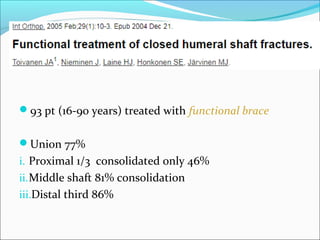
93 pt (16-90 years) treated with functional brace
Union 77%
i. Proximal 1/3 consolidated only 46%
ii.Middle shaft 81% consolidation
iii.Distal third 86%
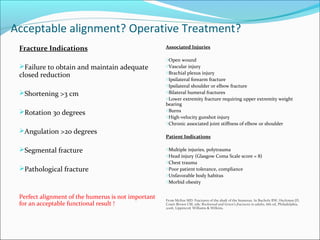
Acceptable alignment? Operative Treatment?
Fracture Indications
Failure to obtain and maintain adequate
closed reduction
Shortening >3 cm
Rotation 30 degrees
Angulation >20 degrees
Segmental fracture
Pathological fracture
Perfect alignment of the humerus is not important
for an acceptable functional result !
Associated Injuries
oOpen wound
oVascular injury
oBrachial plexus injury
oIpsilateral forearm fracture
oIpsilateral shoulder or elbow fracture
oBilateral humeral fractures
oLower extremity fracture requiring upper extremity weight
bearing
oBurns
oHigh-velocity gunshot injury
oChronic associated joint stiffness of elbow or shoulder
Patient Indications
oMultiple injuries, polytrauma
oHead injury (Glasgow Coma Scale score = 8)
oChest trauma
oPoor patient tolerance, compliance
oUnfavorable body habitus
oMorbid obesity
From McKee MD: Fractures of the shaft of the humerus. In Bucholz RW, Heckman JD,
Court-Brown CM, eds: Rockwood and Green’s fractures in adults, 6th ed, Philadelphia,
2006, Lippincott Williams & Wilkins.
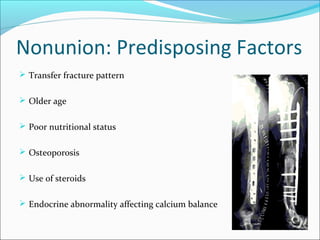
Nonunion: Predisposing Factors
 Transfer fracture pattern
 Older age
 Poor nutritional status
 Osteoporosis
 Use of steroids
 Endocrine abnormality affecting calcium balance
Osteosynthesis
LCP , DCP. IMN, external fixation (EF)
There is no specific algorithm for deciding since it
is necessary to take into account many factors
before reaching a final decision as to which
treatment to implement.
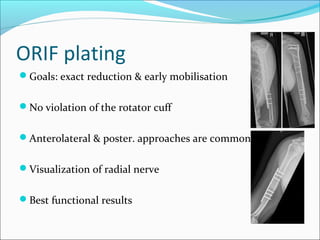
ORIF plating
Goals: exact reduction & early mobilisation
No violation of the rotator cuff
Anterolateral & poster. approaches are common
Visualization of radial nerve
Best functional results
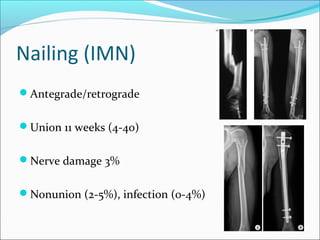
Nailing (IMN)
Antegrade/retrograde
Union 11 weeks (4-40)
Nerve damage 3%
Nonunion (2-5%), infection (0-4%)
Nailing
Antegrade: through rotator cuff insertion
Retrograde: posterior, through m.triceps insertion
Iatrogenic fracture 4-5%
Impingement, pain (16-37%), nail amotion, ROM restriction
In Finland:
 Pathological fracture
 Polytrauma pt
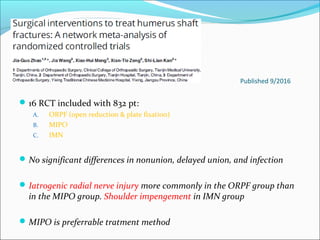
Published 9/2016
16 RCT included with 832 pt:
A. ORPF (open reduction & plate fixation)
B. MIPO
C. IMN
No significant differences in nonunion, delayed union, and infection
Iatrogenic radial nerve injury more commonly in the ORPF group than
in the MIPO group. Shoulder impengement in IMN group
MIPO is preferrable tratment method
The objectives of this trial are to compare the
effectiveness and cost-effectiveness between surgical
treatment with plate osteosynthesis and conservative
treatment with functional bracing for humeral shaft
fractures.
The recruitment began at the end of 2012. At the
current recruiting pace, the recruiting will end in
2018.
Summary
 Functional bracing have good functional results
 Surgery: comminuted fractures, floating shoulder, multiple trauma,
neurovascular compromise, nonunion, open fractures, pathological fractures,
and the failure of conservative treatment
 ORIF plating is preferrable over IMN
 IMN is the preferred mode of treatment for fractures with associated soft
tissue injury, pathologic fracture, diaphyseal segmental fractures, and
osteopenic bone.
 Radial nerve careful documentation, most injuries recover spontaneously
Thank You!
References
1. Shao YC, Harwood P, Grotz MR et-al. Radial nerve palsy associated with fractures of the shaft of the humerus: a systematic
review. J Bone Joint Surg Br. 2005;87 (12): 1647-52. doi:10.1302/0301-620X.87B12.16132 - Pubmed citation
2. Surgical interventions to treat humerus shaft fractures: A network meta-analysis of randomized controlled trials Jia-Guo
Zhao1,2*, Jia Wang2 , Xiao-Hui Meng3 , Xian-Tie Zeng2 , Shi-Lian Kan2 *
3. https://radiopaedia.org/articles/humeral-shaft-fracture-1
4. Radial nerve palsy associated with fractures of the shaft of the humerus A SYSTEMATIC REVIEW. Y. C. Shao, P. Harwood, M. R.
W. Grotz, D. Limb, P. V. Giannoudis
5. Functional treatment of closed humeral shaft fractures. 2014. Toivanen. TAYS
6. Outcome of humeral shaft fractures treated by functional cast braceJitendra Nath Pal1
, Prahas Biswas1
, Avik Roy2
,
Sunit Hazra2
, Somnath Mahato3. 2015
7. Surgical interventions to treat humerus shaft fractures: A network meta-analysis of randomized controlled trials Jia-Guo
Zhao1,2*, Jia Wang2, Xiao-Hui Meng3, Xian-Tie Zeng2, Shi-Lian Kan2*. 2016
8. Olkaluun diafyysimurtumien hoito: konservatiivinen hoito vai osteosynteesi? Vesa Lepola TAYS, Tuki- ja liikuntaelinkirurgia.
2016
9. The epidemiology of traumatic humeral shaft fractures in TaiwanChun-Hao Tsai, Yi-Chin Fong, Ying-Hao Chen, Chin-
Jung Hsu, Chia-Hao Chang, and Horng-Chaung Hsu.
10. Cambell Orthopaedics, ed. 12
11. www.orthobullets.com
12. Kurup H, Hossain M, Andrew JG. Dynamic compression plating versus locked intramedullary nailing for humeral shaft fractures
in adults. Cochrane Database Syst Rev. 2011 Jun
13. Sarmiento A, Horowitch A, Aboulafia A, Vangsness CT Jr. Functional bracing for comminuted extra-articular fractures of the
distal third of the humerus. J Bone Joint Surg Br 1990;72: 283-7. Erratum in: J Bone Joint Surg Br. 1990;72:752

Humerus shaft fractures

  • 1.
  • 2.
    “It is perhapsthe easiest of the major long bones to treat by conservative methods.” Sir John Charnley (1911 – 1982)
  • 3.
    Humeral diaphysis frx 1-3%of adult fractures 20% of humeral fractures 15-30/100 000 frequency (elderly 100/100000) Simple falls, road traffic accidents and sports injuries
  • 4.
  • 5.
  • 6.
    Radiographic features proximal third:30% middle third: 60% distal third: 10%
  • 7.
    Mechanism of injury Proximalshaft  Distal fragment is displaced laterally by the deltoid muscle, and the proximal fragment is displaced medially by the pull of the pectoralis major, latissimus dorsi, and teres major muscles Mid shaft  The proximal fragment is abducted by the deltoid, and the distal fragment is proximally displaced by brachialis m.
  • 8.
    Mechanism of injury Fractureat the deltoid insertion with adduction of the proximal fragment due to pectoralis muscle forces  Fracture distal to the deltoid insertion with abduction (arrow) of the proximal fragment by the deltoid muscle and proximal displacement of the distal fragment (arrow) due to brachialis muscle forces.
  • 9.
    Radial nerve palsy Lossof wrist extension, digit extension  20% of humerus frx (mid-, distal shaft especially Holstein-Lewis fr) Running in the spiral groove between the lateral and medial heads of the triceps muscle. Damage to the brachial artery, median and ulnar nerves are much less common.
  • 10.
    Radial nerve palsy A.Neuropraxia (nerve minor compression/contusion) – closed fr B. Neurotmesis – open fr. (exploration usually needed)  90% injuries usually recover in 3-4 months  Secondary palsy – due to reduction for bracing or iatrogenic ORIF  Radial nerve palsy is not a contraindication to functional bracing!
  • 11.
    Background Sarmiento et al.reported a union rate of 97% in their case series of 922 patients, but they were able to follow only 67% of the patients until healing. Zagorski et al. reported a 98% union rate and 95% excellent functional results in a case series of 233 patients from the same clinic as Sarmiento et al, but 27% of the patients were lost to follow-up.
  • 12.
    Functional Bracing Sarmiento, 1977 Anterior& posterior shell / Velcro straps Active shoulder and elbow ROM
  • 13.
    Conservative treatment Orthosis/ bracingunion 77-98%, complications ⇓ Union in 11 weeks (5-22 weeks) Non union risk in transverse and proximal shaft frx ad 38% (m.deltoideus & m.pectoralis major traction & muscle interposition)
  • 14.
    Conservative treatment Problems withelbow and shoulder functions: Can lead to loss of extra-rotation, flexion and abduction of the shoulder in 10% to 30% of cases. In about 10% of the patients, there may be a loss of flexion and extension of the elbow Obese pt: varus & internal rotation union
  • 15.
    93 pt (16-90years) treated with functional brace Union 77% i. Proximal 1/3 consolidated only 46% ii.Middle shaft 81% consolidation iii.Distal third 86%
  • 16.
    Acceptable alignment? OperativeTreatment? Fracture Indications Failure to obtain and maintain adequate closed reduction Shortening >3 cm Rotation 30 degrees Angulation >20 degrees Segmental fracture Pathological fracture Perfect alignment of the humerus is not important for an acceptable functional result ! Associated Injuries oOpen wound oVascular injury oBrachial plexus injury oIpsilateral forearm fracture oIpsilateral shoulder or elbow fracture oBilateral humeral fractures oLower extremity fracture requiring upper extremity weight bearing oBurns oHigh-velocity gunshot injury oChronic associated joint stiffness of elbow or shoulder Patient Indications oMultiple injuries, polytrauma oHead injury (Glasgow Coma Scale score = 8) oChest trauma oPoor patient tolerance, compliance oUnfavorable body habitus oMorbid obesity From McKee MD: Fractures of the shaft of the humerus. In Bucholz RW, Heckman JD, Court-Brown CM, eds: Rockwood and Green’s fractures in adults, 6th ed, Philadelphia, 2006, Lippincott Williams & Wilkins.
  • 17.
    Nonunion: Predisposing Factors Transfer fracture pattern  Older age  Poor nutritional status  Osteoporosis  Use of steroids  Endocrine abnormality affecting calcium balance
  • 18.
    Osteosynthesis LCP , DCP.IMN, external fixation (EF) There is no specific algorithm for deciding since it is necessary to take into account many factors before reaching a final decision as to which treatment to implement.
  • 19.
    ORIF plating Goals: exactreduction & early mobilisation No violation of the rotator cuff Anterolateral & poster. approaches are common Visualization of radial nerve Best functional results
  • 20.
    Nailing (IMN) Antegrade/retrograde Union 11weeks (4-40) Nerve damage 3% Nonunion (2-5%), infection (0-4%)
  • 21.
    Nailing Antegrade: through rotatorcuff insertion Retrograde: posterior, through m.triceps insertion Iatrogenic fracture 4-5% Impingement, pain (16-37%), nail amotion, ROM restriction In Finland:  Pathological fracture  Polytrauma pt
  • 22.
    Published 9/2016 16 RCTincluded with 832 pt: A. ORPF (open reduction & plate fixation) B. MIPO C. IMN No significant differences in nonunion, delayed union, and infection Iatrogenic radial nerve injury more commonly in the ORPF group than in the MIPO group. Shoulder impengement in IMN group MIPO is preferrable tratment method
  • 23.
    The objectives ofthis trial are to compare the effectiveness and cost-effectiveness between surgical treatment with plate osteosynthesis and conservative treatment with functional bracing for humeral shaft fractures. The recruitment began at the end of 2012. At the current recruiting pace, the recruiting will end in 2018.
  • 24.
    Summary  Functional bracinghave good functional results  Surgery: comminuted fractures, floating shoulder, multiple trauma, neurovascular compromise, nonunion, open fractures, pathological fractures, and the failure of conservative treatment  ORIF plating is preferrable over IMN  IMN is the preferred mode of treatment for fractures with associated soft tissue injury, pathologic fracture, diaphyseal segmental fractures, and osteopenic bone.  Radial nerve careful documentation, most injuries recover spontaneously
  • 25.
  • 26.
    References 1. Shao YC,Harwood P, Grotz MR et-al. Radial nerve palsy associated with fractures of the shaft of the humerus: a systematic review. J Bone Joint Surg Br. 2005;87 (12): 1647-52. doi:10.1302/0301-620X.87B12.16132 - Pubmed citation 2. Surgical interventions to treat humerus shaft fractures: A network meta-analysis of randomized controlled trials Jia-Guo Zhao1,2*, Jia Wang2 , Xiao-Hui Meng3 , Xian-Tie Zeng2 , Shi-Lian Kan2 * 3. https://radiopaedia.org/articles/humeral-shaft-fracture-1 4. Radial nerve palsy associated with fractures of the shaft of the humerus A SYSTEMATIC REVIEW. Y. C. Shao, P. Harwood, M. R. W. Grotz, D. Limb, P. V. Giannoudis 5. Functional treatment of closed humeral shaft fractures. 2014. Toivanen. TAYS 6. Outcome of humeral shaft fractures treated by functional cast braceJitendra Nath Pal1 , Prahas Biswas1 , Avik Roy2 , Sunit Hazra2 , Somnath Mahato3. 2015 7. Surgical interventions to treat humerus shaft fractures: A network meta-analysis of randomized controlled trials Jia-Guo Zhao1,2*, Jia Wang2, Xiao-Hui Meng3, Xian-Tie Zeng2, Shi-Lian Kan2*. 2016 8. Olkaluun diafyysimurtumien hoito: konservatiivinen hoito vai osteosynteesi? Vesa Lepola TAYS, Tuki- ja liikuntaelinkirurgia. 2016 9. The epidemiology of traumatic humeral shaft fractures in TaiwanChun-Hao Tsai, Yi-Chin Fong, Ying-Hao Chen, Chin- Jung Hsu, Chia-Hao Chang, and Horng-Chaung Hsu. 10. Cambell Orthopaedics, ed. 12 11. www.orthobullets.com 12. Kurup H, Hossain M, Andrew JG. Dynamic compression plating versus locked intramedullary nailing for humeral shaft fractures in adults. Cochrane Database Syst Rev. 2011 Jun 13. Sarmiento A, Horowitch A, Aboulafia A, Vangsness CT Jr. Functional bracing for comminuted extra-articular fractures of the distal third of the humerus. J Bone Joint Surg Br 1990;72: 283-7. Erratum in: J Bone Joint Surg Br. 1990;72:752