SIZE SEPARATION
B. PHARMACY SECOND YEAR
BY: SHALINI K. DHAWALE
ASSISTANT PROFESSOR
D. K. PATIL INSTITUTE OF PHARMACY
INTRIDUCTION
 Size separation is an unit operation which involves the
separation of particles of a particular size from a mixture.
 Official standards for powder size
 Coarse powder: a powder of which all particles pass
through a sieve with nominal mesh aperture of 1.70mm(no.
10 sieve) and not more than 40% through a sieve with
nominal mesh aperture of 355µm (no. 44 sieve) is called
coarse powder.
 Moderately Coarse powder: a powder of which all particles
pass through a sieve with nominal mesh aperture of 710µm
(no. 22sieve) and not more than 40% through a sieve with
nominal mesh aperture of 250µm (no. 60 sieve).
2 DKPIOP
Official Standards for powder
 Moderately fine powder: a powder of which all particles
pass through a sieve with nominal mesh aperture of 355µm
(no. 44sieve) and not more than 40% through a sieve with
nominal mesh aperture of 180µm (no. 85sieve).
 Fine powder: If all particles pass through a sieve with
nominal mesh aperture of 180µm (no. 85sieve) it is called
as fine powder.
 Very fine powder: If all particles pass through a sieve with
nominal mesh aperture of 125µm (no. 120sieve) it is called
as fine powder.
3 DKPIOP
Objective of size reduction
 To obtain powder of desired size distribution.
 To obtain stable separation.
 To avoid variation in physicochemical properties.
 To set quality control parameters for raw materials.
 To improve mixing.
Applications of size separation
To maintain uniform particle size.
To improve Absorption.
For effective extraction.
4 DKPIOP
Sieves
 A sieve is a surface having number of apertures of specific
dimensions.
 Sieves for Pharmacopoeial testing are constructed from
wire cloth with square meshes, woven from wires of brass,
bronze, stainless steel or any other suitable material.
Standards for sieves:
 Sieve number: it indicates the number of meshes in a
length of 2.54cm in each transverse direction parallel to
the wires.
 Nominal size of aperture: it indicates distance between the
wires. It represents the length of the side of the square
aperture.
5 DKPIOP
Standards for sieves:
 Nominal diameter of the wire:
Wire mesh sieve are made from the wire having specified
diameter in order to give a suitable aperture size and
sufficient strength to avoid distortion of sieve.
 Tolerance average aperture size:
Some variation in aperture size is unavoidable and when
this variation is expressed as a percentage it is known as
tolerance average aperture size.
6 DKPIOP
Mechanism of size separation
1. Agitation: Sieve may be agitated in many way
a) Oscillation: Sieve is mounted in a frame that oscillates in
back and forth.
b) Vibration: Sieve is vibrated at high speed electrically.
c) Gyration: it uses a system in which sieve is on a rubber
mounting and connected to an eccentric flywheel.
2. Brushing: A brush can be used to move the particles on a
surface of the sieve and to keep the mesh clear.
3. Centrifugal: Mechanical sieve with vertical cylindrical
sieve with high speed rotor inside cylinder so that particles
through outwards by centrifugal force.
7 DKPIOP
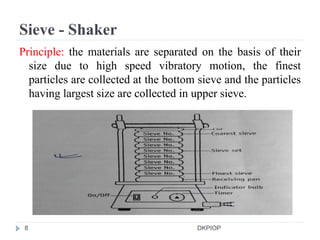
Sieve - Shaker
Principle: the materials are separated on the basis of their
size due to high speed vibratory motion, the finest
particles are collected at the bottom sieve and the particles
having largest size are collected in upper sieve.
8 DKPIOP
Construction And Working
 In the sieve shaker a set of sieves is used, these sieves are arranged in
descending order i. e. sieve of larger size is at top and the sieve of
smallest size is placed at the bottom.
 The bottom sieve is attached to a receiving pan.
 the size separation is done by passing the powder through these
sieves.
Working:
 The powder is placed in upper sieve, The sieves are shaken with the
help of mechanical sieve shaker or electromagnetic device.
 This motion help the particles to pass through the sieve.
 Mixture is separated depending upon its size.
 Working of mechanical devices are based upon Agitation, Brushing
and Centrifugal.
9 DKPIOP
Advantages:
 It requires less are for operation.
 It is fast and more accurate process.
 High speed of vibration avoid the blockage of sieve.
 It is used to separate variety of dry powder, granules
and dry foods.
Disadvantages:
Sieves should be used and stored with care, since they
becomes damaged or distorted.
10 DKPIOP
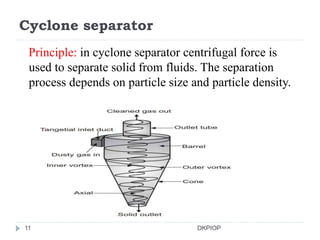
Cyclone separator
Principle: in cyclone separator centrifugal force is
used to separate solid from fluids. The separation
process depends on particle size and particle density.
11 DKPIOP
Construction and working
 It consist of vertical cylindrical vessel with conical base.
 To the upper part of vessel tangential inlet is fitted and outlet is
fitted at its base
 Fluid outlet is provided at the center of top, which extend
inwardly into the separator
 Such arrangement prevent the air short circuiting from the inlet
to the outlet of the fluid.
Working:
 The solid to be separated are suspended in a stream of fluid
 Feed is introduced tangentially at very high velocity , so that
rotary movement take place within vessel.
 Centrifugal force throws the particles to wall of vessel.
 Fluid can escape from the central outlet at the top.
 As the speed of fluid decreases solid particles fall to base.
12 DKPIOP
Advantages
 Relative simplicity and few maintenance problem.
 Low pressure drop
 Small space require.
 No moving parts, low capital cost.
Disadvantages:
 Inability to handle sticky materials.
Uses:
 Used to separate solid particles from gas.
 Used in oil refineries to separate oils and gases.
 To separate heavy and coarse fraction from the dust.
13 DKPIOP
Air separator
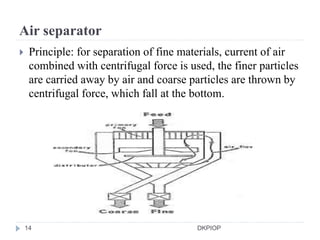
 Principle: for separation of fine materials, current of air
combined with centrifugal force is used, the finer particles
are carried away by air and coarse particles are thrown by
centrifugal force, which fall at the bottom.
14 DKPIOP
Construction and working of air separator
It consist of cylindrical vessel with conical base. A rotating
plate fitted on shaft placed at the center of vessel. A set of
fan blades are also fitted with same shaft. At the base of
vessel two outlets are provided one for finer particles and
other for coarse particles.
Working:
 A disc and fan are rotated with the help of motor, the feed
enters at the center of the vessel and on rotating plate.
 The rotating fan blades produces a draft of air in the
direction, then fine particles are picked up by the air.
 Air velocity is sufficiently reduced so that the fine
particles are dropped and removed through the fine
particle outlet.
15 DKPIOP
Advantages
 It gives efficient separation in smaller apparatus.
 Low maintenance
 High reliability
 Low pressure drop
Disadvantages:
 Low separation yield
 Unsuitable for separating smaller particles.
Uses:
 It often attached to the ball mill or hammer mill to
separate and return over sized particles for furthe size
reduction
16 DKPIOP
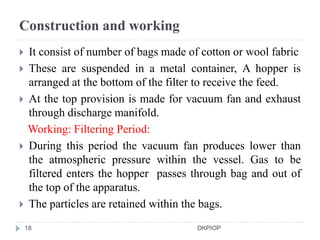
Filter Bag
Principle:
In filter bags the separation of fine powder from coarse
powder is carried out by applying suction.
17 DKPIOP
Construction and working
 It consist of number of bags made of cotton or wool fabric
 These are suspended in a metal container, A hopper is
arranged at the bottom of the filter to receive the feed.
 At the top provision is made for vacuum fan and exhaust
through discharge manifold.
Working: Filtering Period:
 During this period the vacuum fan produces lower than
the atmospheric pressure within the vessel. Gas to be
filtered enters the hopper passes through bag and out of
the top of the apparatus.
 The particles are retained within the bags.
18 DKPIOP
Advantages:
 Bag filters are extremely useful for removing fines.
 Reduced sensitivity to particle size distribution.
 No high voltage required.
 Household vacuum cleaner is a example of bag filter.
Disadvantages:
 collection of hygroscopic material or condensation of
moisture can leads to fabric plugging loss of cleaning
efficiency
 Presence of high acid or alkaline atmospheres and
elevated temperature shortens fabric life.
19 DKPIOP
Elutriation tank
DKPIOP
20
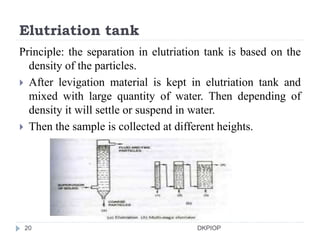
Principle: the separation in elutriation tank is based on the
density of the particles.
 After levigation material is kept in elutriation tank and
mixed with large quantity of water. Then depending of
density it will settle or suspend in water.
 Then the sample is collected at different heights.
Construction and working
DKPIOP
21
 The apparatus consist of vertical column with an inlet near the
bottom of suspension an outlet at the base for coarse particles
and outflow near the top of fluid and fine particles.
 One column will give single separation into two fractions.
multiple tubes can be use in a serial connection.
Working:
 the material which is to be separated is kept in elutriation tank
and large quantity of water is poured into the tank
 The content of tank is mixed with water by stirring, they are
allowed to settle for some time, particle which are having large
size will get settle down and smaller size will remain
suspended in liquid.
 Multiple fraction can be separated containing particles of
different size range.
22 DKPIOP

Size separation - Pharmaceutical Engineering -by- Shalini Dhawale

  • 1.
    SIZE SEPARATION B. PHARMACYSECOND YEAR BY: SHALINI K. DHAWALE ASSISTANT PROFESSOR D. K. PATIL INSTITUTE OF PHARMACY
  • 2.
    INTRIDUCTION  Size separationis an unit operation which involves the separation of particles of a particular size from a mixture.  Official standards for powder size  Coarse powder: a powder of which all particles pass through a sieve with nominal mesh aperture of 1.70mm(no. 10 sieve) and not more than 40% through a sieve with nominal mesh aperture of 355µm (no. 44 sieve) is called coarse powder.  Moderately Coarse powder: a powder of which all particles pass through a sieve with nominal mesh aperture of 710µm (no. 22sieve) and not more than 40% through a sieve with nominal mesh aperture of 250µm (no. 60 sieve). 2 DKPIOP
  • 3.
    Official Standards forpowder  Moderately fine powder: a powder of which all particles pass through a sieve with nominal mesh aperture of 355µm (no. 44sieve) and not more than 40% through a sieve with nominal mesh aperture of 180µm (no. 85sieve).  Fine powder: If all particles pass through a sieve with nominal mesh aperture of 180µm (no. 85sieve) it is called as fine powder.  Very fine powder: If all particles pass through a sieve with nominal mesh aperture of 125µm (no. 120sieve) it is called as fine powder. 3 DKPIOP
  • 4.
    Objective of sizereduction  To obtain powder of desired size distribution.  To obtain stable separation.  To avoid variation in physicochemical properties.  To set quality control parameters for raw materials.  To improve mixing. Applications of size separation To maintain uniform particle size. To improve Absorption. For effective extraction. 4 DKPIOP
  • 5.
    Sieves  A sieveis a surface having number of apertures of specific dimensions.  Sieves for Pharmacopoeial testing are constructed from wire cloth with square meshes, woven from wires of brass, bronze, stainless steel or any other suitable material. Standards for sieves:  Sieve number: it indicates the number of meshes in a length of 2.54cm in each transverse direction parallel to the wires.  Nominal size of aperture: it indicates distance between the wires. It represents the length of the side of the square aperture. 5 DKPIOP
  • 6.
    Standards for sieves: Nominal diameter of the wire: Wire mesh sieve are made from the wire having specified diameter in order to give a suitable aperture size and sufficient strength to avoid distortion of sieve.  Tolerance average aperture size: Some variation in aperture size is unavoidable and when this variation is expressed as a percentage it is known as tolerance average aperture size. 6 DKPIOP
  • 7.
    Mechanism of sizeseparation 1. Agitation: Sieve may be agitated in many way a) Oscillation: Sieve is mounted in a frame that oscillates in back and forth. b) Vibration: Sieve is vibrated at high speed electrically. c) Gyration: it uses a system in which sieve is on a rubber mounting and connected to an eccentric flywheel. 2. Brushing: A brush can be used to move the particles on a surface of the sieve and to keep the mesh clear. 3. Centrifugal: Mechanical sieve with vertical cylindrical sieve with high speed rotor inside cylinder so that particles through outwards by centrifugal force. 7 DKPIOP
  • 8.
    Sieve - Shaker Principle:the materials are separated on the basis of their size due to high speed vibratory motion, the finest particles are collected at the bottom sieve and the particles having largest size are collected in upper sieve. 8 DKPIOP
  • 9.
    Construction And Working In the sieve shaker a set of sieves is used, these sieves are arranged in descending order i. e. sieve of larger size is at top and the sieve of smallest size is placed at the bottom.  The bottom sieve is attached to a receiving pan.  the size separation is done by passing the powder through these sieves. Working:  The powder is placed in upper sieve, The sieves are shaken with the help of mechanical sieve shaker or electromagnetic device.  This motion help the particles to pass through the sieve.  Mixture is separated depending upon its size.  Working of mechanical devices are based upon Agitation, Brushing and Centrifugal. 9 DKPIOP
  • 10.
    Advantages:  It requiresless are for operation.  It is fast and more accurate process.  High speed of vibration avoid the blockage of sieve.  It is used to separate variety of dry powder, granules and dry foods. Disadvantages: Sieves should be used and stored with care, since they becomes damaged or distorted. 10 DKPIOP
  • 11.
    Cyclone separator Principle: incyclone separator centrifugal force is used to separate solid from fluids. The separation process depends on particle size and particle density. 11 DKPIOP
  • 12.
    Construction and working It consist of vertical cylindrical vessel with conical base.  To the upper part of vessel tangential inlet is fitted and outlet is fitted at its base  Fluid outlet is provided at the center of top, which extend inwardly into the separator  Such arrangement prevent the air short circuiting from the inlet to the outlet of the fluid. Working:  The solid to be separated are suspended in a stream of fluid  Feed is introduced tangentially at very high velocity , so that rotary movement take place within vessel.  Centrifugal force throws the particles to wall of vessel.  Fluid can escape from the central outlet at the top.  As the speed of fluid decreases solid particles fall to base. 12 DKPIOP
  • 13.
    Advantages  Relative simplicityand few maintenance problem.  Low pressure drop  Small space require.  No moving parts, low capital cost. Disadvantages:  Inability to handle sticky materials. Uses:  Used to separate solid particles from gas.  Used in oil refineries to separate oils and gases.  To separate heavy and coarse fraction from the dust. 13 DKPIOP
  • 14.
    Air separator  Principle:for separation of fine materials, current of air combined with centrifugal force is used, the finer particles are carried away by air and coarse particles are thrown by centrifugal force, which fall at the bottom. 14 DKPIOP
  • 15.
    Construction and workingof air separator It consist of cylindrical vessel with conical base. A rotating plate fitted on shaft placed at the center of vessel. A set of fan blades are also fitted with same shaft. At the base of vessel two outlets are provided one for finer particles and other for coarse particles. Working:  A disc and fan are rotated with the help of motor, the feed enters at the center of the vessel and on rotating plate.  The rotating fan blades produces a draft of air in the direction, then fine particles are picked up by the air.  Air velocity is sufficiently reduced so that the fine particles are dropped and removed through the fine particle outlet. 15 DKPIOP
  • 16.
    Advantages  It givesefficient separation in smaller apparatus.  Low maintenance  High reliability  Low pressure drop Disadvantages:  Low separation yield  Unsuitable for separating smaller particles. Uses:  It often attached to the ball mill or hammer mill to separate and return over sized particles for furthe size reduction 16 DKPIOP
  • 17.
    Filter Bag Principle: In filterbags the separation of fine powder from coarse powder is carried out by applying suction. 17 DKPIOP
  • 18.
    Construction and working It consist of number of bags made of cotton or wool fabric  These are suspended in a metal container, A hopper is arranged at the bottom of the filter to receive the feed.  At the top provision is made for vacuum fan and exhaust through discharge manifold. Working: Filtering Period:  During this period the vacuum fan produces lower than the atmospheric pressure within the vessel. Gas to be filtered enters the hopper passes through bag and out of the top of the apparatus.  The particles are retained within the bags. 18 DKPIOP
  • 19.
    Advantages:  Bag filtersare extremely useful for removing fines.  Reduced sensitivity to particle size distribution.  No high voltage required.  Household vacuum cleaner is a example of bag filter. Disadvantages:  collection of hygroscopic material or condensation of moisture can leads to fabric plugging loss of cleaning efficiency  Presence of high acid or alkaline atmospheres and elevated temperature shortens fabric life. 19 DKPIOP
  • 20.
    Elutriation tank DKPIOP 20 Principle: theseparation in elutriation tank is based on the density of the particles.  After levigation material is kept in elutriation tank and mixed with large quantity of water. Then depending of density it will settle or suspend in water.  Then the sample is collected at different heights.
  • 21.
    Construction and working DKPIOP 21 The apparatus consist of vertical column with an inlet near the bottom of suspension an outlet at the base for coarse particles and outflow near the top of fluid and fine particles.  One column will give single separation into two fractions. multiple tubes can be use in a serial connection. Working:  the material which is to be separated is kept in elutriation tank and large quantity of water is poured into the tank  The content of tank is mixed with water by stirring, they are allowed to settle for some time, particle which are having large size will get settle down and smaller size will remain suspended in liquid.  Multiple fraction can be separated containing particles of different size range.
  • 22.