FLOW OF FLUID
BY- SANCHIT DHANKHAR
Disclaimer
Presentation slides are provided on
student's request for purpose of
quick reference only, hence it can
not be replaced with standard study
material or books that are mentioned
in syllabus of respective subjects.
Students are expected to refer
standard books for study for
examination.
Fluid flow
• Mention fluid properties such as viscosity,
compressibility and surface tension of fluids.
• Hydrostatics (Fluidststics) influencing fluid
flow.
• Fluid dynamics‐ Bernoulli’s theorem, flow
of fluids in pipes, laminar and turbulent flow.
VISCOSITY :-
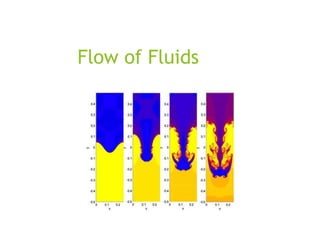
Flow of Fluids
FLUID FLOW
A fluid is a substance that continually deforms (flows) under an
applied shear stress.
Fluids are a subset of the phases of matter and include liquids,
gases.
Fluid flow may be defined as the flow of substances that do not
permanently resist distortion
The subject of fluid flow can be divided into fluid static's and fluid
dynamics
FLUID STATICS
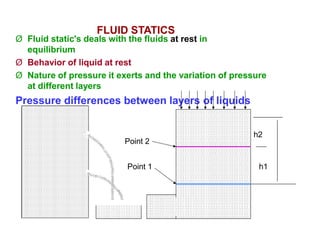
Ø Fluid static's deals with the fluids at rest in
equilibrium
Ø Behavior of liquid at rest
Ø Nature of pressure it exerts and the variation of pressure
at different layers
Pressure differences between layers of liquids
h2
h1
Point 2
Point 1
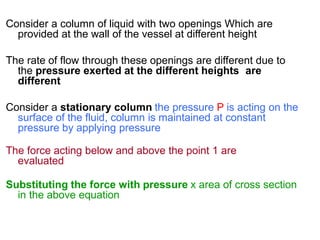
Consider a column of liquid with two openings Which are
provided at the wall of the vessel at different height
The rate of flow through these openings are different due to
the pressure exerted at the different heights are
different
Consider a stationary column the pressure P is acting on the
surface of the fluid, column is maintained at constant
pressure by applying pressure
The force acting below and above the point 1 are
evaluated
Substituting the force with pressure x area of cross section
in the above equation
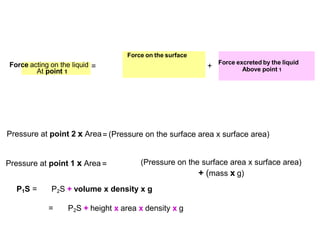
Force acting on the liquid =
At point 1
+
Force on the surface
Force excreted by the liquid
Above point 1
Pressure at point 2 x Area= (Pressure on the surface area x surface area)
P1S = P2S + volume x density x g
= P2S + height x area x density x g
Pressure at point 1 x Area = (Pressure on the surface area x surface area)
+ (mass x g)
P1s = P2s + volume x density x g
= P2s + height x area x density x g P2s
+ h1 S ρ g
P1s =
Since surface area is same
P1 = Ps + h1 ρ g
Pressure acting on point 2 may be written as
P2 = Ps + h2 ρ g
Difference in the pressure is --
P2 - P1 = g (Ps + h2 ρ ) – ( Ps + h1 ρ) g
∆P = (Ps + h2 ρ – Ps
∆P = ∆ h ρ g
- h1 ρ ) g
[F=Volume.ρ g]
FLD
U
IY
D
NAMICS
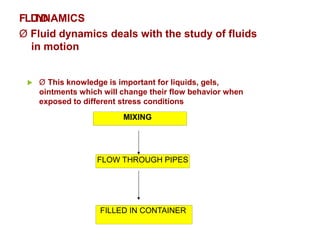
Ø Fluid dynamics deals with the study of fluids
in motion
 Ø This knowledge is important for liquids, gels,
ointments which will change their flow behavior when
exposed to different stress conditions
MIXING
FLOW THROUGH PIPES
FILLED IN CONTAINER
Importance
Identification of type of flow is important in
Manufacture of dosage forms
ü Handling of drugs for administration
The flow of fluid through a pipe can be
viscous or turbulent and it can be
determined by Reynolds number
Reynolds number have no unit
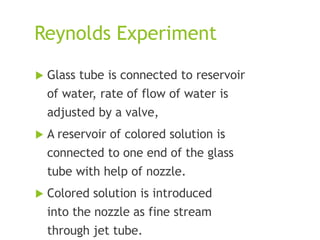
Reynolds Experiment
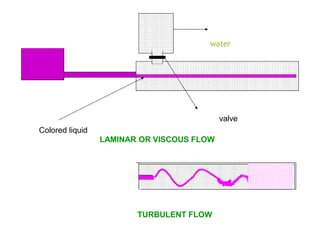
 Glass tube is connected to reservoir
of water, rate of flow of water is
adjusted by a valve,
 A reservoir of colored solution is
connected to one end of the glass
tube with help of nozzle.
 Colored solution is introduced
into the nozzle as fine stream
through jet tube.
water
valve
Colored liquid
LAMINAR OR VISCOUS FLOW
TURBULENT FLOW
TYPES OF FLOW
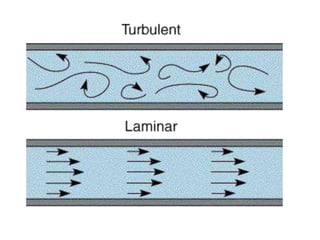
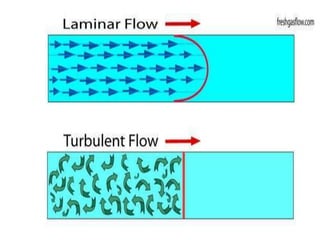
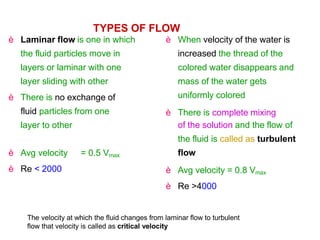
è Laminar flow is one in which
the fluid particles move in
layers or laminar with one
layer sliding with other
è There is no exchange of
fluid particles from one
layer to other
è Avg velocity
è Re < 2000
= 0.5 Vmax
è When velocity of the water is
increased the thread of the
colored water disappears and
mass of the water gets
uniformly colored
è There is complete mixing
of the solution and the flow of
the fluid is called as turbulent
flow
è Avg velocity = 0.8 Vmax
è Re >4000
The velocity at which the fluid changes from laminar flow to turbulent
flow that velocity is called as critical velocity
REYNOLDS NUMBER
In Reynolds experiment the flow conditions are affected by
Ø Diameter of pipe Ø
Average velocity Ø
Density of liquid
Ø Viscosity of the fluid
This four factors are combined in one way as Reynolds
number
Re=
Ø Inertial forces are due to mass and the velocity of the fluid particles
trying to diffuse the fluid particles
Ø viscous force if the frictional force due to the viscosity of
the fluid which make the motion of the fluid in parallel.
D u ρ
η
INERTIAL FORCES
= ------------------------------
VISCOUS FORCES
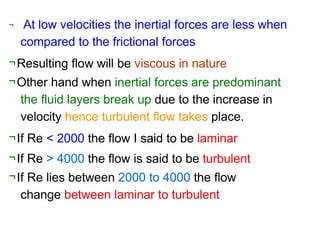
¬ At low velocities the inertial forces are less when
compared to the frictional forces
¬Resulting flow will be viscous in nature
¬Other hand when inertial forces are predominant
the fluid layers break up due to the increase in
velocity hence turbulent flow takes place.
¬If Re < 2000 the flow I said to be laminar
¬If Re > 4000 the flow is said to be turbulent
¬If Re lies between 2000 to 4000 the flow
change between laminar to turbulent
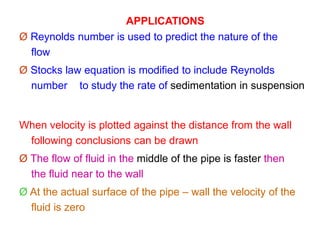
APPLICATIONS
Ø Reynolds number is used to predict the nature of the
flow
Ø Stocks law equation is modified to include Reynolds
number to study the rate of sedimentation in suspension
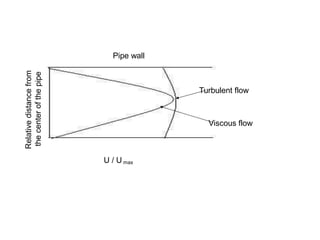
When velocity is plotted against the distance from the wall
following conclusions can be drawn
Ø The flow of fluid in the middle of the pipe is faster then
the fluid near to the wall
Ø At the actual surface of the pipe – wall the velocity of the
fluid is zero
Pipe wall
Relative
distance
from
the
center
of
the
pipe
U / U max
Turbulent flow
Viscous flow
BERNOULLI'S THEOREM
When the principals of the law of energy is applied to the flow of the
fluids the resulting equation is a Bernoulli's theorem
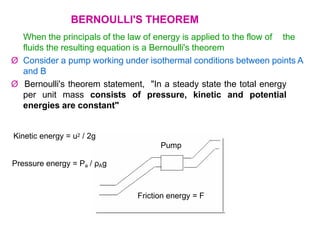
Ø Consider a pump working under isothermal conditions between points A
and B
Ø Bernoulli's theorem statement, "In a steady state the total energy
per unit mass consists of pressure, kinetic and potential
energies are constant"
Kinetic energy = u2 / 2g
Pump
Pressure energy = Pa / ρAg
Friction energy = F
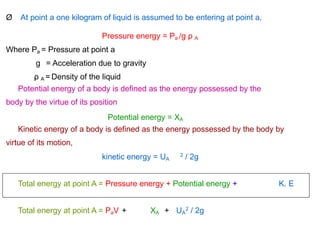
Ø At point a one kilogram of liquid is assumed to be entering at point a,
Pressure energy = Pa /g ρ A
Where Pa = Pressure at point a
g = Acceleration due to gravity
ρ A = Density of the liquid
Potential energy of a body is defined as the energy possessed by the
body by the virtue of its position
Potential energy = XA
Kinetic energy of a body is defined as the energy possessed by the body by
virtue of its motion,
kinetic energy = UA / 2g
2
Total energy at point A = Pressure energy + Potential energy + K. E
Total energy at point A = PaV + XA + UA / 2g
2
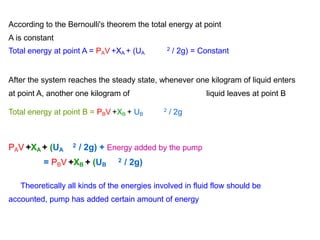
According to the Bernoulli's theorem the total energy at point
A is constant
Total energy at point A = PAV +XA + (UA / 2g) = Constant
2
After the system reaches the steady state, whenever one kilogram of liquid enters
at point A, another one kilogram of liquid leaves at point B
Total energy at point B = PBV +XB + UB / 2g
2
PAV +XA + (UA
2 / 2g) + Energy added by the pump
= PBV +XB + (UB
2 / 2g)
Theoretically all kinds of the energies involved in fluid flow should be
accounted, pump has added certain amount of energy
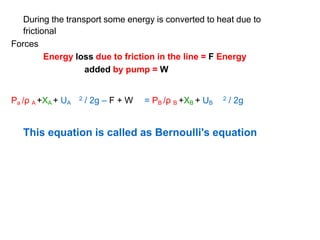
During the transport some energy is converted to heat due to
frictional
Forces
Energy loss due to friction in the line = F Energy
added by pump = W
Pa /ρ A +XA + UA
2 / 2g – F + W = PB /ρ B +XB + UB / 2g
2
This equation is called as Bernoulli's equation
ENERGY LOSS
According to the law of conversation of energy, energy
balance have to be properly calculated fluids
experiences energy losses in several ways
while flowing through pipes, they are
Ø Frictional losses
Ø Losses in the fitting Ø
Enlargement losses Ø
Contraction losses
Application of
BERNOULLI'S THEOREM
 Ø Used in the measurement of
rate of fluid flow using
flowmeters
 Ø It applied in the working of
the centrifugal pump, in this
kinetic energy is converted in
to pressure.
THANK-YOU

Flow of fluid- Pharmaceutical Engineering

  • 1.
    FLOW OF FLUID BY-SANCHIT DHANKHAR
  • 2.
    Disclaimer Presentation slides areprovided on student's request for purpose of quick reference only, hence it can not be replaced with standard study material or books that are mentioned in syllabus of respective subjects. Students are expected to refer standard books for study for examination.
  • 3.
    Fluid flow • Mentionfluid properties such as viscosity, compressibility and surface tension of fluids. • Hydrostatics (Fluidststics) influencing fluid flow. • Fluid dynamics‐ Bernoulli’s theorem, flow of fluids in pipes, laminar and turbulent flow.
  • 4.
  • 5.
  • 6.
    FLUID FLOW A fluidis a substance that continually deforms (flows) under an applied shear stress. Fluids are a subset of the phases of matter and include liquids, gases. Fluid flow may be defined as the flow of substances that do not permanently resist distortion The subject of fluid flow can be divided into fluid static's and fluid dynamics
  • 7.
    FLUID STATICS Ø Fluidstatic's deals with the fluids at rest in equilibrium Ø Behavior of liquid at rest Ø Nature of pressure it exerts and the variation of pressure at different layers Pressure differences between layers of liquids h2 h1 Point 2 Point 1
  • 8.
    Consider a columnof liquid with two openings Which are provided at the wall of the vessel at different height The rate of flow through these openings are different due to the pressure exerted at the different heights are different Consider a stationary column the pressure P is acting on the surface of the fluid, column is maintained at constant pressure by applying pressure The force acting below and above the point 1 are evaluated Substituting the force with pressure x area of cross section in the above equation
  • 9.
    Force acting onthe liquid = At point 1 + Force on the surface Force excreted by the liquid Above point 1 Pressure at point 2 x Area= (Pressure on the surface area x surface area) P1S = P2S + volume x density x g = P2S + height x area x density x g Pressure at point 1 x Area = (Pressure on the surface area x surface area) + (mass x g)
  • 10.
    P1s = P2s+ volume x density x g = P2s + height x area x density x g P2s + h1 S ρ g P1s = Since surface area is same P1 = Ps + h1 ρ g Pressure acting on point 2 may be written as P2 = Ps + h2 ρ g Difference in the pressure is -- P2 - P1 = g (Ps + h2 ρ ) – ( Ps + h1 ρ) g ∆P = (Ps + h2 ρ – Ps ∆P = ∆ h ρ g - h1 ρ ) g [F=Volume.ρ g]
  • 11.
    FLD U IY D NAMICS Ø Fluid dynamicsdeals with the study of fluids in motion  Ø This knowledge is important for liquids, gels, ointments which will change their flow behavior when exposed to different stress conditions MIXING FLOW THROUGH PIPES FILLED IN CONTAINER
  • 12.
    Importance Identification of typeof flow is important in Manufacture of dosage forms ü Handling of drugs for administration The flow of fluid through a pipe can be viscous or turbulent and it can be determined by Reynolds number Reynolds number have no unit
  • 13.
    Reynolds Experiment  Glasstube is connected to reservoir of water, rate of flow of water is adjusted by a valve,  A reservoir of colored solution is connected to one end of the glass tube with help of nozzle.  Colored solution is introduced into the nozzle as fine stream through jet tube.
  • 14.
    water valve Colored liquid LAMINAR ORVISCOUS FLOW TURBULENT FLOW
  • 17.
    TYPES OF FLOW èLaminar flow is one in which the fluid particles move in layers or laminar with one layer sliding with other è There is no exchange of fluid particles from one layer to other è Avg velocity è Re < 2000 = 0.5 Vmax è When velocity of the water is increased the thread of the colored water disappears and mass of the water gets uniformly colored è There is complete mixing of the solution and the flow of the fluid is called as turbulent flow è Avg velocity = 0.8 Vmax è Re >4000 The velocity at which the fluid changes from laminar flow to turbulent flow that velocity is called as critical velocity
  • 18.
    REYNOLDS NUMBER In Reynoldsexperiment the flow conditions are affected by Ø Diameter of pipe Ø Average velocity Ø Density of liquid Ø Viscosity of the fluid This four factors are combined in one way as Reynolds number Re= Ø Inertial forces are due to mass and the velocity of the fluid particles trying to diffuse the fluid particles Ø viscous force if the frictional force due to the viscosity of the fluid which make the motion of the fluid in parallel. D u ρ η INERTIAL FORCES = ------------------------------ VISCOUS FORCES
  • 19.
    ¬ At lowvelocities the inertial forces are less when compared to the frictional forces ¬Resulting flow will be viscous in nature ¬Other hand when inertial forces are predominant the fluid layers break up due to the increase in velocity hence turbulent flow takes place. ¬If Re < 2000 the flow I said to be laminar ¬If Re > 4000 the flow is said to be turbulent ¬If Re lies between 2000 to 4000 the flow change between laminar to turbulent
  • 20.
    APPLICATIONS Ø Reynolds numberis used to predict the nature of the flow Ø Stocks law equation is modified to include Reynolds number to study the rate of sedimentation in suspension When velocity is plotted against the distance from the wall following conclusions can be drawn Ø The flow of fluid in the middle of the pipe is faster then the fluid near to the wall Ø At the actual surface of the pipe – wall the velocity of the fluid is zero
  • 21.
  • 22.
    BERNOULLI'S THEOREM When theprincipals of the law of energy is applied to the flow of the fluids the resulting equation is a Bernoulli's theorem Ø Consider a pump working under isothermal conditions between points A and B Ø Bernoulli's theorem statement, "In a steady state the total energy per unit mass consists of pressure, kinetic and potential energies are constant" Kinetic energy = u2 / 2g Pump Pressure energy = Pa / ρAg Friction energy = F
  • 23.
    Ø At pointa one kilogram of liquid is assumed to be entering at point a, Pressure energy = Pa /g ρ A Where Pa = Pressure at point a g = Acceleration due to gravity ρ A = Density of the liquid Potential energy of a body is defined as the energy possessed by the body by the virtue of its position Potential energy = XA Kinetic energy of a body is defined as the energy possessed by the body by virtue of its motion, kinetic energy = UA / 2g 2 Total energy at point A = Pressure energy + Potential energy + K. E Total energy at point A = PaV + XA + UA / 2g 2
  • 24.
    According to theBernoulli's theorem the total energy at point A is constant Total energy at point A = PAV +XA + (UA / 2g) = Constant 2 After the system reaches the steady state, whenever one kilogram of liquid enters at point A, another one kilogram of liquid leaves at point B Total energy at point B = PBV +XB + UB / 2g 2 PAV +XA + (UA 2 / 2g) + Energy added by the pump = PBV +XB + (UB 2 / 2g) Theoretically all kinds of the energies involved in fluid flow should be accounted, pump has added certain amount of energy
  • 25.
    During the transportsome energy is converted to heat due to frictional Forces Energy loss due to friction in the line = F Energy added by pump = W Pa /ρ A +XA + UA 2 / 2g – F + W = PB /ρ B +XB + UB / 2g 2 This equation is called as Bernoulli's equation
  • 26.
    ENERGY LOSS According tothe law of conversation of energy, energy balance have to be properly calculated fluids experiences energy losses in several ways while flowing through pipes, they are Ø Frictional losses Ø Losses in the fitting Ø Enlargement losses Ø Contraction losses
  • 27.
    Application of BERNOULLI'S THEOREM Ø Used in the measurement of rate of fluid flow using flowmeters  Ø It applied in the working of the centrifugal pump, in this kinetic energy is converted in to pressure.
  • 28.