BURN FLUID CALCULATION
DEPARTMENT
OF
MEDICAL SURGICAL NURSING
L EARNING OBJECTIVES
At the end of this lecture the students will be able to:
• Describe various formulas for fluid calculation of
burn
Management of Fluid loss and shock :
For haemodynamic stabilization fluid resuscitation may
be initiated immediately on the basis of the
percentage of burn injury. The goal of fluid
resuscitation is to give sufficient fluid to allow
perfusion of vital organs without over hydrating the
patient and risking later complication and circulatory
overload.
Some combination of fluid categories
1) Colloids :- Whole blood, plasma, and plasma
expenders.
2) Electrolyte : Physiologic sodium chloride, Ringer’s
Sol, Hartmann’s Son.
There are some formula which is use is calculating fluid
for Burn patient.
1) The consensus formula
It was agreed that salt and water are essential
requirement of burn patient but that colloid may or
may not be useful during the 1st 2 4 hours to 48
hours post burn.
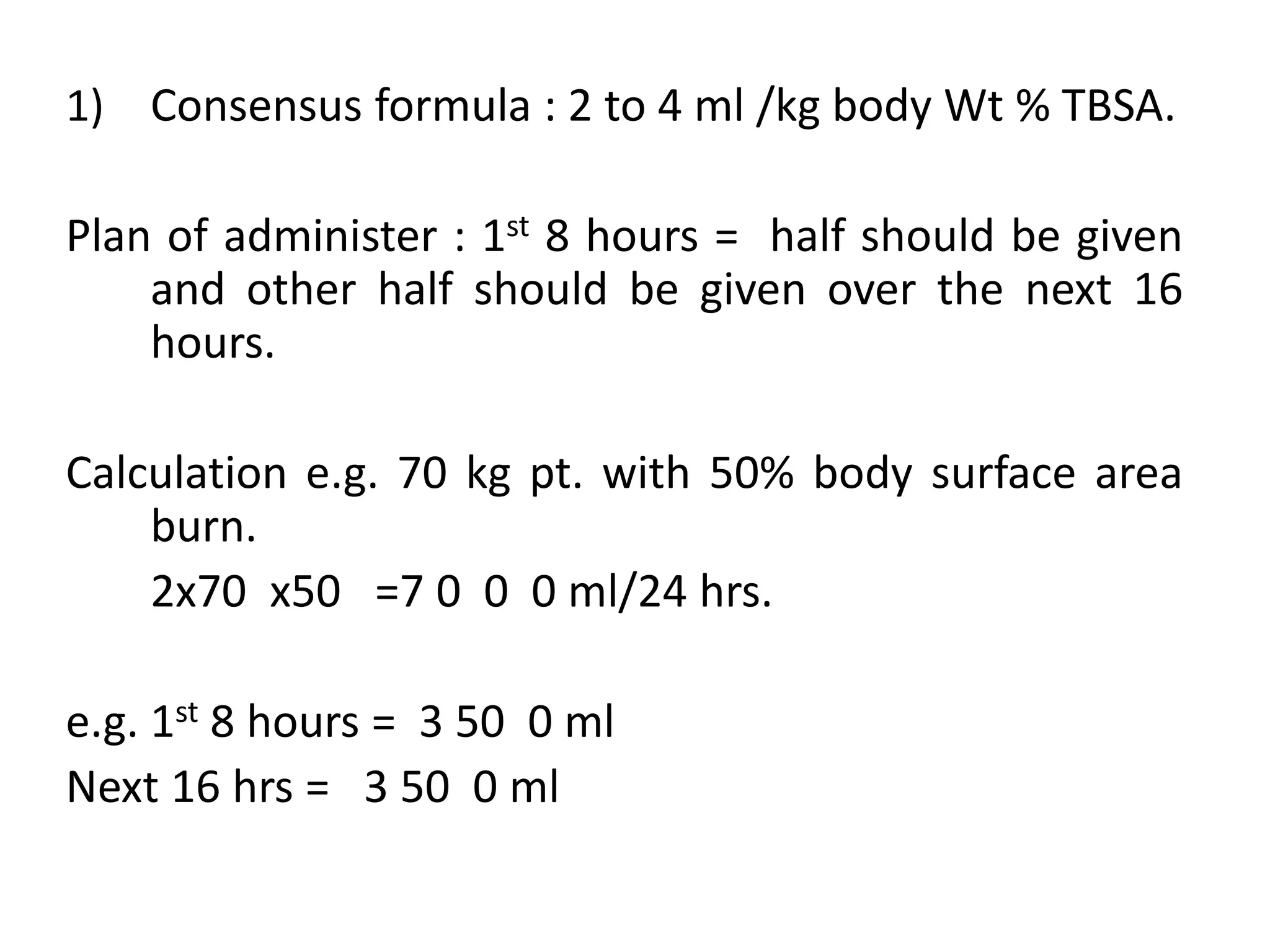
1) Consensus formula : 2 to 4 ml /kg body Wt % TBSA.
Plan of administer : 1st 8 hours = half should be given
and other half should be given over the next 16
hours.
Calculation e.g. 70 kg pt. with 50% body surface area
burn.
2x70 x50 =7 0 0 0 ml/24 hrs.
e.g. 1st 8 hours = 3 50 0 ml
Next 16 hrs = 3 50 0 ml
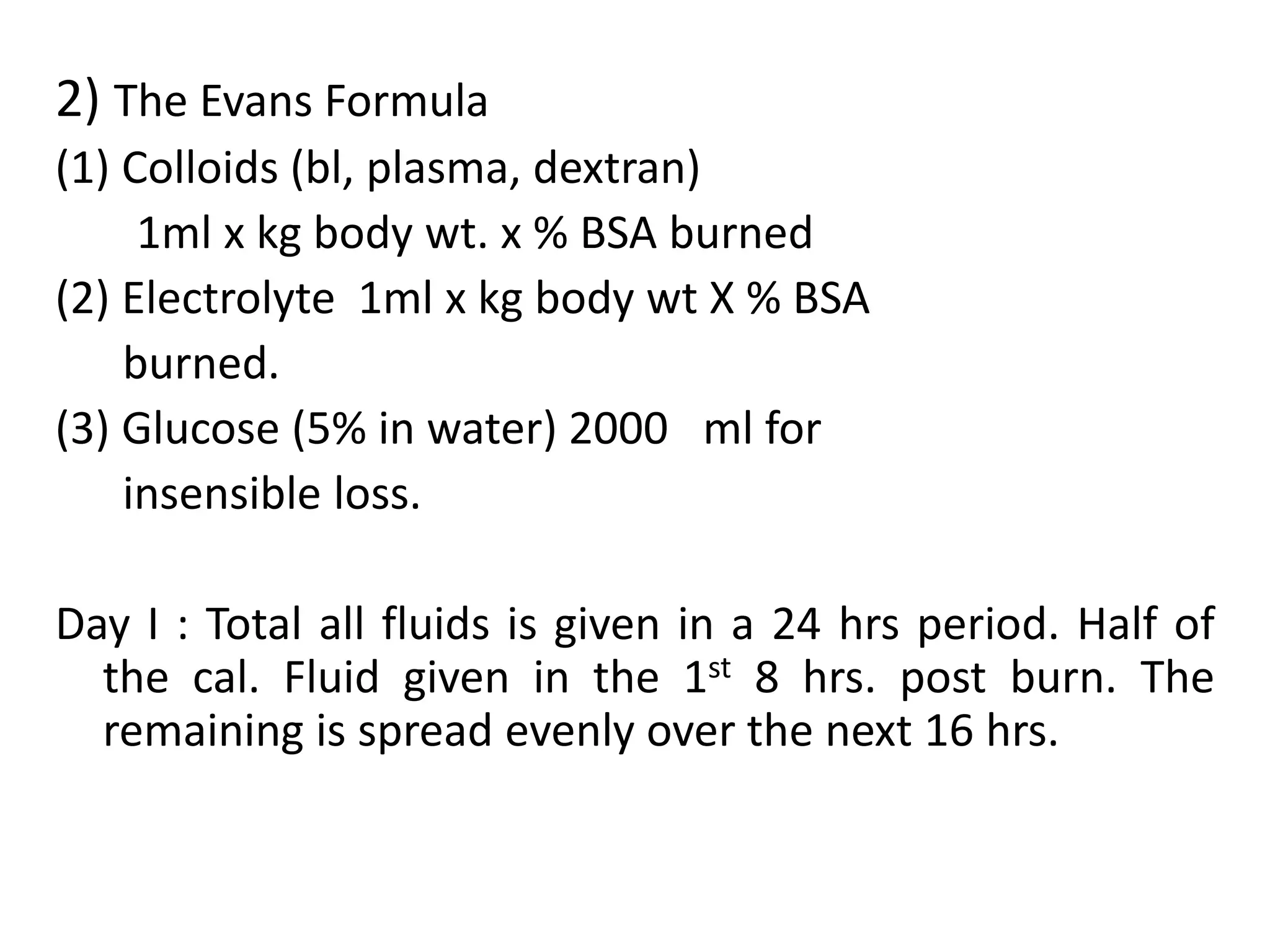
2) The Evans Formula
(1) Colloids (bl, plasma, dextran)
1ml x kg body wt. x % BSA burned
(2) Electrolyte 1ml x kg body wt X % BSA
burned.
(3) Glucose (5% in water) 2000 ml for
insensible loss.
Day I : Total all fluids is given in a 24 hrs period. Half of
the cal. Fluid given in the 1st 8 hrs. post burn. The
remaining is spread evenly over the next 16 hrs.
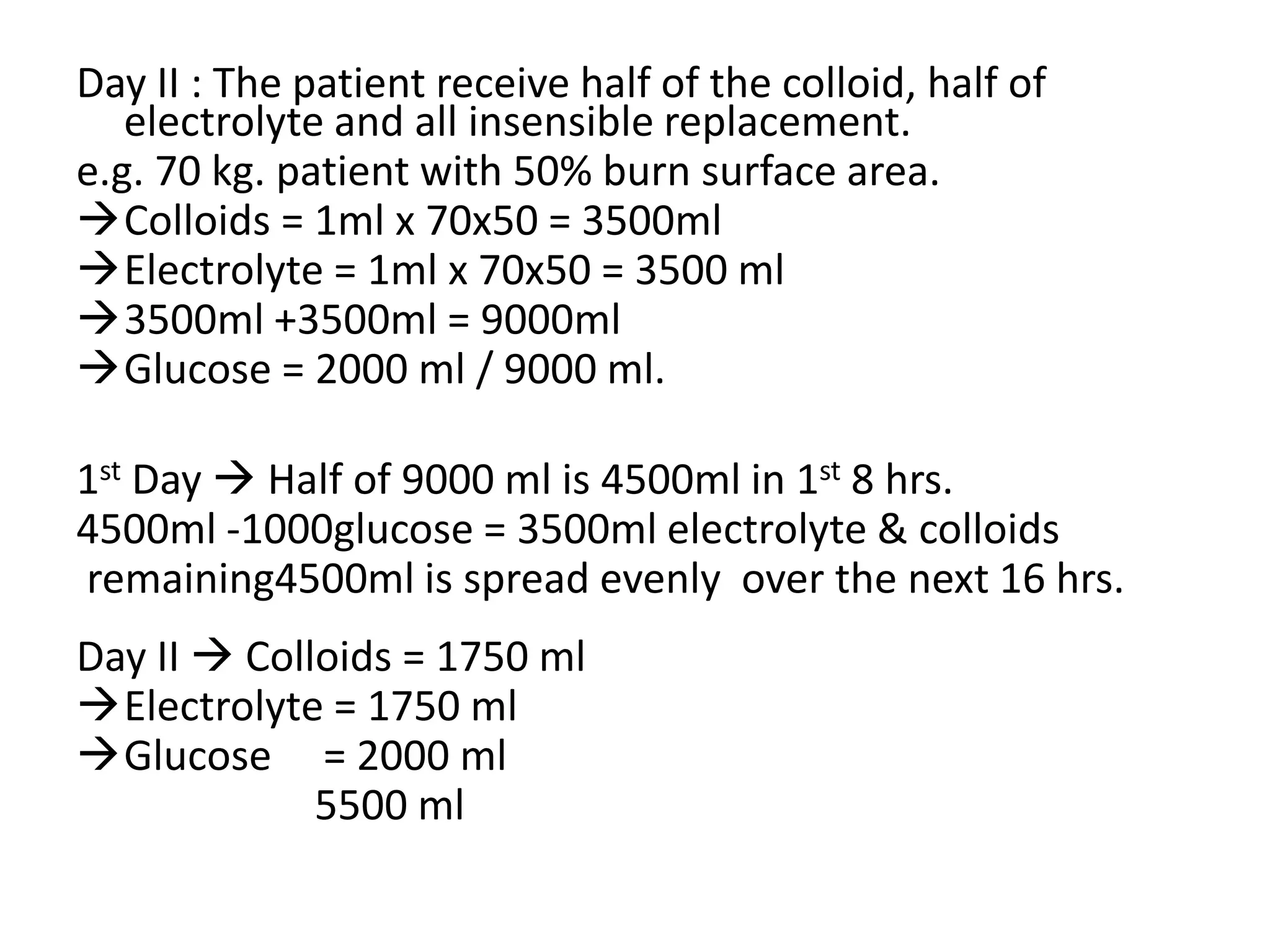
Day II : The patient receive half of the colloid, half of
electrolyte and all insensible replacement.
e.g. 70 kg. patient with 50% burn surface area.
Colloids = 1ml x 70x50 = 3500ml
Electrolyte = 1ml x 70x50 = 3500 ml
3500ml +3500ml = 9000ml
Glucose = 2000 ml / 9000 ml.
1st Day  Half of 9000 ml is 4500ml in 1st 8 hrs.
4500ml -1000glucose = 3500ml electrolyte & colloids
remaining4500ml is spread evenly over the next 16 hrs.
Day II  Colloids = 1750 ml
Electrolyte = 1750 ml
Glucose = 2000 ml
5500 ml
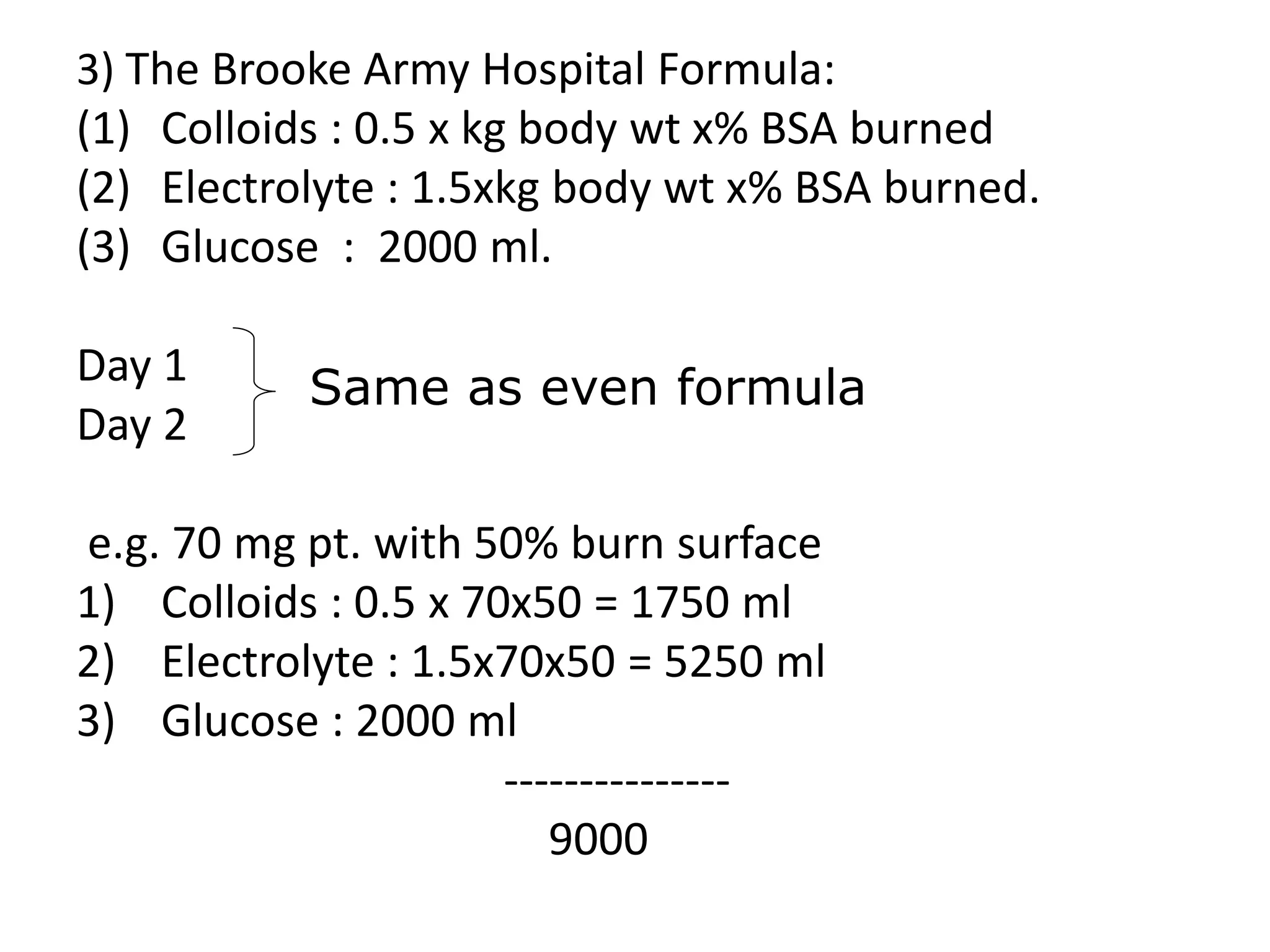
3) The Brooke Army Hospital Formula:
(1) Colloids : 0.5 x kg body wt x% BSA burned
(2) Electrolyte : 1.5xkg body wt x% BSA burned.
(3) Glucose : 2000 ml.
Day 1
Day 2
e.g. 70 mg pt. with 50% burn surface
1) Colloids : 0.5 x 70x50 = 1750 ml
2) Electrolyte : 1.5x70x50 = 5250 ml
3) Glucose : 2000 ml
---------------
9000
Same as even formula
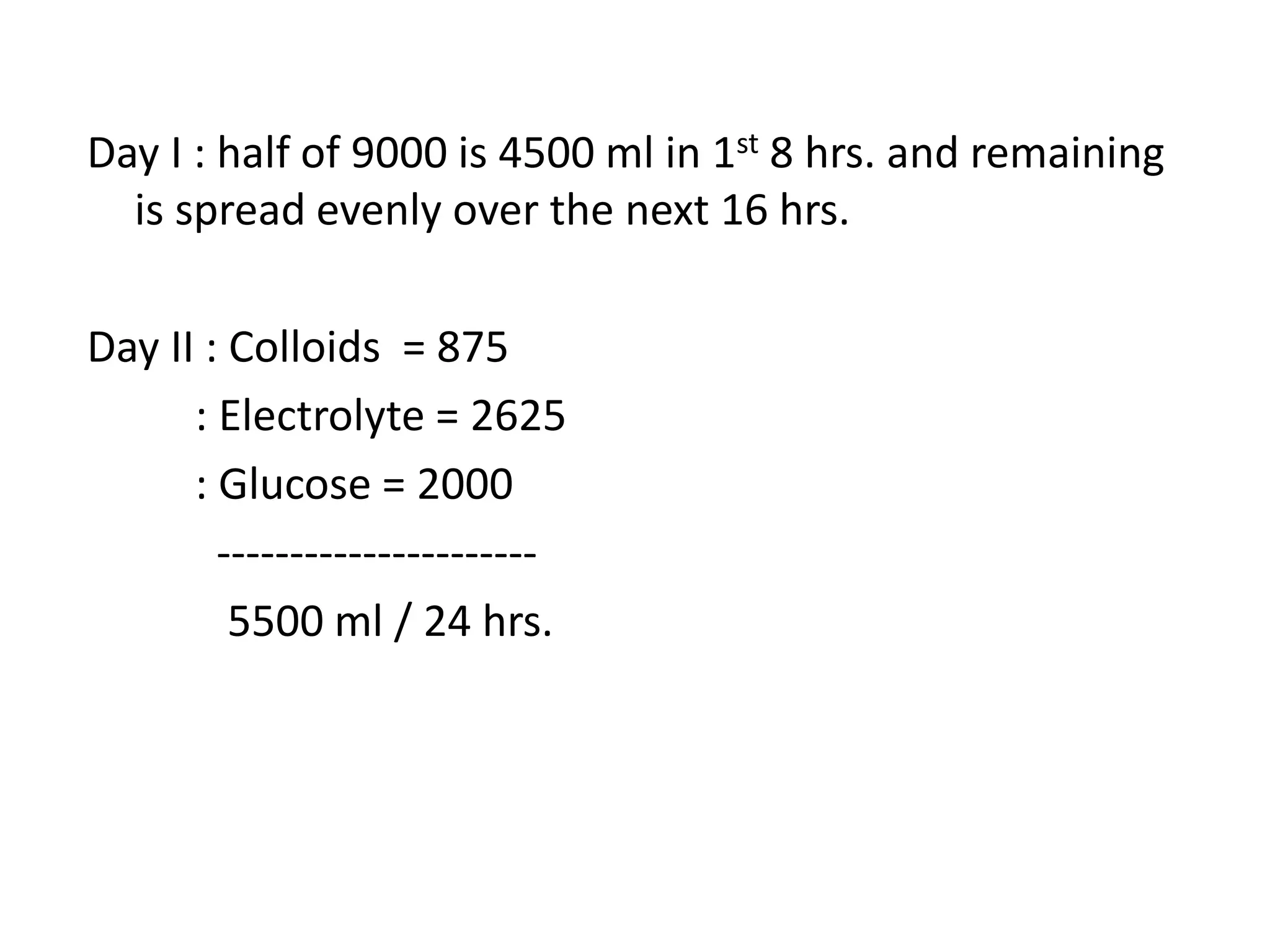
Day I : half of 9000 is 4500 ml in 1st 8 hrs. and remaining
is spread evenly over the next 16 hrs.
Day II : Colloids = 875
: Electrolyte = 2625
: Glucose = 2000
----------------------
5500 ml / 24 hrs.
4] The Parkland or Boxter Formula :
4ml x kg of body wt. x % burn
- Half is given in the 1st 8 hrs and rest over the next 16
hrs.
e.g. 70 kg pt. with 50%.
4ml x 70 x 50 = 1400
7000 ml is given in 1st 8 hrs and rest over the next 16
hrs.
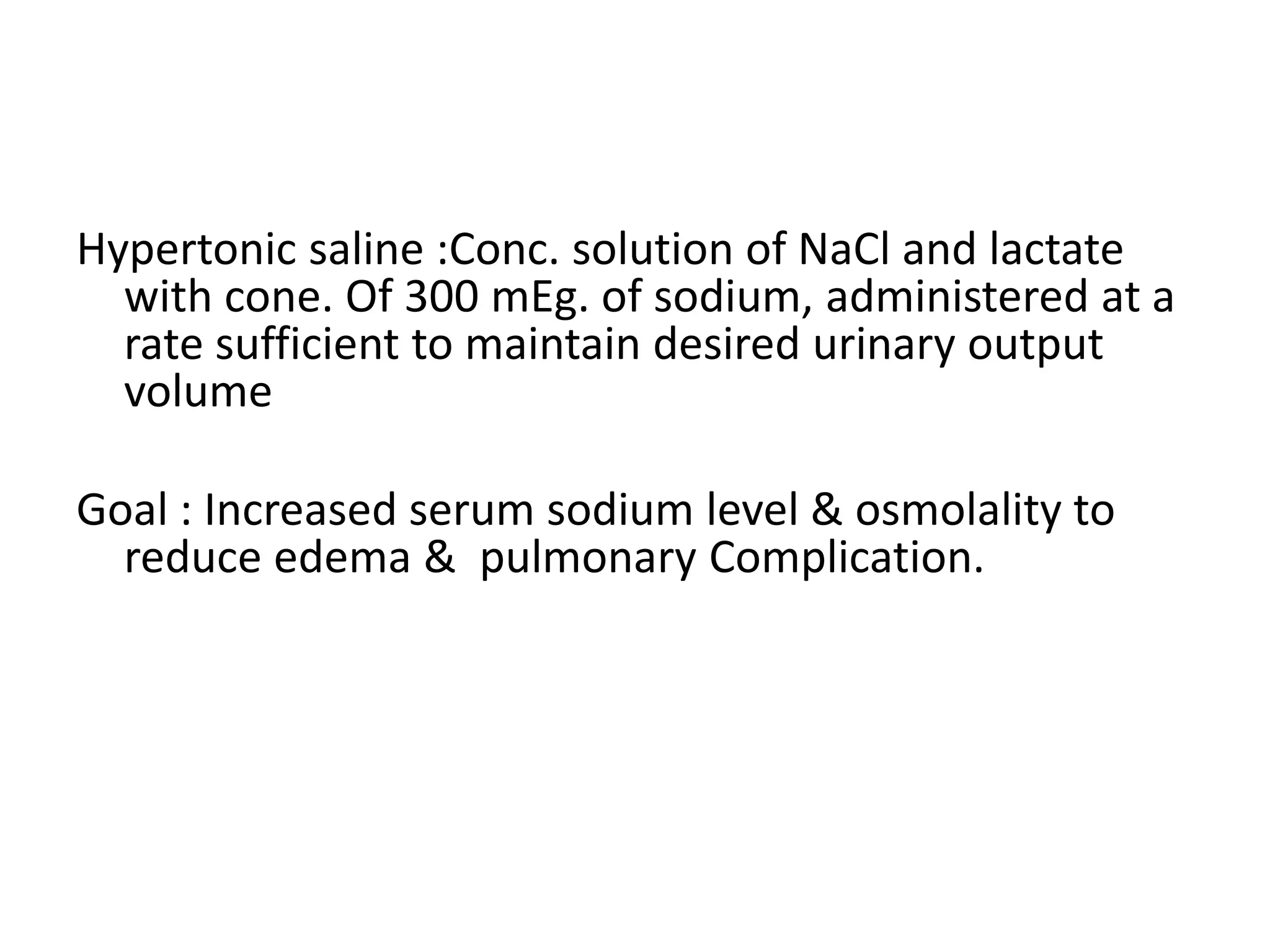
Hypertonic saline :Conc. solution of NaCl and lactate
with cone. Of 300 mEg. of sodium, administered at a
rate sufficient to maintain desired urinary output
volume
Goal : Increased serum sodium level & osmolality to
reduce edema & pulmonary Complication.
Summary
• So far we have discussed about various
formulas for fluid calculation of burn
Bibliography
• Lewis et al, Medical Surgical Nursing, Mosby
Elsevier,7th edition.
• Joyce.M.Black et al, Medical Surgical Nursing,
Saunders publication.
• Brunner and Siddhartha, Medical Surgical
Nursing, Lippincott Williams and Wilkins.
Thank You

Fluid calculation for burn

  • 1.
  • 2.
    L EARNING OBJECTIVES Atthe end of this lecture the students will be able to: • Describe various formulas for fluid calculation of burn
  • 3.
    Management of Fluidloss and shock : For haemodynamic stabilization fluid resuscitation may be initiated immediately on the basis of the percentage of burn injury. The goal of fluid resuscitation is to give sufficient fluid to allow perfusion of vital organs without over hydrating the patient and risking later complication and circulatory overload.
  • 4.
    Some combination offluid categories 1) Colloids :- Whole blood, plasma, and plasma expenders. 2) Electrolyte : Physiologic sodium chloride, Ringer’s Sol, Hartmann’s Son. There are some formula which is use is calculating fluid for Burn patient.
  • 5.
    1) The consensusformula It was agreed that salt and water are essential requirement of burn patient but that colloid may or may not be useful during the 1st 2 4 hours to 48 hours post burn.
  • 6.
    1) Consensus formula: 2 to 4 ml /kg body Wt % TBSA. Plan of administer : 1st 8 hours = half should be given and other half should be given over the next 16 hours. Calculation e.g. 70 kg pt. with 50% body surface area burn. 2x70 x50 =7 0 0 0 ml/24 hrs. e.g. 1st 8 hours = 3 50 0 ml Next 16 hrs = 3 50 0 ml
  • 7.
    2) The EvansFormula (1) Colloids (bl, plasma, dextran) 1ml x kg body wt. x % BSA burned (2) Electrolyte 1ml x kg body wt X % BSA burned. (3) Glucose (5% in water) 2000 ml for insensible loss. Day I : Total all fluids is given in a 24 hrs period. Half of the cal. Fluid given in the 1st 8 hrs. post burn. The remaining is spread evenly over the next 16 hrs.
  • 8.
    Day II :The patient receive half of the colloid, half of electrolyte and all insensible replacement. e.g. 70 kg. patient with 50% burn surface area. Colloids = 1ml x 70x50 = 3500ml Electrolyte = 1ml x 70x50 = 3500 ml 3500ml +3500ml = 9000ml Glucose = 2000 ml / 9000 ml. 1st Day  Half of 9000 ml is 4500ml in 1st 8 hrs. 4500ml -1000glucose = 3500ml electrolyte & colloids remaining4500ml is spread evenly over the next 16 hrs. Day II  Colloids = 1750 ml Electrolyte = 1750 ml Glucose = 2000 ml 5500 ml
  • 9.
    3) The BrookeArmy Hospital Formula: (1) Colloids : 0.5 x kg body wt x% BSA burned (2) Electrolyte : 1.5xkg body wt x% BSA burned. (3) Glucose : 2000 ml. Day 1 Day 2 e.g. 70 mg pt. with 50% burn surface 1) Colloids : 0.5 x 70x50 = 1750 ml 2) Electrolyte : 1.5x70x50 = 5250 ml 3) Glucose : 2000 ml --------------- 9000 Same as even formula
  • 10.
    Day I :half of 9000 is 4500 ml in 1st 8 hrs. and remaining is spread evenly over the next 16 hrs. Day II : Colloids = 875 : Electrolyte = 2625 : Glucose = 2000 ---------------------- 5500 ml / 24 hrs.
  • 11.
    4] The Parklandor Boxter Formula : 4ml x kg of body wt. x % burn - Half is given in the 1st 8 hrs and rest over the next 16 hrs. e.g. 70 kg pt. with 50%. 4ml x 70 x 50 = 1400 7000 ml is given in 1st 8 hrs and rest over the next 16 hrs.
  • 12.
    Hypertonic saline :Conc.solution of NaCl and lactate with cone. Of 300 mEg. of sodium, administered at a rate sufficient to maintain desired urinary output volume Goal : Increased serum sodium level & osmolality to reduce edema & pulmonary Complication.
  • 13.
    Summary • So farwe have discussed about various formulas for fluid calculation of burn
  • 14.
    Bibliography • Lewis etal, Medical Surgical Nursing, Mosby Elsevier,7th edition. • Joyce.M.Black et al, Medical Surgical Nursing, Saunders publication. • Brunner and Siddhartha, Medical Surgical Nursing, Lippincott Williams and Wilkins.
  • 15.