“Damage to
the skin or other body
parts caused by extreme
heat,flame,contact with
heated objects or
chemicals that is known
as Burn.”
- www.medterms.com
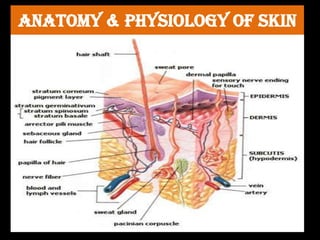
ANATOMY & PHYSIOLOGY OF SKIN
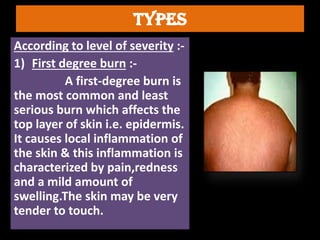
According to level of severity :-
1) First degree burn :-
A first-degree burn is
the most common and least
serious burn which affects the
top layer of skin i.e. epidermis.
It causes local inflammation of
the skin & this inflammation is
characterized by pain,redness
and a mild amount of
swelling.The skin may be very
tender to touch.
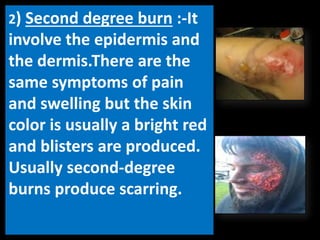
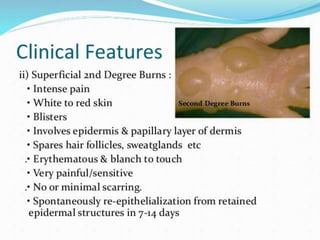
2) Second degree burn :-It
involve the epidermis and
the dermis.There are the
same symptoms of pain
and swelling but the skin
color is usually a bright red
and blisters are produced.
Usually second-degree
burns produce scarring.
.
3) THIRD DEGREE BURN
4TH DEGREE
• :-The 4TH degree burn may appear patches
which appear white,brown or black.Both the
dermis and epidermis are destroyed and
other organs, tissues and bones may also be
involved.Third-degree burns are considered
the most serious
s
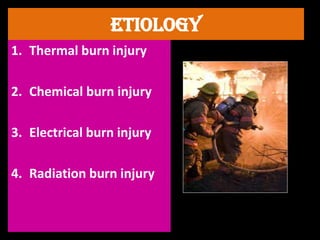
Etiology
1. Thermal burn injury
2. Chemical burn injury
3. Electrical burn injury
4. Radiation burn injury
Thermal burn
• A thermal burn is a type of burn resulting
from making contact with heated objects,
such as boiling water, steam, hot cooking oil,
fire, and hot objects.
Chemical burn
• A chemical burn occurs when your skin or
eyes come into contact with an irritant, such
as an acid or a base. Bases are described as
alkaline. Chemical burns are also known as
caustic burns. They may cause a reaction on
your skin or within your body.
Electrical burn
• An electrical burn is a burn that results from
electricity passing through the body causing
rapid injury.
Radiation
• A radiation burn is damage to the skin or
other biological tissue caused by exposure
to radiation. The radiation types of greatest
concern are thermal radiation, radio
frequency energy, ultraviolet light and
ionizing radiation. The most common type
of radiation burn is a sunburn caused by
UVradiation.
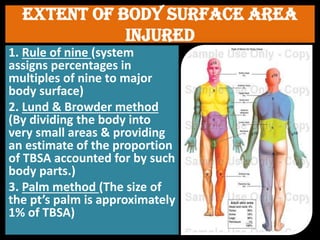
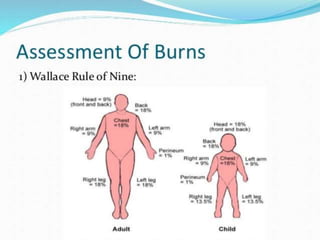
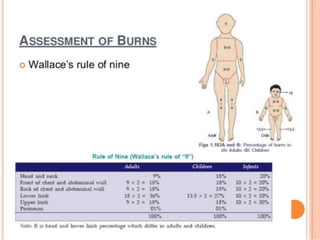
Extent of body surface area
injured
1. Rule of nine (system
assigns percentages in
multiples of nine to major
body surface)
2. Lund & Browder method
(By dividing the body into
very small areas & providing
an estimate of the proportion
of TBSA accounted for by such
body parts.)
3. Palm method (The size of
the pt’s palm is approximately
1% of TBSA)
s
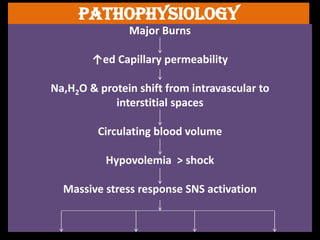
Pathophysiology
Major Burns
↑ed Capillary permeability
Na,H2O & protein shift from intravascular to
interstitial spaces
Circulating blood volume
Hypovolemia > shock
Massive stress response SNS activation
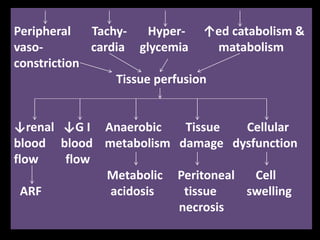
Peripheral Tachy- Hyper- ↑ed catabolism &
vaso- cardia glycemia matabolism
constriction
Tissue perfusion
↓renal ↓G I Anaerobic Tissue Cellular
blood blood metabolism damage dysfunction
flow flow
Metabolic Peritoneal Cell
ARF acidosis tissue swelling
necrosis
Clinical manifestation
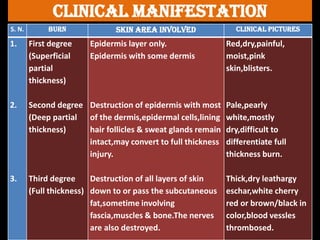
S. N. BURN SKIN AREA INVOLVED CLINICAL PICTURES
1.
2.
3.
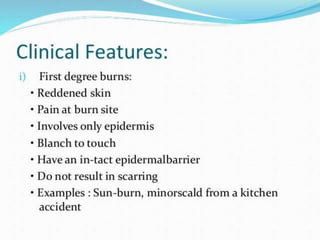
First degree
(Superficial
partial
thickness)
Second degree
(Deep partial
thickness)
Third degree
(Full thickness)
Epidermis layer only.
Epidermis with some dermis
Destruction of epidermis with most
of the dermis,epidermal cells,lining
hair follicles & sweat glands remain
intact,may convert to full thickness
injury.
Destruction of all layers of skin
down to or pass the subcutaneous
fat,sometime involving
fascia,muscles & bone.The nerves
are also destroyed.
Red,dry,painful,
moist,pink
skin,blisters.
Pale,pearly
white,mostly
dry,difficult to
differentiate full
thickness burn.
Thick,dry leathargy
eschar,white cherry
red or brown/black in
color,blood vessles
thrombosed.
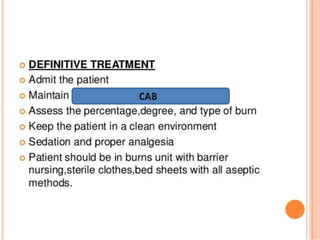
Management
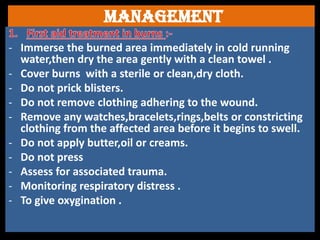
- Immerse the burned area immediately in cold running
water,then dry the area gently with a clean towel .
- Cover burns with a sterile or clean,dry cloth.
- Do not prick blisters.
- Do not remove clothing adhering to the wound.
- Remove any watches,bracelets,rings,belts or constricting
clothing from the affected area before it begins to swell.
- Do not apply butter,oil or creams.
- Do not press
- Assess for associated trauma.
- Monitoring respiratory distress .
- To give oxygination .
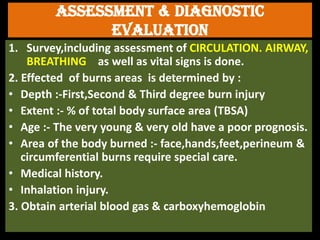
Assessment & diagnostic
evaluation
1. Survey,including assessment of CIRCULATION. AIRWAY,
BREATHING as well as vital signs is done.
2. Effected of burns areas is determined by :
• Depth :-First,Second & Third degree burn injury
• Extent :- % of total body surface area (TBSA)
• Age :- The very young & very old have a poor prognosis.
• Area of the body burned :- face,hands,feet,perineum &
circumferential burns require special care.
• Medical history.
• Inhalation injury.
3. Obtain arterial blood gas & carboxyhemoglobin
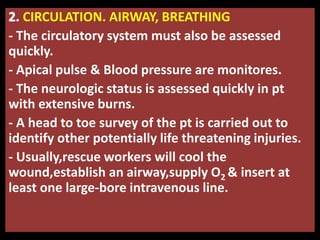
CIRCULATION. AIRWAY, BREATHING
- The circulatory system must also be assessed
quickly.
- Apical pulse & Blood pressure are monitores.
- The neurologic status is assessed quickly in pt
with extensive burns.
- A head to toe survey of the pt is carried out to
identify other potentially life threatening injuries.
- Usually,rescue workers will cool the
wound,establish an airway,supply O2 & insert at
least one large-bore intravenous line.
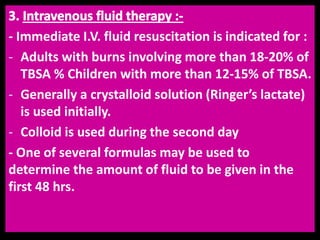
- Immediate I.V. fluid resuscitation is indicated for :
- Adults with burns involving more than 18-20% of
TBSA % Children with more than 12-15% of TBSA.
- Generally a crystalloid solution (Ringer’s lactate)
is used initially.
- Colloid is used during the second day
- One of several formulas may be used to
determine the amount of fluid to be given in the
first 48 hrs.
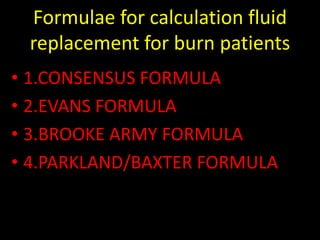
Formulae for calculation fluid
replacement for burn patients
• 1.CONSENSUS FORMULA
• 2.EVANS FORMULA
• 3.BROOKE ARMY FORMULA
• 4.PARKLAND/BAXTER FORMULA
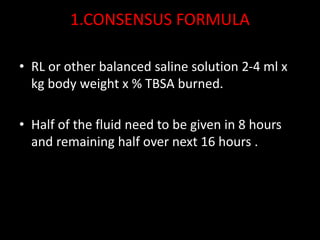
1.CONSENSUS FORMULA
• RL or other balanced saline solution 2-4 ml x
kg body weight x % TBSA burned.
• Half of the fluid need to be given in 8 hours
and remaining half over next 16 hours .
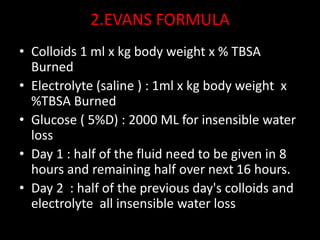
2.EVANS FORMULA
• Colloids 1 ml x kg body weight x % TBSA
Burned
• Electrolyte (saline ) : 1ml x kg body weight x
%TBSA Burned
• Glucose ( 5%D) : 2000 ML for insensible water
loss
• Day 1 : half of the fluid need to be given in 8
hours and remaining half over next 16 hours.
• Day 2 : half of the previous day's colloids and
electrolyte all insensible water loss
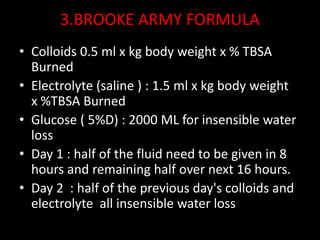
3.BROOKE ARMY FORMULA
• Colloids 0.5 ml x kg body weight x % TBSA
Burned
• Electrolyte (saline ) : 1.5 ml x kg body weight
x %TBSA Burned
• Glucose ( 5%D) : 2000 ML for insensible water
loss
• Day 1 : half of the fluid need to be given in 8
hours and remaining half over next 16 hours.
• Day 2 : half of the previous day's colloids and
electrolyte all insensible water loss
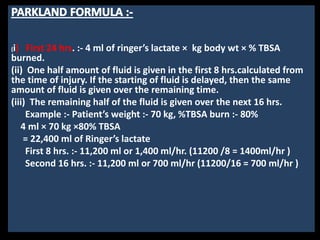
4.PARKLAND/BAXTER
FORMULA
(i) First 24 hrs. :- 4 ml of ringer’s lactate × kg body wt × % TBSA
burned.
(ii) One half amount of fluid is given in the first 8 hrs.calculated from
the time of injury. If the starting of fluid is delayed, then the same
amount of fluid is given over the remaining time.
(iii) The remaining half of the fluid is given over the next 16 hrs.
Example :- Patient’s weight :- 70 kg, %TBSA burn :- 80%
4 ml × 70 kg ×80% TBSA
= 22,400 ml of Ringer’s lactate
First 8 hrs. :- 11,200 ml or 1,400 ml/hr. (11200 /8 = 1400ml/hr )
Second 16 hrs. :- 11,200 ml or 700 ml/hr (11200/16 = 700 ml/hr )
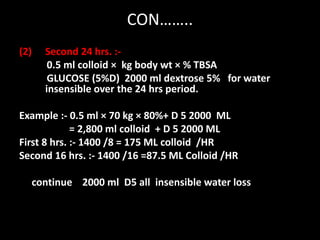
CON……..
(2) Second 24 hrs. :-
0.5 ml colloid × kg body wt × % TBSA
GLUCOSE (5%D) 2000 ml dextrose 5% for water
insensible over the 24 hrs period.
Example :- 0.5 ml × 70 kg × 80%+ D 5 2000 ML
= 2,800 ml colloid + D 5 2000 ML
First 8 hrs. :- 1400 /8 = 175 ML colloid /HR
Second 16 hrs. :- 1400 /16 =87.5 ML Colloid /HR
continue 2000 ml D5 all insensible water loss
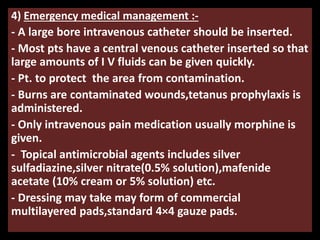
4) Emergency medical management :-
- A large bore intravenous catheter should be inserted.
- Most pts have a central venous catheter inserted so that
large amounts of I V fluids can be given quickly.
- Pt. to protect the area from contamination.
- Burns are contaminated wounds,tetanus prophylaxis is
administered.
- Only intravenous pain medication usually morphine is
given.
- Topical antimicrobial agents includes silver
sulfadiazine,silver nitrate(0.5% solution),mafenide
acetate (10% cream or 5% solution) etc.
- Dressing may take may form of commercial
multilayered pads,standard 4×4 gauze pads.
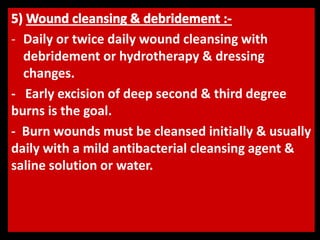
- Daily or twice daily wound cleansing with
debridement or hydrotherapy & dressing
changes.
- Early excision of deep second & third degree
burns is the goal.
- Burn wounds must be cleansed initially & usually
daily with a mild antibacterial cleansing agent &
saline solution or water.
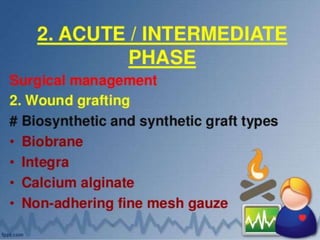
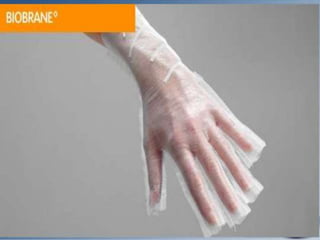
BIOBRANE
• (a type of artificial skin) is a
man made skin substitute composed
of nylon mesh, silicone and collagen
(derived from pig skin). It is a stretchable
dressing that is used as a temporary cover
for clean partial thickness burns and
donor sites or as a protective covering
over meshed skin grafts.
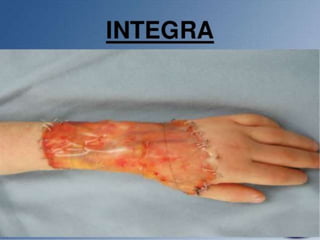
• INTEGRA
• is a product that is used to help re-grow
skin on body parts where skin has been
removed or badly damaged. It was
initially used to safely cover large areas
of burned tissue where skin needed to be
regrown. However, Integra is now used
far more widely as part of skin grafts in
reconstructive surgery.
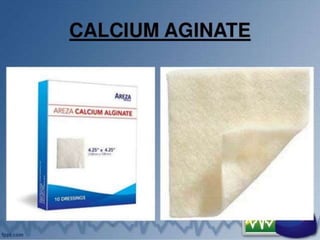
CALCIUM ALGINATE DRESSING
uses is to provide homeostasis, calcium
alginate is more commonly thought of as
the dressing that can absorb 20 times its
weight in exudate, soak up loose debris
from the wound bed, provide an optimal
environment for healing, and provide a
painless dressing change.
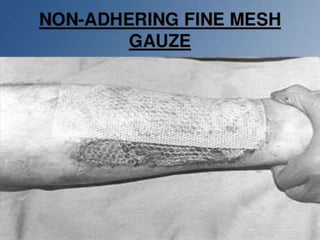
•Vaseline Gauze – Fine
mesh gauze which is non-
adherent to wound sites
and helps maintain a moist
wound environment.
Surgical managemenT
- The basic goal is the early excision & grafting.
1. Tangential Excision :-A special blade is used to
slice off thin layers ( 0.5 mm thick ) of damaged
skin until live tissue is evidenced by capillary
bleeding.Commonly used with deep partial
thickness burns & followed with immediate
dressing. Appling to deep dermal burns 3rd
degree burns .
2. Fascial (Primary) Excision :- The skin,lymphatics
& subcutaneous tissue are removed down to
fascia with either immediate autografting or
temporary coverage with biologic dressings.
ESCHAROTOMY
• is a surgical procedure used to treat full
thickness burn circumferential burn . In full
thickness burn ,both the dermis and
epidermis layer are destroyed along with
sensory nerve in the dermis .
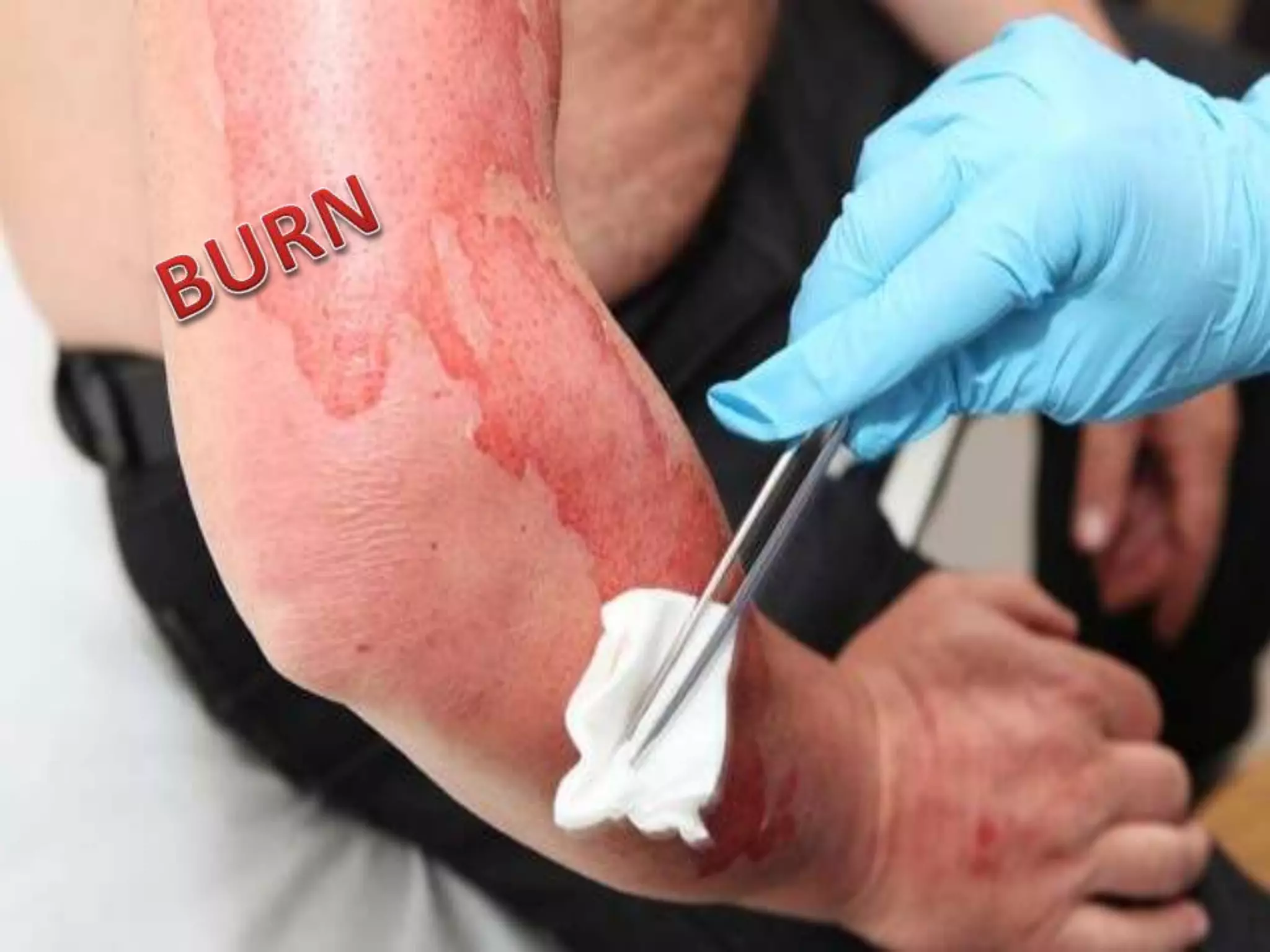
BURN
BURN
BURN

BURN

  • 3.
    “Damage to the skinor other body parts caused by extreme heat,flame,contact with heated objects or chemicals that is known as Burn.” - www.medterms.com
  • 6.
  • 7.
    According to levelof severity :- 1) First degree burn :- A first-degree burn is the most common and least serious burn which affects the top layer of skin i.e. epidermis. It causes local inflammation of the skin & this inflammation is characterized by pain,redness and a mild amount of swelling.The skin may be very tender to touch.
  • 9.
    2) Second degreeburn :-It involve the epidermis and the dermis.There are the same symptoms of pain and swelling but the skin color is usually a bright red and blisters are produced. Usually second-degree burns produce scarring.
  • 11.
  • 13.
    4TH DEGREE • :-The4TH degree burn may appear patches which appear white,brown or black.Both the dermis and epidermis are destroyed and other organs, tissues and bones may also be involved.Third-degree burns are considered the most serious
  • 15.
  • 16.
    Etiology 1. Thermal burninjury 2. Chemical burn injury 3. Electrical burn injury 4. Radiation burn injury
  • 17.
    Thermal burn • Athermal burn is a type of burn resulting from making contact with heated objects, such as boiling water, steam, hot cooking oil, fire, and hot objects.
  • 18.
    Chemical burn • Achemical burn occurs when your skin or eyes come into contact with an irritant, such as an acid or a base. Bases are described as alkaline. Chemical burns are also known as caustic burns. They may cause a reaction on your skin or within your body.
  • 19.
    Electrical burn • Anelectrical burn is a burn that results from electricity passing through the body causing rapid injury.
  • 20.
    Radiation • A radiationburn is damage to the skin or other biological tissue caused by exposure to radiation. The radiation types of greatest concern are thermal radiation, radio frequency energy, ultraviolet light and ionizing radiation. The most common type of radiation burn is a sunburn caused by UVradiation.
  • 21.
    Extent of bodysurface area injured 1. Rule of nine (system assigns percentages in multiples of nine to major body surface) 2. Lund & Browder method (By dividing the body into very small areas & providing an estimate of the proportion of TBSA accounted for by such body parts.) 3. Palm method (The size of the pt’s palm is approximately 1% of TBSA)
  • 22.
  • 24.
    Pathophysiology Major Burns ↑ed Capillarypermeability Na,H2O & protein shift from intravascular to interstitial spaces Circulating blood volume Hypovolemia > shock Massive stress response SNS activation
  • 25.
    Peripheral Tachy- Hyper-↑ed catabolism & vaso- cardia glycemia matabolism constriction Tissue perfusion ↓renal ↓G I Anaerobic Tissue Cellular blood blood metabolism damage dysfunction flow flow Metabolic Peritoneal Cell ARF acidosis tissue swelling necrosis
  • 26.
    Clinical manifestation S. N.BURN SKIN AREA INVOLVED CLINICAL PICTURES 1. 2. 3. First degree (Superficial partial thickness) Second degree (Deep partial thickness) Third degree (Full thickness) Epidermis layer only. Epidermis with some dermis Destruction of epidermis with most of the dermis,epidermal cells,lining hair follicles & sweat glands remain intact,may convert to full thickness injury. Destruction of all layers of skin down to or pass the subcutaneous fat,sometime involving fascia,muscles & bone.The nerves are also destroyed. Red,dry,painful, moist,pink skin,blisters. Pale,pearly white,mostly dry,difficult to differentiate full thickness burn. Thick,dry leathargy eschar,white cherry red or brown/black in color,blood vessles thrombosed.
  • 28.
    Management - Immerse theburned area immediately in cold running water,then dry the area gently with a clean towel . - Cover burns with a sterile or clean,dry cloth. - Do not prick blisters. - Do not remove clothing adhering to the wound. - Remove any watches,bracelets,rings,belts or constricting clothing from the affected area before it begins to swell. - Do not apply butter,oil or creams. - Do not press - Assess for associated trauma. - Monitoring respiratory distress . - To give oxygination .
  • 30.
    Assessment & diagnostic evaluation 1.Survey,including assessment of CIRCULATION. AIRWAY, BREATHING as well as vital signs is done. 2. Effected of burns areas is determined by : • Depth :-First,Second & Third degree burn injury • Extent :- % of total body surface area (TBSA) • Age :- The very young & very old have a poor prognosis. • Area of the body burned :- face,hands,feet,perineum & circumferential burns require special care. • Medical history. • Inhalation injury. 3. Obtain arterial blood gas & carboxyhemoglobin
  • 31.
    CIRCULATION. AIRWAY, BREATHING -The circulatory system must also be assessed quickly. - Apical pulse & Blood pressure are monitores. - The neurologic status is assessed quickly in pt with extensive burns. - A head to toe survey of the pt is carried out to identify other potentially life threatening injuries. - Usually,rescue workers will cool the wound,establish an airway,supply O2 & insert at least one large-bore intravenous line.
  • 32.
    - Immediate I.V.fluid resuscitation is indicated for : - Adults with burns involving more than 18-20% of TBSA % Children with more than 12-15% of TBSA. - Generally a crystalloid solution (Ringer’s lactate) is used initially. - Colloid is used during the second day - One of several formulas may be used to determine the amount of fluid to be given in the first 48 hrs.
  • 33.
    Formulae for calculationfluid replacement for burn patients • 1.CONSENSUS FORMULA • 2.EVANS FORMULA • 3.BROOKE ARMY FORMULA • 4.PARKLAND/BAXTER FORMULA
  • 34.
    1.CONSENSUS FORMULA • RLor other balanced saline solution 2-4 ml x kg body weight x % TBSA burned. • Half of the fluid need to be given in 8 hours and remaining half over next 16 hours .
  • 35.
    2.EVANS FORMULA • Colloids1 ml x kg body weight x % TBSA Burned • Electrolyte (saline ) : 1ml x kg body weight x %TBSA Burned • Glucose ( 5%D) : 2000 ML for insensible water loss • Day 1 : half of the fluid need to be given in 8 hours and remaining half over next 16 hours. • Day 2 : half of the previous day's colloids and electrolyte all insensible water loss
  • 36.
    3.BROOKE ARMY FORMULA •Colloids 0.5 ml x kg body weight x % TBSA Burned • Electrolyte (saline ) : 1.5 ml x kg body weight x %TBSA Burned • Glucose ( 5%D) : 2000 ML for insensible water loss • Day 1 : half of the fluid need to be given in 8 hours and remaining half over next 16 hours. • Day 2 : half of the previous day's colloids and electrolyte all insensible water loss
  • 37.
  • 38.
    (i) First 24hrs. :- 4 ml of ringer’s lactate × kg body wt × % TBSA burned. (ii) One half amount of fluid is given in the first 8 hrs.calculated from the time of injury. If the starting of fluid is delayed, then the same amount of fluid is given over the remaining time. (iii) The remaining half of the fluid is given over the next 16 hrs. Example :- Patient’s weight :- 70 kg, %TBSA burn :- 80% 4 ml × 70 kg ×80% TBSA = 22,400 ml of Ringer’s lactate First 8 hrs. :- 11,200 ml or 1,400 ml/hr. (11200 /8 = 1400ml/hr ) Second 16 hrs. :- 11,200 ml or 700 ml/hr (11200/16 = 700 ml/hr )
  • 39.
    CON…….. (2) Second 24hrs. :- 0.5 ml colloid × kg body wt × % TBSA GLUCOSE (5%D) 2000 ml dextrose 5% for water insensible over the 24 hrs period. Example :- 0.5 ml × 70 kg × 80%+ D 5 2000 ML = 2,800 ml colloid + D 5 2000 ML First 8 hrs. :- 1400 /8 = 175 ML colloid /HR Second 16 hrs. :- 1400 /16 =87.5 ML Colloid /HR continue 2000 ml D5 all insensible water loss
  • 40.
    4) Emergency medicalmanagement :- - A large bore intravenous catheter should be inserted. - Most pts have a central venous catheter inserted so that large amounts of I V fluids can be given quickly. - Pt. to protect the area from contamination. - Burns are contaminated wounds,tetanus prophylaxis is administered. - Only intravenous pain medication usually morphine is given. - Topical antimicrobial agents includes silver sulfadiazine,silver nitrate(0.5% solution),mafenide acetate (10% cream or 5% solution) etc. - Dressing may take may form of commercial multilayered pads,standard 4×4 gauze pads.
  • 41.
    - Daily ortwice daily wound cleansing with debridement or hydrotherapy & dressing changes. - Early excision of deep second & third degree burns is the goal. - Burn wounds must be cleansed initially & usually daily with a mild antibacterial cleansing agent & saline solution or water.
  • 52.
    BIOBRANE • (a typeof artificial skin) is a man made skin substitute composed of nylon mesh, silicone and collagen (derived from pig skin). It is a stretchable dressing that is used as a temporary cover for clean partial thickness burns and donor sites or as a protective covering over meshed skin grafts.
  • 54.
    • INTEGRA • isa product that is used to help re-grow skin on body parts where skin has been removed or badly damaged. It was initially used to safely cover large areas of burned tissue where skin needed to be regrown. However, Integra is now used far more widely as part of skin grafts in reconstructive surgery.
  • 56.
    CALCIUM ALGINATE DRESSING usesis to provide homeostasis, calcium alginate is more commonly thought of as the dressing that can absorb 20 times its weight in exudate, soak up loose debris from the wound bed, provide an optimal environment for healing, and provide a painless dressing change.
  • 58.
    •Vaseline Gauze –Fine mesh gauze which is non- adherent to wound sites and helps maintain a moist wound environment.
  • 59.
    Surgical managemenT - Thebasic goal is the early excision & grafting. 1. Tangential Excision :-A special blade is used to slice off thin layers ( 0.5 mm thick ) of damaged skin until live tissue is evidenced by capillary bleeding.Commonly used with deep partial thickness burns & followed with immediate dressing. Appling to deep dermal burns 3rd degree burns . 2. Fascial (Primary) Excision :- The skin,lymphatics & subcutaneous tissue are removed down to fascia with either immediate autografting or temporary coverage with biologic dressings.
  • 60.
    ESCHAROTOMY • is asurgical procedure used to treat full thickness burn circumferential burn . In full thickness burn ,both the dermis and epidermis layer are destroyed along with sensory nerve in the dermis .