

At the end of this lecture the students should be
able to:-
Explain the types of hernia
List down the causes of hernia
Enumerate the symptoms of hernia
Enlist the diagnosis and treatment of hernia
Desdcribe the nursing consideration of hernia
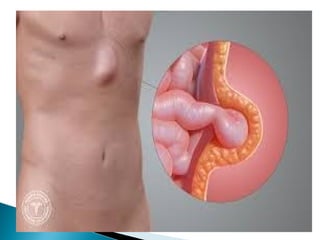
 A hernia is an abnormal protrusion of part of the
body out of its normal anatomical area of
confinement. This normally results in a swelling, pain
and in some cases loss of function.
 Abdominal wall hernias are common, with a
prevalence of 1.7 % of all ages and 4% of those aged
over 45 yrs
 Ingunial hernias accounts for 75% of abdominal wall
hernias, with a lifetime risk of 27% in men and 3% in
women
 Repair of inguinal hernia is most common operation
in general surgery, with rates ranging from 10 per
100000 of the population in United Kingdom to 28
per 100000 in united state
 Strangulated : blood supply is ceased and
contents are ischemic due to compressed blood
supply
 Incarnated : when the contents are not able to
reduce back to abdominal cavity
 Reducible : hernia content can be pushed back to
abdominal cavity
 Any condition that increases pressure on the
abdominal cavity
◦ Obesity
◦ Heavy lifting
◦ Coughing
◦ Straining during a bowel movement or urination
◦ Chronic lung disease
◦ Fluid in the abdominal cavity
 Family history
 Age
 Damage from injury
 Sudden weight gain
 Poor nutrition
 Smoking
 Weakness and straining
 Failure of the abdominal wall to close properly in the
womb, which is a congenital defect
 Being pregnant
 Ascitis
 Heredity
 Surgery
 Sneezing
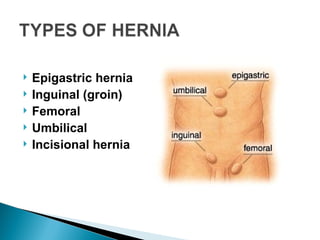
 Epigastric hernia
 Inguinal (groin)
 Femoral
 Umbilical
 Incisional hernia
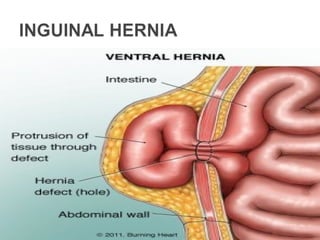
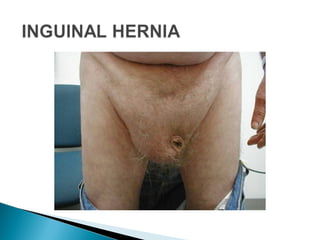
 Inguinal Hernia (groin)
 A bulge in the are on either side of pubic bone
◦ 75% of all abdominal wall hernias
◦ Occurs 25% more often in men than women
◦ 2 types which occur both in the groin area where
the skin crease at the top of the thigh joins the torso
(inguinal crease)
 Indirect inguinal – hernia sac may protrude into
the scrotum; may occur at any age
 Direct inguinal hernia – middle-aged to elderly as
their abdominal walls weaken with age
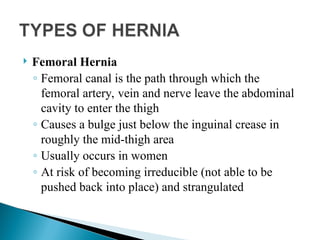
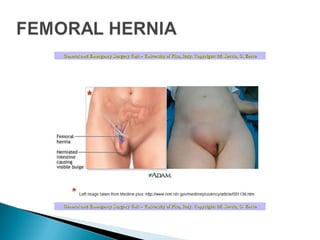
 Femoral Hernia
◦ Femoral canal is the path through which the
femoral artery, vein and nerve leave the abdominal
cavity to enter the thigh
◦ Causes a bulge just below the inguinal crease in
roughly the mid-thigh area
◦ Usually occurs in women
◦ At risk of becoming irreducible (not able to be
pushed back into place) and strangulated
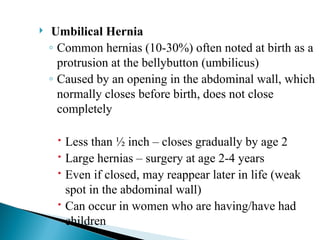
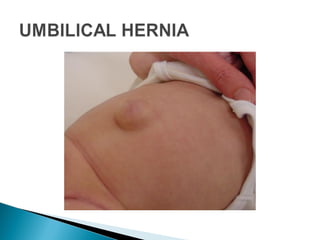
 Umbilical Hernia
◦ Common hernias (10-30%) often noted at birth as a
protrusion at the bellybutton (umbilicus)
◦ Caused by an opening in the abdominal wall, which
normally closes before birth, does not close
completely
 Less than ½ inch – closes gradually by age 2
 Large hernias – surgery at age 2-4 years
 Even if closed, may reappear later in life (weak
spot in the abdominal wall)
 Can occur in women who are having/have had
children
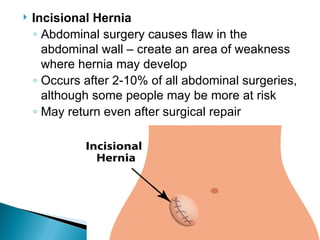
 Incisional Hernia
◦ Abdominal surgery causes flaw in the
abdominal wall – create an area of weakness
where hernia may develop
◦ Occurs after 2-10% of all abdominal surgeries,
although some people may be more at risk
◦ May return even after surgical repair
 Epigastric Hernia
◦ Occurs between the navel and the lower part of the
rib cage in the midline of the abdomen
◦ Usually composed of fatty tissue and rarely contain
intestine
◦ Formed in the area of relative weakness of the
abdominal wall
◦ Often painless and unable to be pushed back into
the abdomen when first discovered
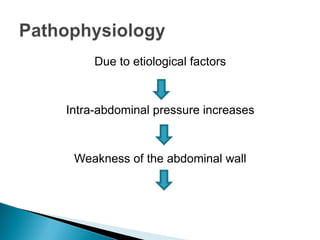
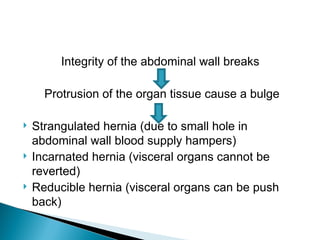
Due to etiological factors
Intra-abdominal pressure increases
Weakness of the abdominal wall
Integrity of the abdominal wall breaks
Protrusion of the organ tissue cause a bulge
 Strangulated hernia (due to small hole in
abdominal wall blood supply hampers)
 Incarnated hernia (visceral organs cannot be
reverted)
 Reducible hernia (visceral organs can be push
back)
 This type of hernia occur when part of the
stomach pushes through the diaphragm. The
diaphragm normally has a small opening for the
esophagus. This opening can become the place
where part of the stomach pushes through
 Chest pain
 Severe heart burn
 Abdominal pain
 Frequent burping
 Difficulty in swallowing
 Throat soreness
 Belching
 nausea
 Reducible hernia
◦ New lump in the groin or other abdominal wall area
◦ May ache but not tender when touched
◦ Sometimes pain precedes the discovery of the lump.
◦ Lump increases in size when standing or when
abdominal pressure is increased (ex. coughing).
◦ May be reduced (pushed back into the abdomen)
unless very large
 Irreducible hernia
◦ Occasionally painful enlargement of a
previously reducible hernia that cannot be
returned to the abdominal cavity on its own or
when you push it.
◦ Some may be long term without pain.
◦ Also known as incarcerated hernia
◦ Can lead to strangulation
◦ Signs and symptoms of bowel obstruction may
occur, such as nausea and vomiting.
 Strangulated hernia
◦ Irreducible hernia in which the entrapped
intestine has its blood supply cut off
◦ Pain is always present, followed quickly by
tenderness and sometimes symptoms of bowel
obstruction (nausea and vomiting).
◦ The affected person may appear ill with or
without fever.
◦ Not all strangulated hernias are irreducible (but
all irreducible hernias are strangulated).
 History
 Physical examination
 Remarkable bulging
 Abdominal mass
 Abdominal distention
 Endoscopy
 Barium swallow
 Ultrasound
 MRI & CT-Scan
 Obstruction
 Stenosis
 GERD
 Ulcer formation in the herniated portion
 Tracheal aspiration
 Sepsis
 death
 Only symptomatic management can be given to
the patient to reduce symptoms
 General measures : educate the patient to avoid
heavy lifting and strenuous exercise
 Advice the patient to avoid wearing tight cloths
 Encourage the patient to consume low fat diet
 Antibiotic (iv cefoxitin 1gm 6-8 hrly, cap. Ampicilin
250-500mg)
 H2 receptor blocker (ta. Famotidine 40mg daily,
tab. Ranitidine 150mg BD)
 Proton pump inhibitors (tab. Pantoprazole 20-
40mg daily)
 Antianxiety agents (tab. Dormicun 7.5-15 mg)
 NSAIDS (tab. Ibuprofen100mg 6hrly)
 Truss (inguinal hernia) – a pad made with firm
material that will held in place over the hernia with
belt to help keep the abdominal contents from
protruding into the hernia sac
 Nissen fundoplication – this involve suturing the
upper part of the stomach around the lower
esophagus
 Harniorrhaphy – repair of the hernia can be done
 Herniotomy : removed the herniated sac followed
by repair of weak muscle area
 Gastropexy – stomach is attached by
subdiaphragmatically to prevent reherniation
 Preoperative nursing management :
 Anxiety related to undergoing surgery
 Acute pain related to swelling and pressure
 Risk for aspiration related to reflux of gastric
content
 Potential for ineffective tissue perfusion related to
the strangulated hernia
 Post operative nursing management :
 Acute pain related to surgical repair
 Risk for infection related to surgical incision
 Avoid food that cause acid reflux or heart burn like
spicy food and oily food
 Do not lie down or bend over immediately after
meal
 Exercise regularly
 Cessation of smoking
 Discourage use of carbonate drinks
 Avoid heavy weight lifting
In this class we discussed the
Explain the types of hernia
List down the causes of hernia
Enumerate the symptoms of hernia
Enlist the diagnosis and treatment of hernia
Describe the nursing consideration of hernia
Lippincott “Medical surgical nursing” 10th
edition
Joyce M Black ” Medical surgical nursing”
Brunner And Suddharth “Medical surgical
nursing”
THANK YOU

Hernias and its nursing managementss.ppt

  • 2.
    At the endof this lecture the students should be able to:- Explain the types of hernia List down the causes of hernia Enumerate the symptoms of hernia Enlist the diagnosis and treatment of hernia Desdcribe the nursing consideration of hernia
  • 3.
     A herniais an abnormal protrusion of part of the body out of its normal anatomical area of confinement. This normally results in a swelling, pain and in some cases loss of function.
  • 4.
     Abdominal wallhernias are common, with a prevalence of 1.7 % of all ages and 4% of those aged over 45 yrs  Ingunial hernias accounts for 75% of abdominal wall hernias, with a lifetime risk of 27% in men and 3% in women  Repair of inguinal hernia is most common operation in general surgery, with rates ranging from 10 per 100000 of the population in United Kingdom to 28 per 100000 in united state
  • 5.
     Strangulated :blood supply is ceased and contents are ischemic due to compressed blood supply  Incarnated : when the contents are not able to reduce back to abdominal cavity  Reducible : hernia content can be pushed back to abdominal cavity
  • 6.
     Any conditionthat increases pressure on the abdominal cavity ◦ Obesity ◦ Heavy lifting ◦ Coughing ◦ Straining during a bowel movement or urination ◦ Chronic lung disease ◦ Fluid in the abdominal cavity  Family history
  • 7.
     Age  Damagefrom injury  Sudden weight gain  Poor nutrition  Smoking
  • 8.
     Weakness andstraining  Failure of the abdominal wall to close properly in the womb, which is a congenital defect  Being pregnant  Ascitis  Heredity  Surgery  Sneezing
  • 9.
     Epigastric hernia Inguinal (groin)  Femoral  Umbilical  Incisional hernia
  • 10.
     Inguinal Hernia(groin)  A bulge in the are on either side of pubic bone ◦ 75% of all abdominal wall hernias ◦ Occurs 25% more often in men than women ◦ 2 types which occur both in the groin area where the skin crease at the top of the thigh joins the torso (inguinal crease)  Indirect inguinal – hernia sac may protrude into the scrotum; may occur at any age  Direct inguinal hernia – middle-aged to elderly as their abdominal walls weaken with age
  • 13.
     Femoral Hernia ◦Femoral canal is the path through which the femoral artery, vein and nerve leave the abdominal cavity to enter the thigh ◦ Causes a bulge just below the inguinal crease in roughly the mid-thigh area ◦ Usually occurs in women ◦ At risk of becoming irreducible (not able to be pushed back into place) and strangulated
  • 15.
     Umbilical Hernia ◦Common hernias (10-30%) often noted at birth as a protrusion at the bellybutton (umbilicus) ◦ Caused by an opening in the abdominal wall, which normally closes before birth, does not close completely  Less than ½ inch – closes gradually by age 2  Large hernias – surgery at age 2-4 years  Even if closed, may reappear later in life (weak spot in the abdominal wall)  Can occur in women who are having/have had children
  • 17.
     Incisional Hernia ◦Abdominal surgery causes flaw in the abdominal wall – create an area of weakness where hernia may develop ◦ Occurs after 2-10% of all abdominal surgeries, although some people may be more at risk ◦ May return even after surgical repair
  • 18.
     Epigastric Hernia ◦Occurs between the navel and the lower part of the rib cage in the midline of the abdomen ◦ Usually composed of fatty tissue and rarely contain intestine ◦ Formed in the area of relative weakness of the abdominal wall ◦ Often painless and unable to be pushed back into the abdomen when first discovered
  • 20.
    Due to etiologicalfactors Intra-abdominal pressure increases Weakness of the abdominal wall
  • 21.
    Integrity of theabdominal wall breaks Protrusion of the organ tissue cause a bulge  Strangulated hernia (due to small hole in abdominal wall blood supply hampers)  Incarnated hernia (visceral organs cannot be reverted)  Reducible hernia (visceral organs can be push back)
  • 22.
     This typeof hernia occur when part of the stomach pushes through the diaphragm. The diaphragm normally has a small opening for the esophagus. This opening can become the place where part of the stomach pushes through
  • 23.
     Chest pain Severe heart burn  Abdominal pain  Frequent burping  Difficulty in swallowing  Throat soreness  Belching  nausea
  • 24.
     Reducible hernia ◦New lump in the groin or other abdominal wall area ◦ May ache but not tender when touched ◦ Sometimes pain precedes the discovery of the lump. ◦ Lump increases in size when standing or when abdominal pressure is increased (ex. coughing). ◦ May be reduced (pushed back into the abdomen) unless very large
  • 25.
     Irreducible hernia ◦Occasionally painful enlargement of a previously reducible hernia that cannot be returned to the abdominal cavity on its own or when you push it. ◦ Some may be long term without pain. ◦ Also known as incarcerated hernia ◦ Can lead to strangulation ◦ Signs and symptoms of bowel obstruction may occur, such as nausea and vomiting.
  • 26.
     Strangulated hernia ◦Irreducible hernia in which the entrapped intestine has its blood supply cut off ◦ Pain is always present, followed quickly by tenderness and sometimes symptoms of bowel obstruction (nausea and vomiting). ◦ The affected person may appear ill with or without fever. ◦ Not all strangulated hernias are irreducible (but all irreducible hernias are strangulated).
  • 27.
     History  Physicalexamination  Remarkable bulging  Abdominal mass  Abdominal distention  Endoscopy  Barium swallow  Ultrasound  MRI & CT-Scan
  • 28.
     Obstruction  Stenosis GERD  Ulcer formation in the herniated portion  Tracheal aspiration  Sepsis  death
  • 30.
     Only symptomaticmanagement can be given to the patient to reduce symptoms  General measures : educate the patient to avoid heavy lifting and strenuous exercise  Advice the patient to avoid wearing tight cloths  Encourage the patient to consume low fat diet
  • 31.
     Antibiotic (ivcefoxitin 1gm 6-8 hrly, cap. Ampicilin 250-500mg)  H2 receptor blocker (ta. Famotidine 40mg daily, tab. Ranitidine 150mg BD)  Proton pump inhibitors (tab. Pantoprazole 20- 40mg daily)  Antianxiety agents (tab. Dormicun 7.5-15 mg)  NSAIDS (tab. Ibuprofen100mg 6hrly)
  • 32.
     Truss (inguinalhernia) – a pad made with firm material that will held in place over the hernia with belt to help keep the abdominal contents from protruding into the hernia sac
  • 33.
     Nissen fundoplication– this involve suturing the upper part of the stomach around the lower esophagus  Harniorrhaphy – repair of the hernia can be done  Herniotomy : removed the herniated sac followed by repair of weak muscle area  Gastropexy – stomach is attached by subdiaphragmatically to prevent reherniation
  • 34.
     Preoperative nursingmanagement :  Anxiety related to undergoing surgery  Acute pain related to swelling and pressure  Risk for aspiration related to reflux of gastric content  Potential for ineffective tissue perfusion related to the strangulated hernia
  • 35.
     Post operativenursing management :  Acute pain related to surgical repair  Risk for infection related to surgical incision
  • 36.
     Avoid foodthat cause acid reflux or heart burn like spicy food and oily food  Do not lie down or bend over immediately after meal  Exercise regularly  Cessation of smoking  Discourage use of carbonate drinks  Avoid heavy weight lifting
  • 37.
    In this classwe discussed the Explain the types of hernia List down the causes of hernia Enumerate the symptoms of hernia Enlist the diagnosis and treatment of hernia Describe the nursing consideration of hernia
  • 38.
    Lippincott “Medical surgicalnursing” 10th edition Joyce M Black ” Medical surgical nursing” Brunner And Suddharth “Medical surgical nursing”
  • 39.