Oral rehydration therapy Jervin mano
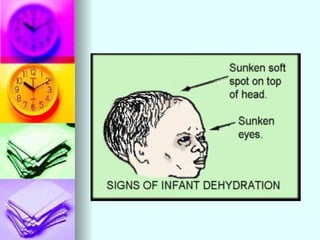
What is oral rehydration therapy? Rehydrating a dehydrated person through oral route is called as ORT .

AIM To correct the water &electrolyte deficiet To prevent dehydration Reduce mortality
PROOF? A study in kolkatta showed 90-95% of all cases of cholera &acute diarrhoea can be treated with ors alone  . Mortality rate in cholera has been reduced to 0.11% from 49.3%
 
PRINCIPLE Glucose when given orally enhances the intestinal absorption of salt & water. Thus it can correct electrolyte & water deficit.
WHOM CAN IT BE GIVEN? IN WHAT CONDITIONS CAN IT BE GIVEN? All age groups All aetiologies All countries
TYPES OF ORS?? Sodium bicarbonate based Trisodium citrate based Reduced osmolarity ORS Super ORS
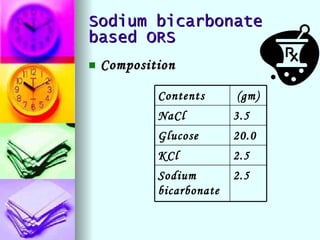
Sodium bicarbonate based ORS Composition 2.5 Sodium bicarbonate  2.5 KCl 20.0 Glucose 3.5 NaCl (gm) Contents
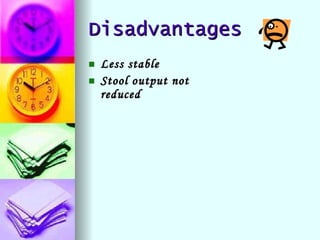
Disadvantages Less stable Stool output not reduced
Trisodium citrate based ORS
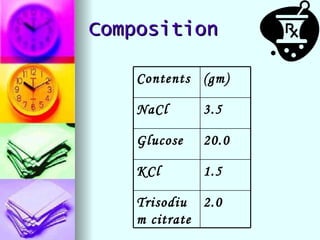
Composition 2.0 Trisodium citrate 1.5 KCl 20.0 Glucose 3.5 NaCl (gm) Contents
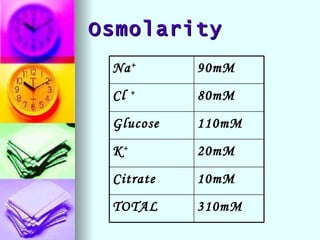
Osmolarity 310mM TOTAL 10mM Citrate 20mM K + 110mM Glucose 80mM Cl  + 90mM Na +
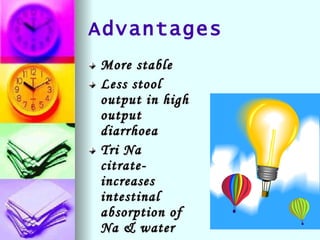
Advantages More stable Less stool output in high output diarrhoea Tri Na citrate-increases intestinal absorption of Na & water
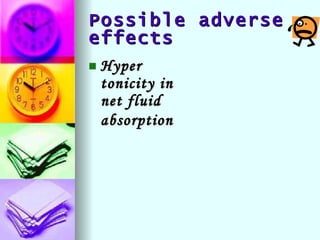
Possible adverse effects Hyper tonicity in net fluid absorption
To overcome this
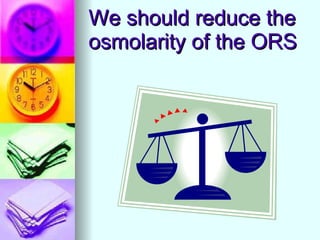
We should reduce the osmolarity of the ORS
Reduced osmolarity ORS
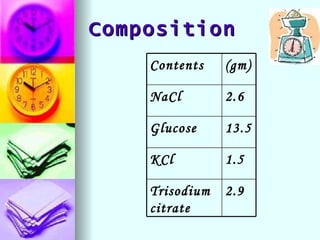
Composition Trisodium citrate KCl Glucose NaCl Contents 2.9 1.5 13.5 2.6 (gm)
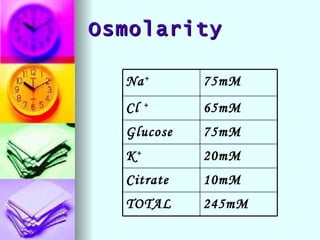
Osmolarity TOTAL Citrate K + Glucose Cl  + Na + 245mM 10mM 20mM 75mM 65mM 75mM
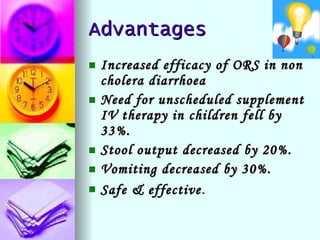
Advantages Increased efficacy of ORS in non cholera diarrhoea Need for unscheduled supplement IV therapy in children fell by 33%. Stool output decreased by 20%. Vomiting decreased by 30%. Safe & effective .
 
DOSAGE & REQUIREMENT? If the child’s weight is known, the amount of ORS soln.for rehydration during the first 4hrs may be calculated as 75ml/kg
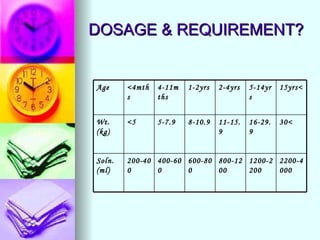
DOSAGE & REQUIREMENT? 2200-4000 1200-2200 800-1200 600-800 400-600 200-400 Soln.(ml) 30< 16-29.9 11-15.9 8-10.9 5-7.9 <5 Wt.(kg) 15yrs< 5-14yrs 2-4yrs 1-2yrs 4-11mths <4mths Age
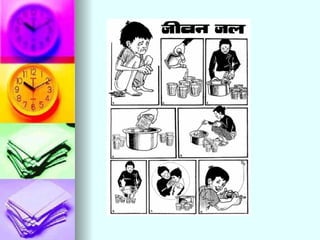
HOW TO ADMINISTER??? Teach the mother ORS
RULES <2yrs :- give 1-2 teaspoon every 2-3 minutes Older children :- offer frequent sips out of a cup Adults:- drink as much as they can Give the estimated amount within 4hrs
If the child vomits?? Wait for 10 minutes Give a teaspoonful every 2-3 minutes
If the child wants to drink more than the estimated amount ? No harm , give more
If the child refuses to drink ? See whether the signs of dehydration has disappeared If yes Treat similar to a non dehydrated diarrheal child.
If the child is breast fed ? Nursing  + treatment with ORS solution
Non breast fed infants less than 6 months Along with ORS solution give 100-200 ml of clean water for first 4 hours
Where is it available ? PHC Sub centers Hospitals Chemist shops
Cost? Free
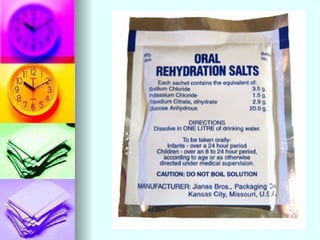
How to prepare it ? Dissolve the entire contents of the packet in 1l of drinking water It should be used within 24 hours
If ORS packets are not available ? Table salt (5gm) + sugar (20gm) in 1l of drinking water
Administer till the diarrhea stops Earlier the treatment is instituted the better is for the patient
ORT programme First started in 1986-1987 Implemented through RCH programme ORS packets are supplied by the central govt. Twice a year 150 packets of ORS are provided as apart of drug kit supplied to all sub centers in the country
Theme Adequate nutritional care of child  with diarrhoea Proper advice to mother in feeding
Achievements & benefits Low cost treatment Treatment of the patient in their own homes Ingredients are inexpensive and readily available
Achievements & benefits Drinking water is sufficient (no need for boiling or other means of sterilization) Breakthrough in the fight against cholera and other diarrheal diseases Mortality rate in cholera has been reduced to 0.11% from 49.3%
 
THANK YOU

Oral Rehydration Therapy

  • 1.
  • 2.
    What is oralrehydration therapy? Rehydrating a dehydrated person through oral route is called as ORT .
  • 3.
    AIM To correctthe water &electrolyte deficiet To prevent dehydration Reduce mortality
  • 4.
    PROOF? A studyin kolkatta showed 90-95% of all cases of cholera &acute diarrhoea can be treated with ors alone . Mortality rate in cholera has been reduced to 0.11% from 49.3%
  • 5.
  • 6.
    PRINCIPLE Glucose whengiven orally enhances the intestinal absorption of salt & water. Thus it can correct electrolyte & water deficit.
  • 7.
    WHOM CAN ITBE GIVEN? IN WHAT CONDITIONS CAN IT BE GIVEN? All age groups All aetiologies All countries
  • 8.
    TYPES OF ORS??Sodium bicarbonate based Trisodium citrate based Reduced osmolarity ORS Super ORS
  • 9.
    Sodium bicarbonate basedORS Composition 2.5 Sodium bicarbonate 2.5 KCl 20.0 Glucose 3.5 NaCl (gm) Contents
  • 10.
    Disadvantages Less stableStool output not reduced
  • 11.
  • 12.
    Composition 2.0 Trisodiumcitrate 1.5 KCl 20.0 Glucose 3.5 NaCl (gm) Contents
  • 13.
    Osmolarity 310mM TOTAL10mM Citrate 20mM K + 110mM Glucose 80mM Cl + 90mM Na +
  • 14.
    Advantages More stableLess stool output in high output diarrhoea Tri Na citrate-increases intestinal absorption of Na & water
  • 15.
    Possible adverse effectsHyper tonicity in net fluid absorption
  • 16.
  • 17.
    We should reducethe osmolarity of the ORS
  • 18.
  • 19.
    Composition Trisodium citrateKCl Glucose NaCl Contents 2.9 1.5 13.5 2.6 (gm)
  • 20.
    Osmolarity TOTAL CitrateK + Glucose Cl + Na + 245mM 10mM 20mM 75mM 65mM 75mM
  • 21.
    Advantages Increased efficacyof ORS in non cholera diarrhoea Need for unscheduled supplement IV therapy in children fell by 33%. Stool output decreased by 20%. Vomiting decreased by 30%. Safe & effective .
  • 22.
  • 23.
    DOSAGE & REQUIREMENT?If the child’s weight is known, the amount of ORS soln.for rehydration during the first 4hrs may be calculated as 75ml/kg
  • 24.
    DOSAGE & REQUIREMENT?2200-4000 1200-2200 800-1200 600-800 400-600 200-400 Soln.(ml) 30< 16-29.9 11-15.9 8-10.9 5-7.9 <5 Wt.(kg) 15yrs< 5-14yrs 2-4yrs 1-2yrs 4-11mths <4mths Age
  • 25.
    HOW TO ADMINISTER???Teach the mother ORS
  • 26.
    RULES <2yrs :-give 1-2 teaspoon every 2-3 minutes Older children :- offer frequent sips out of a cup Adults:- drink as much as they can Give the estimated amount within 4hrs
  • 27.
    If the childvomits?? Wait for 10 minutes Give a teaspoonful every 2-3 minutes
  • 28.
    If the childwants to drink more than the estimated amount ? No harm , give more
  • 29.
    If the childrefuses to drink ? See whether the signs of dehydration has disappeared If yes Treat similar to a non dehydrated diarrheal child.
  • 30.
    If the childis breast fed ? Nursing + treatment with ORS solution
  • 31.
    Non breast fedinfants less than 6 months Along with ORS solution give 100-200 ml of clean water for first 4 hours
  • 32.
    Where is itavailable ? PHC Sub centers Hospitals Chemist shops
  • 33.
  • 34.
    How to prepareit ? Dissolve the entire contents of the packet in 1l of drinking water It should be used within 24 hours
  • 35.
    If ORS packetsare not available ? Table salt (5gm) + sugar (20gm) in 1l of drinking water
  • 36.
    Administer till thediarrhea stops Earlier the treatment is instituted the better is for the patient
  • 37.
    ORT programme Firststarted in 1986-1987 Implemented through RCH programme ORS packets are supplied by the central govt. Twice a year 150 packets of ORS are provided as apart of drug kit supplied to all sub centers in the country
  • 38.
    Theme Adequate nutritionalcare of child with diarrhoea Proper advice to mother in feeding
  • 39.
    Achievements & benefitsLow cost treatment Treatment of the patient in their own homes Ingredients are inexpensive and readily available
  • 40.
    Achievements & benefitsDrinking water is sufficient (no need for boiling or other means of sterilization) Breakthrough in the fight against cholera and other diarrheal diseases Mortality rate in cholera has been reduced to 0.11% from 49.3%
  • 41.
  • 42.