
Transport Considerations of
the Burned Patient
Gustavo E. Flores, MD EMT-P
Objectives
• Classification of burns
• Initial resuscitation
• Transport considerations
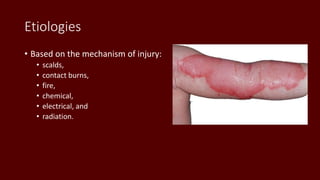
Etiologies
• Based on the mechanism of injury:
• scalds,
• contact burns,
• fire,
• chemical,
• electrical, and
• radiation.
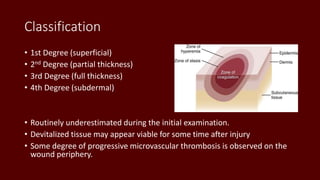
Classification
• 1st Degree (superficial)
• 2nd Degree (partial thickness)
• 3rd Degree (full thickness)
• 4th Degree (subdermal)
• Routinely underestimated during the initial examination.
• Devitalized tissue may appear viable for some time after injury
• Some degree of progressive microvascular thrombosis is observed on the
wound periphery.
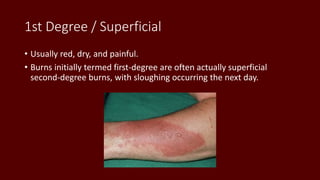
1st Degree / Superficial
• Usually red, dry, and painful.
• Burns initially termed first-degree are often actually superficial
second-degree burns, with sloughing occurring the next day.
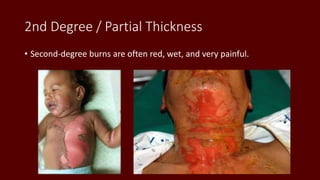
2nd Degree / Partial Thickness
• Second-degree burns are often red, wet, and very painful.
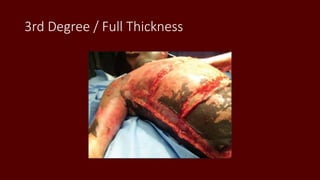
3rd Degree / Full Thickness
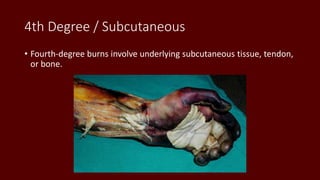
4th Degree / Subcutaneous
• Fourth-degree burns involve underlying subcutaneous tissue, tendon,
or bone.
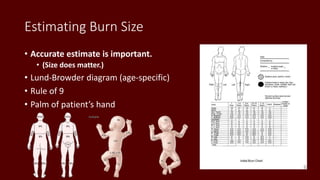
Estimating Burn Size
• Accurate estimate is important.
• (Size does matter.)
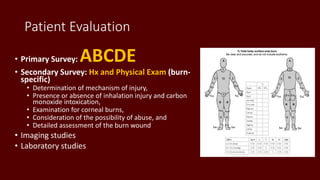
• Lund-Browder diagram (age-specific)
• Rule of 9
• Palm of patient’s hand
Initial Burn Size and Depth
• Outside reports are notoriously unreliable.
• Correctly estimated only 1/3 of times.
• Leads to over-resuscitation.
Systemic inflammatory response (1/4)
• When TBSA > 30%, cytokines and other mediators are released into
the systemic circulation, causing a systemic inflammatory response.
• Because vessels in burned tissue exhibit increased vascular
permeability, an extravasation of fluids into the burned tissues occurs.
• Hypovolemia is the immediate consequence of this fluid loss, which
accounts for decreased perfusion and oxygen delivery.
• In patients with serious burns, release of catecholamines,
vasopressin, and angiotensin causes peripheral and splanchnic bed
vasoconstriction that can compromise in-organ perfusion.
• Myocardial contractility also may be reduced by the release of
inflammatory cytokine tumor necrosis factor-alpha.
Edema Formation (2/4)
• At the peak of edema formation, essentially all whole blood elements up to the
size of RBCs are able to transmigrate through the vessel wall in burned tissue.
• As a result of this capillary leak, replacing the intravascular
deficits drives the continued accumulation of edema.
• Nearly 50% of infused crystalloid volume lost to the interstitium.
• As the burn size approaches 15-20% total body surface area (TBSA), shock sets in
if the patient does not undergo appropriate fluid resuscitation.
Edema Formation (3/4)
• The peak of this third-spacing occurs at some point 6-12 hours postburn as
the capillary barrier begins to regain its integrity.
• Hence the reduction in fluid requirements observed in resuscitation formulas around
this point.
• At this point, the theoretic benefits of adjuvant colloid therapy during the
resuscitation allow the careful downward titration of fluid administration to
reduce the obligatory edema.
Systemic inflammatory response (4/4)
• Hemolysis may occur in deep 3rd deg burns.
• PRBC to HCT of 30-35
• Decrease in pulmonary function can occur in severely burned patients
without evidence of inhalation injury from the bronchoconstriction
caused by humoral actors, such as histamine, serotonin, and
thromboxane A2.
• Burned skin  increased evaporative water loss  heat loss 
hypothermia.
Patient Evaluation
• Primary Survey: ABCDE
• Secondary Survey: Hx and Physical Exam (burn-
specific)
• Determination of mechanism of injury,
• Presence or absence of inhalation injury and carbon
monoxide intoxication,
• Examination for corneal burns,
• Consideration of the possibility of abuse, and
• Detailed assessment of the burn wound
• Imaging studies
• Laboratory studies
Vital Signs
• Very difficult to interpret in patients with large burns.
• BP ok due to catecholamine release despite extensive intravascular
depletion.
• Edema limits usefulness of NIBP.
• Arterial line measurements limited by peripheral vasospasm from
high-cathecolamine state.
• Tachycardic due to pain and high adrenergic state, not just
hypovolemia.
• Following a trend is much more useful than any single reading.
Fluid Resuscitation
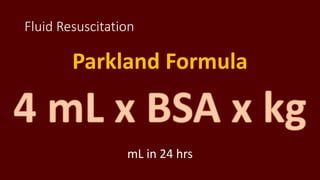
Parkland Formula
mL in 24 hrs
Caution
• Not all burns require use of the Parkland formula for resuscitation.
• Adult with < 15-20% TBSA without inhalation injury does not require
Parkland Formula.
• Not enough to initiate the systemic inflammatory response.
• These patients can be rehydrated successfully primarily via the oral route with
modest IV fluid supplementation.
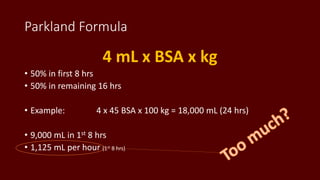
Parkland Formula
4 mL x BSA x kg
• 50% in first 8 hrs
• 50% in remaining 16 hrs
• Example: 4 x 45 BSA x 100 kg = 18,000 mL (24 hrs)
• 9,000 mL in 1st 8 hrs
• 1,125 mL per hour (1st 8 hrs)
Adequate Fluid Resuscitation
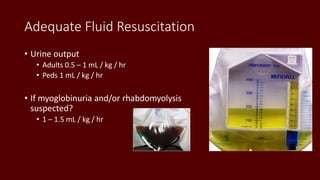
• Urine output
• Adults 0.5 – 1 mL / kg / hr
• Peds 1 mL / kg / hr
• If myoglobinuria and/or rhabdomyolysis
suspected?
• 1 – 1.5 mL / kg / hr
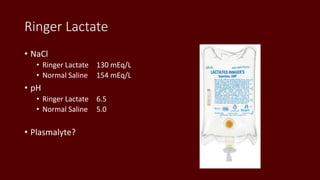
Ringer Lactate
• NaCl
• Ringer Lactate 130 mEq/L
• Normal Saline 154 mEq/L
• pH
• Ringer Lactate 6.5
• Normal Saline 5.0
• Plasmalyte?
Hypoperfused?
• Failure to meet these goals should be addressed with gentle upward
corrections in the rate of fluid administration by approximately 25%.
• Frequent boluses result in transient elevations in hydrostatic pressure
gradients that further increase the shift of fluids to the interstitium and
worsen the edema.
• However, do not hesitate to administer a bolus to patients as appropriate early
in the resuscitation for hypotensive shock.
Hyperperfused?
• Avoid urine output at rates > 0.5 - 1 mL / kg / h.
• Fluid overload in the critical hours of early burn management leads to unnecessary
edema and pulmonary dysfunction.
• It can necessitate morbid escharotomies and extend the time required for ventilator
support.
Even More Fluids
• Inhalation injuries sometimes as much as 30-40% higher (close to 5.7 mL/kg
x BSA)
• Delays in initiating resuscitation promptly have also been shown to increase
fluid requirements by as much as 30%, presumably by permitting the
occurrence of an increased inflammatory cascade.
• Home diuretic therapy frequently have preexisting free-water deficits in
addition to burn shock.
• Escharotomy or fasciotomy can substantially increase free water loss from
the wound.
• Electrical burns, associated with large and underappreciated tissue insult
Formula Fluid in First 24 Hours Crystalloid in Second 24-Hours Colloid in Second 24-Hours
Parkland RL at 4 mL/kg per percentage burn 20-60% estimated plasma volume Titrated to urinary output of 30 mL/h
Evans[2]
NS at 1 mL/kg per percentage burn, 2000 mL
D5W*, and colloid at 1 mL/kg per percentage
burn
50% of first 24-hour volume plus 2000 mL D5W 50% of first 24-hour volume
Slater[2] RL at 2 L/24 h plus fresh frozen plasma at 75
mL/kg/24 h
Brooke[2]
RL at 1.5 mL/kg per percentage burn, colloid at
0.5 mL/kg per percentage burn, and 2000 mL
D5W
50% of first 24-hour volume plus 2000 mL D5W 50% of first 24-hour volume
Modified Brooke RL at 2 mL/kg per percentage burn
MetroHealth
(Cleveland)
RL solution with 50 mEq sodium bicarbonate per
liter at 4 mL/kg per percentage burn
Half NS titrated to urine output
1 U fresh frozen plasma for each liter of half NS
used plus D5W as needed for hypoglycemia
Monafo hypertonic
Demling[22, 23]
250 mEq/L saline titrated to urine output at 30
mL/h, dextran 40 in NS at 2 mL/kg/h for 8 hours,
RL titrated to urine output at 30 mL/h, and fresh
frozen plasma 0.5 mL/h for 18 hours beginning 8
hours postburn
One-third NS titrated to urine output
*D5W is dextrose 5% in water solution
Table 2. Resuscitation Formulas
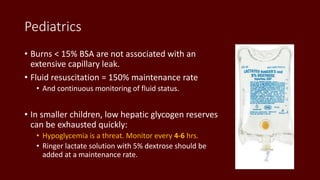
Pediatrics
• Burns < 15% BSA are not associated with an
extensive capillary leak.
• Fluid resuscitation = 150% maintenance rate
• And continuous monitoring of fluid status.
• In smaller children, low hepatic glycogen reserves
can be exhausted quickly:
• Hypoglycemia is a threat. Monitor every 4-6 hrs.
• Ringer lactate solution with 5% dextrose should be
added at a maintenance rate.
Pain Control
1. Morphine @ 2mg increments up to 20 mg max;
2. Ativan @ 1-2 mg increments up to 4 mg max.;
3. Fentanyl @ 1-3mcg/kg or 50-200 mcg IV q 30-40 minutes;
4. Propofol (Diprivan) @ 5 mcg/kg/min
• Increase 5-10 mcg/kg/min to max of 80 mcg/kg/min.
• Maintenance rate @ minimum 25-50 mcg/kg/min;
5. If patient is wheezing administer: Albuterol 2.5/3 cc with repeat
prn and if pt. is intubated administer in-line;
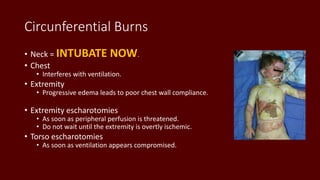
Circunferential Burns
• Neck = INTUBATE NOW.
• Chest
• Interferes with ventilation.
• Extremity
• Progressive edema leads to poor chest wall compliance.
• Extremity escharotomies
• As soon as peripheral perfusion is threatened.
• Do not wait until the extremity is overtly ischemic.
• Torso escharotomies
• As soon as ventilation appears compromised.
Monitor Electrolytes
• Hyponatremia can lead to cerebral edema and seizures.
• Rapid correction of hyponatremia may result in central pontine
demyelinating lesions.
Take-home
•Airway deteriorates over time. Consider early intubation.
•Breathing may become difficult if patient is awake and has low
chest wall compliance. Manage pain aggressively.
•Circulation is very labile. 4 mL x BSA x kg. Keep an eye on BP and
urine output if using multiple analgesics and sedation.
•Disability is due to low perfusion unless TBI is also suspected.
•Exposure is critical to re-evaluate extent. Prevent hypothermia.
References
• Initial Evaluation and Management of the Burn Patient
• http://emedicine.medscape.com/article/435402-overview#showall
• Burn Resuscitation and Early Management
• http://emedicine.medscape.com/article/1277360-overview#showall
Thank you!

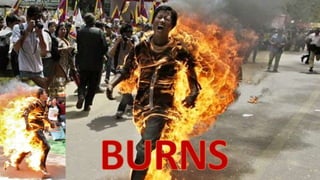
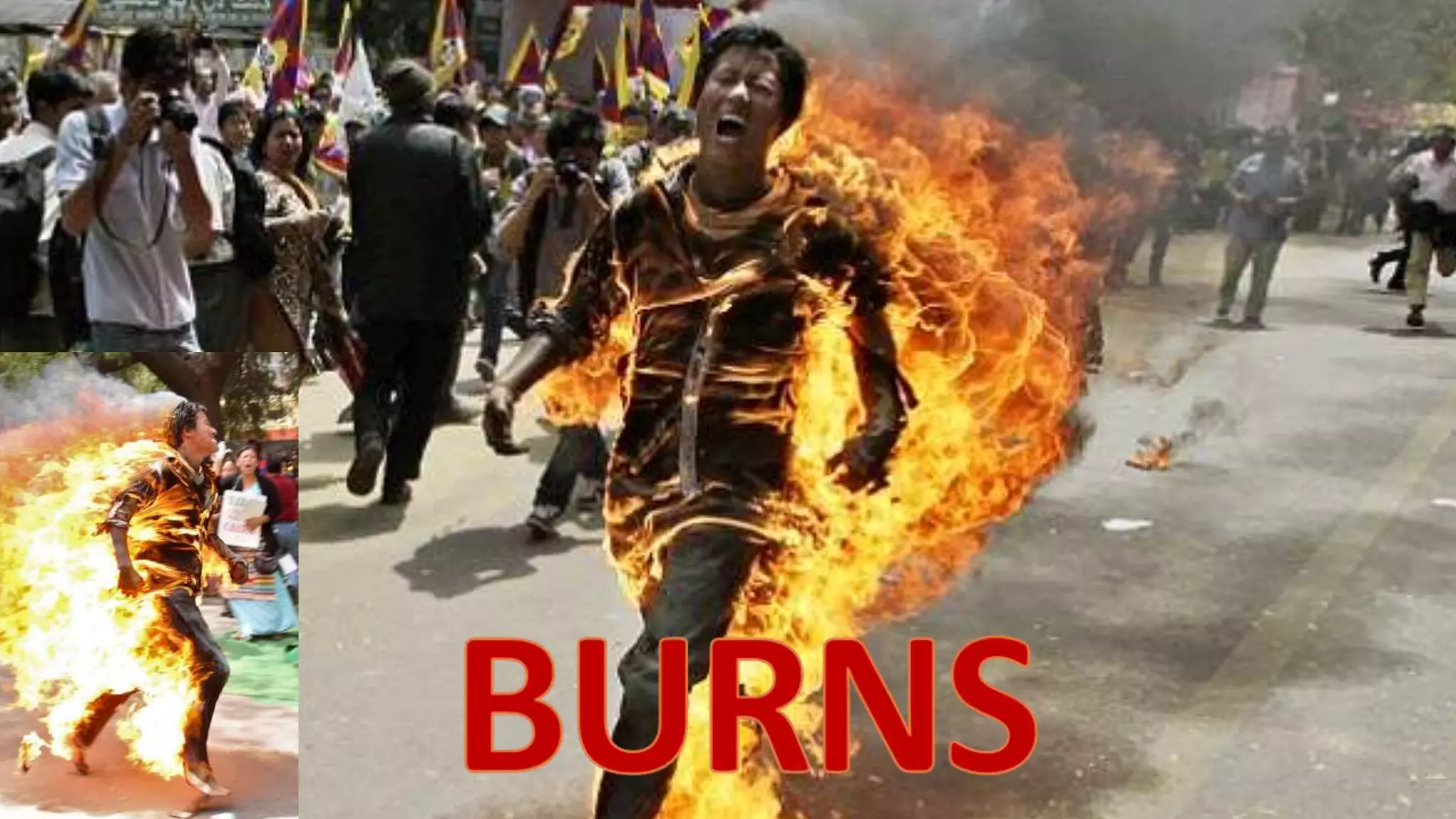
Burns

  • 2.
    Transport Considerations of theBurned Patient Gustavo E. Flores, MD EMT-P
  • 3.
    Objectives • Classification ofburns • Initial resuscitation • Transport considerations
  • 4.
    Etiologies • Based onthe mechanism of injury: • scalds, • contact burns, • fire, • chemical, • electrical, and • radiation.
  • 5.
    Classification • 1st Degree(superficial) • 2nd Degree (partial thickness) • 3rd Degree (full thickness) • 4th Degree (subdermal) • Routinely underestimated during the initial examination. • Devitalized tissue may appear viable for some time after injury • Some degree of progressive microvascular thrombosis is observed on the wound periphery.
  • 6.
    1st Degree /Superficial • Usually red, dry, and painful. • Burns initially termed first-degree are often actually superficial second-degree burns, with sloughing occurring the next day.
  • 7.
    2nd Degree /Partial Thickness • Second-degree burns are often red, wet, and very painful.
  • 8.
    3rd Degree /Full Thickness
  • 9.
    4th Degree /Subcutaneous • Fourth-degree burns involve underlying subcutaneous tissue, tendon, or bone.
  • 10.
    Estimating Burn Size •Accurate estimate is important. • (Size does matter.) • Lund-Browder diagram (age-specific) • Rule of 9 • Palm of patient’s hand
  • 11.
    Initial Burn Sizeand Depth • Outside reports are notoriously unreliable. • Correctly estimated only 1/3 of times. • Leads to over-resuscitation.
  • 12.
    Systemic inflammatory response(1/4) • When TBSA > 30%, cytokines and other mediators are released into the systemic circulation, causing a systemic inflammatory response. • Because vessels in burned tissue exhibit increased vascular permeability, an extravasation of fluids into the burned tissues occurs. • Hypovolemia is the immediate consequence of this fluid loss, which accounts for decreased perfusion and oxygen delivery. • In patients with serious burns, release of catecholamines, vasopressin, and angiotensin causes peripheral and splanchnic bed vasoconstriction that can compromise in-organ perfusion. • Myocardial contractility also may be reduced by the release of inflammatory cytokine tumor necrosis factor-alpha.
  • 13.
    Edema Formation (2/4) •At the peak of edema formation, essentially all whole blood elements up to the size of RBCs are able to transmigrate through the vessel wall in burned tissue. • As a result of this capillary leak, replacing the intravascular deficits drives the continued accumulation of edema. • Nearly 50% of infused crystalloid volume lost to the interstitium. • As the burn size approaches 15-20% total body surface area (TBSA), shock sets in if the patient does not undergo appropriate fluid resuscitation.
  • 14.
    Edema Formation (3/4) •The peak of this third-spacing occurs at some point 6-12 hours postburn as the capillary barrier begins to regain its integrity. • Hence the reduction in fluid requirements observed in resuscitation formulas around this point. • At this point, the theoretic benefits of adjuvant colloid therapy during the resuscitation allow the careful downward titration of fluid administration to reduce the obligatory edema.
  • 15.
    Systemic inflammatory response(4/4) • Hemolysis may occur in deep 3rd deg burns. • PRBC to HCT of 30-35 • Decrease in pulmonary function can occur in severely burned patients without evidence of inhalation injury from the bronchoconstriction caused by humoral actors, such as histamine, serotonin, and thromboxane A2. • Burned skin  increased evaporative water loss  heat loss  hypothermia.
  • 16.
    Patient Evaluation • PrimarySurvey: ABCDE • Secondary Survey: Hx and Physical Exam (burn- specific) • Determination of mechanism of injury, • Presence or absence of inhalation injury and carbon monoxide intoxication, • Examination for corneal burns, • Consideration of the possibility of abuse, and • Detailed assessment of the burn wound • Imaging studies • Laboratory studies
  • 17.
    Vital Signs • Verydifficult to interpret in patients with large burns. • BP ok due to catecholamine release despite extensive intravascular depletion. • Edema limits usefulness of NIBP. • Arterial line measurements limited by peripheral vasospasm from high-cathecolamine state. • Tachycardic due to pain and high adrenergic state, not just hypovolemia. • Following a trend is much more useful than any single reading.
  • 18.
  • 19.
    Caution • Not allburns require use of the Parkland formula for resuscitation. • Adult with < 15-20% TBSA without inhalation injury does not require Parkland Formula. • Not enough to initiate the systemic inflammatory response. • These patients can be rehydrated successfully primarily via the oral route with modest IV fluid supplementation.
  • 20.
    Parkland Formula 4 mLx BSA x kg • 50% in first 8 hrs • 50% in remaining 16 hrs • Example: 4 x 45 BSA x 100 kg = 18,000 mL (24 hrs) • 9,000 mL in 1st 8 hrs • 1,125 mL per hour (1st 8 hrs)
  • 21.
    Adequate Fluid Resuscitation •Urine output • Adults 0.5 – 1 mL / kg / hr • Peds 1 mL / kg / hr • If myoglobinuria and/or rhabdomyolysis suspected? • 1 – 1.5 mL / kg / hr
  • 22.
    Ringer Lactate • NaCl •Ringer Lactate 130 mEq/L • Normal Saline 154 mEq/L • pH • Ringer Lactate 6.5 • Normal Saline 5.0 • Plasmalyte?
  • 23.
    Hypoperfused? • Failure tomeet these goals should be addressed with gentle upward corrections in the rate of fluid administration by approximately 25%. • Frequent boluses result in transient elevations in hydrostatic pressure gradients that further increase the shift of fluids to the interstitium and worsen the edema. • However, do not hesitate to administer a bolus to patients as appropriate early in the resuscitation for hypotensive shock.
  • 24.
    Hyperperfused? • Avoid urineoutput at rates > 0.5 - 1 mL / kg / h. • Fluid overload in the critical hours of early burn management leads to unnecessary edema and pulmonary dysfunction. • It can necessitate morbid escharotomies and extend the time required for ventilator support.
  • 25.
    Even More Fluids •Inhalation injuries sometimes as much as 30-40% higher (close to 5.7 mL/kg x BSA) • Delays in initiating resuscitation promptly have also been shown to increase fluid requirements by as much as 30%, presumably by permitting the occurrence of an increased inflammatory cascade. • Home diuretic therapy frequently have preexisting free-water deficits in addition to burn shock. • Escharotomy or fasciotomy can substantially increase free water loss from the wound. • Electrical burns, associated with large and underappreciated tissue insult
  • 26.
    Formula Fluid inFirst 24 Hours Crystalloid in Second 24-Hours Colloid in Second 24-Hours Parkland RL at 4 mL/kg per percentage burn 20-60% estimated plasma volume Titrated to urinary output of 30 mL/h Evans[2] NS at 1 mL/kg per percentage burn, 2000 mL D5W*, and colloid at 1 mL/kg per percentage burn 50% of first 24-hour volume plus 2000 mL D5W 50% of first 24-hour volume Slater[2] RL at 2 L/24 h plus fresh frozen plasma at 75 mL/kg/24 h Brooke[2] RL at 1.5 mL/kg per percentage burn, colloid at 0.5 mL/kg per percentage burn, and 2000 mL D5W 50% of first 24-hour volume plus 2000 mL D5W 50% of first 24-hour volume Modified Brooke RL at 2 mL/kg per percentage burn MetroHealth (Cleveland) RL solution with 50 mEq sodium bicarbonate per liter at 4 mL/kg per percentage burn Half NS titrated to urine output 1 U fresh frozen plasma for each liter of half NS used plus D5W as needed for hypoglycemia Monafo hypertonic Demling[22, 23] 250 mEq/L saline titrated to urine output at 30 mL/h, dextran 40 in NS at 2 mL/kg/h for 8 hours, RL titrated to urine output at 30 mL/h, and fresh frozen plasma 0.5 mL/h for 18 hours beginning 8 hours postburn One-third NS titrated to urine output *D5W is dextrose 5% in water solution Table 2. Resuscitation Formulas
  • 27.
    Pediatrics • Burns <15% BSA are not associated with an extensive capillary leak. • Fluid resuscitation = 150% maintenance rate • And continuous monitoring of fluid status. • In smaller children, low hepatic glycogen reserves can be exhausted quickly: • Hypoglycemia is a threat. Monitor every 4-6 hrs. • Ringer lactate solution with 5% dextrose should be added at a maintenance rate.
  • 28.
    Pain Control 1. Morphine@ 2mg increments up to 20 mg max; 2. Ativan @ 1-2 mg increments up to 4 mg max.; 3. Fentanyl @ 1-3mcg/kg or 50-200 mcg IV q 30-40 minutes; 4. Propofol (Diprivan) @ 5 mcg/kg/min • Increase 5-10 mcg/kg/min to max of 80 mcg/kg/min. • Maintenance rate @ minimum 25-50 mcg/kg/min; 5. If patient is wheezing administer: Albuterol 2.5/3 cc with repeat prn and if pt. is intubated administer in-line;
  • 29.
    Circunferential Burns • Neck= INTUBATE NOW. • Chest • Interferes with ventilation. • Extremity • Progressive edema leads to poor chest wall compliance. • Extremity escharotomies • As soon as peripheral perfusion is threatened. • Do not wait until the extremity is overtly ischemic. • Torso escharotomies • As soon as ventilation appears compromised.
  • 30.
    Monitor Electrolytes • Hyponatremiacan lead to cerebral edema and seizures. • Rapid correction of hyponatremia may result in central pontine demyelinating lesions.
  • 31.
    Take-home •Airway deteriorates overtime. Consider early intubation. •Breathing may become difficult if patient is awake and has low chest wall compliance. Manage pain aggressively. •Circulation is very labile. 4 mL x BSA x kg. Keep an eye on BP and urine output if using multiple analgesics and sedation. •Disability is due to low perfusion unless TBI is also suspected. •Exposure is critical to re-evaluate extent. Prevent hypothermia.
  • 32.
    References • Initial Evaluationand Management of the Burn Patient • http://emedicine.medscape.com/article/435402-overview#showall • Burn Resuscitation and Early Management • http://emedicine.medscape.com/article/1277360-overview#showall
  • 34.