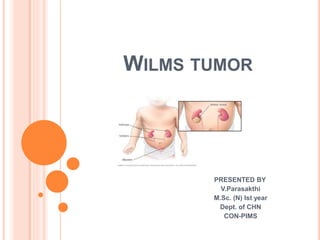
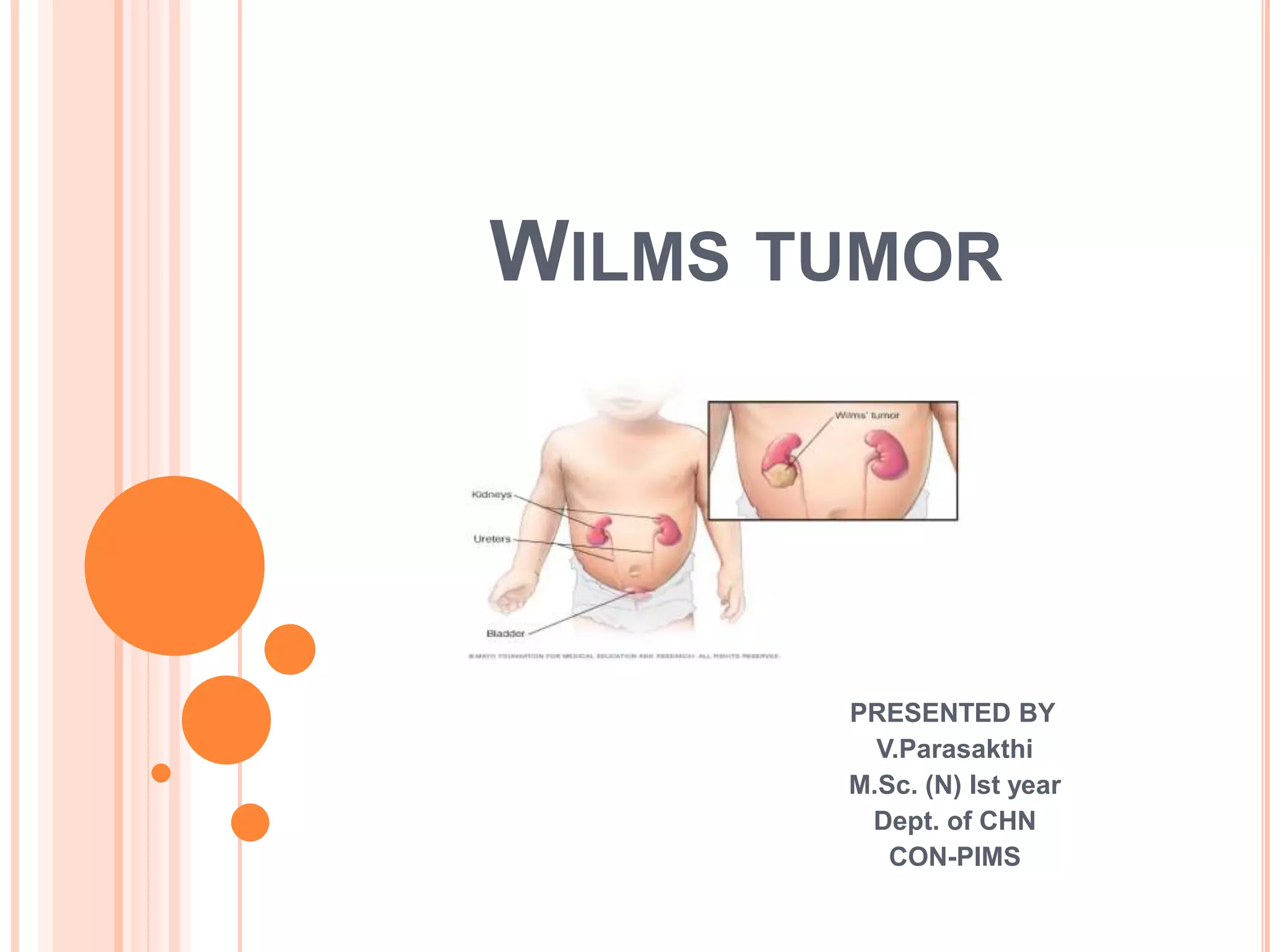
WILMS TUMOR
PRESENTED BY
V.Parasakthi
M.Sc. (N) Ist year
Dept. of CHN
CON-PIMS
DEFINITION
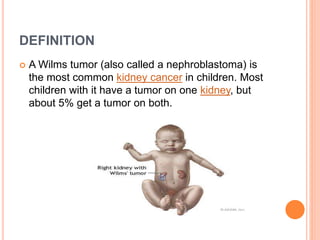
 A Wilms tumor (also called a nephroblastoma) is
the most common kidney cancer in children. Most
children with it have a tumor on one kidney, but
about 5% get a tumor on both.
INCIDENCE AND ETIOLOGY
 Usually the tumor’s is unilateral , but in 5% cases
it may be bilateral.
 The tumor involves left kidney more than right
kidney.
 It affects children between 3-5 years of age
 The disease occur in about 1 out of 2-2.5 lakh
children.
 The exact cause of tumor is unknown, but it has
been identified that tumor suppressors gene acts
to promote normal kidney development. This
gene may be absent or missing in wilm’s tumor
RISK FACTORS
 Age Most children who get this type of cancer are
between 3 and 5 years old.
 Gender Girls are more likely to have it than boys.
 Race Black children are slightly more likely to get a
Wilms tumor than children of other races.
 Family history If someone in your family has had a
Wilms tumor, the odds are higher that your child will
get it, too.
 Birth defect Cryptorchidism, hypospadias
TYPES OF WILMS TUMORS
There are two kinds of Wilms tumors , divided by how the
cells look under a microscope.
 Favorable histology More than 9 out of 10 Wilms
tumors fall into this group. It means there isn’t a lot of
difference among the cancer cells. Children with this
type have a good chance of being cured.
 Unfavorable or anaplastic histology This type has a
variety of deformed cancer cells. It can be much
harder to cure.
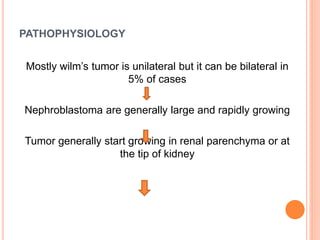
PATHOPHYSIOLOGY
Mostly wilm’s tumor is unilateral but it can be bilateral in
5% of cases
Nephroblastoma are generally large and rapidly growing
Tumor generally start growing in renal parenchyma or at
the tip of kidney
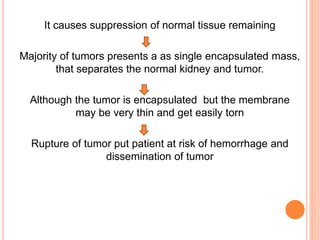
It causes suppression of normal tissue remaining
Majority of tumors presents a as single encapsulated mass,
that separates the normal kidney and tumor.
Although the tumor is encapsulated but the membrane
may be very thin and get easily torn
Rupture of tumor put patient at risk of hemorrhage and
dissemination of tumor
SYMPTOMS
 Belly pain
 Swelling in their belly
 A growth that you can see or feel in their belly
 Fever
 Nausea
 Lack of appetite
 High blood pressure
 Blood in their pee
 Constipation
 Shortness of breath
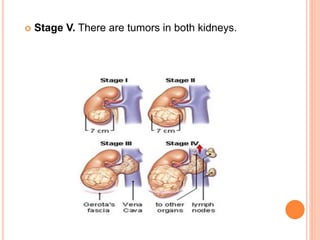
WILMS TUMOR STAGING
 Stage I. It’s in only one kidney. Surgery can remove it
all.
 Stage II. Cancer has moved into the area around the
kidney, but surgery can remove it all.
 Stage III. Cancer hasn’t spread outside the child’s
abdomen. Surgery can’t remove it all.
 Stage IV. Cancer has spread to parts of the body that
are farther away, like the lungs, bones, or brain, or to
lymph nodes outside the belly.
 Stage V. There are tumors in both kidneys.
DIAGNOSIS
 History the child may have positive family history
 Physical examination reveals presence of abdominal
mass
 Urinanalysis reveals presence of blood in urine
 Abdominal X-ray
 Ultrasound
 Chest X-ray to detect metastasis to lungs
 A blood test to check kidneys and liver are working,
their red and white blood cells, and their blood clotting.
TREATMENT
 Wilms tumor is treated depends on how much the
cancer has spread. It can include
 surgery,
 Chemotherapy
 radiation therapy
SURGERY
 Partial nephrectomy. This removes the tumor and
some healthy tissue around it.
 Radical nephrectomy. This removes the affected
kidney, the ureter (the tube that carries pee away from
the kidney), the adrenal gland on top of the kidney, and
nearby tissue.
 Removal of both kidneys. In some cases, the doctor
will need to take out both kidneys. Your child would then
need to have dialysis, using a machine to filter waste out
of their blood. Once they’re healthy enough, they might
have a kidney transplant.
CHEMOTHERAPY
Certain medications can fight or kill cancer cells inside your
child’s body. Most children who have Wilms tumors will get
chemo at some point during treatment. These drugs can also
affect healthy cells, leading to side effects including:
 Hair loss
 Fatigue
 Mouth sores
 Loss of appetite
 Nausea and vomiting
 Diarrhea or constipation
 Bruising or bleeding easier than usual
 Higher chances of infection
 Chemotherapy for 6 month
 Actinomycin D,vincristin,doxorubicin
RADIATION
 Strong radiation can also kill cancer cells. A
machine focuses it onto the cancer.
 Doctors tend to use radiation for tumors that are
stage III and above. But it can also have short-term
and long-term side effects, including tissue
damage, so they’ll use as little as possible.
 Moderate radiation therapy for 5 days a week for
several week. Each session for 15-30 minute
NURSING MANAGEMENT
Preoperative care
 Prepare the parents and child for surgery
 Explain parents not to palpate the abdomen of the
child
 Explain child about post operative care , if he or she
is old enough
 Caution should be taken while turning and handling
the child
POST OPERATIVE CARE
 Monitor vitals
 Monitor renal functioning by monitoring weight ,
intake & output and kidney function test values.
 Use aseptic techniques while doing dressing
 Explain parents about follow up and continuing
about the tie of discharge.
CONCLUSION
Wilms tumor is the most common renal malignancy in
children. In the 1930s overall survival for children
with wilms tumor was approximately 30%.Use of
multidisciplinary therapy , guided by results from
multi-institutional, has substantially improved overall
survival to about 90%.
BIBLIOGRAPHY
 Rimple Sharma ,”text book of essential of pediatric
nursing”,2nd edition, jaypee brothers publication,
page no:546-550.
 Parthasarathy.a,”text book of iap textbook of
pediatrics “,2nd edition (2008),jaypee brothers
publication page no:1330-1332
 Parul dutta, “text book of pediatric nursing “,2nd
edition (2008) ,jaypee brothers publication ,page
no: 439-444
Thank you

Wilms tumor.pptx

  • 1.
    WILMS TUMOR PRESENTED BY V.Parasakthi M.Sc.(N) Ist year Dept. of CHN CON-PIMS
  • 2.
    DEFINITION  A Wilmstumor (also called a nephroblastoma) is the most common kidney cancer in children. Most children with it have a tumor on one kidney, but about 5% get a tumor on both.
  • 3.
    INCIDENCE AND ETIOLOGY Usually the tumor’s is unilateral , but in 5% cases it may be bilateral.  The tumor involves left kidney more than right kidney.  It affects children between 3-5 years of age  The disease occur in about 1 out of 2-2.5 lakh children.  The exact cause of tumor is unknown, but it has been identified that tumor suppressors gene acts to promote normal kidney development. This gene may be absent or missing in wilm’s tumor
  • 4.
    RISK FACTORS  AgeMost children who get this type of cancer are between 3 and 5 years old.  Gender Girls are more likely to have it than boys.  Race Black children are slightly more likely to get a Wilms tumor than children of other races.  Family history If someone in your family has had a Wilms tumor, the odds are higher that your child will get it, too.  Birth defect Cryptorchidism, hypospadias
  • 5.
    TYPES OF WILMSTUMORS There are two kinds of Wilms tumors , divided by how the cells look under a microscope.  Favorable histology More than 9 out of 10 Wilms tumors fall into this group. It means there isn’t a lot of difference among the cancer cells. Children with this type have a good chance of being cured.  Unfavorable or anaplastic histology This type has a variety of deformed cancer cells. It can be much harder to cure.
  • 6.
    PATHOPHYSIOLOGY Mostly wilm’s tumoris unilateral but it can be bilateral in 5% of cases Nephroblastoma are generally large and rapidly growing Tumor generally start growing in renal parenchyma or at the tip of kidney
  • 7.
    It causes suppressionof normal tissue remaining Majority of tumors presents a as single encapsulated mass, that separates the normal kidney and tumor. Although the tumor is encapsulated but the membrane may be very thin and get easily torn Rupture of tumor put patient at risk of hemorrhage and dissemination of tumor
  • 8.
    SYMPTOMS  Belly pain Swelling in their belly  A growth that you can see or feel in their belly  Fever  Nausea  Lack of appetite  High blood pressure  Blood in their pee  Constipation  Shortness of breath
  • 9.
    WILMS TUMOR STAGING Stage I. It’s in only one kidney. Surgery can remove it all.  Stage II. Cancer has moved into the area around the kidney, but surgery can remove it all.  Stage III. Cancer hasn’t spread outside the child’s abdomen. Surgery can’t remove it all.  Stage IV. Cancer has spread to parts of the body that are farther away, like the lungs, bones, or brain, or to lymph nodes outside the belly.
  • 10.
     Stage V.There are tumors in both kidneys.
  • 11.
    DIAGNOSIS  History thechild may have positive family history  Physical examination reveals presence of abdominal mass  Urinanalysis reveals presence of blood in urine  Abdominal X-ray  Ultrasound  Chest X-ray to detect metastasis to lungs  A blood test to check kidneys and liver are working, their red and white blood cells, and their blood clotting.
  • 12.
    TREATMENT  Wilms tumoris treated depends on how much the cancer has spread. It can include  surgery,  Chemotherapy  radiation therapy
  • 13.
    SURGERY  Partial nephrectomy.This removes the tumor and some healthy tissue around it.  Radical nephrectomy. This removes the affected kidney, the ureter (the tube that carries pee away from the kidney), the adrenal gland on top of the kidney, and nearby tissue.  Removal of both kidneys. In some cases, the doctor will need to take out both kidneys. Your child would then need to have dialysis, using a machine to filter waste out of their blood. Once they’re healthy enough, they might have a kidney transplant.
  • 14.
    CHEMOTHERAPY Certain medications canfight or kill cancer cells inside your child’s body. Most children who have Wilms tumors will get chemo at some point during treatment. These drugs can also affect healthy cells, leading to side effects including:  Hair loss  Fatigue  Mouth sores  Loss of appetite  Nausea and vomiting  Diarrhea or constipation  Bruising or bleeding easier than usual  Higher chances of infection
  • 15.
     Chemotherapy for6 month  Actinomycin D,vincristin,doxorubicin
  • 16.
    RADIATION  Strong radiationcan also kill cancer cells. A machine focuses it onto the cancer.  Doctors tend to use radiation for tumors that are stage III and above. But it can also have short-term and long-term side effects, including tissue damage, so they’ll use as little as possible.  Moderate radiation therapy for 5 days a week for several week. Each session for 15-30 minute
  • 17.
    NURSING MANAGEMENT Preoperative care Prepare the parents and child for surgery  Explain parents not to palpate the abdomen of the child  Explain child about post operative care , if he or she is old enough  Caution should be taken while turning and handling the child
  • 18.
    POST OPERATIVE CARE Monitor vitals  Monitor renal functioning by monitoring weight , intake & output and kidney function test values.  Use aseptic techniques while doing dressing  Explain parents about follow up and continuing about the tie of discharge.
  • 19.
    CONCLUSION Wilms tumor isthe most common renal malignancy in children. In the 1930s overall survival for children with wilms tumor was approximately 30%.Use of multidisciplinary therapy , guided by results from multi-institutional, has substantially improved overall survival to about 90%.
  • 20.
    BIBLIOGRAPHY  Rimple Sharma,”text book of essential of pediatric nursing”,2nd edition, jaypee brothers publication, page no:546-550.  Parthasarathy.a,”text book of iap textbook of pediatrics “,2nd edition (2008),jaypee brothers publication page no:1330-1332  Parul dutta, “text book of pediatric nursing “,2nd edition (2008) ,jaypee brothers publication ,page no: 439-444
  • 21.