1.4 Programming Tools
•
•
•
•

Flowcharts
Pseudocode
Hierarchy Chart
Direction of Numbered NYC Streets
Algorithm
• Class Average Algorithm

1
Flowcharts and Pseudocode

2
Programming Tools
• Three tools are used to convert
algorithms into computer programs:
• Flowchart - Graphically depicts the logical
steps to carry out a task and shows how the
steps relate to each other.
• Pseudocode - Uses English-like phrases with
some Visual Basic terms to outline the
program.

3
Problem solving example
• How many stamps do you use when
mailing a letter?
• One rule of thumb is to use one stamp
for every five sheets of paper or fraction
thereof.

4
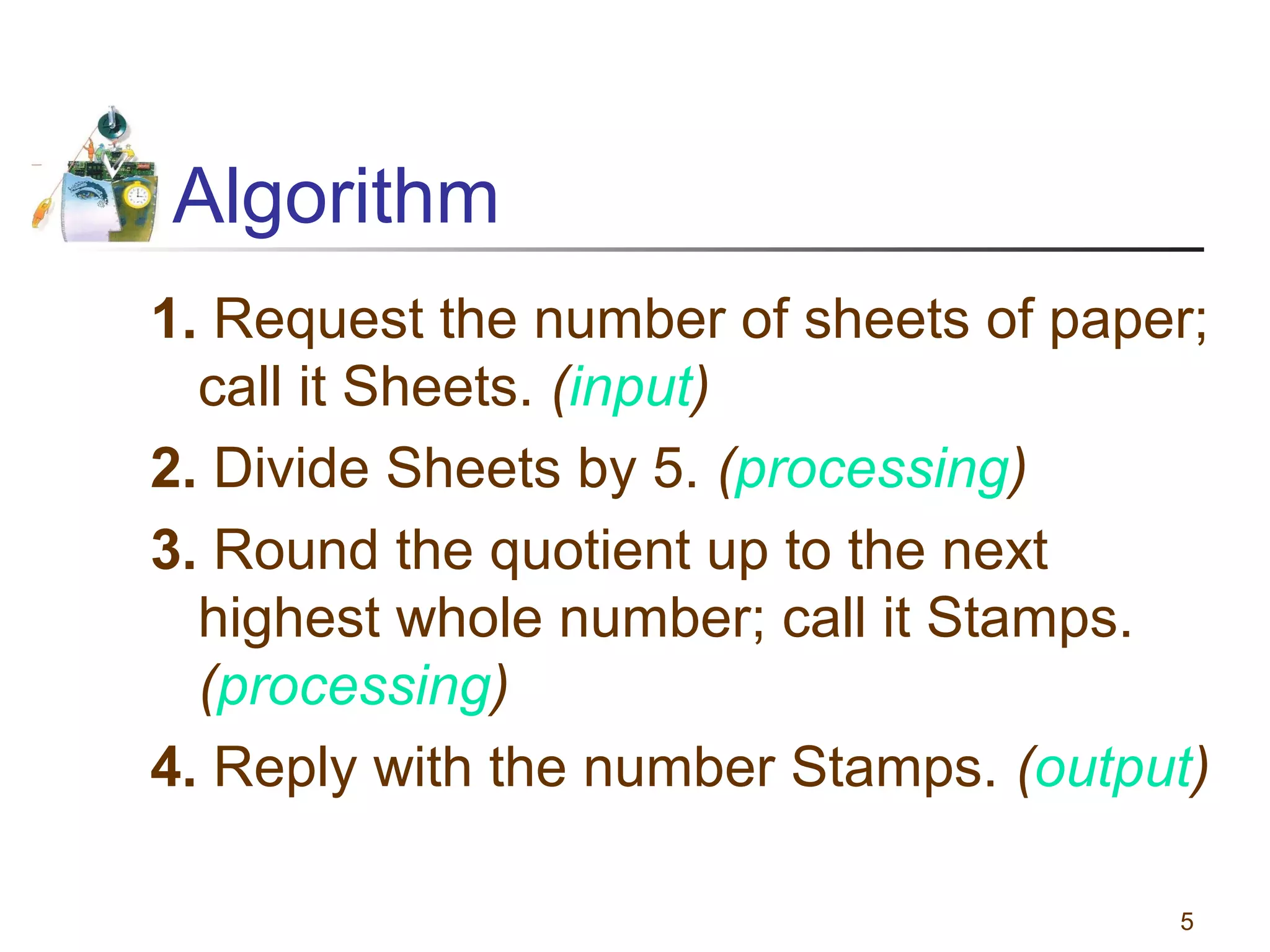
Algorithm
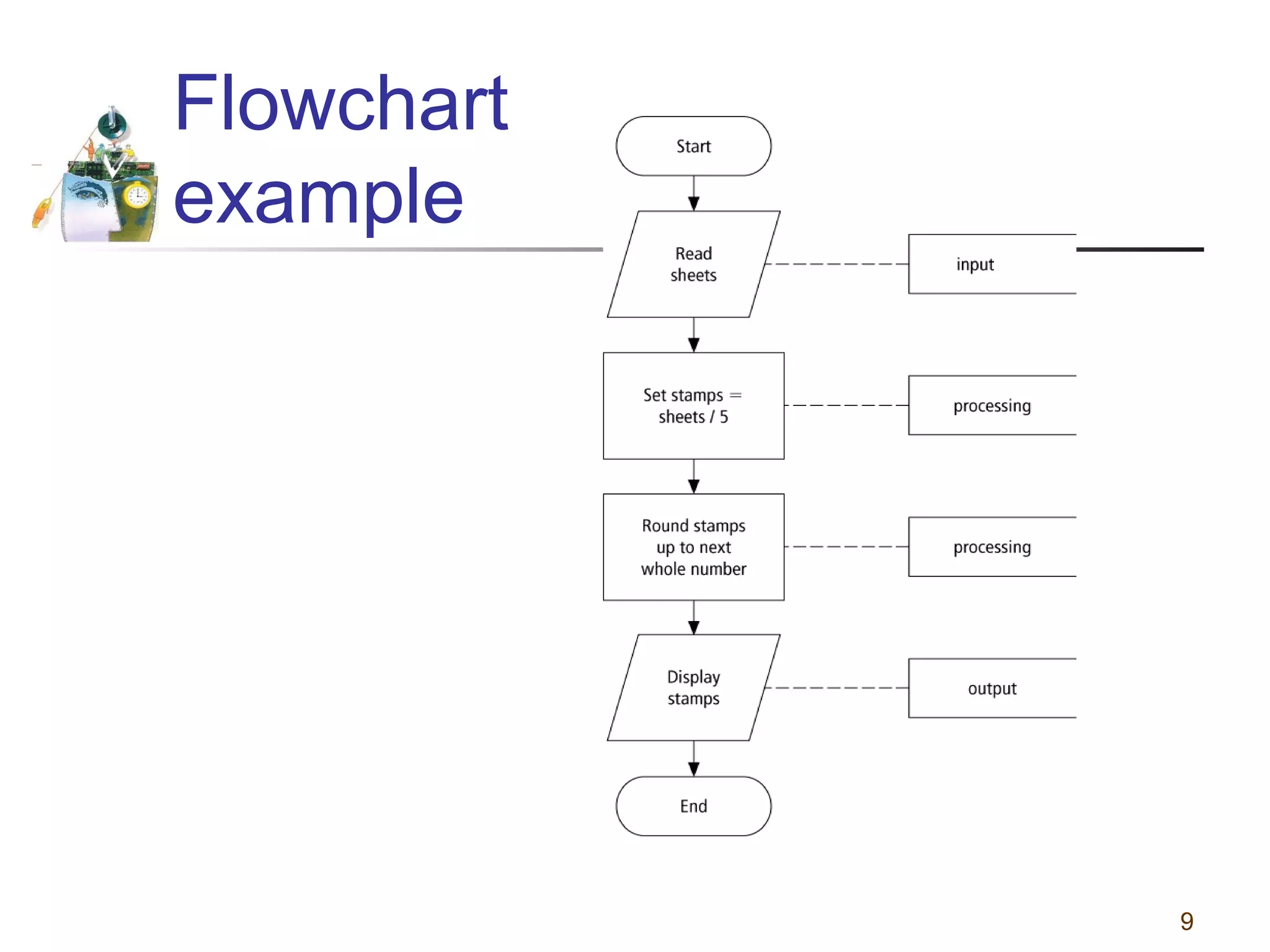
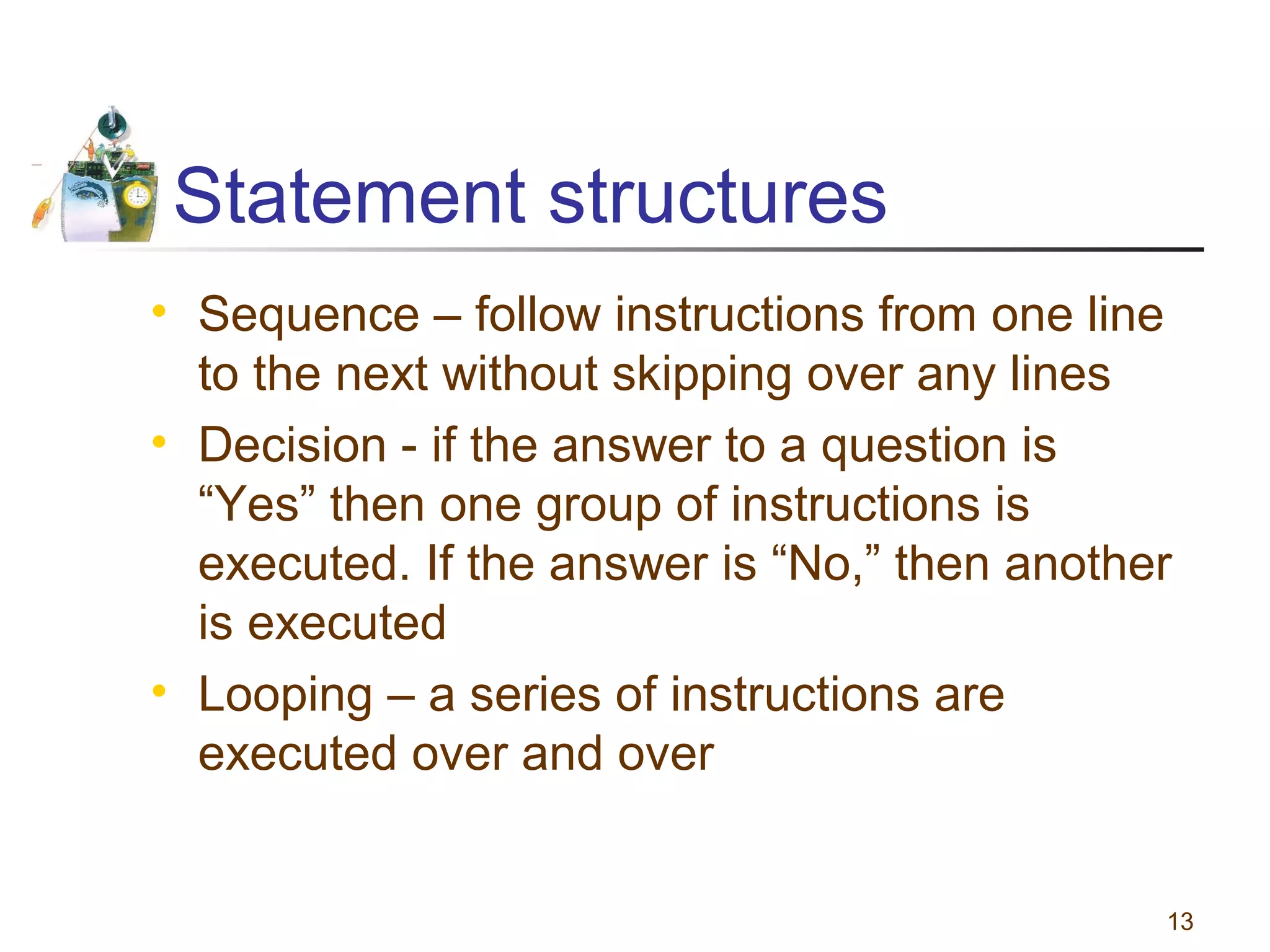
1. Request the number of sheets of paper;
call it Sheets. (input)
2. Divide Sheets by 5. (processing)
3. Round the quotient up to the next
highest whole number; call it Stamps.
(processing)
4. Reply with the number Stamps. (output)
5
Flowcharts
• Graphically depict the logical steps to
carry out a task and show how the steps
relate to each other.

6
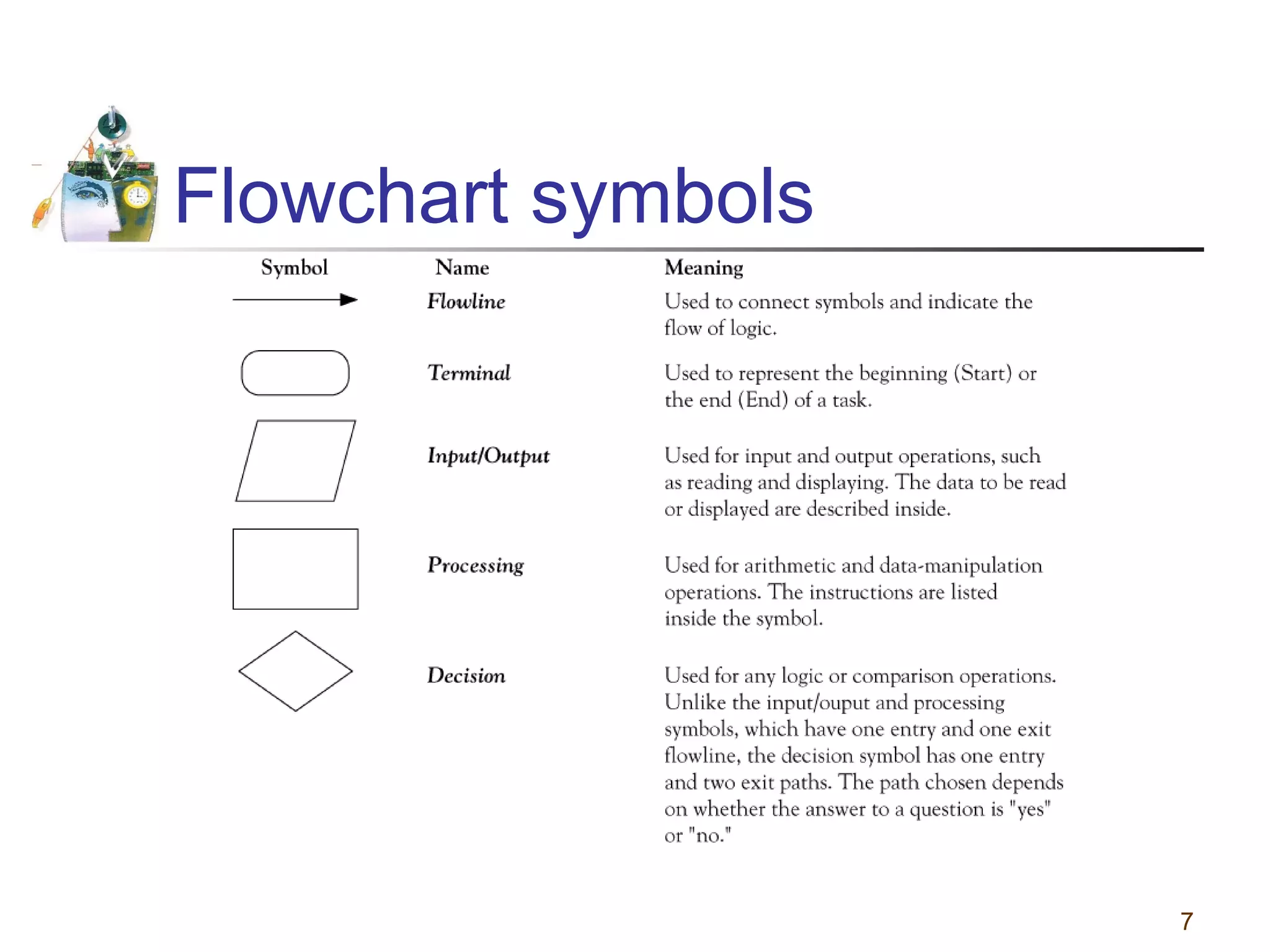
Flowchart symbols

7
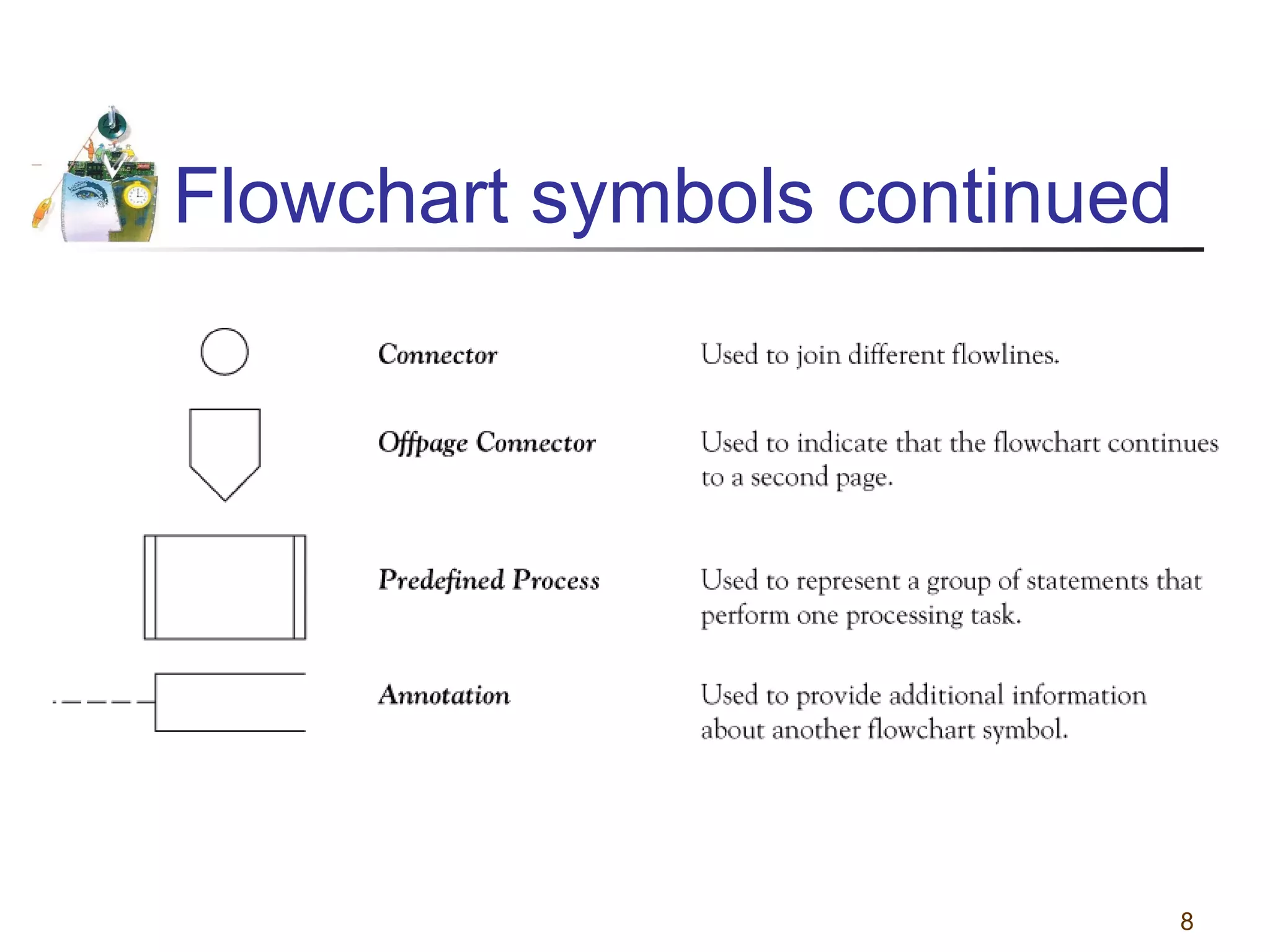
Flowchart symbols continued

8
Flowchart
example

9
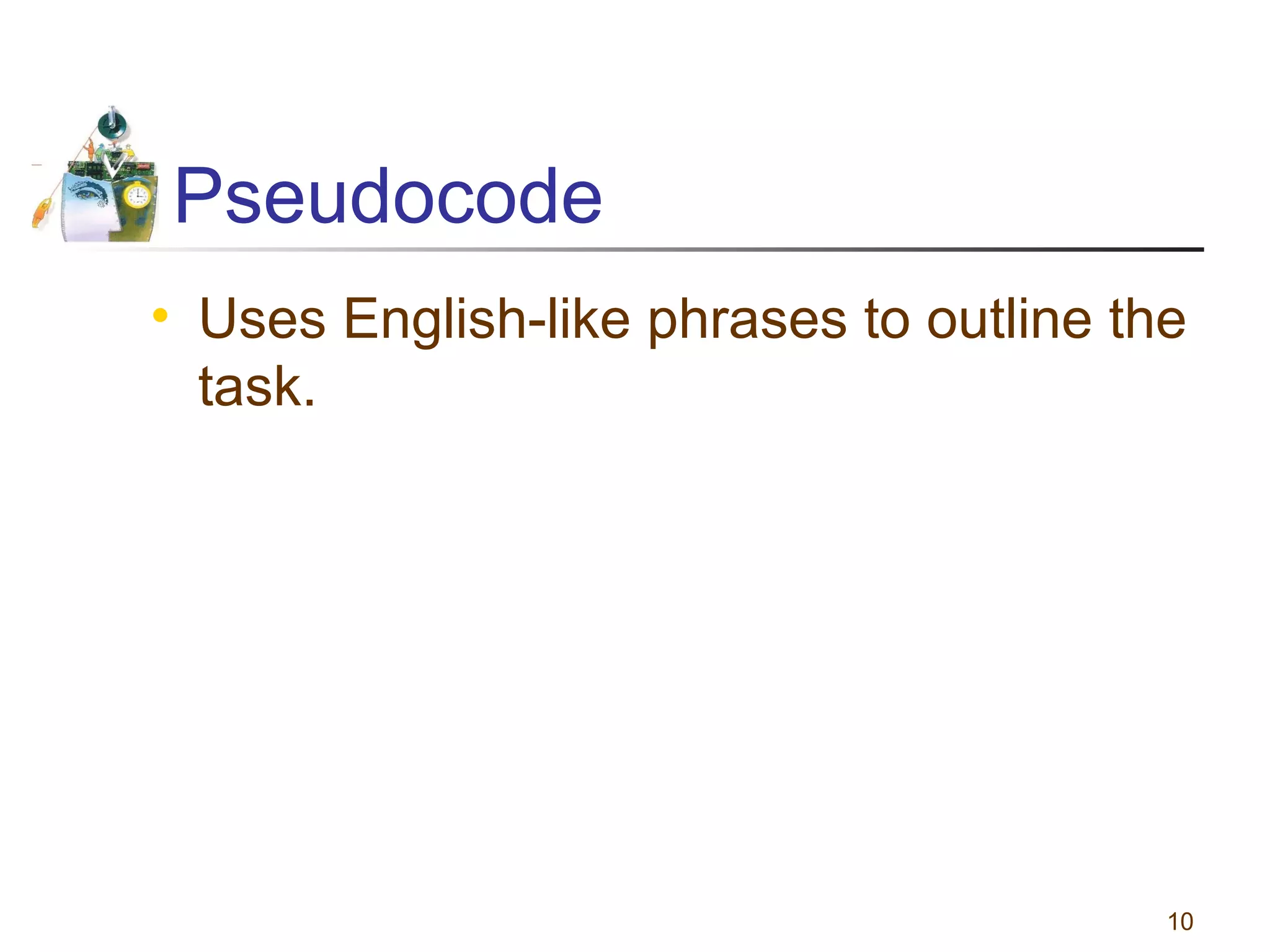
Pseudocode
• Uses English-like phrases to outline the
task.

10
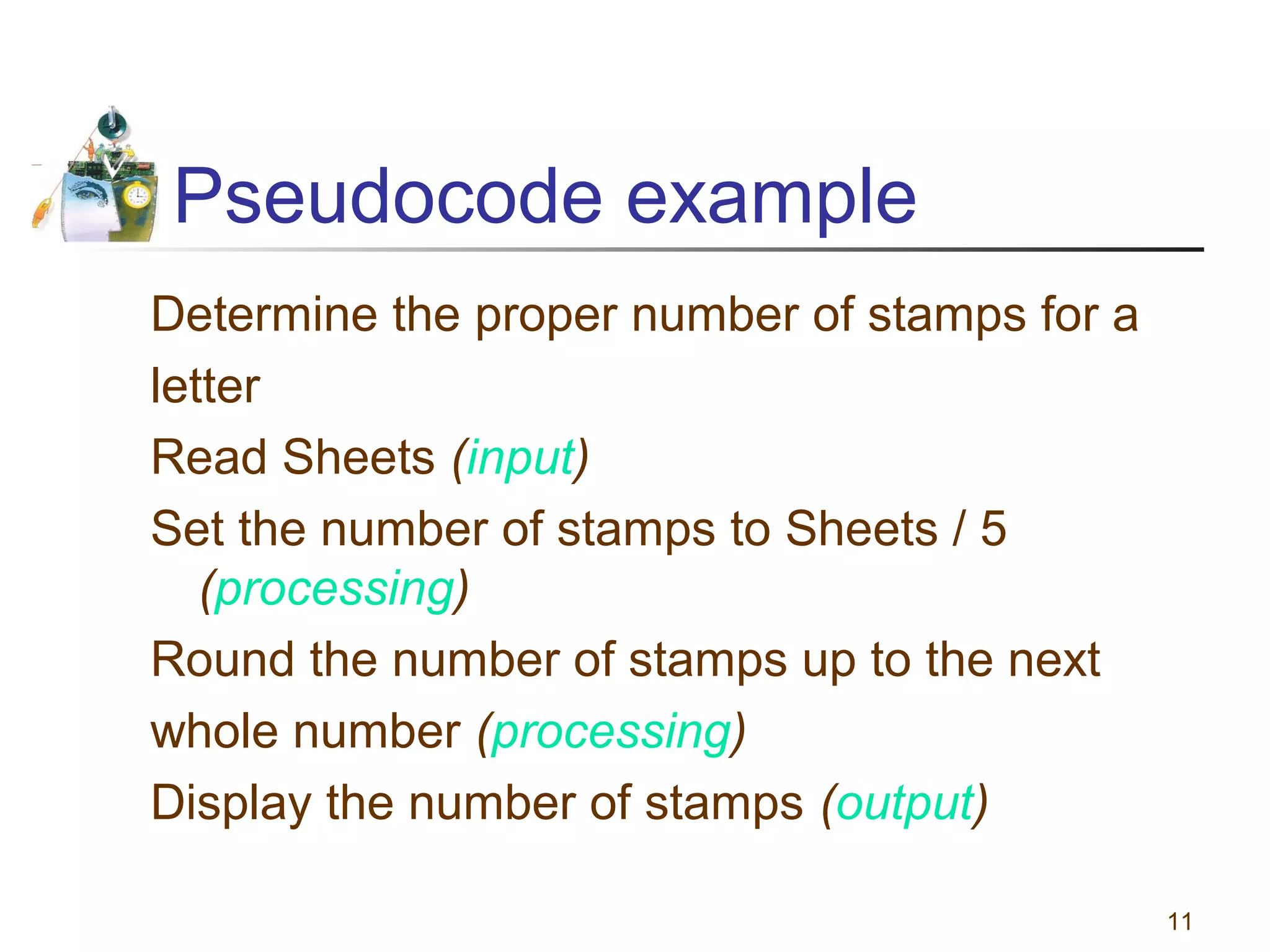
Pseudocode example
Determine the proper number of stamps for a
letter
Read Sheets (input)
Set the number of stamps to Sheets / 5
(processing)
Round the number of stamps up to the next
whole number (processing)
Display the number of stamps (output)
11
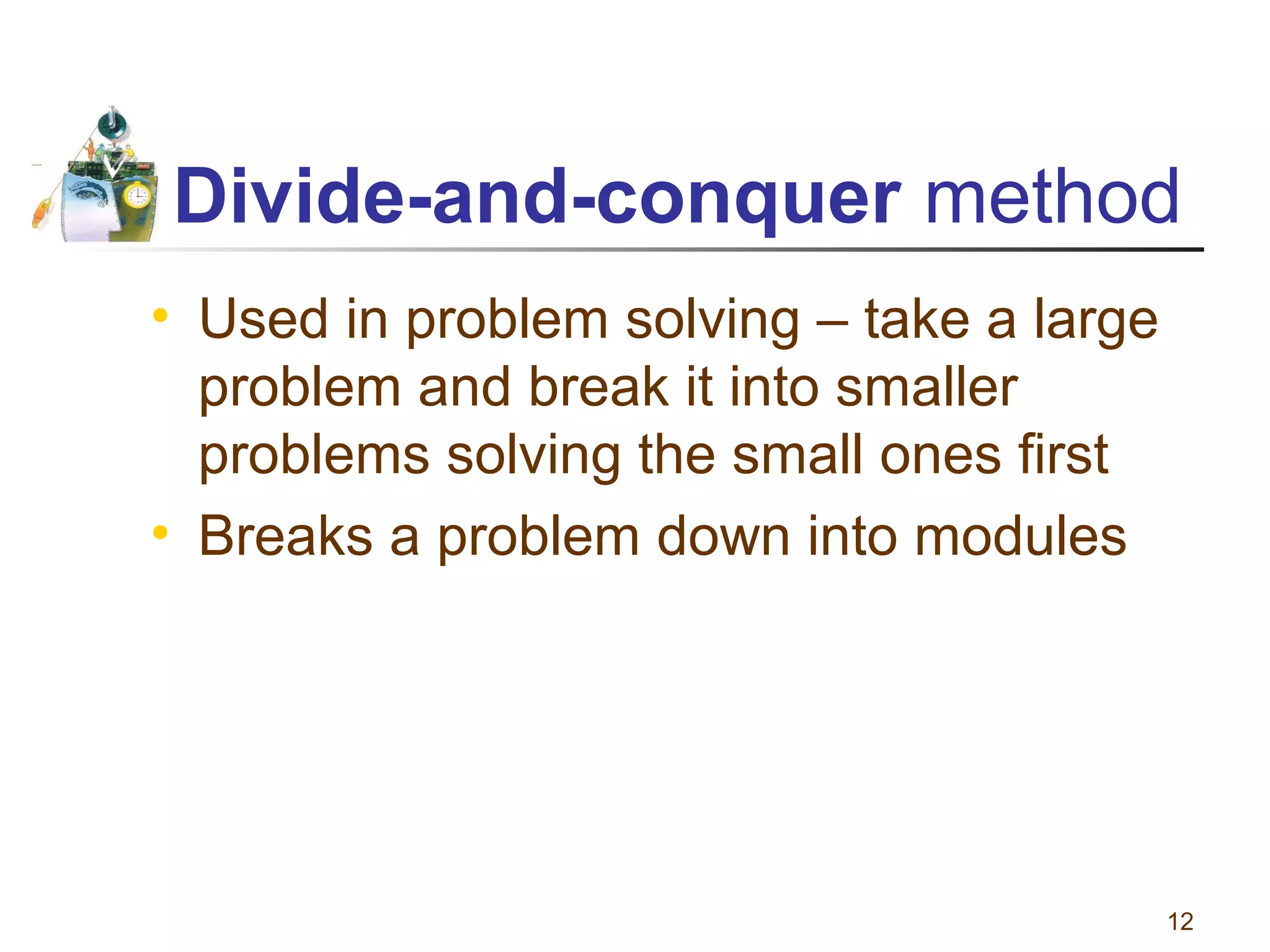
Divide-and-conquer method
• Used in problem solving – take a large
problem and break it into smaller
problems solving the small ones first
• Breaks a problem down into modules

12
Statement structures
• Sequence – follow instructions from one line
to the next without skipping over any lines
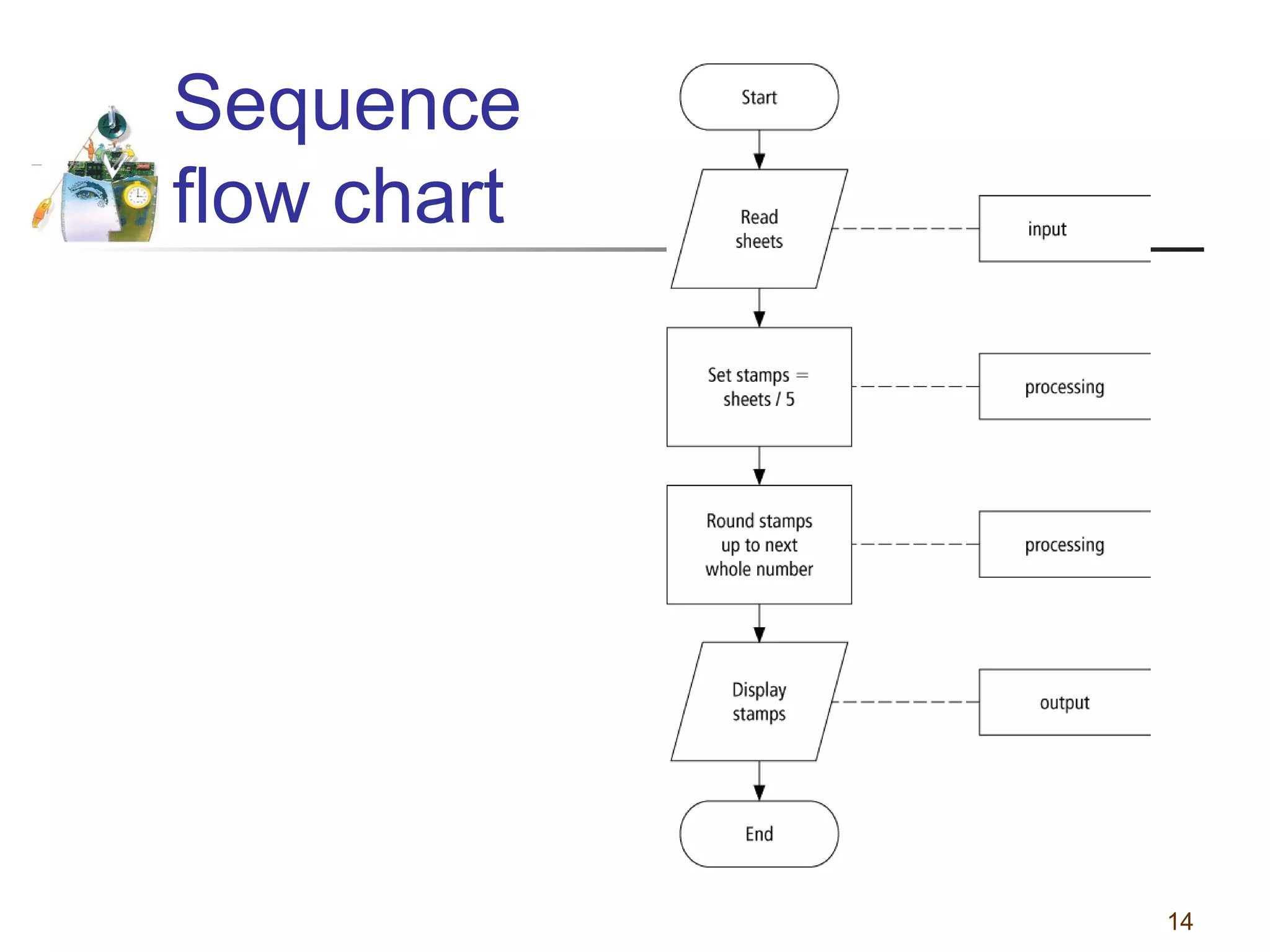
• Decision - if the answer to a question is
“Yes” then one group of instructions is
executed. If the answer is “No,” then another
is executed
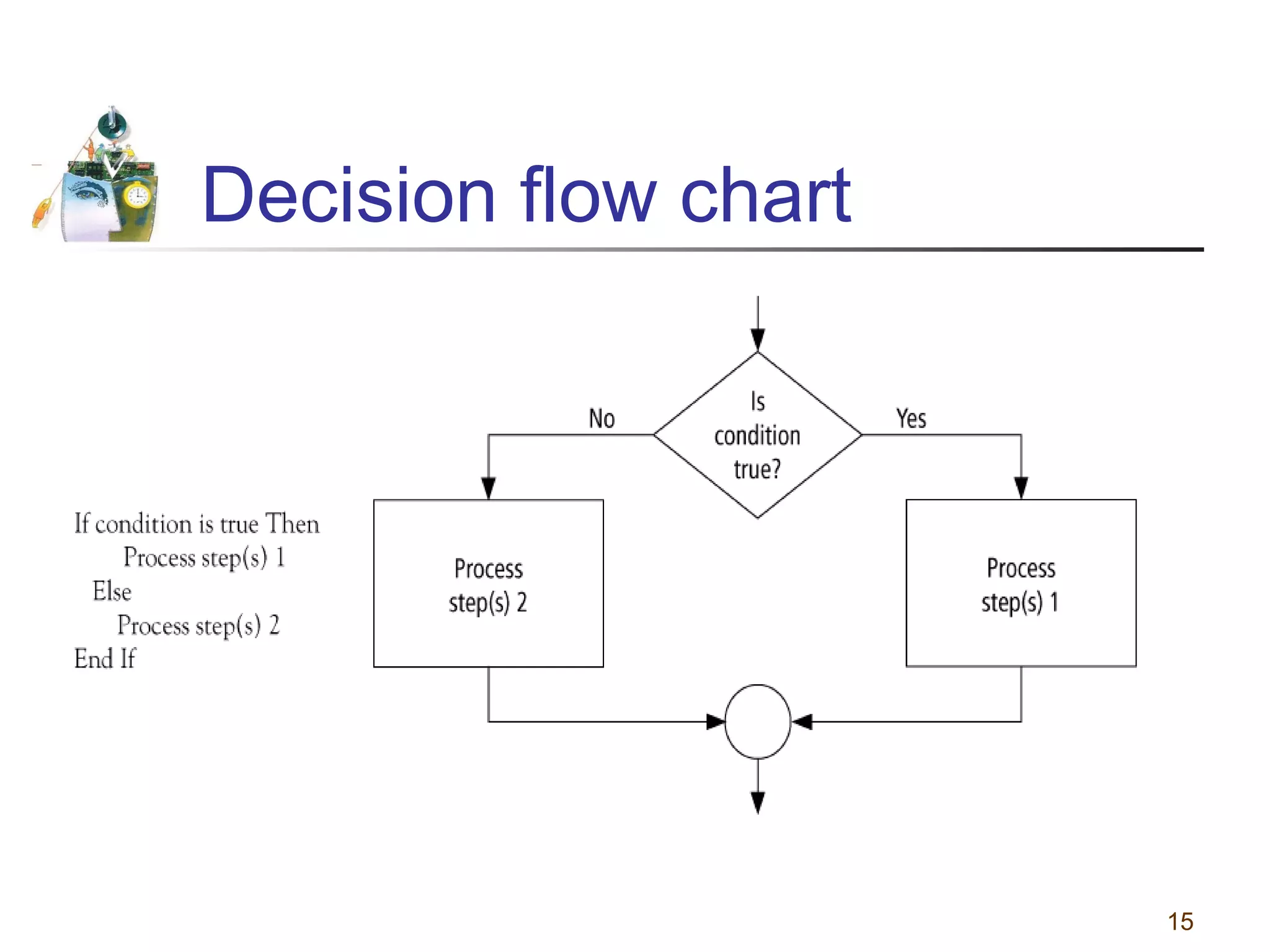
• Looping – a series of instructions are
executed over and over

13
Sequence
flow chart

14
Decision flow chart

15
Looping flow chart

16
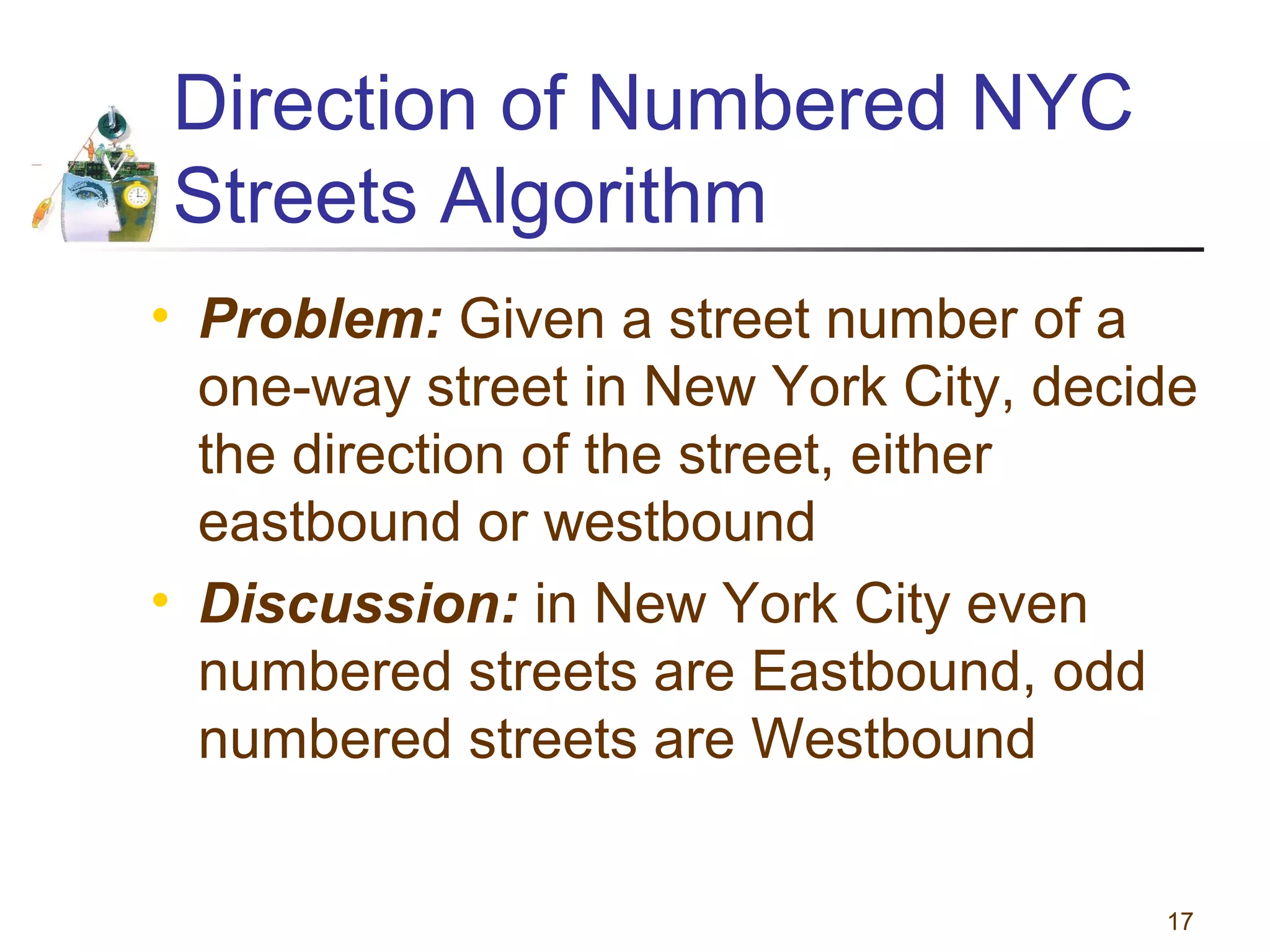
Direction of Numbered NYC
Streets Algorithm
• Problem: Given a street number of a
one-way street in New York City, decide
the direction of the street, either
eastbound or westbound
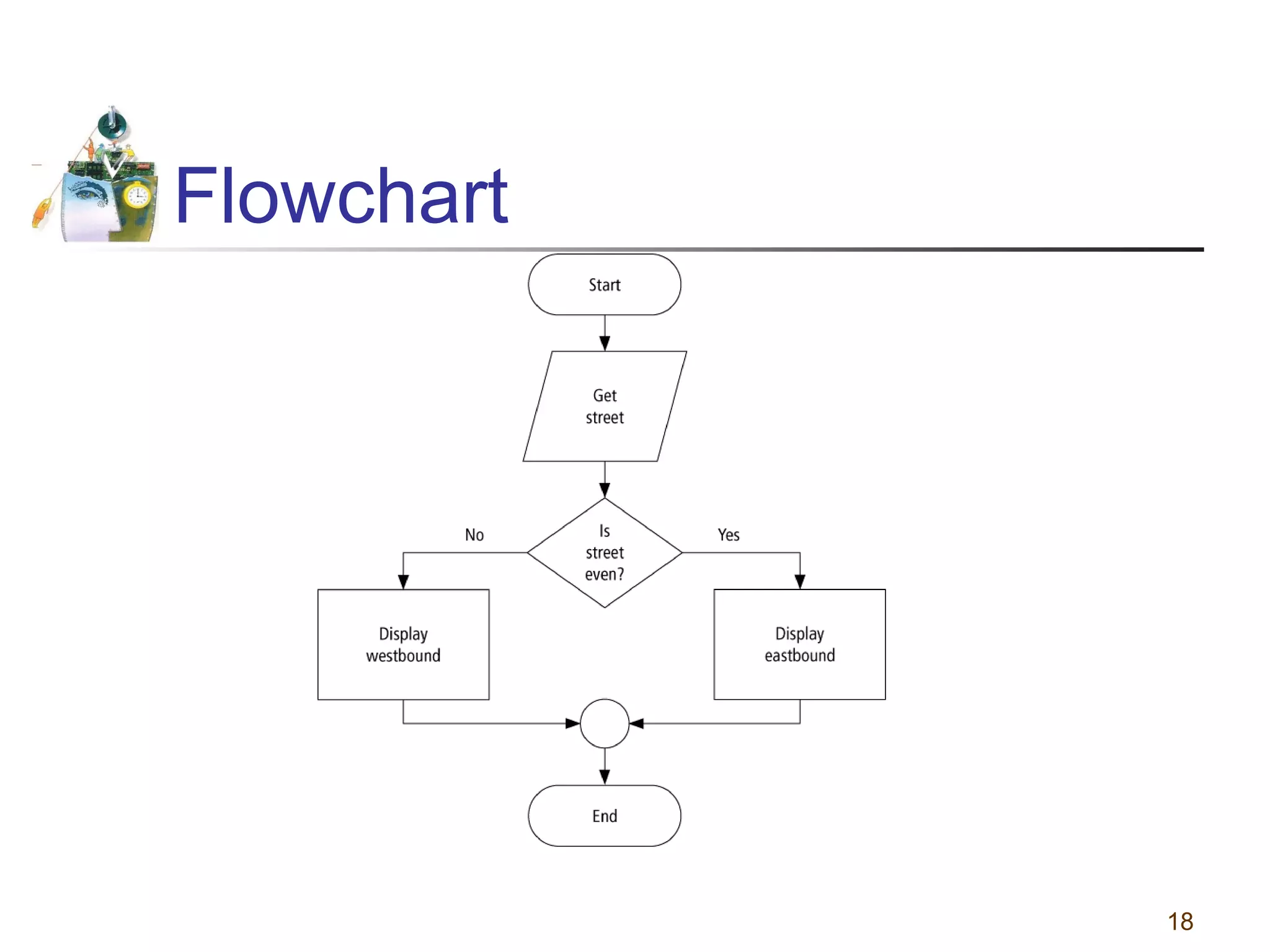
• Discussion: in New York City even
numbered streets are Eastbound, odd
numbered streets are Westbound
17
Flowchart

18
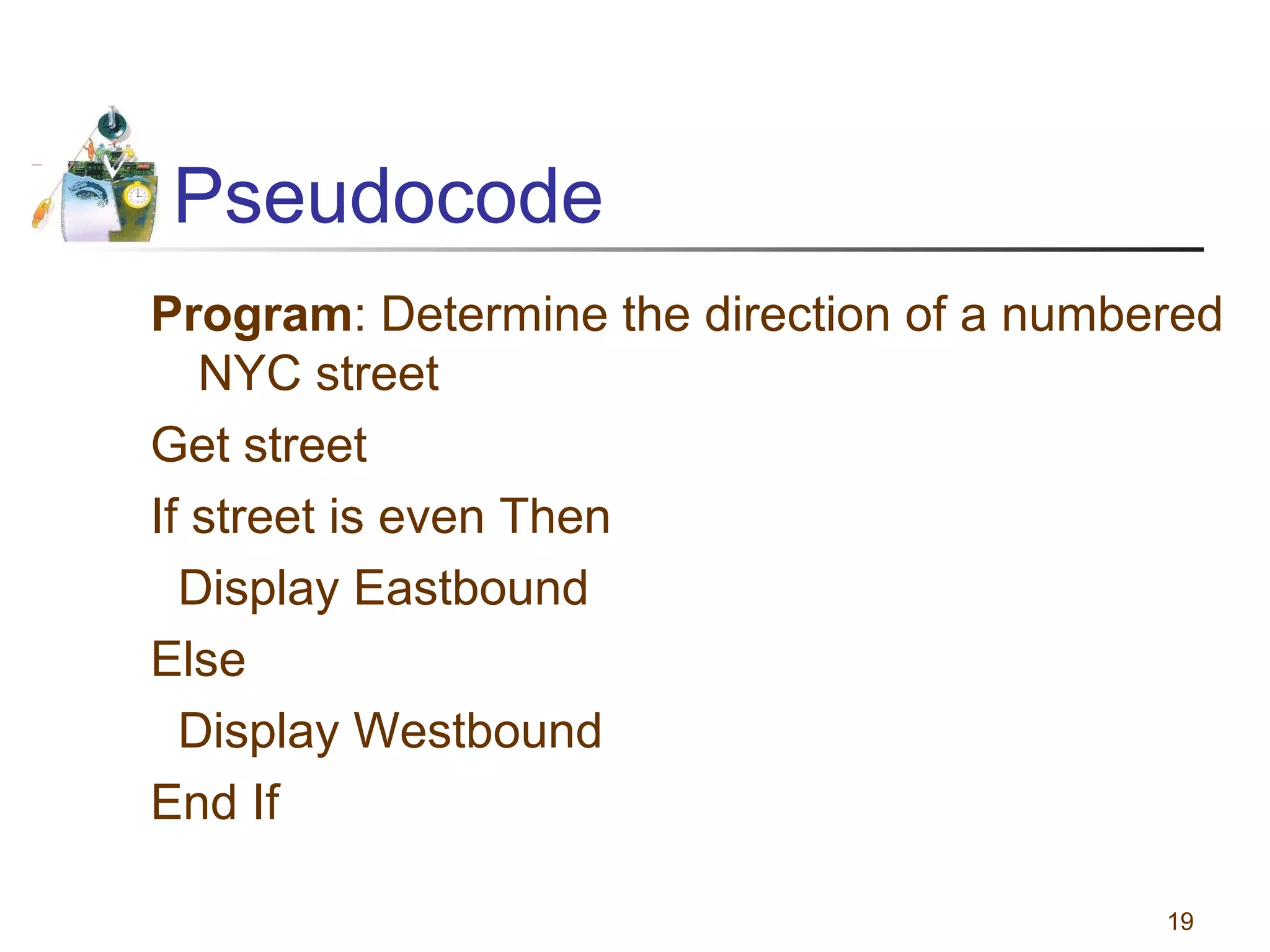
Pseudocode
Program: Determine the direction of a numbered
NYC street
Get street
If street is even Then
Display Eastbound
Else
Display Westbound
End If
19
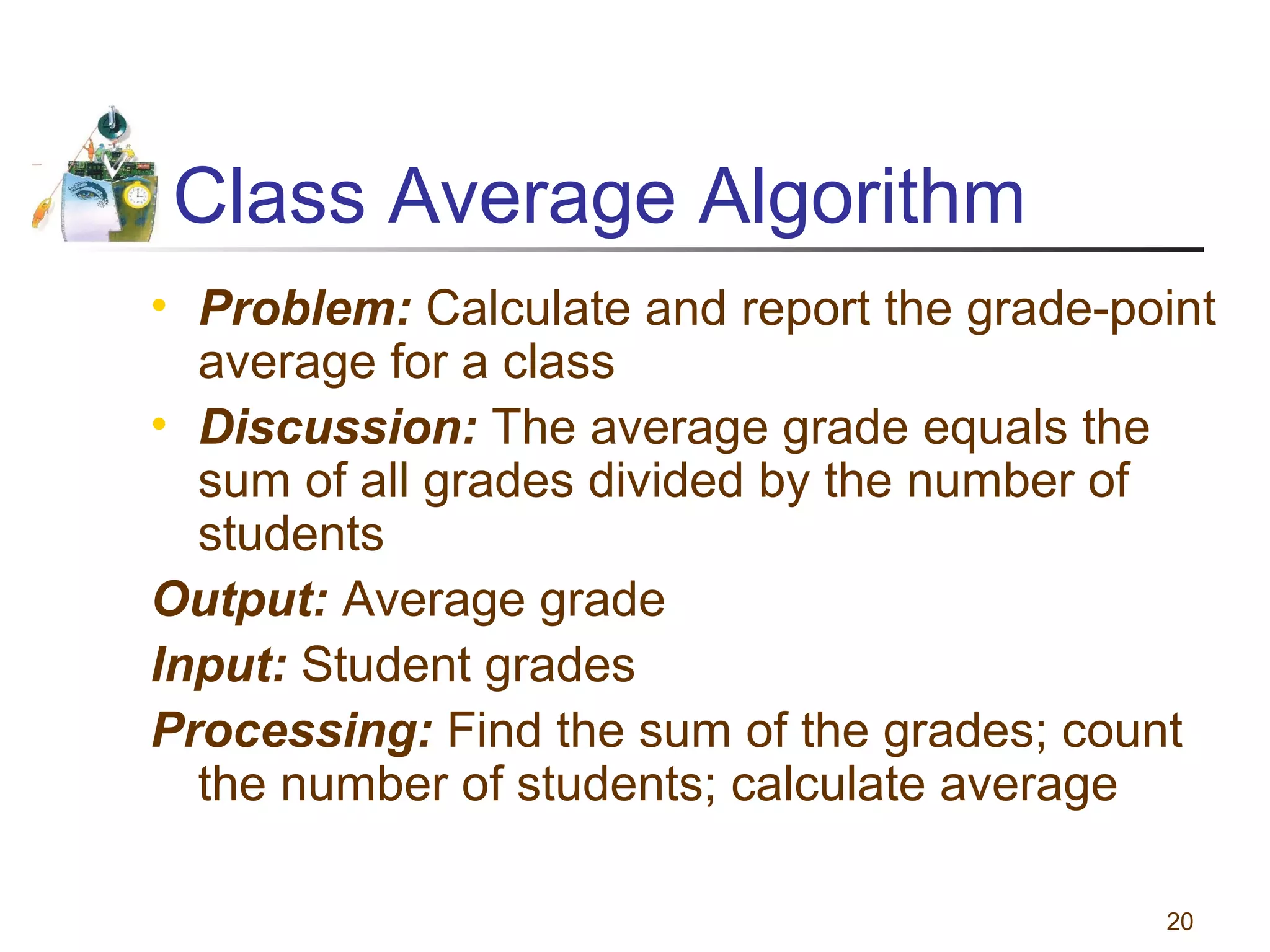
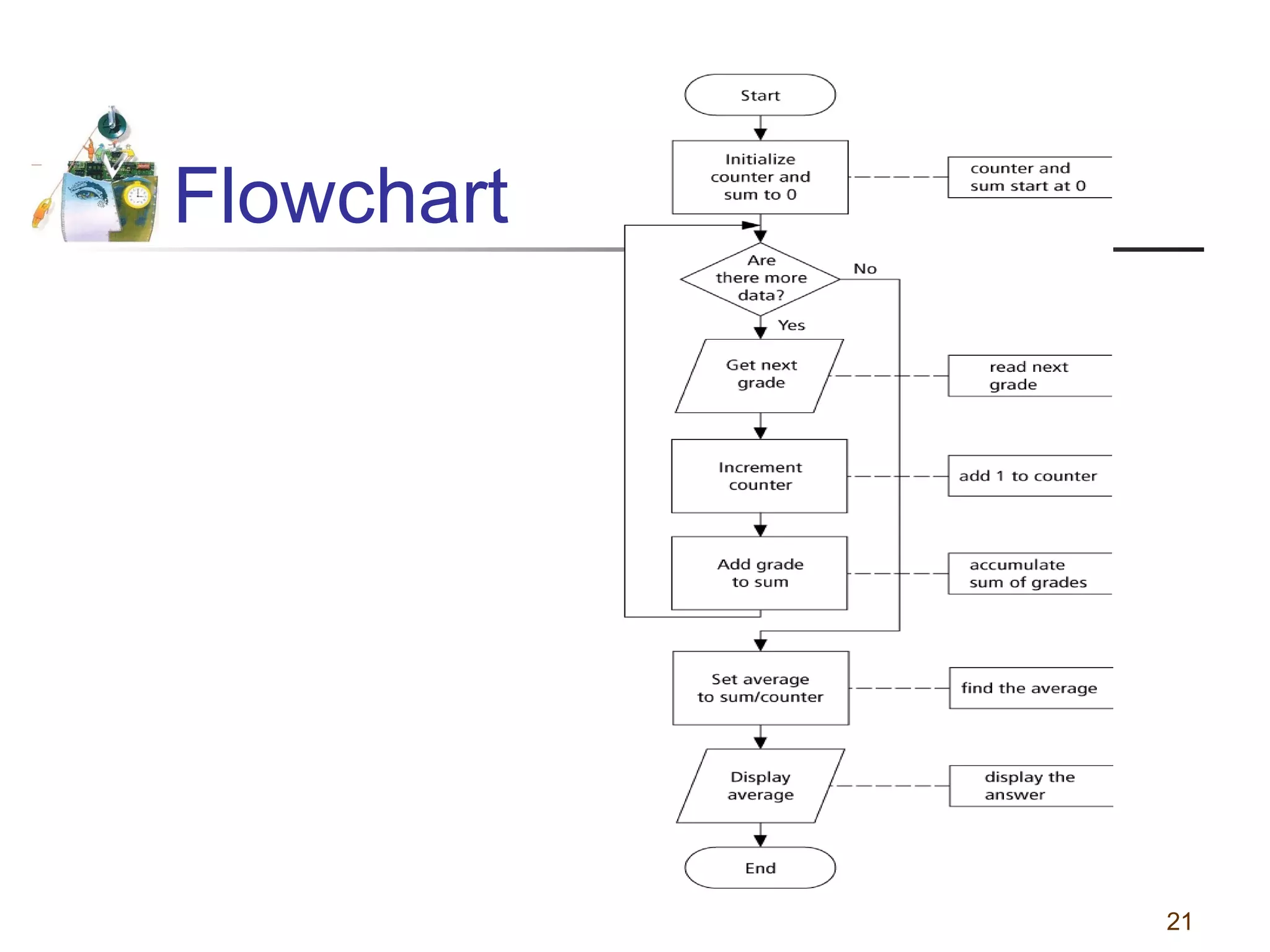
Class Average Algorithm
• Problem: Calculate and report the grade-point
average for a class
• Discussion: The average grade equals the
sum of all grades divided by the number of
students
Output: Average grade
Input: Student grades
Processing: Find the sum of the grades; count
the number of students; calculate average
20
Flowchart

21
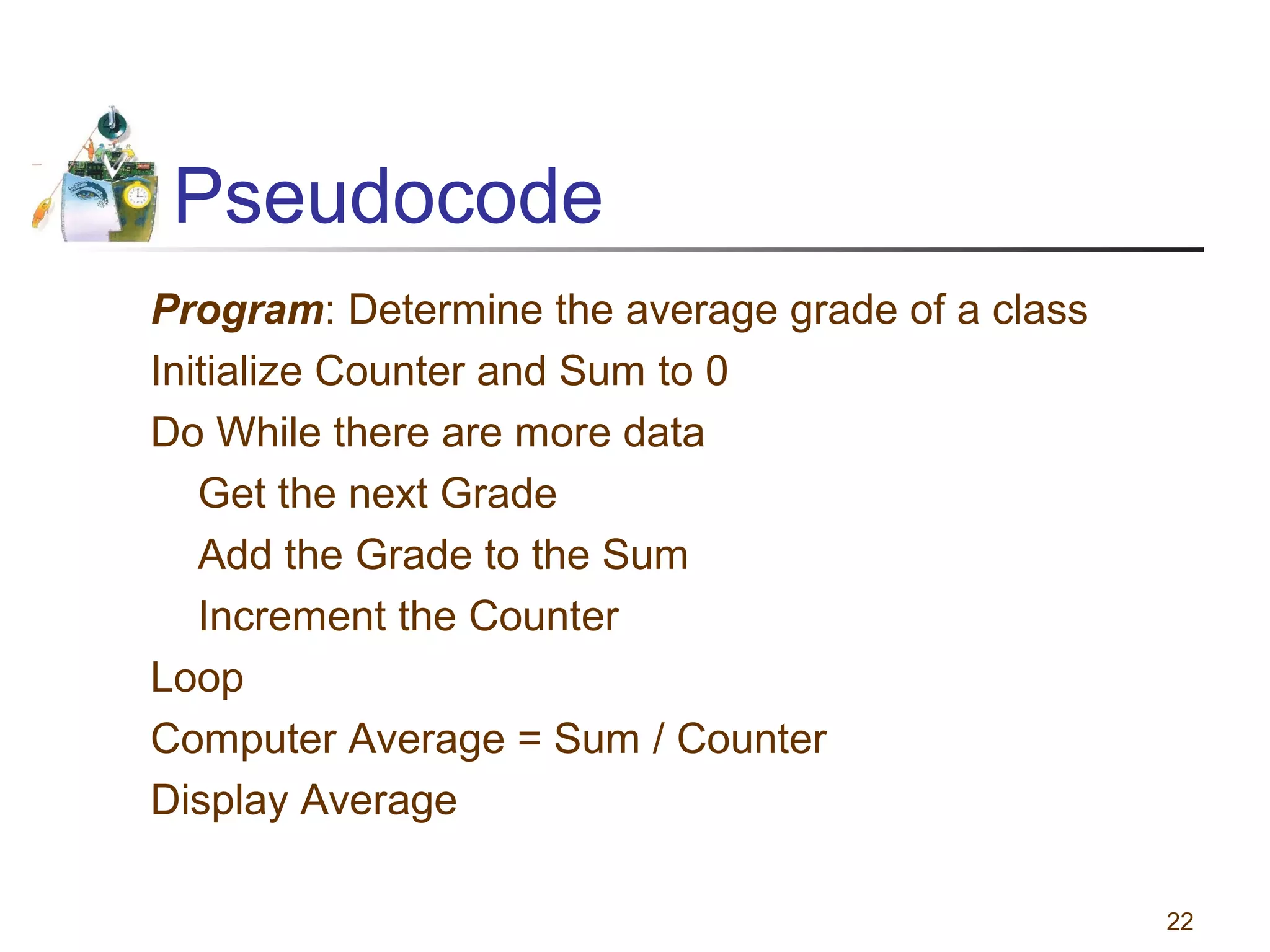
Pseudocode
Program: Determine the average grade of a class
Initialize Counter and Sum to 0
Do While there are more data
Get the next Grade
Add the Grade to the Sum
Increment the Counter
Loop
Computer Average = Sum / Counter
Display Average
22
Tips and tricks of flowcharts
• Flowcharts are time-consuming to write and
difficult to update
• For this reason, professional programmers are
more likely to favor pseudocode and hierarchy
charts
• Because flowcharts so clearly illustrate the
logical flow of programming techniques, they
are a valuable tool in the education of
programmers
23
Tips and tricks of pseudocode
• There are many styles of pseudocode
• Some programmers use an outline form
• Some use a form that looks almost like a
programming language
• The pseudocode in the case studies of this text
focus on the primary tasks to be performed by
the program and leaves many of the routine
details to be completed during the coding
process
24
URL’s for free Flowcharting
software
• www.smartdraw.com
• www.gliffy.com/uses/flowchartsoftware/
• www.breezetree.com/flowchartingsoftware/
Flowchart Software, FREE Flowchart
Examples and Templates ...
• www.edrawsoft.com/flowchart.php
25

Flowcharts

  • 1.
    1.4 Programming Tools • • • • Flowcharts Pseudocode HierarchyChart Direction of Numbered NYC Streets Algorithm • Class Average Algorithm 1
  • 2.
  • 3.
    Programming Tools • Threetools are used to convert algorithms into computer programs: • Flowchart - Graphically depicts the logical steps to carry out a task and shows how the steps relate to each other. • Pseudocode - Uses English-like phrases with some Visual Basic terms to outline the program. 3
  • 4.
    Problem solving example •How many stamps do you use when mailing a letter? • One rule of thumb is to use one stamp for every five sheets of paper or fraction thereof. 4
  • 5.
    Algorithm 1. Request thenumber of sheets of paper; call it Sheets. (input) 2. Divide Sheets by 5. (processing) 3. Round the quotient up to the next highest whole number; call it Stamps. (processing) 4. Reply with the number Stamps. (output) 5
  • 6.
    Flowcharts • Graphically depictthe logical steps to carry out a task and show how the steps relate to each other. 6
  • 7.
  • 8.
  • 9.
  • 10.
    Pseudocode • Uses English-likephrases to outline the task. 10
  • 11.
    Pseudocode example Determine theproper number of stamps for a letter Read Sheets (input) Set the number of stamps to Sheets / 5 (processing) Round the number of stamps up to the next whole number (processing) Display the number of stamps (output) 11
  • 12.
    Divide-and-conquer method • Usedin problem solving – take a large problem and break it into smaller problems solving the small ones first • Breaks a problem down into modules 12
  • 13.
    Statement structures • Sequence– follow instructions from one line to the next without skipping over any lines • Decision - if the answer to a question is “Yes” then one group of instructions is executed. If the answer is “No,” then another is executed • Looping – a series of instructions are executed over and over 13
  • 14.
  • 15.
  • 16.
  • 17.
    Direction of NumberedNYC Streets Algorithm • Problem: Given a street number of a one-way street in New York City, decide the direction of the street, either eastbound or westbound • Discussion: in New York City even numbered streets are Eastbound, odd numbered streets are Westbound 17
  • 18.
  • 19.
    Pseudocode Program: Determine thedirection of a numbered NYC street Get street If street is even Then Display Eastbound Else Display Westbound End If 19
  • 20.
    Class Average Algorithm •Problem: Calculate and report the grade-point average for a class • Discussion: The average grade equals the sum of all grades divided by the number of students Output: Average grade Input: Student grades Processing: Find the sum of the grades; count the number of students; calculate average 20
  • 21.
  • 22.
    Pseudocode Program: Determine theaverage grade of a class Initialize Counter and Sum to 0 Do While there are more data Get the next Grade Add the Grade to the Sum Increment the Counter Loop Computer Average = Sum / Counter Display Average 22
  • 23.
    Tips and tricksof flowcharts • Flowcharts are time-consuming to write and difficult to update • For this reason, professional programmers are more likely to favor pseudocode and hierarchy charts • Because flowcharts so clearly illustrate the logical flow of programming techniques, they are a valuable tool in the education of programmers 23
  • 24.
    Tips and tricksof pseudocode • There are many styles of pseudocode • Some programmers use an outline form • Some use a form that looks almost like a programming language • The pseudocode in the case studies of this text focus on the primary tasks to be performed by the program and leaves many of the routine details to be completed during the coding process 24
  • 25.
    URL’s for freeFlowcharting software • www.smartdraw.com • www.gliffy.com/uses/flowchartsoftware/ • www.breezetree.com/flowchartingsoftware/ Flowchart Software, FREE Flowchart Examples and Templates ... • www.edrawsoft.com/flowchart.php 25

Editor's Notes

  • #21 We need a loop to read and then add (accumulate) the grades for each student in the class. Inside the loop, we also need to total (count) the number of students in the class. See Figures 2.8 to 2.10. grade = sum of grades / number of students.