
Pythagoras of SamosPythagoras of Samos is often described as the first                                                 pure  is often described as the first                                                 pure 
mathematician. He is an extremely important                                                figure in the mathematician. He is an extremely important                                                figure in the 
development of mathematics yet we know                                          relatively little about development of mathematics yet we know                                          relatively little about 
his mathematical achievementshis mathematical achievements..    
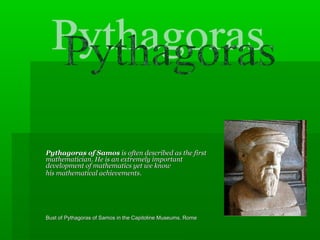
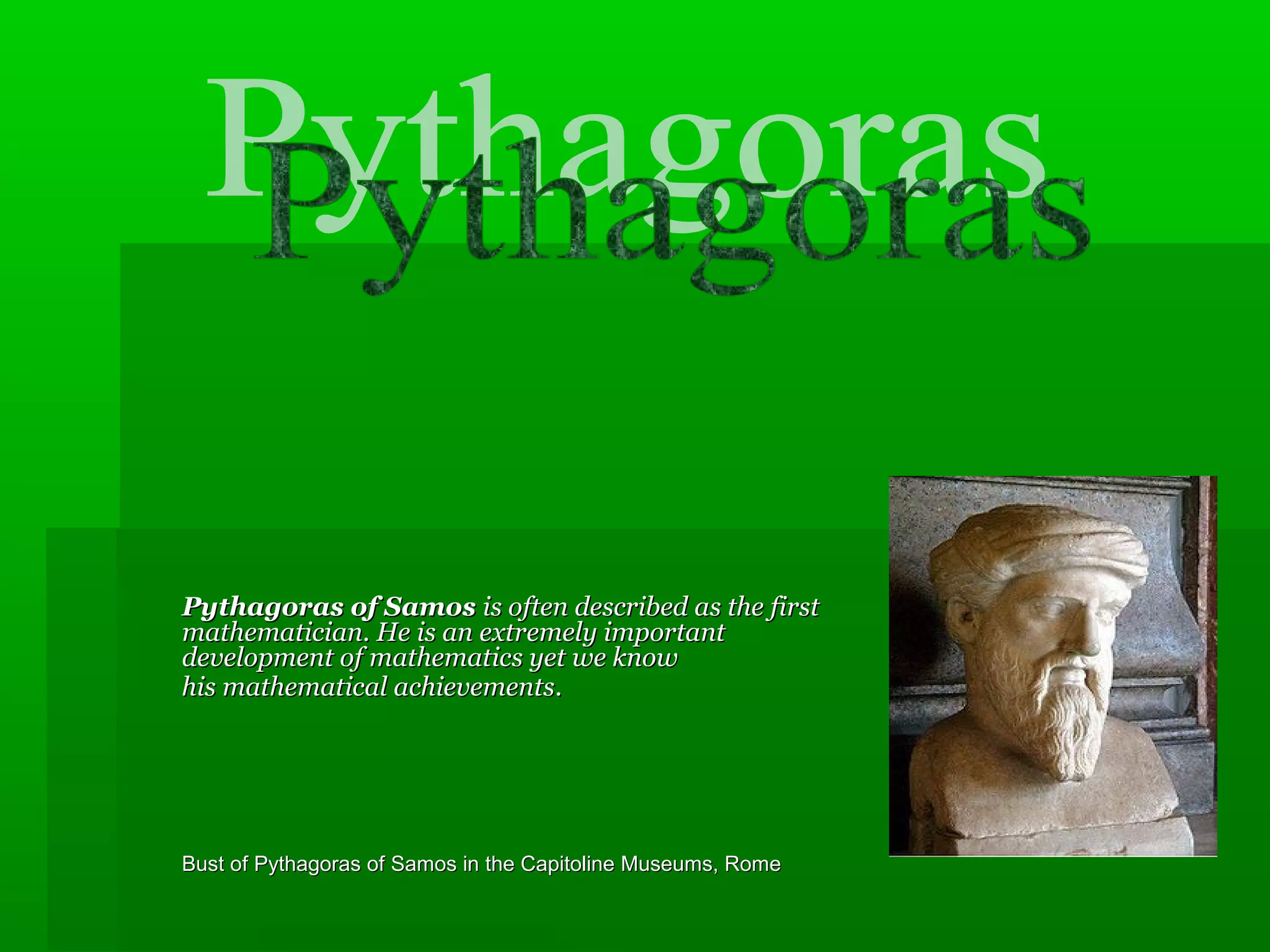
Bust of Pythagoras of Samos in the Capitoline Museums, RomeBust of Pythagoras of Samos in the Capitoline Museums, Rome                                                               
                          
   
IntroductionIntroduction
 Pythagoras of Samos was Pythagoras of Samos was 
Ionian Greek philosopher, mathematician, and founder of the Ionian Greek philosopher, mathematician, and founder of the 
religious movement called Pythagoreanism. Most of the religious movement called Pythagoreanism. Most of the 
information about Pythagoras was written down centuries information about Pythagoras was written down centuries 
after he lived, so very little reliable information is known about after he lived, so very little reliable information is known about 
him. He was born on the island of Samos, and might have him. He was born on the island of Samos, and might have 
traveled widely in his youth, visiting Egypt and other places traveled widely in his youth, visiting Egypt and other places 
seeking knowledge. Around 530 BC, he moved to Croton, seeking knowledge. Around 530 BC, he moved to Croton, 
a Greek colony in southern Italy, and there set up a religious a Greek colony in southern Italy, and there set up a religious 
sect. His followers pursued the religious rites and practices sect. His followers pursued the religious rites and practices 
developed by Pythagoras, and studied his philosophical developed by Pythagoras, and studied his philosophical 
theories. The society took an active role in the politics of theories. The society took an active role in the politics of 
Croton, but this eventually led to their downfall. The Croton, but this eventually led to their downfall. The 
Pythagorean meeting-places were burned, and Pythagoras Pythagorean meeting-places were burned, and Pythagoras 
was forced to flee the city. He is said to have ended his days in was forced to flee the city. He is said to have ended his days in 
Meta. Meta. 
 Pythagoras made influential contributions to philosophy andPythagoras made influential contributions to philosophy and
religious teaching in the late 6th century BC. He is often reveredreligious teaching in the late 6th century BC. He is often revered
as a great mathematician, mystic and scientist, but he is bestas a great mathematician, mystic and scientist, but he is best
known for the Pythagorean theorem which bears his name.known for the Pythagorean theorem which bears his name.
However, because legend and obfuscation cloud his work evenHowever, because legend and obfuscation cloud his work even
more than with the other pre-Socratic philosophers, one canmore than with the other pre-Socratic philosophers, one can
give account of his teachings to a little extent, and some havegive account of his teachings to a little extent, and some have
questioned whether he contributed muchquestioned whether he contributed much
to mathematics and natural philosophy. Many of theto mathematics and natural philosophy. Many of the
accomplishments credited to Pythagoras may actually haveaccomplishments credited to Pythagoras may actually have
been accomplishments of his colleagues and successors. Whetherbeen accomplishments of his colleagues and successors. Whether
or not his disciples believed that everything was related toor not his disciples believed that everything was related to
mathematics and that numbers were the ultimate reality ismathematics and that numbers were the ultimate reality is
unknown. It was said that he was the first man to call himself aunknown. It was said that he was the first man to call himself a
philosopher, or lover of wisdom and Pythagorean ideasphilosopher, or lover of wisdom and Pythagorean ideas
exercised a marked influence on Plato, and through him, allexercised a marked influence on Plato, and through him, all
of Western philosophy.of Western philosophy.
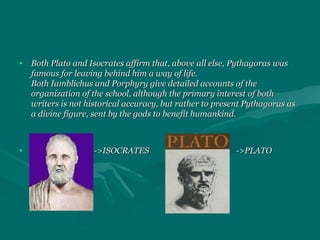
• Both Plato and Isocrates affirm that, above all else, Pythagoras wasBoth Plato and Isocrates affirm that, above all else, Pythagoras was
famous for leaving behind him a way of life.famous for leaving behind him a way of life.
Both Iamblichus and Porphyry give detailed accounts of theBoth Iamblichus and Porphyry give detailed accounts of the
organization of the school, although the primary interest of bothorganization of the school, although the primary interest of both
writers is not historical accuracy, but rather to present Pythagoras aswriters is not historical accuracy, but rather to present Pythagoras as
a divine figure, sent by the gods to benefit humankind.a divine figure, sent by the gods to benefit humankind.
• ->ISOCRATES ->PLATO->ISOCRATES ->PLATO
• Pythagoras set up an organization which was in some ways a school,Pythagoras set up an organization which was in some ways a school,
in some ways a brotherhood (and here it should be noted that sourcesin some ways a brotherhood (and here it should be noted that sources
indicate that as well as men there were many women among theindicate that as well as men there were many women among the
adherents of Pythagoras) and in some ways a monastery. It was basedadherents of Pythagoras) and in some ways a monastery. It was based
upon the religious teachings of Pythagoras and was very secretive. Theupon the religious teachings of Pythagoras and was very secretive. The
adherents were bound by a vow to Pythagoras and each other, for theadherents were bound by a vow to Pythagoras and each other, for the
purpose of pursuing the religious and ascetic observances, and ofpurpose of pursuing the religious and ascetic observances, and of
studying his religious and philosophical theories. The claim that theystudying his religious and philosophical theories. The claim that they
put all their property into a common stock is perhaps only a laterput all their property into a common stock is perhaps only a later
inference from certain Pythagorean maxims and practices.inference from certain Pythagorean maxims and practices.
Pythagoras TheoremPythagoras Theorem
• In mathematics, the Pythagorean theorem or Pythagoras'In mathematics, the Pythagorean theorem or Pythagoras'
theorem is a relation in Euclidean geometry among the three sidestheorem is a relation in Euclidean geometry among the three sides
of a right triangle (right-angled triangle). In terms of areas, itof a right triangle (right-angled triangle). In terms of areas, it
states:states:
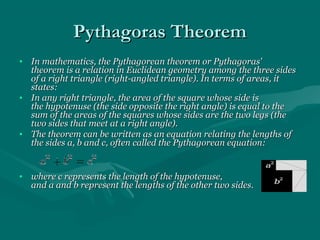
• In any right triangle, the area of the square whose side isIn any right triangle, the area of the square whose side is
the hypotenuse (the side opposite the right angle) is equal to thethe hypotenuse (the side opposite the right angle) is equal to the
sum of the areas of the squares whose sides are the two legs (thesum of the areas of the squares whose sides are the two legs (the
two sides that meet at a right angle).two sides that meet at a right angle).
• The theorem can be written as an equation relating the lengths ofThe theorem can be written as an equation relating the lengths of
the sides a, b and c, often called the Pythagorean equation:the sides a, b and c, often called the Pythagorean equation:
• where c represents the length of the hypotenuse,where c represents the length of the hypotenuse,
and a and b represent the lengths of the other two sides.and a and b represent the lengths of the other two sides.
• The Pythagorean theorem is named afterThe Pythagorean theorem is named after
the Greek mathematician Pythagoras, who by tradition is creditedthe Greek mathematician Pythagoras, who by tradition is credited
with its discovery and proof, although it is often argued thatwith its discovery and proof, although it is often argued that
knowledge of the theorem predates him. There is evidenceknowledge of the theorem predates him. There is evidence
that Babylonian mathematicians understood the formula, althoughthat Babylonian mathematicians understood the formula, although
there is little surviving evidence that they used it in a mathematicalthere is little surviving evidence that they used it in a mathematical
framework.framework.
• The theorem has numerous proofs, possibly the most of anyThe theorem has numerous proofs, possibly the most of any
mathematical theorem. These are very diverse, including bothmathematical theorem. These are very diverse, including both
geometric proofs and algebraic proofs, with some dating backgeometric proofs and algebraic proofs, with some dating back
thousands of years.thousands of years.
• The theorem can be generalized in various ways, including higher-The theorem can be generalized in various ways, including higher-
dimensional spaces, to spaces that are not Euclidean, to objects thatdimensional spaces, to spaces that are not Euclidean, to objects that
are not right triangles, and indeed, to objects that are not triangles atare not right triangles, and indeed, to objects that are not triangles at
all, but n-dimensional solids. The Pythagorean theorem has attractedall, but n-dimensional solids. The Pythagorean theorem has attracted
interest outside mathematics as a symbol of mathematicalinterest outside mathematics as a symbol of mathematical
abstruseness, mystique, or intellectual power; popular references inabstruseness, mystique, or intellectual power; popular references in
literature, plays, musicals, songs, stamps and cartoons abound.literature, plays, musicals, songs, stamps and cartoons abound.
Done by:Done by:
ShaktiShakti

Pythagoras