Salcombe Devon 2013


High Modulus Polyethylene (HMP)

                 by
          Malcolm Mackley


                             1
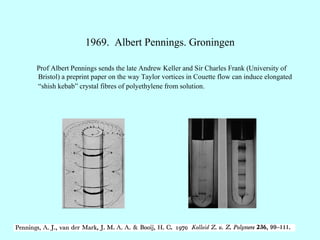
1969. Albert Pennings. Groningen

Prof Albert Pennings sends the late Andrew Keller and Sir Charles Frank (University of
Bristol) a preprint paper on the way Taylor vortices in Couette flow can induce elongated
“shish kebab” crystal fibres of polyethylene from solution.


                                                                    2
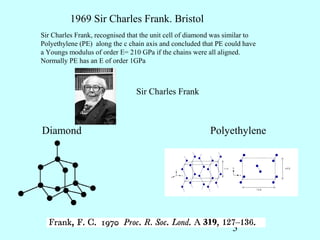
1969 Sir Charles Frank. Bristol
Sir Charles Frank, recognised that the unit cell of diamond was similar to
Polyethylene (PE) along the c chain axis and concluded that PE could have
a Youngs modulus of order E= 210 GPa if the chains were all aligned.
Normally PE has an E of order 1GPa


                                Sir Charles Frank


Diamond                                                   Polyethylene


                                                                  3
1970-1972 Bristol
Frank conjectured the extensional flow component of “Pennings” Taylor vortices caused chain stretching
and proposed the use of “Opposed jets” to induce sufficiently high extensional strain rates to stretch chains.
I, Malcolm Mackley Was the PhD student asked to develop a rig and test the idea.


   Localised chain extension was observed from flow birefringence studies and “Shish Kebab” PE crystals
   formed in an aggregated mass; but with low overall modulus.


             M.R.Mackley and A. Keller. Phil. Trans. Royal Soc. (Lond.) 278, 29 (1975).
                                                                                4
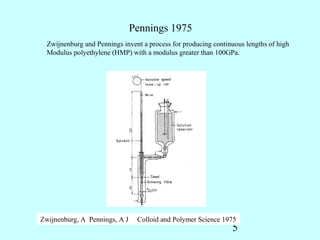
Pennings 1975
  Zwijnenburg and Pennings invent a process for producing continuous lengths of high
  Modulus polyethylene (HMP) with a modulus greater than 100GPa.


Zwijnenburg, A Pennings, A J    Colloid and Polymer Science 1975
                                                                5
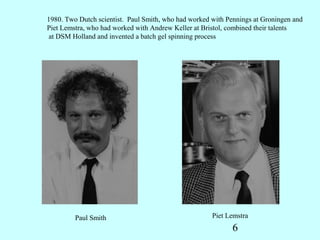
1980. Two Dutch scientist. Paul Smith, who had worked with Pennings at Groningen and
Piet Lemstra, who had worked with Andrew Keller at Bristol, combined their talents
at DSM Holland and invented a batch gel spinning process


         Paul Smith                                   Piet Lemstra
                                                            6
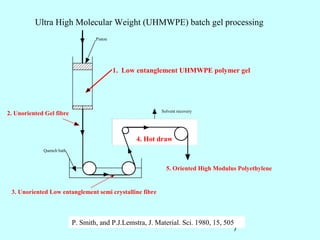
Ultra High Molecular Weight (UHMWPE) batch gel processing
                                   Piston


                                            1. Low entanglement UHMWPE polymer gel


                                                           Solvent recovery
2. Unoriented Gel fibre


                                                  4. Hot draw
             Quench bath


                                                             5. Oriented High Modulus Polyethylene


 3. Unoriented Low entanglement semi crystalline fibre


                           P. Smith, and P.J.Lemstra, J. Material. Sci. 1980, 15, 505
                                                                                    7
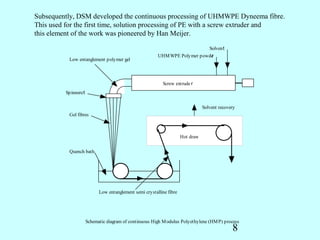
Subsequently, DSM developed the continuous processing of UHMWPE Dyneema fibre.
This used for the first time, solution processing of PE with a screw extruder and
this element of the work was pioneered by Han Meijer.

                                                                            Solvent
                                                                             r
                                                         UHM WPE Polymer powde
           Low entanglement polymer gel


                                                           Screw extrude r
          Spinneret

                                                                                 Solvent recovery
           Gel fibres


                                                                      Hot draw

           Quench bath


                            Low entanglement semi crystalline fibre


                      Schematic diagram of continuous High M odulus Polyethylene (HM P) process
                                                                                               8
Dyneema®, the world’s strongest fiber™


2000. Malcolm Mackley sailing his
National Twelve dinghy “Big Issue”
at Whitstable. Some of the running
rigging was made from Dyneema


                                                    9
Dyneema®, the world’s strongest fiber™


2000. Malcolm Mackley sailing his
National Twelve dinghy “Big Issue”
at Whitstable. Some of the running
rigging was made from Dyneema


                                                    9

High Modulus Polyethylene 2013

  • 1.
    Salcombe Devon 2013 HighModulus Polyethylene (HMP) by Malcolm Mackley 1
  • 2.
    1969. Albert Pennings.Groningen Prof Albert Pennings sends the late Andrew Keller and Sir Charles Frank (University of Bristol) a preprint paper on the way Taylor vortices in Couette flow can induce elongated “shish kebab” crystal fibres of polyethylene from solution. 2
  • 3.
    1969 Sir CharlesFrank. Bristol Sir Charles Frank, recognised that the unit cell of diamond was similar to Polyethylene (PE) along the c chain axis and concluded that PE could have a Youngs modulus of order E= 210 GPa if the chains were all aligned. Normally PE has an E of order 1GPa Sir Charles Frank Diamond Polyethylene 3
  • 4.
    1970-1972 Bristol Frank conjecturedthe extensional flow component of “Pennings” Taylor vortices caused chain stretching and proposed the use of “Opposed jets” to induce sufficiently high extensional strain rates to stretch chains. I, Malcolm Mackley Was the PhD student asked to develop a rig and test the idea. Localised chain extension was observed from flow birefringence studies and “Shish Kebab” PE crystals formed in an aggregated mass; but with low overall modulus. M.R.Mackley and A. Keller. Phil. Trans. Royal Soc. (Lond.) 278, 29 (1975). 4
  • 5.
    Pennings 1975 Zwijnenburg and Pennings invent a process for producing continuous lengths of high Modulus polyethylene (HMP) with a modulus greater than 100GPa. Zwijnenburg, A Pennings, A J Colloid and Polymer Science 1975 5
  • 6.
    1980. Two Dutchscientist. Paul Smith, who had worked with Pennings at Groningen and Piet Lemstra, who had worked with Andrew Keller at Bristol, combined their talents at DSM Holland and invented a batch gel spinning process Paul Smith Piet Lemstra 6
  • 7.
    Ultra High MolecularWeight (UHMWPE) batch gel processing Piston 1. Low entanglement UHMWPE polymer gel Solvent recovery 2. Unoriented Gel fibre 4. Hot draw Quench bath 5. Oriented High Modulus Polyethylene 3. Unoriented Low entanglement semi crystalline fibre P. Smith, and P.J.Lemstra, J. Material. Sci. 1980, 15, 505 7
  • 8.
    Subsequently, DSM developedthe continuous processing of UHMWPE Dyneema fibre. This used for the first time, solution processing of PE with a screw extruder and this element of the work was pioneered by Han Meijer. Solvent r UHM WPE Polymer powde Low entanglement polymer gel Screw extrude r Spinneret Solvent recovery Gel fibres Hot draw Quench bath Low entanglement semi crystalline fibre Schematic diagram of continuous High M odulus Polyethylene (HM P) process 8
  • 9.
    Dyneema®, the world’sstrongest fiber™ 2000. Malcolm Mackley sailing his National Twelve dinghy “Big Issue” at Whitstable. Some of the running rigging was made from Dyneema 9
  • 10.
    Dyneema®, the world’sstrongest fiber™ 2000. Malcolm Mackley sailing his National Twelve dinghy “Big Issue” at Whitstable. Some of the running rigging was made from Dyneema 9