1
Some brilliant Polymer Scientist
and brilliant Polymer Science.
By
Professor Malcolm Mackley
Department of Chemical Engineering and
Biotechnology
University of Cambridge
UK
Nantes September 2011
Red caption additions made in 2021
2
Brilliant Polymer Scientist, 1
1940s
W and H Kuhn
Swiss Physical Chemists
3
1940s, Werner and Hans Kuhn
Werner Kuhn Hans Kuhn
1900 1950 2000 2010
WK HK
4




 d
)
r
b
(
b
d
)
z
,
y
,
x
(
P 2
2
2
/
3
3
R0
a
n links
Root mean square
end to end distance
1/2
0
1/2
2
n
a
R
r 

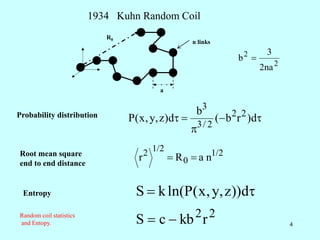
1934 Kuhn Random Coil

 d
))
z
,
y
,
x
(
P
ln(
k
S
2
2
r
kb
c
S 

2
2
na
2
3
b 
Probability distribution
Entropy
Random coil statistics
and Entopy.
5
Rubber Elasticity Kuhn and Treloar 1950s
1

2

3

N crosslinks /unit volume
)
3
(
NkT
2
1
W 2
3
2
2
2
1 







)
3
(
Nk
2
1
S 2
3
2
2
2
1 








S
T
w 



1
d
w 



1
3
2
1 



)
1
(
NkT
2
1
1





Entropy change
Energy change entropic
Incompressible Mechanical work
Constitutive equation
Molecular - Macro
A brilliant example of
linking molecular behaviour
to macroscopic mechanical
Properties.
6
Brilliant Polymer Scientist, 2
1950- 70s
Andrew Keller
Hungarian Physical Chemist
7
Andrew Keller
1900 1950 2000 2010
AK
8
Andrew Keller
• Polymer crystallisation
9
Polyethylene single crystals
Electron microscope photos
of PE solution grown ‘single crystals.
10
1955-1990s Polyethylene solution crystallisation
Andrew Keller was one of the first to conclude. PE polymer chains
‘had’ to be chain folded within crystal.
11
1980 Polyethylene nano and microstructure
Polymer semi crystalline
Spherulites building blocks
are from chain folded
Lamella crystals.
12
Low density polyethylene AFM
AFM micrograph
showing chain
folded lamella crytals
near the surface of a
PE plastic bag.
13
Brilliant Polymer Scientist, 3
1970- 2000s
Pierre de Gennes
French Physicist
14
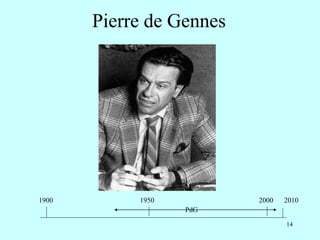
Pierre de Gennes
1900 1950 2000 2010
PdG
15
Pierre de Gennes
• Superconductivity
• Liquid crystals
• Polymers
• Soft Matter
One of France great
20th Century Physicist
16
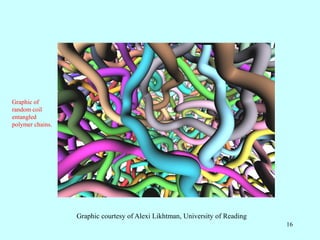
Graphic courtesy of Alexi Likhtman, University of Reading
Graphic of
random coil
entangled
polymer chains.
17
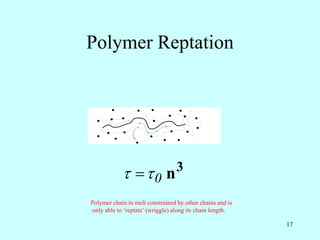
Polymer Reptation
3
n
0

 
Polymer chain in melt constrained by other chains and is
only able to ‘reptate’ (wriggle) along its chain length.
18
Linear viscoelasticty of polymer melt
1
10
100
1000
10000
100000
0.001 0.01 0.1 1 10
i (s)
g
i
(Pa)
Linear viscoelastic behaviour of polymer melts
can be modelled using a spectrum of relaxation times.
19
Multimode Pom-Pom model
Viscoelastic stress:
Backbone orientation:
Stretch:
Time scales:
1988 McLeish and Larson
McLeish, TCB Larson, RC J. Rheol. 42, 1 81-110 (1998)
20
dP = 3.96 bar
dP = 3.76 bar
Vp = 0.44 mms-1
3D simulation Experiment
3D EUsolve
Polystyrene (PS2)
10mm depth
LHS Pom Pom
RHS Experiment
Numerical simulation
can predict flow
birefringence
stress distributions
of flowing polymer melts.
21
Brilliant Polymer Scientist, 4
1950- 1980s
Sir Charles Frank
English Physicist
1900 1950 2000 2010
FCF
22
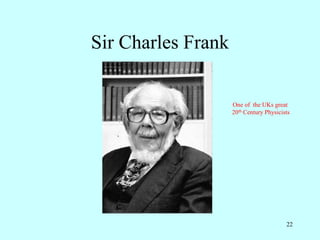
Sir Charles Frank
One of the UKs great
20th Century Physicists
23
Sir Charles Frank
• Dislocations; Frank-Read source
• Liquid crystals; Frank elasticity
• “Meson catalysed Cold fusion”
• Polymer crystallisation
• High modulus polyethylene
24
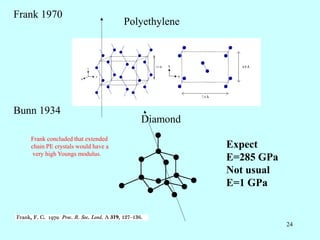
Polyethylene
Diamond
Expect
E=285 GPa
Not usual
E=1 GPa
Frank 1970
Bunn 1934
Frank concluded that extended
chain PE crystals would have a
very high Youngs modulus.
25
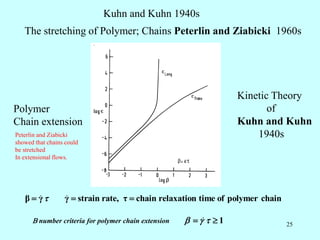
The stretching of Polymer; Chains Peterlin and Ziabicki 1960s
Polymer
Chain extension
chain
polymer
of
time
relaxation
chain
τ
rate,
strain
γ
γ
β 

 
 
B number criteria for polymer chain extension 1

 

 
Kinetic Theory
of
Kuhn and Kuhn
1940s
Kuhn and Kuhn 1940s
Peterlin and Ziabicki
showed that chains could
be stretched
In extensional flows.
26
Chain extension with opposed jets
B number criteria for chain extension 1

 

 
Frank proposed twin jets
To achieved high extensional
Strain rates.
27
Localized Flow Birefringence of Polyethylene Oxide Solutions in a
Four Roll Mill 1974
Crowley et al. Journal of Polymer Science: Vol 14 1111-1119 (1976)
Localised chain extension
in extensional flows was a
surprise finding.
28
x0 ,y0
x1 , y1
Chain extension in
solution requires both
high extensional
strain rates and high
strains.
29
1

 

 
0
t 
 

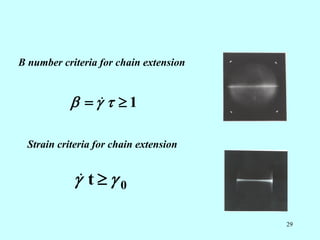
B number criteria for chain extension
Strain criteria for chain extension
30
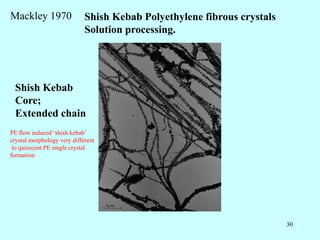
Shish Kebab
Core;
Extended chain
Shish Kebab Polyethylene fibrous crystals
Solution processing.
Mackley 1970
PE flow induced ‘shish kebab’
crystal morphology very different
to quiescent PE single crystal
formation
31
Brilliant Polymer Scientists, 5
1980s
Piet Lemstra and Paul Smith
Dutch Polymer Scientists
Smith and Lemstra took up the ‘Frank’ challenge to produce
High Modulus Polyethylene.
32
Paul Smith.
Now ETH
Piet Lemstra
Now TU Eindhoven
Smith and Lemstra 1980
1900 1950 2000 2010
33
P. Smith, and P.J.Lemstra, J. Material. Sci. 1980, 15, 505
1. Low entanglement UHMWPE polymer gel
2. Unoriented Gel fibre
Quench bath
3. Unoriented Low entanglement semi crystalline fibre
4. Hot draw
5. Oriented High Modulus Polyethylene
Solvent recovery
Piston
Low entanglement,Gel Drawing
Simple, but effective batch
process to produce HMP,
High Modulus Polyethylene.
34
Continuous processing of UHMWPE Dyneema
Screw extruder
UHMWPE Polymer powder Solvent
Low entanglement polymer gel
Spinneret
Gel fibres
Quench bath
Low entanglement semi crystalline fibre
Hot draw
Solvent recovery
High Modulus
Polyethylene
Smith and Lemstra J Mat Sci 1980
Simple and commercially viable
route to continuous processing of
HMP that was developed by DSM
35
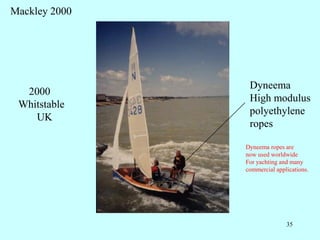
2000
Whitstable
UK
Mackley 2000
Dyneema
High modulus
polyethylene
ropes
Dyneema ropes are
now used worldwide
For yachting and many
commercial applications.
36
Common Factors
• Intelligence
• Genuine interest, motivation
• Physical and Scientific insight
• Appreciation of both experimental and
theoretical aspects
• Something special
37
The 20th Century was a ‘Golden Age’ for Synthetic Polymers.
• Polymers and plastics were discovered.
• Plastics possessed unique and low energy cost materials with many different applications.
• The science of polymers and plastics steadily advanced in the 20th Century influencing
the worlds understanding of biopolymers and plastics applications.
The 21st Century has seen a ‘Reality Check’ on plastics.
• Plastic pollution, inappropriate and over use, lack of recycling, global warming have all contributed
(with justification) to plastics in particular being cast as villains.
• 21st century Plastic recycling and reuse can be properly addressed (in a similar way to paper, glass
and metal was in the 20th century).
• If used and recycled in a correct way, plastics can remain ‘fantastic’ as there are still many situations
where plastics continue to offer life enhancing applications that are superior to other materials and
are not damaging to the global ecosystem.

Nantes brilliant sci-2011 (v2)

  • 1.
    1 Some brilliant PolymerScientist and brilliant Polymer Science. By Professor Malcolm Mackley Department of Chemical Engineering and Biotechnology University of Cambridge UK Nantes September 2011 Red caption additions made in 2021
  • 2.
    2 Brilliant Polymer Scientist,1 1940s W and H Kuhn Swiss Physical Chemists
  • 3.
    3 1940s, Werner andHans Kuhn Werner Kuhn Hans Kuhn 1900 1950 2000 2010 WK HK
  • 4.
    4      d ) r b ( b d ) z , y , x ( P 2 2 2 / 3 3 R0 a nlinks Root mean square end to end distance 1/2 0 1/2 2 n a R r   1934 Kuhn Random Coil   d )) z , y , x ( P ln( k S 2 2 r kb c S   2 2 na 2 3 b  Probability distribution Entropy Random coil statistics and Entopy.
  • 5.
    5 Rubber Elasticity Kuhnand Treloar 1950s 1  2  3  N crosslinks /unit volume ) 3 ( NkT 2 1 W 2 3 2 2 2 1         ) 3 ( Nk 2 1 S 2 3 2 2 2 1          S T w     1 d w     1 3 2 1     ) 1 ( NkT 2 1 1      Entropy change Energy change entropic Incompressible Mechanical work Constitutive equation Molecular - Macro A brilliant example of linking molecular behaviour to macroscopic mechanical Properties.
  • 6.
    6 Brilliant Polymer Scientist,2 1950- 70s Andrew Keller Hungarian Physical Chemist
  • 7.
  • 8.
  • 9.
    9 Polyethylene single crystals Electronmicroscope photos of PE solution grown ‘single crystals.
  • 10.
    10 1955-1990s Polyethylene solutioncrystallisation Andrew Keller was one of the first to conclude. PE polymer chains ‘had’ to be chain folded within crystal.
  • 11.
    11 1980 Polyethylene nanoand microstructure Polymer semi crystalline Spherulites building blocks are from chain folded Lamella crystals.
  • 12.
    12 Low density polyethyleneAFM AFM micrograph showing chain folded lamella crytals near the surface of a PE plastic bag.
  • 13.
    13 Brilliant Polymer Scientist,3 1970- 2000s Pierre de Gennes French Physicist
  • 14.
    14 Pierre de Gennes 19001950 2000 2010 PdG
  • 15.
    15 Pierre de Gennes •Superconductivity • Liquid crystals • Polymers • Soft Matter One of France great 20th Century Physicist
  • 16.
    16 Graphic courtesy ofAlexi Likhtman, University of Reading Graphic of random coil entangled polymer chains.
  • 17.
    17 Polymer Reptation 3 n 0    Polymerchain in melt constrained by other chains and is only able to ‘reptate’ (wriggle) along its chain length.
  • 18.
    18 Linear viscoelasticty ofpolymer melt 1 10 100 1000 10000 100000 0.001 0.01 0.1 1 10 i (s) g i (Pa) Linear viscoelastic behaviour of polymer melts can be modelled using a spectrum of relaxation times.
  • 19.
    19 Multimode Pom-Pom model Viscoelasticstress: Backbone orientation: Stretch: Time scales: 1988 McLeish and Larson McLeish, TCB Larson, RC J. Rheol. 42, 1 81-110 (1998)
  • 20.
    20 dP = 3.96bar dP = 3.76 bar Vp = 0.44 mms-1 3D simulation Experiment 3D EUsolve Polystyrene (PS2) 10mm depth LHS Pom Pom RHS Experiment Numerical simulation can predict flow birefringence stress distributions of flowing polymer melts.
  • 21.
    21 Brilliant Polymer Scientist,4 1950- 1980s Sir Charles Frank English Physicist 1900 1950 2000 2010 FCF
  • 22.
    22 Sir Charles Frank Oneof the UKs great 20th Century Physicists
  • 23.
    23 Sir Charles Frank •Dislocations; Frank-Read source • Liquid crystals; Frank elasticity • “Meson catalysed Cold fusion” • Polymer crystallisation • High modulus polyethylene
  • 24.
    24 Polyethylene Diamond Expect E=285 GPa Not usual E=1GPa Frank 1970 Bunn 1934 Frank concluded that extended chain PE crystals would have a very high Youngs modulus.
  • 25.
    25 The stretching ofPolymer; Chains Peterlin and Ziabicki 1960s Polymer Chain extension chain polymer of time relaxation chain τ rate, strain γ γ β       B number criteria for polymer chain extension 1       Kinetic Theory of Kuhn and Kuhn 1940s Kuhn and Kuhn 1940s Peterlin and Ziabicki showed that chains could be stretched In extensional flows.
  • 26.
    26 Chain extension withopposed jets B number criteria for chain extension 1       Frank proposed twin jets To achieved high extensional Strain rates.
  • 27.
    27 Localized Flow Birefringenceof Polyethylene Oxide Solutions in a Four Roll Mill 1974 Crowley et al. Journal of Polymer Science: Vol 14 1111-1119 (1976) Localised chain extension in extensional flows was a surprise finding.
  • 28.
    28 x0 ,y0 x1 ,y1 Chain extension in solution requires both high extensional strain rates and high strains.
  • 29.
    29 1       0 t    B number criteria for chain extension Strain criteria for chain extension
  • 30.
    30 Shish Kebab Core; Extended chain ShishKebab Polyethylene fibrous crystals Solution processing. Mackley 1970 PE flow induced ‘shish kebab’ crystal morphology very different to quiescent PE single crystal formation
  • 31.
    31 Brilliant Polymer Scientists,5 1980s Piet Lemstra and Paul Smith Dutch Polymer Scientists Smith and Lemstra took up the ‘Frank’ challenge to produce High Modulus Polyethylene.
  • 32.
    32 Paul Smith. Now ETH PietLemstra Now TU Eindhoven Smith and Lemstra 1980 1900 1950 2000 2010
  • 33.
    33 P. Smith, andP.J.Lemstra, J. Material. Sci. 1980, 15, 505 1. Low entanglement UHMWPE polymer gel 2. Unoriented Gel fibre Quench bath 3. Unoriented Low entanglement semi crystalline fibre 4. Hot draw 5. Oriented High Modulus Polyethylene Solvent recovery Piston Low entanglement,Gel Drawing Simple, but effective batch process to produce HMP, High Modulus Polyethylene.
  • 34.
    34 Continuous processing ofUHMWPE Dyneema Screw extruder UHMWPE Polymer powder Solvent Low entanglement polymer gel Spinneret Gel fibres Quench bath Low entanglement semi crystalline fibre Hot draw Solvent recovery High Modulus Polyethylene Smith and Lemstra J Mat Sci 1980 Simple and commercially viable route to continuous processing of HMP that was developed by DSM
  • 35.
    35 2000 Whitstable UK Mackley 2000 Dyneema High modulus polyethylene ropes Dyneemaropes are now used worldwide For yachting and many commercial applications.
  • 36.
    36 Common Factors • Intelligence •Genuine interest, motivation • Physical and Scientific insight • Appreciation of both experimental and theoretical aspects • Something special
  • 37.
    37 The 20th Centurywas a ‘Golden Age’ for Synthetic Polymers. • Polymers and plastics were discovered. • Plastics possessed unique and low energy cost materials with many different applications. • The science of polymers and plastics steadily advanced in the 20th Century influencing the worlds understanding of biopolymers and plastics applications. The 21st Century has seen a ‘Reality Check’ on plastics. • Plastic pollution, inappropriate and over use, lack of recycling, global warming have all contributed (with justification) to plastics in particular being cast as villains. • 21st century Plastic recycling and reuse can be properly addressed (in a similar way to paper, glass and metal was in the 20th century). • If used and recycled in a correct way, plastics can remain ‘fantastic’ as there are still many situations where plastics continue to offer life enhancing applications that are superior to other materials and are not damaging to the global ecosystem.