1
DESIGN OF MINI-FLUIDIC REACTOR FOR
EXTRACTION OF EPA/DHA FROM FISH
OIL
Kirubanandan Shanmugam
MASc in Chemical Engineering
Presented on 17th ISME Conference on Advances in Mechanical Engineering,
3-4th Oct 2015, Indian Institute of Technology, Delhi, India.
Dr. Adam. A. Donaldson
Supervisor
Contents
2
1. Introduction
2. Objective
3. EPA/DHA Yields
4. Hydrodynamics
5. Conclusion and Discussion
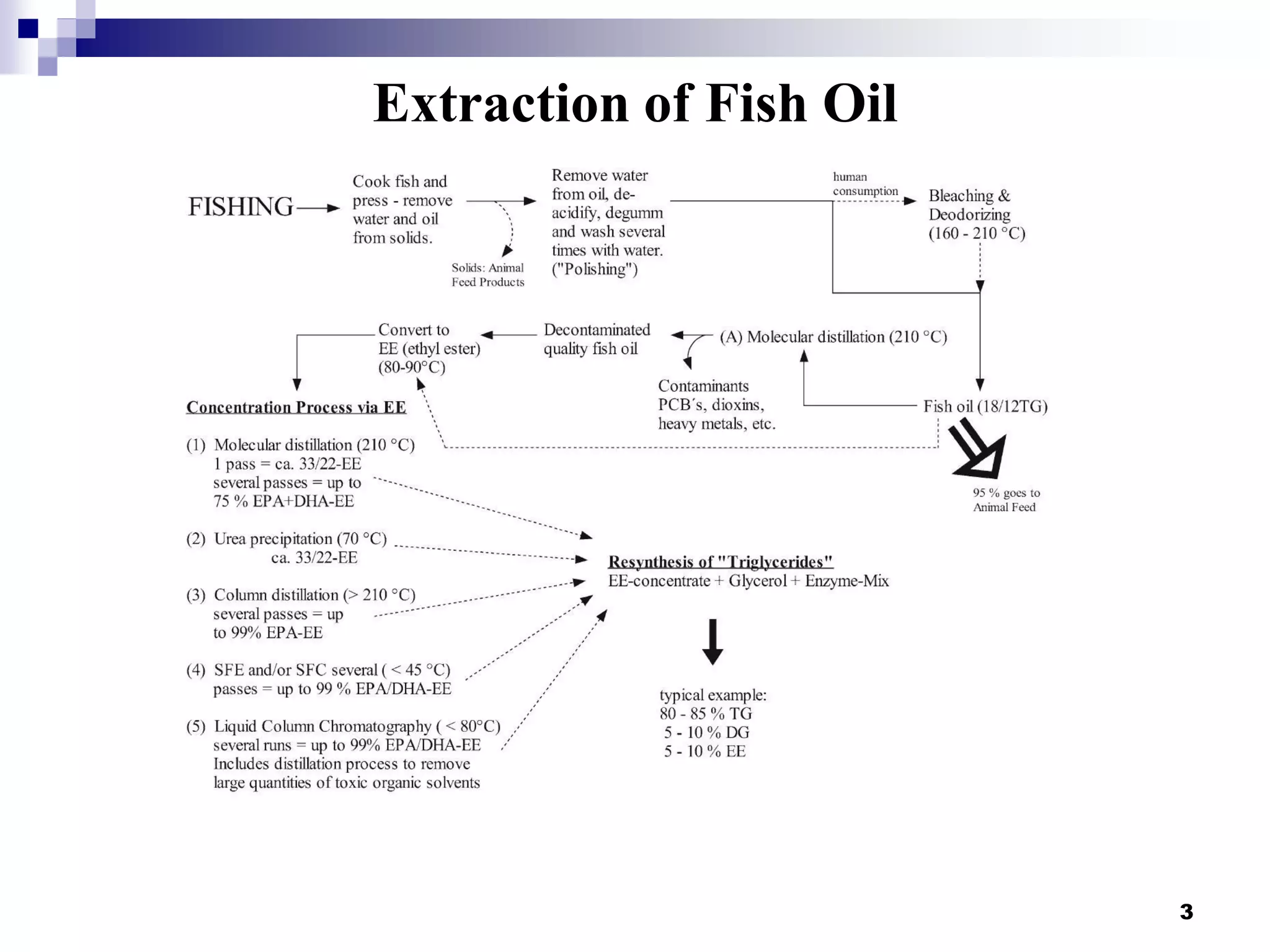
Extraction of Fish Oil
3
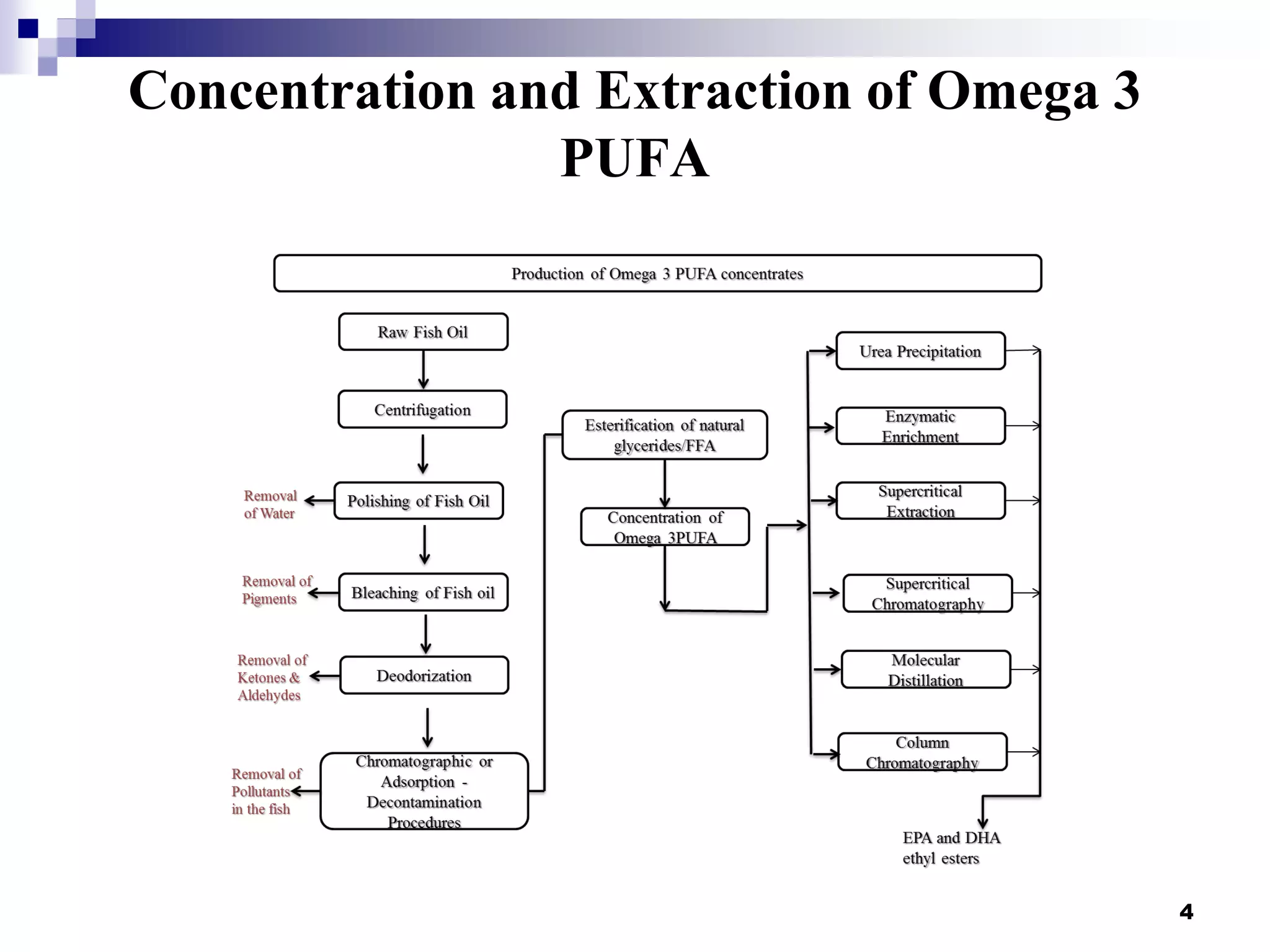
Concentration and Extraction of Omega 3
PUFA
4
Introduction
5
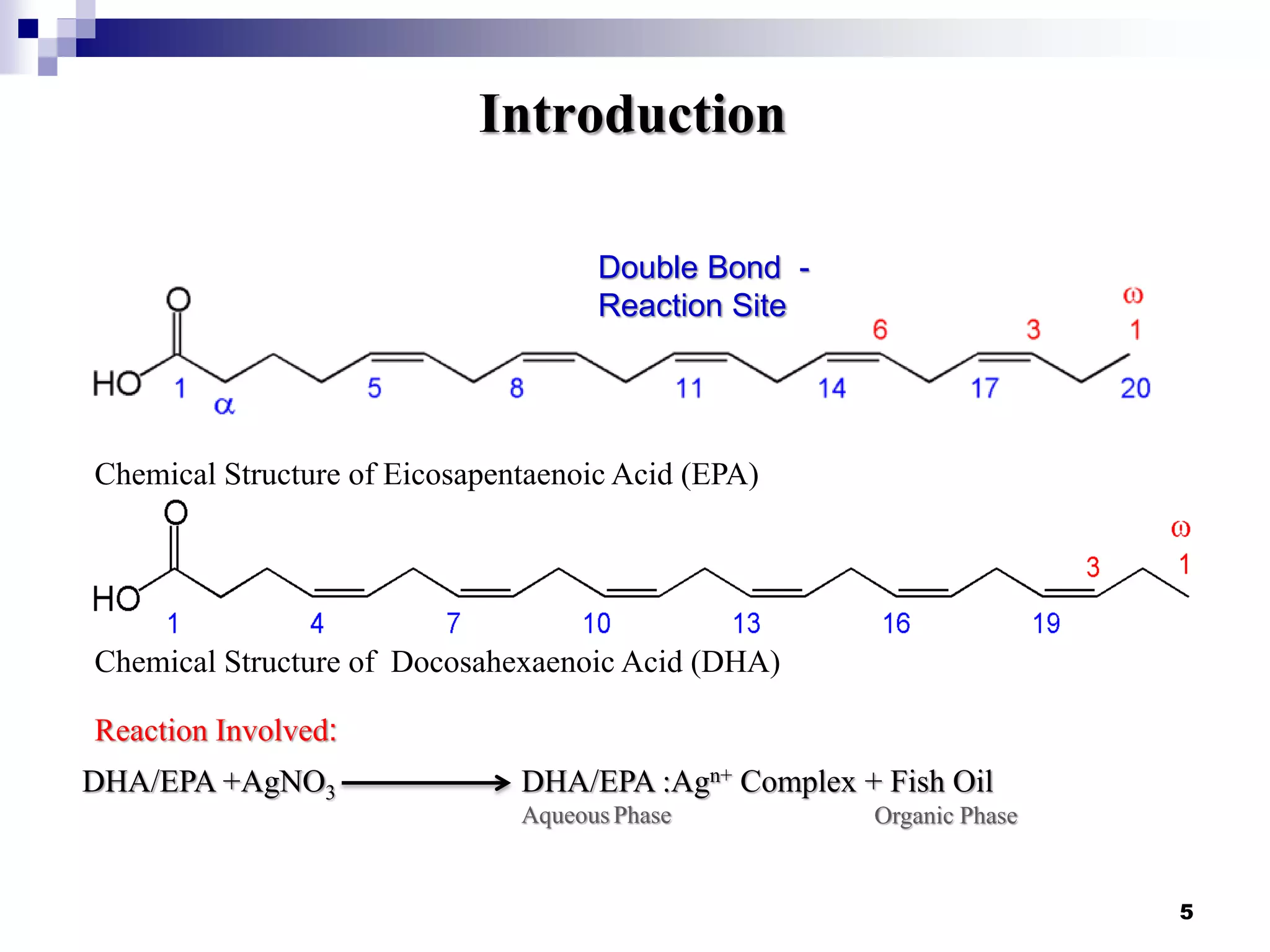
Chemical Structure of Eicosapentaenoic Acid (EPA)
Chemical Structure of Docosahexaenoic Acid (DHA)
Double Bond -
Reaction Site
Reaction Involved:
DHA/EPA +AgNO3 DHA/EPA :Agn+ Complex + Fish Oil
Aqueous Phase Organic Phase
6
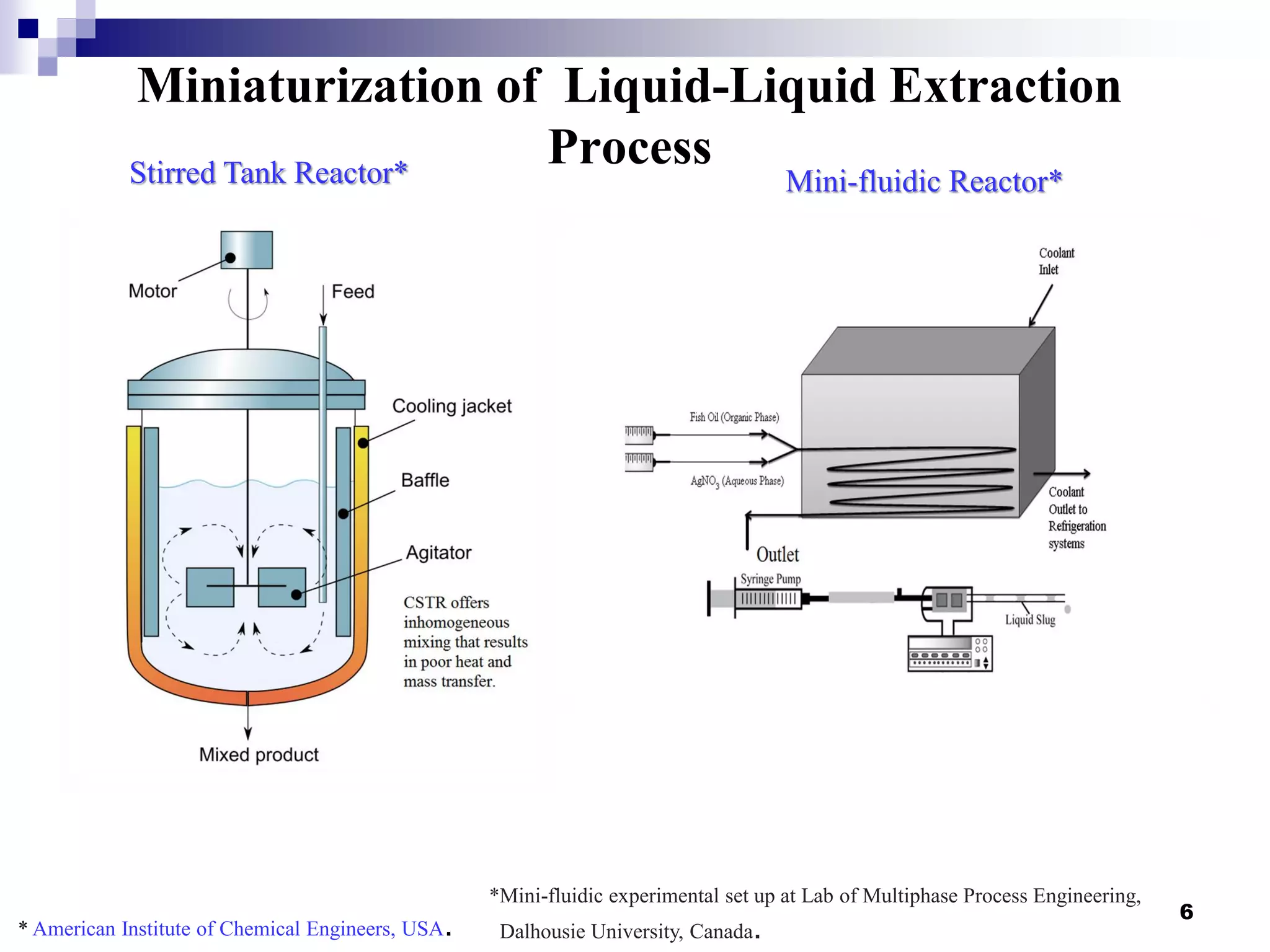
Miniaturization of Liquid-Liquid Extraction
Process
* American Institute of Chemical Engineers, USA.
Stirred Tank Reactor* Mini-fluidic Reactor*
*Mini-fluidic experimental set up at Lab of Multiphase Process Engineering,
Dalhousie University, Canada.
Research Objective
7
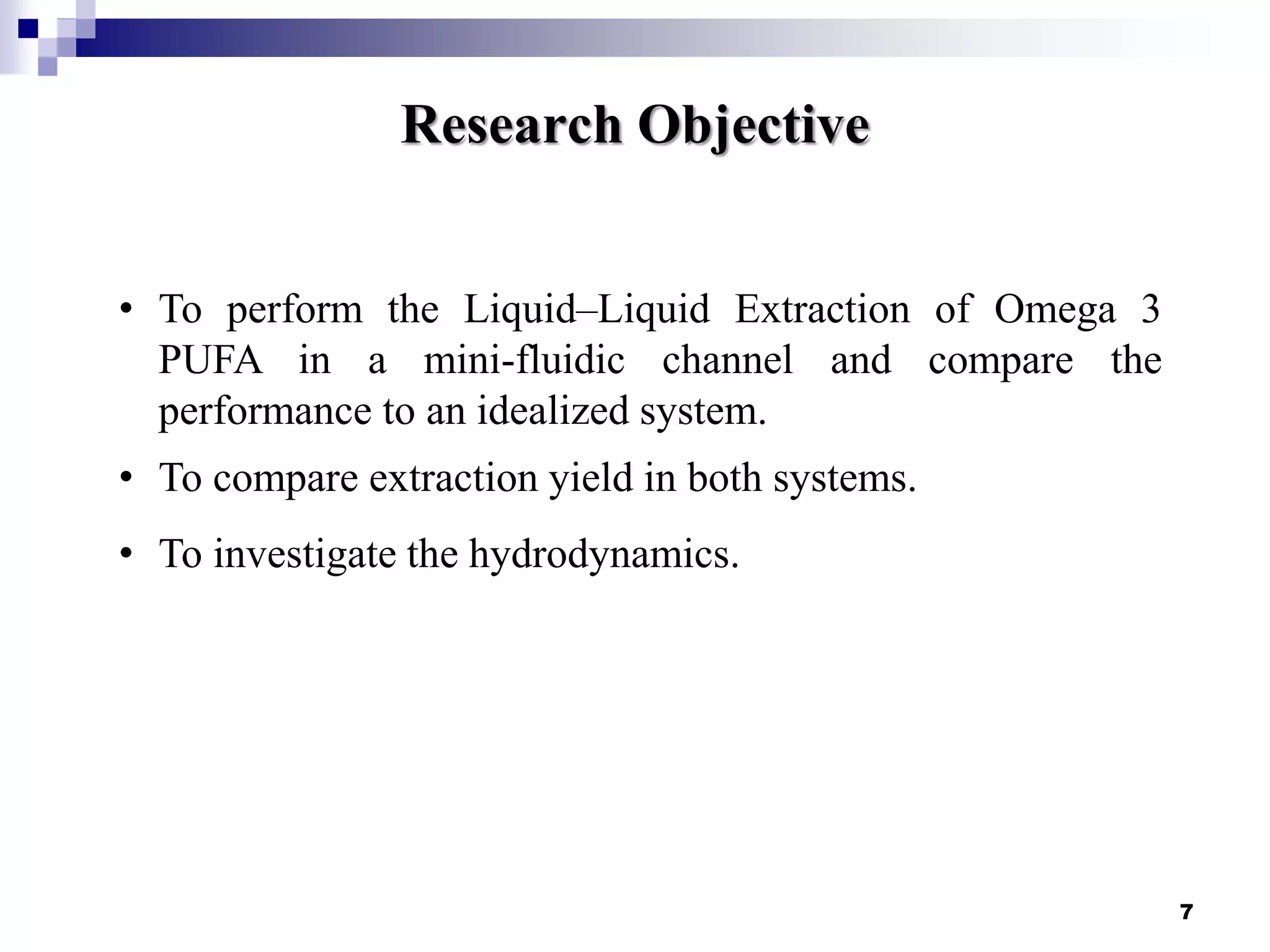
• To perform the Liquid–Liquid Extraction of Omega 3
PUFA in a mini-fluidic channel and compare the
performance to an idealized system.
• To compare extraction yield in both systems.
• To investigate the hydrodynamics.
8
Experimental Method
Process
Inputs
Contacting
Collecting
Settling
Raw
Extract
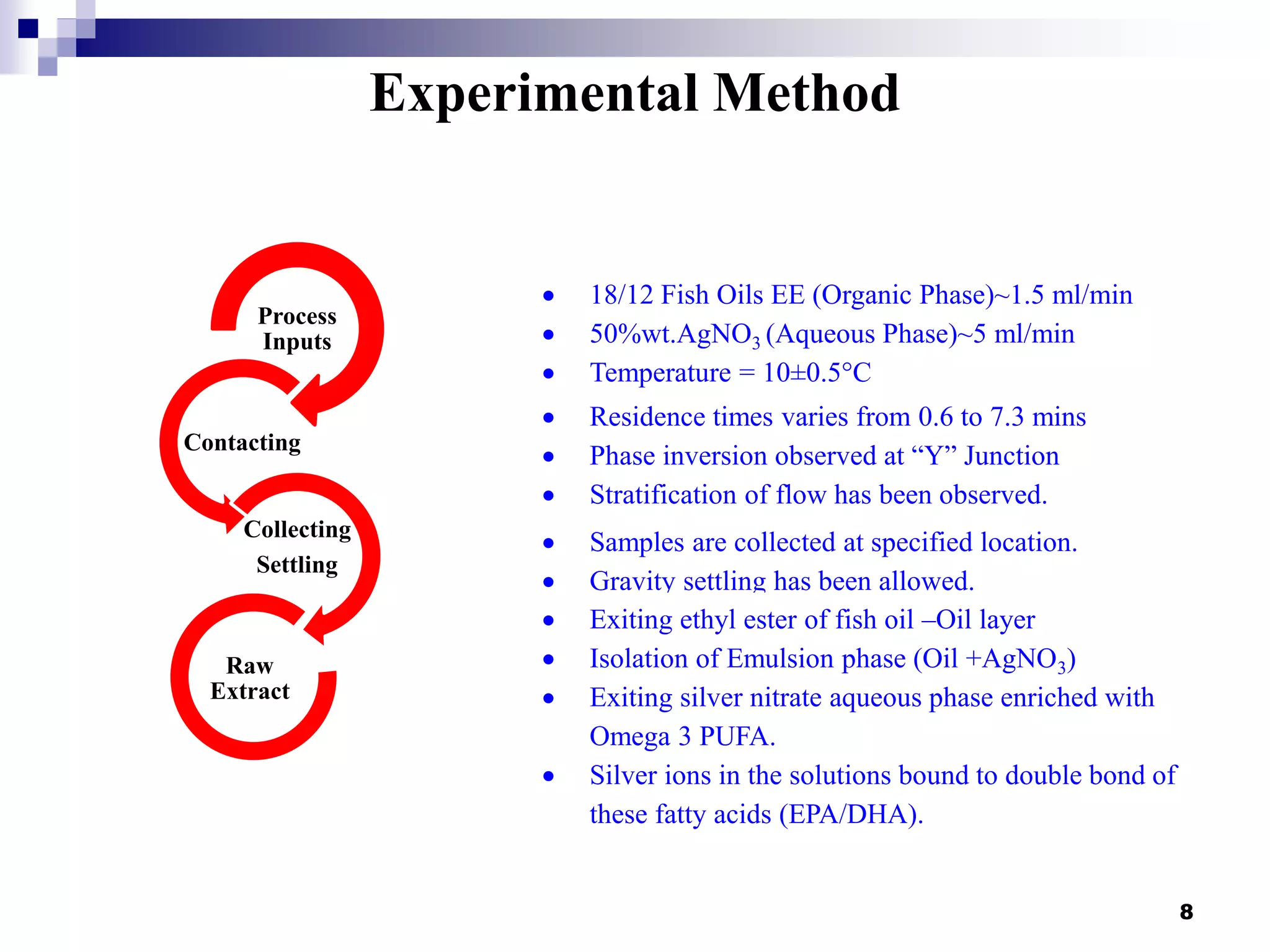
 18/12 Fish Oils EE (Organic Phase)~1.5 ml/min
 50%wt.AgNO3 (Aqueous Phase)~5 ml/min
 Temperature = 10±0.5°C
 Residence times varies from 0.6 to 7.3 mins
 Phase inversion observed at “Y” Junction
 Stratification of flow has been observed.
 Samples are collected at specified location.
 Gravity settling has been allowed.
 Exiting ethyl ester of fish oil –Oil layer
 Isolation of Emulsion phase (Oil +AgNO3)
 Exiting silver nitrate aqueous phase enriched with
Omega 3 PUFA.
 Silver ions in the solutions bound to double bond of
these fatty acids (EPA/DHA).
9
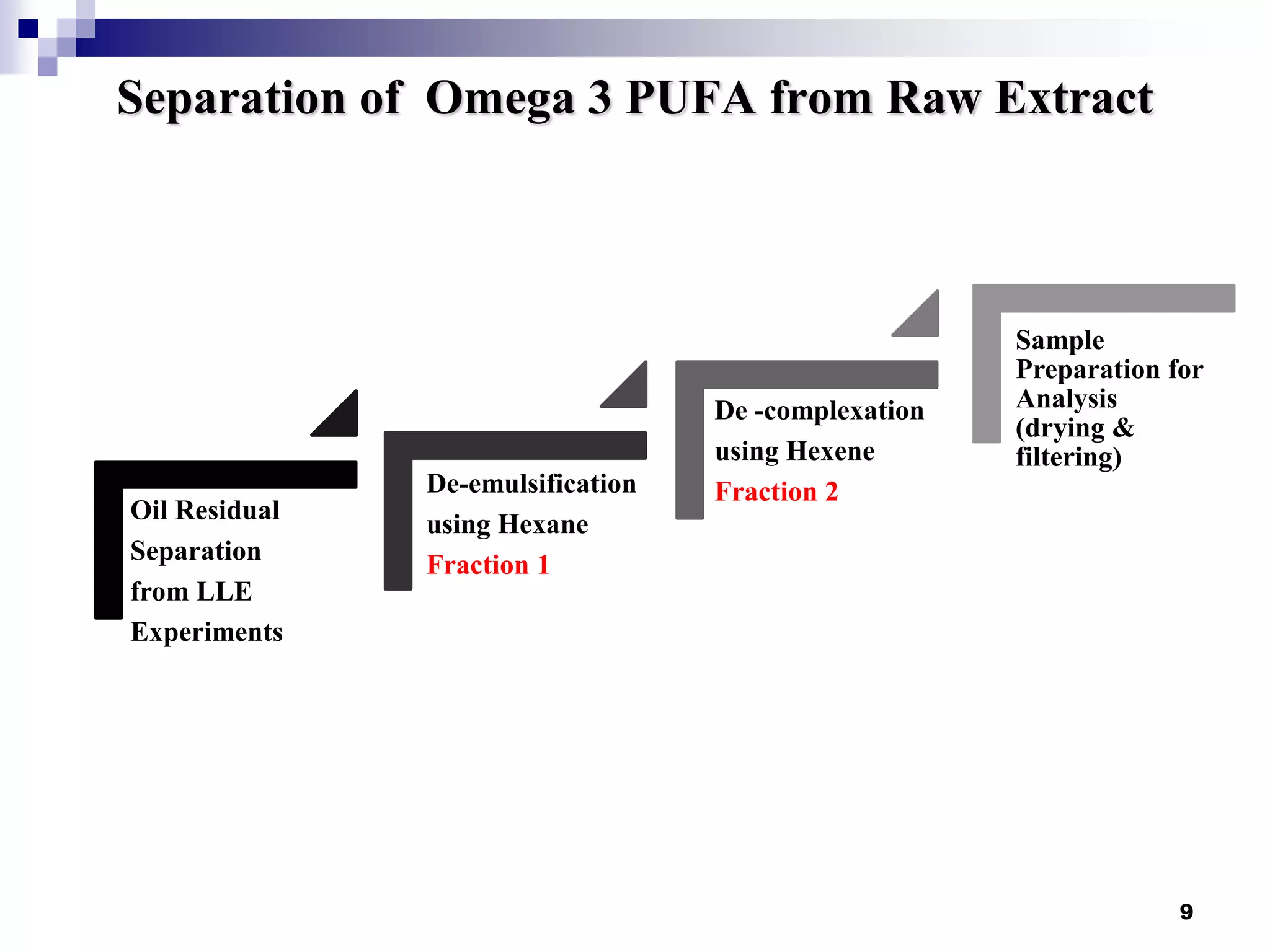
Separation of Omega 3 PUFA from Raw Extract
Oil Residual
Separation
from LLE
Experiments
De-emulsification
using Hexane
Fraction 1
De -complexation
using Hexene
Fraction 2
Sample
Preparation for
Analysis
(drying &
filtering)
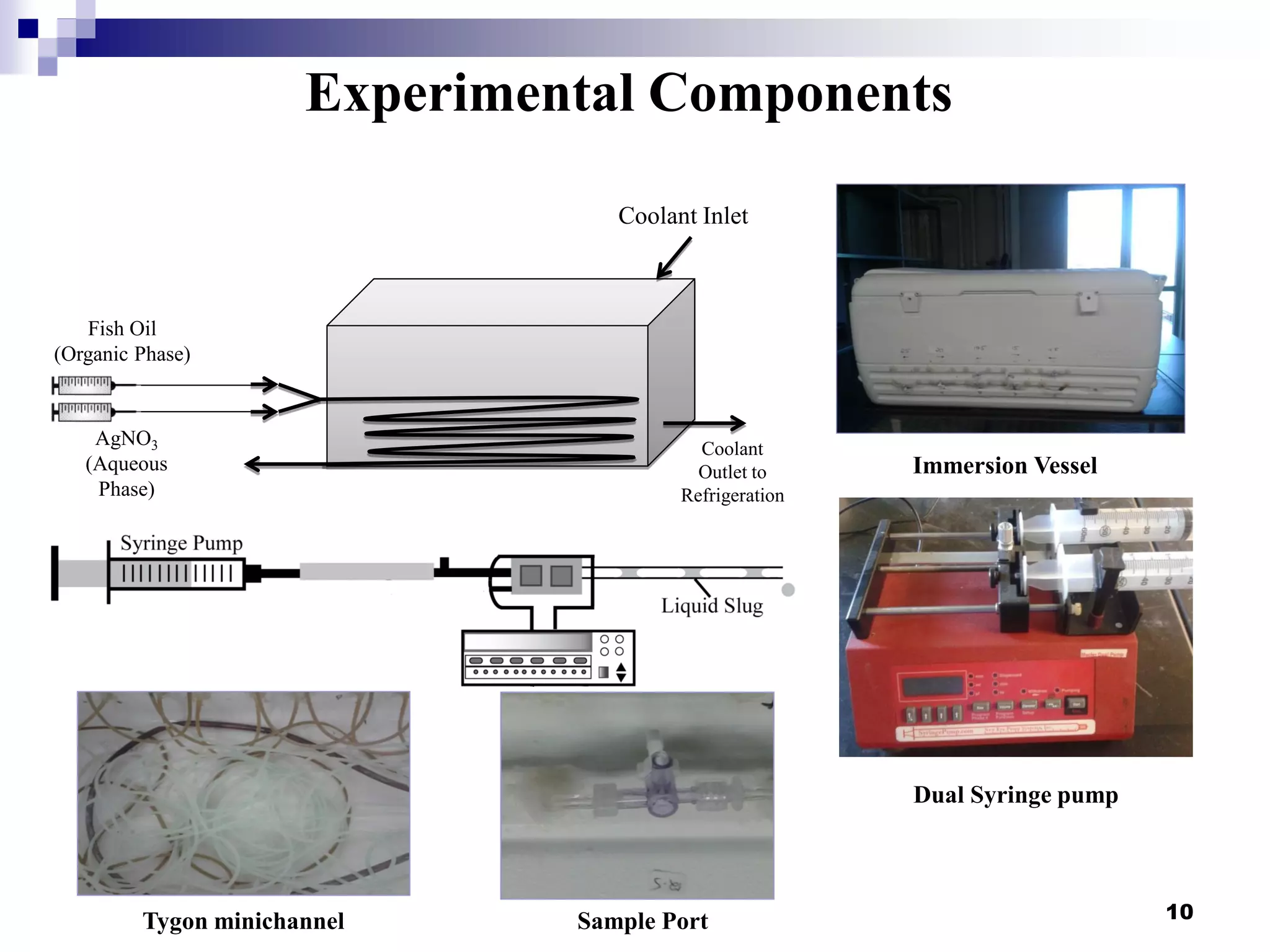
Experimental Components
10
Fish Oil
(Organic Phase)
AgNO3
(Aqueous
Phase)
Coolant Inlet
Coolant
Outlet to
Refrigeration
Dual Syringe pump
Immersion Vessel
Sample PortTygon minichannel
Mini-fluidic Reactor Batch Reactor
tResidence
(mins)
EPA–
Et
Wt.%
DHA–
Et Wt.
%
Ώ 3
Wt.
%
tReaction
(mins)
EPA–
Et
Wt.%
DHA–
Et Wt.
%
Ώ 3
Wt.%
0.6 42.3 30.5 81.3 15 41.5 27.1 81.8
1.2 39.8 29.0 77.5 30 41.6 27.0 81.9
2.4 40.4 29.2 78.5 60 39.8 25.9 78.9
4.8 37.9 26.8 73.7 90 42.0 27.4 82.5
7.3 40.3 27.8 78.5 120 40.1 26.6 78.7 11
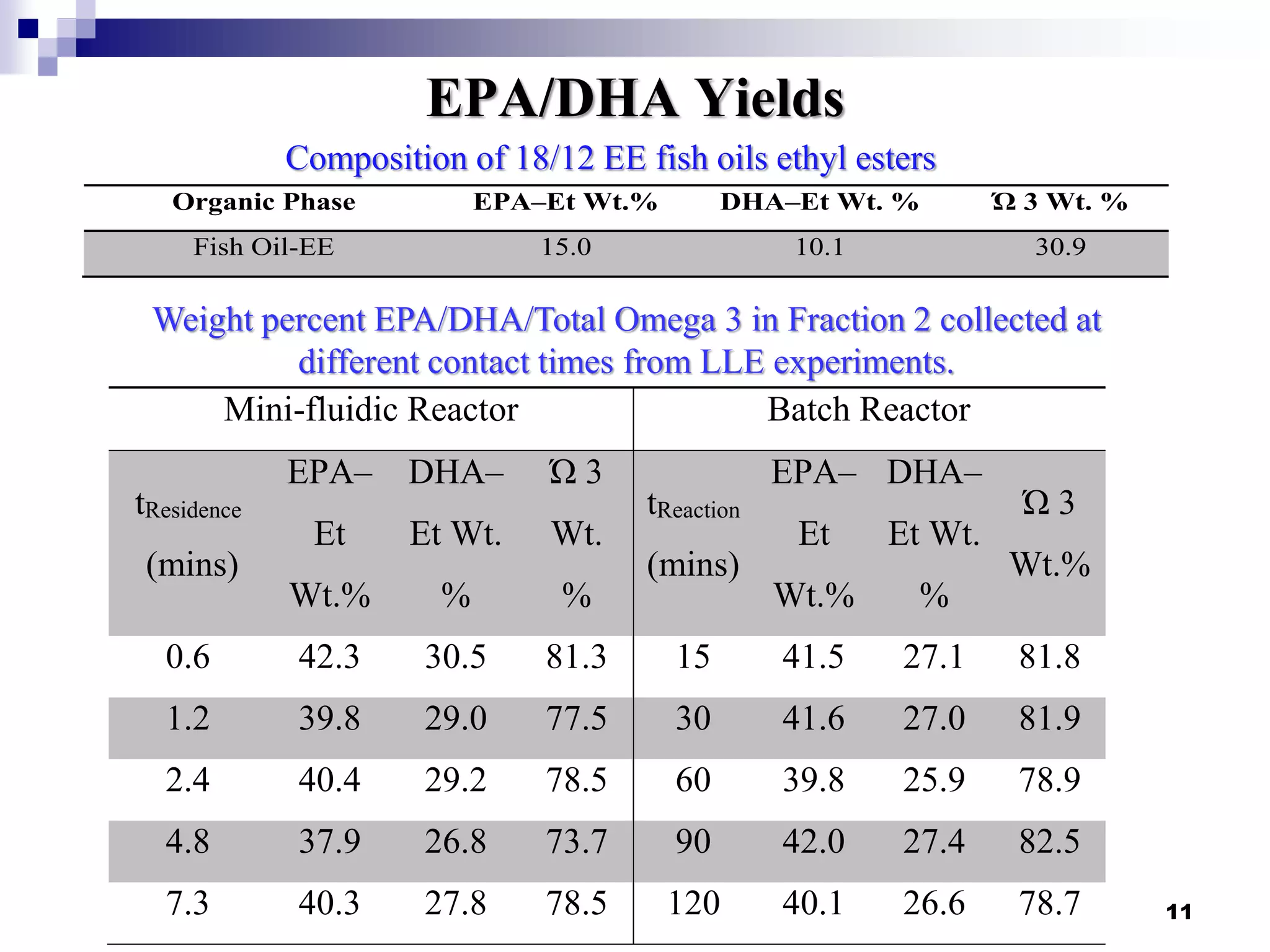
EPA/DHA Yields
Composition of 18/12 EE fish oils ethyl esters
Organic Phase EPA–Et Wt.% DHA–Et Wt. % Ώ 3 Wt. %
Fish Oil-EE 15.0 10.1 30.9
Weight percent EPA/DHA/Total Omega 3 in Fraction 2 collected at
different contact times from LLE experiments.
12
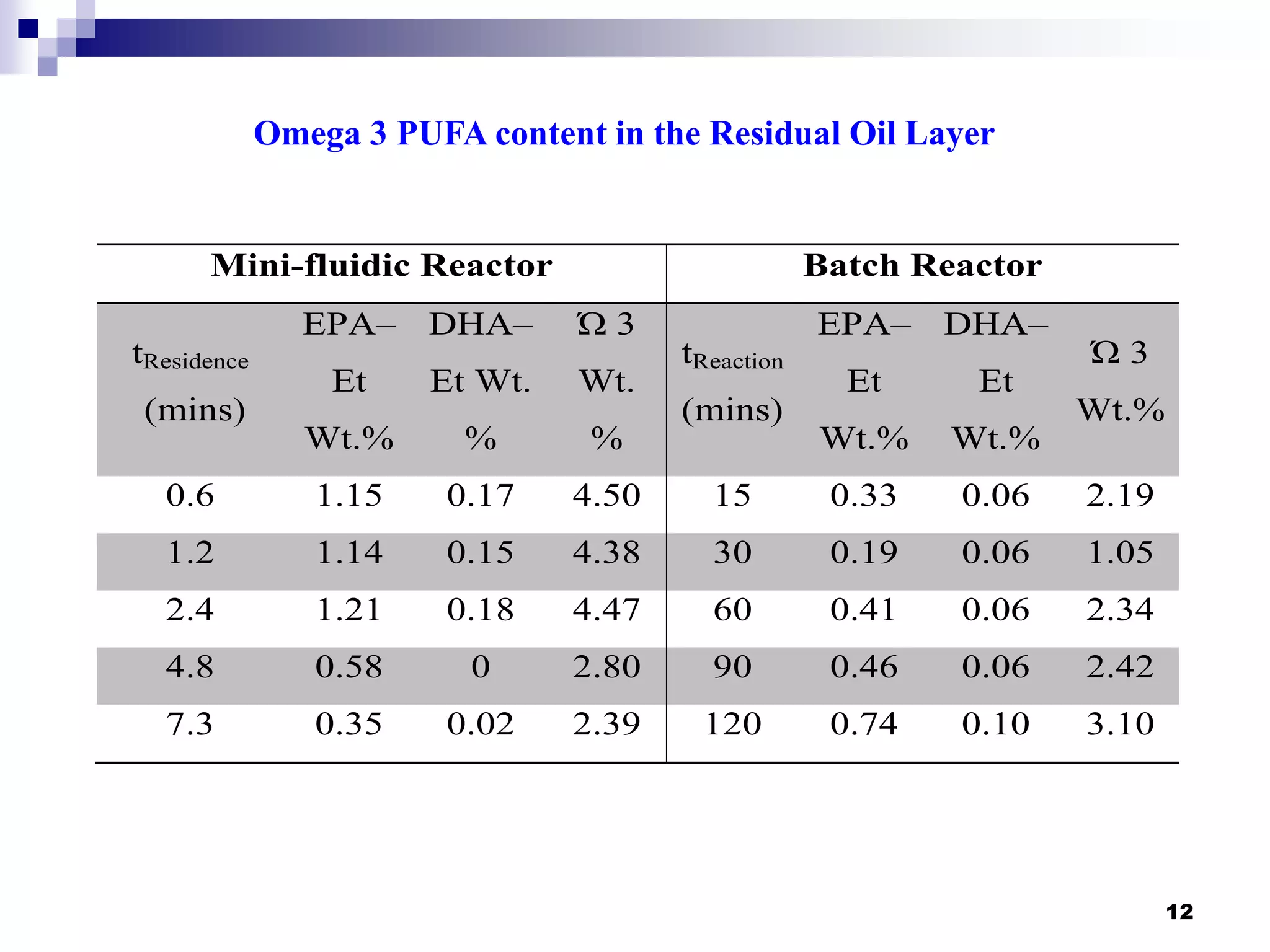
Omega 3 PUFA content in the Residual Oil Layer
Mini-fluidic Reactor Batch Reactor
tResidence
(mins)
EPA–
Et
Wt.%
DHA–
Et Wt.
%
Ώ 3
Wt.
%
tReaction
(mins)
EPA–
Et
Wt.%
DHA–
Et
Wt.%
Ώ 3
Wt.%
0.6 1.15 0.17 4.50 15 0.33 0.06 2.19
1.2 1.14 0.15 4.38 30 0.19 0.06 1.05
2.4 1.21 0.18 4.47 60 0.41 0.06 2.34
4.8 0.58 0 2.80 90 0.46 0.06 2.42
7.3 0.35 0.02 2.39 120 0.74 0.10 3.10
13
Mini-fluidic Reactor Batch Reactor
tResidence
(mins)
EPA–
Et
Wt.%
DHA–
Et Wt.
%
Ώ 3
Wt.
%
tReaction
(mins)
EPA–
Et
Wt.%
DHA–
Et Wt.
%
Ώ 3
Wt.
%
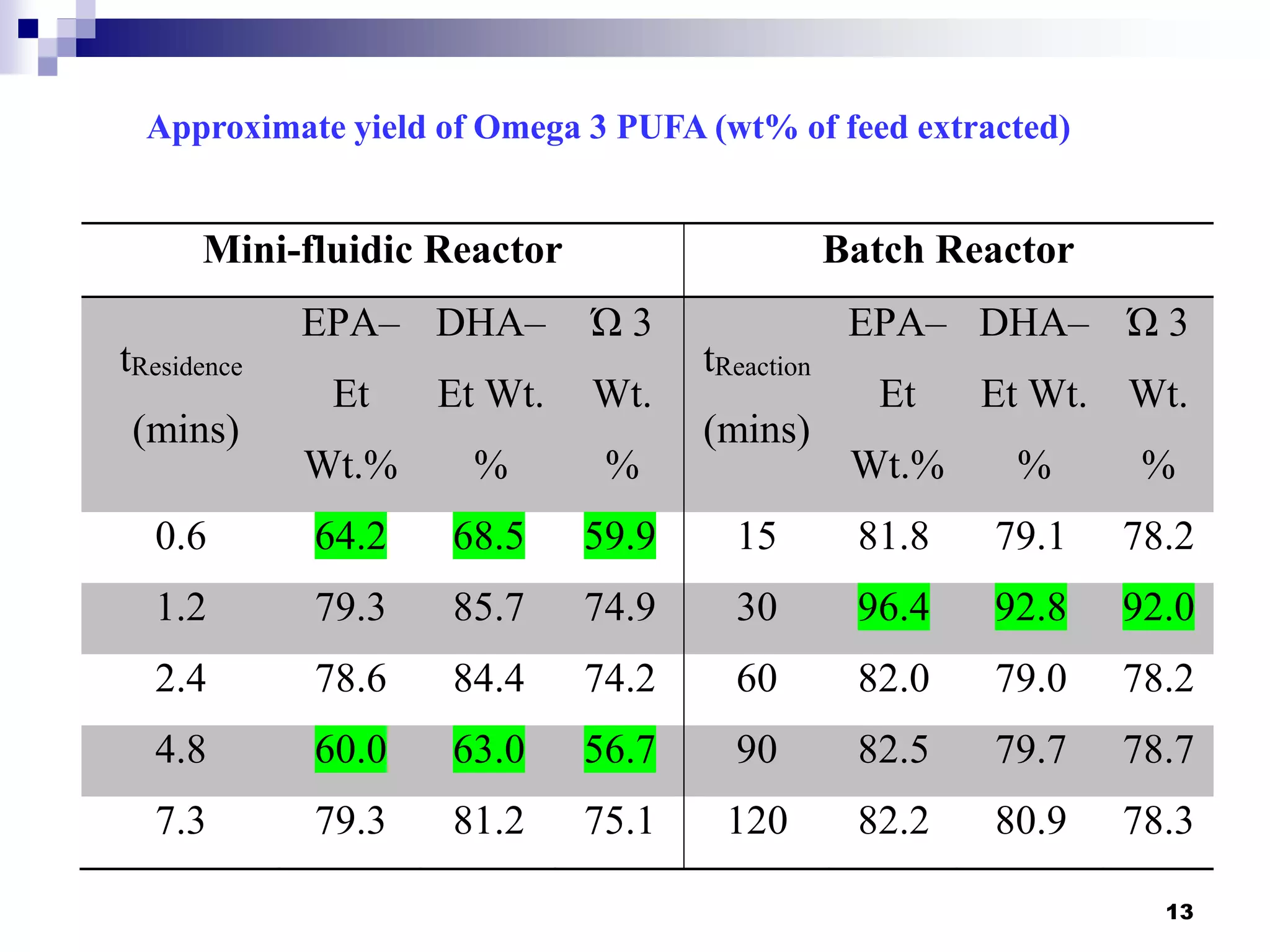
0.6 64.2 68.5 59.9 15 81.8 79.1 78.2
1.2 79.3 85.7 74.9 30 96.4 92.8 92.0
2.4 78.6 84.4 74.2 60 82.0 79.0 78.2
4.8 60.0 63.0 56.7 90 82.5 79.7 78.7
7.3 79.3 81.2 75.1 120 82.2 80.9 78.3
Approximate yield of Omega 3 PUFA (wt% of feed extracted)
Reported Results from Literature
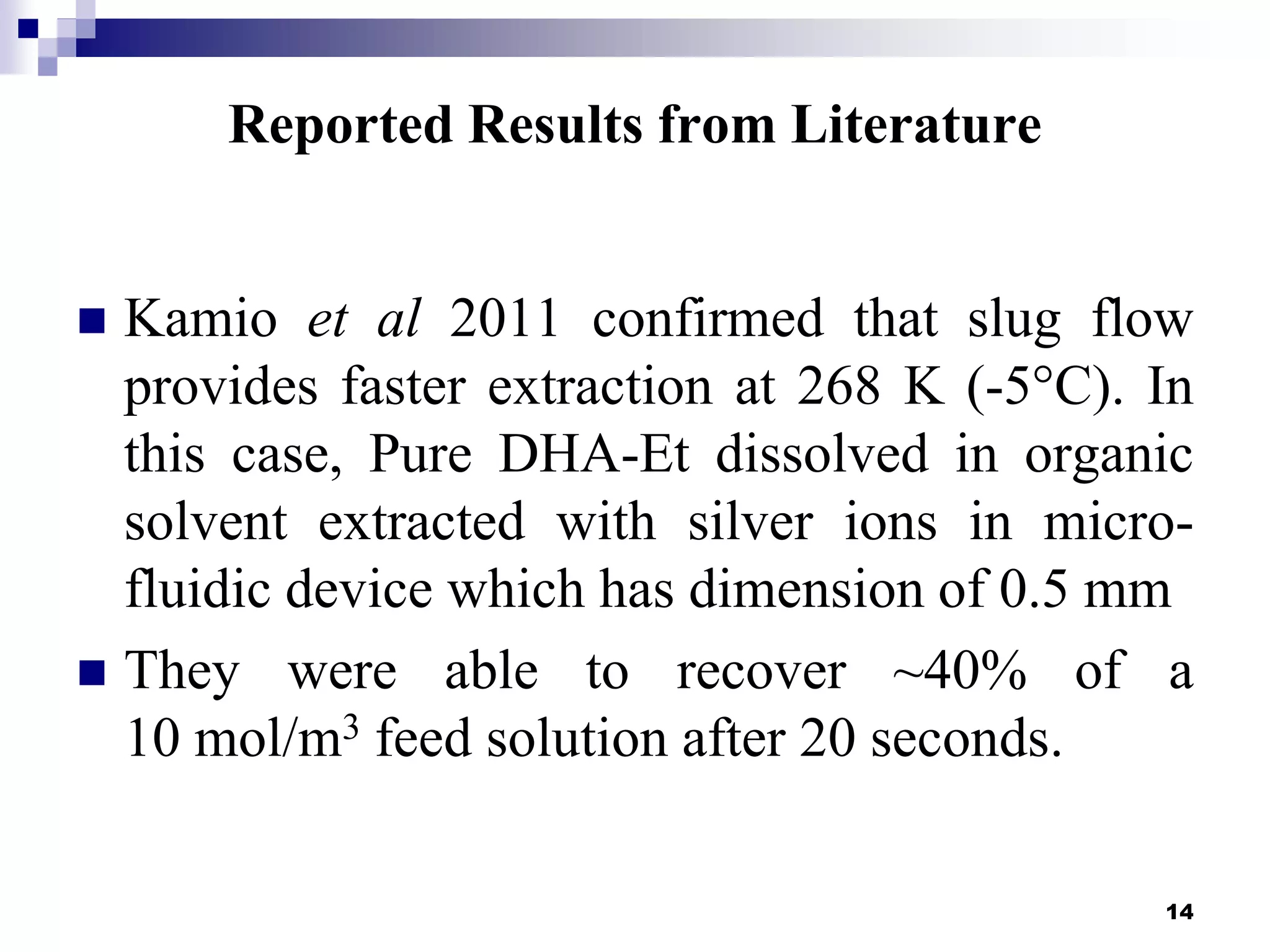
 Kamio et al 2011 confirmed that slug flow
provides faster extraction at 268 K (-5°C). In
this case, Pure DHA-Et dissolved in organic
solvent extracted with silver ions in micro-
fluidic device which has dimension of 0.5 mm
 They were able to recover ~40% of a
10 mol/m3 feed solution after 20 seconds.
14
Deviation from Slug Flow Pattern
15
Fish Oil EE –Silver nitrate
solution interface
Dimensionless
numbers
Definition Formula Values Significance
Weber Number Inertial force
Interfacial tension force 
 2
ud
We H

21.778 We <<1→stable interface
We >> 1 → unstable interface
Capillary
Number
Viscous Force
Intenfacial tenstion force 
u
Ca 
0.450 Ca<<1→ reduce inter. area
Ca>>1 → parallel flow
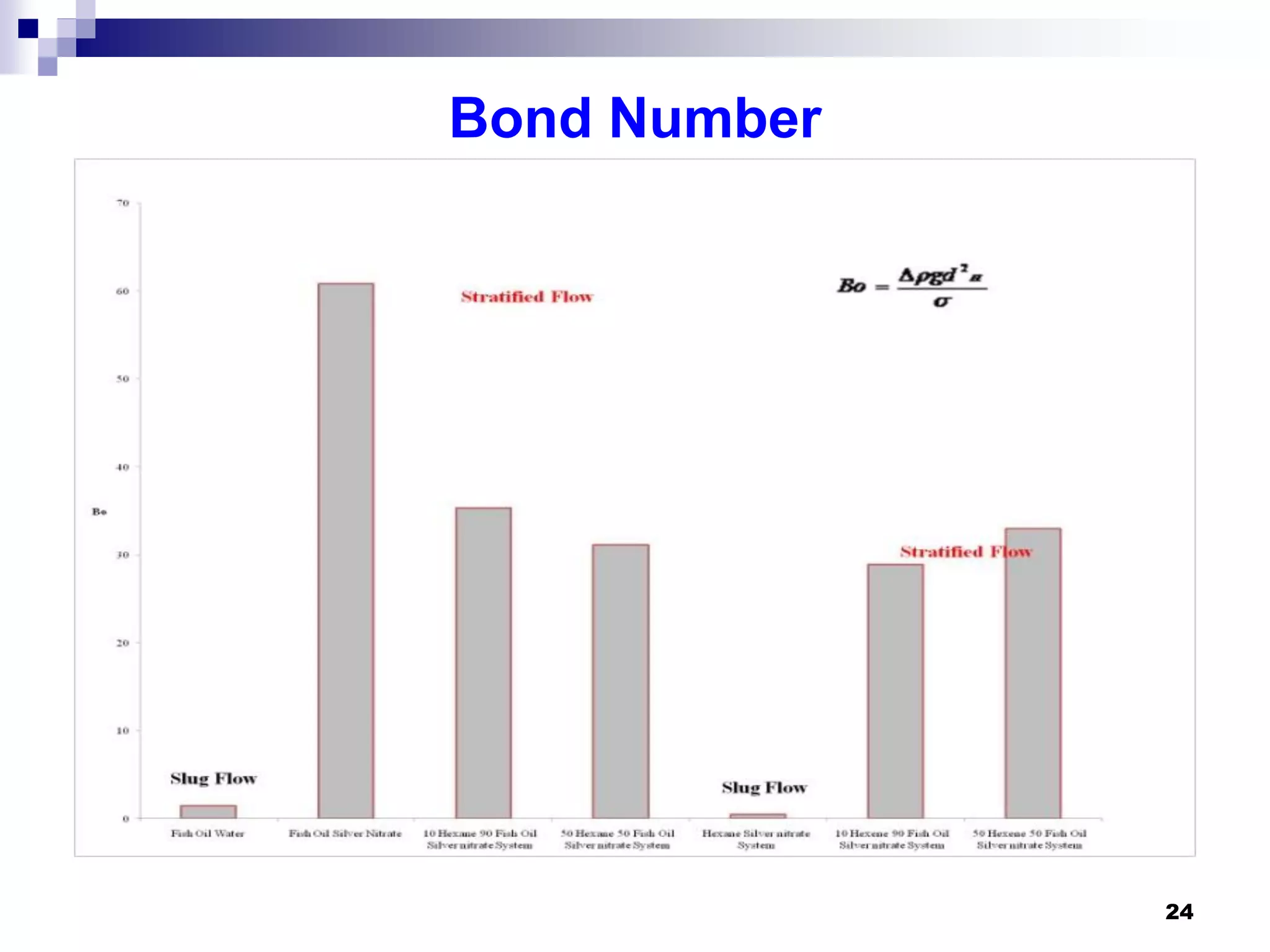
Bond Number Gravity Forces
Interfacial Tension 
 Hgd
Bo
2


54.937 Bo >> 1,Gravity Force
dominates
Bo << 1,Interfacial tension
dominates
Reynolds
Number
Inertia force
Viscous force 
udH
Re
48.345 Re<2100 – Laminar flow
Re>2300– Transition Flow
Conclusion
16
17
Conclusion
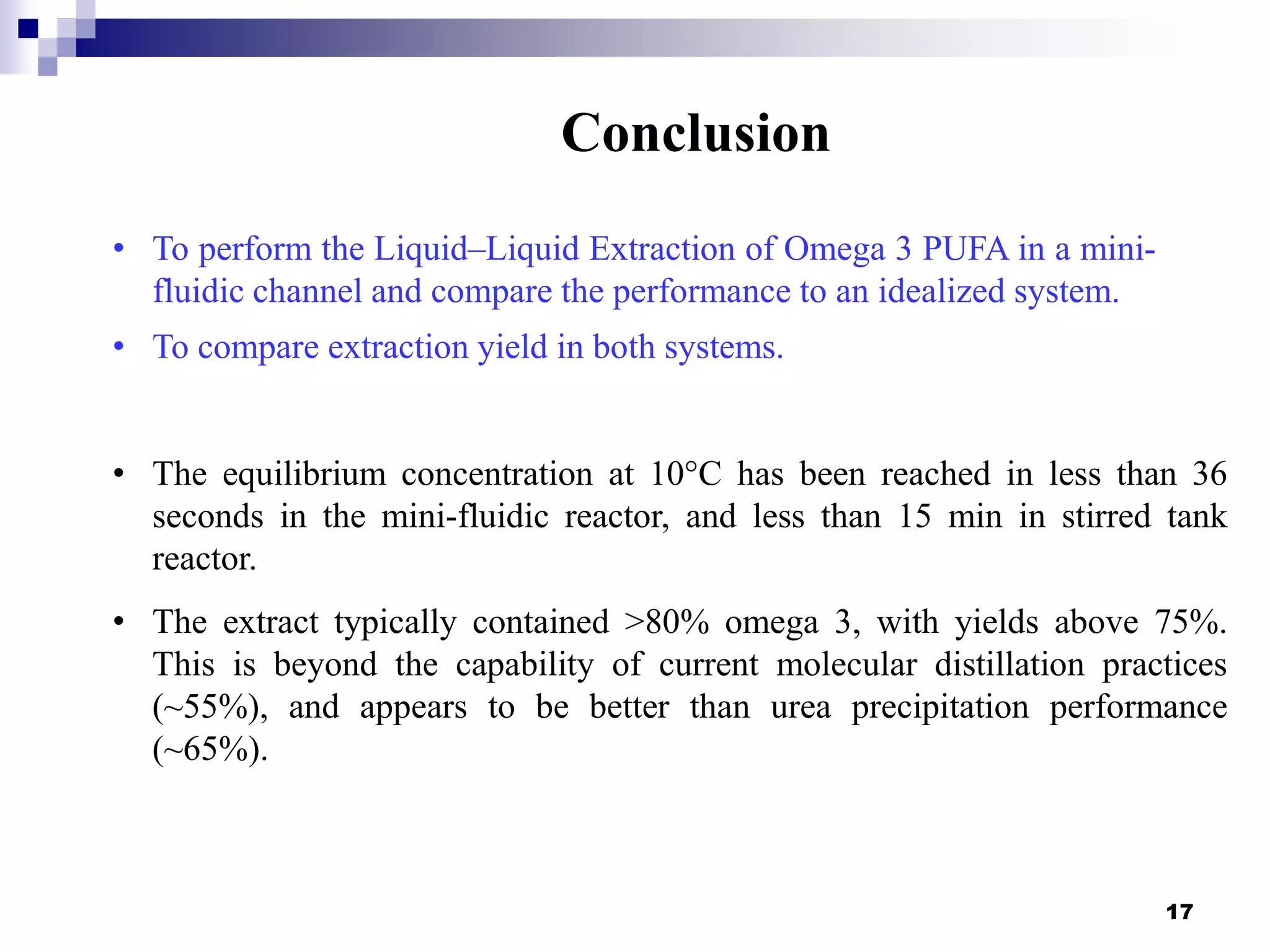
• The equilibrium concentration at 10°C has been reached in less than 36
seconds in the mini-fluidic reactor, and less than 15 min in stirred tank
reactor.
• The extract typically contained >80% omega 3, with yields above 75%.
This is beyond the capability of current molecular distillation practices
(~55%), and appears to be better than urea precipitation performance
(~65%).
• To perform the Liquid–Liquid Extraction of Omega 3 PUFA in a mini-
fluidic channel and compare the performance to an idealized system.
• To compare extraction yield in both systems.
Influence of Interfacial Tension on Flow
Pattern
18
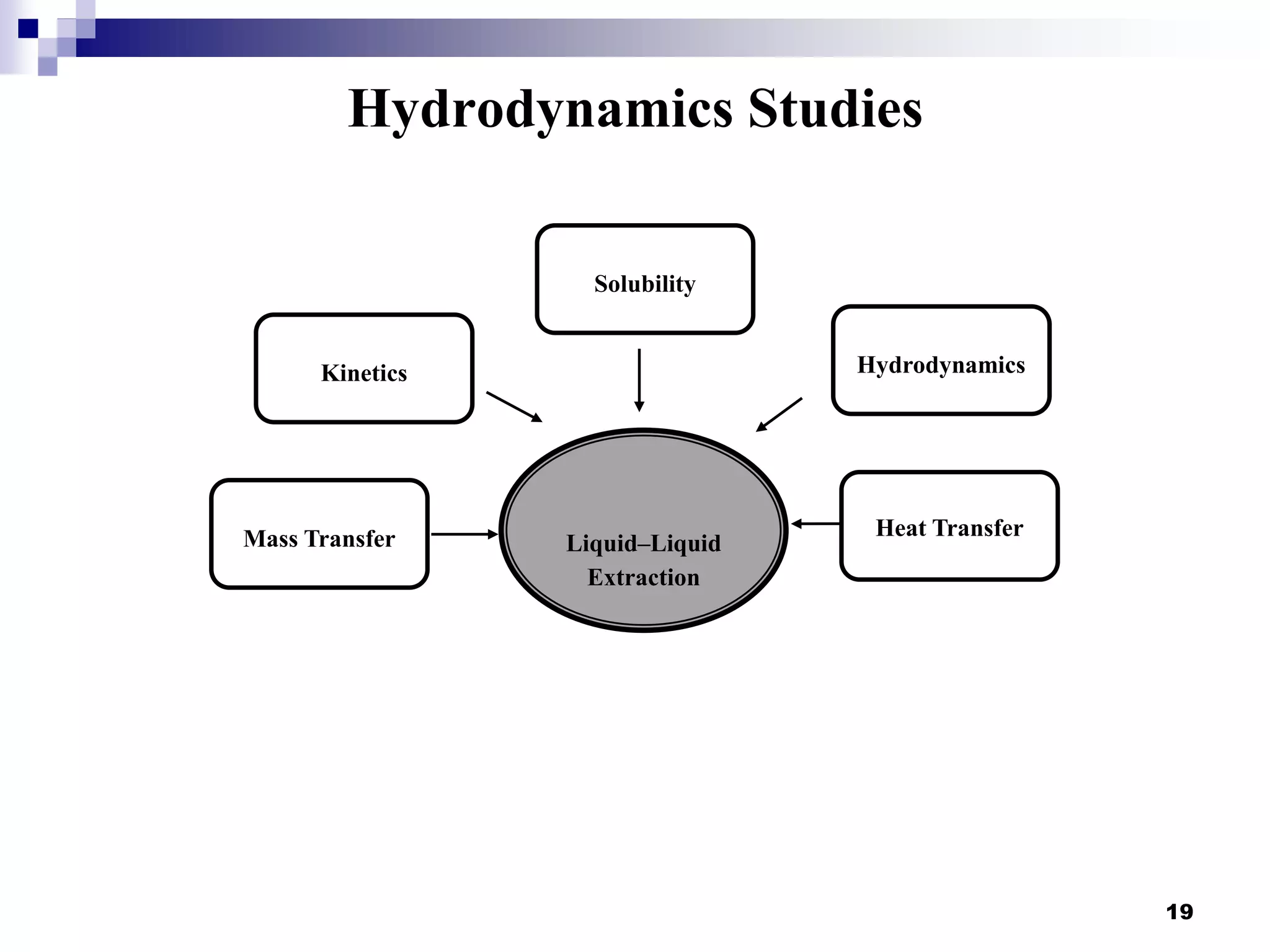
Hydrodynamics Studies
19
Liquid–Liquid
Extraction
Mass Transfer Heat Transfer
Kinetics
Solubility
Hydrodynamics
Interfacial Tension Studies
20
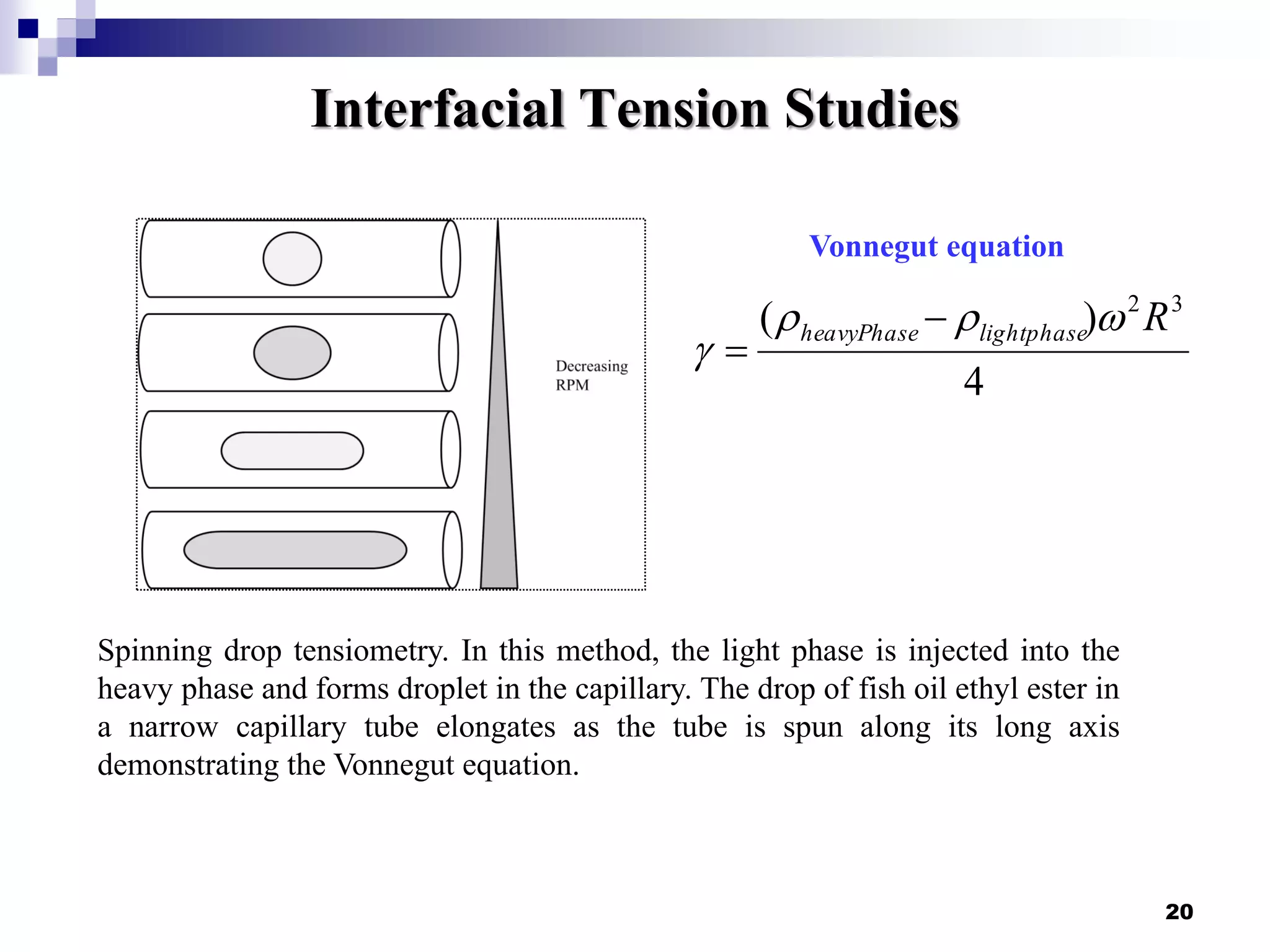
Spinning drop tensiometry. In this method, the light phase is injected into the
heavy phase and forms droplet in the capillary. The drop of fish oil ethyl ester in
a narrow capillary tube elongates as the tube is spun along its long axis
demonstrating the Vonnegut equation.
4
)( 32
RlightphaseheavyPhase 



Vonnegut equation
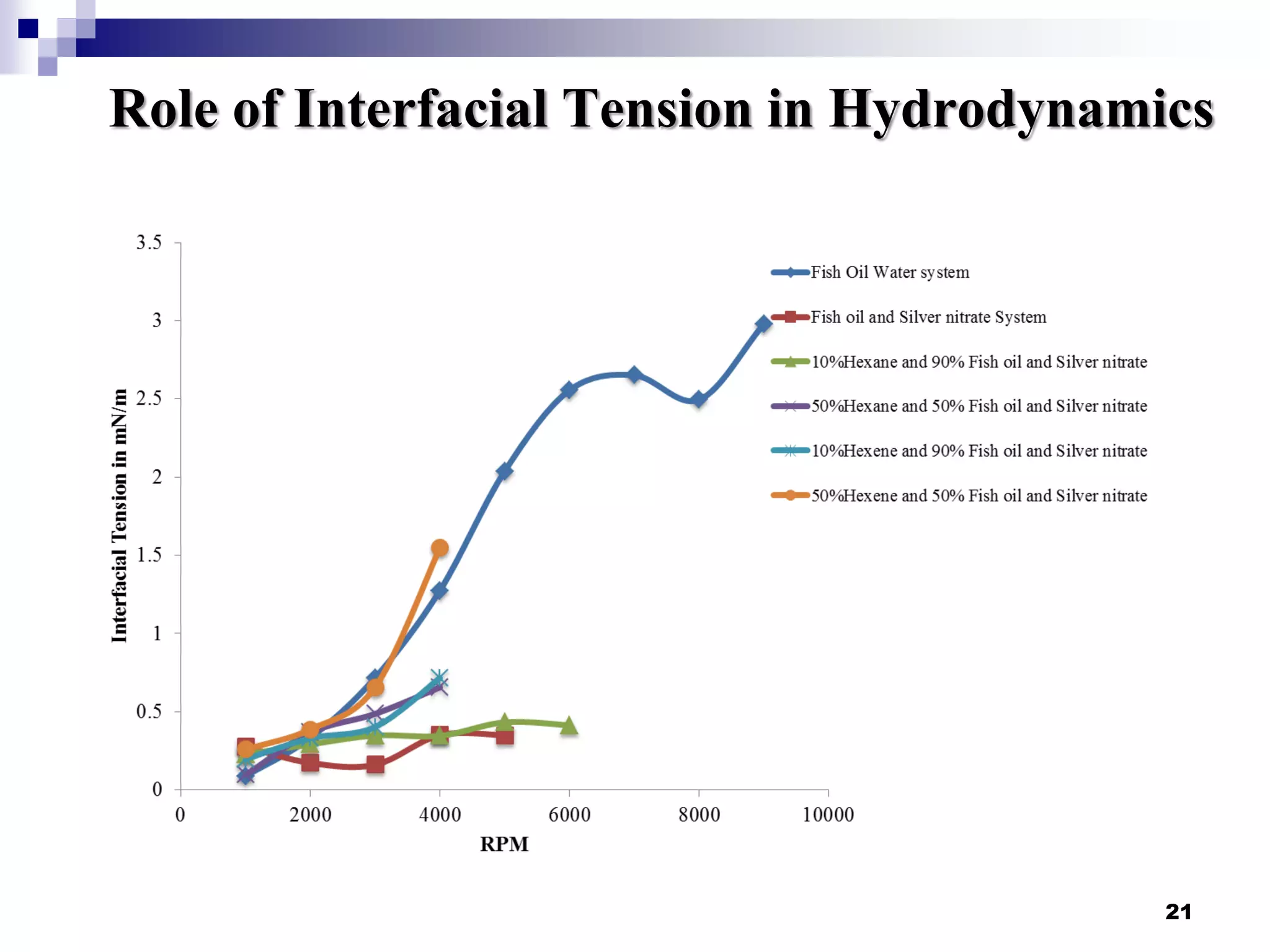
Role of Interfacial Tension in Hydrodynamics
21
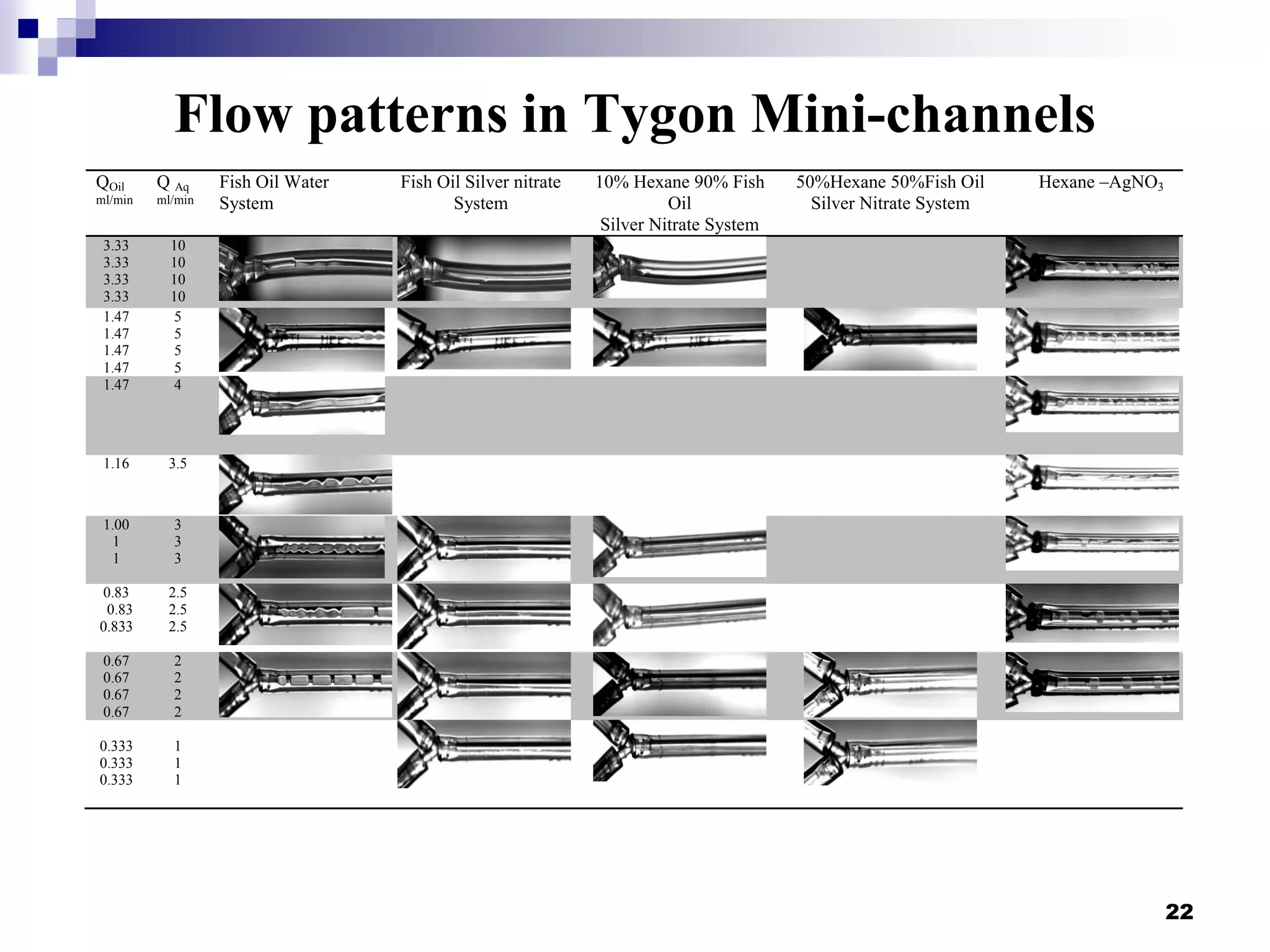
Flow patterns in Tygon Mini-channels
22
QOil
ml/min
Q Aq
ml/min
Fish Oil Water
System
Fish Oil Silver nitrate
System
10% Hexane 90% Fish
Oil
Silver Nitrate System
50%Hexane 50%Fish Oil
Silver Nitrate System
Hexane –AgNO3
3.33
3.33
3.33
3.33
10
10
10
10
1.47
1.47
1.47
1.47
5
5
5
5
1.47 4
1.16 3.5
1.00
1
1
3
3
3
0.83
0.83
0.833
2.5
2.5
2.5
0.67
0.67
0.67
0.67
2
2
2
2
0.333
0.333
0.333
1
1
1
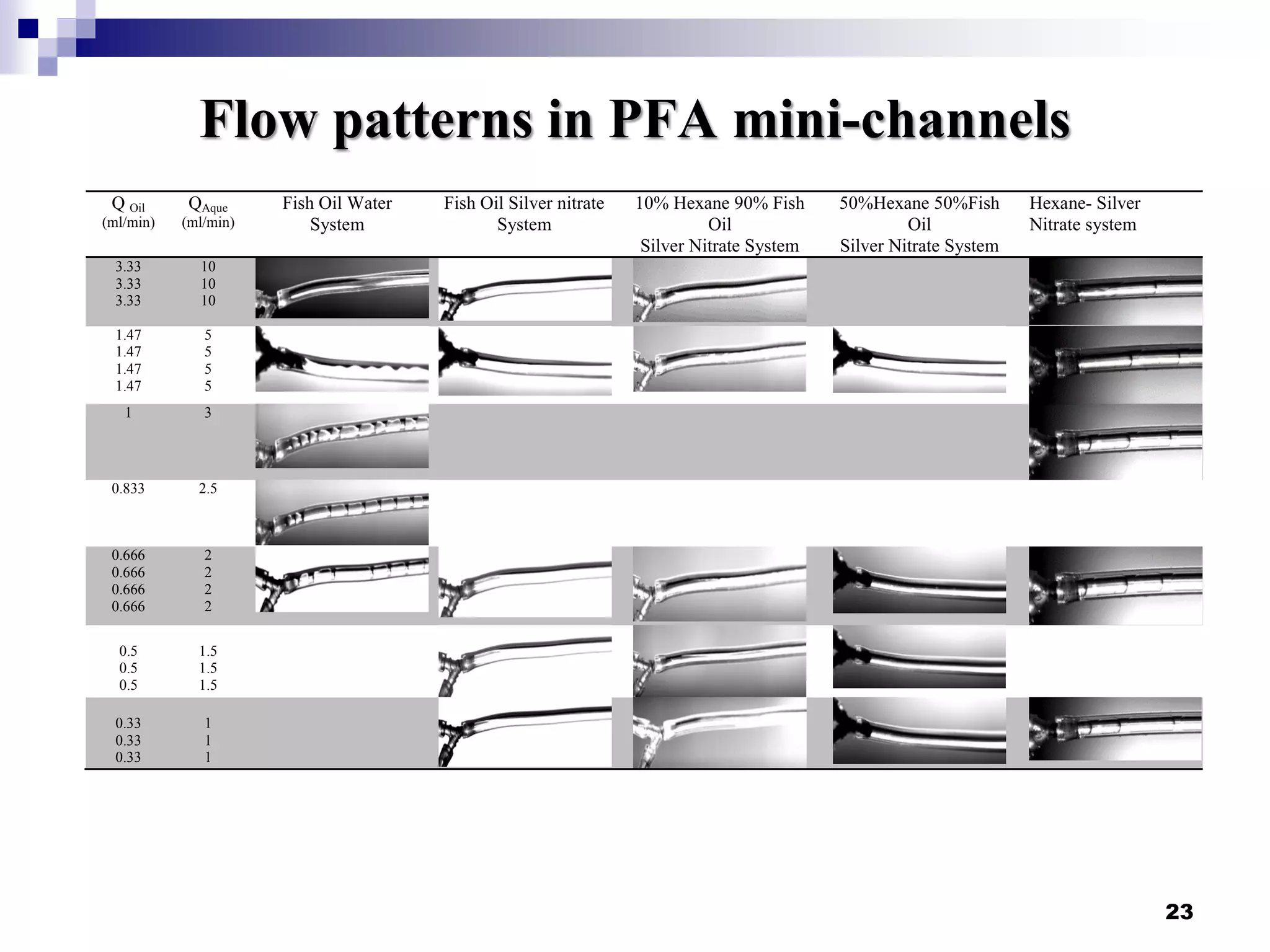
Flow patterns in PFA mini-channels
23
Q Oil
(ml/min)
QAque
(ml/min)
Fish Oil Water
System
Fish Oil Silver nitrate
System
10% Hexane 90% Fish
Oil
Silver Nitrate System
50%Hexane 50%Fish
Oil
Silver Nitrate System
Hexane- Silver
Nitrate system
3.33
3.33
3.33
10
10
10
1.47
1.47
1.47
1.47
5
5
5
5
1 3
0.833 2.5
0.666
0.666
0.666
0.666
2
2
2
2
0.5
0.5
0.5
1.5
1.5
1.5
0.33
0.33
0.33
1
1
1
Bond Number
24
Conclusion
25
Conclusion
26
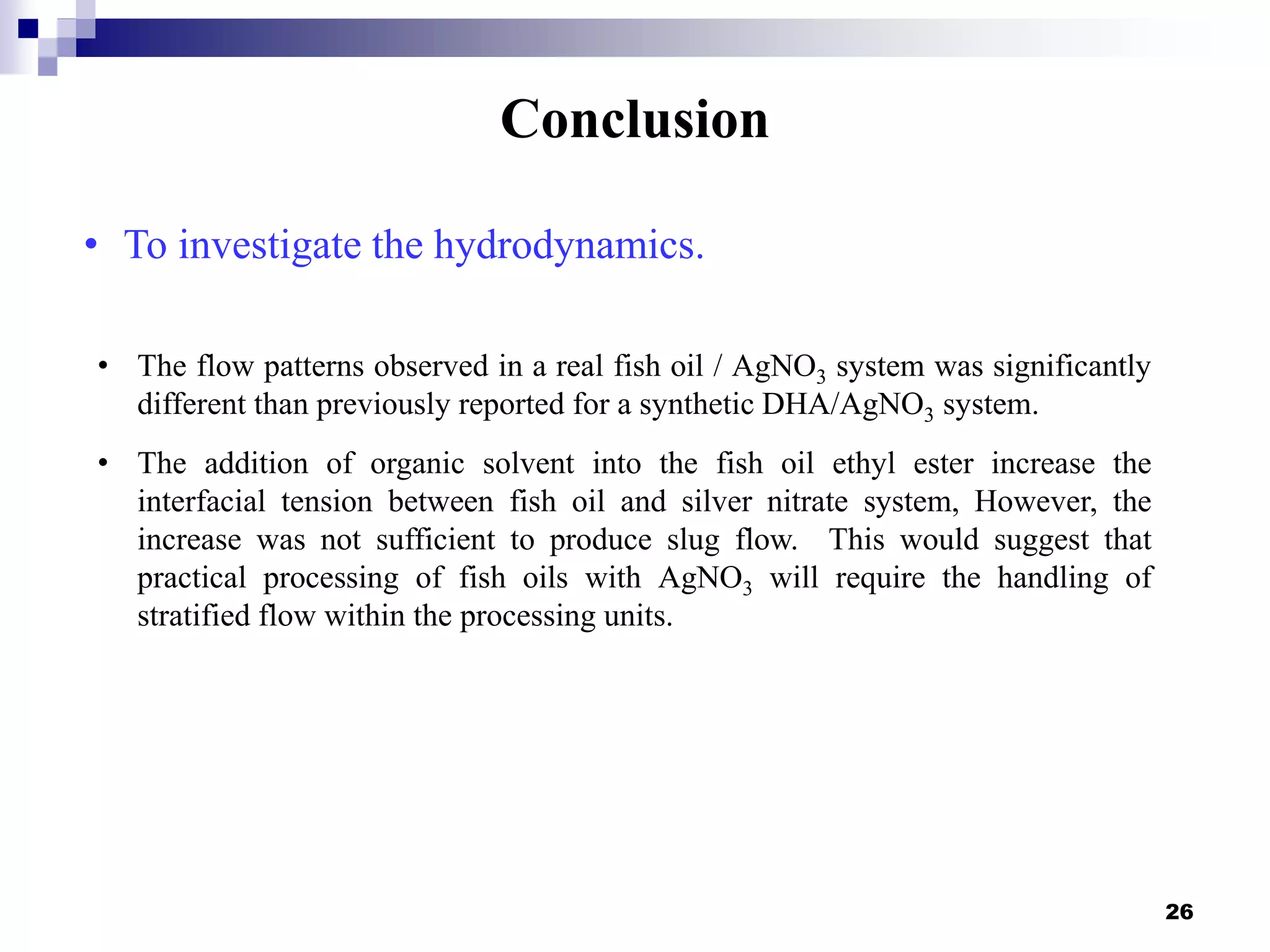
• The flow patterns observed in a real fish oil / AgNO3 system was significantly
different than previously reported for a synthetic DHA/AgNO3 system.
• The addition of organic solvent into the fish oil ethyl ester increase the
interfacial tension between fish oil and silver nitrate system, However, the
increase was not sufficient to produce slug flow. This would suggest that
practical processing of fish oils with AgNO3 will require the handling of
stratified flow within the processing units.
• To investigate the hydrodynamics.
27
Reference
Benz, K.; Jäckel, K.P.; Regenauer, K.J.; Schiewe, J.; Drese, K.; Ehrfeld,W.; Hessel,V.;
Löwe,H., (2001) “Utilization of Micromixers for Extraction Processes”, Chem. Eng.
Technol. 24 :1.
Lembke,P., (2013) “Production Techniques for Omega3 Concentrates” Omega-6/3 Fatty
Acids: Functions, Sustainability Strategies and Perspectives, Edited by: F. De Meester et
al.(eds.), DOI 10.1007/978-1-62703-215-5_29, 353-364.
Ratnayake, WMN.; Olson, B.; Matthews, D.; Ackman, RG., (1988) “Preparation of
omega-3 PUFA concentrates from fish oil via urea complexation”. Eur J Lipid Sci Tech.;
90(10):381–6.
Seike, Y.; Kamio, E.; Ono, T.; Yoshizawa, H., (2007) Extraction of ethyl ester of
polyunsaturated fatty acids by utilizing slug flow prepared by microreactor. J Chem Eng
Jpn. 2007;40:1076–1084.
28
THANK YOU
29
Questions
?
30
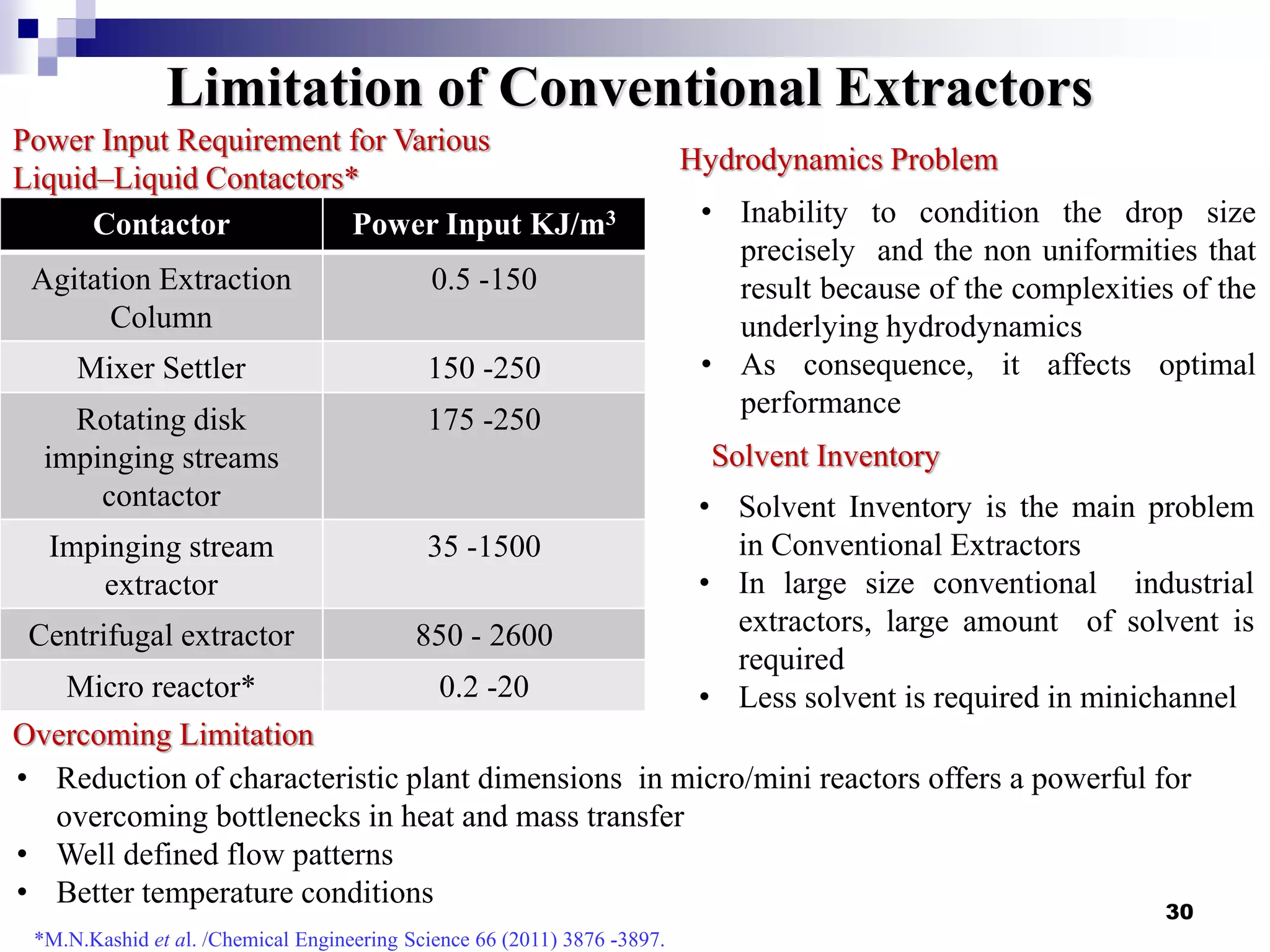
Limitation of Conventional Extractors
Power Input Requirement for Various
Liquid–Liquid Contactors*
Contactor Power Input KJ/m3
Agitation Extraction
Column
0.5 -150
Mixer Settler 150 -250
Rotating disk
impinging streams
contactor
175 -250
Impinging stream
extractor
35 -1500
Centrifugal extractor 850 - 2600
Micro reactor* 0.2 -20
Hydrodynamics Problem
• Inability to condition the drop size
precisely and the non uniformities that
result because of the complexities of the
underlying hydrodynamics
• As consequence, it affects optimal
performance
Solvent Inventory
• Solvent Inventory is the main problem
in Conventional Extractors
• In large size conventional industrial
extractors, large amount of solvent is
required
• Less solvent is required in minichannel
Overcoming Limitation
• Reduction of characteristic plant dimensions in micro/mini reactors offers a powerful for
overcoming bottlenecks in heat and mass transfer
• Well defined flow patterns
• Better temperature conditions
*M.N.Kashid et al. /Chemical Engineering Science 66 (2011) 3876 -3897.
Slug Flow Based Mini -Fluidics
31
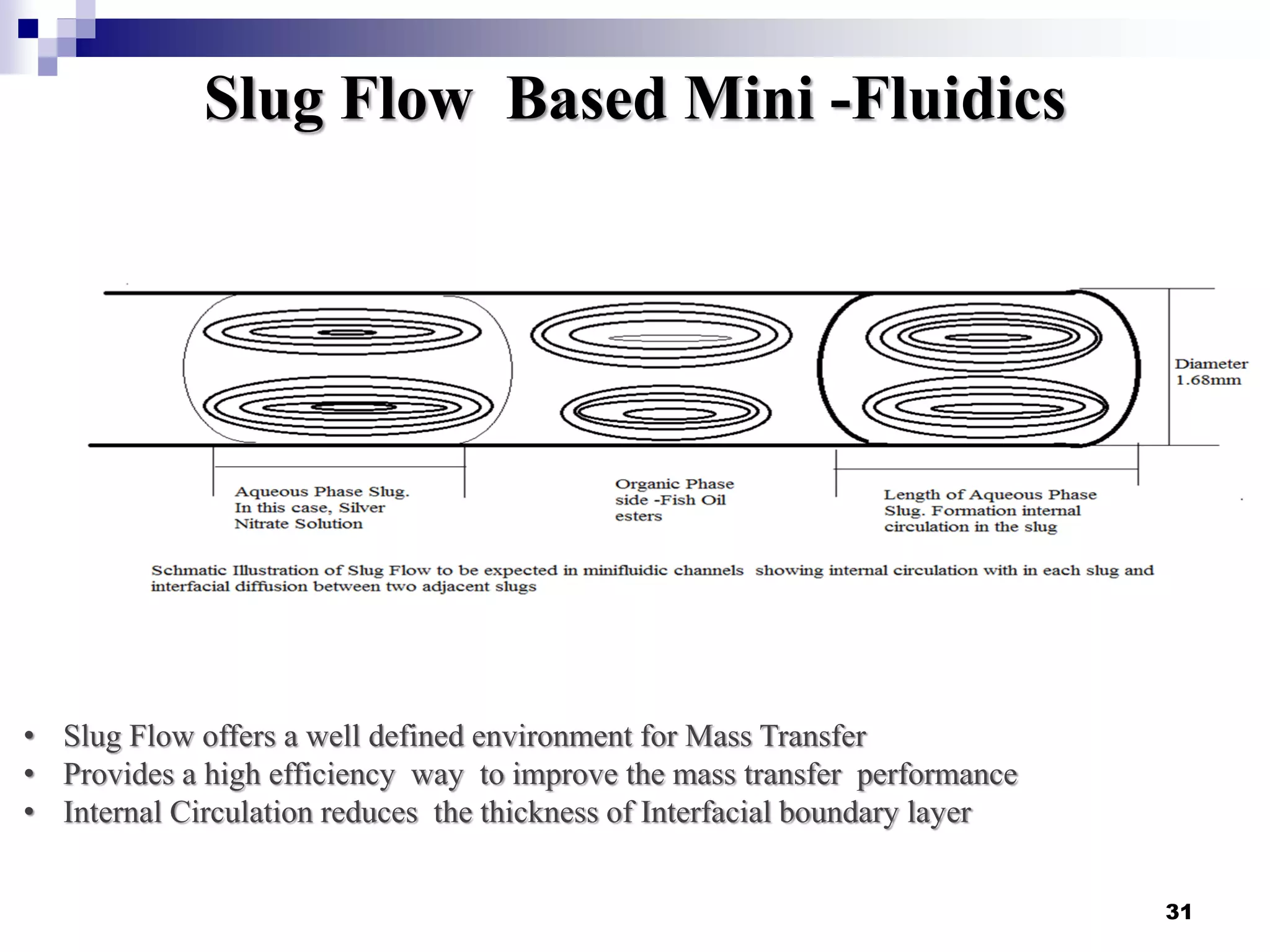
• Slug Flow offers a well defined environment for Mass Transfer
• Provides a high efficiency way to improve the mass transfer performance
• Internal Circulation reduces the thickness of Interfacial boundary layer
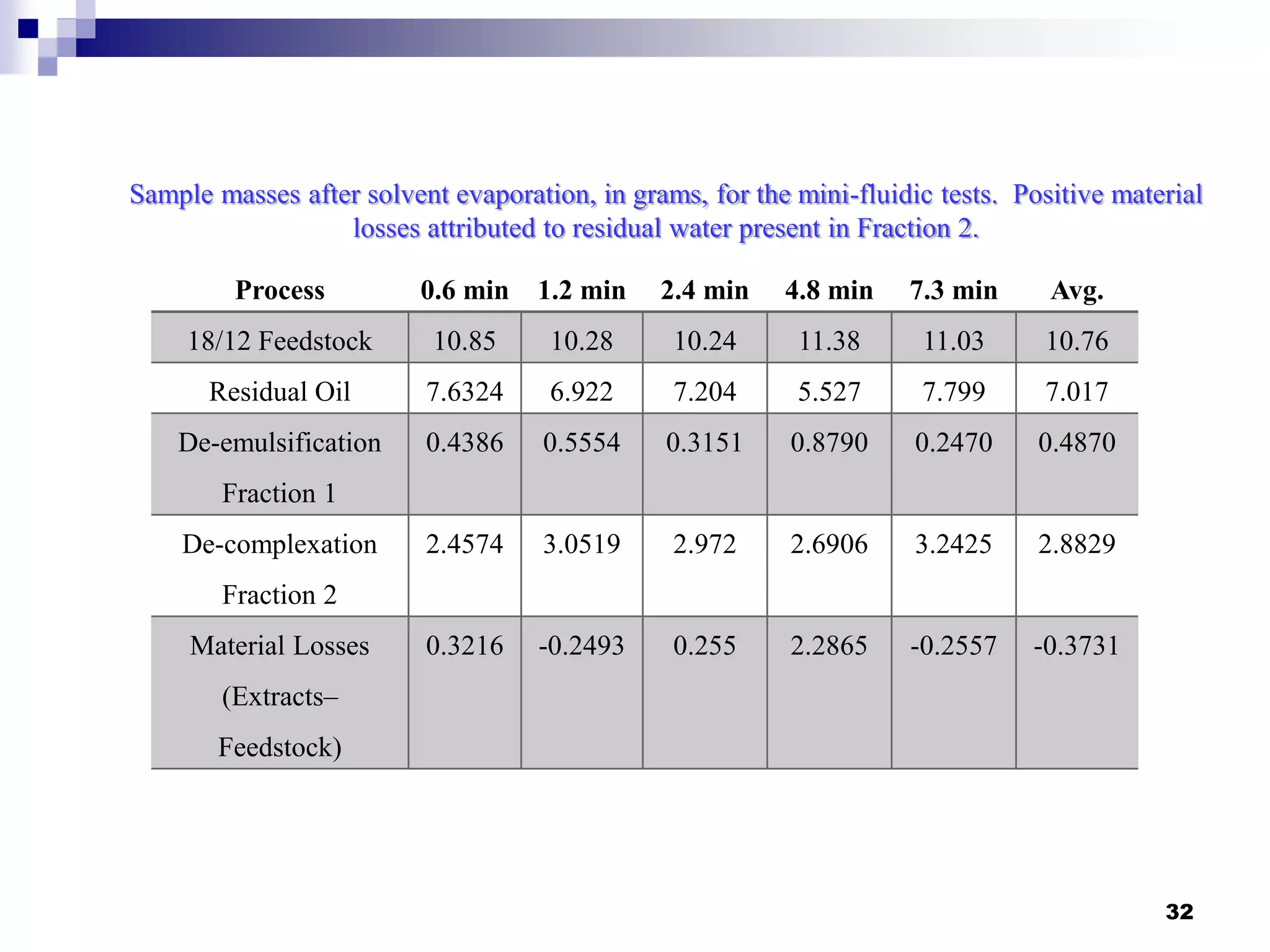
32
Sample masses after solvent evaporation, in grams, for the mini-fluidic tests. Positive material
losses attributed to residual water present in Fraction 2.
Process 0.6 min 1.2 min 2.4 min 4.8 min 7.3 min Avg.
18/12 Feedstock 10.85 10.28 10.24 11.38 11.03 10.76
Residual Oil 7.6324 6.922 7.204 5.527 7.799 7.017
De-emulsification
Fraction 1
0.4386 0.5554 0.3151 0.8790 0.2470 0.4870
De-complexation
Fraction 2
2.4574 3.0519 2.972 2.6906 3.2425 2.8829
Material Losses
(Extracts–
Feedstock)
0.3216 -0.2493 0.255 2.2865 -0.2557 -0.3731
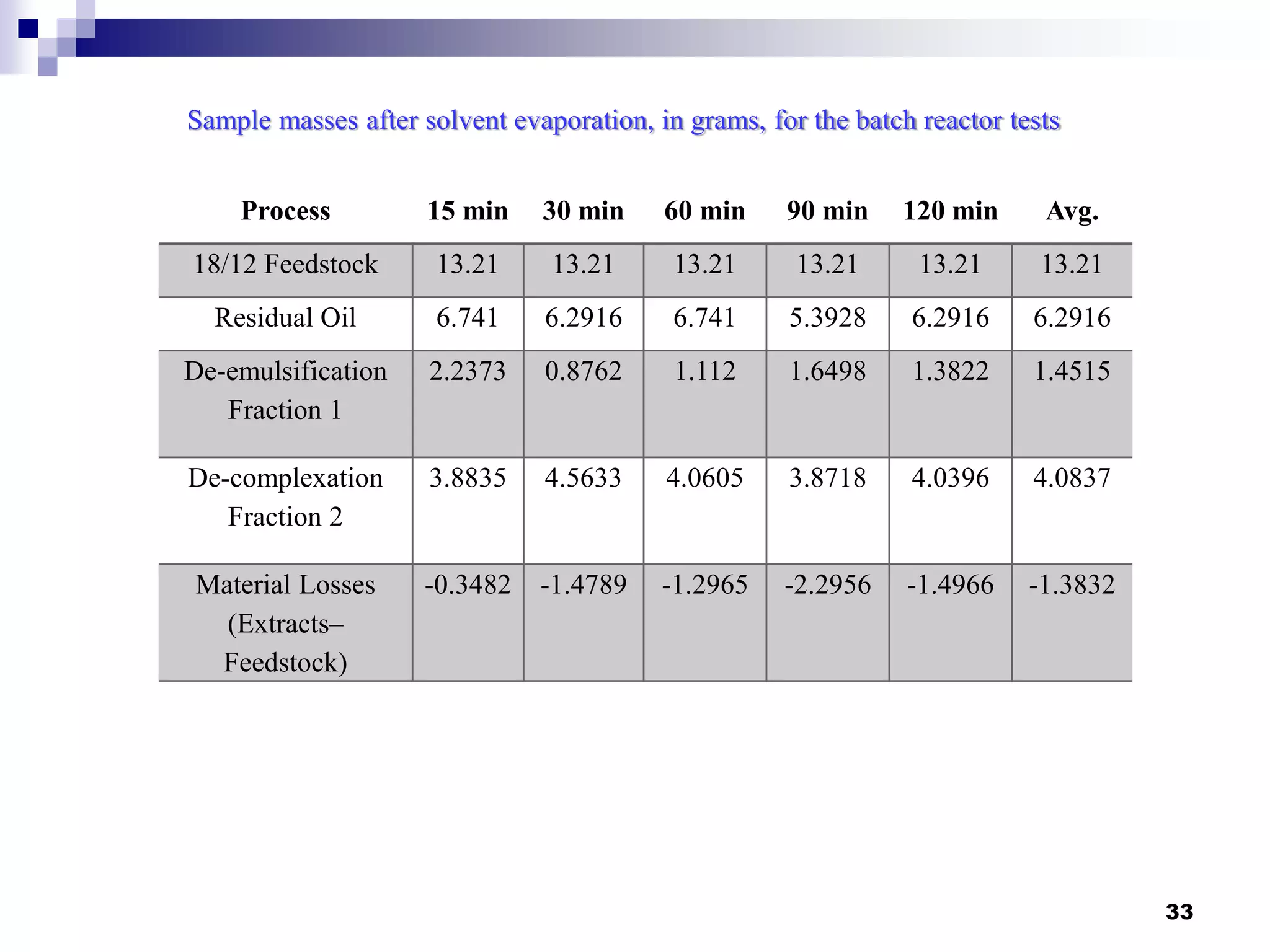
33
Sample masses after solvent evaporation, in grams, for the batch reactor tests
Process 15 min 30 min 60 min 90 min 120 min Avg.
18/12 Feedstock 13.21 13.21 13.21 13.21 13.21 13.21
Residual Oil 6.741 6.2916 6.741 5.3928 6.2916 6.2916
De-emulsification
Fraction 1
2.2373 0.8762 1.112 1.6498 1.3822 1.4515
De-complexation
Fraction 2
3.8835 4.5633 4.0605 3.8718 4.0396 4.0837
Material Losses
(Extracts–
Feedstock)
-0.3482 -1.4789 -1.2965 -2.2956 -1.4966 -1.3832
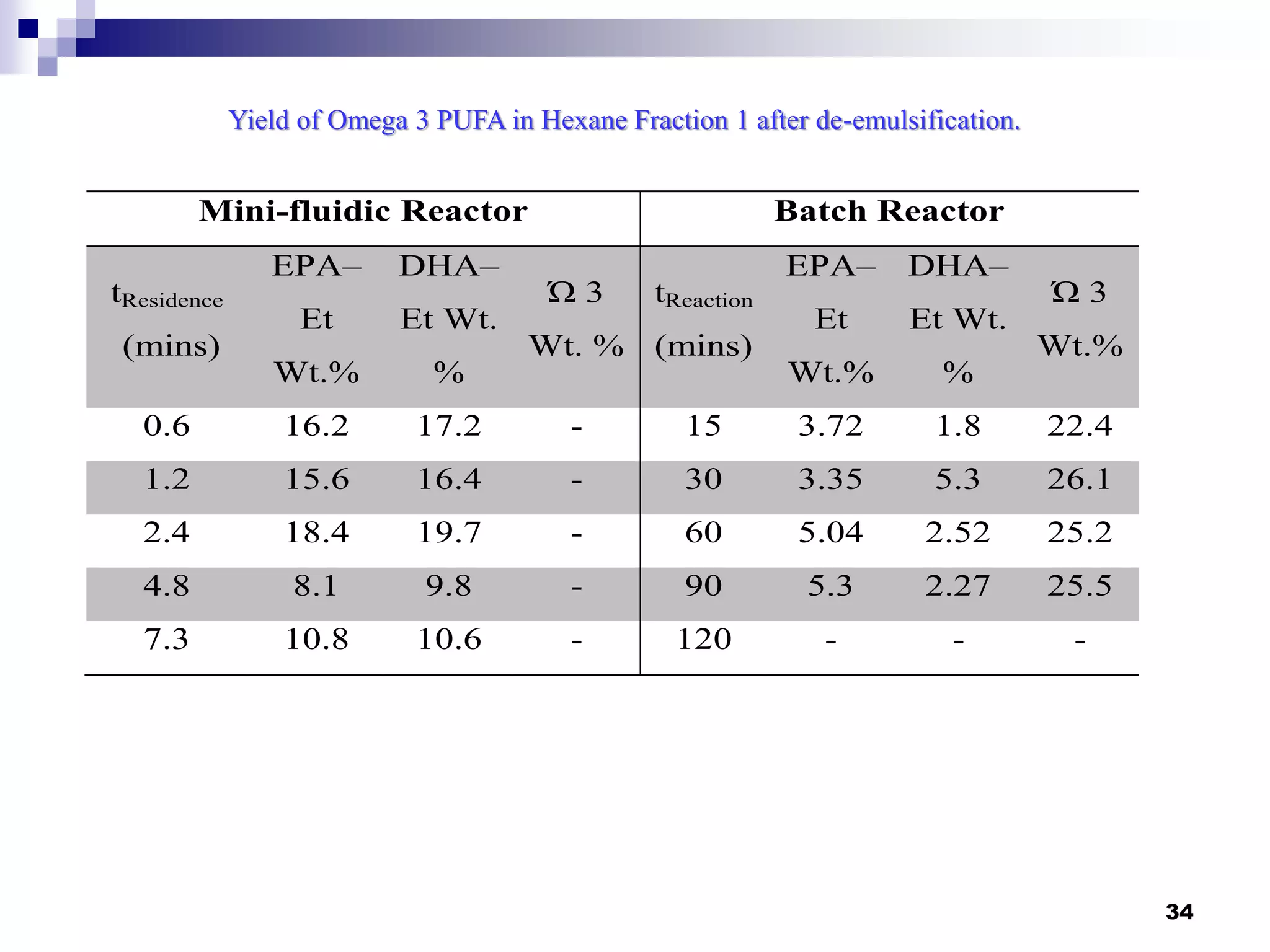
34
Mini-fluidic Reactor Batch Reactor
tResidence
(mins)
EPA–
Et
Wt.%
DHA–
Et Wt.
%
Ώ 3
Wt. %
tReaction
(mins)
EPA–
Et
Wt.%
DHA–
Et Wt.
%
Ώ 3
Wt.%
0.6 16.2 17.2 - 15 3.72 1.8 22.4
1.2 15.6 16.4 - 30 3.35 5.3 26.1
2.4 18.4 19.7 - 60 5.04 2.52 25.2
4.8 8.1 9.8 - 90 5.3 2.27 25.5
7.3 10.8 10.6 - 120 - - -
Yield of Omega 3 PUFA in Hexane Fraction 1 after de-emulsification.
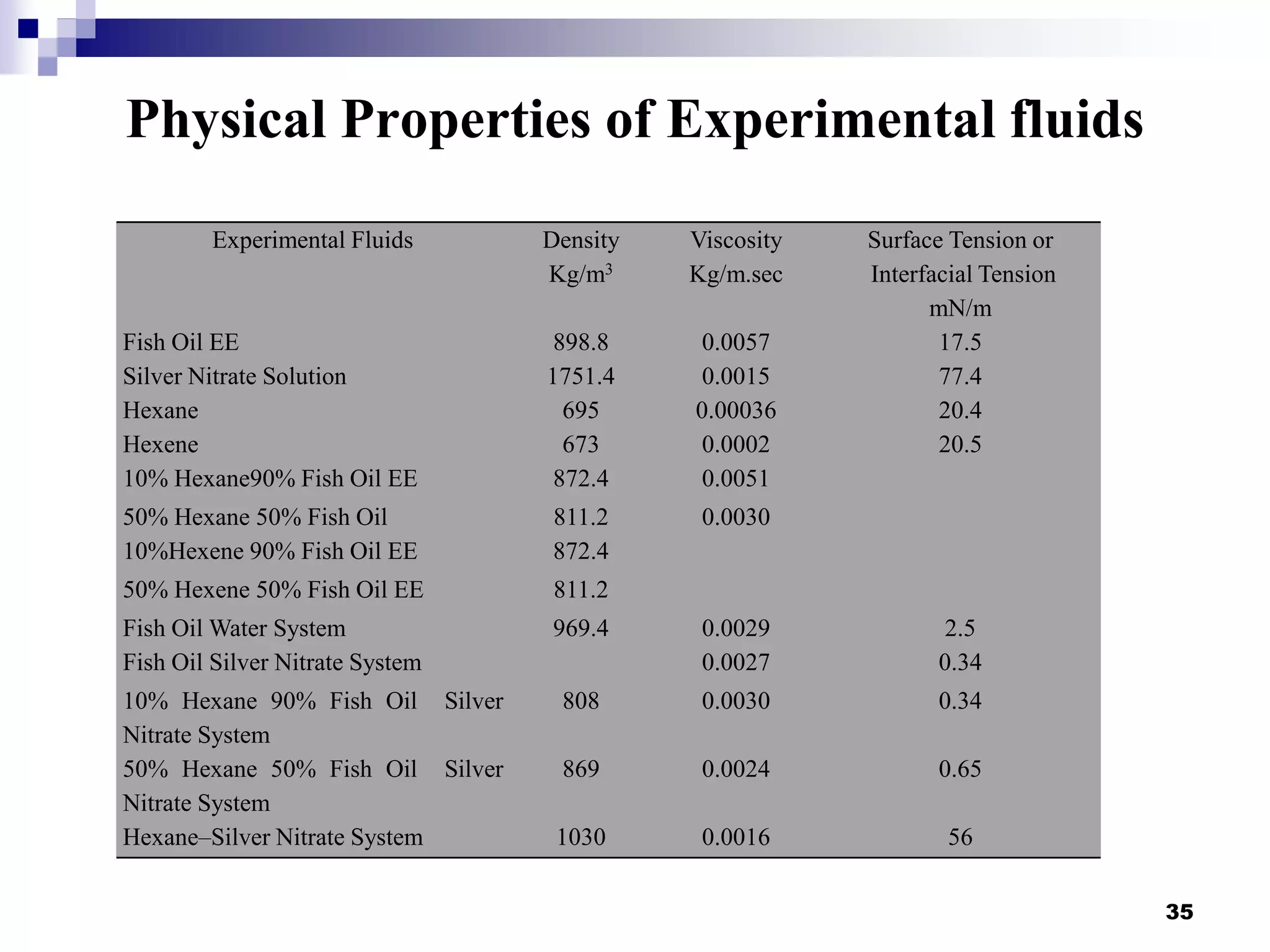
Physical Properties of Experimental fluids
35
Experimental Fluids Density
Kg/m3
Viscosity
Kg/m.sec
Surface Tension or
Interfacial Tension
mN/m
Fish Oil EE 898.8 0.0057 17.5
Silver Nitrate Solution 1751.4 0.0015 77.4
Hexane 695 0.00036 20.4
Hexene 673 0.0002 20.5
10% Hexane90% Fish Oil EE 872.4 0.0051
50% Hexane 50% Fish Oil 811.2 0.0030
10%Hexene 90% Fish Oil EE 872.4
50% Hexene 50% Fish Oil EE 811.2
Fish Oil Water System 969.4 0.0029 2.5
Fish Oil Silver Nitrate System 0.0027 0.34
10% Hexane 90% Fish Oil Silver
Nitrate System
808 0.0030 0.34
50% Hexane 50% Fish Oil Silver
Nitrate System
869 0.0024 0.65
Hexane–Silver Nitrate System 1030 0.0016 56
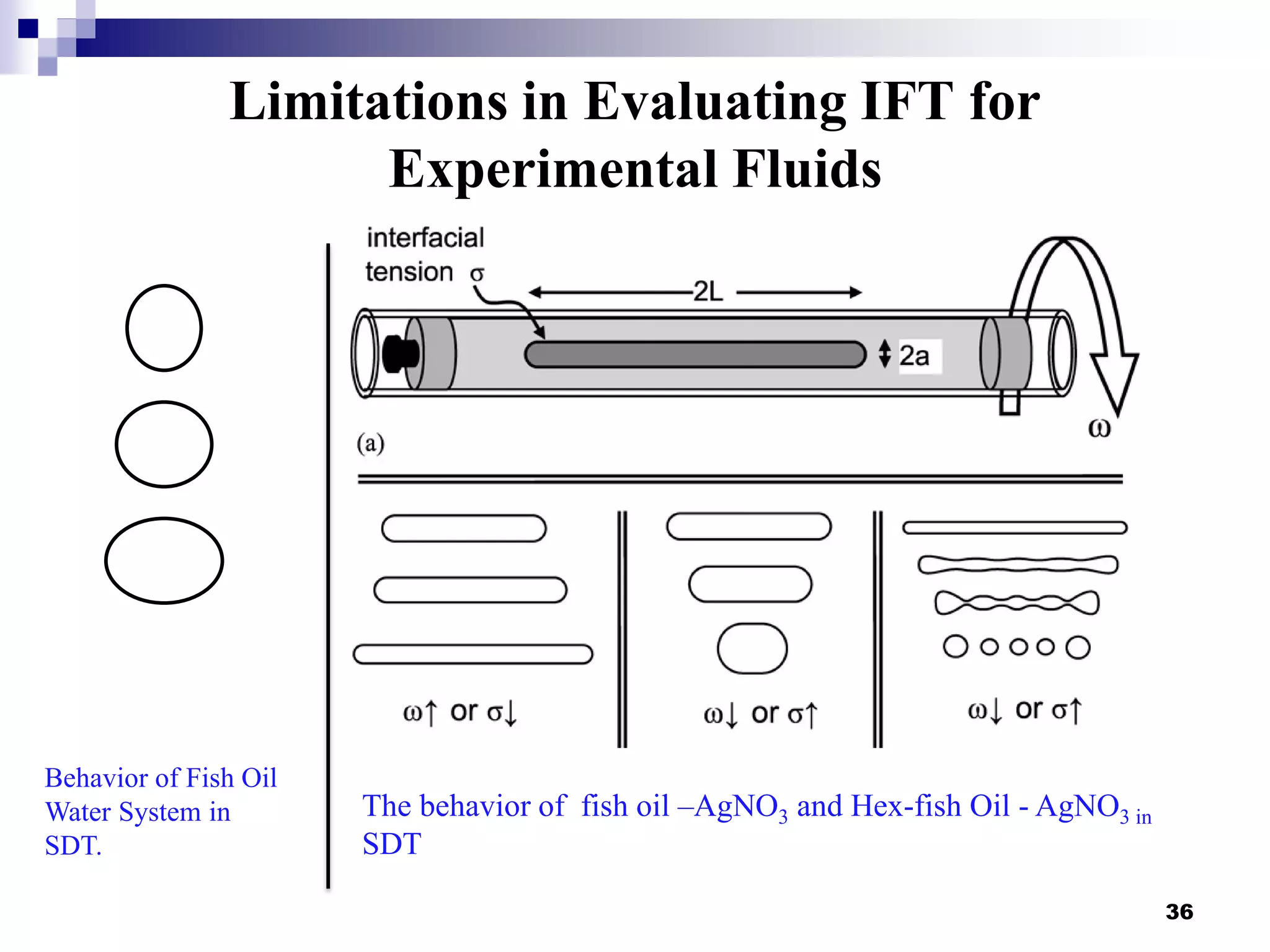
Limitations in Evaluating IFT for
Experimental Fluids
36
Behavior of Fish Oil
Water System in
SDT.
The behavior of fish oil –AgNO3 and Hex-fish Oil - AgNO3 in
SDT
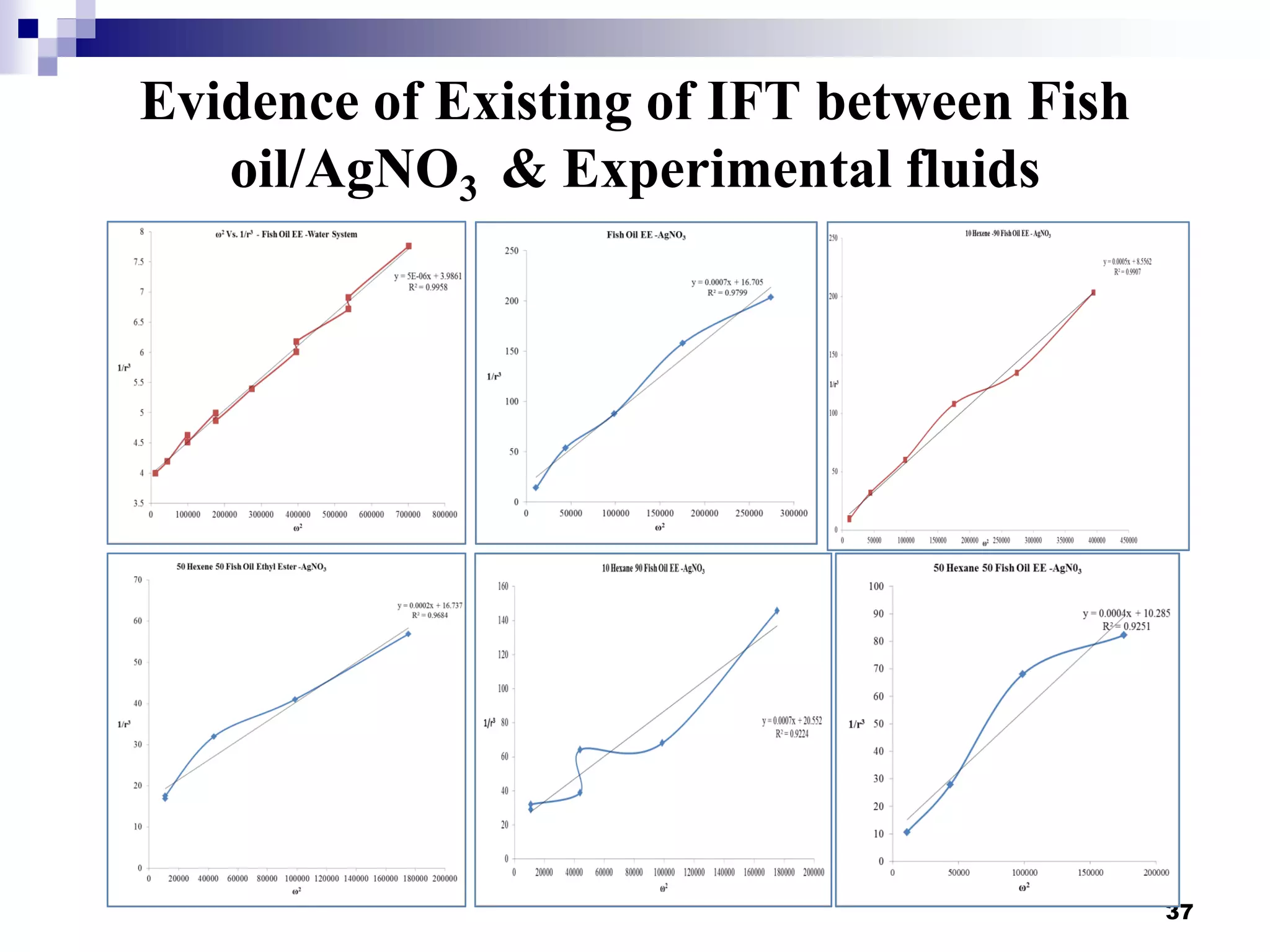
Evidence of Existing of IFT between Fish
oil/AgNO3 & Experimental fluids
37

Design of Mini-fluidic reactor for Extraction

  • 1.
    1 DESIGN OF MINI-FLUIDICREACTOR FOR EXTRACTION OF EPA/DHA FROM FISH OIL Kirubanandan Shanmugam MASc in Chemical Engineering Presented on 17th ISME Conference on Advances in Mechanical Engineering, 3-4th Oct 2015, Indian Institute of Technology, Delhi, India. Dr. Adam. A. Donaldson Supervisor
  • 2.
    Contents 2 1. Introduction 2. Objective 3.EPA/DHA Yields 4. Hydrodynamics 5. Conclusion and Discussion
  • 3.
  • 4.
  • 5.
    Introduction 5 Chemical Structure ofEicosapentaenoic Acid (EPA) Chemical Structure of Docosahexaenoic Acid (DHA) Double Bond - Reaction Site Reaction Involved: DHA/EPA +AgNO3 DHA/EPA :Agn+ Complex + Fish Oil Aqueous Phase Organic Phase
  • 6.
    6 Miniaturization of Liquid-LiquidExtraction Process * American Institute of Chemical Engineers, USA. Stirred Tank Reactor* Mini-fluidic Reactor* *Mini-fluidic experimental set up at Lab of Multiphase Process Engineering, Dalhousie University, Canada.
  • 7.
    Research Objective 7 • Toperform the Liquid–Liquid Extraction of Omega 3 PUFA in a mini-fluidic channel and compare the performance to an idealized system. • To compare extraction yield in both systems. • To investigate the hydrodynamics.
  • 8.
    8 Experimental Method Process Inputs Contacting Collecting Settling Raw Extract  18/12Fish Oils EE (Organic Phase)~1.5 ml/min  50%wt.AgNO3 (Aqueous Phase)~5 ml/min  Temperature = 10±0.5°C  Residence times varies from 0.6 to 7.3 mins  Phase inversion observed at “Y” Junction  Stratification of flow has been observed.  Samples are collected at specified location.  Gravity settling has been allowed.  Exiting ethyl ester of fish oil –Oil layer  Isolation of Emulsion phase (Oil +AgNO3)  Exiting silver nitrate aqueous phase enriched with Omega 3 PUFA.  Silver ions in the solutions bound to double bond of these fatty acids (EPA/DHA).
  • 9.
    9 Separation of Omega3 PUFA from Raw Extract Oil Residual Separation from LLE Experiments De-emulsification using Hexane Fraction 1 De -complexation using Hexene Fraction 2 Sample Preparation for Analysis (drying & filtering)
  • 10.
    Experimental Components 10 Fish Oil (OrganicPhase) AgNO3 (Aqueous Phase) Coolant Inlet Coolant Outlet to Refrigeration Dual Syringe pump Immersion Vessel Sample PortTygon minichannel
  • 11.
    Mini-fluidic Reactor BatchReactor tResidence (mins) EPA– Et Wt.% DHA– Et Wt. % Ώ 3 Wt. % tReaction (mins) EPA– Et Wt.% DHA– Et Wt. % Ώ 3 Wt.% 0.6 42.3 30.5 81.3 15 41.5 27.1 81.8 1.2 39.8 29.0 77.5 30 41.6 27.0 81.9 2.4 40.4 29.2 78.5 60 39.8 25.9 78.9 4.8 37.9 26.8 73.7 90 42.0 27.4 82.5 7.3 40.3 27.8 78.5 120 40.1 26.6 78.7 11 EPA/DHA Yields Composition of 18/12 EE fish oils ethyl esters Organic Phase EPA–Et Wt.% DHA–Et Wt. % Ώ 3 Wt. % Fish Oil-EE 15.0 10.1 30.9 Weight percent EPA/DHA/Total Omega 3 in Fraction 2 collected at different contact times from LLE experiments.
  • 12.
    12 Omega 3 PUFAcontent in the Residual Oil Layer Mini-fluidic Reactor Batch Reactor tResidence (mins) EPA– Et Wt.% DHA– Et Wt. % Ώ 3 Wt. % tReaction (mins) EPA– Et Wt.% DHA– Et Wt.% Ώ 3 Wt.% 0.6 1.15 0.17 4.50 15 0.33 0.06 2.19 1.2 1.14 0.15 4.38 30 0.19 0.06 1.05 2.4 1.21 0.18 4.47 60 0.41 0.06 2.34 4.8 0.58 0 2.80 90 0.46 0.06 2.42 7.3 0.35 0.02 2.39 120 0.74 0.10 3.10
  • 13.
    13 Mini-fluidic Reactor BatchReactor tResidence (mins) EPA– Et Wt.% DHA– Et Wt. % Ώ 3 Wt. % tReaction (mins) EPA– Et Wt.% DHA– Et Wt. % Ώ 3 Wt. % 0.6 64.2 68.5 59.9 15 81.8 79.1 78.2 1.2 79.3 85.7 74.9 30 96.4 92.8 92.0 2.4 78.6 84.4 74.2 60 82.0 79.0 78.2 4.8 60.0 63.0 56.7 90 82.5 79.7 78.7 7.3 79.3 81.2 75.1 120 82.2 80.9 78.3 Approximate yield of Omega 3 PUFA (wt% of feed extracted)
  • 14.
    Reported Results fromLiterature  Kamio et al 2011 confirmed that slug flow provides faster extraction at 268 K (-5°C). In this case, Pure DHA-Et dissolved in organic solvent extracted with silver ions in micro- fluidic device which has dimension of 0.5 mm  They were able to recover ~40% of a 10 mol/m3 feed solution after 20 seconds. 14
  • 15.
    Deviation from SlugFlow Pattern 15 Fish Oil EE –Silver nitrate solution interface Dimensionless numbers Definition Formula Values Significance Weber Number Inertial force Interfacial tension force   2 ud We H  21.778 We <<1→stable interface We >> 1 → unstable interface Capillary Number Viscous Force Intenfacial tenstion force  u Ca  0.450 Ca<<1→ reduce inter. area Ca>>1 → parallel flow Bond Number Gravity Forces Interfacial Tension   Hgd Bo 2   54.937 Bo >> 1,Gravity Force dominates Bo << 1,Interfacial tension dominates Reynolds Number Inertia force Viscous force  udH Re 48.345 Re<2100 – Laminar flow Re>2300– Transition Flow
  • 16.
  • 17.
    17 Conclusion • The equilibriumconcentration at 10°C has been reached in less than 36 seconds in the mini-fluidic reactor, and less than 15 min in stirred tank reactor. • The extract typically contained >80% omega 3, with yields above 75%. This is beyond the capability of current molecular distillation practices (~55%), and appears to be better than urea precipitation performance (~65%). • To perform the Liquid–Liquid Extraction of Omega 3 PUFA in a mini- fluidic channel and compare the performance to an idealized system. • To compare extraction yield in both systems.
  • 18.
    Influence of InterfacialTension on Flow Pattern 18
  • 19.
    Hydrodynamics Studies 19 Liquid–Liquid Extraction Mass TransferHeat Transfer Kinetics Solubility Hydrodynamics
  • 20.
    Interfacial Tension Studies 20 Spinningdrop tensiometry. In this method, the light phase is injected into the heavy phase and forms droplet in the capillary. The drop of fish oil ethyl ester in a narrow capillary tube elongates as the tube is spun along its long axis demonstrating the Vonnegut equation. 4 )( 32 RlightphaseheavyPhase     Vonnegut equation
  • 21.
    Role of InterfacialTension in Hydrodynamics 21
  • 22.
    Flow patterns inTygon Mini-channels 22 QOil ml/min Q Aq ml/min Fish Oil Water System Fish Oil Silver nitrate System 10% Hexane 90% Fish Oil Silver Nitrate System 50%Hexane 50%Fish Oil Silver Nitrate System Hexane –AgNO3 3.33 3.33 3.33 3.33 10 10 10 10 1.47 1.47 1.47 1.47 5 5 5 5 1.47 4 1.16 3.5 1.00 1 1 3 3 3 0.83 0.83 0.833 2.5 2.5 2.5 0.67 0.67 0.67 0.67 2 2 2 2 0.333 0.333 0.333 1 1 1
  • 23.
    Flow patterns inPFA mini-channels 23 Q Oil (ml/min) QAque (ml/min) Fish Oil Water System Fish Oil Silver nitrate System 10% Hexane 90% Fish Oil Silver Nitrate System 50%Hexane 50%Fish Oil Silver Nitrate System Hexane- Silver Nitrate system 3.33 3.33 3.33 10 10 10 1.47 1.47 1.47 1.47 5 5 5 5 1 3 0.833 2.5 0.666 0.666 0.666 0.666 2 2 2 2 0.5 0.5 0.5 1.5 1.5 1.5 0.33 0.33 0.33 1 1 1
  • 24.
  • 25.
  • 26.
    Conclusion 26 • The flowpatterns observed in a real fish oil / AgNO3 system was significantly different than previously reported for a synthetic DHA/AgNO3 system. • The addition of organic solvent into the fish oil ethyl ester increase the interfacial tension between fish oil and silver nitrate system, However, the increase was not sufficient to produce slug flow. This would suggest that practical processing of fish oils with AgNO3 will require the handling of stratified flow within the processing units. • To investigate the hydrodynamics.
  • 27.
    27 Reference Benz, K.; Jäckel,K.P.; Regenauer, K.J.; Schiewe, J.; Drese, K.; Ehrfeld,W.; Hessel,V.; Löwe,H., (2001) “Utilization of Micromixers for Extraction Processes”, Chem. Eng. Technol. 24 :1. Lembke,P., (2013) “Production Techniques for Omega3 Concentrates” Omega-6/3 Fatty Acids: Functions, Sustainability Strategies and Perspectives, Edited by: F. De Meester et al.(eds.), DOI 10.1007/978-1-62703-215-5_29, 353-364. Ratnayake, WMN.; Olson, B.; Matthews, D.; Ackman, RG., (1988) “Preparation of omega-3 PUFA concentrates from fish oil via urea complexation”. Eur J Lipid Sci Tech.; 90(10):381–6. Seike, Y.; Kamio, E.; Ono, T.; Yoshizawa, H., (2007) Extraction of ethyl ester of polyunsaturated fatty acids by utilizing slug flow prepared by microreactor. J Chem Eng Jpn. 2007;40:1076–1084.
  • 28.
  • 29.
  • 30.
    30 Limitation of ConventionalExtractors Power Input Requirement for Various Liquid–Liquid Contactors* Contactor Power Input KJ/m3 Agitation Extraction Column 0.5 -150 Mixer Settler 150 -250 Rotating disk impinging streams contactor 175 -250 Impinging stream extractor 35 -1500 Centrifugal extractor 850 - 2600 Micro reactor* 0.2 -20 Hydrodynamics Problem • Inability to condition the drop size precisely and the non uniformities that result because of the complexities of the underlying hydrodynamics • As consequence, it affects optimal performance Solvent Inventory • Solvent Inventory is the main problem in Conventional Extractors • In large size conventional industrial extractors, large amount of solvent is required • Less solvent is required in minichannel Overcoming Limitation • Reduction of characteristic plant dimensions in micro/mini reactors offers a powerful for overcoming bottlenecks in heat and mass transfer • Well defined flow patterns • Better temperature conditions *M.N.Kashid et al. /Chemical Engineering Science 66 (2011) 3876 -3897.
  • 31.
    Slug Flow BasedMini -Fluidics 31 • Slug Flow offers a well defined environment for Mass Transfer • Provides a high efficiency way to improve the mass transfer performance • Internal Circulation reduces the thickness of Interfacial boundary layer
  • 32.
    32 Sample masses aftersolvent evaporation, in grams, for the mini-fluidic tests. Positive material losses attributed to residual water present in Fraction 2. Process 0.6 min 1.2 min 2.4 min 4.8 min 7.3 min Avg. 18/12 Feedstock 10.85 10.28 10.24 11.38 11.03 10.76 Residual Oil 7.6324 6.922 7.204 5.527 7.799 7.017 De-emulsification Fraction 1 0.4386 0.5554 0.3151 0.8790 0.2470 0.4870 De-complexation Fraction 2 2.4574 3.0519 2.972 2.6906 3.2425 2.8829 Material Losses (Extracts– Feedstock) 0.3216 -0.2493 0.255 2.2865 -0.2557 -0.3731
  • 33.
    33 Sample masses aftersolvent evaporation, in grams, for the batch reactor tests Process 15 min 30 min 60 min 90 min 120 min Avg. 18/12 Feedstock 13.21 13.21 13.21 13.21 13.21 13.21 Residual Oil 6.741 6.2916 6.741 5.3928 6.2916 6.2916 De-emulsification Fraction 1 2.2373 0.8762 1.112 1.6498 1.3822 1.4515 De-complexation Fraction 2 3.8835 4.5633 4.0605 3.8718 4.0396 4.0837 Material Losses (Extracts– Feedstock) -0.3482 -1.4789 -1.2965 -2.2956 -1.4966 -1.3832
  • 34.
    34 Mini-fluidic Reactor BatchReactor tResidence (mins) EPA– Et Wt.% DHA– Et Wt. % Ώ 3 Wt. % tReaction (mins) EPA– Et Wt.% DHA– Et Wt. % Ώ 3 Wt.% 0.6 16.2 17.2 - 15 3.72 1.8 22.4 1.2 15.6 16.4 - 30 3.35 5.3 26.1 2.4 18.4 19.7 - 60 5.04 2.52 25.2 4.8 8.1 9.8 - 90 5.3 2.27 25.5 7.3 10.8 10.6 - 120 - - - Yield of Omega 3 PUFA in Hexane Fraction 1 after de-emulsification.
  • 35.
    Physical Properties ofExperimental fluids 35 Experimental Fluids Density Kg/m3 Viscosity Kg/m.sec Surface Tension or Interfacial Tension mN/m Fish Oil EE 898.8 0.0057 17.5 Silver Nitrate Solution 1751.4 0.0015 77.4 Hexane 695 0.00036 20.4 Hexene 673 0.0002 20.5 10% Hexane90% Fish Oil EE 872.4 0.0051 50% Hexane 50% Fish Oil 811.2 0.0030 10%Hexene 90% Fish Oil EE 872.4 50% Hexene 50% Fish Oil EE 811.2 Fish Oil Water System 969.4 0.0029 2.5 Fish Oil Silver Nitrate System 0.0027 0.34 10% Hexane 90% Fish Oil Silver Nitrate System 808 0.0030 0.34 50% Hexane 50% Fish Oil Silver Nitrate System 869 0.0024 0.65 Hexane–Silver Nitrate System 1030 0.0016 56
  • 36.
    Limitations in EvaluatingIFT for Experimental Fluids 36 Behavior of Fish Oil Water System in SDT. The behavior of fish oil –AgNO3 and Hex-fish Oil - AgNO3 in SDT
  • 37.
    Evidence of Existingof IFT between Fish oil/AgNO3 & Experimental fluids 37