Examples of Training
 Slides Used by John
     Woon Latex
     Consultants
NR LATEX PROPERTIES
  (Hevea Brasiliensis)


   John Woon Sung-Liang

    JW Latex Consultants
http://latexconsultants.blogsp
            ot.com
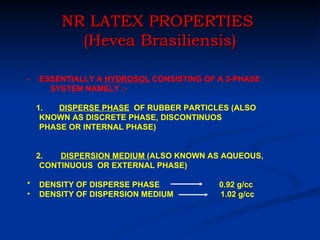
NR LATEX PROPERTIES
           (Hevea Brasiliensis)
-
-   ESSENTIALLY A HYDROSOL CONSISTING OF A 2-PHASE
      SYSTEM NAMELY :-

    1.   DISPERSE PHASE OF RUBBER PARTICLES (ALSO
     KNOWN AS DISCRETE PHASE, DISCONTINUOS
     PHASE OR INTERNAL PHASE)


    2.   DISPERSION MEDIUM (ALSO KNOWN AS AQUEOUS,
     CONTINUOUS OR EXTERNAL PHASE)

*   DENSITY OF DISPERSE PHASE            0.92 g/cc
•   DENSITY OF DISPERSION MEDIUM         1.02 g/cc
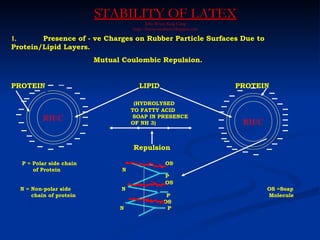
STABILITY OF LATEX
                                           John Woon Sung-Liang
                                    http://latexconsultants.blogspot.com

1.      Presence of - ve Charges on Rubber Particle Surfaces Due to
Protein/Lipid Layers.
                         Mutual Coulombic Repulsion.


PROTEIN                                LIPID                               PROTEIN

                                     (HYDROLYSED
                                    TO FATTY ACID
          RH/C                      SOAP IN PRESENCE
                                    OF NH 3)                                RH/C

                                    Repulsion

  P = Polar side chain                               OS-
      of Protein                N
                                                     P-
                                                     OS-
  N = Non-polar side           N                                                   OS =Soap
      chain of protein                               P-                            Molecule
                                                    OS-
                               N                     P-
   What is Nitrile or Buna-N or NBR
    Rubber?


   By John Woon Sung-Liang
   JW Latex Consultants (SA0052392P)
   http://latexconsultants.blogspot.com
   Email: woonsungliang@yahoo.com.sg
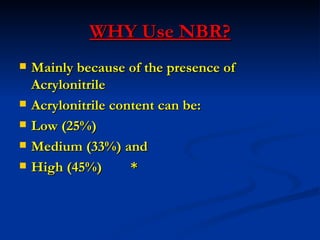
WHY Use NBR?
   Mainly because of the presence of
    Acrylonitrile
   Acrylonitrile content can be:
   Low (25%)
   Medium (33%) and
   High (45%)       *
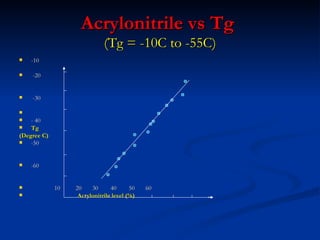
Acrylonitrile vs Tg
                             (Tg = -10C to -55C)
   -10

   -20


   -30


   - 40
   Tg
(Degree C)
   -50


   -60


            10   20    30      40      50   60
                  Acrylonitrile level (%)
Main Differences in Processing
          Compared with NR

   1) pH adjustment

   - Sensitive ……...

   - If below 9.0 …………

   - If above 9.8 …………

   Alkali must be added ………..
Formulation Design

 Review basic findings:


   1) Sulphur X-links ………

   2) Ionic X-links …….
   ZnO gives maximum ………

   3) Role played by KOH
 Latex Dipping Technology


 iohn woon sung-liang
 JW Latex Consultants (SA0052392-P)

 http://latexconsultants.blogspot.com

 Email: woonsungliang@yahoo.com.sg
THE DIPPING PROCESS
3 MAIN TYPES :-

1.   STRAIGHT DIPPING
     (OR SIMPLE DIPPING)
     0.03 – 0.04MM

2.   COAGULANT DIPPING
     0.1 – 1.0 MM

3.   HEAT – SENSITIVE DIPPING
     0.5 – 3.0MM
Properties of Good Antifoaming /
                Antiwebbing Agent
1.   Surface tension of antiwebbing agent must be lower than
     that of foaming solution or liquid

2.   Solubility of antiwebbing agent in foaming solution must
     be low enough but without causing cissing and oil spots.

5.   It must be readily dispersible in the liquid

4.   It must have high spreading coefficient
GLOVES FAULTS /
   DEFECTS
 By John Woon Sung-Liang
 http://latexconsultants.blogspot.com
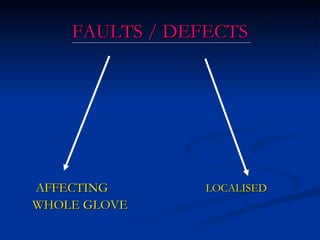
FAULTS / DEFECTS


AFFECTING       LOCALISED
WHOLE GLOVE
AFFECTING WHOLE GLOVE

1.   THICKNESS
2.   POWDER MARKS
3.   COLOUR
4.   FILM WEAKNESS (OCCLUSIONS ?)
5.   TACKINESS
6.   SURFACE BLEMISH (BLOOM?)
7.   SMELL
8.   TASTE
9.   MOULDY     *
LOCALISED DEFECTS

1.   PIN HOLES
2.   OCCLUSIONS
3.   COAGULUM
4.   RUNS OR STREAKS
5.   THICK EXTREMITIES
6.   CRACKS *
Polychloroprene Rubber
         (CR)


           John Woon Sung-Liang
    JW Latex Consultants (SA0052392-P)
    http://latexconsultants.blogspot.com
Polychloroprene Rubber (CR)
                 - Properties
   1) More polar than Butadiene due to
   carbon-chlorine bond but not as polar as Nitrile rubber (medium and
    high acrylonitrile level)

   2) Tg = - 45C

   3) Moderate resistance to hydrocarbon oil (cf Nitrile rubber)
   and good resistance to chemicals

   4) Excellent resistance to Ozone (O3) degradation

   5) Good adhesion to polar substrates

   6) Flame resistance (Self-extinguishing) *
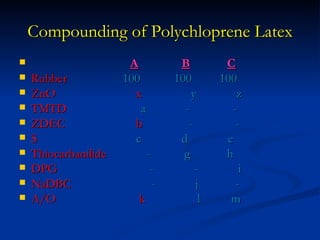
Compounding of Polychloprene Latex
                      A             B         C
   Rubber            100           100       100
   ZnO                 x               y        z
   TMTD                  a           -         -
   ZDEC                b              -         -
   S                   c            d         e
   Thiocarbanilide           -       g        h
   DPG                        -         -        i
   NaDBC                       -        j       -
   A/O                  k                l     m
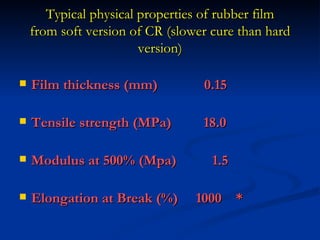
Typical physical properties of rubber film
    from soft version of CR (slower cure than hard
                        version)

   Film thickness (mm)           0.15

   Tensile strength (MPa)        18.0

   Modulus at 500% (Mpa)           1.5

   Elongation at Break (%)      1000 *
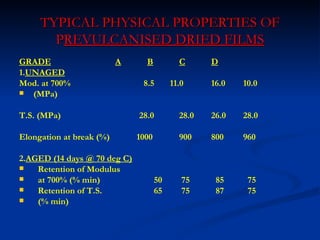
TYPICAL PHYSICAL PROPERTIES OF
       PREVULCANISED DRIED FILMS
GRADE                     A     B           C      D
1.UNAGED
Mod. at 700%                   8.5        11.0     16.0   10.0
  (MPa)

T.S. (MPa)                    28.0          28.0   26.0   28.0

Elongation at break (%)       1000          900    800    960

2.AGED (14 days @ 70 deg C)
   Retention of Modulus
   at 700% (% min)                  50      75     85     75
   Retention of T.S.                65      75     87     75
   (% min)
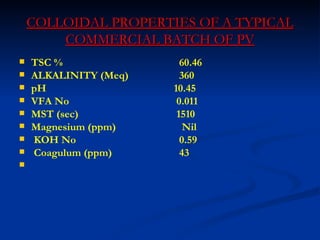
COLLOIDAL PROPERTIES OF A TYPICAL
        COMMERCIAL BATCH OF PV
   TSC %                60.46
   ALKALINITY (Meq)     360
   pH                 10.45
   VFA No              0.011
   MST (sec)           1510
   Magnesium (ppm)       Nil
   KOH No               0.59
   Coagulum (ppm)       43

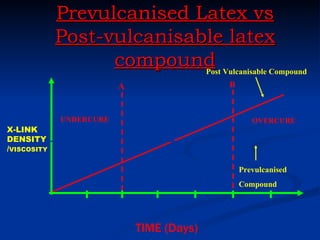
Prevulcanised Latex vs
             Post-vulcanisable latex
                   compound Vulcanisable Compound
                            Post
                         A                 B


             UNDERCURE                            OVERCURE
X-LINK
DENSITY
/VISCOSITY

                                               Prevulcanised
                                               Compound

                 1       2      3      4   5           6


                             TIME (Days)

PowerPoint Training Slides Used By John Woon Latex Consultants

  • 1.
    Examples of Training Slides Used by John Woon Latex Consultants
  • 2.
    NR LATEX PROPERTIES (Hevea Brasiliensis) John Woon Sung-Liang JW Latex Consultants http://latexconsultants.blogsp ot.com
  • 3.
    NR LATEX PROPERTIES (Hevea Brasiliensis) - - ESSENTIALLY A HYDROSOL CONSISTING OF A 2-PHASE SYSTEM NAMELY :- 1. DISPERSE PHASE OF RUBBER PARTICLES (ALSO KNOWN AS DISCRETE PHASE, DISCONTINUOS PHASE OR INTERNAL PHASE) 2. DISPERSION MEDIUM (ALSO KNOWN AS AQUEOUS, CONTINUOUS OR EXTERNAL PHASE) * DENSITY OF DISPERSE PHASE 0.92 g/cc • DENSITY OF DISPERSION MEDIUM 1.02 g/cc
  • 4.
    STABILITY OF LATEX John Woon Sung-Liang http://latexconsultants.blogspot.com 1. Presence of - ve Charges on Rubber Particle Surfaces Due to Protein/Lipid Layers. Mutual Coulombic Repulsion. PROTEIN LIPID PROTEIN (HYDROLYSED TO FATTY ACID RH/C SOAP IN PRESENCE OF NH 3) RH/C Repulsion P = Polar side chain OS- of Protein N P- OS- N = Non-polar side N OS =Soap chain of protein P- Molecule OS- N P-
  • 5.
    What is Nitrile or Buna-N or NBR Rubber?  By John Woon Sung-Liang  JW Latex Consultants (SA0052392P)  http://latexconsultants.blogspot.com  Email: woonsungliang@yahoo.com.sg
  • 6.
    WHY Use NBR?  Mainly because of the presence of Acrylonitrile  Acrylonitrile content can be:  Low (25%)  Medium (33%) and  High (45%) *
  • 7.
    Acrylonitrile vs Tg (Tg = -10C to -55C)  -10  -20  -30   - 40  Tg (Degree C)  -50  -60  10 20 30 40 50 60  Acrylonitrile level (%)
  • 8.
    Main Differences inProcessing Compared with NR  1) pH adjustment  - Sensitive ……...  - If below 9.0 …………  - If above 9.8 …………  Alkali must be added ………..
  • 9.
    Formulation Design  Reviewbasic findings:  1) Sulphur X-links ………  2) Ionic X-links …….  ZnO gives maximum ………  3) Role played by KOH
  • 10.
     Latex DippingTechnology  iohn woon sung-liang  JW Latex Consultants (SA0052392-P)  http://latexconsultants.blogspot.com  Email: woonsungliang@yahoo.com.sg
  • 11.
    THE DIPPING PROCESS 3MAIN TYPES :- 1. STRAIGHT DIPPING (OR SIMPLE DIPPING) 0.03 – 0.04MM 2. COAGULANT DIPPING 0.1 – 1.0 MM 3. HEAT – SENSITIVE DIPPING 0.5 – 3.0MM
  • 12.
    Properties of GoodAntifoaming / Antiwebbing Agent 1. Surface tension of antiwebbing agent must be lower than that of foaming solution or liquid 2. Solubility of antiwebbing agent in foaming solution must be low enough but without causing cissing and oil spots. 5. It must be readily dispersible in the liquid 4. It must have high spreading coefficient
  • 13.
    GLOVES FAULTS / DEFECTS By John Woon Sung-Liang http://latexconsultants.blogspot.com
  • 14.
    FAULTS / DEFECTS AFFECTING LOCALISED WHOLE GLOVE
  • 15.
    AFFECTING WHOLE GLOVE 1. THICKNESS 2. POWDER MARKS 3. COLOUR 4. FILM WEAKNESS (OCCLUSIONS ?) 5. TACKINESS 6. SURFACE BLEMISH (BLOOM?) 7. SMELL 8. TASTE 9. MOULDY *
  • 16.
    LOCALISED DEFECTS 1. PIN HOLES 2. OCCLUSIONS 3. COAGULUM 4. RUNS OR STREAKS 5. THICK EXTREMITIES 6. CRACKS *
  • 17.
    Polychloroprene Rubber (CR) John Woon Sung-Liang JW Latex Consultants (SA0052392-P) http://latexconsultants.blogspot.com
  • 18.
    Polychloroprene Rubber (CR) - Properties  1) More polar than Butadiene due to  carbon-chlorine bond but not as polar as Nitrile rubber (medium and high acrylonitrile level)  2) Tg = - 45C  3) Moderate resistance to hydrocarbon oil (cf Nitrile rubber)  and good resistance to chemicals  4) Excellent resistance to Ozone (O3) degradation  5) Good adhesion to polar substrates  6) Flame resistance (Self-extinguishing) *
  • 19.
    Compounding of PolychlopreneLatex  A B C  Rubber 100 100 100  ZnO x y z  TMTD a - -  ZDEC b - -  S c d e  Thiocarbanilide - g h  DPG - - i  NaDBC - j -  A/O k l m
  • 20.
    Typical physical propertiesof rubber film from soft version of CR (slower cure than hard version)  Film thickness (mm) 0.15  Tensile strength (MPa) 18.0  Modulus at 500% (Mpa) 1.5  Elongation at Break (%) 1000 *
  • 22.
    TYPICAL PHYSICAL PROPERTIESOF PREVULCANISED DRIED FILMS GRADE A B C D 1.UNAGED Mod. at 700% 8.5 11.0 16.0 10.0  (MPa) T.S. (MPa) 28.0 28.0 26.0 28.0 Elongation at break (%) 1000 900 800 960 2.AGED (14 days @ 70 deg C)  Retention of Modulus  at 700% (% min) 50 75 85 75  Retention of T.S. 65 75 87 75  (% min)
  • 23.
    COLLOIDAL PROPERTIES OFA TYPICAL COMMERCIAL BATCH OF PV  TSC % 60.46  ALKALINITY (Meq) 360  pH 10.45  VFA No 0.011  MST (sec) 1510  Magnesium (ppm) Nil  KOH No 0.59  Coagulum (ppm) 43 
  • 24.
    Prevulcanised Latex vs Post-vulcanisable latex compound Vulcanisable Compound Post A B UNDERCURE OVERCURE X-LINK DENSITY /VISCOSITY Prevulcanised Compound 1 2 3 4 5 6 TIME (Days)