Salcombe, Devon 2013


The Cambridge Trimaster


             by
      Malcolm Mackley


                            1
The 1990s
          Filament stretching and thinning of fluids has been extensively
studied for many decades and in particular in relation to the so called Trouton
Ratio, which is the ratio of the extensional viscosity to the simple shear
viscosity. Newtonian fluids have a Trouton ratio of 3, however polymer based
fluids can have Trouton ratios much greater than 3.
           The Polymer Fluids Group at Cambridge had a long term interest in
extensional behaviour and in the 1990s we had the opportunity to purchase
what we called “The Russian Rheometer”. This was a period of great change in
Russia and in order to purchase the rheometer, money had to be sent to a
Canadian bank account and our Technical Officer, Robert Marshall was asked
to collect the apparatus by hand from a pub in East London!
          Dr Ruifeng (Ray) Liang was working in the Group at the time and he
carried out a range of filament thinning experiments using the apparatus. The
trigger mechanism to form the initial filament was not totally reproducable,
however the optical centre line detector measuring filament thickness as a
function of time worked well.

                                                            2
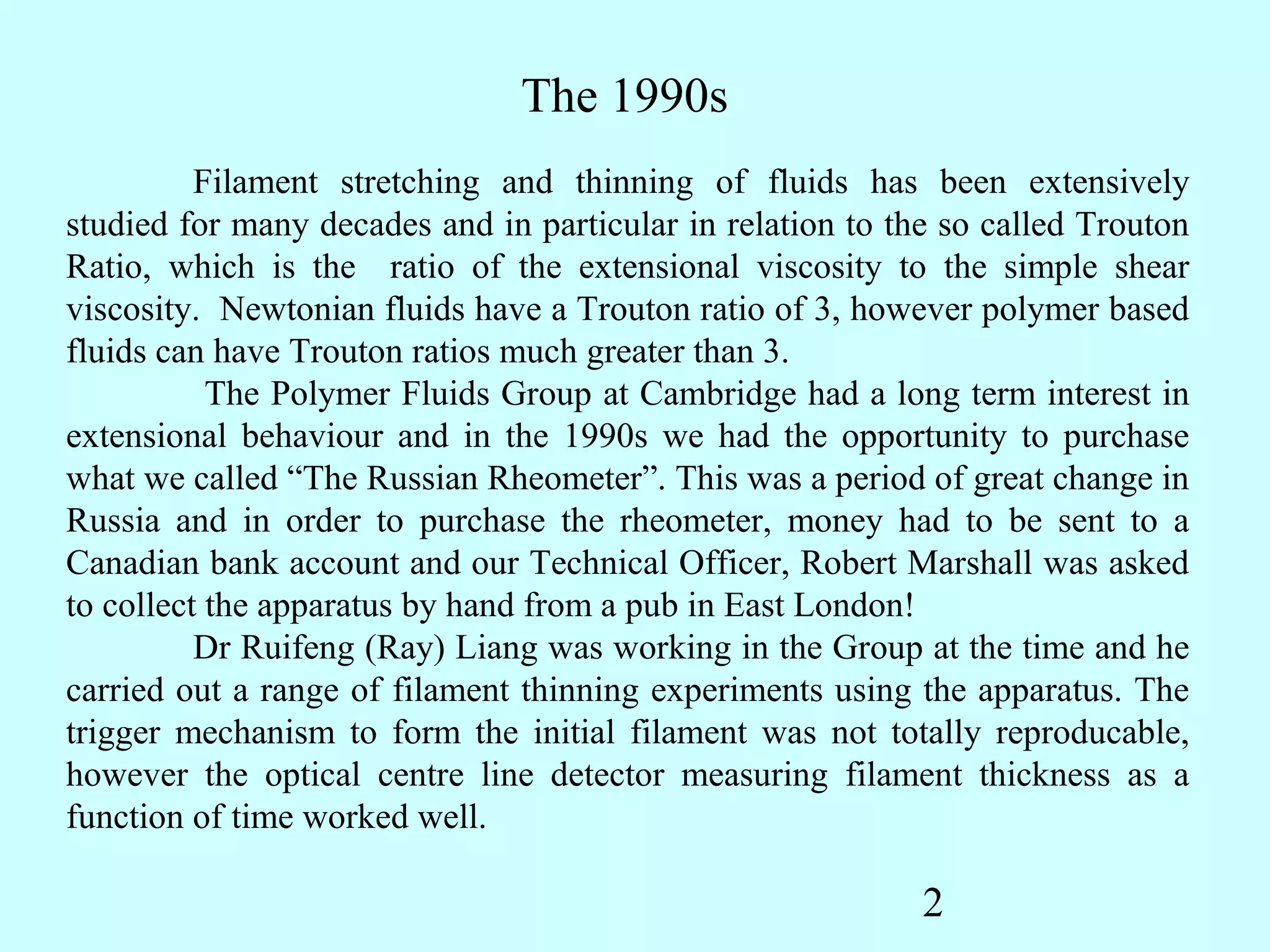
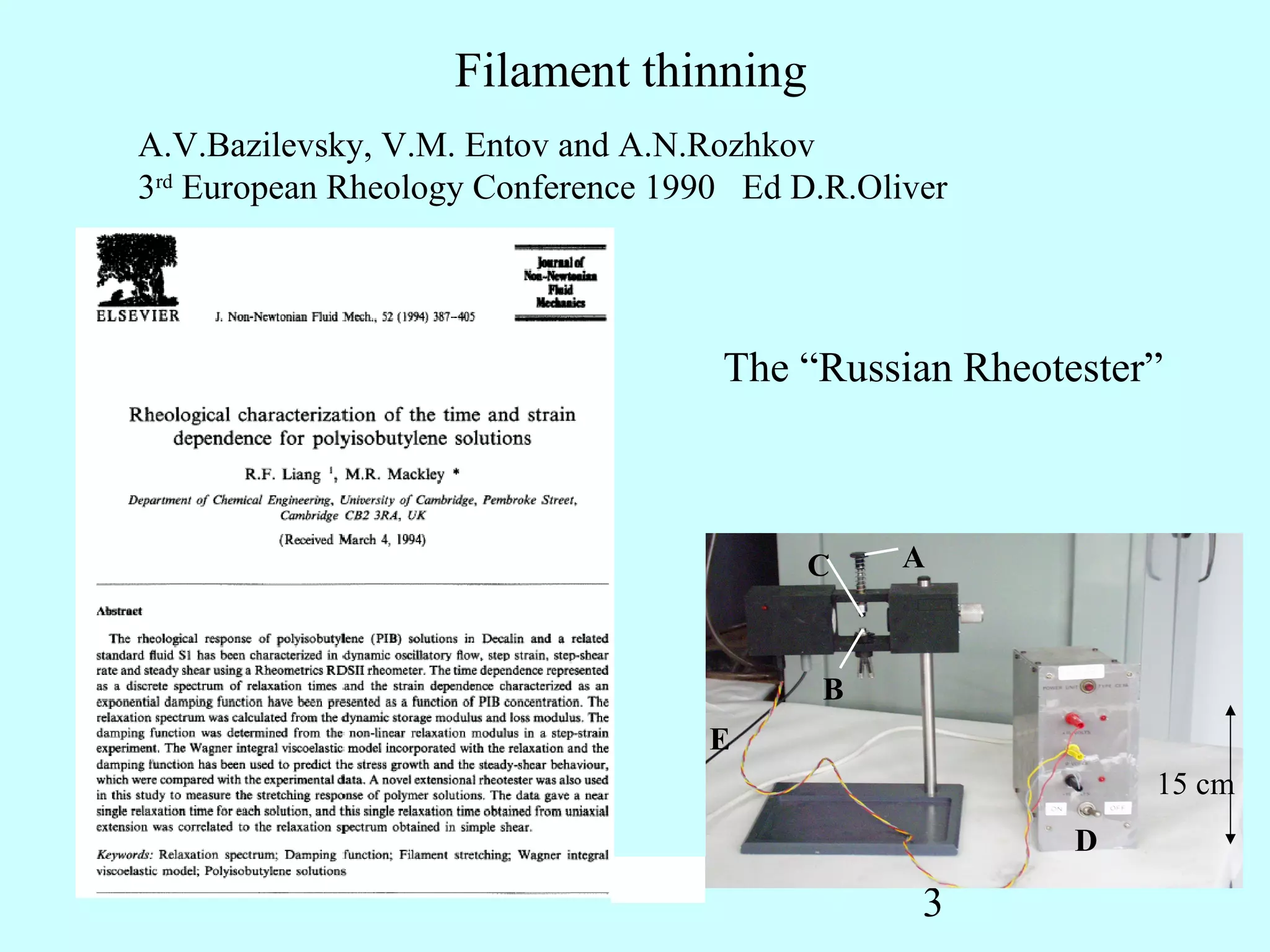
Filament thinning
A.V.Bazilevsky, V.M. Entov and A.N.Rozhkov
3rd European Rheology Conference 1990 Ed D.R.Oliver


                                    The “Russian Rheotester”


                                          C     A


                                           B
                                    E
                                                           15 cm
                                                       D

                                                 3
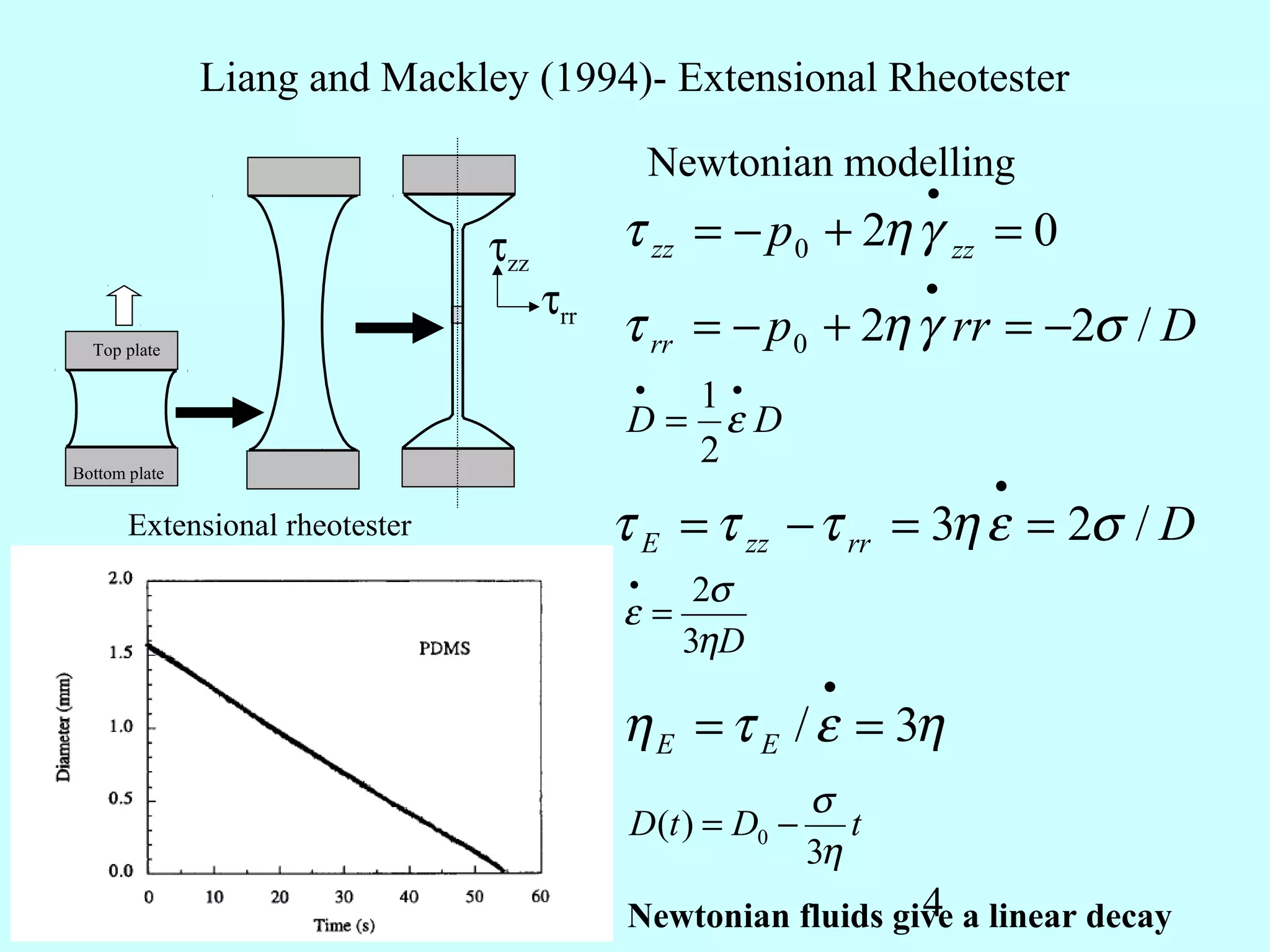
Liang and Mackley (1994)- Extensional Rheotester

                                                 Newtonian modelling
                                                                   •

                                τzz         τ zz = − p 0 + 2η γ zz = 0
                                                                   •
                                      τrr
  Top plate
                                            τ rr = − p 0 + 2η γ rr = −2σ / D
                                             •1•
                                            D= εD
Bottom plate
                                              2
                                                                       •
       Extensional rheotester               τ E = τ zz − τ rr = 3η ε = 2σ / D
                                             •     2σ
                                            ε=
                                                  3ηD
                                                             •
                                            η E = τ E / ε = 3η
                                                            σ
                                             D(t ) = D0 −      t
                                                            3η
                                                               4
                                            Newtonian fluids give a linear decay
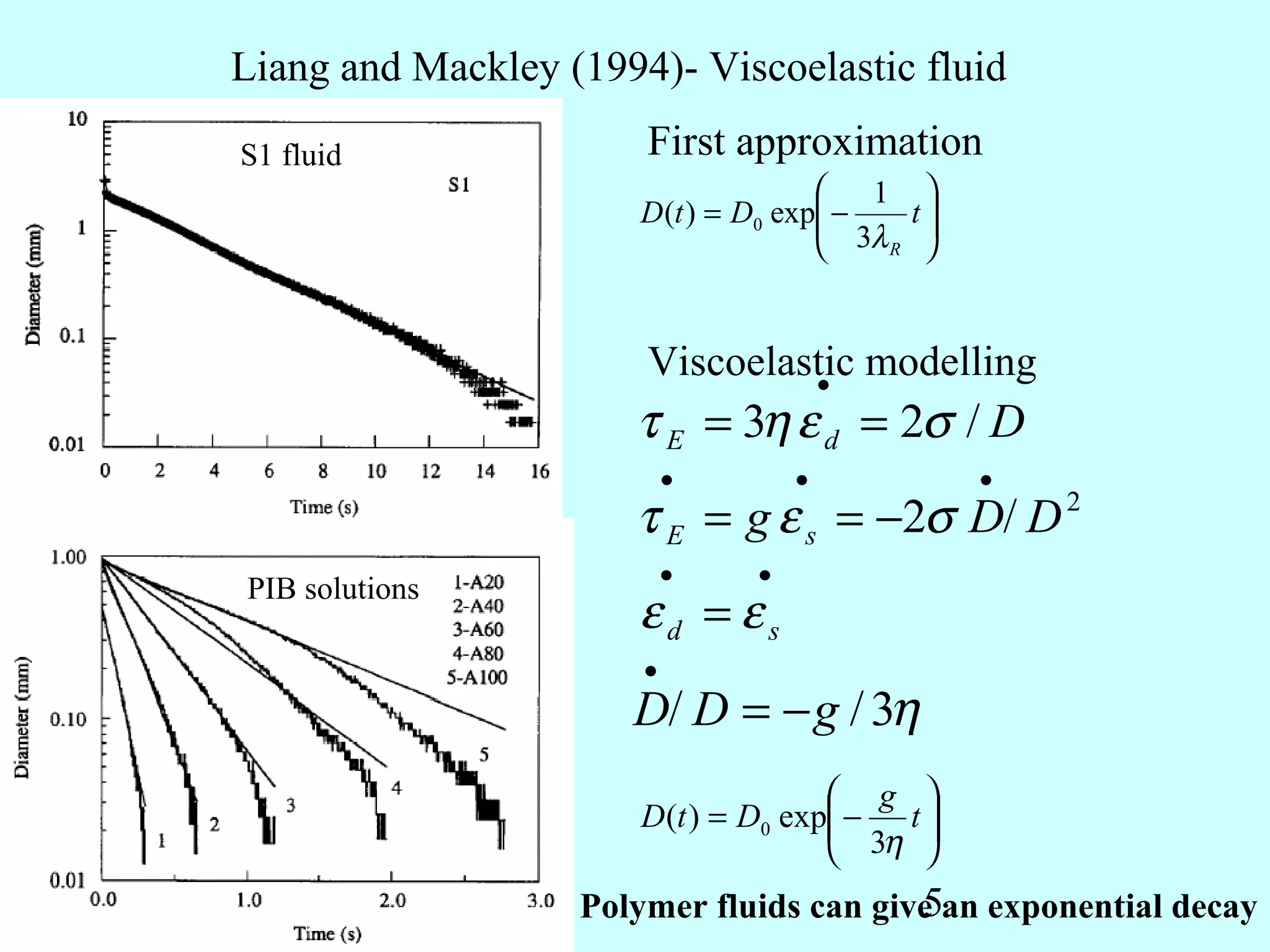
Liang and Mackley (1994)- Viscoelastic fluid

S1 fluid               First approximation
                                       1       
                       D (t ) = D0 exp −
                                       3λ     t
                                                
                                          R    


                       Viscoelastic modelling
                                •
                       τ E = 3η ε d = 2σ / D
                           •        •               •
                       τ E = g ε s = −2σ D/ D 2
                           •    •
PIB solutions
                       εd = εs
                       •
                      D/ D = − g / 3η
                                       g 
                       D (t ) = D0 exp − t 
                                       3η 
                                           
                                         5
                   Polymer fluids can give an exponential decay
The 2000s
          In the 2000s the importance of ink jet rheology became apparent to
both ink formulators and ink jet device manufacturers. Ink jet fluids usually
have a low viscosity and their filament stretch and breakup behaviour when
the ink leaves the ink jet nozzle can be crucial in relation to performance. The
drop breakup times of order ms can be particularly sensitive to formulation.
          The stretch and experimentally measurable filament thinning time
scales for the “Russian Rheometer” were too long for ink jet fluid
characterisation and so Dr Tri Tuladhar, working in the Polymer Fluids Group
at Cambridge, evaluated the Cambridge Multipass Rheometer (MPR) as a
potential fast filament and stretch and breakup device.
          The MPR proved to be an excellent filament stretching device as the
twin piston movement was very fast and precise and the pistons were
controlled by the servo hydraulics of the apparatus. An additional bonus of
the apparatus was that the two pistons could move in opposite directions,
leaving the centre of the fluid in a fixed position. We now call this MPR
configuration the MK1 Trimaster. In order to capture the ms timescales of the
experiment it was necessary to use a high speed camera.

                                                            6
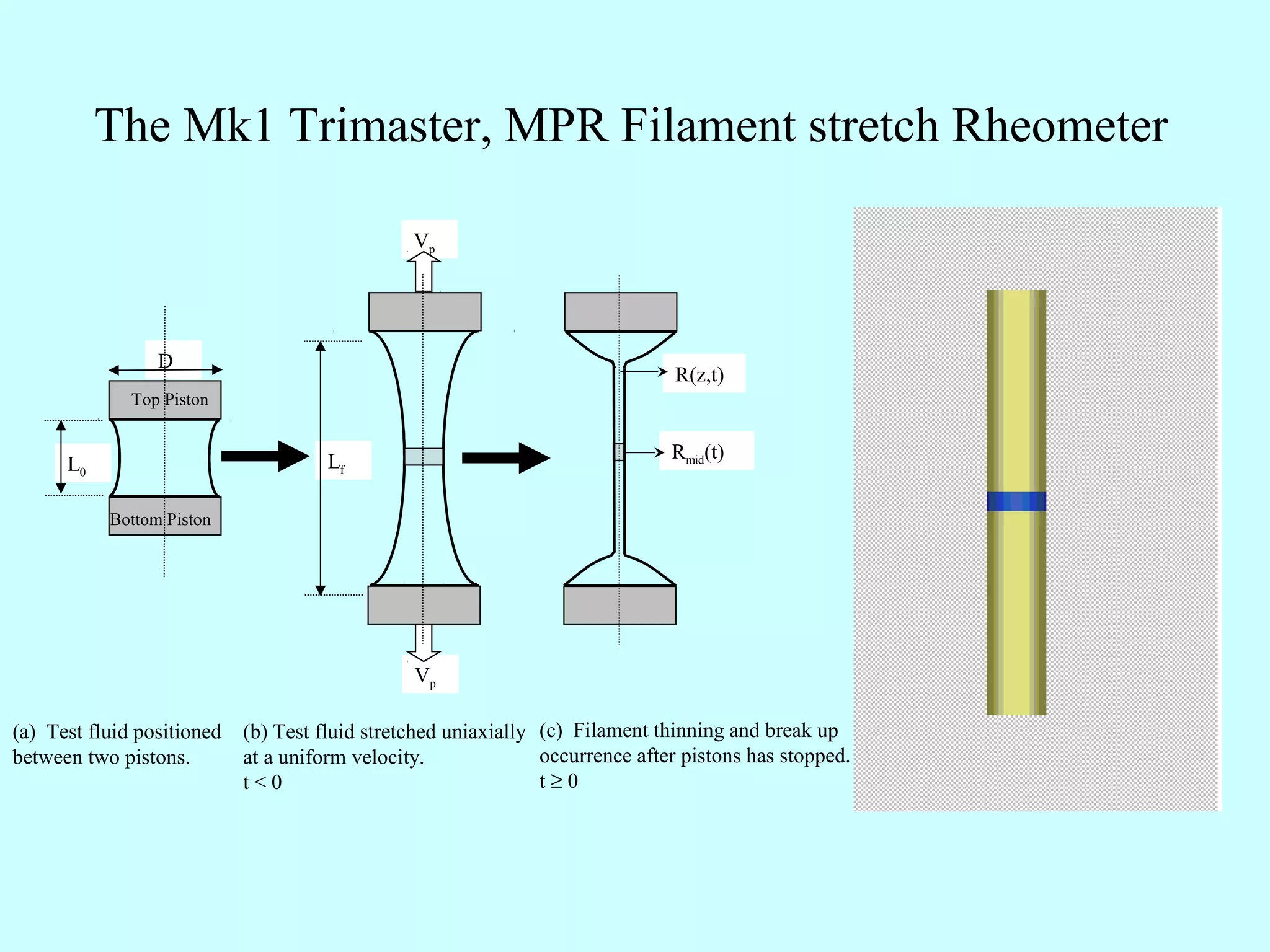
The Mk1 Trimaster, MPR Filament stretch Rheometer

                                                Vp


                 D
                                                                               R(z,t)
              Top Piston


                                      Lf                                       Rmid(t)
      L0

           Bottom Piston


                                                Vp

(a) Test fluid positioned   (b) Test fluid stretched uniaxially (c) Filament thinning and break up
between two pistons.        at a uniform velocity.              occurrence after pistons has stopped.
                            t<0                                 t≥0


                                                                                                        7
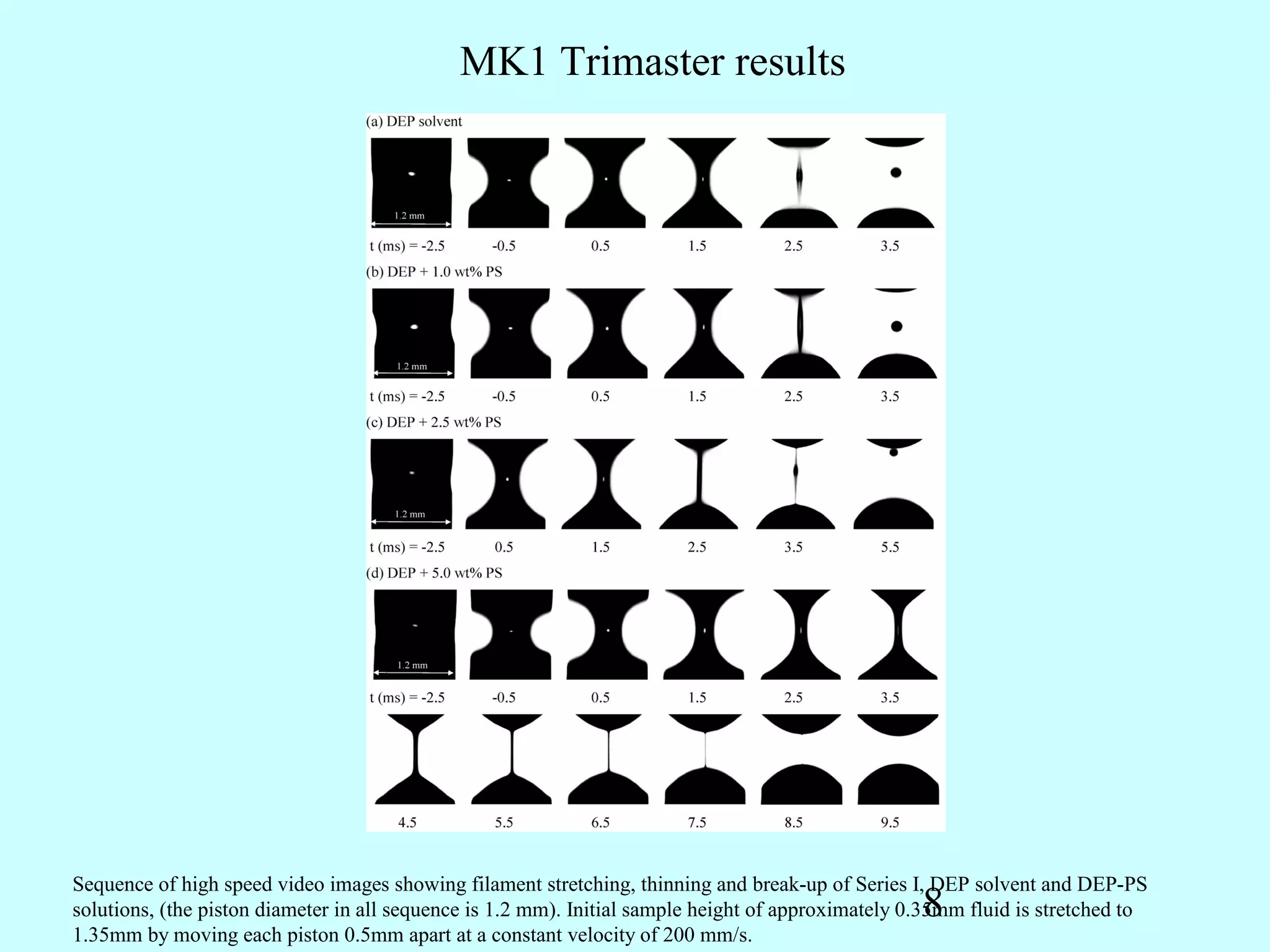
MK1 Trimaster results


Sequence of high speed video images showing filament stretching, thinning and break-up of Series I, DEP solvent and DEP-PS
                                                                                                    8
solutions, (the piston diameter in all sequence is 1.2 mm). Initial sample height of approximately 0.35mm fluid is stretched to
1.35mm by moving each piston 0.5mm apart at a constant velocity of 200 mm/s.
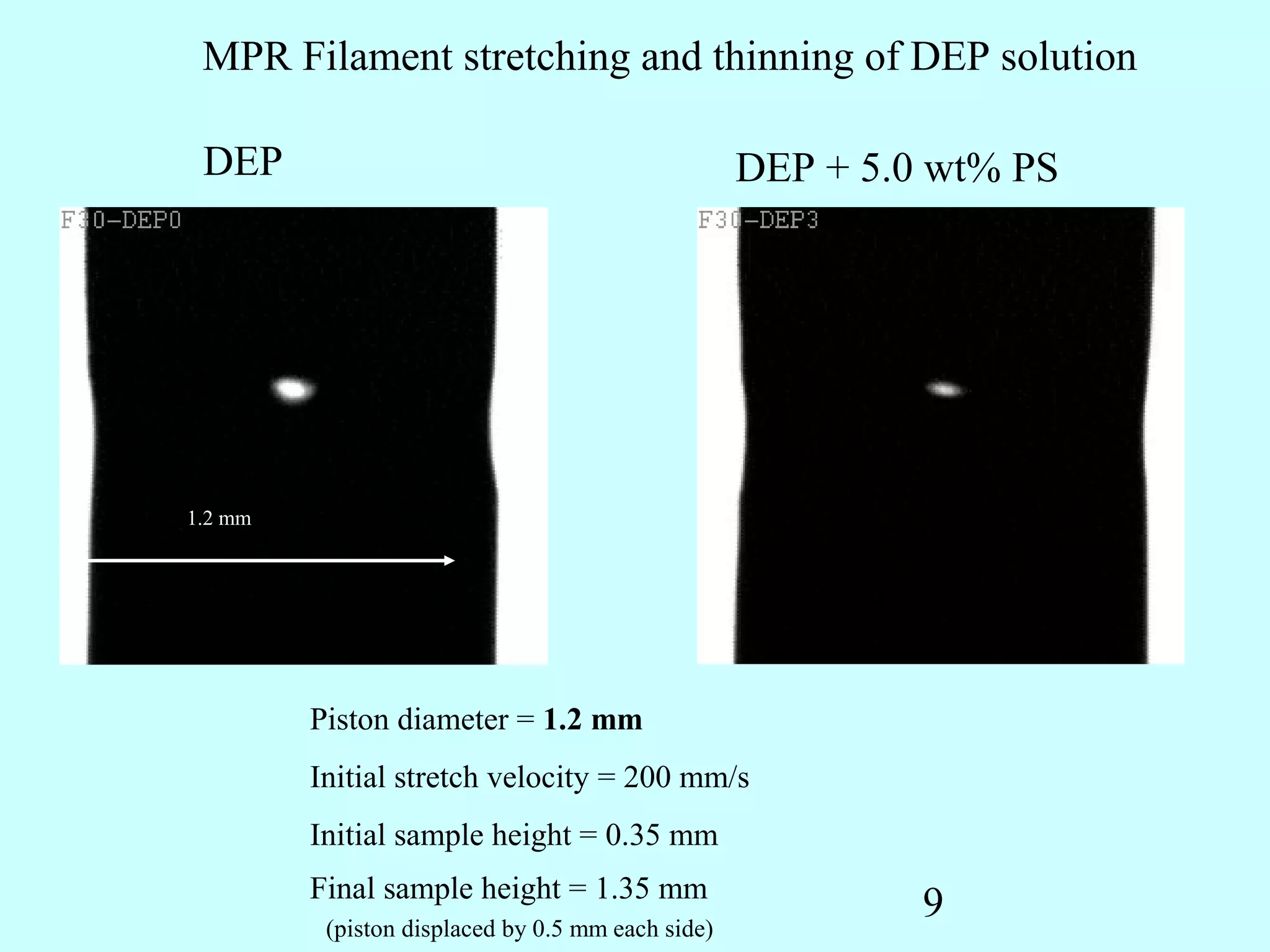
MPR Filament stretching and thinning of DEP solution

 DEP                                               DEP + 5.0 wt% PS


1.2 mm


         Piston diameter = 1.2 mm
         Initial stretch velocity = 200 mm/s
         Initial sample height = 0.35 mm
         Final sample height = 1.35 mm
          (piston displaced by 0.5 mm each side)
                                                            9
The Mk2-4 Cambridge Trimasters
           The Mk1 Cambridge Trimaster was an effective apparatus, but
we felt at the time the use of the MPR servo hydraulics to activate the
pistons was “rather like using a sledge hammer to crack a nut.” In addition
we wanted to produce a lower cost unit that potentially could be used by
others.
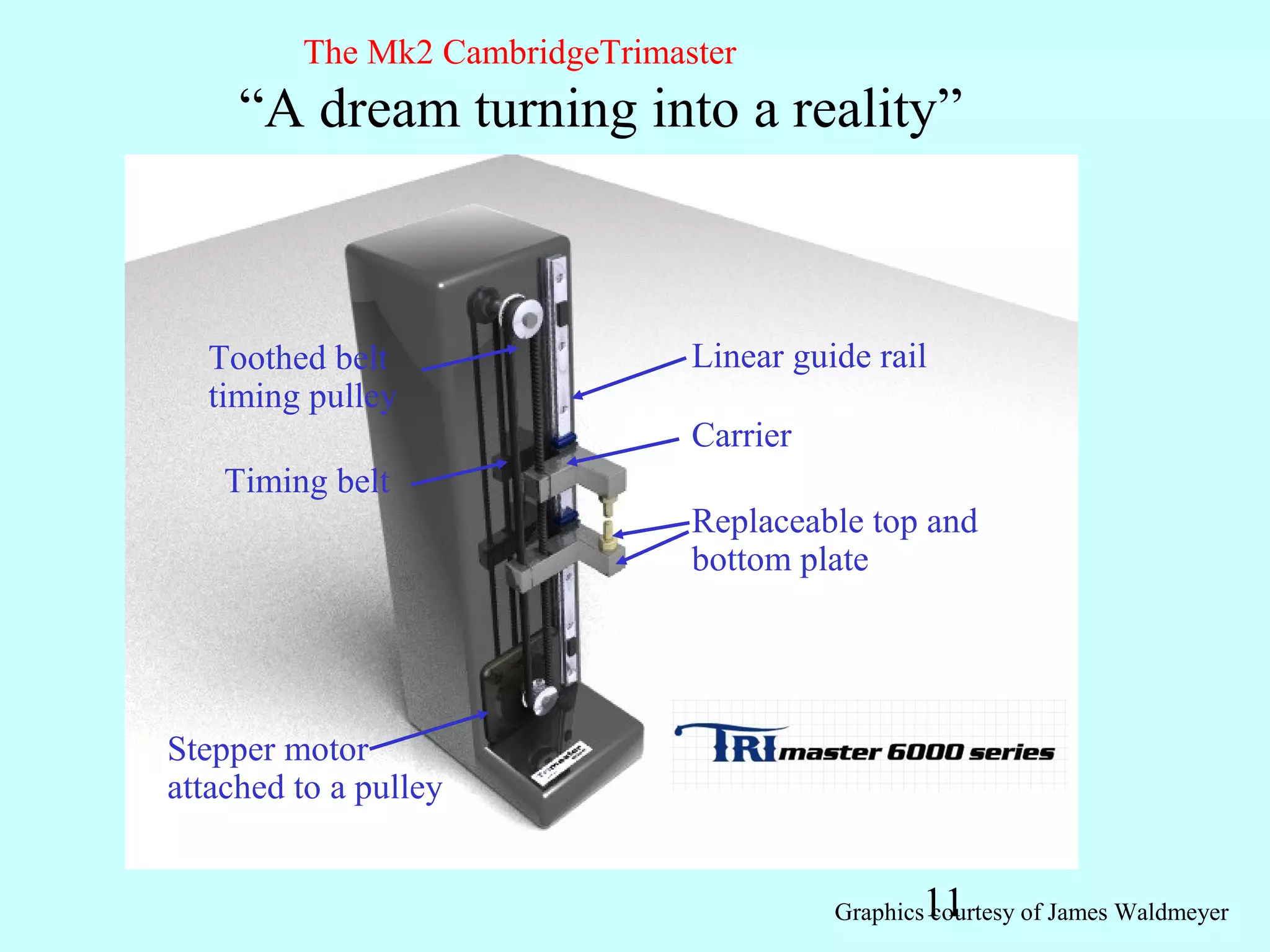
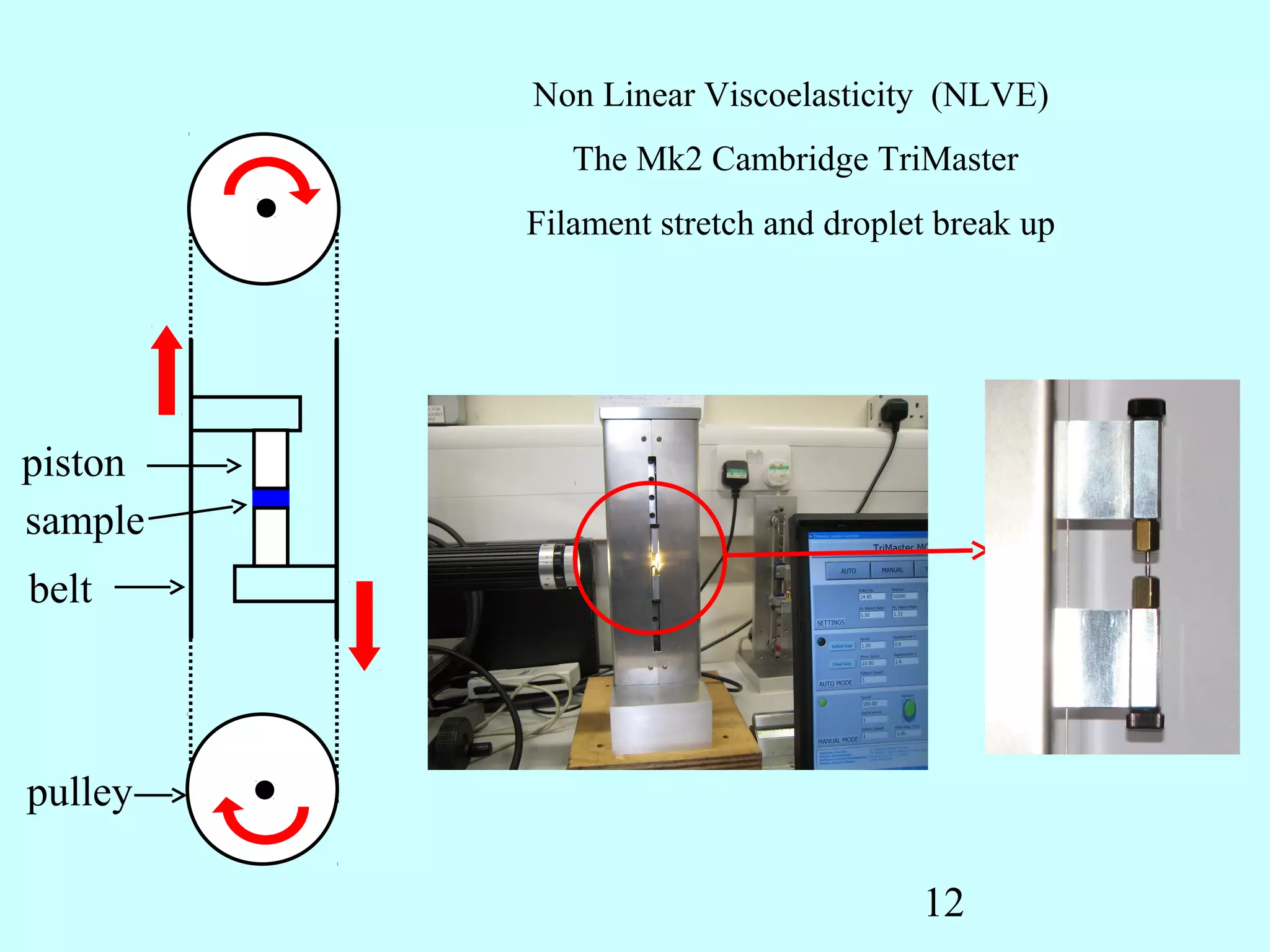
         In 2008 The Mk2 Cambridge Trimaster was designed as a purpose
built Filament stretch, thin and breakup device. The unit worked on the
same principle as the MK1 with equal and opposite piston movements,
however the drive was from a single stepper motor. The Mk2 Trimaster
proved to be an effective apparatus and both Dr Tri Tuladhar and Dr
Damien Vadillo carried out useful experiments with the apparatus.
         In an attempt to achieve higher piston speeds than the Mk2
Trimaster a Mk3 unit was prototyped using voice coil activation. This
apparatus was designed and built by a Company “The Ideas Studio”,
however it was not a success and the project was abandoned in 2010.
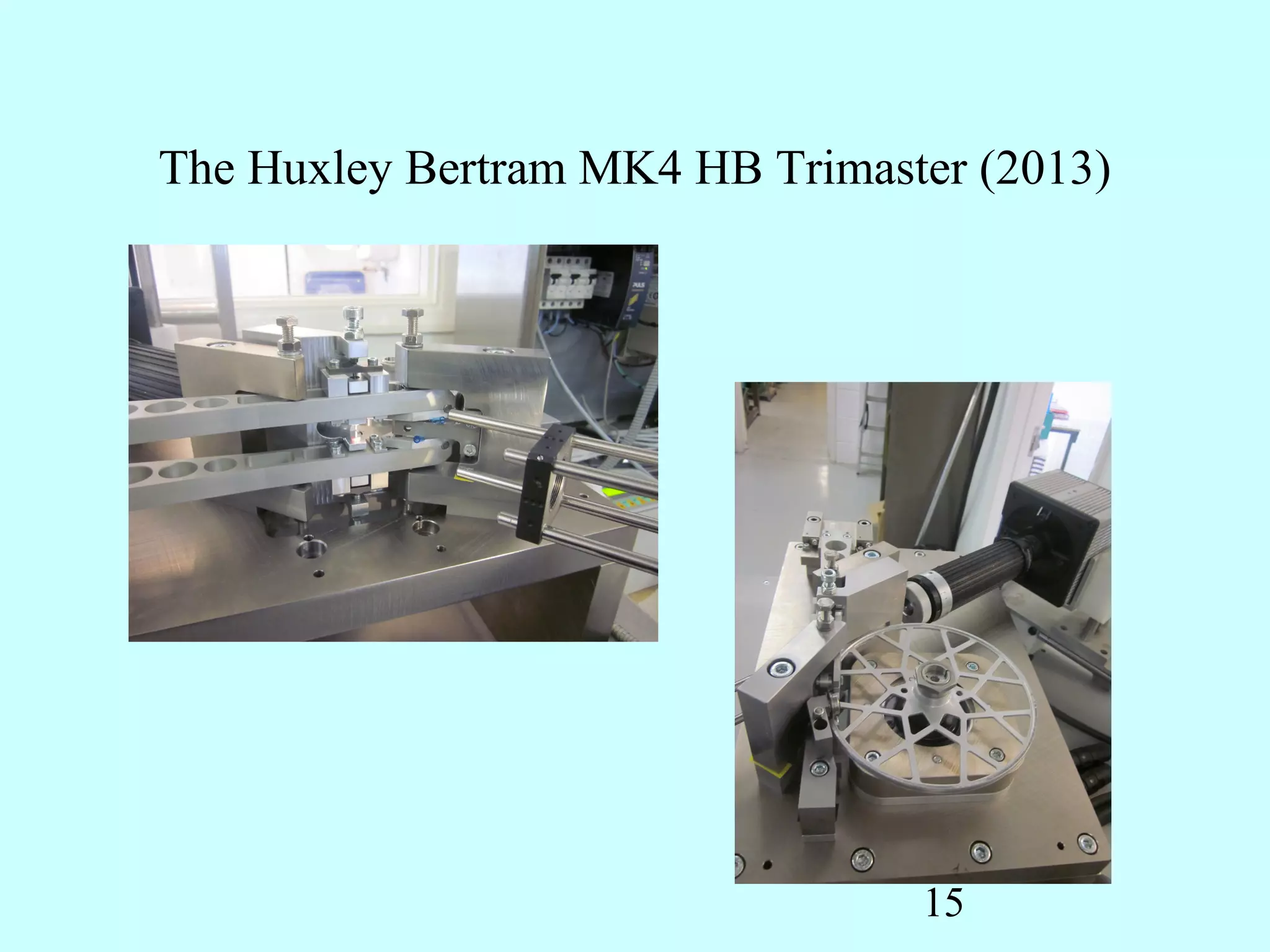
         Currently (2013) a Mk4 HB Trimaster manufactured by a
Company Huxley Bertram is being trialled and this instrument looks very
promising.                                               10
The Mk2 CambridgeTrimaster
     “A dream turning into a reality”


  Toothed belt                  Linear guide rail
  timing pulley
                                Carrier
    Timing belt
                                Replaceable top and
                                bottom plate


Stepper motor
attached to a pulley


                                                  11
                                          Graphics courtesy of James Waldmeyer
Non Linear Viscoelasticity (NLVE)
            The Mk2 Cambridge TriMaster
         Filament stretch and droplet break up


piston
sample
belt


pulley

                                    12
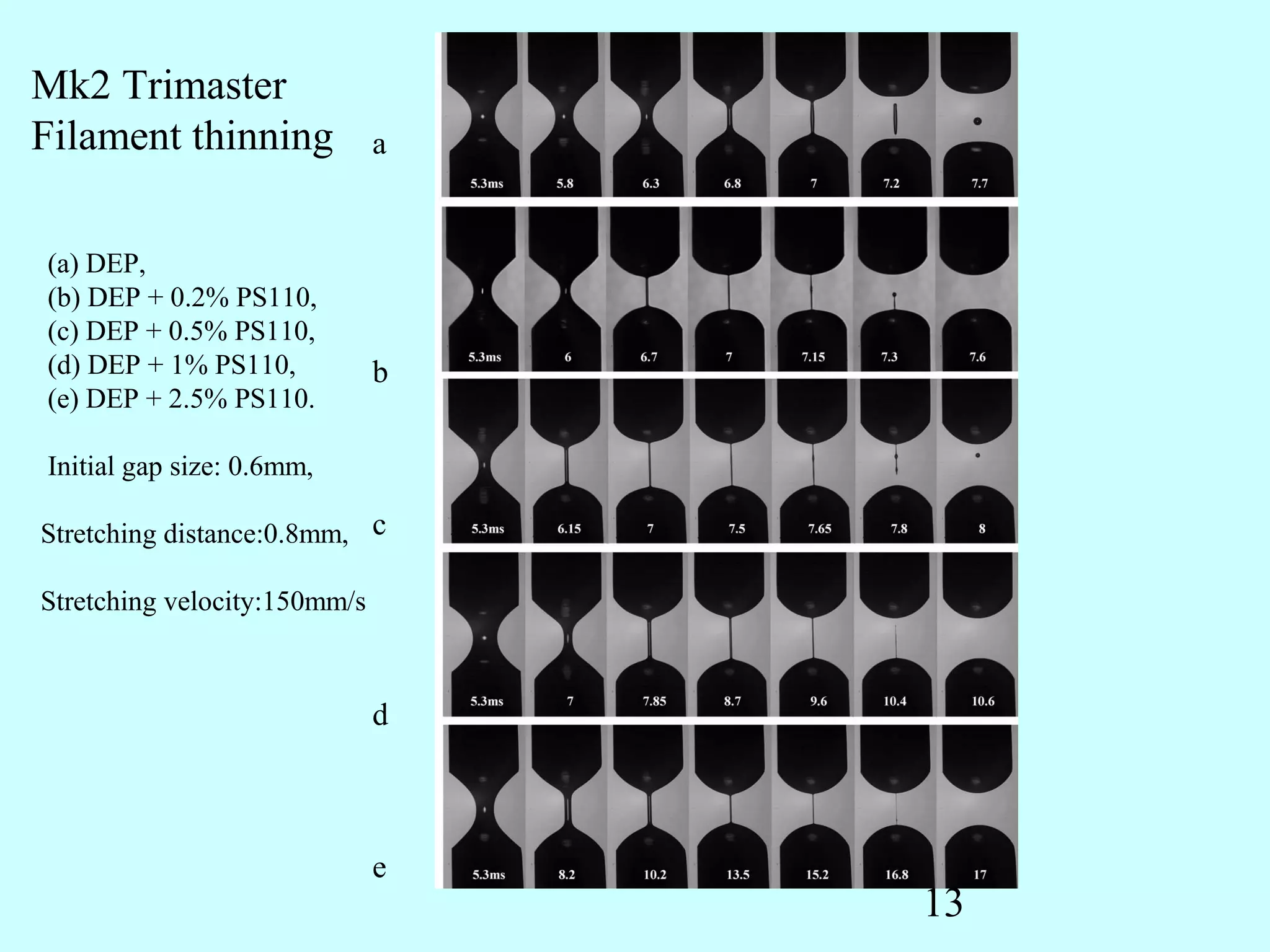
Mk2 Trimaster
Filament thinning             a


(a) DEP,
(b) DEP + 0.2% PS110,
(c) DEP + 0.5% PS110,
(d) DEP + 1% PS110,           b
(e) DEP + 2.5% PS110.

Initial gap size: 0.6mm,

Stretching distance:0.8mm, c

Stretching velocity:150mm/s


                              d


                              e
                                  13
“Trimasters”


Tri Tuladhar


                         Damien Vadillo
                                14
The Huxley Bertram MK4 HB Trimaster (2013)


                                 15

The Cambridge Trimaster 2013

  • 1.
    Salcombe, Devon 2013 TheCambridge Trimaster by Malcolm Mackley 1
  • 2.
    The 1990s Filament stretching and thinning of fluids has been extensively studied for many decades and in particular in relation to the so called Trouton Ratio, which is the ratio of the extensional viscosity to the simple shear viscosity. Newtonian fluids have a Trouton ratio of 3, however polymer based fluids can have Trouton ratios much greater than 3. The Polymer Fluids Group at Cambridge had a long term interest in extensional behaviour and in the 1990s we had the opportunity to purchase what we called “The Russian Rheometer”. This was a period of great change in Russia and in order to purchase the rheometer, money had to be sent to a Canadian bank account and our Technical Officer, Robert Marshall was asked to collect the apparatus by hand from a pub in East London! Dr Ruifeng (Ray) Liang was working in the Group at the time and he carried out a range of filament thinning experiments using the apparatus. The trigger mechanism to form the initial filament was not totally reproducable, however the optical centre line detector measuring filament thickness as a function of time worked well. 2
  • 3.
    Filament thinning A.V.Bazilevsky, V.M.Entov and A.N.Rozhkov 3rd European Rheology Conference 1990 Ed D.R.Oliver The “Russian Rheotester” C A B E 15 cm D 3
  • 4.
    Liang and Mackley(1994)- Extensional Rheotester Newtonian modelling • τzz τ zz = − p 0 + 2η γ zz = 0 • τrr Top plate τ rr = − p 0 + 2η γ rr = −2σ / D •1• D= εD Bottom plate 2 • Extensional rheotester τ E = τ zz − τ rr = 3η ε = 2σ / D • 2σ ε= 3ηD • η E = τ E / ε = 3η σ D(t ) = D0 − t 3η 4 Newtonian fluids give a linear decay
  • 5.
    Liang and Mackley(1994)- Viscoelastic fluid S1 fluid First approximation  1  D (t ) = D0 exp −  3λ t   R  Viscoelastic modelling • τ E = 3η ε d = 2σ / D • • • τ E = g ε s = −2σ D/ D 2 • • PIB solutions εd = εs • D/ D = − g / 3η  g  D (t ) = D0 exp − t   3η    5 Polymer fluids can give an exponential decay
  • 6.
    The 2000s In the 2000s the importance of ink jet rheology became apparent to both ink formulators and ink jet device manufacturers. Ink jet fluids usually have a low viscosity and their filament stretch and breakup behaviour when the ink leaves the ink jet nozzle can be crucial in relation to performance. The drop breakup times of order ms can be particularly sensitive to formulation. The stretch and experimentally measurable filament thinning time scales for the “Russian Rheometer” were too long for ink jet fluid characterisation and so Dr Tri Tuladhar, working in the Polymer Fluids Group at Cambridge, evaluated the Cambridge Multipass Rheometer (MPR) as a potential fast filament and stretch and breakup device. The MPR proved to be an excellent filament stretching device as the twin piston movement was very fast and precise and the pistons were controlled by the servo hydraulics of the apparatus. An additional bonus of the apparatus was that the two pistons could move in opposite directions, leaving the centre of the fluid in a fixed position. We now call this MPR configuration the MK1 Trimaster. In order to capture the ms timescales of the experiment it was necessary to use a high speed camera. 6
  • 7.
    The Mk1 Trimaster,MPR Filament stretch Rheometer Vp D R(z,t) Top Piston Lf Rmid(t) L0 Bottom Piston Vp (a) Test fluid positioned (b) Test fluid stretched uniaxially (c) Filament thinning and break up between two pistons. at a uniform velocity. occurrence after pistons has stopped. t<0 t≥0 7
  • 8.
    MK1 Trimaster results Sequenceof high speed video images showing filament stretching, thinning and break-up of Series I, DEP solvent and DEP-PS 8 solutions, (the piston diameter in all sequence is 1.2 mm). Initial sample height of approximately 0.35mm fluid is stretched to 1.35mm by moving each piston 0.5mm apart at a constant velocity of 200 mm/s.
  • 9.
    MPR Filament stretchingand thinning of DEP solution DEP DEP + 5.0 wt% PS 1.2 mm Piston diameter = 1.2 mm Initial stretch velocity = 200 mm/s Initial sample height = 0.35 mm Final sample height = 1.35 mm (piston displaced by 0.5 mm each side) 9
  • 10.
    The Mk2-4 CambridgeTrimasters The Mk1 Cambridge Trimaster was an effective apparatus, but we felt at the time the use of the MPR servo hydraulics to activate the pistons was “rather like using a sledge hammer to crack a nut.” In addition we wanted to produce a lower cost unit that potentially could be used by others. In 2008 The Mk2 Cambridge Trimaster was designed as a purpose built Filament stretch, thin and breakup device. The unit worked on the same principle as the MK1 with equal and opposite piston movements, however the drive was from a single stepper motor. The Mk2 Trimaster proved to be an effective apparatus and both Dr Tri Tuladhar and Dr Damien Vadillo carried out useful experiments with the apparatus. In an attempt to achieve higher piston speeds than the Mk2 Trimaster a Mk3 unit was prototyped using voice coil activation. This apparatus was designed and built by a Company “The Ideas Studio”, however it was not a success and the project was abandoned in 2010. Currently (2013) a Mk4 HB Trimaster manufactured by a Company Huxley Bertram is being trialled and this instrument looks very promising. 10
  • 11.
    The Mk2 CambridgeTrimaster “A dream turning into a reality” Toothed belt Linear guide rail timing pulley Carrier Timing belt Replaceable top and bottom plate Stepper motor attached to a pulley 11 Graphics courtesy of James Waldmeyer
  • 12.
    Non Linear Viscoelasticity(NLVE) The Mk2 Cambridge TriMaster Filament stretch and droplet break up piston sample belt pulley 12
  • 13.
    Mk2 Trimaster Filament thinning a (a) DEP, (b) DEP + 0.2% PS110, (c) DEP + 0.5% PS110, (d) DEP + 1% PS110, b (e) DEP + 2.5% PS110. Initial gap size: 0.6mm, Stretching distance:0.8mm, c Stretching velocity:150mm/s d e 13
  • 14.
  • 15.
    The Huxley BertramMK4 HB Trimaster (2013) 15