


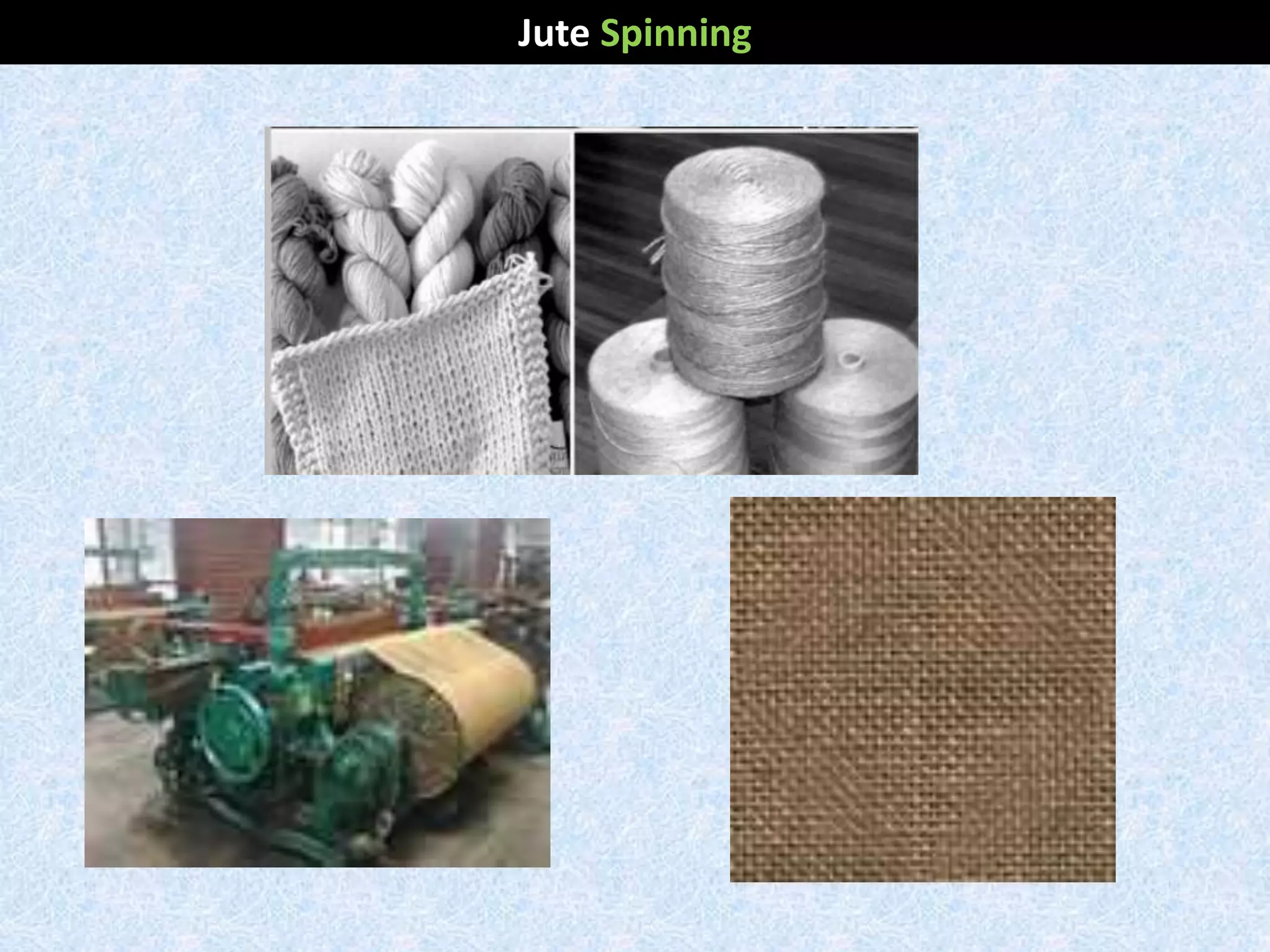

Jute Spinning
Md. Nakib-Ul-Hasan
Lecturer
Dept. of Textile Engineering
Green University of Bangladesh
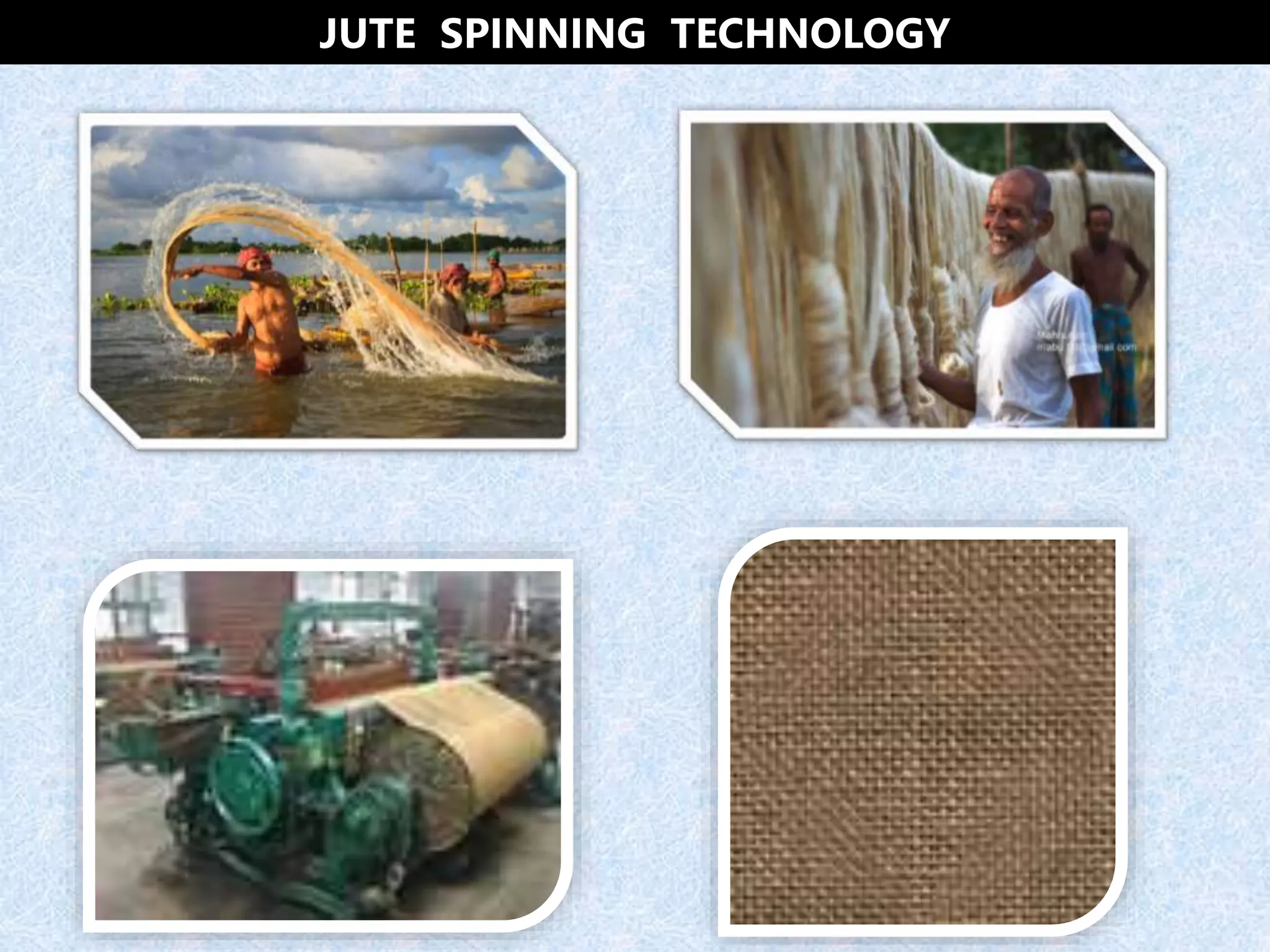
JUTE SPINNING TECHNOLOGY
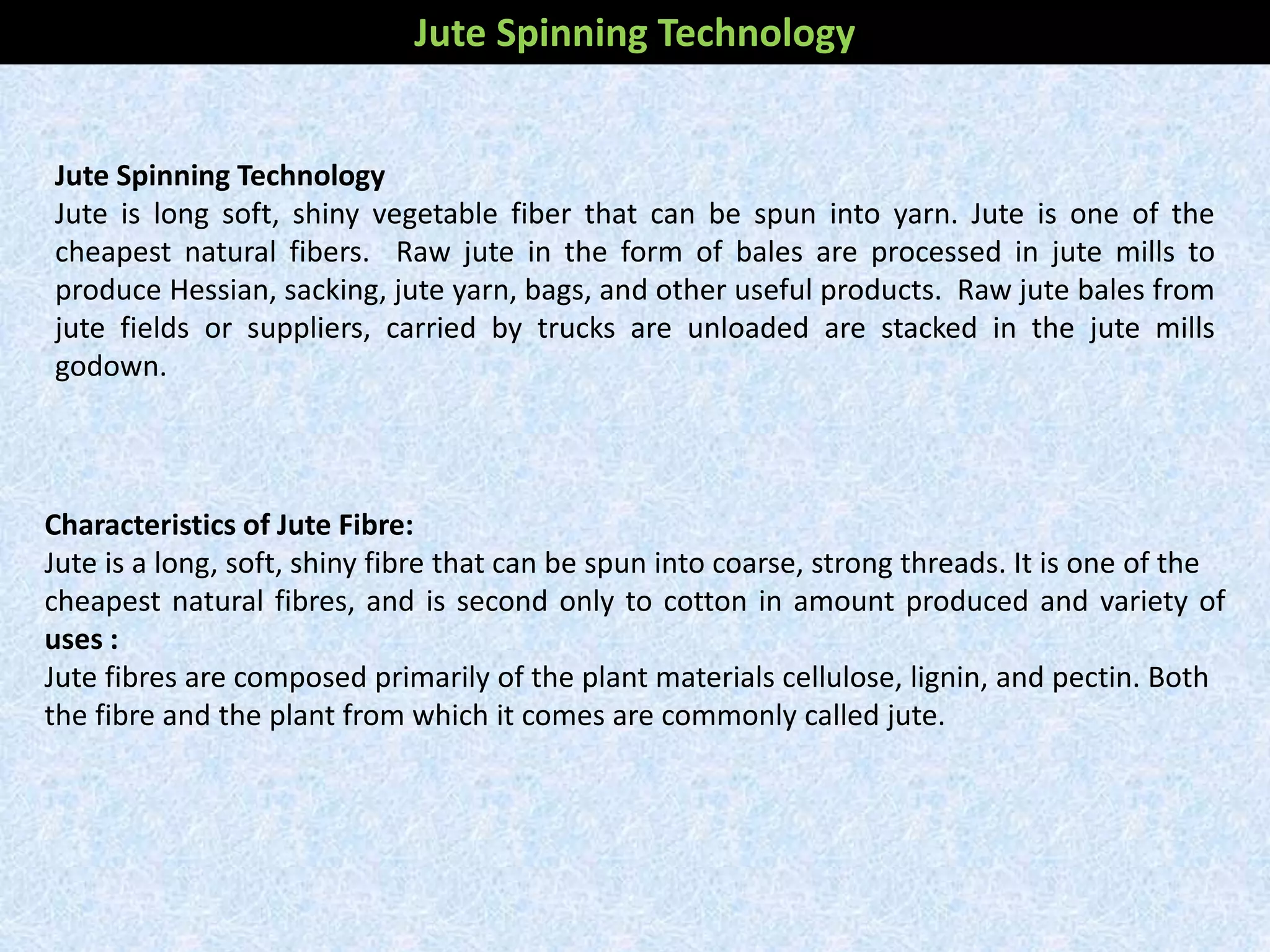
Jute Spinning Technology
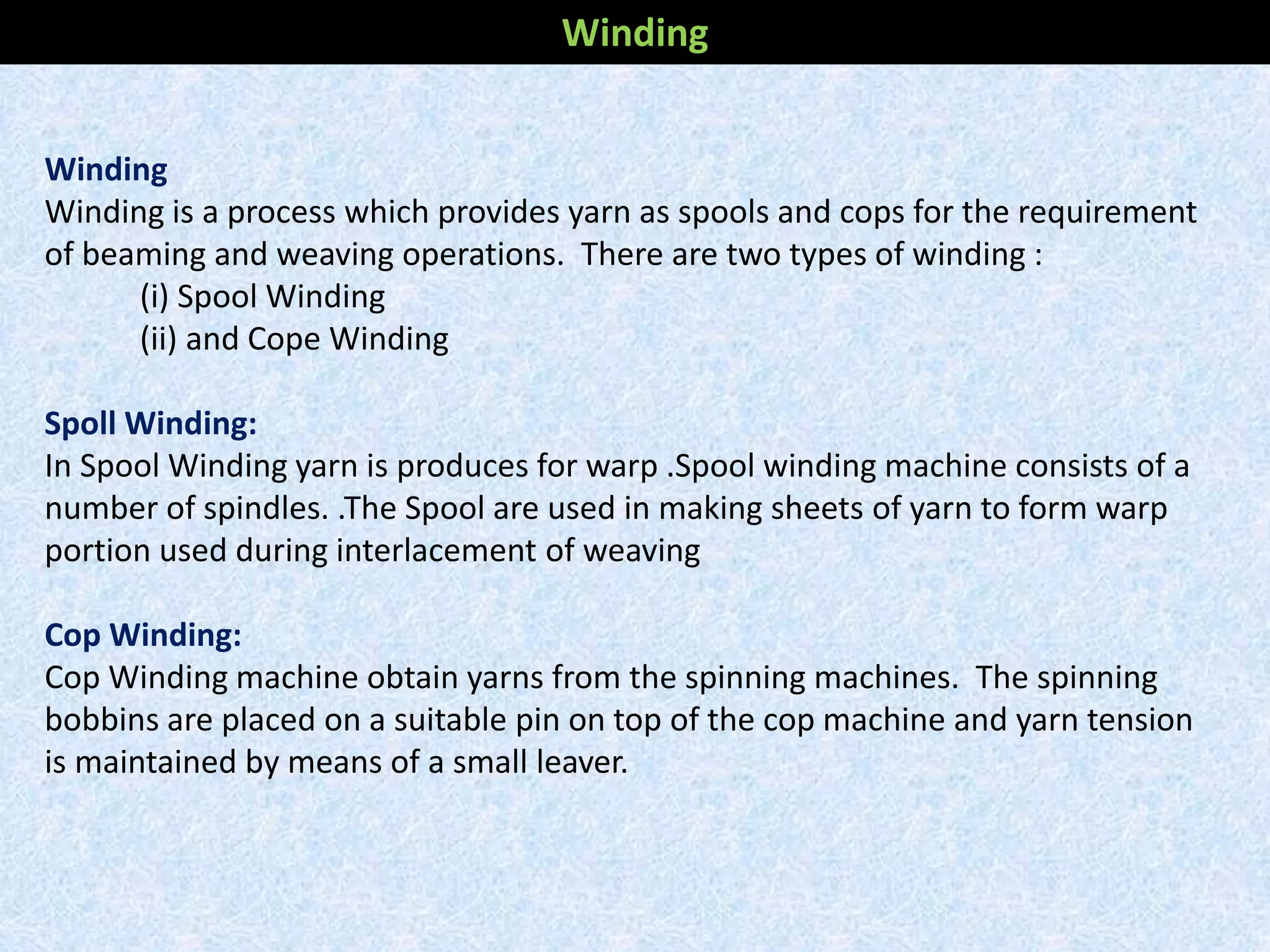
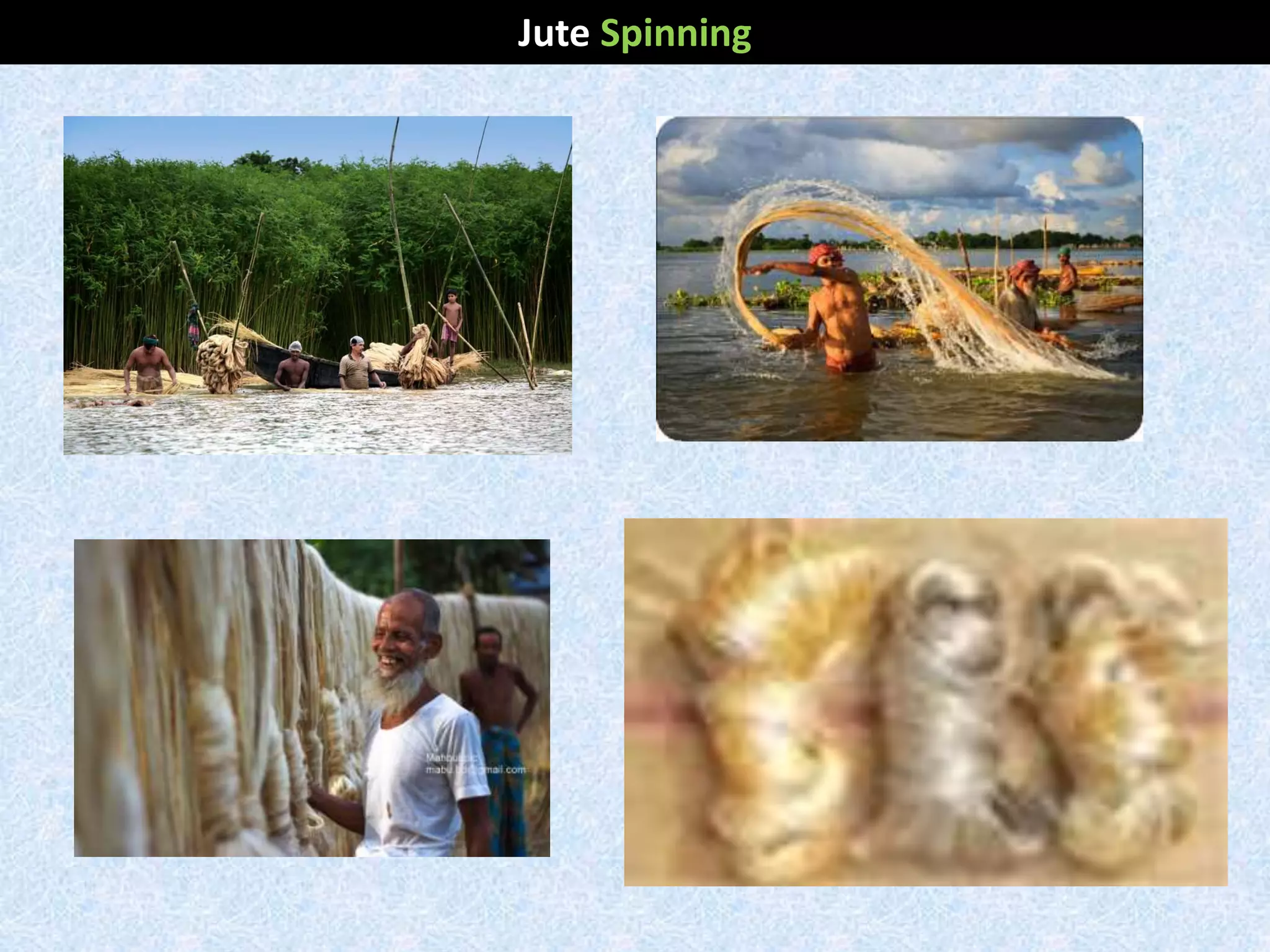
Jute is long soft, shiny vegetable fiber that can be spun into yarn. Jute is one of the
cheapest natural fibers. Raw jute in the form of bales are processed in jute mills to
produce Hessian, sacking, jute yarn, bags, and other useful products. Raw jute bales from
jute fields or suppliers, carried by trucks are unloaded are stacked in the jute mills
godown.
Characteristics of Jute Fibre:
Jute is a long, soft, shiny fibre that can be spun into coarse, strong threads. It is one of the
cheapest natural fibres, and is second only to cotton in amount produced and variety of
uses :
Jute fibres are composed primarily of the plant materials cellulose, lignin, and pectin. Both
the fibre and the plant from which it comes are commonly called jute.
Jute Spinning Technology
Jute
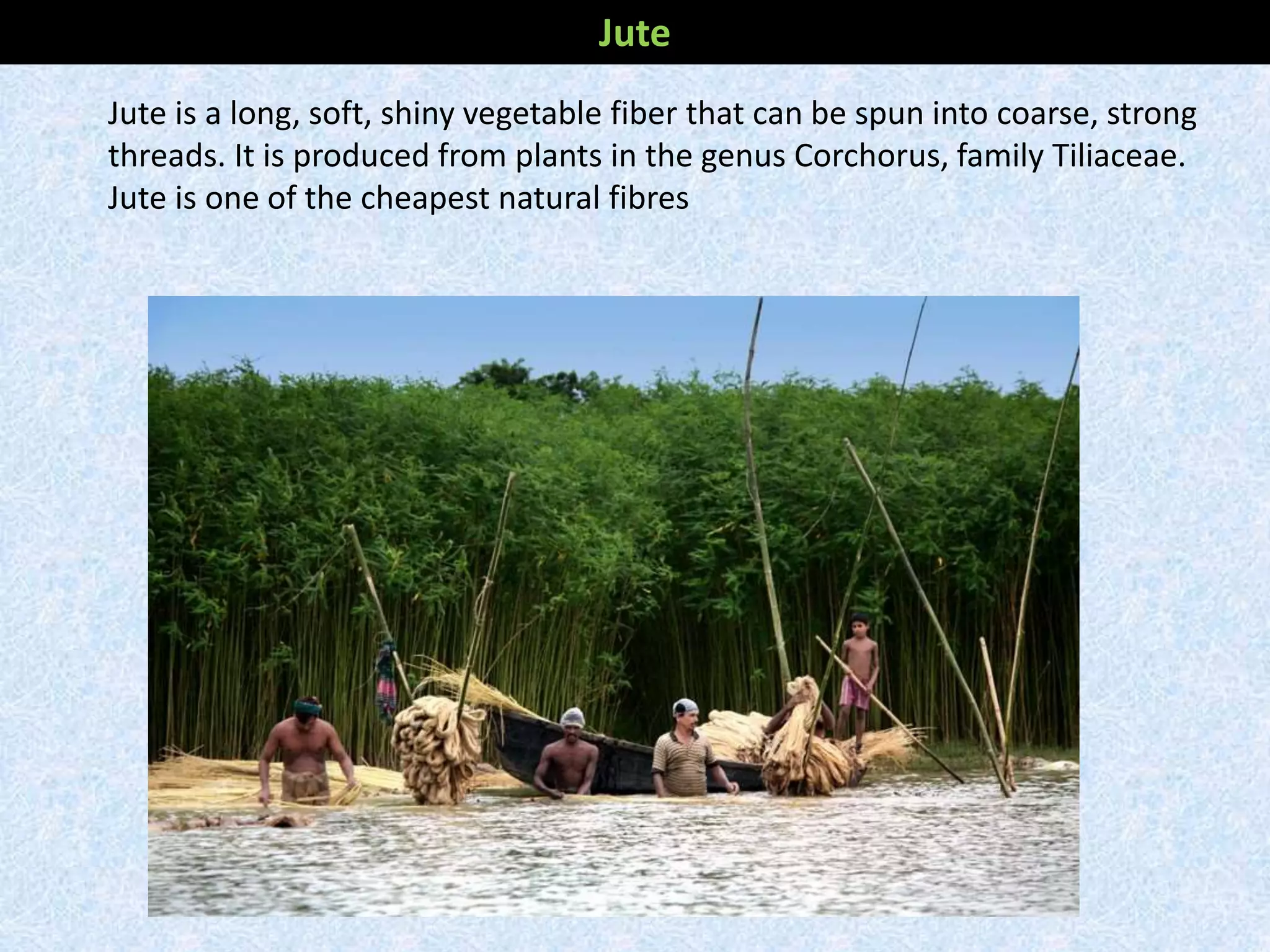
Jute is a long, soft, shiny vegetable fiber that can be spun into coarse, strong
threads. It is produced from plants in the genus Corchorus, family Tiliaceae.
Jute is one of the cheapest natural fibres
Raw jute in the form of
bales are processed in
jute mills to produce
hessian, sacking, jute
yarn, bags, and other
useful products. Raw
jute bales from jute
fields or suppliers,
carried by trucks are
unloaded are stacked in
the jute mills gowdown.
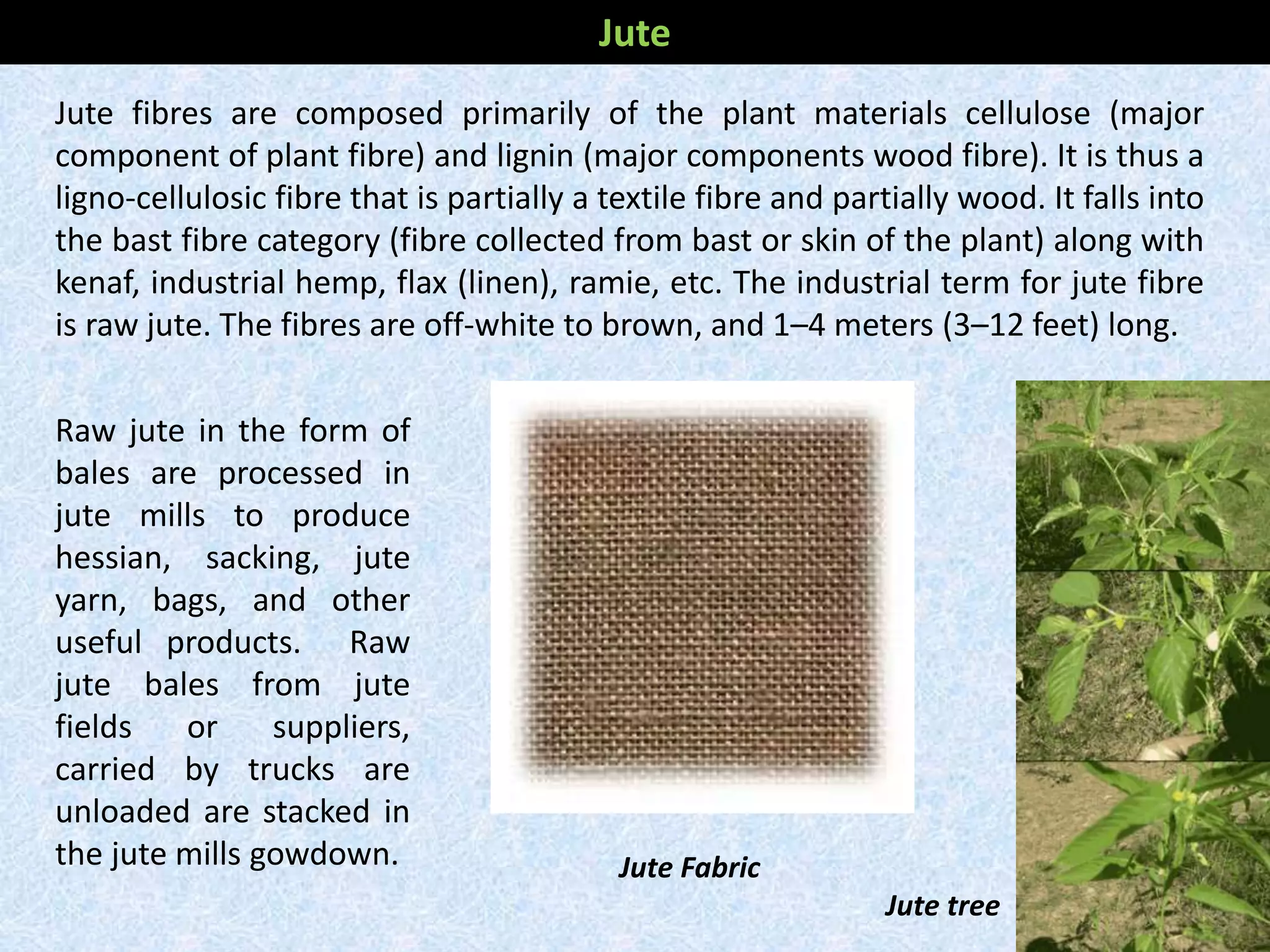
Jute fibres are composed primarily of the plant materials cellulose (major
component of plant fibre) and lignin (major components wood fibre). It is thus a
ligno-cellulosic fibre that is partially a textile fibre and partially wood. It falls into
the bast fibre category (fibre collected from bast or skin of the plant) along with
kenaf, industrial hemp, flax (linen), ramie, etc. The industrial term for jute fibre
is raw jute. The fibres are off-white to brown, and 1–4 meters (3–12 feet) long.
Jute
Jute Fabric
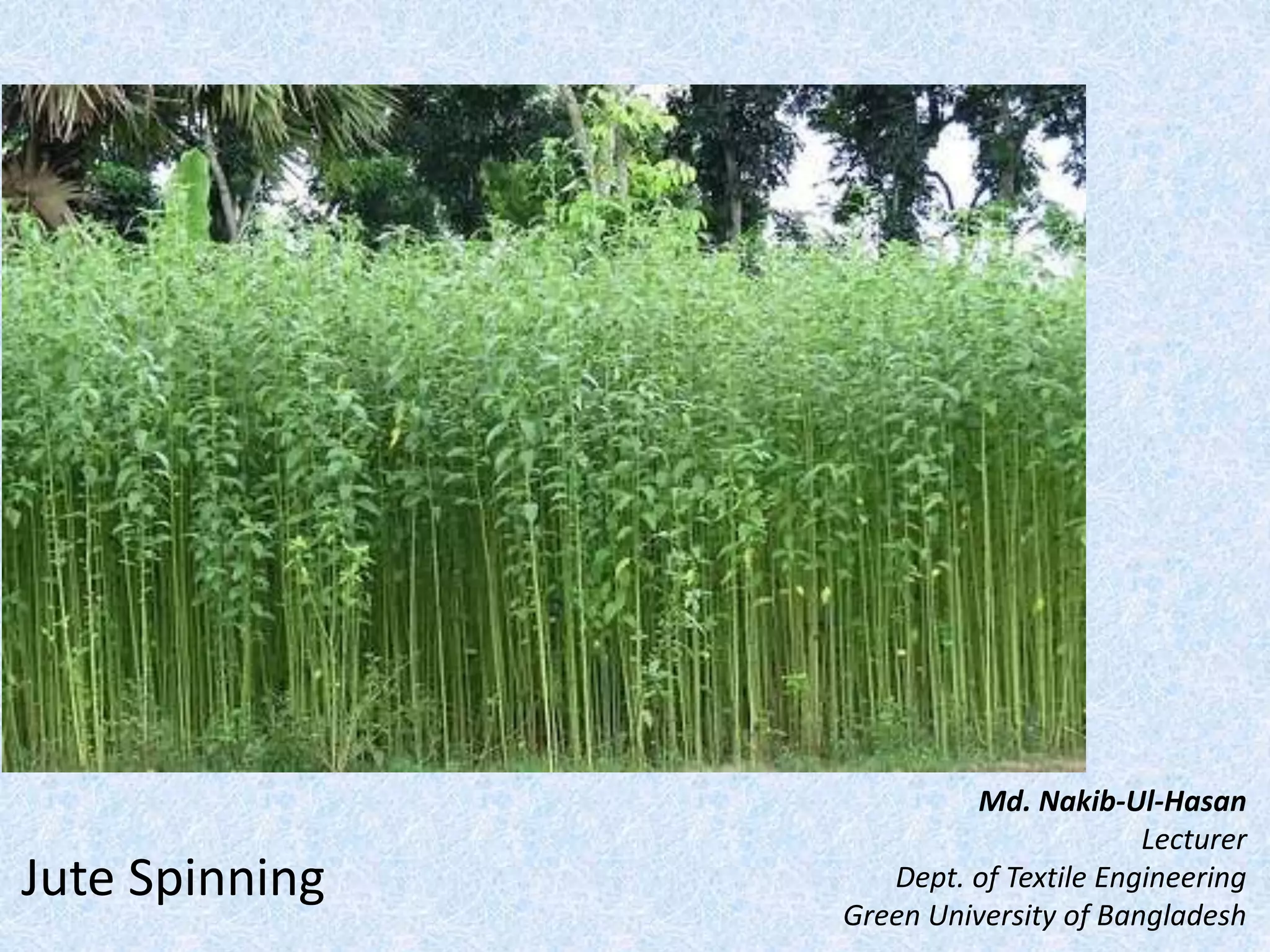
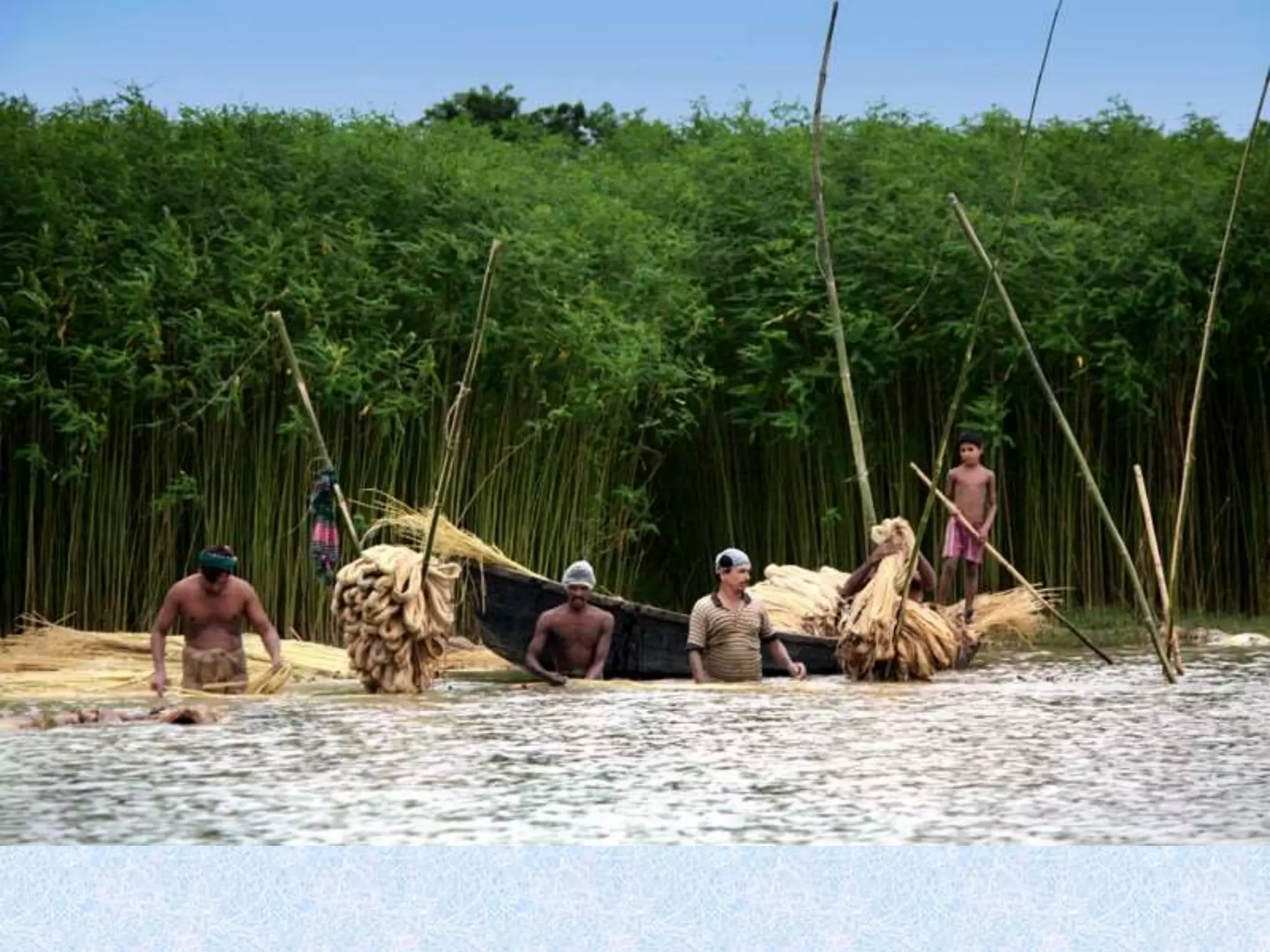
Jute tree
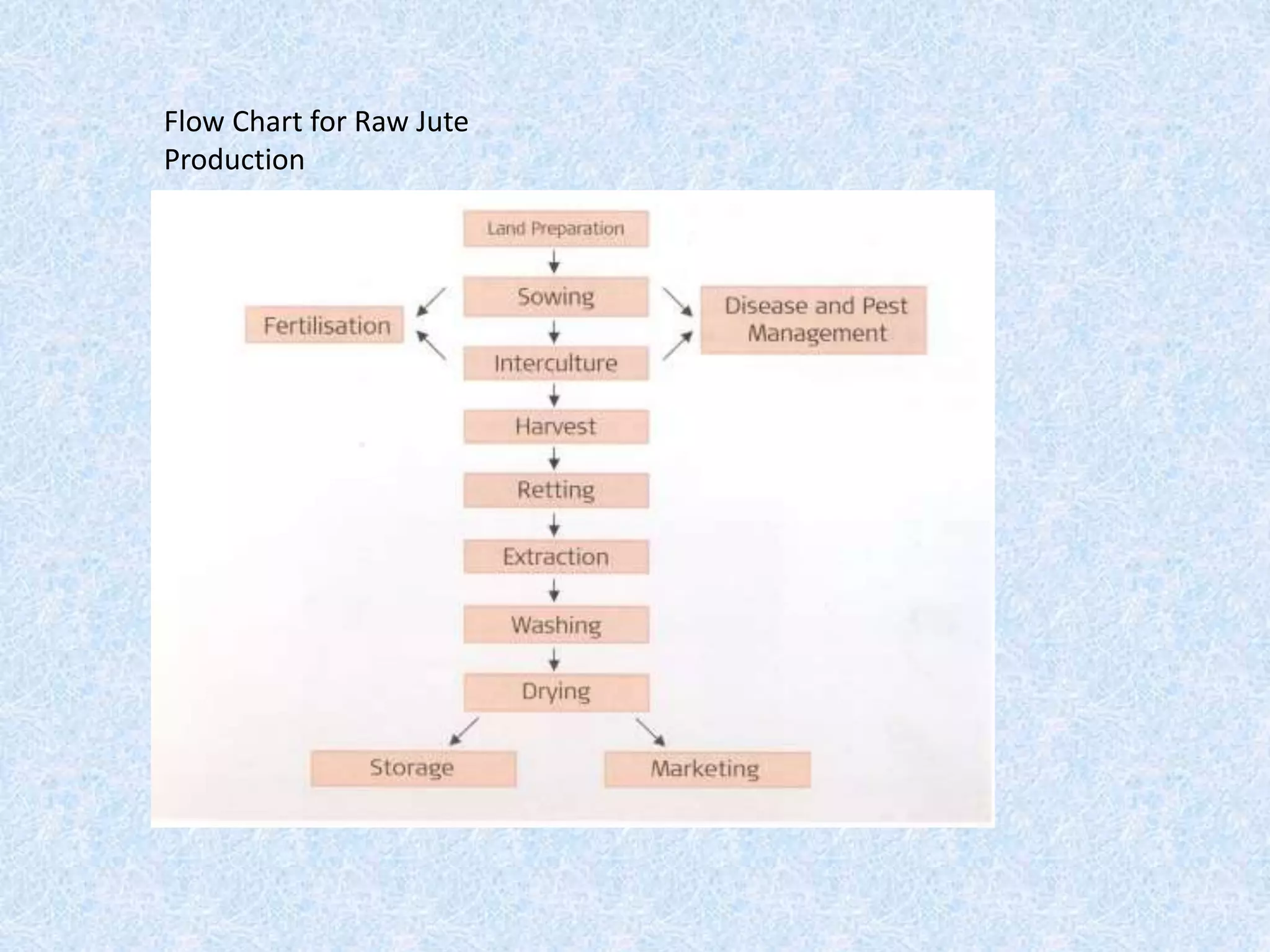
Flow Chart for Raw Jute
Production
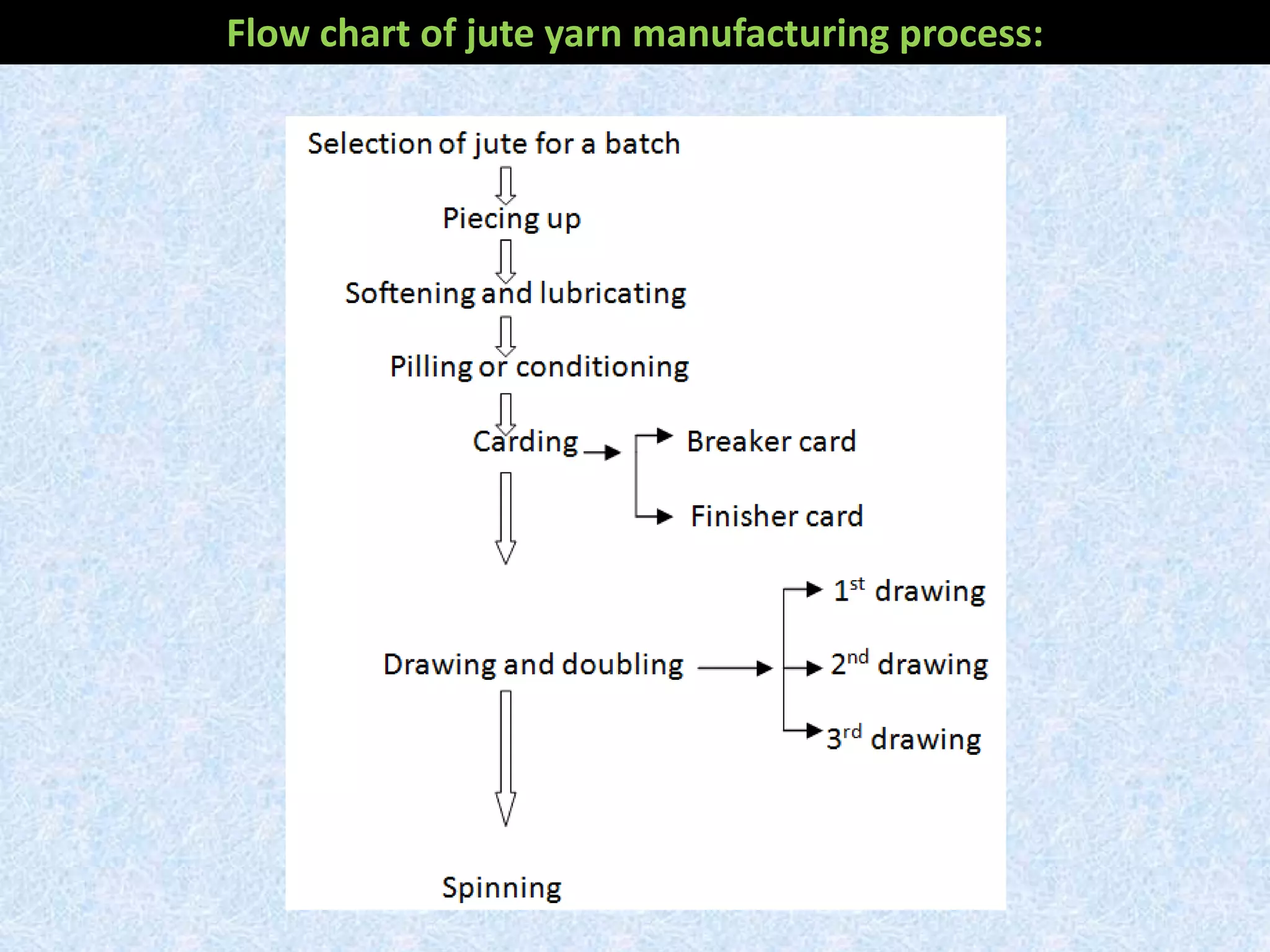
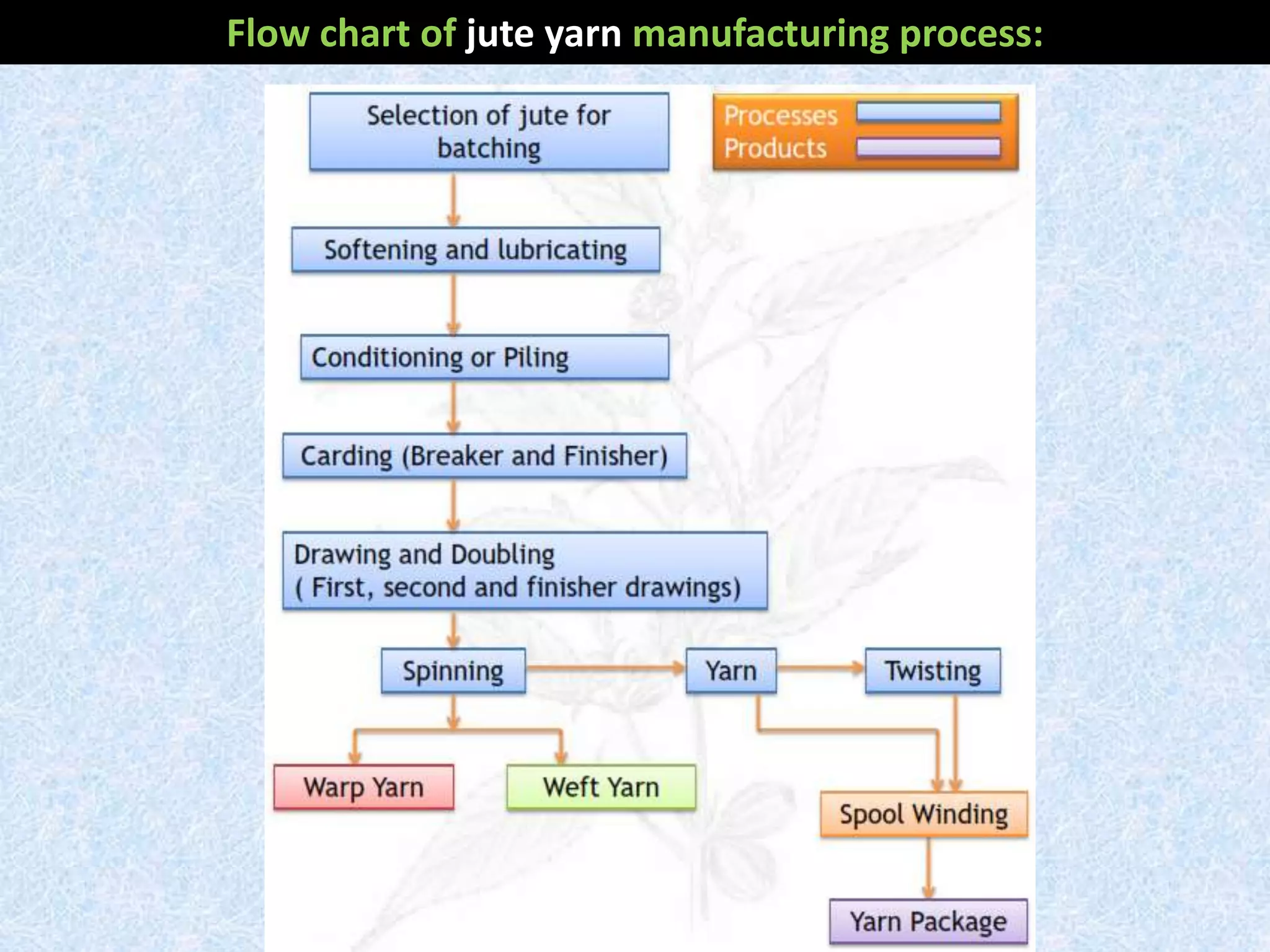
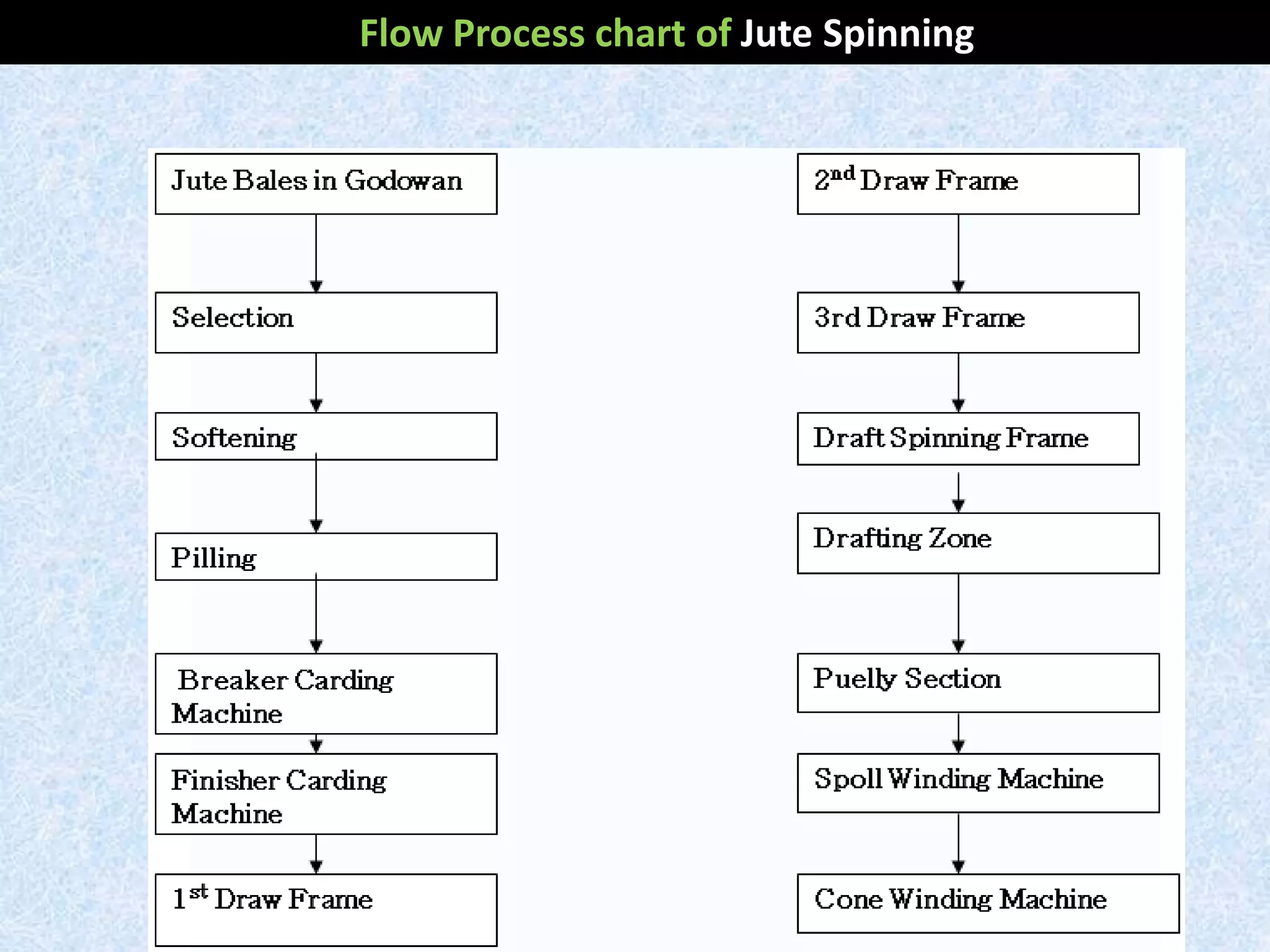
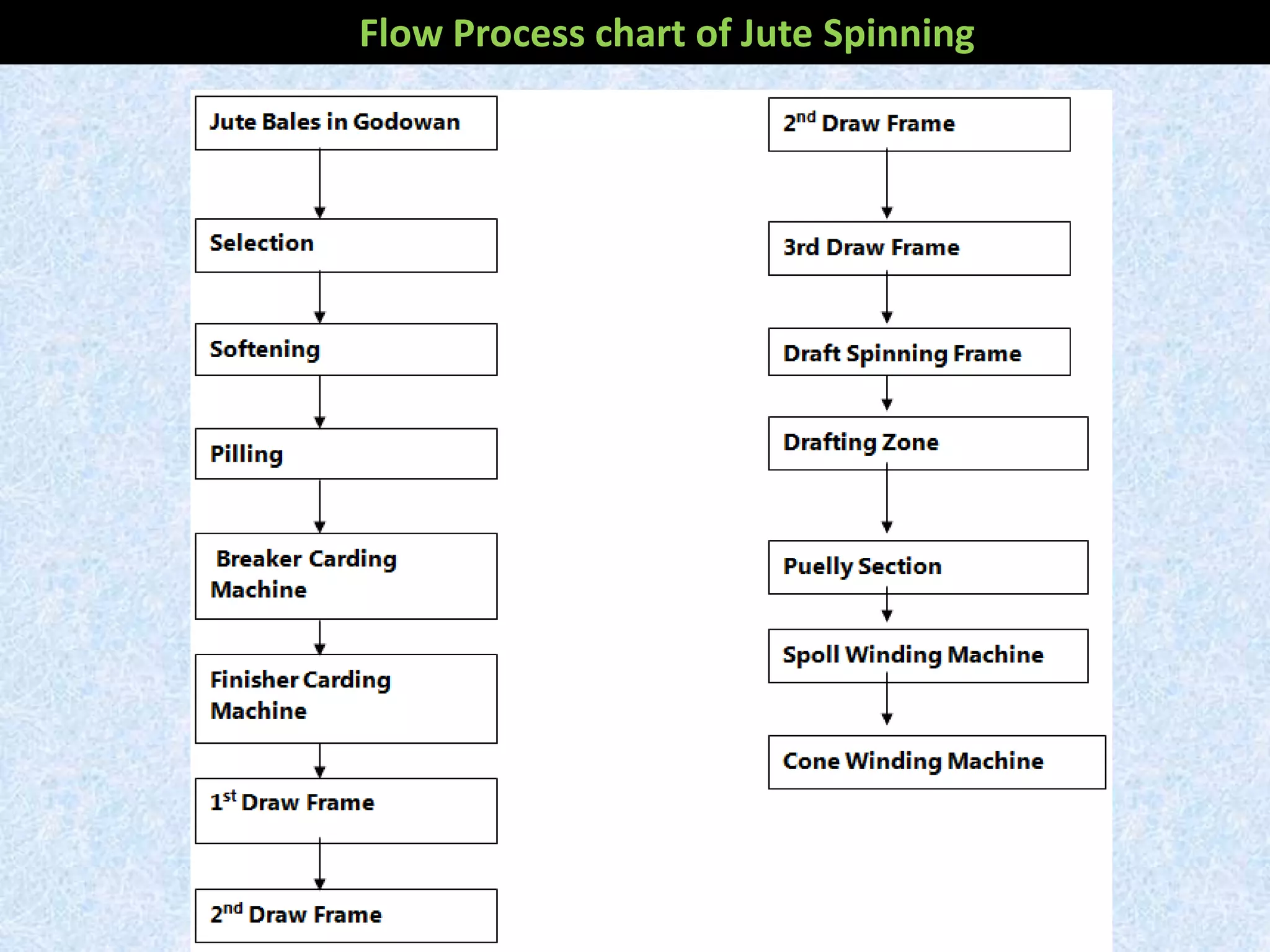
Flow chart of jute yarn manufacturing process:
Flow Process chart of Jute Spinning
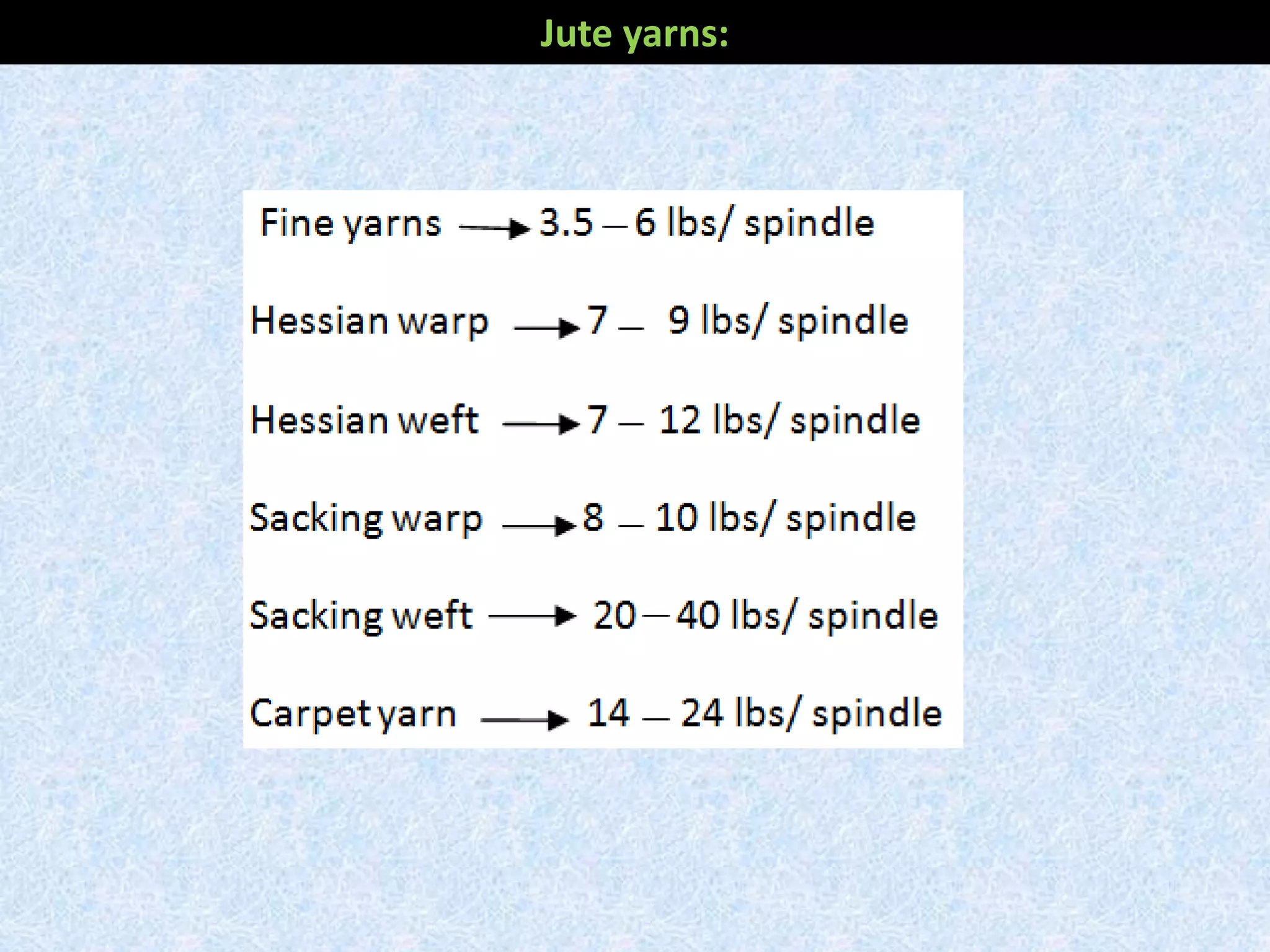
Jute yarns:
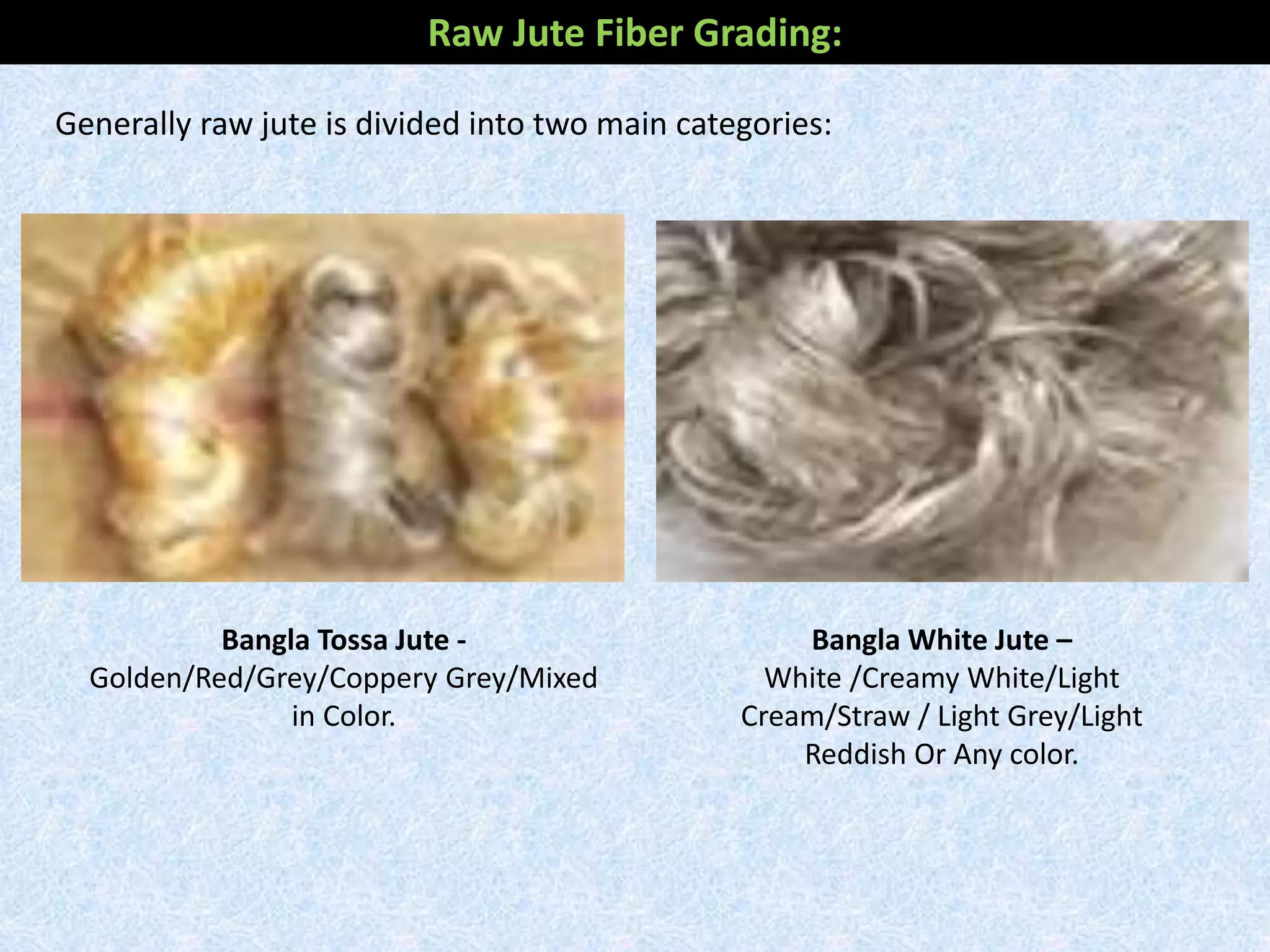
Bangla White Jute –
White /Creamy White/Light
Cream/Straw / Light Grey/Light
Reddish Or Any color.
Generally raw jute is divided into two main categories:
Bangla Tossa Jute -
Golden/Red/Grey/Coppery Grey/Mixed
in Color.
Raw Jute Fiber Grading:
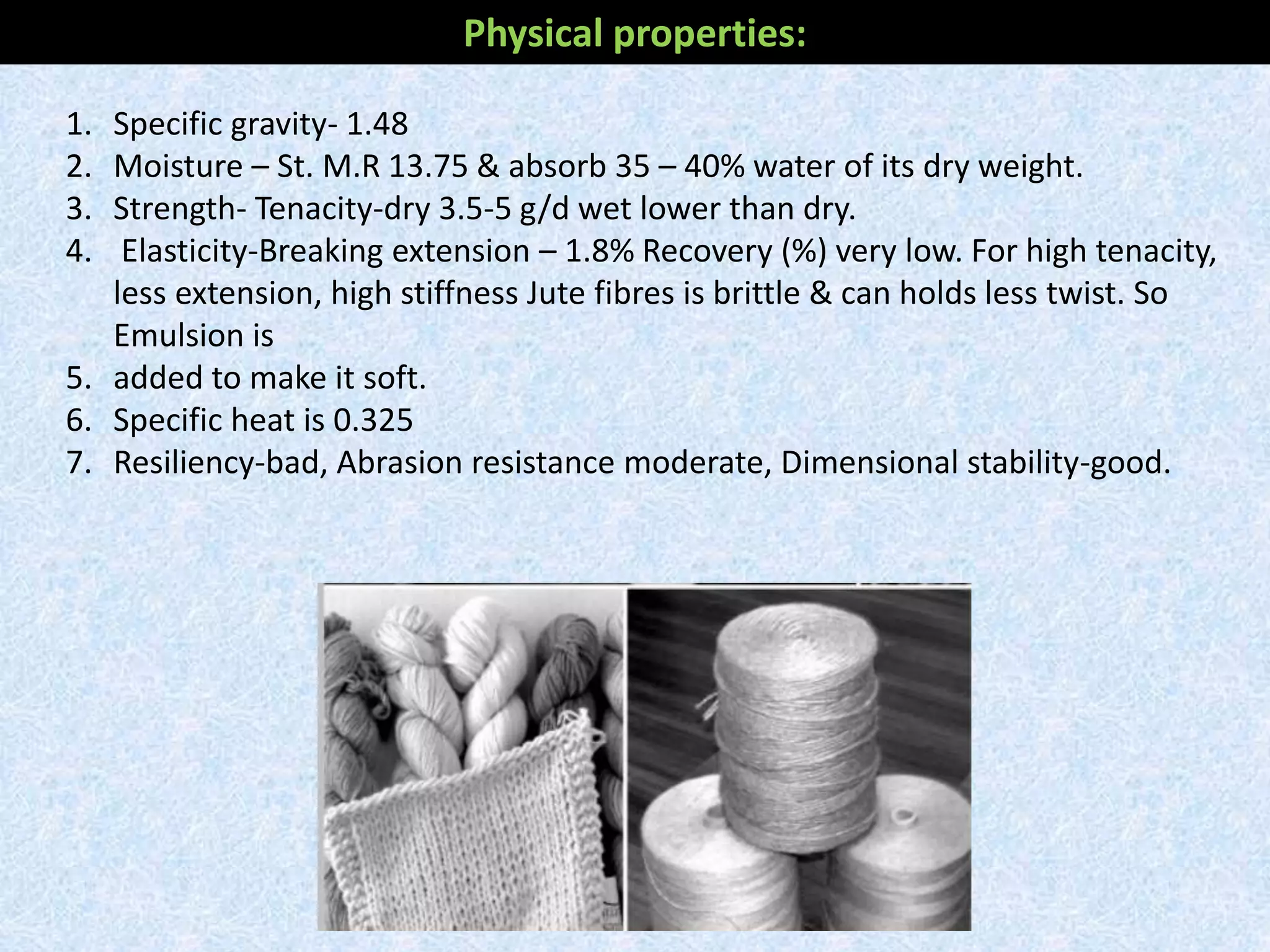
Physical properties:
1. Specific gravity- 1.48
2. Moisture – St. M.R 13.75 & absorb 35 – 40% water of its dry weight.
3. Strength- Tenacity-dry 3.5-5 g/d wet lower than dry.
4. Elasticity-Breaking extension – 1.8% Recovery (%) very low. For high tenacity,
less extension, high stiffness Jute fibres is brittle & can holds less twist. So
Emulsion is
5. added to make it soft.
6. Specific heat is 0.325
7. Resiliency-bad, Abrasion resistance moderate, Dimensional stability-good.
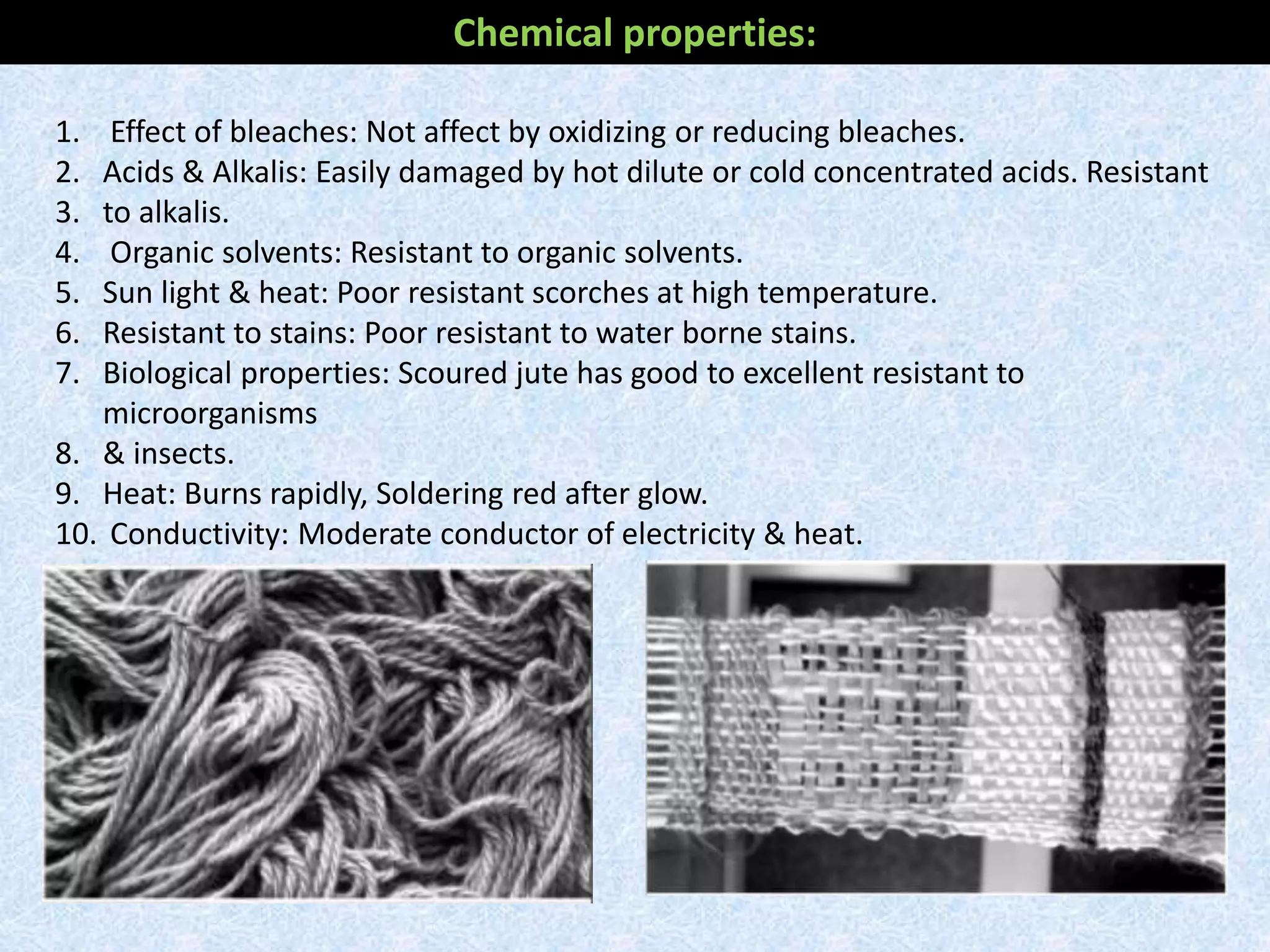
Chemical properties:
1. Effect of bleaches: Not affect by oxidizing or reducing bleaches.
2. Acids & Alkalis: Easily damaged by hot dilute or cold concentrated acids. Resistant
3. to alkalis.
4. Organic solvents: Resistant to organic solvents.
5. Sun light & heat: Poor resistant scorches at high temperature.
6. Resistant to stains: Poor resistant to water borne stains.
7. Biological properties: Scoured jute has good to excellent resistant to
microorganisms
8. & insects.
9. Heat: Burns rapidly, Soldering red after glow.
10. Conductivity: Moderate conductor of electricity & heat.
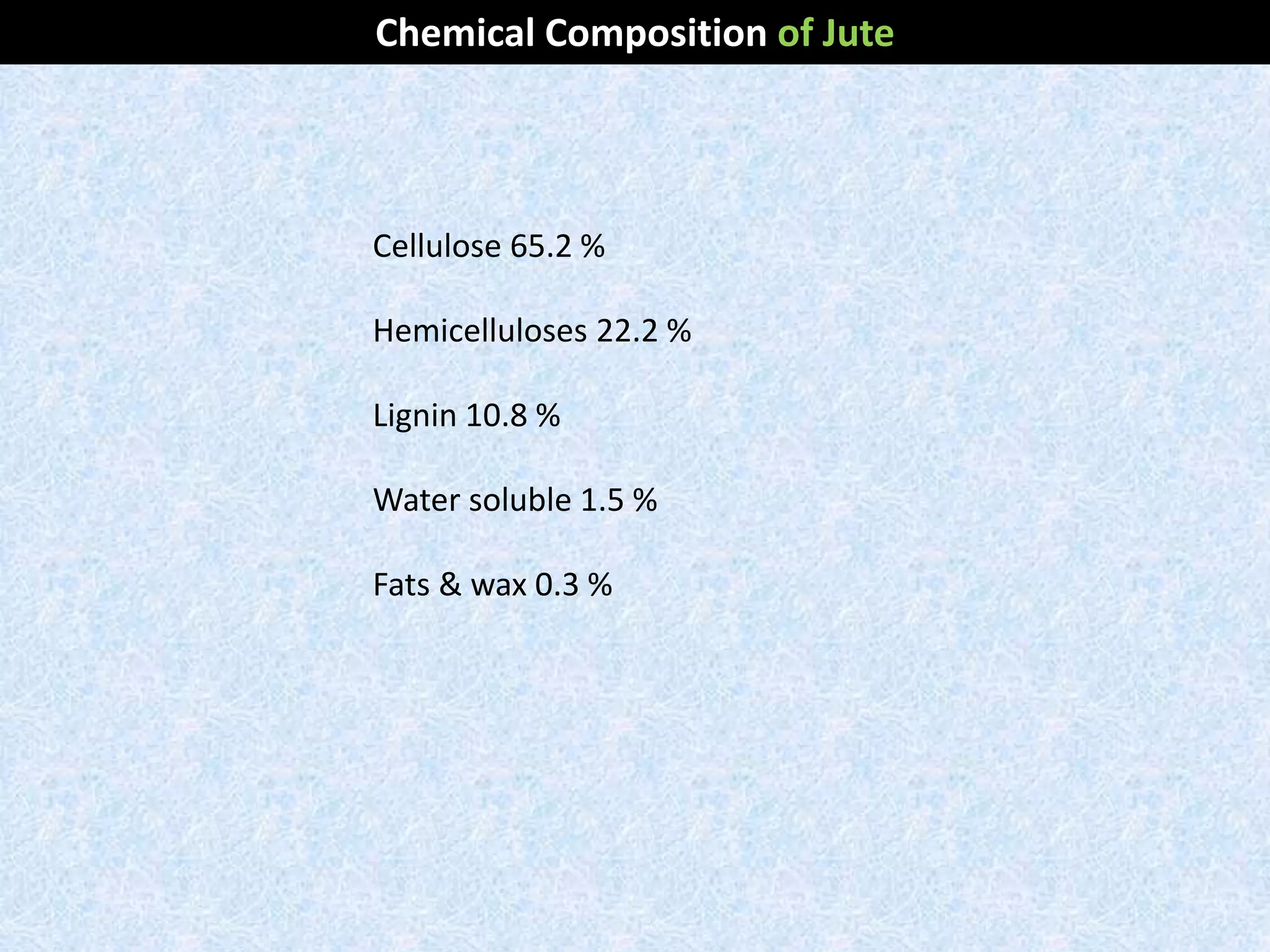
Cellulose 65.2 %
Hemicelluloses 22.2 %
Lignin 10.8 %
Water soluble 1.5 %
Fats & wax 0.3 %
Chemical Composition of Jute
Count:
The weight in lb of 1 spindle or 14,400 of jute yarn is the count of that yarn.
Batch:
A blend of different types of jute is made up to suit the particular class of yarns
being spun, this blend is known as batch.
i.e. In batch the no. of bales of jute is selected for making a particular type of
yarn.
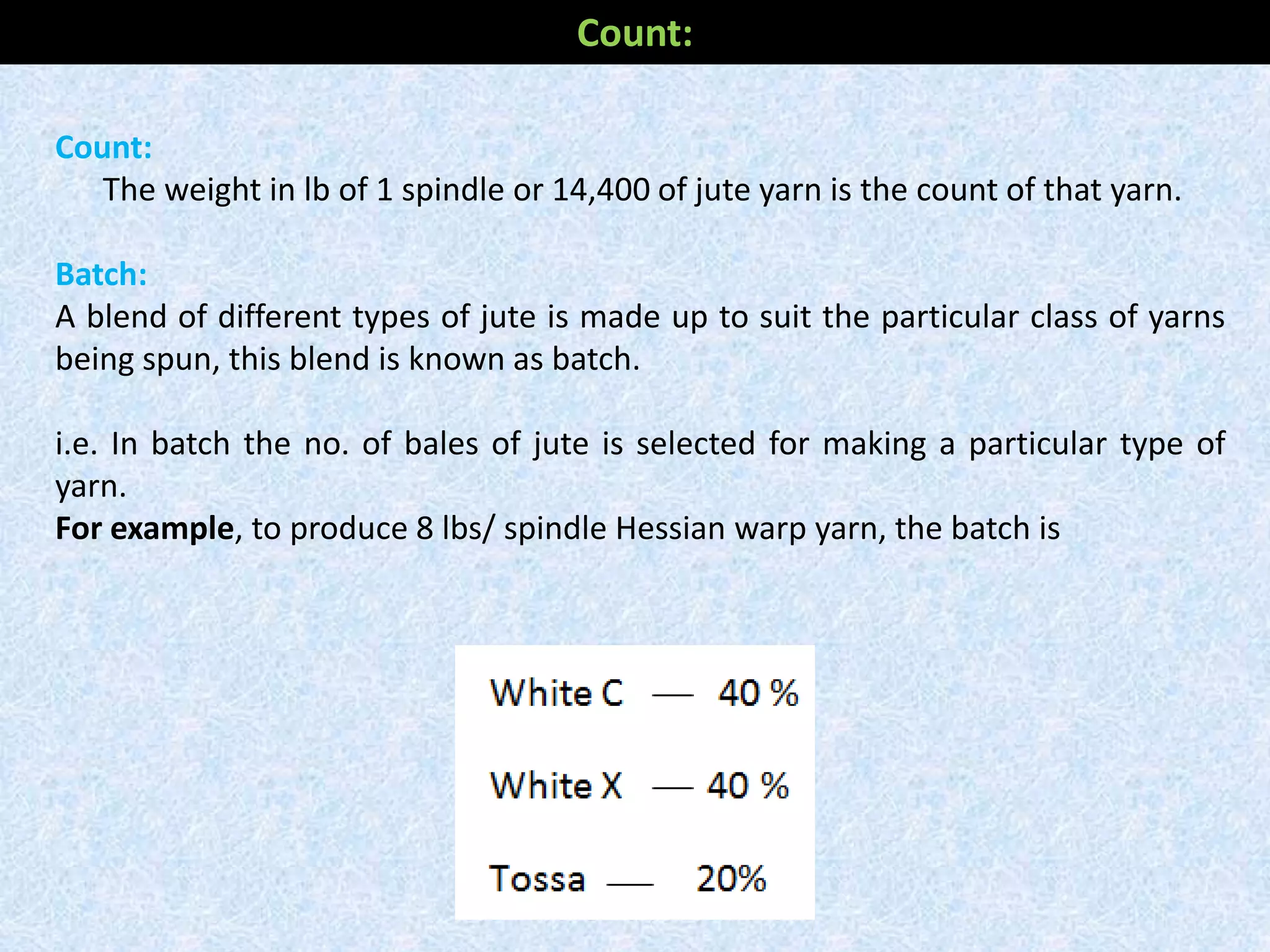
For example, to produce 8 lbs/ spindle Hessian warp yarn, the batch is
Count:
Batching:
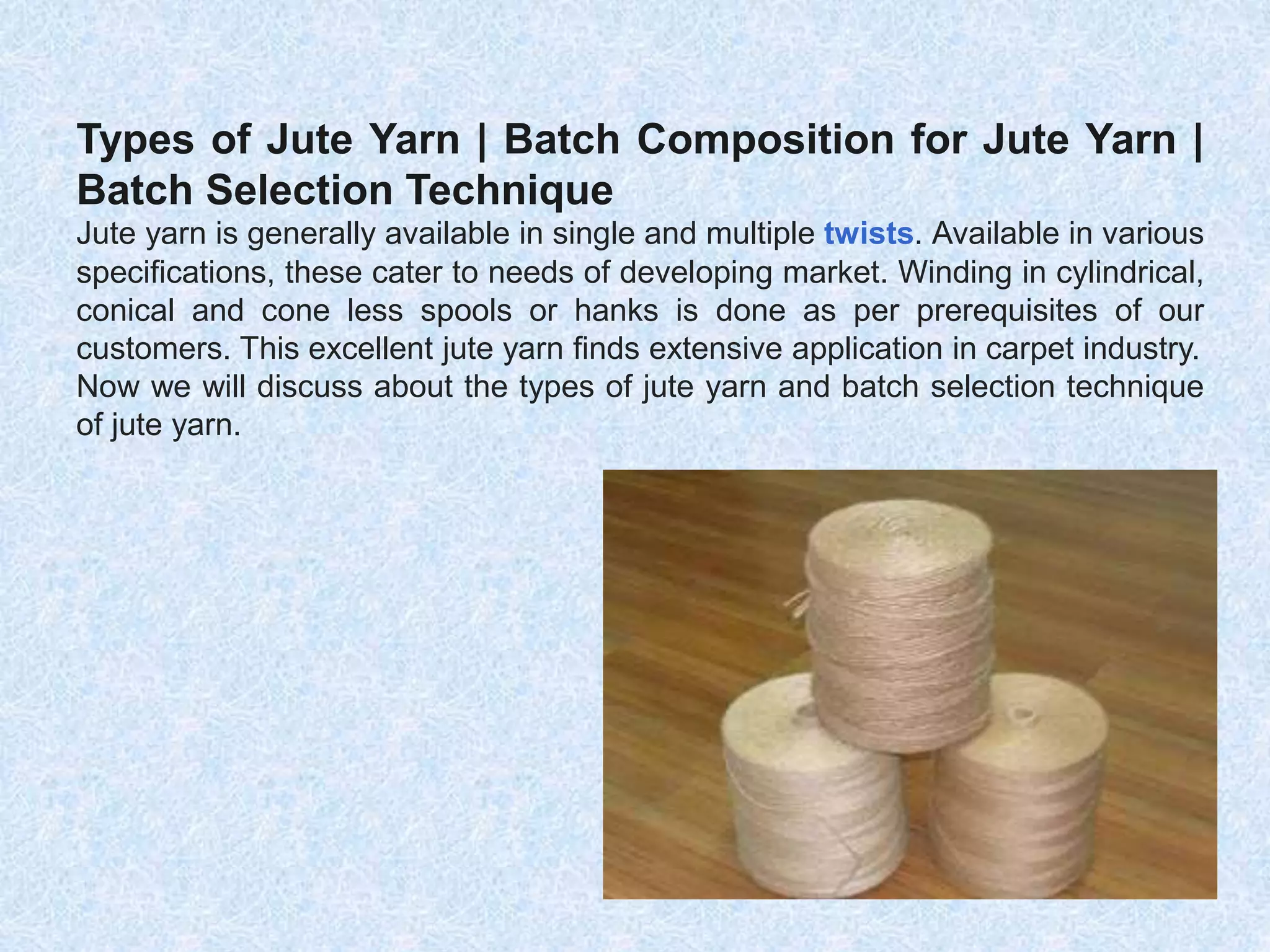
All the process preparatory to carding includes in the batching. It is the primary
stage of jute processing.
Object of batching:
1. To help the fiber movement freely during processing.
2. To get expected dampness and flexibility.
3. To reduce harshness or stiffness.
4. To control and reduce the yarn cost.
5. To reduce waste.
6. To intermix the batch component effectively.
7. To produce improve graded yarn.
Batching:
Types of Jute Yarn | Batch Composition for Jute Yarn |
Batch Selection Technique
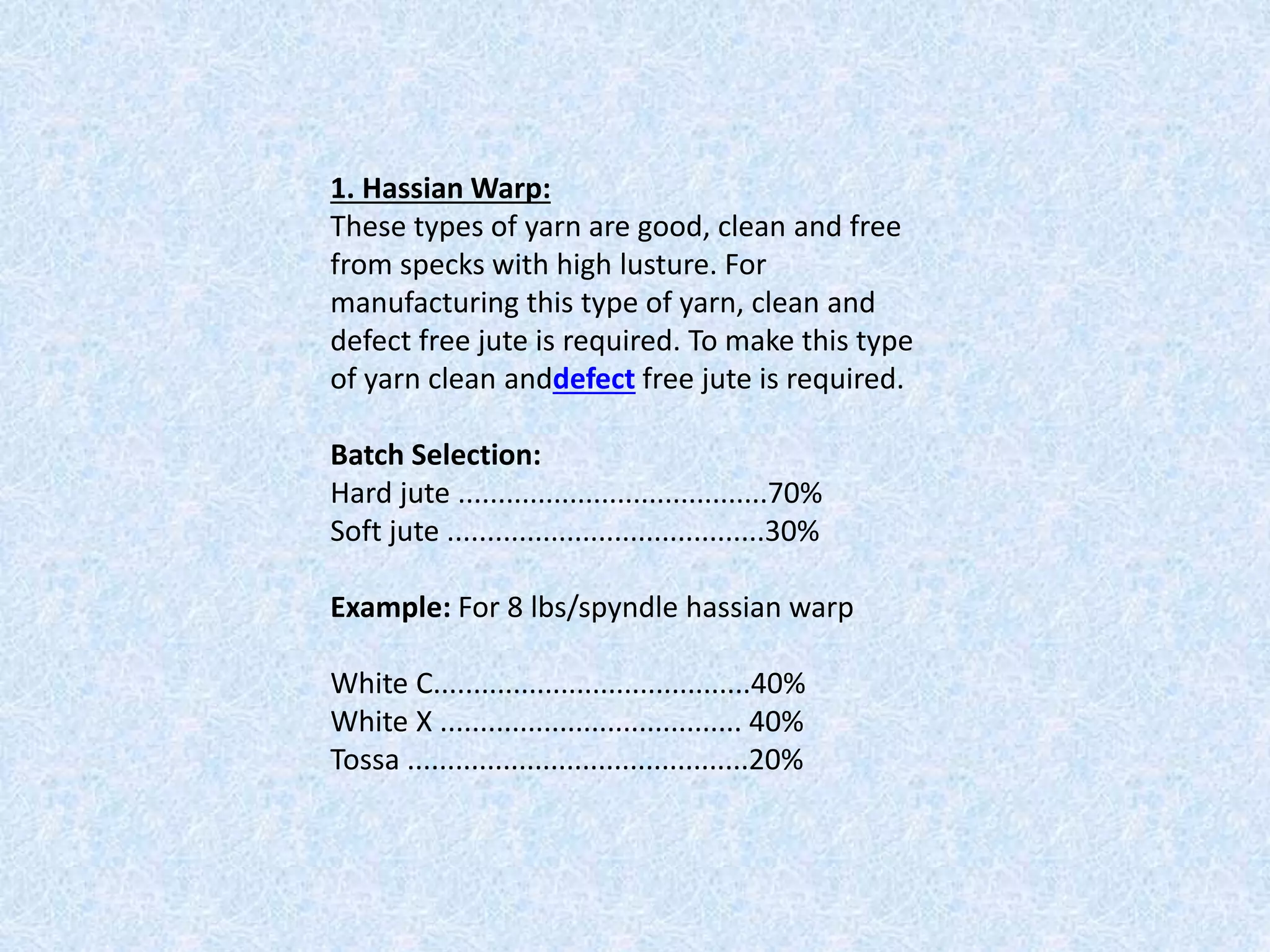
Jute yarn is generally available in single and multiple twists. Available in various
specifications, these cater to needs of developing market. Winding in cylindrical,
conical and cone less spools or hanks is done as per prerequisites of our
customers. This excellent jute yarn finds extensive application in carpet industry.
Now we will discuss about the types of jute yarn and batch selection technique
of jute yarn.
1. Hassian Warp:
These types of yarn are good, clean and free
from specks with high lusture. For
manufacturing this type of yarn, clean and
defect free jute is required. To make this type
of yarn clean anddefect free jute is required.
Batch Selection:
Hard jute .......................................70%
Soft jute ........................................30%
Example: For 8 lbs/spyndle hassian warp
White C........................................40%
White X ...................................... 40%
Tossa ...........................................20%
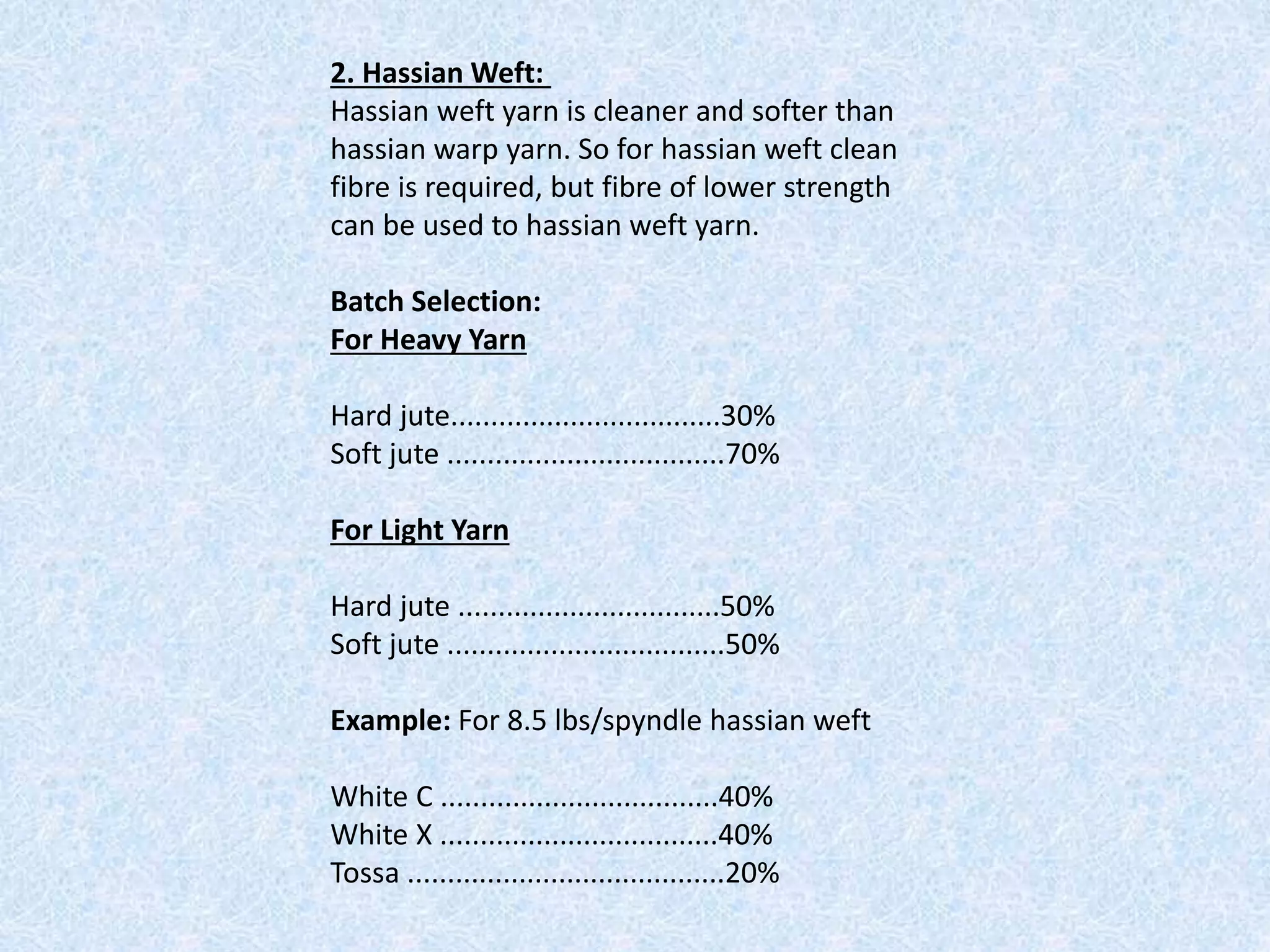
2. Hassian Weft:
Hassian weft yarn is cleaner and softer than
hassian warp yarn. So for hassian weft clean
fibre is required, but fibre of lower strength
can be used to hassian weft yarn.
Batch Selection:
For Heavy Yarn
Hard jute..................................30%
Soft jute ...................................70%
For Light Yarn
Hard jute .................................50%
Soft jute ...................................50%
Example: For 8.5 lbs/spyndle hassian weft
White C ...................................40%
White X ...................................40%
Tossa ........................................20%
3. Sacking Warp:
Sacking warp jute yarn is good and strong.
Specks and colour is not important when
manufacturing this type of yarn. So, 70 to 80%
Tossa jute can be used.
Batch Selection:
Hard jute ................................... 60%
Soft jute .....................................40%
Example: For 8 lbs/spyndle sacking warp
X bottom ..................................67%
S M R ......................................33%
4. Sacking Weft:
Sacking weft yarns are low quality yarn. It is
coarse and is made from low grade jute fibre.
It may contain line cuttings, bale cuttings, soft
and hard waste, rope waste, jute dust, habijabi
and entangled jute.
Example: For sacking weft
NC .......................................................70%
S M R ..................................................15%
Caddis ..................................................5%
Thread waste and gunny cuttings............10%
5. C.B.C (carpet breaking cloth):
Batch Selection:
Hard jute ................................... 100%
Example: For 8 lbs/spyndle C.B.C warp
B.W.B ....................................... 40%
B.W.C ...................................... 60%
Example: For 8 lbs/spyndle C.B.C weft
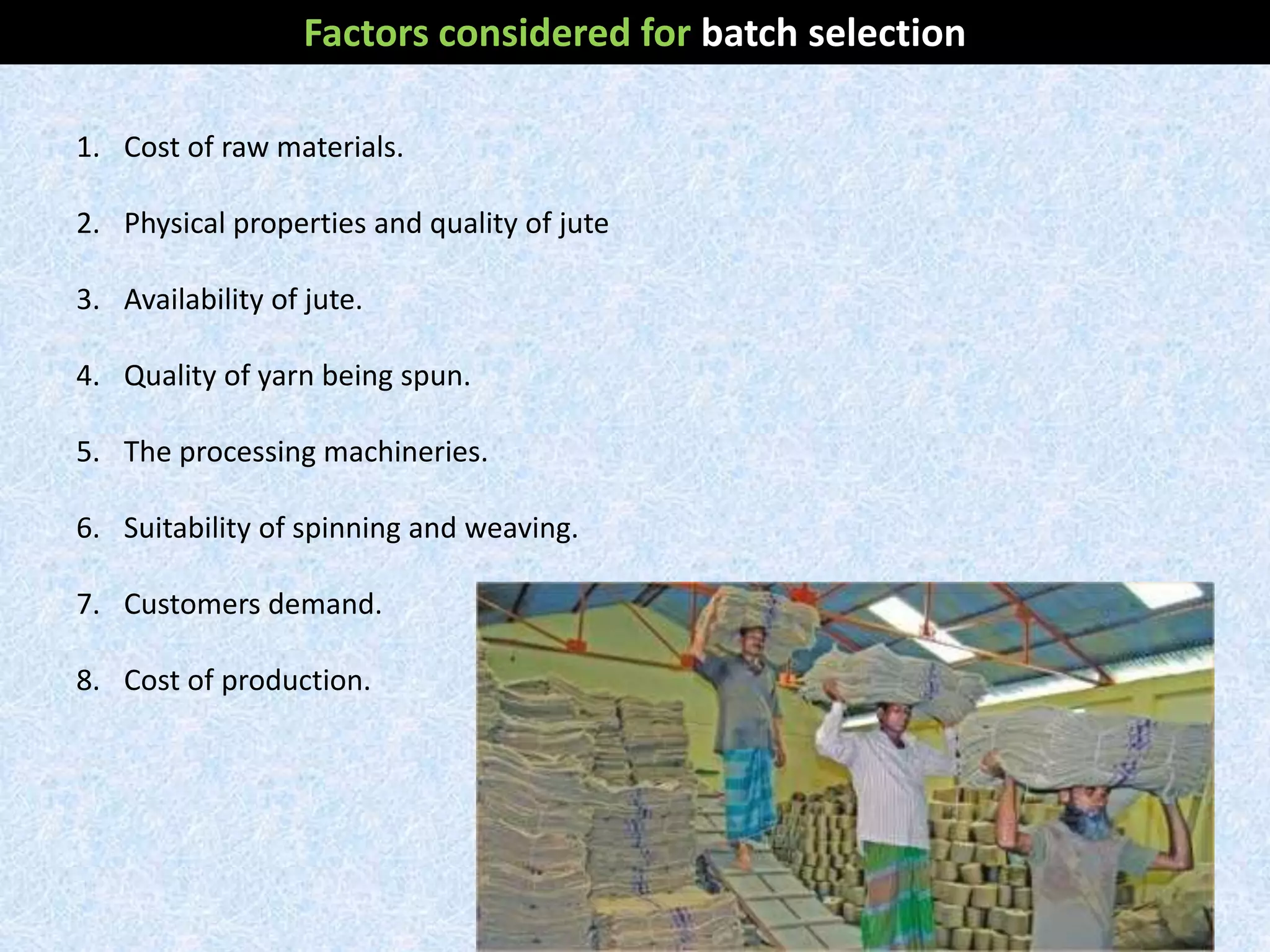
1. Cost of raw materials.
2. Physical properties and quality of jute
3. Availability of jute.
4. Quality of yarn being spun.
5. The processing machineries.
6. Suitability of spinning and weaving.
7. Customers demand.
8. Cost of production.
Factors considered for batch selection
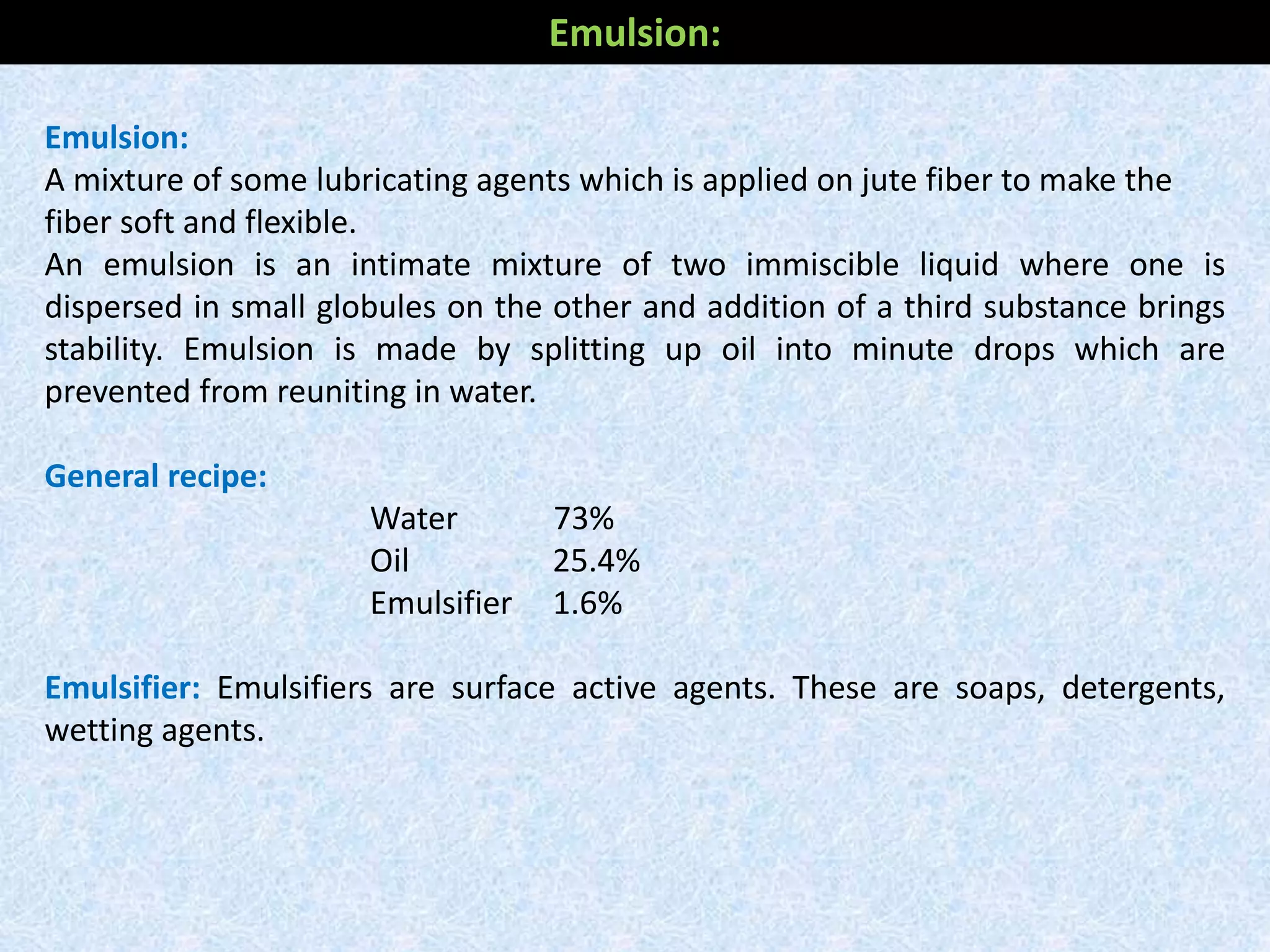
Emulsion:
A mixture of some lubricating agents which is applied on jute fiber to make the
fiber soft and flexible.
An emulsion is an intimate mixture of two immiscible liquid where one is
dispersed in small globules on the other and addition of a third substance brings
stability. Emulsion is made by splitting up oil into minute drops which are
prevented from reuniting in water.
General recipe:
Water 73%
Oil 25.4%
Emulsifier 1.6%
Emulsifier: Emulsifiers are surface active agents. These are soaps, detergents,
wetting agents.
Emulsion:
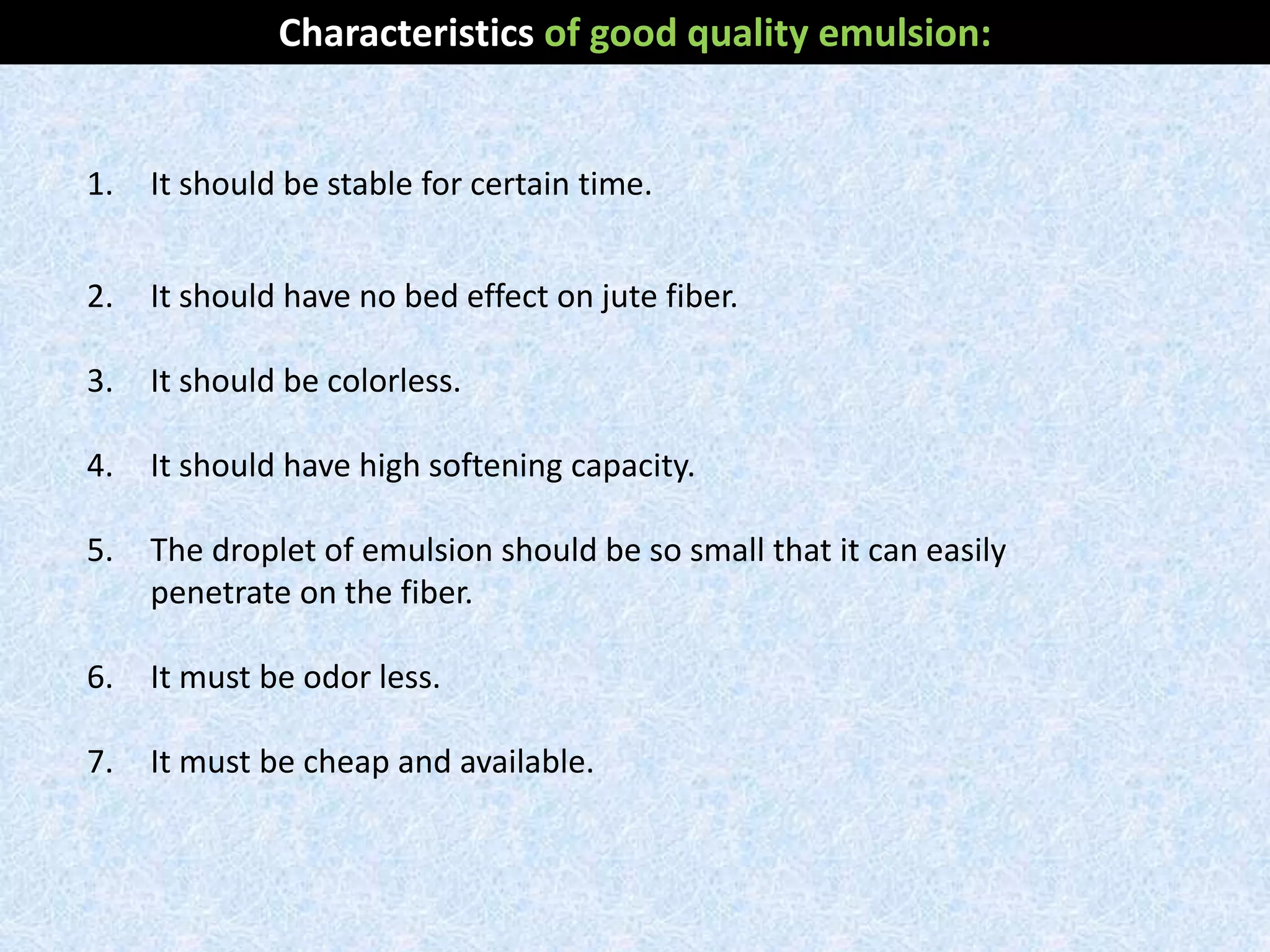
1. It should be stable for certain time.
2. It should have no bed effect on jute fiber.
3. It should be colorless.
4. It should have high softening capacity.
5. The droplet of emulsion should be so small that it can easily
penetrate on the fiber.
6. It must be odor less.
7. It must be cheap and available.
Characteristics of good quality emulsion:
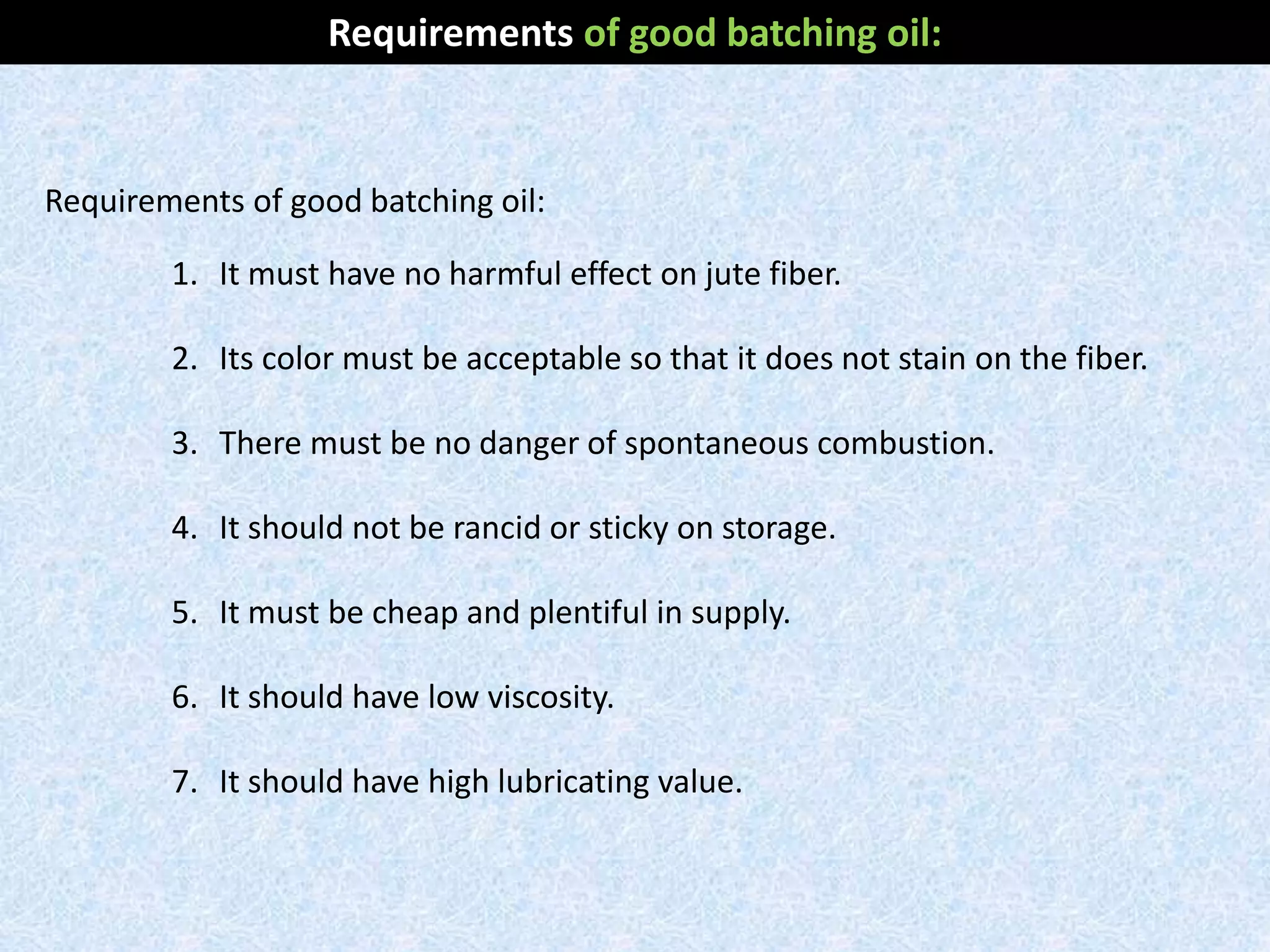
Requirements of good batching oil:
1. It must have no harmful effect on jute fiber.
2. Its color must be acceptable so that it does not stain on the fiber.
3. There must be no danger of spontaneous combustion.
4. It should not be rancid or sticky on storage.
5. It must be cheap and plentiful in supply.
6. It should have low viscosity.
7. It should have high lubricating value.
Requirements of good batching oil:
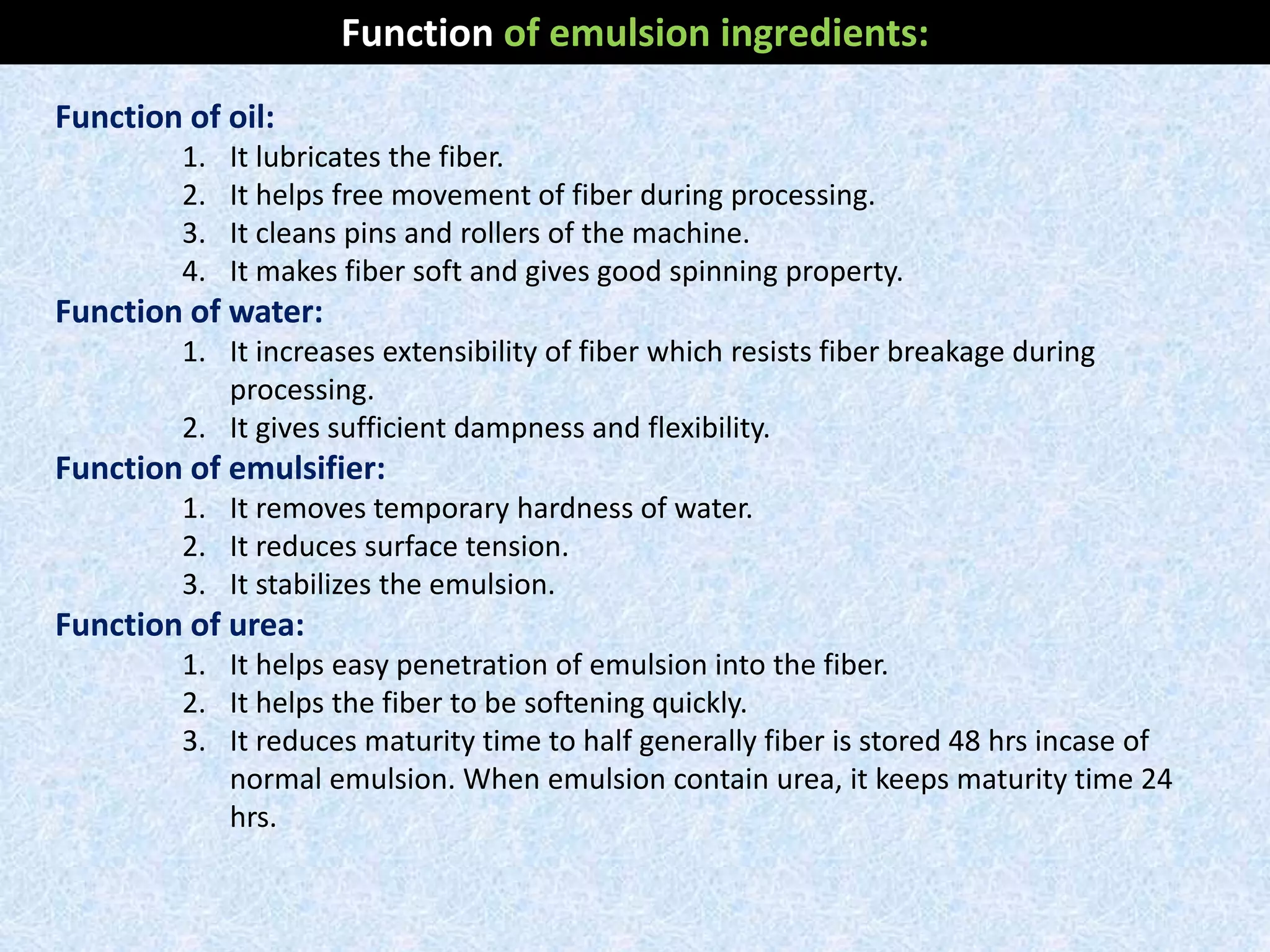
Function of oil:
1. It lubricates the fiber.
2. It helps free movement of fiber during processing.
3. It cleans pins and rollers of the machine.
4. It makes fiber soft and gives good spinning property.
Function of water:
1. It increases extensibility of fiber which resists fiber breakage during
processing.
2. It gives sufficient dampness and flexibility.
Function of emulsifier:
1. It removes temporary hardness of water.
2. It reduces surface tension.
3. It stabilizes the emulsion.
Function of urea:
1. It helps easy penetration of emulsion into the fiber.
2. It helps the fiber to be softening quickly.
3. It reduces maturity time to half generally fiber is stored 48 hrs incase of
normal emulsion. When emulsion contain urea, it keeps maturity time 24
hrs.
Function of emulsion ingredients:
1. Creaming: when an emulsion is prepared, it is impossible to make all the drops
exactly same size, some will be much smaller than others and there will be a few
quite large drops. In general, the smaller the drops and the less scatter there is in
their diameters the better is the emulsion. If there are a number of comparatively
large drops of oil they will slowly rise to the top of the emulsion because of their
lower specific gravity until a layer of them forms at the surface of the emulsion.
This is known as “creaming”. This can be overcome by arranging a slow-running
paddle to keep the contents of all emulsion stage tank in gentle motion as
creaming will only occur in a standing emulsion.
2. Breaking: breaking can be regarded as the opposite of emulsification where the
droplets of the internal oil phase unite to form large drops which then float to the
surface of the emulsion. It is a sign of complete instability in the emulsion and
once begun cannot be arrested. No amount of re-agitation will split these drops
once they have formed and a broken emulsion is useless.
Defects in emulsions:
Types of emulsion making machine:
1. Paddle mixer and agitators – (OD batch mixture m/c)
2. Homogenizers.
3. Colloid mills.
4. Ultrasonic emulsion plant.
Types of emulsion making machine:
OD Automatic Batch Mixer:
Specification:
1. Capacity of mixing cylinder: 1000L
2. Motor for paddle(1 HP)
3. Volume of machine: Length 5’’-3’’, width 2”-2 ¾,Height 5”-10”.
4. Power of production:1-6 tones/hr.
‘OD’ batch mixer is a simple automatic m/c for producing batching emulsion for
jute. The percentage of emulsifier, oil and water are measured accurately and
automatically by volume.
The percentage of oil and emulsifier can be adjusted easily by setting the pointers
on oil and emulsifier scale. When adjusted, the machine automatically adds the
required percentage of water to complete 1000L. Once the required percentages
are set, the machine will automatically continue to measure and mix these
percentages each time.
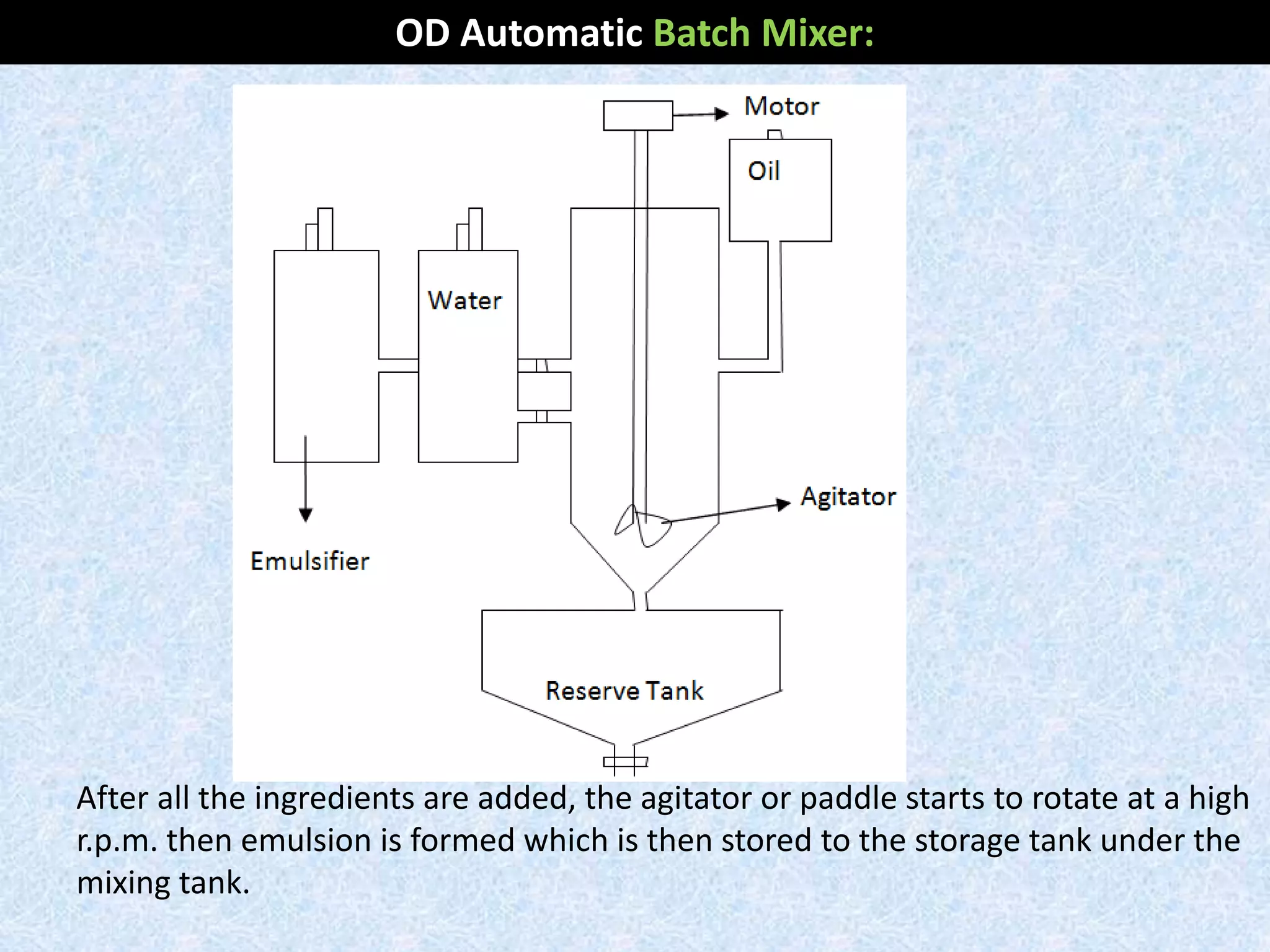
OD Automatic Batch Mixer:
After all the ingredients are added, the agitator or paddle starts to rotate at a high
r.p.m. then emulsion is formed which is then stored to the storage tank under the
mixing tank.
OD Automatic Batch Mixer:
1. Single softener M/c,.
2. Tandem softener m/c.
3. Good softener m/c.
Jute softener machine:
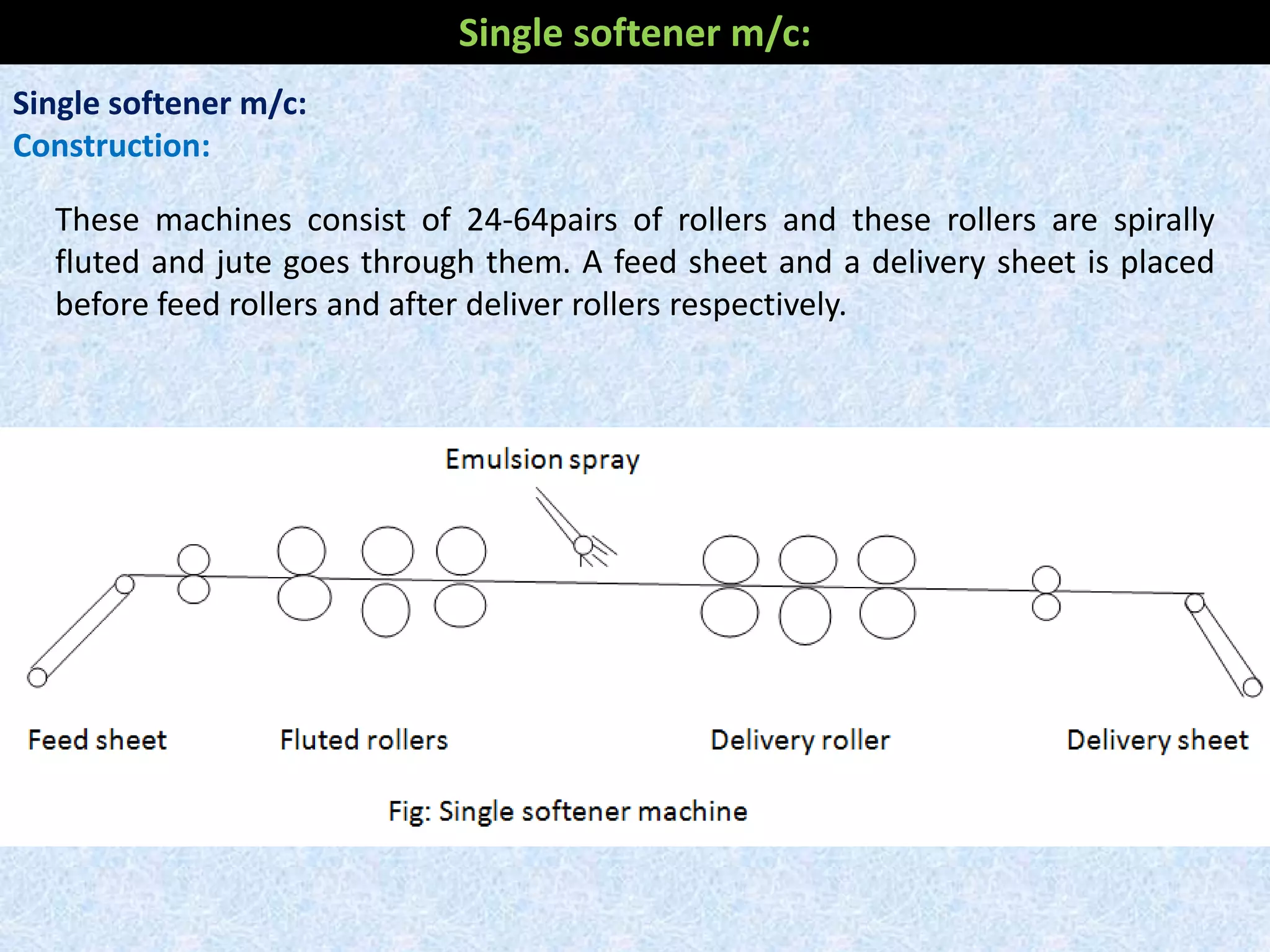
Single softener m/c:
Construction:
These machines consist of 24-64pairs of rollers and these rollers are spirally
fluted and jute goes through them. A feed sheet and a delivery sheet is placed
before feed rollers and after deliver rollers respectively.
Single softener m/c:
Working principle:
1. In this machine, material is feed manually on feed sheet.
2. Then the material goes throw a series of spirally flutted rollers. Spirally flutted
rollers have right hand and left hand spiral flutes alternatively.
3. After passing 1/3 area between the feed rollers and delivery roller emulsion is
applied over material, which soften jute and a tray below the machine collects
excess emulsion.
4. Then through the delivery roller, the material is delivered from delivery sheet.
Working principle:
Pilling or conditioning:
The process by which after applied emulsion, jute fiber is stored at a specific
condition for certain time is called pilling.
Objects:
1. To soften and split up of jute fiber.
2. To loosen the fiber.
3. To convert the rooty material into spinnable fiber.
Pilling or conditioning:
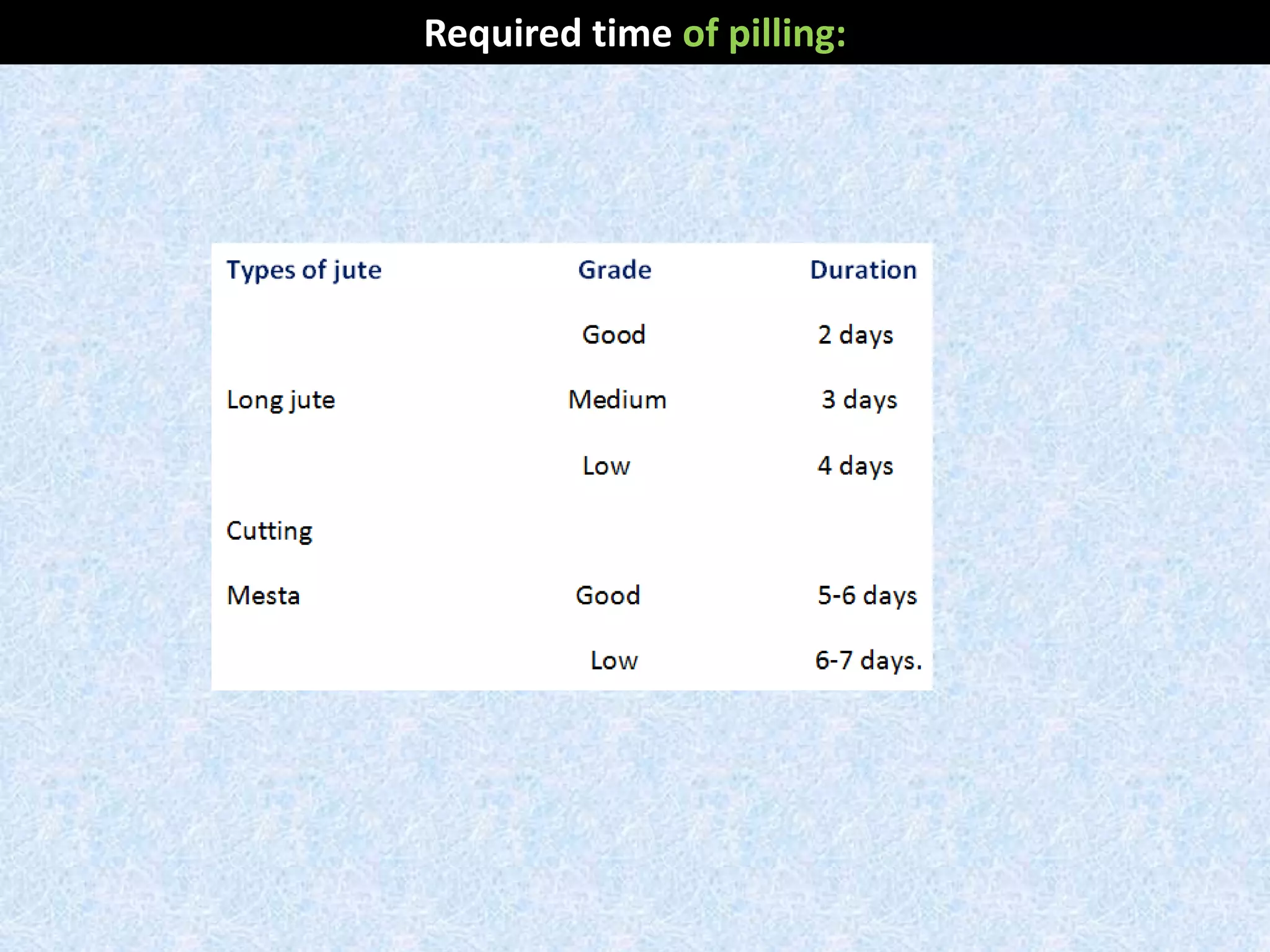
Required time of pilling:
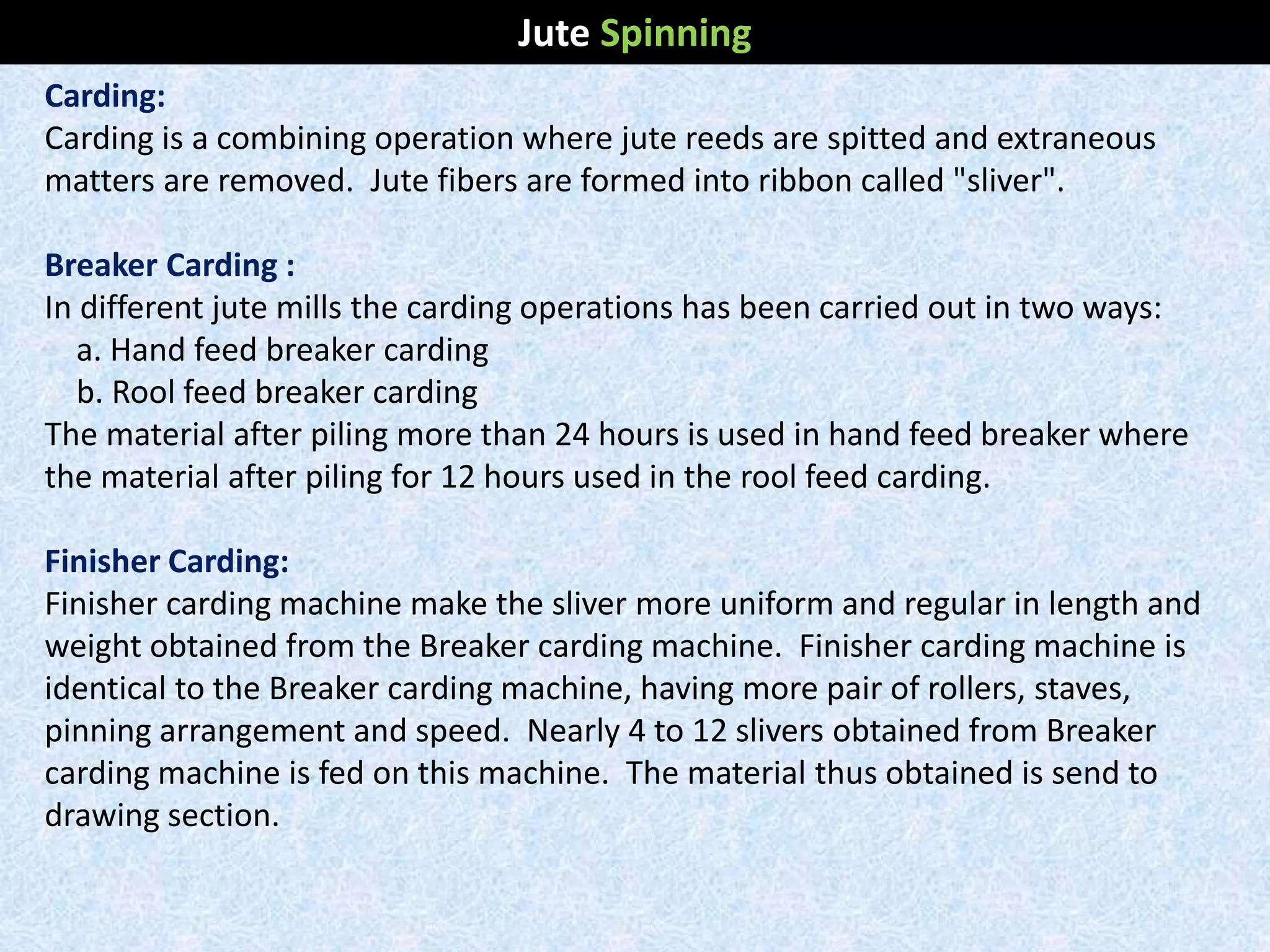
Carding:
Carding is a combining operation where jute reeds are spitted and extraneous
matters are removed. Jute fibers are formed into ribbon called "sliver".
Breaker Carding :
In different jute mills the carding operations has been carried out in two ways:
a. Hand feed breaker carding
b. Rool feed breaker carding
The material after piling more than 24 hours is used in hand feed breaker where
the material after piling for 12 hours used in the rool feed carding.
Finisher Carding:
Finisher carding machine make the sliver more uniform and regular in length and
weight obtained from the Breaker carding machine. Finisher carding machine is
identical to the Breaker carding machine, having more pair of rollers, staves,
pinning arrangement and speed. Nearly 4 to 12 slivers obtained from Breaker
carding machine is fed on this machine. The material thus obtained is send to
drawing section.
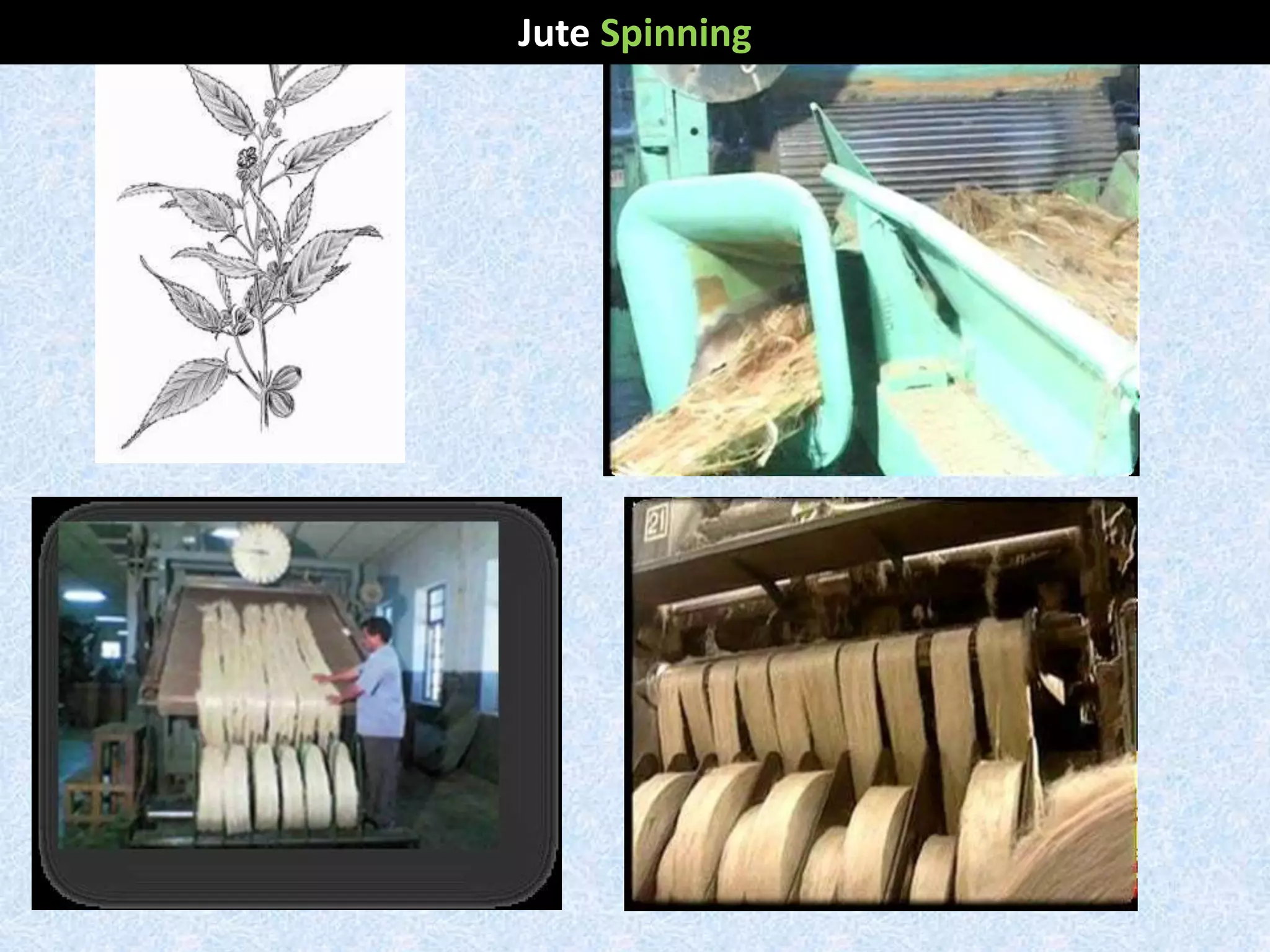
Jute Spinning
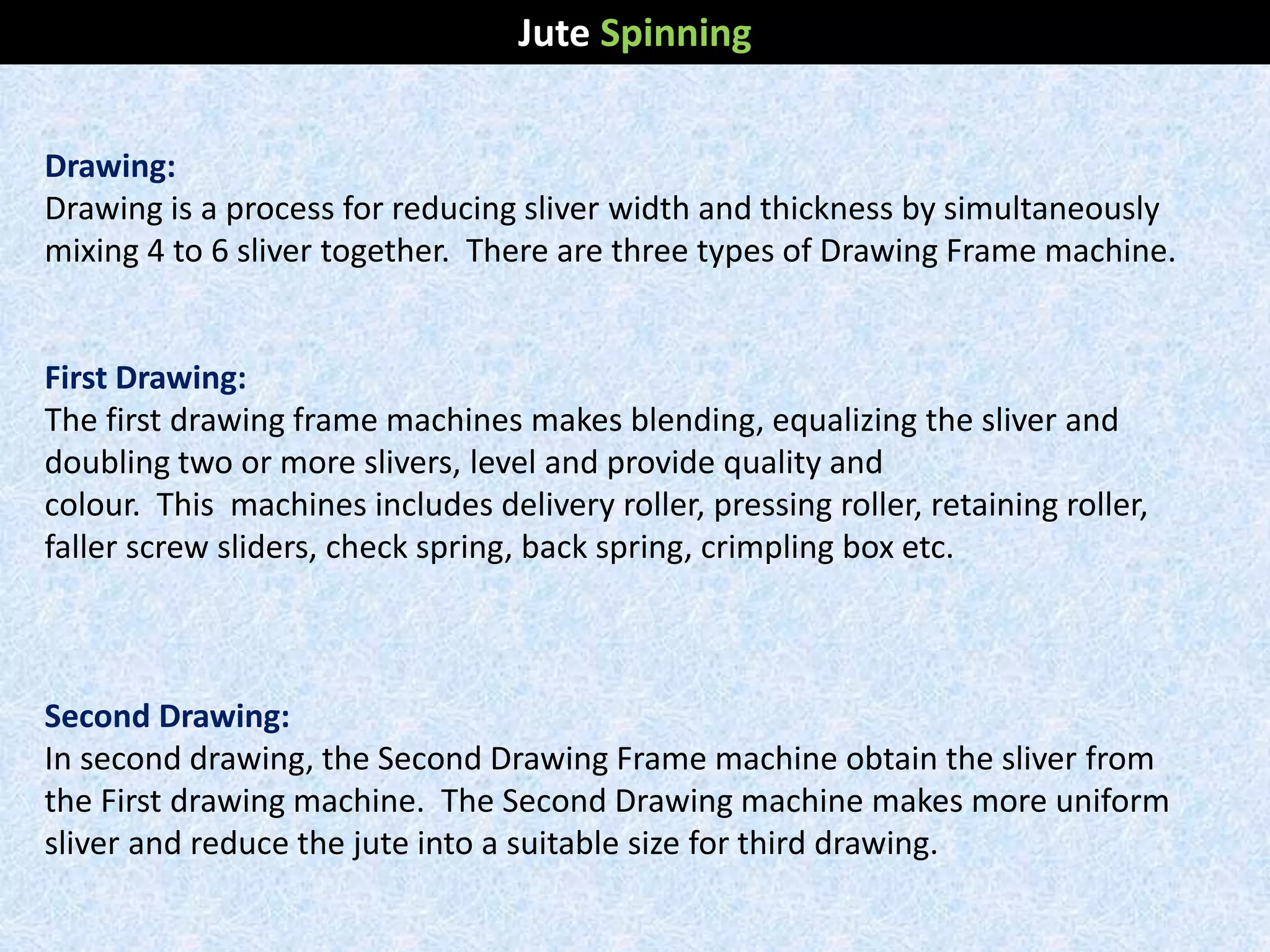
Drawing:
Drawing is a process for reducing sliver width and thickness by simultaneously
mixing 4 to 6 sliver together. There are three types of Drawing Frame machine.
First Drawing:
The first drawing frame machines makes blending, equalizing the sliver and
doubling two or more slivers, level and provide quality and
colour. This machines includes delivery roller, pressing roller, retaining roller,
faller screw sliders, check spring, back spring, crimpling box etc.
Second Drawing:
In second drawing, the Second Drawing Frame machine obtain the sliver from
the First drawing machine. The Second Drawing machine makes more uniform
sliver and reduce the jute into a suitable size for third drawing.
Jute Spinning
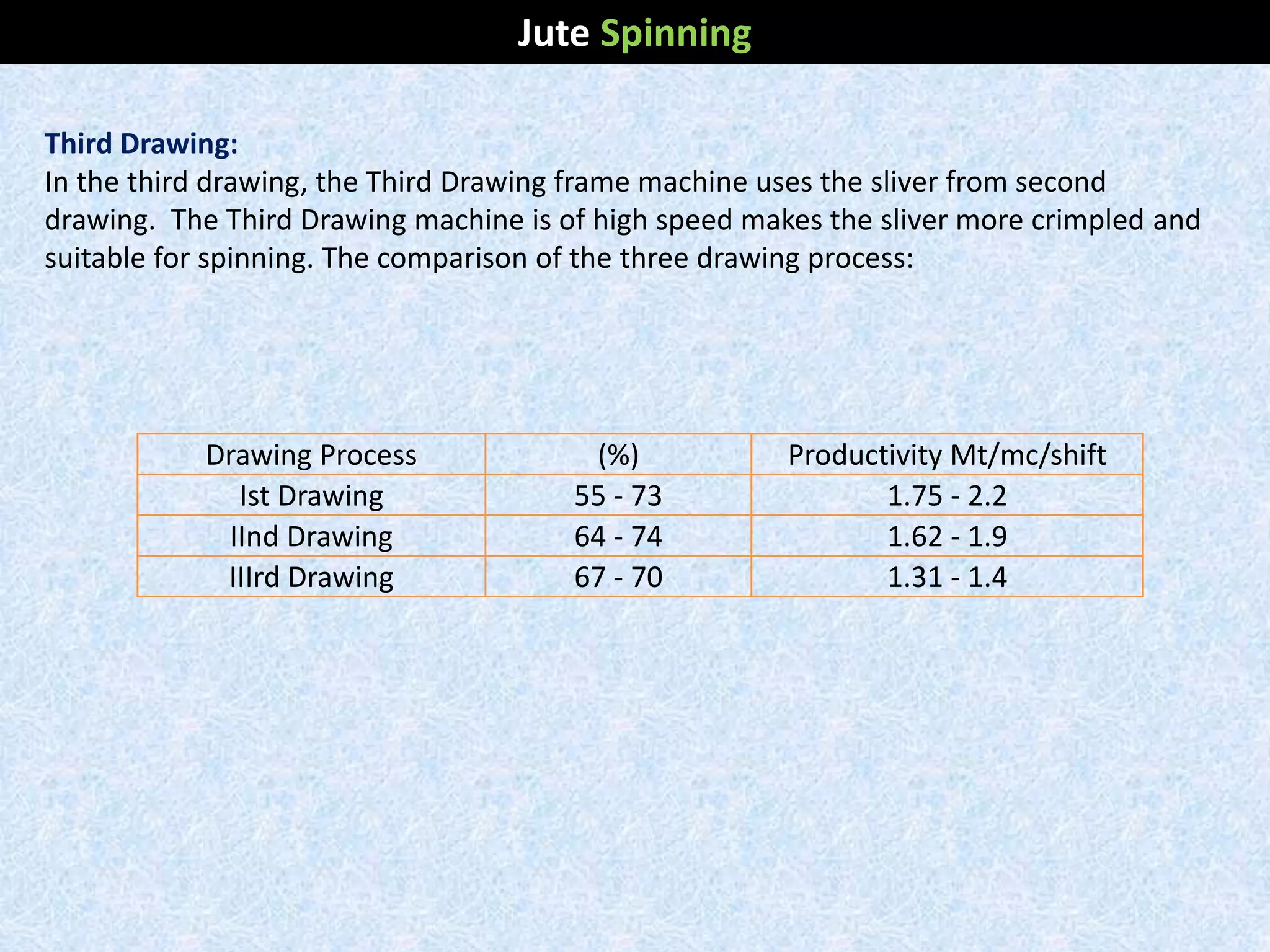
Drawing Process (%) Productivity Mt/mc/shift
Ist Drawing 55 - 73 1.75 - 2.2
IInd Drawing 64 - 74 1.62 - 1.9
IIIrd Drawing 67 - 70 1.31 - 1.4
Third Drawing:
In the third drawing, the Third Drawing frame machine uses the sliver from second
drawing. The Third Drawing machine is of high speed makes the sliver more crimpled and
suitable for spinning. The comparison of the three drawing process:
Jute Spinning
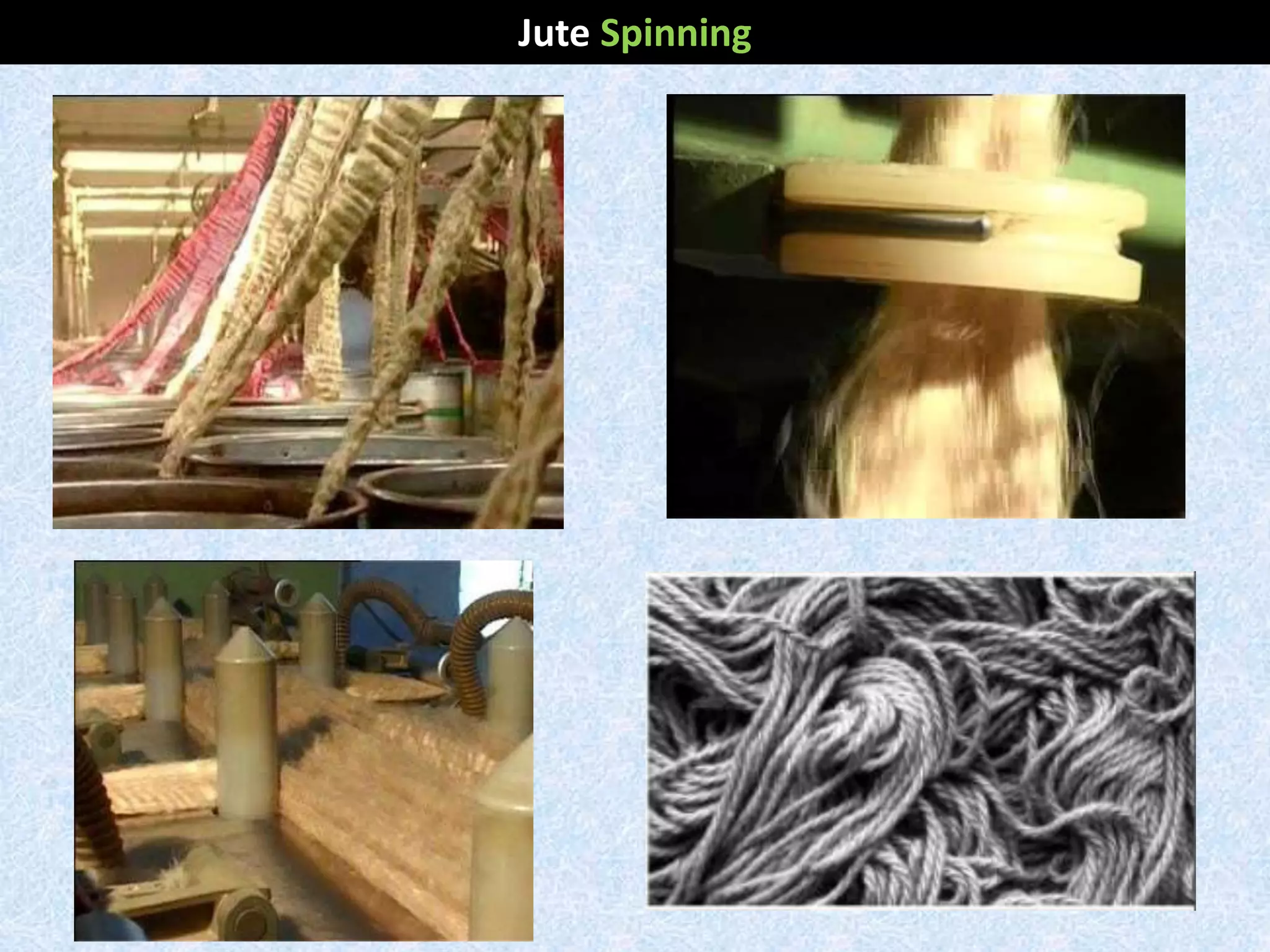
Winding
Winding is a process which provides yarn as spools and cops for the requirement
of beaming and weaving operations. There are two types of winding :
(i) Spool Winding
(ii) and Cope Winding
Spoll Winding:
In Spool Winding yarn is produces for warp .Spool winding machine consists of a
number of spindles. .The Spool are used in making sheets of yarn to form warp
portion used during interlacement of weaving
Cop Winding:
Cop Winding machine obtain yarns from the spinning machines. The spinning
bobbins are placed on a suitable pin on top of the cop machine and yarn tension
is maintained by means of a small leaver.
Winding
Jute Spinning
Jute Spinning
Jute Spinning
Jute Spinning
Flow chart of juteyarnmanufacturingprocess 140522095533-phpapp01

Flow chart of juteyarnmanufacturingprocess 140522095533-phpapp01

  • 1.
    Jute Spinning Md. Nakib-Ul-Hasan Lecturer Dept.of Textile Engineering Green University of Bangladesh
  • 2.
  • 3.
    Jute Spinning Technology Juteis long soft, shiny vegetable fiber that can be spun into yarn. Jute is one of the cheapest natural fibers. Raw jute in the form of bales are processed in jute mills to produce Hessian, sacking, jute yarn, bags, and other useful products. Raw jute bales from jute fields or suppliers, carried by trucks are unloaded are stacked in the jute mills godown. Characteristics of Jute Fibre: Jute is a long, soft, shiny fibre that can be spun into coarse, strong threads. It is one of the cheapest natural fibres, and is second only to cotton in amount produced and variety of uses : Jute fibres are composed primarily of the plant materials cellulose, lignin, and pectin. Both the fibre and the plant from which it comes are commonly called jute. Jute Spinning Technology
  • 4.
    Jute Jute is along, soft, shiny vegetable fiber that can be spun into coarse, strong threads. It is produced from plants in the genus Corchorus, family Tiliaceae. Jute is one of the cheapest natural fibres
  • 5.
    Raw jute inthe form of bales are processed in jute mills to produce hessian, sacking, jute yarn, bags, and other useful products. Raw jute bales from jute fields or suppliers, carried by trucks are unloaded are stacked in the jute mills gowdown. Jute fibres are composed primarily of the plant materials cellulose (major component of plant fibre) and lignin (major components wood fibre). It is thus a ligno-cellulosic fibre that is partially a textile fibre and partially wood. It falls into the bast fibre category (fibre collected from bast or skin of the plant) along with kenaf, industrial hemp, flax (linen), ramie, etc. The industrial term for jute fibre is raw jute. The fibres are off-white to brown, and 1–4 meters (3–12 feet) long. Jute Jute Fabric Jute tree
  • 6.
    Flow Chart forRaw Jute Production
  • 7.
    Flow chart ofjute yarn manufacturing process:
  • 8.
    Flow chart ofjute yarn manufacturing process:
  • 9.
    Flow Process chartof Jute Spinning
  • 10.
    Flow Process chartof Jute Spinning
  • 11.
  • 12.
    Bangla White Jute– White /Creamy White/Light Cream/Straw / Light Grey/Light Reddish Or Any color. Generally raw jute is divided into two main categories: Bangla Tossa Jute - Golden/Red/Grey/Coppery Grey/Mixed in Color. Raw Jute Fiber Grading:
  • 13.
    Physical properties: 1. Specificgravity- 1.48 2. Moisture – St. M.R 13.75 & absorb 35 – 40% water of its dry weight. 3. Strength- Tenacity-dry 3.5-5 g/d wet lower than dry. 4. Elasticity-Breaking extension – 1.8% Recovery (%) very low. For high tenacity, less extension, high stiffness Jute fibres is brittle & can holds less twist. So Emulsion is 5. added to make it soft. 6. Specific heat is 0.325 7. Resiliency-bad, Abrasion resistance moderate, Dimensional stability-good.
  • 14.
    Chemical properties: 1. Effectof bleaches: Not affect by oxidizing or reducing bleaches. 2. Acids & Alkalis: Easily damaged by hot dilute or cold concentrated acids. Resistant 3. to alkalis. 4. Organic solvents: Resistant to organic solvents. 5. Sun light & heat: Poor resistant scorches at high temperature. 6. Resistant to stains: Poor resistant to water borne stains. 7. Biological properties: Scoured jute has good to excellent resistant to microorganisms 8. & insects. 9. Heat: Burns rapidly, Soldering red after glow. 10. Conductivity: Moderate conductor of electricity & heat.
  • 15.
    Cellulose 65.2 % Hemicelluloses22.2 % Lignin 10.8 % Water soluble 1.5 % Fats & wax 0.3 % Chemical Composition of Jute
  • 16.
    Count: The weight inlb of 1 spindle or 14,400 of jute yarn is the count of that yarn. Batch: A blend of different types of jute is made up to suit the particular class of yarns being spun, this blend is known as batch. i.e. In batch the no. of bales of jute is selected for making a particular type of yarn. For example, to produce 8 lbs/ spindle Hessian warp yarn, the batch is Count:
  • 17.
    Batching: All the processpreparatory to carding includes in the batching. It is the primary stage of jute processing. Object of batching: 1. To help the fiber movement freely during processing. 2. To get expected dampness and flexibility. 3. To reduce harshness or stiffness. 4. To control and reduce the yarn cost. 5. To reduce waste. 6. To intermix the batch component effectively. 7. To produce improve graded yarn. Batching:
  • 18.
    Types of JuteYarn | Batch Composition for Jute Yarn | Batch Selection Technique Jute yarn is generally available in single and multiple twists. Available in various specifications, these cater to needs of developing market. Winding in cylindrical, conical and cone less spools or hanks is done as per prerequisites of our customers. This excellent jute yarn finds extensive application in carpet industry. Now we will discuss about the types of jute yarn and batch selection technique of jute yarn.
  • 19.
    1. Hassian Warp: Thesetypes of yarn are good, clean and free from specks with high lusture. For manufacturing this type of yarn, clean and defect free jute is required. To make this type of yarn clean anddefect free jute is required. Batch Selection: Hard jute .......................................70% Soft jute ........................................30% Example: For 8 lbs/spyndle hassian warp White C........................................40% White X ...................................... 40% Tossa ...........................................20%
  • 20.
    2. Hassian Weft: Hassianweft yarn is cleaner and softer than hassian warp yarn. So for hassian weft clean fibre is required, but fibre of lower strength can be used to hassian weft yarn. Batch Selection: For Heavy Yarn Hard jute..................................30% Soft jute ...................................70% For Light Yarn Hard jute .................................50% Soft jute ...................................50% Example: For 8.5 lbs/spyndle hassian weft White C ...................................40% White X ...................................40% Tossa ........................................20%
  • 21.
    3. Sacking Warp: Sackingwarp jute yarn is good and strong. Specks and colour is not important when manufacturing this type of yarn. So, 70 to 80% Tossa jute can be used. Batch Selection: Hard jute ................................... 60% Soft jute .....................................40% Example: For 8 lbs/spyndle sacking warp X bottom ..................................67% S M R ......................................33%
  • 22.
    4. Sacking Weft: Sackingweft yarns are low quality yarn. It is coarse and is made from low grade jute fibre. It may contain line cuttings, bale cuttings, soft and hard waste, rope waste, jute dust, habijabi and entangled jute. Example: For sacking weft NC .......................................................70% S M R ..................................................15% Caddis ..................................................5% Thread waste and gunny cuttings............10%
  • 23.
    5. C.B.C (carpetbreaking cloth): Batch Selection: Hard jute ................................... 100% Example: For 8 lbs/spyndle C.B.C warp B.W.B ....................................... 40% B.W.C ...................................... 60% Example: For 8 lbs/spyndle C.B.C weft
  • 27.
    1. Cost ofraw materials. 2. Physical properties and quality of jute 3. Availability of jute. 4. Quality of yarn being spun. 5. The processing machineries. 6. Suitability of spinning and weaving. 7. Customers demand. 8. Cost of production. Factors considered for batch selection
  • 28.
    Emulsion: A mixture ofsome lubricating agents which is applied on jute fiber to make the fiber soft and flexible. An emulsion is an intimate mixture of two immiscible liquid where one is dispersed in small globules on the other and addition of a third substance brings stability. Emulsion is made by splitting up oil into minute drops which are prevented from reuniting in water. General recipe: Water 73% Oil 25.4% Emulsifier 1.6% Emulsifier: Emulsifiers are surface active agents. These are soaps, detergents, wetting agents. Emulsion:
  • 29.
    1. It shouldbe stable for certain time. 2. It should have no bed effect on jute fiber. 3. It should be colorless. 4. It should have high softening capacity. 5. The droplet of emulsion should be so small that it can easily penetrate on the fiber. 6. It must be odor less. 7. It must be cheap and available. Characteristics of good quality emulsion:
  • 30.
    Requirements of goodbatching oil: 1. It must have no harmful effect on jute fiber. 2. Its color must be acceptable so that it does not stain on the fiber. 3. There must be no danger of spontaneous combustion. 4. It should not be rancid or sticky on storage. 5. It must be cheap and plentiful in supply. 6. It should have low viscosity. 7. It should have high lubricating value. Requirements of good batching oil:
  • 31.
    Function of oil: 1.It lubricates the fiber. 2. It helps free movement of fiber during processing. 3. It cleans pins and rollers of the machine. 4. It makes fiber soft and gives good spinning property. Function of water: 1. It increases extensibility of fiber which resists fiber breakage during processing. 2. It gives sufficient dampness and flexibility. Function of emulsifier: 1. It removes temporary hardness of water. 2. It reduces surface tension. 3. It stabilizes the emulsion. Function of urea: 1. It helps easy penetration of emulsion into the fiber. 2. It helps the fiber to be softening quickly. 3. It reduces maturity time to half generally fiber is stored 48 hrs incase of normal emulsion. When emulsion contain urea, it keeps maturity time 24 hrs. Function of emulsion ingredients:
  • 32.
    1. Creaming: whenan emulsion is prepared, it is impossible to make all the drops exactly same size, some will be much smaller than others and there will be a few quite large drops. In general, the smaller the drops and the less scatter there is in their diameters the better is the emulsion. If there are a number of comparatively large drops of oil they will slowly rise to the top of the emulsion because of their lower specific gravity until a layer of them forms at the surface of the emulsion. This is known as “creaming”. This can be overcome by arranging a slow-running paddle to keep the contents of all emulsion stage tank in gentle motion as creaming will only occur in a standing emulsion. 2. Breaking: breaking can be regarded as the opposite of emulsification where the droplets of the internal oil phase unite to form large drops which then float to the surface of the emulsion. It is a sign of complete instability in the emulsion and once begun cannot be arrested. No amount of re-agitation will split these drops once they have formed and a broken emulsion is useless. Defects in emulsions:
  • 33.
    Types of emulsionmaking machine: 1. Paddle mixer and agitators – (OD batch mixture m/c) 2. Homogenizers. 3. Colloid mills. 4. Ultrasonic emulsion plant. Types of emulsion making machine:
  • 34.
    OD Automatic BatchMixer: Specification: 1. Capacity of mixing cylinder: 1000L 2. Motor for paddle(1 HP) 3. Volume of machine: Length 5’’-3’’, width 2”-2 ¾,Height 5”-10”. 4. Power of production:1-6 tones/hr. ‘OD’ batch mixer is a simple automatic m/c for producing batching emulsion for jute. The percentage of emulsifier, oil and water are measured accurately and automatically by volume. The percentage of oil and emulsifier can be adjusted easily by setting the pointers on oil and emulsifier scale. When adjusted, the machine automatically adds the required percentage of water to complete 1000L. Once the required percentages are set, the machine will automatically continue to measure and mix these percentages each time. OD Automatic Batch Mixer:
  • 35.
    After all theingredients are added, the agitator or paddle starts to rotate at a high r.p.m. then emulsion is formed which is then stored to the storage tank under the mixing tank. OD Automatic Batch Mixer:
  • 36.
    1. Single softenerM/c,. 2. Tandem softener m/c. 3. Good softener m/c. Jute softener machine:
  • 37.
    Single softener m/c: Construction: Thesemachines consist of 24-64pairs of rollers and these rollers are spirally fluted and jute goes through them. A feed sheet and a delivery sheet is placed before feed rollers and after deliver rollers respectively. Single softener m/c:
  • 38.
    Working principle: 1. Inthis machine, material is feed manually on feed sheet. 2. Then the material goes throw a series of spirally flutted rollers. Spirally flutted rollers have right hand and left hand spiral flutes alternatively. 3. After passing 1/3 area between the feed rollers and delivery roller emulsion is applied over material, which soften jute and a tray below the machine collects excess emulsion. 4. Then through the delivery roller, the material is delivered from delivery sheet. Working principle:
  • 39.
    Pilling or conditioning: Theprocess by which after applied emulsion, jute fiber is stored at a specific condition for certain time is called pilling. Objects: 1. To soften and split up of jute fiber. 2. To loosen the fiber. 3. To convert the rooty material into spinnable fiber. Pilling or conditioning:
  • 40.
  • 41.
    Carding: Carding is acombining operation where jute reeds are spitted and extraneous matters are removed. Jute fibers are formed into ribbon called "sliver". Breaker Carding : In different jute mills the carding operations has been carried out in two ways: a. Hand feed breaker carding b. Rool feed breaker carding The material after piling more than 24 hours is used in hand feed breaker where the material after piling for 12 hours used in the rool feed carding. Finisher Carding: Finisher carding machine make the sliver more uniform and regular in length and weight obtained from the Breaker carding machine. Finisher carding machine is identical to the Breaker carding machine, having more pair of rollers, staves, pinning arrangement and speed. Nearly 4 to 12 slivers obtained from Breaker carding machine is fed on this machine. The material thus obtained is send to drawing section. Jute Spinning
  • 42.
    Drawing: Drawing is aprocess for reducing sliver width and thickness by simultaneously mixing 4 to 6 sliver together. There are three types of Drawing Frame machine. First Drawing: The first drawing frame machines makes blending, equalizing the sliver and doubling two or more slivers, level and provide quality and colour. This machines includes delivery roller, pressing roller, retaining roller, faller screw sliders, check spring, back spring, crimpling box etc. Second Drawing: In second drawing, the Second Drawing Frame machine obtain the sliver from the First drawing machine. The Second Drawing machine makes more uniform sliver and reduce the jute into a suitable size for third drawing. Jute Spinning
  • 43.
    Drawing Process (%)Productivity Mt/mc/shift Ist Drawing 55 - 73 1.75 - 2.2 IInd Drawing 64 - 74 1.62 - 1.9 IIIrd Drawing 67 - 70 1.31 - 1.4 Third Drawing: In the third drawing, the Third Drawing frame machine uses the sliver from second drawing. The Third Drawing machine is of high speed makes the sliver more crimpled and suitable for spinning. The comparison of the three drawing process: Jute Spinning
  • 44.
    Winding Winding is aprocess which provides yarn as spools and cops for the requirement of beaming and weaving operations. There are two types of winding : (i) Spool Winding (ii) and Cope Winding Spoll Winding: In Spool Winding yarn is produces for warp .Spool winding machine consists of a number of spindles. .The Spool are used in making sheets of yarn to form warp portion used during interlacement of weaving Cop Winding: Cop Winding machine obtain yarns from the spinning machines. The spinning bobbins are placed on a suitable pin on top of the cop machine and yarn tension is maintained by means of a small leaver. Winding
  • 45.
  • 46.
  • 47.
  • 48.