PRESENTER: DR. SOUVIK
/DR.NAVEEN
MODERATOR:DR VIVEK SINGH
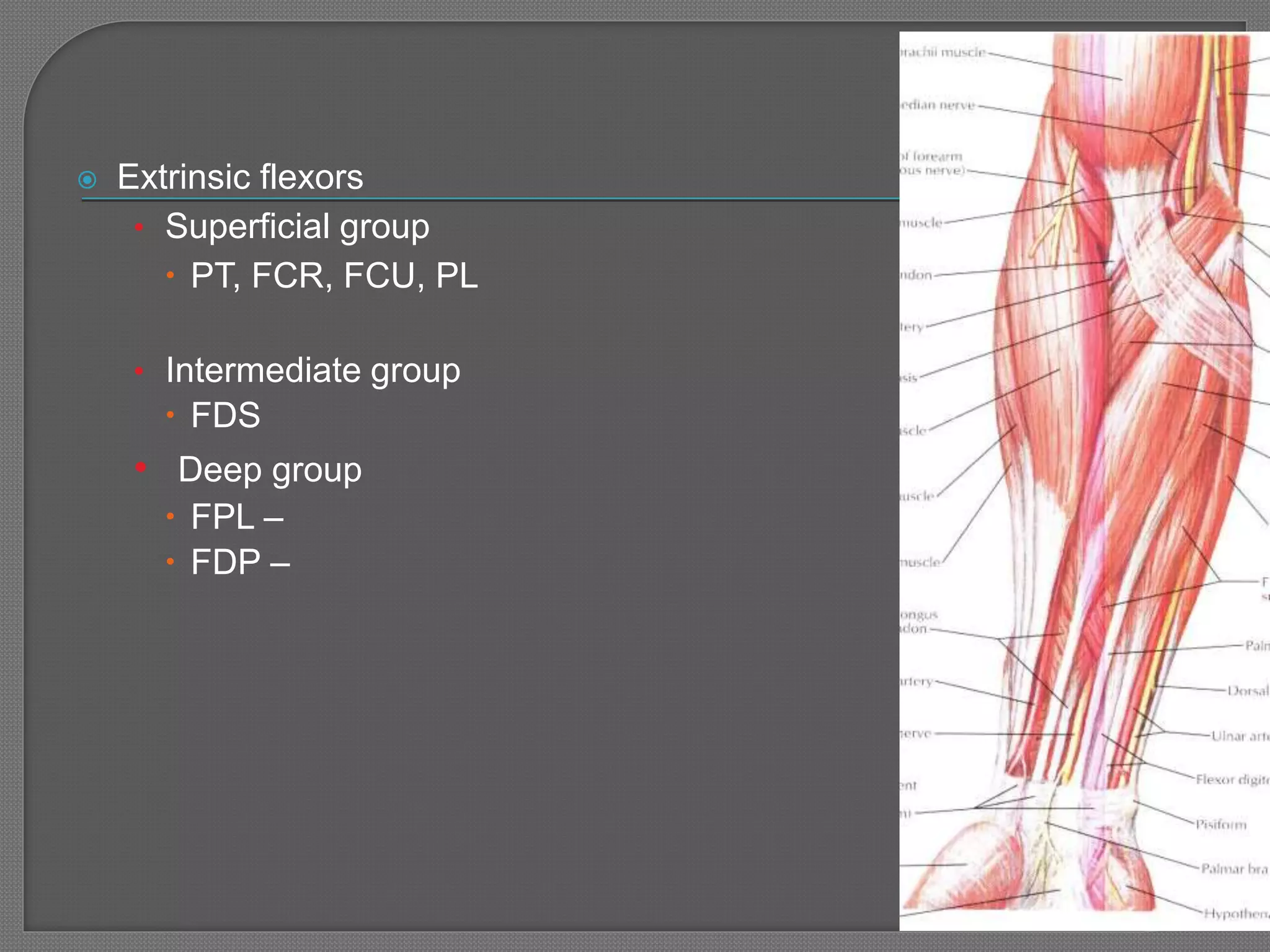
 Extrinsic flexors
• Superficial group
 PT, FCR, FCU, PL
• Intermediate group
 FDS
• Deep group
 FPL –
 FDP –
Condensations of the fibrous retinacular
sheath form the flexor pulleys
Cruciform pully:allow digital flexion to
occur without significant deformation of
annular pulley system
Annular pulley : stiffer and thicker
A1
A2
A3
A4
A5
 Contains only one tendon-FDP
 Tendon laceration occurs close to its insertion
 Tendon to bone repair is required
Green DP, JBJS 2002
Kleinert and verdan classified into 5 anatomic
zones
 From metacarpal head to middle phalanx
 FDS n FDP within one sheath
 Adhesion formation risk is amplified at campers chiasm
ZONE III
•B/W transverse carpal ligament and proximal margin of tendon
sheath formation
•Lumbricals origin here prevents profundus tendons from over acting
 Lies deep to deep transverse ligament
 Tendon injuries are rare
Lies proximal to transverse carpal ligament in the forearm
ZONE V
History
Clinical examination
Special tests
 H/o trauma by sharp objects
 completely transected :no active flexion
and loss of tenodesis effect
 Loss of inherent flexor tone and
extended posture at PIP and DIP
 Functional tests of FDS and FDP
 light touch and static two-point discrimination
 Capillary refill of the volar digital pulp and the nail bed
Types :
 Primary: first 12-24 hours of injury
 Delayed primary repair : 24 hours to 10 days
 Secondary repair: 10 to 14 days,
 Late secondary repair: after 4 weeks
Ref campbell 12 th ed
 Emergency repair needed if altered digital perfusion present
 Clean wound caused by sharp object.
Indicated if a/w
 extensive crushing with bony comminution
 severe neurovascular injury
 severe joint injury and skin loss requiring a coverage procedure
 Primary repair gives better functional outcomes than secondary
repairs
 Ref: Tang JB :Injury. 2006 Nov
 Incisions should not compromise viability of skin flaps shd not
create contractures or cosmetically unsightly scars
 Zigzag (Brunner) or midaxial incisions and midlateral incisions
 Core Non-absorbable 4/0 suture
 4-0 or 3-0 prolene or mersilene suture may be used
 5-0 or 6-0 monofilament running epitenon suture.
Ref: J Bone Joint Surg Am. 1998.
 Singer G,
 Direct repair (primary tenorraphy): laceration >1 cm from FDP
insertion
 Entire A4 annular pulley preserved
 proximal tendon
Retrieved by feeding
tube and passed
underneath A4 pulley
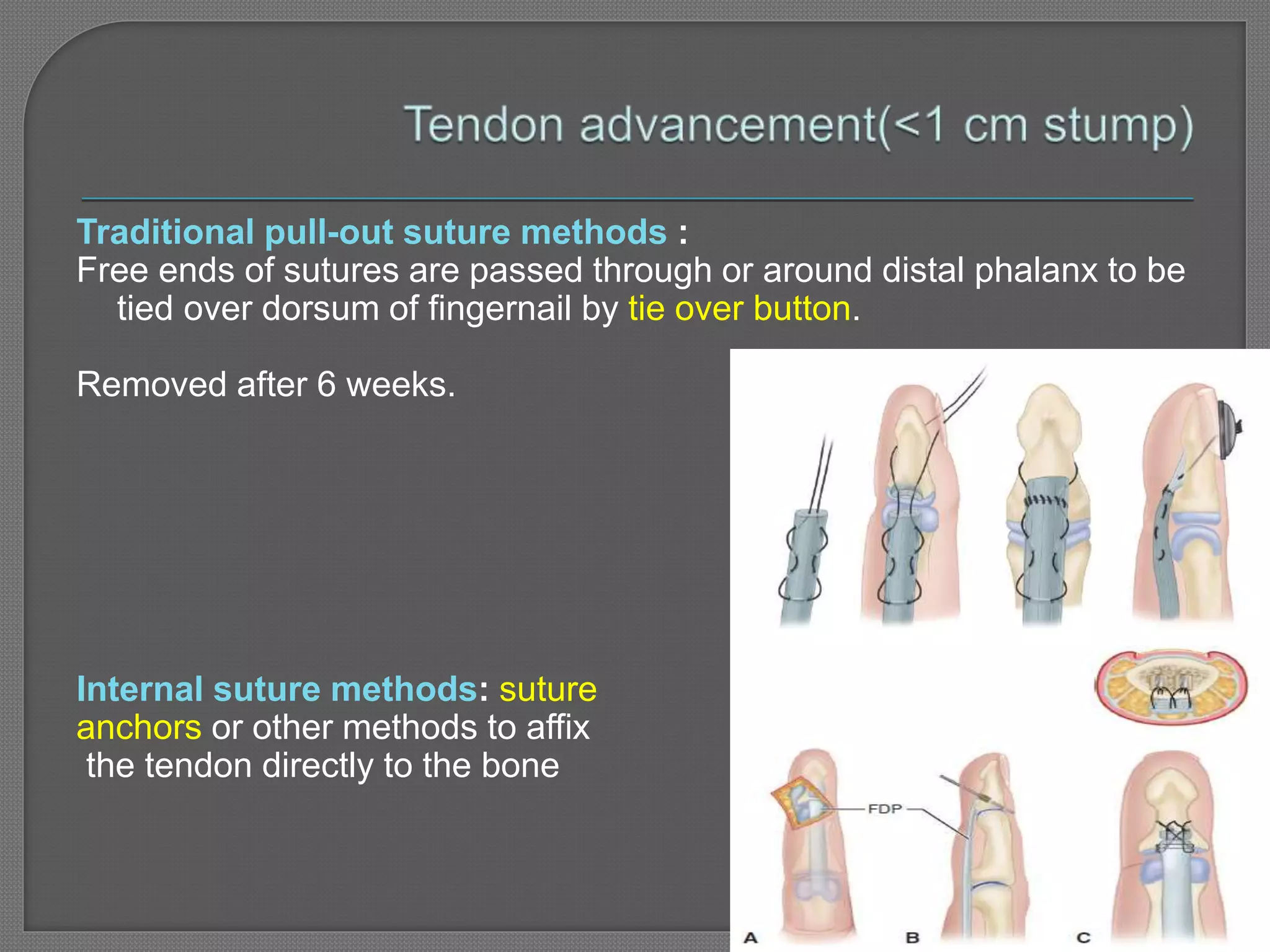
Traditional pull-out suture methods :
Free ends of sutures are passed through or around distal phalanx to be
tied over dorsum of fingernail by tie over button.
Removed after 6 weeks.
Internal suture methods: suture
anchors or other methods to affix
the tendon directly to the bone
 Dissection proceeds with identification
and protection of the digital nerves and arteries
 It is necessary to open either the C1 (between A2 and A3) or C2
(between A3 and A4) cruciate-synovial sheath
 Always restore the normal relation between the two tendons
Pearls
 Multistrand core suture method with running circumferential suture
preferred
 Enter sheath between distal A2 and proximal A4.
 Proximal stump retrieval by milking, feeding tube, or direct exposure
 Deliver distal stump by passive DIP hyperflexion
 Repair by transfixation using 25-gauge, 5/8 inch needle
 Use two or four strand core suture technique
Newer ones: Strickland, cruciate,
Becker, Savage, and Winters
Core suture loops
 When transverse component passes within tendon
superficial to the longitudinal component, suture “locks” a
bundle of tendon fibers.
 When transverse component passes deep to longitudinal
component, but the suture does not “lock” a bundle of
tendon fibers, but pulls through the tendon by grasping it.
 Postoperative POP and dressing applied with wrist
flexed (20 to 30 degrees) and MP joints flexed (50 to 70
degrees), and PIP and DIP joints at zero or slight flexion
 Graded rehabilitation protocol(Duran ,Kleinert)
 Unrestricted activity at 4 to 6 months after surgery
 If both tendons are lacerated, both are repaired, end to end with
circumferential re-enforcing sutures
 May affect lumbricals inaddition to flexor tendons
 Damaged lumbrical is either repaired or excised depending on
severity of injury and the location of the laceration
 Lumbricals muscle bellies usually are not sutured, cause lumbrical
plus finger
 A/w median ,ulnar nerve or ulnar or radial vessel injury.
 Here vessels and nerves should be repaired first and the tendons
last
 Partially severed tendon should not be repaired if at least 40% of
the tendon remains intact
 J Hand Surg 2000;25A:1118-1121 :
 Extensile exposure in a controlled setting with optical
magnification allows the extent of the injury to be defined.
▪ Tendon retrieval is done using atraumatic techniques and
windows through noncrucial areas of the flexor tendon sheath.
▪ Handling of the tendon should be minimal.
▪ The tendon must be accurately oriented.
▪ The core tendon sutures should be placed to allow for
accurate coaptation of the tendon ends. The suture method
should provide a stable, smooth repair that is freely gliding
within the tendon sheath.
▪ Circumferential suture is used to “finish” the repair and
add strength to the repair.
▪ Sheath closure is necessary only if it improves tendon
gliding.
 Acknowledgments
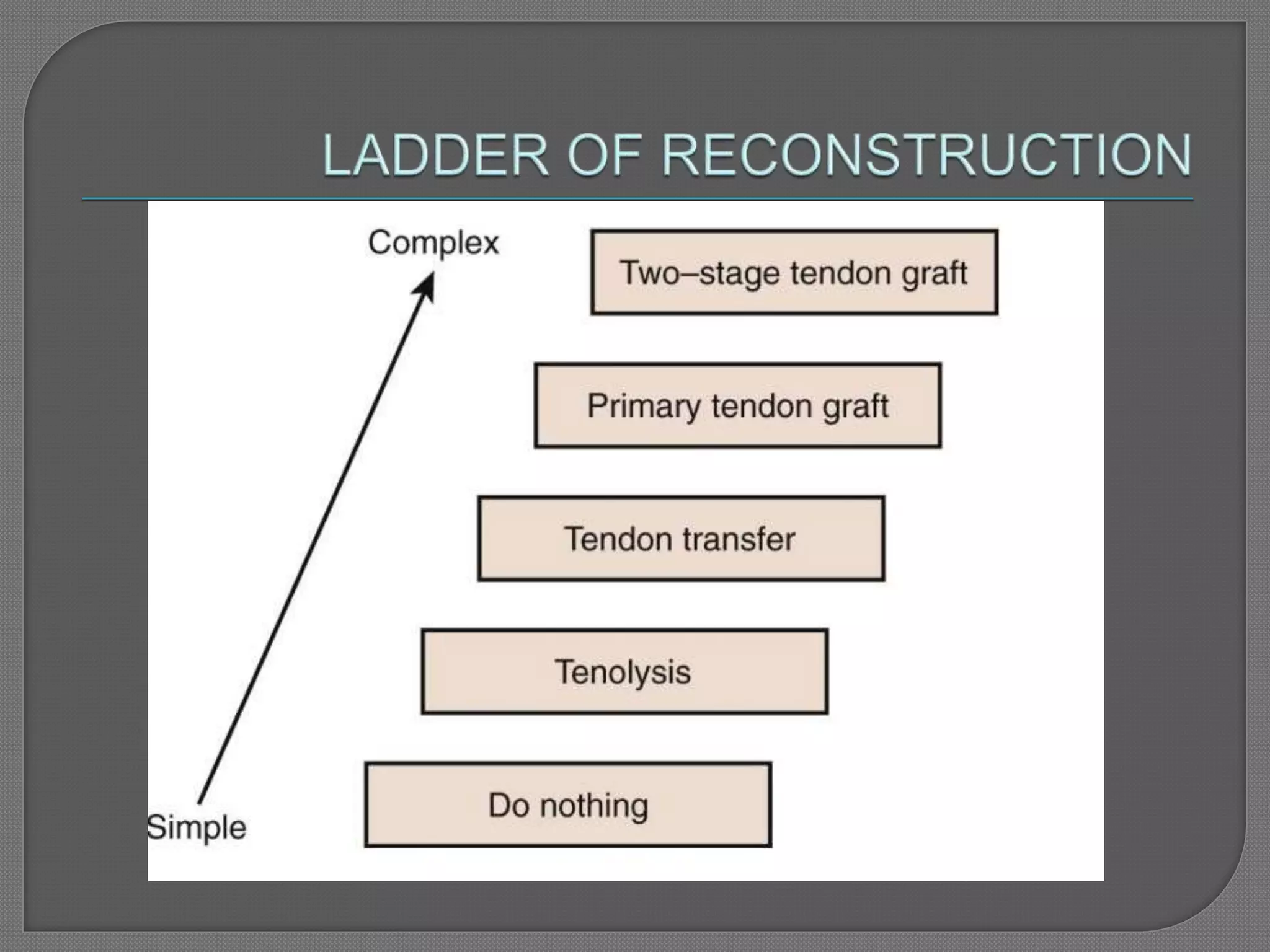
 Indications: 1.Injuries resulting in segmental tendon loss.
2. Neglected >3 to 6 weeks with tendon degeneration and scar
within the tendon sheath.
3. Large section of tendon has been damaged in zone 2 injury

4.Delayed presentation of FDP avulsion injuries associated with
significant tendon retraction.
 Grade 1 Good: Minimal scar with mobile joints and no trophic
changes
 Grade 2 Cicatrix: because of injury , failed primary repair or
infection
 Grade 3 Joint damage: with restricted range of motion
 Grade 4 Nerve damage: resulting in trophic changes
 Grade 5 Multiple damage: Involvement of multiple fingers with
combination of above problems
From Boyes JH: J Bone Joint Surg Am 32:489-499, 1950.
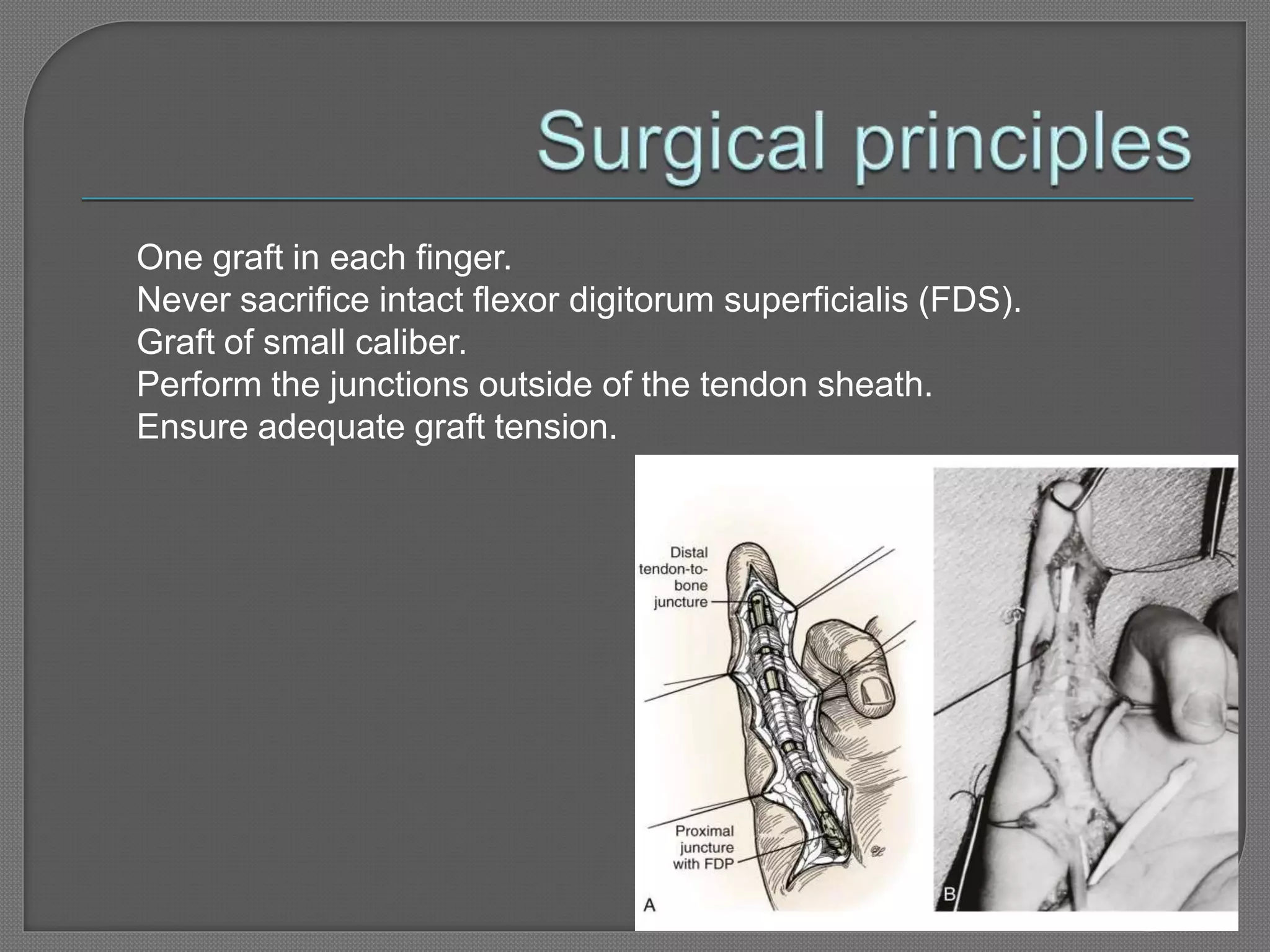
One graft in each finger.
Never sacrifice intact flexor digitorum superficialis (FDS).
Graft of small caliber.
Perform the junctions outside of the tendon sheath.
Ensure adequate graft tension.
 Palmaris longus[1] tendon present in approximately 85%
of all individuals of sufficient length and size .
 Plantaris [2] when graft length is important.
present in about 93% of population
 EDL[3]
 EI [3]
 EDM[3]
 FDS of unaffected finger[4]
 Ref: 1. MARTIN I. BOYER.JBJS 2002
 2.Morrison WA J Hand Surg [Br] 1992
 3. Harvey FJ, J Hand Surg [Am] 1983
 4.Snow JW: Plast Reconstr Surg 1968
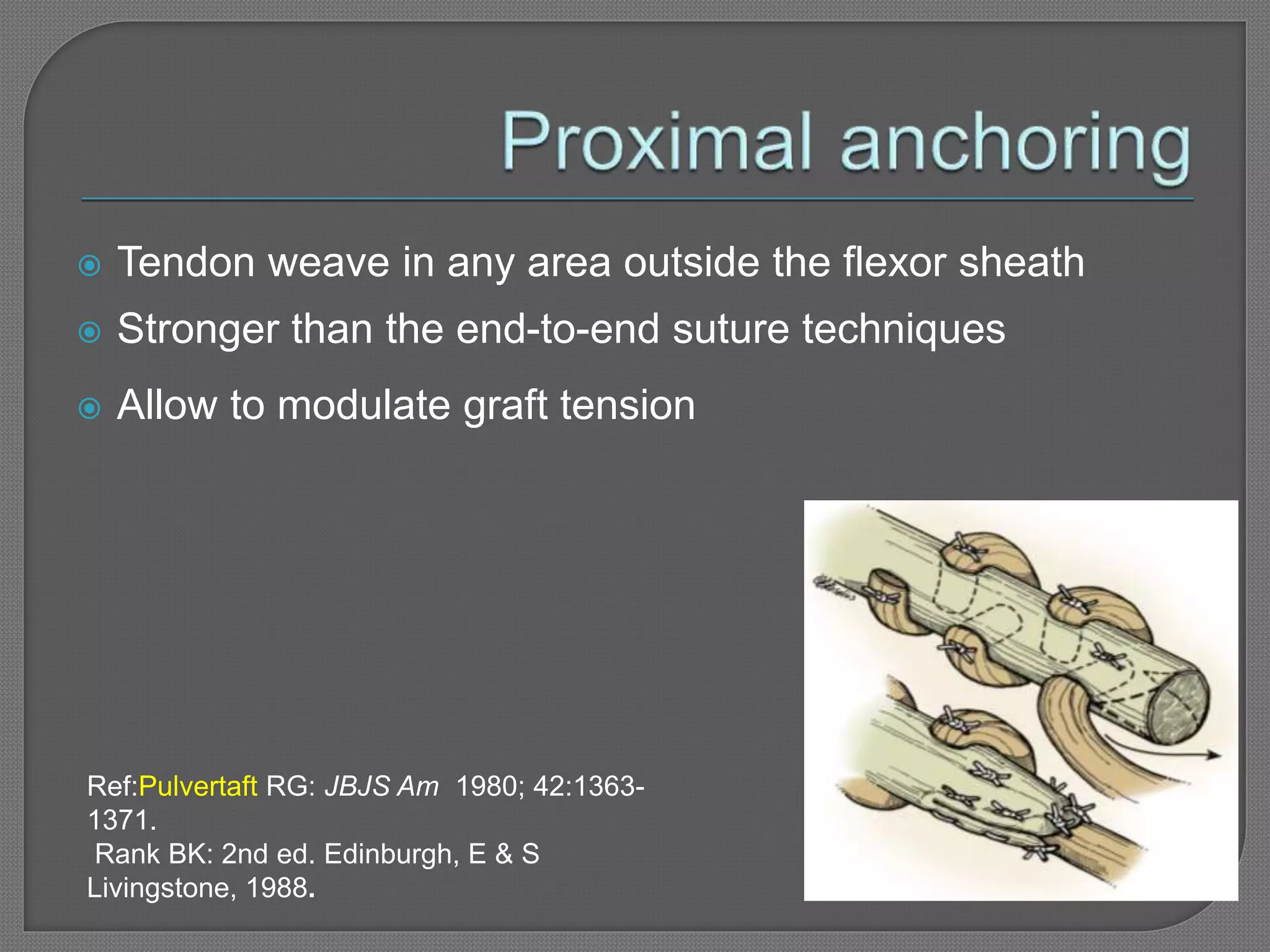
 Tendon weave in any area outside the flexor sheath
 Stronger than the end-to-end suture techniques
 Allow to modulate graft tension
Ref:Pulvertaft RG: JBJS Am 1980; 42:1363-
1371.
Rank BK: 2nd ed. Edinburgh, E & S
Livingstone, 1988.
 Profundus stump not available:
 Profundus stump available:
▪ 1 cm FDP stump ,1 to 2 cm FDS tendon near insertion
▪ Obtaining flexor graft
▪ Graft threaded under pulleys with suture passer(pediatric
feeding tube/red rubber catheter
▪ Distal juncture created
▪ Proximal juncture into the FDP tendon just distal to the
lumbrical origin. (≥3 interweaves)
Sourmelis SG: J Hand Surg Br 1987;
▪ In patients with DIP joint hyperextension, tenodesis
or arthrodesis can be offered.
 Postoperative Care
▪ Static dorsal blocking splint (4 to 6 weeks) with the
wrist neutral, MP joints at 45 degrees, and IP joints
neutral.
▪ Treat flexion contractures with passive stretching
and splinting (6 to 8 weeks).
 Passive tendon implants at first surgery, placement of
tendon graft at second surgery
 Indications ▪ Crushing injuries a/w # or skin damage
▪ Damaged pulley system
▪ Excessive scarring of the tendon bed
▪ Failure of previous operations
▪ Contracted joints
 1-cm FDP stump kept & proximal FDP tendon
transected at the level of the lumbrical origin.
 Through distal forearm incision identify the involved
FDS tendon, draw it into the wound, and transect it
near the musculotendinous junction
 Appropriate size of the silicone implant.
 Assess pulley system
 Pass implant from proximal palm to distal forearm
between the FDP and FDS
Distal juncture suture applied
 ROM checked
 If implant assumes bowstring posture, pulley
reconstruction done by Bunnell encircling
method/ Kleinert technique
Postoperative Care :Splint with wrist in 35 degrees of
flexion, MP joints at 60 to 70 degrees of flexion, and IP
joints extended.
▪Start passive motion on first postoperative visit
▪Contracture releases may benefit from dynamic splinting
(6 to 8 weeks).
 Indication: Patient who underwent stage I of flexor reconstruction
process
 Interval between stages I and II :2-3 months.
 Hand must be soft, and joints well mobilized.
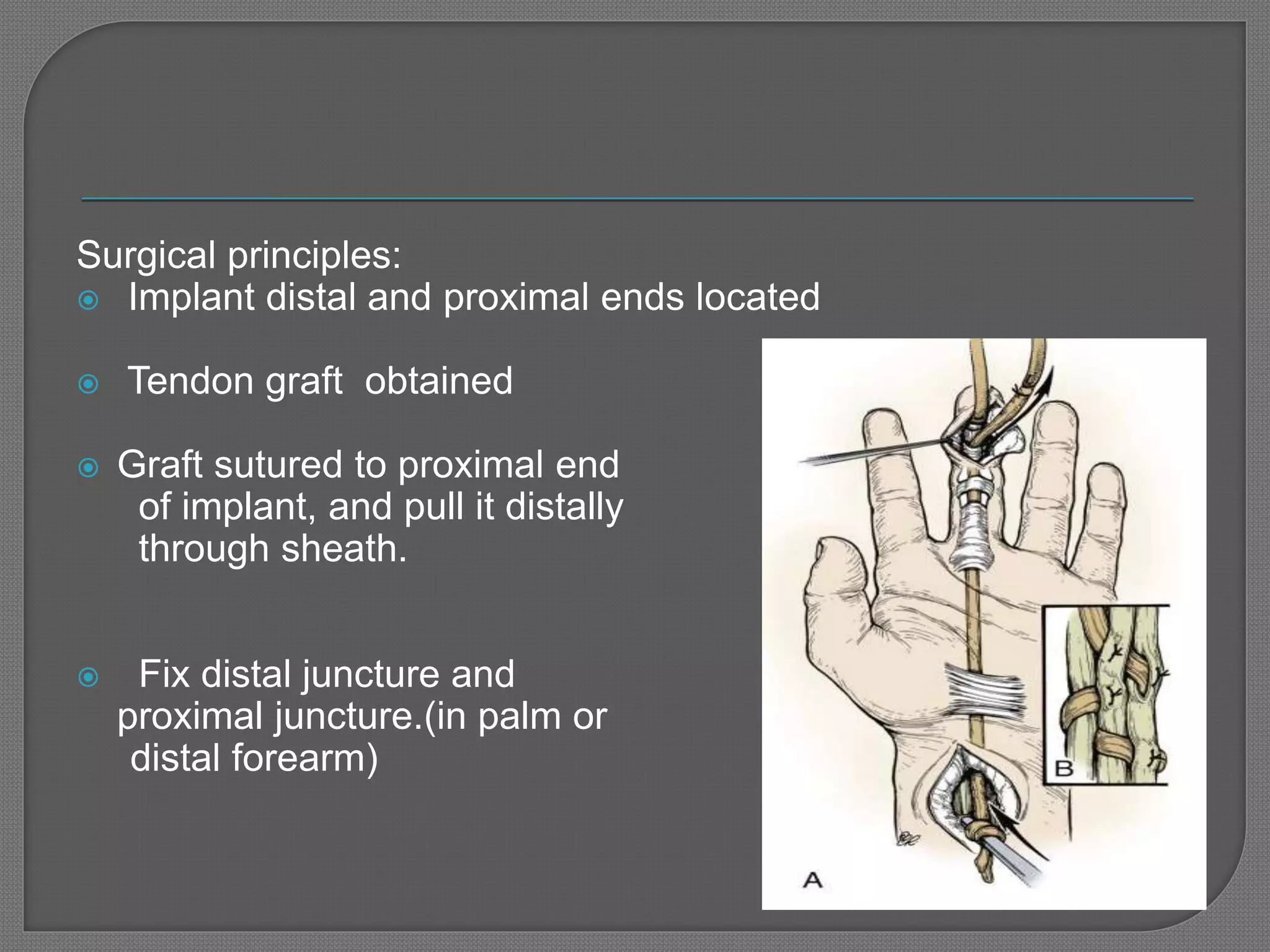
Surgical principles:
 Implant distal and proximal ends located
 Tendon graft obtained
 Graft sutured to proximal end
of implant, and pull it distally
through sheath.
 Fix distal juncture and
proximal juncture.(in palm or
distal forearm)
Proper tension of graft maintaining necessary
 Postoperative Care
▪ Apply a short arm dorsal blocking splint
▪ Protected passive range of motion early
▪ Dynamic splinting for contractures.
Flexor tendon injury

Flexor tendon injury

  • 1.
  • 2.
     Extrinsic flexors •Superficial group  PT, FCR, FCU, PL • Intermediate group  FDS • Deep group  FPL –  FDP –
  • 3.
    Condensations of thefibrous retinacular sheath form the flexor pulleys Cruciform pully:allow digital flexion to occur without significant deformation of annular pulley system Annular pulley : stiffer and thicker A1 A2 A3 A4 A5
  • 4.
     Contains onlyone tendon-FDP  Tendon laceration occurs close to its insertion  Tendon to bone repair is required Green DP, JBJS 2002 Kleinert and verdan classified into 5 anatomic zones
  • 5.
     From metacarpalhead to middle phalanx  FDS n FDP within one sheath  Adhesion formation risk is amplified at campers chiasm ZONE III •B/W transverse carpal ligament and proximal margin of tendon sheath formation •Lumbricals origin here prevents profundus tendons from over acting
  • 6.
     Lies deepto deep transverse ligament  Tendon injuries are rare Lies proximal to transverse carpal ligament in the forearm ZONE V
  • 7.
  • 8.
     H/o traumaby sharp objects  completely transected :no active flexion and loss of tenodesis effect  Loss of inherent flexor tone and extended posture at PIP and DIP  Functional tests of FDS and FDP  light touch and static two-point discrimination  Capillary refill of the volar digital pulp and the nail bed
  • 9.
    Types :  Primary:first 12-24 hours of injury  Delayed primary repair : 24 hours to 10 days  Secondary repair: 10 to 14 days,  Late secondary repair: after 4 weeks Ref campbell 12 th ed
  • 10.
     Emergency repairneeded if altered digital perfusion present  Clean wound caused by sharp object.
  • 11.
    Indicated if a/w extensive crushing with bony comminution  severe neurovascular injury  severe joint injury and skin loss requiring a coverage procedure  Primary repair gives better functional outcomes than secondary repairs  Ref: Tang JB :Injury. 2006 Nov
  • 12.
     Incisions shouldnot compromise viability of skin flaps shd not create contractures or cosmetically unsightly scars  Zigzag (Brunner) or midaxial incisions and midlateral incisions
  • 13.
     Core Non-absorbable4/0 suture  4-0 or 3-0 prolene or mersilene suture may be used  5-0 or 6-0 monofilament running epitenon suture. Ref: J Bone Joint Surg Am. 1998.  Singer G,
  • 14.
     Direct repair(primary tenorraphy): laceration >1 cm from FDP insertion  Entire A4 annular pulley preserved  proximal tendon Retrieved by feeding tube and passed underneath A4 pulley
  • 15.
    Traditional pull-out suturemethods : Free ends of sutures are passed through or around distal phalanx to be tied over dorsum of fingernail by tie over button. Removed after 6 weeks. Internal suture methods: suture anchors or other methods to affix the tendon directly to the bone
  • 16.
     Dissection proceedswith identification and protection of the digital nerves and arteries  It is necessary to open either the C1 (between A2 and A3) or C2 (between A3 and A4) cruciate-synovial sheath  Always restore the normal relation between the two tendons
  • 17.
    Pearls  Multistrand coresuture method with running circumferential suture preferred  Enter sheath between distal A2 and proximal A4.  Proximal stump retrieval by milking, feeding tube, or direct exposure  Deliver distal stump by passive DIP hyperflexion  Repair by transfixation using 25-gauge, 5/8 inch needle  Use two or four strand core suture technique
  • 18.
    Newer ones: Strickland,cruciate, Becker, Savage, and Winters
  • 19.
    Core suture loops When transverse component passes within tendon superficial to the longitudinal component, suture “locks” a bundle of tendon fibers.  When transverse component passes deep to longitudinal component, but the suture does not “lock” a bundle of tendon fibers, but pulls through the tendon by grasping it.
  • 20.
     Postoperative POPand dressing applied with wrist flexed (20 to 30 degrees) and MP joints flexed (50 to 70 degrees), and PIP and DIP joints at zero or slight flexion  Graded rehabilitation protocol(Duran ,Kleinert)  Unrestricted activity at 4 to 6 months after surgery
  • 21.
     If bothtendons are lacerated, both are repaired, end to end with circumferential re-enforcing sutures  May affect lumbricals inaddition to flexor tendons  Damaged lumbrical is either repaired or excised depending on severity of injury and the location of the laceration  Lumbricals muscle bellies usually are not sutured, cause lumbrical plus finger
  • 22.
     A/w median,ulnar nerve or ulnar or radial vessel injury.  Here vessels and nerves should be repaired first and the tendons last
  • 23.
     Partially severedtendon should not be repaired if at least 40% of the tendon remains intact  J Hand Surg 2000;25A:1118-1121 :
  • 24.
     Extensile exposurein a controlled setting with optical magnification allows the extent of the injury to be defined. ▪ Tendon retrieval is done using atraumatic techniques and windows through noncrucial areas of the flexor tendon sheath. ▪ Handling of the tendon should be minimal. ▪ The tendon must be accurately oriented. ▪ The core tendon sutures should be placed to allow for accurate coaptation of the tendon ends. The suture method should provide a stable, smooth repair that is freely gliding within the tendon sheath. ▪ Circumferential suture is used to “finish” the repair and add strength to the repair. ▪ Sheath closure is necessary only if it improves tendon gliding.  Acknowledgments
  • 27.
     Indications: 1.Injuriesresulting in segmental tendon loss. 2. Neglected >3 to 6 weeks with tendon degeneration and scar within the tendon sheath. 3. Large section of tendon has been damaged in zone 2 injury  4.Delayed presentation of FDP avulsion injuries associated with significant tendon retraction.
  • 28.
     Grade 1Good: Minimal scar with mobile joints and no trophic changes  Grade 2 Cicatrix: because of injury , failed primary repair or infection  Grade 3 Joint damage: with restricted range of motion  Grade 4 Nerve damage: resulting in trophic changes  Grade 5 Multiple damage: Involvement of multiple fingers with combination of above problems From Boyes JH: J Bone Joint Surg Am 32:489-499, 1950.
  • 29.
    One graft ineach finger. Never sacrifice intact flexor digitorum superficialis (FDS). Graft of small caliber. Perform the junctions outside of the tendon sheath. Ensure adequate graft tension.
  • 30.
     Palmaris longus[1]tendon present in approximately 85% of all individuals of sufficient length and size .  Plantaris [2] when graft length is important. present in about 93% of population  EDL[3]  EI [3]  EDM[3]  FDS of unaffected finger[4]  Ref: 1. MARTIN I. BOYER.JBJS 2002  2.Morrison WA J Hand Surg [Br] 1992  3. Harvey FJ, J Hand Surg [Am] 1983  4.Snow JW: Plast Reconstr Surg 1968
  • 31.
     Tendon weavein any area outside the flexor sheath  Stronger than the end-to-end suture techniques  Allow to modulate graft tension Ref:Pulvertaft RG: JBJS Am 1980; 42:1363- 1371. Rank BK: 2nd ed. Edinburgh, E & S Livingstone, 1988.
  • 32.
     Profundus stumpnot available:  Profundus stump available:
  • 33.
    ▪ 1 cmFDP stump ,1 to 2 cm FDS tendon near insertion ▪ Obtaining flexor graft ▪ Graft threaded under pulleys with suture passer(pediatric feeding tube/red rubber catheter ▪ Distal juncture created ▪ Proximal juncture into the FDP tendon just distal to the lumbrical origin. (≥3 interweaves) Sourmelis SG: J Hand Surg Br 1987;
  • 34.
    ▪ In patientswith DIP joint hyperextension, tenodesis or arthrodesis can be offered.  Postoperative Care ▪ Static dorsal blocking splint (4 to 6 weeks) with the wrist neutral, MP joints at 45 degrees, and IP joints neutral. ▪ Treat flexion contractures with passive stretching and splinting (6 to 8 weeks).
  • 35.
     Passive tendonimplants at first surgery, placement of tendon graft at second surgery  Indications ▪ Crushing injuries a/w # or skin damage ▪ Damaged pulley system ▪ Excessive scarring of the tendon bed ▪ Failure of previous operations ▪ Contracted joints
  • 36.
     1-cm FDPstump kept & proximal FDP tendon transected at the level of the lumbrical origin.  Through distal forearm incision identify the involved FDS tendon, draw it into the wound, and transect it near the musculotendinous junction  Appropriate size of the silicone implant.  Assess pulley system
  • 37.
     Pass implantfrom proximal palm to distal forearm between the FDP and FDS Distal juncture suture applied  ROM checked  If implant assumes bowstring posture, pulley reconstruction done by Bunnell encircling method/ Kleinert technique
  • 38.
    Postoperative Care :Splintwith wrist in 35 degrees of flexion, MP joints at 60 to 70 degrees of flexion, and IP joints extended. ▪Start passive motion on first postoperative visit ▪Contracture releases may benefit from dynamic splinting (6 to 8 weeks).
  • 39.
     Indication: Patientwho underwent stage I of flexor reconstruction process  Interval between stages I and II :2-3 months.  Hand must be soft, and joints well mobilized.
  • 40.
    Surgical principles:  Implantdistal and proximal ends located  Tendon graft obtained  Graft sutured to proximal end of implant, and pull it distally through sheath.  Fix distal juncture and proximal juncture.(in palm or distal forearm)
  • 41.
    Proper tension ofgraft maintaining necessary  Postoperative Care ▪ Apply a short arm dorsal blocking splint ▪ Protected passive range of motion early ▪ Dynamic splinting for contractures.