1
Flexible Display
Technologies For Flexible Displays
AMOLEDs
FlexUp technology
Passivation and encapsulation of flexible AMOLEDs
Applications of flexible AMOLED displays
i2r E-paper
Production of i2R E-paper
Applications of i2r E-paper
Conclusion
2
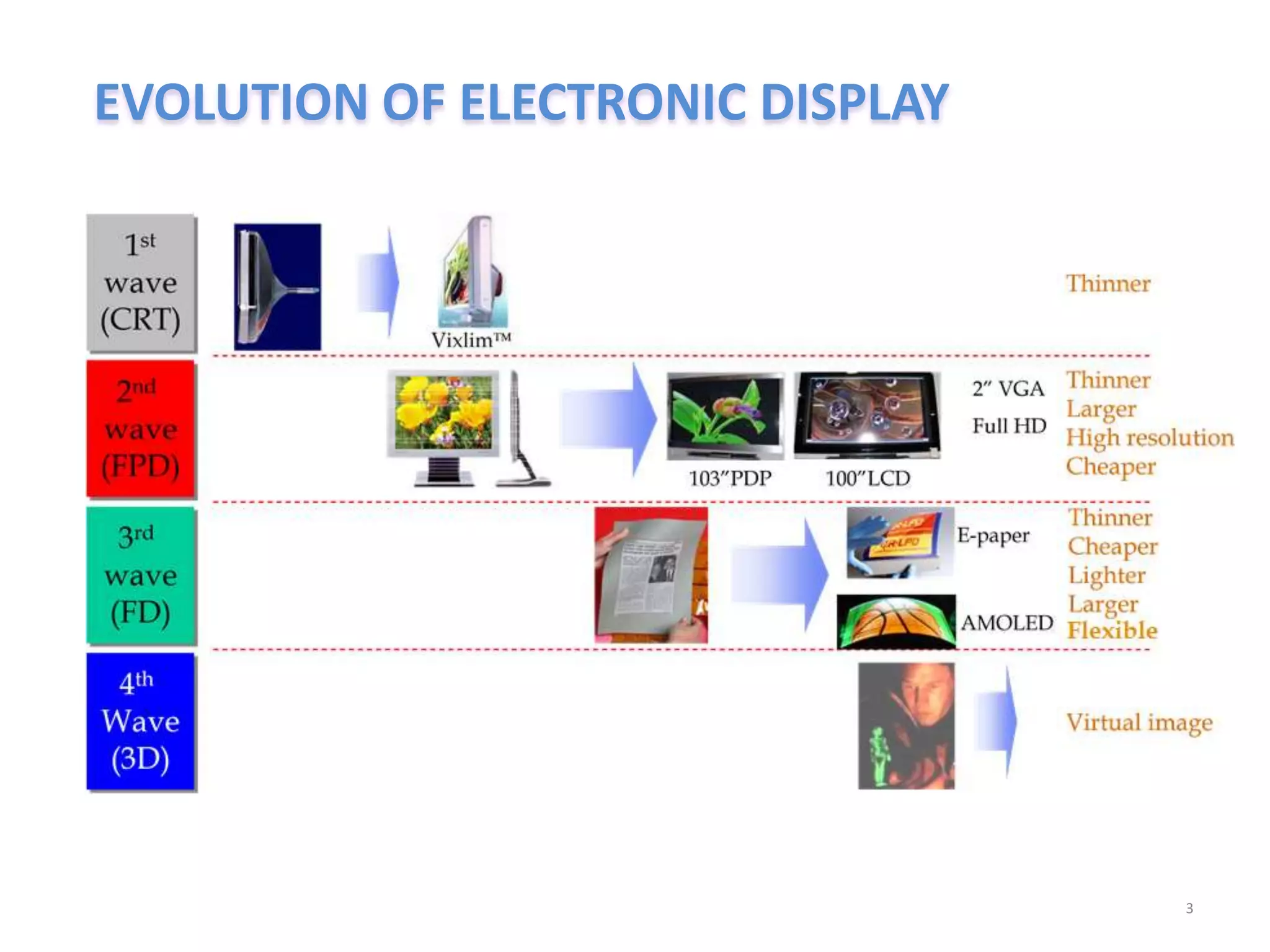
EVOLUTION OF ELECTRONIC DISPLAY
3
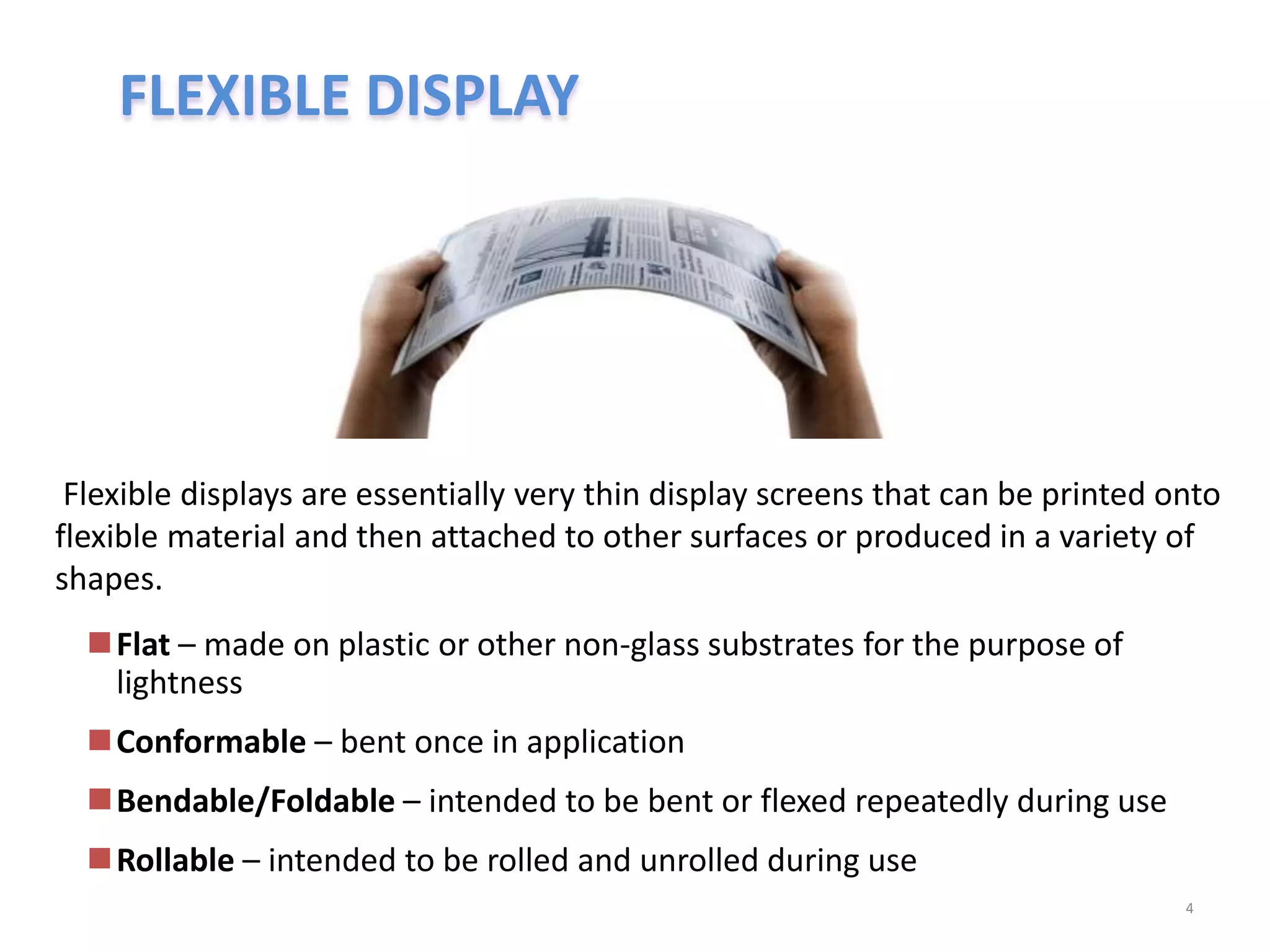
FLEXIBLE DISPLAY
Flexible displays are essentially very thin display screens that can be printed onto
flexible material and then attached to other surfaces or produced in a variety of
shapes.
4
Flat – made on plastic or other non-glass substrates for the purpose of
lightness
Conformable – bent once in application
Bendable/Foldable – intended to be bent or flexed repeatedly during use
Rollable – intended to be rolled and unrolled during use
FLEXIBLE DISPLAY MARKET
12/29/2014 Footer Text 5
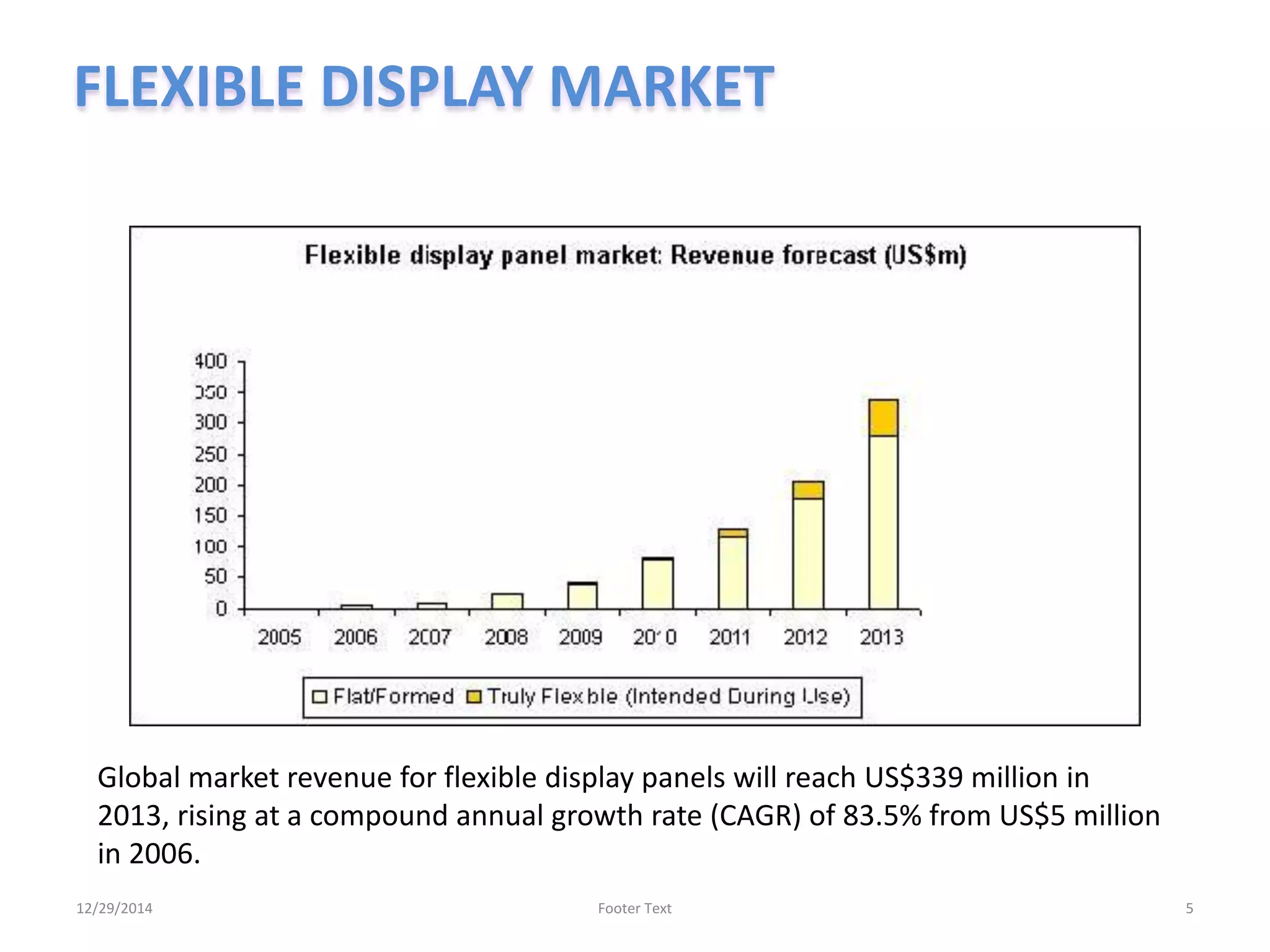
Global market revenue for flexible display panels will reach US$339 million in
2013, rising at a compound annual growth rate (CAGR) of 83.5% from US$5 million
in 2006.
6
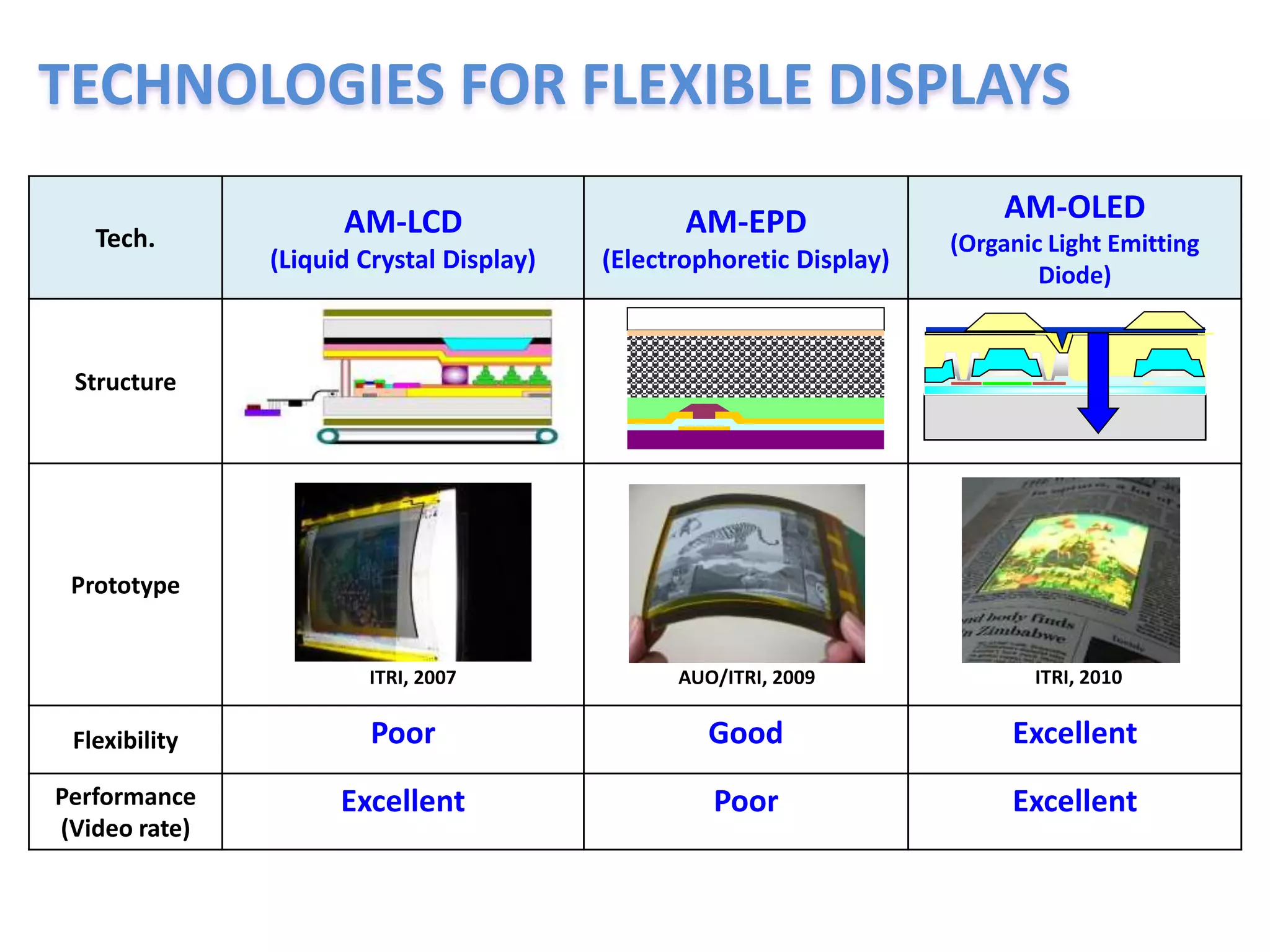
Tech.
AM-LCD
(Liquid Crystal Display)
AM-EPD
(Electrophoretic Display)
AM-OLED
(Organic Light Emitting
Diode)
Structure
Prototype
Flexibility Poor Good Excellent
Performance
(Video rate)
Excellent Poor Excellent
AUO/ITRI, 2009 ITRI, 2010ITRI, 2007
TECHNOLOGIES FOR FLEXIBLE DISPLAYS
7
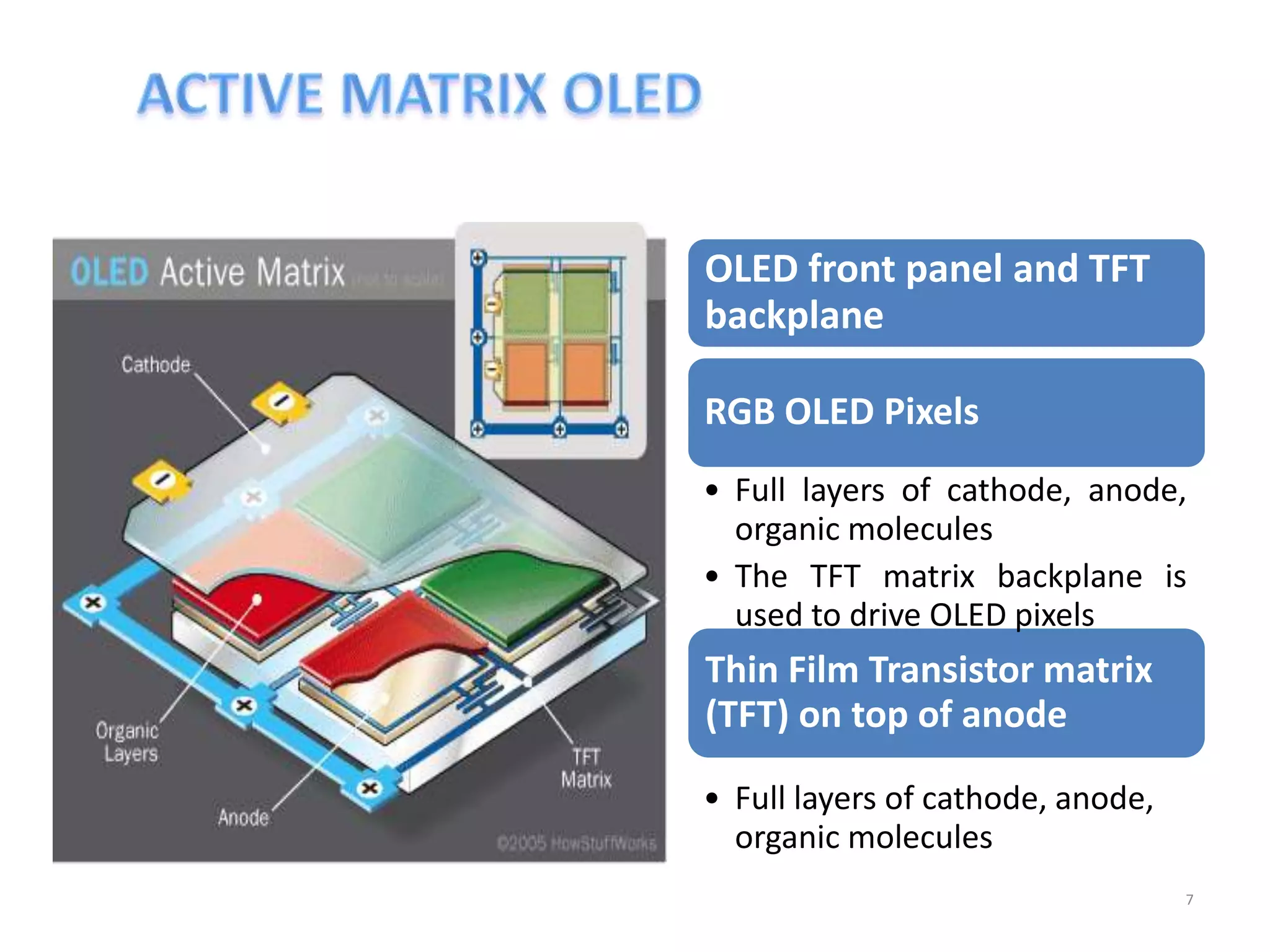
OLED front panel and TFT
backplane
RGB OLED Pixels
• Full layers of cathode, anode,
organic molecules
Thin Film Transistor matrix
(TFT) on top of anode
• Full layers of cathode, anode,
organic molecules
• The TFT matrix backplane is
used to drive OLED pixels
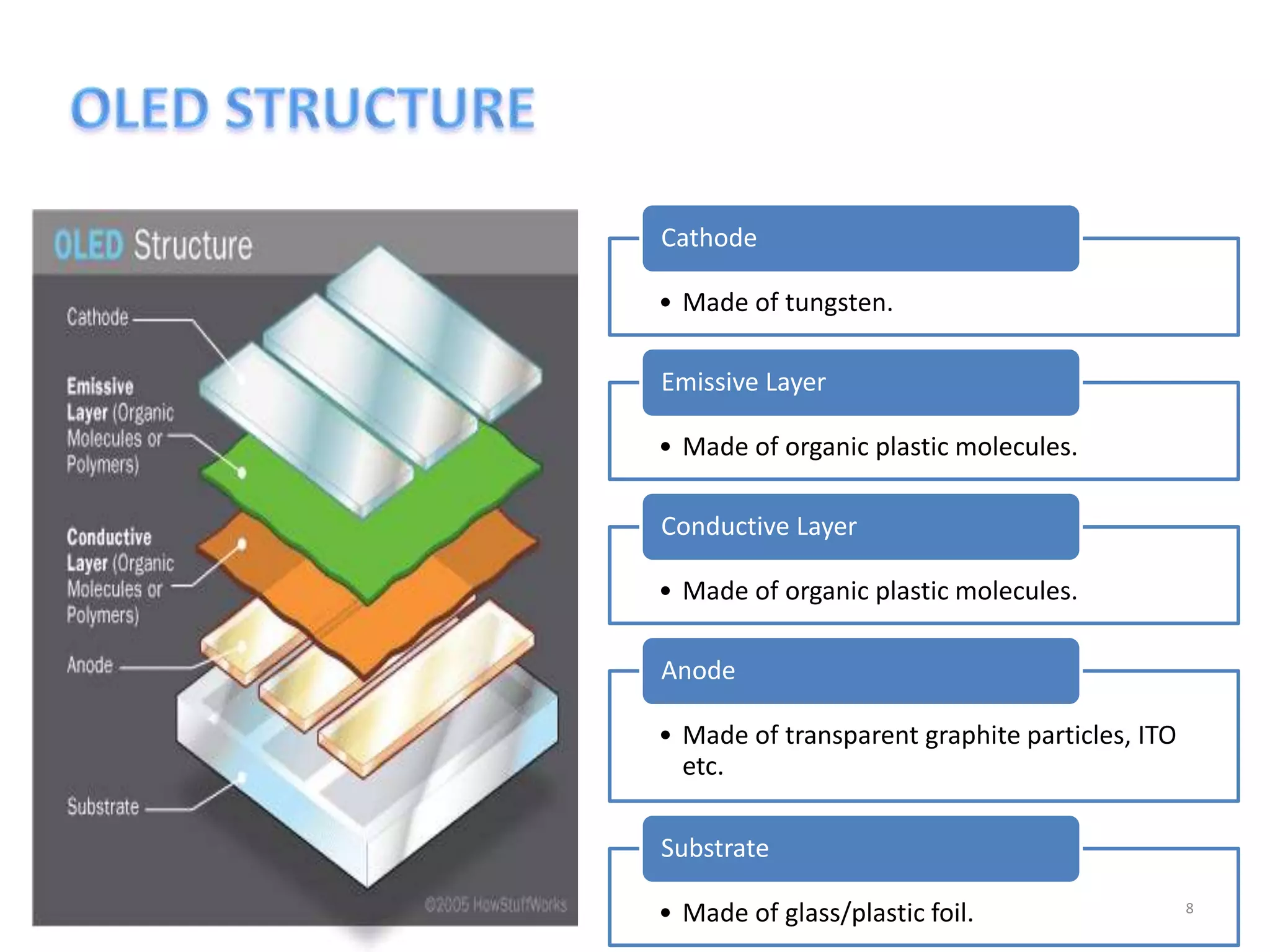
• Made of tungsten.
Cathode
• Made of organic plastic molecules.
Emissive Layer
• Made of organic plastic molecules.
Conductive Layer
• Made of transparent graphite particles, ITO
etc.
Anode
• Made of glass/plastic foil.
Substrate
8
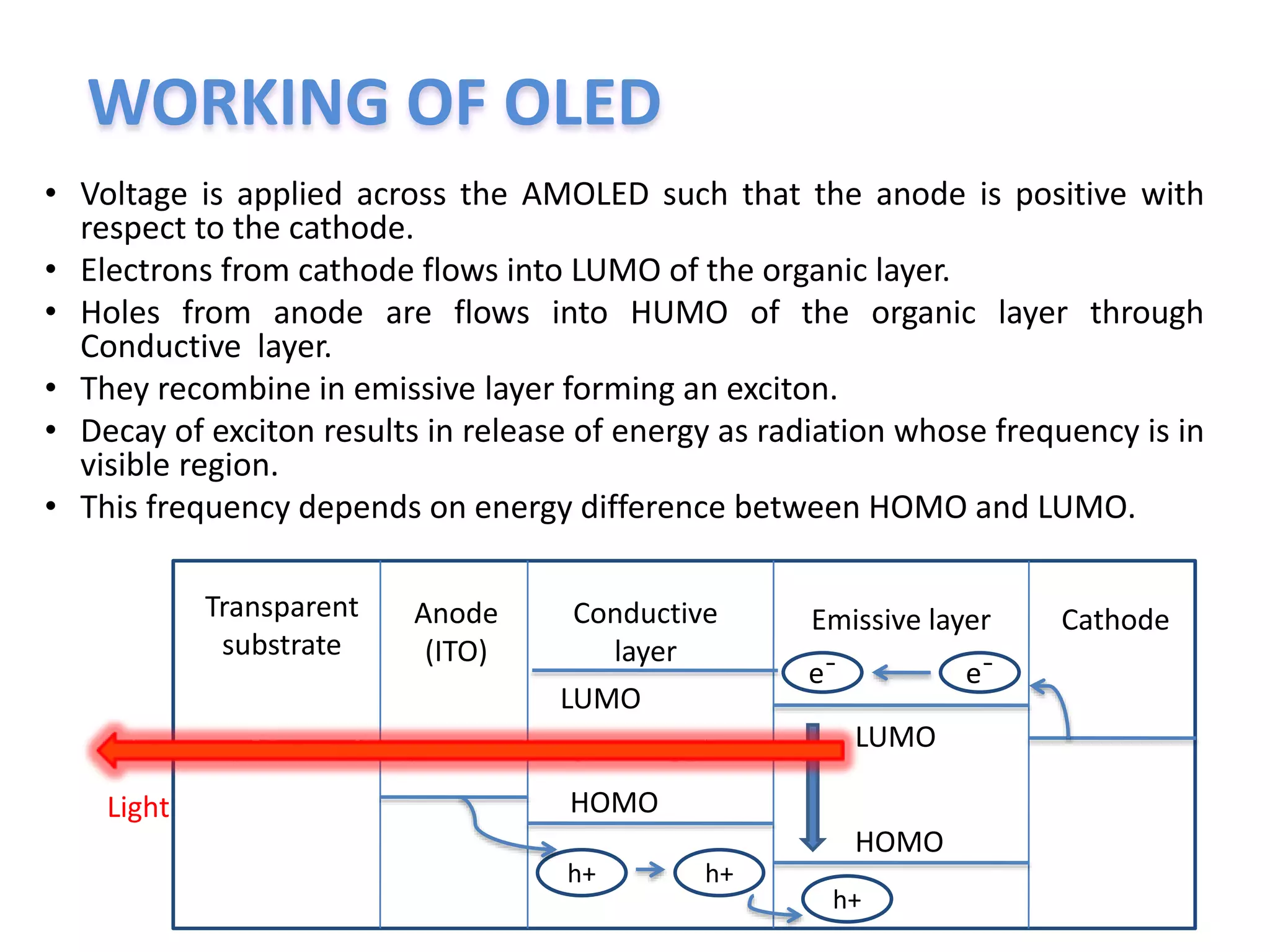
WORKING OF OLED
• Voltage is applied across the AMOLED such that the anode is positive with
respect to the cathode.
• Electrons from cathode flows into LUMO of the organic layer.
• Holes from anode are flows into HUMO of the organic layer through
Conductive layer.
• They recombine in emissive layer forming an exciton.
• Decay of exciton results in release of energy as radiation whose frequency is in
visible region.
• This frequency depends on energy difference between HOMO and LUMO.
Transparent
substrate
Anode
(ITO)
Conductive
layer
Emissive layer Cathode
LUMO
LUMO
HOMO
HOMO
eˉeˉ
h+
h+h+
Light
10
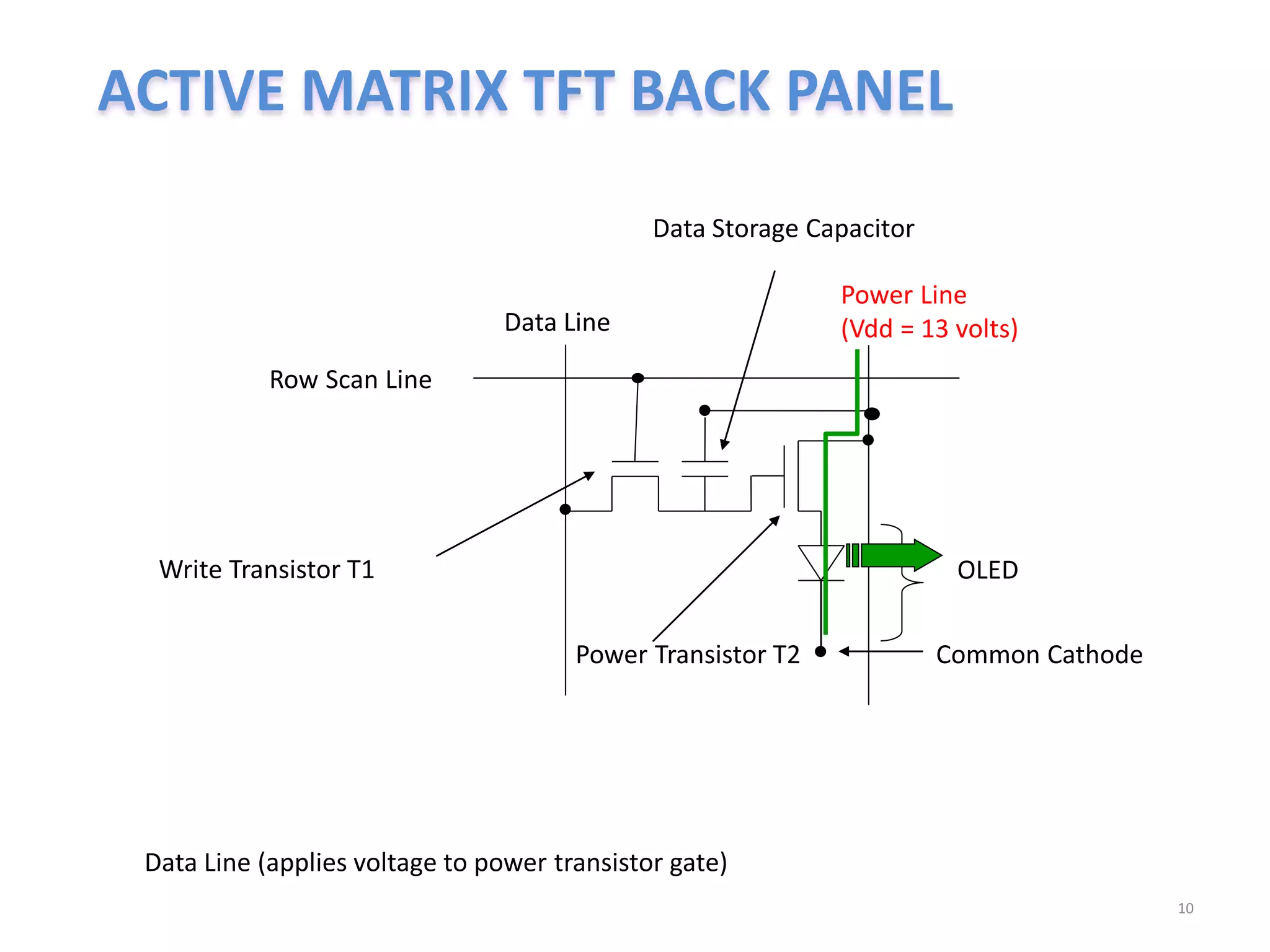
Data Line
Data Storage Capacitor
Power Transistor T2
Write Transistor T1
Data Line (applies voltage to power transistor gate)
Row Scan Line
Power Line
(Vdd = 13 volts)
OLED
Common Cathode
ACTIVE MATRIX TFT BACK PANEL
ADVANDAGES OF AMOLEDs
11
 Thinner, lighter and more flexible
 Do not require backlighting
 Brighter than LEDs because the organic layers
 Do not require glass for support
 Easier to produce and can be made to large sizes using roll to roll technology
 Can enable a greater artificial contrast ratio
 Better viewing angle compared to LCDs.
 Requires a low amount of energy consumption
 Faster refresh rate
FLEXUP : FLEXIBLE UNIVERSAL PLANE
12
• FlexUP used integrate flexible Si based transistor array on a flexible
transparent polyimide substrate.
• Utilizes the existing glass line production facility.
• FlexUP enables a high temperature process with high accuracy.
• Also increases the efficiency of de-bonding procedure that separates the
flexible substrate from production carrier.
• Increase mobility of display panels by reducing weight and increasing
rigidness.
• Reduce overall production cost by utilizing current display fabrication
facility.
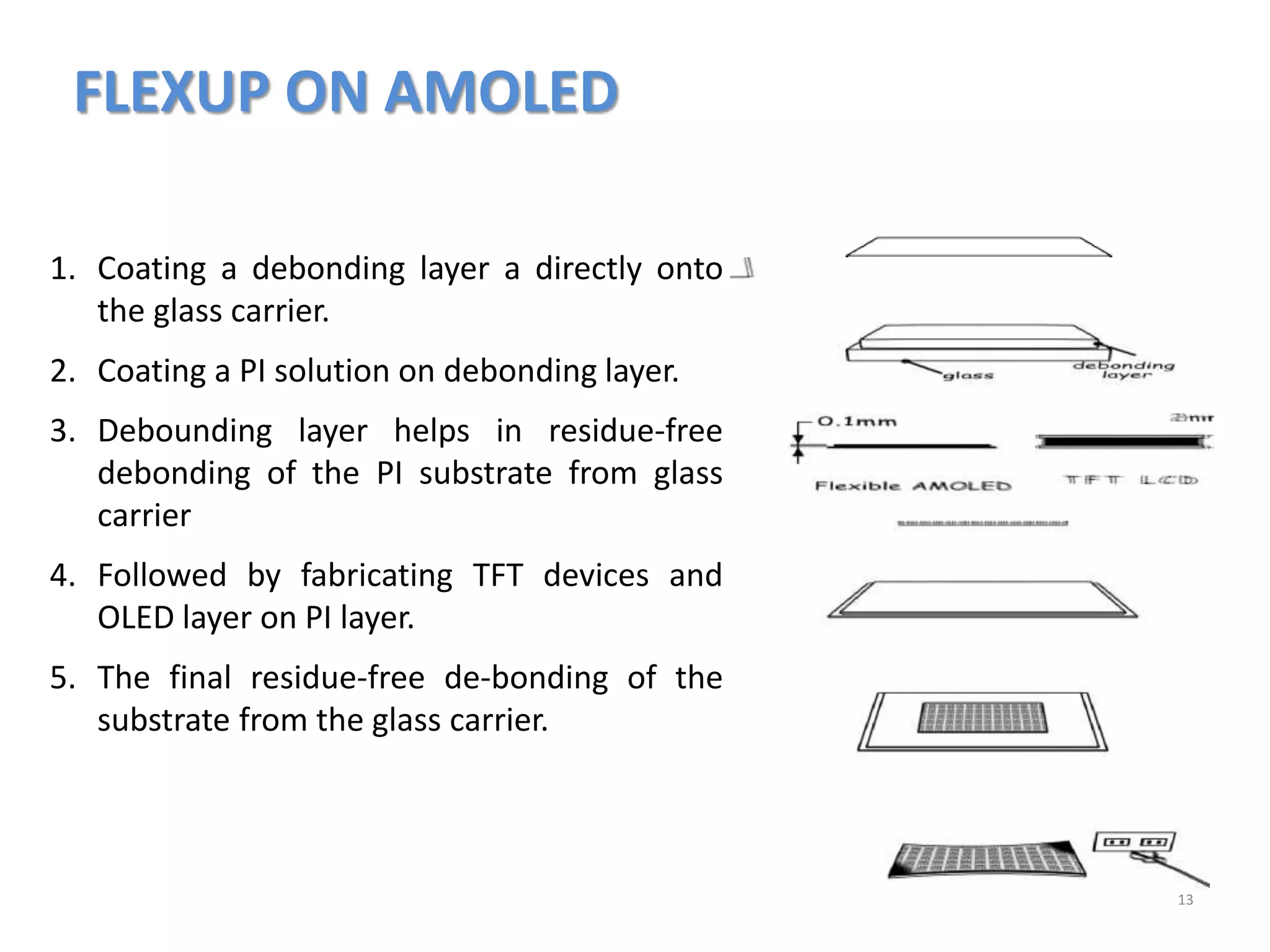
FLEXUP ON AMOLED
13
1. Coating a debonding layer a directly onto
the glass carrier.
2. Coating a PI solution on debonding layer.
3. Debounding layer helps in residue-free
debonding of the PI substrate from glass
carrier
4. Followed by fabricating TFT devices and
OLED layer on PI layer.
5. The final residue-free de-bonding of the
substrate from the glass carrier.
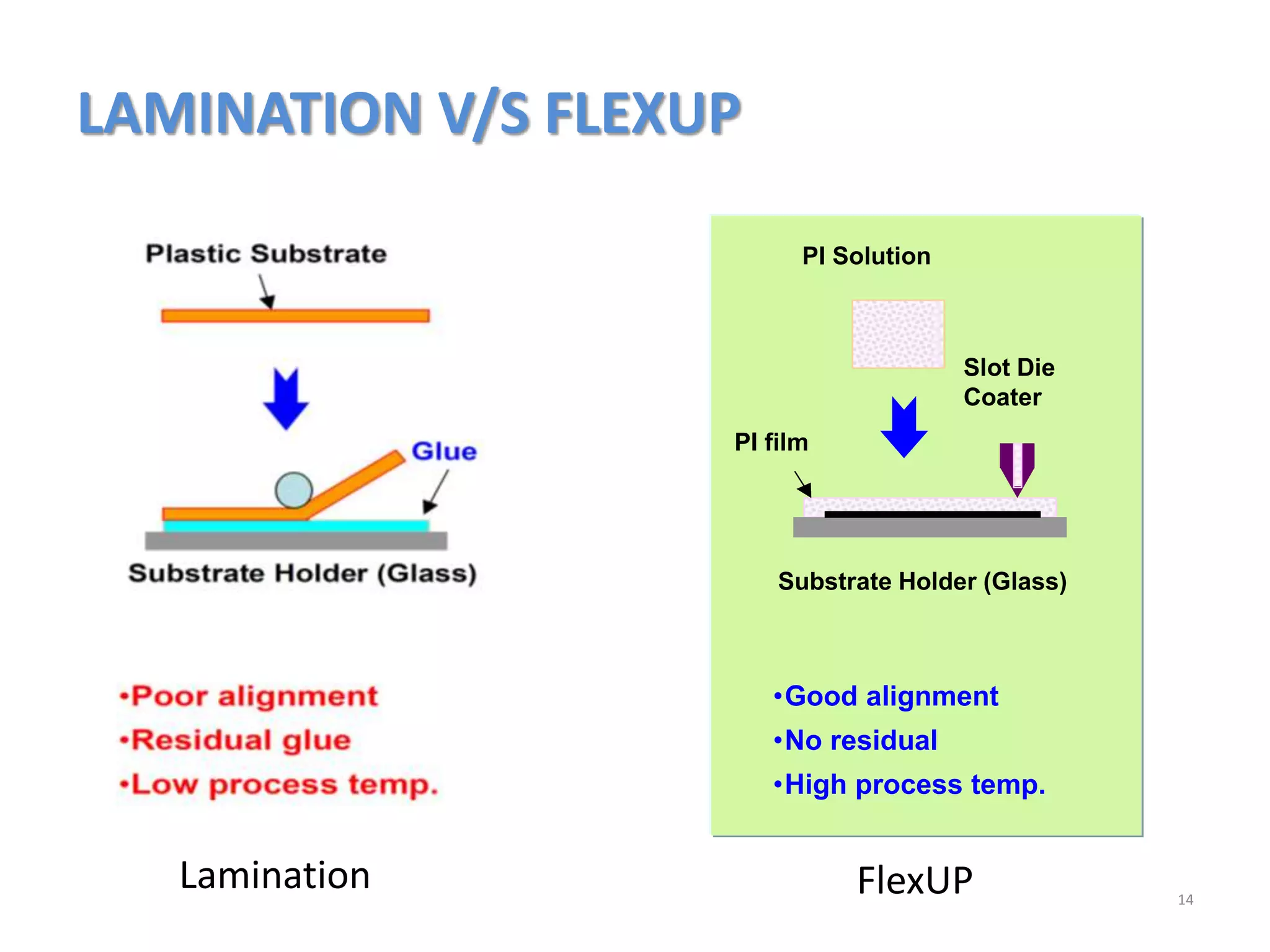
LAMINATION V/S FLEXUP
14
PI Solution
PI film
Substrate Holder (Glass)
Slot Die
Coater
•Good alignment
•No residual
•High process temp.
Lamination FlexUP
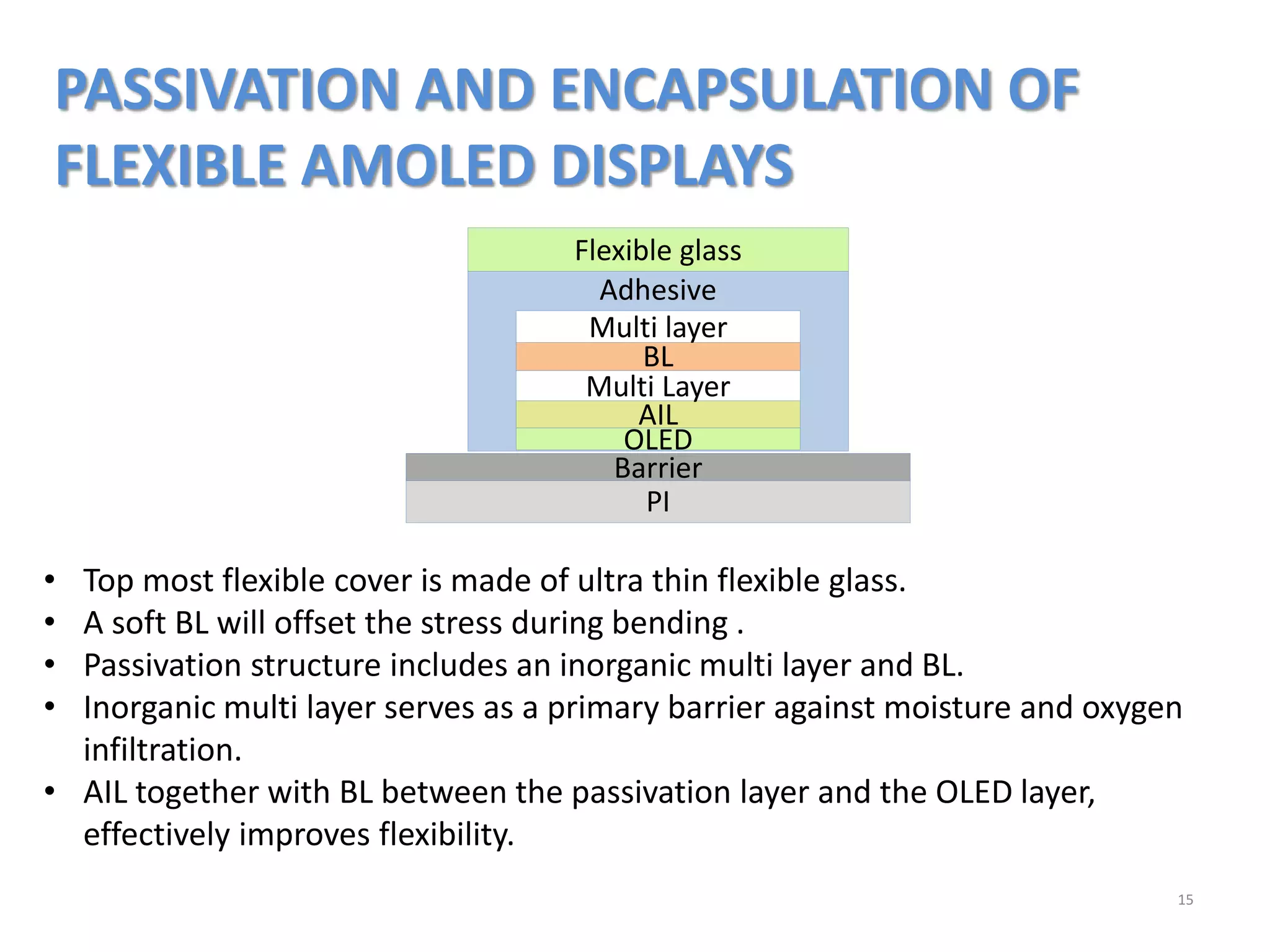
PASSIVATION AND ENCAPSULATION OF
FLEXIBLE AMOLED DISPLAYS
15
• Top most flexible cover is made of ultra thin flexible glass.
• A soft BL will offset the stress during bending .
• Passivation structure includes an inorganic multi layer and BL.
• Inorganic multi layer serves as a primary barrier against moisture and oxygen
infiltration.
• AIL together with BL between the passivation layer and the OLED layer,
effectively improves flexibility.
PI
Barrier
Flexible glass
OLED
AIL
Multi Layer
BL
Multi layer
Adhesive
TFT BACKPLANE TECHNOLOGIES FOR FLEXUP
16
• Low-temperature poly-Si TFTs and IGZO TFTs are excellent semiconductors
for OLED driving.
• a-IGZO TFTs are excellent for flexible display, improves the pixel aperture
ratio and also reduce cost.
• The Back Channel Etching type a-IGZO TFTs were fabricated on a FlexUP
substrate by using a four-mask process with a process temperature less
than 300°C.
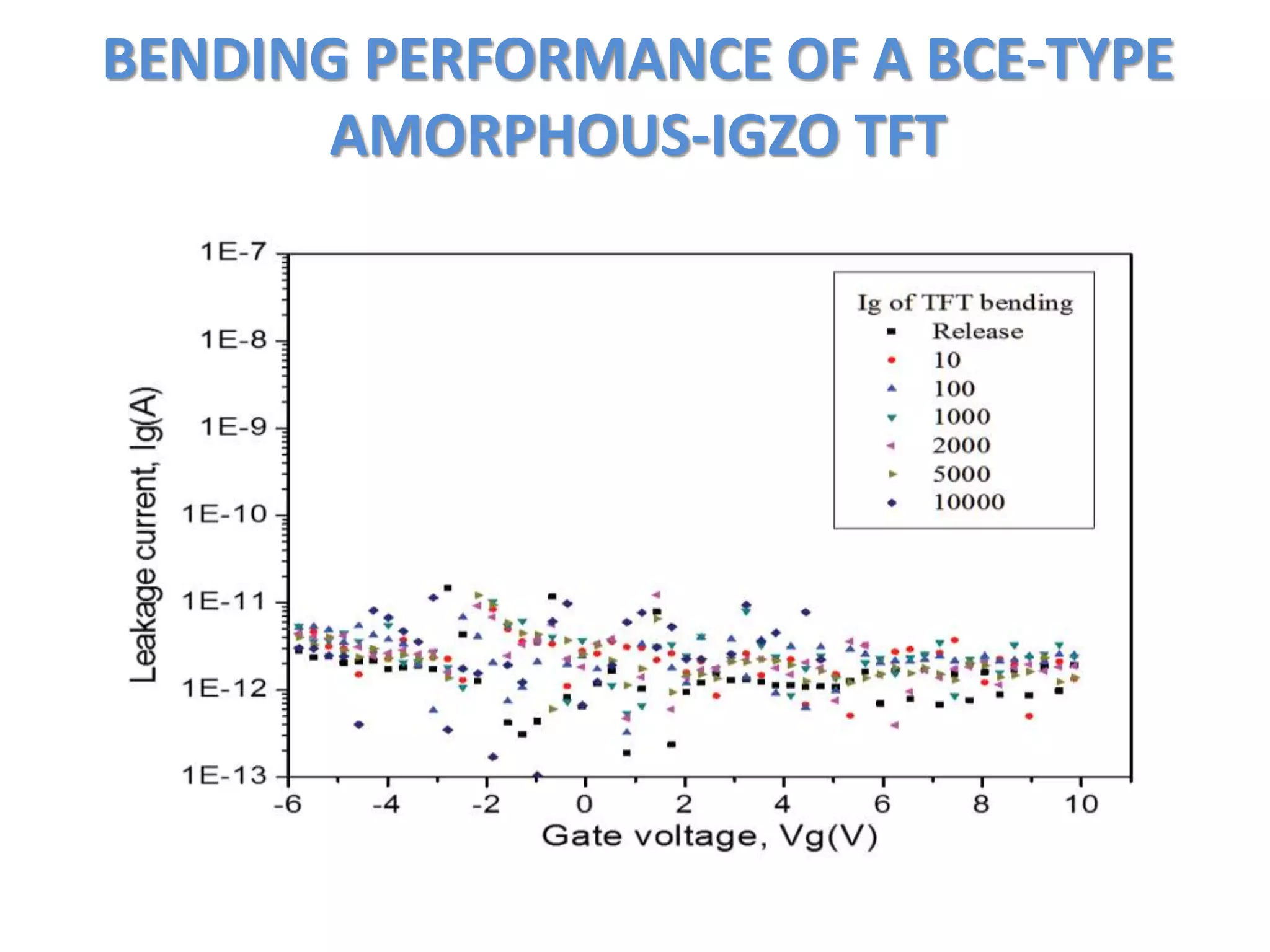
• The a-IGZO TFT backplane was bent at a 25 mm radius up to 10000 times,
with the leakage current maintained below 10–11A.
• Flexible transparent a-IGZO TFTs have the advantages of good electrical
characteristics and low process temperature.
BENDING PERFORMANCE OF A BCE-TYPE
AMORPHOUS-IGZO TFT
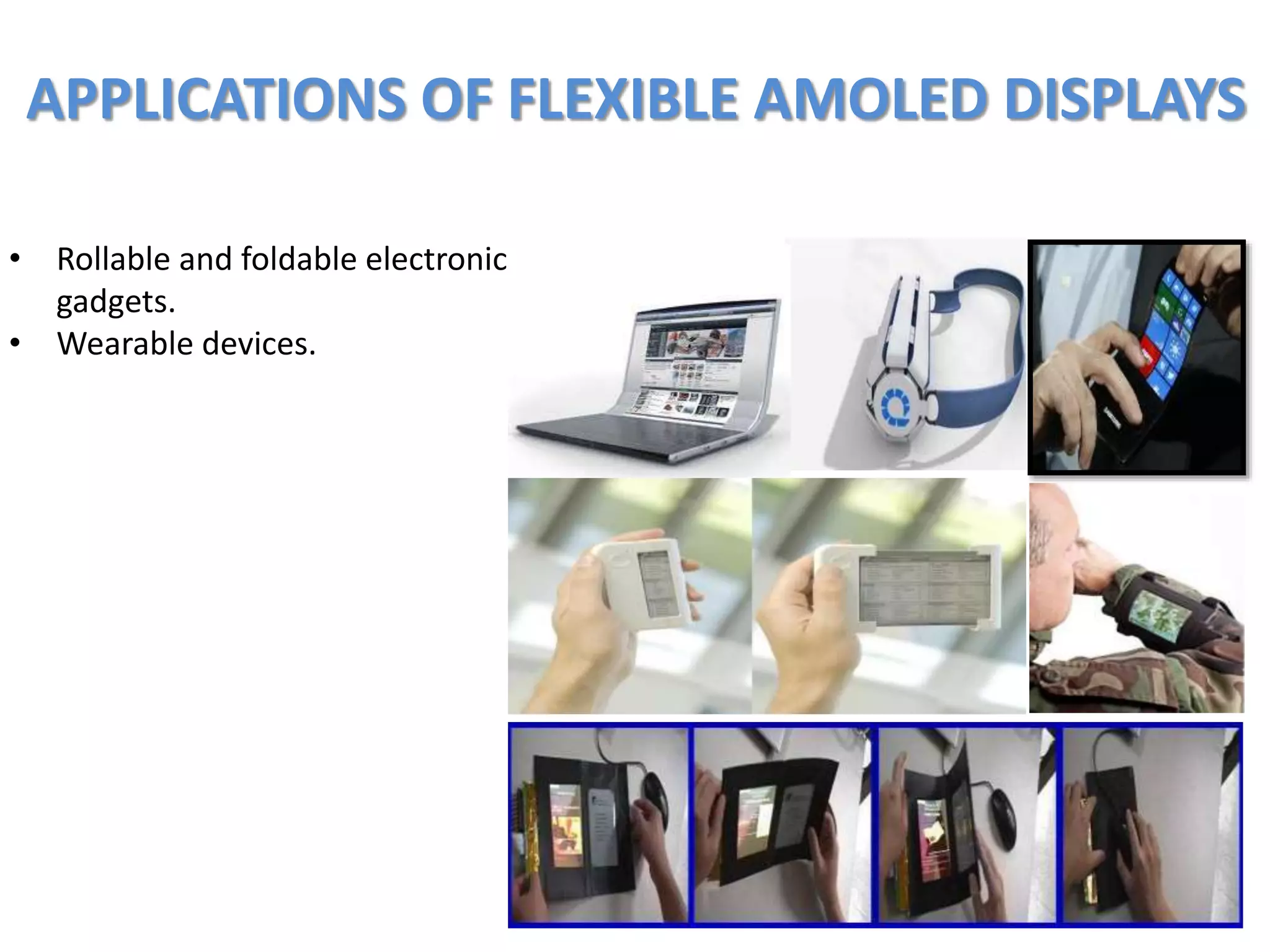
APPLICATIONS OF FLEXIBLE AMOLED DISPLAYS
18
• Rollable and foldable electronic
gadgets.
• Wearable devices.
ELECTRONIC PAPER : i2R E-PAPER
• Display technology designed to mimic the appearance of ordinary
paper.
• It provides a rewritable, reusable and environmentally friendly
print medium - an "electronic paper" - to reduce traditional paper
consumption.
• Capable of holding text and images indefinitely without drawing
energy, while allowing the image to be changed later
Key features :
Wide viewing angle
Reflects light like ordinary paper
Image retain without power
Extremely thin
Low manufacturing cost
19
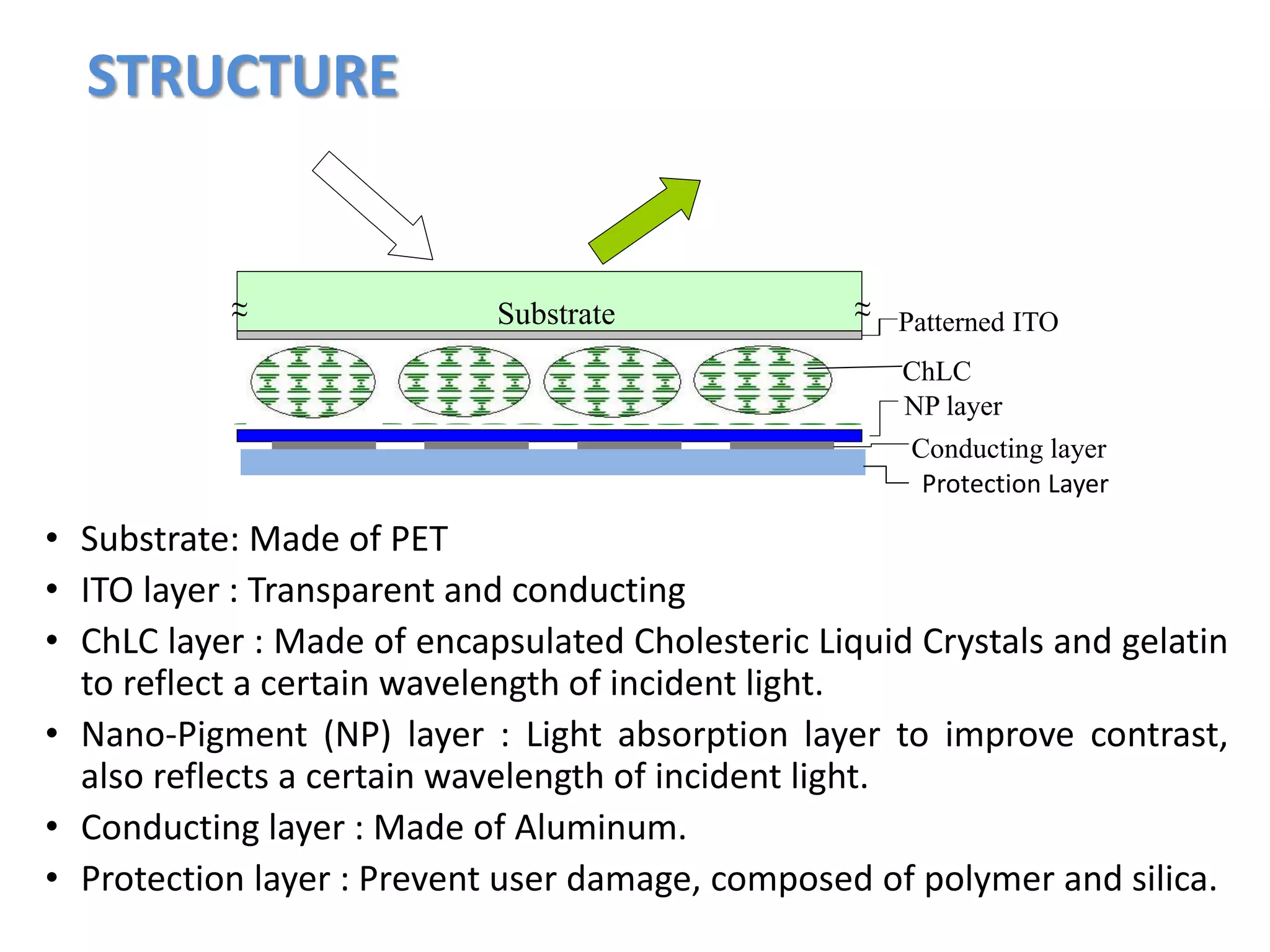
STRUCTURE
• Substrate: Made of PET
• ITO layer : Transparent and conducting
• ChLC layer : Made of encapsulated Cholesteric Liquid Crystals and gelatin
to reflect a certain wavelength of incident light.
• Nano-Pigment (NP) layer : Light absorption layer to improve contrast,
also reflects a certain wavelength of incident light.
• Conducting layer : Made of Aluminum.
• Protection layer : Prevent user damage, composed of polymer and silica.
Substrate Patterned ITO
ChLC
NP layer
Conducting layer
~~ ~~
Protection Layer
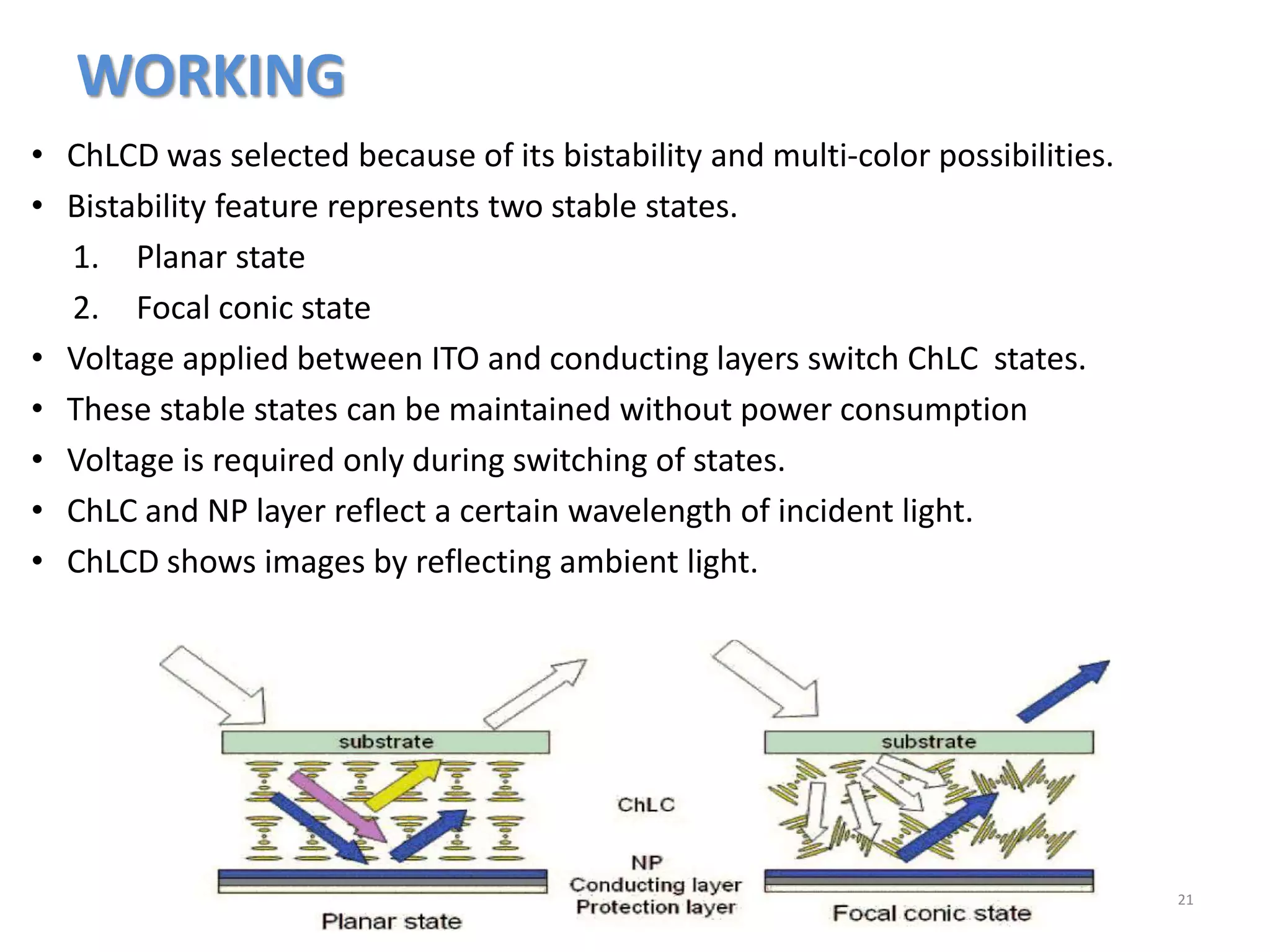
WORKING
• ChLCD was selected because of its bistability and multi-color possibilities.
• Bistability feature represents two stable states.
1. Planar state
2. Focal conic state
• Voltage applied between ITO and conducting layers switch ChLC states.
• These stable states can be maintained without power consumption
• Voltage is required only during switching of states.
• ChLC and NP layer reflect a certain wavelength of incident light.
• ChLCD shows images by reflecting ambient light.
21
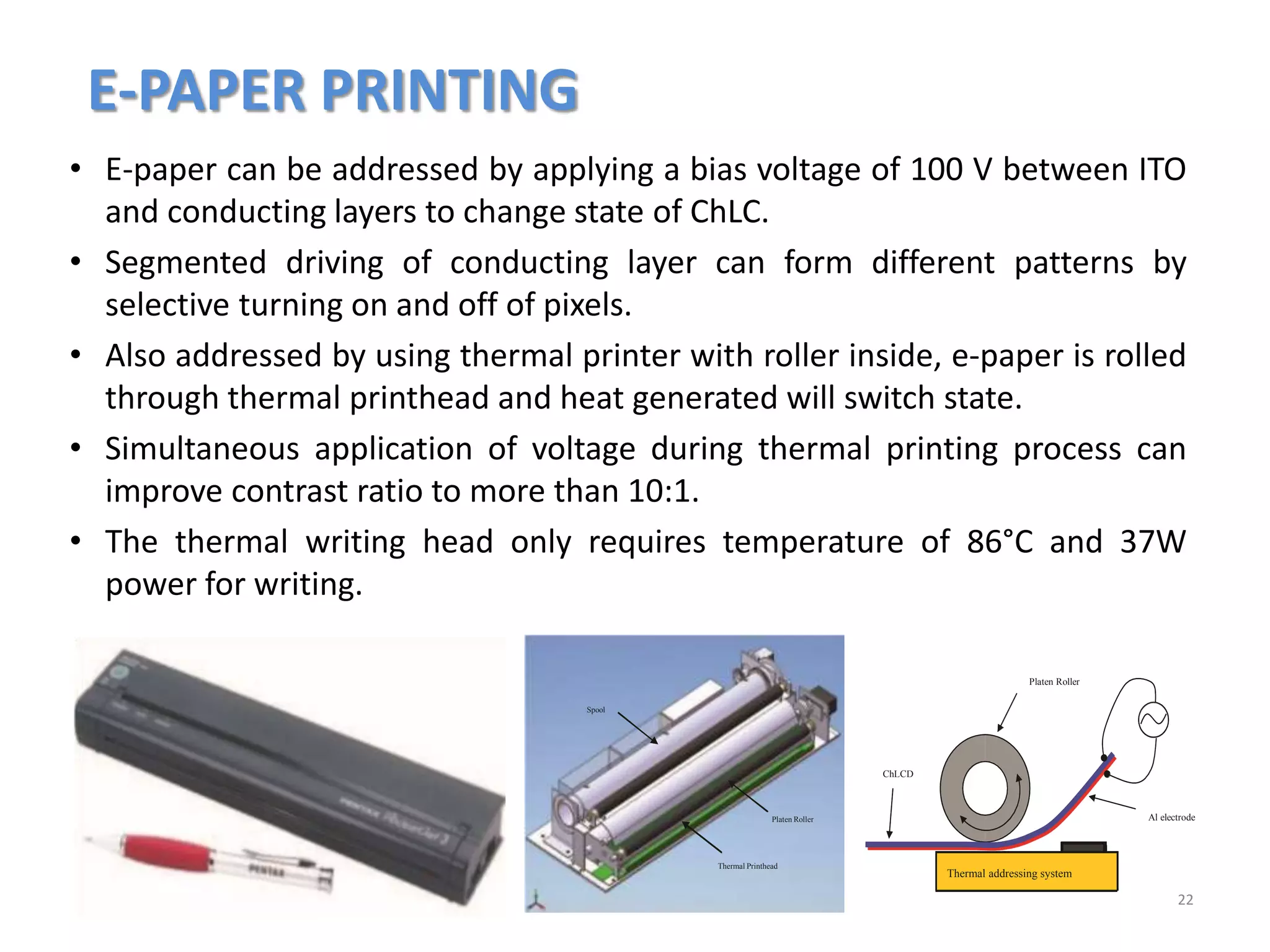
E-PAPER PRINTING
22
• E-paper can be addressed by applying a bias voltage of 100 V between ITO
and conducting layers to change state of ChLC.
• Segmented driving of conducting layer can form different patterns by
selective turning on and off of pixels.
• Also addressed by using thermal printer with roller inside, e-paper is rolled
through thermal printhead and heat generated will switch state.
• Simultaneous application of voltage during thermal printing process can
improve contrast ratio to more than 10:1.
• The thermal writing head only requires temperature of 86°C and 37W
power for writing.
Thermal Printhead
Platen Roller
Spool
Thermal addressing system
Al electrode
Platen Roller
ChLCD
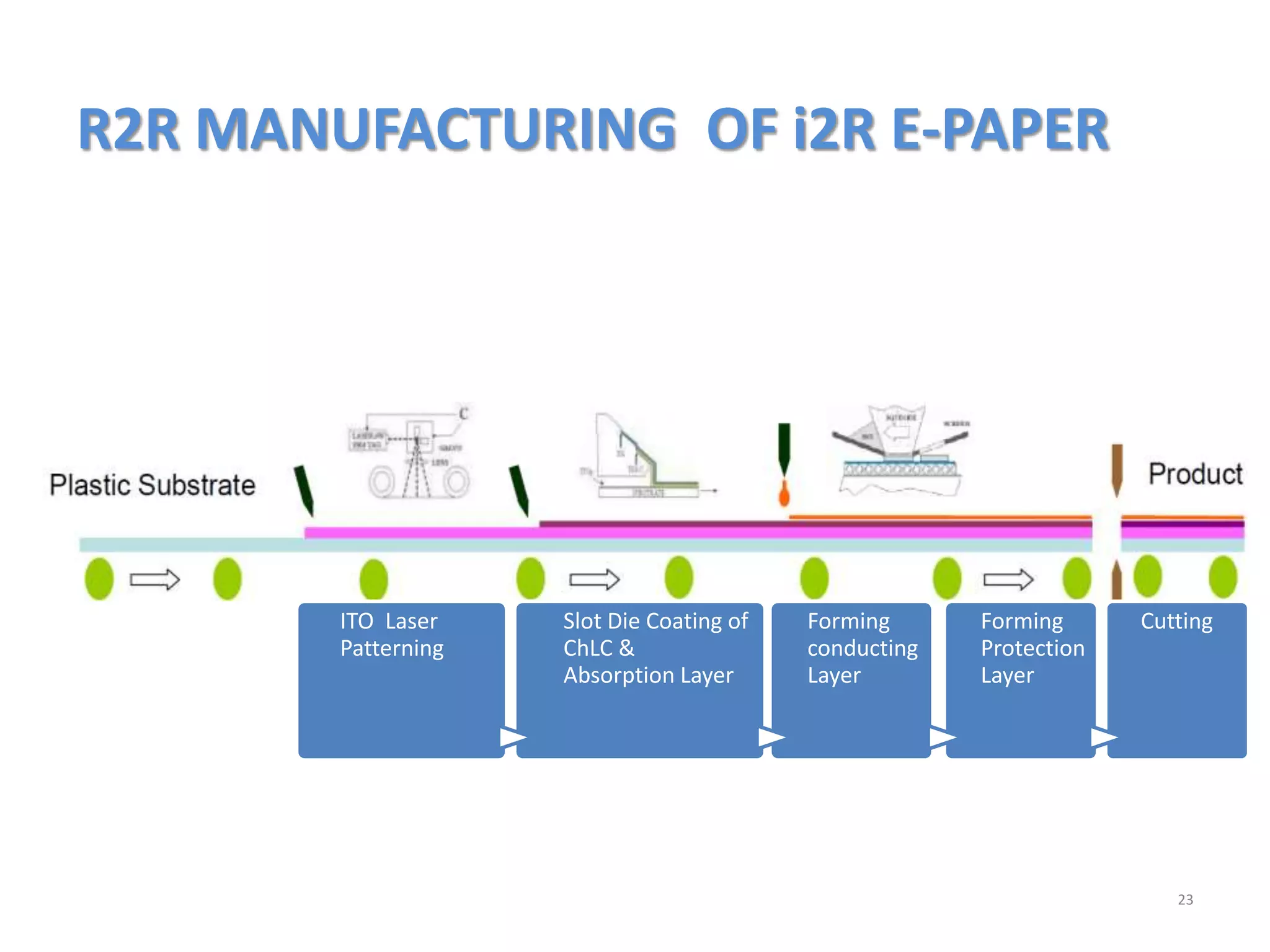
R2R MANUFACTURING OF i2R E-PAPER
23
ITO Laser
Patterning
Slot Die Coating of
ChLC &
Absorption Layer
Forming
conducting
Layer
Forming
Protection
Layer
Cutting
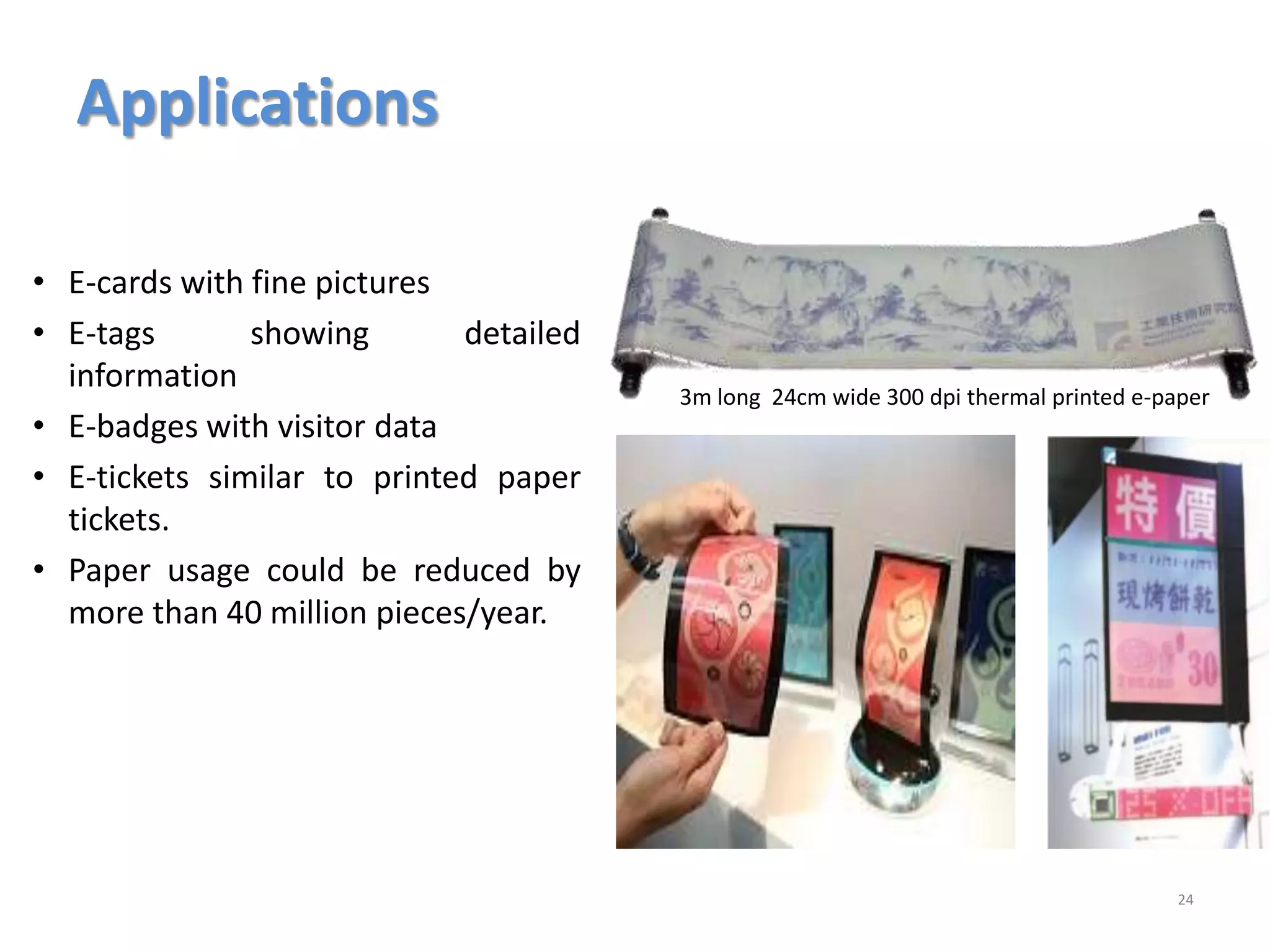
Applications
24
3m long 24cm wide 300 dpi thermal printed e-paper
• E-cards with fine pictures
• E-tags showing detailed
information
• E-badges with visitor data
• E-tickets similar to printed paper
tickets.
• Paper usage could be reduced by
more than 40 million pieces/year.
CONCLUSION
25
• We reported a novel technology, the FlexUP, to fabricate AMOLED
displays on current glass carrier production line.
• By inserting a release layer, displays and electronic devices are easily
fabricated on substrates and thereafter debonded.
• Presented barrier encapsulation technologies for protecting flexible
AMOLEDs from stress, oxygen and moisture infusion.
• Also attained flexible cheap and rewritable e-paper technology using
R2R production technology.
THANK YOU
26

Technology advances in flexible displays and substrates

  • 1.
  • 2.
    Flexible Display Technologies ForFlexible Displays AMOLEDs FlexUp technology Passivation and encapsulation of flexible AMOLEDs Applications of flexible AMOLED displays i2r E-paper Production of i2R E-paper Applications of i2r E-paper Conclusion 2
  • 3.
  • 4.
    FLEXIBLE DISPLAY Flexible displaysare essentially very thin display screens that can be printed onto flexible material and then attached to other surfaces or produced in a variety of shapes. 4 Flat – made on plastic or other non-glass substrates for the purpose of lightness Conformable – bent once in application Bendable/Foldable – intended to be bent or flexed repeatedly during use Rollable – intended to be rolled and unrolled during use
  • 5.
    FLEXIBLE DISPLAY MARKET 12/29/2014Footer Text 5 Global market revenue for flexible display panels will reach US$339 million in 2013, rising at a compound annual growth rate (CAGR) of 83.5% from US$5 million in 2006.
  • 6.
    6 Tech. AM-LCD (Liquid Crystal Display) AM-EPD (ElectrophoreticDisplay) AM-OLED (Organic Light Emitting Diode) Structure Prototype Flexibility Poor Good Excellent Performance (Video rate) Excellent Poor Excellent AUO/ITRI, 2009 ITRI, 2010ITRI, 2007 TECHNOLOGIES FOR FLEXIBLE DISPLAYS
  • 7.
    7 OLED front paneland TFT backplane RGB OLED Pixels • Full layers of cathode, anode, organic molecules Thin Film Transistor matrix (TFT) on top of anode • Full layers of cathode, anode, organic molecules • The TFT matrix backplane is used to drive OLED pixels
  • 8.
    • Made oftungsten. Cathode • Made of organic plastic molecules. Emissive Layer • Made of organic plastic molecules. Conductive Layer • Made of transparent graphite particles, ITO etc. Anode • Made of glass/plastic foil. Substrate 8
  • 9.
    WORKING OF OLED •Voltage is applied across the AMOLED such that the anode is positive with respect to the cathode. • Electrons from cathode flows into LUMO of the organic layer. • Holes from anode are flows into HUMO of the organic layer through Conductive layer. • They recombine in emissive layer forming an exciton. • Decay of exciton results in release of energy as radiation whose frequency is in visible region. • This frequency depends on energy difference between HOMO and LUMO. Transparent substrate Anode (ITO) Conductive layer Emissive layer Cathode LUMO LUMO HOMO HOMO eˉeˉ h+ h+h+ Light
  • 10.
    10 Data Line Data StorageCapacitor Power Transistor T2 Write Transistor T1 Data Line (applies voltage to power transistor gate) Row Scan Line Power Line (Vdd = 13 volts) OLED Common Cathode ACTIVE MATRIX TFT BACK PANEL
  • 11.
    ADVANDAGES OF AMOLEDs 11 Thinner, lighter and more flexible  Do not require backlighting  Brighter than LEDs because the organic layers  Do not require glass for support  Easier to produce and can be made to large sizes using roll to roll technology  Can enable a greater artificial contrast ratio  Better viewing angle compared to LCDs.  Requires a low amount of energy consumption  Faster refresh rate
  • 12.
    FLEXUP : FLEXIBLEUNIVERSAL PLANE 12 • FlexUP used integrate flexible Si based transistor array on a flexible transparent polyimide substrate. • Utilizes the existing glass line production facility. • FlexUP enables a high temperature process with high accuracy. • Also increases the efficiency of de-bonding procedure that separates the flexible substrate from production carrier. • Increase mobility of display panels by reducing weight and increasing rigidness. • Reduce overall production cost by utilizing current display fabrication facility.
  • 13.
    FLEXUP ON AMOLED 13 1.Coating a debonding layer a directly onto the glass carrier. 2. Coating a PI solution on debonding layer. 3. Debounding layer helps in residue-free debonding of the PI substrate from glass carrier 4. Followed by fabricating TFT devices and OLED layer on PI layer. 5. The final residue-free de-bonding of the substrate from the glass carrier.
  • 14.
    LAMINATION V/S FLEXUP 14 PISolution PI film Substrate Holder (Glass) Slot Die Coater •Good alignment •No residual •High process temp. Lamination FlexUP
  • 15.
    PASSIVATION AND ENCAPSULATIONOF FLEXIBLE AMOLED DISPLAYS 15 • Top most flexible cover is made of ultra thin flexible glass. • A soft BL will offset the stress during bending . • Passivation structure includes an inorganic multi layer and BL. • Inorganic multi layer serves as a primary barrier against moisture and oxygen infiltration. • AIL together with BL between the passivation layer and the OLED layer, effectively improves flexibility. PI Barrier Flexible glass OLED AIL Multi Layer BL Multi layer Adhesive
  • 16.
    TFT BACKPLANE TECHNOLOGIESFOR FLEXUP 16 • Low-temperature poly-Si TFTs and IGZO TFTs are excellent semiconductors for OLED driving. • a-IGZO TFTs are excellent for flexible display, improves the pixel aperture ratio and also reduce cost. • The Back Channel Etching type a-IGZO TFTs were fabricated on a FlexUP substrate by using a four-mask process with a process temperature less than 300°C. • The a-IGZO TFT backplane was bent at a 25 mm radius up to 10000 times, with the leakage current maintained below 10–11A. • Flexible transparent a-IGZO TFTs have the advantages of good electrical characteristics and low process temperature.
  • 17.
    BENDING PERFORMANCE OFA BCE-TYPE AMORPHOUS-IGZO TFT
  • 18.
    APPLICATIONS OF FLEXIBLEAMOLED DISPLAYS 18 • Rollable and foldable electronic gadgets. • Wearable devices.
  • 19.
    ELECTRONIC PAPER :i2R E-PAPER • Display technology designed to mimic the appearance of ordinary paper. • It provides a rewritable, reusable and environmentally friendly print medium - an "electronic paper" - to reduce traditional paper consumption. • Capable of holding text and images indefinitely without drawing energy, while allowing the image to be changed later Key features : Wide viewing angle Reflects light like ordinary paper Image retain without power Extremely thin Low manufacturing cost 19
  • 20.
    STRUCTURE • Substrate: Madeof PET • ITO layer : Transparent and conducting • ChLC layer : Made of encapsulated Cholesteric Liquid Crystals and gelatin to reflect a certain wavelength of incident light. • Nano-Pigment (NP) layer : Light absorption layer to improve contrast, also reflects a certain wavelength of incident light. • Conducting layer : Made of Aluminum. • Protection layer : Prevent user damage, composed of polymer and silica. Substrate Patterned ITO ChLC NP layer Conducting layer ~~ ~~ Protection Layer
  • 21.
    WORKING • ChLCD wasselected because of its bistability and multi-color possibilities. • Bistability feature represents two stable states. 1. Planar state 2. Focal conic state • Voltage applied between ITO and conducting layers switch ChLC states. • These stable states can be maintained without power consumption • Voltage is required only during switching of states. • ChLC and NP layer reflect a certain wavelength of incident light. • ChLCD shows images by reflecting ambient light. 21
  • 22.
    E-PAPER PRINTING 22 • E-papercan be addressed by applying a bias voltage of 100 V between ITO and conducting layers to change state of ChLC. • Segmented driving of conducting layer can form different patterns by selective turning on and off of pixels. • Also addressed by using thermal printer with roller inside, e-paper is rolled through thermal printhead and heat generated will switch state. • Simultaneous application of voltage during thermal printing process can improve contrast ratio to more than 10:1. • The thermal writing head only requires temperature of 86°C and 37W power for writing. Thermal Printhead Platen Roller Spool Thermal addressing system Al electrode Platen Roller ChLCD
  • 23.
    R2R MANUFACTURING OFi2R E-PAPER 23 ITO Laser Patterning Slot Die Coating of ChLC & Absorption Layer Forming conducting Layer Forming Protection Layer Cutting
  • 24.
    Applications 24 3m long 24cmwide 300 dpi thermal printed e-paper • E-cards with fine pictures • E-tags showing detailed information • E-badges with visitor data • E-tickets similar to printed paper tickets. • Paper usage could be reduced by more than 40 million pieces/year.
  • 25.
    CONCLUSION 25 • We reporteda novel technology, the FlexUP, to fabricate AMOLED displays on current glass carrier production line. • By inserting a release layer, displays and electronic devices are easily fabricated on substrates and thereafter debonded. • Presented barrier encapsulation technologies for protecting flexible AMOLEDs from stress, oxygen and moisture infusion. • Also attained flexible cheap and rewritable e-paper technology using R2R production technology.
  • 26.