INTRODUCTION
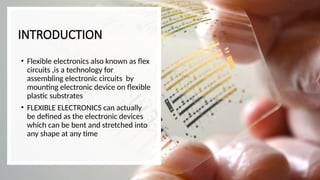
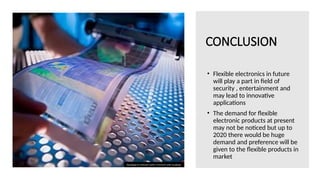
• Flexible electronicsalso known as flex
circuits ,is a technology for
assembling electronic circuits by
mounting electronic device on flexible
plastic substrates
• FLEXIBLE ELECTRONICS can actually
be defined as the electronic devices
which can be bent and stretched into
any shape at any time
3.
FABRICATION
TECHNOLOGY FOR FE
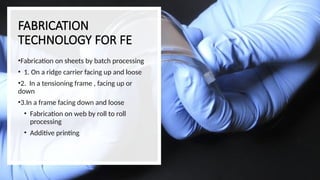
•Fabricationon sheets by batch processing
• 1. On a ridge carrier facing up and loose
•2. In a tensioning frame , facing up or
down
•3.In a frame facing down and loose
• Fabrication on web by roll to roll
processing
• Additive printing
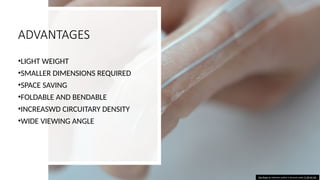
ADVANTAGES
•LIGHT WEIGHT
•SMALLER DIMENSIONSREQUIRED
•SPACE SAVING
•FOLDABLE AND BENDABLE
•INCREASWD CIRCUITARY DENSITY
•WIDE VIEWING ANGLE
This Photo by Unknown author is licensed under CC BY-NC-ND.
9.
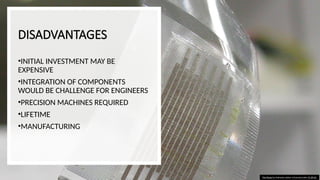
DISADVANTAGES
•INITIAL INVESTMENT MAYBE
EXPENSIVE
•INTEGRATION OF COMPONENTS
WOULD BE CHALLENGE FOR ENGINEERS
•PRECISION MACHINES REQUIRED
•LIFETIME
•MANUFACTURING
This Photo by Unknown author is licensed under CC BY-SA.
10.
CONCLUSION
• Flexible electronicsin future
will play a part in field of
security , entertainment and
may lead to innovative
applications
• The demand for flexible
electronic products at present
may not be noticed but up to
2020 there would be huge
demand and preference will be
given to the flexible products in
market
This Photo by Unknown author is licensed under CC BY-SA.
11.
This Photo byUnknown author is licensed under CC BY-SA.