Presented by
Varun K
varunkpa@gmail.com
USER INTRRACTIVE ELECTRONIC
SKIN(E-SKIN) FOR INSTANTNEOUS
PRESSURE VISUALIZATION.
INTRODUCTION
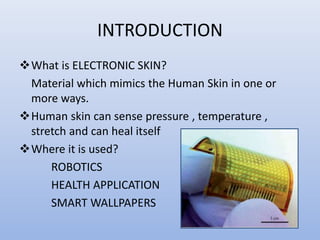
What is ELECTRONIC SKIN?
Material which mimics the Human Skin in one or
more ways.
Human skin can sense pressure , temperature ,
stretch and can heal itself
Where it is used?
ROBOTICS
HEALTH APPLICATION
SMART WALLPAPERS
DEVELOPMENT OF E-SKIN
• 2010:
I. Attaching nanowire transistors to sticky substrate,
embedded in in thin pressure sensitive rubber-capable of
sensing wide range of pressures(California University)
II. First prototype for e-skin
• 2011:
I. Stretchable solar cell used to power the electronic
skin(Stanford)
• 2012:
I. Self healing capacity
II. Made by plastic and nickel
DEVELOPMENT OF E-SKIN(cont..)
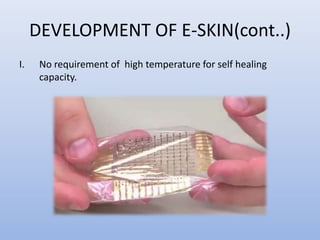
I. No requirement of high temperature for self healing
capacity.
E-SKIN FEATURES
• Optimization of pressure sensors & Electronic read out-but no
Human Readable output.
• The new e-skin: Spatially map the applied pressure and
instantaneous visual response through OLED.
• BUILT IN ACTIVE ORGANIC LED DISPLAY: OLEDs are turned on
locally where the surface is touched and the intensity of the
emitted light quantifies the magnitude of the applied
pressure.
• System on plastic Demonstration 1.Thin film Transistor
2.Pressure sensor
3.OLED arrays
How Visual response is achieved?
Passive matrix
• Grid of vertical and
horizontal lines
• Each pixel is controlled by
an intersection of 2 wires
• Color and brightness is
altered by changing
electrical signal.
Active matrix
• Each pixel is controlled by TFT
thin film transistors
• Act as switch for addressing
either voltage or current
devices
• TFTs contains Semiconductor
enriched nanotubes as the
channel materials.
• Carbon nanotubes-High
current drives for OLEDs
Structure of pixel of e-skin
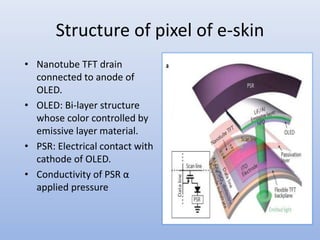
• Nanotube TFT drain
connected to anode of
OLED.
• OLED: Bi-layer structure
whose color controlled by
emissive layer material.
• PSR: Electrical contact with
cathode of OLED.
• Conductivity of PSR α
applied pressure
Electrical performance of carbon nano
tubes
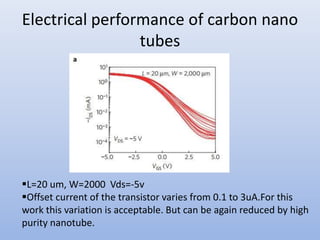
L=20 um, W=2000 Vds=-5v
Offset current of the transistor varies from 0.1 to 3uA.For this
work this variation is acceptable. But can be again reduced by high
purity nanotube.
OLED characteristics
• Led whose electroluminescent layer is organic compound.
• OLED Vs LCD
• Low power consumption, Faster refresh rate
• Better contrast
• Greater contrast, Brightness.
• Better durability-Better temperature range.
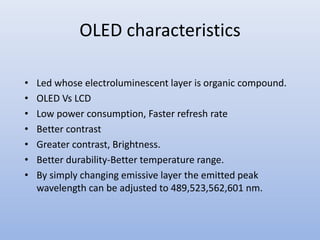
• By simply changing emissive layer the emitted peak
wavelength can be adjusted to 489,523,562,601 nm.
How to control OLED
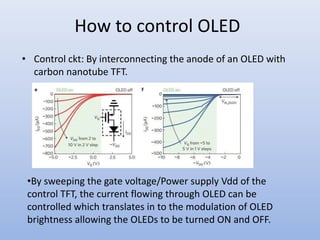
• Control ckt: By interconnecting the anode of an OLED with
carbon nanotube TFT.
•By sweeping the gate voltage/Power supply Vdd of the
control TFT, the current flowing through OLED can be
controlled which translates in to the modulation of OLED
brightness allowing the OLEDs to be turned ON and OFF.
AMOLED
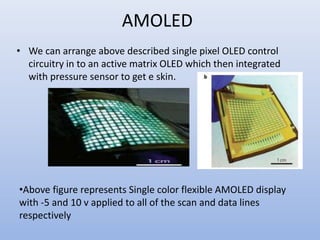
• We can arrange above described single pixel OLED control
circuitry in to an active matrix OLED which then integrated
with pressure sensor to get e skin.
•Above figure represents Single color flexible AMOLED display
with -5 and 10 v applied to all of the scan and data lines
respectively
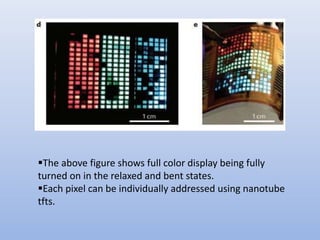
The above figure shows full color display being fully
turned on in the relaxed and bent states.
Each pixel can be individually addressed using nanotube
tfts.
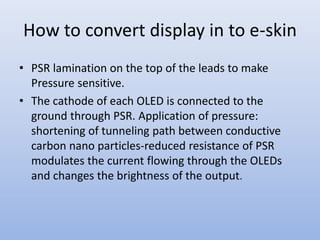
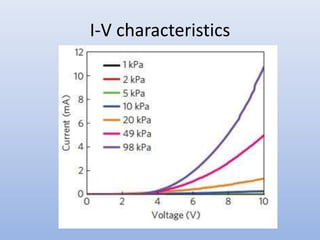
How to convert display in to e-skin
• PSR lamination on the top of the leads to make
Pressure sensitive.
• The cathode of each OLED is connected to the
ground through PSR. Application of pressure:
shortening of tunneling path between conductive
carbon nano particles-reduced resistance of PSR
modulates the current flowing through the OLEDs
and changes the brightness of the output.
I-V characteristics
Video Demonstration-eSkin
Electronic Skin.mp4
Advantages
• First demonstration of a user interactive flexible
system that can not only detect the spatially map
external stimuli but also respond with an integrated
display.
• System enables sensed pressure profile to be
instantaneously visible without the need for
sophisticated data acquisition ckts and electronic
boards.
APPLICATIONS
• Automatic control panel
• Interactive input devices
• Robotics
• Medical & Health monitoring device
THANK YOU

User Interactive Electronic Skin

  • 1.
    Presented by Varun K varunkpa@gmail.com USERINTRRACTIVE ELECTRONIC SKIN(E-SKIN) FOR INSTANTNEOUS PRESSURE VISUALIZATION.
  • 2.
    INTRODUCTION What is ELECTRONICSKIN? Material which mimics the Human Skin in one or more ways. Human skin can sense pressure , temperature , stretch and can heal itself Where it is used? ROBOTICS HEALTH APPLICATION SMART WALLPAPERS
  • 3.
    DEVELOPMENT OF E-SKIN •2010: I. Attaching nanowire transistors to sticky substrate, embedded in in thin pressure sensitive rubber-capable of sensing wide range of pressures(California University) II. First prototype for e-skin • 2011: I. Stretchable solar cell used to power the electronic skin(Stanford) • 2012: I. Self healing capacity II. Made by plastic and nickel
  • 4.
    DEVELOPMENT OF E-SKIN(cont..) I.No requirement of high temperature for self healing capacity.
  • 5.
    E-SKIN FEATURES • Optimizationof pressure sensors & Electronic read out-but no Human Readable output. • The new e-skin: Spatially map the applied pressure and instantaneous visual response through OLED. • BUILT IN ACTIVE ORGANIC LED DISPLAY: OLEDs are turned on locally where the surface is touched and the intensity of the emitted light quantifies the magnitude of the applied pressure. • System on plastic Demonstration 1.Thin film Transistor 2.Pressure sensor 3.OLED arrays
  • 6.
    How Visual responseis achieved? Passive matrix • Grid of vertical and horizontal lines • Each pixel is controlled by an intersection of 2 wires • Color and brightness is altered by changing electrical signal. Active matrix • Each pixel is controlled by TFT thin film transistors • Act as switch for addressing either voltage or current devices • TFTs contains Semiconductor enriched nanotubes as the channel materials. • Carbon nanotubes-High current drives for OLEDs
  • 7.
    Structure of pixelof e-skin • Nanotube TFT drain connected to anode of OLED. • OLED: Bi-layer structure whose color controlled by emissive layer material. • PSR: Electrical contact with cathode of OLED. • Conductivity of PSR α applied pressure
  • 8.
    Electrical performance ofcarbon nano tubes L=20 um, W=2000 Vds=-5v Offset current of the transistor varies from 0.1 to 3uA.For this work this variation is acceptable. But can be again reduced by high purity nanotube.
  • 9.
    OLED characteristics • Ledwhose electroluminescent layer is organic compound. • OLED Vs LCD • Low power consumption, Faster refresh rate • Better contrast • Greater contrast, Brightness. • Better durability-Better temperature range. • By simply changing emissive layer the emitted peak wavelength can be adjusted to 489,523,562,601 nm.
  • 10.
    How to controlOLED • Control ckt: By interconnecting the anode of an OLED with carbon nanotube TFT. •By sweeping the gate voltage/Power supply Vdd of the control TFT, the current flowing through OLED can be controlled which translates in to the modulation of OLED brightness allowing the OLEDs to be turned ON and OFF.
  • 11.
    AMOLED • We canarrange above described single pixel OLED control circuitry in to an active matrix OLED which then integrated with pressure sensor to get e skin. •Above figure represents Single color flexible AMOLED display with -5 and 10 v applied to all of the scan and data lines respectively
  • 12.
    The above figureshows full color display being fully turned on in the relaxed and bent states. Each pixel can be individually addressed using nanotube tfts.
  • 13.
    How to convertdisplay in to e-skin • PSR lamination on the top of the leads to make Pressure sensitive. • The cathode of each OLED is connected to the ground through PSR. Application of pressure: shortening of tunneling path between conductive carbon nano particles-reduced resistance of PSR modulates the current flowing through the OLEDs and changes the brightness of the output.
  • 14.
  • 15.
  • 16.
    Advantages • First demonstrationof a user interactive flexible system that can not only detect the spatially map external stimuli but also respond with an integrated display. • System enables sensed pressure profile to be instantaneously visible without the need for sophisticated data acquisition ckts and electronic boards.
  • 17.
    APPLICATIONS • Automatic controlpanel • Interactive input devices • Robotics • Medical & Health monitoring device
  • 18.