1
Academic year 2016/2017
University of Sousse
Higher Institute of Applied Sciences and Technology
Flexible electronics
Elaborated by :
ElAGUECH Mohamed Amin
2
Outline :
Introduction & statistics
Materials for flexible electronics
Fabrication Technology of Flexible Electronics
Applications
Conclusion
3
Flexible electronics is a technology where the electronic circuits are assembled on flexible
substrates for use. These flexible electronics are very thin, light weight, portable, and
flexible and have many advantages over rigid electronic devices. Currently, researchers
around the globe are trying to build flexible electronic devices in various fields of
electronics.
introduction
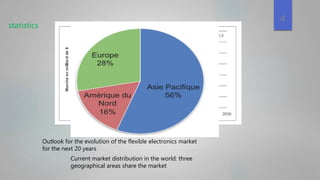
Outlook for the evolution of the flexible electronics market
for the next 20 years
Current market distribution in the world: three
geographical areas share the market
4
statistics
5
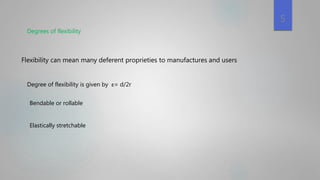
Degrees of flexibility
Flexibility can mean many deferent proprieties to manufactures and users
Degree of flexibility is given by ε= d/2r
Bendable or rollable
Elastically stretchable
Materials for flexible electronics
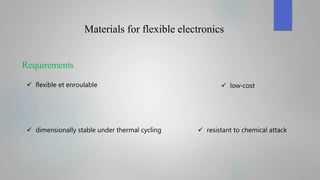
Requirements
 flexible et enroulable  low‐cost
 resistant to chemical attack dimensionally stable under thermal cycling
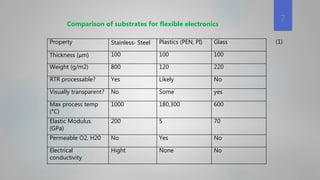
Property Stainless‐ Steel Plastics (PEN, PI) Glass
Thickness (μm) 100 100 100
Weight (g/m2) 800 120 220
RTR processable? Yes Likely No
Visually transparent? No Some yes
Max process temp
(°C)
1000 180,300 600
Elastic Modulus
(GPa)
200 5 70
Permeable O2, H20 No Yes No
Electrical
conductivity
Hight None No
Comparison of substrates for flexible electronics
(1)
7
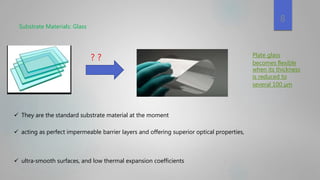
Substrate Materials: Glass
 acting as perfect impermeable barrier layers and offering superior optical properties,
 ultra‐smooth surfaces, and low thermal expansion coefficients
? ? Plate glass
becomes flexible
when its thickness
is reduced to
several 100 μm
8
 They are the standard substrate material at the moment
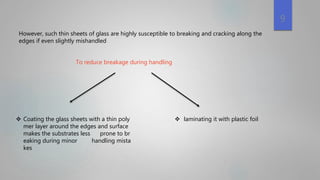
 Coating the glass sheets with a thin poly
mer layer around the edges and surface
makes the substrates less prone to br
eaking during minor handling mista
kes
However, such thin sheets of glass are highly susceptible to breaking and cracking along the
edges if even slightly mishandled
To reduce breakage during handling
 laminating it with plastic foil
9
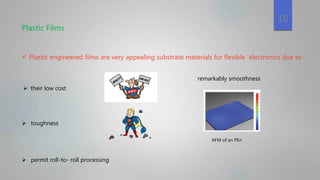
Plastic Films
 Plastic engineered films are very appealing substrate materials for flexible electronics due to
 toughness
 their low cost
 permit roll-to- roll processing
remarkably smoothness
AFM of an PEn
10
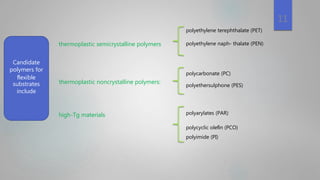
Candidate
polymers for
flexible
substrates
include
thermoplastic semicrystalline polymers
polyethylene terephthalate (PET)
polyethylene naph- thalate (PEN)
thermoplastic noncrystalline polymers:
polycarbonate (PC)
polyethersulphone (PES)
high-Tg materials polyarylates (PAR)
polycyclic olefin (PCO)
polyimide (PI)
11
they are thermally and dimensionally less stable than glass substrates and are
easily permeated by oxygen and water. A glass transition temper- ature, T ,
compatible with the device process temperature is essential. However, a high Tg
alone is not sufficient. Dimensional stability and a low CTE are also important
factors.
12
Plastic Films
Stainless Steel
 steel (SS) is a leading substrate candidate for applications where transparency is not required
 SS foils, produced with thicknesses of 125 μm, provide a durable, flexible substrate that tolerates high te
mperature processes
 The foils provide a perfect diffusion barrier to oxygen and water vapor
 The steel foils, however, have a rough surface and are highly conductive
13
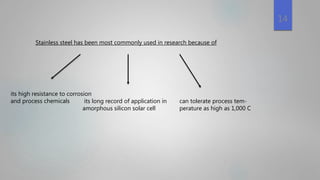
Stainless steel has been most commonly used in research because of
its high resistance to corrosion
and process chemicals its long record of application in
amorphous silicon solar cell
can tolerate process tem-
perature as high as 1,000 C
14
Fabrication Technology of Flexible Electronics
15
Roll to roll technique
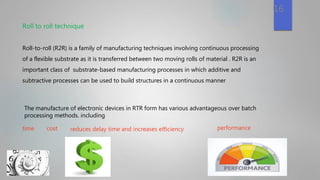
Roll-to-roll (R2R) is a family of manufacturing techniques involving continuous processing
of a flexible substrate as it is transferred between two moving rolls of material . R2R is an
important class of substrate-based manufacturing processes in which additive and
subtractive processes can be used to build structures in a continuous manner
16
The manufacture of electronic devices in RTR form has various advantageous over batch
processing methods. including
time cost reduces delay time and increases efficiency performance
17
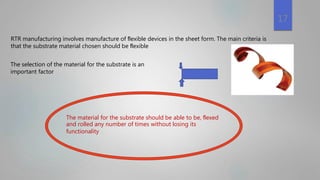
RTR manufacturing involves manufacture of flexible devices in the sheet form. The main criteria is
that the substrate material chosen should be flexible
The selection of the material for the substrate is an
important factor
The material for the substrate should be able to be, flexed
and rolled any number of times without losing its
functionality
18
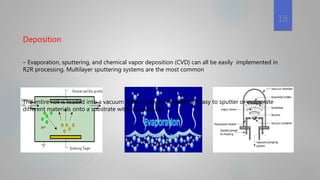
Deposition
– Evaporation, sputtering, and chemical vapor deposition (CVD) can all be easily implemented in
R2R processing. Multilayer sputtering systems are the most common
The entire roll is loaded into a vacuum system where it is relatively easy to sputter or evaporate
different materials onto a substrate without crosstalk
19
Etching
A type of printing process which involves engraving the image onto an image carrier
-A form of printing process which utilizes a flexible relief plate. It is essentially a modern version of
letterpress which can be used for printing on almost any type of substrate, including plastic, metallic
films, and paper
Flexographic Printing
20
Laser Ablation
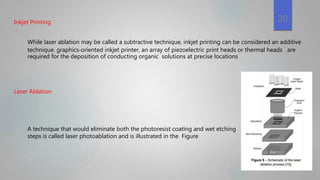
A technique that would eliminate both the photoresist coating and wet etching
steps is called laser photoablation and is illustrated in the Figure
Inkjet Printing
While laser ablation may be called a subtractive technique, inkjet printing can be considered an additive
technique. graphics‐oriented inkjet printer, an array of piezoelectric print heads or thermal heads are
required for the deposition of conducting organic solutions at precise locations
21
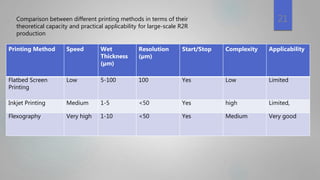
Printing Method Speed Wet
Thickness
(µm)
Resolution
(µm)
Start/Stop Complexity Applicability
Flatbed Screen
Printing
Low 5-100 100 Yes Low Limited
Inkjet Printing Medium 1-5 <50 Yes high Limited,
Flexography Very high 1-10 <50 Yes Medium Very good
Comparison between different printing methods in terms of their
theoretical capacity and practical applicability for large-scale R2R
production
supply roller
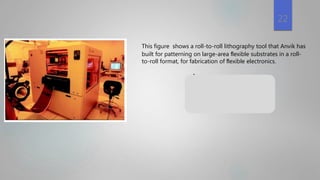
This figure shows a roll-to-roll lithography tool that Anvik has
built for patterning on large-area flexible substrates in a roll-
to-roll format, for fabrication of flexible electronics.
copper-on-Kapton
22
Applications
23
24
smart fabric
applications
Wearable technology
Healthcare
Mobile devices
Automotive
25
Conclusion :
Flexible electronics has occupied a big part of the electronics industry due to there :
Low cost
Size and weight
High integration rate
Challenges :
Scientists have to find new innovative materials to increase yield of flexible devices,
increase the lifetime and they have to improve the encapsulation of the devices ,
26
Thanks for your attention

Flexible electronics

  • 1.
    1 Academic year 2016/2017 Universityof Sousse Higher Institute of Applied Sciences and Technology Flexible electronics Elaborated by : ElAGUECH Mohamed Amin
  • 2.
    2 Outline : Introduction &statistics Materials for flexible electronics Fabrication Technology of Flexible Electronics Applications Conclusion
  • 3.
    3 Flexible electronics isa technology where the electronic circuits are assembled on flexible substrates for use. These flexible electronics are very thin, light weight, portable, and flexible and have many advantages over rigid electronic devices. Currently, researchers around the globe are trying to build flexible electronic devices in various fields of electronics. introduction
  • 4.
    Outlook for theevolution of the flexible electronics market for the next 20 years Current market distribution in the world: three geographical areas share the market 4 statistics
  • 5.
    5 Degrees of flexibility Flexibilitycan mean many deferent proprieties to manufactures and users Degree of flexibility is given by ε= d/2r Bendable or rollable Elastically stretchable
  • 6.
    Materials for flexibleelectronics Requirements  flexible et enroulable  low‐cost  resistant to chemical attack dimensionally stable under thermal cycling
  • 7.
    Property Stainless‐ SteelPlastics (PEN, PI) Glass Thickness (μm) 100 100 100 Weight (g/m2) 800 120 220 RTR processable? Yes Likely No Visually transparent? No Some yes Max process temp (°C) 1000 180,300 600 Elastic Modulus (GPa) 200 5 70 Permeable O2, H20 No Yes No Electrical conductivity Hight None No Comparison of substrates for flexible electronics (1) 7
  • 8.
    Substrate Materials: Glass acting as perfect impermeable barrier layers and offering superior optical properties,  ultra‐smooth surfaces, and low thermal expansion coefficients ? ? Plate glass becomes flexible when its thickness is reduced to several 100 μm 8  They are the standard substrate material at the moment
  • 9.
     Coating theglass sheets with a thin poly mer layer around the edges and surface makes the substrates less prone to br eaking during minor handling mista kes However, such thin sheets of glass are highly susceptible to breaking and cracking along the edges if even slightly mishandled To reduce breakage during handling  laminating it with plastic foil 9
  • 10.
    Plastic Films  Plasticengineered films are very appealing substrate materials for flexible electronics due to  toughness  their low cost  permit roll-to- roll processing remarkably smoothness AFM of an PEn 10
  • 11.
    Candidate polymers for flexible substrates include thermoplastic semicrystallinepolymers polyethylene terephthalate (PET) polyethylene naph- thalate (PEN) thermoplastic noncrystalline polymers: polycarbonate (PC) polyethersulphone (PES) high-Tg materials polyarylates (PAR) polycyclic olefin (PCO) polyimide (PI) 11
  • 12.
    they are thermallyand dimensionally less stable than glass substrates and are easily permeated by oxygen and water. A glass transition temper- ature, T , compatible with the device process temperature is essential. However, a high Tg alone is not sufficient. Dimensional stability and a low CTE are also important factors. 12 Plastic Films
  • 13.
    Stainless Steel  steel(SS) is a leading substrate candidate for applications where transparency is not required  SS foils, produced with thicknesses of 125 μm, provide a durable, flexible substrate that tolerates high te mperature processes  The foils provide a perfect diffusion barrier to oxygen and water vapor  The steel foils, however, have a rough surface and are highly conductive 13
  • 14.
    Stainless steel hasbeen most commonly used in research because of its high resistance to corrosion and process chemicals its long record of application in amorphous silicon solar cell can tolerate process tem- perature as high as 1,000 C 14
  • 15.
    Fabrication Technology ofFlexible Electronics 15
  • 16.
    Roll to rolltechnique Roll-to-roll (R2R) is a family of manufacturing techniques involving continuous processing of a flexible substrate as it is transferred between two moving rolls of material . R2R is an important class of substrate-based manufacturing processes in which additive and subtractive processes can be used to build structures in a continuous manner 16 The manufacture of electronic devices in RTR form has various advantageous over batch processing methods. including time cost reduces delay time and increases efficiency performance
  • 17.
    17 RTR manufacturing involvesmanufacture of flexible devices in the sheet form. The main criteria is that the substrate material chosen should be flexible The selection of the material for the substrate is an important factor The material for the substrate should be able to be, flexed and rolled any number of times without losing its functionality
  • 18.
    18 Deposition – Evaporation, sputtering,and chemical vapor deposition (CVD) can all be easily implemented in R2R processing. Multilayer sputtering systems are the most common The entire roll is loaded into a vacuum system where it is relatively easy to sputter or evaporate different materials onto a substrate without crosstalk
  • 19.
    19 Etching A type ofprinting process which involves engraving the image onto an image carrier -A form of printing process which utilizes a flexible relief plate. It is essentially a modern version of letterpress which can be used for printing on almost any type of substrate, including plastic, metallic films, and paper Flexographic Printing
  • 20.
    20 Laser Ablation A techniquethat would eliminate both the photoresist coating and wet etching steps is called laser photoablation and is illustrated in the Figure Inkjet Printing While laser ablation may be called a subtractive technique, inkjet printing can be considered an additive technique. graphics‐oriented inkjet printer, an array of piezoelectric print heads or thermal heads are required for the deposition of conducting organic solutions at precise locations
  • 21.
    21 Printing Method SpeedWet Thickness (µm) Resolution (µm) Start/Stop Complexity Applicability Flatbed Screen Printing Low 5-100 100 Yes Low Limited Inkjet Printing Medium 1-5 <50 Yes high Limited, Flexography Very high 1-10 <50 Yes Medium Very good Comparison between different printing methods in terms of their theoretical capacity and practical applicability for large-scale R2R production
  • 22.
    supply roller This figureshows a roll-to-roll lithography tool that Anvik has built for patterning on large-area flexible substrates in a roll- to-roll format, for fabrication of flexible electronics. copper-on-Kapton 22
  • 23.
  • 24.
  • 25.
    25 Conclusion : Flexible electronicshas occupied a big part of the electronics industry due to there : Low cost Size and weight High integration rate Challenges : Scientists have to find new innovative materials to increase yield of flexible devices, increase the lifetime and they have to improve the encapsulation of the devices ,
  • 26.

Editor's Notes

  • #5 Source : www.idtechex.com, Printed, Organic & Flexible Electronics Forecasts, Players & Opportunities 2010-2020
  • #7  No material has emerged that fills all of these needs (see Table 1), but the three that have come close are glass, plastic and stainless steel.
  • #8 (1)Vitex Systems, Inc. “The Guardian Tool.” Available online: http://www.vitexsys.com/guardian.html.  
  • #9 Glass foils as thin as 30 μm can be produced by the downdraw method However, such thin sheets of glass are highly susceptible to breaking g and cracking along the edges if even slightly mishandled
  • #10 More work in this area is necessary in order to  make glass a viable substrate for R2R processing
  • #12 Transition temperature is the temperature at which a material changes from one crystal state (allotrope) to another
  • #13 MacDonald, William. “Engineered films for display technologies.” J. Mater. Chem. 14,  4‐10, 2004. 
  • #17 Flexible Electronics and Displays: High-Resolution, Roll-to-Roll, Projection Lithography and Photoablation Processing Technologies for High-Throughput Production KANTI JAIN, SENIOR MEMBER, IEEE, MARC KLOSNER, MARC ZEMEL, AND SHYAM RAGHUNANDAN 0018-9219/$20.00 © 2005 IEEE
  • #18 As a comparison of the variety of processes that can be used for R2R manufacturing, a brief description of each are provided here.