Storage classes in
C
Storage classes
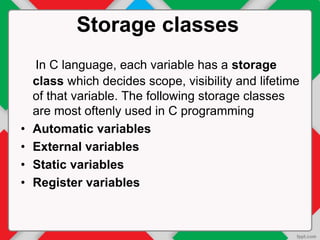
In C language, each variable has a storage
class which decides scope, visibility and lifetime
of that variable. The following storage classes
are most oftenly used in C programming
• Automatic variables
• External variables
• Static variables
• Register variables
Automatic variables
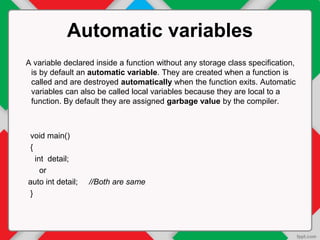
A variable declared inside a function without any storage class specification,
is by default an automatic variable. They are created when a function is
called and are destroyed automatically when the function exits. Automatic
variables can also be called local variables because they are local to a
function. By default they are assigned garbage value by the compiler.
void main()
{
int detail;
or
auto int detail; //Both are same
}
External or Global variable
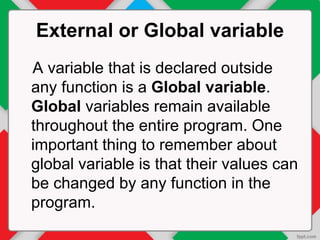
A variable that is declared outside
any function is a Global variable.
Global variables remain available
throughout the entire program. One
important thing to remember about
global variable is that their values can
be changed by any function in the
program.
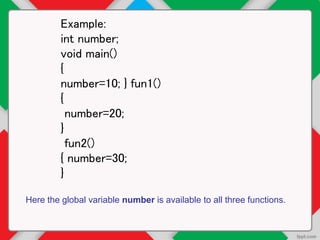
Example:
int number;
void main()
{
number=10; } fun1()
{
number=20;
}
fun2()
{ number=30;
}
Here the global variable number is available to all three functions.
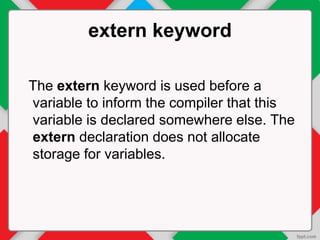
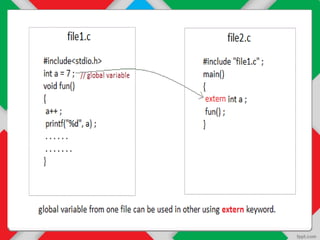
extern keyword
The extern keyword is used before a
variable to inform the compiler that this
variable is declared somewhere else. The
extern declaration does not allocate
storage for variables.
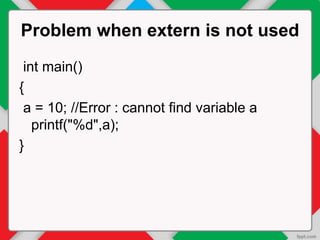
Problem when extern is not used
int main()
{
a = 10; //Error : cannot find variable a
printf("%d",a);
}
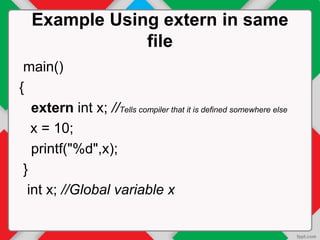
Example Using extern in same
file
main()
{
extern int x; //Tells compiler that it is defined somewhere else
x = 10;
printf("%d",x);
}
int x; //Global variable x
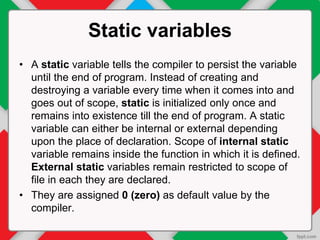
Static variables
• A static variable tells the compiler to persist the variable
until the end of program. Instead of creating and
destroying a variable every time when it comes into and
goes out of scope, static is initialized only once and
remains into existence till the end of program. A static
variable can either be internal or external depending
upon the place of declaration. Scope of internal static
variable remains inside the function in which it is defined.
External static variables remain restricted to scope of
file in each they are declared.
• They are assigned 0 (zero) as default value by the
compiler.
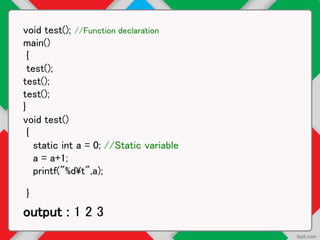
void test(); //Function declaration
main()
{
test();
test();
test();
}
void test()
{
static int a = 0; //Static variable
a = a+1;
printf("%dt",a);
}
output : 1 2 3
Register variable
• Register variable inform the compiler to store
the variable in register instead of memory.
Register variable has faster access than normal
variable. Frequently used variables are kept in
register. Only few variables can be placed inside
register.
• NOTE : We can never get the address of such
variables.
• Syntax :
register int number;
Storage classes in C

Storage classes in C

  • 1.
  • 2.
    Storage classes In Clanguage, each variable has a storage class which decides scope, visibility and lifetime of that variable. The following storage classes are most oftenly used in C programming • Automatic variables • External variables • Static variables • Register variables
  • 3.
    Automatic variables A variabledeclared inside a function without any storage class specification, is by default an automatic variable. They are created when a function is called and are destroyed automatically when the function exits. Automatic variables can also be called local variables because they are local to a function. By default they are assigned garbage value by the compiler. void main() { int detail; or auto int detail; //Both are same }
  • 4.
    External or Globalvariable A variable that is declared outside any function is a Global variable. Global variables remain available throughout the entire program. One important thing to remember about global variable is that their values can be changed by any function in the program.
  • 5.
    Example: int number; void main() { number=10;} fun1() { number=20; } fun2() { number=30; } Here the global variable number is available to all three functions.
  • 6.
    extern keyword The externkeyword is used before a variable to inform the compiler that this variable is declared somewhere else. The extern declaration does not allocate storage for variables.
  • 8.
    Problem when externis not used int main() { a = 10; //Error : cannot find variable a printf("%d",a); }
  • 9.
    Example Using externin same file main() { extern int x; //Tells compiler that it is defined somewhere else x = 10; printf("%d",x); } int x; //Global variable x
  • 10.
    Static variables • Astatic variable tells the compiler to persist the variable until the end of program. Instead of creating and destroying a variable every time when it comes into and goes out of scope, static is initialized only once and remains into existence till the end of program. A static variable can either be internal or external depending upon the place of declaration. Scope of internal static variable remains inside the function in which it is defined. External static variables remain restricted to scope of file in each they are declared. • They are assigned 0 (zero) as default value by the compiler.
  • 11.
    void test(); //Functiondeclaration main() { test(); test(); test(); } void test() { static int a = 0; //Static variable a = a+1; printf("%dt",a); } output : 1 2 3
  • 12.
    Register variable • Registervariable inform the compiler to store the variable in register instead of memory. Register variable has faster access than normal variable. Frequently used variables are kept in register. Only few variables can be placed inside register. • NOTE : We can never get the address of such variables. • Syntax : register int number;