Flame Test
Involves   placing the unknown element or
 compound sample to a flame to determine
 it’s identity through the flame color
 (emission spectrum).
The flame would change its color
 depending on the metal ions present in
 the given element or compound.

The color helps distinguish the given
 element from the others.


Flame test
Flame  gives energy to any element or
 compound.
if any sample is placed through heat, its
 electrons would get “excited” , and its
 electrons would transfer to higher state
 from its ground state to excited state As
 the electrons emit that accumulated
 energy as they return to lower orbitals ,
 photons are produced.


Flame test
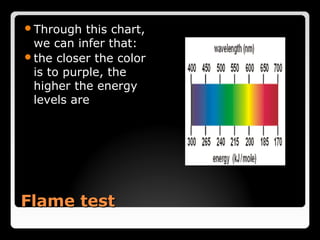
Through   this chart,
 we can infer that:
the closer the color
 is to purple, the
 higher the energy
 levels are


Flame test
Procedure
Based on the given instruction on the Lab Manual
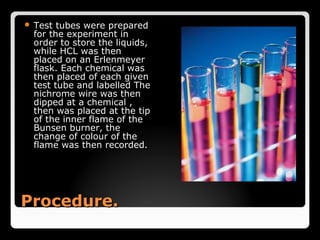
 Test tubes were prepared
 for the experiment in
 order to store the liquids,
 while HCL was then
 placed on an Erlenmeyer
 flask. Each chemical was
 then placed of each given
 test tube and labelled The
 nichrome wire was then
 dipped at a chemical ,
 then was placed at the tip
 of the inner flame of the
 Bunsen burner, the
 change of colour of the
 flame was then recorded.


Procedure.
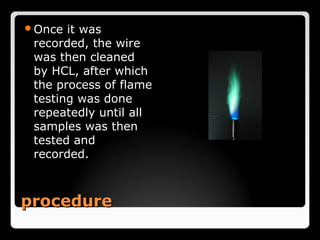
Once  it was
 recorded, the wire
 was then cleaned
 by HCL, after which
 the process of flame
 testing was done
 repeatedly until all
 samples was then
 tested and
 recorded.


procedure
   After all of it are
 tested, an unknown
 liquid then was
 tested. Once the
 unknown liquid was
 determined by its
 flame colour it was
 then recorded.


Unknown chemical
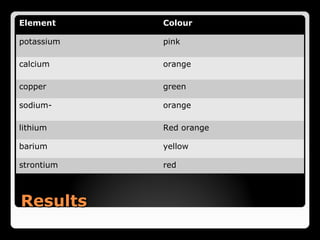
Element     Colour

potassium   pink

calcium     orange

copper      green

sodium-     orange

lithium     Red orange

barium      yellow

strontium   red


Results
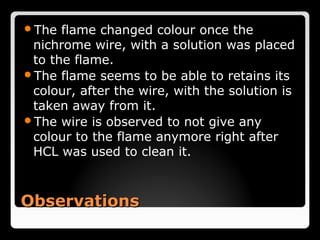
The  flame changed colour once the
 nichrome wire, with a solution was placed
 to the flame.
The flame seems to be able to retains its
 colour, after the wire, with the solution is
 taken away from it.
The wire is observed to not give any
 colour to the flame anymore right after
 HCL was used to clean it.


Observations
Guide Questions
One  difficulty found in the experiment is
 that there are some flame colors which
 are found very similar to the other.
in order to avoid similarly colored flames,
 thorough cleaning of the loop and a
 restarting the test of the same colour is
 necessary.


Difficulties found in the
experiment?
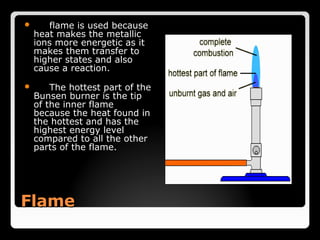
      flame is used because
    heat makes the metallic
    ions more energetic as it
    makes them transfer to
    higher states and also
    cause a reaction.

       The hottest part of the
    Bunsen burner is the tip
    of the inner flame
    because the heat found in
    the hottest and has the
    highest energy level
    compared to all the other
    parts of the flame.


Flame
Ifthe sample has more than one metal,
 then the flame would emit colors which
 are mix from both components of that
 sample which makes the result seem
 confusing and unreliable.


More than one metal component
Real life situations
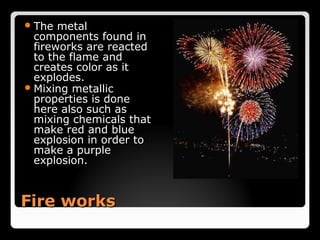
 The  metal
  components found in
  fireworks are reacted
  to the flame and
  creates color as it
  explodes.
 Mixing metallic
  properties is done
  here also such as
  mixing chemicals that
  make red and blue
  explosion in order to
  make a purple
  explosion.


Fire works
 Forensic   science uses
  flame as one of its
  methods in solving
  crime.
 Through conducting
  flame test on the
  victims blood, they
  would notice in the
  victim is poisoned or
  not , if it emitted a
  flame color found only
  on toxic elements or
  compounds like Barium.


Forensic analysis
   Images :
   Gondhia , Reema. "The Future." THE CHEMISTRY OF FIREWORKS. Imerial College London, n.d. Web. 5
   Aug 2012. <http://www.ch.ic.ac.uk/local/projects/gondhia/images/stillfirework7.jpg>.
   "Question Mark ." Answers. Getty Images, Inc, n.d. Web. 5 Aug 2012.
   <http://www.answers.com/topic/question-mark-large-image>.
   Helmenstine , Anne Marie, Ph.D., . "Flame Tests." about.com. Chemistry, n.d. Web. 5 Aug 2012.
   < http://chemistry.about.com/od/firecombustionchemistry/ig/Flame-Tests/ >.
   "Is Worship an Experience or an Offering? Leaving the “Heavenly Sanctuary” for the “Laboratory.”." My
   two cents. Wordpress, January 10, 2007. Web. 5 Aug 2012.
   <http://mytwocents.files.wordpress.com/2007/01/test-tubes.jpg>.
   Shakhashiri, Bassam. "Fireworks!." Chemical of the week. Science is fun, n.d. Web. 5 Aug 2012.
   < http://scifun.chem.wisc.edu/chemweek/fireworks/images/spectrum.gif >.
   "The Bunsen burner." GCSE Bitesiz. BBC, n.d. Web. 5 Aug 2012.
   <http://www.bbc.co.uk/schools/gcsebitesize/science/images/gatewaysci_05.gifl>.
   "Forensics." UNODC. N.p., n.d. Web. 5 Aug 2012.
   <http://www.unodc.org/images/southeasterneurope//forensic_image.jpg>.


   Web
   Shakhashiri, Bassam. "Fireworks!." Chemical of the week. Science is fun, n.d. Web. 5 Aug 2012.
   <http://scifun.chem.wisc.edu/chemweek/fireworks/fireworks.htm>.
   Anne Marie Helmenstine, Ph.D.. "Flame Tests." about.com. Chemistry, n.d. Web. 5 Aug 2012.
   <http://chemistry.about.com/od/analyticalchemistry/a/flametest.htm>.
   . "Flame Test." howstuffworks. howstuffworks, n.d. Web. 5 Aug 2012.
   <http://science.howstuffworks.com/flame-test-info.htm>.
   Clark, Jim. "FLAME TESTS." chemguide. Understanding Chemistry, 2005. Web. 5 Aug 2012.
   <http://www.chemguide.co.uk/inorganic/group1/flametests.html>.
   "The salt cellar mystery." Chemistry the next generation. Royal Society of Chemistry, 2009. Web. 5 Aug
   2012. <http://www.rsc.org/images/Saltercellarmystery_tcm18-159233.pdf>.


Internet sources

Flame test part 2

  • 1.
  • 2.
    Involves placing the unknown element or compound sample to a flame to determine it’s identity through the flame color (emission spectrum). The flame would change its color depending on the metal ions present in the given element or compound. The color helps distinguish the given element from the others. Flame test
  • 3.
    Flame givesenergy to any element or compound. if any sample is placed through heat, its electrons would get “excited” , and its electrons would transfer to higher state from its ground state to excited state As the electrons emit that accumulated energy as they return to lower orbitals , photons are produced. Flame test
  • 4.
    Through this chart, we can infer that: the closer the color is to purple, the higher the energy levels are Flame test
  • 5.
    Procedure Based on thegiven instruction on the Lab Manual
  • 6.
     Test tubeswere prepared for the experiment in order to store the liquids, while HCL was then placed on an Erlenmeyer flask. Each chemical was then placed of each given test tube and labelled The nichrome wire was then dipped at a chemical , then was placed at the tip of the inner flame of the Bunsen burner, the change of colour of the flame was then recorded. Procedure.
  • 7.
    Once itwas recorded, the wire was then cleaned by HCL, after which the process of flame testing was done repeatedly until all samples was then tested and recorded. procedure
  • 8.
    After all of it are tested, an unknown liquid then was tested. Once the unknown liquid was determined by its flame colour it was then recorded. Unknown chemical
  • 9.
    Element Colour potassium pink calcium orange copper green sodium- orange lithium Red orange barium yellow strontium red Results
  • 10.
    The flamechanged colour once the nichrome wire, with a solution was placed to the flame. The flame seems to be able to retains its colour, after the wire, with the solution is taken away from it. The wire is observed to not give any colour to the flame anymore right after HCL was used to clean it. Observations
  • 11.
  • 12.
    One difficultyfound in the experiment is that there are some flame colors which are found very similar to the other. in order to avoid similarly colored flames, thorough cleaning of the loop and a restarting the test of the same colour is necessary. Difficulties found in the experiment?
  • 13.
    flame is used because heat makes the metallic ions more energetic as it makes them transfer to higher states and also cause a reaction.  The hottest part of the Bunsen burner is the tip of the inner flame because the heat found in the hottest and has the highest energy level compared to all the other parts of the flame. Flame
  • 14.
    Ifthe sample hasmore than one metal, then the flame would emit colors which are mix from both components of that sample which makes the result seem confusing and unreliable. More than one metal component
  • 15.
  • 16.
     The metal components found in fireworks are reacted to the flame and creates color as it explodes.  Mixing metallic properties is done here also such as mixing chemicals that make red and blue explosion in order to make a purple explosion. Fire works
  • 17.
     Forensic science uses flame as one of its methods in solving crime.  Through conducting flame test on the victims blood, they would notice in the victim is poisoned or not , if it emitted a flame color found only on toxic elements or compounds like Barium. Forensic analysis
  • 18.
    Images :  Gondhia , Reema. "The Future." THE CHEMISTRY OF FIREWORKS. Imerial College London, n.d. Web. 5  Aug 2012. <http://www.ch.ic.ac.uk/local/projects/gondhia/images/stillfirework7.jpg>.  "Question Mark ." Answers. Getty Images, Inc, n.d. Web. 5 Aug 2012.  <http://www.answers.com/topic/question-mark-large-image>.  Helmenstine , Anne Marie, Ph.D., . "Flame Tests." about.com. Chemistry, n.d. Web. 5 Aug 2012.  < http://chemistry.about.com/od/firecombustionchemistry/ig/Flame-Tests/ >.  "Is Worship an Experience or an Offering? Leaving the “Heavenly Sanctuary” for the “Laboratory.”." My  two cents. Wordpress, January 10, 2007. Web. 5 Aug 2012.  <http://mytwocents.files.wordpress.com/2007/01/test-tubes.jpg>.  Shakhashiri, Bassam. "Fireworks!." Chemical of the week. Science is fun, n.d. Web. 5 Aug 2012.  < http://scifun.chem.wisc.edu/chemweek/fireworks/images/spectrum.gif >.  "The Bunsen burner." GCSE Bitesiz. BBC, n.d. Web. 5 Aug 2012.  <http://www.bbc.co.uk/schools/gcsebitesize/science/images/gatewaysci_05.gifl>.  "Forensics." UNODC. N.p., n.d. Web. 5 Aug 2012.  <http://www.unodc.org/images/southeasterneurope//forensic_image.jpg>.  Web  Shakhashiri, Bassam. "Fireworks!." Chemical of the week. Science is fun, n.d. Web. 5 Aug 2012.  <http://scifun.chem.wisc.edu/chemweek/fireworks/fireworks.htm>.  Anne Marie Helmenstine, Ph.D.. "Flame Tests." about.com. Chemistry, n.d. Web. 5 Aug 2012.  <http://chemistry.about.com/od/analyticalchemistry/a/flametest.htm>.  . "Flame Test." howstuffworks. howstuffworks, n.d. Web. 5 Aug 2012.  <http://science.howstuffworks.com/flame-test-info.htm>.  Clark, Jim. "FLAME TESTS." chemguide. Understanding Chemistry, 2005. Web. 5 Aug 2012.  <http://www.chemguide.co.uk/inorganic/group1/flametests.html>.  "The salt cellar mystery." Chemistry the next generation. Royal Society of Chemistry, 2009. Web. 5 Aug  2012. <http://www.rsc.org/images/Saltercellarmystery_tcm18-159233.pdf>. Internet sources