SURVEY OF CHEMISTRY LABORATORY I
CHEM 1151L
FLAME TESTS
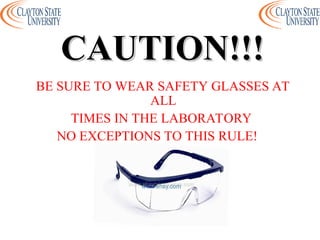
CAUTION!!!
CAUTION!!!
BE SURE TO WEAR SAFETY GLASSES AT
ALL
TIMES IN THE LABORATORY
NO EXCEPTIONS TO THIS RULE!
- To explore the line spectra of a variety of elements by heating
them in a Bunsen burner flame
- The data gathered from the flame colors created by the elements
will be used to identify some elements present in unknown
solutions
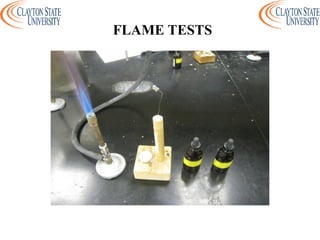
FLAME TESTS
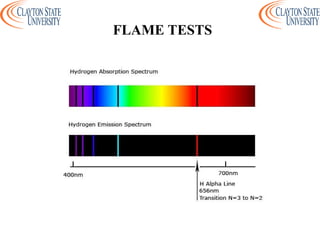
- Electrons in atoms, ions and molecules are restricted to specific
energy levels
- An electron “excited” by some outside energy (flame or
electricity) moves from its present energy level to a higher
energy level
- A photon of light is produced as the electron falls back to its
ground state
- The light given off is of a specific color since it has a specific
wavelength or frequency of light associated with it
FLAME TESTS
FLAME TESTS
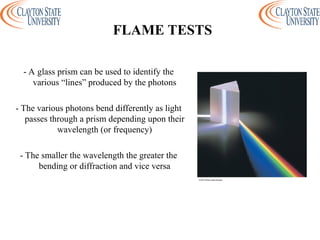
- A glass prism can be used to identify the
various “lines” produced by the photons
- The various photons bend differently as light
passes through a prism depending upon their
wavelength (or frequency)
- The smaller the wavelength the greater the
bending or diffraction and vice versa
FLAME TESTS
FLAME TESTS
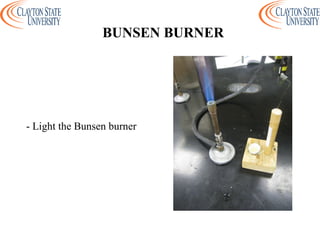
- Light the Bunsen burner
BUNSEN BURNER
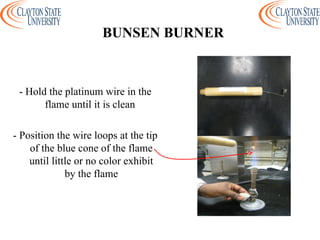
- Hold the platinum wire in the
flame until it is clean
- Position the wire loops at the tip
of the blue cone of the flame
until little or no color exhibit
by the flame
BUNSEN BURNER
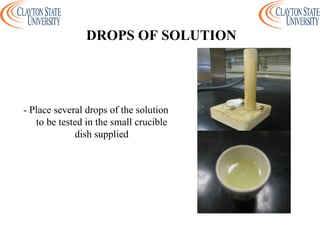
- Place several drops of the solution
to be tested in the small crucible
dish supplied
DROPS OF SOLUTION
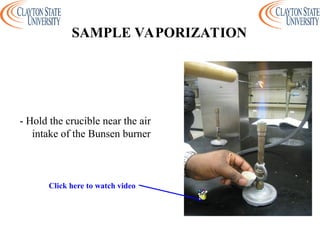
- Hold the crucible near the air
intake of the Bunsen burner
SAMPLE VAPORIZATION
Package
Click here to watch video
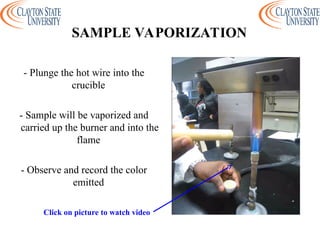
- Plunge the hot wire into the
crucible
- Sample will be vaporized and
carried up the burner and into the
flame
- Observe and record the color
emitted
SAMPLE VAPORIZATION
Click on picture to watch video
- Move to a new location for the next flame test
- The burners and wires stay in one location
- Be sure to observe all of the seven known samples and
the five unknown samples
- Match the colors to identify the unknown samples
IDENTIFICATION OF UNKNOWNS

flame-test-ppt.ppt.ppt.ppt.ppt.ppt.ppt.ppt

  • 1.
    SURVEY OF CHEMISTRYLABORATORY I CHEM 1151L FLAME TESTS
  • 2.
    CAUTION!!! CAUTION!!! BE SURE TOWEAR SAFETY GLASSES AT ALL TIMES IN THE LABORATORY NO EXCEPTIONS TO THIS RULE!
  • 3.
    - To explorethe line spectra of a variety of elements by heating them in a Bunsen burner flame - The data gathered from the flame colors created by the elements will be used to identify some elements present in unknown solutions FLAME TESTS
  • 4.
    - Electrons inatoms, ions and molecules are restricted to specific energy levels - An electron “excited” by some outside energy (flame or electricity) moves from its present energy level to a higher energy level - A photon of light is produced as the electron falls back to its ground state - The light given off is of a specific color since it has a specific wavelength or frequency of light associated with it FLAME TESTS
  • 5.
  • 6.
    - A glassprism can be used to identify the various “lines” produced by the photons - The various photons bend differently as light passes through a prism depending upon their wavelength (or frequency) - The smaller the wavelength the greater the bending or diffraction and vice versa FLAME TESTS
  • 7.
  • 8.
    - Light theBunsen burner BUNSEN BURNER
  • 9.
    - Hold theplatinum wire in the flame until it is clean - Position the wire loops at the tip of the blue cone of the flame until little or no color exhibit by the flame BUNSEN BURNER
  • 10.
    - Place severaldrops of the solution to be tested in the small crucible dish supplied DROPS OF SOLUTION
  • 11.
    - Hold thecrucible near the air intake of the Bunsen burner SAMPLE VAPORIZATION Package Click here to watch video
  • 12.
    - Plunge thehot wire into the crucible - Sample will be vaporized and carried up the burner and into the flame - Observe and record the color emitted SAMPLE VAPORIZATION Click on picture to watch video
  • 13.
    - Move toa new location for the next flame test - The burners and wires stay in one location - Be sure to observe all of the seven known samples and the five unknown samples - Match the colors to identify the unknown samples IDENTIFICATION OF UNKNOWNS