Fixed point vs. Floating point
Outlines
 Introduction.
 Fixed point processors.
 Q Format.
 Floating point processors.
 Overflow and scaling.
 Scaling.
 Comparison.
 Conclusion.
1
Digital Signal Processing -
Introduction
 Digital Signal Processing can be divided into two
categories,
 Fixed point
 Floating point.
 Refer to the format used to store and manipulate
numbers within the devices.
2
Digital Signal Processing -
Fixed point processors
 Represents each number with a minimum of 16 bits.
 Numbers are represented and manipulated in integer
format.
 There are four common ways that these 2^16=65,536
possible bit patterns can represent a number:
 unsigned integer
 signed integer
 unsigned fraction notation
 signed fraction format
3
Digital Signal Processing -
Fixed point processors usages
 There is simply no need for the floating-
point processing in mobile TVs.
 Indeed, floating point computations would
produce a more precise DCT,
Unfortunately, the DCTs in video codec are
designed to be performed on a fixed point
processor and are bit-exact.
4
Digital Signal Processing -
Q Format (Fractional Representation)
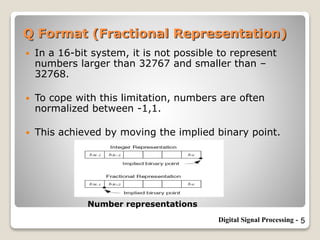
 In a 16-bit system, it is not possible to represent
numbers larger than 32767 and smaller than –
32768.
 To cope with this limitation, numbers are often
normalized between -1,1.
 This achieved by moving the implied binary point.
Number representations
5
Digital Signal Processing -
Examples
Example (1)
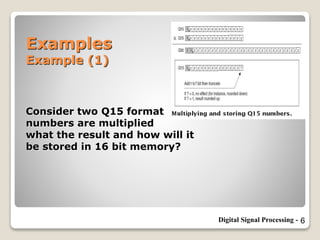
Consider two Q15 format
numbers are multiplied
what the result and how will it
be stored in 16 bit memory?
6
Digital Signal Processing -
Example (2)
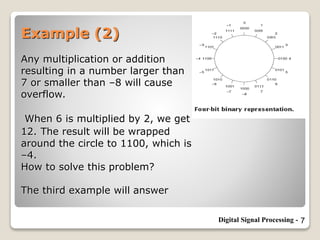
Any multiplication or addition
resulting in a number larger than
7 or smaller than –8 will cause
overflow.
When 6 is multiplied by 2, we get
12. The result will be wrapped
around the circle to 1100, which is
–4.
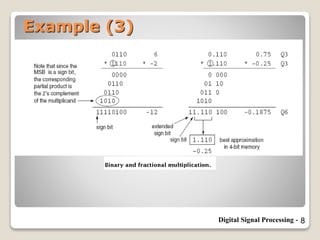
How to solve this problem?
The third example will answer
7
Digital Signal Processing -
Example (3)
8
Digital Signal Processing -
But….
 It should be realized that some precision
is lost.
 As a result of discarding the smaller
fractional bits.
 To solve this problem, the scaling
approach will be used (discussed later)
9
Digital Signal Processing -
Floating point Number
representation
 Use a minimum of 32 bits to store each value.
 The represented numbers are not uniformly spaced.
 Composed of a mantissa and exponent
 Floating point processor can also support integer
representation and calculations.
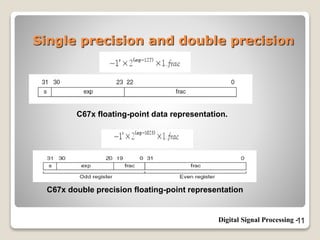
 There are two floating-point data representations on the
C67x processor:
 single precision (SP)
 and double precision(DP).
10
Digital Signal Processing -
Single precision and double precision
C67x floating-point data representation.
C67x double precision floating-point representation
11
Digital Signal Processing -
Floating point processors
 All steps needed to perform floating-point
arithmetic are done by the floating-point
hardware.
 It is inefficient to perform floating-point
arithmetic on fixed-point processors , Since all
the operations involved, must be done in
software.
12
Digital Signal Processing -
Floating point processors usages
 In military radar, the floating point processor is
frequently used because its performance is
essential.
 Floating point processing is good for doing large
FFTs so we can implement the FIR in frequency
domain.
 Appropriate in systems where gain coefficients
are changing with time or coefficients have large
dynamic ranges .
13
Digital Signal Processing -
Overflow and scaling
 When multiplying two Q15 numbers, which are in
the range of –1 and 1the product will be in the
same range.
 However, when two Q15 numbers are added, the
sum may fall outside this range, leading to an
overflow.
 Overflows can cause major problems by
generating erroneous results.
 The simplest correction method for overflow is
scaling.
14
Digital Signal Processing -
Scaling
 The idea of scaling is to scale down the system input
before performing any processing then to scale up
the resulting output to the original size.
 Scaling can be applied to most filtering and transform
operations.
 An easy way to achieve scaling is by shifting.
 Since a right shift of 1 is equivalent to a division by 2,
we can scale the input repeatedly by 0.5 until all
overflows disappear.
 The output can then be rescaled back to the total
scaling amount.
15
Digital Signal Processing -
Comparison
Characteristic Floating point Fixed point
Dynamic range much larger smaller
Resolution comparable comparable
Speed comparable comparable
Ease of programming much easier more difficult
Compiler efficiency more efficient less efficient
Power consumption comparable comparable
Chip cost comparable comparable
System cost comparable comparable
Design cost less more
Time to market faster slower
16
Digital Signal Processing -
Conclusion
 DSP processors are designed as fixed point and
floating point.
 Fixed-point
◦ Partition a binary word into integer and fractional
◦ Radix point is in a fixed position
 Floating-point
◦ Large dynamic range
◦ Composed of a mantissa and exponent
 Scaling solves the problem of overflow.
 Comparison between fixed point and floating point
17
Digital Signal Processing -

fixed-point-vs-floating-point.ppt

  • 1.
    Fixed point vs.Floating point
  • 2.
    Outlines  Introduction.  Fixedpoint processors.  Q Format.  Floating point processors.  Overflow and scaling.  Scaling.  Comparison.  Conclusion. 1 Digital Signal Processing -
  • 3.
    Introduction  Digital SignalProcessing can be divided into two categories,  Fixed point  Floating point.  Refer to the format used to store and manipulate numbers within the devices. 2 Digital Signal Processing -
  • 4.
    Fixed point processors Represents each number with a minimum of 16 bits.  Numbers are represented and manipulated in integer format.  There are four common ways that these 2^16=65,536 possible bit patterns can represent a number:  unsigned integer  signed integer  unsigned fraction notation  signed fraction format 3 Digital Signal Processing -
  • 5.
    Fixed point processorsusages  There is simply no need for the floating- point processing in mobile TVs.  Indeed, floating point computations would produce a more precise DCT, Unfortunately, the DCTs in video codec are designed to be performed on a fixed point processor and are bit-exact. 4 Digital Signal Processing -
  • 6.
    Q Format (FractionalRepresentation)  In a 16-bit system, it is not possible to represent numbers larger than 32767 and smaller than – 32768.  To cope with this limitation, numbers are often normalized between -1,1.  This achieved by moving the implied binary point. Number representations 5 Digital Signal Processing -
  • 7.
    Examples Example (1) Consider twoQ15 format numbers are multiplied what the result and how will it be stored in 16 bit memory? 6 Digital Signal Processing -
  • 8.
    Example (2) Any multiplicationor addition resulting in a number larger than 7 or smaller than –8 will cause overflow. When 6 is multiplied by 2, we get 12. The result will be wrapped around the circle to 1100, which is –4. How to solve this problem? The third example will answer 7 Digital Signal Processing -
  • 9.
  • 10.
    But….  It shouldbe realized that some precision is lost.  As a result of discarding the smaller fractional bits.  To solve this problem, the scaling approach will be used (discussed later) 9 Digital Signal Processing -
  • 11.
    Floating point Number representation Use a minimum of 32 bits to store each value.  The represented numbers are not uniformly spaced.  Composed of a mantissa and exponent  Floating point processor can also support integer representation and calculations.  There are two floating-point data representations on the C67x processor:  single precision (SP)  and double precision(DP). 10 Digital Signal Processing -
  • 12.
    Single precision anddouble precision C67x floating-point data representation. C67x double precision floating-point representation 11 Digital Signal Processing -
  • 13.
    Floating point processors All steps needed to perform floating-point arithmetic are done by the floating-point hardware.  It is inefficient to perform floating-point arithmetic on fixed-point processors , Since all the operations involved, must be done in software. 12 Digital Signal Processing -
  • 14.
    Floating point processorsusages  In military radar, the floating point processor is frequently used because its performance is essential.  Floating point processing is good for doing large FFTs so we can implement the FIR in frequency domain.  Appropriate in systems where gain coefficients are changing with time or coefficients have large dynamic ranges . 13 Digital Signal Processing -
  • 15.
    Overflow and scaling When multiplying two Q15 numbers, which are in the range of –1 and 1the product will be in the same range.  However, when two Q15 numbers are added, the sum may fall outside this range, leading to an overflow.  Overflows can cause major problems by generating erroneous results.  The simplest correction method for overflow is scaling. 14 Digital Signal Processing -
  • 16.
    Scaling  The ideaof scaling is to scale down the system input before performing any processing then to scale up the resulting output to the original size.  Scaling can be applied to most filtering and transform operations.  An easy way to achieve scaling is by shifting.  Since a right shift of 1 is equivalent to a division by 2, we can scale the input repeatedly by 0.5 until all overflows disappear.  The output can then be rescaled back to the total scaling amount. 15 Digital Signal Processing -
  • 17.
    Comparison Characteristic Floating pointFixed point Dynamic range much larger smaller Resolution comparable comparable Speed comparable comparable Ease of programming much easier more difficult Compiler efficiency more efficient less efficient Power consumption comparable comparable Chip cost comparable comparable System cost comparable comparable Design cost less more Time to market faster slower 16 Digital Signal Processing -
  • 18.
    Conclusion  DSP processorsare designed as fixed point and floating point.  Fixed-point ◦ Partition a binary word into integer and fractional ◦ Radix point is in a fixed position  Floating-point ◦ Large dynamic range ◦ Composed of a mantissa and exponent  Scaling solves the problem of overflow.  Comparison between fixed point and floating point 17 Digital Signal Processing -