Presentation by Árni M. Mathiesen
Assistant-Director General
Fisheries and Aquaculture Department
Food and Agriculture Organization of the
United Nations
24th Session of the Committee on Agriculture,
Rome, Italy, 29 September - 3 October 2014
SIDE EVENT ON THE SECOND INTERNATIONAL
CONFERENCE ON NUTRITION (ICN2)
Wednesday, 1 October 2014
“FISH AND HUMAN NUTRITION”
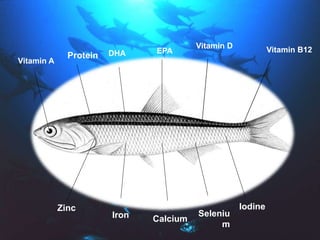
Protein
Seleniu
m
IodineZinc
Calcium
Vitamin D
Vitamin A
DHA Vitamin B12EPA
Iron
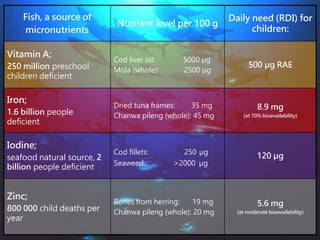
Fish, a source of
micronutrients
Nutrient level per 100 g
Daily need (RDI) for
children:
Vitamin A;
250 million preschool
children deficient
Cod liver oil: 5000 µg
Mola (whole): 2500 µg
500 µg RAE
Iron;
1.6 billion people
deficient
Dried tuna frames: 35 mg
Chanwa pileng (whole): 45 mg
8.9 mg
(at 10% bioavailability)
Iodine;
seafood natural source, 2
billion people deficient
Cod fillets: 250 µg
Seaweed: >2000 µg
120 µg
Zinc;
800 000 child deaths per
year
Bones from herring: 19 mg
Chanwa pileng (whole): 20 mg
5.6 mg
(at moderate bioavailability)
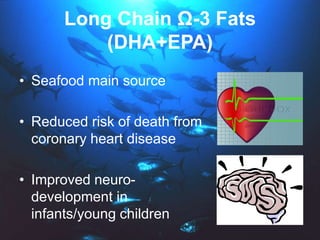
Long Chain Ω-3 Fats
(DHA+EPA)
• Seafood main source
• Reduced risk of death from
coronary heart disease
• Improved neuro-
development in
infants/young children
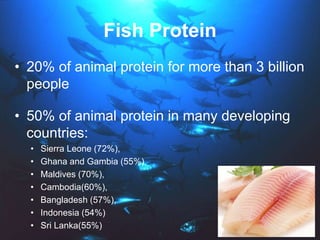
Fish Protein
• 20% of animal protein for more than 3 billion
people
• 50% of animal protein in many developing
countries:
• Sierra Leone (72%),
• Ghana and Gambia (55%)
• Maldives (70%),
• Cambodia(60%),
• Bangladesh (57%),
• Indonesia (54%)
• Sri Lanka(55%)
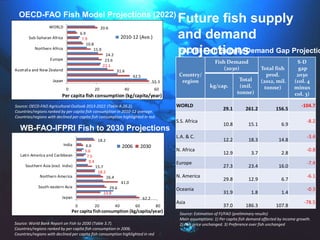
Future fish supply
and demand
projections
55.3
42.5
31.6
22.1
23.6
24.2
15.9
10.8
7.9
6.9
20.6
0 20 40 60
Japan
Australia and New Zealand
Europe
Northern Africa
Sub-Saharan Africa
WORLD
Per capita fish consumption (kg/capita/year)
2010-12 (Ave.)
OECD-FAO Fish Model Projections (2022)
Source: OECD-FAO Agricultural Outlook 2013-2022 (Table A.26.2).
Countries/regions ranked by per capita fish consumption in 2010-12 average.
Countries/regions with declined per capita fish consumption highlighted in red.
WB-FAO-IFPRI Fish to 2030 Projections
Source: World Bank Report on Fish to 2030 (Table 3.7).
Countries/regions ranked by per capita fish consumption in 2006.
Countries/regions with declined per capita fish consumption highlighted in red
62.2
23.8
29.6
41.0
26.4
18.2
15.7
9.4
7.5
5.6
6.6
18.2
0 20 40 60 80
Japan
South-eastern Asia
Northern America
Southern Asia (excl. India)
Latin America and Caribbean
India
Per capita fishconsumption (kg/capita/year)
2006 2030
Country/
region
Fish Demand
(2030) Total fish
prod.
(2012, mil.
tonne)
S-D
gap
2030
(col. 4
minus
col. 3)
kg/cap.
Total
(mil.
tonne)
WORLD
29.1 261.2 156.5
-104.7
S.S. Africa
10.8 15.1 6.9
-8.2
L.A. & C.
12.2 18.3 14.8
-3.4
N. Africa
12.9 3.7 2.8
-0.8
Europe
27.3 23.4 16.0
-7.4
N. America
29.8 12.9 6.7
-6.1
Oceania
31.9 1.8 1.4
-0.3
Asia
37.0 186.3 107.8
-78.5
Source: Estimation of FI/FAO (preliminary results)
Main assumptions: 1) Per capita fish demand affected by income growth.
2) Fish price unchanged. 3) Preference over fish unchanged
FAO/FI Fish Supply-Demand Gap Projectio
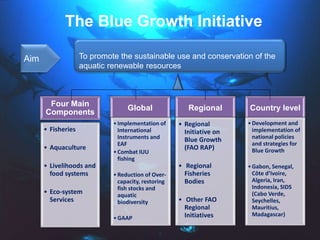
The Blue Growth Initiative
Four Main
Components
• Fisheries
• Aquaculture
• Livelihoods and
food systems
• Eco-system
Services
Global
•Implementation of
International
Instruments and
EAF
•Combat IUU
fishing
•Reduction of Over-
capacity, restoring
fish stocks and
aquatic
biodiversity
•GAAP
Regional
• Regional
Initiative on
Blue Growth
(FAO RAP)
• Regional
Fisheries
Bodies
• Other FAO
Regional
Initiatives
Country level
•Development and
implementation of
national policies
and strategies for
Blue Growth
•Gabon, Senegal,
Côte d’Ivoire,
Algeria, Iran,
Indonesia, SIDS
(Cabo Verde,
Seychelles,
Mauritius,
Madagascar)
Aim To promote the sustainable use and conservation of the
aquatic renewable resources
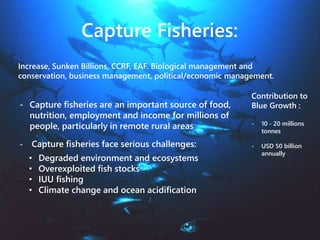
Capture Fisheries:
Increase, Sunken Billions, CCRF, EAF. Biological management and
conservation, business management, political/economic management.
Contribution to
Blue Growth :
- 10 - 20 millions
tonnes
- USD 50 billion
annually
- Capture fisheries are an important source of food,
nutrition, employment and income for millions of
people, particularly in remote rural areas
- Capture fisheries face serious challenges:
• Degraded environment and ecosystems
• Overexploited fish stocks
• IUU fishing
• Climate change and ocean acidification
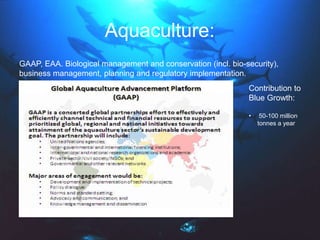
Aquaculture:
GAAP, EAA. Biological management and conservation (incl. bio-security),
business management, planning and regulatory implementation.
Contribution to
Blue Growth:
• 50-100 million
tonnes a year
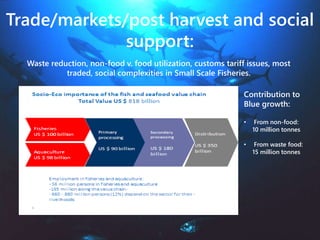
Trade/markets/post harvest and social
support:
Waste reduction, non-food v. food utilization, customs tariff issues, most
traded, social complexities in Small Scale Fisheries.
Contribution to
Blue growth:
• From non-food:
10 million tonnes
• From waste food:
15 million tonnes
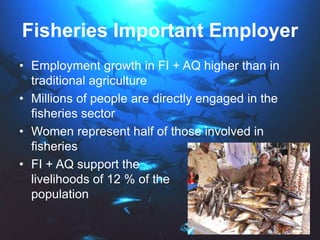
Fisheries Important Employer
• Employment growth in FI + AQ higher than in
traditional agriculture
• Millions of people are directly engaged in the
fisheries sector
• Women represent half of those involved in
fisheries
• FI + AQ support the
livelihoods of 12 % of the global
population
Fish and Human Nutrition

Fish and Human Nutrition

  • 1.
    Presentation by ÁrniM. Mathiesen Assistant-Director General Fisheries and Aquaculture Department Food and Agriculture Organization of the United Nations 24th Session of the Committee on Agriculture, Rome, Italy, 29 September - 3 October 2014 SIDE EVENT ON THE SECOND INTERNATIONAL CONFERENCE ON NUTRITION (ICN2) Wednesday, 1 October 2014 “FISH AND HUMAN NUTRITION”
  • 2.
  • 3.
    Fish, a sourceof micronutrients Nutrient level per 100 g Daily need (RDI) for children: Vitamin A; 250 million preschool children deficient Cod liver oil: 5000 µg Mola (whole): 2500 µg 500 µg RAE Iron; 1.6 billion people deficient Dried tuna frames: 35 mg Chanwa pileng (whole): 45 mg 8.9 mg (at 10% bioavailability) Iodine; seafood natural source, 2 billion people deficient Cod fillets: 250 µg Seaweed: >2000 µg 120 µg Zinc; 800 000 child deaths per year Bones from herring: 19 mg Chanwa pileng (whole): 20 mg 5.6 mg (at moderate bioavailability)
  • 4.
    Long Chain Ω-3Fats (DHA+EPA) • Seafood main source • Reduced risk of death from coronary heart disease • Improved neuro- development in infants/young children
  • 5.
    Fish Protein • 20%of animal protein for more than 3 billion people • 50% of animal protein in many developing countries: • Sierra Leone (72%), • Ghana and Gambia (55%) • Maldives (70%), • Cambodia(60%), • Bangladesh (57%), • Indonesia (54%) • Sri Lanka(55%)
  • 6.
    Future fish supply anddemand projections 55.3 42.5 31.6 22.1 23.6 24.2 15.9 10.8 7.9 6.9 20.6 0 20 40 60 Japan Australia and New Zealand Europe Northern Africa Sub-Saharan Africa WORLD Per capita fish consumption (kg/capita/year) 2010-12 (Ave.) OECD-FAO Fish Model Projections (2022) Source: OECD-FAO Agricultural Outlook 2013-2022 (Table A.26.2). Countries/regions ranked by per capita fish consumption in 2010-12 average. Countries/regions with declined per capita fish consumption highlighted in red. WB-FAO-IFPRI Fish to 2030 Projections Source: World Bank Report on Fish to 2030 (Table 3.7). Countries/regions ranked by per capita fish consumption in 2006. Countries/regions with declined per capita fish consumption highlighted in red 62.2 23.8 29.6 41.0 26.4 18.2 15.7 9.4 7.5 5.6 6.6 18.2 0 20 40 60 80 Japan South-eastern Asia Northern America Southern Asia (excl. India) Latin America and Caribbean India Per capita fishconsumption (kg/capita/year) 2006 2030 Country/ region Fish Demand (2030) Total fish prod. (2012, mil. tonne) S-D gap 2030 (col. 4 minus col. 3) kg/cap. Total (mil. tonne) WORLD 29.1 261.2 156.5 -104.7 S.S. Africa 10.8 15.1 6.9 -8.2 L.A. & C. 12.2 18.3 14.8 -3.4 N. Africa 12.9 3.7 2.8 -0.8 Europe 27.3 23.4 16.0 -7.4 N. America 29.8 12.9 6.7 -6.1 Oceania 31.9 1.8 1.4 -0.3 Asia 37.0 186.3 107.8 -78.5 Source: Estimation of FI/FAO (preliminary results) Main assumptions: 1) Per capita fish demand affected by income growth. 2) Fish price unchanged. 3) Preference over fish unchanged FAO/FI Fish Supply-Demand Gap Projectio
  • 7.
    The Blue GrowthInitiative Four Main Components • Fisheries • Aquaculture • Livelihoods and food systems • Eco-system Services Global •Implementation of International Instruments and EAF •Combat IUU fishing •Reduction of Over- capacity, restoring fish stocks and aquatic biodiversity •GAAP Regional • Regional Initiative on Blue Growth (FAO RAP) • Regional Fisheries Bodies • Other FAO Regional Initiatives Country level •Development and implementation of national policies and strategies for Blue Growth •Gabon, Senegal, Côte d’Ivoire, Algeria, Iran, Indonesia, SIDS (Cabo Verde, Seychelles, Mauritius, Madagascar) Aim To promote the sustainable use and conservation of the aquatic renewable resources
  • 8.
    Capture Fisheries: Increase, SunkenBillions, CCRF, EAF. Biological management and conservation, business management, political/economic management. Contribution to Blue Growth : - 10 - 20 millions tonnes - USD 50 billion annually - Capture fisheries are an important source of food, nutrition, employment and income for millions of people, particularly in remote rural areas - Capture fisheries face serious challenges: • Degraded environment and ecosystems • Overexploited fish stocks • IUU fishing • Climate change and ocean acidification
  • 9.
    Aquaculture: GAAP, EAA. Biologicalmanagement and conservation (incl. bio-security), business management, planning and regulatory implementation. Contribution to Blue Growth: • 50-100 million tonnes a year
  • 10.
    Trade/markets/post harvest andsocial support: Waste reduction, non-food v. food utilization, customs tariff issues, most traded, social complexities in Small Scale Fisheries. Contribution to Blue growth: • From non-food: 10 million tonnes • From waste food: 15 million tonnes
  • 11.
    Fisheries Important Employer •Employment growth in FI + AQ higher than in traditional agriculture • Millions of people are directly engaged in the fisheries sector • Women represent half of those involved in fisheries • FI + AQ support the livelihoods of 12 % of the global population

Editor's Notes

  • #4 Small fish, eaten whole or as fish products, e.g. dried fish, are particularly rich in calcium and other micronutrients. In recent years, through Scaling Up Nutrition (SUN) and 1 000 Days, there has been focus on the role of fish as a rich animal-source food containing multiple nutrients for growth, development and wellbeing, and specifically as a source of essential fats for brain development and cognition in the first 1 000 days of life.
  • #5 Foods from the aquatic environment are a complete and unique source of both the macro- and micronutrients required in a healthy diet. The benefits, as well as the potential risks, of fish consumption are well documented in the report of an FAO/WHO Expert Consultation on the risks and benefits of fish consumption (FAO/WHO 2011) that concluded that the benefits far outweigh the risks, which were principally from mercury and dioxins. The experts found convincing evidence of beneficial health outcomes from fish consumption for: reduction in the risk of death from coronary heart disease. improved neurodevelopment in infants and young children when the mother consumes fish before and during pregnancy.
  • #6 72 percent in Sierra Leone, 55 percent in Ghana and Gambia and 43 percent in Senegal. Also in Asia and some small island states the contribution is high: 70 percent in the Maldives, 60 percent in Cambodia, 57 percent in Bangladesh, 54 percent in Indonesia, 55 percent in Sri Lanka (FAO 2012).
  • #8 The aim of the Blue Growth Initiative (BGI) is to promote the sustainable use and conservation of aquatic renewable resources, in an economically, socially and environmentally responsible manner. It is a cross-cutting initiative which would provide global, regional and national impact to increase food security, improve nutrition, reduce poverty of coastal and riparian communities and support sustainable management of aquatic resources. Within the SPF and for the implementation of PWB 14-15, the Blue Growth Initiative is now a Major Area of Work anchored in SO2 where it clusters relevant P/S and underpinning activities, but reaches out to related P/S in other SOs and activities in the other technical units, which impact on the health and performance of the aquatic eco-systems and dependent communities. At the regional level, it aligns its support with the RAP regional initiative on aquaculture and contributes to other regional initiatives such as water scarcity in RNE and Rice Initiative in RAP. At the national level, several countries have adopted national strategies for Blue Growth and are seeking FAO technical support in implementing these strategies. Work has been recently initiated in Indonesia, and about to be initiated for Gabon, Algeria and Senegal. Finally, at the global level, the BGI aligns with major organizations (such as UNEP, OECD, World Bank and the EU) and their initiatives launched to promote the concept. These organizations have welcomed a collaboration with FAO on the Blue Growth/Blue Economy. As Global Initiative, it is conducive to resource mobilization (e.g. GEF 6) and advocacy in major events discussing major issues related to Oceans. It encompasses 4 components: 1- Capture Fisheries: The aim is to provide policy, technical and capacity-building support to Governments, regional fisheries bodies (RFBs) and industry to ensure that adequate institutional, scientific and legal framework is in place for introducing, supporting and enforcing fisheries management and good practices to combat IUU, reduce overcapacity, restore stocks and minimize the impact of fishing on the environment. 2- Global Aquaculture Advancement Partnership (GAAP): The aim here is to support an increase in global aquaculture production to meet increased demand for fish as the world population grows. GAAP will contribute to this aim by providing technical and capacity building support to Governments and farmers to develop national strategies for aquaculture development, disseminate and adopt better management and governance policies and best practices that increase productivity and reduce environmental and disease risk to stimulate investment. 3- Livelihoods and food systems: Under this component, FAO would assist members and industry organizations to develop policies for value addition and trade promotion integrating economic performance, food security, sustainability and social protection. With the transition to more sustainable fisheries management, it will promote public/private partnerships that support investment in infrastructure, technology and practices to increase fisheries value addition and quality. Livelihoods? 4- Ecosystem Services: Under this component, FAO will contribute expertise to conduct and disseminate national and regional studies on carbon binding possibilities in sea grass beds, mangroves as defense for coastal erosion and storm and wave damage, fish-crop (rice etc.) systems, seaweed cultivation as well as other possibilities. The information will be used to assist communities to create income and livelihoods in coastal communities, reduce poverty, strengthen and improve social conditions.
  • #11 The sector of fisheries and aquaculture contributes significantly to national economies, income and livelihood for millions of people around the world. In 2008, the first sale value of capture fisheries was estimated at US$ 100 billion and that of aquaculture at 98 billion, in addition to US$ 7.4 billion of aquatic plants. This harvest undergoes a primary and a secondary processing before distribution, generating additional value at each subsequent step, estimated in 2007 at US$ 90 billion, 180 US$ billion and 350 US$ billion respectively for primary processing, secondary processing and distribution. This value addition is also accompanied by employment opportunities, especially for women employed in first and secondary processing in developing countries. Employment in fisheries and aquaculture: - 52 million persons in fisheries and aquaculture 2008 195 million along the value chain - 660 - 880 million persons (12%) depend on the sector for their livelihoods