FISH SPOILAGE AND METHOD
OF DETECTION
Dr. Babasaheb Kumbhar
M.V.Sc scholar
College of Veterinary Sciences, Hyderabad
bobbyvph11@gmail.com
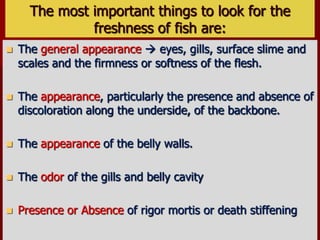
The most important things to look for the
freshness of fish are:
 The general appearance  eyes, gills, surface slime and
scales and the firmness or softness of the flesh.
 The appearance, particularly the presence and absence of
discoloration along the underside, of the backbone.
 The appearance of the belly walls.
 The odor of the gills and belly cavity
 Presence or Absence of rigor mortis or death stiffening
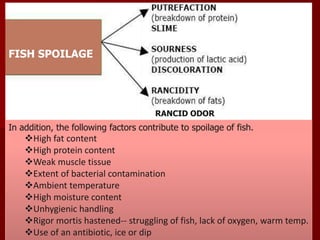
FISH SPOILAGE
FISH
POSINIGN
In addition, the following factors contribute to spoilage of fish.
High fat content
High protein content
Weak muscle tissue
Extent of bacterial contamination
Ambient temperature
High moisture content
Unhygienic handling
Rigor mortis hastened-- struggling of fish, lack of oxygen, warm temp.
Use of an antibiotic, ice or dip
RANCID ODOR
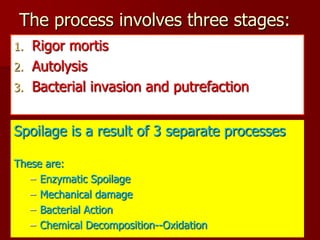
The process involves three stages:
1. Rigor mortis
2. Autolysis
3. Bacterial invasion and putrefaction
Spoilage is a result of 3 separate processes
These are:
– Enzymatic Spoilage
– Mechanical damage
– Bacterial Action
– Chemical Decomposition--Oxidation
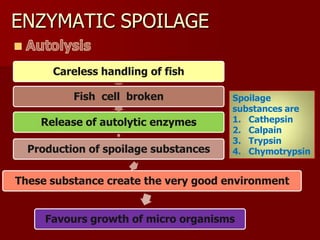
ENZYMATIC SPOILAGE
Careless handling of fish
Fish cell broken
Release of autolytic enzymes
Production of spoilage substances
These substance create the very good environment
Favours growth of micro organisms
Spoilage
substances are
1. Cathepsin
2. Calpain
3. Trypsin
4. Chymotrypsin
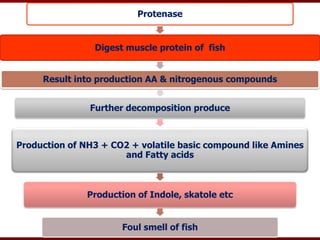
Protenase
Digest muscle protein of fish
Result into production AA & nitrogenous compounds
Further decomposition produce
Production of NH3 + CO2 + volatile basic compound like Amines
and Fatty acids
Production of Indole, skatole etc
Foul smell of fish
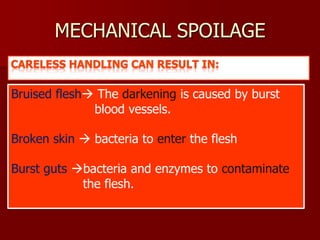
MECHANICAL SPOILAGE
Bruised flesh The darkening is caused by burst
blood vessels.
Broken skin  bacteria to enter the flesh
Burst guts bacteria and enzymes to contaminate
the flesh.
Factor responsible for microbial spoilage
 These are:
– Suitable temperatures (Bacteria grow much
faster in the warmth);
– The presence of water;
– Suitable chemical substances present in the
flesh as a source of food.
BACTRIOLOGICAL SPOILAGE
Millions of bacterial present on outer surface and
inside the fish
Healthy fish  natural protection against the harmful
bacteria
Live fish bacteria present on skin & gills, intestine
 but can not attack the fish muscle
Died fish  bacteria penetrate the fish muscle 
more rapid for thin skin fish
Bacteria & enzymes  changes fish odour, flavour
to sour, gassy, fruity &
finally ammonia &faecal odour
Multiply quickly and produce its metabolites that are
responsible for the causes of spoilage
When fish died some of the bacteria enters in the
flesh
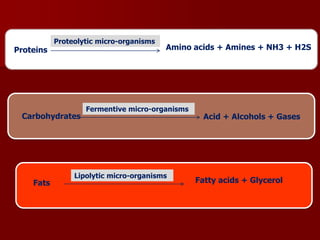
Proteins
Proteolytic micro-organisms
Amino acids + Amines + NH3 + H2S
Carbohydrates
Fermentive micro-organisms
Acid + Alcohols + Gases
Fats
Lipolytic micro-organisms
Fatty acids + Glycerol
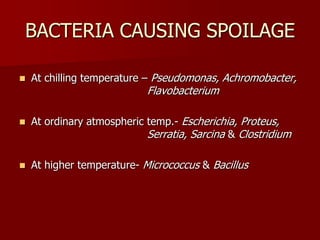
BACTERIA CAUSING SPOILAGE
 At chilling temperature – Pseudomonas, Achromobacter,
Flavobacterium
 At ordinary atmospheric temp.- Escherichia, Proteus,
Serratia, Sarcina & Clostridium
 At higher temperature- Micrococcus & Bacillus
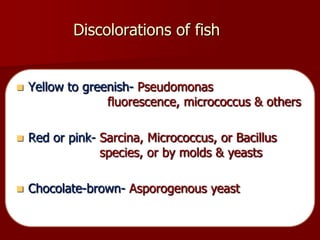
Discolorations of fish
 Yellow to greenish- Pseudomonas
fluorescence, micrococcus & others
 Red or pink- Sarcina, Micrococcus, or Bacillus
species, or by molds & yeasts
 Chocolate-brown- Asporogenous yeast
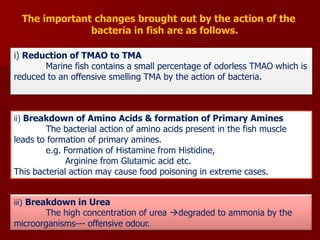
iii) Breakdown in Urea
The high concentration of urea degraded to ammonia by the
microorganisms--- offensive odour.
i) Reduction of TMAO to TMA
Marine fish contains a small percentage of odorless TMAO which is
reduced to an offensive smelling TMA by the action of bacteria.
ii) Breakdown of Amino Acids & formation of Primary Amines
The bacterial action of amino acids present in the fish muscle
leads to formation of primary amines.
e.g. Formation of Histamine from Histidine,
Arginine from Glutamic acid etc.
This bacterial action may cause food poisoning in extreme cases.
CHEMICAL SPOILAGE
 The chemicals present in living things are able to
change due to them either splitting up or joining
together.
 In both cases new chemicals are formed.
It is more pronounced in fat fishes
e.g. oil sardine, mackerels, catla, trout, grass carp etc.
Depends upon
•Temperature:- high temperature – rapid spoilage
•Water availability
•Enzymes
 Fat oxidation  occurs after autolysis & bacterial
spoilage
 High Lipid concentration  contribute spoilage
 Fat mainly unsaturated fatty acid  easily
oxidised by atm.O2
 Increase temperature & exposure to light
increase oxidation rate bad & unpleasant odour
& rancid taste. (sour or stale smell or taste )
Rancidity
e.g. Herring & Mackerel
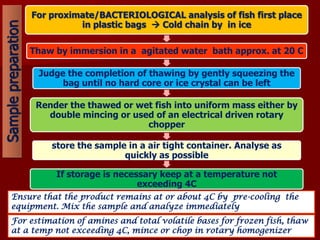
Samplepreparation For proximate/BACTERIOLOGICAL analysis of fish first place
in plastic bags  Cold chain by in ice
Thaw by immersion in a agitated water bath approx. at 20 C
Judge the completion of thawing by gently squeezing the
bag until no hard core or ice crystal can be left
Render the thawed or wet fish into uniform mass either by
double mincing or used of an electrical driven rotary
chopper
store the sample in a air tight container. Analyse as
quickly as possible
If storage is necessary keep at a temperature not
exceeding 4C
For estimation of amines and total volatile bases for frozen fish, thaw
at a temp not exceeding 4C, mince or chop in rotary homogenizer
Ensure that the product remains at or about 4C by pre-cooling the
equipment. Mix the sample and analyze immediately
Assessment of fish spoilage
Physical method- instrumental test piercing a Torrymeter on the skin of
about 16 randomly selected fish and picking 1 of the result as
representing the entire lot.
Subjective method-
involves the use of human sense organs and not machines, chemicals or
reagents. called “Sensory tests”, may be biased but its represent the
customers view
Organoleptic test – utilizing the sense of touch, smell, sight and taste for
quality assessment of fish.
 Sight- gill colour, presence/absence of indentation
 Flavour- for degree of freshness
 Texture- state of the muscles firmly held condition of the belly, or
soft presence of blemishes and parasites on fish.
 Visual exam – in cured fish – general appearance, degree of insect/
mould infestation intensity of smoking from appearance bulging
cans, broken fishes.
Touch- texture of fish, elastic firm, soft or
flabby, fragmentation in dried whole fish if fish end
without breaking it is flexible
Smell – Good and bad flavour, smoke or cooked.
Taste – Sweet, bitter, salt and sour,(salty or acidic)
fermented and marinades
Flavour – a combination of taste and odour cause by
volatile organic compounds. Mostly use objective test
rather than taste panel evaluation eventhough too
expensive (chromatograph which measure a flavour at a
time). Thus they often train taste panel to prevent
Physicochemical:
Determination of pH:
Method of pH determination :
A. Using digital pH meter
B. Indicator pH strips (just give an indication of pH but not
accurate),
C. Litmus test (gives an idea of range but not actual pH)
D. Chemical indicator method (Nitrazine yellow, indicates pH
range).
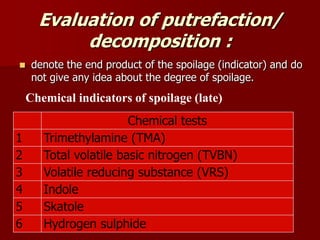
Evaluation of putrefaction/
decomposition :
 denote the end product of the spoilage (indicator) and do
not give any idea about the degree of spoilage.
Chemical indicators of spoilage (late)
Chemical tests
1 Trimethylamine (TMA)
2 Total volatile basic nitrogen (TVBN)
3 Volatile reducing substance (VRS)
4 Indole
5 Skatole
6 Hydrogen sulphide
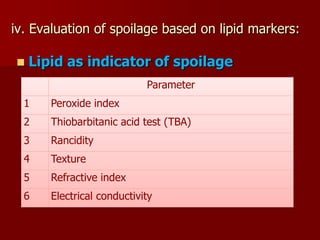
iv. Evaluation of spoilage based on lipid markers:
 Lipid as indicator of spoilage
Parameter
1 Peroxide index
2 Thiobarbitanic acid test (TBA)
3 Rancidity
4 Texture
5 Refractive index
6 Electrical conductivity
LIMITING SPOILAGE
 There are three main substances which, if
reduced, would limit the spoilage processes
 They are:
 Water content;
 Enzymes;
 Fat content.
1. if the water content reduced:
– The chemical decomposition- reduce
– The bacteria present would be deprived of one
of the substances needed for their survival.
LIMITING SPOILAGE
2. Reduction in the concentration of enzymes  reduce
chemical decomposition.
3. If the fat content of the fish is reduced, there is less
possibility of oxidation occurring.
This means that there is less chance of the taste of the
fish being spoilt due to rancidity of the fat.
 Handling and Storage
– Careful handling of the fish means that, at all stages, it is
important to prevent damage to the fish.
– Careless handling can result in damage
Fish spoilage

Fish spoilage

  • 1.
    FISH SPOILAGE ANDMETHOD OF DETECTION Dr. Babasaheb Kumbhar M.V.Sc scholar College of Veterinary Sciences, Hyderabad bobbyvph11@gmail.com
  • 2.
    The most importantthings to look for the freshness of fish are:  The general appearance  eyes, gills, surface slime and scales and the firmness or softness of the flesh.  The appearance, particularly the presence and absence of discoloration along the underside, of the backbone.  The appearance of the belly walls.  The odor of the gills and belly cavity  Presence or Absence of rigor mortis or death stiffening
  • 3.
    FISH SPOILAGE FISH POSINIGN In addition,the following factors contribute to spoilage of fish. High fat content High protein content Weak muscle tissue Extent of bacterial contamination Ambient temperature High moisture content Unhygienic handling Rigor mortis hastened-- struggling of fish, lack of oxygen, warm temp. Use of an antibiotic, ice or dip RANCID ODOR
  • 4.
    The process involvesthree stages: 1. Rigor mortis 2. Autolysis 3. Bacterial invasion and putrefaction Spoilage is a result of 3 separate processes These are: – Enzymatic Spoilage – Mechanical damage – Bacterial Action – Chemical Decomposition--Oxidation
  • 5.
    ENZYMATIC SPOILAGE Careless handlingof fish Fish cell broken Release of autolytic enzymes Production of spoilage substances These substance create the very good environment Favours growth of micro organisms Spoilage substances are 1. Cathepsin 2. Calpain 3. Trypsin 4. Chymotrypsin
  • 6.
    Protenase Digest muscle proteinof fish Result into production AA & nitrogenous compounds Further decomposition produce Production of NH3 + CO2 + volatile basic compound like Amines and Fatty acids Production of Indole, skatole etc Foul smell of fish
  • 7.
    MECHANICAL SPOILAGE Bruised fleshThe darkening is caused by burst blood vessels. Broken skin  bacteria to enter the flesh Burst guts bacteria and enzymes to contaminate the flesh.
  • 8.
    Factor responsible formicrobial spoilage  These are: – Suitable temperatures (Bacteria grow much faster in the warmth); – The presence of water; – Suitable chemical substances present in the flesh as a source of food.
  • 9.
    BACTRIOLOGICAL SPOILAGE Millions ofbacterial present on outer surface and inside the fish Healthy fish  natural protection against the harmful bacteria Live fish bacteria present on skin & gills, intestine  but can not attack the fish muscle
  • 10.
    Died fish bacteria penetrate the fish muscle  more rapid for thin skin fish Bacteria & enzymes  changes fish odour, flavour to sour, gassy, fruity & finally ammonia &faecal odour Multiply quickly and produce its metabolites that are responsible for the causes of spoilage When fish died some of the bacteria enters in the flesh
  • 12.
    Proteins Proteolytic micro-organisms Amino acids+ Amines + NH3 + H2S Carbohydrates Fermentive micro-organisms Acid + Alcohols + Gases Fats Lipolytic micro-organisms Fatty acids + Glycerol
  • 13.
    BACTERIA CAUSING SPOILAGE At chilling temperature – Pseudomonas, Achromobacter, Flavobacterium  At ordinary atmospheric temp.- Escherichia, Proteus, Serratia, Sarcina & Clostridium  At higher temperature- Micrococcus & Bacillus
  • 14.
    Discolorations of fish Yellow to greenish- Pseudomonas fluorescence, micrococcus & others  Red or pink- Sarcina, Micrococcus, or Bacillus species, or by molds & yeasts  Chocolate-brown- Asporogenous yeast
  • 15.
    iii) Breakdown inUrea The high concentration of urea degraded to ammonia by the microorganisms--- offensive odour. i) Reduction of TMAO to TMA Marine fish contains a small percentage of odorless TMAO which is reduced to an offensive smelling TMA by the action of bacteria. ii) Breakdown of Amino Acids & formation of Primary Amines The bacterial action of amino acids present in the fish muscle leads to formation of primary amines. e.g. Formation of Histamine from Histidine, Arginine from Glutamic acid etc. This bacterial action may cause food poisoning in extreme cases.
  • 16.
    CHEMICAL SPOILAGE  Thechemicals present in living things are able to change due to them either splitting up or joining together.  In both cases new chemicals are formed. It is more pronounced in fat fishes e.g. oil sardine, mackerels, catla, trout, grass carp etc. Depends upon •Temperature:- high temperature – rapid spoilage •Water availability •Enzymes
  • 17.
     Fat oxidation occurs after autolysis & bacterial spoilage  High Lipid concentration  contribute spoilage  Fat mainly unsaturated fatty acid  easily oxidised by atm.O2  Increase temperature & exposure to light increase oxidation rate bad & unpleasant odour & rancid taste. (sour or stale smell or taste ) Rancidity e.g. Herring & Mackerel
  • 18.
    Samplepreparation For proximate/BACTERIOLOGICALanalysis of fish first place in plastic bags  Cold chain by in ice Thaw by immersion in a agitated water bath approx. at 20 C Judge the completion of thawing by gently squeezing the bag until no hard core or ice crystal can be left Render the thawed or wet fish into uniform mass either by double mincing or used of an electrical driven rotary chopper store the sample in a air tight container. Analyse as quickly as possible If storage is necessary keep at a temperature not exceeding 4C For estimation of amines and total volatile bases for frozen fish, thaw at a temp not exceeding 4C, mince or chop in rotary homogenizer Ensure that the product remains at or about 4C by pre-cooling the equipment. Mix the sample and analyze immediately
  • 19.
    Assessment of fishspoilage Physical method- instrumental test piercing a Torrymeter on the skin of about 16 randomly selected fish and picking 1 of the result as representing the entire lot. Subjective method- involves the use of human sense organs and not machines, chemicals or reagents. called “Sensory tests”, may be biased but its represent the customers view Organoleptic test – utilizing the sense of touch, smell, sight and taste for quality assessment of fish.  Sight- gill colour, presence/absence of indentation  Flavour- for degree of freshness  Texture- state of the muscles firmly held condition of the belly, or soft presence of blemishes and parasites on fish.  Visual exam – in cured fish – general appearance, degree of insect/ mould infestation intensity of smoking from appearance bulging cans, broken fishes.
  • 20.
    Touch- texture offish, elastic firm, soft or flabby, fragmentation in dried whole fish if fish end without breaking it is flexible Smell – Good and bad flavour, smoke or cooked. Taste – Sweet, bitter, salt and sour,(salty or acidic) fermented and marinades Flavour – a combination of taste and odour cause by volatile organic compounds. Mostly use objective test rather than taste panel evaluation eventhough too expensive (chromatograph which measure a flavour at a time). Thus they often train taste panel to prevent
  • 21.
    Physicochemical: Determination of pH: Methodof pH determination : A. Using digital pH meter B. Indicator pH strips (just give an indication of pH but not accurate), C. Litmus test (gives an idea of range but not actual pH) D. Chemical indicator method (Nitrazine yellow, indicates pH range).
  • 22.
    Evaluation of putrefaction/ decomposition:  denote the end product of the spoilage (indicator) and do not give any idea about the degree of spoilage. Chemical indicators of spoilage (late) Chemical tests 1 Trimethylamine (TMA) 2 Total volatile basic nitrogen (TVBN) 3 Volatile reducing substance (VRS) 4 Indole 5 Skatole 6 Hydrogen sulphide
  • 23.
    iv. Evaluation ofspoilage based on lipid markers:  Lipid as indicator of spoilage Parameter 1 Peroxide index 2 Thiobarbitanic acid test (TBA) 3 Rancidity 4 Texture 5 Refractive index 6 Electrical conductivity
  • 24.
    LIMITING SPOILAGE  Thereare three main substances which, if reduced, would limit the spoilage processes  They are:  Water content;  Enzymes;  Fat content. 1. if the water content reduced: – The chemical decomposition- reduce – The bacteria present would be deprived of one of the substances needed for their survival.
  • 25.
    LIMITING SPOILAGE 2. Reductionin the concentration of enzymes  reduce chemical decomposition. 3. If the fat content of the fish is reduced, there is less possibility of oxidation occurring. This means that there is less chance of the taste of the fish being spoilt due to rancidity of the fat.  Handling and Storage – Careful handling of the fish means that, at all stages, it is important to prevent damage to the fish. – Careless handling can result in damage