Freshwater Fish Species
Agriscience 381
2nd Period
By: Dustin Carnahan
Objectives
Students will be able to:
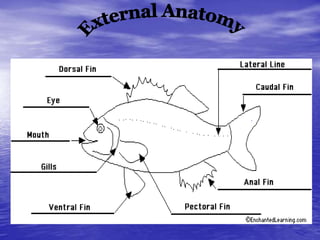
1. Label the external parts of a fish.
2. List and describe five types of freshwater
fish found in Texas.
Freshwater fish are those species that live in
waters from 0 to 5 (parts per thousand)
salt content.
This includes rivers, streams, creeks, lakes,
ponds, and reservoirs.
Game Fish Species
Game fish are regulated by the Texas Parks and
Wildlife Department.
They are mainly predators even though they
may eat vegetation.
Many species have natural hybrids. “They cross
and mate between two similar species.”
In the case of the Florida largemouth bass and
the hybrid striped bass, human involvement was
incurred.
Regardless if the species is pure or a hybrid, all
game fish have a statewide bag limit and have
many length limits.
Freshwater Fish
Identification
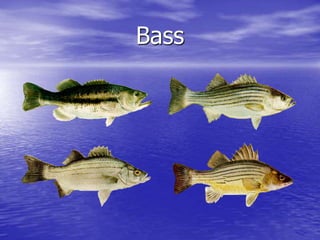
Bass
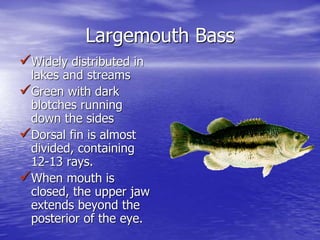
Largemouth Bass
Widely distributed in
lakes and streams
Green with dark
blotches running
down the sides
Dorsal fin is almost
divided, containing
12-13 rays.
When mouth is
closed, the upper jaw
extends beyond the
posterior of the eye.
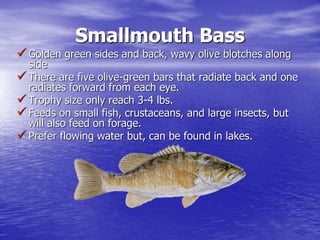
Smallmouth Bass
 Golden green sides and back, wavy olive blotches along
side
 There are five olive-green bars that radiate back and one
radiates forward from each eye.
 Trophy size only reach 3-4 lbs.
 Feeds on small fish, crustaceans, and large insects, but
will also feed on forage.
 Prefer flowing water but, can be found in lakes.
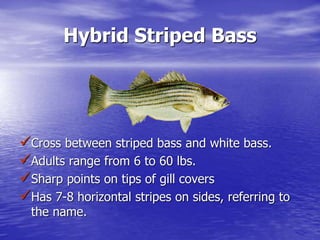
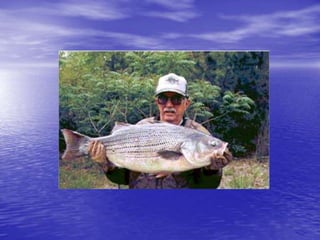
Hybrid Striped Bass
Cross between striped bass and white bass.
Adults range from 6 to 60 lbs.
Sharp points on tips of gill covers
Has 7-8 horizontal stripes on sides, referring to
the name.
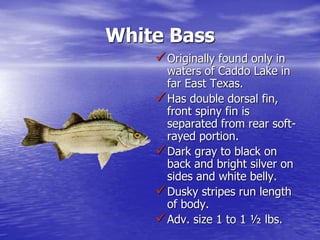
White Bass
Originally found only in
waters of Caddo Lake in
far East Texas.
Has double dorsal fin,
front spiny fin is
separated from rear soft-
rayed portion.
Dark gray to black on
back and bright silver on
sides and white belly.
Dusky stripes run length
of body.
Adv. size 1 to 1 ½ lbs.
Yellow Bass
Gets name from color
on belly and sides.
Bottom two stripes
are broken slightly
behind the middle.
Travels in schools.
Likes rocky and gravel
bottoms.
Feed on fish, insects,
and crustaceans.
Less than 1 pound
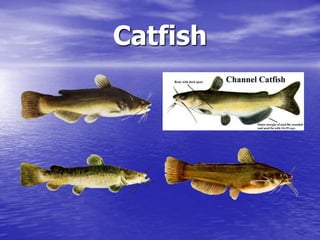
Catfish
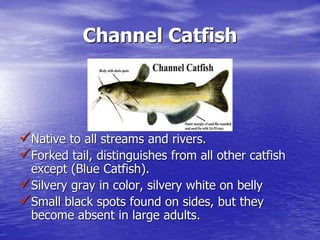
Channel Catfish
Native to all streams and rivers.
Forked tail, distinguishes from all other catfish
except (Blue Catfish).
Silvery gray in color, silvery white on belly
Small black spots found on sides, but they
become absent in large adults.
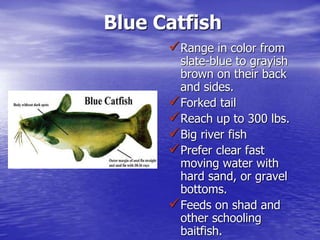
Blue Catfish
Range in color from
slate-blue to grayish
brown on their back
and sides.
Forked tail
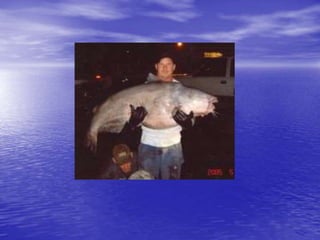
Reach up to 300 lbs.
Big river fish
Prefer clear fast
moving water with
hard sand, or gravel
bottoms.
Feeds on shad and
other schooling
baitfish.
Flathead Catfish
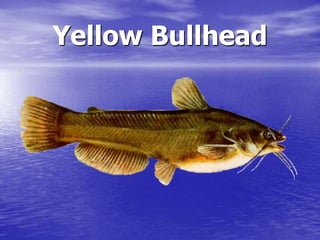
Yellow Bullhead
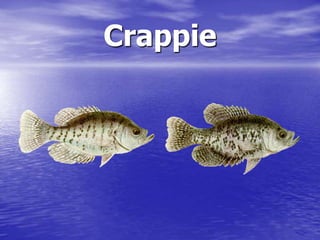
Crappie
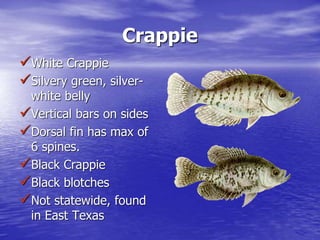
Crappie
White Crappie
Silvery green, silver-
white belly
Vertical bars on sides
Dorsal fin has max of
6 spines.
Black Crappie
Black blotches
Not statewide, found
in East Texas
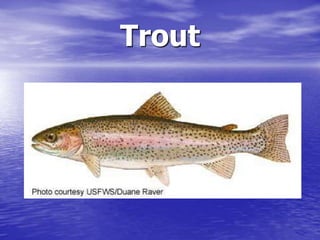
Trout
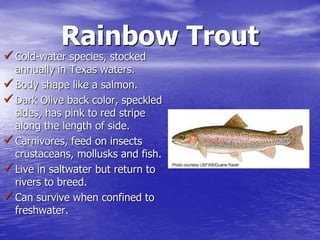
Rainbow Trout
 Cold-water species, stocked
annually in Texas waters.
 Body shape like a salmon.
 Dark Olive back color, speckled
sides, has pink to red stripe
along the length of side.
 Carnivores, feed on insects
crustaceans, mollusks and fish.
 Live in saltwater but return to
rivers to breed.
 Can survive when confined to
freshwater.
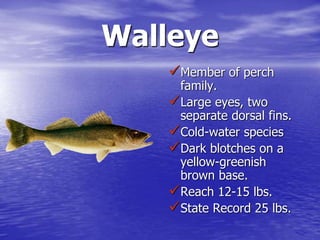
Walleye
Member of perch
family.
Large eyes, two
separate dorsal fins.
Cold-water species
Dark blotches on a
yellow-greenish
brown base.
Reach 12-15 lbs.
State Record 25 lbs.
Summary
1. 5 types of freshwater species
• Bass, Catfish, Crappie, Trout,
Walleye
2. Labeling external fish parts.
• Dorsal Fin, Caudal Fin, Anal Fin,
Pelvic Fin, Pectoral Fin, Operculum

Freshwater Fish ppt. (1).ppt

  • 1.
    Freshwater Fish Species Agriscience381 2nd Period By: Dustin Carnahan
  • 2.
    Objectives Students will beable to: 1. Label the external parts of a fish. 2. List and describe five types of freshwater fish found in Texas.
  • 3.
    Freshwater fish arethose species that live in waters from 0 to 5 (parts per thousand) salt content. This includes rivers, streams, creeks, lakes, ponds, and reservoirs.
  • 4.
    Game Fish Species Gamefish are regulated by the Texas Parks and Wildlife Department. They are mainly predators even though they may eat vegetation. Many species have natural hybrids. “They cross and mate between two similar species.” In the case of the Florida largemouth bass and the hybrid striped bass, human involvement was incurred. Regardless if the species is pure or a hybrid, all game fish have a statewide bag limit and have many length limits.
  • 8.
  • 9.
  • 10.
    Largemouth Bass Widely distributedin lakes and streams Green with dark blotches running down the sides Dorsal fin is almost divided, containing 12-13 rays. When mouth is closed, the upper jaw extends beyond the posterior of the eye.
  • 11.
    Smallmouth Bass  Goldengreen sides and back, wavy olive blotches along side  There are five olive-green bars that radiate back and one radiates forward from each eye.  Trophy size only reach 3-4 lbs.  Feeds on small fish, crustaceans, and large insects, but will also feed on forage.  Prefer flowing water but, can be found in lakes.
  • 12.
    Hybrid Striped Bass Crossbetween striped bass and white bass. Adults range from 6 to 60 lbs. Sharp points on tips of gill covers Has 7-8 horizontal stripes on sides, referring to the name.
  • 14.
    White Bass Originally foundonly in waters of Caddo Lake in far East Texas. Has double dorsal fin, front spiny fin is separated from rear soft- rayed portion. Dark gray to black on back and bright silver on sides and white belly. Dusky stripes run length of body. Adv. size 1 to 1 ½ lbs.
  • 15.
    Yellow Bass Gets namefrom color on belly and sides. Bottom two stripes are broken slightly behind the middle. Travels in schools. Likes rocky and gravel bottoms. Feed on fish, insects, and crustaceans. Less than 1 pound
  • 16.
  • 17.
    Channel Catfish Native toall streams and rivers. Forked tail, distinguishes from all other catfish except (Blue Catfish). Silvery gray in color, silvery white on belly Small black spots found on sides, but they become absent in large adults.
  • 18.
    Blue Catfish Range incolor from slate-blue to grayish brown on their back and sides. Forked tail Reach up to 300 lbs. Big river fish Prefer clear fast moving water with hard sand, or gravel bottoms. Feeds on shad and other schooling baitfish.
  • 20.
  • 21.
  • 22.
  • 23.
    Crappie White Crappie Silvery green,silver- white belly Vertical bars on sides Dorsal fin has max of 6 spines. Black Crappie Black blotches Not statewide, found in East Texas
  • 24.
  • 25.
    Rainbow Trout  Cold-waterspecies, stocked annually in Texas waters.  Body shape like a salmon.  Dark Olive back color, speckled sides, has pink to red stripe along the length of side.  Carnivores, feed on insects crustaceans, mollusks and fish.  Live in saltwater but return to rivers to breed.  Can survive when confined to freshwater.
  • 26.
    Walleye Member of perch family. Largeeyes, two separate dorsal fins. Cold-water species Dark blotches on a yellow-greenish brown base. Reach 12-15 lbs. State Record 25 lbs.
  • 27.
    Summary 1. 5 typesof freshwater species • Bass, Catfish, Crappie, Trout, Walleye 2. Labeling external fish parts. • Dorsal Fin, Caudal Fin, Anal Fin, Pelvic Fin, Pectoral Fin, Operculum