Fish Anatomy
By
Prof. Dr. Abdelmohaimen Mostafa Saleh
Professor of Anatomy & Embryology
Assiut University
Student Learning Objectives
.1. Introduction
2. External features of the typical fish.
3. Identify common freshwater fish species
found in South Carolina waters.
4. Identify common saltwater fish species
found in South Carolina waters.
2
3
 Fish are cold-blooded, vertebrate that
breathe with gills and move with fins. They are
the most numerous vertebrates more than
30,000 species
 smallest
 Philippine Island Goby – 1/3”- 1/2”
 largest
 Whale Shark – 50’ and several tons
 INTRODUCTION:
4
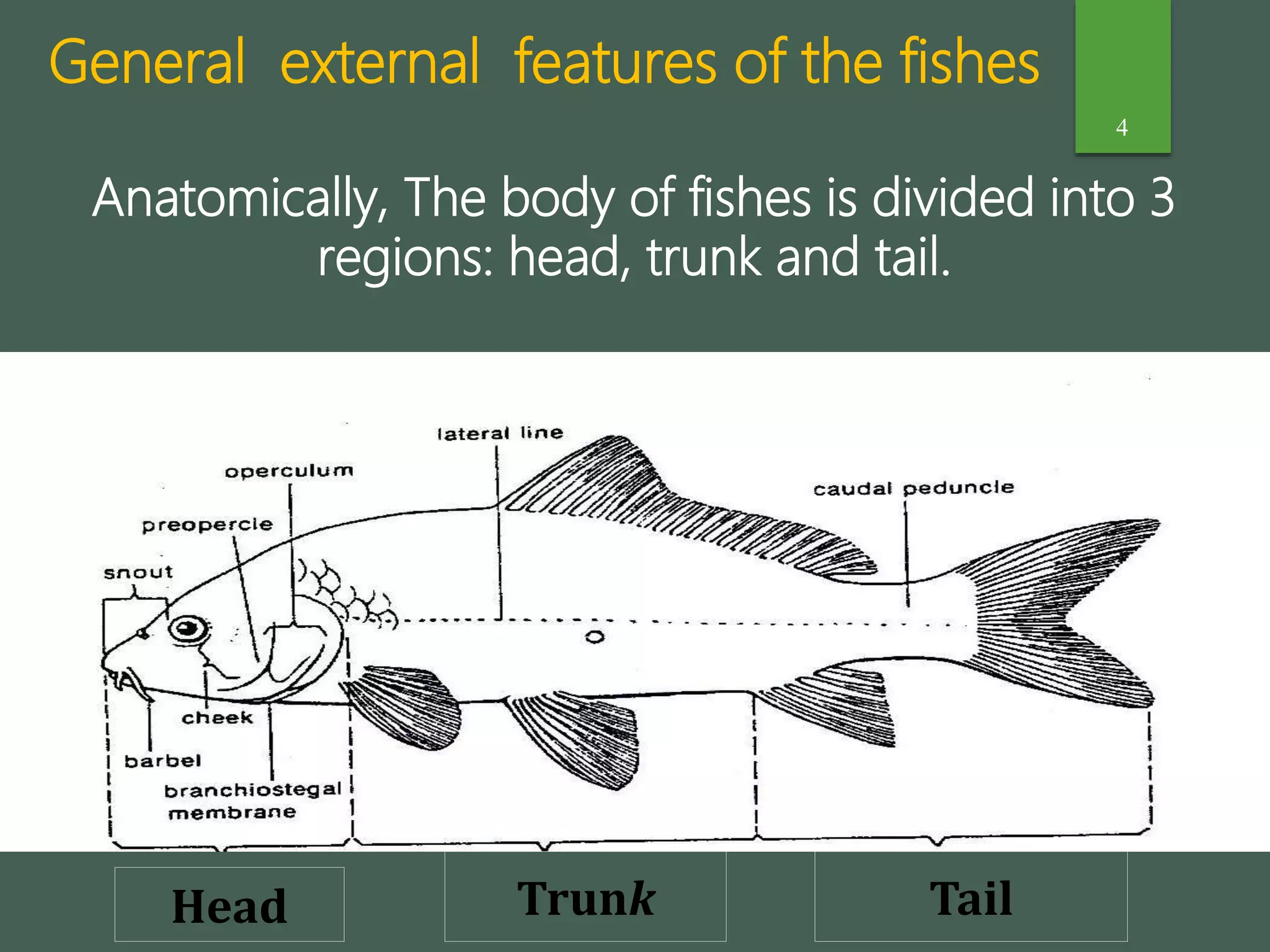
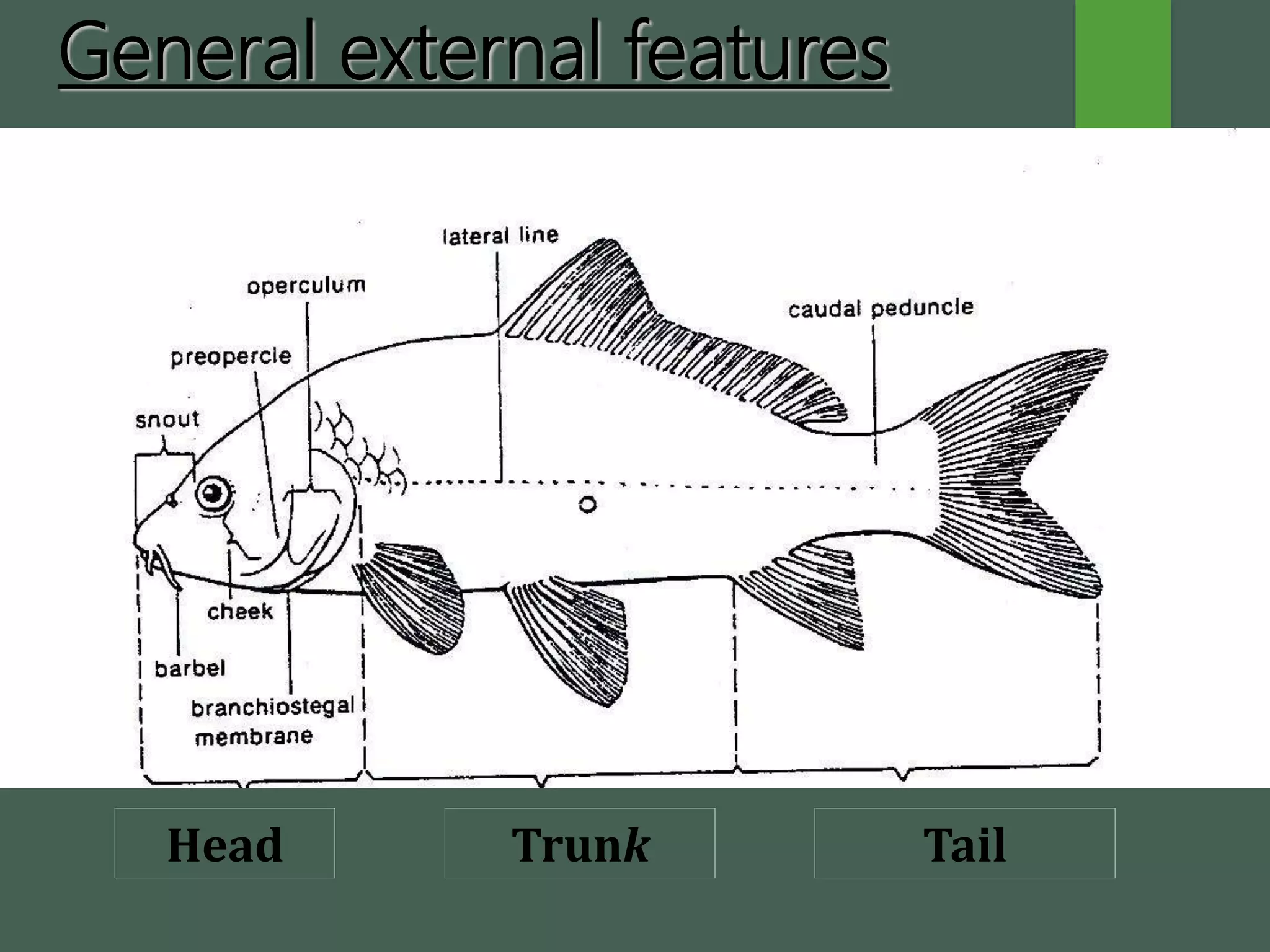
Anatomically, The body of fishes is divided into 3
regions: head, trunk and tail.
General external features of the fishes
Head Trunk Tail
General external features
Head Trunk Tail
6
A- Head region:
7
• The head extends from the tip of upper jaw to
caudal margin of operculum.
• It includes mouth, snout, eyes, cheek,
operculum, chin, barbels, nostrils, spine , and
sensory canals .
8
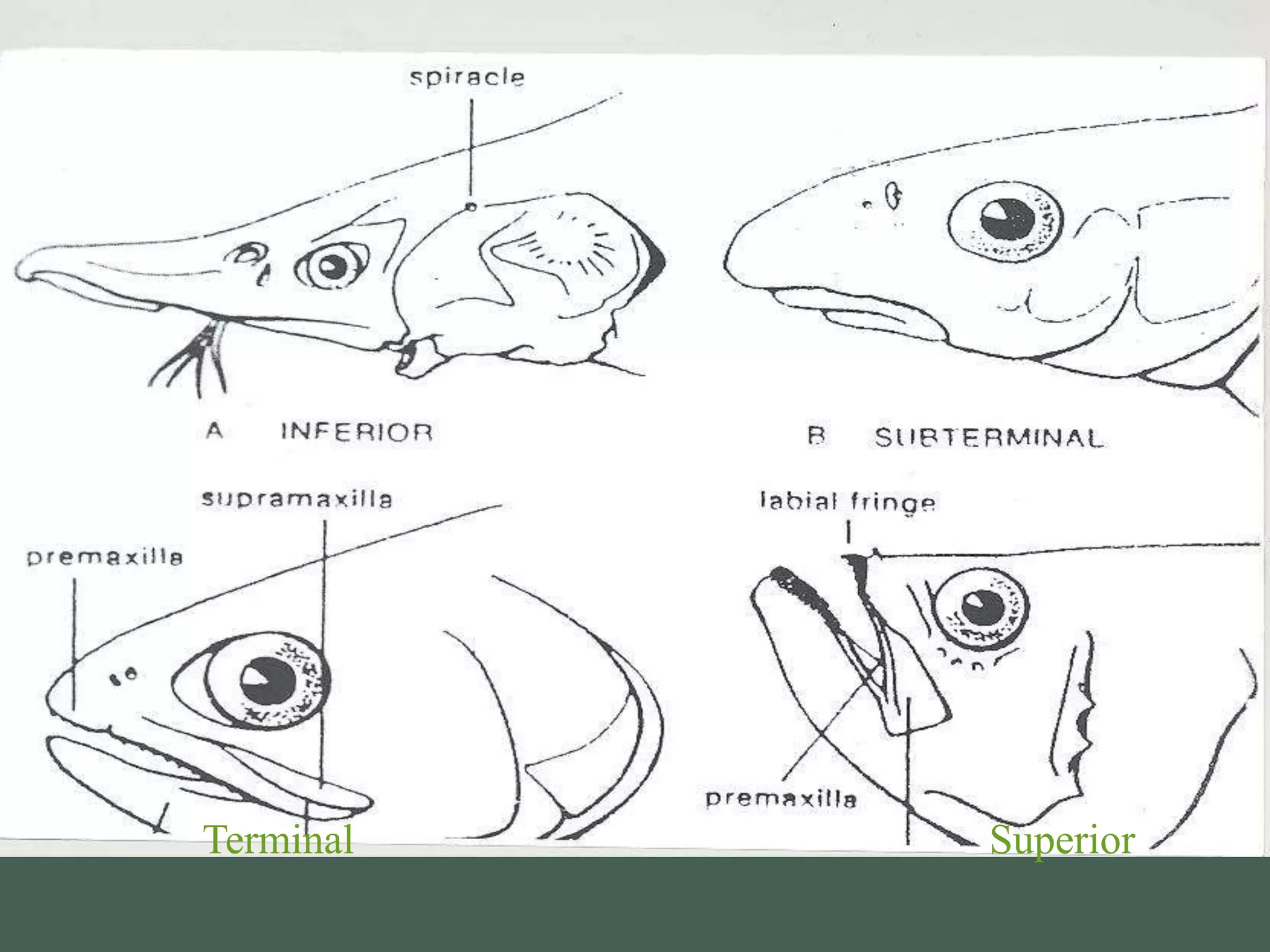
** Features of the head :
1- Mouth:
It has different positions:
a) Inferior
b) Subterminal
c) Terminal
d) Superior
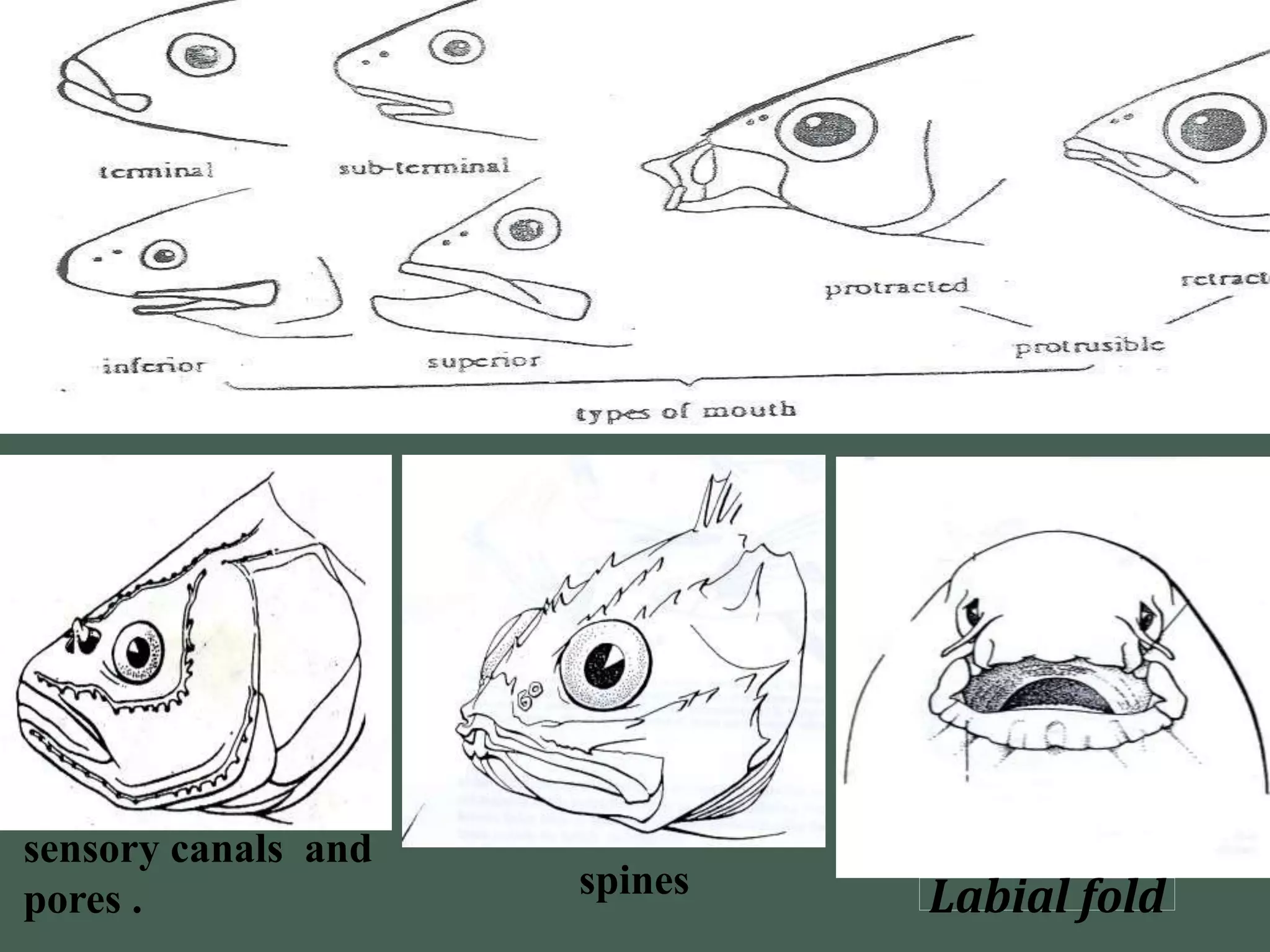
The mouth may be:
A- protrusible
B- nonprotrusible.
Terminal Superior
Labial fold
sensory canals and
pores . spines
11
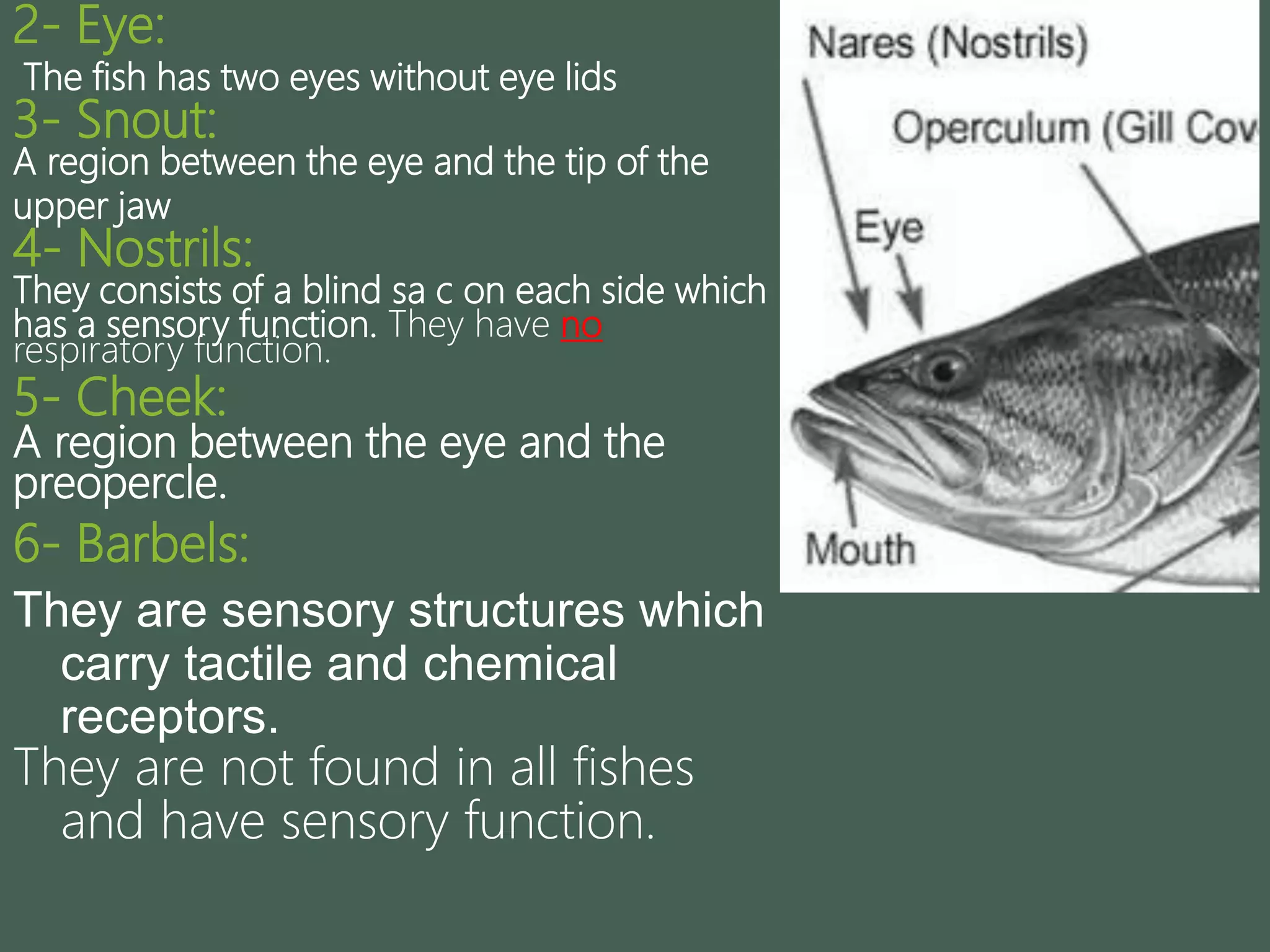
2- Eye:
The fish has two eyes without eye lids
3- Snout:
A region between the eye and the tip of the
upper jaw
4- Nostrils:
They consists of a blind sa c on each side which
has a sensory function. They have no
respiratory function.
5- Cheek:
A region between the eye and the
preopercle.
6- Barbels:
They are sensory structures which
carry tactile and chemical
receptors.
They are not found in all fishes
and have sensory function.
12
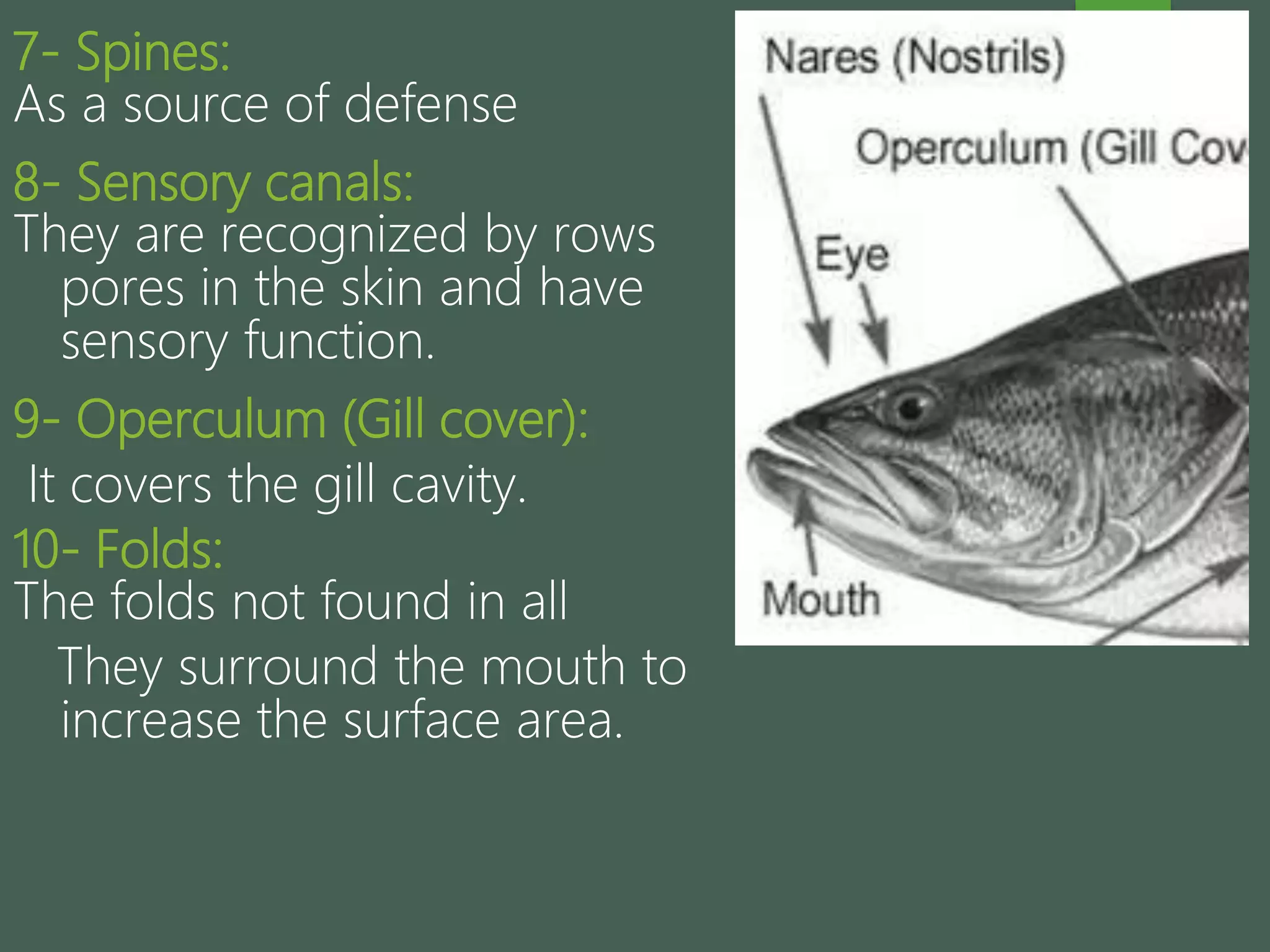
7- Spines:
As a source of defense
8- Sensory canals:
They are recognized by rows
pores in the skin and have
sensory function.
9- Operculum (Gill cover):
It covers the gill cavity.
10- Folds:
The folds not found in all
They surround the mouth to
increase the surface area.
13
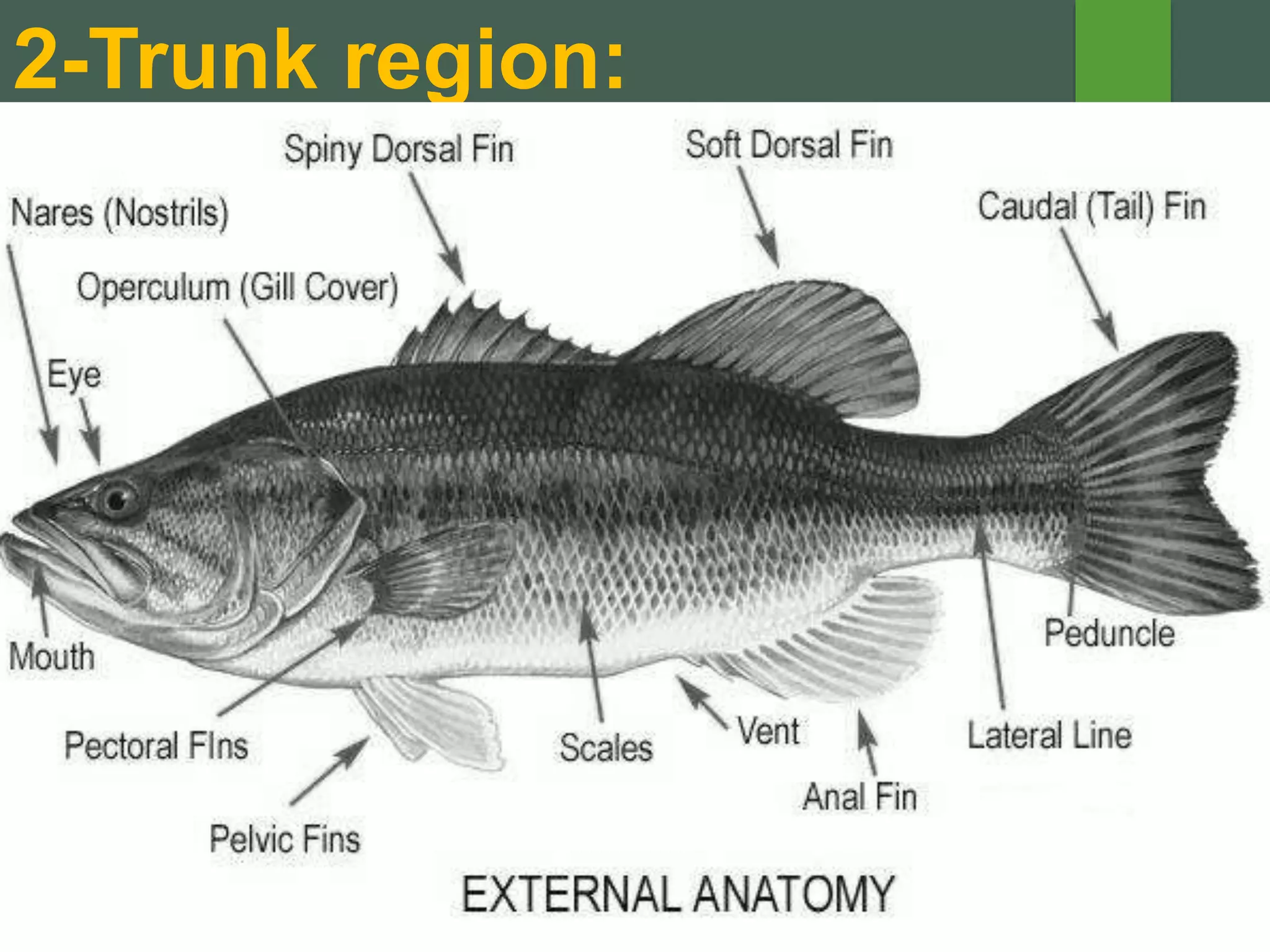
2-Trunk region:
The trunk extends from the caudal margin of the
operculum to the anus.
-It has the following features:
1- Nuchal region:
-It is the dorsal surface just behind the occiput.
2- Isthmus:
-It is the most anterior ventral part of the body that
extends forward below and between the gills
openings.
2-Trunk region
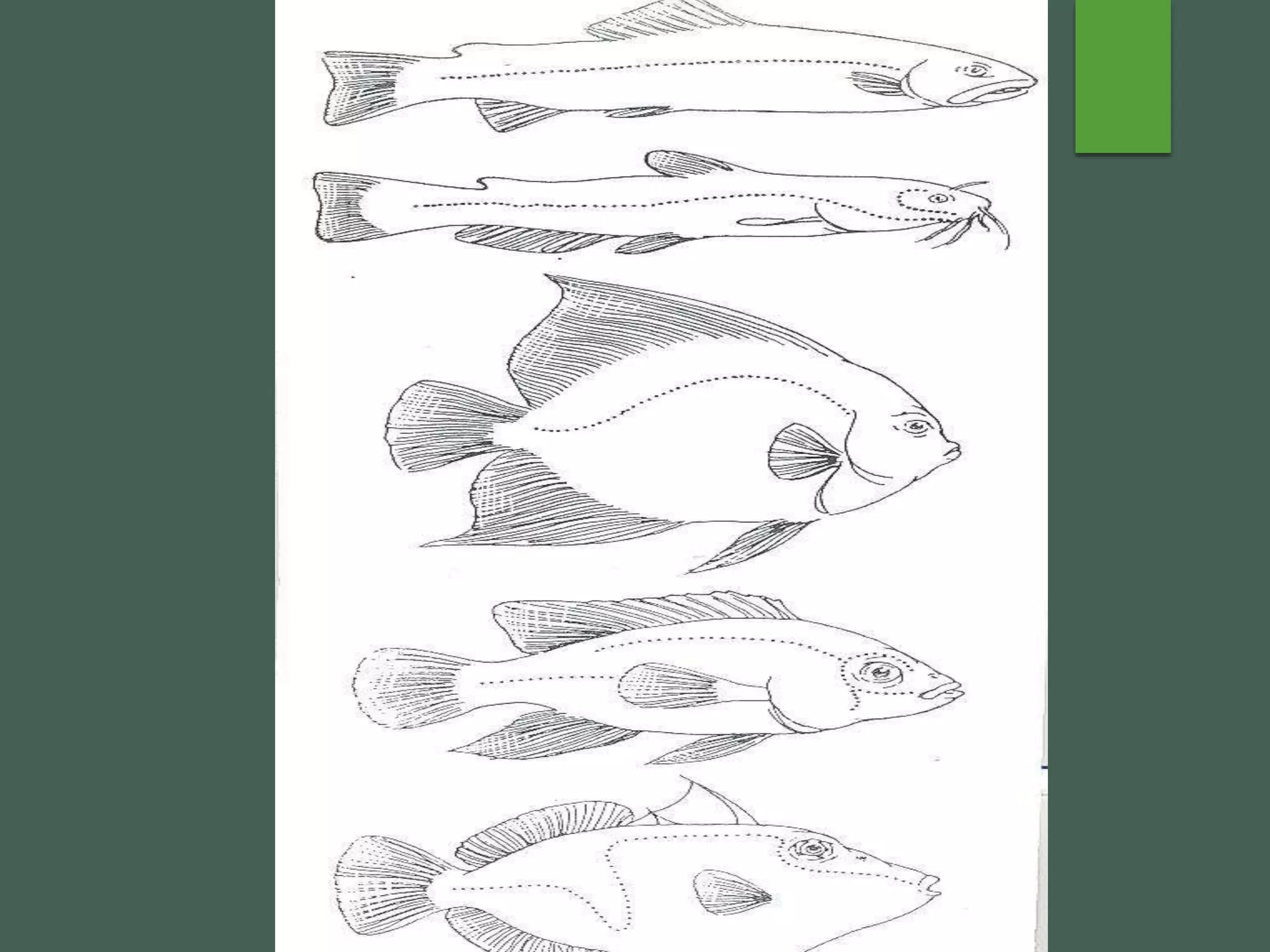
3- Lateral line:
- It is a continuation of the sensory canals of the
head, along each side of fish.
- It is usually single line ( may be an open groove
,or a row of pores in the skin).
- Lines may be multiple or variously reduced.
- It has sensory function.
3- Gill openings:
They are typically in a lateral position covered by
operculum.
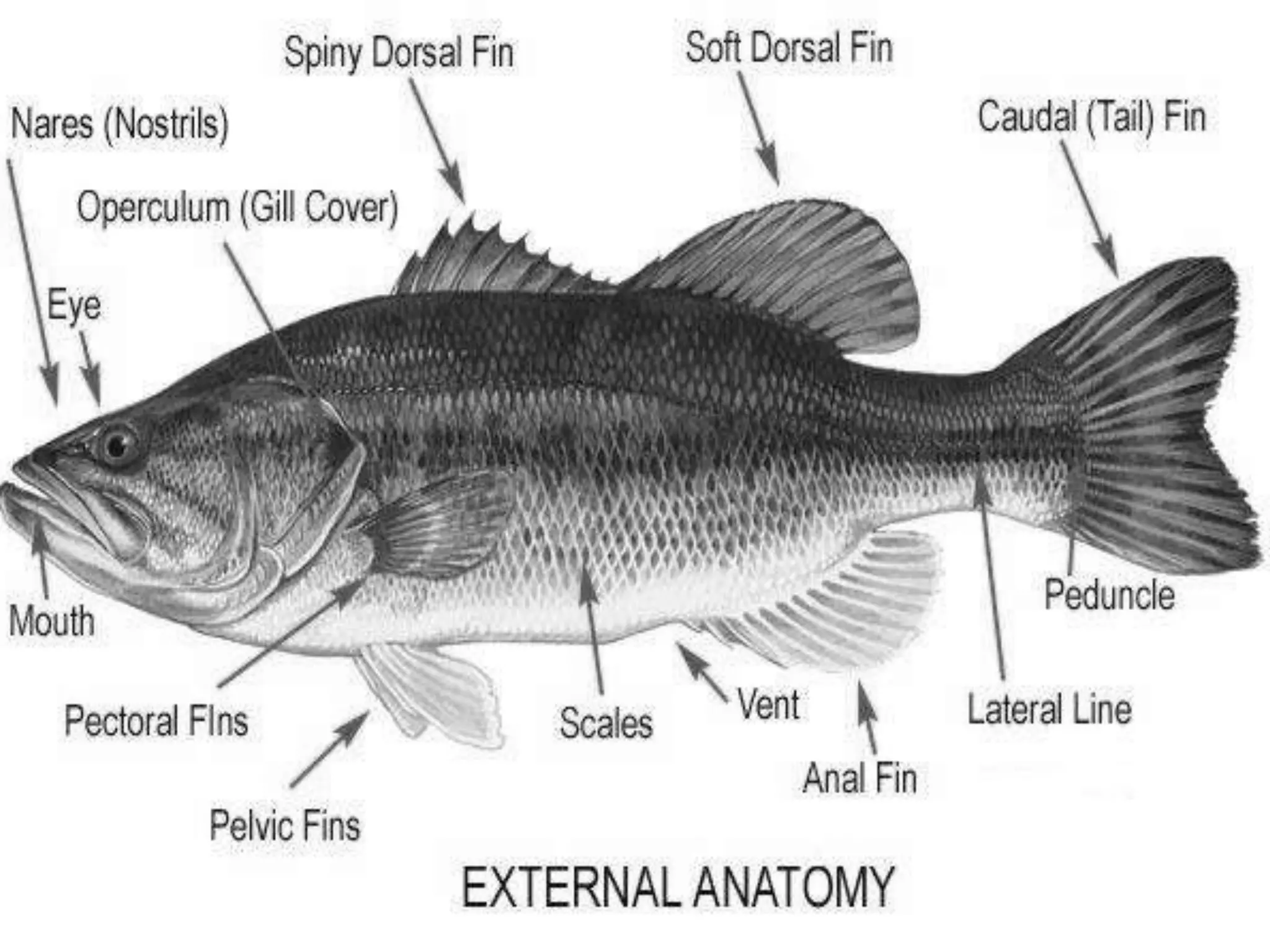
4- Fins:
* Single:
Dorsal fin - Anal fin - Caudal fin
** Paired:
Pectoral fins - Pelvic fins
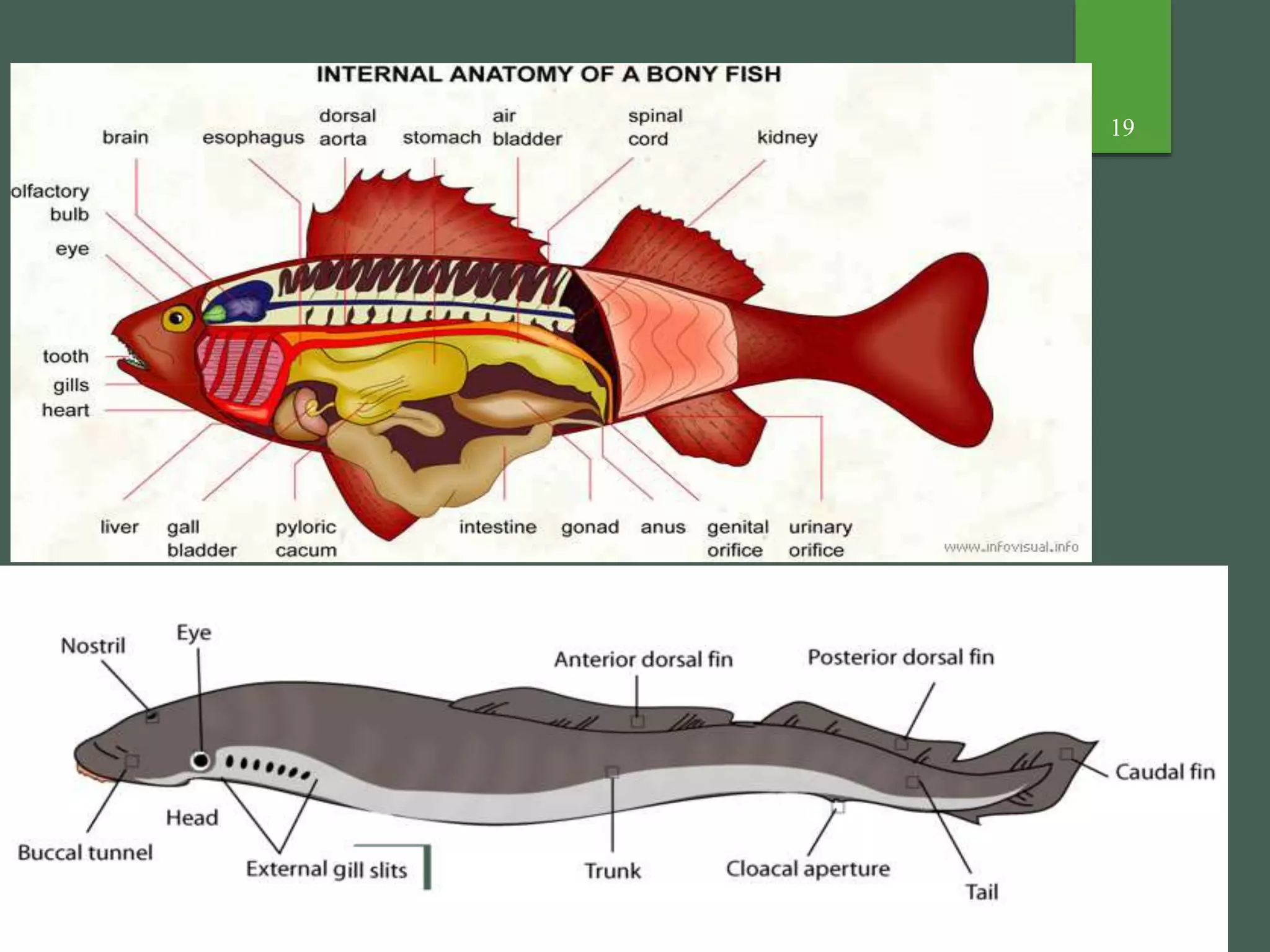
5- Anus:
Represents the opening of the gut in most fishes.
18
6- Urogenital opening:
Lies caudal to the anus, the urinary opening may
be separate from and behind the genital pore.
Some fishes have:
A- Combined urogenital opening lies behind anus.
B- The urinary opening is separated and lies
caudal to the genital opening.
C- There is a cloaca which receive the openings of gut
genital and urinary systems
6- Cloaca:
Found in some fishes (shark) and receives the
openings of the gut, the urinary and genital
systems.
19
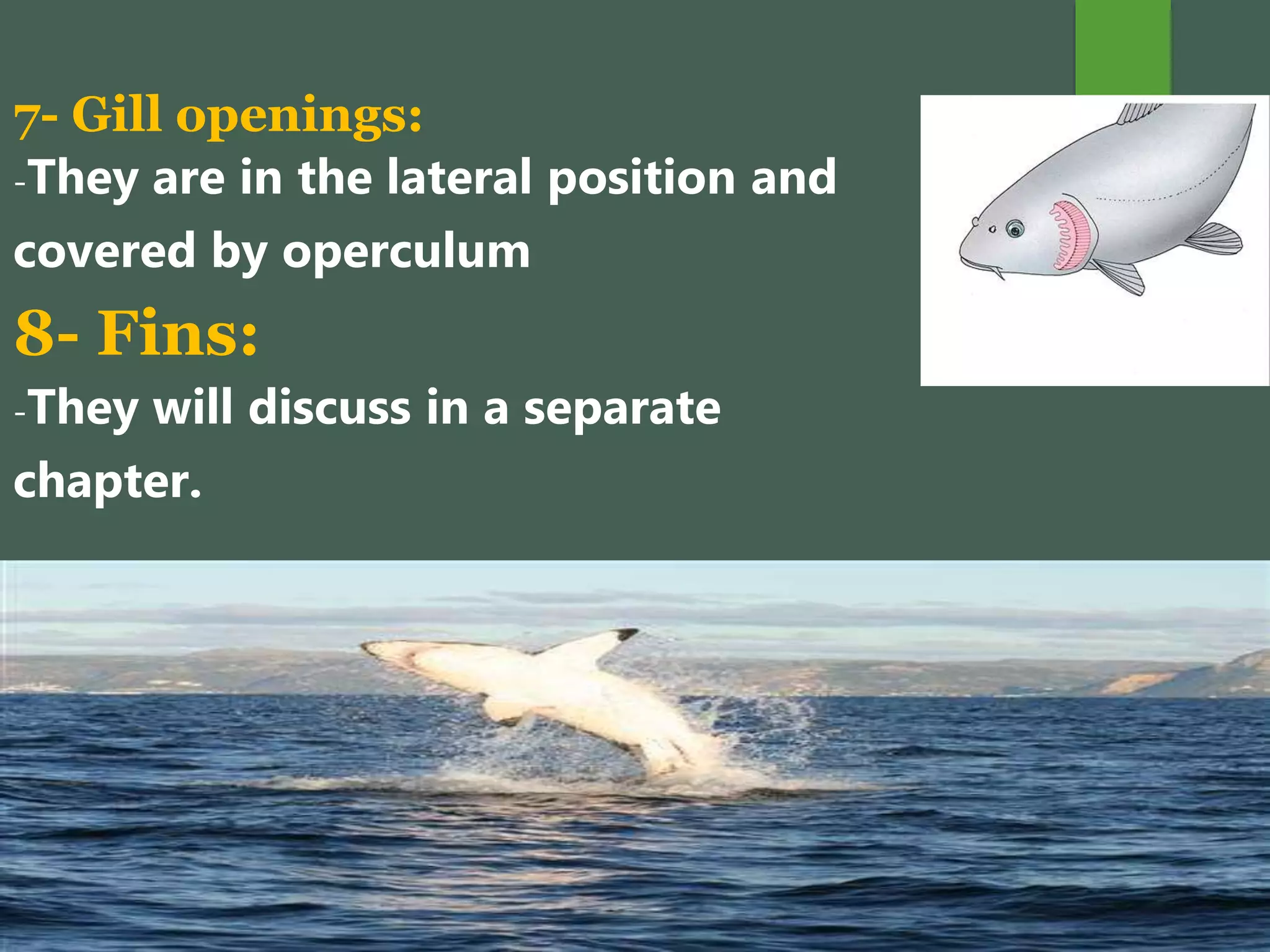
7- Gill openings:
-They are in the lateral position and
covered by operculum
8- Fins:
-They will discuss in a separate
chapter.
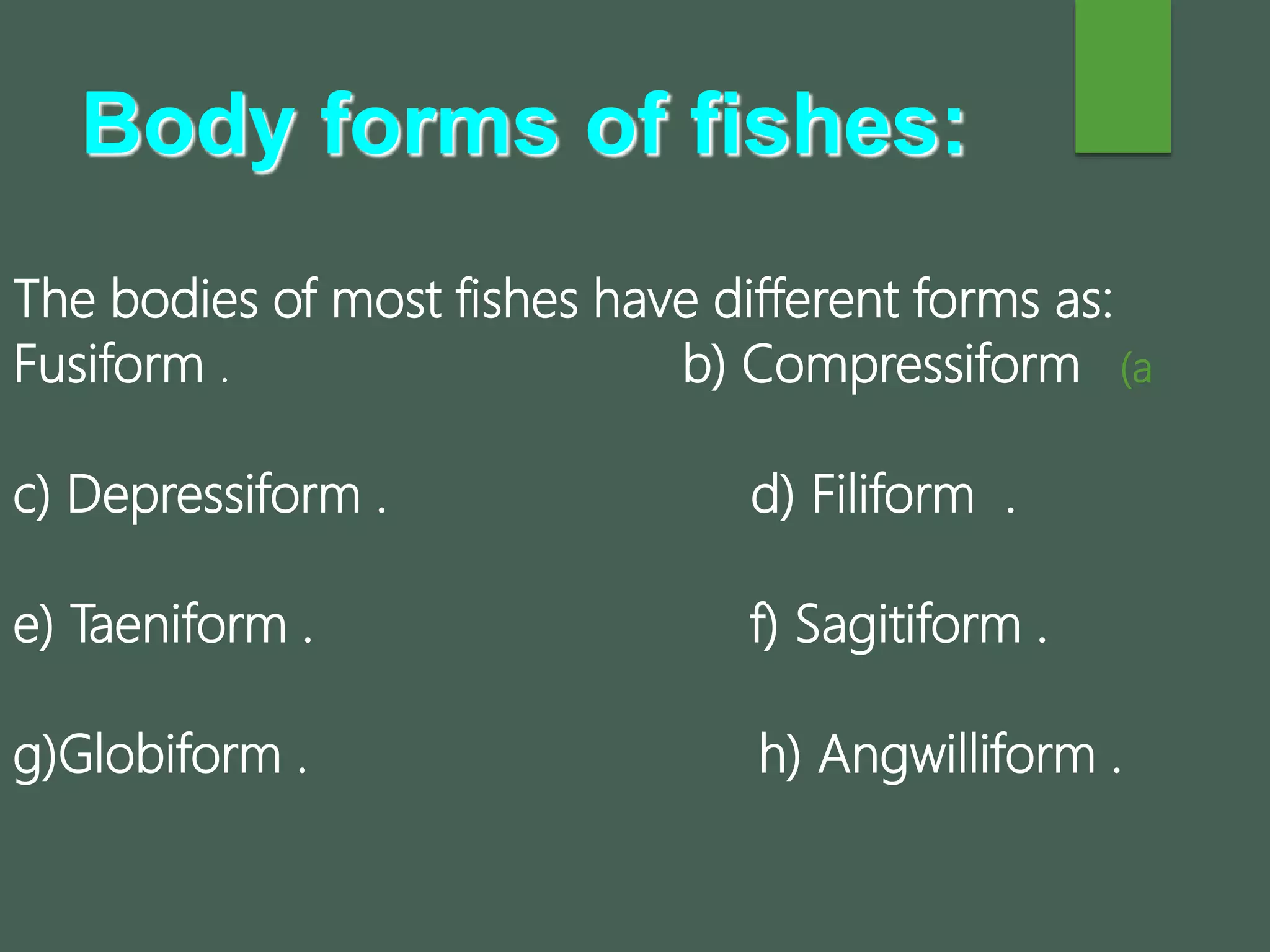
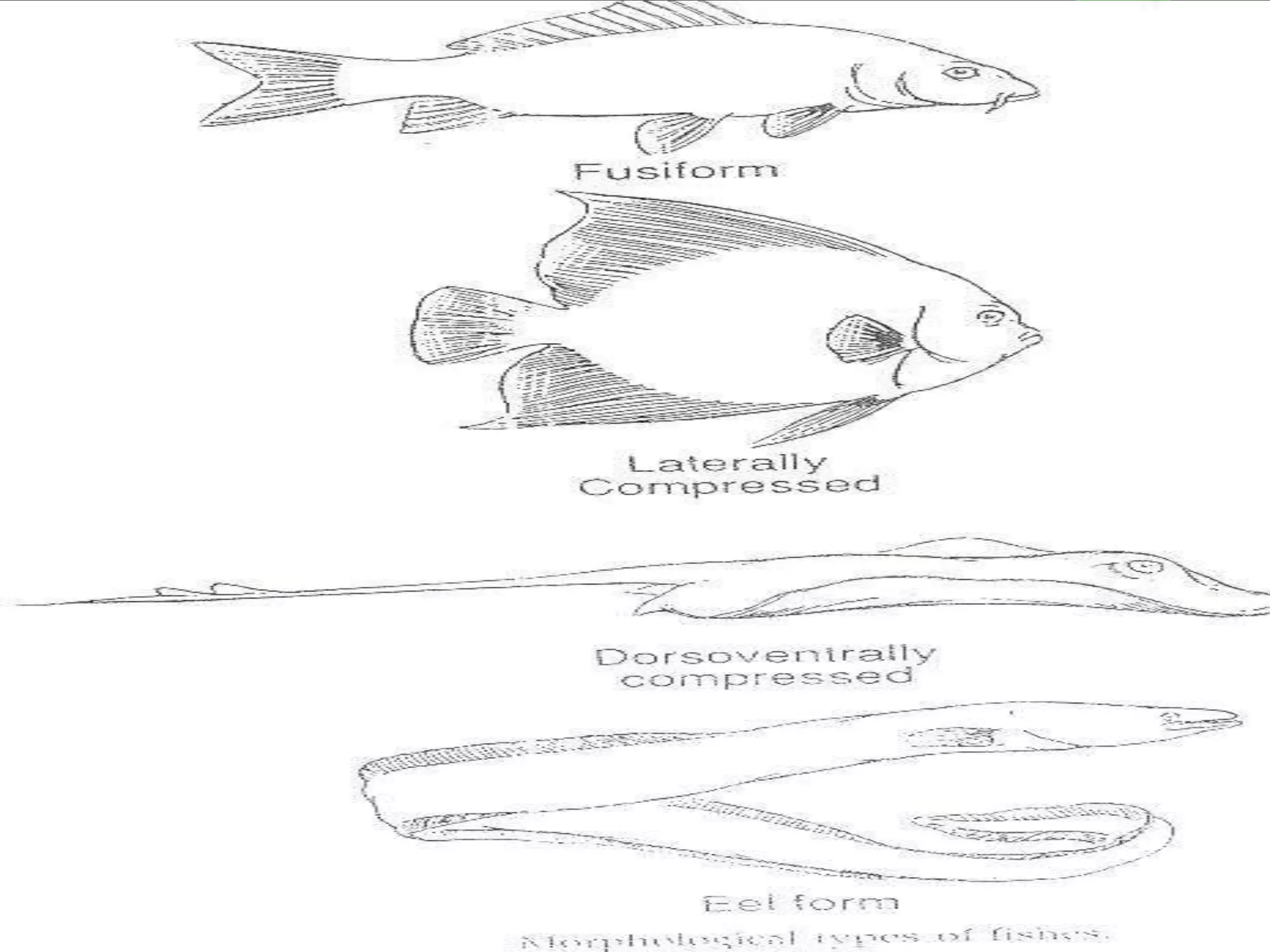
Body forms of fishes:
The bodies of most fishes have different forms as:
(aFusiform . b) Compressiform
c) Depressiform . d) Filiform .
e) Taeniform . f) Sagitiform .
g)Globiform . h) Angwilliform .
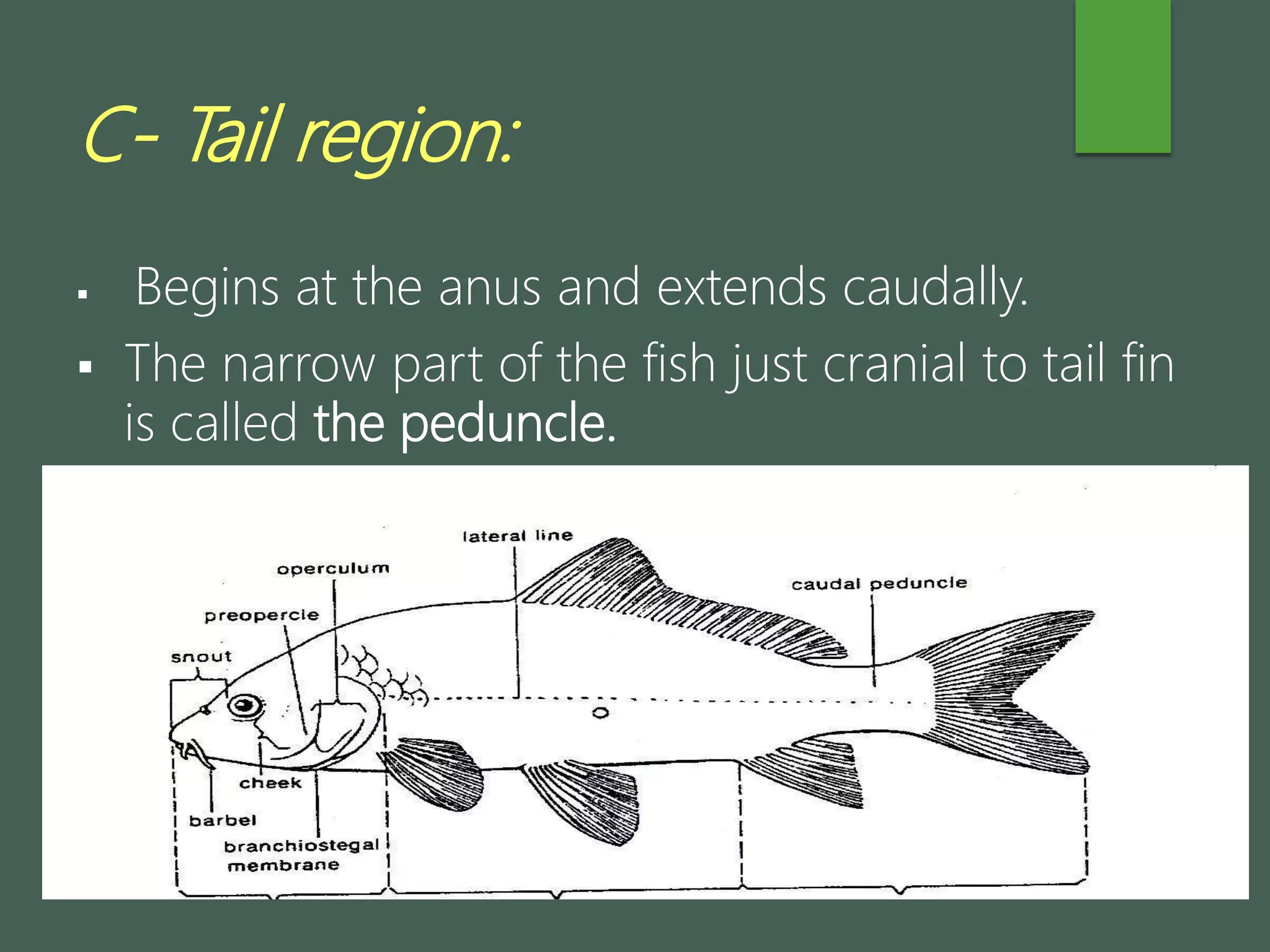
C- Tail region:
 Begins at the anus and extends caudally.
 The narrow part of the fish just cranial to tail fin
is called the peduncle.
Fins -The fins are the most characteristic features on
the fish body.
 They are fold of skin strengthed by rays which may
be soft or modified into spines.
- -They are Classified into 2 groups:
1- single fins: dorsal , caudal and anal .
2- paired fins: pectoral and pelvic .
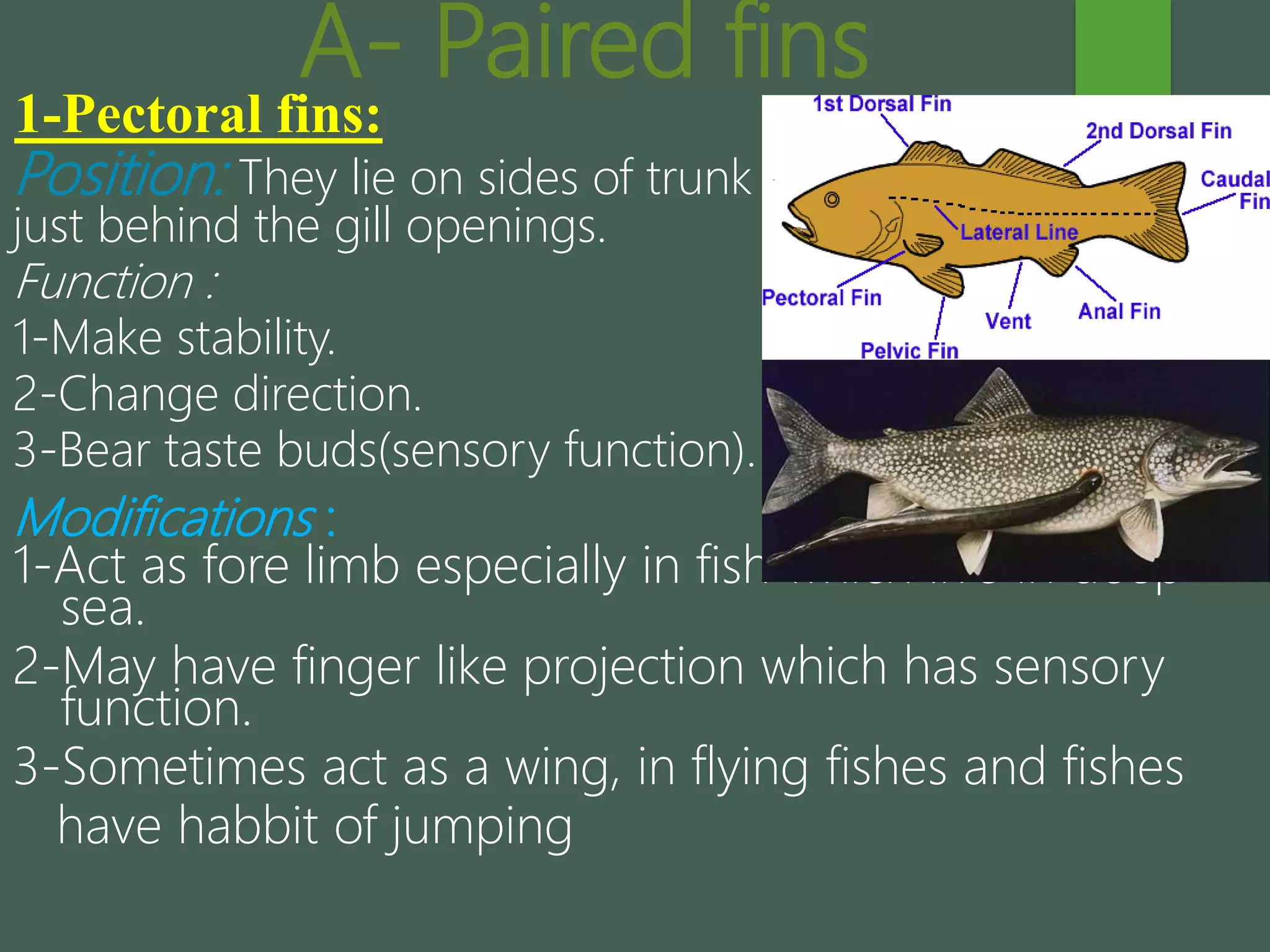
Position: They lie on sides of trunk
just behind the gill openings.
Function :
1-Make stability.
2-Change direction.
3-Bear taste buds(sensory function).
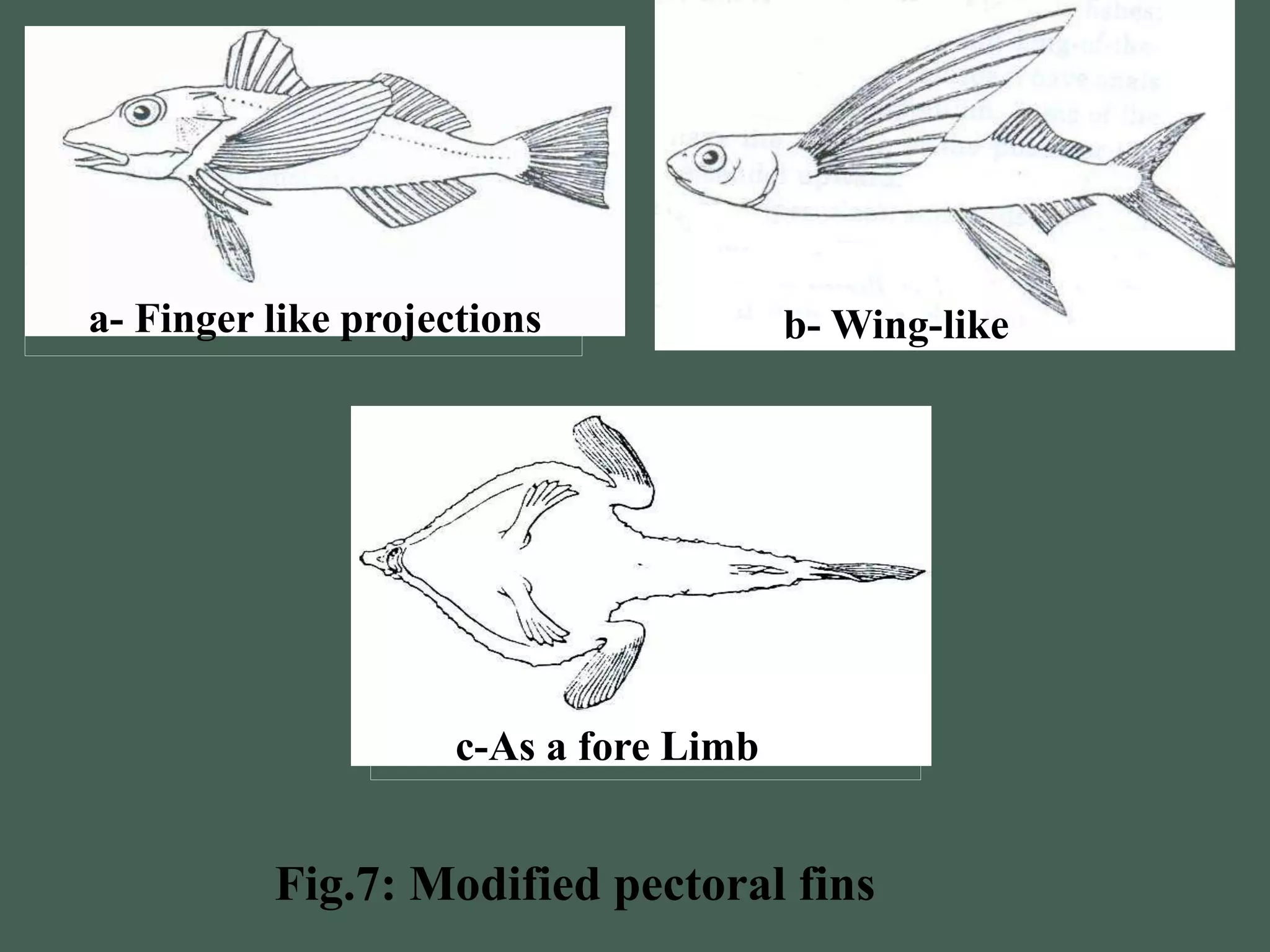
Modifications :
1-Act as fore limb especially in fish which live in deep
sea.
2-May have finger like projection which has sensory
function.
3-Sometimes act as a wing, in flying fishes and fishes
have habbit of jumping
1-Pectoral fins:
A- Paired fins
a- Finger like projections b- Wing-like
Fig.7: Modified pectoral fins
c-As a fore Limb
2-Pelvic fins:
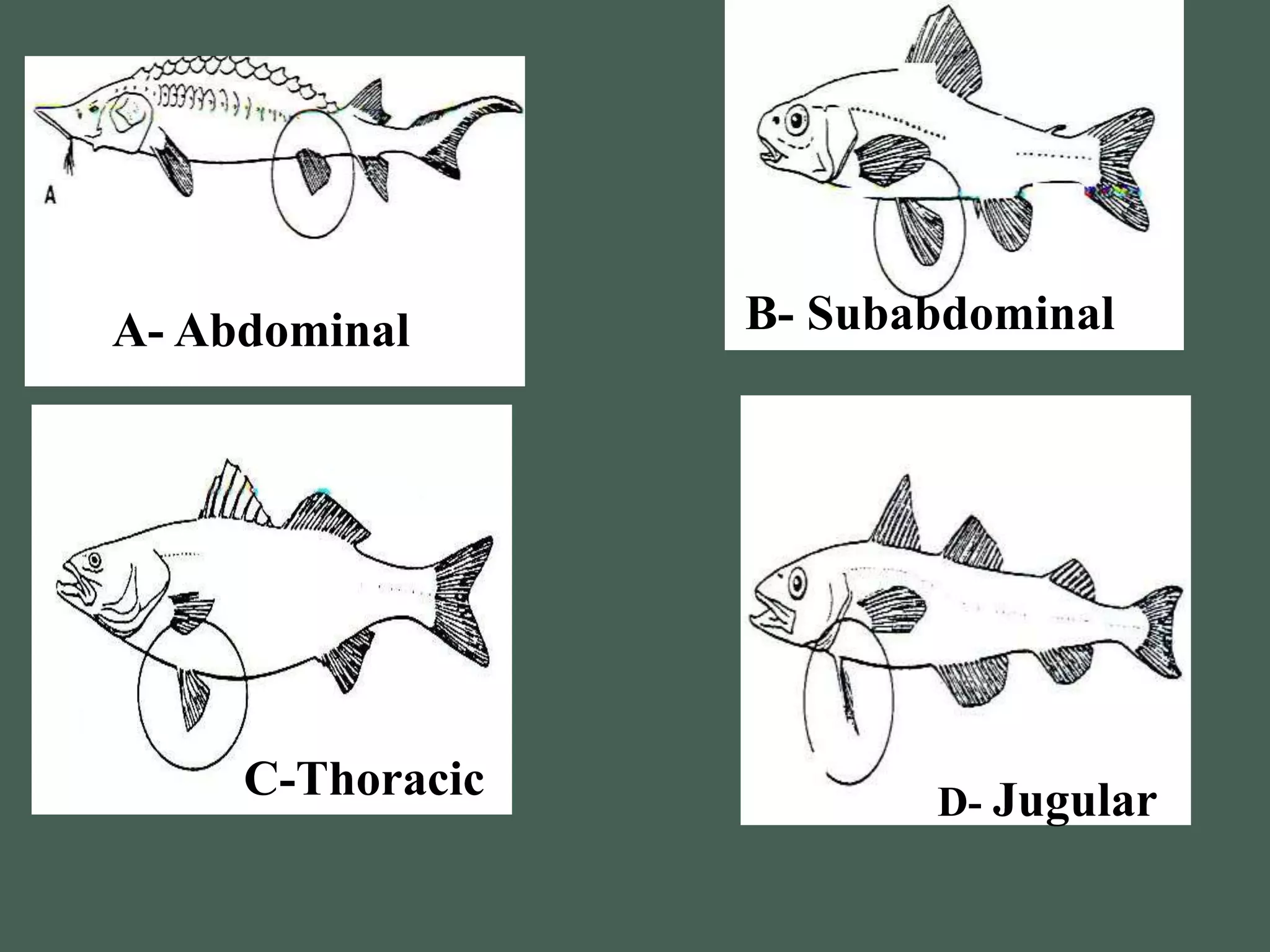
Position: They have different positions:
1- jugular: cranial to pectoral fins .
2- thoracic: behind the pectoral fins .
3- subabdominal: cranial to the anus.
4- abdominal : caudal to the anus.
Function:
1- Stability (balance).
2- braking.
3- sexual intercourse .
A- Abdominal B- Subabdominal
C-Thoracic D- Jugular
29
Single Fins
It extends along the back of the fish.
It may be:
- Divided into two or three separate fins
- Single and small or may not found .
Function
- Balance
- Change the direction of motion
- Undulating movement when it extends
along the back .
Modification
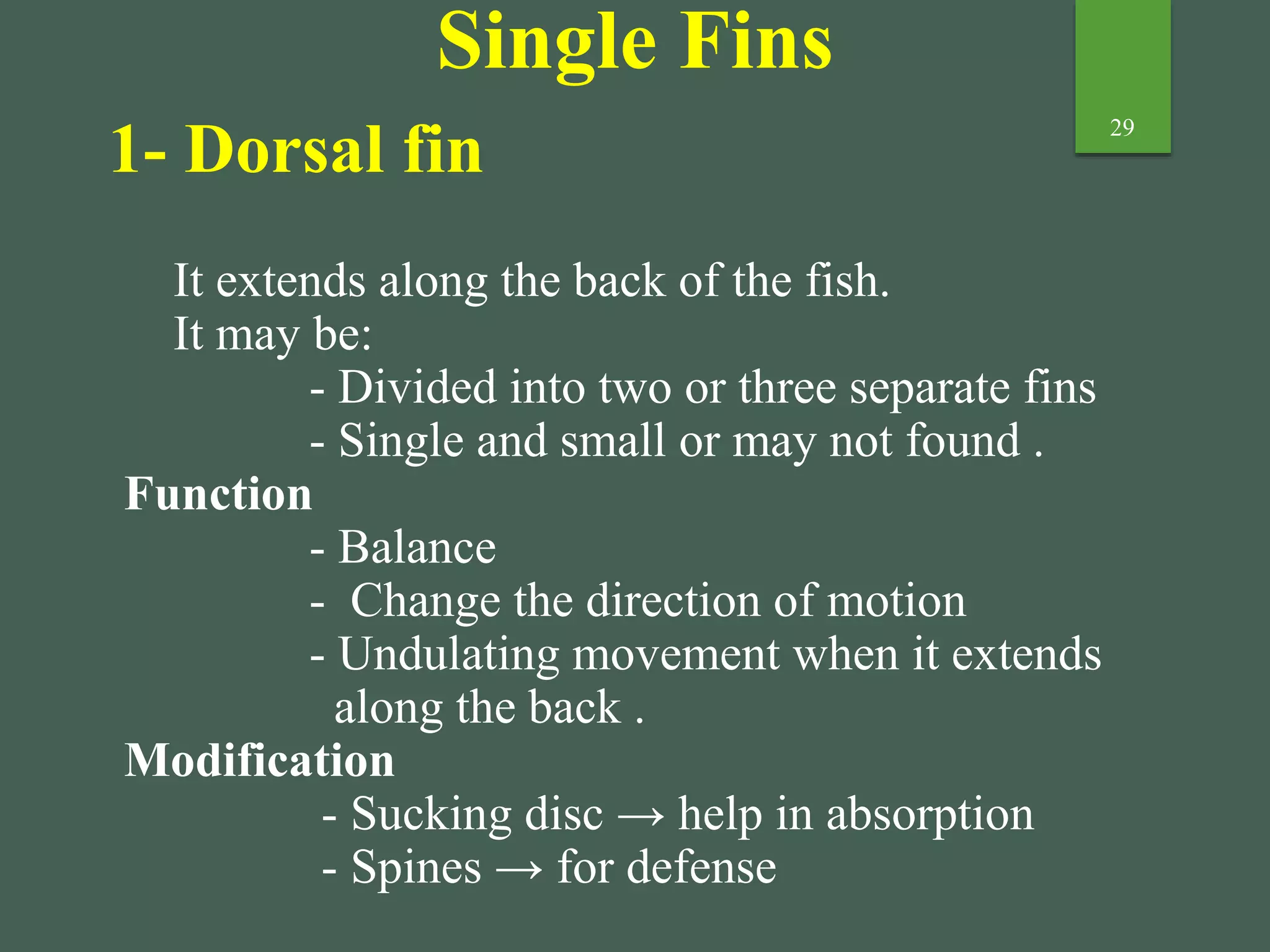
- Sucking disc → help in absorption
- Spines → for defense
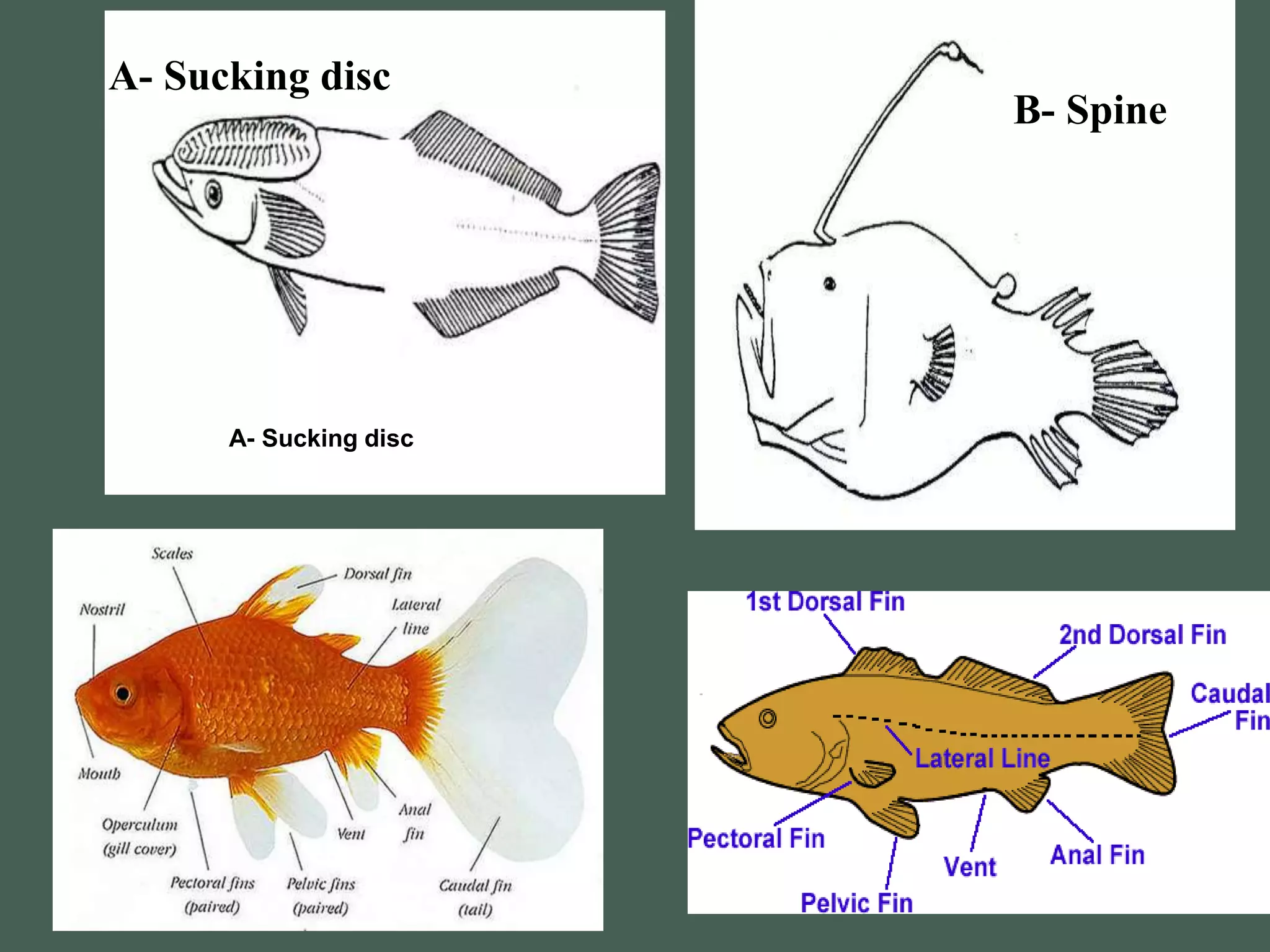
1- Dorsal fin
A- Sucking disc
A- Sucking disc
B- Spine
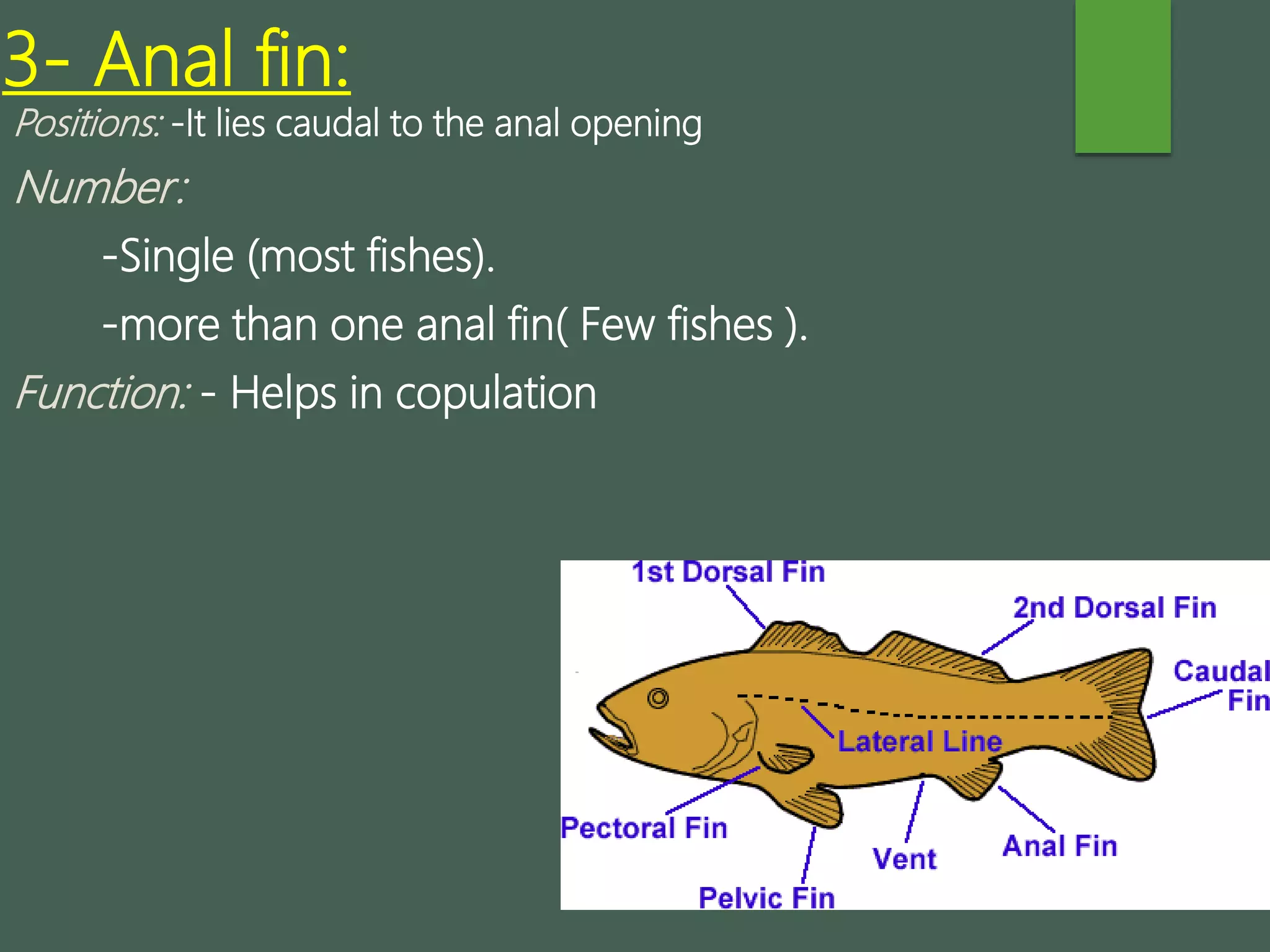
3- Anal fin:
Positions: -It lies caudal to the anal opening
Number:
-Single (most fishes).
-more than one anal fin( Few fishes ).
Function: - Helps in copulation
Position:
It is the terminal fin.
Size:
It is small in size in most fishes.
Function:
It changes the direction of motion as follow.
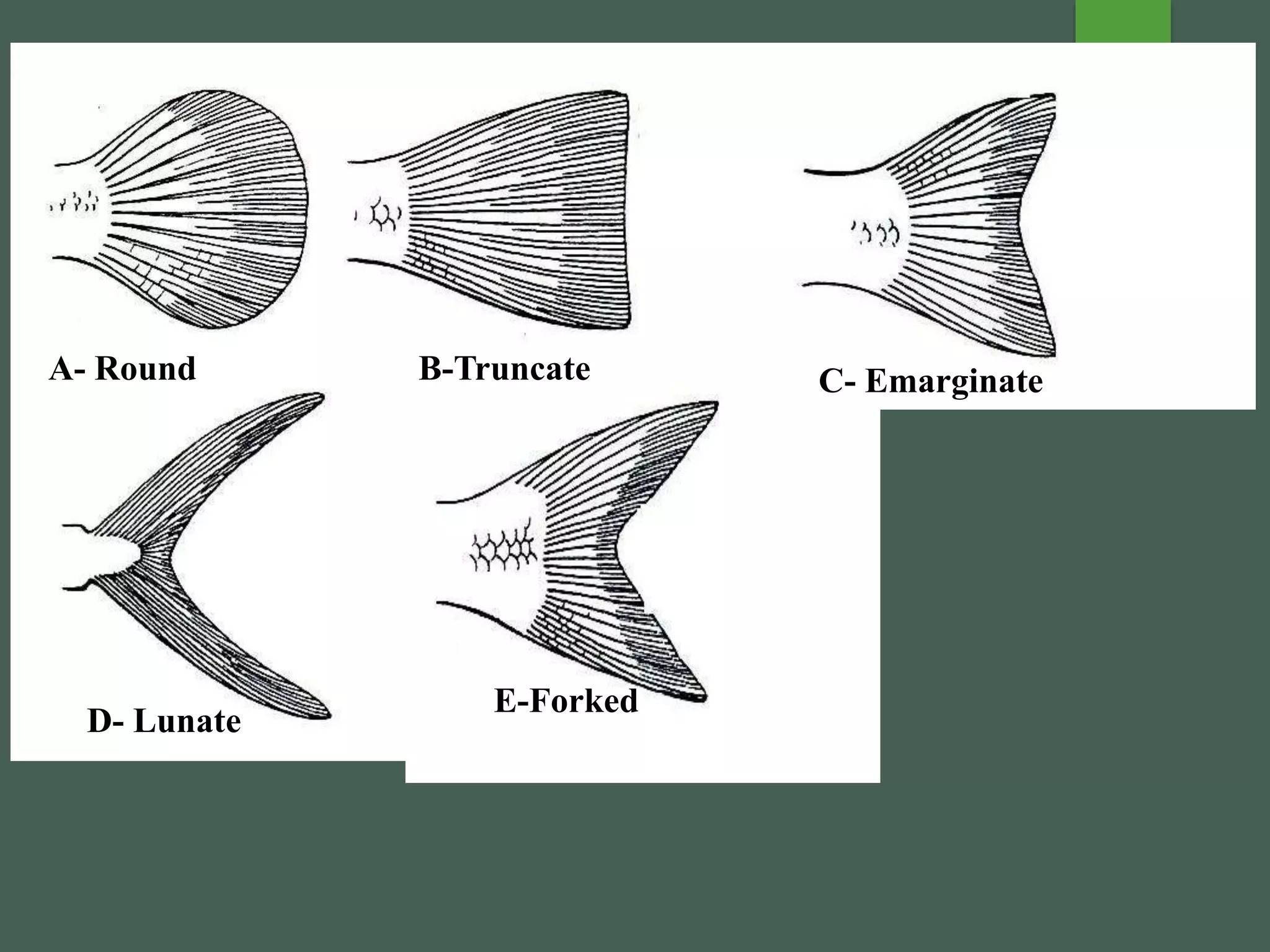
1-speediest fishes have lunate fin.
2-strong swimmers have other shapes of fins.
They are slower than the previous group.
3-weak swimmers have small caudal fin.
3. Caudal (Tail) fin:
A- Round B-Truncate
D- Lunate
C- Emarginate
E-Forked
Scales:
Definition:
-Translucent plates of dermal origin that
project into the epidermis.
Function:
-Have protection function.
Types:
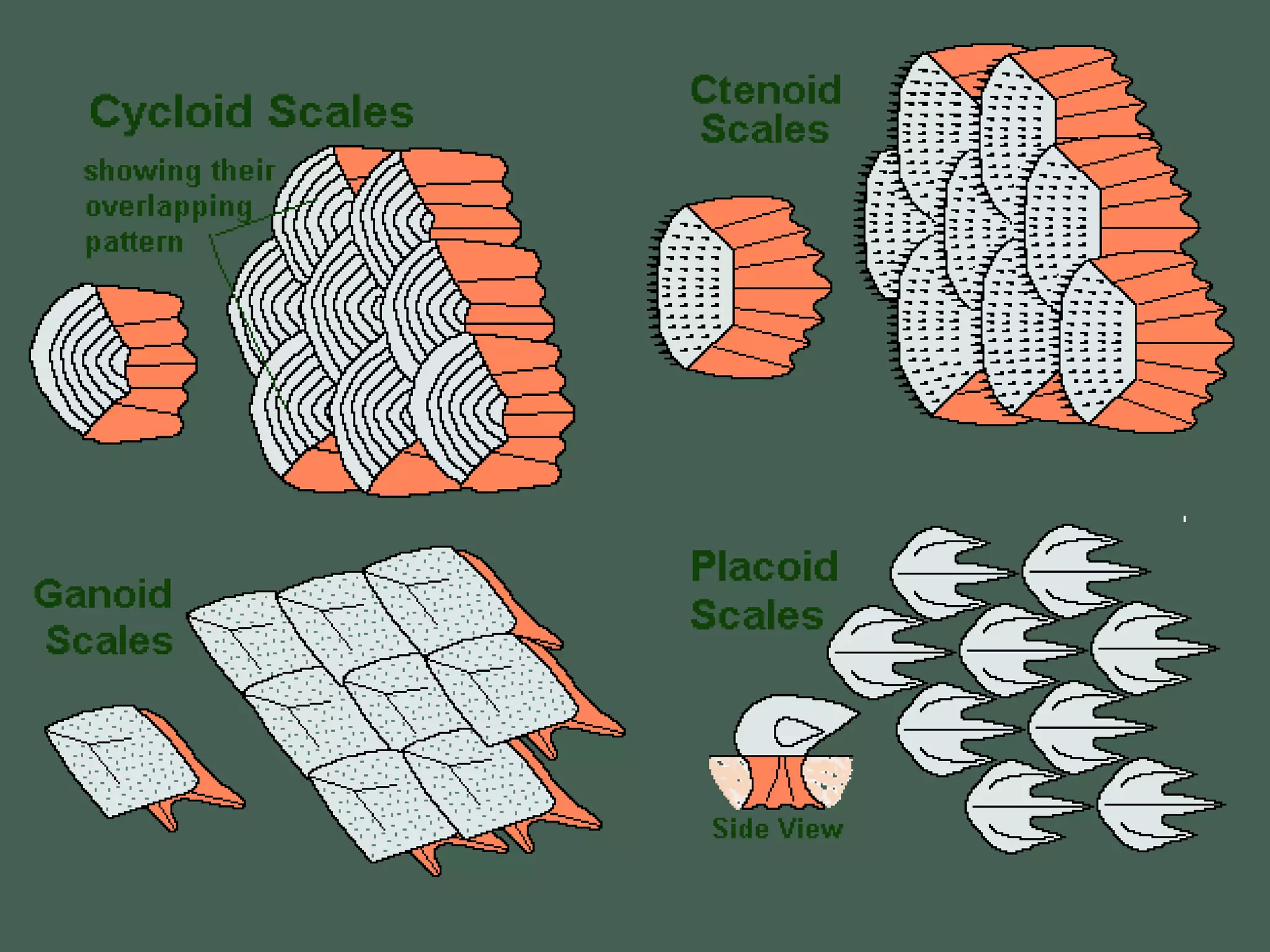
-There are 4 major scale types :
1- Cycloid scales:
-Oval with smooth borders .
2- Ctenoid scales:
-Ridged scales.
3- Ganoid scales:
-It consists of a bony basal layer( of dentine) and an outer layer of ganoine. (an
inorganic bone salt).
4-Placoid scales:
-Flattened rectangular base plate embedded in the fish, and variously developed
structures, such as spines, project posteriorly on the surface.
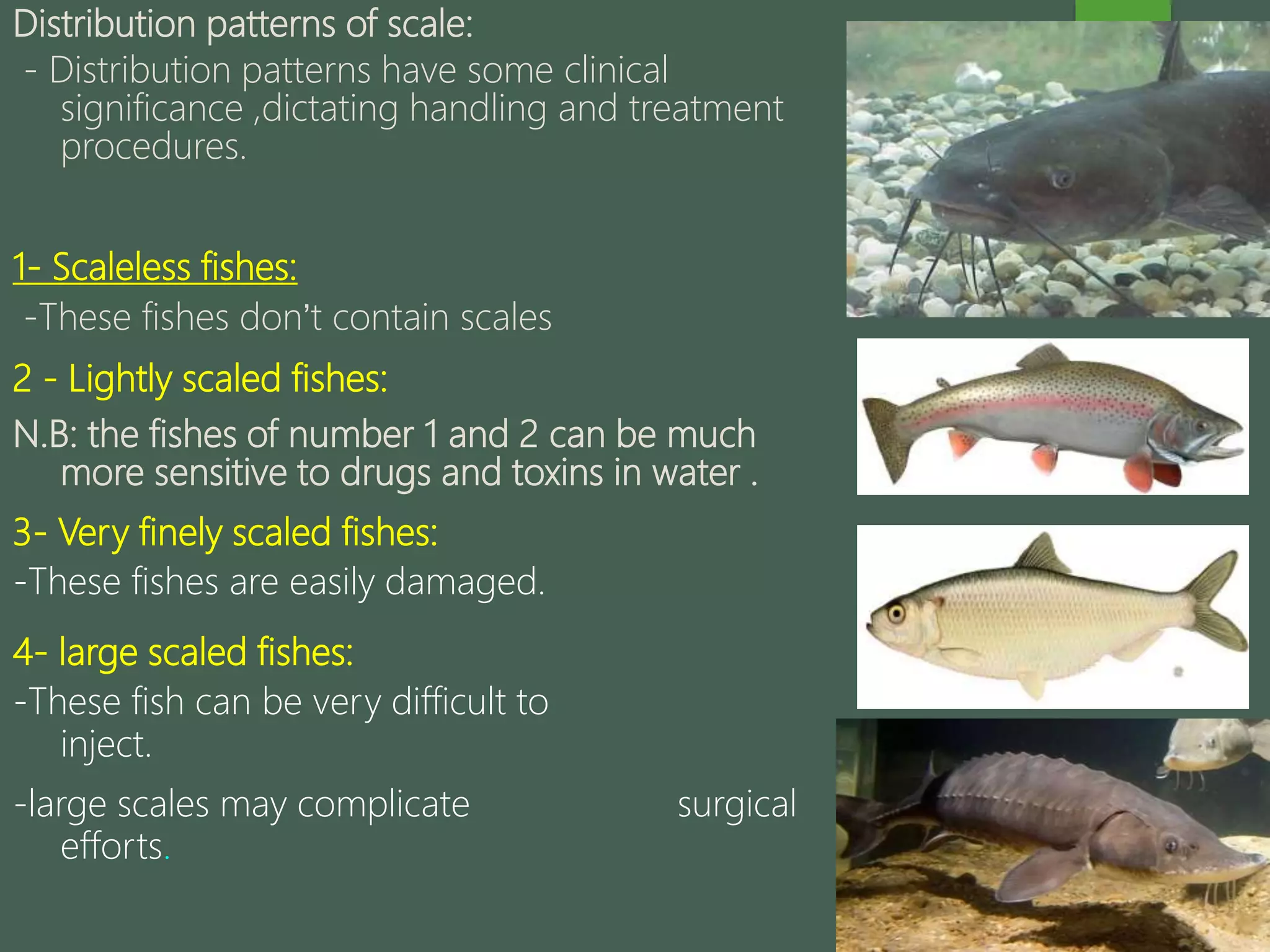
Distribution patterns of scale:
- Distribution patterns have some clinical
significance ,dictating handling and treatment
procedures.
1- Scaleless fishes:
-These fishes don’t contain scales
2 - Lightly scaled fishes:
N.B: the fishes of number 1 and 2 can be much
more sensitive to drugs and toxins in water .
3- Very finely scaled fishes:
-These fishes are easily damaged.
4- large scaled fishes:
-These fish can be very difficult to
inject.
-large scales may complicate surgical
efforts.
40

Anatomy of External Organs of the Fishes

  • 1.
    Fish Anatomy By Prof. Dr.Abdelmohaimen Mostafa Saleh Professor of Anatomy & Embryology Assiut University
  • 2.
    Student Learning Objectives .1.Introduction 2. External features of the typical fish. 3. Identify common freshwater fish species found in South Carolina waters. 4. Identify common saltwater fish species found in South Carolina waters. 2
  • 3.
    3  Fish arecold-blooded, vertebrate that breathe with gills and move with fins. They are the most numerous vertebrates more than 30,000 species  smallest  Philippine Island Goby – 1/3”- 1/2”  largest  Whale Shark – 50’ and several tons  INTRODUCTION:
  • 4.
    4 Anatomically, The bodyof fishes is divided into 3 regions: head, trunk and tail. General external features of the fishes Head Trunk Tail
  • 5.
  • 6.
  • 7.
    A- Head region: 7 •The head extends from the tip of upper jaw to caudal margin of operculum. • It includes mouth, snout, eyes, cheek, operculum, chin, barbels, nostrils, spine , and sensory canals .
  • 8.
    8 ** Features ofthe head : 1- Mouth: It has different positions: a) Inferior b) Subterminal c) Terminal d) Superior The mouth may be: A- protrusible B- nonprotrusible.
  • 9.
  • 10.
    Labial fold sensory canalsand pores . spines
  • 11.
    11 2- Eye: The fishhas two eyes without eye lids 3- Snout: A region between the eye and the tip of the upper jaw 4- Nostrils: They consists of a blind sa c on each side which has a sensory function. They have no respiratory function. 5- Cheek: A region between the eye and the preopercle. 6- Barbels: They are sensory structures which carry tactile and chemical receptors. They are not found in all fishes and have sensory function.
  • 12.
    12 7- Spines: As asource of defense 8- Sensory canals: They are recognized by rows pores in the skin and have sensory function. 9- Operculum (Gill cover): It covers the gill cavity. 10- Folds: The folds not found in all They surround the mouth to increase the surface area.
  • 13.
  • 14.
    The trunk extendsfrom the caudal margin of the operculum to the anus. -It has the following features: 1- Nuchal region: -It is the dorsal surface just behind the occiput. 2- Isthmus: -It is the most anterior ventral part of the body that extends forward below and between the gills openings. 2-Trunk region
  • 15.
    3- Lateral line: -It is a continuation of the sensory canals of the head, along each side of fish. - It is usually single line ( may be an open groove ,or a row of pores in the skin). - Lines may be multiple or variously reduced. - It has sensory function.
  • 17.
    3- Gill openings: Theyare typically in a lateral position covered by operculum. 4- Fins: * Single: Dorsal fin - Anal fin - Caudal fin ** Paired: Pectoral fins - Pelvic fins 5- Anus: Represents the opening of the gut in most fishes.
  • 18.
    18 6- Urogenital opening: Liescaudal to the anus, the urinary opening may be separate from and behind the genital pore. Some fishes have: A- Combined urogenital opening lies behind anus. B- The urinary opening is separated and lies caudal to the genital opening. C- There is a cloaca which receive the openings of gut genital and urinary systems 6- Cloaca: Found in some fishes (shark) and receives the openings of the gut, the urinary and genital systems.
  • 19.
  • 20.
    7- Gill openings: -Theyare in the lateral position and covered by operculum 8- Fins: -They will discuss in a separate chapter.
  • 21.
    Body forms offishes: The bodies of most fishes have different forms as: (aFusiform . b) Compressiform c) Depressiform . d) Filiform . e) Taeniform . f) Sagitiform . g)Globiform . h) Angwilliform .
  • 23.
    C- Tail region: Begins at the anus and extends caudally.  The narrow part of the fish just cranial to tail fin is called the peduncle.
  • 24.
    Fins -The finsare the most characteristic features on the fish body.  They are fold of skin strengthed by rays which may be soft or modified into spines. - -They are Classified into 2 groups: 1- single fins: dorsal , caudal and anal . 2- paired fins: pectoral and pelvic .
  • 25.
    Position: They lieon sides of trunk just behind the gill openings. Function : 1-Make stability. 2-Change direction. 3-Bear taste buds(sensory function). Modifications : 1-Act as fore limb especially in fish which live in deep sea. 2-May have finger like projection which has sensory function. 3-Sometimes act as a wing, in flying fishes and fishes have habbit of jumping 1-Pectoral fins: A- Paired fins
  • 26.
    a- Finger likeprojections b- Wing-like Fig.7: Modified pectoral fins c-As a fore Limb
  • 27.
    2-Pelvic fins: Position: Theyhave different positions: 1- jugular: cranial to pectoral fins . 2- thoracic: behind the pectoral fins . 3- subabdominal: cranial to the anus. 4- abdominal : caudal to the anus. Function: 1- Stability (balance). 2- braking. 3- sexual intercourse .
  • 28.
    A- Abdominal B-Subabdominal C-Thoracic D- Jugular
  • 29.
    29 Single Fins It extendsalong the back of the fish. It may be: - Divided into two or three separate fins - Single and small or may not found . Function - Balance - Change the direction of motion - Undulating movement when it extends along the back . Modification - Sucking disc → help in absorption - Spines → for defense 1- Dorsal fin
  • 30.
    A- Sucking disc A-Sucking disc B- Spine
  • 31.
    3- Anal fin: Positions:-It lies caudal to the anal opening Number: -Single (most fishes). -more than one anal fin( Few fishes ). Function: - Helps in copulation
  • 32.
    Position: It is theterminal fin. Size: It is small in size in most fishes. Function: It changes the direction of motion as follow. 1-speediest fishes have lunate fin. 2-strong swimmers have other shapes of fins. They are slower than the previous group. 3-weak swimmers have small caudal fin. 3. Caudal (Tail) fin:
  • 33.
    A- Round B-Truncate D-Lunate C- Emarginate E-Forked
  • 34.
    Scales: Definition: -Translucent plates ofdermal origin that project into the epidermis. Function: -Have protection function.
  • 35.
    Types: -There are 4major scale types : 1- Cycloid scales: -Oval with smooth borders . 2- Ctenoid scales: -Ridged scales. 3- Ganoid scales: -It consists of a bony basal layer( of dentine) and an outer layer of ganoine. (an inorganic bone salt). 4-Placoid scales: -Flattened rectangular base plate embedded in the fish, and variously developed structures, such as spines, project posteriorly on the surface.
  • 39.
    Distribution patterns ofscale: - Distribution patterns have some clinical significance ,dictating handling and treatment procedures. 1- Scaleless fishes: -These fishes don’t contain scales 2 - Lightly scaled fishes: N.B: the fishes of number 1 and 2 can be much more sensitive to drugs and toxins in water . 3- Very finely scaled fishes: -These fishes are easily damaged. 4- large scaled fishes: -These fish can be very difficult to inject. -large scales may complicate surgical efforts.
  • 40.