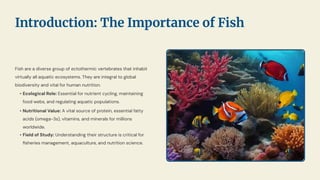
Fish are adiverse group of ectothermic vertebrates that inhabit
virtually all aquatic ecosystems. They are integral to global
biodiversity and vital for human nutrition.
• Ecological Role: Essential for nutrient cycling, maintaining
food webs, and regulating aquatic populations.
• Nutritional Value: A vital source of protein, essential fatty
acids (omega-3s), vitamins, and minerals for millions
worldwide.
• Field of Study: Understanding their structure is critical for
fisheries management, aquaculture, and nutrition science.
Introduction: The Importance of Fish
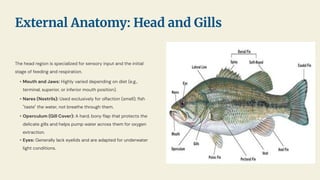
The head regionis specialized for sensory input and the initial
stage of feeding and respiration.
• Mouth and Jaws: Highly varied depending on diet (e.g.,
terminal, superior, or inferior mouth position).
• Nares (Nostrils): Used exclusively for olfaction (smell); fish
"taste" the water, not breathe through them.
• Operculum (Gill Cover): A hard, bony flap that protects the
delicate gills and helps pump water across them for oxygen
extraction.
• Eyes: Generally lack eyelids and are adapted for underwater
light conditions.
External Anatomy: Head and Gills
5.
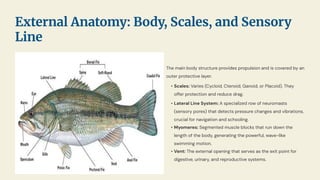
The main bodystructure provides propulsion and is covered by an
outer protective layer.
• Scales: Varies (Cycloid, Ctenoid, Ganoid, or Placoid). They
offer protection and reduce drag.
• Lateral Line System: A specialized row of neuromasts
(sensory pores) that detects pressure changes and vibrations,
crucial for navigation and schooling.
• Myomeres: Segmented muscle blocks that run down the
length of the body, generating the powerful, wave-like
swimming motion.
• Vent: The external opening that serves as the exit point for
digestive, urinary, and reproductive systems.
External Anatomy: Body, Scales, and Sensory
Line
6.
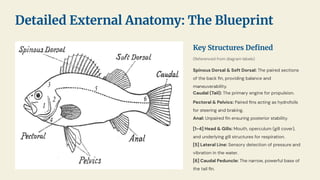
Key Structures Defined
(Referencedfrom diagram labels)
Spinous Dorsal & Soft Dorsal: The paired sections
of the back fin, providing balance and
maneuverability.
Caudal (Tail): The primary engine for propulsion.
Pectoral & Pelvics: Paired fins acting as hydrofoils
for steering and braking.
Anal: Unpaired fin ensuring posterior stability.
[1-4] Head & Gills: Mouth, operculum (gill cover),
and underlying gill structures for respiration.
[5] Lateral Line: Sensory detection of pressure and
vibration in the water.
[6] Caudal Peduncle: The narrow, powerful base of
the tail fin.
Detailed External Anatomy: The Blueprint
7.
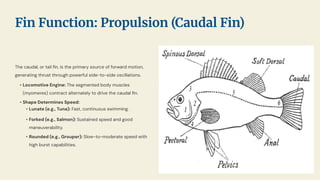
The caudal, ortail fin, is the primary source of forward motion,
generating thrust through powerful side-to-side oscillations.
• Locomotive Engine: The segmented body muscles
(myomeres) contract alternately to drive the caudal fin.
• Shape Determines Speed:
• Lunate (e.g., Tuna): Fast, continuous swimming.
• Forked (e.g., Salmon): Sustained speed and good
maneuverability.
• Rounded (e.g., Grouper): Slow-to-moderate speed with
high burst capabilities.
Fin Function: Propulsion (Caudal Fin)
8.
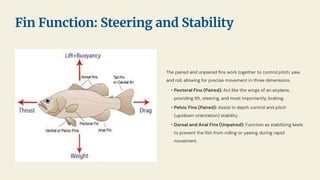
The paired andunpaired fins work together to control pitch, yaw,
and roll, allowing for precise movement in three dimensions.
• Pectoral Fins (Paired): Act like the wings of an airplane,
providing lift, steering, and most importantly, braking.
• Pelvic Fins (Paired): Assist in depth control and pitch
(up/down orientation) stability.
• Dorsal and Anal Fins (Unpaired): Function as stabilizing keels
to prevent the fish from rolling or yawing during rapid
movement.
Fin Function: Steering and Stability
Skeletal System
The backbone(vertebral column) provides axial support.
Bony fish (Osteichthyes) have hard bone; sharks and rays
(Chondrichthyes) have cartilage.
Muscular System
Composed of W-shaped myomeres, the majority of muscle
mass is lateral, powering the tail. Red muscle is for sustained
swimming; white is for bursts.
Internal Systems: Movement and Support
11.
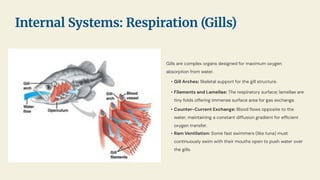
Gills are complexorgans designed for maximum oxygen
absorption from water.
• Gill Arches: Skeletal support for the gill structure.
• Filaments and Lamellae: The respiratory surface; lamellae are
tiny folds offering immense surface area for gas exchange.
• Counter-Current Exchange: Blood flows opposite to the
water, maintaining a constant diffusion gradient for efficient
oxygen transfer.
• Ram Ventilation: Some fast swimmers (like tuna) must
continuously swim with their mouths open to push water over
the gills.
Internal Systems: Respiration (Gills)
12.
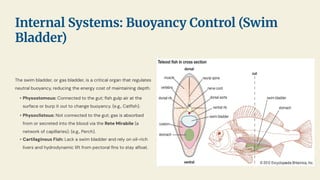
The swim bladder,or gas bladder, is a critical organ that regulates
neutral buoyancy, reducing the energy cost of maintaining depth.
• Physostomous: Connected to the gut; fish gulp air at the
surface or burp it out to change buoyancy. (e.g., Catfish).
• Physoclistous: Not connected to the gut; gas is absorbed
from or secreted into the blood via the Rete Mirabile (a
network of capillaries). (e.g., Perch).
• Cartilaginous Fish: Lack a swim bladder and rely on oil-rich
livers and hydrodynamic lift from pectoral fins to stay afloat.
Internal Systems: Buoyancy Control (Swim
Bladder)
13.
•
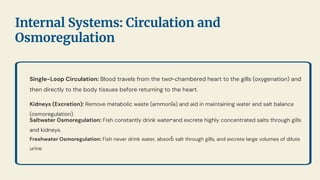
Single-Loop Circulation: Bloodtravels from the two-chambered heart to the gills (oxygenation) and
then directly to the body tissues before returning to the heart.
•
Kidneys (Excretion): Remove metabolic waste (ammonia) and aid in maintaining water and salt balance
(osmoregulation).
•
Saltwater Osmoregulation: Fish constantly drink water and excrete highly concentrated salts through gills
and kidneys.
•
Freshwater Osmoregulation: Fish never drink water, absorb salt through gills, and excrete large volumes of dilute
urine.
Internal Systems: Circulation and
Osmoregulation
14.
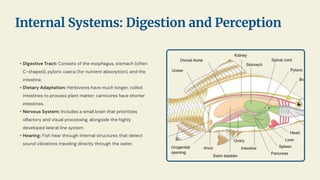
• Digestive Tract:Consists of the esophagus, stomach (often
C-shaped), pyloric caeca (for nutrient absorption), and the
intestine.
• Dietary Adaptation: Herbivores have much longer, coiled
intestines to process plant matter; carnivores have shorter
intestines.
• Nervous System: Includes a small brain that prioritizes
olfactory and visual processing, alongside the highly
developed lateral line system.
• Hearing: Fish hear through internal structures that detect
sound vibrations traveling directly through the water.
Internal Systems: Digestion and Perception
15.
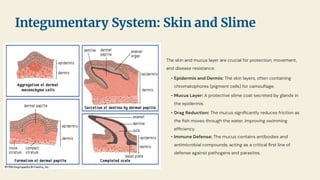
The skin andmucus layer are crucial for protection, movement,
and disease resistance.
• Epidermis and Dermis: The skin layers, often containing
chromatophores (pigment cells) for camouflage.
• Mucus Layer: A protective slime coat secreted by glands in
the epidermis.
• Drag Reduction: The mucus significantly reduces friction as
the fish moves through the water, improving swimming
efficiency.
• Immune Defense: The mucus contains antibodies and
antimicrobial compounds, acting as a critical first line of
defense against pathogens and parasites.
Integumentary System: Skin and Slime
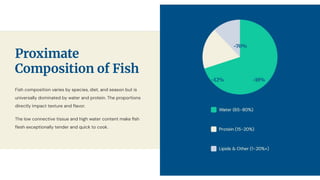
Proximate
Composition of Fish
Fishcomposition varies by species, diet, and season but is
universally dominated by water and protein. The proportions
directly impact texture and flavor.
The low connective tissue and high water content make fish
flesh exceptionally tender and quick to cook.
18.
• Myofibrillar Proteins(65-75%): Actin and Myosin, responsible for muscle contraction. These denature
and coagulate rapidly upon heating, leading to flaking.
• Sarcoplasmic Proteins (25-30%): Enzymes and myoglobin (giving red/dark fish meat its color).
• Connective Tissue (1-5%): Primarily **collagen** and **elastin**. Fish have much less connective
tissue than meat, contributing to tenderness. Collagen converts to gelatin easily when cooked.
• Digestibility: The combination of high protein and low connective tissue makes fish one of the most
easily digested proteins.
Biochemical: Protein Components
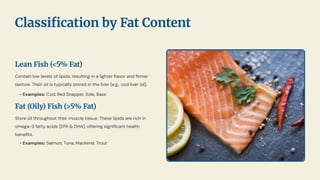
Lean Fish (<5%Fat)
Contain low levels of lipids, resulting in a lighter flavor and firmer
texture. Their oil is typically stored in the liver (e.g., cod liver oil).
Fat (Oily) Fish (>5% Fat)
Store oil throughout their muscle tissue. These lipids are rich in
omega-3 fatty acids (EPA & DHA), offering significant health
benefits.
• Examples: Cod, Red Snapper, Sole, Bass
• Examples: Salmon, Tuna, Mackerel, Trout
Classification by Fat Content
21.
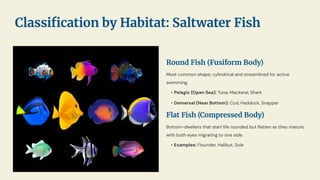
Round Fish (FusiformBody)
Most common shape; cylindrical and streamlined for active
swimming.
Flat Fish (Compressed Body)
Bottom-dwellers that start life rounded but flatten as they mature,
with both eyes migrating to one side.
• Pelagic (Open Sea): Tuna, Mackerel, Shark
• Demersal (Near Bottom): Cod, Haddock, Snapper
• Examples: Flounder, Halibut, Sole
Classification by Habitat: Saltwater Fish
22.
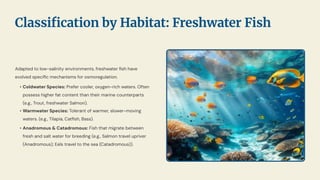
Adapted to low-salinityenvironments, freshwater fish have
evolved specific mechanisms for osmoregulation.
• Coldwater Species: Prefer cooler, oxygen-rich waters. Often
possess higher fat content than their marine counterparts
(e.g., Trout, freshwater Salmon).
• Warmwater Species: Tolerant of warmer, slower-moving
waters. (e.g., Tilapia, Catfish, Bass).
• Anadromous & Catadromous: Fish that migrate between
fresh and salt water for breeding (e.g., Salmon travel upriver
(Anadromous); Eels travel to the sea (Catadromous)).
Classification by Habitat: Freshwater Fish
23.
Fusiform (Torpedo)
Streamlined body,typical of fast,
active swimmers like Tuna and
Mackerel. Minimal drag, high cruising
speed.
Compressed (Laterally
Flat)
Thin side-to-side, like Angelfish or
Butterflyfish. Excellent for
maneuvering in coral reefs or tight
spaces.
Depressed
(Dorso-ventrally Flat)
Flattened top-to-bottom, ideal for
bottom-dwelling species like Rays,
Skates, and sometimes Flounder.
Classification by Body Morphology (Shape)