What is a FISH?
A fish is any member of
a paraphyletic group of organisms that
consist of all gill -
bearing aquatic craniate animals that
lack limbs with digits.
Scientific classification
Kingdom: Animalia
Phylum: Chordata
History
Early fish from the fossil record are
represented by a group of small, jawless,
armored fish known as ostracoderms.
Jawless fish lineages are mostly extinct. An
extant clade, the lampreys may approximate
ancient pre-jawed fish. The first jaws are
found in Placodermi fossils. The diversity of
jawed vertebrates may indicate the
evolutionary advantage of a jawed mouth
CLASSIFICATION
 KINGDOM - ANIMALIA
 PHYLUM - CHORDATA
 SUB PHYLUM - VERTEBRATA
 CLASSES - AGNATHA
- CHONDRICHTHYES
- OSTEICHTHYES
DIFFERENT TERMS
 ANTERIOR (CRANIAL) : TOWARD THE HEAD
 POSTERIOR (CAUDAL) : TOWARD THE TAIL
 CRANIAL : HEAD REGION
 CAUDAL : PERTAINING TO THE TAIL REGION
 DORSAL : TOWARD THE BACK
 VENTRAL : TOWARD THE BELLY
 LATERAL : TO THE SIDES
 MEDIAL : TOWARD THE MEDIAN LINE
 DISTAL : AWAY FROM THE CENTER OR ORIGIN
 PROXIMAL : TOWARD THE CENTER OR ORIGIN
 BUCCAL : MOUTH REGION
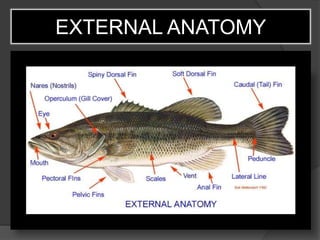
 PECTORAL FINS : ON EACH SIDE BEHIND THE
OPERCULUM
 PELVIC FINS : ON VENTRAL SURFACE NEAR THE
HEAD
 ANAL FIN : BEHIND ANUS
EXTERNAL ANATOMY
INTERNAL ANATOMY
ANATOMY
Gills - Consist of threadlike structures called
filaments. Each filament contains a capillary network
that provides a large surface area for exchanging O &
CO2
Circulation - Fish have a closed-loop circulatory system.
The heart pumps the blood in a single loop
throughout the body.
In most fish, the heart consists of four parts,
including two chambers and an entrance and
exit. The first part is the sinus venosus, a thin-
walled sac that collects blood from the
fish's veins before allowing it to flow to the
second part, the atrium, which is a large
muscular chamber.
Digestion - Jaws allow fish to eat a wide variety of food, including plants
and other organisms. Fish ingest food through the mouth and break it
down in the esophagus. In the stomach, food is further digested and, in
many fish, processed in finger-shaped pouches called pyloric caeca,
which secrete digestive enzymes and absorb nutrients. Organs such as
the liver and pancreas add enzymes and various chemicals as the food
moves through the digestive tract. The intestine completes the process of
digestion and nutrient absorption.
Excretion - As with many aquatic animals, most fish release their
nitrogenous wastes as ammonia. Some of the wastes diffuse through the
gills. Blood wastes are filtered by the kidneys.
Saltwater fish tend to lose water because of osmosis. Their kidneys return
water to the body. Some fish have specially adapted kidneys that vary in
function, allowing them to move from freshwater to saltwater.
Scales - The scales of fish originate from the mesoderm (layer of
the dermis, which distinguishes them from reptile scales); they may be
similar in structure to teeth.
Central Nervous System
Fish typically have quite small brains relative to body size compared
with other vertebrates, typically one-fifteenth the brain mass of a
similarly sized bird or mammal. some fish have relatively large
brains, most notably mormyrids and sharks, which have brains
about as massive relative to body weight as birds.
FOREBRAIN – Olfactory Lobes – receive & process signals from
the nostrils.
MIDBRAIN – DIENCEPHALON connects the forebrain and the
midbrain.
HINDBRAIN or METECEPHALON – swimming and balance.
BRAIN STEM – Respiration and Osmoregulation.
Sense Organs
VISION- Fish eyes are similar to those
of terrestrial vertebrates like birds and mammals,
but have a more spherical lens.
RETINA – have rods and cones. Some fish can see
ultraviolet and others can see polarized light.
Adaptation to the environment.
Hearing - An important sensory system for most species of
fish.
Fish sense sound using their lateral lines and
their ears.
Fish reproductive organs
include testicles and ovaries.
SPERMATOGONIA OVARIES
Seminiferous
Tubules
Atherinomorph
Gymnovarian
Secondary
Gymnovarian
Larvae - The newly hatched young of oviparous fish.
- They are usually poorly formed, carry a
large yolk sac (for nourishment).
Ovoviviparous fish - Eggs develop inside the mother's
body after internal fertilization but receive little or no
nourishment directly from the mother, depending instead
on the yolk. (Guppies)
Viviparous - In such species the mother retains the eggs
and nourishes the embryos. (Lemon Shark).
• Most Fish reproduce sexually, and
fertilize their eggs externally
• Spawning is the process of fertilizing
eggs.
• Baby fish are called FRY
EDIBLE FISHES
FINFISH SHELLFISH
BASED ON
ANATOMICAL
DIFFERENCES
FIN FISH
FRESH
WATER
• SARDINE
• MULLET
• CATFISH
• PERCH
• PEARLESPOT
SALT
WATER
• SHARK
• SALMON
• MACKEREL
• SOLE
• TUNA
CLASSIFICATION
OF FISH
WHITE FISH BLUE FISH
BASED ON
MUSCLE COLOR
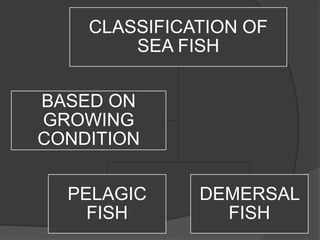
CLASSIFICATION OF
SEA FISH
PELAGIC
FISH
DEMERSAL
FISH
BASED ON
GROWING
CONDITION
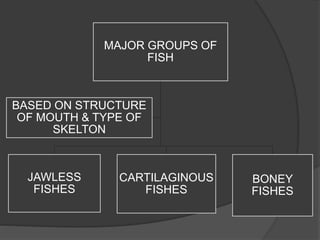
MAJOR GROUPS OF
FISH
JAWLESS
FISHES
CARTILAGINOUS
FISHES
BONEY
FISHES
BASED ON STRUCTURE
OF MOUTH & TYPE OF
SKELTON
JAWLESS
FISH
(AGNATHA)
NO JAW,
NO SCALE
SKELETON
MADE OF
CARTILAGE
HAGFISH
LAMPREY
HAGFISH
LAMPREY
CARTILAGINOUS
FISH
(CHONDRICHTHYES)
MOVABLE JAW,
TEETH
ENDOSKELETONS
MADE OF
CARTILAGE
SHARK
RAY
SKATE
SHARK
RAY
BONEY FISH
(OSTEICHTHYES)
SKELETONS
MADE OF
BONE
SWIM
BLADDER
CATFISH
SALMON
GOLDFISH
CATFISH
SALMON
GOLDFISH
SCHOOLING – Refers to a group of fish
swimming together in the same direction
in a coordinated manner.
What do fish eat?
Fish usually eat each other, as well as
crustaceans such as shrimp, krill and
crabs.
They also eat kelp, algae and plankton,
as well as cephalopods such as squid
and octopus and also echinoderms such
as sea urchins
FISH HABITAT
Fastest Fish – Black Marlin 129km/h
Slowest Fish - Seahorse
ありがとう

Fish

  • 2.
    What is aFISH? A fish is any member of a paraphyletic group of organisms that consist of all gill - bearing aquatic craniate animals that lack limbs with digits. Scientific classification Kingdom: Animalia Phylum: Chordata
  • 3.
    History Early fish fromthe fossil record are represented by a group of small, jawless, armored fish known as ostracoderms. Jawless fish lineages are mostly extinct. An extant clade, the lampreys may approximate ancient pre-jawed fish. The first jaws are found in Placodermi fossils. The diversity of jawed vertebrates may indicate the evolutionary advantage of a jawed mouth
  • 4.
    CLASSIFICATION  KINGDOM -ANIMALIA  PHYLUM - CHORDATA  SUB PHYLUM - VERTEBRATA  CLASSES - AGNATHA - CHONDRICHTHYES - OSTEICHTHYES
  • 5.
    DIFFERENT TERMS  ANTERIOR(CRANIAL) : TOWARD THE HEAD  POSTERIOR (CAUDAL) : TOWARD THE TAIL  CRANIAL : HEAD REGION  CAUDAL : PERTAINING TO THE TAIL REGION  DORSAL : TOWARD THE BACK  VENTRAL : TOWARD THE BELLY  LATERAL : TO THE SIDES  MEDIAL : TOWARD THE MEDIAN LINE  DISTAL : AWAY FROM THE CENTER OR ORIGIN  PROXIMAL : TOWARD THE CENTER OR ORIGIN  BUCCAL : MOUTH REGION  PECTORAL FINS : ON EACH SIDE BEHIND THE OPERCULUM  PELVIC FINS : ON VENTRAL SURFACE NEAR THE HEAD  ANAL FIN : BEHIND ANUS
  • 6.
  • 7.
  • 8.
    ANATOMY Gills - Consistof threadlike structures called filaments. Each filament contains a capillary network that provides a large surface area for exchanging O & CO2 Circulation - Fish have a closed-loop circulatory system. The heart pumps the blood in a single loop throughout the body. In most fish, the heart consists of four parts, including two chambers and an entrance and exit. The first part is the sinus venosus, a thin- walled sac that collects blood from the fish's veins before allowing it to flow to the second part, the atrium, which is a large muscular chamber.
  • 9.
    Digestion - Jawsallow fish to eat a wide variety of food, including plants and other organisms. Fish ingest food through the mouth and break it down in the esophagus. In the stomach, food is further digested and, in many fish, processed in finger-shaped pouches called pyloric caeca, which secrete digestive enzymes and absorb nutrients. Organs such as the liver and pancreas add enzymes and various chemicals as the food moves through the digestive tract. The intestine completes the process of digestion and nutrient absorption. Excretion - As with many aquatic animals, most fish release their nitrogenous wastes as ammonia. Some of the wastes diffuse through the gills. Blood wastes are filtered by the kidneys. Saltwater fish tend to lose water because of osmosis. Their kidneys return water to the body. Some fish have specially adapted kidneys that vary in function, allowing them to move from freshwater to saltwater. Scales - The scales of fish originate from the mesoderm (layer of the dermis, which distinguishes them from reptile scales); they may be similar in structure to teeth.
  • 10.
    Central Nervous System Fishtypically have quite small brains relative to body size compared with other vertebrates, typically one-fifteenth the brain mass of a similarly sized bird or mammal. some fish have relatively large brains, most notably mormyrids and sharks, which have brains about as massive relative to body weight as birds. FOREBRAIN – Olfactory Lobes – receive & process signals from the nostrils. MIDBRAIN – DIENCEPHALON connects the forebrain and the midbrain. HINDBRAIN or METECEPHALON – swimming and balance. BRAIN STEM – Respiration and Osmoregulation.
  • 11.
    Sense Organs VISION- Fisheyes are similar to those of terrestrial vertebrates like birds and mammals, but have a more spherical lens. RETINA – have rods and cones. Some fish can see ultraviolet and others can see polarized light. Adaptation to the environment. Hearing - An important sensory system for most species of fish. Fish sense sound using their lateral lines and their ears.
  • 12.
    Fish reproductive organs includetesticles and ovaries. SPERMATOGONIA OVARIES Seminiferous Tubules Atherinomorph Gymnovarian Secondary Gymnovarian
  • 13.
    Larvae - Thenewly hatched young of oviparous fish. - They are usually poorly formed, carry a large yolk sac (for nourishment). Ovoviviparous fish - Eggs develop inside the mother's body after internal fertilization but receive little or no nourishment directly from the mother, depending instead on the yolk. (Guppies) Viviparous - In such species the mother retains the eggs and nourishes the embryos. (Lemon Shark).
  • 14.
    • Most Fishreproduce sexually, and fertilize their eggs externally • Spawning is the process of fertilizing eggs. • Baby fish are called FRY
  • 16.
    EDIBLE FISHES FINFISH SHELLFISH BASEDON ANATOMICAL DIFFERENCES
  • 17.
    FIN FISH FRESH WATER • SARDINE •MULLET • CATFISH • PERCH • PEARLESPOT SALT WATER • SHARK • SALMON • MACKEREL • SOLE • TUNA
  • 18.
    CLASSIFICATION OF FISH WHITE FISHBLUE FISH BASED ON MUSCLE COLOR
  • 19.
  • 20.
  • 21.
  • 22.
  • 23.
  • 24.
  • 25.
  • 26.
  • 27.
  • 28.
  • 29.
  • 30.
  • 31.
    SCHOOLING – Refersto a group of fish swimming together in the same direction in a coordinated manner.
  • 32.
    What do fisheat? Fish usually eat each other, as well as crustaceans such as shrimp, krill and crabs. They also eat kelp, algae and plankton, as well as cephalopods such as squid and octopus and also echinoderms such as sea urchins
  • 33.
  • 35.
    Fastest Fish –Black Marlin 129km/h Slowest Fish - Seahorse
  • 36.