BS Ag. Ed. 3
NAGCARLAN,
CAMPUS
FISH TECHNOLOGY
as a course is divided into three (3) areas of speialization
1. MARINE FISHERIES 2. INLAND FISHERIES 3. FISH PROCESSING
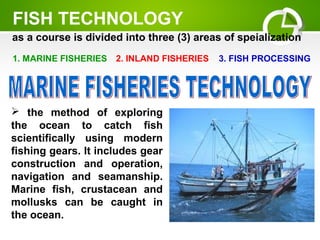
 the method of exploring
the ocean to catch fish
scientifically using modern
fishing gears. It includes gear
construction and operation,
navigation and seamanship.
Marine fish, crustacean and
mollusks can be caught in
the ocean.
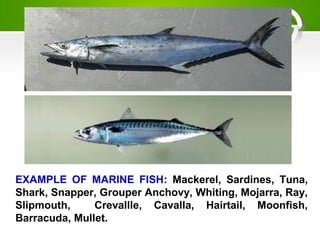
EXAMPLE OF MARINE FISH: Mackerel, Sardines, Tuna,
Shark, Snapper, Grouper Anchovy, Whiting, Mojarra, Ray,
Slipmouth, Crevallle, Cavalla, Hairtail, Moonfish,
Barracuda, Mullet.
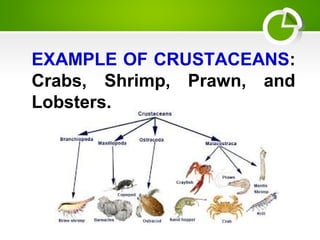
EXAMPLE OF CRUSTACEANS:
Crabs, Shrimp, Prawn, and
Lobsters.
EXAMPLE OF MOLLUSKS: Seashells, Squid, and
Octopus, Volute, Olive, Cowrie, Helmet, Oyster, Cone,
Clams.
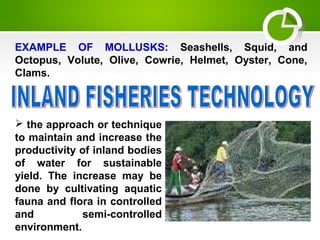
 the approach or technique
to maintain and increase the
productivity of inland bodies
of water for sustainable
yield. The increase may be
done by cultivating aquatic
fauna and flora in controlled
and semi-controlled
environment.
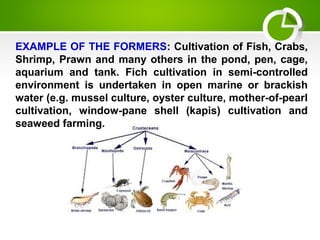
EXAMPLE OF THE FORMERS: Cultivation of Fish, Crabs,
Shrimp, Prawn and many others in the pond, pen, cage,
aquarium and tank. Fich cultivation in semi-controlled
environment is undertaken in open marine or brackish
water (e.g. mussel culture, oyster culture, mother-of-pearl
cultivation, window-pane shell (kapis) cultivation and
seaweed farming.
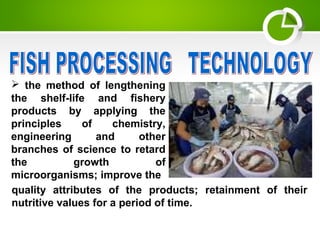
 the method of lengthening
the shelf-life and fishery
products by applying the
principles of chemistry,
engineering and other
branches of science to retard
the growth of
microorganisms; improve the
quality attributes of the products; retainment of their
nutritive values for a period of time.
EXAMPLE OF PROCESSING: Processing can be means
of Curing, Icing, Refrigerating, Freezing, Canning.
 Kench Salted Fish, Dried Fish, Smoked Fish and
Pickled Fish.
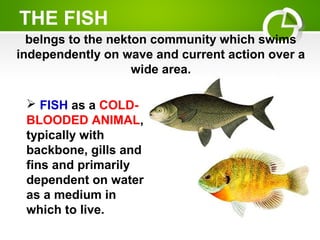
THE FISH
belngs to the nekton community which swims
independently on wave and current action over a
wide area.
 FISH as a COLD-
BLOODED ANIMAL,
typically with
backbone, gills and
fins and primarily
dependent on water
as a medium in
which to live.
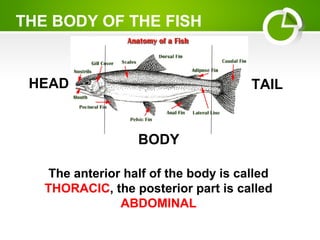
HEAD
BODY
TAIL
THE BODY OF THE FISH
The anterior half of the body is called
THORACIC, the posterior part is called
ABDOMINAL
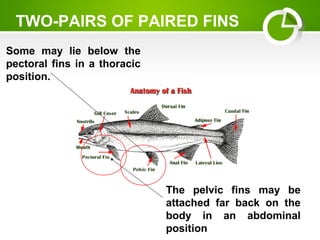
The pelvic fins may be
attached far back on the
body in an abdominal
position
TWO-PAIRS OF PAIRED FINS
Some may lie below the
pectoral fins in a thoracic
position.
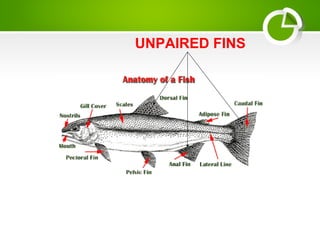
UNPAIRED FINS
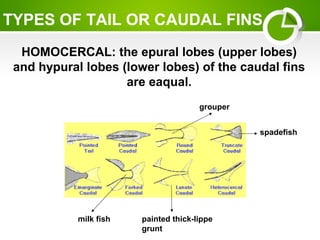
TYPES OF TAIL OR CAUDAL FINS
HOMOCERCAL: the epural lobes (upper lobes)
and hypural lobes (lower lobes) of the caudal fins
are eaqual.
painted thick-lippe
grunt
grouper
spadefish
milk fish
HETEROCERCAL: the shark is heterocercal
shape, its epural lobe is much longer than the
hypural lobe.
LEPTOCERCAL: the sting ray has a leptocercal
type of caudal fin. There is an appearance of a
whip with the vertebral column continous to the
tip of the tail.
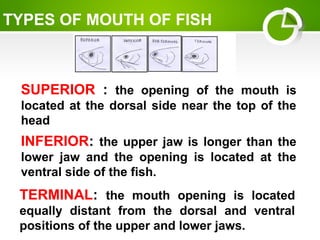
TYPES OF MOUTH OF FISH
SUPERIOR : the opening of the mouth is
located at the dorsal side near the top of the
head
INFERIOR: the upper jaw is longer than the
lower jaw and the opening is located at the
ventral side of the fish.
TERMINAL: the mouth opening is located
equally distant from the dorsal and ventral
positions of the upper and lower jaws.
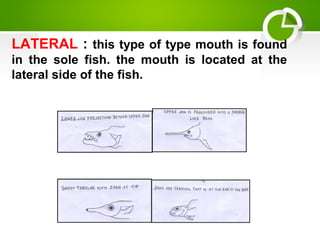
LATERAL : this type of type mouth is found
in the sole fish. the mouth is located at the
lateral side of the fish.
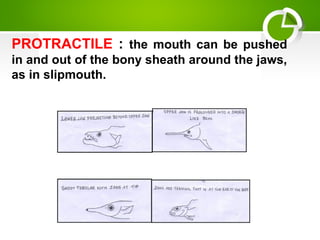
PROTRACTILE : the mouth can be pushed
in and out of the bony sheath around the jaws,
as in slipmouth.
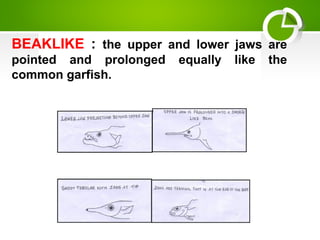
BEAKLIKE : the upper and lower jaws are
pointed and prolonged equally like the
common garfish.
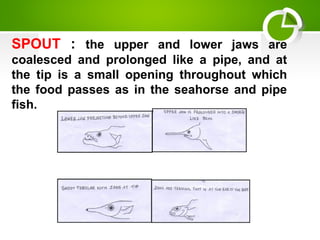
SPOUT : the upper and lower jaws are
coalesced and prolonged like a pipe, and at
the tip is a small opening throughout which
the food passes as in the seahorse and pipe
fish.
REPRODUCTION
FISH REPRODUCE BY "OVIPAROUS" OR
"VIVIPAROUS"
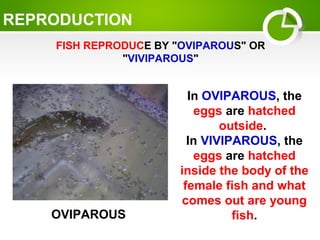
OVIPAROUS
In OVIPAROUS, the
eggs are hatched
outside.
In VIVIPAROUS, the
eggs are hatched
inside the body of the
female fish and what
comes out are young
fish.
SPAWNING HABITS
The Spawning Habits of Fish are
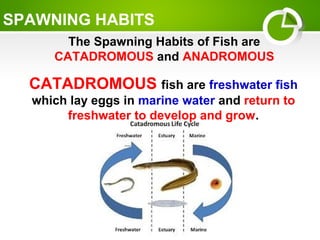
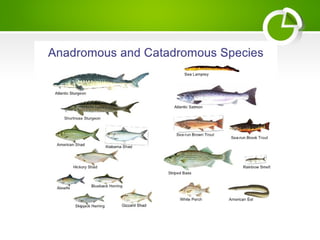
CATADROMOUS and ANADROMOUS
CATADROMOUS fish are freshwater fish
which lay eggs in marine water and return to
freshwater to develop and grow.
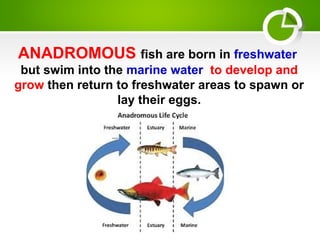
ANADROMOUS fish are born in freshwater
but swim into the marine water to develop and
grow then return to freshwater areas to spawn or
lay their eggs.
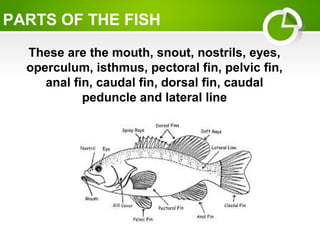
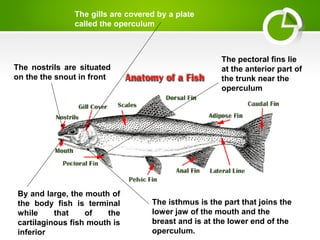
PARTS OF THE FISH
These are the mouth, snout, nostrils, eyes,
operculum, isthmus, pectoral fin, pelvic fin,
anal fin, caudal fin, dorsal fin, caudal
peduncle and lateral line
By and large, the mouth of
the body fish is terminal
while that of the
cartilaginous fish mouth is
inferior
The nostrils are situated
on the the snout in front
The gills are covered by a plate
called the operculum
The isthmus is the part that joins the
lower jaw of the mouth and the
breast and is at the lower end of the
operculum.
The pectoral fins lie
at the anterior part of
the trunk near the
operculum
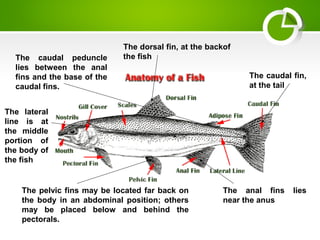
The pelvic fins may be located far back on
the body in an abdominal position; others
may be placed below and behind the
pectorals.
The anal fins lies
near the anus
The caudal fin,
at the tail
The dorsal fin, at the backof
the fishThe caudal peduncle
lies between the anal
fins and the base of the
caudal fins.
The lateral
line is at
the middle
portion of
the body of
the fish
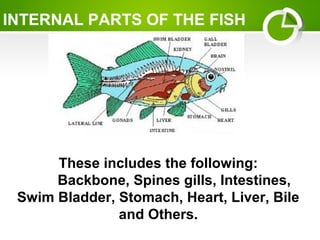
INTERNAL PARTS OF THE FISH
These includes the following:
Backbone, Spines gills, Intestines,
Swim Bladder, Stomach, Heart, Liver, Bile
and Others.
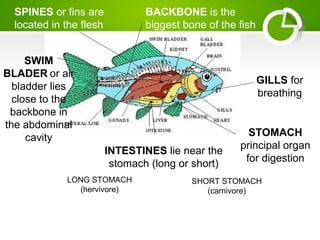
SPINES or fins are
located in the flesh
BACKBONE is the
biggest bone of the fish
GILLS for
breathing
INTESTINES lie near the
stomach (long or short)
LONG STOMACH
(hervivore)
SHORT STOMACH
(carnivore)
SWIM
BLADER or air
bladder lies
close to the
backbone in
the abdominal
cavity STOMACH
principal organ
for digestion
• Fish vary in form or shape but their parts,
both external and internal, are almost
similar. The different body forms of fish
are:
– FUSIFORM (elongated, slender, tapering
towards the head and tails)
– COMPRESSIFORM (compressed laterally,
has body which is wide, flat, circular-liked
BODY FORMS OF FISH
– DEPRESSIFORM (has body which is thin,
flat, and strongly depressed, having very
low and broad bodies
– TAENIFORM (ribbon-like body of fish
which is elongated
– ANGUILLIFORM (has a body which is
elongated usually roundfish and snake-like
– GLOBIFORM (has a short, roundfish body
and is globular
FISH CULTURE PRACTICES IN THE
PHILIPPINES
PRIMITIVE TYPE - pond consist of one or more
ponds with culvert made of hallow tre trunks for
drainage, with one or more overflow gates or
incoming and outgoing and admitting of fish fry.
ADVANTAGES
1. less capital
2. less labor exerted in the construction
3. easy to repair
4. no problem of fry supply
PRODUCTION IS LOW
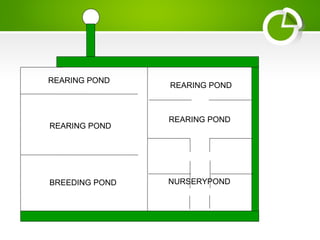
IMPROVED TYPE - high cost of fishpond
development, the layout of improved types must
be simple and functional. The nature of
compartments or unit of a fishpond project is
dependent upon the nature and quality of water
supply and the species of fish to be cultivated.
REARING POND
REARING POND
REARING POND
REARING POND
BREEDING POND NURSERYPOND

Lecture note 3

  • 1.
    BS Ag. Ed.3 NAGCARLAN, CAMPUS
  • 2.
    FISH TECHNOLOGY as acourse is divided into three (3) areas of speialization 1. MARINE FISHERIES 2. INLAND FISHERIES 3. FISH PROCESSING  the method of exploring the ocean to catch fish scientifically using modern fishing gears. It includes gear construction and operation, navigation and seamanship. Marine fish, crustacean and mollusks can be caught in the ocean.
  • 3.
    EXAMPLE OF MARINEFISH: Mackerel, Sardines, Tuna, Shark, Snapper, Grouper Anchovy, Whiting, Mojarra, Ray, Slipmouth, Crevallle, Cavalla, Hairtail, Moonfish, Barracuda, Mullet.
  • 4.
    EXAMPLE OF CRUSTACEANS: Crabs,Shrimp, Prawn, and Lobsters.
  • 5.
    EXAMPLE OF MOLLUSKS:Seashells, Squid, and Octopus, Volute, Olive, Cowrie, Helmet, Oyster, Cone, Clams.  the approach or technique to maintain and increase the productivity of inland bodies of water for sustainable yield. The increase may be done by cultivating aquatic fauna and flora in controlled and semi-controlled environment.
  • 6.
    EXAMPLE OF THEFORMERS: Cultivation of Fish, Crabs, Shrimp, Prawn and many others in the pond, pen, cage, aquarium and tank. Fich cultivation in semi-controlled environment is undertaken in open marine or brackish water (e.g. mussel culture, oyster culture, mother-of-pearl cultivation, window-pane shell (kapis) cultivation and seaweed farming.
  • 7.
     the methodof lengthening the shelf-life and fishery products by applying the principles of chemistry, engineering and other branches of science to retard the growth of microorganisms; improve the quality attributes of the products; retainment of their nutritive values for a period of time.
  • 8.
    EXAMPLE OF PROCESSING:Processing can be means of Curing, Icing, Refrigerating, Freezing, Canning.  Kench Salted Fish, Dried Fish, Smoked Fish and Pickled Fish.
  • 9.
    THE FISH belngs tothe nekton community which swims independently on wave and current action over a wide area.  FISH as a COLD- BLOODED ANIMAL, typically with backbone, gills and fins and primarily dependent on water as a medium in which to live.
  • 10.
    HEAD BODY TAIL THE BODY OFTHE FISH The anterior half of the body is called THORACIC, the posterior part is called ABDOMINAL
  • 11.
    The pelvic finsmay be attached far back on the body in an abdominal position TWO-PAIRS OF PAIRED FINS Some may lie below the pectoral fins in a thoracic position.
  • 12.
  • 13.
    TYPES OF TAILOR CAUDAL FINS HOMOCERCAL: the epural lobes (upper lobes) and hypural lobes (lower lobes) of the caudal fins are eaqual. painted thick-lippe grunt grouper spadefish milk fish
  • 14.
    HETEROCERCAL: the sharkis heterocercal shape, its epural lobe is much longer than the hypural lobe. LEPTOCERCAL: the sting ray has a leptocercal type of caudal fin. There is an appearance of a whip with the vertebral column continous to the tip of the tail.
  • 15.
    TYPES OF MOUTHOF FISH SUPERIOR : the opening of the mouth is located at the dorsal side near the top of the head INFERIOR: the upper jaw is longer than the lower jaw and the opening is located at the ventral side of the fish. TERMINAL: the mouth opening is located equally distant from the dorsal and ventral positions of the upper and lower jaws.
  • 16.
    LATERAL : thistype of type mouth is found in the sole fish. the mouth is located at the lateral side of the fish.
  • 17.
    PROTRACTILE : themouth can be pushed in and out of the bony sheath around the jaws, as in slipmouth.
  • 18.
    BEAKLIKE : theupper and lower jaws are pointed and prolonged equally like the common garfish.
  • 19.
    SPOUT : theupper and lower jaws are coalesced and prolonged like a pipe, and at the tip is a small opening throughout which the food passes as in the seahorse and pipe fish.
  • 20.
    REPRODUCTION FISH REPRODUCE BY"OVIPAROUS" OR "VIVIPAROUS" OVIPAROUS In OVIPAROUS, the eggs are hatched outside. In VIVIPAROUS, the eggs are hatched inside the body of the female fish and what comes out are young fish.
  • 21.
    SPAWNING HABITS The SpawningHabits of Fish are CATADROMOUS and ANADROMOUS CATADROMOUS fish are freshwater fish which lay eggs in marine water and return to freshwater to develop and grow.
  • 22.
    ANADROMOUS fish areborn in freshwater but swim into the marine water to develop and grow then return to freshwater areas to spawn or lay their eggs.
  • 24.
    PARTS OF THEFISH These are the mouth, snout, nostrils, eyes, operculum, isthmus, pectoral fin, pelvic fin, anal fin, caudal fin, dorsal fin, caudal peduncle and lateral line
  • 25.
    By and large,the mouth of the body fish is terminal while that of the cartilaginous fish mouth is inferior The nostrils are situated on the the snout in front The gills are covered by a plate called the operculum The isthmus is the part that joins the lower jaw of the mouth and the breast and is at the lower end of the operculum. The pectoral fins lie at the anterior part of the trunk near the operculum
  • 26.
    The pelvic finsmay be located far back on the body in an abdominal position; others may be placed below and behind the pectorals. The anal fins lies near the anus The caudal fin, at the tail The dorsal fin, at the backof the fishThe caudal peduncle lies between the anal fins and the base of the caudal fins. The lateral line is at the middle portion of the body of the fish
  • 27.
    INTERNAL PARTS OFTHE FISH These includes the following: Backbone, Spines gills, Intestines, Swim Bladder, Stomach, Heart, Liver, Bile and Others.
  • 28.
    SPINES or finsare located in the flesh BACKBONE is the biggest bone of the fish GILLS for breathing INTESTINES lie near the stomach (long or short) LONG STOMACH (hervivore) SHORT STOMACH (carnivore) SWIM BLADER or air bladder lies close to the backbone in the abdominal cavity STOMACH principal organ for digestion
  • 29.
    • Fish varyin form or shape but their parts, both external and internal, are almost similar. The different body forms of fish are: – FUSIFORM (elongated, slender, tapering towards the head and tails) – COMPRESSIFORM (compressed laterally, has body which is wide, flat, circular-liked BODY FORMS OF FISH
  • 30.
    – DEPRESSIFORM (hasbody which is thin, flat, and strongly depressed, having very low and broad bodies – TAENIFORM (ribbon-like body of fish which is elongated – ANGUILLIFORM (has a body which is elongated usually roundfish and snake-like – GLOBIFORM (has a short, roundfish body and is globular
  • 31.
    FISH CULTURE PRACTICESIN THE PHILIPPINES PRIMITIVE TYPE - pond consist of one or more ponds with culvert made of hallow tre trunks for drainage, with one or more overflow gates or incoming and outgoing and admitting of fish fry. ADVANTAGES 1. less capital 2. less labor exerted in the construction 3. easy to repair 4. no problem of fry supply PRODUCTION IS LOW
  • 32.
    IMPROVED TYPE -high cost of fishpond development, the layout of improved types must be simple and functional. The nature of compartments or unit of a fishpond project is dependent upon the nature and quality of water supply and the species of fish to be cultivated.
  • 33.
    REARING POND REARING POND REARINGPOND REARING POND BREEDING POND NURSERYPOND