WEAVING A PERSONAL WEB:
USING ONLINE TECHNOLOGIES
TO CREATE CUSTOMIZED,
CONNECTED, AND DYNAMIC
LEARNING ENVIRONMENTS
BY JESSICA MCELVANEY & ZANE BERGE
Presented by:
Harmeet Kaur
Student id: 2117534
“… we find ourselves awash in petabytes
of information of widely varying quality.”
How can this flood of information be
managed and used to the learner’s
advantage?
(p. 2)
PERSONAL WEB TEHNOLOGIES
“……Customized, personal web- based environments… that
explicitly support one’s social, professional, and learning….
Activities via highly personalised windows to the networked world”
(p 1)
1. Social bookmarking and research tools
2. Personal publishing tools
3. Aggregators and Metagators
4. widgets
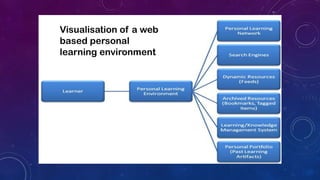
Visualisation of a web
based personal
learning environment
SOCIAL BOOKMARKING AND RESEARCH
TOOLS
Online storage of web
pages, articles and other
media
Allow users to organise
and share information
easily and in meaningful
way
Includes bibliographic
feature (zotero and
connote)
Personal publishing tools
Free and user- friendly to publish oneself on
the internet
Ranges from content- focused, formal blog
posts to socially- focused, informal messages
Blogging used to create an individualised
content management system that publishes,
organises, and archives an on- going activity
feed of a student’s learning
aggregators metagatores
Filter online information and
collect articles, media, and
conversations customized to
the user’s needs; saving time
and effort (p 4)
Allows to manage the tools,
networks, content, and websites,
without visiting and logging in to
multiple sites
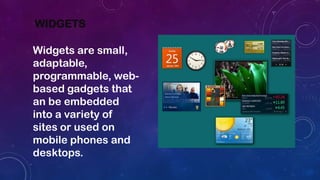
WIDGETS
Widgets are small,
adaptable,
programmable, web-
based gadgets that
an be embedded
into a variety of
sites or used on
mobile phones and
desktops.
USE OF PWT’S SUPPORTS CONNECTIVISM
THEORY OF LEARNING
Knowledge rests in networks
Knowledge may reside in non- human appliances
and learning is enabled/ facilitated by technology
Accurate and up to date knowledge is the intent
of all connectivist learning activities
Using personal web technologies to create PLEs
and PLNs
Personal learning environments (PLEs) is the sum of
websites and technologies that an individual makes use
of to learn.
Personal learning network is a network of colleagues
and friends from around the world by joining social
networking sites.
now majority of PWTs have mobile friendly version
available, they can be accessed anywhere and anytime.
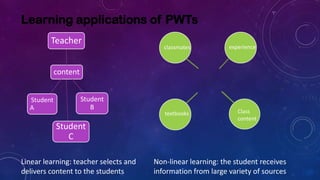
Learning applications of PWTs
content
Teacher
Student
B
Student
A
Student
C
Linear learning: teacher selects and
delivers content to the students
classmates experience
textbooks Class
content
Non-linear learning: the student receives
information from large variety of sources
Disadvantages of using PWTs
1.Connection addiction
2.Work interrupted
3.Popularity contests
4.Echo chambers
5.Privacy and security concerns
Questions and concerns
1. Which learning method is the better way to use PWTs: Linear learning or non-
linear learning
Group A: think about it as a teacher
Group B: think about it as a learner
2. “It is possible for some well- known individuals ( such as internet celebrities)
to dominate the online discussion, by gathering large number of followers,
who amplify their ideas and opinions by supporting and spreading them
around the internet. Valuable or innovative ideas put forth by lesser- known
individuals can easily become lost in the noise”
Do you agree or disagree with this statement? Share your opinion and
experience.
Conclusion
Learners need to discard their role as passive
consumers of information and to take on new
roles
Learner must become active learner and
editor to effectively use the PWTs.
Teachers and trainers can encourage the use
of PWTs, but true quality and effectiveness of
a PLE or PLN depends on the learners
him/herself.
Thankyou for your valuable time

Weaving a personal web

  • 1.
    WEAVING A PERSONALWEB: USING ONLINE TECHNOLOGIES TO CREATE CUSTOMIZED, CONNECTED, AND DYNAMIC LEARNING ENVIRONMENTS BY JESSICA MCELVANEY & ZANE BERGE Presented by: Harmeet Kaur Student id: 2117534
  • 2.
    “… we findourselves awash in petabytes of information of widely varying quality.” How can this flood of information be managed and used to the learner’s advantage? (p. 2)
  • 3.
    PERSONAL WEB TEHNOLOGIES “……Customized,personal web- based environments… that explicitly support one’s social, professional, and learning…. Activities via highly personalised windows to the networked world” (p 1) 1. Social bookmarking and research tools 2. Personal publishing tools 3. Aggregators and Metagators 4. widgets
  • 4.
    Visualisation of aweb based personal learning environment
  • 5.
    SOCIAL BOOKMARKING ANDRESEARCH TOOLS Online storage of web pages, articles and other media Allow users to organise and share information easily and in meaningful way Includes bibliographic feature (zotero and connote)
  • 6.
    Personal publishing tools Freeand user- friendly to publish oneself on the internet Ranges from content- focused, formal blog posts to socially- focused, informal messages Blogging used to create an individualised content management system that publishes, organises, and archives an on- going activity feed of a student’s learning
  • 7.
    aggregators metagatores Filter onlineinformation and collect articles, media, and conversations customized to the user’s needs; saving time and effort (p 4) Allows to manage the tools, networks, content, and websites, without visiting and logging in to multiple sites
  • 8.
    WIDGETS Widgets are small, adaptable, programmable,web- based gadgets that an be embedded into a variety of sites or used on mobile phones and desktops.
  • 9.
    USE OF PWT’SSUPPORTS CONNECTIVISM THEORY OF LEARNING Knowledge rests in networks Knowledge may reside in non- human appliances and learning is enabled/ facilitated by technology Accurate and up to date knowledge is the intent of all connectivist learning activities
  • 10.
    Using personal webtechnologies to create PLEs and PLNs Personal learning environments (PLEs) is the sum of websites and technologies that an individual makes use of to learn. Personal learning network is a network of colleagues and friends from around the world by joining social networking sites. now majority of PWTs have mobile friendly version available, they can be accessed anywhere and anytime.
  • 11.
    Learning applications ofPWTs content Teacher Student B Student A Student C Linear learning: teacher selects and delivers content to the students classmates experience textbooks Class content Non-linear learning: the student receives information from large variety of sources
  • 12.
    Disadvantages of usingPWTs 1.Connection addiction 2.Work interrupted 3.Popularity contests 4.Echo chambers 5.Privacy and security concerns
  • 13.
    Questions and concerns 1.Which learning method is the better way to use PWTs: Linear learning or non- linear learning Group A: think about it as a teacher Group B: think about it as a learner 2. “It is possible for some well- known individuals ( such as internet celebrities) to dominate the online discussion, by gathering large number of followers, who amplify their ideas and opinions by supporting and spreading them around the internet. Valuable or innovative ideas put forth by lesser- known individuals can easily become lost in the noise” Do you agree or disagree with this statement? Share your opinion and experience.
  • 14.
    Conclusion Learners need todiscard their role as passive consumers of information and to take on new roles Learner must become active learner and editor to effectively use the PWTs. Teachers and trainers can encourage the use of PWTs, but true quality and effectiveness of a PLE or PLN depends on the learners him/herself.
  • 15.
    Thankyou for yourvaluable time