Dr. Judy Baker, Dean of Foothill Global Access Learning Commons Collaborative Open  Online Learning
Distance Learning in the Web 2.0 Era Challenges Causes Solutions Action
Challenges in Distance Learning Concerned ? Lack of student engagement  Ease of student cheating Rising cost of LMS, textbooks and course development  Disappointed ?  Low enrollments Poor retention Low student success
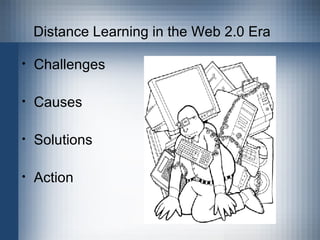
What is wrong with this picture? Technology driven  pedagogy Publisher directed  curriculum and  learning objects
Causes:  Current Distance Learning Model LMS Closed system One-to-few Few-to-few Enrollment limits Underutilizes internet as a medium for collaborative and networked learning
LMS Limits Learning LMS and publishers’ materials not suited to meet the need for: Dynamic online learning content Interaction Collaboration Networking Faculty and students lose  control of the learning process  when textbook publishers  provide a tempting array of  fast-food style  instructional tools
Use of LMS and Publishers’ Materials: Unintended Consequences May undermine online faculty development  Technological determinism More difficult for faculty and students to assert self in the course Commodification of distance teaching and learning by textbook publishing industry  Publisher cost of developing materials passed on  to all textbooks Homogeneity of courses all developed from same prepackaged course materials Standardization, conformity and sanitization Test question pools promote limited type  of testing with little prevention of cheating
Felt as engaged with online courses as they do with: Ebay Instant messenger myspace, friendster, and facebook Amazon.com What If Distance Learners …
Solution: Unlock Learning Learning without LMS Social software  accommodates student  demands for  self-expression and  rapid interaction Self-sustaining and scalable  educational delivery Course content collaborative, networked, current, dynamic, and flexible
Open Access to Online Courses   Sofia at Foothill De Anza Community College District   Utah State University Open  CourseWare   MIT Open Courseware   Rice University  Connexions
Beyond Open Access Courses: E-learning 2.0 “ E-learning 2.0” coined by Canadian researcher  Stephen Downes in fall 2005  Describes students as controllers and creators of learning Before “ artificial and often contrived "discussions" supported by learning management systems….communities were typically limited to a given group of learners, such as a … class, had a fixed start and end-point”  “ e-learning as … a type of content, produced by publishers, organized  and structured into courses, and consumed by students” Now and Future Online learning software ceases to be a type of content-consumption tool Learning is "delivered" and becomes more like a content-authoring tool Learning is created Content, it is used rather than read— more likely to be produced by students than courseware authors Structure…more likely to resemble a language or a conversation rather than a book or a manual”
Learning Commons   COOL Model:   Collaborative Open Online  Learning Delivery of online courses in a learning commons for collaborative and dynamic courseware Open access to online courses for faculty, students, and self-learners throughout the world Learners build on and extend  each other's ideas which  creates iterative and  community-owned content  Courses run as a self-regulated  social systems
COOL Course Features   Course development an iterative process based on input from participants/students who enroll  Content changes made via a wiki-like process of ongoing edits based on group approval or vetting Learner-defined glossary subject to review and revision by all participants  Authentic and participatory student assessment
Tools for Learning Need to allow for self-expression  (e.g., blogs, wikis, etc.) Digital repositories of personal artifacts (e-portfolios)  Tools For Content interaction and collaboration (shared workspaces, collaborative tools)  For connecting with instructors/ mentors/other learners (discussion forums, peer-to-peer social tools, virtual communities)  For searching and ranking educational resources (search engines, semantic content filters)  that engage and facilitate higher-order learning (databases, spreadsheets, simulations, expert systems, and virtual worlds)   Foster participatory and authentic assessment
 
Leverage Social Software for Learning Flip the Funnel  Give megaphone to  students who love to  learn and love the topic Word-of-mouth or viral  marketing technique Leverage social software for teaching E.g.,  del.icio.us ,  Flickr  and  Squidoo  to generate grassroots interest in sharing of information, knowledge and resources
COOL Course Features Social software  chat instant messaging student blogs group use wiki Polling ongoing formative evaluation (feedback) for the course instructor gives participant/students opportunities to improve their evaluation skills
Iterative Course Development High quality in COOL courses Collective wisdom Large and potentially international pool of educators, experts, and participants/students continuously scrutinize and revise course materials  Foster ongoing course improvements By including participant/students in the  course content development process,  faculty and experts from anywhere  can contribute Resulting course content reflects  greater breadth and depth of instructional material than ever possible under more traditional online course development processes
Participatory Assessment Exam process includes students  making up questions answering other students' questions  grading answers to questions they author  appealing the grades Exam process involves  collaboration between students  and/or experts to derive answers
Curious ?
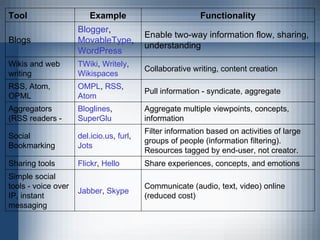
Communicate (audio, text, video) online (reduced cost) Jabber ,  Skype Simple social tools - voice over IP, instant messaging Share experiences, concepts, and emotions Flickr ,  Hello Sharing tools Filter information based on activities of large groups of people (information filtering). Resources tagged by end-user, not creator. del.icio.us ,  furl ,  Jots Social Bookmarking  Aggregate multiple viewpoints, concepts, information Bloglines ,  SuperGlu Aggregators (RSS readers -  Pull information - syndicate, aggregate OMPL ,  RSS ,  Atom RSS, Atom, OPML Collaborative writing, content creation TWiki ,  Writely ,  Wikispaces Wikis and web writing  Enable two-way information flow, sharing, understanding Blogger ,  MovableType ,  WordPress Blogs  Functionality Example Tool
Reduces cost of "being online" for high-bandwidth media ourmedia ,  Google Video Hosting services  Broadcast views/opinions Odeo Podcasts  Discover/find people of similar interest Facebook ,  ELGG Social Network  Capture and organize digital information. ELGG ,  Plone Content management  Integrate functionality of different tools - blogs, wikis, filtering, tags, etc. Open integration (i.e. integration enable ease of use, but needs to be based on open protocols in order for value to accrue to the end user, not the software maker) is critical for mainstream adoption. Flock ,  ELGG Integrated suites  Collaborate and function as a team/group - includes calendar, brainstorming tools,  Groove Groupware  Functionality Example Tool

Collaborative Open Online Learning

  • 1.
    Dr. Judy Baker,Dean of Foothill Global Access Learning Commons Collaborative Open Online Learning
  • 2.
    Distance Learning inthe Web 2.0 Era Challenges Causes Solutions Action
  • 3.
    Challenges in DistanceLearning Concerned ? Lack of student engagement Ease of student cheating Rising cost of LMS, textbooks and course development Disappointed ? Low enrollments Poor retention Low student success
  • 4.
    What is wrongwith this picture? Technology driven pedagogy Publisher directed curriculum and learning objects
  • 5.
    Causes: CurrentDistance Learning Model LMS Closed system One-to-few Few-to-few Enrollment limits Underutilizes internet as a medium for collaborative and networked learning
  • 6.
    LMS Limits LearningLMS and publishers’ materials not suited to meet the need for: Dynamic online learning content Interaction Collaboration Networking Faculty and students lose control of the learning process when textbook publishers provide a tempting array of fast-food style instructional tools
  • 7.
    Use of LMSand Publishers’ Materials: Unintended Consequences May undermine online faculty development Technological determinism More difficult for faculty and students to assert self in the course Commodification of distance teaching and learning by textbook publishing industry Publisher cost of developing materials passed on to all textbooks Homogeneity of courses all developed from same prepackaged course materials Standardization, conformity and sanitization Test question pools promote limited type of testing with little prevention of cheating
  • 8.
    Felt as engagedwith online courses as they do with: Ebay Instant messenger myspace, friendster, and facebook Amazon.com What If Distance Learners …
  • 9.
    Solution: Unlock LearningLearning without LMS Social software accommodates student demands for self-expression and rapid interaction Self-sustaining and scalable educational delivery Course content collaborative, networked, current, dynamic, and flexible
  • 10.
    Open Access toOnline Courses Sofia at Foothill De Anza Community College District Utah State University Open CourseWare MIT Open Courseware Rice University Connexions
  • 11.
    Beyond Open AccessCourses: E-learning 2.0 “ E-learning 2.0” coined by Canadian researcher Stephen Downes in fall 2005 Describes students as controllers and creators of learning Before “ artificial and often contrived "discussions" supported by learning management systems….communities were typically limited to a given group of learners, such as a … class, had a fixed start and end-point” “ e-learning as … a type of content, produced by publishers, organized and structured into courses, and consumed by students” Now and Future Online learning software ceases to be a type of content-consumption tool Learning is "delivered" and becomes more like a content-authoring tool Learning is created Content, it is used rather than read— more likely to be produced by students than courseware authors Structure…more likely to resemble a language or a conversation rather than a book or a manual”
  • 12.
    Learning Commons COOL Model: Collaborative Open Online Learning Delivery of online courses in a learning commons for collaborative and dynamic courseware Open access to online courses for faculty, students, and self-learners throughout the world Learners build on and extend each other's ideas which creates iterative and community-owned content Courses run as a self-regulated social systems
  • 13.
    COOL Course Features Course development an iterative process based on input from participants/students who enroll Content changes made via a wiki-like process of ongoing edits based on group approval or vetting Learner-defined glossary subject to review and revision by all participants Authentic and participatory student assessment
  • 14.
    Tools for LearningNeed to allow for self-expression (e.g., blogs, wikis, etc.) Digital repositories of personal artifacts (e-portfolios) Tools For Content interaction and collaboration (shared workspaces, collaborative tools) For connecting with instructors/ mentors/other learners (discussion forums, peer-to-peer social tools, virtual communities) For searching and ranking educational resources (search engines, semantic content filters) that engage and facilitate higher-order learning (databases, spreadsheets, simulations, expert systems, and virtual worlds) Foster participatory and authentic assessment
  • 15.
  • 16.
    Leverage Social Softwarefor Learning Flip the Funnel Give megaphone to students who love to learn and love the topic Word-of-mouth or viral marketing technique Leverage social software for teaching E.g., del.icio.us , Flickr and Squidoo to generate grassroots interest in sharing of information, knowledge and resources
  • 17.
    COOL Course FeaturesSocial software chat instant messaging student blogs group use wiki Polling ongoing formative evaluation (feedback) for the course instructor gives participant/students opportunities to improve their evaluation skills
  • 18.
    Iterative Course DevelopmentHigh quality in COOL courses Collective wisdom Large and potentially international pool of educators, experts, and participants/students continuously scrutinize and revise course materials Foster ongoing course improvements By including participant/students in the course content development process, faculty and experts from anywhere can contribute Resulting course content reflects greater breadth and depth of instructional material than ever possible under more traditional online course development processes
  • 19.
    Participatory Assessment Examprocess includes students making up questions answering other students' questions grading answers to questions they author appealing the grades Exam process involves collaboration between students and/or experts to derive answers
  • 20.
  • 21.
    Communicate (audio, text,video) online (reduced cost) Jabber , Skype Simple social tools - voice over IP, instant messaging Share experiences, concepts, and emotions Flickr , Hello Sharing tools Filter information based on activities of large groups of people (information filtering). Resources tagged by end-user, not creator. del.icio.us , furl , Jots Social Bookmarking Aggregate multiple viewpoints, concepts, information Bloglines , SuperGlu Aggregators (RSS readers - Pull information - syndicate, aggregate OMPL , RSS , Atom RSS, Atom, OPML Collaborative writing, content creation TWiki , Writely , Wikispaces Wikis and web writing Enable two-way information flow, sharing, understanding Blogger , MovableType , WordPress Blogs Functionality Example Tool
  • 22.
    Reduces cost of"being online" for high-bandwidth media ourmedia , Google Video Hosting services Broadcast views/opinions Odeo Podcasts Discover/find people of similar interest Facebook , ELGG Social Network Capture and organize digital information. ELGG , Plone Content management Integrate functionality of different tools - blogs, wikis, filtering, tags, etc. Open integration (i.e. integration enable ease of use, but needs to be based on open protocols in order for value to accrue to the end user, not the software maker) is critical for mainstream adoption. Flock , ELGG Integrated suites Collaborate and function as a team/group - includes calendar, brainstorming tools, Groove Groupware Functionality Example Tool