Cognitive Computing
AND THE FUTURE OF ARTIFICIAL INTELLIGENCE
Cognitive Computing
 Mimicking functioning of Human Brain and handling Human kind of
problems.
 Synthesis of not just information sources but also of influences, contexts,
and insights.
 Answer that is “best” rather than “right”.
 Finding patterns to form the answer rather than looking for the answer
itself.
 Learns by experience and instructions given.
 Redefines the relationship between the people and their increasingly
pervasive digital environment.
 Cognitive computing systems learn and interact naturally with people to
extend what either humans or machine could do on their own. They help
human experts make better decisions by penetrating the complexity of Big
Data.
 It will forever change the way people interact with computing systems to
help people extend their expertise across any domain of knowledge and
make complex decisions involving extraordinary volumes of fast
moving Big Data.
 Cognitive systems can quickly identify new patterns and insights. Over
time, they will simulate even more closely how the brain actually works.
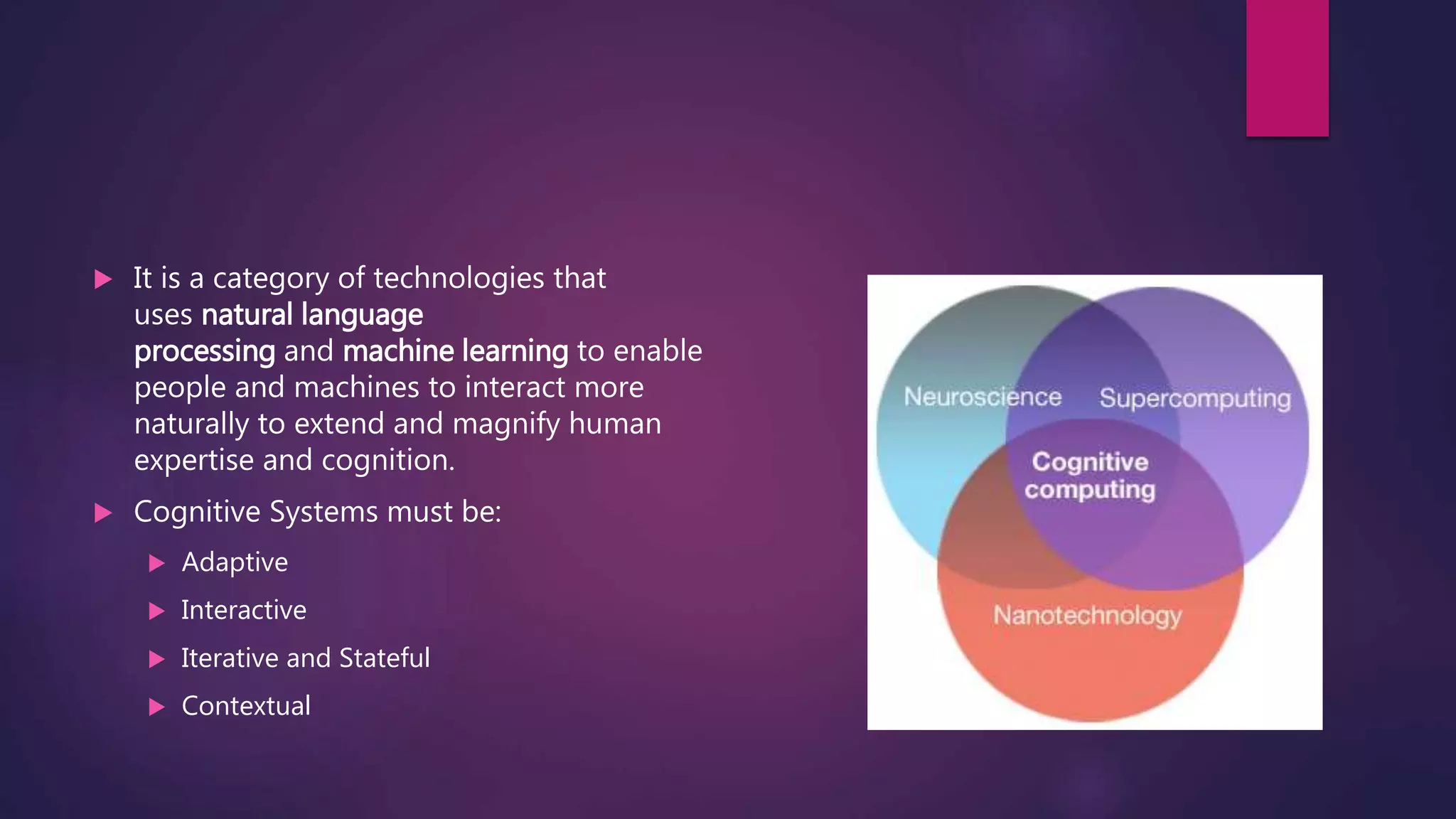
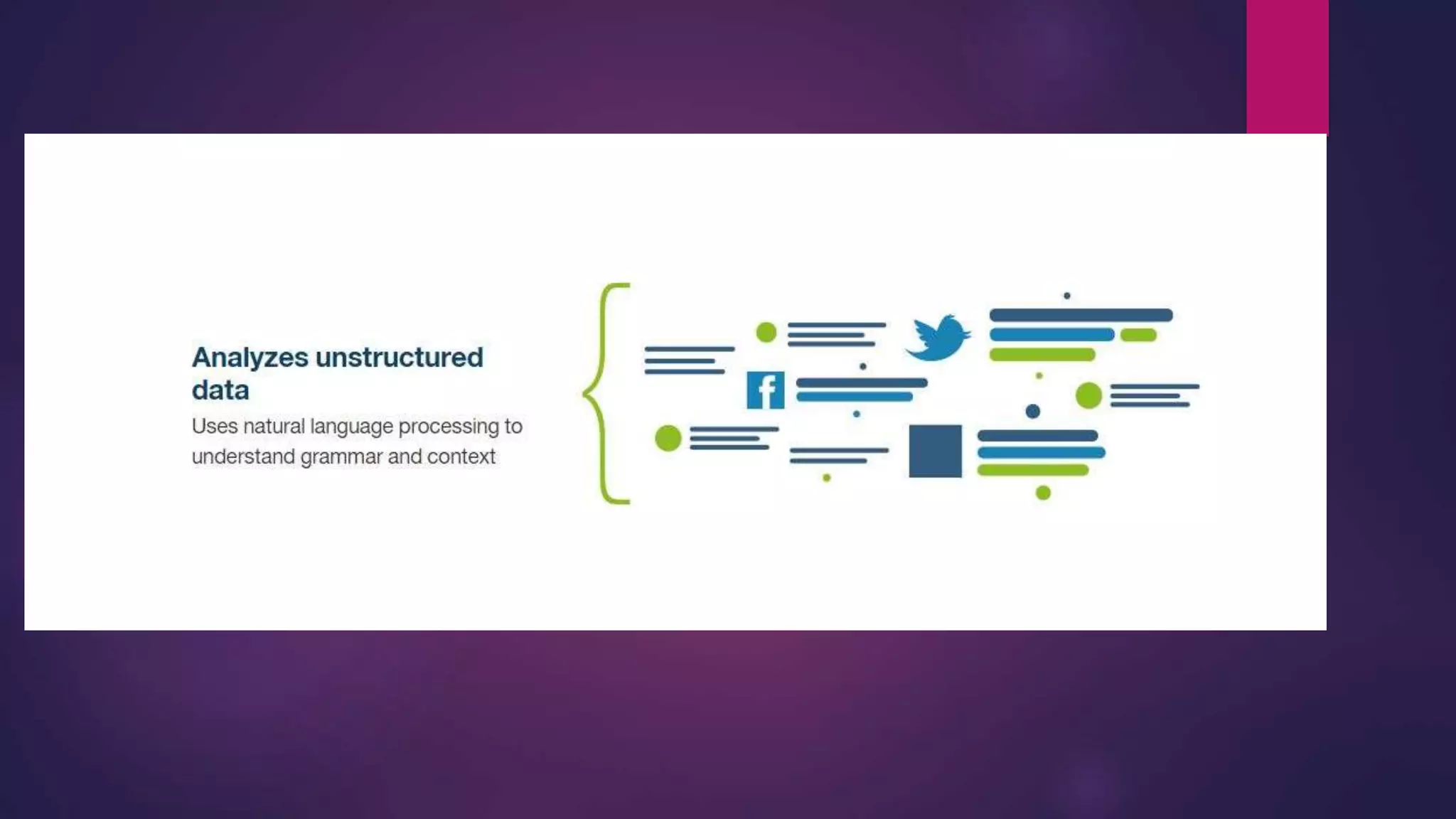
 It is a category of technologies that
uses natural language
processing and machine learning to enable
people and machines to interact more
naturally to extend and magnify human
expertise and cognition.
 Cognitive Systems must be:
 Adaptive
 Interactive
 Iterative and Stateful
 Contextual
Cognitive Environment
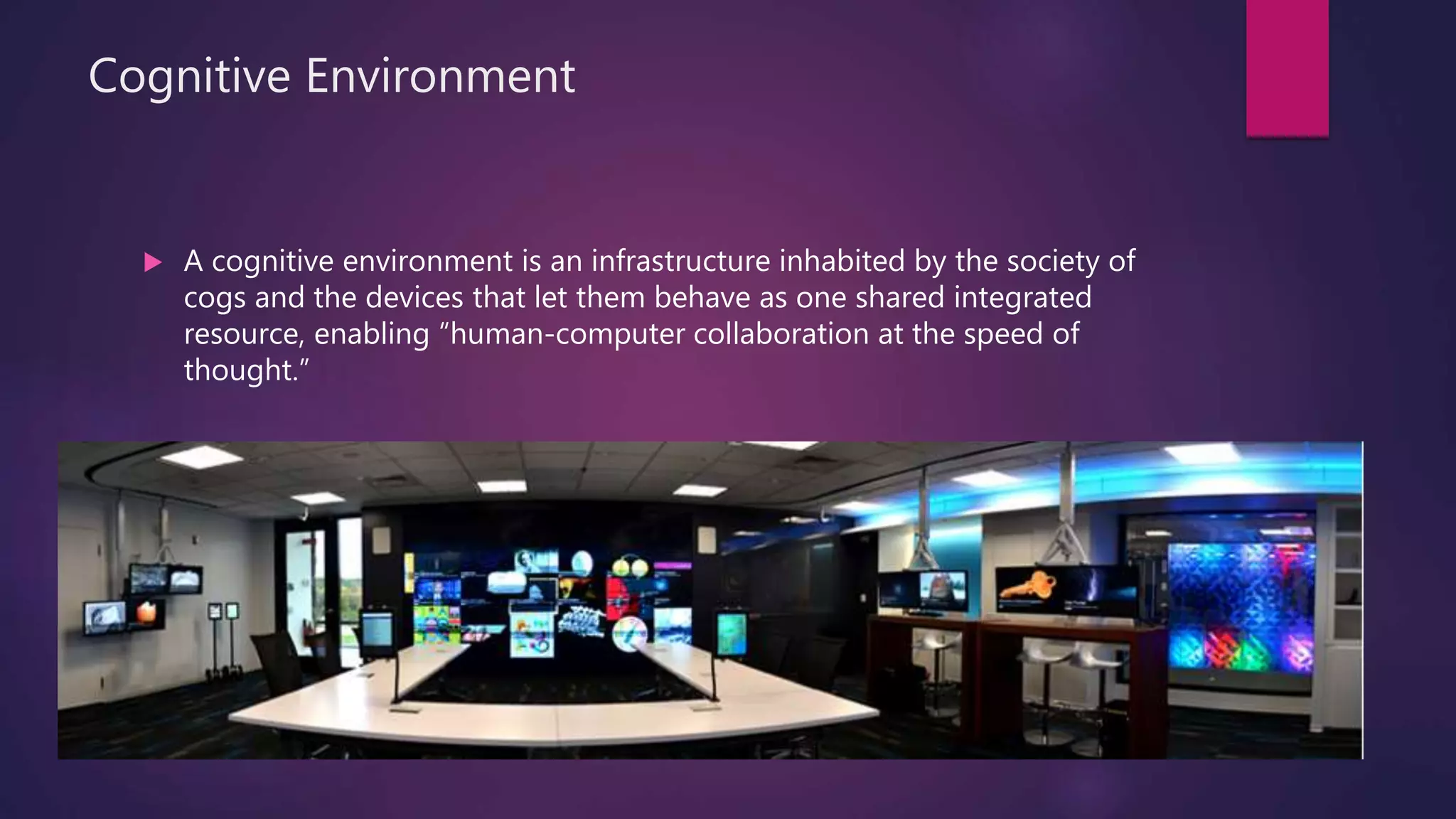
 A cognitive environment is an infrastructure inhabited by the society of
cogs and the devices that let them behave as one shared integrated
resource, enabling “human-computer collaboration at the speed of
thought.”
Artificial intelligence
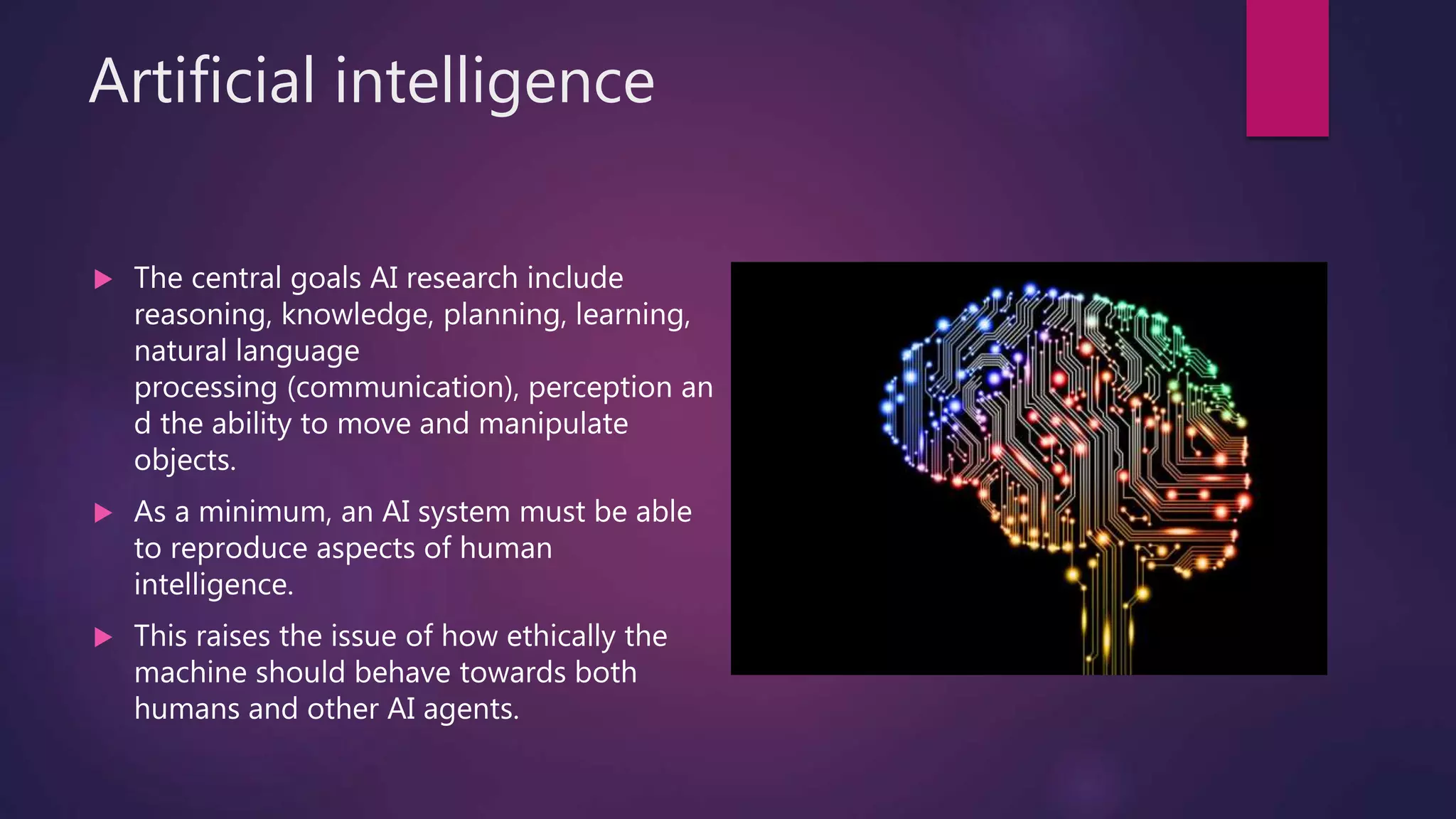
 The central goals AI research include
reasoning, knowledge, planning, learning,
natural language
processing (communication), perception an
d the ability to move and manipulate
objects.
 As a minimum, an AI system must be able
to reproduce aspects of human
intelligence.
 This raises the issue of how ethically the
machine should behave towards both
humans and other AI agents.
Future of artificial intelligence
 Humans should not assume machines or robots would treat us favorably,
because there is no prior reason to believe that they would be sympathetic
to our system of morality.
 Hyper-intelligent software may not necessarily decide to support the
continued existence of mankind, and would be extremely difficult to stop.
 Physicist Stephen Hawking, Microsoft founder Bill Gates and SpaceX
founder Elon Musk have expressed concerns about the possibility that AI
could evolve to the point that humans could not control it, with Hawking
theorizing that this could "spell the end of the human race".
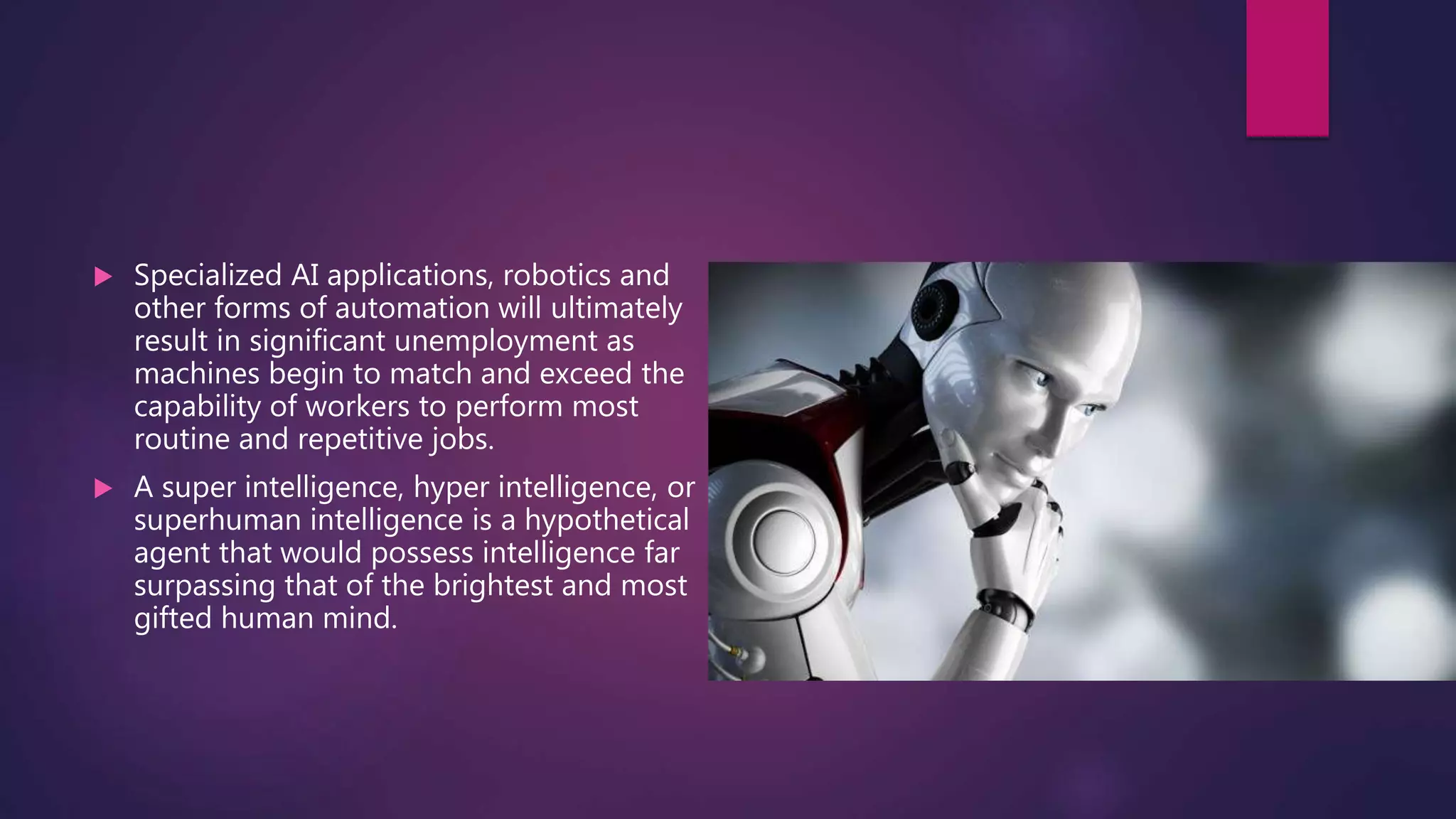
 Specialized AI applications, robotics and
other forms of automation will ultimately
result in significant unemployment as
machines begin to match and exceed the
capability of workers to perform most
routine and repetitive jobs.
 A super intelligence, hyper intelligence, or
superhuman intelligence is a hypothetical
agent that would possess intelligence far
surpassing that of the brightest and most
gifted human mind.
 If research into Strong AI produced sufficiently intelligent software, it
might be able to reprogram and improve itself. The improved software
would be even better at improving itself, leading to recursive self-
improvement.
 The new intelligence could thus increase exponentially and dramatically
surpass humans. This will give birth to Technological Singularity.
 Technological Singularity will be the beginning of the end of mankind.

Cognitive computing

  • 1.
    Cognitive Computing AND THEFUTURE OF ARTIFICIAL INTELLIGENCE
  • 2.
    Cognitive Computing  Mimickingfunctioning of Human Brain and handling Human kind of problems.  Synthesis of not just information sources but also of influences, contexts, and insights.  Answer that is “best” rather than “right”.  Finding patterns to form the answer rather than looking for the answer itself.  Learns by experience and instructions given.  Redefines the relationship between the people and their increasingly pervasive digital environment.
  • 3.
     Cognitive computingsystems learn and interact naturally with people to extend what either humans or machine could do on their own. They help human experts make better decisions by penetrating the complexity of Big Data.  It will forever change the way people interact with computing systems to help people extend their expertise across any domain of knowledge and make complex decisions involving extraordinary volumes of fast moving Big Data.  Cognitive systems can quickly identify new patterns and insights. Over time, they will simulate even more closely how the brain actually works.
  • 4.
     It isa category of technologies that uses natural language processing and machine learning to enable people and machines to interact more naturally to extend and magnify human expertise and cognition.  Cognitive Systems must be:  Adaptive  Interactive  Iterative and Stateful  Contextual
  • 6.
    Cognitive Environment  Acognitive environment is an infrastructure inhabited by the society of cogs and the devices that let them behave as one shared integrated resource, enabling “human-computer collaboration at the speed of thought.”
  • 15.
    Artificial intelligence  Thecentral goals AI research include reasoning, knowledge, planning, learning, natural language processing (communication), perception an d the ability to move and manipulate objects.  As a minimum, an AI system must be able to reproduce aspects of human intelligence.  This raises the issue of how ethically the machine should behave towards both humans and other AI agents.
  • 16.
    Future of artificialintelligence  Humans should not assume machines or robots would treat us favorably, because there is no prior reason to believe that they would be sympathetic to our system of morality.  Hyper-intelligent software may not necessarily decide to support the continued existence of mankind, and would be extremely difficult to stop.  Physicist Stephen Hawking, Microsoft founder Bill Gates and SpaceX founder Elon Musk have expressed concerns about the possibility that AI could evolve to the point that humans could not control it, with Hawking theorizing that this could "spell the end of the human race".
  • 17.
     Specialized AIapplications, robotics and other forms of automation will ultimately result in significant unemployment as machines begin to match and exceed the capability of workers to perform most routine and repetitive jobs.  A super intelligence, hyper intelligence, or superhuman intelligence is a hypothetical agent that would possess intelligence far surpassing that of the brightest and most gifted human mind.
  • 18.
     If researchinto Strong AI produced sufficiently intelligent software, it might be able to reprogram and improve itself. The improved software would be even better at improving itself, leading to recursive self- improvement.  The new intelligence could thus increase exponentially and dramatically surpass humans. This will give birth to Technological Singularity.  Technological Singularity will be the beginning of the end of mankind.