Network Security Risks and
Challenges for Enterprises
Source : Cisco
Perceptions of Security Risk
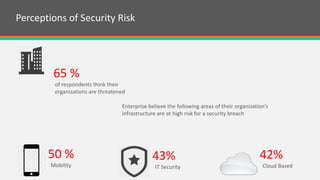
65 %
of respondents think their
organizations are threatened
Enterprise believe the following areas of their organization’s
infrastructure are at high risk for a security breach
50 %
Mobility
43%
IT Security
42%
Cloud Based
The relentless rise in information security breaches underscores the deep need for
enterprises to trust that their systems, data, business partners, customers, and
citizens are safe. We are seeing trust become a major factor for businesses selecting
IT and networking infrastructure. In fact, many are now requiring that security and
trustworthiness be integrated throughout the product lifecycle of the solutions that
comprise their infrastructure.
Trustworthiness : The Major Factor
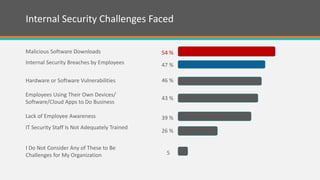
Internal Security Challenges Faced
Malicious Software Downloads
Internal Security Breaches by Employees
Hardware or Software Vulnerabilities
Employees Using Their Own Devices/
Software/Cloud Apps to Do Business
Lack of Employee Awareness
IT Security Staff Is Not Adequately Trained
I Do Not Consider Any of These to Be
Challenges for My Organization
54 %
47 %
46 %
43 %
39 %
26 %
5
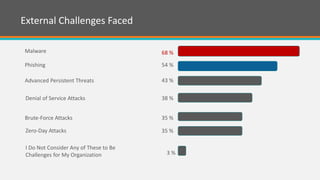
External Challenges Faced
Malware
Phishing
Advanced Persistent Threats
Denial of Service Attacks
Brute-Force Attacks
Zero-Day Attacks
I Do Not Consider Any of These to Be
Challenges for My Organization
68 %
54 %
43 %
38 %
35 %
35 %
3 %
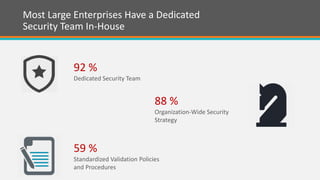
Most Large Enterprises Have a Dedicated
Security Team In-House
92 %
Dedicated Security Team
88 %
Organization-Wide Security
Strategy
59 %
Standardized Validation Policies
and Procedures
How Vendors Can Demonstrate Trustworthiness
In today’s threat-centric landscape, confidence in a vendor’s processes, policies,
technologies, and people—and the ability to verify them—are foundational to
building a lasting, trusted relationship between vendors and enterprises.
Technology vendors demonstrate trustworthiness by:
• Building security into their solutions and the value chain from inception
• Having and following policies and processes in place that reduce risk
• Creating a security-aware culture
• Responding to breaches quickly and transparently
• Providing rapid remediation and constant vigilance after an incident
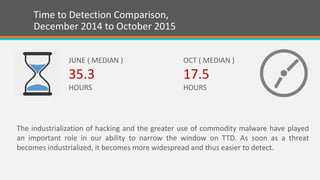
Time to Detection Comparison,
December 2014 to October 2015
JUNE ( MEDIAN )
35.3
HOURS
OCT ( MEDIAN )
17.5
HOURS
The industrialization of hacking and the greater use of commodity malware have played
an important role in our ability to narrow the window on TTD. As soon as a threat
becomes industrialized, it becomes more widespread and thus easier to detect.
Even with the narrowed time window for TTD, some threats remain harder to detect than
others.
Downloaders that target Microsoft Word users are typically the easiest to detect (<20 hours).
Adware and browser injections are among the most difficult threats to
detect (<200 hours).
However,
One reason the latter threats are so challenging to detect is that they are typically designated as a lower
priority by security teams, and are therefore often overlooked in the race to deflect adversaries’ onslaught
of zero-day attacks
The Six Tenets of Integrated Threat
Defence
So It’s time for ….

Network Security Risks and Challenges for Enterprises

  • 1.
    Network Security Risksand Challenges for Enterprises Source : Cisco
  • 2.
    Perceptions of SecurityRisk 65 % of respondents think their organizations are threatened Enterprise believe the following areas of their organization’s infrastructure are at high risk for a security breach 50 % Mobility 43% IT Security 42% Cloud Based
  • 3.
    The relentless risein information security breaches underscores the deep need for enterprises to trust that their systems, data, business partners, customers, and citizens are safe. We are seeing trust become a major factor for businesses selecting IT and networking infrastructure. In fact, many are now requiring that security and trustworthiness be integrated throughout the product lifecycle of the solutions that comprise their infrastructure. Trustworthiness : The Major Factor
  • 4.
    Internal Security ChallengesFaced Malicious Software Downloads Internal Security Breaches by Employees Hardware or Software Vulnerabilities Employees Using Their Own Devices/ Software/Cloud Apps to Do Business Lack of Employee Awareness IT Security Staff Is Not Adequately Trained I Do Not Consider Any of These to Be Challenges for My Organization 54 % 47 % 46 % 43 % 39 % 26 % 5
  • 5.
    External Challenges Faced Malware Phishing AdvancedPersistent Threats Denial of Service Attacks Brute-Force Attacks Zero-Day Attacks I Do Not Consider Any of These to Be Challenges for My Organization 68 % 54 % 43 % 38 % 35 % 35 % 3 %
  • 6.
    Most Large EnterprisesHave a Dedicated Security Team In-House 92 % Dedicated Security Team 88 % Organization-Wide Security Strategy 59 % Standardized Validation Policies and Procedures
  • 7.
    How Vendors CanDemonstrate Trustworthiness In today’s threat-centric landscape, confidence in a vendor’s processes, policies, technologies, and people—and the ability to verify them—are foundational to building a lasting, trusted relationship between vendors and enterprises. Technology vendors demonstrate trustworthiness by: • Building security into their solutions and the value chain from inception • Having and following policies and processes in place that reduce risk • Creating a security-aware culture • Responding to breaches quickly and transparently • Providing rapid remediation and constant vigilance after an incident
  • 8.
    Time to DetectionComparison, December 2014 to October 2015 JUNE ( MEDIAN ) 35.3 HOURS OCT ( MEDIAN ) 17.5 HOURS The industrialization of hacking and the greater use of commodity malware have played an important role in our ability to narrow the window on TTD. As soon as a threat becomes industrialized, it becomes more widespread and thus easier to detect.
  • 9.
    Even with thenarrowed time window for TTD, some threats remain harder to detect than others. Downloaders that target Microsoft Word users are typically the easiest to detect (<20 hours). Adware and browser injections are among the most difficult threats to detect (<200 hours). However, One reason the latter threats are so challenging to detect is that they are typically designated as a lower priority by security teams, and are therefore often overlooked in the race to deflect adversaries’ onslaught of zero-day attacks
  • 10.
    The Six Tenetsof Integrated Threat Defence So It’s time for ….