Network Security Architecture
CS461/ECE422
Computer Security I
Fall 2010
Reading Material
• Computer Security chapter 26.
• “Firewalls and Internet Security: Repelling the
Wily Hacker”, Cheswick, Bellovin, and Rubin.
– New second edition
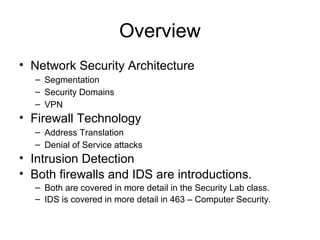
Overview
• Network Security Architecture
– Segmentation
– Security Domains
– VPN
• Firewall Technology
– Address Translation
– Denial of Service attacks
• Intrusion Detection
• Both firewalls and IDS are introductions.
– Both are covered in more detail in the Security Lab class.
– IDS is covered in more detail in 463 – Computer Security.
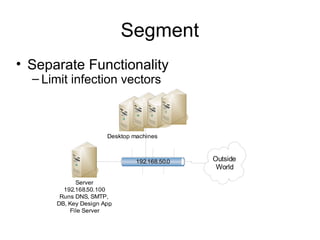
Segment
• Separate Functionality
– Limit infection vectors
Server
192.168.50.100
Runs DNS, SMTP,
DB, Key Design App
,
File Server
Outside
World
192.168.50.0
Desktop machines
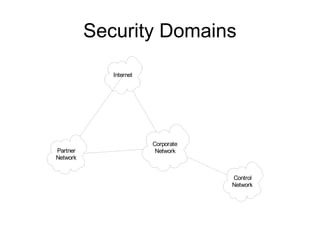
Security Domains
Internet
Corporate
Network
Control
Network
Partner
Network
Virtual Private Networks
• A private network that is configured within
a public network
• A VPN “appears” to be dedicated network
to customer
• The customer is actually “sharing” trunks
and other physical infrastructure with other
customers
• Security?
– Depends on implementing protocol
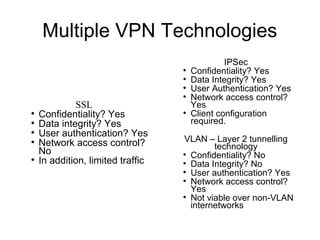
Multiple VPN Technologies
SSL

Confidentiality? Yes

Data integrity? Yes

User authentication? Yes

Network access control?
No

In addition, limited traffic
IPSec

Confidentiality? Yes

Data Integrity? Yes

User Authentication? Yes

Network access control?
Yes

Client configuration
required.
VLAN – Layer 2 tunnelling
technology

Confidentiality? No

Data Integrity? No

User authentication? Yes

Network access control?
Yes

Not viable over non-VLAN
internetworks
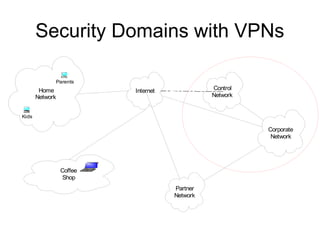
Security Domains with VPNs
Internet
Corporate
Network
Control
Network
Partner
Network
Home
Network
Coffee
Shop
Kids
Parents
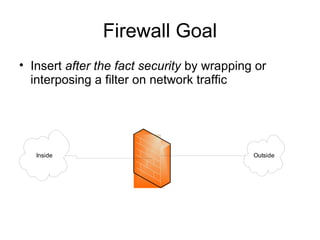
Firewall Goal
• Insert after the fact security by wrapping or
interposing a filter on network traffic
Inside Outside
“Typical” corporate network
Web Server
Mail forwarding
Mail server DNS (internal)
DNS (DMZ)
Internet
File Server
User machines
User machines
User machines
Web Server
Demilitarized
Zone (DMZ)
Intranet
Firewall
Firewall
Application Proxy Firewall
• Firewall software runs in application space on
the firewall
• The traffic source must be aware of the proxy
and add an additional header
• Leverage basic network stack functionality to
sanitize application level traffic
– Block java or active X
– Filter out “bad” URLs
– Ensure well formed protocols or block suspect
aspects of protocol
Packet Filter Firewall
• Operates at Layer 3 in router or HW firewall
• Has access to the Layer 3 header and Layer 4
header
• Can block traffic based on source and destination
address, ports, and protocol
• Does not reconstruct Layer 4 payload, so cannot
do reliable analysis of layer 4 or higher content
Stateful Packet Filters
• Evolved as packet filters aimed for proxy functionality
• In addition to Layer 3 reassembly, it can reconstruct layer 4
traffic
• Some application layer analysis exists, e.g., for HTTP, FTP,
H.323
– Called context-based access control (CBAC) on IOS
– Configured by fixup command on PIX
• Some of this analysis is necessary to enable address
translation and dynamic access for negotiated data channels
• Reconstruction and analysis can be expensive.
– Must be configured on specified traffic streams
– At a minimum the user must tell the Firewall what kind of traffic
to expect on a port
– Degree of reconstruction varies per platform, e.g. IOS does not
do IP reassembly
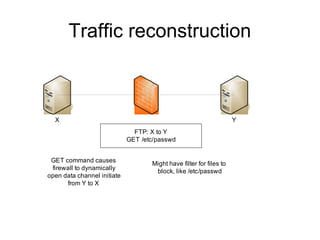
Traffic reconstruction
X Y
FTP: X to Y
GET /etc/passwd
GET command causes
firewall to dynamically
open data channel initiate
from Y to X
Might have filter for files to
block, like /etc/passwd
Access Control Lists (ACLs)
• Used to define traffic streams
– Bind ACL’s to interface and action
• Access Control Entry (ACE) contains
– Source address
– Destination Address
– Protocol, e.g., IP, TCP, UDP, ICMP, GRE
– Source Port
– Destination Port
• ACL runtime lookup
– Linear
– N-dimensional tree lookup (PIX Turbo ACL)
– Object Groups
– HW classification assists
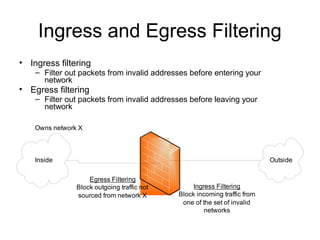
Ingress and Egress Filtering
• Ingress filtering
– Filter out packets from invalid addresses before entering your
network
• Egress filtering
– Filter out packets from invalid addresses before leaving your
network
Inside Outside
Owns network X
Egress Filtering
Block outgoing traffic not
sourced from network X
Ingress Filtering
Block incoming traffic from
one of the set of invalid
networks
Denial of Service
• Example attacks
– Smurf Attack
– TCP SYN Attack
– Teardrop
• DoS general exploits resource
limitations
– Denial by Consumption
– Denial by Disruption
– Denial by Reservation
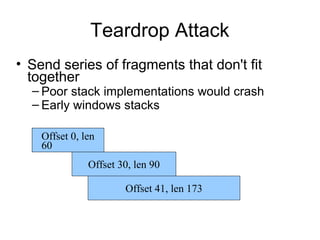
Teardrop Attack
• Send series of fragments that don't fit
together
– Poor stack implementations would crash
– Early windows stacks
Offset 0, len
60
Offset 30, len 90
Offset 41, len 173
Address Translation
• Traditional NAT RFC 3022 Reference RFC
• Map real address to alias address
– Real address associated with physical device, generally an
unroutable address
– Alias address generally a routeable associated with the
translation device
• Originally motivated by limited access to publicly routable
IP addresses
– Folks didn’t want to pay for addresses and/or hassle with getting
official addresses
• Later folks said this also added security
– By hiding structure of internal network
– Obscuring access to internal machines
• Adds complexity to firewall technology
– Must dig around in data stream to rewrite references to IP
addresses and ports
– Limits how quickly new protocols can be firewalled
Address Hiding (NAPT)
• Many to few dynamic mapping
– Packets from a large pool of private addresses are
mapped to a small pool of public addresses at runtime
• Port remapping makes this sharing more
scalable
– Two real addresses can be rewritten to the same alias
address
– Rewrite the source port to differentiate the streams
• Traffic must be initiated from the real side
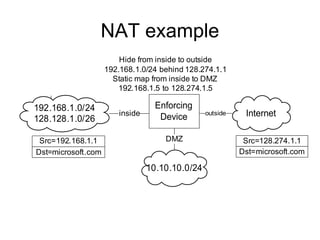
NAT example
Enforcing
Device
192.168.1.0/24
128.128.1.0/26
10.10.10.0/24
Internet
Hide from inside to outside
192.168.1.0/24 behind 128.274.1.1
Static map from inside to DMZ
192.168.1.5 to 128.274.1.5
inside
DMZ
outside
Src=192.168.1.1
Dst=microsoft.com
Src=128.274.1.1
Dst=microsoft.com
Static Mapping
• One-to-one fixed mapping
– One real address is mapped to one alias
address at configuration time
– Traffic can be initiated from either side
• Used to statically map out small set of
servers from a network that is otherwise
hidden
• Static port remapping is also available
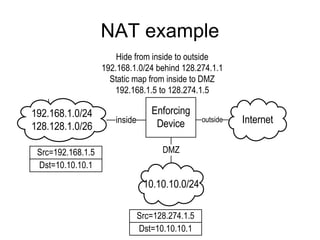
NAT example
Enforcing
Device
192.168.1.0/24
128.128.1.0/26
10.10.10.0/24
Internet
Hide from inside to outside
192.168.1.0/24 behind 128.274.1.1
Static map from inside to DMZ
192.168.1.5 to 128.274.1.5
inside
DMZ
outside
Src=192.168.1.5
Dst=10.10.10.1
Src=128.274.1.5
Dst=10.10.10.1
Intrusion Detection
• Holy Grail: Detect and correct “bad” system
behaviour
• Detection can be viewed in two parts
– Anomaly detection: Use statistical techniques to
determine unusual behavior
– Mis-use detection: Use signatures to determine
occurrence of known attacks
• Detection can be performed on host data
(HIDS), network data (NIDS), or a hybrid of both
IDS Architecture
• Agents run at the lowest level gathering data. Perform
some basic processing.
• Agents send data to a Director that performs more
significant processing of the data. Potentially there is a
hierarchy of agents and directors
– Director has information from multiple sources and can perform
a time-based correlation to derive more significant actions
• Directors invoke Notifiers to perform some action in
response to a detected attack
– Popup a window on a screen
– Send an email or a page
– Send a new syslog message elsewhere.
– Adjust a firewall or some other policy to block future action from
the attacker
Data Sources
• Direct data
– Network packets
– System calls
• Indirect data
– Syslog data, Windows event logs
– Events from other intrusion detection systems
– Netflow information generated by routers
about network traffic
Mis-use/Signature Detection
• Fixed signatures are used in most deployed IDS products
– E.g., Cisco, ISS, Snort
• Like virus scanners, part of the value of the product is the
team of people producing new signatures for newly observed
malevolent behavior
• The static signature mechanism has obvious problems in that
a dedicated attacker can adjust his behaviour to avoid
matching the signature.
• The volume of signatures can result in many false positives
– Must tune the IDS to match the characteristics of your network
– E.g., what might be unusual in a network of Unix systems might
be normal in a network of Windows Systems (or visa versa)
– Can result in IDS tuned too low to miss real events
– Can hide real attacks in the mass of false positives
Example Signature
• Signature for port sweep
– A set of TCP packets attempting to connect to
a sequence of ports on the same device in a
fixed amount of time
• In some environments, the admin might
run nmap periodically to get an inventory
of what is on the network
– You would not want to activate this signature
in that case
Anomaly/statistical detection
• Seems like using statistics will result in a more adaptable
and self-tuning system
– Statistics, neural networks, data mining, etc.
• How do you characterize normal?
– Create training data from observing “good” runs
• E.g., Forrest’s program system call analysis
– Use visualization to rely on your eyes
• How do you adjust to real changes in behaviour?
– Gradual changes can be easily addressed. Gradually adjust
expected changes over time
– Rapid changes can occur. E.g., different behaviour after work
hours or changing to a work on the next project
Host Based IDS
• Tripwire – Very basic detection of changes
to installed binaries
• More recent HIDS. Look at patterns of
actions of system calls, file activity, etc. to
permit, deny, or query operations
– Cisco Security Agent
– Symantec
– McAfee Entercept
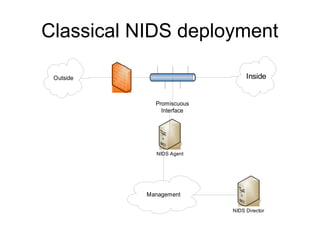
Classical NIDS deployment
NIDS Agent
Outside Inside
Management
Promiscuous
Interface
NIDS Director
NIDS Remediation Options
• Log the event
• Drop the connection
• Reset the connection
• Change the configuration of a nearby
router or firewall to block future
connections
Intrusion Protection Systems (IPS)
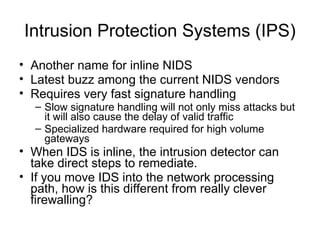
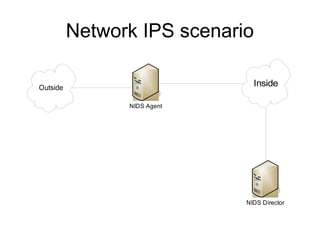
• Another name for inline NIDS
• Latest buzz among the current NIDS vendors
• Requires very fast signature handling
– Slow signature handling will not only miss attacks but
it will also cause the delay of valid traffic
– Specialized hardware required for high volume
gateways
• When IDS is inline, the intrusion detector can
take direct steps to remediate.
• If you move IDS into the network processing
path, how is this different from really clever
firewalling?
Network IPS scenario
NIDS Agent
Outside
Inside
NIDS Director
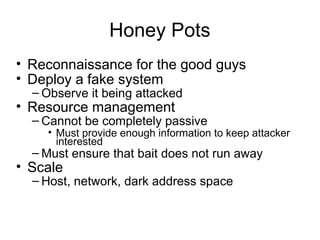
Honey Pots
• Reconnaissance for the good guys
• Deploy a fake system
– Observe it being attacked
• Resource management
– Cannot be completely passive
• Must provide enough information to keep attacker
interested
– Must ensure that bait does not run away
• Scale
– Host, network, dark address space
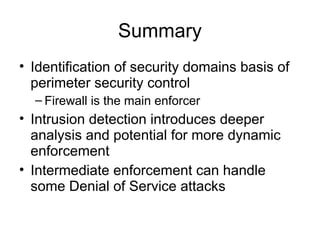
Summary
• Identification of security domains basis of
perimeter security control
– Firewall is the main enforcer
• Intrusion detection introduces deeper
analysis and potential for more dynamic
enforcement
• Intermediate enforcement can handle
some Denial of Service attacks

network-security-arch Firewall Access Control.pdf

  • 1.
  • 2.
    Reading Material • ComputerSecurity chapter 26. • “Firewalls and Internet Security: Repelling the Wily Hacker”, Cheswick, Bellovin, and Rubin. – New second edition
  • 3.
    Overview • Network SecurityArchitecture – Segmentation – Security Domains – VPN • Firewall Technology – Address Translation – Denial of Service attacks • Intrusion Detection • Both firewalls and IDS are introductions. – Both are covered in more detail in the Security Lab class. – IDS is covered in more detail in 463 – Computer Security.
  • 4.
    Segment • Separate Functionality –Limit infection vectors Server 192.168.50.100 Runs DNS, SMTP, DB, Key Design App , File Server Outside World 192.168.50.0 Desktop machines
  • 5.
  • 6.
    Virtual Private Networks •A private network that is configured within a public network • A VPN “appears” to be dedicated network to customer • The customer is actually “sharing” trunks and other physical infrastructure with other customers • Security? – Depends on implementing protocol
  • 7.
    Multiple VPN Technologies SSL  Confidentiality?Yes  Data integrity? Yes  User authentication? Yes  Network access control? No  In addition, limited traffic IPSec  Confidentiality? Yes  Data Integrity? Yes  User Authentication? Yes  Network access control? Yes  Client configuration required. VLAN – Layer 2 tunnelling technology  Confidentiality? No  Data Integrity? No  User authentication? Yes  Network access control? Yes  Not viable over non-VLAN internetworks
  • 8.
    Security Domains withVPNs Internet Corporate Network Control Network Partner Network Home Network Coffee Shop Kids Parents
  • 9.
    Firewall Goal • Insertafter the fact security by wrapping or interposing a filter on network traffic Inside Outside
  • 10.
    “Typical” corporate network WebServer Mail forwarding Mail server DNS (internal) DNS (DMZ) Internet File Server User machines User machines User machines Web Server Demilitarized Zone (DMZ) Intranet Firewall Firewall
  • 11.
    Application Proxy Firewall •Firewall software runs in application space on the firewall • The traffic source must be aware of the proxy and add an additional header • Leverage basic network stack functionality to sanitize application level traffic – Block java or active X – Filter out “bad” URLs – Ensure well formed protocols or block suspect aspects of protocol
  • 12.
    Packet Filter Firewall •Operates at Layer 3 in router or HW firewall • Has access to the Layer 3 header and Layer 4 header • Can block traffic based on source and destination address, ports, and protocol • Does not reconstruct Layer 4 payload, so cannot do reliable analysis of layer 4 or higher content
  • 13.
    Stateful Packet Filters •Evolved as packet filters aimed for proxy functionality • In addition to Layer 3 reassembly, it can reconstruct layer 4 traffic • Some application layer analysis exists, e.g., for HTTP, FTP, H.323 – Called context-based access control (CBAC) on IOS – Configured by fixup command on PIX • Some of this analysis is necessary to enable address translation and dynamic access for negotiated data channels • Reconstruction and analysis can be expensive. – Must be configured on specified traffic streams – At a minimum the user must tell the Firewall what kind of traffic to expect on a port – Degree of reconstruction varies per platform, e.g. IOS does not do IP reassembly
  • 14.
    Traffic reconstruction X Y FTP:X to Y GET /etc/passwd GET command causes firewall to dynamically open data channel initiate from Y to X Might have filter for files to block, like /etc/passwd
  • 15.
    Access Control Lists(ACLs) • Used to define traffic streams – Bind ACL’s to interface and action • Access Control Entry (ACE) contains – Source address – Destination Address – Protocol, e.g., IP, TCP, UDP, ICMP, GRE – Source Port – Destination Port • ACL runtime lookup – Linear – N-dimensional tree lookup (PIX Turbo ACL) – Object Groups – HW classification assists
  • 16.
    Ingress and EgressFiltering • Ingress filtering – Filter out packets from invalid addresses before entering your network • Egress filtering – Filter out packets from invalid addresses before leaving your network Inside Outside Owns network X Egress Filtering Block outgoing traffic not sourced from network X Ingress Filtering Block incoming traffic from one of the set of invalid networks
  • 17.
    Denial of Service •Example attacks – Smurf Attack – TCP SYN Attack – Teardrop • DoS general exploits resource limitations – Denial by Consumption – Denial by Disruption – Denial by Reservation
  • 18.
    Teardrop Attack • Sendseries of fragments that don't fit together – Poor stack implementations would crash – Early windows stacks Offset 0, len 60 Offset 30, len 90 Offset 41, len 173
  • 19.
    Address Translation • TraditionalNAT RFC 3022 Reference RFC • Map real address to alias address – Real address associated with physical device, generally an unroutable address – Alias address generally a routeable associated with the translation device • Originally motivated by limited access to publicly routable IP addresses – Folks didn’t want to pay for addresses and/or hassle with getting official addresses • Later folks said this also added security – By hiding structure of internal network – Obscuring access to internal machines • Adds complexity to firewall technology – Must dig around in data stream to rewrite references to IP addresses and ports – Limits how quickly new protocols can be firewalled
  • 20.
    Address Hiding (NAPT) •Many to few dynamic mapping – Packets from a large pool of private addresses are mapped to a small pool of public addresses at runtime • Port remapping makes this sharing more scalable – Two real addresses can be rewritten to the same alias address – Rewrite the source port to differentiate the streams • Traffic must be initiated from the real side
  • 21.
    NAT example Enforcing Device 192.168.1.0/24 128.128.1.0/26 10.10.10.0/24 Internet Hide frominside to outside 192.168.1.0/24 behind 128.274.1.1 Static map from inside to DMZ 192.168.1.5 to 128.274.1.5 inside DMZ outside Src=192.168.1.1 Dst=microsoft.com Src=128.274.1.1 Dst=microsoft.com
  • 22.
    Static Mapping • One-to-onefixed mapping – One real address is mapped to one alias address at configuration time – Traffic can be initiated from either side • Used to statically map out small set of servers from a network that is otherwise hidden • Static port remapping is also available
  • 23.
    NAT example Enforcing Device 192.168.1.0/24 128.128.1.0/26 10.10.10.0/24 Internet Hide frominside to outside 192.168.1.0/24 behind 128.274.1.1 Static map from inside to DMZ 192.168.1.5 to 128.274.1.5 inside DMZ outside Src=192.168.1.5 Dst=10.10.10.1 Src=128.274.1.5 Dst=10.10.10.1
  • 24.
    Intrusion Detection • HolyGrail: Detect and correct “bad” system behaviour • Detection can be viewed in two parts – Anomaly detection: Use statistical techniques to determine unusual behavior – Mis-use detection: Use signatures to determine occurrence of known attacks • Detection can be performed on host data (HIDS), network data (NIDS), or a hybrid of both
  • 25.
    IDS Architecture • Agentsrun at the lowest level gathering data. Perform some basic processing. • Agents send data to a Director that performs more significant processing of the data. Potentially there is a hierarchy of agents and directors – Director has information from multiple sources and can perform a time-based correlation to derive more significant actions • Directors invoke Notifiers to perform some action in response to a detected attack – Popup a window on a screen – Send an email or a page – Send a new syslog message elsewhere. – Adjust a firewall or some other policy to block future action from the attacker
  • 26.
    Data Sources • Directdata – Network packets – System calls • Indirect data – Syslog data, Windows event logs – Events from other intrusion detection systems – Netflow information generated by routers about network traffic
  • 27.
    Mis-use/Signature Detection • Fixedsignatures are used in most deployed IDS products – E.g., Cisco, ISS, Snort • Like virus scanners, part of the value of the product is the team of people producing new signatures for newly observed malevolent behavior • The static signature mechanism has obvious problems in that a dedicated attacker can adjust his behaviour to avoid matching the signature. • The volume of signatures can result in many false positives – Must tune the IDS to match the characteristics of your network – E.g., what might be unusual in a network of Unix systems might be normal in a network of Windows Systems (or visa versa) – Can result in IDS tuned too low to miss real events – Can hide real attacks in the mass of false positives
  • 28.
    Example Signature • Signaturefor port sweep – A set of TCP packets attempting to connect to a sequence of ports on the same device in a fixed amount of time • In some environments, the admin might run nmap periodically to get an inventory of what is on the network – You would not want to activate this signature in that case
  • 29.
    Anomaly/statistical detection • Seemslike using statistics will result in a more adaptable and self-tuning system – Statistics, neural networks, data mining, etc. • How do you characterize normal? – Create training data from observing “good” runs • E.g., Forrest’s program system call analysis – Use visualization to rely on your eyes • How do you adjust to real changes in behaviour? – Gradual changes can be easily addressed. Gradually adjust expected changes over time – Rapid changes can occur. E.g., different behaviour after work hours or changing to a work on the next project
  • 30.
    Host Based IDS •Tripwire – Very basic detection of changes to installed binaries • More recent HIDS. Look at patterns of actions of system calls, file activity, etc. to permit, deny, or query operations – Cisco Security Agent – Symantec – McAfee Entercept
  • 31.
    Classical NIDS deployment NIDSAgent Outside Inside Management Promiscuous Interface NIDS Director
  • 32.
    NIDS Remediation Options •Log the event • Drop the connection • Reset the connection • Change the configuration of a nearby router or firewall to block future connections
  • 33.
    Intrusion Protection Systems(IPS) • Another name for inline NIDS • Latest buzz among the current NIDS vendors • Requires very fast signature handling – Slow signature handling will not only miss attacks but it will also cause the delay of valid traffic – Specialized hardware required for high volume gateways • When IDS is inline, the intrusion detector can take direct steps to remediate. • If you move IDS into the network processing path, how is this different from really clever firewalling?
  • 34.
    Network IPS scenario NIDSAgent Outside Inside NIDS Director
  • 35.
    Honey Pots • Reconnaissancefor the good guys • Deploy a fake system – Observe it being attacked • Resource management – Cannot be completely passive • Must provide enough information to keep attacker interested – Must ensure that bait does not run away • Scale – Host, network, dark address space
  • 36.
    Summary • Identification ofsecurity domains basis of perimeter security control – Firewall is the main enforcer • Intrusion detection introduces deeper analysis and potential for more dynamic enforcement • Intermediate enforcement can handle some Denial of Service attacks