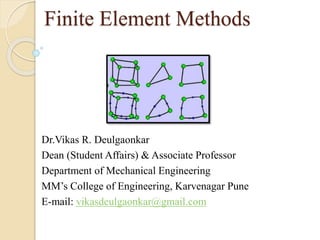
Finite Element Methods
Dr.Vikas R. Deulgaonkar
Dean (Student Affairs) & Associate Professor
Department of Mechanical Engineering
MM’s College of Engineering, Karvenagar Pune
E-mail: vikasdeulgaonkar@gmail.com
Design & Analysis of a Component
 Mechanical Design is the design of a
component for optimum size, shape etc.
against failure under application of loads.
 A good design is expected to minimize the
cost of the material and consequently cost
of production.
 Failure commonly associated with
mechanical components are broadly
categorized as
◦ Failures by breaking of brittle materials and
fatigue failure (when subjected to repetitive
loads for ductile materials)
◦ Failure by yielding of ductile materials,
subjected to non-repetitive loads
◦ Failure by elastic deformation
Last two failure modes cause change of shape or
size of the component making it useless and
therefore refer to functional or operational
failure.
Most of the design problems refer one of these
two types of failures, hence designing involves
estimation of stresses and deformations.
 These stresses and deformations are
evaluated at critical locations of the
components for specified loads and
boundary conditions, so as to satisfy the
operational constraints.
 Design is associated with the calculations
of dimensions of a component to withstand
the applied loads and perform desired
function.
 Analysis is associated with estimation of
displacements or stresses in a component
of specific dimensions, to verify adequacy.
 Optimum design is obtained by many
iterations of modifying dimensions of the
component based on the calculated values
of displacement/stresses, permitted values
and reanalysis.
 An analytical method is applied to a model
problem rather than to actual physical
problem. Even many lab experiments
extensively use models.
 A geometric model for analysis can be
devised after the physical nature of the
problem as been understood.
 A model excludes superfluous details such
as bolts, nuts, rivets but includes all
essential features so that analysis of the
model is not complicated and results of the
actual problem describe sufficient accuracy.
 A geometric model becomes a
mathematical model when its behaviour is
described or approximated by incorporating
restrictions such as homogeneity, isotropy,
constancy of material properties and
mathematical simplifications applicable for
small magnitudes of strains and rotations.
 Several methods such as method of Joints
for trusses, simple theory of bending,
theory of bending, theory of torsion,
analysis of cylinders and spheres for axi-
symmetric load pressure etc. are available
for designing/analysing simple
components of a structure.
 These methods try to obtain exact
solutions of second order partial
differential equations and are based on
several assumptions as size, loads, end
conditions, likely deformation pattern etc.
 Further, these methods are not amenable
for generalization and effective utilization
of computer for repetitive jobs.
 Strength of materials approach deals with
a single beam member for different load
and end conditions (Free, simply
supported and fixed)
 Use of strength of materials approach for
designing a component is associated with
higher factor of safety.
 The individual member method is
available for civil structures.
Approximate vs Exact
Methods
 An analytical solution is a mathematical
expression that gives the values of desired
unknown quantity at any location of a
body and hence is valid for infinite
number of points in a component.
 However, in many engineering situations
it is not possible to obtain analytical
mathematical solutions.
 For problems involving complex material
properties and boundary conditions,
numerical methods provide approximate
but acceptable solutions (with reasonable
accuracy) for unknown quantities only at
discrete or finite number of points in a
component.
 Approximate solution is carried out in two
phases:
◦ Phase 1: In the formulation of the
mathematical model with respect to the
physical behaviour of the component.
◦ e.g. approximation of joint with multiple rivets
at the junction of any two members of a truss
as a pin joint, assumption that the joint
between a column and a beam behaves like a
simple support for the beam.. For this results
are necessarily accurate far away from the
joint.
• In obtaining numerical solution to the
simplified mathematical model. Involves
approximation of functional (as P.E) in
terms of unknown functions
(displacements) at finite number of
points. There are 2 broad categories as:
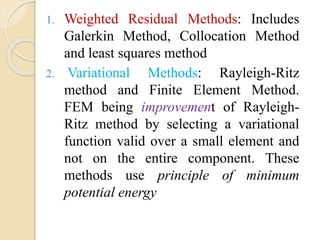
1. Weighted Residual Methods: Includes
Galerkin Method, Collocation Method
and least squares method
2. Variational Methods: Rayleigh-Ritz
method and Finite Element Method.
FEM being improvement of Rayleigh-
Ritz method by selecting a variational
function valid over a small element and
not on the entire component. These
methods use principle of minimum
potential energy
 Most engineering problems end up with
differential equations. Closed form
solutions are not feasible in many of
these problems.
 Different approaches are suggested to
obtain approximate solutions. One such
category is weighted residual technique.
 Here an approximate solution in the form
of Y = Σ NiCi for i=1 to n where Ci are
unknown coefficients are or (constants)
and Ni are the functions of independent
variable satisfying the given kinematic
boundary as used in differential equations.
 Difference between two sides of a
equation with known terms on one side
(Usually functions of applied loads) and
unknown terms on the other side
(functions of constants Ci) is called
residual R.
 This residual value may vary from point
to point in the component depending on
the particular approximate solution.
 Different methods are proposed based on
how the residual is used in obtaining the
best (approximate) solution as below;
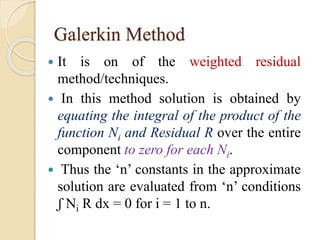
Galerkin Method
 It is on of the weighted residual
method/techniques.
 In this method solution is obtained by
equating the integral of the product of the
function Ni and Residual R over the entire
component to zero for each Ni.
 Thus the ‘n’ constants in the approximate
solution are evaluated from ‘n’ conditions
ʃ Ni R dx = 0 for i = 1 to n.
 The resulting solution may match with the
exact solution at some points of the
components and may differ at other
points.
 The number of terms Ni used for
approximating the solution is arbitrary and
depends on the accuracy required.
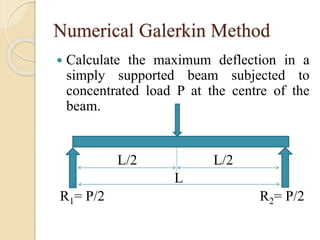
Numerical Galerkin Method
 Calculate the maximum deflection in a
simply supported beam subjected to
concentrated load P at the centre of the
beam.
L/2 L/2
L
R1= P/2 R2= P/2
 Kinematic boundary conditions for the
beam are y = 0 at x =0 and y= 0 at x = L
 So the functions Ni are selected from the
(x-a)p.(x-b)q with different positive integer
values for p and q; and a = 0 and b = L
Model 1 ( 1 – term approximation)
The deflection is assumed as y(x) = N.c
with the function N = x(x-L) which satisfies
the boundary conditions y = 0 at x = 0 and
y=0 at x = L
Model 2 ( 2 – term approximation)
The deflection is assumed as
y(x) = N1c1 + N2 c2
With Functions as
N1 = x (x-L) and N2 = x (x-L)2
Thus considering
y = x. (x-L).c1 + x.(x-L)2. c2
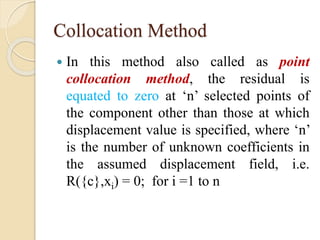
Collocation Method
 In this method also called as point
collocation method, the residual is
equated to zero at ‘n’ selected points of
the component other than those at which
displacement value is specified, where ‘n’
is the number of unknown coefficients in
the assumed displacement field, i.e.
R({c},xi) = 0; for i =1 to n
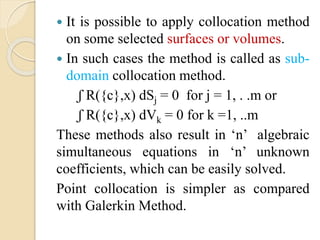
 It is possible to apply collocation method
on some selected surfaces or volumes.
 In such cases the method is called as sub-
domain collocation method.
ʃ R({c},x) dSj = 0 for j = 1, . .m or
ʃ R({c},x) dVk = 0 for k =1, ..m
These methods also result in ‘n’ algebraic
simultaneous equations in ‘n’ unknown
coefficients, which can be easily solved.
Point collocation is simpler as compared
with Galerkin Method.
Numerical Collocation Method
 Calculate the maximum deflection in a
simply supported beam subjected to
concentrated load P at the centre of the
beam.
L/2 L/2
L
R1= P/2 R2= P/2
 Kinematic boundary conditions for the
beam are y = 0 at x =0 and y= 0 at x = L
 So the functions Ni are selected from the
(x-a)p.(x-b)q with different positive integer
values for p and q; and a = 0 and b = L
Model 1 ( 1 – term approximation)
The deflection is assumed as y(x) = N.c
with the function N = x(x-L) which satisfies
the boundary conditions y = 0 at x = 0 and
y=0 at x = L
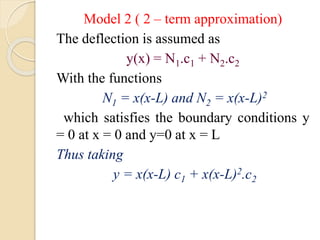
Model 2 ( 2 – term approximation)
The deflection is assumed as
y(x) = N1.c1 + N2.c2
With the functions
N1 = x(x-L) and N2 = x(x-L)2
which satisfies the boundary conditions y
= 0 at x = 0 and y=0 at x = L
Thus taking
y = x(x-L) c1 + x(x-L)2.c2
Least Squares Method
 In this method the integral of the residual
over entire component is minimized
i.e.
𝝏𝐼
𝝏𝑐𝑖
= 0 for i=1,..n
Where I = ʃ[R({a},x]2dx
This method also results in ‘n’ algebraic
simultaneous equations in ‘n’ unknown
coefficients, which can be solved easily
Numerical Least Squares Method
 Calculate the maximum deflection in a
simply supported beam subjected to
concentrated load P at the centre of the
beam.
L/2 L/2
L
R1= P/2 R2= P/2
 Kinematic boundary conditions for the
beam are y = 0 at x =0 and y= 0 at x = L
 So the functions Ni are selected from the
(x-a)p.(x-b)q with different positive integer
values for p and q
Model 1 ( 1 – term approximation)
The deflection is assumed as y(x) = N.C
with the function N = x(x-L) which satisfies
the boundary conditions y = 0 at x = 0 and
y=0 at x = L
Variational Method or Rayleigh-Ritz
Method
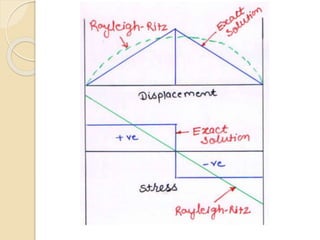
 This method involves selecting a
displacement field over the entire
component usually in the form of
polynomial function and evaluating the
unknown coefficients of the polynomial
for minimum potential energy. It gives an
approximate solution
Numerical: Variational Method
 Calculate the displacement at node 2 of
fixed beam as shown below, subjected to
an axial load ‘P’ at node 2
1 2 3P
L/2L/2
L
X , u
Method 1
Method 2
Principle of Minimum Potential
Energy (Virtual Work)
 For conservative systems, all the
kinematically admissible displacement
fields, those corresponding to the total
equilibrium extremize the total potential
energy, if the extremum condition is
minimum, the equilibrium state is stable.
OR
Among all possible kinematically
admissible displacement fields (satisfying --
-- compatibility and boundary conditions) of
a conservative system, the one
corresponding to stable equilibrium state
has minimum potential energy.
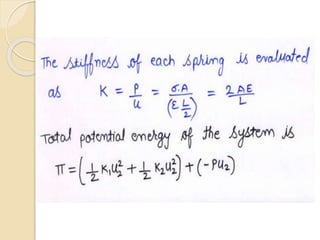
The total potential energy of an elastic body
(Π) is defined as the sum of total strain
energy (U) and the work potential (W)
Π = U + W
Where U = ʃv σ ε dv and
W = -ʃv UT F dv - ʃs UT T ds - ∑Ui Pi
 Here F is the distributed body force, ‘T’ is
the distributed surface force and Pi is the
concentrated load applied at points i=1,..n
one or more of them may be acting on the
component at any instant.
 For a bar with axial load, if the stress σ
and strain ε are assumed uniform
throughout the bar
U =
1
2
σ ε V =
1
2
σ ε AL =
1
2
σ A εL =
1
2
F⸹=
1
2
K ⸹2
 The work potential,
W = - ʃ qT f dV - ʃ qT T ds - ∑ ui
T Pi
For body force, surface traction and point
loads respectively
Numerical: Virtual Work
Thank You

Finite Element Methods

  • 1.
    Finite Element Methods Dr.VikasR. Deulgaonkar Dean (Student Affairs) & Associate Professor Department of Mechanical Engineering MM’s College of Engineering, Karvenagar Pune E-mail: vikasdeulgaonkar@gmail.com
  • 2.
    Design & Analysisof a Component  Mechanical Design is the design of a component for optimum size, shape etc. against failure under application of loads.  A good design is expected to minimize the cost of the material and consequently cost of production.  Failure commonly associated with mechanical components are broadly categorized as
  • 3.
    ◦ Failures bybreaking of brittle materials and fatigue failure (when subjected to repetitive loads for ductile materials) ◦ Failure by yielding of ductile materials, subjected to non-repetitive loads ◦ Failure by elastic deformation Last two failure modes cause change of shape or size of the component making it useless and therefore refer to functional or operational failure. Most of the design problems refer one of these two types of failures, hence designing involves estimation of stresses and deformations.
  • 4.
     These stressesand deformations are evaluated at critical locations of the components for specified loads and boundary conditions, so as to satisfy the operational constraints.  Design is associated with the calculations of dimensions of a component to withstand the applied loads and perform desired function.  Analysis is associated with estimation of displacements or stresses in a component of specific dimensions, to verify adequacy.
  • 5.
     Optimum designis obtained by many iterations of modifying dimensions of the component based on the calculated values of displacement/stresses, permitted values and reanalysis.  An analytical method is applied to a model problem rather than to actual physical problem. Even many lab experiments extensively use models.  A geometric model for analysis can be devised after the physical nature of the problem as been understood.
  • 6.
     A modelexcludes superfluous details such as bolts, nuts, rivets but includes all essential features so that analysis of the model is not complicated and results of the actual problem describe sufficient accuracy.  A geometric model becomes a mathematical model when its behaviour is described or approximated by incorporating restrictions such as homogeneity, isotropy, constancy of material properties and mathematical simplifications applicable for small magnitudes of strains and rotations.
  • 7.
     Several methodssuch as method of Joints for trusses, simple theory of bending, theory of bending, theory of torsion, analysis of cylinders and spheres for axi- symmetric load pressure etc. are available for designing/analysing simple components of a structure.  These methods try to obtain exact solutions of second order partial differential equations and are based on several assumptions as size, loads, end conditions, likely deformation pattern etc.
  • 8.
     Further, thesemethods are not amenable for generalization and effective utilization of computer for repetitive jobs.  Strength of materials approach deals with a single beam member for different load and end conditions (Free, simply supported and fixed)  Use of strength of materials approach for designing a component is associated with higher factor of safety.  The individual member method is available for civil structures.
  • 9.
    Approximate vs Exact Methods An analytical solution is a mathematical expression that gives the values of desired unknown quantity at any location of a body and hence is valid for infinite number of points in a component.  However, in many engineering situations it is not possible to obtain analytical mathematical solutions.
  • 10.
     For problemsinvolving complex material properties and boundary conditions, numerical methods provide approximate but acceptable solutions (with reasonable accuracy) for unknown quantities only at discrete or finite number of points in a component.  Approximate solution is carried out in two phases: ◦ Phase 1: In the formulation of the mathematical model with respect to the physical behaviour of the component.
  • 11.
    ◦ e.g. approximationof joint with multiple rivets at the junction of any two members of a truss as a pin joint, assumption that the joint between a column and a beam behaves like a simple support for the beam.. For this results are necessarily accurate far away from the joint. • In obtaining numerical solution to the simplified mathematical model. Involves approximation of functional (as P.E) in terms of unknown functions (displacements) at finite number of points. There are 2 broad categories as:
  • 12.
    1. Weighted ResidualMethods: Includes Galerkin Method, Collocation Method and least squares method 2. Variational Methods: Rayleigh-Ritz method and Finite Element Method. FEM being improvement of Rayleigh- Ritz method by selecting a variational function valid over a small element and not on the entire component. These methods use principle of minimum potential energy
  • 13.
     Most engineeringproblems end up with differential equations. Closed form solutions are not feasible in many of these problems.  Different approaches are suggested to obtain approximate solutions. One such category is weighted residual technique.  Here an approximate solution in the form of Y = Σ NiCi for i=1 to n where Ci are unknown coefficients are or (constants) and Ni are the functions of independent variable satisfying the given kinematic boundary as used in differential equations.
  • 14.
     Difference betweentwo sides of a equation with known terms on one side (Usually functions of applied loads) and unknown terms on the other side (functions of constants Ci) is called residual R.  This residual value may vary from point to point in the component depending on the particular approximate solution.  Different methods are proposed based on how the residual is used in obtaining the best (approximate) solution as below;
  • 15.
    Galerkin Method  Itis on of the weighted residual method/techniques.  In this method solution is obtained by equating the integral of the product of the function Ni and Residual R over the entire component to zero for each Ni.  Thus the ‘n’ constants in the approximate solution are evaluated from ‘n’ conditions ʃ Ni R dx = 0 for i = 1 to n.
  • 16.
     The resultingsolution may match with the exact solution at some points of the components and may differ at other points.  The number of terms Ni used for approximating the solution is arbitrary and depends on the accuracy required.
  • 17.
    Numerical Galerkin Method Calculate the maximum deflection in a simply supported beam subjected to concentrated load P at the centre of the beam. L/2 L/2 L R1= P/2 R2= P/2
  • 18.
     Kinematic boundaryconditions for the beam are y = 0 at x =0 and y= 0 at x = L  So the functions Ni are selected from the (x-a)p.(x-b)q with different positive integer values for p and q; and a = 0 and b = L Model 1 ( 1 – term approximation) The deflection is assumed as y(x) = N.c with the function N = x(x-L) which satisfies the boundary conditions y = 0 at x = 0 and y=0 at x = L
  • 23.
    Model 2 (2 – term approximation) The deflection is assumed as y(x) = N1c1 + N2 c2 With Functions as N1 = x (x-L) and N2 = x (x-L)2 Thus considering y = x. (x-L).c1 + x.(x-L)2. c2
  • 28.
    Collocation Method  Inthis method also called as point collocation method, the residual is equated to zero at ‘n’ selected points of the component other than those at which displacement value is specified, where ‘n’ is the number of unknown coefficients in the assumed displacement field, i.e. R({c},xi) = 0; for i =1 to n
  • 29.
     It ispossible to apply collocation method on some selected surfaces or volumes.  In such cases the method is called as sub- domain collocation method. ʃ R({c},x) dSj = 0 for j = 1, . .m or ʃ R({c},x) dVk = 0 for k =1, ..m These methods also result in ‘n’ algebraic simultaneous equations in ‘n’ unknown coefficients, which can be easily solved. Point collocation is simpler as compared with Galerkin Method.
  • 30.
    Numerical Collocation Method Calculate the maximum deflection in a simply supported beam subjected to concentrated load P at the centre of the beam. L/2 L/2 L R1= P/2 R2= P/2
  • 31.
     Kinematic boundaryconditions for the beam are y = 0 at x =0 and y= 0 at x = L  So the functions Ni are selected from the (x-a)p.(x-b)q with different positive integer values for p and q; and a = 0 and b = L Model 1 ( 1 – term approximation) The deflection is assumed as y(x) = N.c with the function N = x(x-L) which satisfies the boundary conditions y = 0 at x = 0 and y=0 at x = L
  • 34.
    Model 2 (2 – term approximation) The deflection is assumed as y(x) = N1.c1 + N2.c2 With the functions N1 = x(x-L) and N2 = x(x-L)2 which satisfies the boundary conditions y = 0 at x = 0 and y=0 at x = L Thus taking y = x(x-L) c1 + x(x-L)2.c2
  • 39.
    Least Squares Method In this method the integral of the residual over entire component is minimized i.e. 𝝏𝐼 𝝏𝑐𝑖 = 0 for i=1,..n Where I = ʃ[R({a},x]2dx This method also results in ‘n’ algebraic simultaneous equations in ‘n’ unknown coefficients, which can be solved easily
  • 40.
    Numerical Least SquaresMethod  Calculate the maximum deflection in a simply supported beam subjected to concentrated load P at the centre of the beam. L/2 L/2 L R1= P/2 R2= P/2
  • 41.
     Kinematic boundaryconditions for the beam are y = 0 at x =0 and y= 0 at x = L  So the functions Ni are selected from the (x-a)p.(x-b)q with different positive integer values for p and q Model 1 ( 1 – term approximation) The deflection is assumed as y(x) = N.C with the function N = x(x-L) which satisfies the boundary conditions y = 0 at x = 0 and y=0 at x = L
  • 44.
    Variational Method orRayleigh-Ritz Method  This method involves selecting a displacement field over the entire component usually in the form of polynomial function and evaluating the unknown coefficients of the polynomial for minimum potential energy. It gives an approximate solution
  • 45.
    Numerical: Variational Method Calculate the displacement at node 2 of fixed beam as shown below, subjected to an axial load ‘P’ at node 2 1 2 3P L/2L/2 L X , u
  • 46.
  • 53.
  • 58.
    Principle of MinimumPotential Energy (Virtual Work)  For conservative systems, all the kinematically admissible displacement fields, those corresponding to the total equilibrium extremize the total potential energy, if the extremum condition is minimum, the equilibrium state is stable. OR Among all possible kinematically admissible displacement fields (satisfying --
  • 59.
    -- compatibility andboundary conditions) of a conservative system, the one corresponding to stable equilibrium state has minimum potential energy. The total potential energy of an elastic body (Π) is defined as the sum of total strain energy (U) and the work potential (W) Π = U + W Where U = ʃv σ ε dv and W = -ʃv UT F dv - ʃs UT T ds - ∑Ui Pi
  • 60.
     Here Fis the distributed body force, ‘T’ is the distributed surface force and Pi is the concentrated load applied at points i=1,..n one or more of them may be acting on the component at any instant.  For a bar with axial load, if the stress σ and strain ε are assumed uniform throughout the bar U = 1 2 σ ε V = 1 2 σ ε AL = 1 2 σ A εL = 1 2 F⸹= 1 2 K ⸹2
  • 61.
     The workpotential, W = - ʃ qT f dV - ʃ qT T ds - ∑ ui T Pi For body force, surface traction and point loads respectively
  • 62.
  • 67.