MCE 565
Wave Motion & Vibration in Continuous Media
Spring 2005
Professor M. H. Sadd
Introduction to Finite Element Methods
Need for Computational Methods
• Solutions Using Either Strength of Materials or Theory of
Elasticity Are Normally Accomplished for Regions and
Loadings With Relatively Simple Geometry
• Many Applicaitons Involve Cases with Complex Shape,
Boundary Conditions and Material Behavior
• Therefore a Gap Exists Between What Is Needed in
Applications and What Can Be Solved by Analytical Closed-
form Methods
• This Has Lead to the Development of Several
Numerical/Computational Schemes Including: Finite
Difference, Finite Element and Boundary Element Methods
Introduction to Finite Element Analysis
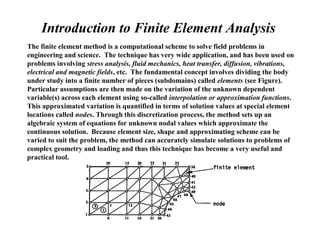
The finite element method is a computational scheme to solve field problems in
engineering and science. The technique has very wide application, and has been used on
problems involving stress analysis, fluid mechanics, heat transfer, diffusion, vibrations,
electrical and magnetic fields, etc. The fundamental concept involves dividing the body
under study into a finite number of pieces (subdomains) called elements (see Figure).
Particular assumptions are then made on the variation of the unknown dependent
variable(s) across each element using so-called interpolation or approximation functions.
This approximated variation is quantified in terms of solution values at special element
locations called nodes. Through this discretization process, the method sets up an
algebraic system of equations for unknown nodal values which approximate the
continuous solution. Because element size, shape and approximating scheme can be
varied to suit the problem, the method can accurately simulate solutions to problems of
complex geometry and loading and thus this technique has become a very useful and
practical tool.
Advantages of Finite Element Analysis
- Models Bodies of Complex Shape
- Can Handle General Loading/Boundary Conditions
- Models Bodies Composed of Composite and Multiphase Materials
- Model is Easily Refined for Improved Accuracy by Varying
Element Size and Type (Approximation Scheme)
- Time Dependent and Dynamic Effects Can Be Included
- Can Handle a Variety Nonlinear Effects Including Material
Behavior, Large Deformations, Boundary Conditions, Etc.
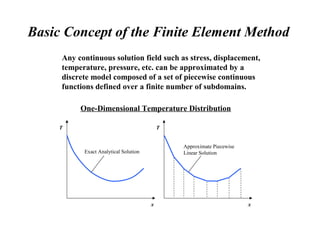
Basic Concept of the Finite Element Method
Any continuous solution field such as stress, displacement,
temperature, pressure, etc. can be approximated by a
discrete model composed of a set of piecewise continuous
functions defined over a finite number of subdomains.
Exact Analytical Solution
x
T
Approximate Piecewise
Linear Solution
x
T
One-Dimensional Temperature Distribution
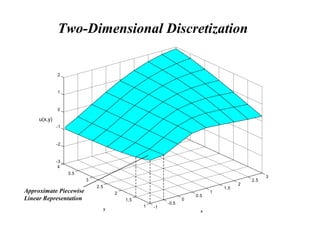
Two-Dimensional Discretization
-1
-0.5
0
0.5
1
1.5
2
2.5
3
1
1.5
2
2.5
3
3.5
4
-3
-2
-1
0
1
2
x
y
u(x,y)
Approximate Piecewise
Linear Representation
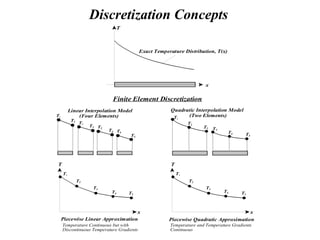
Discretization Concepts
x
T
Exact Temperature Distribution, T(x)
Finite Element Discretization
Linear Interpolation Model
(Four Elements)
Quadratic Interpolation Model
(Two Elements)
T1
T2
T2
T3 T3
T4 T4
T5
T1
T2
T3
T4 T5
Piecewise Linear Approximation
T
x
T1
T2
T3 T3
T4 T5
T
T1
T2
T3
T4 T5
Piecewise Quadratic Approximation
x
Temperature Continuous but with
Discontinuous Temperature Gradients
Temperature and Temperature Gradients
Continuous
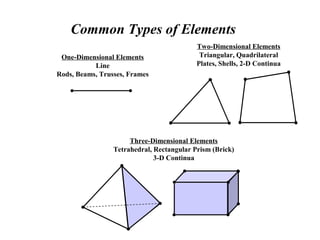
Common Types of Elements
One-Dimensional Elements
Line
Rods, Beams, Trusses, Frames
Two-Dimensional Elements
Triangular, Quadrilateral
Plates, Shells, 2-D Continua
Three-Dimensional Elements
Tetrahedral, Rectangular Prism (Brick)
3-D Continua
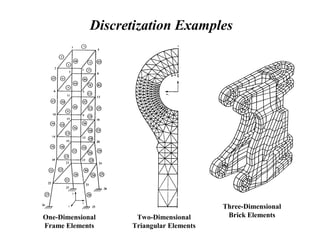
Discretization Examples
One-Dimensional
Frame Elements
Two-Dimensional
Triangular Elements
Three-Dimensional
Brick Elements
Basic Steps in the Finite Element Method
Time Independent Problems
- Domain Discretization
- Select Element Type (Shape and Approximation)
- Derive Element Equations (Variational and Energy Methods)
- Assemble Element Equations to Form Global System
[K]{U} = {F}
[K] = Stiffness or Property Matrix
{U} = Nodal Displacement Vector
{F} = Nodal Force Vector
- Incorporate Boundary and Initial Conditions
- Solve Assembled System of Equations for Unknown Nodal
Displacements and Secondary Unknowns of Stress and Strain Values
Common Sources of Error in FEA
• Domain Approximation
• Element Interpolation/Approximation
• Numerical Integration Errors
(Including Spatial and Time Integration)
• Computer Errors (Round-Off, Etc., )
Measures of Accuracy in FEA
Accuracy
Error = |(Exact Solution)-(FEM Solution)|
Convergence
Limit of Error as:
Number of Elements (h-convergence)
or
Approximation Order (p-convergence)
Increases
Ideally, Error → 0 as Number of Elements or
Approximation Order → ∞
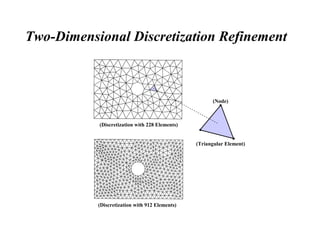
Two-Dimensional Discretization Refinement
(Discretization with 228 Elements)
(Discretization with 912 Elements)
(Triangular Element)
(Node)
•
•
•
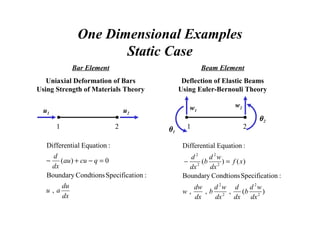
One Dimensional Examples
Static Case
1 2
u1 u2
Bar Element
Uniaxial Deformation of Bars
Using Strength of Materials Theory
Beam Element
Deflection of Elastic Beams
Using Euler-Bernouli Theory
1 2
w1
w2
θ2
θ1
dx
du
au
qcuau
dx
d
,
:ionSpecificatCondtionsBoundary
0)(
:EquationalDifferenti
=−+−
)(,,,
:ionSpecificatCondtionsBoundary
)()(
:EquationalDifferenti
2
2
2
2
2
2
2
2
dx
wd
b
dx
d
dx
wd
b
dx
dw
w
xf
dx
wd
b
dx
d
=−
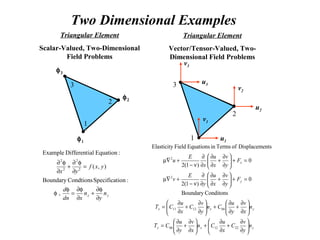
Two Dimensional Examples
u1
u2
1
2
3 u3
v1
v2
v3
1
2
3
φ1
φ2
φ3
Triangular Element
Scalar-Valued, Two-Dimensional
Field Problems
Triangular Element
Vector/Tensor-Valued, Two-
Dimensional Field Problems
yx n
y
n
xdn
d
yxf
yx
∂
φ∂
+
∂
φ∂
=
φ
φ
=
∂
φ∂
+
∂
φ∂
,
:ionSpecificatCondtionsBoundary
),(
:EquationialDifferentExample
2
2
2
2
yxy
yxx
y
x
n
y
v
C
x
u
Cn
x
v
y
u
CT
n
x
v
y
u
Cn
y
v
C
x
u
CT
F
y
v
x
u
y
E
v
F
y
v
x
u
x
E
u






∂
∂
+
∂
∂
+





∂
∂
+
∂
∂
=






∂
∂
+
∂
∂
+





∂
∂
+
∂
∂
=
=+





∂
∂
+
∂
∂
∂
∂
ν−
+∇µ
=+





∂
∂
+
∂
∂
∂
∂
ν−
+∇µ
221266
661211
2
2
ConditonsBoundary
0
)1(2
0
)1(2
entsDisplacemofTermsinEquationsFieldElasticity
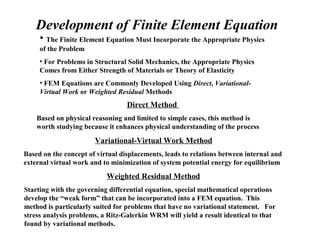
Development of Finite Element Equation
• The Finite Element Equation Must Incorporate the Appropriate Physics
of the Problem
• For Problems in Structural Solid Mechanics, the Appropriate Physics
Comes from Either Strength of Materials or Theory of Elasticity
• FEM Equations are Commonly Developed Using Direct, Variational-
Virtual Work or Weighted Residual Methods
Variational-Virtual Work Method
Based on the concept of virtual displacements, leads to relations between internal and
external virtual work and to minimization of system potential energy for equilibrium
Weighted Residual Method
Starting with the governing differential equation, special mathematical operations
develop the “weak form” that can be incorporated into a FEM equation. This
method is particularly suited for problems that have no variational statement. For
stress analysis problems, a Ritz-Galerkin WRM will yield a result identical to that
found by variational methods.
Direct Method
Based on physical reasoning and limited to simple cases, this method is
worth studying because it enhances physical understanding of the process
Simple Element Equation Example
Direct Stiffness Derivation
1 2
k
u1 u2
F1 F2
}{}]{[
rmMatrix Foinor
2NodeatmEquilibriu
1NodeatmEquilibriu
2
1
2
1
212
211
FuK
F
F
u
u
kk
kk
kukuF
kukuF
=






=












−
−
+−=⇒
−=⇒
Stiffness Matrix Nodal Force Vector
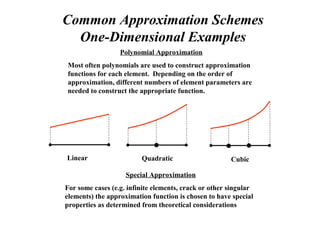
Common Approximation Schemes
One-Dimensional Examples
Linear Quadratic Cubic
Polynomial Approximation
Most often polynomials are used to construct approximation
functions for each element. Depending on the order of
approximation, different numbers of element parameters are
needed to construct the appropriate function.
Special Approximation
For some cases (e.g. infinite elements, crack or other singular
elements) the approximation function is chosen to have special
properties as determined from theoretical considerations
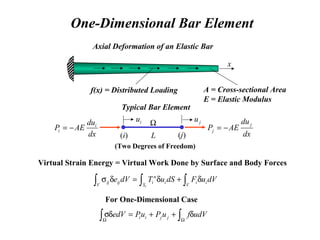
One-Dimensional Bar Element
⇒δ++=δσ ∫∫ ΩΩ
udVfuPuPedV jjii
}]{[:LawStrain-Stress
}]{[}{
][
)(:Strain
}{][)(:ionApproximat
dB
dBd
N
dN
EEe
dx
d
ux
dx
d
dx
du
e
uxu
k
kk
k
kk
==σ
==ψ==
=ψ=
∑
∑
⇒+






= ∫∫
L
TT
j
iT
L
TT
fdxA
P
P
dxEA
00
][}{}{}{][][}{ NδdδddBBδd
∫∫ +=
L
T
L
T
fdxAdxEA
00
][}{}{][][ NPdBB
VectorentDisplacemNodal}{
VectorLoading][}{
MatrixStiffness][][][
0
0
=






=
=+






=
==
∫
∫
j
i
L
T
j
i
L
T
u
u
fdxA
P
P
dxEAK
d
NF
BB
}{}]{[ FdK =
One-Dimensional Bar Element
A = Cross-sectional Area
E = Elastic Modulus
f(x) = Distributed Loading
dVuFdSuTdVe i
V
i
S
i
n
iij
V
ij
t
δ+δ=δσ ∫∫∫
Virtual Strain Energy = Virtual Work Done by Surface and Body Forces
For One-Dimensional Case
∫∫ ΩΩ
δ++=δσ udVfuPuPedV jjii
Ω
(i) (j)
Axial Deformation of an Elastic Bar
Typical Bar Element
dx
du
AEP i
i −=
dx
du
AEP
j
j −=
iu ju
L
x
(Two Degrees of Freedom)
Linear Approximation Scheme
[ ]
VectorentDisplacemNodal}{
MatrixFunctionionApproximat][
}]{[1
)()(
1
2
1
2
1
21
2211
21
12
1
212
11
21
=
=
=










−=






ψψ=
ψ+ψ=






+





−=
−
+=⇒
+=
=
⇒+=
d
N
dN
ntDisplacemeElasticeApproximat
u
u
L
x
L
x
u
u
u
uxux
u
L
x
u
L
x
x
L
uu
uu
Laau
au
xaau
x (local coordinate system)
(1) (2)
iu ju
L
x
(1) (2)
u(x)
x
(1) (2)
ψ1(x) ψ2(x)
1
ψk(x) – Lagrange Interpolation Functions
Element Equation
Linear Approximation Scheme, Constant Properties
VectorentDisplacemNodal}{
1
1
2
][}{
11
1111
1
1
][][][][][
2
1
2
1
0
2
1
0
2
1
00
=






=






+






=










−
+






=+






=






−
−
=






−










−
===
∫∫
∫∫
u
u
LAf
P
P
dx
L
x
L
x
Af
P
P
fdxA
P
P
L
AE
L
LL
L
LAEdxAEdxEAK
o
L
o
L
T
L
T
L
T
d
NF
BBBB






+






=












−
−
⇒=
1
1
211
11
}{}]{[
2
1
2
1 LAf
P
P
u
u
L
AE o
FdK
Quadratic Approximation Scheme
[ ] }]{[
)()()(
42
3
2
1
321
332211
2
3213
2
3212
11
2
321
dN
ntDisplacemeElasticeApproximat
=








ψψψ=
ψ+ψ+ψ=
++=
++=
=
⇒++=
u
u
u
u
uxuxuxu
LaLaau
L
a
L
aau
au
xaxaau
x
(1) (3)
1u 3u
(2)
2u
L
u(x)
x
(1) (3)(2)
x
(1) (3)(2)
1
ψ1(x) ψ3(x)
ψ2(x)










=




















−
−−
−
3
2
1
3
2
1
781
8168
187
3
F
F
F
u
u
u
L
AE
EquationElement
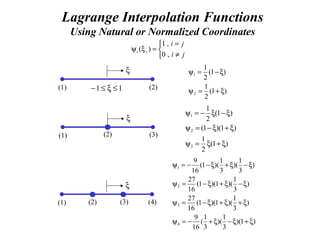
Lagrange Interpolation Functions
Using Natural or Normalized Coordinates
11 ≤ξ≤−
ξ
(1) (2)
)1(
2
1
)1(
2
1
2
1
ξ+=ψ
ξ−=ψ
)1(
2
1
)1)(1(
)1(
2
1
3
2
1
ξ+ξ=ψ
ξ+ξ−=ψ
ξ−ξ−=ψ
)1)(
3
1
)(
3
1
(
16
9
)
3
1
)(1)(1(
16
27
)
3
1
)(1)(1(
16
27
)
3
1
)(
3
1
)(1(
16
9
4
3
2
1
ξ+ξ−ξ+−=ψ
ξ+ξ+ξ−=ψ
ξ−ξ+ξ−=ψ
ξ−ξ+ξ−−=ψ
ξ
(1) (2) (3)
ξ
(1) (2) (3) (4)



≠
=
=ξψ
ji
ji
ji
,0
,1
)(
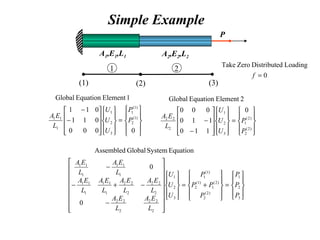
Simple Example
P
A1,E1,L1 A2,E2,L2
(1) (3)(2)
1 2










=




















−
−
0000
011
011
1ElementEquationGlobal
)1(
2
)1(
1
3
2
1
1
11
P
P
U
U
U
L
EA










=




















−
−
)2(
2
)2(
1
3
2
1
2
22
0
110
110
000
2ElementEquationGlobal
P
P
U
U
U
L
EA










=










+=




























−
−+−
−
3
2
1
)2(
2
)2(
1
)1(
2
)1(
1
3
2
1
2
22
2
22
2
22
2
22
1
11
1
11
1
11
1
11
0
0
EquationSystemGlobalAssembled
P
P
P
P
PP
P
U
U
U
L
EA
L
EA
L
EA
L
EA
L
EA
L
EA
L
EA
L
EA
0
LoadingedDistributZeroTake
=f
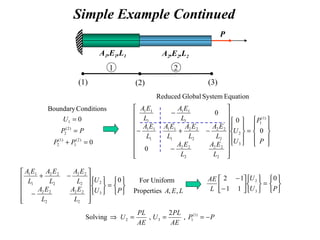
Simple Example Continued
P
A1,E1,L1 A2,E2,L2
(1) (3)(2)
1 2
0
0
ConditionsBoundary
)2(
1
)1(
2
)2(
2
1
=+
=
=
PP
PP
U










=




























−
−+−
−
P
P
U
U
L
EA
L
EA
L
EA
L
EA
L
EA
L
EA
L
EA
L
EA
0
0
0
0
EquationSystemGlobalReduced
)1(
1
3
2
2
22
2
22
2
22
2
22
1
11
1
11
1
11
1
11






=


















−
−+
PU
U
L
EA
L
EA
L
EA
L
EA
L
EA
0
3
2
2
22
2
22
2
22
2
22
1
11
LEA ,,Properties
mFor Unifor






=












−
−
PU
U
L
AE 0
11
12
3
2
PP
AE
PL
U
AE
PL
U −===⇒ )1(
132 ,
2
,Solving
One-Dimensional Beam Element
Deflection of an Elastic Beam
2
2423
1
1211
2
2
2
4
2
2
2
3
1
2
2
2
1
2
2
1
,,,
,
,
dx
dw
uwu
dx
dw
uwu
dx
wd
EIQ
dx
wd
EI
dx
d
Q
dx
wd
EIQ
dx
wd
EI
dx
d
Q
−=θ==−=θ==






−=





−=






=





=
I = Section Moment of Inertia
E = Elastic Modulus
f(x) = Distributed Loading
Ω
(1) (2)
Typical Beam Element
1w
L
2w
1θ 2θ
1M 2M
1V 2V
x
Virtual Strain Energy = Virtual Work Done by Surface and Body Forces
⇒δ++++=δσ ∫∫ ΩΩ
wdVfwQuQuQuQedV 44332211
∫∫ ++++=
L
T
L
dVfwQuQuQuQdxEI
0
44332211
0
][}{][][ NdBB T
(Four Degrees of Freedom)
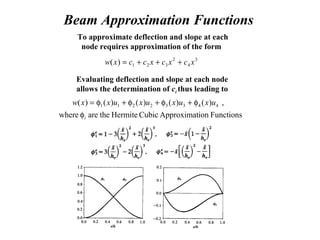
Beam Approximation Functions
To approximate deflection and slope at each
node requires approximation of the form
3
4
2
321)( xcxcxccxw +++=
Evaluating deflection and slope at each node
allows the determination of ci thus leading to
FunctionsionApproximatCubicHermitethearewhere
,)()()()()( 44332211
i
uxuxuxuxxw
φ
φ+φ+φ+φ=
Beam Element Equation
∫∫ ++++=
L
T
L
dVfwQuQuQuQdxEI
0
44332211
0
][}{][][ NdBB T














=
4
3
2
1
}{
u
u
u
u
d ][
][
][ 4321
dx
d
dx
d
dx
d
dx
d
dx
d φφφφ
==
N
B












−
−
−
−−−
== ∫
22
22
30
233
3636
323
3636
2
][][][
LLLL
LL
LLLL
LL
L
EI
dxEI
L
BBK T














−
+














=


























−
−
−
−−−
L
LfL
Q
Q
Q
Q
u
u
u
u
LLLL
LL
LLLL
LL
L
EI
6
6
12
233
3636
323
3636
2
4
3
2
1
4
3
2
1
22
22
3














−
=














φ
φ
φ
φ
= ∫∫
L
LfL
dxfdxf
LL
T
6
6
12
][
0
4
3
2
1
0
N
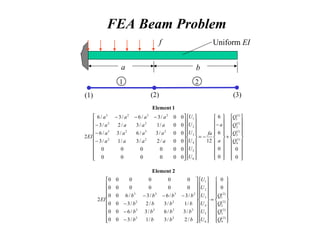
FEA Beam Problem
f
a b
Uniform EI




















+




















−
−=








































−
−
−
−−−
0
0
0
0
6
6
12
000000
000000
00/2/3/1/3
00/3/6/3/6
00/1/3/2/3
00/3/6/3/6
2 )1(
4
)1(
3
)1(
2
)1(
1
6
5
4
3
2
1
22
2323
22
2323
Q
Q
Q
Q
a
a
fa
U
U
U
U
U
U
aaaa
aaaa
aaaa
aaaa
EI
1Element




















=








































−
−
−
−−−
)2(
4
)2(
3
)2(
2
)2(
1
6
5
4
3
2
1
22
2323
22
2323
0
0
/2/3/1/300
/3/6/3/600
/1/3/2/300
/3/6/3/600
000000
000000
2
Q
Q
Q
Q
U
U
U
U
U
U
bbbb
bbbb
bbbb
bbbb
EI
2Element
(1) (3)(2)
1 2
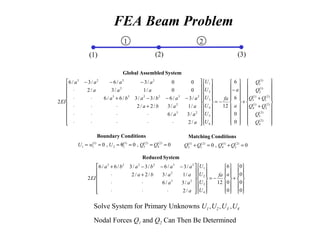
FEA Beam Problem




















+
+
+




















−
−=








































⋅⋅⋅⋅⋅
⋅⋅⋅⋅
+⋅⋅⋅
−−−+⋅⋅
⋅
−−−
)2(
4
)2(
3
)2(
2
)1(
4
)2(
1
)1(
3
)1(
2
)1(
1
6
5
4
3
2
1
23
2
232233
2
2323
0
0
6
6
12
/2
/3/6
/1/3/2/2
/3/6/3/3/6/6
00/1/3/2
00/3/6/3/6
2
Q
Q
QQ
QQ
Q
Q
a
a
fa
U
U
U
U
U
U
a
aa
aaba
aababa
aaa
aaaa
EI
SystemAssembledGlobal
0,0,0 )2(
4
)2(
3
)1(
12
)1(
11 ===θ=== QQUwU
ConditionsBoundary
0,0 )2(
2
)1(
4
)2(
1
)1(
3 =+=+ QQQQ
ConditionsMatching














+














−=




























⋅⋅⋅
⋅⋅
+⋅
−−−+
0
0
0
0
0
0
6
12
/2
/3/6
/1/3/2/2
/3/6/3/3/6/6
2
4
3
2
1
23
2
332233
afa
U
U
U
U
a
aa
aaba
aababa
EI
SystemReduced
Solve System for Primary Unknowns U1 ,U2 ,U3 ,U4
Nodal Forces Q1 and Q2 Can Then Be Determined
(1) (3)(2)
1 2
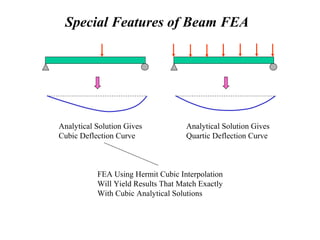
Special Features of Beam FEA
Analytical Solution Gives
Cubic Deflection Curve
Analytical Solution Gives
Quartic Deflection Curve
FEA Using Hermit Cubic Interpolation
Will Yield Results That Match Exactly
With Cubic Analytical Solutions
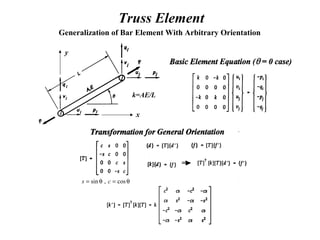
Truss Element
Generalization of Bar Element With Arbitrary Orientation
x
y
k=AE/L
θ=θ= cos,sin cs
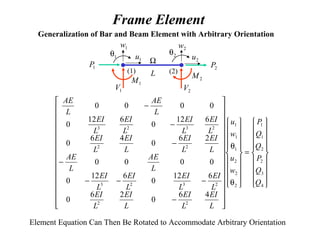
Frame Element
Generalization of Bar and Beam Element with Arbitrary Orientation
Ω
(1) (2)
1w
L
2w
1θ 2θ
1M 2M
1V 2V
2P1P
1u 2u


















=


















θ
θ






























−
−−−
−
−
−
−
4
3
2
2
1
1
2
2
2
1
1
1
22
2323
22
2323
46
0
26
0
612
0
612
0
0000
26
0
46
0
612
0
612
0
0000
Q
Q
P
Q
Q
P
w
u
w
u
L
EI
L
EI
L
EI
L
EI
L
EI
L
EI
L
EI
L
EI
L
AE
L
AE
L
EI
L
EI
L
EI
L
EI
L
EI
L
EI
L
EI
L
EI
L
AE
L
AE
Element Equation Can Then Be Rotated to Accommodate Arbitrary Orientation
Some Standard FEA References
Bathe, K.J., Finite Element Procedures in Engineering Analysis, Prentice-Hall, 1982, 1995.
Beer, G. and Watson, J.O., Introduction to Finite and Boundary Element Methods for Engineers, John Wiley, 1993
Bickford, W.B., A First Course in the Finite Element Method, Irwin, 1990.
Burnett, D.S., Finite Element Analysis, Addison-Wesley, 1987.
Chandrupatla, T.R. and Belegundu, A.D., Introduction to Finite Elements in Engineering, Prentice-Hall, 2002.
Cook, R.D., Malkus, D.S. and Plesha, M.E., Concepts and Applications of Finite Element Analysis, 3rd
Ed., John Wiley,
1989.
Desai, C.S., Elementary Finite Element Method, Prentice-Hall, 1979.
Fung, Y.C. and Tong, P., Classical and Computational Solid Mechanics, World Scientific, 2001.
Grandin, H., Fundamentals of the Finite Element Method, Macmillan, 1986.
Huebner, K.H., Thorton, E.A. and Byrom, T.G., The Finite Element Method for Engineers, 3rd
Ed., John Wiley, 1994.
Knight, C.E., The Finite Element Method in Mechanical Design, PWS-KENT, 1993.
Logan, D.L., A First Course in the Finite Element Method, 2nd
Ed., PWS Engineering, 1992.
Moaveni, S., Finite Element Analysis – Theory and Application with ANSYS, 2nd
Ed., Pearson Education, 2003.
Pepper, D.W. and Heinrich, J.C., The Finite Element Method: Basic Concepts and Applications, Hemisphere, 1992.
Pao, Y.C., A First Course in Finite Element Analysis, Allyn and Bacon, 1986.
Rao, S.S., Finite Element Method in Engineering, 3rd
Ed., Butterworth-Heinemann, 1998.
Reddy, J.N., An Introduction to the Finite Element Method, McGraw-Hill, 1993.
Ross, C.T.F., Finite Element Methods in Engineering Science, Prentice-Hall, 1993.
Stasa, F.L., Applied Finite Element Analysis for Engineers, Holt, Rinehart and Winston, 1985.
Zienkiewicz, O.C. and Taylor, R.L., The Finite Element Method, Fourth Edition, McGraw-Hill, 1977, 1989.

Fem lecture

  • 1.
    MCE 565 Wave Motion& Vibration in Continuous Media Spring 2005 Professor M. H. Sadd Introduction to Finite Element Methods
  • 2.
    Need for ComputationalMethods • Solutions Using Either Strength of Materials or Theory of Elasticity Are Normally Accomplished for Regions and Loadings With Relatively Simple Geometry • Many Applicaitons Involve Cases with Complex Shape, Boundary Conditions and Material Behavior • Therefore a Gap Exists Between What Is Needed in Applications and What Can Be Solved by Analytical Closed- form Methods • This Has Lead to the Development of Several Numerical/Computational Schemes Including: Finite Difference, Finite Element and Boundary Element Methods
  • 3.
    Introduction to FiniteElement Analysis The finite element method is a computational scheme to solve field problems in engineering and science. The technique has very wide application, and has been used on problems involving stress analysis, fluid mechanics, heat transfer, diffusion, vibrations, electrical and magnetic fields, etc. The fundamental concept involves dividing the body under study into a finite number of pieces (subdomains) called elements (see Figure). Particular assumptions are then made on the variation of the unknown dependent variable(s) across each element using so-called interpolation or approximation functions. This approximated variation is quantified in terms of solution values at special element locations called nodes. Through this discretization process, the method sets up an algebraic system of equations for unknown nodal values which approximate the continuous solution. Because element size, shape and approximating scheme can be varied to suit the problem, the method can accurately simulate solutions to problems of complex geometry and loading and thus this technique has become a very useful and practical tool.
  • 4.
    Advantages of FiniteElement Analysis - Models Bodies of Complex Shape - Can Handle General Loading/Boundary Conditions - Models Bodies Composed of Composite and Multiphase Materials - Model is Easily Refined for Improved Accuracy by Varying Element Size and Type (Approximation Scheme) - Time Dependent and Dynamic Effects Can Be Included - Can Handle a Variety Nonlinear Effects Including Material Behavior, Large Deformations, Boundary Conditions, Etc.
  • 5.
    Basic Concept ofthe Finite Element Method Any continuous solution field such as stress, displacement, temperature, pressure, etc. can be approximated by a discrete model composed of a set of piecewise continuous functions defined over a finite number of subdomains. Exact Analytical Solution x T Approximate Piecewise Linear Solution x T One-Dimensional Temperature Distribution
  • 6.
  • 7.
    Discretization Concepts x T Exact TemperatureDistribution, T(x) Finite Element Discretization Linear Interpolation Model (Four Elements) Quadratic Interpolation Model (Two Elements) T1 T2 T2 T3 T3 T4 T4 T5 T1 T2 T3 T4 T5 Piecewise Linear Approximation T x T1 T2 T3 T3 T4 T5 T T1 T2 T3 T4 T5 Piecewise Quadratic Approximation x Temperature Continuous but with Discontinuous Temperature Gradients Temperature and Temperature Gradients Continuous
  • 8.
    Common Types ofElements One-Dimensional Elements Line Rods, Beams, Trusses, Frames Two-Dimensional Elements Triangular, Quadrilateral Plates, Shells, 2-D Continua Three-Dimensional Elements Tetrahedral, Rectangular Prism (Brick) 3-D Continua
  • 9.
  • 10.
    Basic Steps inthe Finite Element Method Time Independent Problems - Domain Discretization - Select Element Type (Shape and Approximation) - Derive Element Equations (Variational and Energy Methods) - Assemble Element Equations to Form Global System [K]{U} = {F} [K] = Stiffness or Property Matrix {U} = Nodal Displacement Vector {F} = Nodal Force Vector - Incorporate Boundary and Initial Conditions - Solve Assembled System of Equations for Unknown Nodal Displacements and Secondary Unknowns of Stress and Strain Values
  • 11.
    Common Sources ofError in FEA • Domain Approximation • Element Interpolation/Approximation • Numerical Integration Errors (Including Spatial and Time Integration) • Computer Errors (Round-Off, Etc., )
  • 12.
    Measures of Accuracyin FEA Accuracy Error = |(Exact Solution)-(FEM Solution)| Convergence Limit of Error as: Number of Elements (h-convergence) or Approximation Order (p-convergence) Increases Ideally, Error → 0 as Number of Elements or Approximation Order → ∞
  • 13.
    Two-Dimensional Discretization Refinement (Discretizationwith 228 Elements) (Discretization with 912 Elements) (Triangular Element) (Node) • • •
  • 14.
    One Dimensional Examples StaticCase 1 2 u1 u2 Bar Element Uniaxial Deformation of Bars Using Strength of Materials Theory Beam Element Deflection of Elastic Beams Using Euler-Bernouli Theory 1 2 w1 w2 θ2 θ1 dx du au qcuau dx d , :ionSpecificatCondtionsBoundary 0)( :EquationalDifferenti =−+− )(,,, :ionSpecificatCondtionsBoundary )()( :EquationalDifferenti 2 2 2 2 2 2 2 2 dx wd b dx d dx wd b dx dw w xf dx wd b dx d =−
  • 15.
    Two Dimensional Examples u1 u2 1 2 3u3 v1 v2 v3 1 2 3 φ1 φ2 φ3 Triangular Element Scalar-Valued, Two-Dimensional Field Problems Triangular Element Vector/Tensor-Valued, Two- Dimensional Field Problems yx n y n xdn d yxf yx ∂ φ∂ + ∂ φ∂ = φ φ = ∂ φ∂ + ∂ φ∂ , :ionSpecificatCondtionsBoundary ),( :EquationialDifferentExample 2 2 2 2 yxy yxx y x n y v C x u Cn x v y u CT n x v y u Cn y v C x u CT F y v x u y E v F y v x u x E u       ∂ ∂ + ∂ ∂ +      ∂ ∂ + ∂ ∂ =       ∂ ∂ + ∂ ∂ +      ∂ ∂ + ∂ ∂ = =+      ∂ ∂ + ∂ ∂ ∂ ∂ ν− +∇µ =+      ∂ ∂ + ∂ ∂ ∂ ∂ ν− +∇µ 221266 661211 2 2 ConditonsBoundary 0 )1(2 0 )1(2 entsDisplacemofTermsinEquationsFieldElasticity
  • 16.
    Development of FiniteElement Equation • The Finite Element Equation Must Incorporate the Appropriate Physics of the Problem • For Problems in Structural Solid Mechanics, the Appropriate Physics Comes from Either Strength of Materials or Theory of Elasticity • FEM Equations are Commonly Developed Using Direct, Variational- Virtual Work or Weighted Residual Methods Variational-Virtual Work Method Based on the concept of virtual displacements, leads to relations between internal and external virtual work and to minimization of system potential energy for equilibrium Weighted Residual Method Starting with the governing differential equation, special mathematical operations develop the “weak form” that can be incorporated into a FEM equation. This method is particularly suited for problems that have no variational statement. For stress analysis problems, a Ritz-Galerkin WRM will yield a result identical to that found by variational methods. Direct Method Based on physical reasoning and limited to simple cases, this method is worth studying because it enhances physical understanding of the process
  • 17.
    Simple Element EquationExample Direct Stiffness Derivation 1 2 k u1 u2 F1 F2 }{}]{[ rmMatrix Foinor 2NodeatmEquilibriu 1NodeatmEquilibriu 2 1 2 1 212 211 FuK F F u u kk kk kukuF kukuF =       =             − − +−=⇒ −=⇒ Stiffness Matrix Nodal Force Vector
  • 18.
    Common Approximation Schemes One-DimensionalExamples Linear Quadratic Cubic Polynomial Approximation Most often polynomials are used to construct approximation functions for each element. Depending on the order of approximation, different numbers of element parameters are needed to construct the appropriate function. Special Approximation For some cases (e.g. infinite elements, crack or other singular elements) the approximation function is chosen to have special properties as determined from theoretical considerations
  • 19.
    One-Dimensional Bar Element ⇒δ++=δσ∫∫ ΩΩ udVfuPuPedV jjii }]{[:LawStrain-Stress }]{[}{ ][ )(:Strain }{][)(:ionApproximat dB dBd N dN EEe dx d ux dx d dx du e uxu k kk k kk ==σ ==ψ== =ψ= ∑ ∑ ⇒+       = ∫∫ L TT j iT L TT fdxA P P dxEA 00 ][}{}{}{][][}{ NδdδddBBδd ∫∫ += L T L T fdxAdxEA 00 ][}{}{][][ NPdBB VectorentDisplacemNodal}{ VectorLoading][}{ MatrixStiffness][][][ 0 0 =       = =+       = == ∫ ∫ j i L T j i L T u u fdxA P P dxEAK d NF BB }{}]{[ FdK =
  • 20.
    One-Dimensional Bar Element A= Cross-sectional Area E = Elastic Modulus f(x) = Distributed Loading dVuFdSuTdVe i V i S i n iij V ij t δ+δ=δσ ∫∫∫ Virtual Strain Energy = Virtual Work Done by Surface and Body Forces For One-Dimensional Case ∫∫ ΩΩ δ++=δσ udVfuPuPedV jjii Ω (i) (j) Axial Deformation of an Elastic Bar Typical Bar Element dx du AEP i i −= dx du AEP j j −= iu ju L x (Two Degrees of Freedom)
  • 21.
    Linear Approximation Scheme [] VectorentDisplacemNodal}{ MatrixFunctionionApproximat][ }]{[1 )()( 1 2 1 2 1 21 2211 21 12 1 212 11 21 = = =           −=       ψψ= ψ+ψ=       +      −= − +=⇒ += = ⇒+= d N dN ntDisplacemeElasticeApproximat u u L x L x u u u uxux u L x u L x x L uu uu Laau au xaau x (local coordinate system) (1) (2) iu ju L x (1) (2) u(x) x (1) (2) ψ1(x) ψ2(x) 1 ψk(x) – Lagrange Interpolation Functions
  • 22.
    Element Equation Linear ApproximationScheme, Constant Properties VectorentDisplacemNodal}{ 1 1 2 ][}{ 11 1111 1 1 ][][][][][ 2 1 2 1 0 2 1 0 2 1 00 =       =       +       =           − +       =+       =       − − =       −           − === ∫∫ ∫∫ u u LAf P P dx L x L x Af P P fdxA P P L AE L LL L LAEdxAEdxEAK o L o L T L T L T d NF BBBB       +       =             − − ⇒= 1 1 211 11 }{}]{[ 2 1 2 1 LAf P P u u L AE o FdK
  • 23.
    Quadratic Approximation Scheme [] }]{[ )()()( 42 3 2 1 321 332211 2 3213 2 3212 11 2 321 dN ntDisplacemeElasticeApproximat =         ψψψ= ψ+ψ+ψ= ++= ++= = ⇒++= u u u u uxuxuxu LaLaau L a L aau au xaxaau x (1) (3) 1u 3u (2) 2u L u(x) x (1) (3)(2) x (1) (3)(2) 1 ψ1(x) ψ3(x) ψ2(x)           =                     − −− − 3 2 1 3 2 1 781 8168 187 3 F F F u u u L AE EquationElement
  • 24.
    Lagrange Interpolation Functions UsingNatural or Normalized Coordinates 11 ≤ξ≤− ξ (1) (2) )1( 2 1 )1( 2 1 2 1 ξ+=ψ ξ−=ψ )1( 2 1 )1)(1( )1( 2 1 3 2 1 ξ+ξ=ψ ξ+ξ−=ψ ξ−ξ−=ψ )1)( 3 1 )( 3 1 ( 16 9 ) 3 1 )(1)(1( 16 27 ) 3 1 )(1)(1( 16 27 ) 3 1 )( 3 1 )(1( 16 9 4 3 2 1 ξ+ξ−ξ+−=ψ ξ+ξ+ξ−=ψ ξ−ξ+ξ−=ψ ξ−ξ+ξ−−=ψ ξ (1) (2) (3) ξ (1) (2) (3) (4)    ≠ = =ξψ ji ji ji ,0 ,1 )(
  • 25.
    Simple Example P A1,E1,L1 A2,E2,L2 (1)(3)(2) 1 2           =                     − − 0000 011 011 1ElementEquationGlobal )1( 2 )1( 1 3 2 1 1 11 P P U U U L EA           =                     − − )2( 2 )2( 1 3 2 1 2 22 0 110 110 000 2ElementEquationGlobal P P U U U L EA           =           +=                             − −+− − 3 2 1 )2( 2 )2( 1 )1( 2 )1( 1 3 2 1 2 22 2 22 2 22 2 22 1 11 1 11 1 11 1 11 0 0 EquationSystemGlobalAssembled P P P P PP P U U U L EA L EA L EA L EA L EA L EA L EA L EA 0 LoadingedDistributZeroTake =f
  • 26.
    Simple Example Continued P A1,E1,L1A2,E2,L2 (1) (3)(2) 1 2 0 0 ConditionsBoundary )2( 1 )1( 2 )2( 2 1 =+ = = PP PP U           =                             − −+− − P P U U L EA L EA L EA L EA L EA L EA L EA L EA 0 0 0 0 EquationSystemGlobalReduced )1( 1 3 2 2 22 2 22 2 22 2 22 1 11 1 11 1 11 1 11       =                   − −+ PU U L EA L EA L EA L EA L EA 0 3 2 2 22 2 22 2 22 2 22 1 11 LEA ,,Properties mFor Unifor       =             − − PU U L AE 0 11 12 3 2 PP AE PL U AE PL U −===⇒ )1( 132 , 2 ,Solving
  • 27.
    One-Dimensional Beam Element Deflectionof an Elastic Beam 2 2423 1 1211 2 2 2 4 2 2 2 3 1 2 2 2 1 2 2 1 ,,, , , dx dw uwu dx dw uwu dx wd EIQ dx wd EI dx d Q dx wd EIQ dx wd EI dx d Q −=θ==−=θ==       −=      −=       =      = I = Section Moment of Inertia E = Elastic Modulus f(x) = Distributed Loading Ω (1) (2) Typical Beam Element 1w L 2w 1θ 2θ 1M 2M 1V 2V x Virtual Strain Energy = Virtual Work Done by Surface and Body Forces ⇒δ++++=δσ ∫∫ ΩΩ wdVfwQuQuQuQedV 44332211 ∫∫ ++++= L T L dVfwQuQuQuQdxEI 0 44332211 0 ][}{][][ NdBB T (Four Degrees of Freedom)
  • 28.
    Beam Approximation Functions Toapproximate deflection and slope at each node requires approximation of the form 3 4 2 321)( xcxcxccxw +++= Evaluating deflection and slope at each node allows the determination of ci thus leading to FunctionsionApproximatCubicHermitethearewhere ,)()()()()( 44332211 i uxuxuxuxxw φ φ+φ+φ+φ=
  • 29.
    Beam Element Equation ∫∫++++= L T L dVfwQuQuQuQdxEI 0 44332211 0 ][}{][][ NdBB T               = 4 3 2 1 }{ u u u u d ][ ][ ][ 4321 dx d dx d dx d dx d dx d φφφφ == N B             − − − −−− == ∫ 22 22 30 233 3636 323 3636 2 ][][][ LLLL LL LLLL LL L EI dxEI L BBK T               − +               =                           − − − −−− L LfL Q Q Q Q u u u u LLLL LL LLLL LL L EI 6 6 12 233 3636 323 3636 2 4 3 2 1 4 3 2 1 22 22 3               − =               φ φ φ φ = ∫∫ L LfL dxfdxf LL T 6 6 12 ][ 0 4 3 2 1 0 N
  • 30.
    FEA Beam Problem f ab Uniform EI                     +                     − −=                                         − − − −−− 0 0 0 0 6 6 12 000000 000000 00/2/3/1/3 00/3/6/3/6 00/1/3/2/3 00/3/6/3/6 2 )1( 4 )1( 3 )1( 2 )1( 1 6 5 4 3 2 1 22 2323 22 2323 Q Q Q Q a a fa U U U U U U aaaa aaaa aaaa aaaa EI 1Element                     =                                         − − − −−− )2( 4 )2( 3 )2( 2 )2( 1 6 5 4 3 2 1 22 2323 22 2323 0 0 /2/3/1/300 /3/6/3/600 /1/3/2/300 /3/6/3/600 000000 000000 2 Q Q Q Q U U U U U U bbbb bbbb bbbb bbbb EI 2Element (1) (3)(2) 1 2
  • 31.
    FEA Beam Problem                     + + +                     − −=                                         ⋅⋅⋅⋅⋅ ⋅⋅⋅⋅ +⋅⋅⋅ −−−+⋅⋅ ⋅ −−− )2( 4 )2( 3 )2( 2 )1( 4 )2( 1 )1( 3 )1( 2 )1( 1 6 5 4 3 2 1 23 2 232233 2 2323 0 0 6 6 12 /2 /3/6 /1/3/2/2 /3/6/3/3/6/6 00/1/3/2 00/3/6/3/6 2 Q Q QQ QQ Q Q a a fa U U U U U U a aa aaba aababa aaa aaaa EI SystemAssembledGlobal 0,0,0)2( 4 )2( 3 )1( 12 )1( 11 ===θ=== QQUwU ConditionsBoundary 0,0 )2( 2 )1( 4 )2( 1 )1( 3 =+=+ QQQQ ConditionsMatching               +               −=                             ⋅⋅⋅ ⋅⋅ +⋅ −−−+ 0 0 0 0 0 0 6 12 /2 /3/6 /1/3/2/2 /3/6/3/3/6/6 2 4 3 2 1 23 2 332233 afa U U U U a aa aaba aababa EI SystemReduced Solve System for Primary Unknowns U1 ,U2 ,U3 ,U4 Nodal Forces Q1 and Q2 Can Then Be Determined (1) (3)(2) 1 2
  • 32.
    Special Features ofBeam FEA Analytical Solution Gives Cubic Deflection Curve Analytical Solution Gives Quartic Deflection Curve FEA Using Hermit Cubic Interpolation Will Yield Results That Match Exactly With Cubic Analytical Solutions
  • 33.
    Truss Element Generalization ofBar Element With Arbitrary Orientation x y k=AE/L θ=θ= cos,sin cs
  • 34.
    Frame Element Generalization ofBar and Beam Element with Arbitrary Orientation Ω (1) (2) 1w L 2w 1θ 2θ 1M 2M 1V 2V 2P1P 1u 2u                   =                   θ θ                               − −−− − − − − 4 3 2 2 1 1 2 2 2 1 1 1 22 2323 22 2323 46 0 26 0 612 0 612 0 0000 26 0 46 0 612 0 612 0 0000 Q Q P Q Q P w u w u L EI L EI L EI L EI L EI L EI L EI L EI L AE L AE L EI L EI L EI L EI L EI L EI L EI L EI L AE L AE Element Equation Can Then Be Rotated to Accommodate Arbitrary Orientation
  • 35.
    Some Standard FEAReferences Bathe, K.J., Finite Element Procedures in Engineering Analysis, Prentice-Hall, 1982, 1995. Beer, G. and Watson, J.O., Introduction to Finite and Boundary Element Methods for Engineers, John Wiley, 1993 Bickford, W.B., A First Course in the Finite Element Method, Irwin, 1990. Burnett, D.S., Finite Element Analysis, Addison-Wesley, 1987. Chandrupatla, T.R. and Belegundu, A.D., Introduction to Finite Elements in Engineering, Prentice-Hall, 2002. Cook, R.D., Malkus, D.S. and Plesha, M.E., Concepts and Applications of Finite Element Analysis, 3rd Ed., John Wiley, 1989. Desai, C.S., Elementary Finite Element Method, Prentice-Hall, 1979. Fung, Y.C. and Tong, P., Classical and Computational Solid Mechanics, World Scientific, 2001. Grandin, H., Fundamentals of the Finite Element Method, Macmillan, 1986. Huebner, K.H., Thorton, E.A. and Byrom, T.G., The Finite Element Method for Engineers, 3rd Ed., John Wiley, 1994. Knight, C.E., The Finite Element Method in Mechanical Design, PWS-KENT, 1993. Logan, D.L., A First Course in the Finite Element Method, 2nd Ed., PWS Engineering, 1992. Moaveni, S., Finite Element Analysis – Theory and Application with ANSYS, 2nd Ed., Pearson Education, 2003. Pepper, D.W. and Heinrich, J.C., The Finite Element Method: Basic Concepts and Applications, Hemisphere, 1992. Pao, Y.C., A First Course in Finite Element Analysis, Allyn and Bacon, 1986. Rao, S.S., Finite Element Method in Engineering, 3rd Ed., Butterworth-Heinemann, 1998. Reddy, J.N., An Introduction to the Finite Element Method, McGraw-Hill, 1993. Ross, C.T.F., Finite Element Methods in Engineering Science, Prentice-Hall, 1993. Stasa, F.L., Applied Finite Element Analysis for Engineers, Holt, Rinehart and Winston, 1985. Zienkiewicz, O.C. and Taylor, R.L., The Finite Element Method, Fourth Edition, McGraw-Hill, 1977, 1989.